Archive for the ‘PS3, PS4’ Category

Weekly News Roundup (10 April 2011)

Sunday, April 10th, 2011

Welcome to another edition of the WNR. I have a feeling this is one of those editions where the number of news items is actually not all that great, but they’re all stories well made for a good rant or two (of five), and so it’s one where people are going to have a look, and say “oh no, not another ******* essay”. If by essay, you mean angry incoherent rant, that is. So let’s get started.

CopyrightSo let’s start this week with copyright news, the rantiest of sections, as per usual. While politics in Washington seems more and more divisive, with the entire system almost grinding to a halt this week, and the two major parties locked in an epic ideological struggle, there still exists some signs of cooperation between the major political entities. Unfortunately, the cooperation only seems to exist when the issue of copyright is being discussed, which suggests that the MPAA and RIAA’s lobbying effort has been a very apolitical one.

The only political contest, in relation to copyright, has been from parties and members competing to show just who loves the entertainment industry the most, and it is one fierce fight for the title of teacher’s pet. The House Committee on Intellectual Properties have been holding hearings all week, grilling the likes of Google (more on that later) on copyright issues, and trying to pass new legislation, that COICA thing I mentioned last year. The MPAA has taken the opportunity to hail the success of Operation In Our Sites, the Homeland Security ICE operation that seized dozens of websites suspected of providing copyrighted content. Yes, this is the same operation that seems to have had no actual effect on piracy activities on the Internet, an operation where many of the closed websites have already been replaced with new websites, or even the same websites under a different domain name, the same operation led by a junior agent whose legal paper work consisted mainly of copying/pasting previous MPAA statements on copyright, and an operation where due process was bypassed, where those accused did not have adequate avenues of appeal, and where we know for a fact that a lot of the closures were questionable to say the least (including a few websites with good credibility within the industry for allowing artists places to leak content to for promotional purposes, but ones that the RIAA didn’t personally approve because it might have threatened their domain, and so had the US government close these websites just to be sure using piracy as an excuse).

And of course, in US politics these days, it’s all about jobs. Except the fact that nobody is actually lo0king to put in any concrete actions to create any jobs, the “oh noes, piracy costs jobs” excuse has been brandied about quite a lot this week. You see, COICA is not about making the FBI, Homeland Security and ICE the private police force of the MPAA/RIAA, allowing them to bypass due process if and when needed. No, COICA is about protecting “property rights and American jobs”, and it’s so great that it will “not only save jobs” it will mean the United States can even “gain jobs”. And before you want to point to a political party and blame them for all of this, you cannot, just like you couldn’t really with the Global Financial Crisis, the investment banks and the fiscal and regulatory policy at the center of it, because this baby is a bi-partisan effort, which in Washington these days just means the lobbyist managed to distribute financial favours in an equal and fair manner, to all concerned, no one was left out. How socialists of them. Why spend millions on research and development, testing new innovation and meeting market demands, when you can simply bribe the right people to get the tax payers to fight your fight. And that’s exactly what is happening, with COICA promising millions and millions of tax payer money to help the MPAA and RIAA not have to change their business model, even as the two parties bicker over trimming the deficit.

Protest in Egypt

Congress asks: If Google can topple a government, with a tiny little bit of help from the people of that country, why can't it stop piracy?

But to fight the publicly funded fight, you have to have a target. And this week, the target was Google. A bi-partisan show was put on to allow Google to testify in front of the House Committee on Un-Authorised Downloads Activities, but the show trial was really just an occasion for the MPAA/RIAA’s intentions to be heard, via the mouthpieces they’ve already paid for. So why isn’t Google filtering results for pirated contents, asked one mouthpiece. Why is it that Google can stop child pornography but not stop copyright infringement, asked another. Because it’s quite clear that both types of activities are just as illegal and serious as the each other, and so warrants the same type of attention (if not more for MP3 downloads, because there’s no lobby for stopping child pornography, is there?). Even when Google tried to respond that spotting child pornography is a bit easier than trying to find out which YouTube uploads used which company’s songs and who actually holds the copyright, the search engine giant was accused of of having a lack of will when it comes to stopping piracy. I mean, if Google can topple the head of a country in weekend, one politician asked, why can’t Google stop “facilitating illegal content and illegal products”? I mean it’s not like the Tunisian or Egyptian people had anything to do with what happened in those countries, right? Yeah, they helped, but Google did most of the work, and so should do most of the work when it comes to stopping the revenue decline of the entertainment industry.

The MPAA was also busy this week suing video rental website Zediva this week. Zediva had attempted to bypass the MPAA studio imposed digital streaming licensing fees, otherwise known as the anti-innovation tax, by doing something, at least to me, felt very clever. Instead of purchasing the right to stream content over the Internet, Zediva allowed people to rent physical copies of movies, and instead of sending out those copies, they streamed the content to customers and put the physical copy to one side to preserve the one viewer/one copy relationship. In other words, Zediva helped you to play the disc you rented, over the Internet, for you. And this allowed the company to skip paying the overpriced streaming license. Remember these are the same people that don’t even like it when you try to stream your discs from your lounge room to your bed room, so it’s no surprise that streaming across the entire Internet, even if a physical disc was there somewhere, was going to get the MPAA angry. And trust me, you won’t like it when the MPAA is angry. That somehow Zediva can get away with having lower expenses by actually having a physical copy of a disc for ever person that wants to stream the movie, suggests that perhaps the whole point of going digital and away from the physical (ie. lower manufacturing, duplication, transportation costs, and greater economy of scale with *more* people being able to access *more* movies, leading to lower prices) seems to have been lost.

High Definition

In 3D/HD news, a bunch of researchers in the UK have conclusive proof that if you get paid to do a study by a group with special interests, the results of your study might just be exactly what the special interests group had wanted to get out of the study.

My Dinner with Andre

I wonder if the 3D Blu-ray version of My Dinner with Andre would still be 7% more stimulating than the regular Blu-ray version

I kid. Seriously, researchers at the Sussex Innovation Centre has found, through the painful sounding skin conductance tests and EEGs, that viewers are more emotionally stimulated when watching 3D Blu-ray compared to Blu-ray, and Blu-ray compared to DVDs. Yes, the study was paid for by the European Blu-ray Disc Association, but science is science. So there you have it, scientific evidence that Blu-ray is in fact better than DVD, and that 3D Blu-ray is the best of all. Of course, assuming they used the same movie for comparison, watching a movie made for 3D, in 2D, is basically watching a bunch of gimmick shots that make no sense at all in 2D (“what kind of message is the film-maker trying to purvey, about the relationship between society’s ills and the total lack of compassion in today’s youth, in that scene where the five ping pong balls fly towards to camera”). If somebody ever makes a 3D version of My Dinner with Andre (yes, I watched *that* Community episode), and then use that to do the above test, I wonder if 3D Blu-ray would still come out 7% “better” than the 2D Blu-ray version (and the Blu-ray version being 12% “better” than the DVD version).

Much maligned rental company Redbox, in trouble for daring to make DVD (and now Blu-ray) rental easier and cheaper than it should be, may be hooking up with Hulu Plus, if it ever actually launches its digital service. Hulu, being owned by an actual movie studio, hasn’t really been under attack by the industry, which is strange considering it’s one of the best ways to watch free TV shows, even for those outside of the allowed regions if you’re clever enough with a VPN, making it a very good alternative to piracy (even though the actual result is the same, in that I didn’t wait for the local airing of the show, denying the local station advertising money and denying studios greater licensing fees, and also didn’t buy the show on iTunes or DVD, if it’s there, and denying the studio further income). I guess it’s not just that Hollywood doesn’t want innovation, it just doesn’t want innovation to come from places and companies where it had no control over. So not anti-competitive at all, really.

And an update on my Godfather II Blu-ray disc problem that I posted about last week, Technicolor were nice enough to offer a replacement disc even though from what they’re telling me, they’re not really in charge of Australian market, nor have they encountered this problem with Australian discs.

Gaming

And finally in gaming, Anonymous is now targeting Sony, and so if your PSN connection has been on the fritz, then you know why. They’re attacking Sony’s servers because of Sony’s treatment of hackers geohot and Graf_Chokolo, amongst others.

I’m only surprised that they didn’t do this earlier, considering Sony’s history with DRM, copyright protection, and the fact that they are active members of both the MPAA and RIAA, earlier targets of Anonymous. A typical Sony response would be to block entire IP ranges where they suspect the attack may be coming from, and this may be why your PS3 cannot connect to PSN temporarily.

DS vs PSP (Worldwide), Wii vs PS3 (US)

Nintendo may only make "babysitting" consoles, but they sure do sell a lot more of them compared to Sony's "real" machines

But for all of the PlayStation’s troubles recently, the head of Sony Computer Entertainment America, Jack Tretton, is bullish about the prospects of the PS3 and the company’s next portable gaming system, the NGP. And Sony being bullish means they have to attack their rivals, in an almost arrogant manner (almost?). Attacking both the Wii and Xbox 360 for running out of steam, Tretton laughed at the fact that the Wii (and I guess the cheaper version of the Xbox 360) does not come with a hard-drive, that the Wii’s motion control system is “cute” but not effective, and that only the PS3 has the staying power as it is “just hitting its stride” 4 years after launch. The most curious attack was against the DS, in particularly the new 3DS, which Tretton called “for children”, and that no “self-respecting twenty-something” would have anything to do with a portable console that has sold more than twice as many units as the “superior” PSP. Then Tretton went on to big up the NGP, which he says will have every “every [bell and] whistle”, even if the sale price is likely to be much higher than the 3DS (or if not, then Sony would have to eat up a lot of that in losses).

Where to start …

Despite the PS3’s technical advantage, are games on the platform *that* much more technically advanced as similar games on the Xbox 360? With the PS3’s superior graphics, sound, storage, are games on that platform so much more fun than even the game that came free with the Wii? Does superior technology actually translates to fun?

Sure, the PS3 is likely to outlast the Xbox 360 (well it should, considering the 360 was launched a year earlier), and definitely the Wii, but for how long? So when Microsoft releases the Xbox 720 using today’s best technology, are Sony confident that their PS3 can still compete, and for how long? Another 6 years from now to bring the PS3 to the promised 10 year lifecycle?

As for the DS being for babies or whatever Tretton was trying to say, is that really a bad thing, you know, to make games and game consoles for families and children? Isn’t this how the video game industry started? And isn’t that how the industry is evolving (back) towards once again? And you might as well include smartphone gaming as well, because I’m pretty sure Angry Birds’ colourful birds, slingshot, and green pigs, is not geared towards your average tech-savvy 20 year old male.

But Sony have a right to solely produce consoles aimed at a specific demographic, the twenty-something male, but that’s just another way of trying saying they’re making a console that ignores all the other demographics. Just don’t be surprised when you’re not making as much money as the other companies. While the company is busy trying to convince hard-core gamers that the Move is for them, Microsoft is simply busy selling Kinect’s, and making money off families and children that like that sort of thing (while still happily making money off hard-core gamers).

And if Tretton’s stance is any indication, the NGP will fail in the same way the PSP failed, by concentrating too much on the technology, and not enough on actually making the thing fun and stuff. I’m sure the NGP is superior to the 3DS in all ways possible, heck, maybe even the PSP is already superior, but will it be more fun? I don’t give a damn if it can run PS3 graphics or not, because I don’t want to play PS3 games designed for a 50″ screen on a 5″ screen, and I’d rather have a game designed specifically to get the best out of the portable experience, than a game that only has superior graphics.

And just like the Xbox 360, I’ve run out of steam (ranting uses a lot of steam, you see). See you in a week’s time.

Weekly News Roundup (3 April 2011)

Sunday, April 3rd, 2011

This is probably the most difficult week for someone whose “job” is to go hunt for news to write about, a day that I really hate personally. While everyone was enjoying April Fool’s Day, I’m sitting here getting paranoid about which stories are real and which are not. The worst part is that some people fire off AFD news stories a day early, you know, to be clever and stuff (it’s not clever, IT’S CHEATING!). Did isoHunt really hire an anti-piracy tech guy? Did Obama really get caught downloading a pirated MP3 version of Rebecca Black’s Friday? Did the RIAA really try to claim a trillion dollar worth of damages … oh wait, that’s real.

So, disclaimer warning, some of the stories I will summarise in this WNR may very well turn out to be someone’s idea of a joke, so I make no guarantees, and if you quote something as fact and it turns out S0ny didn’t really kidnap geohot’s cat in a bid to try and get him to return from South America, and people point and laugh at you and stuff, it’s not my fault!

CopyrightSo let’s start this week’s news roundup, with increasing trepidation, with some copyright news. While the major music labels are trying to squeeze a trillion or two from LimeWire, it turns out that LimeWire’s demise has had a really positive effect on reducing online music piracy.

NPD reports that music piracy is down, probably for the first time in ages, in the last quarter of 2010, with 12 million less pirates, and fewer songs pirated per person. This shouldn’t really come as a huge surprise, considering the popularity of LimeWire, although also as expected, other downloading methods picked up due to the shut down, and over time, the download rate might creep up again. What I find most interesting though is that, given all of this took place last year, we have no heard a single peep from the RIAA about just how much more money (trillions?) they’ve made thanks to reducing piracy, quite dramatically I might add. Where’s the press releases from Sony, BMG and co about just how effective their anti-piracy measures have been in terms of increasing revenue, because this was the whole point behind the expensive anti-piracy efforts and lobbying, right? If reducing piracy does not increase profits, then why bother reducing piracy? And if piracy does not equal lost sales, then just what is responsible for the decline in revenue in recent years?

RIAA music revenue

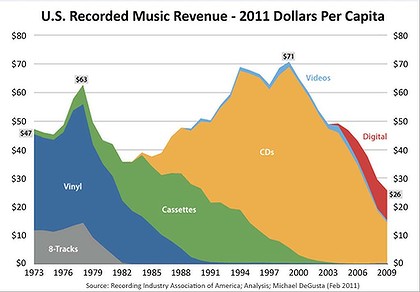
The decline of CD revenue has not been filled by the increasing digital revenue

By the RIAA’s own graphs, revenue has decreased, on a per capital basis, to a point lower than any time in the last 40 years, and I don’t actually doubt this figure. It’s based on a per capita basis, and since population has grown, it doesn’t actually mean that music industry revenue is lower than ever. And because it tallies results only based on sales of recordings, it does not take into account live music revenue, which from what I gather, is up. But looking at the graph, sales weren’t exactly hot just before CDs came out, and sales are only bad in comparison now because of the high peak that CDs sales managed in the early 2000’s. CD’s decline does coincide with the growth of the Internet in the last decade, but interestingly, it also coincides with the rise of DVDs. Is there no correlation between people spending more on DVDs and the same people spending less on music? I think most people have finite budgets, so it’s not inconceivable that this limited budget is being spent on other forms of entertainment, like video games (an industry also on the rise for most of the last decade), or not even on entertainment at all due to rising living costs and the poor global economic condition. But instead, all we hear are the billions and billions being “lost” by the music industry due to piracy. Once upon a time, companies realised that peaks and troughs exists in business, and innovation is what helps rejuvenate the cycle. Now, there’s this obsession with revenue, as if revenue has to rise every year, and by a significant percentage, as otherwise, the company or the industry is suddenly “in trouble”. The work force is downsized and/or moved offshore, books are being cooked, all just to avoid the share price decline, a decline (or rise) is largely determined by speculation these days, as opposed to it being an accurate reflection of company value and revenue expectations. And then, of course, they blame the Internet for it all.

Newzbin 2 Logo

Newzbin2 now uses Tor to allow its website to be accessed without a domain name

And so the powers that be, trying to please their corporate buddies, will try more and more things, even if it means screwing up the entire Internet. The US government has hinted at implementing domain name blocking, at the behest of the RIAA and MPAA of course, a move that experts, including those that invented the Internet (working under Al Gore’s leadership), have warned will damage the Internet irrevocably. And you know what, it still won’t stop people who want to download pirated stuff. In response to the imminent threat of domain blocking, Usenet website Newzbin2 is now using Tor to allow its website to be accessed even without a domain name. So even before domain blocking has been launched, it has already been circumvented. Decentralized, encrypted, piracy would be almost impossible to monitor, let alone stop, and that’s the direction we’re headed towards. And when we get there, egged on by an obsessed industry that’s too arrogant to change their business model, what will we do then? When people know for a fact they will never get caught pirating songs or movies, how will the RIAA and MPAA stop them then?

And there’s always the slim hope that the industry might embrace the Internet, and allow innovation to blossom and create new revenue streams. Or they might just sue Amazon for daring to allow people to store their legally purchased MP3s in the cloud. Instead of working with Amazon to create a new distribution method, one which gives consumers more freedom, and also perhaps allows for a new way to make money in the Internet age, the RIAA labels simply voiced their arrogant displeasure at Amazon daring to make things easier for users without gaining their kingly approval first. They argue that Amazon, by allowing people to stream their music from their cloud accounts to their Android devices, that this somehow breaks licensing agreements. But Amazon argues that this is no different than playing your MP3s from an external drive, the only difference being that this external drive is accessible from anyone where there’s an Internet connection. But the fact of the matter is that if people legally purchased their songs, then streaming them to their Android device does not harm the record industry in any fashion, since there’s a million ways to get songs to an Android device. Now, if people are storing pirated songs on their Amazon cloud drive, then the people that do that have broken the law, and I don’t see how Amazon is in any way responsible (because if companies handling data transmission can be found liable, then every Internet and networking based company in the world would be liable for all sorts of piracy, because raw data simply goes through everything. But of course, suing Amazon is easier than suing individuals, just like Viacom suing YouTube is easier than suing the actual users that upload pirated content, so that’s where we’re headed, where another piece of innovation may be stopped in its track (or severely limited) because one industry does not want to change and adapt to the times.

Meanwhile, in Righthaven-land, another week, and another lawsuit, although this one didn’t last for very long. Righthaven this week sued tech website Ars Technica (or at least a writer for them). What for? For using a photo that Righthaven sued Drudge report for. Except this photo wasn’t the original photo. It was black and white for a start. And it also came from Righthaven’t own legal documents, that they’ve submitted to court. Not to mention that fair use would have covered Ars Technica’s use of the photo anyway. And also the fact that Righthaven sued the writer of the article, and not Ars Techinca. Even Righthaven realised that something was not right and pulled the lawsuit only a day later, but it brings up the question, if they can make a mistake like this with a high profile target like Ars Technica, how many other mistakes have they made in their filings? And when you can “accidentally” sue someone, perhaps it shows that these lawsuits are not really worth the paper they’re being filed on.

This week’s anti-DRM message is brought to you by Christofer Sundberg, and Avalance Studios, makers of the Just Cause franchise. And the message is, DRM is stupid and useless. And it is a message that I think is hard to argue against, simply because I’m a pragmatist, and DRM simply does not work at stopping piracy. It works well in annoying legitimate buyers though. And controversially, Sundberg says that making better games will mean more people will buy those games. Having to make a better product to keep your customers? How does that even work, and more importantly, why do you need to do it when you can simply lobby the government to destroy competition and innovation.

High Definition

Not much happening in 3D/HD this week, but I’m contractually obligated to write something for this section at least once every fortnight, and so I will write something this week.

While doing the weekly Blu-ray/DVD sales analysis, I’ve noticed that so far for 2011, there has only been one week in which Blu-ray and DVD revenue, combined, have produced an overall gain compared to the same time last year. In other words, almost every week of 2011 has been worse, usually to the tunes of at least $20-30 million, compared to the same week a year ago. That’s an alarming decline, and while some of it is down to digital distribution (which is not included in these figures), still, the decline seems too rapid to be just due to downloads.

Piracy? Perhaps that’s a cause, but piracy has always been a problem, not just in the last year. Only one of the weeks did Blu-ray revenue actually drop compared to last year, so the decline is definitely all DVD related (which makes sense, since digital distribution should affect DVD the most, considering most downloads and streams are still SD or relatively low quality HD, that does not compete directly with the quality offered by Blu-ray). I think the economy has a lot to do with it, and also the quality of the releases.

And a warning to those, like me, that buys movies and don’t test them out until you decide to view them, which could be weeks, months or even years after the purchase, you might want to think twice. I purchased the Godfather Blu-ray trilogy pack way back in 2008, and for whatever reason, I never got around to watching it until now. It turns out the second movie’s disc is faulty, a known production glitch, and it only took me two and a half years to discover the problem. Apparently, Paramount may still have a recall program for this disc, so I’ll try my luck and hope that they won’t require explanation as to why I waited so long to watch, what are, some of my favourite movies.

Gaming

And finally in gaming, lucky Xbox 360 gamers in the US can sign up for a new beta-test with the reward of a free copy of Halo Reach. The testing is apparently for a new disc format that promises to allow the dual-layer game DVD, which is now limited to 6.8GB, to hold a GB more, as well as new anti-piracy measures.

Yet another Xbox 360 Blu-ray rumour surfaces ...

And of course, the old time tested “Blu-ray coming to Xbox 360” rumour came out again. I’ve tried to explain why I think this rumour keeps on getting repeated, having blamed it on PS3 and Blu-ray fanboys who think that Microsoft supporting Blu-ray is the ultimate trophy in the Blu-ray vs HD DVD war, and an admission that Sony was right in delaying the PS3 for a year while they waited to put the Blu-ray drive in. Anyway, it looks like if a Microsoft console is to have Blu-ray, it will have to be the Xbox 720 or whatever it will be called, and if I were a betting man, I would definitely put money on Blu-ray being used for the next-gen Microsoft console.

Speaking of fanboy wars, the news this week was that global PS3 sales finally overtook Xbox 360 sales, which has PS3 fanboys so so excited. “We we we so excited”, so they will all say. Xbox 360 sales are largely non existent in Japan, I think it was outsold by the Sega Genesis last week, and they haven’t been doing too well in Europe either, although the “slim” and Kinect has helped the Xbox 360 do well in 2010 in the UK at least. But in the US, the Xbox 360 continues to dominate.

Anyway, I think that’s all there is this week. Yes, I conveniently ignored one news story I wrote which, if it isn’t clear to you by now, was a very much failed attempt at an April Fools joke. I hate doing these kinds of stories, either you’re too subtle and nobody even notices that it’s fake news, or you’ll have to make it so obvious that you might as well just put “April Fools Joke” in the headline. And even when it’s a good one, when people think it’s true, you have to beg and cry on the phone to the MPAA’s lawyers and explain just why you don’t think you’ve libelled them when you posted that they were forming a partnership with Al Qaeda.

I hate April Fools.

Weekly News Roundup (27 March 2011)

Sunday, March 27th, 2011

Another week, another WNR. A pretty quiet week I think, one where I wasn’t paying much attention anyway, so it was good that it was a pretty quiet week and I didn’t miss any big stories because I was too busy wasting time. Anyway …

Copyright… let’s start with copyright news. One news that did escape my attention from last week was the White House’s attempt to make unauthorized video streaming a felony. Actually, I did see the news, and dismissed it as typical posturing. And it was just a white paper anyway, and you can buy tons of white paper at Staples for less than the price of a sandwich.

TorrentFreak

TorrentFreak is under fire of music industry expert Moses Avalon, who says the website could be shut down under new US laws

That is until this week, when I stumbled upon an online spat between music industry expert Moses Avalon and BitTorrent/anti-piracy news website, TorrentFreak. You’ll have to read my news article, as well as Avalon’s blog and TorrentFreak’s response, to get the full picture, but to sum up, Avalon surmised, from the White House white paper, that pretty soon, P2P usage would be made a felony as well. From what I’ve read, and to be honest, I only skimmed as I usually do when I come across an opinion I don’t agree with, it seems Avalon is saying that P2P, the technology itself, would be illegal if the White House’s IP Czar had her way. I believe the only connection between the white paper, and P2P use in general, is that because P2P has an upload component, it *could* make BitTorrent transfers somewhat akin to streaming. However, and I think it’s fairly clear, that there is a huge difference between illegal use of a technology, and making that technology illegal. I don’t for one second think that technology like BitTorrent will be made illegal, because it would also make perfectly legal services, like Skype, Spotify, or even applications used by the US military today, illegal. BitTorrent is perfectly legal, under any law. What some people use it for though …

And as for why Avalon thinks TorrentFreak should be put on the banned website list, I have no idea. TF is a news and information website, much like what Digital Digest is pretending to be, and sure, it has a bias, but I think one would be hard pressed to find one website (especially a niche one) that doesn’t have a bit of a bias, including Avalon’s own website. Avalon refers to “P2P lifestyle”, for which he thinks TF promotes, and that this is the area in which the new proposed laws could see TF get banned, as TF “encourages” unsuspecting youth to lead a life of crime by downloading the latest Bieber hit. “P2P lifestyle” reminds me of the term “gangsta lifestyle”. There seems to be a lot of music these days that might be what one might believe to be promoting the “gangsta lifestyle”, something Avalon should surely know about working around the music industry (Nate Dogg R.I.P – Regulate In Peace!). Is Avalon saying that the government should ban music that could be seen as corrupting today’s youth (and yesterday’s youth too, considering gangsta rap’s long history)? If song lyrics which call for the assassination of police officers or the physical assault or even murder of other people are not illegal, then I’m pretty sure TF should be safe.

Pile of money

The first of many instalments that LimeWire has to pay to record labels, if they had their way in terms of damages payable

LimeWire’s troubles in the courts continues, as the music labels suing the defunct music file sharing network wants a potential $75 trillion dollars in damages, more money than the global music industry has ever made since recorded history began, and greater than the entire world’s combined GDP for a year. The judge presiding over the case has called it “absurd”, although to be fair to the record companies, they didn’t really ask for $75 trillion. It was just that the calculations they used to determine the billions in damages that do actually want is so flawed that, multiplying the amount they want per download, rather than per unique work, it does work out to be in the trillions, or at least several hundred billion. This again brings up the question of just how much money the industry is actually losing to piracy. I will cover this in more detail in a news article next week (I’m like that squirrel in that well known fable – I’m saving stuff for the “news winter”,  by saving some real news for next week when there might not be any real news), but it appears that since LimeWire’s shutdown, music piracy has decreased dramatically (and yes, I’m taking a huge personal risk by linking to notorious “P2P lifestyle” website, TorrentFreak – I’m calling my lawyer as I type), as expected. In fact, nearly half of Americans that pirated music have stopped doing so in the last quarter of 2010, largely thanks to the shut down of LimeWire (according to respected research group, NPD). So surely, this should lead to increased revenues, what with 12 million less music pirates in the US now? All we need now is the figure for increased revenue, divide that by the 12 million who stopped downloading, and then we can work out the real cost of piracy, per person. Of course, if revenue actually went down in the last quarter of 2010, then that could be a bit of a problem for the RIAA PR machine.

So if there was no significant revenue increase, or heaven forbid, that there was an actual decrease in revenue, then what does it mean? Another music industry and piracy expert, from the University of Queensland Australia, thinks that the solution to the piracy problem is for the music industry to compete with piracy. Reducing price and making content more available, and as easy to access as pirated downloads, say professor Stuart Cunningham, is the key. I’m not a university professor, as I barely have a bachelor’s degree, but I think this is what I’ve been saying for some time now and it’s good to hear someone who has read books and stuff to agree with me. To be honest, the piracy problem is so bad these days (I’m in total agreement with the entertainment industry on this point), that anything, *anything*, is worth a try. Even if it means having to let go of a century old business model. Cunningham also criticized the industry’s tendencies to over-exaggerate the financial toll of piracy (and this was before the “LimeWire $75 trillion” news story came out) – it’s good politics, but it doesn’t really solve any problems, and sometimes I think the industry doesn’t really want to solve the piracy problem, it only wants to be subsidized (via tax payer handouts and whatnot) for it. Or get some judge to give them $75 trillion.

In other unreported news (unreported on Digital Digest, that is), the Australian arm of the MPAA, the AFACT, is going all the way to the highest court in Australia (there I go, linking to TF again … I’ve just become a repeat offender!) to appeal two decisions so far that have seen it on the losing side of the legal battle with Australian ISP, iiNet, over the issue ISP issued infringement warnings.

Not much happening in the world of 3D, HD and Blu-ray. Is it me or is the 3D hype dying? The only news of note was one where Samsung I think producing an external 3D Blu-ray drive for the PC. Except that all Blu-ray drives are capable of playing 3D Blu-ray movies, and so really, the “3D Blu-ray” marketing here may be just in the software included, which is not even made by Samsung (it’s Cyberlink’s). The only hardware change I can figure may be the connection interface, maybe USB 3.0 instead of 2.0, but 2.0 should be more than enough for 3D Blu-ray’s requirement of 60 Mbps, considering 2.0 is rated for up to 480 Mbps (although real world performance is only a fraction of this, but 200 Mbps is still easily achievable). Any drive rated 2x or above for Blu-ray read speed should suffice for 3D Blu-ray. I guess the 3D hype isn’t dying yet when companies are still using it to promote products that aren’t really any different to its non 3D predecessor, at least in hardware.

Gaming

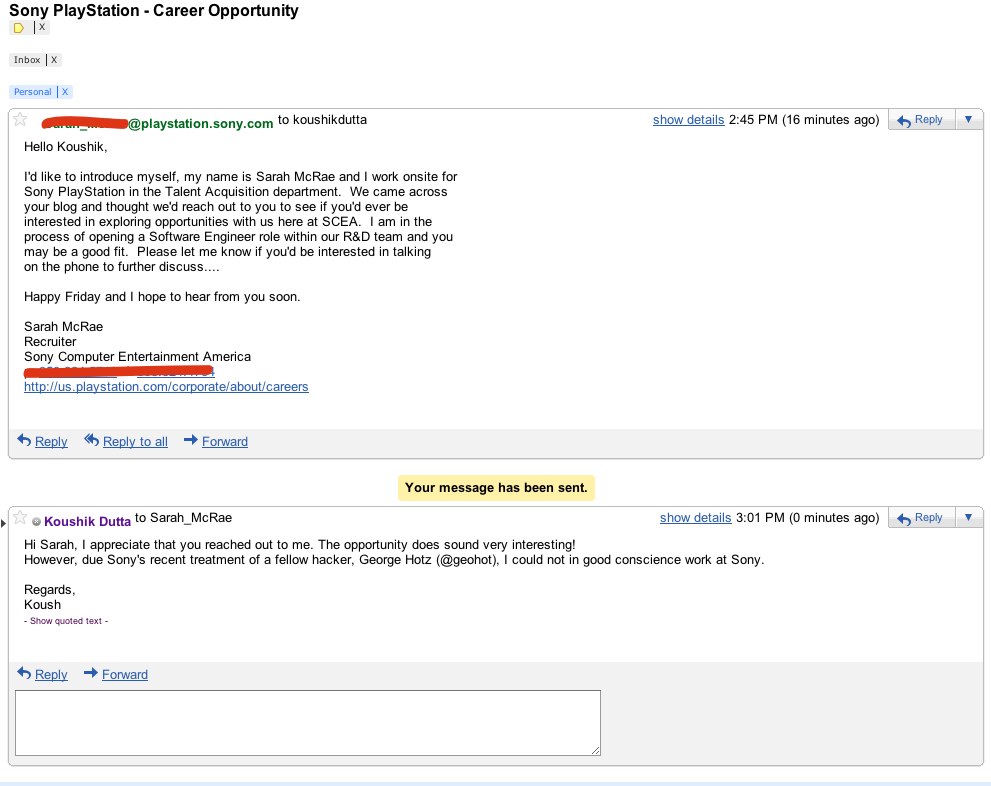
And finally, in gaming news, more PS3 jailbreak news this week as well known Android hacker Koushik Dutta turns down a Sony job offer to protest the company’s ill treatment of fellow hacker, George Hotz.

Sony’s R&D recruiter emailed Dutta with a Software Engineering job offer, but Dutta politely declined saying that he “could not in good conscience work at Sony”. It’s good to see someone with principles.

Dutta Sony job offer

Android hacker Koushik Dutta says no to Sony's job offer, to protest geohot's treatment

Sony, on the other hand, were busy trying to discredit geohot for taking a long planned vacation this week by accusing the hacker of trying to delay proceedings. Hotz is actually in South America, which sounds iffy, but he has clarified that the trip was long planned, and paid for using his own money, not that which has been donated to his fighting fund. He also assured Sony that he’s in contact with his lawyers.

One hack that may or may not make Sony mad is one demonstrated by Kinect hacker Shantanu Goel, when he demo’d running Kinect on the PS3, and using Microsoft’s controller-less motion gaming system to play Killzone 3. It’s all pre-alpha stuff, so things don’t work as well as expected, but it’s still interesting to see in action (YouTube video of the hack in action here). Why did I say it would make Sony mad? Well, what doesn’t, these days.

Best of all, the hack is open source, so anyone with Kinect and a PS3 can try it out for themselves.

Alright, that’s enough writing for this week. Have a good one!

Weekly News Roundup (20 March 2011)

Sunday, March 20th, 2011

Last week was my birthday, but despite the auspicious occasion, I had to work, and not even on Digital Digest related stuff. I’ve always thought that people should get a week off for their birthdays, or at least a day off. I mean, it only happens once a year anyway, and we celebrate some President’s birthday, one that we didn’t even elect, and here in Australia, the Queen’s birthday, even though the day isn’t actually her birthday at all. Anyway, on a scale of 1 to 10 in terms of the amount of stuff to go through, this week is a solid 7, so let’s get started!

CopyrightStarting with copyright news, last week, I reported on The Observer editorial regarding movie piracy being very much a problem of of the movie studios’ creation. This week comes a report that the problem is very much to do with pricing, and not legal enforcement.

Pirated Movies For Sale

Pirated movies are sometimes the only real alternative to movie consumption in developing nations, thanks to unrealistic pricing of the legal kind

The report mostly looked at piracy in developing nations, where pricing for movies, music or software is usually many times what it costs someone living in a developed nation, relatively speaking. When buying a movie means you have to fork out a day’s wage, then no wonder piracy is a hit. It becomes the only realistic alternative. The reason for this has to do with the usually lower level of competiti0n in these countries, where there aren’t a Wal-Mart or Amazon or an iTunes everywhere you look. But the main reason is artificial. Movie studios and music labels simply do not want to sell content cheaper in these regions, because they feel that once that step is taken, it will lead to the eventual decline in pricing in the developed regions, where most of their revenue comes from. Region control for DVDs and Blu-ray’s was the movie studios’ way to combat this phenomenon, to allow developing nations to access cheaper content, but to limit the damage cheaper content does to other regions. But this is all based on a theory that content owners, particularly in the digital age, still need the same pricing structures deployed for analogue and physical goods. And while the report looked at developing regions, the same also applies to developed regions, because not every can afford what is being asked of them, and so some of them resort to piracy.

I think this is one area that needs closer examination. The advantage of digital content is that it can be replicated perfectly with ease (compare copying a MP3 file, to say copying a tape recording, especially if you want perfect replication), with very little cost, if any. And for pure digital content, without physical media, there are also other cost savings. And yet, we are still expected to pay as much, if not more, for media-less digital content compared to the physical media version (compare TV episode prices on iTunes, add it up for a whole season, and then compare to the cost the superior DVD or Blu-ray versions, for example). I don’t know what the answer is, but I think it has to involve more people buying content for a lower price, as opposed to getting fewer people to pay higher prices.

At least Paramount seems to be wanting to try something new, as they’ve detailed plans to release the independently produced film, The Tunnel, free via BitTorrent. It’s certainly a “if you can’t beat them, join them” strategy, although this isn’t the first time the film’s producers has tried innovative ways to promote and raise funds for the movie (having previously “sold” frames for the movie, 135,000 of them, for $1 each). Paramount isn’t just giving it all away though, they still have a DVD version of the movie being released at the same time, with hours of bonus content, an alternative ending. I think they’re hoping that the hype created by the BitTorrent release will help to raise awareness of the DVD and promote sales, and I hope they succeed. I don’t think the movie is available to buy on Amazon yet, but when it does, I urge everyone to buy a copy if not to just support a movie studio trying something different, and not associating BitTorrent with piracy. I still don’t think this is the best way to make money off movies in the Internet age, because there’s no money being made by giving it away on BitTorrent, and if the DVD is still regularly priced, then it still doesn’t solve the problem of some people not being able to afford it.

Everyone’s second favourite sue-for-profit law firm (the most popular firm being USCG), Righthaven, is in the news again. But it’s bad news for the outfit trying to make a quick buck by suing those that copy, even if it’s just a small extract, of newspaper articles. They’ve had yet another case being potentially dismissed on fair use grounds. The judge in the case found that suing non-profits for profit, is a no go, especially if the claim is that somehow the non-profit profits from the alleged copyright infringement. Righthaven had another case thrown out also for fair use last year, when they tried to make the case that even partial copying, with attribution to the original publisher, was worthy of a lawsuit (or a couple of thousand dollars in settlement fees). One issue the judge found disturbing was the lack of warning Righthaven (or the copyright owner) gave to the alleged infringer. I thought that the DMCA was created to prevent just this sort of thing, where a cease-and-desist system is created to prevent copyright lawsuits from clogging up the legal system, a scenario very likely due to the Internet and how easy it becomes to create copies of other’s works. Righthaven and others “copyright trolls” bypassing the DMCA, should surely be grounds enough for dismissal. And I never though I would actually defend the use of the DMCA, and for that, it makes me hate Righthaven even more.

Assassin's Creed Brotherhood

The Digital Deluxe edition of Assassin's Creed Brotherhood may contain pirated songs

And everyone’s favourite copyright hypocrite, Ubisoft, has done it again, this time releasing a pirated version of their own product. As you may know, they previously used a NO-CD crack by hacking group Reloaded for the digital version of Rainbow Six Vegas 2, because I guess it was easier to steal other people’s work than to create your own. And now, the Digital Deluxe version of their new game, Assassin’s Creed Brotherhood, contains the soundtrack from the game that was downloaded from private BitTorrent tracker Demonoid. This was apparently discovered because Ubisoft, or perhaps whoever packaged the Digital Deluxe release, did not change the ID3 tags from the pirated soundtrack, and so the username of a popular contributor to Demonoid showed up for the “official” release in the song’s tags. There’s actually no concrete confirmation of this, whether it was Ubisoft or one of the distributors that did this, or even if the songs were derived from the pirated version at all, but I wouldn’t be surprised if all of this were true. Ubisoft have said that they’ve launched an internal investigation into the matter. The most annoying thing was that, if the included tracks were sourced via piracy, they are actually an inferior version of the pirated soundtrack, re-encoded with a lower quality.

High Definition

In HD and 3D news, Blu-ray has just had its best ever week in terms of market share, breaking the 23% barrier for the first time. It was all thanks to the release of Disney’s classic, Bambi.

The results are slightly misleading because the release was actually a Blu-ray+DVD combo (the DVD only release will be available in April), and that combos like this are only counted as Blu-ray sales, even though with timed exclusives, it means DVD 0wners may have to buy the Blu-ray version as well. Some will say that there aren’t many that are buying the Blu-ray+DVD version just so they can watch the movie on DVD, but I beg to differ. Disney actually produces the same combo set in both Blu-ray and DVD packaging, and they produce the DVD packaging because they want DVD buyers to buy this version (so to these buyers, they are buying the DVD version with the Blu-ray thrown in as an extra, as opposed to the other way around). In fact, in Australia, I’ve bought combos that are packaged in a DVD sized slipcase, but the actual plastic case being the standard Blu-ray size – I can only guess that publishers are doing this because they don’t want DVD owners to be afraid to buy the smaller, different package.

Lord of the Rings Extended Trilogy Blu-ray

The extended LotR movies are finally on Blu-ray, but is this really the most definitive edition?

The other big news of the week was that the announcement of the Blu-ray version of The Lord of the Rings extended trilogy. Still no firm release date, but despite the pack possibly not being available until 2012, it’s already shot to the top of the sales charts on Amazon. The early details, unfortunately, don’t look great. The movies are still split on two discs each, which if the encodings takes full advantage of the space available, then it’s not such a bad news (although with a 50GB disc, even the longest of the movies can still have an average bitrate of around 25 Mbps – although if they can increase the average audio+video bitrate closer to the Blu-ray maximum, for that extra bit of quality, then I’m all for splitting up the movies on two discs). And despite using two discs, the theatrical versions of the movies does not seem to be included, which is a shame given seamless branching will make this quite an easy thing to do. But the most annoying news is that the extra features still come on DVDs, just like in the theatrical box set. This suggests very little, if any, new Blu-ray exclusive features. It all seems like a fairly lazy release, especially frustrating that it has taken so long to produce the set (which probably has more to do with Warner Bros. trying to milk money out of the theatrical releases, as opposed to the time and effort needed to produce the new extended set). Hopefully I’m wrong and that new details will emerge listing the new Blu-ray exclusive content.

Before I move on to the gaming news, and this news is sort of related, the terrible earthquake crisis in Japan seems likely to affect Blu-ray disc production, not that this is really that important in the grand scheme of things really. I’m sure the Japanese would rather people spend the money they would have otherwise spent on Blu-ray discs towards to relief effort anyway.

Gaming

And in gaming news, and continuing from the story above, 3DS production seems to be okay, and the US launch should not need to be delayed. 3Ds consoles are produced in China anyway, so production should not have been affected, although Nintendo being a Japanese company, there will still be other types of disruptions.

And a clarification on last week’s story in regards to the PS3 HDD issue – the issue seems only present when one attempts to upgrade the HDD after installing the very first buggy version of the 3.56 firmware. Subsequent versions of the firmware, including 3.56v2 and 3.60, fixed the bug so that people who upgraded their HDDs after installing 3.56v2 and 3.60 did not encounter the same problem. People who had installed the first buggy 3.56 firmware, then upgraded their HDDs, are stuck unless they have the original unmodified PS3 HDD, which they need to put back into the console, install 3.56v2 or 3.60, and then attempt to upgrade their HDD again (which will now work). In any case, it’s obviously Sony’s fault for all of this because the way they silently released 3.56v2 (a “ninja” release, as some have called it), seems to me like an admission of “oops, we f**ked up” if there ever was one. And I’m sure it would be possible for Sony to do something in software to allow people still suffering to fix their PS3s, such as being allowed to roll back to an earlier firmware, or to force the install of 3.60 through. But I suspect they don’t want to do it because it will interfere with their anti-piracy efforts, which was the whole point behind the recent series of firmware updates. Hackers have already said that 3.60 appears to be secure once more, and I doubt Sony wants to reverse the improvement. At the very least, Sony should offer to repair this problem free of charge, even if just for the PR value.

And good PR they need, because according to analyst Michael Pachter, Kinect is outselling Sony’s PlayStation Move by a five to one margin. It’s largely based on the number of Kinect/Move console bundles that have been sold, so it’s not the best way to gauge actual uptake, but this is always difficult because a single PS3 owner can buy 4 Move controllers and this counts as 4 sales, whereas an Xbox 360 owner only ever needs to buy on Kinect accessory (so in fact, it should be natural for Move to outsell Kinect, even if they have the same uptake rate), and so counting bundles may not be such a bad way to do it.

Alright, that’s it for this week. Have a good one.

Weekly News Roundup (13 March 2011)

Sunday, March 13th, 2011

Welcome to another edition of the WNR. For those that are new to this, this is where I usually write my introduction, or in the rare cases, I get to mention the one piece of work that I actually managed to do the whole week. This is one of those rare cases. The work in question is the monthly NPD US video game sales analysis for February 2011, which I posted yesterday. No big surprises, and the five week reporting period for this February made the figures look better than what it was a year ago, when it was only a four week reporting period, but once again, the Xbox 360 was the real winner with year-on-year growth even when you take into account the reporting differences. Kinect is a big part of why the Xbox 360 is doing well, but you do wonder how long people are willing to wait for some new games, because people I think are already bored with the launch titles.

Also, just a reminder that the draw for the Digital Digest Facebook/Twitter competition took place this week, and you can see if you’ve won here. I’ve tried contacting the winners via Facebook/Twitter, but not everyone has gotten back to me, so hopefully you’ll read this message and collect your $20 Amazon gift card.

Lots to go through, so let’s get started.

CopyrightIn copyright news, LimeWire is in the news again, this time for settling one of the two lawsuits it is facing. No details have emerged regarding the settlement agreement, other than both sides will pay for their own legal costs.

But the way music copyright works, LimeWire is still facing about a billion dollar worth of damages from the other lawsuit. With music copyright, copyright is split between copyright owners of the song in question, and the publisher, which owns particular recordings of songs. The settlement this week is with the publishers, but some of the very same companies as part of the settlement are still suing LimeWire as copyright owners. LimeWire is still fighting that other lawsuit though, and they’ve even gone as far as subpoenaing mega-corps such as Apple and Google to see how distribution deals are normally set up. And the conclusion they’ve drawn from the internal emails they’ve looked at is that piracy possibly even helps sales, and that the closure of LimeWire actually had a huge negative effect on legal music sales. And this will all have an effect on the possible amount of damages that LimeWire needs to pay.

Sony's Michael Lynton

Sony Pictures CEO Michael Lynton once said that he's the type of guy that "doesn't see anything good having come from the internet. Period."

Other than this piece of news, it was actually pretty quiet on the copyright front this week. Just before I started writing this edition of the WNR, I came across this editorial in The Observer, on the websites of the British newspaper. The premise of the article is very simple – that movie studios have only themselves to blame for not embracing the Internet, and allowing online piracy to fill the gap left between the traditional, outdated business model, and the consumer’s demand for something new. The entertainment industry spent the last decade basically trying to use the courts and lobby governments to intervene on their behalf, instead of actually working with the technology. And when they did work with technology, it was to invent DRM whose only function was to annoy legitimate consumers, and actually create a legitimate excuse, at least for some, to obtain content illegally. When people can obtain the same or higher quality content for free, and more easily than legal purchases, this creates the illusion that what they’re doing is perfectly justified, even when they know that it’s illegal. What the industry needs to do is to not give people any excuses, at least not good ones, to not buy legal content. And this starts with making content easier to access, to grant users access to more content, faster, and all at a price point that is reasonable. The Observer article hints at the fact that it may already be too late to act, that a whole generation has grown up disrespecting any type of legal purchase, making fun of those that do the right thing. However, I’m more optimistic, because the success of iTunes and Apps suggest that, people in this new under-25 generation do still spend money, even if their expectations are very much raised in terms of value and ease of use. It’s now up to the industry to rise up and meet those expectations, or the doomed scenario that The Observer article predicts, one where a perfect storm of “excessive budgets, dwindling finance and diminishing returns” will catch up to the industry.

iTunes

You still can't re-download your past purchases on iTunes, thanks to the music industry's imposed limitations

If you want an example of the industry not embracing the Internet, then Apple’s iTunes is a good example. While the music industry was pre-occupied on cramming as much DRM into music as possible, even putting root-kits on CDs, Apple was quietly building a new business model to suit the Internet age. Sure, Apple also did experiment with DRM, with no success as predicted, but they also made sure that even if you had to deal with Apple’s draconian DRM scheme, you would at least get something back, which would be cheaper music (cheaper than buying a whole album just for a song anyway), ease of use, and hardware devices that made it all work. And Apple, a computer company, now profits from a music, where the music industry could have perfectly easily retained this revenue for themselves, if they just had the foresight to embrace the Internet, instead of fearing it. And this week, another example of the industry’s fear was on show, as news broke of Apple trying to re-negotiate re-download rights for iTunes music with the major labels. That’s right, once you buy a song on iTunes, you cannot re-download the song without paying for it again. This is not Apple’s doing, this is a roadblock put up by the industry, who greedily wants to be paid on a per download basis, as opposed to a per purchase basis. While this is a simple inconvenience to iTunes users, it just goes to show the mentality of the industry who sees the Internet as the worst thing ever (as one Sony executive put it), trying to make it harder for Apple to sell music *legally*.

I can sort of see why the entertainment industry is reluctant to offer re-download rights, and to also put out reasonable prices. They way they see it, if someone is spending $50 on 30 music tracks at $1 each and one DVD movie at $20 every month, then by lowering the price of tracks to 10 cents, and movies to $5, then they will see their income drop from $50 to $8. But the way I see it, if you do truly build a great and easy to use system, people will still spend $50, they’ll just buy more things. In fact, I can see people even spending more than $50, if every buying decision becomes a non-decision and the perceived greater value in their purchases will probably mean more purchases over time. And there will also be more people paying for content than before, because nobody but the really hardcore downloaders will find it necessary to go through the trouble of pirating a 10 cent track. Then there’s the indirect result of “teaching” a generation about copyright, not by trying to punish those that don’t do the right thing, but by creating reasons for them to do the right thing.

High Definition

In HD and 3D news, nothing much again this week. The only thing remotely related to HD was the news that you will soon be able to rent movies on Facebook, using Facebook credits.

I guess after my rant above about the entertainment industry not embracing the Internet, this is one example of the opposite. I still don’t know if this will be a success, but at least they’re trying. The problem is that it costs 30 Facebook credits, or around $3, to rent a movie that you can only really watch online, via a Flash based movie player not too dissimilar to YouTube. That sounds a bit steep for $3 to me. And the same argument I made above rings true here as well, as instead of trying to sell/rent a few overpriced movies to a small minority of Facebook users, wouldn’t it be better to sell/rent a lot of reasonably priced movies to more Facebook users – the long tail approach, where the money is made on a huge number of small transactions, as opposed to a few large ones.

Gaming

And in gaming news, some better news for Sony this week as their European PS3 import ban has been lifted, and LG, which initiated the ban in court, might even be fined for perhaps taking things a bit too far.

It’s all just as I suspected, a petty patent dispute (one which, to be fair, was started by Sony), with no real consequences once both sides settle down and settle the matter, in or outside of court. But even Sony admit this one could have been costly, since supply was definitely starting to get constrained had the ban not been lifted in time.

And a new firmware is available for the PS3 as well, with 3.60 released this week to give PlayStation Plus subscribers access to 150MB of online storage to store their save games in the cloud. The firmware also addressed security issues, as I suspect every firmware release from this point will, and hackers have reported that it is somewhat effective, for now at least.

PS3 HDD Upgrade

Sony encourages people to upgrade their PS3's HDDs, but refuses to fix the firmware bug that renders some PS3s with upgraded HDDs useless

While the update is good for PlayStation Plus subscribers, it’s not so good for those that had their consoles bricked due to the botched 3.56 firmware. What happened was that 3.56’s security fix to fight hackers, fought against those that had legally upgraded their PS3’s HDDs (something Sony encourages people to do, even providing instructions in the manual on how to do it). The update rendered the system unusable, and even the later 3.56 Hotfix didn’t fix the problem, although it did allow those that still had the original unmodified HDD to get the system up and running again (and once that happened, users could then upgrade their HDD again without problems – in other words, users needed install the 3.56 Hotfix by using their original unmodified PS3 HDD, and then afterwards upgrade their HDD). Everybody thought that 3.60 would then fix this major bug, and allow borked systems to work again, but unfortunately, this was not the case. Apart from paying for an expensive repair by Sony tech support, there’s no other way to restore functionality, but some have had success begging Sony to fix their PS3s for free, if they were only out of the warranty period by a few months. I urge people to talk to their local consumer rights group, to inform themselves of their statutory warranty rights, and demand Sony repair their PS3s for free, for a problem that Sony and Sony alone were responsible for in the first place.

Microsoft, on the other hand, are basking in the rays of good news, with Kinect officially entering the Guinness Book of Records as the “fastest-selling consumer electronics device”, with 8 million units sold/shipped in the first 60 days according to Guinness’ own independent research. So far, 10 million units have been shipped to retailers as of the end of February, that’s almost one for every five Xbox 360’s. Still, as I mentioned earlier, Kinect will succeed or fail based on the software offerings, and so far, what’s on offer has been pretty average.

And so that’s another WNR done and dusted. Before I go, I would just like to say that my condolences goes out to the people of Japan. Google has set up a page with resources on the crisis in Japan, for those seeking information or ways to help.