Archive for the ‘Gaming’ Category

Game Consoles – April 2009 NPD Sales Figure Analysis

Monday, May 18th, 2009

The April 2009 NPD figures are out, and on the surface, it makes bad reading for the gaming industry. Sales of both hardware and software are down, and even more so compared to the same time last year. Is the gaming industry in trouble, or are the figures not really as bad as they seem? Read on the find out. The figures are from NPD, a marketing research firm that releases games console sale data every month.

The figures for US sales in April 2009 are below, ranked in order of number of sales (April 2008 figures also shown, including percentage change):
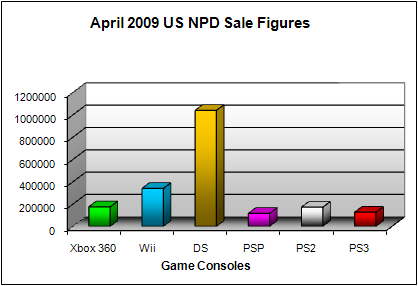
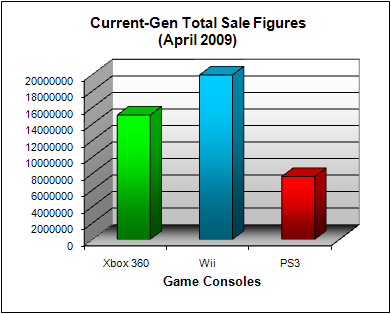
  • DS: 1,040,000 (Total: 30.7 million; April 2008: 414,800 – up 151%)
  • Wii: 340,000 (Total: 19.9 million; April 2008: 714,200 – down 38%)
  • Xbox 360: 175,000 (Total: 15.1 million; April 2008: 188,000 – down 7%)
  • PS2: 172,000 (Total: 44 million; April 2008: 124,400 – up 38%)
  • PS3: 127,000 (Total: 7.6 million; April 2008: 187,100 – down 32%)
  • PSP: 116,000 (Total: 15.1 million; April 2008: 192,700 – down 40%)
  • NPD April 2009 Game Console US Sales Figures
    NPD April 2009 Game Console US Sales Figures

    NPD Game Console Total US Sales Figures (as of April 2009)

    NPD Game Console Total US Sales Figures (as of April 2009)

    My prediction from last month was:

    I have no idea what’s on sale next month. I could check, but I’m lazy. Suffice to say, I don’t expect the situation to change much, although hardware sales could improve. Can the PS3 outsell it’s 2008 self? I’m going to say yes again to that, even though I was wrong last month. This is because April 2008 was a bad month for the PS3, the first signs that it wasn’t going to beat the 360 in 2008 like the first few months had promised. Sony will hope April 2009 will be a better month.

    I was right. I was lazy and I should have checked. No, the PS3 once again did not out-sell its 2008 self. It didn’t even manage to outsell the PS2 this month. And the situation has changed, because everything is down, apart from the DS and the PS2.

    Starting with what little good news we have this month. The DS did manage to outsell its 2008 self, but only because a new DS, the DSi, was released. But still, a 150% increase is impressive regardless of the reason behind it. The PS2 is the only other console to have increased in sales compared to the April 2008 figures. This I think is largely down to the recent price drop announced by Sony. If a small price drop for such an old console can show this kind of result, imagine what a price drop can do for a PS3? The rumours of a new PS3 “slim” with a lower price due to a cheaper manufacturing process may explain why Sony is reluctant to drop PS3 prices for now, and reports show that the PS3 is currently losing around $40 per console sold, and Sony can’t afford to increase its losses this financial year.

    On to the bad news. The least bad this month is the Xbox 360 sales figures, which only dropped *only* 7% compared to last year, although it still meant a 47% month-to-month drop for the console. But compared to all the other consoles, it did well. The low price of the Xbox 360 may have something to do with this. The Wii, PSP and PS3 all recorded dismal efforts, falling both in month-to-month and year-to-year comparisons. The fact that the PS3 was outsold by the PS2 should ring alarm bells at Sony HQ. The Wii’s good run seems to have come to an end, although it was still comfortable the best selling non portable console. The PSP is going nowhere. Fast.

    But to put everything in perspective, April 2008 was a good month for software at least, due to the release of GTA IV and Mario Kart for the Wii. So let’s not over analyse the April 2008 to 2009 comparison. April 2009 is a bad month, but it’s not as bad as it looks. 

    Software wise, again due to April 2008 being a huge month, there is an overall drop in sales. In the top 10, Wii comfortably held the most market share, followed far behind by the Xbox 360, and the PS3 even further behind. Nintendo’s usual suspects, Wii Fit, Wii Play and Mario Kart, were responsible for this, and the only Wii titles in the top 10. Where are the third party titles, you have to wonder. April wasn’t a great months for hit releases either, with the sequel “The Godfather II” being the only notable release. It was the top selling Xbox 360 game, and outsold the PS3 version by 1.7:1 (the PS3 version was the top selling PS3 game, coming at 10th on the top 10 list). Resident Evil 5 for the Xbox 360 was again in the top 5, just behind The Godfather II – it’s strange to see an iconic PlayStation title doing much better on the Xbox 360 than on the PS3. RE5 on the 360 outsold the PS3 version by 1.6:1 last month, although the 360 enjoys a 2:1 lead over the PS3 in hardware numbers. This means, at least for the hit games, the PS3 is doing better than expected, which is some good news at last for Sony. The Wii had 42.7% of the top 10, Xbox 360 on 19.4% and the PS3 with only 4.6%. The rest, 33.3%, belonged to the DS, making April 2009 definitely one to remember for the portable console. Here’s the complete list of the top 10 software sales:

    1. Wii Fit w/Board (Wii, Nintendo) – 471,000
    2. Pokemon Platinum (DS, Nintendo) – 433,000
    3. Mario Kart w/ Wheel (Wii, Nintendo) – 210,000
    4. Wii Play w/ Remote (Wii, Nintendo) – 170,000
    5. The Godfather II (Xbox 360, EA) – 155,000
    6. Resident Evil 5 (Xbox 360, Capcom) – 122,000
    7. New Super Mario Bros. (DS, Nintendo) – 119,000 
    8. Mario Kart (DS, Nintendo) – 112,000
    9. Guitar Hero Aerosmith (Xbox 360, Activision) – 110,000
    10. The Godfather II (PS3, EA) – 91,000

    Can a recovery take place in May? Looking at the Amazon top 10 charts now, it doesn’t look like a great month for games. PS3’s exclusive Infamous might make a dent, but it may come too late in May to make a huge difference to May’s figures. I’m going to predict a slight recovery for the PS3, as PS2 sales will start to drop again following the price cut, and PS3 has nowhere to go but up, especially if Infamous can help to lift sales up. Everything else the same as it was this month, I suppose.

    See you next month.

    Weekly News Roundup (17 May 2009)

    Sunday, May 17th, 2009

    It was a long time coming, but I finally managed to write the latest edition in the “If I were to buy a new computer today” series. With Windows 7 around the corner, Intel’s Core i7 and AMD’s Phenom II processors being released, it was a good time to update the series. The poor economic conditions have been factored in as well, so I’ve managed to “assemble” a system that’s cheaper than the last one, while still offering excellent all around performance and features. In my opinion, anyway. People say PC’s are dead, especially when it comes to PC gaming, but I hold the view that there are certain games that are best played on PCs, and until consoles actually become PCs by allowing gamers to use keyboard/mouse controls, there will always be a place for PC gaming.

    Copyright

    Lots to go through this week so let’s start with the copyright news. In Australia, the copyright case against the ISP iiNet continues. There is sort of good news for iiNet, in that part of the lawsuit against them have been dropped. They are no longer being accused of being the main copyright infringer, rather, they are now only being accused of providing copyrighted material. This was most likely because the Judge in the case asked for evidence of this, and the AFACT (Australia’s very own MPAA , the group suing iiNet) could not provide it.

    Meanwhile, the more well known case against The Pirate Bay gets closer to a retrial. There was also evidence that the Judge in that case was not only guilty of a conflict of interest, because he was part of a pro-copyright panel, that he is also biased because he was involved in a scandal relating to the police search of an ISP that wasn’t entirely based on solid evidence. Looks like the other side got a very very friendly Judge in this case. The other big case at the moment is of course the MPAA vs RealNetworks trial. RealNetworks has hit back by filing anti-trust charges against the MPAA, calling it a “price-fixing cartel”. Whatever you feel about RealNetworks’ products (and I’m a huge anti-fan of them), and even what you feel about the software on trial (RealDVD creates more DRM than it removes), you do want the MPAA to lose this one, because it will then open up DVD and even Blu-ray to so many other uses, such as being able to store copies of the movies on NAS to stream to your media device without having to insert the disc all the time.

    Good news and bad news in Europe/UK this week. UK ISPs have refused to become copyright cops to police their users’ usage. This is all good, except if the government passes laws to force them to do it, then they have no other choice. Which is what is happening across the Channel in France. The French has passed their “Net Piracy” bill which will people having their Internet connections disconnected if they are “caught” download illegal content three times. It’s a shame to see such a draconian measure being passed in what has traditionally been a very liberal country. I don’t know the details, but I can’t see there being a fair way for people to appeal this decision, since I doubt the court system has the capacity to absorb the hundreds of thousands of cases that will spring up each year. And if the court system is not involved, then are users simply guilty because two corporations (the ISP and content owners) say they are? And having an Internet connection these days is just as important as any other utility such as water or gas for many people, and do you really want your supply to be controlled by multi-national corporations with no chance of appeals?

    Better movie, more hype, but less ticket sales because it wasn't pirated

    Better movie, more hype, but less ticket sales because it wasn't pirated?

    The industry will talk about the threat of piracy, how in the current economic climate it is even more important to crack down (it’s funny how they take advantage of serious issues to cram in their own agendas, such as using an anti child pornography bill to get their anti-piracy stuff through). But does Internet piracy really affect sales, or can the extra (and free) promotion actually help? Last week I mentioned the movie Wolverine, how it was leaked online months before the premier, but still managed to do very well at the box office. This week, we have that other summer sci-fi blockbuster that’s received way more (traditional) hype, Star Trek, and appears to be the better movie. And it was also not leaked online. This makes for an interesting comparison between the two movies – a better and more hyped up one that’s not leaked, and another that was leaked. And guess which movie sold more tickets? Yep, you guessed right, Wolvering beat Star Trek at the box office based on opening weekend numbers, despite (or is that because of) the online leak. So does piracy actually help to promote a movie? The Internet certainly helps to promote movies, and the more piracy, the more Internet hype, and who knows.

    Nintendo has also recently released their updated DS handheld, the DSi. Part of the new set of “features” is a firmware update service that has been specifically designed to root out piracy. Unfortunately, it won’t work. The companies that make flashcarts that allows copied games to be played are one step ahead (or technically just one small step behind) by releasing their own “fixed” firmware – one for each new firmware released by Nintendo. This way, users can have the latest Nintendo firmware, but still (within a short period of time) play their copied games. So that’s another DRM problem solved. Which is no wonder that game developers are finally rallying against DRM, because they simply do not work. If they work, then perhaps you can argue for their necessity. But they don’t work, so they cost money, make things more difficult for legitimate users, and maybe even encourage anti DMCA behaviour for those sick and tired of having to insert their game disc or carts every time they want to play something, even just for a few minutes.

    High Definition

    That was a long copyright section. Next up is high definition news. One needs to be careful when digesting the stories about Blu-ray sales skyrocketing. As Betanews says, Blu-ray sales *are* skyrocketing, but only if you lower the sky. This article talks about hardware, and the stats make interesting reading because the 72% increase in the number of players sold has only resulted in a 14% increase in dollar sales. This suggest that the average Blu-ray player sold today is 34% cheaper than what it was a year ago. This makes perfect sense because hardware prices have dropped as expected, and cheaper products equals more sales. But is a 72% increase enough? Especially considering the low starting point in the first place.

    Now, I’ve been keeping track of Blu-ray movie sales figures through Nielsen VideoScan stats, and have been posting analysis of them for over a year now in this forum thread. This means, for the first time, we can actually compare this year and last year’s stats for the same week. This isn’t actually a good way to compare figures, since movie sales are largely related to the titles being released, rather than what week it was. However, if you do an average, then you will be able to get a fair picture of what’s going on with movies as well. It is pretty clear that Blu-ray movies sales have nearly doubled (possibly close to a 72% increase as well), although again the low starting point makes this sound better than it is (if I sold one Blu-ray movie last year, and I sold 5 of them this year, then the 400% increase isn’t as impressive as it sounds). It’s not good enough to replace the lost sales of DVDs, that’s for sure, but again the question is whether it is good enough for the Blu-ray format? I really don’t know the answer. I think if we fast forward another year and we see the same level of increase, then you will probably be able to say that Blu-ray has made it. Right now, it’s too soon I think to declare a winner.

    Zulu on Blu-ray: Amazing restoration effort

    Zulu on Blu-ray: Amazing restoration effort

    But assuming you are one of the additional 72% that purchased a Blu-ray player this year, what movies do you get to show off your system? Engadget HD asks this question of its readers. Personally, I think sections of Planet Earth are absolutely amazing and exactly the type of stuff I picture when I dreamt about going HD some years ago. Other people will have their own list, some concentrating on sound rather than picture, or on interactivity. But I also prefer older movies that have been properly restored on Blu-ray, and you get to see them at the best they’ve ever been shown. Zulu is one such example, where the transfer is simply amazing for a movie of this age. These can often surprise and amaze people more so than say Iron Man, because people expect Iron Man to look great on HD, not so much an older movie that they’ve gotten used to on TV or even DVD with their poor transfers. Certainly, Blu-ray has given studios an excuse to spend a lot of money restoring old movies. Whether the money was worth it commercially or not, remains to be seen.

    Gaming

    And finally in gaming, the April NDP figures are out and I will analyse them early next week. The numbers look bad across the borad, except for the Nintendo DSi. All the other consoles have dropped in sales, both compared to the last month and also compared to a year ago, with only the cheapest console, the Xbox 360, dropping the least. The PS3 was outsold by the PS2, which has recently received a price drop (hint to Sony?).

    There are rumours of a new PS3 build being released, and could Sony be perhaps lowering prices through this new SKU by cutting some corners here and there in the new build? The current models apparently costs 10% more than what the retail price. This is not that surprising, although I thought it would have been much higher than 10% to explain Sony’s stubbornness on price cutting. Another way for them to cut prices without cutting prices would be to put more Sony produced games in game bundles with the console, if you include 5 free games by redemption or something but with the pack remaining at the same price point, then it works out to be good value, especially if there’s a list of games you can choose to redeem. Blu-ray did this at the beginning, and it helped to make the expensive players more attractive, but only at a small cost to the manufacturer.

    That’s the news that was for the week. Have a nice weekend, or whatever is left of it depending on your time zone. See you next week.

    Weekly News Roundup (2 May 2009)

    Sunday, May 3rd, 2009

    Hello. Another week, another WNR. Running out of things to say in the intro though, especially when I’ve been a lazy boy this week and haven’t done a thing of note to talk about. I did continue working on the new project I mentioned a couple of weeks ago, and I had hoped it would be ready before May, but it looks like I missed that deadline as well. I really should stop talking about it, because I’m just building up the hype and no doubt you will be disappointed at what I actually managed to do. So I should now lower expectations by saying that this thing is quite run of the mill, you see it on lots of other websites and they’ve done it better too, and it’s not great looking and it has bad breath. In fact, if you see it, you should run away immediately. Expectation lowered!

    Copyright

    Copyright news is first. The repercussions from the Pirate Bay trial continues, as the defence tries to work up an appeal. The first point of appeal may be the judge, as TPB lawyers believe the judge of the case may be biased due to his past affiliations with a copyright organization.

    Sweden's new copyright laws are forcing ISPs to take action

    Sweden's new copyright laws are forcing ISPs to take action

    The recent Swedish anti file sharing laws has also produced a strange side-effect that may actually help piracy. Swedish ISPs have stopped retaining usage data in the fear that they may have to turn over this data to the authorities. Not sure if the government will stop them from doing this, but this is quite an effective way to circumvent the law. Of course, this may make the fight against serious computer crime harder, but one can’t expect anything else if government is so keen to infringe the privacy of its own citizens at the behest of multi-national corporations – they have lost the moral high ground on the ability to selectively invade the privacy of citizens for the greater good of society, which is something that needs to to occur from time to time, such as in the fight against child pornography. But to prevent people from downloading MP3s is not sufficient reason to violate a fundamental principle of democracy and human rights.

    Meanwhile, the MPAA says that jobs will be saved by the fight against piracy. I have no doubt that *jobs at the MPAA* will be saved if the expensive fight against piracy, which has yielded no results, is set to continue. Meanwhile, the anti-piracy industry sells DRM and other useless things which eats into the profit margins of content owners and means job losses everywhere else. Not to mention the consumer confusion that causes less sales to occur. And the MPAA can at the very least employ few more people to manage the security of their own website, because apparently it can be exploited to allow people to browse The Pirate Bay through the website.

    The BBC’s new broadcast TV DRM continues to be under attack by critics. The biggest criticism is that it doesn’t really work, because anyone with a DVB card can easily record the programs without any limitations. It’s only the average Joe that don’t know how to do it, that will be affected, and they’re not the ones uploading TV shows onto the net I can assure you. But this kind of DRM was never meant to stop online piracy – it’s just another way to control the average TV viewer and “steer” them towards a system where they will have less and less control about what they can watch, when they can do it and how many times they can do it. Less control for consumers equals more control for the producers, and someone will then try to squeeze more money out of people just for the right to be able to record anything.

    High Definition

    And in HD news, but still copyright related, Paramount is set to license BD+, the Blu-ray copy protection system commonly used by Fox, for their own Blu-ray discs. This is bad news, but how bad really depends on how Paramount plans to use BD+.

    Paramount adopting BD+ hopefully won't mean region coded Blu-ray's

    Paramount adopting BD+ hopefully won't mean region coded Blu-ray's

    If it is just a copy protection mechanism, then that’s fine because it’s not as if BD+ is unbreakable. However, if they are going to copy what Fox does with Blu-ray releases, and that means adding region protection to movies, then that’s bad news. For the record, Paramount does not use region coding at all on its Blu-ray releases so far. Not for the people who are willing to take the risk of circumventing the copy protection mechanisms and disable region checking, but for the average consumer who wants to buy the occasional disc from another country.

    And speaking of Blu-ray copy protection, this article explains some aspects of the Blu-ray licensing scheme and how it does no favours for small publishers. One of the key differences between the approaches of the HD DVD group, and the Blu-ray people, is their opinions towards home publishing. HD DVD encourages it (and just before it died, it had a partnership with Amazon to allow people to create and sell their own content on HD DVD), while Blu-ray (most supporters are from the traditional movie business side) don’t really want people to be making their own movies at home. Which is why AACS is mandatory on Blu-ray, but only optional on HD DVD (which is more in line with DVDs, as DVD”s CSS copy protection is optional as well). It’s not just the trouble of being forced to put copy protection on content that the producers may not even want copy protection on, but it’s also the added cost, which could go into the thousands for just a small project.

    Gaming

    And finally in gaming, Sony says the PS3 will win in 3 to 5 years. I really hope that’s not another way of saying that the nearest price cut is 3 to 5 years away, because even an idiot like me can predict that a price cut right now will really help the PS3 catch up to the Xbox 360, possibly by the end of this year.

    Build-a-Lot: Good fun for a few spare minutes

    Build-a-Lot: Good fun for a few spare minutes

    Personally, I’ve not had that much free time recently so I’ve been limited to playing games that won’t take too long. I’ve been playing a lot of Big Fish games that I managed to download for free thanks to coupon codes, which I have posted in the Free Games from Big Fish thread on the Deals & Freebies section. It’s no longer available, but the Build-a-lot series was good fun. I’m now playing Mystic Inn (which sadly, is also no longer available for free – you have to be quick with these types of deals). They are mostly point and click games, bigger than your average flash game, but has strategy elements added so it’s not just a mouse bashing exercise. There are also card games, mystery games … you can’t argue with the price though, and I’ve managed to get about $200 worth of games for free so far.

    Another game I’ve been playing is the online time-waster My Brute. This online game lets you create a character that does (automated) battles with other user created characters. It’s a bit of nonsense for first thing in the morning. My brute, ApAzzard, has a webpage where you can challenge me (and become my student, which gives me more experience points).

    That’s it for this week. More WNR next week. I wanted to write something funny and witty in this outro, but screw it, I’m going to play Mystic Inn before I get back to work.

    Weekly News Roundup (26 April 2009)

    Sunday, April 26th, 2009

    Welcome to yet another WNR. I hope you’ve had a nice week. It’s getting colder now here in Melbourne, and I’m starting to see the downside of having a new Core 2 Duo – it just doesn’t generate enough heat as compared to my old computer. I published the March 2009 NPD video game sales analysis earlier in the week. It’s the first time in a long time that sales have declined, all except for the cheap Xbox 360, so the economy will affect the gaming industry, despite previous months showing otherwise.

    Copyright

    First up is copyright news. The fallout from The Pirate Bay verdict is still being felt this week, as protesters turned up in Sweden to protest the decision. As reported last week, the fight is far from over (in fact, it’s just barely begun), so it could be years before we know the fate of TPB. IFPI, the organisation suing TPB, has had its own website under attack by supporters of TPB as well.

    Protesting The Pirate Bay Verdict

    Protesting The Pirate Bay Verdict

    Still, even if TPB was taken down, it does not mean the end of piracy. TorrentSpy, Suprnova were all once as big as TPB, but both were taken down and torrent downloads did not cease (in fact, Suprnova was taken over by the TPB and re-launched). The only way to stop torrents is to offer a legal alternative, and it’s as simple as that. The copyright side of things apart, another problem with torrents is the amount of bandwidth it saps from networks. ISPs can deal with this by either banning of throttling P2P traffic, but this has a very negative effect on customer satisfaction. So the alternative is to optimize P2P traffic, by prioritising local based exchanges, and some ISPs are doing this to both save money and improve P2P speeds. Of course, this puts ISPs at greater risk of prosecution, not just from private companies like the MPAA, but also from governments. The German government, for example, has gotten German ISPs to agree to web filtering, which they will say it’s for inappropriate sites, but can also be used against sites like TPB. As you may know, Australia is currently debating this sort of thing and our system could be the envy of authoritarian regimes worldwide, as well as organisations like the MPAA. 

    The other big legal news is the official start of the MPAA vs RealDVD trial. With these types of cases, a lot really depends on the Judge, because if you get a tech savvy one that can understand the arguments put forward, then Real Networks may have a chance. If not, then the scare tactics of the MPAA will work in court very well.

    Last week, I reported that the BBC is adding DRM. This week, the BBC has started broadcasting propaganda for the MPAA. Next week, the BBC commission a weekly hourly program called “The MPAA: All Hail Our New Masters”. 

    While this could possibly be put into the gaming section, I’ll put it here. Sony says that piracy is hurting PSP game sales. And by “piracy”, they are of course referring to the Nintendo DS. Aren’t they? Or perhaps the ease in which the Nintendo DS can be used to play pirated games, and the half-hearted effort from Nintendo to stop the act, is really hurting the PSP, which is harder to mod to make it play homebrew or pirated games. The fact that the DS is more fun than the PSP may also contribute, as PSP sales continue to drop year-on-year as our NPD analysis shows. 

    High Definition

    In HD news, the big news of the week is Warner Bros.’s launch of their new red2blu.com website. What this website allows you to do is to upgrade your HD DVD collection to Blu-ray, at minimal cost. 

    red2blu.com - Exchange your HD DVDs for Blu-ray's

    red2blu.com - Exchange your HD DVDs for Blu-ray's

    How it works is that you can upgrade up to 25 HD DVD titles (per household) for $4.95 each, with $6.95 charged for shipping for the entire (up to 25 disc) order. Considering that most people paid peanuts for HD DVDs, this adds up to fantastic savings, especially when you consider that people with the HD DVD versions were able to enjoy the movies in HD for a year now, and still end up paying less than the people who went straight to Blu-ray. I guess my series of HD DVD Fire Sales blog posts wasn’t a waste of time after all. I can only hope that something similar will happen in Australia (unlikely, since HD DVD did not sell that much here), because I managed to pick up lots of discs for around $3-5 each. 

    For those who managed to buy cheap HD DVD players before or just after the downfall and want to upgrade them as well, then cheap Blu-ray players are coming as well, according to Samsung: Sub $100 Blu-ray players will be here soon. With Samsung’s latest players, I can definitely see the trend of merging Profile 2.0 (BD-Live) Blu-ray players with online video delivery (OVD) services, such as Netflix, so instead of getting the ultra cheap players, it may be wise to wait a bit see what develops in this area. OVD is growing at an extremely fast rate, thanks to deals with gaming and consumer electronic firms that adds integration into hardware devices like the Xbox 360 or Blu-ray players. Amazon is getting into the game as well, now with HD video service added to support Roku, TiVo and other compatible devices. Watch this space.

    Plasma TVs are becoming rarer and rarer, now that Pioneer has pulled out of the game and that their beautiful Kuro range will be discontinued soon. But Panasonic is still sticking with the format, and for good reason: Plasma still wins on quality, if not so much on price or energy efficiency. Panasonic’s new THX certified plasma range looks like the perfect way to replace the Kuro. I was all ready to go LCD after reading reviews of the the latest Samsung series, but it looks like I may have to reconsider. 

    Gaming

    And finally in gaming, inside sources are suggesting a possible Sony PSP and PS3 price cut in June. I’ll believe it when I see it in writing on Sony.com. Sony is still rather bullish about the future of the PS3, and from their recent statements, it doesn’t sound like a price cut will be coming anytime soon. But people do want a price cut, as our recent poll shows.

    Sony says that the Xbox 360 owns the office, the PS3 owns the living room, and that the Wii owns the closet. I don’t know what owning the office means, but owning the closet means that they think the Wii is not used as much as the PS3, with most gathering dust in the closet. Considering how the Wii continues to outsell the PS3, people must have big empty closets to fill these days. And offices appears to be fun places to be as well, well for those that still have jobs anyway.

    That’s all I have for this week. Really, I’m not lying. You can check my pockets if you want to, I have nothing to hide. Well, not much anyway. See you next week.

    Game Consoles – March 2009 NPD Sales Figure Analysis

    Tuesday, April 21st, 2009

    Welcome to another issue of the monthly NPD Sales Figure Analysis. This time, it’s for the month of March 2009. The video gaming industry has been recession proof so far, and not only that, seems to be growing at an incredible rate despite other industries struggling all around them. However, March 2009 may just serve notice to the industry that they are not immune to the global condition and that, while home entertainment will always be more robust during a recession, things like pricing are still important (take note Sony!). And I think this month’s figures will prove this point. The figures are from NPD, a marketing research firm that releases games console sale data every month.

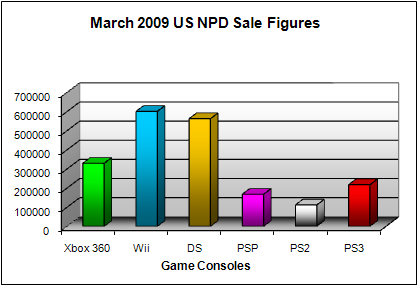
    The figures for US sales in March 2009 are below, ranked in order of number of sales (March 2008  figures also shown, including percentage change):

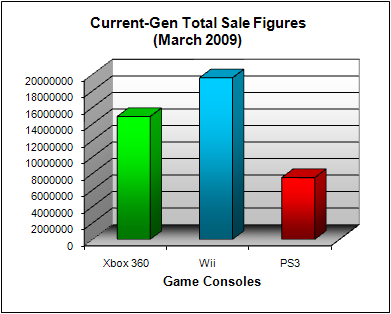
  • Wii: 601,000 (Total: 19.6 million; March 2008: 721,000 – down 17%)
  • DS: 563,000 (Total: 29.7 million; March 2008: 698,600 – down 19%)
  • Xbox 360: 331,000 (Total: 14.9 million; March 2008: 262,000 – up 26%)
  • PS3: 218,000 (Total: 7.5 million; March 2008: 257,000 – down 16%)
  • PSP: 168,000 (Total: 15 million; March 2008: 297,100 – down 43%)
  • PS2: 112,000 (Total: 43.8 million; March 2008: 216,000 – down 48%)
  • NPD March 2009 Game Console US Sales Figures

    NPD March 2009 Game Console US Sales Figures

    NPD Game Console Total US Sales Figures (as of March 2009)

    NPD Game Console Total US Sales Figures (as of March 2009)

    My prediction from last month was:

    My prediction for March 2009 would be that PS3 sales finally beat the 2008 equivalent, thanks largely to Killzone 2 and RE5 (March 2008 was also a very slow month). The ordering of the hardware sales would still remain the same though, as RE5 is no longer platform exclusive for the first time. It will be interesting on the software front, because you would imagine RE5 selling better on the 360, although perhaps only by the same margin as SFIV, and Killzone 2 should do better than the averagely rated (relatively speaking) Halo Wars. 

    Well I did get one thing right, which was that the order of the hardware numbers would remain the same. Unfortunately, every other piece of prediction was incorrect (although RE5 did sell better on the 360). My first prediction of the PS3 finally beating its 2008 numbers was sadly incorrect. In fact, none of the consoles did better than in 2008, except for the Xbox 360. All the red you see from the numbers above makes bad reading for the industry. Only Microsoft will be happy, but for how long? For the software predictions, I will take about them later.

    The PlayStation numbers look worse and worse. Not just the PS3, but also the PSP and PS2. It seems the PS brand is no longer capturing the imaginations of users, largely thanks to the innovative Wii, but I think the main issue is still price. Price is an issue highlighted very strongly this month. It is no wonder that the cheapest non-portable console, the Xbox 360, was the best selling and the only one to have year-on-year growth. Even in the portable arena, the cheaper Nintendo DS continues to soundly beat the more expensive and technically superior PSP – the PSP in particular seems to have peaked in sales and has allowed the Nintendo DS to completely dominate the portable market thanks to its broad spectrum marketing plans that target children of all ages and sexes, as opposed to the “typical” PlayStation user. The one bright spot, if you can call it that, is that out of all the drops, the PS3 dropped the least.

    The Nintendo consoles had an unexpected drop in sales as well, year-on-year. To be fair, nobody expected their surge in sales to last so long – the numbers will have to drop because they have nowhere else to go, not for so long anyway. It will be interesting to see next month if this was a blip (or if the whole month of March was a blip), or a new trend that’s emerging.

    Microsoft will be happy with the numbers again. 2009 has proved to be a good year so far, at least if the goal is to cement second place in the console wars. The Xbox 360 numbers are very encouraging thank to the year-on-year growth, and I think its status as the cheapest video game console on the market is finally paying dividends. Remember, this follows on from last month where it also had a sales surge (up 54% year-on-year – the biggest out of all consoles), and although it appears strange since nothing new has actually happened on pricing or bundling front, perhaps it’s just a case of the economy finally forcing people to buy the cheapest console, rather than the one that really want (Wii). I don’t think the people forced to do this will be entirely unhappy with their decision though, because value wise, the Xbox 360 is fantastic. And anyone that classify themselves more than just casual gamers will appreciate the range of games on the 360 as compared to the Wii.

    Software was a different situation, where March was actually quite a good month. Not as good as March 2008, but it had Super Smash Bros. Brawl that inflated the overall sales by selling 2.7 million – this month’s top selling game didn’t even break a million. But overall, it looks more positive than last month. As for my predictions from the last month, RE5 did sell better on the 360 over the PS3, but I was expecting SF IV type numbers (neck and neck between PS3 and 360), but it turned out to be more GTA IV (2-to-1 in favour of the 360). I was also wrong to say that Halo Wars would sell less well than Killzone 2, despite the former’s poorer rating. I guess franchaises sell, and Halo is bigger than Killzone. And it looks like the decision to release Killzone 2 in late February, as opposed to delaying the release date to the March reporting period, may have hurt Sony’s chances to grab more software market share. Killzone 2’s March sales was almost as well as February’s, but had they been combined, it would have taken it maybe to 3rd spot, just above Halo Wars (probably just short of it though). Instead, it’s 5th and 7th result, while still respectable compared to other PS3 titles in the past, looks pretty average when compared to the pretty average Halo Wars (scored only 82 on Metacritics, while Killzone 2 was  at a high 92). And while I casually mentioned the first GTA game on the DS last month, it didn’t even make the top 10, which perhaps shows that the DS does not have the same demographic as your typical GTA lover, further proven by the fact that a Pokemon game was number 2 on the chart. I wonder how well GTA would have done if it was a PSP exclusive?

    Microsoft’s recent resurgence sees them take top spot in sales, as well as being the most popular console in the top 10 with 36.5% of all sales in the top 10 belonging to the platform. Sony held on to second place with 3 titles in the top 10 (a record?), and 24.3% of the market share. Nintendo is the loser this month with 22.6%, down from the 50% average they’ve been achieving in the last 4 months. You do wonder how long before Wii Fit, Wii Play and Mario Kart are no longer automatic entries in the top 10. Here’s the complete list of the top 10 software sales:

    1. Resident Evil 5 (Xbox 360, Capcom) – 938,000
    2. Pokemon Platinum (DS, Nintendo) – 805,000
    3. Halo Wars (Xbox 360, Microsoft) – 639,000
    4. Resident Evil 5 (PS3, Capcom) – 585,000
    5. Wii Fit w/Board (Wii, Nintendo) – 541,000 
    6. MLB ’09: The Show (PS3, Sony) – 305,000  
    7. Killzone 2 (PS3, Sony) – 296,000
    8. Wii Play w/ Remote (Wii, Nintendo) – 281,000
    9. Mario Kart w/ Wheel (Wii, Nintendo) – 278,000
    10. MLB 2K9 (Xbox 360, Take-Two) – 205,000

    I have no idea what’s on sale next month. I could check, but I’m lazy. Suffice to say, I don’t expect the situation to change much, although hardware sales could improve. Can the PS3 outsell it’s 2008 self? I’m going to say yes again to that, even though I was wrong last month. This is because April 2008 was a bad month for the PS3, the first signs that it wasn’t going to beat the 360 in 2008 like the first few months had promised. Sony will hope April 2009 will be a better month.

    See you next month.