Archive for the ‘Video Technology’ Category

Weekly News Roundup (30 October 2011)

Sunday, October 30th, 2011

Welcome to this Halloween-eve edition of the Weekly News Roundup, where you’ll read scary stories that will send chills down your spine, give you nightmares night after night, and bring forth the disturbing thoughts from the deepest and darkest part of your soul. Stories like, um, a new proposed copyright bill, and I guess something about a new jailbreak device for the PS3. Okay, not quite as scary as I first thought, perhaps.

Copyright

Starting with the copyright news as has been the custom, Halloween eve or otherwise, and we have a scary thing to report, and that’s the US House of Representative’s newly produced copyright bill, dubbed the Stop Online Piracy Act (SOPA).

Roll of money

What a typical US voter looks like, judging by what/who the politicians really listen to

First off, the title of the bill is misleading, because online piracy cannot be stopped, as history has shown us, through legislation or technical measures – people will just find a way around it as usual. But the “people’s representatives”, you know, the guy with only 9% approval these days, are trying their best to ensure the good money lobbyist have spent produce something worthy of the $$$, and so we have SOPA. SOPA is similar to the stalled PROTECT IP Act, which was stalled after one Senator with common sense (there had to be one, after all) decided that sacrificing the tenets of democracy to appease the movie industry wasn’t the right thing to do. SOPA will give the government the power to seize the assets of one industry at the behest of the most powerful members of another competing industry, namely the members represented by the RIAA and MPAA, all because of the stronger lobbying power of that industry. That’s democracy at work, folks.

And the bill extends not only to websites and domain names in the US (I think this bill will kill US jobs as webmasters and businesses mitigate the risk of domain seizures by moving their business elsewhere), it also applies to foreign websites (they might as well just write “The Pirate Bay” into the bill, if they haven’t already). And in the spirit of shifting responsibility of copyright enforcement away from the actual copyright holders towards the government, as the bill will allow the US government to lead the charge overseas and file injunctions against “bad” websites on behalf of studios like Sony and Fox. Because as you know, these small businesses don’t really have the financial resources, nor teams of lawyers, that can handle this sort of stuff, so tax payers will have to do the right thing and help out of course.

But while SOPA will make the US government the public face of copyright enforcement, the government is already doing plenty behind the scenes, specifically, in Russia. Russia’s application to join the WTO faces many hurdles, but if they are seen as friendly copyright enforcement, it will make the MPAA/RIAA happy, and then they will stop whispering bad things about Russia (which has already helped to put the country onto the “notorious piracy market” list) to the US government, which will then drop (some) opposition to Russia’s application. And so the Russia government is now making an example of two admins of the defunct BitTorrent tracker, Interfilm. The married couple now faces up to 6 years in a Russian prison, as the MPAA claims the trackers has caused as much as $1.25 billion in damages (although under Russian law, the couple may only be liable for $16,000). International diplomacy and politics in action, comrades.
Righthaven R.I.P.

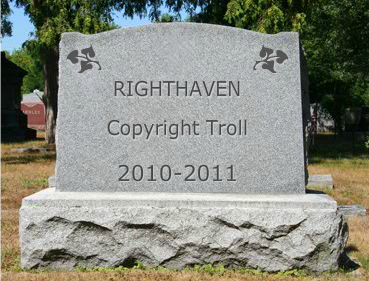
This gravestone picture detailing Righthaven's possible demise is appropriate given it's Halloween-eve and all, despite having being used only last month. Plus Righthaven sort of sounds like Raven, which is very Halloween-y

But it’s not all bad news this week. With the threat of bankruptcy looming, Righthaven has somehow gotten themselves into more trouble this week, as a judge has ruled against the firm in the biggest ruling yet – $120,000 in costs that Righthaven will have to pay to Thomas DiBiase, a former prosecutor that Righthaven tried to sue for the use of an article by the Las Vegas Review-Journal. Remember that Righthaven has already said they are having trouble paying just the $35,000 ruled against them, to the point where they may have to declare bankruptcy, so $120,000 is going to be a bit more difficult. At this point, and I know I shouldn’t, I almost feel sorry for Righthaven. While what they’re trying to do is despicable, in my opinion, the way they have done is, really, just stupid. And I have a soft spot for stupid people, or law firms. The key to settlement-for-profit is to find the right marks, I mean, defendants. You pick the ones that are less likely to put up a fight, and more likely to pay up. So it’s a no go suing poor people, people with knowledge of the law (like, for example, a former prosecutor), people who have the connections to mount a good defence (for example, a former prosecutor), and people or groups that are not part of a charity, non profit, or public service organisation (for example, a former prosecutor who runs a non profit websites providing details about unsolved murder cases as a public service). Other law firms have been selecting defendants carefully and wisely, so it’s no secret. But the biggest problem with Righthaven’s approach is that, copying newspaper articles is not in the same league as copying music or movies. The people who download music and movies illegally, and their motives for doing so, are very much different to people who copy/paste newspaper articles for discussion, public discourse, or information sharing, usually without any financial benefit to themselves.

Over here in Australia, opposition to our local variety of  “copyright trolling” seems to be growing, as the boss of an ISP has signalled the company’s intention to fight the “scum” (he’s words, not mine) who are trying to profit from allegations of copyright infringement. John Linton, chief of ISP Exetel says the ISP is now taking measures and investing $200,000 in the process to do some unspecified work to make it harder for the “blackmailing scum” to target their customers. It will be interesting to see if other ISPs follow suit.

And to add to the growing movement against draconian anti-piracy measure, whether it’s legal or technical, Valve’s Gabe Newell is once again highlighting that the only way to prevent online piracy may very well mean that publishers have to compete with pirates, by doing the controversial thing of actually improving services. Once again, Newell highlighted the success Valve’s Steam platform has had in the pirate haven known as Russia, a country that publishers have said would be impossible to make money from due to rampant piracy, but is now Steam’s second largest continental European market. Apart from more reasonable pricing, the key was localisation, according to Newell, to provide Russian translated games to gamers before the pirates do, as opposed to the publisher’s tradition of waiting 6 months or more to bring out a local version. Publishers want to eliminate piracy, but they don’t really want to do the hard work of making a better (or in Russia’s case, a usuable) product. It seems you can’t have your cake and still eat it (even if the cake is a lie).

And even in the area of pricing, it seems publisher may be able to compete with pirates too. Competing with “free” isn’t impossible it seems, as Newell says their pricing experiment with the now “free-to-play” Team Fortress 2 has paid off big time, with 20% to 30% of those playing it (for free) paying for in-game stuff. Mostly hats, I guess. Just goes to show that people are willing to pay for anything if they decide, and not publishers, if there’s value in it. A variation on “free-to-play” may very well be “pay-what-you-want”, and I would love to see Steam try this one out.

High Definition

In HD/3D news, there’s not much going on, although Blu-ray market share remains suitably high and above the 30% level that, a few weeks ago, would have set new records.

However, I do have a story about Zediva’s ongoing battle with the MPAA. Zediva offered a service where people rent physical DVDs, but the company streams the DVD to users via the web, as opposed to sending them the disc.  This week, a judge ruled that what Zediva is doing is not legal and has granted the MPAA a permanent injunction, as it’s just a (not so clever) way to avoid having to pay web streaming licensing fees to movie studios, as no licensing is needed for physical disc rental. This story is only HD related because of the company’s plans (former plans now, perhaps) to stream Blu-ray movies in the future too. Zediva also has to pay the MPAA $1.8 million in damages.

Hulu

Hulu is not available in Australia and many other countries due to the lack of a global licensing scheme, which sucks for us Australians

Licensing is an interesting issue that I wanted to talk about for a while, but not about what Zediva was trying to do, which was a bit too obvious an attempt to avoid paying the fees, and offered users no real benefits compared to traditional web streaming at all  (with all of the benefits belong to Zediva). But licensing right now, I feel, is holding back innovation. The lack of a truly “global” licensing scheme means that companies like Netflix can’t truly call themselves global giants, and the likes of Amazon can’t offer overseas customers the same experience with their Kindles, even though they allow overseas buyers to buy the devices. The greed of copyright holders, wanting to eke out as much as possible from each market individually, is even hurting  some of their own initiatives, such as the recently rolled out UltraViolet cloud based digital copy scheme, which is yet again a geo-limited (AKA US and, maybe if you’re lucky, Canada, only) service. And here in Australia, we don’t have Netflix, barely a Kindle presence, no Hulu or Spotify, and UltraViolet won’t really help us (yet), and with most of these services actually making money for studios in the US, it’s a huge opportunity they’re missing out on, just so they can get a couple of thousands more from putting pressure on local distributors (which then forces prices up for local content, and pushes people towards grey imports, or even piracy).

GamingAnd finally in gaming, it appears another jailbreak device has been released for the PS3 which circumvents Sony’s latest attempts to lock down the console.

PS3 gamers with consoles still using firmware 3.55 or older can grab the $50 Jailbreak 2 device, and play games released after firmware 3.60, which feature security fixes that prevented the use of the original jailbreak device. And so the cat and mouse game between Sony and hackers continues (although maybe Sony are the mice in this analogy).

That’s it for this week. I’m really tired after a bad night’s sleep, so most likely, I will have no recollection of ever writing any of the above by tomorrow.


Weekly News Roundup (25 September 2011)

Sunday, September 25th, 2011

Welcome to yet another edition of the WNR. Hope you’ve had a good week. It was mainly an uneventful week for me, except my graphics card broke early on the in the week, and so I had found the perfect excuse to do a little bit of upgrading. Faced with restrictions in budget, card length (my old Antec Sonata Designer case would only fit a card 23cm/9″ or less), power supply constraints (although my Antec EarthWatt 500W, with dual 17A rails on the 12V, is not the worst around), I eventually settled for a Radeon 6850, upgrading exactly +2,000 from my old Radeon 4850. While my Intel E8500 is now the bottleneck in certain games, it’s definitely great to be able to play most games at 1080p without having to turn down the details (or as in my old card’s case, all the way down to 1360×768 @ medium just so it doesn’t crash the faulty card). A quick, cheap, and not so nasty upgrade is sometimes a great way to give some life back to an old PC.

More than expected number of news items this week, so let’s get started.

Copyright

In copyright news, it’s hard to know where to begin. I guess we should start with the source of the problem, the money. More precisely, the money flowing into Washington and other capitals of the world, as the copyright lobby spends millions scaring politicians into believing  “net piracy plague” hype.

It was revealed this week that the MPAA spent $470,000 in lobbying in the last quarter alone, mainly to promote the hugely controversial PROTECT IP act, which if you’ve been following the WNR, you should already know that it has come under attack by a variety of professionals, from engineers, to entrepreneurs, to law professors. The idea of messing around with the foundation of the Internet, the domain naming system, just so the billion dollar movie industry can feel a little bit better, without actually solving any real problems, is I guess what these professionals are most concerned about. Basically, the MPAA has convinced politicians that the few harmless flies are actually killer bees, and that the only way to solve the problem is to launch a tactical nuclear strike (except in this analogy, the nuclear strike would probably solve the fly problem, whereas PROTECT IP won’t do anything to piracy).

What surprised me more was that, despite being only a fraction of the size of the movie industry, the music industry via its lobby group the RIAA actually spend almost three times as much money – $1.25M, in just one quarter. And somehow, this was still down on last year’s $1.4M, in the same quarter. Had the RIAA simply spend the money they’ve spent on lobbying and DRM, on actual innovation, they would have been the ones making the iPod and running iTunes, not Apple. Instead, they spend a million plus trying to get new legislation through that would allow labels to receive royalty from radio station airings – once upon a time, labels were happy to just get free airings for promotional purposes, but not any more I guess.

Rapidshare logo

RapidShare will hope its recent lobbying spending of $260,000 is enough to convince Washington politicians not to kill off the file sharing industry

The same story also showed some lobbying from the other side, specifically, by Rapidshare. If PROTECT IP passes, they have the most to lose, since they will probably be the first website to get filtered, after having appeared in all the copyright blacklists. There would be far too much collateral damage if lawmakers outlaw public file sharing, because while I do admit Rapidshare has its fair share of pirated files, it’s also an essential service for many others to share large files without having access to your own FTP server. I can’t see how you can have a public file sharing service without the problem of piracy cropping up, but it’s not as if Rapidshare doesn’t have tools for rights holders to get infringing files removed – it’s just that rights holders don’t want to have to do the work to get them removed. Automatic filters are easy to escape by real pirates, but makes false positives hard to avoid – think of the YouTube false positive copyright thing and times it by about 1,000, since at least with YouTube, some kind of audio/visual analysis could be performed, while it’s harder with generic files.

The world’s second most famous music pirate, Boston University student Joel Tenenbaum, is back in the news this week as the RIAA’s appeal of an earlier reduction in damages, to “only” $67,500, was rejected by the appellate court. But not because they supported the original jury rewarded $675,000, but because they thought that Judge Nancy Gertner has jumped to the constitutional issues  a bit too early in citing the reason for the reduction, when there were other legal recourse that should have been taken before going down this route. It appears that the appeals court agrees that $675,000 was inappropriate, and in their summary, even urged Congress to consider reducing the excessive statutory damages in relation to copyright infringement (but we’ll be lucky if Congress doesn’t do the opposite, and increase statutory damages). This is become a bigger issue, because back in the day, most copyright infringement lawsuits were related to commercial infringement, and so the statutory damages are relevant to those types of cases. Today, most copyright infringement cases relate to non commercial infringement, such as illegally downloading a 99 cent song for free, and so $150,000 per act of infringement doesn’t really fit the “crime” any more. A sensible copyright reform would introduce a new tier of penalties dealing specifically with non commercial infringement, because a fine of $150 per act is enough of a deterrent for those that actually fear the law on the matter (most don’t, even with $675,000 in damages as a potential outcome). And so for now, Tenenbaum faces $675,000 in damages again, which will of course be appealed.

But Boston University students aren’t the only ones having money trouble these days. Righthaven’s refusal to pay the $34,000 in legal fees it owns to Wayne Hoehn, possibly through lack of ability to pay, has forced Hoehn’s attorneys to petition the court to send US Marshals to seize Righthaven assets in response. Now that would be a beautiful sight to behold, wouldn’t it? Righthaven took the risk in trying to scare Hoehn into paying a settlement fee, only for Hoehn to refuse to lie down and fight his way to a win in court, and so it’s only fair that Righthaven should pay up. After all, they’re the ones who send letters threatening tens and hundreds of thousands in damages, if people don’t settle. They should have taken their own advice and settled, if they didn’t want to pay up (except I think the judge refused them the right to do so, heh).

Over to Europe right now, whose financial system should collapse any day now, but before then, there are some deck chair shuffling that needs to happen. In Italy, MPs from Berlusconi’s party (why is the guy still prime minster?) want to introduce the world’s first “one-strike” system, where people may get kicked off the Internet for just a single allegation of copyright infringement. Sometimes I think politicians are actually just using copyright as an excuse to kill off the Internet, as the Internet is  making it harder to rule against the wishes of the people. And also to hide your bunga bunga parties. You know what this is? It’s fascism. And we all know how Italians deal with fascists (well, eventually, anyway).

SFI Logo

The SFI's IP address being used for piracy should not be proof that the institute was engaged in piracy

On to Sweden, and the Swedish Film Institute has just gone through what hundreds and thousands of individuals have gone through, after the SFI was accused of pirating films because its IP address had been found in one of many BitTorrent swarms. It would be hard for the SFI to go with the “my router was hacked” excuse, because no hacking did occur, but because they operated a public Wi-Fi, and because the agency tasked with collection IP addresses aren’t cooperating with the SFI on the investigation, it has been extremely difficult for the SFI to find the source of the piracy. And if this doesn’t prove that an IP address does not equal the identity of the individual(s) who made the infringement, then nothing will. And if public Wi-Fi is now going to be the target of anti-piracy operations, then that’s taking a huge step backwards in terms of the Internet everywhere approach that we’ve become used to (and which many websites, like Facebook or FourSquare, rely on).

And this increasing perception gap between how the world works now, and how the copyright lobby/politicians want things to work, is probably why the German Pirate Party has won 15 seats in the Berlin regional elections. With their Swedish counterpart winning a seat in the EU parliament, pirate parties around the world could become the new Greens, as the issue of Internet privacy and rights become more and more important.

High Definition

In HD/3D news, next week should bring us the Star Wars numbers, an early signs show that it will be a big one. I’m a huge Star Wars nerd, having watched the originally trilogies at least 50 times altogether (and the new prequels trilogies about 6 times), but I’ve actually not pre-ordered the set. It’s not a protest at George Lucas or anything, but while Star Wars on DVD was a special moment for me, I’m a bit more meh about Star Wars on Blu-ray for some reason. Probably because, upscaled, the DVD edition still looks quite good, and from early reviews, while the Blu-ray version definitely looks better, the classic trilogies aren’t the “hi-defy” experience that many would be expecting. It’s not only the age of the film that the cause, but I think not going with a new transfer, given advances in technology since the last one, seems like a step backwards. Which is why I suspect we’ll get a new transfer in time for next year’s 3D version of the films, which means a new Blu-ray set (hopefully with the remastered films in 2D, as well as 3D), and so it’s hard to get too excited. I will still probably get it, I mean I got the LotR theatrical mess on Blu-ray.

Plus, I’m finding it difficult to get the time to watch movies these days, got a dozen or more on Blu-ray that’s still under shrink wrap.

For 3D news, this week, YouTube announced a new feature in which you can convert any existing or new uploaded 2D video to 3D. Cool if you like this sort of thing, but the 3D hype is definitely dying, and the 2D to 3D conversion could be the jump the shark moment for the format, because really, it’s an admission by YouTube that nobody is uploading any real 3D content.

GamingAnd finally in gaming, those that saw and agreed to the new PSN user agreement, without reading it (obviously didn’t watch that South Park episode), may realise that they’ve signed over more than they realised.

Sony apparently sneaked a clause which makes it a lot harder for people to join in one of the many class action lawsuit against Sony for the PSN data theft. Those that signed the agreement will have agreed to go through binding individual arbitration before being allowed to join any class action lawsuit, with a Sony appointed arbitrator. If you don’t sign the agreement, then you won’t be allowed to use PSN, but you can opt out of the arbitration only by sending a letter to Sony HQ detailing your wishes, and within 30 days of signing the original agreement, and of course, all of these details were “hidden” in the wordy user agreement. I’m not going to comment on whether this is an underhanded move by Sony or not, but all I will say is that this is exactly what you would expect from such a company, and probably why it’s such an attractive target for hackers.

Diablo III

Diablo III could be a great game, but Blizzard are doing all they can to ruin it with "always-on" DRM and MMO restrictions, without any of the MMO benefits, in the single player mode

Diablo III is an eagerly awaited game, and Blizzard has a great reputation as a game producer. But the company’s insistence on using always-on DRM, they say for anti-cheating purposes, not anti-piracy, could really hurt their reputation, not to mention sales of the game. A recent play of the beta version seems to show a lot of quirks related to the always-on DRM, including the inability to pause games, and game glitches whenever the connection goes down (and it went down a lot, thanks to the flaky beta Blizzard servers), and eventually users get  thrown back to the main menu, losing unsaved progress. Hopefully, the final version will not be as “crippled”, but without adding in a true offline mode, Blizzard is always going to set themselves up to fail. The good news is that there’s still a lot of time between now and the game’s release, so enough public pressure could make Blizzard do the right thing.

And that’s all that was for the week. I’m off to play Starcraft 2 in 1080p, extreme quality mode (which is more than playable at 50/60 FPS on my new 6850, at least when the on screen unit count isn’t too high). See you next week.

Weekly News Roundup (7 August 2011)

Sunday, August 7th, 2011

A pretty light week in term of news, and since I’m running a bit behind, let’s see if I can wrap this one up quickly.

CopyrightStarting as usual with the copyright news, we start with the MPAA’s win against Zediva, as the judge in the case handed down a preliminary injunction against the “innovative” video rental service.

Zediva Promo

Zediva is a great deal for consumers, but it can only do it by using loop holes that Hollywood is trying to close

A little background info. Zediva’s service works by allowing you to rent physical discs, but instead of sending the disc to you like what Netflix would do, they do what Netflix’s other service does, by offering you a streaming version of the same movie. Zediva then reserves the disc you “rented”, and removes it from circulation. Or basically as Zediva puts it, you rent the disc, and they play it for you over the Internet (imagine a DVD player with a really really long cable). Why did Zediva do this? They did this – and this is where I think Zediva’s downfall will be – to avoid having to pay licensing fees for streaming content.

You see, the problem is that Zediva’s motivations, it seems to me, are born out of trying to avoid paying these licensing fees and release restrictions, and make more money than they would otherwise. If this is Zediva’s real motivation, then good luck to them, but I don’t think they have a snowball’s chance in hell with their case. And in the judge’s summary of the ruling, it’s made quite clear that the judge sees real problems with Zediva’s argument, and that if Zediva was allowed to continue operating, it could harm the existing video-on-demand industry, Netflix included.

Now, it could be debated that what Zediva is doing actually does not hurt Hollywood if you compare it to traditional disc rental, but that it does hurt Hollywood studios when compared to what they can make from streaming deals, and even Zediva won’t deny this, as after all, their business model is to save on licencing costs. This then leads to the debate as to why streaming should cost more than traditional rentals, why Hollywood should choose to not only “tax” new innovative distribution methods, but to place artificial limits (like a 30-day embargo to help increase disc rental income), when these help to fight piracy. But that’s their business decision, and they may be right or wrong, but that’s not for Zediva to decide. So people get pissed off with Redbox waiting times for new releases, or the somewhat hysterical reaction to the Netflix price increases (best encapsulated in this video), and it might hurt Hollywood more to be too greedy when it comes to streaming licensing fees and release schedules, if people do decide to “screw it” and use BitTorrent.

Pron magazine/website Perfect 10 is making legal headlines again this week, twice actually, as they launch yet another lawsuit against yet another online company, this time Megaupload. As you may or may not know, Perfect 10 has in the past sued Microsoft, Google, Amazon, the middle of these three recorded a win against Perfect 10 this week in which the Ninth Circuit court rejected Perfect 10’s appeal over an earlier decision favouring the search giant. But while courts are reluctant to rule about top tech companies that have been Perfect 10’s target before, they may be more favourable to ruling in Perfect 10’s favour against Megaupload, especially since the MPAA’s case against similar file hosting provider, Hotfile, seems to be going okay. So I wouldn’t be surprised if this turns out to be Perfect 10’s first victory, but it all depends on how frequently their content has been uploaded by users of Megaupload, and if it’s not frequent at all, why Perfect 10 didn’t file DMCA notices to get those content removed, instead of launching a lawsuit (“to make more money” is not an excuse the court would accept, I think).

Diablo III

Diablo III will use 'always-on' DRM, but not for anti-piracy, says Blizzard

Good will amongst gamers is something every game developer needs, and up until this week, Blizzard, the makers of the addictive World of Warcraft and Starcraft series,  probably thought that the had enough good will stored in the bank to pull a nasty surprise. But, as Blizzard will admit, they might have miscalculated. What happened was that Blizzard announced the next episode in another one of their addictive franchises, Diablo III, would have “always-on” DRM, meaning gamers won’t be able to play the game offline, even for a couple of seconds. So Blizzard decided to do a Ubi, and as I talked about last week, nobody likes Ubi DRM. The funny thing was that Blizzard probably never intended to do this as a form of anti-piracy, but only as an anti-cheating feature. This may very well be true, but Blizzard could have avoided this whole controversy (and still used “always-on” DRM) by including an offline mode, much like how Test Drive Unlimited 2 does it (offline and online progress are recoded separately). The statements made by Blizzard immediately after the backlash began didn’t help either – executive vice president of game design Rob Pardo’s statement about there being other games to play when people are offline, for example on long plane trips, was the most ill-conceived of them all (yes, “other games” that people will buy instead of your games).

So it’s a lesson for Blizzard and any other company that chooses to use draconian DRM, for whatever reason – beware of the backlash, which might ultimately hurt revenue more than a couple of extra pirated copies would have (or the cost of adding an offline play mode).

High Definition

In Blu-ray/3D news, exciting news, sort of, although it’s technically neither HD nor 3D (not yet anyway).

I’ve been talking up UltraViolet for a while now, and it’s not like me really to voice my support for anything Hollywood comes up with, especially if it’s wrapped up in all sorts of DRM, which UltraViolet will no doubt be. But for me, UV is a huge shift in the way we “buy” movies, and it comes just at the right time when cloud storage is all the rage.

UV, simply puts, turns buying a movie into really buying a movie. The idea is that, instead of buying a movie on each platform, on disc, then on iTunes,  then another version for your Android device … instead of doing this, you buy the license to watch the movie, and then you get access to all the versions via the cloud, for all of your popular devices. It’s like Digital Copy, except it’s all done in the cloud. So when you buy a Blu-ray movie at Walmart, you can instantly get the movie to play on your Android phone, as long as you have a good Internet connection. And at home, instead of finding and popping the disc in or pre-ripping it to your media player, you can just fire up your TV’s UV app, and watch all your purchased movies from the cloud.

Flixster for iOS

Flixster is already available on a variety of mobile devices, and so, it's the natural fit for delivering and managing UltraViolet

The big news this week in regards to UV is the first announcement of UV compatible movies, as Warner Bros. announced both Bad Bosses and Green Lantern will feature UV support. I’m not surprised at all WB is one of the first companies to announced UV support, as they’ve always been quite open to new formats, having supported VCD in Asia, and HD DVD before they decided not to. And WB’s recent acquisition of Flixster is starting to make sense as well, as it seems Flixster is the app that WB plans to use to allow users to manage and watch UV content. As Flixster is already available on a wide variety of mobile devices, it’s an easy decision for WB to use it for UV.

What was more interesting was that WB also announced that it would even be possible for users to bring in their old DVDs to retailers, and have them “enable” access to the UV version of the movie. I don’t know how this will work, or whether there might be a way to do it without having to go to the store, but it does sound interesting. And as mentioned earlier, I really hope TV and console manufacturers embrace UV as well, as this would allow me to digitally stream my movie collection without ripping (also need studios and ISPs to work out some kind of deal to offer free bandwidth for watching UV movies).

In related news, Time Warner owned HBO plans to make available console versions of the HBO Go app, which is great news for those that are actually in the regions that can access HBO Go, which sadly does not seem to include Australia (we miss out on Hulu as well … boo!). The announcement also mentioned other “connected devices”, which sounds a bit vague, but hopefully will include things like Blu-ray players and TVs, for easy peasy catch-up viewing.

Gaming

And finally in gaming, Sony has, as expected really, announced a strong degree of integration between their upcoming portable console, the PlayStation Vita, and the PS3.

This will include the ability to use the Vita as a controller for the PS3 (so allowing the touch surface, gyroscope, microphone, camera … all to be used to control PS3 games), plus the PS3 can also send graphics data to the Vita to display. Sounds familiar? It should, because this is exactly how the Wii U controller would work.

PlayStation Vita

PS Vita will offer Wii U like features, much earlier than Nintendo's console

With the Vita coming to the US probably early next year, and the Wii U much later than that, it’s a shot across the bow for Nintendo, if not directly at them. The only issue is the price. At the expected price of $249, and add the $299 cost of the PS3, yes, you might have a system that rivals some of the innovative parts of the Wii U, but might be more expensive, and not have as good  graphics as the Wii U (which must surely be an ironic situation for both Sony and Nintendo). But then again, the Vita can be used as a standalone gaming console far far away from the Wii U (the Wii U controller also allows independent play, but only within close proximity to the main Wii U console). So a Vita + PS3 combination could in fact replace the Wii U + DS combination, and if that’s true (and if graphics quality is discounted as a factor), then Sony becomes the better value proposition. And a PS3 price drop, or a PS3 + Vita bundle, may help.  Of course, Nintendo knows how to make fun games, and Sony struggles at times, and this could be the deciding factor.

For the Xbox 360, they’re going in a totally different direction, which could work for and against them. But Microsoft has demonstrated Windows Phone integration with Kinect and the Xbox 360, so they’re planning something similar too – and it will be even better value for those already with Windows Phones.

So we come to the end of another WNR. Hope you enjoyed this issue, and see you next week.

Weekly News Roundup (22 May 2011)

Sunday, May 22nd, 2011

A fairly quiet week this one, I guess there’s not really much of a point to write news when the world is ending today. I guess there’s also not much point in writing this WNR, but I can’t think of a better way to go out than in a blaze of angry, angry ranting. There’s no time to waste, as the apocalypse may be upon us any second, and I’d hate to write all this and not have time to send it out. So let’s get started.

CopyrightLet’s start with copyright news. The French have enjoyed their three-strikes system for some time now, although I’ve yet to actually hear any good news about a reduction in piracy or rise in consumer purchasing or anything like that, which is the whole point of the exercise, non?

TMG hacked server directory

This screenshot shows the contents of TMG's "hacked" server

Anyway, one of the private firms the government pays to spy on its own citizens, to gather IP addresses for warning notifications and all that, has had a security breach this week. Trident Media Guard had one of its test servers “hacked” into, with data and tools stolen. From what I gather, it’s not much a case of hacking, as a case of very very lax security, which allowed anyone to browse the contents of the server. A lot of stuff turned up, which ironically made its way to P2P networks in short order, and it includes things like IP addresses that the company uses to track users, plus tools to create fake peers (again, for data collection). Basically stuff that hackers can take a look at and find a way to block TMG from being able to conduct their activities successfully. But the bigger issue is that whether a company tasked with handling sensitive data should be held to higher standards when it comes to security, because while no personal data has been leaked so far, it could very well have if TMG maintains their other servers in the same manner.

But by far the biggest story of the week was a response to last week’s big story, which was the proposed PROTECT IP act, which will give the government power to shut down any website it deems “unacceptable”, including messing with the domain name system (DNS) at the very core of the Internet, as well as forcing search engines to adopt censorship. And as expected, a search engine company, the biggest in fact, has come out fighting against the proposed act. Google’s Chairman, Eric Schmidt, says the company will fight PROTECT IP even if it becomes law. While Schmidt was primary talking about the government messing with DNS, I’m sure Google is even more concerned about the forced search engine result filtering. But messing with DNS is extremely dangerous, because the DNS system is probably the most important Internet protocol, as it maps domain names to the IP address of the servers that hosts the website. The current system is like a huge peer-to-peer network, where an authority server shares information with the rest of the world, and data propagates to every other DNS server. But if the US starts messing with the DNS records in the US, and then Europe does the same, and every other country, then this could very well break down the very thing that is essential for visiting websites. Prominent engineers and Internet pioneer have already warned the US against this, but the RIAA/MPAA lobbying was just too great (and they could care less if the Internet breaks, and it’s probably something they’ll welcome).

And make no mistake, the push behind PROTECT IP is all RIAA and MPAA. This is why, following Google’s statements, both the RIAA and MPAA came out attacking Google, one accusing the search giant of benefiting from criminal activities, and the other saying Google is acting as if they’re above the law. Last week, I ranted about the aim of copyright, which is to protect the public’s right to have access to information, as well as to promote creativity. What the RIAA and MPAA want almost the exact opposite of what copyright is all about, and so if anyone is acting as if they’re “above the law”, it’s the movie studios and record labels. And even if they’re right about copyright and the need to censor certain websites, then why should the tax payer, search engines like Google, ISPs, pay for this? And all for something that will probably be easy to bypass anyway. The RIAA and MPAA thinks they’re entitled to their business model and large profits forever, and want everyone else to pay to ensure they keep their entitlements.

Protest brick

One of the lovely packaged bricks being sent to Nintendo HQ to protest the 3DS's DRM

Moving on now to gaming. The Free Software Foundation (FSF) is launching a protest against the DRM regime of Nintendo’s new 3DS, which actually allows Nintendo to brick anyone’s 3DS console if it detects that it has been modified in any way. So instead of waiting for Nintendo to brick their consoles, they decided that Nintendo should be the one that’s “bricked” first. The FSF has started an  innovative protest, with people donating money to the recognized non-profit organisation, and for every $10 donated, they will send a brick to Nintendo’s CEO (presumably via mail, not via a projection through a window). For those that want better bang, or bricks, for their buck, they can donate $250, the cost of a 3Ds, and have 30 bricks delivered to Nintendo HQ. The campaign was set to end once 200 bricks had been delivered, but due to popular demand, it’s still going on at the moment, and if you want Nintendo to get the message that we are buying the hardware, not just merely licensing it (and so we should be able to do whatever we want with it), go here and donate.

High Definition

Not much in HD or 3D news, but I’ll try to jam in something almost unrelated here just to take up some space. It’s not to unrelated, as Netflix does do HD, and I’m sure they’ll offer 3D sometime soon as well.

The good news is that Netflix is finally coming to Android. The slightly bad news is that it won’t be available on all phones, and Netflix are individually testing each and every phone to ensure compatibility. This is necessary because of the lack of a standardized streaming platform for Android phones, something Google really needs to look at. But I’m also pretty sure this has something, or maybe everything, to do with DRM, something the Netflix has hinted before when asked why it’s taking so long for the Android app the arrive. To try and do anything innovative on the Internet these days when it comes to entertainment, companies have to jump through hoops to meet the paranoid demands of entertainment companies, the rights holders, and in this case, Netflix has to get DRM nice and tight before the movie studios would allow Netflix to deliver content on Android phones. I guess the studios are worried that somehow people will crack the app, and capture the video stream and distribute the SD YouTube quality footage online. Yeah, I’m sure that’s likely, considering how hard it is for people to rip DVDs and Blu-ray’s. Almost as likely as people ripping movies via HDMI, now that HDCP has been cracked. Luddites. Interestingly, he original Luddite movement was borne out of fear of the Industrial revolution, with Luddites destroying machines and anything that represented progress. Sound like anyone to you? The only difference is that the RIAA and MPAA have the government on their side, which the original Luddites did not.

Gaming

And finally in gaming, yep, the PSN is back baby. Well sort of. Some of the functions are still not, um, functioning, but at least gaming is back.

Of course, it’s another week, and another set of security breaches being discovered at Sony and their affiliates. The most annoying of all was that a rather stupid flaw was found in the very system that was supposed to bring security back to the PSN – the password reset function. With Sony forcing everyone to update their firmware and then change their PSN password before they’re allowed back on, you would think that Sony would at the very least ensure this process was secure. But alas, that was too much wishful thinking. The flawed password reset system would allow anyone who had your birth date, and PSN email address (which at this point, is about everyone), to reset your password, and hence gain access to your account on the “new and secure” PSN. And so while Sony went about fixing the flaw, the password reset system was down, and so people like me, who had not reset their password yet, were left without PSN for another couple of days. A lot of people would have been able to reset their passwords on the console it self, but many, who like me, that didn’t create the account on my current console had to use the web version (my original died and was replaced by Sony, more on that below), which was down. There were also other stories about Sony owned ISPs also revealing user information, but I suppose these kind of stories will be plentiful as Sony conduct a full security audit of all their systems.

Dead Nation

Zombie killing fun in Dead Nation - one of the free games available in selected regions as part of the PSN "Welcome Back" package

Sony also detailed the goodies people will get once the PSN store, one of those non-functioning functions, comes back. People will be able to download two games from a list of five, including inFAMOUS, Wipeout HD + Fury, and Little Big Planet. Different regions will get slightly different sets of free games, and there are also PSP games that PSP gamers can download. I think I’ll get Wipeout HD + Fury for my 3D TV, and so far undecided between inFAMOUS, LittleBigPlanet, or Dead Nation (I just can’t resist Zombie games).

One slight problem, that doesn’t affect me, is that at least in the EU and here in Australia (and NZ), only those that had PSN accounts before the network went down on the 20th of April are eligible for the freebies. Which kind of sucks, because I would have thought that the people who got new PS3s after the 20th would be even more deserving of a “we’re sorry” gift, as the last thing you want after forking out a lot of money for a PS3 is for half the functions to not even work for weeks. I mean how much could it actually cost Sony to allow all PSN users, up to say today, to be eligible for the welcome back package? This is exactly why people hate Sony.

Thinking about the earlier 3DS protest thing, one lesson I hope Sony learns from this incident is that people *buy* their console, not license them, so you can’t just take away features without repercussions. And if we’re really just licensing the hardware, then the hardware should be a lot cheaper, and we should receive refunds for outages (just like anything you can license, if you can’t actually use the licensed service of feature, then you should get your money back). Without these checks and balances, what’s to stop Sony from removing a core feature, like say AVI/DivX playback or DLNA support to stop pirated files from being played on the console? I mean, if they are allowed to remove “OtherOS” for “financial reason”, then they can use the same argument to remove other features as well. Of course, it’s not in Sony’s interest to remove either of these features, but that’s now, who knows what will happen in the future.

For Xbox 360 owners, you should now be getting the “Spring” update notice, or will get it soon. There’s misleading information around that this update will brick certain Xbox 360’s, which is not true (at least not yet). What had happened was that a previous update, and not the Spring update, had caused some Xbox 360’s to fail, and Microsoft has already promised to replace all failed 360’s due to that other firmware update  (mostly older Xbox 360 60GB Pro’s) with brand new consoles. You see, that’s the right thing to do. The PS3 is actually more notorious for firmware induced bricking (or at least a drive that no longer reads any discs – something that I’ve experienced personally – luckily, my PS3 was still in warranty at that time, as otherwise I would have had to pay $AUD 250 for the repair), and the only response from Sony was to respond to the various class action lawsuits launched against the company for this alleged fault. This is also exactly why people hate Sony.

Alright, that’s it for this week. See you next week (if the world hasn’t ended by then).

Weekly News Roundup (6 March 2011)

Sunday, March 6th, 2011

Welcome to my favourite month of the year. Not just because it’s the month where I celebrate my birthday, but there are many reasons why March is the bestest month ever. Spring is happening (or Autumn here in the southern hemisphere, and autumn is my favourite season), the sun is shining (but it’s not too hot), the Easter break is just around the corner, and it’s just a brilliant month. Not even Sony can ruin it, no matter how many lawsuits they launch! Speaking of lawsuits, let’s get to this week’s WNR, filled with goodness that you can only expect from March.

CopyrightLet’s start with copyright news, and I’m going to do things a bit differently this week by talking about some of the gaming related copyright news in this section, and some in the gaming section, mainly because most of the copyright related news items have to do with gaming.

Pirated DVD Poster

Anti-piracy promotions have had almost no effect on the public's perception of piracy, which most consider socially acceptable

But we’ll start with a non gaming related copyright news, about a new Danish study which says that online piracy, despite being illegal, is socially accepted. In other words, most people know that online piracy is not legal, but most people don’t care. In fact, 70% of all respondents surveyed said that piracy was socially acceptable, whereas 20% even said that it was “totally acceptable”. So why do people, knowing full well that something is illegal, still goes out and does it? Is it because they feel they won’t get caught? Maybe. Or maybe it’s just the numbers, that so many are doing it, the law has become as respected as say the jaywalking law. And maybe people think that there’s no real harm in it. In any case, the entertainment industry would not have been happy upon hearing the results of the study, because it shows that the millions and millions they’ve spent on anti-piracy advertising has been totally ineffective, since the study’s results haven’t changed much since a similar study in 1997. And most interestingly, the study showed that people were aware of the difference between piracy for personal use, and piracy for profit, with three quarters of those surveyed saying piracy for profit was unacceptable. So this does point to the fact that people just don’t think personal piracy is harmful, and they’re right if a) piracy leads to sales, and b) if the “pirate” never intended to buy.

I think online piracy has reached a state of total ubiquitousness, that I don’t think you can find many Internet users that aren’t aware of the fact that pirated stuff can be found online. Now, some of these people may not know how to download it, that’s true, but I’m sure they will know someone who can help them download it, and most can figure out how to watch streamed TV shows and movies online because I assume that most people can figure out how to play a YouTube style video. What’s my point? It is that despite this, a lot of people are still buying a lot of movies, TV shows, games and everything else, and probably more so than compared to when the Internet didn’t exist. And I suspect a lot of the people that buy also pirate at the same time. If the entertainment industry wants to find out how to stop piracy, they have to first find out why these people, given the temptation of online piracy, still go out to buy stuff, and why some of them will buy some things, and pirate others. If a pattern can be found, then perhaps it can lead to a solution. And at the same time, question those that only pirate and ask why they don’t buy. If the answer is that buying costs money, then you know these were never the type to buy anything in the first place, but if it is another answer, then perhaps it too can be used to craft a real anti-piracy solution. To me, if the industry is serious about tackling the problem, this is what they should be doing. Not go crying to the government about how come their old business model isn’t working as well now as before the Internet, and about how people are stealing all their stuff.

Minecraft

Minecraft creator says piracy does not equal theft

And whether piracy of digital content should be considered stealing, that’s another contentious issues. I actually see valid points on both side of the argument, so it’s a hard one for me. This issue’s been in the news this week when, at GDC 11, Minecraft creator Markus “Notch” Persson said that piracy does not equal theft. His argument is that, in the real world, when you steal something physical, the owner of that something has a physical loss that has to be replaced at cost. With digital content, you can steal something and the original owners won’t even know about it, because what you’re doing is copying, not actually stealing. This makes sense, but it depends on who you see as the subject of the theft. If you’re copying your friend’s music, then you’re not stealing from your friend. But if the subject of the theft is the original copyright owners, who would otherwise have received royalty of some kind from a legal purchase, then perhaps that is considered theft. What copyright holders have got wrong, is that they believe every digital “theft” equates to a lost sale, when it only really at best represents a “potential” lost sale, and may only be a temporary one at that (if the “thief” then decides this game or movie is pretty good and I should buy a copy). There are lots of things that causes “potential lost sales”, such as a bad review (as “Notch” noted), and “temporary lost sales” (such as a missed shipping date, as “Notch” also noted). And what about lost sales because the item is priced too high? Copyright holders don’t have a right to claim a lost sale just because people didn’t want to buy their products. The only thing that’s changed is that people are now able to use said product that they didn’t want to buy by obtaining it illegally online, and that’s not a lost sale, that’s a gained user if said user didn’t like your product enough to ever want to pay for it.

High Definition

In HD and 3D news, I actually managed to find one this week, although it’s not good news really. Panasonic seems intent to milk their Avatar 3D Blu-ray exclusivity deal to the full, and it’s now unlikely we’ll see this 3D movie available for general sale until after February 2012.

But before you go bad mouth Panasonic, it seems they’re aware of the possibly bad publicity this move has (you don’t want to get Avatar fans angry! Some of those people are nutty. And blue), and so they’ve shifted all the blame to Fox, even accusing them of trying to start a bidding war between Panasonic and Samsung, as to who gets Avatar exclusivity. None of this surprises me, because Fox has always seemed like a company forever searching for short term gains at the (usually huge) expense of the long term (Star Wars merchandising anyone? Or their insistence on region-locking every damn thing). Avatards, do what the Na’vi did in the movie (you know it’s just a movie, right?), and fight the oppression dished out to you by this mega-corporation, who wants to destroy your way of life (if your way of life consists of buying Avatar 3D Blu-ray on general release and watching it on your non Panasonic equipment). But seriously, if you don’t want studios like Fox treating film fans as some kind of collateral to negotiate big money exclusive deals, then do the only thing that will hurt them – don’t buy Avatar on 3D Blu-ray when it comes out! It’s the only way that Fox will learn their lesson.

MPEG LA Logo

The MPEG LA is being investigated by the US DoJ

And continuing the H.264 vs Flash vs HTML5 vs … oh I don’t know, it’s already so confusing … war coverage in this section, this week marked the first shot fired in the H.264 vs WebM wars, or rather, the MPEG LA versus Google war. And interestingly the shot was fired by the US DoJ. The DoJ is investigating the MPEG LA for anti-competitive behaviour, accusing it of trying to stifle Google’s VP8/WebM. The MPEG LA says they’ve done nothing wrong, since it’s their business model to license patents, and if Google uses patents held by MPEG LA members, then Google needs to pay up (instead of go crying to the DoJ about it). I think Google’s wish to take over the web codec standard with their royalty free WebM isn’t going to work, because from what I’ve read, it will be almost impossible for WebM to escape without having to depend on at least some patents. I suspect all will be settled in court one way or another, but I don’t think the DoJ really needs to interfere, considering the MPEG LA is only doing what it has always done and it’s up to Google to ensure WebM doesn’t use any patents held by MPEG LA members.

And I suppose it is sort of HD related, so if you want to find out what’s new with the iPad 2, go here to read all about it.

Gaming

Ahh, gaming news. It used to be all about fun things like Fallout 3, Kinect and Fallout New Vegas, but now, it’s all PS3 jailbreak this, PS3 jailbreak that.

Sony’s legal setback a month ago seems to have been just a temporary one, since they have now managed to get all the subpoenas they wanted, and more. The overreaching and extremely broad subpoenas, as the EFF puts it, means Sony can now request the details of anyone who simply viewed the geohot hacking video on YouTube, followed geohot’s twitter account, or even just visited his website, and then sue, sue, sue! I’ll save Sony some time now – I’m guilty on all three counts, and I even dared to embed one of the PS3 jailbreak videos in the forum, as a companion to the news article about the massive Sony security FAIL. But I suspect journalists, or “web journalists” like myself (ie. opinionated hacks) aren’t immune from the mother of all mass lawsuits Sony wants to initiate – let’s just hope that someone talks them out of this and the total PR disaster that would ensue.

Ridiculous requests by Sony, and just when you think they couldn’t over-react more to their own PS3 security failings, they go and do something like this. Sigh.

And it seems Sony’s over litigious nature do get them into trouble, and not just in the PR front either. They tried to sue LG for patent breaches back in December, in relation to mobile phones. They didn’t expect LG to fire back, let alone actually win a counter dispute, in relation to Blu-ray patents, which has now seen tens of thousands of PS3 shipped to Europe seized by customs. The PS3 shipment will be seized for 10 days, unless LG uses the option to extend to temporary sales injunction, and if this thing drags on, you could actually see PS3s being taken off store shelves all across Europe. Karma?

And speaking of  security breaches, the Nintendo 3DS has already been cracked to allow pirated DS games to work. DS games were always easy to crack, but let’s see if Nintendo can stay strong against efforts to crack 3DS games.

That’s it for the week. Don’t forget, you still have two and a half days to enter our Facebook/Twitter competition, details here. Good luck!