Archive for the ‘PS3, PS4’ Category

Game Consoles – February 2011 NPD Sales Figure Analysis

Saturday, March 12th, 2011

It’s that time of the month again, and NPD has “released” US video game sales figures for February 2011. And I did manage to get the 2010 year in review up, which you can read here. For those that are new to this, this analysis looks at US video games sales figures compiled by NPD.

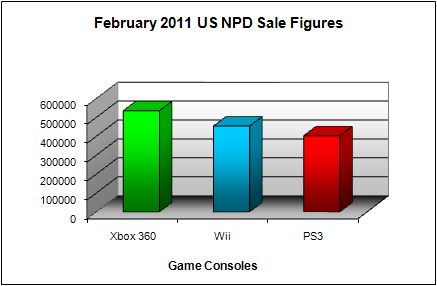
The figures for US sales in February 2011 are below, ranked in order of number of sales (February 2010 figures also shown, including percentage change):

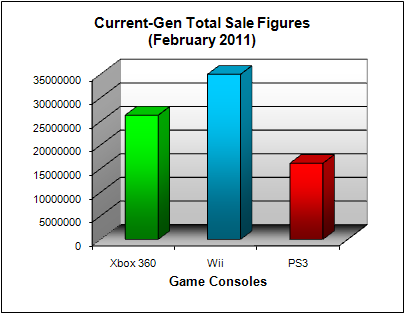
  • Xbox 360: 535,000 (Total: 26.3 million; February 2010: 422,000 – up 26.8%)
  • Wii: 454,000  (Total: 35 million; February 2010: 397,900 – up 14.1%)
  • PS3: 403,000 (Total: 16.1 million; February 2010: 360,100 – up 11.9%)
NPD February 2011 Game Console US Sales Figures

NPD February 2011 Game Console US Sales Figures

NPD Game Console Total US Sales Figures (as of February 2011)

NPD Game Console Total US Sales Figures (as of February 2011)

My prediction from last month was:

My brain tells me the hardware ordering will be the same, but my heart tells me there could be some surprises. A resurgence for the Wii? Xbox 360 suffering a sales slump after the holidays? PS3 sales up thanks to Killzone 3? Speaking of Killzone 3, it is one of *the* titles for February, while Bulletstorm seems to be selling well right now, along with Marvel vs Capcom 3. And the recent hits will be in the top 10 too.

My brain was right, it looks like. The hardware ordering remained the same, which meant that the Xbox 360 managed to outsell the Wii yet again, with the PS3 placing last again amongst the home consoles. The battle between Bulletstorm and Killzone 3 was eventually won by Bulletstorm, although considering the former was a multi-platform release, and the latter a platform exclusive, Killzone 3 did well. And as predicted Marvel vs Capcom 3 was a new entry into the top 10, and actually the best selling new release of the month (the best selling title was actually Black Ops again).

So, looking at the stats above, February seems to have been a great month for the industry. But upon closer inspection, this doesn’t really hold true. The reason is that February 2010 was a four week reporting period, while February 2011 was a 5 week reporting period, and the extra week was mainly responsible for the “year-on-year” growth you see. Doing a bit of simple match (multiply by 4/5), the actual growth rate of the Xbox 360 becomes 1.4%, and Wii and PS3 sales actually fell 8.7% and 10.5% respectively.

But even so, the real winner again is the Xbox 360, and whichever way you look at it, it managed to have sales growth in a period when the other consoles have only managed declines. Just this past week, Microsoft touted Kinect’s performance, which has been recognized by The Guinness Book of Records as the fastest selling consumer electronic device in history, even beating the likes of the iPhone and iPad. While I’m not saying that Kinect sales are whole responsible for the Xbox 360 performance (over 10 million Kinect units have now been shipped to retailers), but there is a relationship, even if it just the indirect buzz that keeps the news positive around the console. The next round of Kinect games should be in stores soon, with the big one being that Michael Jackson game, and so Microsoft will hope the sales momentum continues.

Not doing as well is Sony’s PlayStation Move accessory, at least in comparison to Kinect. Sony are usually the quickest out of the block when it comes to releasing positive sales news, and we haven’t really hard anything in terms of sales figures since late November, so I’m assuming that it is in fact not selling anywhere as well as Kinect. And with a raft of other negative news surrounding the PS3 (jailbreak, broken firmware, LG lawsuit …), it’s not helping the console, even though it’s had the better of exclusive releases lately. And so PS3 sales lag behind both the Wii and the Xbox 360, and in fact had the biggest year-on-year drop of all the consoles, which is worrying considering Sony blamed stock shortages for last year’s numbers, and so the decline may be even bigger.

Nintendo also blamed stock issues for poor sales figures a year ago. The decline in sales actually lessened this February though, so maybe last year’s stock issues weren’t too far off the mark, because we should normally be seeing a 30%+ drop in sales, not the 8.7% drop when the figures are adjusted for the 4/5 week reporting period difference (albeit adjusted in a very simplistic and inaccurate manner). What is becoming clearer is that the Xbox 360 has taken the Wii’s crown as the best selling console in recent months, and I think it will stay this way until some kind of price drop action occurs.

Onto software news now, as mentioned earlier, Call of Duty: Black Ops managed to keep the top spot, which is another way of saying that no new game were good enough to topple the three month old game. But perhaps Marvel vs. Capcom 3 came close, I don’t know. For the console exclusives, Just Dance 2 is still selling well, which probably explains why Microsoft is so keen to promote the dance game aspect of Kinect, almost at the expense of any other type of Kinect game. Killzone 3 was the other platform exclusive that also sold well, coming in at 8th. The Wii’s Mario Sports Mix was also a platform exclusive, coming in at 10th. Here’s the full software sales chart for February:

  1. Call of Duty: Black Ops (Activision Blizzard, Xbox 360, PS3, Wii, NDS, PC)
  2. Marvel vs. Capcom 3: Fate of Two Worlds (Capcom, Xbox 360, PS3)
  3. Just Dance 2 (Ubisoft, Wii)
  4. NBA 2K11 (Take-Two, Xbox 360, PS3, PS2, Wii, PSP, PC)
  5. Dead Space 2 (EA, Xbox 360, PS3, PC)
  6. Zumba Fitness: Join the Party (Majesco, Wii, Xbox 360, PS3)
  7. Bulletstorm (EA, Xbox 360, PS3, PC)
  8. Killzone 3 (Sony, PS3)
  9. Michael Jackson The Experience (Ubisoft, Wii, DS, PSP)
  10. Mario Sports Mix (Nintendo, Wii)

So, prediction time. Same hardware ordering I think, with the big new releases being Pokemon Black/White, Dragon Age 2 and Homefront. Shortest prediction ever?

See you next month.

Weekly News Roundup (6 March 2011)

Sunday, March 6th, 2011

Welcome to my favourite month of the year. Not just because it’s the month where I celebrate my birthday, but there are many reasons why March is the bestest month ever. Spring is happening (or Autumn here in the southern hemisphere, and autumn is my favourite season), the sun is shining (but it’s not too hot), the Easter break is just around the corner, and it’s just a brilliant month. Not even Sony can ruin it, no matter how many lawsuits they launch! Speaking of lawsuits, let’s get to this week’s WNR, filled with goodness that you can only expect from March.

CopyrightLet’s start with copyright news, and I’m going to do things a bit differently this week by talking about some of the gaming related copyright news in this section, and some in the gaming section, mainly because most of the copyright related news items have to do with gaming.

Pirated DVD Poster

Anti-piracy promotions have had almost no effect on the public's perception of piracy, which most consider socially acceptable

But we’ll start with a non gaming related copyright news, about a new Danish study which says that online piracy, despite being illegal, is socially accepted. In other words, most people know that online piracy is not legal, but most people don’t care. In fact, 70% of all respondents surveyed said that piracy was socially acceptable, whereas 20% even said that it was “totally acceptable”. So why do people, knowing full well that something is illegal, still goes out and does it? Is it because they feel they won’t get caught? Maybe. Or maybe it’s just the numbers, that so many are doing it, the law has become as respected as say the jaywalking law. And maybe people think that there’s no real harm in it. In any case, the entertainment industry would not have been happy upon hearing the results of the study, because it shows that the millions and millions they’ve spent on anti-piracy advertising has been totally ineffective, since the study’s results haven’t changed much since a similar study in 1997. And most interestingly, the study showed that people were aware of the difference between piracy for personal use, and piracy for profit, with three quarters of those surveyed saying piracy for profit was unacceptable. So this does point to the fact that people just don’t think personal piracy is harmful, and they’re right if a) piracy leads to sales, and b) if the “pirate” never intended to buy.

I think online piracy has reached a state of total ubiquitousness, that I don’t think you can find many Internet users that aren’t aware of the fact that pirated stuff can be found online. Now, some of these people may not know how to download it, that’s true, but I’m sure they will know someone who can help them download it, and most can figure out how to watch streamed TV shows and movies online because I assume that most people can figure out how to play a YouTube style video. What’s my point? It is that despite this, a lot of people are still buying a lot of movies, TV shows, games and everything else, and probably more so than compared to when the Internet didn’t exist. And I suspect a lot of the people that buy also pirate at the same time. If the entertainment industry wants to find out how to stop piracy, they have to first find out why these people, given the temptation of online piracy, still go out to buy stuff, and why some of them will buy some things, and pirate others. If a pattern can be found, then perhaps it can lead to a solution. And at the same time, question those that only pirate and ask why they don’t buy. If the answer is that buying costs money, then you know these were never the type to buy anything in the first place, but if it is another answer, then perhaps it too can be used to craft a real anti-piracy solution. To me, if the industry is serious about tackling the problem, this is what they should be doing. Not go crying to the government about how come their old business model isn’t working as well now as before the Internet, and about how people are stealing all their stuff.

Minecraft

Minecraft creator says piracy does not equal theft

And whether piracy of digital content should be considered stealing, that’s another contentious issues. I actually see valid points on both side of the argument, so it’s a hard one for me. This issue’s been in the news this week when, at GDC 11, Minecraft creator Markus “Notch” Persson said that piracy does not equal theft. His argument is that, in the real world, when you steal something physical, the owner of that something has a physical loss that has to be replaced at cost. With digital content, you can steal something and the original owners won’t even know about it, because what you’re doing is copying, not actually stealing. This makes sense, but it depends on who you see as the subject of the theft. If you’re copying your friend’s music, then you’re not stealing from your friend. But if the subject of the theft is the original copyright owners, who would otherwise have received royalty of some kind from a legal purchase, then perhaps that is considered theft. What copyright holders have got wrong, is that they believe every digital “theft” equates to a lost sale, when it only really at best represents a “potential” lost sale, and may only be a temporary one at that (if the “thief” then decides this game or movie is pretty good and I should buy a copy). There are lots of things that causes “potential lost sales”, such as a bad review (as “Notch” noted), and “temporary lost sales” (such as a missed shipping date, as “Notch” also noted). And what about lost sales because the item is priced too high? Copyright holders don’t have a right to claim a lost sale just because people didn’t want to buy their products. The only thing that’s changed is that people are now able to use said product that they didn’t want to buy by obtaining it illegally online, and that’s not a lost sale, that’s a gained user if said user didn’t like your product enough to ever want to pay for it.

High Definition

In HD and 3D news, I actually managed to find one this week, although it’s not good news really. Panasonic seems intent to milk their Avatar 3D Blu-ray exclusivity deal to the full, and it’s now unlikely we’ll see this 3D movie available for general sale until after February 2012.

But before you go bad mouth Panasonic, it seems they’re aware of the possibly bad publicity this move has (you don’t want to get Avatar fans angry! Some of those people are nutty. And blue), and so they’ve shifted all the blame to Fox, even accusing them of trying to start a bidding war between Panasonic and Samsung, as to who gets Avatar exclusivity. None of this surprises me, because Fox has always seemed like a company forever searching for short term gains at the (usually huge) expense of the long term (Star Wars merchandising anyone? Or their insistence on region-locking every damn thing). Avatards, do what the Na’vi did in the movie (you know it’s just a movie, right?), and fight the oppression dished out to you by this mega-corporation, who wants to destroy your way of life (if your way of life consists of buying Avatar 3D Blu-ray on general release and watching it on your non Panasonic equipment). But seriously, if you don’t want studios like Fox treating film fans as some kind of collateral to negotiate big money exclusive deals, then do the only thing that will hurt them – don’t buy Avatar on 3D Blu-ray when it comes out! It’s the only way that Fox will learn their lesson.

MPEG LA Logo

The MPEG LA is being investigated by the US DoJ

And continuing the H.264 vs Flash vs HTML5 vs … oh I don’t know, it’s already so confusing … war coverage in this section, this week marked the first shot fired in the H.264 vs WebM wars, or rather, the MPEG LA versus Google war. And interestingly the shot was fired by the US DoJ. The DoJ is investigating the MPEG LA for anti-competitive behaviour, accusing it of trying to stifle Google’s VP8/WebM. The MPEG LA says they’ve done nothing wrong, since it’s their business model to license patents, and if Google uses patents held by MPEG LA members, then Google needs to pay up (instead of go crying to the DoJ about it). I think Google’s wish to take over the web codec standard with their royalty free WebM isn’t going to work, because from what I’ve read, it will be almost impossible for WebM to escape without having to depend on at least some patents. I suspect all will be settled in court one way or another, but I don’t think the DoJ really needs to interfere, considering the MPEG LA is only doing what it has always done and it’s up to Google to ensure WebM doesn’t use any patents held by MPEG LA members.

And I suppose it is sort of HD related, so if you want to find out what’s new with the iPad 2, go here to read all about it.

Gaming

Ahh, gaming news. It used to be all about fun things like Fallout 3, Kinect and Fallout New Vegas, but now, it’s all PS3 jailbreak this, PS3 jailbreak that.

Sony’s legal setback a month ago seems to have been just a temporary one, since they have now managed to get all the subpoenas they wanted, and more. The overreaching and extremely broad subpoenas, as the EFF puts it, means Sony can now request the details of anyone who simply viewed the geohot hacking video on YouTube, followed geohot’s twitter account, or even just visited his website, and then sue, sue, sue! I’ll save Sony some time now – I’m guilty on all three counts, and I even dared to embed one of the PS3 jailbreak videos in the forum, as a companion to the news article about the massive Sony security FAIL. But I suspect journalists, or “web journalists” like myself (ie. opinionated hacks) aren’t immune from the mother of all mass lawsuits Sony wants to initiate – let’s just hope that someone talks them out of this and the total PR disaster that would ensue.

Ridiculous requests by Sony, and just when you think they couldn’t over-react more to their own PS3 security failings, they go and do something like this. Sigh.

And it seems Sony’s over litigious nature do get them into trouble, and not just in the PR front either. They tried to sue LG for patent breaches back in December, in relation to mobile phones. They didn’t expect LG to fire back, let alone actually win a counter dispute, in relation to Blu-ray patents, which has now seen tens of thousands of PS3 shipped to Europe seized by customs. The PS3 shipment will be seized for 10 days, unless LG uses the option to extend to temporary sales injunction, and if this thing drags on, you could actually see PS3s being taken off store shelves all across Europe. Karma?

And speaking of  security breaches, the Nintendo 3DS has already been cracked to allow pirated DS games to work. DS games were always easy to crack, but let’s see if Nintendo can stay strong against efforts to crack 3DS games.

That’s it for the week. Don’t forget, you still have two and a half days to enter our Facebook/Twitter competition, details here. Good luck!

Weekly News Roundup (27 February 2011)

Sunday, February 27th, 2011

The last week of the “high maintenance” month of February is upon us, and it’s a relatively quiet one in terms of news stories (quantity wise, anyway). I did finally write that US video game sales 2010 year-in-review blog that I promised over a month ago. And it was pretty short as promised as well, mainly thanks to NPD no longer releasing publicly all the figures needed to do a proper analysis. But really, the story of 2010 was the Xbox 360 revival (not that it was ever close to dying or anything), with the last of the three graphs I posted in the review blog being the most telling, showing the trend of the three major home-based consoles. Anyway, onto the news roundup.

CopyrightIn copyright news, let’s start with more bad news for isoHunt. Not only did they get sued again last week, now, even a potential ally in Google has come out blasting the BitTorrent search engine.

Now, on first glance, you might expect Google to back isoHunt, considering both are search engines. And since Google is fighting its own copyright battle against Viacom, surely this puts them on the same side as isoHunt. But that’s not really the case. Viacom’s strategy in their appeal of the YouTube verdict is to say that it’s no longer enough for websites to be DMCA compliant, that is to remove infringing content when requested. Instead, Viacom says that there is something called “red flag” infringement, which means that if it’s somewhat obvious that infringement is occurring, then Google/YouTube should take action even without any specific DMCA complaints. The problem for Google in regards to the isoHunt appeal is that the MPAA might just win the case against isoHunt on the basis of “red flag” infringement, and it would set a precedent that would disadvantage Google. So what’s Google’s legal strategy? It’s to paint isoHunt not as a search engine, but just a really really bad copyright infringer. It’s arguing that there’s no need for the MPAA to even use “red flag” infringement, because isoHunt is plainly guilty of actively and deliberately supporting piracy, something that Google/YouTube cannot be accused of. Yes, it really hurts isoHunt’s defence that they’re just a search engine, like Google, but this is Google in self-protection mode.

Red Flag

The so called "red flag" infringement ruling could spell an end to online innovation

Regardless, “red flag” infringement is actually quite a dangerous precedent to set, so I do support Google’s efforts in trying to fight against it, even if it means that isoHunt will be sacrificed as a result. The problem with “red flag” infringement is that it potentially could kill innovation on the Internet, because let’s admit it, a lot of even today’s most popular and mainstream web services had to tolerate or even support “red flag” infringement, to get their business up and running. Would YouTube exist today if people weren’t allowed to upload copyrighted content back when it first started out? Would Google, the search engine, have become the most popular search engine if it blocked all piracy related search results when it was first launched? Would any of the free file hosting websites even exist, allowing us to share large (legal) files that otherwise would be too big for email? “Red flag” infringement is basically the content owner’s way of stopping all innovation, even if there is a remote chance that infringement could occur at some unspecified time in the present or future, and that’s dangerous. And it also puts the onus on identifying infringing activity on the side of the website publishers, as opposed to the content owners, which doesn’t even make sense, since how would I know what content belonged to whom and whether it’s really authorized or not (case in point, Viacom’s own employees uploading copyrighted clips under fake accounts, to create fake hype and promote their shows)?

And so we move on to the next set of news, which is also about appeals. This time, it’s the Australian Federation Against Copyright Theft’s (AFACT) appeal of a verdict from a year ago which found Internet Service Provider, iiNet, not guilty of authorizing copyright infringement committed by its subscribers, even though iiNet failed to act on infringement notices sent by the AFACT. The result of the appeal was announced this week, and it’s victory again for iiNet, even if it’s mostly symbolic at this point. While iiNet won the appeal, several decision has been overturned in favour of the AFACT, and it probably paves the way for AFACT stepping up its campaign to make ISPs the copyright police. iiNet’s victory apparently was more due to technical reasons, the precise design of the copyright infringement notices which the court found inadequate, and really, the decision probably gives the AFACT a very clear set of guidelines on just how to send infringement notices to ISPs. Basically, a symbolic victory for iiNet, but probably a more substantial win for the AFACT in the long run.

What frustrates me most about these types of trials, and about ISP warnings and/or three-strikes system, is that, in the end, it will be so so easy for users to bypass monitoring and escape being caught, or even cautioned. This is because anti-piracy monitoring today is basically just based on monitoring BitTorrent networks, which is only one way to obtain pirated content. Encryption, VPNs, or even just direct Internet downloads via digital lockers, can all escape the watching eyes of the piracy police, and so with millions of dollars being spent on lawsuits, and even more millions per year for monitoring and policing, the result will, as always, just push people towards using new piracy tools that will make online piracy harder and harder to track and stop. Remember in the good old days when websites simply hosted the pirated files, and how easy that was to stop compared to stopping torrents? Civil liberties are being sacrificed to give corporations a *false* sense of security, and that’s a really really bad reason to force us to give up our rights (is there even such a thing as a “good reason”?)

High Definition

Again, not much happening for HD/3D news, and I’m not even going to mention the stupid “Inception to be converted to 3D” news, because if there’s one thing worse than the 3D hype, then it’s “taking a 2D movie and converting it to fake 3D so we can squeeze more money out of the fans” phenomenon. Note to studios: not everything has to be in 3D!

XviD 1.3.0

XviD 1.3.0 has been released this week

While not exactly HD news, exactly, but a new version of Xvid has been released, version 1.3.0, and it’s the first new version in quite a while. MPEG-4 ASP based codecs may no longer be as sexy or “cool” as the MPEG-4 AVC/H.264 ones, but there’s still a place for the good old Xvid codec  for medium quality video files.

And the absence of real news means that I will have to plug my weekly US Blu-ray (and DVD) sales analysis feature, the latest analysis found here. It’s a place where Blu-ray fans can go to bask in the glory of “their” format’s sales successes, and where die hard HD DVD fans like myself can go and find any signs that show Blu-ray’s weakening stance, no matter how statistically insignificant (“OMG, Blu-ray sales fell 20% compared to last week – it’s doooomed!!”).

And as part of compiling the stats, I also regularly update a series of related graphs, that are never actually posted anywhere (other than on our on-and-off “Blu-ray: The State of Play” feature). So instead, I’ll post some of the graphs here right now, for your enjoyment.

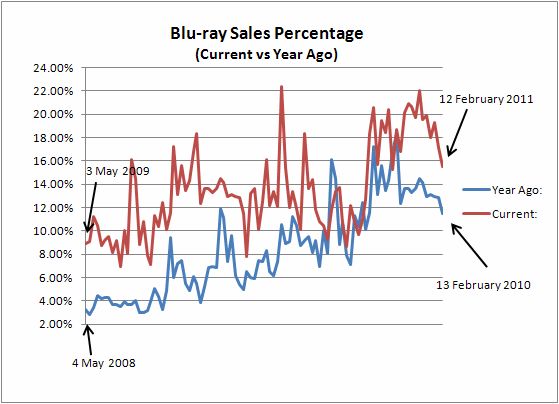
Every week, there are stats to show how Blu-ray revenue as a percentage of combined disc (Blu-ray + DVD) revenue, and here’s the stats plotted that compare the most recent weeks (in red) to the same week a year ago (blue):

Blu-ray Sales Percentage: Currents vs a Year Ago (as of 2011-02-12)

Blu-ray Sales Percentage: Currents vs a Year Ago (as of 2011-02-12)

The graph below shows the same stat as above, except plotted in a linear time fashion, with a trend line showing Blu-ray’s growth.

Blu-ray Market Share Trend: As of 2011-02-12

Blu-ray Market Share Trend: As of 2011-02-12

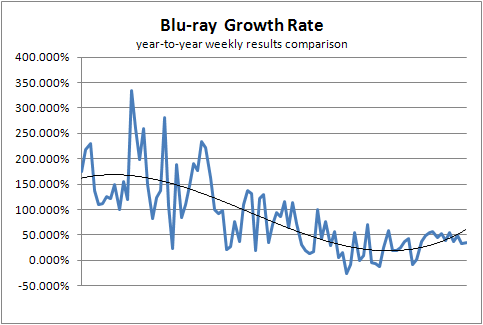
And finally, this graph shows the Blu-ray growth rate (so if Blu-ray’s market share was 5% a year ago, and now it’s 10%, the the growth rate is 100%, or doubled), again with a trend line.
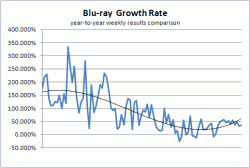
Blu-ray growth rate trend: As of 2011-02-12

Blu-ray growth rate trend: As of 2011-02-12

Gaming

And finally in gaming, which these days, should probably be renamed to the “PS3 Jailbreak” section instead. Last week ended with Sony banning a bunch of users from PSN for using hacked firmware, and now the hackers have fought back by hacking PSN to un-ban themselves, as well as make it possible to ban anyone they want.

Note to Sony: don’t try to out-hack hackers.

geohot's rap video

geohot's takes the battle with Sony to rap form

Then we had the news of Sony attempting to bring out a new PS3 SKU that would be hack proof (famous last words). geohot and others have already said that the only way for Sony to really combat the PS3 hack is to release a new hardware, and it seems Sony has taken their advice. At the same time, Sony is beefing up their own legal team as they seek to sue their way out of this mess (what could possibly go wrong?). Sony have also got the German police to raid the home of PS3 Linux hacker graf_chokolo, which will please the Linux/hacking community. You can read more on these stories here.

For those that think I’ve been too hard on Sony, perhaps you’re right. Personal history with the company aside, the main reason I and a lot of people detest Sony is solely based on their recent actions, best described in this Make article/rant. I started Digital Digest talking about how to play DVDs in Windows, back when commercial solutions were few and far in between, and with Pentium 4’s still an expensive early-adopter thing, you just needed to hack your way to  play DVDs on PCs smoothly, from tweaking drivers to using custom decoders and more. And from then on, it’s always been about using products and software beyond the purposes intended by manufacturers and publishers. Sony’s hatred towards anyone that wants to do things outside of Sony’s own limited imagination, and their arrogance of forcing people to use Sony products in Sony’s own prescribed manner (and it’s not just end users, it’s also developers too, having to adapt themselves to Sony’s way of doing things, as opposed to the other way around – a philosophy that Microsoft, for example, do not share, which is why the Xbox 360 is a much more developer friendly platform). And it’s also the arrogance in their response, which is almost always an overreaction (eg. CD root-kit fiasco), because it’s as if they believe that using, developing for or even selling a Sony product is a privilege, and so if you make Sony angry, expect retribution. Point out a flaw in their security design? Sony will get you. Make their products do more than advertised? Sony will get you. Sell products to help Sony users in a way Sony doesn’t like? Sony will double get you (as geohot wisely raps in his video, “I shed a tear everytime I think of Lik Sang”).

Speaking of Microsoft as a “good guy” when it comes to consumer right seems quite wrong to me, but compared to Sony, there are a lot of “good guys”. But Microsoft’s response to the Kinect hacks (not the first response, which was similar to Sony’s, but the subsequent responses by openly welcoming the hacks) is to be commended, and really, it’s the best business decision as well (Sony’s actions have often hurt themselves more than anyone else, to be fair). And now Microsoft is following up by releasing an official PC developer kit for Kinect, available for free to non commercial users and researchers. Of course, opening up the development of an console accessory is different to the reaction of seeing your product hacked into oblivion, but still, it’s hard to imagine Sony reacting to the hack in the same manner (as the Make article mentioned, the Aibo hacking incident kind of shows what a typical Sony response might have been).

Also, Kinect will work with Windows Phone sometime in the future (not this year though), which given the recent Nokia announcement regarding moving to the Windows Phone platform, can only be a good thing for Kinect. Still, Kinect needs some better, more varied games, because frankly, I’m a bit tired (in both sense of the word) from playing Kinect Sports soccer and winning 4-3 all the time (I’m not that good at goalkeeping, which for me, consists of flapping my arms wildly).

Alright, enough ranting for this week. Have a good one.

Game Consoles – 2010 NPD Sales Figure Year In Review

Tuesday, February 22nd, 2011

As promised, this is the 2010 year in review for US video games sales, based on figures provided by NPD. Due to the NPD withholding many figures towards the end of 2010, this year in review will be pretty short, with a sole focus on the hardware sales figures.

The total sales figures as estimated by the NPD for 2010 are as follows, listed in the order of best selling console to worst:

  • Wii: 7,069,900
  • Xbox 360: 6,764,089
  • PS3: 4,333,500

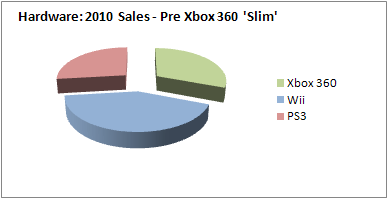
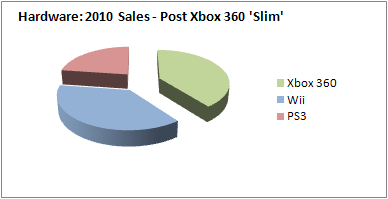
The major even that occurred in 2010 include the release of the Xbox 360 “Slim”, some Wii price cuts, and the release of Sony’s Move and Microsoft Kinect motion gaming add-ons for their respective consoles. Kinect and Move may have had some effect on PS3 and Xbox 360 sales, they occurred too late in the year to really make a huge impact for either console. But by far, the even that had the most impact was the release of the slim version of the Xbox 360, with took the industry by surprise when it was announced at E3. A picture tells a thousand words, or at least a few hundred, and the following graphs best illustrate the effect of the Xbox 360 “Slim” on console sales:

NPD 2010 Hardware Sales - Pre Xbox 360 "Slim"

NPD 2010 Hardware Sales - Pre Xbox 360 "Slim"

NPD 2010 Hardware Sales - Post Xbox 360 "Slim"

NPD 2010 Hardware Sales - Post Xbox 360 "Slim"

As you can see, the “Slim” had a huge effect on Xbox 360 sales, and it affected both PS3 and Wii sales. Before the “slim”, the 30.74% of consoles sold were the Xbox 360 (42.42% for the Wii, 26.84% for the PS3). After the “slim”, it was 39.56% (37.66% for the Wii, 22.78% for the PS3). Which shows that the Xbox 360 gains came more from the decline in sales of the PS3, than the Wii, although that’s simplifying things too much since each console’s gain/decline could be entirely independent from the sales results of the other consoles.

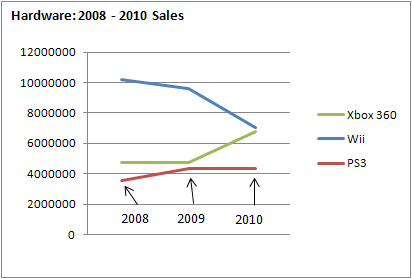
But looking at a single year’s results is too much looking at it in a vacuum – without looking at the past years’ performances, we can’t really see the big picture. And the following graph tries to plot the trend in sales, and why the Wii is in trouble:

Console Sales: 2008 - 2010

Console Sales: 2008 - 2010

The Wii’s steady decline is quite alarming, and shows just how close the Xbox 360 came to outselling the Wii in 2010, and if the early 2011 results are any suggestion, the Xbox 360 is set to become the best selling console in the US in 2011, surpassing the Wii for the first time since the release of Nintendo’s console. PS3 sales mostly remained level from 2009 to 2010, the actual decline in sales is only 1,000 units. The exact percentage changes are as follows (positive indicates growth, negative indicates decline):

  • Xbox 360:
    • From 2008 to 2009: 0.75%
    • From 2009 to 2010: 41.78%
  • Wii:
    • From 2008 to 2009: -5.67%
    • From 2009 to 2010: -26.31%
  • PS3:
    • From 2008 to 2009: 22.3%
    • From 2009 to 2010: -0.02%

The sales bump thanks to the PS3 Slim in 2009, as you can see from the above figure, is only half as big as that gained by the Xbox 360’s “slim”, although the Xbox 360 “slim” had a couple of months more than the PS3 “slim”. But it’s clear that Wii’s decline actually accelerated in 2010.

So what can we conclude from these figures? Nothing that’s not already quite obvious, that the Wii isn’t doing to well, while the Xbox 360 was the real winner of 2010, with the PS3 sales remaining completely flat.

Weekly News Roundup (20 February 2011)

Sunday, February 20th, 2011

Another week, another WNR, but not before I do my usual promotion of the January NPD US video game sales analysis post, apologise for still not writing the 2010 NPD year-in-review that I promised a month ago, and then blame it all on some game I’ve been wasting my time on (finished Fallout New Vegas BTW, now moved onto the new iteration of the classic timewaster, Civilization V, and also finally completing some unfinished business/achievements in Dead Rising). Anyway, regarding the January NPD figures, I mentioned that the Xbox 360’s success (most popular console again) is now largely to do with Kinect, but some other commentators have rightly pointed out that Microsoft spent half a billion dollars promoting the 360 and Kinect, so the small sales increase compared to last year has come at a high price, literally. However, it’s useful to point that that total retail spending on the Xbox 360 in January reached $551 million, so Microsoft can easily afford to splash the cash to promote Kinect.

Alright, let’s get to the news roundup, I’ve got the Americans civilization to destroy afterwards, having spent the last 20 years surrounding their territory with Giant Death Robots.

CopyrightStarting with copyright news, isoHunt is the target of yet another lawsuit, this time by the record industry as it seeks $4m in damages, and the closure of the BitTorrent indexer.

BitTorrent indexers are an interesting category of websites. On one hand, they’re basically search engines, like Google or Bing. On the other hand, they mostly allow you to search for pirated content, and so while they do not host pirated content, they do provide the tools to be able to find and start downloading pirated content. And most of the torrents on these indexers are piracy related, that’s a fact that can’t really be denied. So it’s quite easy to see why the MPAA and RIAA like to go after indexer, and because isoHunt is located in a country that isn’t so far from the HQs of these two industry lobbies (it’s closer than Sweden, anyway), it becomes a natural target.

Tribler

Decentralized indexing is the next big thing for BitTorrent clients, and it will make shutting down torrents much much harder

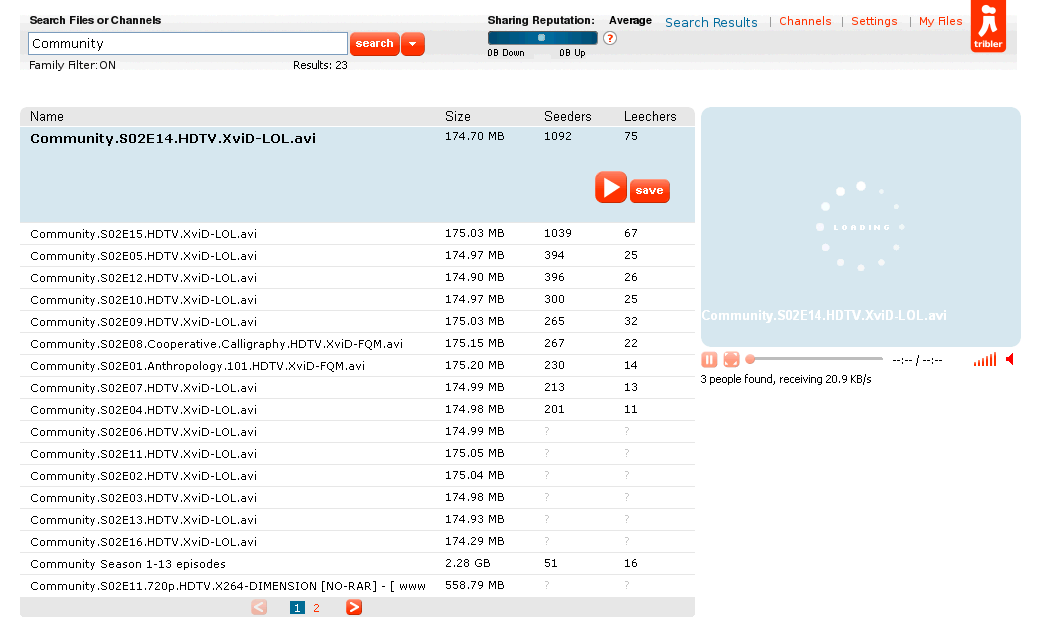
Indexers are really the last centralized system for piracy left, with everything else decentralized in an attempt to avoid being shutdown (magnet links, DHT …). The only thing left now is to make indexing decentralized too, and it’s only a matter of time before all the major torrent downloaders incorporate something this feature. An open sourced BitTorrent client with decentralized indexing like Tribler is something the MPAA and RIAA should be very afraid of because it will be almost impossible to shut down, but it’s exactly what their actions are driving users towards. But I think it will be good if we get to a point where Internet piracy cannot be stopped, because perhaps finally, the industry will wake up and find better ways to combat online piracy than lawsuit after lawsuit and government intervention.

Looking at a country where online piracy already seems impossible to stop, Spain, the government’s attempts to stop people downloading pirated content is meeting with heavy resistance since piracy has become mainstream. And even famous actors like Javier Bardem, who came out to support the government’s initiative, wasn’t spared from the public’s anger. Bardem was booed and had eggs thrown at him for supporting the government. But even some in the Spanish film industry are against the government’s plans to introduce tougher penalties for downloaders, including the president of the Spanish Film Academy, Álex de la Iglesia. Well former president, since he resigned his post to protest against the government’s actions. Iglesia says that innovation, not litigation or legislation, is key to fighting piracy. And that viewers, even those viewing pirated content, should be respected because they’re the only reason the film industry even exists. I think piracy being accepted as something mainstream isn’t actually a very good development, because I still believe creators should profit from their creations. And this is why innovation must come before other countries face the same fate as Spain, and I believe innovation can save the film industry.

And litigation may become a lot harder as courts start to question the very basis of copyright lawsuits that are based on IP address evidence. Former copyright law firm ACS:Law, who tried desperately to avoid having to go to court, is in court and the judge is asking all the wrong questions, from ACS:Law’s perspectives anyway. The questions being asked relate to the IP address, and whether this single piece of evidence is really enough for a copyright lawsuit. Finally, we have judge that appreciates the technical subtleties between an IP address and an actual unique identifier of a person, because as the judge rightly states, an IP address at best identifies the account holder of the Internet connection, not the actual downloader. There’s also the issue of IP addresses being spoofed, or more commonly, connections being used without authorization. The judge then asks about an unauthorized access to the ISP account, or even authorized access but unauthorized usage, and whether this falls under the authorization clause of copyright law. If you lend your car to someone who says he’s using it to go the store to get a few things, and then he goes and robs the store, are you an accomplice? The copyright lobby and law firms say so, the judge is not so sure.

And an update on a story reported here back in December, Matt Drudge of Drudge Report has settled with Righthaven over the unauthorized use a photo on the website. Righthaven had requested $150,000 in damages plus the seizure of Drudge’s domain names for the extremely naughty use of a single photograph on the website. No detail of the settlement has emerged, so it’s an unknown how much Drudge had to pay, or even if any payment was involved. My personal opinion is that Drudge should have put up much more of a fight, because the lawsuit is unreasonable in asking so much for a single photo. Had Drudge put up the same amount of resistance as fellow political website Democratic Underground, then perhaps the settlement wouldn’t have been necessary – Righthaven has tried to extract itself from the Democratic Underground lawsuit, fearing that they may actually have to go to court and face the same kind of questions that ACS:Law in the UK is facing (not to mention the extra cost, which goes against the business model).

Not much happening on the HD/3D front this week, so we’ll skip straight to the gaming section, which is good because all of the gaming stories are copyright related anyway.

Gaming

The first news I posted for this last week was the Crysis 2 leak scandal. What happened was that someone, probably someone on the development team, leaked a pre-release version of the eagerly awaited Crysis 2 game, and of course, hours later, millions of people were trying to download it.

Crysis 2 Leaked Screenshot

A almost full version of Crysis 2 has been leaked, but don't blame the pirates, blame the person who leaked it

EA, the game’s publisher, took the unusual step to address this issue in their blog, blaming it all on online piracy and pirates as you would expect them to do. But that’s like blaming the people who are reading the Wikileak leaks, as well as the people who published the leak cables, and not the actual person that leaked it. For me, this isn’t an issue about piracy at all, this is an issue about not protecting your products properly, and the fault lies with Crytek and EA. A lot of those that downloaded the pre-release version would still buy the game, and those that had already planned to buy or ordered, would still download just because it’s kind of cool to be able to get the pre-release version.

Despite EA’s blame game, PC piracy is actually decreasing, says the new president of the PC Gaming Alliance, Matt Ployhar. Ployhar says that it’s mostly due to new game design, where MMO games like WoW means that piracy really isn’t possible, and also value-added content and services. Steam is the example that I always go to, and it’s a good example of how innovation can work. I mean, this is a company that got into the PC game sales business when everyone was saying it was doomed, and they have flourished thanks to the very Internet that publishers were blaming for the industry’s demise. Things like showing off your list of games to friends, your achievements, the social aspect of gaming, value-added and exclusive content and features, and of course, reasonable pricing, all counts in the end. As for DRM? Ployhar is on the sidelines when it comes to whether publishers should deploy strong DRM or not. But he does say that many legitimate users do break DRM to get a better gaming experience, something I can personally attest to having used cracks to escape the need to insert the game DVD every time (which is why I now prefer Steam games, since you can get the same thing legally – plus the in-game browsing is a big plus point, considering how crap I am at most games and how much help I need during play).

And finally, an update on the PS3 Jailbreak situation. Sony has, as expected, started to ban those with hacked firmware on PSN. Harsh, perhaps, but hardly unexpected. I’m just surprised Sony didn’t insert a virus into hacked PS3s that make them blow up, because you know that was probably their first choice of action until their lawyers talked them out of it. With the PS3 coming last in console sales in the US yet again, Sony can ill afford to take the focus away from their upcoming games, and onto this legal mess. Although with that said, none of this is new. Microsoft went through this, so have Nintendo with all of their consoles, and Sony are really lucky that it hasn’t happened to them until now. What they shouldn’t do is to overreact, which let’s be honest, is something Sony are famous for. Unfortunately, launching the lawsuits and trying to sue those that even watched the hacking video on YouTube does seem like a typical Sony overreaction (although the hack itself is unprecedented, in its totality and completeness, but that’s Sony’s own fault for having crap security).

Alright, that’s another WNR done with. Back to Civ 5 and blowing the smithereens out of the American cities with my stealth bombers equipped carriers (yes, it is possible to have stealth bombers to be stationed on a carrier despite the game not allowing you to do it direct. Simply build a plain old bomber first, base it on a carrier, and then upgrade to a stealth bomber).