Archive for the ‘News Roundup’ Category

Weekly News Roundup (10 March 2013)

Sunday, March 10th, 2013

BAM! A new game app, made by yours truly, out of nowhere! Other than the fact that I mentioned it way back in September, and then again in December … I guess you can say I had tiny bout of development slippage. But better late than never I suppose.

What’s it about? Well, unlike my last effort, this one actually has something to do with what we talk about here and on Digital Digest in general. One of the most absurd things about current copyright laws in the U.S. is the notion of statutory damages. It’s the law that awards up to $150,000 in damages per work. It made sense when it was about commercial piracy, one company ripping off another for commercial gain, but applying it to personal usage piracy or when there’s little commercial intent, is just ridiculous. From Jammie Thomas-Rasset‘s $1.92 million damages, to Joel Tenenbaum, to outrageous damages claims of $75 trillion. It’s the very thing that magnifies the actual cost of piracy, scares politicians into taking drastic actions, encourages law firms to scare people into paying “pre-trial settlements”, and helps to fuel the ongoing crusade against piracy.

Pirate This!

Pirate This is my new game app that highlights the ridiculousness of statutory copyright damages … a game with a message (and no DRM)

Pirate This! is my crappy little app (that somehow still managed to cost me over $1,000 to develop) that aims to highlight the unfairness of statutory damages by making a game out of it. You play as a “typical” web pirate, ‘downloading’ and ‘uploading’ music, movies and games. The aim? To “bankrupting the world, one download at a time’, as you try and increase the amount of damages being awarded against you, with 30 levels to notch up as much total damages as possible. It’s a short game (I have some additional content on the way though), but a game with a message. Apptivism, if you will.

So if you think current copyright laws are wrong, then you should buy my very reasonably priced ($0.99) app. If you don’t like the way ordinary citizens, whose only intention are to listen, view or play content, are being forced to pay thousands and more for downloading something that may have cost less than a cup of coffee, then buy the app (which also costs less than a cup of coffee). If anything you read here makes sense to you, then buy the app. Tell your friends, your family, even your enemies, and get them to buy a copy too. And then buy another two copies for yourself,  just to be safe. And if you manage to grab a pirated version of Pirate This online somewhere, that’s fine too.

Pirate This is currently available on the Google Play store and the Amazon Appstore for the Android platform, both DRM free (well, as much as each platform allows for anyway), and will be available on the Apple App Store soon for your iOS devices (currently waiting on the standard app review process).

And on that note, we come to the end of another weekly news … oh wait, we haven’t done the news thing yet, have we? OK, here we go …

Copyright

Most people don’t like DRM (well, I don’t), but we’ve largely had to live with it. What if not only do we have to live with it, we have to sit on it as well? That is perhaps the rationale behind the design and creation of the world’s very first DRM chair.

Clever in its simplicity, the DRM chair uses a simple sensor to count how many times it has been sat on. Once it reaches the usage limit (8, in this case), the chair disassembles itself via electrically melted wax joints. There’s a video in the link above where you can see it in action – all 8 times, before the DRM kicks in.
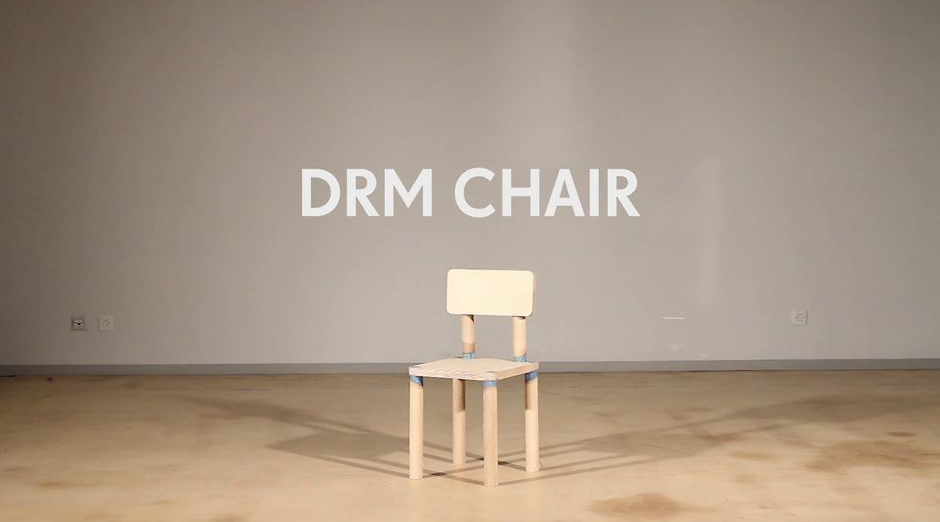
DRM Chair

A chair with DRM. At least it’s not “always-online”!

I hear you saying, technically, how can something analogue like a chair employ *digital* rights management? It’s true, and ironically, the only piece of digital-ness in the whole thing is the DRM system itself. Maybe that was the point the designers were trying to make though, with the project borne out of the brief to re-think “the world as we know it”, as part of The Deconstruction global design project/competition. And I think the DRM chair fits the brief quite effective, asking us to re-think the way DRM has infested our everyday digital lives, how we’ve come to live with it like some chronic incurable disease, even though its very premise is something quite alien to us in terms of our everyday dealings (like with chairs, for example).

And as frustrating as a chair that falls apart after only 8 sittings is, you know the good folks in the game publishing industry can always come up with something even more annoying. So when EA decided to go with the “always-online” route for the latest incarnation of SimCity, the only question was whether they would learn from the mistakes of Blizzard with their botched Diablo III launch or not.

“Or not”, as it happens, as SimCity’s launch was a complete disaster, and possibly even worse than the Diablo III debacle. Gamers were not only met with “server busy” error messages when they tried to play their $60 game, the whole waiting for a free spot thing was made as annoying as possible by essentially having no queue, with only a timer that re-tries a connection every half-hour (at which time, the server might still be busy). Even those that managed to log on were sometimes kicked off due to server problems, sometimes with hours of work wiped out as all saves are online based.
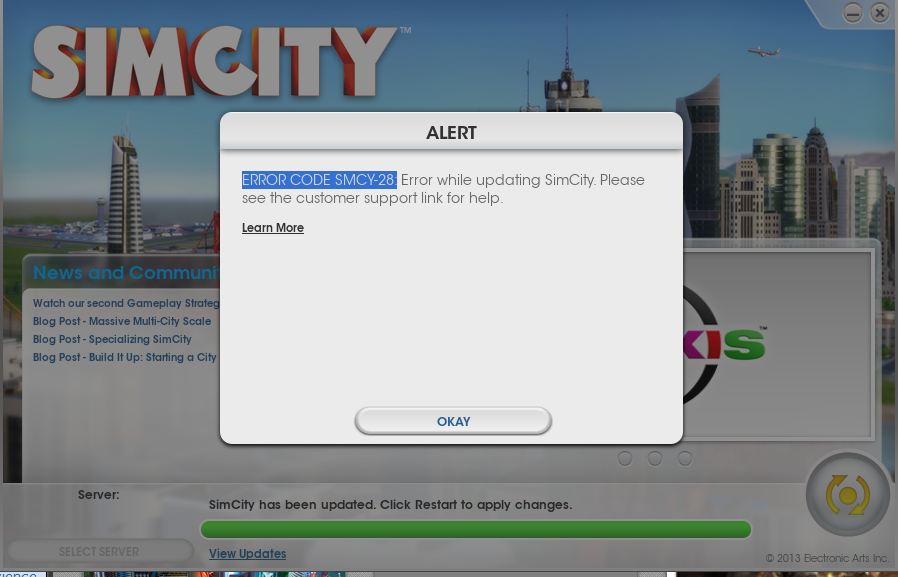
SimCity Error

SimCity is a series of error message dialog boxes, and also a game in there somewhere

A good DRM has to be invisible, and while it’s admirable that the developers of SimCity tried their best to add value to the always-online requirement, the end result is still a DRM that ruins all the hard work that was put into the game. A good DRM also needs to be field tested, as I’m sure the game is great when used on the mostly empty servers during beta testing.

It’s the little things that can makes gamers feel they’re being punished for some reason. For example, if there are online only saves, why not have a temporary offline save that can be queued for later upload if the servers are down? And if it’s not viable to have a full offline mode, then why not have a limited offline mode (a series of complex offline tutorials for example) that might keep users occupied while they’re waiting for a free server. Hell, even a mini-game might have helped!

Of course, all of this could have been avoided if EA had invested as much effort in traffic management as they did in coming up with ludicrous DRM!

From a DRM chair that nobody would really want, to a chair that everyone wants so much that they take part in what’s commonly referred to as a Game of Thrones. Yes, lame segue, but there you go. Game of Thrones is no stranger to the WNR. Not only is it one of my favourite sources of violence and gratuitous nudity (not to mention awesome storytelling and characters), it’s also very much linked to piracy.
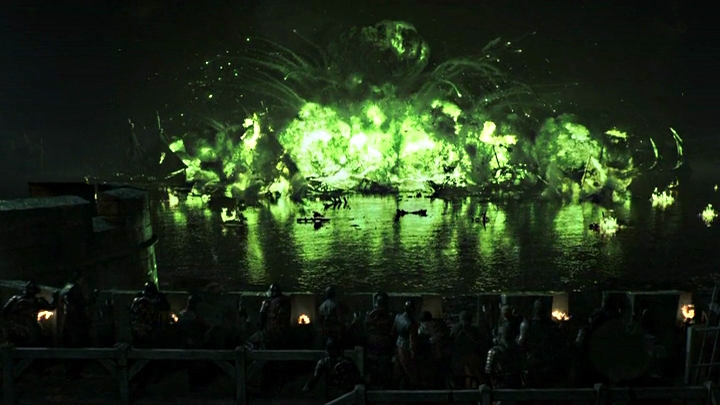
Game of Thrones - Wildfire

How pirates (the ship kind) are dealt with in the Game of Thrones universe

HBO isn’t a stranger to piracy either, and that’s mainly because their shows are some of the most pirated around. Their shows are pirated a lot because they make great shows, and also because not everyone can afford (or want to have) an HBO subscription. And without a cable/HBO subscription, it’s hard to source their shows legally from elsewhere, at least for the new episodes. That’s a perfectly fair thing to do though, as that’s their business model, and everyone should hope they continue to make money so they can continue spend it on shows like Game of Thrones. But the problem arises when access to a HBO subscription isn’t possible, or you simply want to give money to HBO without having to have a cable subscription (eg. via iTunes). Or it’s like in Australia, where once upon a time you had to pay the best part of $80 per month just for the pleasure of watching an episode a week after the same season has already ended in the U.S.

These artificial delays are a real piracy promoter. Most reasonable people are willing to wait a short time, say 24 to 48 hours. But a wait of weeks or months is not reasonable, and so it’s unreasonable to expect people to not seek alternative sources for the same content. Whereas once upon a time I might have pirated episodes of The Walking Dead, now, I watch the 33-hour delayed version on what amounts to basic cable here in Australia. It’s a delay I’m willing to live with, and the added value of not doing anything illegal, HD video, 5.1 surround sound and closed captions more than makes up for the delay and the annoying ad-breaks.

Which is why HBO’s anti-piracy policy for the upcoming season will see the network trying to remove artificial barriers and delays as much as possible. A noble effort, but I think one that will still ultimately mean a lot of pirated downloads. HBO shows are a premium commodity, and a lot of people, rightly or wrongly, just can’t justify spending so much in order to watch a TV show. I’m not saying this is right, it isn’t, but that’s the reality, and that’s what drives piracy ultimately. But for those that can afford it, and are now able to pay for it and receive the latest episodes in a timely fashion thanks to minimal artificial delays, then do it and keep HBO going strong!

——

With The Pirate Bay constantly on the lookout for a new refuge, as the Javert-like anti-piracy agencies pursue the Jean Valjean-like website across the vast digital landscape (sorry, just had to jump on the Les Misérable hype bandwagon), the website may very well have just found a new sanctuary: North Korea!

The irony of the situation wasn’t lost on The Pirate Bay, as it seeks the freedom to freely distribute information in a country where that very freedom is very much not a guaranteed type of thing, but their blog post described this as a necessary evil in their battle against US corporations.

Apart from the fact that the daily traffic of The Pirate Bay probably equals the yearly traffic for the entire Democratic People’s Republic, this story also failed the smell test on many other fronts, for many others. Including one blogger who went on to ruin it for everyone by confirming this is most likely a case of clever IP spoofing. Oh well, it was fun while it lasted.

Still, it would have been fun to see the RIAA/MPAA go after the North Korea government owned ISP that may have hosted The Pirate Bay. I’m thinking the DPRK government probably doesn’t respond too well to lawsuits.

And so that’s another WNR. The lessons learnt? Don’t buy the DRM chair. Don’t buy SimCity. Buy a subscription to HBO if you can afford it. And most importantly, buy my Pirate This app (or pirate it, like the title of the game says).

Update 1: Despite my advice above, I did end up buying a copy of SimCity, mainly because I’m still a huge fan of the franchise, plus it was on sale. After finishing downloading the 3GB or so of files from Origin at 3am, to my surprise, both Oceania servers were still full at that time. I will try again later today.

Update 2: I’m taking the next weekend off and going on vacation (for the first time in 7 years). So the WNR won’t be posted at a later time (most likely next Tuesday or  Wednesday).

Weekly News Roundup (3 March 2013)

Sunday, March 3rd, 2013

Welcome to another edition of the WNR. In my excitement last week, I forgot to mention that I got myself a new Nexus 4 to replace my ageing Sony Ericsson. I’m absolutely loving my N4, it’s hard to find much fault with it (the lack of LTE is a bummer, but I don’t have access to an LTE network with my telco at the moment anyway). What amazes me most is the fact that it comes with 2GB of DDR2 memory. I still have DDR2 desktop memory that cost me more to buy at that time than the N4, and they don’t even fit into the same small space that a N4 occupies.

On with the news …

Copyright

The UK is once again showing the rest of the world how it’s done in terms of domain blocking, with the High Court yet again issuing orders to block six more suspected piracy websites, including KickassTorrents and Fenopy.

This follows similar orders against Newzbin (and its resurrected mirror, Newzbin2) and The Pirate Bay, with these previous precedents contributing to how easily this latest order was handed down. UK’s biggest ISPs, who combined account for 94% of the UK broadband market, will have 15 working days to block these websites.

KickassTorrents Logo

KickassTorrents, one of the six new sites to be blocked in the UK this week

With such drastic actions being taken, I eagerly await news of the huge effect this will have on not just the piracy rate, but also revenue for all creative industries. Surely, with these “majors” taken out, revenue should go through the roof for the music, movie and gaming industries, who according to their respective copyright lobbies, are no doubt losing billions of pounds every year to piracy.

I suspect not only will I not see this news item pop up in my inbox, I don’t think anybody is even trying to measure the financial impact of these anti-piracy measures, and anyone trying to do so and coming up with the “wrong” results will be publicly attacked for being biased or incompetent.

France’s HADOPI agency has been somewhat marginalised in recent times, due to a change of government, and the fact that they’ve yet to produce any noticeable results (again, with respect to creative industry revenue, not just the piracy rate). Which means now is the perfect time for the costly and ineffective government bureaucracy to expands its mandate to cover direct downloads and streaming sites, by ways of domain blocking, seizures, financial blockades and even search engine de-listings. They’ve just written a list of recommendations on doing just this, which also includes taking legal action against third parties that refuses to cooperate (so if Google refuses to de-list Vimeo for example, and PayPal refuses to stop their dealings with the video website, then Google and PayPal can both be sued by HADOPI).

To me, these are all solutions to the wrong problem. The problem isn’t the piracy rate. The problem is the monetary losses due to piracy, and it’s amazing to me that we’re implementing solutions left and right without any effort to assess its impact (mainly because we all know the results won’t look good).

Speaking of implementing solutions to the wrong problems, after a delay of what seems like forever, six-strikes is finally happening in the land of the free. The Copyright Alert System (CAS) goes ahead this week, and the major ISPs participating in the program have only just revealed what exactly will happen after subscribers receive too many strikes (refer to link to see what each ISP has in store for you).

Verizon

Verizon is the only ISP to use speed limits in their “six-strikes” penalty regime

Unlike similar systems already underway in other countries, the penalties for excessive strikes will be set by each ISP, and luckily, none so far have opted for a complete account suspension (although this remains an option). Instead, the focus appears to be on education, to inform subscribers what they’ve been doing is wrong, and to let them know of legal alternatives.

So basically, it’s a multi-million dollars a year operation that is targeted at users who are proficient enough with the Internet to downloading tons of pirated stuff, but don’t actually know that what they’re doing is illegal, or know of legal alternatives that they are more than willing to pay for. Might be cheaper to just email the couple of users that fall into this category and tell them to stop it, no?

For the rest that are downloading quite deliberately, all of this will be more of a hassle than a deal breaker, that is if they use one of the ISPs participating in this program in the first place, and if they haven’t bothered to mask their activities from prying eyes (or use download methods not monitored by CAS).

A new report shows that CAS may just be too little, too late, at least where music piracy is concerned. But it’s not because CAS is far too limiting, it’s because there appears to be better ways to fight piracy. A new survey by the NPD group has shown a dramatic decline in piracy rates from 2011 to 2012, some 26% fewer downloads, from some 40% of users who say they’ve stopped downloading pirated music altogether.

Spotify Logo

Spotify and other licensed music services are dealing a blow to piracy, and also satisfying consumer needs at the same time

But instead of this being down to law enforcement action, most of those surveyed who said they stopped downloading say it was services like Spotify that helped them “get clean”. While 20% did say that the shutdown of their favourite piracy stops, and the threat of malware, had convinced them to start doing the right thing (or at least stop doing the wrong thing), nearly half said that legal alternatives were responsible.

And coincidentally, this same week, the IFPI release their annual Digital Music Report, which showed that music revenue rose 0.3%. A small rise, but the first annual rise since 1999. The rise was largely attributed to the rise in digital music spending, up some 9% in 2012. Even the IFPI, a staunch supporter of tougher anti-piracy action, noted that “licensed music services”, such as Spotify, are “demonstrably meeting consumers’ need”. Who’d have thunk it that “meeting consumers’ needs” was a better way of fighting piracy than simply clamping down on those very same piracy service that had been filling the void by “meeting consumers’ needs”.

And it’s also interesting to note that despite a 26% decline in piracy rate, only a 0.3% increase in revenue was recorded. The relationship between piracy and revenue is definitely not one to one, it seems.

If laws and monitoring isn’t working, and you can’t be bothered coming up with legal alternatives, then there’s always DRM! Another week, another anti-piracy patent by Sony. This new patent apparently uses game loading time as a way to detect if the game is pirated or not.

I guess how it would work is that there’s a database of game loading times for the legit copy of games, but if a game is being loaded too quickly (ie. it’s not being loaded from BD, but from a hard-drive), then that would see the game flagged as a pirated copy and loading blocked. Games that take too long to load (eg. from a DVD rip instead of an original BD copy) can also be flagged this way. The system does take into account different media types (eg. flash drive loaded games, versus downloads versus discs).

The obvious problem with this system is that sometimes legit discs can take too long to load too, because the disc may be damaged from wear and tear, or your PS3/PS4 is just having one of those days. It also doesn’t prevent those making piracy-enabled firmware to artificially delay game loads from HDDs to emulate an actual disc load. So anti-piracy wise, it’s unlikely to do much, but it may very well inconvenience many owners of legit copies.

“But this being a patent application means that it is just as likely to never see the light of day as an actual application, but you do have to give Sony credit in finding new and more annoying DRM” is what I posted the last time an anti-piracy patent related story popped up, and the same goes here.

And so we come to the end of another WNR. Hope you’ve enjoyed this issue, see you next week.

Weekly News Roundup (24 February 2013)

Sunday, February 24th, 2013

So a big week this week, with the PS4 being “unveiled”. I don’t know who thought it was a good idea to launch a console without having a console to show off, but kudos for all those involved that went along with the event, which had a “shit, I didn’t finish my homework – Oh well, I’ll just wing it” feel to it. The news about the lack of a console ended up overshadowing the launch slightly, and in my opinion defeats the purpose of getting one on Microsoft by “unveiling” earlier, and makes the whole thing feels amateurish and rushed. And perhaps I’m the only one underwhelmed by what that PS4 brings to the table – I mean a faster game console with better graphics is always cool, but people expect more than that for a new console these days. Microsoft is said to have their own unveil in April, or June at the lastest (at E3), so it will be interesting to see if the Redmond giant has gone with the “more of the same” approach as per the PS4, or whether they will try and surprise us with what’s on offer (AR glasses, a Kinect that can do fingers …).

Not too much news this week, especially if you discount the PS4 stuff, so we’ll get through it in no time.

Copyright

The RIAA is not too pleased with Google’s anti-piracy demotions, presenting research that shows the worst music piracy sites are still ranking well in Google.

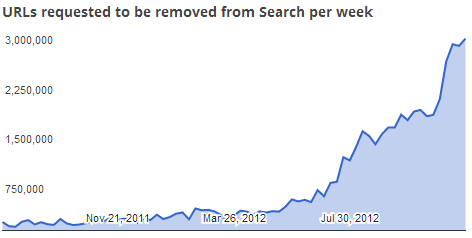
The research appears to show that for sites that are deemed as “serial infringers” (according to Google’s own publicly available data) are still consistently ranking on the first page or in the top 3-5 results. This may sound like Google isn’t doing anything about piracy, but as I explain the article linked to above, the “serial infringer” signal is only one of thousands of “quality signals” that Google looks at, each with its own weight in terms of importance. The most important signals will always be site popularity and the number of incoming links and piracy websites are usually pretty good in these two areas, much more so than legal websites.

Google DMCA Stats

RIAA says Google isn’t demoting popular piracy websites, despite promising to do so

For Google though, the demotion has to balance the appeasement of groups like the RIAA, and the search experience of users. The sad fact is that most piracy websites will be a much better match than what legal websites can offer, so from an user experience point of view only, it makes no sense to have some random blog that features a single line about an artist/song on page one, but having a link to listen/download the song on page 2. If the RIAA really wants piracy websites to be pushed to page 2, perhaps it should help fund the creation of new legal and relevant websites that are good enough to be deemed first page worthy.

Also, from my own personal experience, once a result ranks outside of the top 2, there will be hardly anyone clicking on those links. So while Google may still rank piracy websites on page one, or in the top 3-5, if these links were number one prior to the demotion, then the demotion is working exactly as intended, and traffic to these piracy websites should have been reduced dramatically. Of course, the RIAA would not really want to point out that, despite Google sending maybe 80% less traffic to these music piracy websites, the actual effect on music sales and even the piracy rate may be negligible. It may just mean that people will shift to using another method to get their pirated music, bypassing Google the process (I don’t think Google is the main avenue for people seeking pirated stuff these days, not when they already know of sites like The Pirate Bay). The increasing popularity of Spotify may have more of an effect on piracy rate than anything Google can do for the RIAA.

But Google’s appeasement policy will continue, as it tries to shift focus away from its search results. A report by the UK’s Telegraph suggests that Google is thinking about linking up with financial services providers, such as PayPal, Visa and Mastercard (for example), to cut off the funding source of suspected piracy websites. No details about how exactly this will work, but my guess is that Google will pass on its DMCA takedown data to these financial companies, and get them to suspend any accounts associated with these websites. Focus shifted.

——

The issue of DRM for eBooks has been raised again this week after a group of three independent booksellers filed a class action anti-trust lawsuit against Amazon and the “Big Six” book publishers. The booksellers allege that Amazon’s market dominance, and their insistence on using a proprietary DRM system that cannot be used outside of Amazon apps and devices, and along with the major publisher’s reluctance to allow smaller booksellers to sell eBooks either DRM free, all amount to a violation of the Sherman Act.

No DRM

Is Amazon’s DRM being used to monopolize the eBook market?

But while this seems like a crusade against DRM, one that unfortunately seems like un-winnable given the fact that the DoJ has investigated similar claims and found little reason to take further action against Amazon, what the booksellers want isn’t actually a DRM free utopia, but just a DRM ecosystem they can get their teeth into. While they would love it if publishers agreed to sell books DRM-free, the reality is that this isn’t really going to happen. Instead, the booksellers want to either be able to sell eBooks that contain Amazon’s DRM, or for Amazon to start using a DRM that they can also deploy too. And then for all the other major eBook sellers, like B&N with their NOOK device, to follow suit. Good luck to them, and you do feel for the smaller players in the eBook market, but this really is an uphill battle.

The truth is that the current situation isn’t that good for publishers either. Due to Amazon’s dominance in the marketplace, publishers basically have to do whatever Amazon tells them to do, since the entire ecosystem, from the store, to the file format, to the DRM and to the device/app, are all controlled by Amazon in one way or another. This can allow Amazon to use their market position to force publishers to agree to a lower share of the revenue, which is good for the consumer as this will lower prices, but not so much for competitors, and for the publishers and authors themselves. But with no harm coming to consumers (yet), it’s a really hard case to argue, and so this is yet another example of DRM being used for a purpose other than copyright protection.

Gaming

So the big news of the week was Sony’s PS4 launch, and it was one of the weirdest console launches events ever. It wasn’t so much of a console launch event, as an event that announces the eventual console launch event, because the console itself wasn’t actually present. This is despite Sony promising the console will be available by the end of the year, but it is kind of worrying that perhaps only 9 months out from being able to buy one, Sony are unable to even show us a prototype of the console’s plastic shell.

The only pieces of hardware they were able to show off were the controller, details of which, including photos, had already been leaked pre-event, and a new PS Eye camera. The new camera accessory that will work in conjunction with the controller’s new “light bar” for motion sensing and player detection (whether this will work more like Kinect, or like the current Move controller, is unknown at the moment). All fairly underwhelming and anti-climatic, to be honest, thanks to the pre-event leaks.

PS4 DualShock 4 Controller

A console launch event in which only the controller is unveiled? Weird.

Hardware spec wise, the PS4 looks like a real monster, and some of the game demos looked fantastic as well. The x86 based CPU will complement an AMD based GPU and 8GB of DDR5 memory, specs that already make the recently launched Wii U look decidedly last-gen. The launch games are looking good too, with the eagerly awaited console debut of Diablo III, plus more games from Sony’s own franchises, including new Killzone and Infamous games.

For those worried about a block on second hand games, everything looks okay again as Sony denied that this will be part of the system. Cloud based gaming will be a big feature for the PS4, with PS3 and previous console titles being made available this way as a form of backwards compatibility. Instant play will allow games and demos to be played without pre-downloading too. For those without a fast Internet connection, which is pretty much most people here in Australia, games will still come on discs, and the PS4 will still play Blu-ray (kind of a given, there).

So plenty of info at the event, without the very thing most gamers wanted to see. Typical of Sony to screw something like this up though, something Xbox’s Major Nelson (aka Larry Hyrb) was keen to take advantage of. I guess they may be learning the lessons from the PS3 launch (in that it was a year later than the Xbox 360), but not sure having an earlier launch event (and one that’s missing the actual launch item) gives you much advantage if both consoles are going to be launched at roughly the same time.

That’s all we have for this week. See you in seven.

Weekly News Roundup (17 February 2013)

Sunday, February 17th, 2013

A belated Happy Chinese New Year of the Snake. I was born in the year of the Monkey, and they say only the Monkey can handle Snakes, so all your Snakes better behave yourselves. Those born in the Year of the Snake should also wear something red on them at all times to deflect bad luck, preferably something given to them rather than something they’ve bought themselves.

In this first WNR for the Year of the Snake (technically not true), there are quite a few news items to go through, so let’s get started.

Copyright

Joining the list of people who really shouldn’t be downloading pirated videos may be FBI employees, caught downloading hit TV shows such as Homeland and Dexter. They join employees from Hollywood studios, the DoJ, congressional offices, national parliaments, anti-piracy lobbyists and many other places where they’re pretty sensitive about this whole Internet piracy things.

And even if they weren’t downloading at work, something most people would probably not do, many are probably downloading in the privacy of their own homes.

While this highlights how widespread the “problem” of piracy is, to me, this isn’t actually reason to take harsher action against it. I liken this Piracy Plague® to jaywalking, something that almost everyone does (while knowing they probably shouldn’t), and that they do get in trouble if they’re caught doing it, but in the grand scheme of things, it’s not exactly a high priority for law enforcement (even though jaywalking, unlike pirated downloads, can lead to a life and death situations, so it’s actually more serious than piracy will ever be). I guess the difference is that there is no such thing as an anti-jaywalking lobby group (Car Manufacturers of America? ), so nobody cares.

The other major difference being that there is no monetary loss involved, although that’s debatable with piracy as well.

But there also exist a difference in solving these two problems. If it is identified that people are jaywalking in particular area, and it’s leading to a public safety issue, I would hope there’s an effort to find out why people are jaywalking excessively in this area, but not in others. Perhaps the lack of pedestrian crossings could be the issue. But for piracy, there’s strong pressure against finding out why it happens, with the focus is instead on labeling people who download as criminals, and leveling penalties against them. So instead of adding a pedestrian crossing to fix the problem, the focus would instead be on an ad campaign linking jaywalking to terrorism or something like that, and then setting up a hidden police presence around the corner and fining those that get caught, all the while ignoring the real cause of the “infringement”.

SoShare Logo

SoShare promises to combine the best of cyberlocker storage with BitTorrent technology. It might run into some legal headwind, mind you …

But soon there may be a new and better way for these FBI agents to get their Homeland fix. BitTorrent Inc has launched a new cyberlocker storage service that promises unlimited uploads, and unlimited transfer limits, and uses BitTorrent technology to speed up downloads. The new service, SoShare, has just been made live as a public beta test, and only requires a browser plug-in in order to utilize the BitTorrent based enhancements.

SoShare works by allowing the the uploader and downloaders to use their own bandwidth to help other downloaders speed up their downloads, much like how BitTorrent works. A master copy of the file is also store on SoShare’s servers to allow downloading to continue even if the original uploader is not online.

So with BitTorrent coming to the under pressure cyberlocker scene, the most immediate question that comes to mind, at least for me, is the copyright question. A quick look at SoShare’s copyright policy shows all the typical DMCA related information, but as SoShare does store a copy of the uploaded file, therein lies the danger from a copyright point of view. SoShare will have to be extra responsive to DMCA takedown requests to protect themselves. So far, the service is offered for free, with no monetization and no financial incentives for uploaders, which should also offer some additional protection if the service is ever accused of “incentivizing” illegal uploads.

But for downloaders, SoShare downloading may be a better bet privacy wise than BitTorrent downloads. While not much is known about how exactly the service works, one would hope it does not easily make public the details of all connections to the download swarm like BitTorrent naturally does.

——

In other news, The Pirate Bay is threatening to sue an anti-piracy group for copyright infringement. And no, I did not mix up the subjects in the preceding sentence.

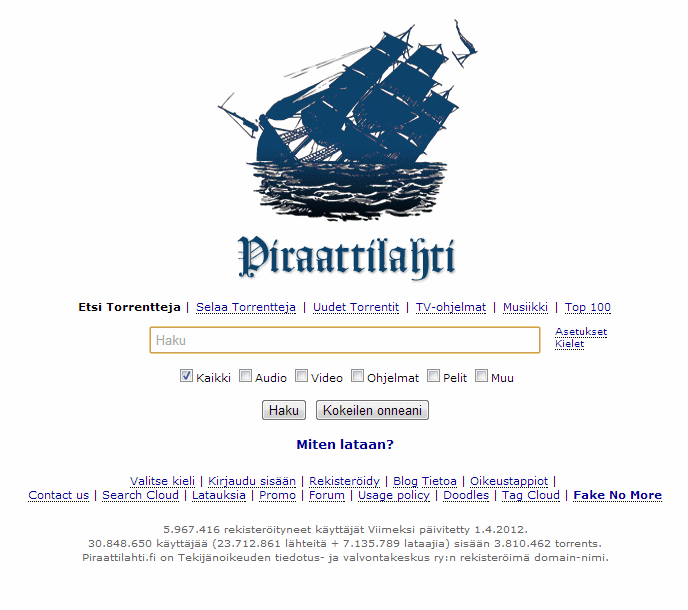
Fake Pirate Bay

This “fake” Pirate Bay, set up by an anti-piracy agency, may be infringing on the copyright of the real Pirate Bay

This all started when Finnish anti-piracy group CIAPC launched a spoof website that imitates the look and feel of The Pirate Bay, in a perhaps misguided attempt to educate the masses about the legal alternatives to piracy. The problem though is that the website wasn’t so much an imitation, but a downright like for like copy in many instances, included the CSS file, which was virtually identical to the one used by the real Pirate Bay. So much for educating others to respect copyright!

This blatant theft, which is against The Pirate Bay’s usage policies, has prompted The Pirate Bay to consider taking legal action against CIAPC, if the group does not “move on”, not just from the spoof website campaign, but from copyright enforcement in general. With The Pirate Bay generally supporting a copy-free ideal, their threat definitely did have the feel of a “not sure if serious” vibe to it. Look here, I for one would love to report on ironic lawsuits, just as long as TPB people do indeed make clear that irony is a clear intent (unlike a certain Mr. David).

Regardless, the CIAPC does deserves everything bad that happens to them, as these are the same people, if you can remember, that raided the home of a 9 year-old and snatched away her Winnie the Pooh laptop for the heinous act of downloading a song.

And in ominous news of the week, the W3C has asked the HTML Working Group to consider adding native DRM support to HTML, to placate the likes of Netflix, BBC, Google and Microsoft. These majors are hoping for a native HTML 5 solution to web video streaming, but that can only happen if DRM is present. To be fair, the requirement for DRM does not come directly from these companies, but from the overly paranoid content producers that supply these companies with content. No DRM, no content.

Gaming

The January NPD US video game sales report has been released, and it’s grim reading for Nintendo’s new flagship console, the Wii U. As per the course, Microsoft’s Xbox 360 remained the best selling console for the month, with 281,000 units sold. This is actually up on January 2012, but only because of the 5-week and 4-week reporting difference between the two Januarys.

With Sony not providing any hardware sale details, but based on the Xbox 360’s “44 percent share of current-generation console sales” figure, that would most likely put the PS3 at around 200,000 units sold, and the Wii at slightly more than half of this.

Which makes the Wii U’s 57,000 (a figure that comes from sources that have access to more detailed NPD reports) rather pathetic. As a comparison, the original Wii sold 435,000 units at the same time in its release cycle, and that was with stock shortage constraints in place. The Wii U, being widely available in stores, is already looking like a flop given the dramatic fall-off from the early sales figures. Still, it’s probably too soon to tell if the Wii U is dead in the water, but unless Nintendo have some killer must-have games and apps out in the next few month, it’s not looking good at all.

Xbox 360 Kinect vs PlayStation Move

Kinect beat Move because of Sony’s “stumbling failure”, more so than anything Microsoft did, according to engineer who designed the original Xbox

With such dismal numbers for the Wii U, and the Xbox 360 selling 5 times as many units, it almost feels churlish to talk about this next story. With 76 million units sold, and one in three of them having a Kinect camera connected (albeit perhaps not used … based on personal experience), and with 46 million members connected online, can the Xbox 360 and the Xbox platform really be considered a failure? Apparently it can be, according to one of the engineers that started this whole Xbox project, Nat Brown.

Brown describes the last couple of year’s development of the Xbox platform as “painful to watch”, mainly because the console will lose the “living room war” to the likes of Apple and Google, unless “somebody with a brain” starts running things.

Nat notes the biggest problem with the Xbox platform is one, indie development, and two, a good user experience. It’s worth noting that both of these areas are where the likes of iOS and Android shine, and Nat says that what Microsoft is doing simply isn’t good enough.

And Nat has a great point. Android development can be started with almost zero cost, and apps can be published for not much more. iOS development is a bit more expensive due to Apple’s more stringent requirements regarding coding environments (ie. Mac only), but it’s still well within reach for most semi-professional coders and cashed up enthusiasts. But more importantly, apps published on both platforms are given plenty of opportunities to be found and are actively promoted. On the other hand, Nat says Microsoft offers indie developers very little help in terms of accessibility, support and promotion, which has alienated “a generation of loyal kids and teens to making games” (not just kids and teens, but also 30-something guys with too much free time on their hands).

Nat’s other big gripe with Xbox is the user experience, the inconsistent nature of it all, and how counter-intuitive it can be given today’s more casual user base. Anyone who has tried to access the initially heavily promoted Kinect Fun Labs on the new Xbox 360 dashboard will certainly agree with this point – the fact that someone had to write a guide on how to access it shows how the UI has failed.

But to be fair to the Xbox 360, none of the other consoles are doing much better, a point Nat concedes as he also says that Microsoft’s recent successes have been due to the “stumbling failure” of Sony and Nintendo (Kinect vs PS Move, and the Wii in general). Might as well add the Wii U to that list of “stumbling failures” too, I suppose.

And with that, we come to the end of this week’s WNR. Hope you’ve enjoyed reading it more than I enjoyed writing it (well, given that I didn’t enjoy writing it, it’s kind of a low bar). See you next week.

Weekly News Roundup (10 February 2013)

Sunday, February 10th, 2013

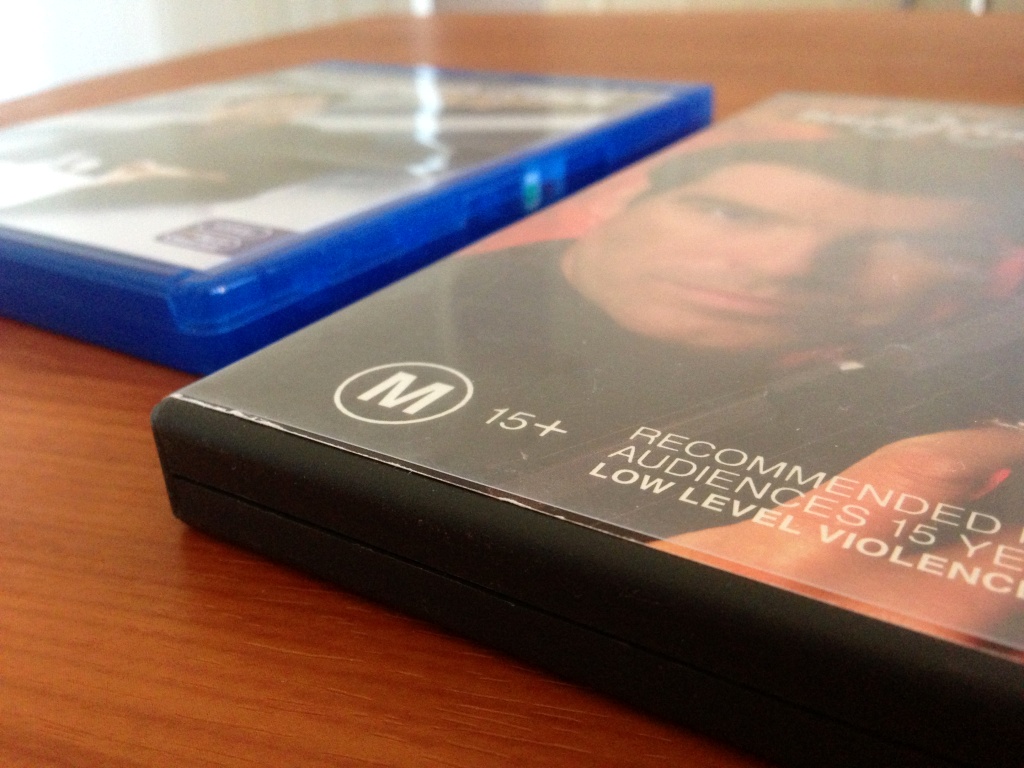
It’s surely some kind of milestone for me this week, as I’ve obtained the Blu-ray copy of a movie that was the first one I purchased on DVD. Back in 1999, when DVD was first launched here in Australia, there wasn’t much choice in terms of movies you can buy on DVD. In fact, you were lucky if the store had any at all, and even luckier if you had more than a dozen titles to choose from. Tomorrow Never Dies was the movie that I chose to be my first ever on DVD (incidentally, Daniel Craig’s Casino Royale was the first Blu-ray that I owned). And you can tell this was an early release because it listed “chapter search” among the special features.

Tomorrow Never Dies DVD and Blu-ray

My first DVD purchase from 14 years ago, and its Blu-ray replacement

I didn’t buy my first standalone DVD player (for $USD 1,000, no less) until much later that year, and I only had a computer with a DVD-ROM drive that wasn’t powerful enough to play the DVD without skipping a few frames now and then. But it was all great fun, mixing and matching software decoder filters and players and squeezing just extra bit of performance just so you can reach the magic 25 frames per second playback rate. A few months after my first DVD purchase, I started this very website in the hope of sharing all that I’ve learnt about DVDs.

But back to Tomorrow Never Dies. The 4.03 GB worth of MPEG-2 and Dolby 5.1 goodness on DVD has now been replaced with 41.3 GB of MPEG-4 AVC deliciousness and a pounding DTS-HD Master Audio 5.1 soundtrack. And despite Bond fans and critics generally dismissing the movie as middling at best, Tomorrow Never Dies remains one of my favourite movies for the sole reason that it introduced me to the world of DVD, almost exactly 14 years ago.

Oh yes, the news …

Copyright

It’s not often that I link to a Pirate Bay torrent here for you to download, but this one happens to be a must-watch, and it also happens to be legal. You see, this is a torrent to a documentary titled TPB AFK, about the infamous Pirate Bay trials and the people who were caught up in it all. You can also watch it on YouTube.

I haven’t seen the film except for snippets here and there, but for anyone interested in just what happens when one of these things actually go to trial, I’m sure it will be very interesting. I did see a clip regarding the personal attacks aimed at a professor who testified in favour of TPB co-founders. It’s a tired old tactic used by Big Money whenever someone questions their ideology, but despite the constant pressure, we are still seeing more and more research back up the idea that piracy isn’t as damaging as being hyped us, and that it might even have some positive things to contribute to the creative economy.

Nice gesture by supporters of TPB to send flowers to the home of the professor though …

——

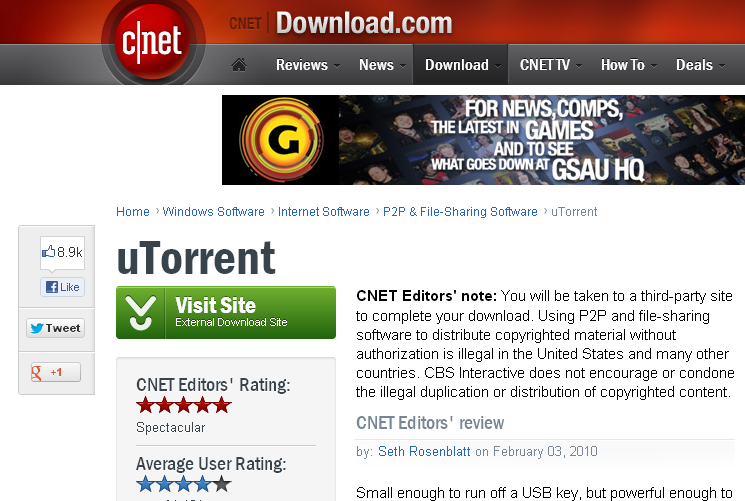
CNET Download.com uTorrent

uTorrent, one of the most popular BitTorrent clients, is still available on CNET’s Download.com – but for how long?

Maybe this is exactly what Alki David had in mind when he sued CNET’s Download.com for distributing LimeWire – to force CNET’s parent company, CBS Interactive, to come out and mount a legal defence of peer-to-peer downloading technology. This is exactly what happened this week when CBS/CNET file a motion in court defending their distribution of BitTorrent clients, citing all the reasons that readers of this news roundup should be familiar with.

In case you haven’t gotten your head around this ultimate case of irony, CNET’s parent company is also the same company that owns the major Hollywood studio, Paramount. This is probably as close as you can get to hear Hollywood come out and defend BitTorrent!

I would like to assume this is what David and co had in mind when they asked the court to grant them a preliminary injunction against CNET from distributing all BitTorrent clients, that this moment was what David, a former victim of Hollywood’s own crusade against tech innovation, had wanted from day one. I would like to think this, as otherwise, this is a very dangerous path that has been taken and the repercussions could be severe if the court somehow finds a distribution technology to be liable for what is being distributed using it.

Still, it was funny to see CBS come out and make all the right points about BitTorrent, of its legal uses in the field of research, entertainment and even political freedom. But to be fair to Hollywood and major rightsholders, they’ve never  focused their efforts on going after BitTorrent, the technology, because I suspect it’s not the kind of thing that’s going to hold up in court. So there’s still hope that common sense will prevail in this case.

Not going after the technology, but going after those who use it illegally can also be fraught with problems too. With the U.S. slowing coming under their own six-strikes regime, it’s worth having a look at the same regimes in other countries to see just what may be in store. New Zealand has one of the toughest copyright laws and their own three-strikes system, but apparently, after 16 month and more than $USD 200,000 spent, all that the NZ version of the RIAA have to show for it is just over $USD 500 in fines received, from a single person.

Three Strikes

Three-strikes in New Zealand hasn’t really produced the right results

And that single person even denies being a major downloader, having little or no knowledge of how BitTorrent actually works (including that an upload component is included with every download).

RIANZ, New Zealand’s version of the RIAA, has defended the $NZD 250,000 cost, 60% of which went to sending out some 6,000 notices to Internet subscribers, saying that people who receive notices are less likely to continue downloading, which they will probably feel is worth the $25 per notice fee that has been imposed on them by the government (for their part, they want the fee lowered to $2). RIANZ even claimed last year that piracy rates have halved in New Zealand since the introduction of the law in September 2011.

Similarly, the France three-strikes experience also led to claims of a dramatic reduction in pirated downloads. It has been reported that the French have already spent millions of euros on their “Hadopi” system with few successful prosecutions.

Of course, not a single person has presented any evidence that music sales have increased thanks graduated response efforts in New Zealand, France and elsewhere. And even the claim of a reduction in piracy can be questioned, since I’m sure many have simply employed encryption or migrated to other downloading methods to avoid detection.

And there we have it, another (fairly short) edition of the WNR done and dusted. See you next week.