Archive for the ‘PS3, PS4’ Category

Weekly News Roundup (29 March 2009)

Sunday, March 29th, 2009

Finally found a bit a free time to diagnose and fix my P4 system, which has graphics corruption problems. Changing the graphics card seemed to have solved it (was thinking it might have been a power supply problem, which it may still be). I also took the opportunity to upgrade the graphics card to a Blu-ray decoding capable one, just to see if the old dog can still learn a new trick or two. And it could! While if you do the maths, it’s probably not worth to spend too much money on an old P4, not when you can get a brand new system up for not much more, but there is an odd kind of attraction to see such an old system play Blu-ray movies perfectly.

Copyright

Starting with Copyright news for the week, RealNetworks has stated that they never thought they would get sued for marketing a DVD copying software, not when it adds even more DRM I suppose.

RealDVD: The "Real" crime is not the copying, but the new playback mode

RealDVD: The "Real" crime is not the copying, but the new playback mode

What RealNetworks didn’t get is that it’s not about the copying at all. Controlling how the user interacts with the material, whether it leads to piracy or not, is the best way to protect your income stream. If there exist a system where the user has to pay for each use of the content, where they don’t own anything, but rather, only rents the content, then that would mean a steady and continuing income stream. The content owners will never get such a system, not when people are already used to “owning” content, but they can at least try to limit what you can do with the content. What RealDVD did was to allow the content to be used in a manner in which the content owners did not approve of – it will lead to no more piracy than the current DRM scheme (because DVD CSS doesn’t work) – and that’s their biggest “crime” here. The question is, once you’ve purchased the DVD, and you’re not allowing piracy to occur, do the content owners even have a say in what you can and cannot do from this point onwards? This again goes back to the point of fair use, of whether backups are allowed to be made, and all the same arguments have been going on since the turn of the century.

With three other major Bittorrent lawsuits going on, or about to start, at the moment, TorrentFreak catches up with the owner of TorrentSpy, one of the first torrent sites to go down in the courts, to see what’s happened in the year since.  TorrentSpy are still appealing a massive $110m ruling against them, and it’s an interesting read on just how the legal system works and how perhaps all the cards are stacked in favour of content owners, because that’s where the money is. This is especially true in the US, where $47 million dollars were given to politicians by the entertainment lobby – you can just imagine the amount of influence this buys, from both side of politics. We can only hope that because the other torrent cases are outside of the US, that their legal systems will produce a fairer judgement. 

A big week for the RIAA, as its threats against ISPs worked

A big week for the RIAA, as its threats against ISPs worked

It’s a bad news week for Internet users as several large US ISPs have agreed to work with the RIAA. There is still a lot of confusion as to what this actually means, but Comcast and a few others have denied that this means the introduction of the three-strikes system. What is clear is that they will be spying on their paying customers for the benefit of large corporations. There’s simply no other way to put what is happening, and I hope it frightens you as much as it does me. But monitoring can only go so far. The Pirate Bay is trialing a new secure system where it would be impossible to track usage. This is nothing new, because today’s torrent network is much harder to track down and stop than yesterday’s simple P2P services. If stopping piracy is the goal here, then the ever increasing monitoring and lawsuits will only lead to systems where it would then be impossible to track or stop. The ironic thing is that if the government was doing this spying, instead of anonymous multinational corporations, there would be a huge outcry. And there may still be, but so far, the ISPs have caved in rather quickly.

The developers of World of Goo, a popular puzzle game, has said that DRM is essentially a waste of time. If anti-piracy technology does not stop piracy at all, then this is the only conclusion one can come up with. Valve’s Steam game download service, always critical of DRM, will also come up with a new distribution system that will make DRM obsolete. It works by generating unique versions of the game for each users, so in essence, it is still a form of digital rights management. But it won’t have the usual trademark of DRM, which is the  inconvenience it causes to legitimate users. You can’t blame publishers from wanting to stop people copying their games illegally, but you can blame them if they inconvenience legitimate users, and so if DRM exists where it’s transparent to users (and doesn’t impede on their privacy), then any argument you make against it would then be an argument for piracy, which is not what anti-DRM people are trying to do. In more bad news for DRM, the FTC has come out to warn content owners to restrain themselves when it comes to DRM usage, and not let it get out of control like the whole Sony rootkit incident, or the recent EA Spore disaster. It looks like EA is finally listening though, because Sim 3, their next big PC hit, will only come with standard disc/serial based DRM that has existed since the days of CD-ROMs. So overall, a good week for the anti-DRM movement, but unfortunately, content owners are already moving quickly to find another way to infringe on our rights with the Big Brother ISP monitoring programme being implemented. 

High Definition

Onto high-def news. Disney did something interesting during last week, where it released the Blu-ray version of Bolt two days earlier than the DVD version, in a move to help out the HD format.
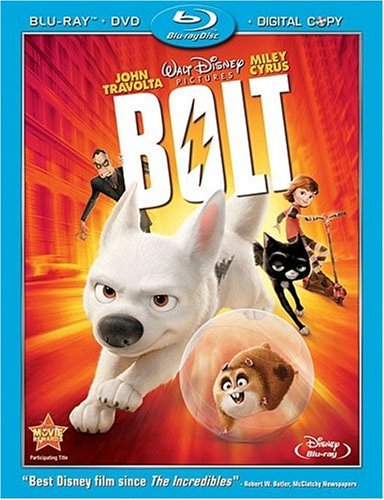
Bolt: Early release on Blu-ray caused confusion

Bolt: Early release on Blu-ray caused confusion

Unfortunately, it seems to have backfired with many stores having to break the release date of the DVD version as confused customers turned up to buy the movie, only to be told that the Blu-ray version is the only version available. Blu-ray supporters will see this as a good move to promote Blu-ray, but anything that prevents people getting what they want when they want it will almost always backfire. This is something that might work when BD has 50% market share and it only needs a small push to get over the line, but when it has at best only 10% market share, you are effectively denying 90% of buyers from buying, all in the attempt to push a format that they are not ready to buy into. More evidence that is has backfired because Bolt barely made it into the weekly Blu-ray top 10, outsold 4-to-1 by Disney’s simultaneous Blu-ray/DVD release of Pinocchio. Of course as it was released rather late in the data period so it may do better next week, although it’s market share of 19% compared to the DVD version is a bit confusing, as the DVD version wasn’t supposed to have been released until the next reporting week. 

Warner Bros. is opening a DVD-on-demand service, for rare films that are not worth publishing through normal channels, but still may have some demand. The “what you want, when you want it” principles behind this is very sound, and just imagine how easy and cheaper this system would be if instead of on demand DVD pressing, that digital distribution was used. Criterion already has such a digital system operating, called Criterion Online Cinematheque. An on-demand pressing service may very well be the only future optical discs have, if digital gets its way. 

GamingAnd finally in gaming, Sony has finally cut price to something PS3 related. Unfortunately, it won’t affect consumers (directly), as it is only a price cut to the development kit. Still no sign of an official price drop for the PS3, despite every sign showing that it needs one badly.

And that’s all we have for this week. Thank-you for reading. Hope I didn’t waste too much of your time by ranting on about this and that, which is very easy to do when you’re sitting in front of a keyboard sometimes. See you next week.


Weekly News Roundup (22 March 2009)

Sunday, March 22nd, 2009

Twice this week I wrote “2008” as the date. It’s funny because I was pretty clear that it was 2009 back in January and February, but I seemed to have forgotten that fact now we’re in March. March Madness, as they say. I did the NPD analysis for February 2009 yesterday, pretty much the same old story with a bit more positive spin for the PS3, but not enough to make it outsell the same period in 2008 (looks like I’m not the only one pining for 2008). There’s more bad news coming the PS3’s way, as you’ll find out later on.

Copyright

But before we get to that, let’s go through the copyright news first. The story of the week (well earlier on anyway) was Apple’s new iPod Shuffle that seems to have a DRM chip on it.

This caused a bit of a stir as expected, but Apple later came out and denied that the chip would be used for anti-piracy measures. Instead, the chip is used to authenticate third party accessory licensing, making sure third party products go through Apple’s licensing scheme. Not really sure if this is any better than anti-piracy DRM, to be honest. 

When I made a list of all the major copyright trials going on at the moment, I forgot about Mininova’s trial which will start in two month’s time. So that’s IsoHunt (Canada), iiNet (Australia), The Pirate Bay (Sweden) and Mininova (Netherlands). Looks like a very international operation is happening to rid the world of nasty pirates, except in Australia’s case, it’s actually an ISP (and one that responds to infringement notices like most other ISPs around the world). But iiNet apart, it looks like all the major torrent sites are being hit in a co-ordinated effort by various agencies, but of course illegal torrents are now even more popular than before, and still being offered on the above sites. And if they fall, others will take their place. 

Google: Most DMCA complains are illegitimate

Google: Most DMCA complains are illegitimate

So while going after the distributors of torrents, the powers that be will also go after individuals (through threatening ISPs), with the so called “three strikes” rule being their current modus operandi. Basically this means that if they detect infringement activity, they will pass it on to the ISP which will then warn the user for three times before automatic disconnection occurs. The ISPs are supposed to absorb the cost of doing this, which only means they’ll pass it on to users. Google has also spoken out against this method, calling it disproportionate. In many cases (far too many cases), the infringement may not even have occured, or was done by someone who did not own the Internet connection (Wi-Fi stealing neighbour, for example). And without an appeals system, many legitimate users and businesses will be disconnected and there’s nothing they can do about it, other than to sue for damages. And of course, they’ll be up against teams of lawyers with unlimited funds if they do go to court. Imagine a court where the prosecutor is also the judge, and you do not get to defend yourself and you have to pay for everything, and this is pretty much what the industry want . Google has a lot of experience with how such a system would not work, as it handles DMCA complains regarding its own listings. The DMCA allows for content owners to send “takedown” notices to sites like Google, asking them to take down infringing content, which in Google’s case is usually just links to piracy websites. Google has to process each request, and they have come out with the unbelievable statement that most DMCA takedown notices are in fact illegitimate. 57% of these notices were done to get rid of competitors, while 37% were not valid copyright notices at all.

Back to Australia, where the government is on a crusade to censor the Internet worse than the worst of Internet censoring countries. They even produced a blacklist of all the sites that would be banned, which included quite a few legitimate ones as they always do, and also blacklisted sites that have published the blacklist. And linking to any of these sites, including the legitimate dentist’s website, or the tour operator, or the sites that have published the blacklist, could cost the website operator a $11,000 per day per link penalty. This is because in Australia, linking is considered as bad as hosting the content, whereas other countries do make the distinction. Technically, this could apply to Google, which in their huge database probably links to all the sites on the blacklist, and so in the face of the severe penalty, may have to withdraw from the Australian market if indeed the government gets its wish of a national filter scheme. If this scheme became a reality, you can just imagine the 57% of complains to get competitors added to the blacklist, can’t you? 

High Definition

Onto happier HD news. Is DVD better than Blu-ray? IGN seem to think so, and they’ve published an entire article going through the various reasons.

Oppo BDP-83: The most fully featured Blu-ray player so far?

Oppo BDP-83: The most fully featured Blu-ray player so far?

I don’t think it’s a case that DVD is better than Blu-ray, but more that DVD is a *better option* than Blu-ray *at the moment*. Much in the same way that a Core 2 Duo is “better” than an Core i7. Nobody is saying that Blu-ray isn’t superior to DVDs, it’s just that perhaps it has some ways to go before it really is the must have, economical, option to home videos. For one, the current range of Blu-ray hardware has a lot of room for improvement, and prices can still come down even more.

But the hardware situation may change soon with Oppo now getting into the Blu-ray game. The Oppo BDP-83 may be the first universal Blu-ray players with excellent DVD upscaling, and comes at a price that won’t require starvation at some point in the near future. It supports BD-Live, decodes all the HD audio formats, plays back all the audio DVD formats, and will almost certainly feature the DVD upscaling engine that made Oppo famous. All they need to do is to make it region-free, and it will become a must-have.  

Apple will start to offer HD movies on iTunes, which is yet another step towards movie downloads taking over from the humble optical disc. It won’t happen overnight, but it’s gonna happen.

GamingAnd in gaming, developers, like gamers, bloggers, forumers, and basically anyone knows what a PS3 is, wants Sony to cut PS3 prices. 

Sony may start to charge developers for hosting content on PSN

Sony may start to charge developers for hosting content on PSN

But instead of agreeing, Sony has responded by mocking developers for asking the world. when all they have asked is for the best solution to save the PS3. Not satisfied with the mocking, they proceeded to make it even more costly for developers to publish games on the PS3 by introducing bandwidth fees for downloadable content. This could mean an extra quarter or half million for your typical 1 GB demo. Xbox Live has no such fee for developers. Sony claims this is needed because they don’t charge users for PSN, which is fair enough, except demos on the 360 are free to download for non paying users (Xbox Live Silver accounts), after the usual first few days of exclusivity on Xbox Live Gold.  Expect more and more developers refusing to release demos on the PS3, which will then mean less games sales for all concerned and make the PS3 even less popular. Is this what Sony wants? I think it is, because everything they do seems to be to try and kill the PlayStation brand. Of course, the other explanation is that they’re still acting as if they’re the kings of video gaming, when in fact, they’re now in a distant third place. 

The other bit of news was Sony wanting to bring Wii like controls, but not to the PS3. Instead, they want to do it for the PS2. It makes sense, since the Wii’s graphics isn’t that much better than the PS2’s, but as you’ll see from my NPD analysis, the PS2 is on its last legs and it doesn’t really make sense to try to prolong its life, when you’ve got a new console to try and save. 

Okay, that’s it for this week. Sorry about the lateness of this post, as it’s been a busy (and very unproductive) day for me. See you next week.

Game Consoles – February 2009 NPD Sales Figure Analysis

Saturday, March 21st, 2009

The February 2009 NPD figures are in. Typically a slow month, February 2009 will prove to be an important one particularly for Sony as it hopes that end a quarter long streak that has seen all of its consoles fall in sales compared to the same time last year, in a time when all other console sales were up. With Killzone 2 being introduced late in February, it may just give Sony what it needs, or will it be a case of too little and too late (certainly, very late in the month). You can read last month’s analysis here. The figures are from NPD, a marketing research firm that releases games console sale data every month.

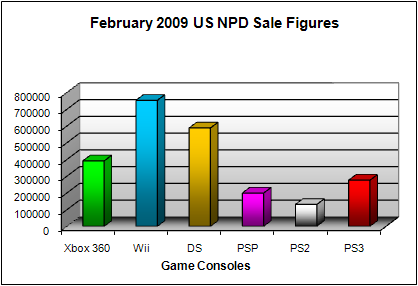
The figures for US sales in February 2009 are below, ranked in order of number of sales (February 2008  figures also shown, including percentage change):

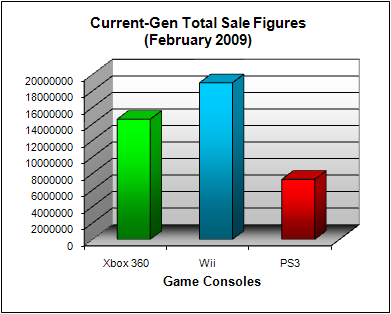
  • Wii: 753,000 (Total: 19 million; February 2008: 432,000 – up 74%)
  • DS: 588,000 (Total: 29.1 million; February 2008: 587,600 – up 0.1%)
  • Xbox 360: 391,000 (Total: 14.5 million; February 2008: 254,600 – up 54%)
  • PS3: 276,000 (Total: 7.3 million; February 2008: 280,800 – down 1.7%)
  • PSP: 199,000 (Total: 14.8 million; February 2008: 243,100 – down 18%)
  • PS2: 131,000 (Total: 43.8 million; February 2008: 351,800 – down 63%)
  • NPD February 2009 Game Console US Sales Figures

    NPD February 2009 Game Console US Sales Figures

    NPD Game Console Total US Sales Figures (as of February  2009)

    NPD Game Console Total US Sales Figures (as of February 2009)

    My prediction from last month was:

    So my prediction would be a slight increase in PS3 sales, with lesser increases for the Wii and Xbox 360, but with the ordering of consoles remaining largely unchanged. It’s unlikely that the PS3 will outsell the same time last year, but it may have better luck in March when Killzone 2 may help in terms of hardware numbers (it’s late release in February won’t affect that month’s figures).  

    I think I was largely right. In fact, I think I was spot on with pretty much everything. PS3 sales did increase, and it did increase more so than the Wii and Xbox 360, but not enough to change the ordering. And I was almost wrong on the “PS3 won’t outsell same time last year” statement, but almost wrong still means I was right. As you will see from the software figures, Killzone 2 did “kill”, but it wasn’t enough to give the hardware numbers a boost.

    And while Sony were so close to breaking their bad luck streak in terms of hardware underselling compared to last year, all three PlayStation consoles again recorded sales drops compared to the same time last year. Both Nintendo and Microsoft again also managed to outsell the same period last year, with the Xbox 360 recording a huge jump and its best “non-holiday” sales since the release of Halo 3 (despite having no A-list exclusives this month). The PS3 was so close to outselling February 2008, and I think had Killzone 2 been released a week earlier in February (it was released on February 27), then the PS3 would have done it. But as they say, timing is everything and with Killzone 2 straddling between two months, it might just distribute sales enough where neither February nor March will mean good enough numbers for the PS3 for it to outsell 2008.

    The PS2 is clearly on its last legs, and the PSP’s momentum has stalled, so Sony has to put everything into the PS3 now as it no longer has any other options. And the decisi0n to release Killzone 2 so close to the end of the reporting period may have hurt the chance of adding a number 1 title to the PS3’s list of achievements (or is that Trophies?), even if it meant taking a hit in Febuary. And Killzone 2 further highlights why high hardware prices are a bad idea, because can you imagine this title not being number 1 if it had been released on the Xbox 360 or the Wii? Sony’s insistence on high hardware prices has meant that they have missed out on a lot of revenue from their high profile release (such as Killzone 2, and LittleBigPlanet, as well as multi-platform releases such as GTA IV) – I don’t have access to Sony’s accounts, but can the extra loss in hardware revenue from faster price drops be offset by the extra gains in software revenue (thanks to the superior number of hardware in people’s homes)? And would this have meant that the total loss in revenue would have been  manageable enough and much more sensible from a mid term perspective? But only Sony knows what they can and cannot afford to do.

    The sales surge for the Xbox 360 is hard to explain. There were no price drops, no hit releases (exclusive or otherwise, Street Fighter IV included), and nothing that would suggest an increase was on the cards. Perhaps its status as the cheapest console on the market is finally providing dividends as the economic situation worsens. The Wii and the Nintendo brand contines its march towards total domination of this game console generation. 

    Let’s get to the software charts. This is at least one area that will give Sony a much needed boost, because the PS3 top 10 sales finally managed to beat the Xbox 360 sales. Neither got near the Nintendo numbers, of course, but it just shows what a critics favourite like Killzone 2 can do for software sales. Another bit of good news is that despite 2:1 hardware advantage for the Xbox 360, the multi-platform Street Fighter IV managed to sell practically even for both the 360 and PS3. This either means that PS3 owners loved SFIV more than Xbox 360 owners, or that at least on the software front, Microsoft is about to lose its status as the console with the best software sales ratio. Killzone 2, as mentioned earlier, did quite well but not enough to seriously challenge Wii Fit/Play, nor SFIV. So good news for Sony as they 23.6% of the market, which beat Microsoft’s 20.7%. All the Nintendo “must-have” releases are still on the list, for both the Wii and DS, so they took nearly 56% of the top 10. Here’s the complete list of the top 10 software sales:

    1. Wii Fit w/Board (Wii, Nintendo) – 644,000   
    2. Street Fighter IV (Xbox 360, Capcom) – 446,000
    3. Street Fighter IV (PS3, Capcom) – 403,000
    4. Wii Play w/ Remote (Wii, Nintendo) – 386,000
    5. Killzone 2 (PS3, Sony) – 323,000
    6. Mario Kart w/ Wheel (Wii, Nintendo) – 263,000
    7. Call of Duty: World at War (Xbox 360, Activision Blizzard) – 193,000
    8. Mario Kart (DS, Nintendo) – 145,000
    9. New Super Mario Bros. (DS, Nintendo) – 144,000 
    10. Guitar Hero: World Tour (Wii, Activision Blizzard) – 136,000

    Next month should be a big one for software sales, as Resident Evil 5, Halo Wars, and GTA: Chinatown Wars all make their way onto their respective consoles. There is also the left over sales from Killzone 2, and any hardware effects that may show up. My prediction for March 2009 would be that PS3 sales finally beat the 2008 equivalent, thanks largely to Killzone 2 and RE5 (March 2008 was also a very slow month). The ordering of the hardware sales would still remain the same though, as RE5 is no longer platform exclusive for the first time. It will be interesting on the software front, because you would imagine RE5 selling better on the 360, although perhaps only by the same margin as SFIV, and Killzone 2 should do better than the averagely rated (relatively speaking) Halo Wars. 

    See you next month.

    Weekly News Roundup (15 March 2009)

    Sunday, March 15th, 2009

    Yesterday was my birthday, and I enjoyed it very much. So much so that I didn’t even want to write a WNR today, but as they say, we’ve all got to work harder for less money in these economic times, so I can’t afford to take a day of. I finished the PowerDVD 9 review  during the week as well. To sum up, the new version is very nice and features some useful new features in particular DVD upscaling and the media center mode. Is it worth the upgrade from version 8? That really depends on your needs, and if you need DVD upscaling to your 50″ HDTV, or if you want better Windows Media Center integration, then version 9 is for you. And despite Windows 7 offering lots of video support, it won’t support Blu-ray, so you will have to come back to one of PowerDVD, WinDVD or ArcSoft TotalMedia.

    Copyright

    Starting with copyright news, a new MPAA study says that America needs a Patriot Act like bill for dealing with piracy

    Once again, the MPAA is comparing movie piracy to terrorism, and to refer to such a controversial bill as a model is just plain bad taste and shows how out of sync the MPAA is with the general public. If most people in the world believes that the Patriot Act is inappropriate even for dealing with something serious as terrorism, why should they think that it would appropriate for dealing with kids downloads movies at home? And do we need a “Gitmo” type insitution for dealing with pirates, although instead of physical imprisonment and torture, perhaps ban them from signing up to ISPs and using the Internet which for some people, is considered a form of torture.

    IsoHunt’s P2P trial will continue after IsoHunt’s lawyers failed to get a summary ruling that it did not infringe copyright. it was always going to trial anyway, so this is not a huge surprise. There are certainly lots of important trials going on at the moment or awaiting judgement, IsoHunt’s trial in Canada, iiNet’s trial in Australia and of course The Pirate Bay trial in Sweden. But the more the industry fight against piracy, it seems the public is less and less enthusiastic about the crusade to rid the Internet of it. A new study shows that more than half of Internet users in Canada and Spain pirate music, films and software, while only 5% believe that piracy is criminal behaviour. Either people are becoming more and more unethical, or that they are so used to how the Internet works, where many things are free or at least made available for low cost, that they see P2P as just another way to get what you want when you want it. If the success of digital game delivery services such as Steam tells us anything, is that people are willing to pay for content as long as it’s delivered in the way they want it. The low prices do help, of course.  

    Steam shows that better delivery and pricing, not more DRM and lawsuits, is the way to go towards fighting piracy

    Steam shows that better delivery and pricing, not more DRM and lawsuits, is the way to go towards fighting piracy

    So instead of fighting piracy with lawsuits and DRM, perhaps they should take a look at Steam and see how it became a successful delivery platform (even if it has DRM), and why people are willing to pay for games this way, but not the boxed version at stores. Of course, some people will never learn. Steam and Valve’s Gabe Newell recently delivered a verbal attack on DRM, but Aladdin’s John Gunn disagrees and has published a rebuttal. Aladdin provides DRM services (of course they do). The main points of attacks seems to be that there are stats showing DRM helps drive sales, which I find hard to believe not because these stats do not exist, but because they are incredibly hard to obtain (how much growth is related directly to having DRM, and how much is it related to other things like better products and services, or just natural growth). Mr. Gunn also goes to say that “good DRM is proven to reduce piracy”, which again depends on what the definition of “good DRM”. Theoretically, a DRM that cannot be broken should help sales as if you can’t pirate it, and you really want it, then you’ll have to buy it. Mr. Gunn points this out in his article as well. But the problem is that such DRM does not exists, because I have yet to see a popular commercial game or application with DRM that hasn’t been cracked, usually within hours of release. Note that I used the term “popular”, as there are apps that don’t get cracked simply because nobody cares enough to do it, and most likely, nobody cares enough to even pirate it anyway. The fact is that the majority of DRM schemes do nothing except annoy legitimate customers. They are about as effective as those unskippable copyright warnings at the start DVDs (funnily enough, only present on legal versions, and removed for the consumer’s convenience on pirated ones). Piracy rates have not dropped since the introduction of tougher and tougher DRM, this is a fact that cannot be disputed. So what exactly does DRM do anyway, other than to provide revenue streams to companies like Aladdin?

    In the end, it’s all about convenience to consumers, and reasonable pricing. Both of these will fight piracy much more effectively than the world’s best DRM scheme. When The Pirate Bay is providing downloads that are faster, less intrusive, less restrictive, then you know you’re going in the wrong direction.

    High Definition

    Onto HD news. Toshiba has launched another attack on Blu-ray, which suggests that the rumours of them accepting cash from Sony to quit the HD game and to shut up about it, might not be entirely accurate.

    TiVo Australia - no download quotas for Internode customers

    TiVo Australia - no download quotas for Internode customers

    This time, Toshiba says that downloads will replace Blu-ray. Sounds like sour grapes of course, but this statement is true in the long run. Music downloads have already replaced CDs, and with increasing and cheaper bandwidth, it’s only a matter of time before downloads replace movie discs too. If there is a trend in 2009, it’s the ever increasing move towards media-less distribution. Here in Australia, TiVo has launched a download service that operates through their set top boxes and with an active Internet connection. Internode, one of the largest ISPs here in Australia and my current ISP, has now teamed up with TiVo to offer unlimited downloads through TiVo’s download service – downloads that won’t eat up your monthly quota. While this does not solve the speed problem, it solves the bandwidth cost problem and we’ll most likely see more and more of these types of ISP/content provider deals in the short term. Then there’s the story of a Lionsgate executive predicting streaming movies on the Wii will be available soon. Again, this isn’t some wild prediction, because the PS3 and Xbox 360 already have it and so the Wii, or the next Nintendo console, will certainly offer some kind of movie service. With HDTVs, TiVo, game consoles, Blu-ray players, smart phones, portable media players and almost every other device (including in-car devices) offering movie streaming and downloads, that’s a lot of devices offering movie downloads, a lot more than say the number of standalone Blu-ray players. So maybe Toshiba does have a point, and what are the odds that all Toshiba’s HDTVs will start offering movie streaming capabilities in the near future?

    Blu-ray sales are doing alright, although definitely down compared to the highs of the holiday period. Blu-ray sales stats show that Blu-ray sales have dropped to levels of around the middle of last year, the market share is down a third (5%) compared to the holiday period. Both Blu-ray and DVD sales have slowed down, but if anything, DVD is holding up a bit better than Blu-ray. With many people still undecided over whether to get 720p or 1080p, it just shows that extra resolution isn’t really the most important factor when it comes to movie buying, not when upscaling quality is improving all the time. However, as a rule of thumb, 1080p is the way to go from now on (and has been for a while).

    Another story about expensive HDMI cables being a rip-off, this time with actual studies providing the fact. Still, it’s hard to get over the feeling that the salesman may be right when he says that your brand new $1000+ purchase “demands” that you pay a proportionate amount for cabling as well. But have you ever asked a computer salesman for a high quality professional grade USB cable, if there’s even such a thing. Both USB and HDMI are digital cables, so if you’re happy to use the one that came free with your printer, than you should be happy with paying the least amount of money for the other. I would still go with a recognized brand though, to avoid buying a dud or one that breaks because of poor workmanship. But if build quality is not a problem, then the only criteria should be pricing. 

    GamingAnd in gaming, Sony has shut down the rumours of a Blu-ray-less PS3. Not much of a surprise really, because it was never going to happen as long as PS3 games used Blu-ray media. Nothing much happening here, although I find it increasingly hard to listen to PS3 fans talk about how the “PS3 experience” is better than anything out there at the moment. It’s a freaking game console, not a journey to the center of your soul for crying out loud. It reeks of marketing speak that’s been eaten up by PS3 fans seeking to prove their consoles is the best when nobody even cares, and this is coming from someone who makes money from telling people which console is the best. You know how you can tell nobody cares? Because if a barely working, badly designed console like the Xbox 360 can sell so many boxes, you know people just don’t really care about the “experience”, only games and how many and how cheap they are. And Microsoft aren’t immune from this either, what with their “New Xbox Experience” – PowerDVD 9’s “FancyView” is a much more appropriate term to describe the new Xbox 360 UI, in my opinion. And all the Nintendo Wii stories about how it’s helping injured people, blah blah blah … who cares? 

    Boil down to it,  all the consoles have their good and bad points, and if you have the money, you should buy them all, if not, then buy the ones that have the games you want on it. It’s really that simple.

    The February NPD figures should be out next week, and we’ll then see what kind of impact Killzone 2 has made. My predictions is probably not a lot, because I haven’t heard Sony scream about it from the top of every roof. We’ll find out soon enough.

    That’s that for this week. Have a good one.

    Weekly News Roundup (8 March 2009)

    Sunday, March 8th, 2009

    A somewhat quiet week in terms of news, but for a site like this, there’s always some excitement whenever there’s a new version of PowerDVD. I’ve had a little bit of time to play around with the new version (PowerDVD 9 Ultra), and I must say that the new features are all pretty useful. TrueTheater HD adds DVD upscaling that worked as well as WinDVD 9’s All2HD function. There’s more Blu-ray and HDMI support, and basically it all adds to an already quite feature packed player. I went through a list of “what’s new” in my last blog post, so have a look at that if you want to know whether it’s worth upgrading or not. And don’t forget to use the PowerDVD 9 discount deal if you do plan to purchase or upgrade.

    Copyright

    Let’s start with the copyright news. The Pirate Bay trial is over, which I thought was rather quick. I guess it’s not like on TV where a court case goes on for what seem like years.

    The MPAA versus all its (current) enemies

    The MPAA versus all its (current) enemies

    I have no idea how it went, and what the verdict will be, but with these sort of things, you always fear the worst. But if The Pirate Bay people can get a victory, even if it will be appealed, then that’s a massive blow for the MPAA. The verdict will be known in a month and a half’s time, but if I had to guess, I would say it’s a win for the MPAA. The “system” is all set up to favour the “big” companies, and I can’t see the MPAA going to court without being somewhat sure of a victory. Let’s hope I’m completely wrong (good odds on that!), and that TPB’s victory can start a chain reaction in terms of the industry’s opinion that litigation is better than mitigation (mitigating the risk of piracy by introducing more consumer friendly services to compete).

    The MPAA’s other big profile case at the moment is against Real Networks, for their RealDVD software. The MPAA now claims that Real Networks destroyed evidence and that RealDVD is based on work by hackers. Of course they’ll claim that. They’ll says Real Networks worships the devil if it helps them win the case. I actually think Real Networks have a good chance to win this one, because you cannot say they did not try to prevent piracy, as one layer of (easily hacked) DRM became two layers after processing in RealDVD, and it became harder to crack as a result, not easier. The only area which they look vulnerable is the CSS licensing area, where they allowed CSS content to be played without the original disc, which the MPAA has won cases on before.

    Boy, it sure was a busy week for the MPAA. They also took time out of their busy court schedules to report on a study that said that piracy equals terrorism. The usual scaremongering from the MPAA, nothing that we have not come to expect from them. But what they’re really saying is that, in their warped minds, terrorism is just as light as an offence as movie piracy. Doesn’t this give comfort to terrorists, to make them think that what they’re doing is only as serious  as what millions of other people are doing at this very moment? Make of that what you will.  

    With so many things on the MPAA plates, and despite their budget being cut by $20m due to the economic crisis, you would think the piracy situation is so desperate that action must be taken now while they still can. And you would be wrong. Ticket sales increased by 17.5% in 2008, even after a record breaking 2007. We all know that piracy has increased, at least from what the MPAA tells us. So does piracy equals ticket sales? You won’t hear the MPAA say this out loud, that’s for sure.

    High Definition

    To HD news we go. Windows 7, which will supports a whole lot of video and audio formats, including Blu-ray’s H.264 (and VC-1, which of course will be supported as it’s a Microsoft format). But Windows 7 will not support Blu-ray playback.

    Windows 7 won't have Blu-ray support

    Windows 7 won't have Blu-ray support

    Now the first reaction people may have is that this is Microsoft’s way of hitting back after backing the wrong horse in the HD format war, but it really isn’t the case here I don’t think. The problem with having Blu-ray support is that if you add the licensing costs for AACS, Dolby, DTS, BD-J and the Blu-ray licensing fee, you end up increasing the cost of each Windows 7 version by $10 to $20. Times that by the millions of copies that Windows 7 will sell, then you have a serious cost problem for Microsoft, especially considering that most people won’t even use their PCs to play Blu-ray movies, and that’s if they have Blu-ray movies to play in the first place. So this is a sensible decision, and it looks like we’ll still have to rely on third party software like PowerDVD 9 to make Blu-ray playback possible. Speaking of PowerDVD 9, one of the new features is “Cinema Mode” which better integrates it with Windows Media Center, and this is very much welcomed for those with home theatre PC setups.

    The HD format war may not be entirely over though. Warner Bros, the company that sealed HD DVD’s fate when it went Blu-ray exclusive, is now supporting HD DVD’s sister format, the CBHD format. But don’t worry yet, this format is a China only format for the Chinese market. It’s not the best of news for Blu-ray, because it is also trying to get into the Chinese market so it can lower overall costs for the rest of the world, but that’s assuming CBHD makes it as a format. I think it will struggle, because without a “global” format to back it up, it’s going to be hard to get studio support. Warner has always been eager to get into the Chinese market, they even supported VCD and SVCD at one point, but I can’t see other studios being that keen, especially when they’re also major Blu-ray backers.

    Samsung's 9 Series may help cure me of my plasma bias

    Samsung's 9 Series may help cure me of my plasma bias

    Now I’m a big fan of plasma TVs, but ever since Pioneer announced that they would pull out of the plasma market, I’ve been looking around for alternatives. I’ve never really liked LCD TVs, mainly due to the main weaknesses of the format, including backlight bleeding, poor black definition and such. But LCD TVs with LED back lighting, such as the Samsung 9 series which has officially become Australia’s most popular LCD TV, seems like something that can finally give plasmas a run for its money. I started this blog by writing a few posts about choosing the right TV, and perhaps it’s time to update that again, but the things that I listed in that post are still relevant today: HDMI inputs (the Samsung has 4 of them, which is quite generous), Resolution/Refresh (most are not 1080p, and with support for 120 Hz, which is nice to see), PC inputs and how it deals with SD content. So I can’t say that I’m totally convinced by TVs like the Samsung 9 series, I can safely say that they are definitely one of the favourites for being my next TV. That or if OLED comes to the market sooner than my next TV purchase, which given my current economic situation, might very well be a reality as it might be years before I can afford a new TV. 

    And 3DHDLEDTV? Maybe for the theater, but not for the home theatre yet, at least according to the director of the new animated film, Monsters vs Aliens

    GamingAnd in gaming, not much happened. The usual “PS3 is awesomer than the Xbox 360” and the “Xbox 360 is king of everything”, and of course the “Wii kicks ass all the way” type of news stories that I won’t even bother reading, much less post here. All I will say again this week is this to Sony in regards to improving PS3 sales : “It’s the price, stupid”.

    Back to dreaming about my next TV. See you next week.