Archive for the ‘PS3, PS4’ Category

Weekly News Roundup (23 September 2012)

Sunday, September 23rd, 2012

I know I ranted a bit about iPhone 5 last week, but I probably should have divulged the fact that I did have one on pre-order (for my mum). Having got it on launch day and helping mum to set it up, my only thought about it so far is that, well, it’s very much an iPhone. I guess that’s a compliment of sorts, but there’s nothing really terribly exciting about it really (other than mountains that appears to be “alive” on the new Map app – check out Tahiti, for example). There are also some concerns about build quality and durability, two things that Apple usually gets spot on – there was already a chip on the black iPhone out of the box (apparently common with the white version too), and there have also been reports of the black paint being scuffed off (check out #scuffgate on Twitter). A bit of a poor show from Apple really, as design problems can happen any time you add something new, but build quality issues shouldn’t exist really.

Hey, I guess that turned into another rant of sort. To be fair, Apple is an easy target, and it’s not as if other companies don’t have the same or worse problems with their new devices. But expectations have been raised by Apple themselves, and so they can’t expect consumers to shrug and not care when a problem does arise.

Onto the news roundup then …

Copyright

With US ISPs gearing up to be at the frontlines of the war against net piracy, a new report questions the fairness and transparency of the “six-strikes” system that will be used.

The MPAA/RIAA (and Obama administration) sponsored deal with ISPs will see users notified of up to 6 times for their alleged copyright offences, after which time a temporary disconnection may be issued. But University of Idaho Law Professor Annemarie Bridy says in a new report that the system is flawed because it the lacks the presumption of innocence, has an reverse burden of proof, lacks verification of the evidence being used, and is inadequate in terms of transparency in the design and implementation of the system.

In other words, alleged offenders are assumed to be guilty using evidence that hasn’t been independently verified or legally tested, evidence they have little recourse to argue against made worse by the fact that the burden of proof is on the accused, all the while happening in a system that was designed in secret and will be operated in secret.

At least there will be an appeals process, Professor Bridy says as she looks for the slim slim sliver of silver lining in the big grey anti-piracy cloud. The fact that permanent internet disconnection is so far not an option, unlike the similar French Hadopi system, is also a positive.

The MPAA/RIAA will probably argue that the scale of the problem requires expediency, something  that can only be achieved by ignoring due process. And the need for expediency is as debatable as the potential damage resulting from web piracy – does piracy really cost the industry a lot of money? The French experience so far has not resulted in any noticeable improvement in things like revenue, even though piracy rates have dropped significantly, so you have to question the effectiveness of these schemes when judged by real outcomes such as revenue.

A set of unfair laws is bad enough, but when they’re not even effective, then that makes them worse. But when lobbyists like the MPAA or RIAA are tasked with writing these laws, then this kind of thing will always happen. And with the MPAA/RIAA basing their entire strategy on an irrational fear of the Internet, it’s no wonder that what they come up with will also be irrational.

And what makes the argument in Washington seem even more one sided is the fact that there aren’t that many lobby groups that are making counter-arguments to those being made by the MPAA/RIAA. Groups like the EFF, Public Knowledge and even the ACLU do have a say, but without special access to politicians that experienced lobbyists have, they’re often not even invited to the conversation, let alone allowed to have any meaningful contribution. Case in point, the “six-strikes” deal mentioned above.

Internet Association Logo

The Internet Association will lobby for the interests of Internet companies, some of which will align with consumer interests

But that may be about to change. Some of the world’s largest Internet companies including Amazon, Facebook and Google have now teamed up to form their own lobbying group dubbed the Internet Association. The group, whose membership also includes the likes of LinkedIn and Yahoo, will be tasked with the role of protecting the interests of these companies, including the issue of Internet censorship and freedom.

It’s still sad that lobbying is still so effective in US politics, and that it seems that monied interests always seem to win out. But at this stage, it’s more a case of “if you can’t beat them, join them”, and while principles are one things, getting the crap beaten out of your industry is the more pressing concern.

And there’s also the concern that the Internet Association’s backers are all corporations with interests that may not always align perfectly with that of the average consumer. But for now, they mostly do, and there are different enough companies as part of the group to hopefully ensure it won’t be just a mouthpiece for the big boys (like the MPAA and RIAA are).

High Definition

But there are signs that maybe Hollywood has realised that they won’t have to destroy the Internet in order to protect its own business interests. Predictably, t’s the $$$ that’s showing them the way.

The tremendous growth in subscription streaming, and the increasing competition that’s occurring in the sector, is set to give Hollywood a mini-boom in revenue. With more players on the market than simply Netflix, the content holders are finally in a good position to negotiate ever better deals, taking advantage of the desperation of the new players to be able to compete with a behemoth like Netflix.

Either Netflix ends up paying more for exclusivity deals – the company is already paying more than $2 billion a year to license their existing content – or studios are able to negotiate non-exclusive deals with a wide range of distributors including Amazon, and an upcoming streaming venture between Verizon and Redbox. Epix, the company co-owned by Paramount, MGM and Lions Gate, recently managed to get $80 million more per year from their deals with these new companies than compared to their previous exclusive deal with Netflix, for example.

The industry is apparently keen to avoid the mistakes of the music industry by not locking themselves into one major players. For the RIAA companies, it is the dominance of Apple devices and iTunes that is putting them at a severe disadvantage when it comes to negotiating licensing deals. The only solution is to make extremely favourable deals with the likes of Amazon and Google in the hope of breaking up the Apple iTunes monopoly, but this may or may not work, and revenue takes a knock as a result. Book publishers are similarly hampered by the virtual monopoly Amazon’s Kindle enjoys.

But with the movie industry the last to fully embrace the Internet, they may yet learn from the mistakes of other industries. For now, it seems that some good has come out of the Internet after all, and that all it took was some innovation. And a new business model, and not more DRM and draconian laws to protect the old one.

The Hunger Games

The streaming availability of The Hunger Games in the US will be delayed by 90 days compared to Canada, something the Netflix says could encourage piracy

But it’s also hard to break old habits, as the issue of release windows has been raised again, this time for the streaming market. Netflix’s chief content officer Ted Sarandos warns that Hollywood’s insistence on having geographical based release windows for streaming content may end up encouraging piracy. Referencing Epix’s The Hunger Games, where Canadian subscription subscribers can watch it 90 days before their US counterparts, Sarandos says that this is an entirely counter-productive way to do business in the online age. Studios are still desperately protecting their sell-through income, and they think that the best strategy to achieve this is to prolong the sell-through period as long as possible. But, ironically, they fail to take into account piracy. Whether they like it or not, piracy competes with both sell-throughs and subscription streaming, and so by limiting people’s legal choices, all you end up is pushing them towards the illegal ones.

But when a single sell-through copy can make $15 for the studio, which is almost double the entire monthly price of a Netflix subscription (which will then be split among many different content holders), you can see why studios are a bit hesitant. But then again, piracy makes $0 for them, so negating the need for piracy will mean additional income. Less money per person, from more people, may be the name of the game, and this can only happen if  Hollywood stops looking for the big profits, and start looking at the small.

Gaming

With most of the recent attention being on Nintendo’s Wii U, Sony obviously felt a little bit left out and, to everyone’s surprise, they’ve introduced a brand new PS3 console. It’s a bit hard to to convey irony on the interwebs, so that bit about “surprise”, as with almost all new product launches these days, was not quite true.

It looked like the earlier leaked pictures were indeed accurate, albeit in poor quality. And the rumour about a low storage capacity version of the PS3 to compete with the Xbox 360 4GB was also true, except the 16GB slower style flash memory version actually turns out to be a 12GB SSD version, and that this budget version will only be available in Europe (and a few other countries, including Australia).

Other than that, the slimmer, lighter PS3 also now uses a top loader for the disc drive, and comes in 250GB and 500GB versions, replacing the 160GB and 320GB found on the not-as-slim-but-still-quite-slim PS3s at the same price points.

"Super Slim" PS3

The new “super slim” PS3 will be available soon, but without a price cut, analysts are wondering “why bother”.

A bit surprising that North America doesn’t get the budget version, as that’s the marketplace that really could benefit from having a cheaper PS3 to compete with the Xbox 360. But maybe Sony are just testing the waters to see if there’s demand for such a console in the first place.

The lack of a price drop has analysts questioning the point of having a new PS3 console out, and they have a good point. But if both Sony and Microsoft want to prolong the life of their respective consoles, then there’s only so much price cutting one can do before they start losing money on the hardware again (having taken so long to finally start making money on them). And if longevity is not important because a new console will be out next year (seems unlikely now, at least for Sony, given the timing of this new PS3 refresh), then a price cut won’t help much in between now and then.

Okey-dokey, that’s that for the week. Have a good one.

Weekly News Roundup (16 September 2012)

Sunday, September 16th, 2012

Welcome to another issue of the WNR. For yet another month, I waited naively in the vain hope that more figures would start leaking out for August’s NPD analysis, but alas, that wasn’t to be the case. So as usual, the gaming section is where August’s NPD will live (on life support, coming in and out of the coma).

iPhone 5

iPhone 5: Faster, lighter, thinner, and bigger where it counts (the screen). But is it still exciting and innovative?

Otherwise, it was a fairly quiet week. I suppose I should talk about the iPhone 5 release or whatever. Was that perhaps the most anti-climatic launch event in Apple’s recent history? Through the various leaks, almost everything about the new iPhone had been fairly well known long before the Wednesday launch event – Apple seems to have given up on the almost impossible job of trying to keep things secret. And even if we somehow didn’t know about the larger (well, taller anyway) screen, LTE and the other new stuff, none of it would have been a huge surprise anyway. There’s nothing wrong with incrementally improving an already well established product, but having failed to keep up with its competitors in terms of screen size, and features such as NFC, the least Apple could have done was to inspire us with some of the ways to use newly added features. This has been their strength in the recent past, so to hear them talk more about “faster CPUs”, “better graphics”, brings back painful memories of the PC upgrade cycle and how pointless it all was talking about MHz and RAM sizes.

With all that said, the iPhone 5 is set to become the fastest selling gadget of all time, so maybe I have no idea what I’m talking about (more than probable). Vote in our poll to tell us your thoughts about the new iPhone.

Copyright

Google’s self-censorship continues this week, with The Pirate Bay joining the list of blacklisted search terms that will no longer be part of Google’s Autocomplete and Instant search products. The name of the website, and its domain name, joins notorious terms such as “torrent” and “RapidShare” as part of Google’s blacklist.

I have no idea what this latest move, part of Google’s appeasement policy, will actually do to combat piracy at all. I guess people who want to search for The Pirate Bay, but don’t know how to spell the words “Pirate”, “Bay” and “The”, may just give up and buy movies and music instead, or something. Interestingly, searching for “teh pyrat bey” still brings up TPB website as the first result, as Google’s auto-correct features appears to still show love for the website.

Meanwhile, TPB co-founder Gottfrid Svartholm has arrived safe and relatively well back in Sweden to face new hacking charges, and to serve the prison sentence imposed on his for his crime of being initially part of The Pirate Bay (as well as pay the million bucks he will be unable to pay), and further jail time for not appearing for a court hearing earlier in the year.

Speaking of millions of bucks in damages, the legal merry-go-around continues for Jamie Thomas-Rasset, as the appeals court ruled this week that the damages decision from the second of her three previous trials was the one that was perfectly valid, and that the judge had no right in those trials to reduce the damages amount to something reasonable like $54,000. Instead, Thomas-Rasset will be asked to pay $222,000 for the act of sharing 24 songs. I guess that’s better than the $1.92 million from the third trial.

There’s no doubt that a large percentage of the $222,000 is punitive in its nature, as even considering the thousand songs that Thomas-Rasset is supposed to have shared (only 24 of those were included as part of the trial), there’s no way that $222,000 worth of damages could have occurred via direct damages. If we take the calculation used to come up with the $222,000 in damages, and couple it with the 11,000 copyrighted songs that the RIAA identified were being shared on LimeWire before its demise, each having being shared a thousand time (the RIAA actually claimed each were shared “thousands” of times), the resulting total damages would be worth excess of $101,750,000,000 (that’s $101 billion). Even if you take the $222,000 and divide by the 1,000 songs that Thomas-Rasset is alleged to have shared, multiply that by the LimeWire figures, then that’s still more than $2.4 billion. And this was just one music sharing method.

The real question is, given Thomas-Rasset’s intent (ie. to download songs for free), is it really fair to class her actions along with wilful pirates that make and sell counterfeit CDs, or start websites fraudulently charging people to download songs that are pirated in the first place? Her intent was to save a few thousands dollars, at best, by downloading instead of buying, so should the punitive nature of the damages be hundreds of times greater?

As controversial as the French “three-strikes” Hadopi regime has been, with the very same thing coming to the US (but twice as many strikes! Beat that Frenchies. USA! USA!), the trials and tribulations of both Thomas-Rasset and her compatriot Joel Tenenbaum would have been far more agreeable if they had fallen foul of these graduated response laws, rather than having to go through the civil court system.

Ironically, three-or-more strikes actually works out better for those that do admit to pirating stuff. At least compared to the threat of a civil lawsuit. But for one craftsman in rural France, his Kafkaesque ordeal might point to the more unfair aspects of graduated response.

Alain Prevost has the unfortunate distinction of being the first person to be fined under France’s Hadopi laws. This is despite Prevost proving he wasn’t responsible for any downloads by bringing the real perpetrator, his soon to be ex-wife, to court to testify to this fact. Prevost was still fined 150 euros for failing to secure his Internet connection.

Having received two warning emails and letters regarding illegal downloads, Prevost actually implemented his own punishment by disconnecting his Internet account, and instructed his wife’s lawyer to write to Hadopi to explain everything. But the Hadopi agency did not like the fact that Prevost stopped responding to his emails (hard to do when you don’t have an Internet connection), and wrote to Prevost to order him to travel all the way to Paris to explain himself. Prevost declined the invitation, feeling such a trivial matter should not warrant the expense of travel. This apparently made Hadopi even more angry, and it was at this point the police were involved. Prevost was summoned to the police station to explain himself, and it is here that Prevost made his biggest, and possibly only mistake, in this whole ordeal – he told the truth!

Prevost told the police that his wife was most likely the responsible party for the downloads (something that his wife would agree to testify to), and that in a show of good faith, he would hire the services of a local computer expert, at his own expense,  to clean his computer of any infringing files. If Prevost thought that explaining away his responsibility and taking pre-emptive actions to remove any infringing content would lead to the end of the matter, he would be sadly mistaken.

Prevost was then summoned to appear in court over his audacity to ignore Hadopi. Prevost brought along his wife to testify to the fact that he had not done anything wrong, but having told the truth to the police earlier on, this was used against him by the court who opined that Prevost must have had prior knowledge of his wife’s illegal activities, and therefore was still responsible. Prevost was eventually fined 150 euros, a lower amount than the prosecutors had asked for due to the fact that Prevost has no criminal record.

All of this because his wife might have downloaded two Rihanna songs, and all to only result in a small fine that probably doesn’t even cover a tenth of the expense that Hadopi used to catch this criminal mastermind. And what benefit to rights holders? Who knows.

High Definition

After the demise of HD DVD, everyone (including yours truly) thought that the next battle would be between Blu-ray and DVDs, and to an extent, that has been true. But the super quick way in which services like Netflix, VUDU, Amazon and iTunes have become ubiquitous among today’s connected multimedia devices suggests that the real battle is not between the new and old disc formats, but between having a disc format and, well, having no discs at all.

Fox Digital HD

Fox Digital HD will allow HD digital copies to be purchased weeks before the DVD/Blu-ray ones

So when Fox, one of the biggest and earliest supporters of Blu-ray revealed plans to release purchasable digital downloads of their movies ahead of their Blu-ray and DVD releases, a few eyebrows were definitely raise. While early release digital downloads are not new in the strictest sense, they’ve mostly been one-offs – a release here, a release there. But the Fox initiative plans to bring the strategy forward for most of their A-listers, including the upcoming releases Prometheus and Abraham Lincoln: Vampire Hunter, and they’re doing it across as many devices as possible (supported platforms currently include Amazon, CinemaNow, iTunes, PlayStation, VUDU and Xbox Live).

And most importantly, all of these releases as part of Fox’s “Digital HD” initiative will be available on glorious HD (well, glorious by today’s download standards), thus directly competing with Blu-ray (although HT die-hards like myself might disagree, at least when talking about the quality of HD).

The immediate risk for Fox is that the digital downloads will cannibalize their disc sales, and also increase the risk of piracy. So Fox are either super confident about the DRM systems being used by its third party partners, or they’ve realised that pirates will pirate anyway, and that the pirated version would most likely already have been available long before the DRM-laden digital download version makes its official appearance.

Gaming

August’s NPD figures, well what was made available anyway, showed nothing particularly alarming or surprising. The Xbox 360 continued to be the most popular console, with 193,000 units sold, down 37% compared to the same month last year.

The 193,000 was 48% of the entire home based console market, leaving 209,000 units between the PS3 and Wii. Given the most recent known results, this probably breaks down to something like 130,000 and 79,000 for the PS3 and Wii respectively, possibly even higher for the PS3 given that the proximity to the Wii U’s introduction.

Speaking of the Wii U, Apple weren’t the only ones to have launched a product this week, with Nintendo officially launching the $299 Wii U (with a more expensive “premium” version for $349, with more storage and accessories). Surprisingly, the rumours from last week about the release date was in fact correct: November 18, for North America.

Wii U TVii

Wii U TVii: Digital download and streaming for the Wii U, but the optical drive is a no-go zone for movies

What I found most interesting was the TVii announcement, which is set to turn the Wii U into a digital media hub in the same way that the PS3 and Xbox 360 already are. Supporting the latest digital streaming services such as Amazon, Netflix, Hulu, and also offering support for TiVo DVRs, the Wii U is an odd device in that it does use Blu-ray sized optical discs, but it appears the only way to play movies would be via digital streaming or downloads. The next evolution of the game console may very well see the disc drive removed, with games being distributed digitally too.

But we’d all need bigger bandwidth allowances, if not unlimited quotas, before that can become a reality. Personally speaking, I’ve used up half of my allowance last month viewing Amazon Prime streaming titles, to the point where I had to ration my usage towards the end of the cycle. An additional $30 to move up to the next bandwidth tier doesn’t seem economical to me, at the moment.

That’s it for this issue. See you in seven.

Weekly News Roundup (19 August 2012)

Sunday, August 19th, 2012

Welcome to another edition of the WNR. NPD “released” its July 2012 sales stats for US video game sales, but unfortunately, only Microsoft again chose to divulge its hardware sales stats. So no July NPD analysis, which is a shame, but there wasn’t any real surprises anyway. I’ll talk a bit about it in the gaming section below.

Another pretty full news week, so let’s get started …

Copyright

So much for “do no evil”. Google gave in to the demands of the MPAA and the RIAA this week by signalling it is ready to start self-censoring its own results to reduce the visibility of alleged piracy websites. Without going as far as removing suspected websites, Google will start demoting any website that receives an unspecified number of DMCA notices.

Google DMCA Demote

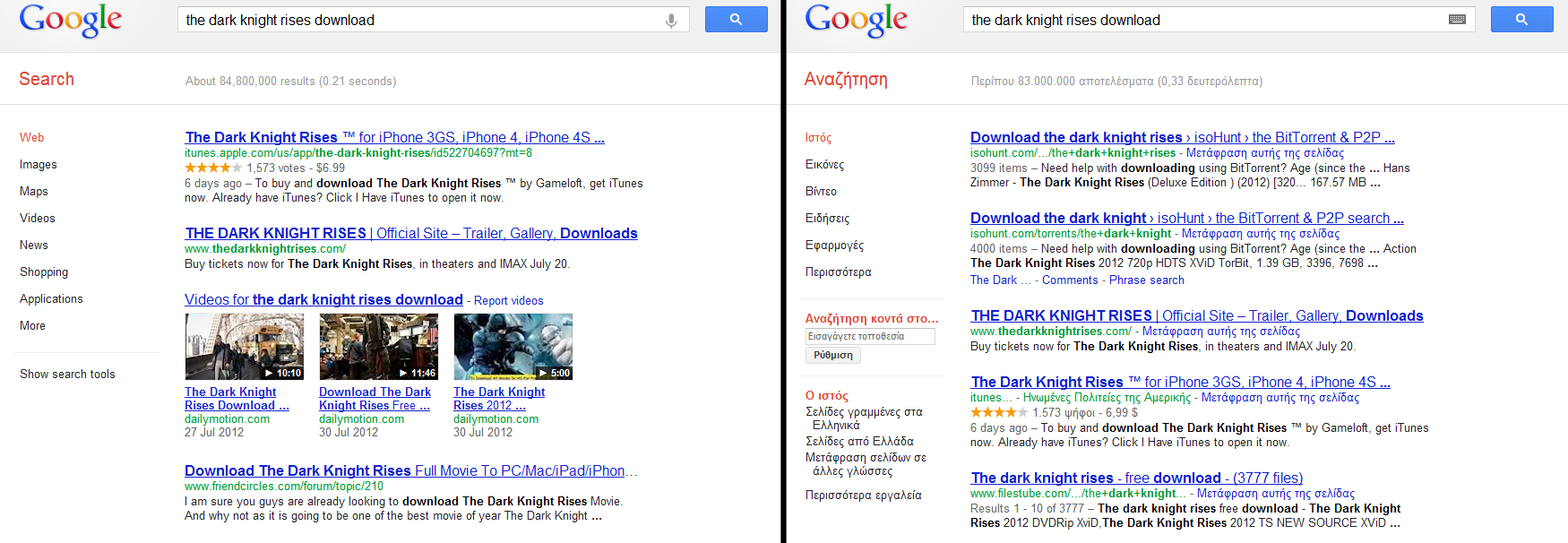
Google has started demoting websites that receive too many DMCA notices, the image on the left shows the demoted rankings, while the image on the right (for the yet unchanged Greek version of Google) shows the previous rankings

It’s own YouTube website, and “major brands” will apparently be exempt from this new rule (webmasters have long suspected there’s one rule for the web top 100, and another rule for the rest), but the rest will now have to live in fear of the system, which is already being massive abused by those seeking an unfair advantage (57% of all filed notices, according to a Google report from 2006), and made even more attractive as a “black hat” weapon of choice now that the entire domains of competitors can be demoted. Since Google started releasing DMCA stats, the number of DMCA notifications has risen from about a million per month, to now over 4!

Except none of this will work to stop piracy, because people aren’t turning into pirates just because they see some links to The Pirate Bay on Google. I don’t know if it’s naivety, a head in sand attitude, or a deliberate attempt to muddy the waters, but the idea that good, people are being fooled and misled into downloading pirated content online is, to put it simply, hogwash. People pirate and they do it willingly, and knowingly. And they spent a lot of effort learning and honing their piracy skills. They will most likely alredy have go-to places to get their piracy fix, or custom search engines that does more work separating the wheat from the chaff, so the idea that they’re all relying on Google to find the S01E08 of The Newsroom is simply a fantasy.

But despite Google’s proactive steps in reducing piracy, the MPAA/RIAA still wants more. In a joint submission to the US Copyright Czar, the MPAA and the RIAA have called on the government to do even more in the CRusade Against Piracy (CRAP™), including going all “Megaupload” on websites like The Pirate Bay. Basically a wish-list and a preview of what the copyright landscape could be like if the MPAA/RIAA get their way, the submission also talks about increasing criminal sentences for copyright offences, including making the unauthorised streaming of videos a felony.

Showing that they’ve not quite given up on SOPA/PIPA, the submission also calls for tighter control of domain names, including those outside of the jurisdiction of the US government. The groups also say that the government needs to go out and threaten private businesses like domain name registrars, search engines, and advertising agencies and get them to fall in line with the MPAA/RIAA’s vision of copyright enforcement. So it’s simply not good enough for Google to only demote websites that have yet to be proven, in a court of law at least, of doing anything wrong – no, the MPAA/RIAA says search engines like Google must “delist rogue sites”. Note the use of the term “rogue”, the same type of language that’s also being used to describes countries like North Korea and Iran, and I don’t think this is a coincidence either.

Feeding into the paranoia and hysterics that aims to paint college kids downloading movies as something much more serious, the MPAA/RIAA also strategically brings “organized crime” and “gangs” into the equation in this submission. But as far as I know, Tony Soprano purchased his copy of The Godfather, and it may be just me, but I just can’t imagine the Crips and the Bloods getting into the torrent search engine business.

High Definition

The wait is finally over. The kind people at Fox studios have finally allowed their customers to buy Avatar on Blu-ray 3D, for a price that isn’t a ridiculous 3 figure number.

Fox’s deal with Panasonic, where the electronic giant has exclusive rights to distribute the Blu-ray 3D version of Avatar with the 3D electronics, was one of the more controversial movie deals in recent times. Coming just at a time when Blu-ray 3D needed a launch title that could only come from the most acclaimed and most financially successful 3D movie of all time, the exclusivity deal meant that the format lacked a killer title available in stores that would have helped the format’s early adoption. As such, Blu-ray 3D hasn’t taken off in the way that electronic manufacturers and movie studios had hoped.

Avatar 3D Blu-ray Panasonic Exclusive

The Panasonic exclusive version of Avatar on Blu-ray 3D is still fetching 3 figures on eBay and Amazon, but the retail version will be available in October

With that said though, while people aren’t using 3D as much as studios would have liked, they’re still buying them because the price premium of 3D over 2D ranges between inconsequential and non-existent. Try and find a top of the range 2D TV that isn’t also 3D, and you’ll struggle. And when there’s only a $20 difference between a 2D Blu-ray player and its 3D equivalent, consumers don’t really have to make any hard choices.

Still, the retail release of Avatar on Blu-ray 3D should help the format break all kinds of records when the disc is released in October. The price is a bit higher than your average Blu-ray movie, $28 at Amazon, but it’s definitely better than paying $128 for it on eBay, right?

But don’t bet on this Blu-ray 3D Limited Collector’s edition to be the most definitive 3D version of the film to arrive on disc. The fact that this release might not even feature the extended cut means that Fox is already planning a quadruple dip of the film sometime in the near future.

Even for the 2D version, it’s only a matter of time before we see the 4K or whatever version of the film on possibly a new disc format, or if bandwidth issues are resolved, via streaming or download. Projects like Australia’s NBN and Google Fiber will aim to fix for the bandwidth issue once and for all with the move to fibre optics, which has almost an unlimited capacity to carry TB/s and beyond, but another solution is to increase the efficiency of the delivery codec. Which is why it was interesting to read about the news of a new format being officially approved by the Moving Picture Experts Group (MPEG), which promises to provide the same visual quality as H.264 with only half of the bandwidth needed.

H.264 is already super efficient, so it’s hard to believe that something could come along and double that efficiency, but HEVC, or H.265, aims to do just that through more computational intensive algorithms. Mobile applications would probably benefit the most from H.265/HEVC, due to their inherent bandwidth limitations, although faster (and more power hungry) devices may be needed to decode the video.

The other main beneficiary from a more efficient codec would be the web streaming industry, finally allowing the likes of Netflix to do true Blu-ray quality streams on connections less than 20 Mbps.

For other applications, 4K is an obvious candidate, but 4K only really benefits super large screens (say 80″ or above), and it’s an overkill for anything smaller. And if staying at 2K or 1080p resolution, the increased efficiency of H.265/HEVC may allow for same bitrate, but higher quality encodes, although you’ll get diminishing returns on any quality improvement for Blu-ray encodes, many of which are already visually flawless to the average viewer.

Gaming

Blizzard’s Battle.net has become, perhaps, one of the most tempting targets for hackers in recent times. Not only does the company hold a heck of a lot of data for a heck of a lot of people, Blizzard also holds tons of financial information for all those subscribers to WoW, and all those buyers/sellers on Diablo III’s Auction House. And the company’s stance towards “always-on” DRM for D3 meant that anyone who pokes holes in their security will instantly receive a lot of “web cred” for their efforts.

Blizzard Security Notice

Blizzard was hacked last week, with a ton of user information stolen in the process.

So unsurprisingly, Battle.net was hacked this week, with a heck of a lot of data being stolen in the process, including emails, (encrypted) passwords, security questions/answers, and even data related to the mobile authenticator that’s supposed to prevent hackers from getting into your account. The scale of the breach is actually quite spectacular, with the email addresses of every Battle.net account (except for those in China – probably on different servers) being leaked, and pretty much all accounts on the North American servers being compromised further.

Just the other week, Blizzard was boasting about how effective “always-on” DRM has been in preventing piracy, which has meant the company has made record amounts of money selling the hit game. It’s a shame that they didn’t invest enough of their loot (using it in the Diablo III sense) in protecting their users, but when you treat your customers as criminals by forcing draconian DRM on them, their rights were never that important to start with.

And as mentioned in the intro, the July NPD report was released, with the Xbox 360 once again riding high among the home based consoles, selling 203,000 units. But it was still 26.7% down compared to the same month last year, although the other home based consoles probably didn’t fare much better (the Wii in particular). The holiday sales period is coming up soon, and with the Wii U out around that time, it will be interesting to see if the Xbox 360 and PS3 will make a comeback, or take a further hit, when sales ramp up for this period.

But a price discount could do wonders for the two ageing consoles, especially when up against the compartively pricey Wii U.

That’s that for the week. See you in seven!

Game Consoles – June 2012 NPD Sales Figure Analysis

Tuesday, July 17th, 2012

After a 2 month break, the NPD analysis is back!

As NPD no longer releases full hardware sales figures, this feature is reliant on the game companies, namely Microsoft, Nintendo and Sony, to release their set of figures, and then calculating missing figures based on “statement math” (that is, arithmetically calculate missing figures based on statements made). For June 2012, these are the statements made by the gaming companies:

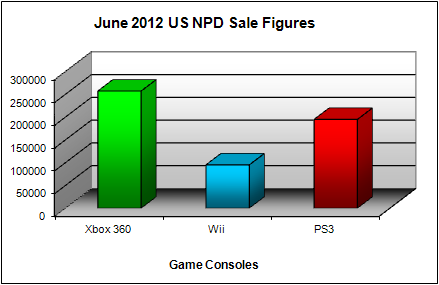
  • “Nintendo sold more than 400,000 total hardware units in June and saw double-digit growth across each of its product lines compared to May. This includes more than 155,000 Nintendo 3DS systems, more than 150,000 units of the Nintendo DS family of systems and nearly 95,000 Wii consoles,” via Gaming Examiner
  • Microsoft revealed 257,000 Xbox 360 units were sold, with 47% of the home based console market share (source)
  • Sony did not reveal any figures for the PS3

A little bit of “statement maths” tells us that just under 195,000 PS3s were sold.

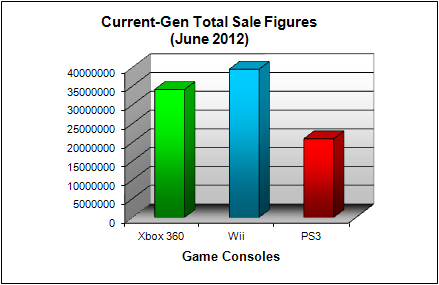
And so the figures for US sales in June 2012 are below, ranked in order of number of sales (June 2011 figures also shown when available, including percentage change – note that totals for the PS3/Wii are now only rough estimates, as exact figures were not available for all months):

  • Xbox 360: 257,000 (Total: 34.1 million; June 2011: 507,000 – down 49.3%)
  • PS3: 195,000 (Total: ~21 million; June 2011: 276,000 – down 29.3%)
  • Wii: 95,000 (Total: ~39.5 million; June 2011: 273,000 – down 65.2%)
NPD June 2012 Game Console US Sales Figures

NPD June 2012 Game Console US Sales Figures

NPD Game Console Total US Sales Figures (as of June 2012)

NPD Game Console Total US Sales Figures (as of June 2012)

This is the first time I can remember of the Wii numbers dropping below the 100k mark, but the 65% drop from the same time last year was probably not unexpected, considering how close the Wii U is to retail.

While the Xbox 360 continues to “impress” by winning the most popular home based console award, 18 month in a row now, its numbers were down a considerable 49% from the same time last year, which to be honest, was a fantastic month for the console (and the Xbox 360 was the only console then to record a year-on-year growth figure). A bit worrying is that the decline seems to have sped up in the last couple of months too, perhaps as a indirect response to the Wii U, but more so perhaps due to this time last year’s numbers being “above normal”.

The PS3 has the smallest year-on-year decline of all the home based consoles, but that’s not to say that it isn’t struggling itself. It’s still down some 36% compared to 2 years ago (Xbox 360 down 43% for the same period – although that’s comparing now to the then launch of the Xbox 360 Slim – the Wii is down 78%!), and it still doesn’t look like its ever going to beat the Xbox 360 unless the 360 is retired early by Microsoft.

It’s not exactly all doom and gloom, since we’re approaching the end of a cycle even if Microsoft and Sony don’t want to admit it publicly, but I think it’s safe to say that we’ve already seen the best of these three home based consoles, and the only way forward now is downwards for them all.

Numbers have also been made available for the PS Vita, which along with the PSP, only sold a combined 100,000 units. Compare and contrast to the Nintendo DS, which sold 150,000 units, and the 3DS, which sold 155,000 units, and you can see the Vita has been a disappointment for Sony so far. The sales figure also highlights a significant drop compared to the earlier sales figures for Vita, which can’t be a good sign either. I think once again, Sony has misjudged the market. Trying to get on the casual gaming bandwagon, while still offering hardcore gamers an exciting gadget, Sony might have ended up catering to neither market. They don’t have the expertise in making fun and casual games like Nintendo, everyone already has a smartphone or tablet that can do what the Vita does, and the high cost of hardware and software, proprietary formats and DRM, means that the Vita was already at a disadvantage before it was even launched. Still, the holiday period will be decisive and if the Vita can have a good one, and if it can have more linkage to the PS3 and other Sony devices, then it can still carve outs its own niche.

In game sales, it’s not exactly been another great month, with the top selling title on all platforms, Lego Batman 2: DC Super Heores, only selling 450,000 copies or so. Speaking of the Vita, what Sony also doesn’t have is a Pokemon like franchise to exploit like the DS/3DS is able to do this month with Pokemon Conquest, coming in at a high 7th for a single platform release (all other listed in the top 10 are multi-platform games). Here’s the full software sales chart for June (new releases shown in bold):

  1. Lego Batman 2: DC Super Heores (Warner Bros – Xbox 360, Wii, PS3, NDS, 3DS, PSV, PC)
  2. Tom Clancy’s Ghost Recon: Future Soldier (Ubisoft – Xbox 360, PS3, PC)
  3. Diablo 3 (Activision Blizzard – PC)
  4. Max Payne 3 (Take-Two Interactive- Xbox 360, PS3, PC)
  5. NBA 2K12 (Take-Two Interactive – Xbox 360, PS3, PS2, PSP, Wii, PC)
  6. Batman: Arkham City (Warner Bros – Xbox 360, PS3, PC)
  7. Pokemon Conquest (Nintendo – NDS)
  8. Call of Duty: Modern Warfare 3 (Activision – Xbox 360, PS3, Wii, PC)
  9. Battlefield 3 (EA – Xbox 360, PS3, PC)
  10. The Amazing Spider-Man (Activision Blizzard – Xbox 360, PS3, 3DS, NDS, Wii)
I don’t think I’ll bother to make a prediction. Firstly because I don’t think we’ll have enough figures to do an analysis next month, and secondly, the hardware sales order  will be pretty much the same as this month (and will be the case until the Wii U is introduced later this year).
See you next month?

Weekly News Roundup (15 July 2012)

Sunday, July 15th, 2012

Happy belated Bastille Day. I’m not French. I don’t speak French, and I don’t really know anybody from France, but 14 is my lucky number, and so that’s the connection I have with the French. That and their fries are a personal favourite.

A couple of real eye openers that I will be covering in this week’s WNR, so without further ado …

CopyrightStarting with copyright news, Wikipedia’s Jimmy Wales has once against caught the ire of the MPAA by, well, not saying anything everyone else hasn’t been saying all along.

Wikipedia Blackout

Wikipedia went black to protest SOPA/PIPA, and founder Jimmy Wales says the site may do it again if Hollywood insists on censoring the web to solves its piracy problem

Speaking at the Wikimedia conference, Wales drew upon personal experience in trying to legally watch the latest episode of Game of Thrones and criticized content holders for not giving the people what they want (and not just to see Joffrey’s head on a spike). Wales also warned that Wikipedia might go dark again if the entertainment industry continues to see web censorship as the solution to everything.

None of Wales remarks were that controversial in my opinion, but anyone who doesn’t agree with the MPAA’s line about pirates being thieves will always be savaged by the lobby group, and the MPAA didn’t disappoint on this occasion. Once again, the MPAA compared downloads to “stealing”, but went one step further by attacking those who only pirate out of convenience (like say if I didn’t feel like jumping through a dozen DRM’d hoops just to satisfy the studio’s piracy paranoia, or I had to download something even though I had already purchased it, just due to ease of use issues). But look at it this way: when your own customers would rather break the law and be called “thieves” than buy your product due to the sole reason of convenience, then maybe, just maybe, you have some work to do before you take a sledgehammer to the Internet. Just a thought.

Of course, even if Hollywood can’t get the government that they’ve already paid for to pass pro-censorship legislation, they can always rely on the threat of legal action to force other private companies to self-censor. PayPal is the latest to demonstrate what a good boy it is when it comes to all this anti-piracy stuff, and it has created a set of new rules for file sharing/newsgroup websites that, effectively, prevent these sites from using PayPal services. In what is surely another nail in the coffin for the once thriving cloud uploading industry (a shame really, since the legitimate services they do provide are invaluable in my opinion), the new rules basically allow PayPal (not even content holders) to dictate what can and cannot be stored on any file sharing website that uses its services. One service provider that has been in talks with PayPal even suggests that PayPal wants full access to all the backend tools to monitor al file uploads, even legitimate, private and confidential ones – a demand that is frankly insane. It would be like if a bank wanted to read all pieces of mail going through private post office boxes (which the bank handles payments for), just so it can reduce its liability in case something dangerous or illegal was sent. Of course, the bank would never be held liable for anything like this, but on the Internet and with the copyright lobby pushing hard, PayPal can become liable (so I guess it’s not all their fault).

At this point though, nothing from PayPal surprises people any more, everyone has had bad experiences with PayPal, and it’s worthwhile to remember that they were the same people who enthusiastically dumped Wikileaks over the tiny bit of governmental pressure. Part of SOPA/PIPA was to give content holders even more power to force private companies like PayPal to do exactly this sort of stuff, but it looks like existing laws and corporate bullying tactics are more than sufficient to ensure exactly the same outcome. So between this and Megaupload, it just goes to show SOPA/PIPA isn’t needed at all.

Napster Logo

The death of Napster gave the RIAA the legal precedent and confidence to engage in a campaign of anti innovation in the years following, according to a new report

Speaking of Megaupload, the decision from this case could very well lead to the kind of landmark decision that will reverberate for years to come. And we don’t even need to look back that far to find how much of a hit on innovation such a decision, or a new set of biased laws, could be. A newly released report goes into detail on how the established music industry profited from now more than a decade ago’s Napster decision. Interviewing 31 leaders of digital music, including CEOs of some of digital music’s biggest firms, the report by Associate Professor Michael A. Carrier of Rutgers University School of Law attempts to show just how much of an effect a copyright decision can have on innovation.

On a high after the victory over Napster, the major music labels, represented by the RIAA, allegedly went on a crusade against all things Internet-y and innovative. By using the funds “earned” from one lawsuit, other websites and start-ups would be sued, until the funds, or suable start-ups, ran out. Not only that, the report alleges that labels strung along start-ups with “good” (and potentially status quo threatening) ideas by refusing to license content to them until these sites had enough traffic, and once they did, sued them for massive copyright infringement. But at the same time, labels were happy to receive huge up-front fees for start-ups they knew would never make it, or made licensing agreements that allowed labels to slowly bleed these new companies dry, the report further alleges. And instead of going after companies, labels would go after individuals associated with the companies, to perhaps add further intimidation for force a favourable outcome in any legal proceedings (although to be fair, everyone does this). Some in the rap business even spoke of physical intimidation,  “being hung out of windows” and things of that nature.

For me, this show why Apple was so bloody clever with the iPod. By making the hardware first, instead of the software/website, Apple made a device that people wanted, loved, and one that the music industry *had* to accept. Had they gone with opening the iTunes store first (and by allowing non Apple devices to buy and play songs), it’s very likely that they too would have been hindered in their attempt to innovate.

With both Hollywood and the recording industry now strongly supporting (if not leading) the case against Megaupload, perhaps both feel another major decision is required to chill the next round of innovation, such as Megaupload’s very own “music label circumventing” Megabox. This mustn’t happen, and I hope it won’t.

As for the actual Megaupload case, the extradition hearing against Kim DotCom, a German-Finnish citizen that ran a Hong Kong based business and currently living in New Zealand and is now being extradited to the US for some reason, won’t be heard until next year, so this one could take a while. DotCom has offered to go to the US voluntarily to avoid the need for an extradition hearing, but only if he gets access to his own frozen/seized funds to pay for mounting legal expenses.

High Definition

People who visit my house often complement, or make fun of, my “oversized” DVD, HD DVD and Blu-ray collection, which I always explain is perfectly reasonable and nowhere near as big as a lot of other people’s.

And now, I finally have proof that my collection is actually perfectly reasonable and I’m not at all an obsessed movie nut that must buy movies even though I only ever watch most of them once. Having spent $500,000 Australian dollars (which is about the same in US dollars), avid collector Greg (you thought that I was talking about myself for a second there, didn’t ya) has now put his entire collection of 50,000 CD, DVD and HD DVD titles, and some 3,500 Blu-ray titles, up for sale for “only” $55,000. Just the storage systems cost Greg $5,000, covers and sleeves another $12,000, and he’s including it all as part of the sale, as well as a HD DVD player, and a region A Blu-ray player.

Greg's Movie Collection

Greg from Sydney Australia shows what a real movie collector is like, and you can be just like him if you pay $55,000 to buy his entire collection!

Greg is selling because his flat is no longer big enough for his, possibly still growing, collection. Ironically, the $500,000 he did spend on the discs could have gone a long way to buying a bigger house, which could have housed his collection in a more permanent fashion (or $445,000 on the house, and $55,000 to buy someone else’s 50,000+ title collection). But I’m sure Greg, like all collectors, regret nothing. Although, as one commenter, it looks like Greg might have spent $500,000 to do what an $8 per month Netflix streaming account can do. Ouch, but not really 100% accurate, since I’m sure he has tons of titles that Netflix doesn’t have, some of them in glorious high def that Netflix can’t provide (yet), but perhaps there’s a good point there too about a new more efficient way to have a movie collection ($8 per month for 50 years, the lifespan of DVDs and Blu-rays, still works out to be less than what Greg paid just for his shelves).

In any case, it does make my collection look rather small by comparison. I’m just hoping the saying “size doesn’t matter” also applies to movie collections!

Gaming

Good news everyone. The NPD analysis will be back for June, as some intern somewhere probably screwed up and actually released some sales figures to allow for a proper comparison between the three major home based consoles, as well as a look at the sales figures for the new Vita portable. Will cover the results in detail in the next few days.

By my calculations, the PS3 sold just under 194,000 units in June, that’s almost 100,000 units more than the Wii, but also 63,000 units less than the Xbox 360. While the Wii has clearly dropped out of the race for the home console market, not by choice really, the PS3 still has a chance to compete with the Xbox 360 and get its user base up in time for the PS4 or whatever it will be called.

While the PS3 is actually pretty good value considering its media credentials, where the PS3 has really struggled though is in the lower end of the market, where the Wii used to dominate, and now the Xbox 360 with its cheaper 4GB console. So the news that Sony might release a 16GB version of the PS3, according to recently leaked photos and documents in Brazil, might not sound too surprising. Still very much a rumour at the moment, so I wouldn’t, say, bet your $500,000 movie collection on the news being true, but it would make a lot of sense if Sony really wanted to extend the life of the PS3. There’s still a market for the PS2 today, and that’s proof the low price strategy works.

What also works though is quitting while you’re ahead, which might be good advice for Sony, but I was talking more about this issue of the WNR to be honest. Any excuse to stop writing! See you next week.