Archive for the ‘Video Technology’ Category

Weekly News Roundup (20 March 2016)

Sunday, March 20th, 2016

Hello again! I’ll try to keep this one nice and short, despite there being actually quite a bit of news this week. I just had a sneaking suspicion that you’re not in the mood for reading a whole bunch, that and the fact that I’m not in the mood for writing too much either.

Being lazy and not feeling guilty about it has its perks!

Copyright

Australia's Internet Filter

Australian Internet filtering about to start … only if the legal stuff can be sorted out first

We first step onto the continent of Australia, where the powers that be (ie. Hollywood) have finally decided to do something about the Pirate Bay problem. And by doing something, it of course means site blocking. But before the blocking can happen, the rights-holders have to get a court order, and things are not very straight forward for them due to the laws we have here (laws that were only recently changed to allow site blocking). You can read the whole piece for details as to why site blocking is kind of tricky to get started here. But a difficult process is what’s needed, as censorship is not something that should be taken lightly, even when it relates to something as obvious as The Pirate Bay.

From one lawsuit to another, this time from the other side of the world. When the sister company of Warner and Intel and the company responsible for managing the HDCP copy protection system found in HDMI/DP connections sued Chinese HDMI/DP splitter/conversion maker LegendSky, it might have seemed a rather straight forward case. After all, one of LegendSky’s latest devices may have been responsible for the spate of 4K rips that hit the torrent scene last year, from sources that had been protected using the latest and most secure version of HDCP.

HDMI Connector

When is a HDCP stripper not a HDCP stripper?

But it appears LegendSky’s devices doesn’t actually strip the new version of HDCP at all from sources like Netflix 4K streams and Ultra HD Blu-ray. Instead, it converts the new, hard to crack version to an older version that has already been cracked – and the conversion is legal (and used to maintain legacy compatibility).  This, LegendSky says, means DCP’s original lawsuit is flawed and based on the wrong assertions, and that it should be dismissed by the judge immediately. Bold words. Fighting words, which means this straight forward lawsuit has just become anything but straight forward.

Speaking of Netflix rips, the streaming giant has done the unthinkable – it has joined the Google DMCA filing game, submitting 71,861 links for removal. Netflix, using the services of the anti-piracy outfit Vobile, wants streaming and download links to shows like Sense8, House of Cards taken down. This marks a drastic change of direction for Netflix, who, up until now, had maintained a relaxed attitude towards piracy. In fact, CEO Reed Hastings even admitted that piracy sometimes “creates the demand” for the streaming network’s own original programming.

Gaming

Microsoft has just dropped the price of the Xbox One again, this time to $299. The price drop is only temporary, but based on history, it might turn into a permanent one if sales respond in the expected manner. It’s the best weapon in Microsoft’s arsenal in their bitter battle with the PS4, and truth be told, it’s probably the most effective weapon anyway. It will be interesting to see if Sony responds, but given their sales lead and momentum, they probably don’t even need to.

——

So that’s it then for the week. Not too long as promised, but still full of tasty goodness as always, erm, or something. See you next week.


Weekly News Roundup (6 March 2016)

Sunday, March 6th, 2016

Long time no see, hope you’ve been well. Sorry for the major gap between this and the last WNR, but a mini vacation and the vacation I needed afterwards to recover from the original vacation meant that there wasn’t much time to write anything. On the other than, it meant that we skip to my joint-favourite month of the year, March – my birth month!

I’m still digging myself out of the mountain of work sitting on my virtual desk, so I’ll try to keep this WNR brief and to the point, and cover all the stories since the last WNR (even if some of them are a bit too old – like I will be in a couple of days, *cries*).

Copyright

Denuvo

Has Denuvo been cracked?

Starting with copyright news as usual, the saviour of the PC gaming industry may not be the panacea first thought, as the Denuvo anti-tampering technology may have been cracked. Chinese cracking group 3DM has claimed responsibility, only weeks after the group announced a hiatus from cracking activities, to allow the PC gaming market to recover. Most didn’t believe the group’s reason for the hiatus, and instead, many thought the group had given up only because Denuvo had proven too hard to crack. To quiet the raucous crowd, and to disprove this theory, 3DM instead announced a temporary return to cracking, to crack the Denuvo protection on popular games including ‘Tomb Raider: The Rise’.

But since that announcement, no concrete crack has actually emerged, so take that announcement with a pinch of salt if you must (I guess this is one of advantages of addressing a news story with an added delay).

Another story from a couple of weeks ago, Kodi announced a crackdown on piracy related add-ons in a bid to distance the open source software home theater from all things illegal. It’s kind of what BitTorrent Inc has been trying to do, with limited success, but it’s always hard to separate the technology from how people choose to use it (remember that once upon a time Usenet had nothing to with piracy, while FTP was synonymous with it at one point). But what Kodi hates the most are those piracy media box sellers that somehow tries to present their products as something officially to do with Kodi, usually the same sellers that offer no support when these boxes eventually fail to work.

RedFox

Slysoft is dead, but RedFox lives on …

Cut to more recent times, the future of Blu-ray ripping may be in doubt, as new legal pressures, and new technology advances means two of the top ripping tool makers have called it quits. Well to be precise, one has called it quits, while the other has given up on ripping Ultra HD Blu-ray before they’ve even started trying. Slysoft suddenly closed shop, shut down their site with only a short statement citing recent “regulatory requirements” as the reason for the closure. Those that purchased AnyDVD can still use it to rip older Blu-rays and DVDs, but new discs that require access to the updated online database to be ripped will no longer be supported. Since the original story was published, a new company called RedFox based in Belize has taken over the development of AnyDVD, and the official Slysoft forum, suggesting that AnyDVD may be resurrected (assuming the new company doesn’t get sued into submission before then).

In a separate piece of news, DVDFab, who have suffered their own legal troubles recently, announced they will not be working on ways to rip Ultra HD Blu-ray. DVDFab’s announcement seems to indicate legal pressure, rather than technical issues, as the cause for the lack of support for the new disc format. That’s not to say there aren’t technical difficulties related to ripping the new ultra HD discs, which use the updated 2.0 version of AACS. As part of the new protection, some discs will need to download the decryption key from the Internet, making it a bit harder (but probably not impossible) for software like DVDFab to find a way in.

High Definition

Panasonic 3DTV and 3D Blu-ray Player

3DTVs may be a dying breed, as Samsung announces their new 2016 TVs won’t support it

Speaking of futures in doubt, the future of 3D is also under a cloud, and not one of those 3D clouds that you can fly through in one of those over the top out of place “made for 3D” scenes you find in all movies these days. While 3D movies will still be a big thing at movie theaters, in the home, it may be a different matter as Samsung (and Philips) will be removing 3D support from their 2016 TVs, while LG is rumoured to be cutting back on the number of models that support 3D.

Samsung and Philips cite the lack of consumer interest in the technology, and the ever dwindling number of must-have 3D titles, while Samsung says they want to concentrate on new technologies such as Ultra HD.

Those following our weekly Blu-ray sales analysis shouldn’t be too surprised by this, as there can be weeks at a time that goes by without single noteworthy Blu-ray 3D release (by noteworthy, I mean one that gets in the top 20 in terms of sales). With the Ultra HD Blu-ray specs not even including 3D support for UHD content, it definitely doesn’t look good for 3D in the home.

Gaming

With the Xbox One failing to beat the PS4, Microsoft thinks their next winning strategy would be to fuse their Windows and Xbox gaming platforms, thus increasing market share without having to unseat Sony. Part of this plan involves Universal Windows Platform, which allows developers to make games using a single platform that can be easily ported to Windows and the Xbox One. There was some initial backlash from developers fearing Microsoft was trying to monopolise the PC gaming market, and forcing PC game developers to work within Microsoft’s framework, even if they don’t want to publish games on Xbox. Some also fear that Microsoft will force developers to use their games store to publish games,. Microsoft has since allayed their fears by saying the platform will be fully open, and won’t be tied to a particular store.

Xbox boss Phil Spencer also hinted that a souped up Xbox One may be available at some time, echoing Sony’s earlier calls for a “Super PS4”. Spencer says consoles are at a disadvantage compared to PCs, whose hardware are constantly being upgraded, while the console upgrade cycle can mean seven years between any meaningful upgrades. So a Xbox One.5 might give players better graphics, while the same game would still work on older Xbox One’s (but with downgraded graphics, I assume). This would also give Microsoft an extra chance to bring out a console that’s better than the PS4 (or the Super PS4), instead of having to wait another four and a half years for the chance.

——

You definitely won’t have to wait four and a half years for the next edition of the WNR though, since things are finally back to normal around here (well, it will be once I climb to the top of the pile of work I’m buried under). See you next week.

Weekly News Roundup (31 January 2016)

Sunday, January 31st, 2016

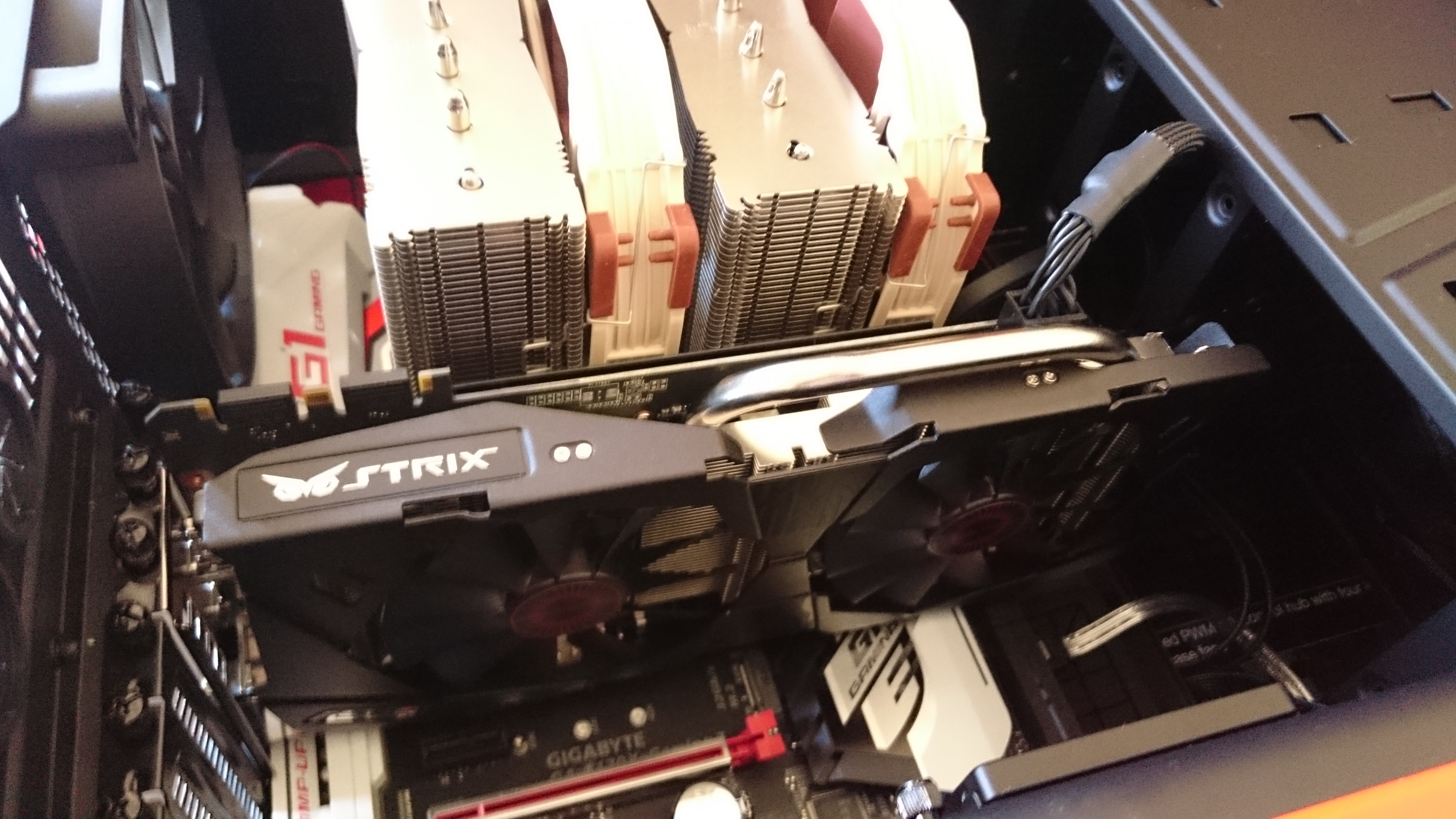
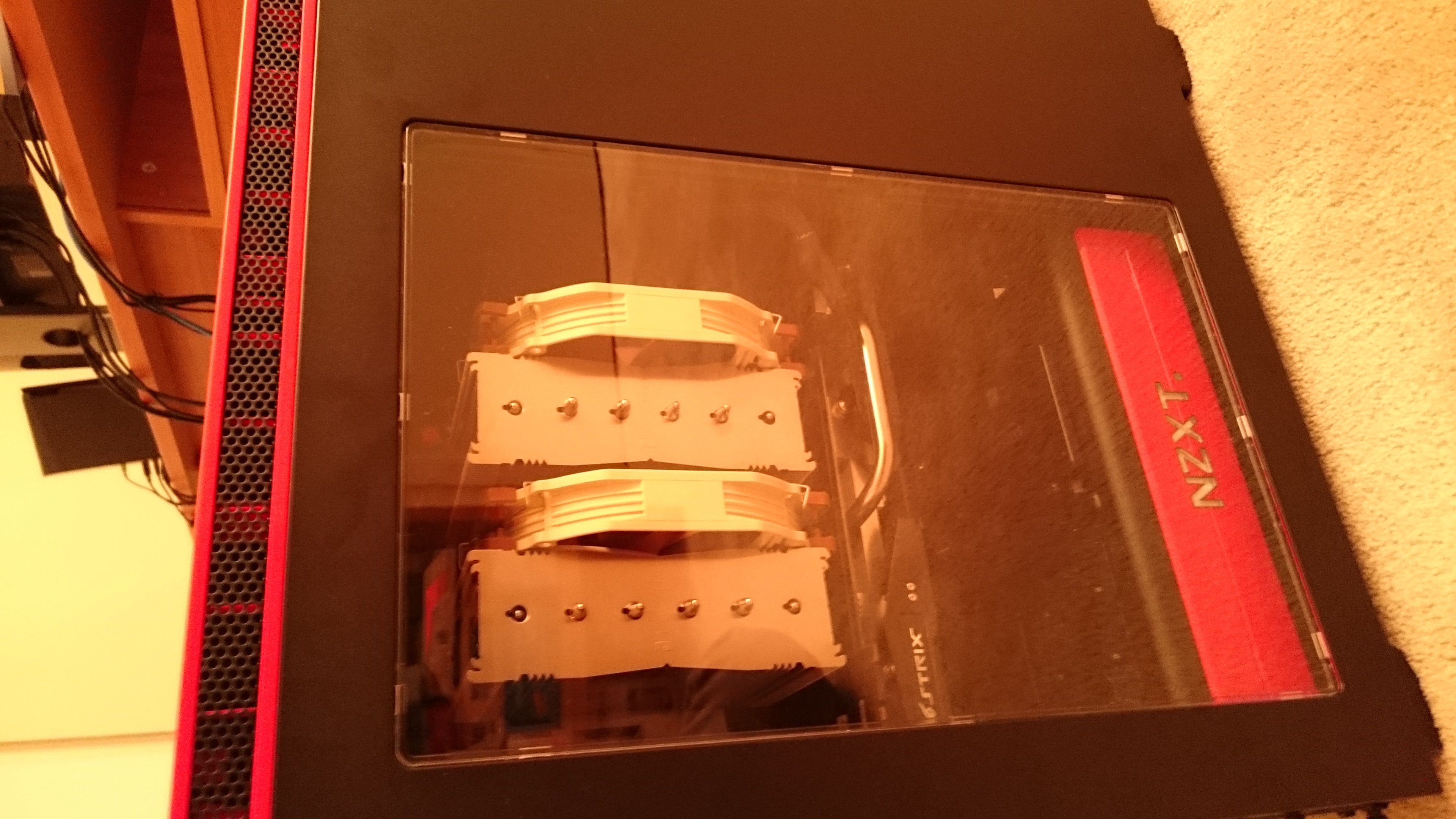
With any luck, I’ll have the first part of my epic PC building guide out on my blog this week, the first part will cover picking and buying of the parts needed for a system, sharing some of my own learned experience on the issue (like how to do price comparisons, check for compatibility, reviews …). The actual build was finished earlier in the week (very good fun, if you must know), but I haven’t had time to tweak and tune the system yet, let alone overclock. In the meantime, here’s a couple of PC build porn pics for you to enjoy.

PC Build - Innards

PC Build – Innards

PC Build - Outards

PC Build – Outards

Oh yes, we have news to cover, don’t we?

Copyright

Australia's Internet Filter

EFF warns of new plans to filter everything on the Internet

The EFF is on the warpath again, this time protecting all of us Internet users from the latest short-sighted plans by content-holders to remove piracy from the Internet. Instead of the current DMCA system, rights-holders wants a new one that puts the onus on the likes of Google to keep pirated content from being found.

Under the current take-down system, rights-holders have to specifically provide each and every URL to be removed. This game of copyright whack-a-mole has proven extremely ineffective, and so rights-holders have devised a new plan – get Google to do everything! Instead of providing the URL, rights-holders only want to identify the actual content being pirated (eg. the movie “The Hateful Eight”) and they want Google and others to identify and remove all related piracy links for said content. So Google’s copyright policing role expands to being ongoing, perpetual detectives, in a never ending search for pirated links.

For obvious reasons, Google don’t want to do this, and why should they? A search engine should not be responsible for content that it has no control over, and it should not be tasked with identifying the legality of a piece of content that it has no legal claim on. Only the rights-holders really know what and what doesn’t belong to them, and so it’s their responsibility to identify and submit URLs for removal.

And it’s not as if these same rights-holders have no responsibility when it comes to piracy – in fact, some of their inaction may be directly responsible for the stuff being uploaded online, including most of this and last season’s Oscar nominated movies.

Pirated Movies For Sale

Hollywood has been supplying pirates with the best movies of the year, thanks leaks of DVD screeners

A Variety report has confirmed what we’ve all long suspected, that Hollywood really doesn’t like new technology, specifically digital. This is why they are still using snail mail to send DVD screeners to award voters, the same screeners that habitually get leaked and uploaded online. But Hollywood still doesn’t like to do screeners digitally. Why? Because, apparently, they think that the 1% chance of digital screeners being copied and distributed illegally is not a chance worth taking (they much prefer the 99% chance that DVD screeners have of getting leaked, I guess?).

The other reason they don’t like digital screeners is also symptomatic of Hollywood’s slow embrace of all things digital, at least when compared to tech companies. Hollywood execs don’t like digital screeners because there does not exist a single platform that will support every studio’s digital screeners. It’s actually the same problem we as consumers face, and Hollywood studio greed has been the reason why every studio has their own convoluted way to play UltraViolet content (WB has Flixter, Sony has Sony Pictures Store, Fox and Disney don’t even use UltraViolet), as opposed to just supporting one of the major platforms (like iTunes, Android Play and whatever thing Microsoft uses).

So stuck with the irrational fear of digital piracy, and the slowness in embracing the new, I guess it’s going to be DVD screeners for a while longer still. Come January 2017, I’ll be keeping an eye out for the DVD screener leaks of that year’s award contenders.

——

I get most of my new music from Spotify, and if that fails (or if my significant other wants to listen to Taylor Swift … oh alright, if *I* want to listen to Taylor Swift), then it’s a quick hop to YouTube. But what if you could combine the best of both worlds, a Spotify like interface that let’s you listen to music sourced from YouTube music videos? Too good to be true? It is.

At least, it is from a legal point of view. New start-up Wefre‘s dream of turning this to reality has quickly turned into a nightmare, part of it because they underestimated how popular this thing could be, but also mainly because they failed to understand the basics of copyright on the Internet: if music labels aren’t getting big money from it, you’re doing it wrong!

Wefre, now “temporarily” suspended only two weeks after launch, was doomed to fail from the beginning. It’s creators failed to see just how rights-holders, and YouTube, might not like what they were doing with the legally uploaded music videos (what they did probably breaks YouTube’s terms of service anyway), and probably also failed to remember you can’t just copy Spotify’s interface without repercussions. Still, despite Spotify’s existence, there still seems to be a wanting of a way to freely stream music, all the music (I’m looking at you Taylor Swift). So those in the industry will have to constantly battle tools like Wefre, or they do the proper thing and just let Spotify have everything (which is a good thing for everyone involved).

——

Gotta get back to watching the tennis now, plus doing more writing on the PC build guide. Have a great week!

Weekly News Roundup (24 January 2016)

Sunday, January 24th, 2016
PC Build - Boxes

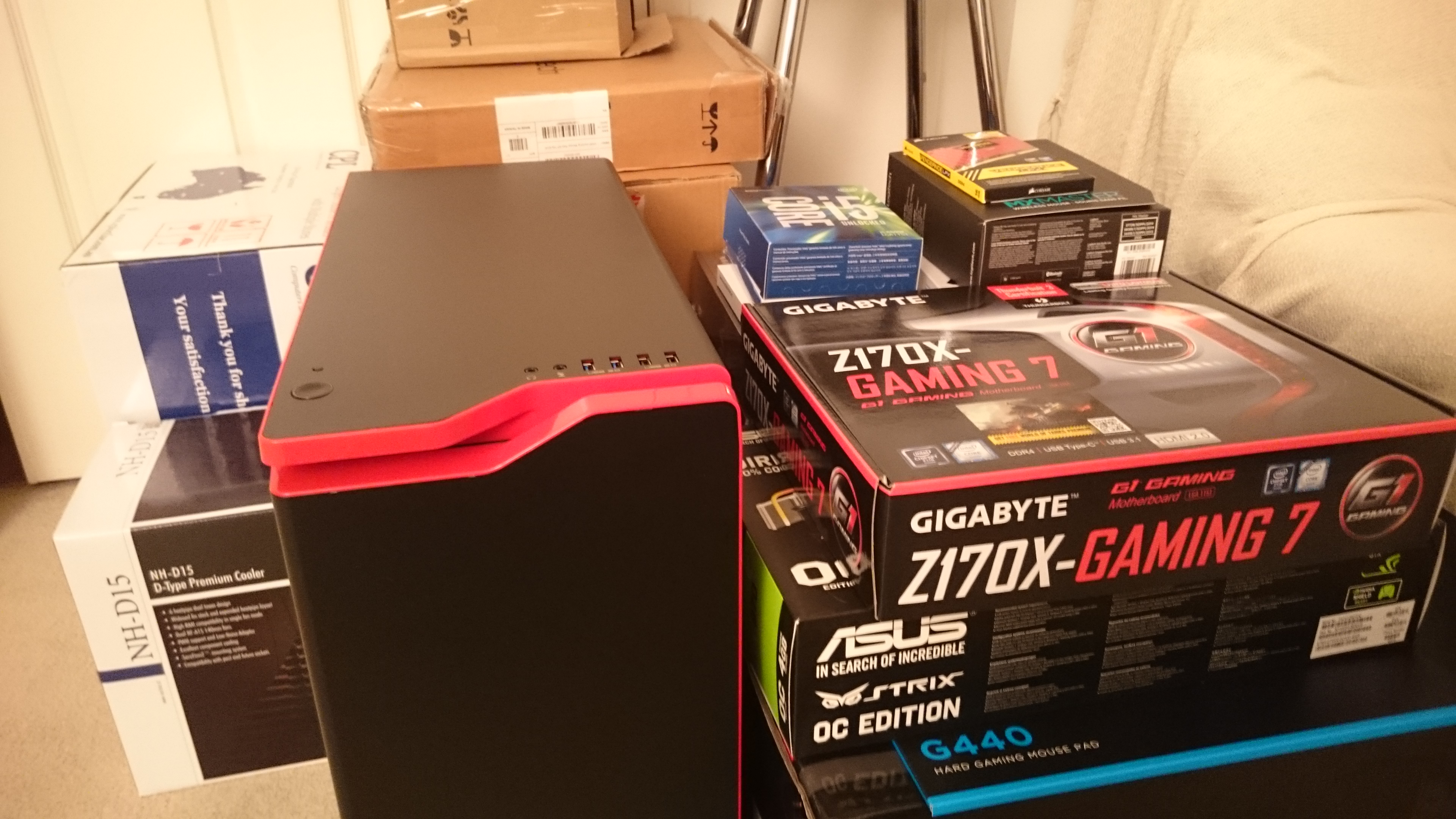
PC Building Step 1: Find a place to store a lot of boxes

A pretty quiet week. I wonder if it’s because of MLK Day, but certainly the news stories only started to flow at the end of the week, too late to make it into this edition of the WNR.

Some update on the PC build front – all the parts have finally arrived, and the build can begin proper. Keep on eye out for our series of blog posts on this, which will feature plenty of hints and tips for those looking to start on their own build. In the meantime, feast your eyes on these glorious pics (of a very messy section of my office).

PC Build - Boxes, close up

Let’s get started with this very short WNR.

Copyright

Smartphone Music Headphones

People may be using piracy to sample new music

Some would like you to be believe that piracy is always bad, and that it always leads to losses for the rights-holders. There are also those that say piracy is never harmful, and it may even be beneficial. But like most things in life, the truth lies somewhere between these two extreme, and it’s far more complicated than a simple ‘yes’ or ‘no.

And so concludes a new study which looked at (admittedly old data, from 2008) piracy and how it relates to sales, and found that piracy does indeed negatively affect sales, but can also boost sales at times. According to the paper, piracy affects physical purchases, while helping digital sales, and the least well known artists have more to lose than those that are more popular. This last point is interesting, as it seems to suggest that pirates are picking and choosing which music they pirate, and once they do that, which music they end up paying for. It’s almost as if they’re treating piracy as a discovery tool, to trial new music without having to pay the full price. Good, popular music have less to lose from piracy (and may even gain from it, thanks to the word-of-mouth effect), while bad or unpopular music aren’t being purchased when there’s a free pirated version around.

This is perhaps why Spotify and others like it has become so popular, so quickly, especially among (former) pirates. Spotify is giving them the chance to discover new music without having to be out of pocket, the difference now being that, thanks to ad-supported listening, the artists can get something out of it. Not much, but certainly more than what they would get from piracy. But if you make bad music nobody wants, don’t be surprised that people will listen to it on Spotify and not pay for it.

High Definition

Jurassic World Blu-ray

Jurassic World was 2015’s biggest Blu-ray release

With news hard to come by this week, I finally had the time to write the 2015 Blu-ray sales analysis article, Blu-ray: The State of Play – 2015. Based stats that I’ve been posting weekly through the entire year, and comparing with the same stats from a year ago, the conclusion definitely seem to point to 2013 being Blu-ray’s peak year in terms of sales revenue. Things have been going backwards for two year’s in a row now (although 2015’s decline was slower than that experienced in 2014), despite there being no lack of big titles, including Big Hero 6The Hobbit: The Battle of the Five ArmiesFurious 7Jurassic World and Minions. Jurassic World was the title to beat in 2015 though (just like The Force Awakens is likely to be hard to beat in 2016), not surprising considering that at the time of its release, it was the third biggest movie in history. There was nothing like it in 2014, and yet Blu-ray revenue was still higher then.

Of course, falling Blu-ray prices contribute to the decline in revenue, but the digital evolution is obviously having an effect too, especially considering you can get pretty good quality HD (and even 4K) from most of the digital outlets, including streaming.

Will Ultra HD Blu-ray lift Blu-ray revenue out from its steady decline? Probably not. There’s just not enough display hardware, and software available in 2016 to make a huge difference, and even if it turns out to be a mainstream success, all it will do is to eat into standard Blu-ray and DVD sales number, without necessarily creating new customers (like DVD did when it first came out). I think the people that will dig Ultra HD and 4K, are those that are already heavily invested into Blu-ray – they will spend money, maybe a little bit more money than normal on Ultra HD, but the average Joe is already looking way from discs, towards streaming and downloads.

——

And I’m already looking away from my monitor, towards getting my new build up and running. See you next week!


Blu-ray: The State of Play – 2015

Monday, January 18th, 2016

Welcome to another edition of our annual Blu-ray sales analysis, where we look at how Blu-ray has performed over the last year. We’ve updated the format of this article slightly to hopefully try and make it clearer, while removing graphs that we think are no longer particularly relevant or useful.

The data used in this analysis derives from our weekly updates, based on figures released by Home Media Magazine. Some of the historical figures you’ll see have also been adjusted, due to slight tweaking of the metrics used by HMM to create these sets of data, although the changes have been very subtle and does not change the bigger picture in any way.

For 2014, we saw for the first time since the Blu-ray format’s inception a decline in revenue compared to the previous year, and at that time, we called 2014 “the year that Blu-ray went backwards”. We declared boldly at that time that it appears Blu-ray’s popularity had peaked in 2013. Were we premature in proclaiming “peak Blu-ray” had been reached, or will Blu-ray make a come-back in 2015? Read on to find out!

Blu-ray Market Share

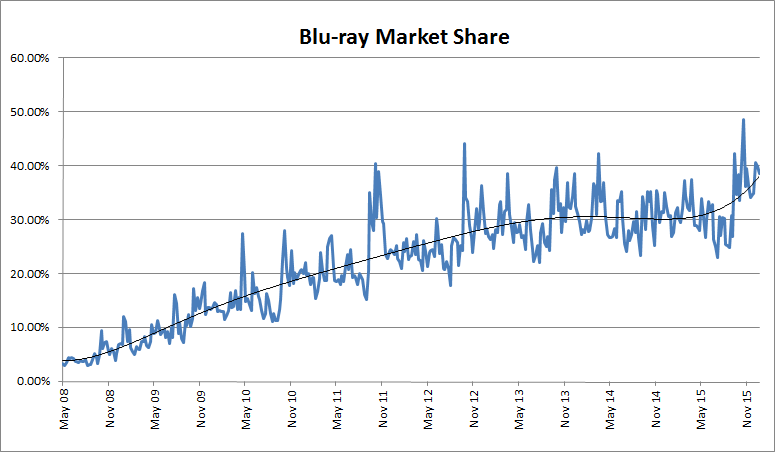
As has been the case with all of our “Blu-ray: The State of Play” reports in the past, we start with the ever wider Blu-ray Market Share graph. Blu-ray market share represents weekly Blu-ray sales as a percentage of total packaged disc sales. So a Blu-ray market share of 45% means that 45% of all disc packages sold in that week contained a Blu-ray disc (inversely, this also means that 55% of disc packages sold only contained the DVD version of the content). In the graph below, we also point out some of the more obvious milestone releases. 2015’s major releases, at least those that had a significant impact on Blu-ray market share for the week that they were released, were Big Hero 6The Hobbit: The Battle of the Five ArmiesFurious 7Jurassic World and Minions, and notable mentions to The Hunger Games: Mockingjay – Part 1, Interstellar, Fifty Shade of Grey, Avengers: Age of Ultron and Inside Out.


Blu-ray Sales Percentage – 4 May 2008 to 26 December 2015

Blu-ray Market Share – 2008 to 2015 – Click to see larger version

Note that because Blu-ray market share is proportional to DVD market share, any drop in DVD sales will also result in a higher Blu-ray market share, even if Blu-ray sales are steady. With DVD on a steady decline, Blu-ray market share will continue to rise as long as it’s own sales decline is slower than that of DVD’s.

Below is the same data condensed and with a trend line added. As you can see, Blu-ray market looked to be on the way down until the second half (or rather, the last quarter) of 2015, when the big releases started coming out (starting with Furious 7). The big peak you see in graph below, which represents the current time record in terms of Blu-ray market share, came in the week Jurassic World was released (Blu-ray market share of 48.62%), a movie which, had it not been for Star Wars: The Force Awakens, would have been this year’s biggest movie, and the 3rd biggest of all time worldwide (now down the 4th). Star Wars could break this record again when it is released in March or April, most likely.

Blu-ray Market Share – 2008 to 2015

Blu-ray Market Share – 2008 to 2015

Blu-ray Revenue

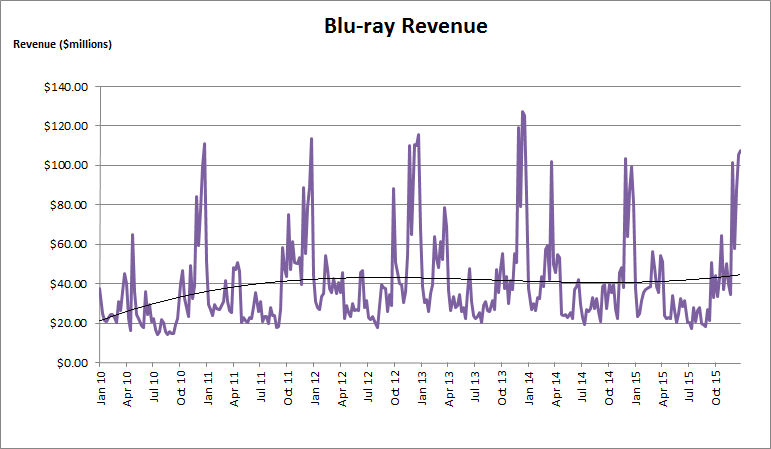
For actual revenue, unfortunately, no records were broken as you can see from the graph below. The peak you see in the graph below again corresponds to the two important sales period, the Black Friday/Cyber Monday week, and the pre-Christmas sales period. 2015’s peaks are comparable, if not slightly higher than that for 2014, but neither of the past two years could compete with 2013. So our earlier premise that 2013 was the peak year for Blu-ray appears to be holding true.

Outside of the two major peaks, the other significant weeks came in the weeks that Furious 7 and Jurassic World were released.

Blu-ray Revenue Growth – 2010 to 2015

Blu-ray Revenue Growth – 2010 to 2015

2014 vs 2015 Comparison

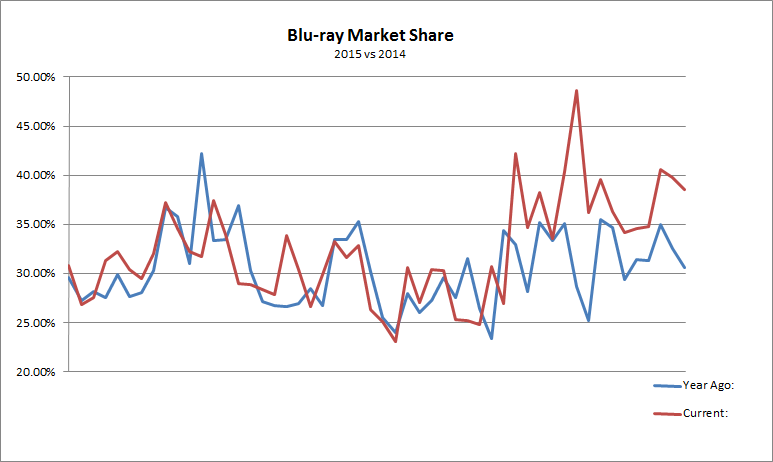
So let’s take a closer look at how 2015 did compared to 2014, starting with Blu-ray market share as shown in the graph below. It’s much easier to see the initial decline and then major rise in market share from first half of 2015 to the second half. Those big releases mentioned earlier had a major effect on Blu-ray market share,

Blu-ray Sales Market Share: 2014 vs 2015 Comparison

Blu-ray Sales Market Share: 2014 vs 2015 Comparison

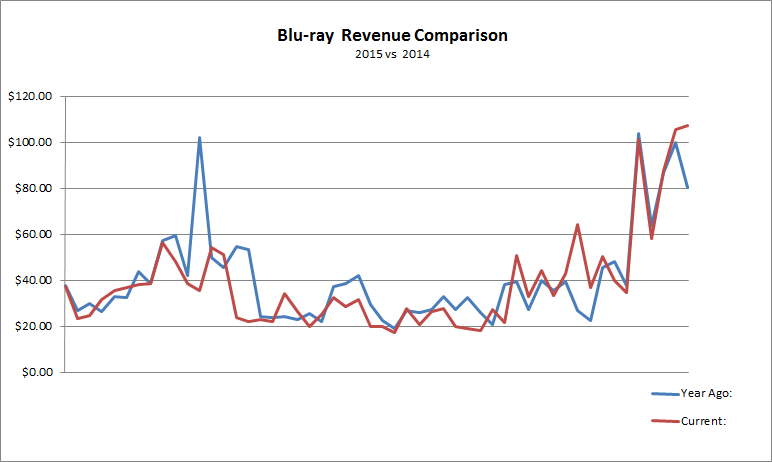
Revenue wise, the differences between 2014 and 2015 were less visible – certainly the first part of 2015 were disappointing for Blu-ray, but the second half at the very least matched, and often beat, the performances of 2014.

Blu-ray Sales Revenue: 2014 vs 2015 Comparison

Blu-ray Sales Revenue: 2014 vs 2015 Comparison

We can get a clearer picture by looking at the raw numbers. Out of the 52 weeks in 2015, 31 of them had a weekly revenue lower than the same week in 2014. 21 weeks recorded a revenue result that was higher than the same week in 2014 (with 11 of these weeks coming in the last four months of the year). This is an improvement compared to last year, when 35 weeks performed poorer than the same weeks in 2013. So if Blu-ray is in decline, the decline definitely slowed in 2015.

But did total Blu-ray revenue decline in 2015? Unfortunately, it did. Total Blu-ray revenue for 2014 was $2.156 billion, compared to $2.041 billion in 2015, a decline of 5.35%. This makes 2015 only the second year in which there was a year-on-year revenue decline, since Blu-ray was first launched in 2006.

Conclusion

To sum up:

  • Blu-ray market share grew, but it may largely be due to the decline in DVD than any rise in Blu-ray sales
  • Jurassic World was the title to beat in 2015
  • Blu-ray revenue declines for the second year running

These results seem to confirm that 2013 was indeed the peak for Blu-ray sales. 2016 will be an interesting year, with Ultra HD Blu-ray coming onto the scene (still unsure how sales will be tracked at this point), and with a couple of big releases already lined up (Spectre, Star Wars: The Force Awakens, The Hunger Games: Mockingjay – Part 2, The Martian …), not to mention the tent-pole releases of 2016 (Batman vs Superman, Star Trek 3, Captain America: Civil War, X-Men: Apocalypse …), it’s hard to say whether we will see a small bounce in 2016, or whether the decline will continue.