Archive for the ‘PS3, PS4’ Category

Game Consoles – April 2011 NPD Sales Figure Analysis

Saturday, May 14th, 2011

We’re back! Well, for this month anyway. Following last month’s lack of PS3 numbers because Sony didn’t want people laughing at the fact that PS3 sales was actually negative for the month (Not Intended To Be A Factual Statement), the monthly NPD analysis had to be temporarily suspended. But we’re back, stronger than ever this month (erm, sort of), largely thanks to PS3 numbers not being so miserable that Sony decided to release some numbers again. It still didn’t really matter because the Xbox 360 still solidly outsold the PS3, but to be fair to Sony, given the month they’ve just had, everything looks like good news these days. For those that are new to this, this analysis looks at US video games sales figures compiled by NPD, unreleased by NPD due to pressure from the gaming companies, but then leaked by various sources, including gaming companies, if/when it suits them.

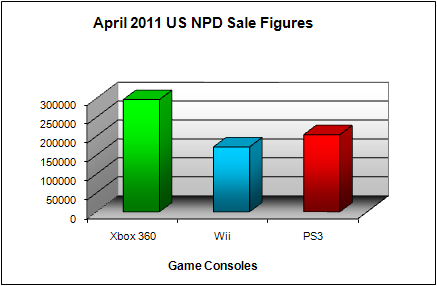
The figures for US sales in April 2011 are below, ranked in order of number of sales (April 2010 figures also shown, including percentage change):

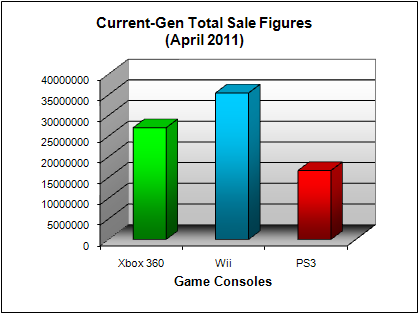
  • Xbox 360: 297,000 (Total: 27 million; April 2010: 185,400 – up 60%)
  • PS3: 204,300 (Total: 16.7 million; April 2010: 180,800 – up 13%)
  • Wii: 172,000  (Total: 35.4 million; April 2010: 277,200 – down 38%)
NPD April 2011 Game Console US Sales Figures

NPD April 2011 Game Console US Sales Figures

NPD Game Console Total US Sales Figures (as of April 2011)

NPD Game Console Total US Sales Figures (as of April 2011)

My prediction from last month was:

I didn’t make a prediction because I didn’t do a NPD analysis last month because of those ******* at Sony (possibly)

Note that some of the figures above are extrapolated, and somewhat based on guestimates. For example, I gave Sony the benefit of the doubt and gave the PS3 350,000 units sold for last month, so I could have an estimate for the total sales figures graph. And this month, Sony only said that the PS3 grew by “nearly” 13% compared to April 2010, and so I again gave them the benefit of the doubt and made the growth exactly 13%. But these figures have always been rounded up and down, and so they’re not that accurate, but accurate enough in terms of providing a general feel of what’s going on, allowing “analysts” like myself to extrapolate the data and make things up, basically.

So the Xbox 360 was the winner again, just like last month (the PS3 numbers weren’t present, but the Xbox 360 and Wii numbers were present, and presented in the gaming section of the April 24 edition of the Weekly News Roundup). In fact, Xbox 360 sales are 60% up compared to the same month last year, which is quite a result. This makes for the best month-to-month-a-year-ago result since last November, when the Xbox 360 recorded 67% growth. It’s hard to explain where the result comes from, but (and this is where the “make things up” thing comes in), with software sales higher than in April 2010 thanks to some a-list releases, and most of them, while being multi-platform, sold better on the Xbox 360 than any other console, and this probably helped hardware sales as well. Microsoft also said that Kinect sales were promising, with Michael Jackson: The Experience the pick of the Kinect new releases for the month.

And as mentioned earlier, the PS3 numbers were good enough for Sony to release figures for this month. This time last year, the Xbox 360 and PS3 were neck and neck (with the Wii way ahead in the lead … more on that later), but the Xbox 360 managed to outsell the PS3 comfortably this month, despite the PS3’s “near” 13% growth figure. Sony would point to this figure showing that the PSN outage for the last ten days of April did not really have a profound effect on sales, but we’ll only know the full scale of the damage in May’s NPD (no doubt if the numbers don’t go well, Sony will withhold the figures again, so we may never find out), when it is revealed that millions of PSN account details and some credit card numbers were leaked. Various sources are already posting information which shows increasing number of PS3 to Xbox 360 console trade-ins at retailers, an increasing number of gamers switching pre-orders from PS3 versions to Xbox 360 versions (for those that presumably owns both consoles), and Sony’s share of game sales dropping from 37% from before the PSN outage, to only 21% with the most recent data.

The Wii was the worst performer out of the home based consoles this month, with sales being 38% down compared to the same period last year, a somewhat consistent decline. Which is probably why the Wii has just received a price cut, and that Nintendo plans to announced the Wii 2 at E3 in less than a month’s time. Nintendo’s other consoles, including the new 3Ds, aren’t doing much better though, with the original DS once again outselling the more expensive 3Ds.

For games, Mortal Kombat was the best seller, followed by Portal 2. Mortal Kombat sold 900,000 copies on the two platforms, the Xbox 360 and PS3, on which it was released, and the Xbox 360 version most likely led the PS3 version in sales (as otherwise Sony would have mentioned that the top selling game of the month did best on their platform). Same with Portal as well, according to GfK-ChartTrack, despite the PS3 version having several exclusives, including a free PC version of the game, plus cross-platform gaming (according to released figures, the Xbox 360 version outsold the PS3 version by about a 1.5-to-1 margin). Michael Jackson The Experience also made the top 10, despite only the PS3 Move and Xbox 360 Kinect SKUs of the game being new in April (the other SKUs were released ages ago). Another game that didn’t make the top 10, but would have if a bundled version had counted as software, as opposed to accessories, sales was SOCOM 4. The “Full Deployment” bundle consisted of a Move controller and the Sharpshooter accessory, and had this bundle been included in the software numbers, SOCOM 4 would have made the top 10. As it is, the bundle was the highest ranking new accessory for the month. Here’s the full software sales chart for April:

  1. Mortal Kombat 2011 (Warner Bros. Interactive, Xbox 360, PS3)
  2. Portal 2 (Electronic Arts, Xbox 360, PS3, PC)
  3. Lego Star Wars III: The Clone Wars (LucasArts, Xbox 360, PS3, Wii, NDS, 3DS, PC)
  4. Call of Duty: Black Ops (Activision Blizzard, Xbox 360, PS3, Wii, NDS,PC)
  5. Tiger Woods PGA Tour 12: The Masters (Electronic Arts, Xbox 360, PS3, Wii)
  6. Crysis 2 (Electronic Arts, Xbox 360, PS3, PC)
  7. Just Dance 2 (Ubisoft, Wii)
  8. Michael Jackson The Experience (Ubisoft, Xbox 360, PS3, Wii, NDS, PSP)
  9. Pokemon White Version (Nintendo, NDS)
  10. NBA 2K11 (Warner Bros. Interactive, Xbox 360, PS3)

I don’t really want to make a prediction next month, because if I’m right, and that the PS3 number falls due to the PSN outage, then Sony won’t release the figures, and we don’t have an NPD. Regardless, I think the Xbox 360 would still be the top selling console, so it’s just a matter of how much the PSN outage hurts the PS3, and how much the Wii price cut helps the Wii. The biggest game new releases for May are L.A. Noire, Brink and LEGO Pirates of the Caribbean.

See you next month, hopefully.

Weekly News Roundup (8 May 2011)

Sunday, May 8th, 2011

Hello everyone. Wow, what a week, right? It’s one of those moments where you remember exactly where you were when the news broke, which you will turn into a story to bore your children and grandchildren with in the future. And it’s impact, real or just emotional, is still being debated, but for me, it was very much a “WTF” moment. I am of course talking about “May the 4th be with you” Star Wars Blu-ray “event”, that took place, surprisingly, on May the 4th. Why, what else do you think I would talk about on *this* blog?

About that other thing, a mission that countless future Call of Duty games will try to replicate, I do have a few things I want to say about it, mainly about the reactions to it, from all sides, but I think that’s best left for my other blog. Except I don’t have another blog. Oh well.

And sorry about last week’s “May Day” “joke”, it seems it didn’t go down too well with some of our capitalist readers judging by the unusually high amount of  “un-subscribe me, you commie a**hole” requests.

CopyrightSo let’s start with copyright news, my fellow freedom loving capitalists. I ended last week’s copyright section with a story about US pressuring Canadia to do the “right thing” in regards to copyright reform. That was from Wikileaks, and more leaks have shown the same kind of pressure being applied to countries all over the world, as I had suspected.

NZ Map US Flag

The US is trying to write New Zealand's copyright laws

But who would have thought that little New Zealand, you know the country where Frodo comes from, would be the target of serious US pressure. Seriously, New Zealand? What, are the sheep now downloading pirated songs too? (Sorry Kiwis, it had to be done!) In any case, it appears the US was even willing to pay for NZ’s copyright crackdown, a program created and run by private companies with links back to US companies. It wasn’t a lot of money, but it’s the idea that the US government is paying for something like this that doesn’t sit right with me. Is there nothing else the US needs to spend money on, other than helping the billion dollar entertainment companies solve a problem that may not even be solvable (or a problem) – and then do it all the way on the other side of the world? And why the need to exert pressure on other countries? When did copyright reform, reforms that really only help out one industry (and usually at the expense of another),  become a foreign policy thing? Is it right that the US government should be abusing its power and damaging foreign relations in services of the RIAA and MPAA. But it’s not really that surprising though, because we’ve seen what the US is capable and willing to do for the RIAA and MPAA masters, during the ACTA negotiations, and it was our luck that during those negotiations other countries stood firm to US pressure.

Then there was the US offering help to draft NZ’s copyright laws, offering them advice such as “don’t have fair use laws”, the very laws that exists in the US, and other things that would not fly back home, but might just work elsewhere. It’s through these leaks that you get to see how things would be done in the US if the likes of the ACLU and EFF didn’t speak out for us. Might as well just turn the RIAA and MPAA into governmental agencies, with full police *and* judicial powers, and get it over with. Luckily, opposition still exists. Whether it’s just people like you and me ranting into the void of cyberspace, or groups like Anonymous who do things, um, slightly differently. And there are also Internet companies like Mozilla, who don’t like where things are headed and are willing to make a stand. Regular readers will know about the Homeland Security ICE domain seizures, but seizing the domain name is different to seizing the websites, because the websites can still pop up under a different domain name. So to make it easier to find alternative websites for seized domains, a Firefox add-on was released called MafiaaFire Redirector, which automatically takes people to the right website whenever they try to visit a seized domain.

Mozilla Logo

Mozilla is standing firm against ICE pressure to have the MafiaaFire Redirector add-on removed

Obviously, a simple add-on like this makes the US immigration and Customs Enforcement’s (ICE’s) “Operation In Our Sites” completely redundant, as people can and still visit the websites that have had their domains seized, and as long as the add-on is updated, ICE can seize all the domains it wants and people can still visit like nothing has happened. And so after millions of dollars of tax payer money wasted, ICE did the next best thing and went after MafiaaFire Redirector, threatening Mozilla to remove the add-on from the Firefox add-on website. What they didn’t expect was Mozilla to refuse the request. Mozilla business and legal affairs guy Harvey Anderson explained the whole thing on his blog, and basically Mozilla refused to be scared into complying with an ICE demand that didn’t come with any legal authorisation at all, nothing to prove that MafiaaFire Redirector was even illegal. And is MafiaaFire Redirector really illegal? All it does is to redirect website requests from one place to another. In effect, ICE has moved on from not allowing these websites to provide content that may be illegal, it’s also saying that people shouldn’t be allowed to visit these websites. It’s one thing to say that a website offering pirated downloads is breaking the law, but to then jump to the conclusion that even people visiting the website should be considered law breakers, and that anyone making it easier for people to get to these sites is also breaking the law. But this is the base argument for censorship and net filters, because I can argue that I can visit The Pirate Bay all day long without breaking a single law by making the decision not to download anything illegal, but the government argues that they can’t trust people like you and me to make this decision. So they have to make it for us, for our own good, to protect us from ourselves, and to protect companies like Sony and Fox from us.

As for the next story, I still can’t decide what it’s all about. CNET has been sued for providing the download for LimeWire. On the surface, this might seem your usual copyright lawsuit. But the people who are behind the lawsuit are the same people behind FilmOn, which itself was sued for copyright abuse by, which I’m sure it was just a coincidence, the parent company of CNET (amongst others). And so it’s hard to know what to make of this. It could be just a “revenge” lawsuit, to get back at CNET’s parent company CBS (whose parent company is Viacom, who is suing YouTube). Or it could be trying to prove a very good point that, the very companies that are suing left and right for copyright are in fact themselves profiting from copyright abuse, in this case, distributing (and promoting, according to the plaintiffs) LimeWire. Or perhaps Alki David, the man behind the lawsuit (and FilmOn), really does think that hosting P2P software is enough when it comes to copyright abuse, something that I don’t think will be easy to argue in court. It’s the same argument as I made above, because I can use The Pirate Bay or P2P tools, but I can also control my actions so that I don’t break any laws, and so it’s not visiting the website or downloading the software that’s illegal, it’s what you do after.

High Definition

So I said that Blu-ray managed to break a few records recently. It appears I was wrong, but to quote Han Solo, “it’s not my fault”.

What happened was that thanks to Tangled, Tron: Legacy and Harry Potter and the Deathly Hallows: Part 1, it appeared that Blu-ray broke through the 25%, 26% and 27% market share barriers for the first time ever. But then when HMM revised last year’s figures for the week in which Avatar was released, it turns out Avatar was and still is the record breaker, as the 27% barrier was already breached a year ago. And to me, this makes sense. As big as Tron: Legacy and HPDH Pt.1 were, they were  no Avatar. Not at the box office, nor as a must-have Blu-ray title. But whenever the record was broken, it was broken, and Blu-ray is quickly becoming a third of all disc sales, and it might not be too long before it overtakes DVDs as the dominant format.

But even as Blu-ray is breaking all the records (or not), DVDs are struggling. Spending on discs is down a massive 10% for Q1 2011, compared to the same quarter in 2010. Analysts are blaming on the poor box office performance of the released titles, which is fair enough. But while Blu-ray has grown, it only grew 10%. Now box office of new releases is also the reason for the smaller growth figure, but I would have though that a new format like Blu-ray, growth is more cumulative, with older titles continue to sell well way beyond the original release date as people who are new to Blu-ray update their collections (which is why you still see older titles pop in the top 10 from time to time. For example, I just purchased Forrest Gump on Blu-ray recently, and I doubt anybody will be still buying this movie on DVD these days.

I will also to look to do a Blu-ray sales review sometime soon, since the 3rd year anniversary of the first Blu-ray revenue analysis has just been reached.

Star Wars Blu-ray Cover

Don't get me wrong, I'm excited about Star Wars on Blu-ray, but the "May 4th" event was a real let down

Then came May 4th, Star Wars Day as it is known because of the play on words (“May the 4th Be With You” geddit?). And so the clever marketing people, assuming for a second that this is not an oxymoron, at Fox and Lucasfilms decided this would be the perfect even to do something special, especially with the Star Wars Blu-ray box set coming in September. So they set up a mini-site, put a counter on it that counts down to May 4th, and got the fans excited. But when the timer counted down to zero, and the website crashed, and then when it did come back on, what was provided was, and still is, a bit of a mystery. So basically, Fox/Lucasfilms wanted people to artificially create social media buzz (yes, because this always works), to “unlock the website”, whatever that means, and when it was all unlocked, it was nothing more than a promo for the Blu-ray set, which has been on sale at Amazon since January. The only useful bit of information was probably the full feature list of the sets, but you know, that’s still promo material, material used to sell something. And this is not how you use social media. I mean, if they had provided something cool, like a free iPhone/Android app, or an exclusive video of one of the new extra features from the boxset, or something that actually befits Star Wars Day, other than very cynical marketing exercise, then perhaps it would have worked better. Or even if this thing was done before the boxset was announced in January, and put on pre-order back then, then it would have been a real surprise and I think that would have been cool, but the marketing people had to put the set out for sale some nine month before it’s actually available, to squeeze in as many sales as possible. And to top it off, the details of the boxset was put into what has to be the world’s slowest scrolling Flash enabled pop-up, making it a chore just to check out what in the boxset that I had already pre-ordered since January (for everyone’s sanity, the features list has been uploaded here in plain text). In other words, in my opinion, this whole event can be described using a word that is an anagram of Sith. I mean, how can they ruin Star Wars. Oh.

Gaming

Ah, gaming. So the PSN is still down as I type, with internal testing going on right now, so the public re-launch should not be too far away. I’ve lost track of the number of days the PSN has been down, but I’m not a huge PS3 gamer (or gamer of any system these days, due to lack of available time), so perhaps others will know down to the exact hour, minute and second the network has been down for.

The event of the week, the one that has rehabilitated the phrase “kill site”, taking it back from serial killers and making it a shoe-in for a level name in the next CoD game, has sort of spared Sony a lot of the focus on the PSN disaster. So much that even Stephen Colbert made a mention of the PSN data theft on his show, in the segment where he explains why this is the best time ever to get bad news out, because nobody is paying any attention. Actually, the theft Cobert mentioned was a new one, where an additional 25 million Sony Online Entertainment accounts had been stolen, including thousands of credit card numbers. It seems Sony has finally decided that a security audit would be a good thing to do once in a while, and they’re uncovering all sorts of stuff. Actually, the OBL stuff might actually have actually hurt Sony this week, because I don’t know about you, but the first thing I did after hearing the news (and after I’ve completed all of the day’s work, of course), was to fire up Modern Warfare 2 and replay the Loose Ends mission (the Makarov takedown mission). If I was into online gaming, which I’m not, then I would have gone online to try and recreate what the Navy Seals did in real life, and I bet a lot of other people tried to do the same, but wait, the PSN was down. Oh well.

And so would some have jumped ship over to the Xbox 360? Perhaps, and if enough people do it, then this could really hurt Sony in the long run. Online gaming is all about swarming to the crowd, about getting on the system that your friends are already on, and if just a few of them switch to the Xbox Live, then others may have to follow. And especially with the perception that Xbox Live is already a superior service, this generation of console gaming may just be won, or lost, on online multiplayer. Along with analysts who feel the same, that the PS3, and all Sony hardware, will suffer as a result of this breach of trust, the news also broke that hackers have managed to re-enable OtherOS support for the PS3 via hacked firmware. So the total effect of Sony removing OtherOS, for security or financial reasons, was that the PS3 got hacked, PSN got hacked, data of 100 million accounts get stolen and OtherOS is back anyway. Oh well.

I should probably say something about this whole f***ed up saga, but I think I shall leave it until next week, since I’m already over my word limit, plus let’s see what goodies Sony gives us as compensation before we begin the moaning process.

In other gaming news, the Wii saw an official price drop, and for the first time ever, Wii Sports is no longer part of the console bundle. Nintendo Prez also says he’s not worried about Kinect, because it doesn’t have any hit games and stuff. I’d be interested to see what the Wii 2 can do before expressing my opinion on Kinect vs Wii.

Alright, that’s that for this week. Have a good one.

Weekly News Roundup (1 May 2011)

Sunday, May 1st, 2011

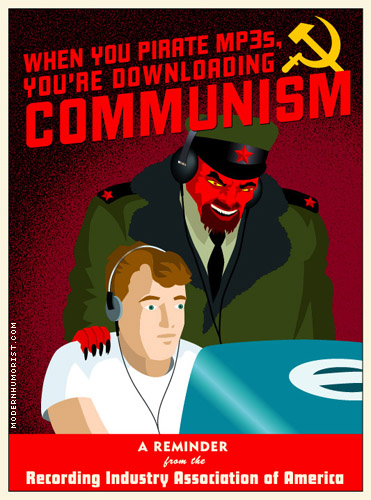
Welcome to this glorious May Day comrades. But there is no rest for the proletariat, as we continue our weekly political studies. In today’s lesson, we cover the imperialist American bullying of neighbouring sovereign nations, in their greed motivated bid to help the corporate capitalist pigs oppress the people in the ongoing class warfare.

But seriously now, this hasn’t been a good week for corporations, sovereign nations starting with ‘C’ and ending with ‘anada’, and we also get serious dose of corporate backed government propaganda as well, so perhaps it is appropriate that we’re discussing all of this on May Day.

CopyrightSo, comrades, let’s start with copyright news. Before we get to the heavy stuff, we start with some funny, and also slightly disturbing news, to do with our old friends, Righthaven.

It appears that ever diligently pursing profits in the courts, Righthaven weren’t so diligent when it came to maintaining their WHOIS records for the domain name Righthaven.com. It’s actually against the rules to not have a properly maintained WHOIS record, which shows who owns which domain names, with contact details and so forth. So somebody thought it would be a good idea to point out that Righthaven’s own domain name did not have a proper WHOIS, and the report went all the way to Righthaven’s domain name provider, GoDaddy. GoDaddy took immediate actions and temporarily seized the domain name, taking Righthaven’s amateurishly produced website down. Righthaven, having frequently used domain name seizures as a threat in the past, finally got a taste of their own medicine. The disturbing part I mentioned about is how quickly GoDaddy took action, and really out of all the things related to domain names, having an inaccurate WHOIS record is a pretty light thing, and so to have the domain seized, is quite harsh of an action. I can only imagine what GoDaddy would do if there was a copyright related seizure, or even if Righthaven themselves lobbied GoDaddy to take down someone else’s domain due to a copyright dispute.

YouTube Rentals

YouTube Rentals could reduce piracy and mean big money for studios, but some won't get on-board to protect, you guessed it, piracy

Moving onto slightly more depressing territory,  it seems YouTube getting into the digital video rental/streaming business is a bit of a no brainer, and you would expect studios to be biting at the heels of the Google owned video giant to get in on the deal. Well, some studios are anyway. Warner Bros, Universal, and yes, even Sony has signed up to the latest attempt to monetize all that YouTube traffic, but the holdouts are Paramound, Disney, and of course, Fox (owned by News Corp, which does not consider Google, or even the Internet, a friend). And what’s the reason for not signing up? Could the deal that YouTube presented be not good enough, although it was apparently good enough for the likes of Warner/Universal/Sony? Paramount, whose parent Viacom is involved in a mega lawsuit against YouTube, is probably and understandable holdout, sources say they’re trying to get a similar deal going with anyone other than YouTube. But what of Disney and Fox? The reason, or rather the excuse, once again, is piracy. It appears that these studios are not happy that Google still isn’t blocking any keyword that may or may not have anything to do with piracy, and so, as a protest, they’re not going to sign up to a new innovative delivery mechanism which may just yet save their “struggling” businesses (their definition, not mine). Talk about cutting off the nose to spite the face, it seems Fox and Disney (and Paramount) are taking the ears off too in this one. I’ve long felt that innovation is the key to reducing piracy, and I’ve long known the entertainment industry is very much resistant to change, preferring to protect their dying business model through technical solutions (DRM) and political lobbying . But to actually turn down innovation that may reduce piracy and improve their revenue outlook, because of their fear of piracy? Well, that just takes the cake, and probably points to just why the industry is doomed if they don’t change their ways soon enough. Because the likes of iTunes, Netflix, and YouTube, won’t stand still and will take over and their worst fears will come true, if they haven’t already.

Speaking of  reducing piracy through innovation and more legitimate sources for content on the Internet, and also speaking of Netflix, it seems it’s actually all working. Netflix now accounts for a huge percentage of Internet bandwidth usage, greatly eclipsing the bandwidth consumed by piracy related sources, such as BitTorrent (remembering that a lot of BitTorrent traffic is also legal). In fact, as Wired reports, Netflix now accounts for 20% of all web traffic in the US, compared to only 8% for BitTorrent. And in the evenings, Netflix accounts for over 40% of the traffic. And from another set of independently collected information, Netflix like real-time entertainment traffic accounted for 42.7% of all traffic, with P2P filesharing not even doing half as well, at 19.2%. This, for me, brings into the question of just how big the piracy problem is, and if a single legal service like Netflix can do so much to counter pirated usage, why isn’t the industry pouring money into supporting such services. I think just like iTunes and the music industry, perhaps the movie industry’s reluctance to accept change may see them missing out a huge chunk of profits. With the music industry, it was their preoccupation with DRM, with the movie industry, it’s DRM and also the political and legal lobbying. So while they were running around seizing domain names with ICE, Netflix and others were innovating their way to new sources of revenue, using the Internet to provide services to homes that were not possible before. And all while helping to fight piracy more effectively than any seizures or three-strikes or mass lawsuits can offer.
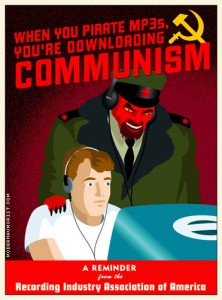
There's probably never a more appropriate occasion than today to bring out this gem of a poster again ...

But seizing domain names with ICE is only apparently part one of the plan. Part 2: propaganda! If you now visit and of the domain names seized as part of “Operations In Our Sites”, such as dvdcollects.com, you’ll be presented with the normal “this domain is seized blah blah blah” message, but there are now two new things. One, if you click on the seizure message, it takes you to a YouTube PSA video posted by ICE, and even if you don’t click, you’re automatically redirected to the fullscreen version of that video anyway. And if you viewed the video, you would probably get a sense of deja vu, and you would be correct, because it’s the video used as part of a tax payer funded anti-piracy campaign by the city of New York I mentioned back in January. It’s the same video, expect the end part that mentioned the NYC campaign has been ripped out and replaced by a message from ICE. Nice one ICE, didn’t even bother creating your own video, just copied someone else’s work, even if it was done with permission. That original video itself, which has only gotten 3000 views so far (that’s on average about 10,000 times worse than your average funny cat video – great way to spend tax payer money), was actually produced by a NBC Universal. So a corporate produced piece of propaganda, that is now not only used by city of New York, but also by a federal agency in peddling more myths about how piracy cost jobs, jobs like that of the boom mike operator lady used in the video. Remember that these are the same corporations who felt they didn’t really need to pay writers, you might say the true creators and copyright holders (not in a legal sense), to publish stuff written by these writers on the Internet. Who’s the pirate now? Who’s destroying jobs by being greedy and keeping a huge chunk of revenue, and not paying the people, like boom mike operators, the pay they deserve? Do I even need another rhetorical question to make my point any clearer?

And the best part? The ICE video has comments and ratings both disabled, obviously learning from NYC’s mistake. Democracy in action, because it’s obviously not democracy if people are allowed to comment on this corporation produced, government funded, piece of propaganda.

Before we get to the really depressing, and scary stuff, we have Facebook’s DMCA snafu this week, where the multi-billion giant was tricked by fake DMCA takedown notices and quickly, without question, took down the several legitimate Facebook pages, including the page of Ars Technica. They quickly reversed their error, and you can’t be too careful these days with Anonymous on the prowl, but it once again shows how flawed the DMCA is. Even Facebook, through an official statement, sorted of hinted at how companies like them struggle with “DMCA abuse”. The whole idea that the court is bypassed with DMCA takedowns, to speed things up, means that DMCA takedowns can be used for taking down anything you want to, referring back to last week’s “doctor use DMCA to take down bad reviews” thing. And then you have the totally fake DMCA notices too. The idea behind the DMCA was to take into account the Internet age, and how copyright infringement would go through the roof, which would overwhelm the courts. So the solution was to take the court and the entire legal system out of the equation, which is fair enough as the DMCA notice is only a notice, and not an actual claim of damages or even an intention to sue (it’s more of a warning of an intention to sue). But then, without the court’s involvement, it gets abused, and even when it’s not abused, copyright holders think it’s too much work to have to identify and proof their copyright has been infringed, and so the only obvious solution is to remove the copyright holder from the equation and put the onus on everyone else to “clean up the Internet”, which brings us to three-strikes, Google filters, and the next evolutionary step in the entertainment industry’s crusade against having to change their business model.

And now for the really scary stuff. We already know the entertainment industry and the copyright lobby already puts a lot of pressure, albeit some of it sweetened with the sweet smell of lobbying cash, on the US government. But where does that pressure end up, because science tells us that it has to end up somewhere. Apparently, it ends up in Canada. The Wikileaks cables has provided us with a lot of information, some useful, some not quite, and definitely not enough UFO stuff, but one thing it did provide is evidence of the US government’s ongoing bullying of Canada when it comes to copyright issues. Like most of the Wikileaks stuff, none of this is particularly surprising (we already know that the US has put Canada on the notorious piracy list, right below Blackbeard, and just above Henry Morgan, but it is nevertheless quite scary when you think of just how much copyright lobbying cash can buy these days.  The cables show the persistent attack on the Canadians, pressuring them to do things the American way (American as in the last ‘A’ in RIAA and MPAA), or else, and with Canadian officials leaking information back to their US handlers as to the progress of the pressure. The questions that immediately pops up into my mind, not just why the US isn’t respecting the sovereignty of another country, an ally and neighbour to boot (unintentional Canadian accent joke), but it’s “aren’t there more important things than getting the Canadians their own DMCA”, the very DMCA that the RIAA and MPAA say that’s no longer good enough? And to see the Canadian PM reduced to almost begging, pleading, and promising the US that, “yes sir, something will happen soon, I promise, please don’t take my lunch money”, really, is just pathetic. And I’m sure the diplomatic cables will reveal more of the same in relation to other countries as well.

Nothing much happening in HD/Blu-ray, so I’ll skip this and move straight onto the …

Gaming

… gaming section. And as you would expect, the gaming related news this week all pretty much center on the PlayStation Network outage, but before we get to that, there’s the exciting news that in just over a month’s time, we’ll get to find out what the Wii 2 will be like.

Nintendo have officially announced the Wii 2, and it will be demoed at E3 in early June. Lots of rumours around, but the one I like the most is the one where the Wii will be X times more powerful than the Xbox 360, or the PS3, or even both combined! The Wii has been very much the small, malnourished, brother of the other two home based consoles, in terms of processing power, so for the Wii 2 to get one over the other two, just seemed interesting to me. Of course, this, like the “Wii 2 will be HD” rumour, isn’t so much of a rumour as “well, doh”, because are people really saying that the next-gen console will have hardware that’s crappier than something from 2005, the year in which the Xbox 360 and PS3 were designed in? And then only come in SD? The one thing I’m interested in though is how Nintendo will take the motion gaming thing forward, whether they learn from the PS Move, or maybe even Kinect (unlikely), or are they not putting so much emphasis on motion gaming, instead taking more of a focus on hardcore games?

And so onto the PSN outage. Oh boy, where to start. First of all, we finally did find out why the PSN was down, and it was as many had suspected, due to hacking. But it wasn’t the Anonymous inspired DDoS attack, as many had first suspected, but it was an actual hacking, with data stolen. A lot of data. The personal information of 77 million PSN users were accessed, and from the statements Sony made and later incidents, it appears they were downloaded as well, in what is one of the biggest security breaches of all time. And while Sony tried to calm the public by saying the credit card numbers were encrypted, and that they didn’t believe hackers had stolen them, then came the news from a security research firm that claims the attackers were selling credit card numbers, 2.2 million of them, and complete with CVV numbers that Sony first said that they didn’t request, then said that they did request, but didn’t store. PSN services are not expected to resume until next week.

So from what we know, are the attackers to blame, or are Sony? Well, why not blame both? Hackers will hack, but it appears that, given a leak of data of this magnitude, that Sony’s security was either very basic or very flawed. It took days for Sony to even discover that their system has been breached, and then when potentially GBs of data have been downloaded, only then did Sony realise something was up and pull the plug on everything. And then the lack of communication with users whose information has just been stolen, was unacceptable. Sony says they didn’t know what was stolen, which may be true, but that in itself is further evidence of the lack of security procedures and safeguards, because if you can’t keep hackers out, at the very least, you should record all actions so you can find out just what was accessed. That they had to bring in an outside security firm in, suggests that their internal security team weren’t up to the job, and this is probably the same team that designed the security system in the first place. Sony have since said that they have “added software monitoring, enhanced data protection and encryption as new security measures”, the AP reports, which suggest that they didn’t have any, or had very little of any of this, before, which is amazing for a network that is one of the largest holders of credit card information on the planet.

Sony executives apologise for PSN hack

Sony executives apologise for PSN hack in typical Japanese fashion, but will it be enough?

And even after Sony decide to release more information, the information was inconsistent and incomplete, with many still no sure what has been stolen. And with no way to log back into PSN, there isn’t even a way to find out if people have provided their credit card numbers or not, and which credit card (although some say that if you did, you should have an email record that contains the last four digits of your card – so search through your email to be sure). And it appears the security hole was opened up thanks to the hack of the PS3, which was also due to a quite silly security flaw. And geohot, who many had blamed for the hacking, was correct in saying that this all started when Sony decided to alienate the hacking community, and blamed the Sony corporate culture for their lack of emphasis on security. “Notice it’s only PSN that gave away all your personal data, not Xbox Live when the 360 was hacked, not iTunes when the iPhone was jailbroken, and not GMail when Android was rooted. Because other companies aren’t crazy,” geohot, aka George Hotz, added.

Sony will say sorry to its users by, first bringing back the PSN, and then offering some freebies as compensation. I wonder if that will be enough to earn user’s trust back, or perhaps, as users, we shouldn’t be so trustful of any company with our personal details.

And this concludes quite a long edition of the WNR, nearly 3000 words already, so I better shut up and let you get on with your more important business. Until next week.

Weekly News Roundup (24 April 2011)

Sunday, April 24th, 2011

No luck with waiting for leaks of NPD data, so I can continue with the NPD analysis, so it looks like that’s the end of that feature, which has been going on for more than two years already. Instead, I think what I will do is to combine the feature with the WNR, and just post whatever stats I can find in the gaming section below, starting with this issue. It appears the analysts that usually leak data has been warned, legally, not to do so by the NPD, who themselves are probably under pressure from certain gaming companies, which shall remain unnamed, that are often too ashamed of their sales results and don’t want the negative publicity.

Not too many interesting news stories this week, thanks to Easter I suppose, so let’s get started.

CopyrightIn copyright news, critics of the DMCA and harsher copyright laws have often warned that they can be used to prevent freedom of speech, and this week, we have a story that seems to perfectly illustrate the dangers of giving too much power to copyright holders.

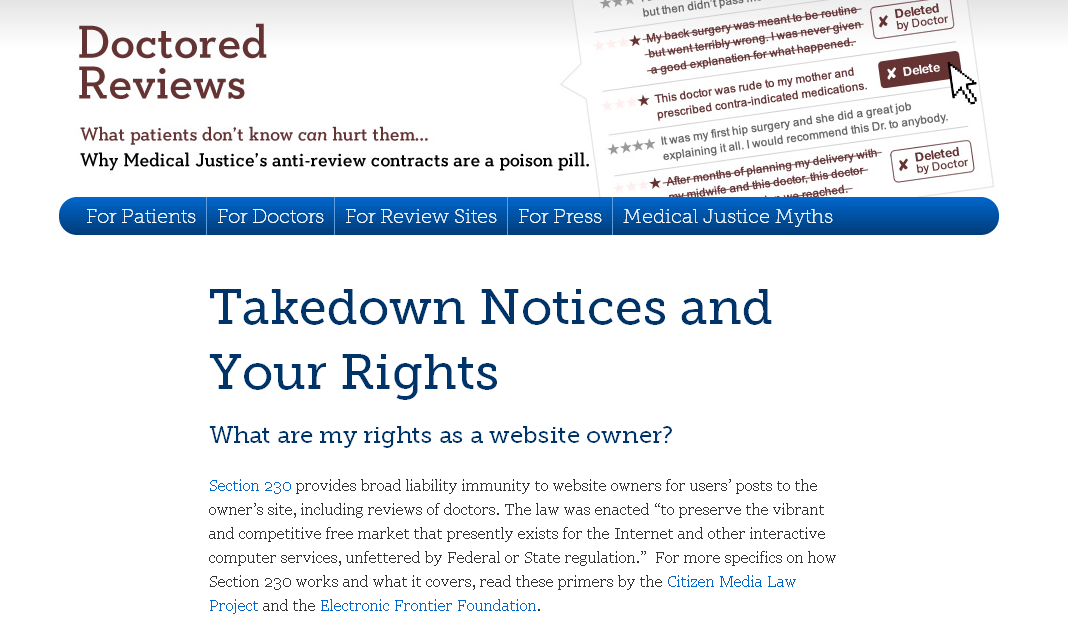
Doctored Reviews

Doctored Reviews: A new website to help fight the practice of using the DMCA to remove bad doctor reviews

Apparently, there’s a company going around removing bad reviews of doctors written by their patients. The company, Medical Justice, provide the service to doctors that are concerned about their reputations being tarnished online, whether justly or unjustly. Doctors can force patients to sign an agreement prior to receiving medical care, and this agreement actually hands over copyright of the patient’s reviews over to Medical Justice, allowing the DMCA to be later used to remove bad reviews. Obviously, this is quite an underhanded practice, and it’s probably a good thing that certain websites now maintain a list of doctors that use the service of Medical Justice, as you can just refer to that list, assume these are all bad doctors, and *avoid* them. And many doctor review sites now ignore DMCA take-down requests of bad reviews, preferring to take this matter to court if necessary, and a couple of UCLA law professors have even set up a new website, Doctored Reviews, with the aim of publishing bad reviews of doctors that Medical Justice wants removed, probably hoping the matter goes to court. This is really only the latest example of copyright laws being abused this way, and if governments around the world continue to pander to the copyright lobby, then there will be more and more such cases in the future. Imagine buying a PC game, you agree to the EULA as you would normally do, except in the 200 page document you just agreed to, there’s a provision saying you hand over all online reviews of this game to the publisher, and this means they can use the DMCA to silence anyone who says a bad thing about the game. Nobody should be able to take away your rights so easily, which in my opinion, is a form of copyright infringement as well. And nobody should be able to use the DMCA or other copyright laws to settle non copyright related issues. But if governments are still intent on handing over *your* rights  over to corporations, then there’s not much we can do.

Anonymous

Anonymous takes on New Zeland, as the island nation passes new harsh copyright laws

The latest country to do is New Zealand, having rushed through legislation without much debate (seems to be a trend these days in relation to copyright laws, from the rushed Digital Economy Act in the UK, to the secretive ACTA discussions) to please the copyright lobby, lobbies that mostly represent non New Zealand interests. The latest story is actually about Anonymous’ plans to attack NZ government websites, but the bigger story is about the new copyright laws and how unbalance they can be. For example, the laws make owners of connections responsible for copyright infringement, something the entertainment industry has been pushing for. You see, it’s hard, if not impossible, to go after the person that actually committed the “crime”, because you would actually needs things like evidence. It’s like if a car was stolen to rob a bank, it’s would be far too hard to actually catch the people that stole the car and robbed the bank, so the police can make it easy on themselves by arresting the owner of the car. Hyperbole aside, the real implication of these ill thought out changes means the end of public Wi-Fi networks in New Zealand. So no more free Wi-Fi at McDonalds unless the fast food joint wants to accept responsibility for pirated downloads. Innovation and competition, has given away to protectionism of an industry that is trying so hard to avoid innovation and competition.

This is just the latest trend in copyright laws that goes against everything a democratic and lawful society is supposed to stand for. The over-exaggeration of the piracy problem by copyright lobby is directly responsible for these over-exaggerated responses by clueless governments being led down the wrong path by the smell of lobbying cash. And I’m convinced the copyright problem, much like every other problem, cannot be addressed until the root causes can be identified, and this starts with real stats and figures on the cost piracy, not “estimates” of “potential” losses (which mostly assume the cost of piracy equals the number of pirated items times the full retail cost of said item). Once we have a real understanding of the scale of the problem, we might then decide that enforcement in all but the most extreme copyright cases might not be in the public interest at all, due to the financial cost of it all. But if there is a substantial problem related to piracy, then no matter how serious the problem is, one should not have to sacrifice the basic tenets of society just to make the problem go away – the ends do not justify the means, especially when the “ends” is not even certain. Innocent until *proven* guilty, with the copyright holders responsible for having to proof that copyright infringement has occurred, and also to proof the extent of actual monetary damage. And they should have to do it in a court, with full rights of appeal for the alleged offender. We’re often told that piracy is just like stealing a car, but the problem is that car thieves actually have more rights than a downloader when it comes to copyright laws of countries like the UK and France, and now New Zealand. With a car theft, first of all, there is conclusive proof of material loss or damage, and then the police have to proof, beyond a reasonable doubt, who actually stole the car, arrest them, and then a judge decides the verdict, with the offender given full rights to argue his or her case, and then to appeal if needed. With downloads, the “victim” is the judge, the jury, and in some cases, the executioner (or at least they organize the execution, by forcing ISPs to act), and all before actual damages have even been proved. The argument is that proofing all of this is too hard, too time consuming, but when is taking shortcuts when justice is concerned ever the right thing to do? Anyone who wants to subvert justice this way should be considered an enemy of the state, an enemy of the people, but it’s the opposite right now, and so it’s no wonder you’ve got movements like Anonymous taking action against what they, and many of us, perceive to be an attack on our freedoms.

High Definition

The week ending 2nd April proved to be a milestone of sorts for Blu-ray, except it turns out the week after was even more, um, “milestonie”. Blu-ray finally broke through the 24% market share record, and the week after, it broke through the 25% as well (I still need to post up the analysis for that week, when it’s up, it will be on this page).

Unfortunately, combined revenue, of both DVD and Blu-ray sales, is actually quite disappointing. This is mainly because DVD sales continue to fall, quite dramatically at times, and the increase in Blu-ray sales haven’t really been enough to even slightly offset losses. It’s no good having $20 million increases in Blu-ray sales, when DVD losses are $100 million or more. The economy probably has a lot to do with it, and perhaps it just shows people are buying a smaller number of better and more expensive products (eg. Blu-ray), but buying less overall. Perhaps they’re turning to piracy, since you can only buy what you can afford. Maybe they’ve turned to digital distribution, Netflix and the like, or cheaper rentals via Redbox. Or maybe they’ve just stopped watching. It’s not as if there’s a dearth of free, legal, entertainment these days – just the free apps on smartphones can occupy someone for ages.

Which is why, as reported by one of our new news contributors, the Harry Potter and the Deathly Hallows Part 1 Blu-ray and DVD situation is so frustrating and unhelpful in the current climate. Not only are there 5 editions of the same movie across the two formats, two of the editions are exclusive to two different stores. And while Warner Bros may have maximized their revenue potential by signing lucrative exclusivity deals, it’s the consumer that ends up having less choice in terms of where to purchase, and more confusion as to which version to buy. I’ve always respected WB for being pioneers in adopting new video formats, they were one of the very few to support VCD, and a major backer behind HD DVD before they decided to abandon the format, and they also abandoned region coding for Blu-ray. But they botched the Lord of the Rings theatrical release, want to make us sextuple dip the LOTR franchise, and will probably do something similar with the HP franchise as well. But it’s their right, and it’s our right to not get sucked in and do more research before parting with our cash, that is if we decide to part with it at all.

Gaming

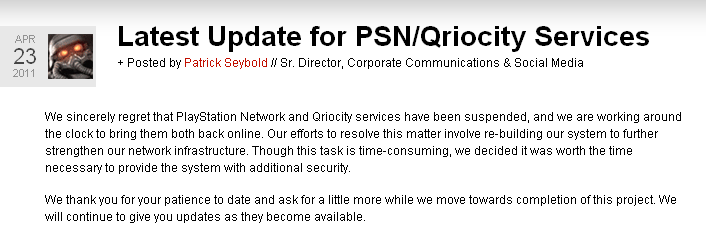
And finally in gaming, the story that everyone is talking about this week has to be the downing of the PlayStation network, which appears to be still down as I write. Of course, everyone pointed the finger at Anonymous, but group has said that they didn’t do it, or at least it wasn’t an official “op”.

PSN Down

The PlayStation Network has been down for the last few days, Sony says "external intrusions" are responsible

And with Sony being their usual selves when it comes to being transparent, there’s not a lot of information about just what went wrong, and what is being done to fix the problem. Speculating blindly, I think this is probably more hacking than denial-of-service. It doesn’t look like a DDoS, the traditional attack method of Anyonmous, because first of all, those are quite easy to stop, certainly would not take two or more days, and it would also mean completely dis-connectivity, but there are reports that people’s queued downloads are still downloading fine. So it looks like hacking, probably a security exploit that someone took advantage of and managed to get deep into the PSN infrastructure. The subsequent fixes to ensure whatever exploit is patched is probably what’s taking so long, so it looks like quite a serious, structural problem.

Now, you can blame the hackers, but just like with the PS3 hack, nobody could have done a thing to it if the exploit was not there in the first place, and exploit and weakness present due to programming errors on Sony’s part. Same with the PSN. The hackers may have tore your house down, but they wouldn’t have been able to so if it wasn’t made of straw, if you know what I mean. So Sony are ultimately responsible, and that’s the way it should be. However, since PSN is mostly a free service, nobody can complain really. Only those that paid for the PSN Plus should demand some kind of compensation, as would Xbox Live Gold users if XBL Gold ever went down for such a long time.

Anyway, it’s the last thing Sony needs, having come last again in last month’s US console sales. I’m going to assume this because otherwise Sony would have touted the fact that they beat the Wii, which sold just above 290,000 units (down 47% compared to March 2010) according to Nintendo. Microsoft did release the sales figures, mainly because they’re not ashamed of having come last I suppose, and with 433,000 (up 28% compared to March 2010), the Xbox 360 was once again the best selling home based console for March 2011, in the US. Only Sony knows just how bad the PS3 results were, although they did say that the PlayStation platform overall sales rose “double digits” compared to a year ago. This could mean anything though, especially with the PSP price drop, and again, I point to Sony not making a big deal of outselling the poor performing Wii as evidence of the PS3’s poor performance in March. And if that’s the case, the the PS3 re-starts its recent trend of sales declines compared to the same month last year, having had a pause in February. And recent events won’t have helped PS3 sales in April, I bet, but we may never find out.

So that’s it for the week, and for this very much abridged version of the monthly NPD analysis. See you next week.

Weekly News Roundup (18 April 2011)

Sunday, April 17th, 2011

I was hoping to bring you another monthly edition of the NPD video games analysis, this time for March 2011, but unfortunately, Sony, my long time nemesis, decided not to release figures for the PS3. This means I’ll have to wait until the many Boffins I’ve already sent out to return from retrieving the information – I really hope not too many of them die as a result. See, this is why the NPD was under pressure from game companies not to regularly release data, because otherwise it would have been much harder to hide a bad result. And so Sony not releasing the data, causing me to not have anything to write about, must mean the PS3 results were even worse than, well, the recent results (despite Sony claiming blah blah blah double digit growth blah blah blah for PlayStation hardware platform blah). This can only mean one thing, and that is that PS3 sales for March was negative – more people returned PS3s in March than people who actually purchased one #NotIntendedToBeAFactualStatement

So until my Boffins return, there’s no NPD analysis, and if none of them make it, then I’ll probably have to make up some figures. Come on Pachter, do your thang!

(In unrelated news, figures were also missing for my weekly Blu-ray/DVD, so no analysis there either. Also the above statement seems to suggest that Michael Pachter is a Boffin, which is not the case as far as I’m aware)

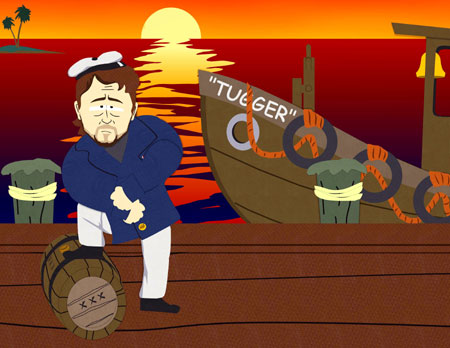
CopyrightLet’s get started with the WNR proper with some copyright news.  My reference to a particular South Park episode might have gone unnoticed with my headline of Fighting Around The World, Piracy Edition, it was still interesting to find out just how much anti-piracy stuff was being debated around the world. Because, as everyone knows, the most pressing political, economical and social concern for countries around the world, and the most important of the “war on” wars, is in fact the war on piracy (and not even the African coast kind).

South Park "Fighting Around the World"

Only 7.35% of people got my reference to South Park in one of this week's headlines

So you have super-conglomerates forming in Australia to stop a country with a super huge population of almost as many people as Texas to stop the piracy problem that is costing the industry more than $60 per man, woman, child, in Australia, according to industry estimates. All of this because they couldn’t get a judge to go along with their plans to make ISPs responsible for the billion dollar problem, and so they’re trying to bypass the court’s decision and head straight to government lobbying and “exerting pressure” on the communications industry. Over in the UK, pretty much the same thing is happening, with ISPs defending their case in court, while copyright holders go crying to the government for assistance. The copyright movement these days seems to want a government run blacklist of websites that they deem to be against their interests, so while The Pirate Bay is a shoe-in for the list, other websites, blogs and services that may disrupt the entertainment industry’s attempt to hold on to their dying business model may also just make the list, with little avenue of appeal for those being listed.

Certainly something like this is being considered in Denmark, although since it actually costs money to run such a scheme, MPs there are suggesting that yet another industry should shoulder the burden of helping another industry avoid having to innovate. MPs there are saying that browsers makers, who they say have been so successful in blocking malware websites (yes, because hardly anybody gets malware these days and most people don’t even need to install security software #NotIntendedToBeAFactualStatement), should apply the same thing to websites not cooperating with the entertainment industry and the copyright lobby. Cue some respected law professor complaining about the trivial matter of freedom of speech and information, blah blah blah. And yes, a browser based blacklist, that surely won’t ever get bypassed, assuming people just don’t switch to one of the billions of other browsers available for free on the Internet. And this might even spur TPB to make their own browser, they can call it Internet Exploder or FireF#@(, which would not only get around the blacklist, but also randomly inserts torrent links into any web page you visit. That would be awesome.

And it’s not just respected law professors, it’s also senior advisors to EU judges that are warning against implementing the type of anti-piracy measures the copyright lobby has been pushing, namely ISP based three-strikes monitoring, and filtering schemes. Apparently, just because people, whose connections have been suspected of being allegedly used to download possibly copyright infringing material, or websites that may have participated in providing infringing content, but we’ll never be sure because the issue hasn’t been debated and decided in a court of law, might not have allowed the individual(s) affected to “challenge it or object to it”, or for the overall systems to have “adequate safeguards”, may all be an issue when it comes to human rights and stuff. I certainly don’t need (or have) a senior legal advisors to tell me that by giving power to the entertainment industry to arbitrarily add to a blacklist of websites they don’t like, that this somehow would get abused due to the lack of checks and balances and avenues of appeal, and that by turning a matter usually decided in a court of law into a simple matter of copying/pasting a new line into the blacklist spreadsheet, is somehow taking away people’s rights.

EA/Bioware proofed this week that pirated games are so much better than paying for the original by not properly maintaining their DRM authentication servers, and blocking legitimate gamers from playing the offline, single player Dragon Age: Origins game for 4 days. People who pirated game were unaffected. I could make my usual rant against DRM, but I think in this instance, nothing more needs to be said. Except I must question why is DRM still needed for a game that’s one and a half years old? Surely, anybody who wanted to pirate it would have done so already, and people who wanted to buy it would have done so already in one of the many Steam sales. Surely most of the pirating happens in the first few months anyway, and so that’s really the only when publishers need to use DRM (to ineffectively prevent piracy), so why not release a patch after the first three month to remove the DRM and avoid having to finance DRM authentication.

Garry's Mod

Garry Newman of Garry's Mod fame attempts to embarrasses pirates

Or how about DRM that uses the reverse logic of most DRM schemes – how about making pirates jump through hoops, and giving legitimate customers a better experience? That’s exactly the point Garry Newman or Garry’s Mod tried to prove this week, when it introduced a bug in the pirated version of the popular Source game engine mod kit, asked if people were having issues with the bug, which then successfully identified and embarrassed all the pirates, while giving buyers “something to be smug about”. But thick skinned pirates won’t care, and might go around the Internet bragging about using pirated software, which means that DRM, other than the odd bit of fun, is not really effective at all. And poorly made and maintained efforts like the EA/Bioware one may in fact drive people to piracy, a point made by Good Old Game’s PR manager, Lukasz Kukawski. As I’ve always said here, if DRM has been proven to not work as intended, that is to stop pirated versions from being downloaded and used, then what’s the point? Game publishers are better off saving the large amounts of money they devote to developing, licensing and maintaining DRM, and use that money to make a better game, or even provide some physical collectable object in every game box (or redemption online for digital copies) – add value to purchases, not take away value, that’s all I’m trying to say here.

And it’s not just game purchases that needs added value (as compared to the pirated version). TV shows, one of the most pirated types of content on the Internet, is another example where value subtraction is being used by copyright holders in a vain attempt to squeeze every dollar from licensing deals. What I’m talking about is that it takes months for a TV show episode that’s aired in the US to make its way around the world, that is if it makes it across at all. Copyright holders expect more money to be paid for early viewing, and so overseas TV networks often take the cheaper route and delay broadcasts. And so, given people’s need today to have everything and have it now, most will have to source the content from illegal outlets. Yes, some episodes are available for purchase on iTunes or whatever, but why should have to buy something that’s free for people in the US, and not just on broadcast TV either, but via Internet outlets such as Hulu? And even those, like me, who pay subscription fees for cable/satellite TV, often still do not get new episodes aired until a week or more later, again probably as the result of greedy copyright holders and TV networks not willing to pay up. And this all causes piracy. UK’s Sky is trying to solve this problem by airing shows hours after the original US air date. Sure, the air time might be in some unholy hour of the night, due to time differences, but some Sky boxes capable of scheduled recording, that’s not a problem for many. I think it’s time for release windows to end – global release and airing times will help reduce piracy, as it saves people the trouble of downloading an inferior, even if ad-free, version (this is particularly true of HD broadcasts). Don’t subtract value from legitimate content by having stupid release windows – all you end up doing is to lose money to piracy, while gaining only a small percentage of that loss back through better licensing agreements).

YouTube’s copyright school? Almost not worth mentioning considering how ridiculous the whole thing is, and how it won’t stop copyright infringement on YouTube. Yeah, I’m sure a 4.5 minute video and a 4 question quiz, in which you only have to answer 75% of the questions correctly, will solve the YouTube piracy problem. Because obviously, people are only infringe copyright because they don’t know the law, not because they just don’t care.

High Definition

In 3D/HD news, NPD has a new report out that tries to explain why people just don’t like 3D. And it’s not surprising to find that having to wear glasses is actually the most common reason for the 3D hate.

Samsung 3D active shutter glasses

People who hate 3D hate having to wear 3D glasses, a new report tells us

Last year, price was a major issue, but with 3D TV pricing dropping every day (the report found that, amazingly, 3D plasma TVs have on average dropped 59% in price!), having to wear glasses is now a bigger problem. And it’s a bigger problem than with cinema 3D, because cinemas use passive glasses, which are easier on the eyes for those that suffer from motion sickness, whereas active shutter passes can make someone like me nauseous in about 10 minutes of wear.

The survey did find that 3D Blu-ray was the preferred method of getting 3D content, ahead of 3D broadcasts, and that 3D awareness was higher than before. I’m still going with my prediction that 3D will be standard by the end of this year, and it will be marketed in the same way having Internet access on TVs is being marketed today (ie. not much marketing at all, and certainly not much of a price premium).

Gaming

And finally in gaming, the big news of the week was that Sony finally decided to settle its lawsuit against George Hotz, aka geohot.

Geohot has been criticized for accepting the terms of the lawsuit, which dictates that he must not come near a Sony equipment if his intentions are not pure, but geohot explains this isn’t a problem because he’s boycotting Sony products anyway, and wouldn’t come near one even if it had a “hack me” sign painted on it. Still, Anonymous are not happy at the settlement conditions, and has planned more attacks on Sony servers.

Anti Sony

I'm surprised this is the first time I've actually used this anti-Sony graphics in the WNR

A Sony boycott used to a lot more painful, because they’ve made some decent stuff over the years. But these days, it’s not too hard to avoid having to buy a Sony product, because they no longer make the best of anything, not TVs, not game consoles, and certainly not portable music players (how did they ever screw up the Walkman brand, I’ll never know). Blu-ray is about their only real success recently, although you can still buy the best Blu-ray equipment and still completely avoid Sony products.

Despite being too scared and embarrassed to release March PS3 figures, no doubt because it reveals that even the PS2 outsold the PS3 for that month (#NotIntendedToBeAFactualStatement), Sony were eager to boast about going over the 50 million mark worldwide for the PS3 (just shy of the Xbox 360’s total), and the 8 million Move controllers shipped since launch. The Move number doesn’t compare too badly to Kinect’s 10 million shipped figure, although it doesn’t compare too well either, considering the Kinect number (of 2 million more units) was reached a whole month earlier, despite being launched one and a half month later. In other words, 8 million Move controllers in just shy of 6 month, while Kinect shipped 10 million units in 4 month. Not quite the 5:1 Pachter was suggesting, but Kinect’s console attach rate is probably at least twice that of Move if you take into consideration two player gaming needs (you need two Move controllers for 2 player gaming, counted as 2 purchases, while the same can be achieved with a single Kinect purchase).

Oh, almost forgot what I was trying to post about, is that Netflix for the Xbox 360 now has Kinect support as promised. But it’s very much limited and not quite useful, but it’s free, so whatever. Hopefully, the Hulu Kinect interface will be less of a rush job.

Alright, that’s that for this week. Still no word from my Boffins, but I can probably guestimate the PS3 numbers using the vague statements Sony have made (double digit growth for the PlayStation family, which is probably closer to 10% than 99%, PSP also grew thanks to price cut, so have to take that into account and since Sony did not say PS3 sales grew in double digits, I also suspect it did not, but can’t confirm so will give Sony the benefit of the doubt)  and the boastful statements they did not make (the PS3 obviously did not outsell the Xbox 360, and I doubt it outsold the 3DS as otherwise Sony would be screaming the news from top of the roof, or at least Jack Tretton anyway considering his views on the “babysitting” 3DS), which puts the PS3 numbers somewhere between 345,290 (10% up from last year) and 380,000 (the 3DS number). Elementary my dear Watson.

See you next week.