Archive for the ‘PS3, PS4’ Category

Weekly News Roundup (13 January 2013)

Sunday, January 13th, 2013

It’s back to work for most people, which sucks, but at least there does seem to be news again. Yeah, that’s just what you need after your first week back at work, a long and ranty WNR to read!

I’ll try to keep this as painless as possible, so let’s not waste more time.

Copyright

A new study has proved what most of us suspected anyway, that DMCA take-downs, and even closing down the likes of Megapload won’t really do much in terms of reducing the availability of pirated downloads from cyberlocker sites.

The problem, according to the study, is that the moment you remove one upload, many others pop up in its place. And even removing entire file hosting websites, either through censorship, domain seizures or a well coordinated international law enforcement action like with the Megaupload shutdown, won’t work because new sites will just pop up the next day. In fact, the closure of Megaupload may have had a detrimental effect on efforts to curb cyberlocker piracy, because it has fragmented the upload scene to the point where uploaders are uploading to multiple cyberlocker sites to avoid any one being taken down. It’s like blowing up a big asteroid headed for earth, only for it to fragment into thousands of smaller and still dangerous pieces still coming at you.

In other words, the cat-and-mouse game between pirates and those seeking to reduce pirated uploads is being truly, fundamentally and comprehensively won by the mice. Not surprising when the ratio is probably something like 17,374 mice to every cat, mind you.

Rapidshare logo

RapidShare is forcing its users to go legit with transfer caps, which has only managed to force some of its users to transfer to competing services

So what’s the solution? RapidShare’s solution to keep pirated content off its network is to implement a transfer cap system that went into effect in late November. Since then, RapidShare’s pageview traffic appears to have dropped by more than a third, although it has no doubt led to probably an even greater reduction in the amount of pirated content on the network. But all this means is that piracy was shifted to other sites.

For those file hosting providers that are not self-policing, the study suggests that perhaps going after payment providers that some of the more blatantly pro-piracy cyberlockers may be more effective, but the best way the study concludes, as it always has been, is to innovate. Instead of trying to reduce piracy, reduce the demand for piracy by introducing good value, innovative services that people actually want to use. An obvious solution that the content industry seems totally oblivious to.

Innovation can be expensive and prone to disaster though. But part of the reason why the content industries don’t seem to innovate as much as, say, the IT industry, in my opinion, is that the content industries (especially the music and movie mobs) seem to enjoy special protection through copyright legislation. This means they have very little incentive to do anything new when there’s already legislation there to protect your ageing business model, and plenty of opportunity to pay for new legislation. This is the kind of thing borne out of the initial desire to “protect” capitalism by some misguided notion that this means giving corporations whatever they want, the kind of thing which actually leads away from the free market capitalism model that the politicians creating these kind of laws actually believe in.

This was something raised by Republican Study Committee (RSC) staffer Derek Khanna in his copyright memo, now simply referred to as that “sensible” one. You know the one that was canned almost instantly after it was published by the RSC, and possibly the catalyst behind the  firing of Derek. This week, Derek, now out of a job, was able to speak  for the first time about the entire ordeal.

Derek Khanna

Derek Khanna, the RSC staffer fired after writing a sensible memo on copyright, speaks out on his ordeal

The RSC canned the memo because it claimed that insufficient review had gone into the memo before it was published, but according to Derek, there was nothing out of the ordinary for the process that went into getting his memo published. If anything, it received more feedback than what is deemed necessary.

What was surprising to Derek, but hopefully not to readers of the WNR, was the backlash the memo received from the content industries. All Derek had wanted was to start a debate, but it seems that’s the last thing movie studios and record labels, long since a protected species under the guardianship of the political structure in Washington, wanted.

As for the firing, Derek was unable to speak candidly about it for obvious reasons, but according to the The Washington Examiner, Tennessee congresswoman Rep. Marsha Blackburn, who has close ties to the record industry due to her district’s geographical location in the suburbs of Nashville, was somewhat instrumental in kicking Derek out of the RSC. So for now, the record industry (and the movie industry) remains a protected species, but one that has had its instincts dulled to the point where it isn’t able to live unassisted in the wild, not with competing species the likes of Apple, Amazon, Netflix and Spotify all flourishing on their own abilities. This is not a sustainable situation, in my opinion.

High Definition

If you had to sum up this year’s CES using using 5 unique letters and a single number, then OLED and 4K is all you need. The 4K hype seems to be gathering pace especially quickly.

Almost all of the major TV manufactures announced both OLED TVs and 4K TVs (or TVs with both), even though in my opinion, OLED is going to be the one that makes the most immediate impact. Boring old 1080p OLED TVs can tap into the vast amount of existing HD content and improve them immediately, but the lack of native 4K content should keep 4K away from the mainstream for a while yet.

Samsung Curve OLED TV

OLED might make the more immediate impact between it and 4K, as exhibitors at this year’s CES show off their OLED TVs, including this curved one

Sony has seen the content problem, and devised their own solutions of sorts – “Mastered in 4K” Blu-ray movies. Soon, Sony will release movies mastered from pristine 4K transfers (which isn’t actually something that hasn’t been done before, by many other studios, eg. Jaws) with extra focus on quality through the use of extra bitrate (those old enough will remember Sony’s similar attempt with Superbit DVDs). These Blu-ray titles, when upscaled and displayed on 4K TVs, is said to present a “near 4K” picture, which is actually kind of cynical when you think about it. That you can fluff around with a, no doubt super looking, 1080p stream and make people believe it’s “near 4K” probably says more about the lack of perceivable difference 4K TV is going to make, especially if one isn’t sitting within touching distance of the screen, or aren’t in possession of a 85″ monster. It’s also questionable whether simply throwing bits at an AVC/VC-1 encoding will actually dramatically improve the picture, diminished returns and all that.

Well at the very least it’s better than Sony’s current solution to the lack of 4K content problem, notably “loaning” 4K TV owners with hard-drives pre-loaded with selected 4K content. Their upcoming online 4K video distribution service does sound a bit more promising though.

The truth of the matter is, due to the limited nature of the human perception system in relation to small details, 4K TVs aren’t going to be the game changer that HDTV was, not unless you go above a certain size (at which point the pixel spacing problem may rear its ugly head). OLED’s superb and vibrant colours and deep deep blacks will give you a much bigger “wow factor”, even with existing 1080p content of which there’s a plentiful supply of. Now combine OLED and 4K, and you may have something that’s really really tempting, as long as you can stomach the astronomical price tag, that is.

Gaming

The December US NPD numbers are out, and once again, the Xbox 360 was on top. This is despite the global situation being reversed, with Sony’s PS3 just having managed  to outsell the Xbox 360 in the worldwide race, despite the Xbox 360 having had a year’s head start. But the situation in the US is actually getting worse for the PS3, with Microsoft happily promoting the fact that its Xbox 360, which sold 1.4 million units in December, sold more than twice as many units as the unnamed next best non-portable console, which had to be the PS3 because the Wii and Wii U sold nowhere near 700,000 units (475,000 and 460,000 units respectively for the Wiis).

The Xbox 360’s 1.4 million units, while impressive, still represented a 17% decline compared to December from a year ago. Still, the decline was smaller than in recent months.

Overall, 2012 was a disappointing year for the gaming industry revenue wise, at least compared to 2011. The age of the current generation of consoles is a major factor, but the lack of new game releases, 29% less than 2011, also contributed to a very lackluster year. On average though, each SKU generated 8% more unit sales and 11% more revenue, so there’s definitely some silver lining in this cloud.

Well, that’s that for the first real news week of 2013. See you next week.

R.I.P Aaron Swartz
Weekly News Roundup (6 January 2013)

Sunday, January 6th, 2013

Welcome to 2013. So another week without much going on, which is nice actually. Nice to be able to get a break and recharge the proverbial batteries ahead of a busy 2013. Let’s get started!

Copyright

A new report from the University of Southern California (USC) says that Google and, to a lesser extent, Yahoo, are aiding and even profiting from web piracy by providing ads to the top piracy websites. In a study that collected information on which ad networks the top piracy websites used (top websites based, ironically, on data that Google releases as part of its anti-piracy transparency efforts), the study found that Google was the second most popular ad network being used by these websites. Yahoo came 6th.

Google DFP Adcode

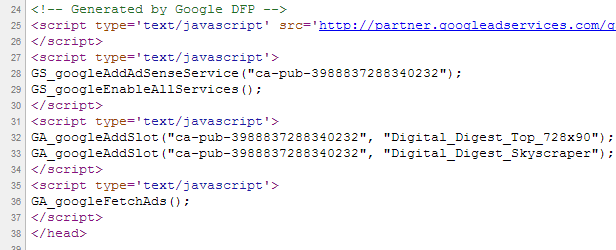
Just because a webpage has a Google adcode, it does not mean the displayed ad is served by Google or that Google profits from it

Google came out immediately to criticize the study for over-simplifying how web advertising works. The report was apparently compiled by scraping ad-code from piracy websites, and Google rightly points out that the presence of an ad network’s ad-code on a page does not necessarily mean that the network’s own ads are being served via the ad-code. The data apparently also includes Google’s DoubleClick ad-codes, but DoubleClick’s role in providing advertising differs significantly from Google’s main publisher advertising platform, AdSense. DoubleClick For Publishers (DFP) merely provides the tools for website publishers to place ads on their websites – the actual ads could be served from any ad network (including Google’s own AdSense). Even AdSense delivers ads from third-party ad networks. So while the USC report may have counted all AdSense and DFP ad-codes as being “Google ads”, the actual money making ads that is delivered via AdSense and DFP could have come from any other ad network.

Similarly, Yahoo’s Right Media platform offers similar functionalities as DFP, and have also been counted as part of Yahoo’s ad network for the report.

From my own experience, both Google and Yahoo have fairly tough anti-piracy policies. They will often reject sites right away if they suspect something is not right, and they have been known the suspend and seize funds from publisher accounts, sometimes over-zealously.

And unlike a lot of other ad networks that have a more hands-on role in sourcing and placing ads, Google at the very least leaves much of the decision to advertisers. So targeting the likes of Google and Yahoo seems slightly unfair given that advertisers, some of them being Hollywood studios, can choose to have full control over what gets placed where. Perhaps a list of top 10 advertisers on pirates sites may be much more informative, than simply blaming the tools that is used to show these ads. What’s next? Name and shame the web browsers used to visit piracy websites?

——

The first DRM story of 2013, and who would have guessed that it involves Sony! Ever the pioneers, not so much in terms of consumer technology (unlike the likes of Apple, Google, Microsoft, Nintendo, Netflix …), but ever the innovator in DRM technology, Sony has come up with a new way to annoy gamers with a new DRM that uses RFID tags to prevent the usage of used games.

RFID Tag

One of these RFID tags could be embedded into a Blu-ray disc, so that Sony can use it as a new form of anti used games DRM. Photo credit: JuditK @ Flickr, Creative Commons License

The RFID tag, embedded deep inside the game disc itself, would wirelessly interact with the console and store the unique information contained within the console onto the disc. And then when you try to play the disc on another console, the console would read the RFID tag, find that it’s been used on another console before, and prevent the use of the disc (unless perhaps you pay $$$ to Sony or the game publisher to get it unlocked again).

The same thing could be done via an Internet connection, but it seems Sony is thinking of offline ways to get its DRM into everything as well.

But this being a patent application means that it is just as likely to never see the light of day as an actual application, but you do have to give Sony credit in finding new and more annoying DRM.

Not that I want to give Sony ideas on how to make more money or anything, but if the real concern is that the second-hand games market is unregulated (ie. Sony and other game publishers don’t make $$$ every time a second hand game is sold), then why not create your own, regulated second-hand game trading environment? Preventing gamers from selling their old games is only going to reduce the budget of these gamers in terms of buying new games (and that won’t help anyone), so if the concern is that Sony and others aren’t getting a cut of the action, why not, you know, do something about it so you *can* get a cut of the action?

But this solution probably makes too much sense, is far too consumer friendly, and does not contain enough DRM goodness for Sony to ever consider something like it, probably.

That’s all for the week, the first of 2013. I suspect more will be forthcoming next week, what with the CES and all. So until then, have a great one!

Weekly News Roundup (11 November 2012)

Sunday, November 11th, 2012

Another very quiet week, no doubt due to the focus on the election and the recriminations afterwards. I didn’t do too badly with my predictions though, 48 out of 50. Technically 49 out of 50, since I changed my mind just before the election and (literally) put my money on Colorado staying blue – so I only managed to get Florida wrong (mainly because I overestimated the Cuban vote for Republicans). I’m no Nate Silver, but considering I was mainly going with gut and educated guessing, I certainly did a lot better than most pundits out there.

Towards the end of the week, the October NPD results came in for video game sales in the US. Once again, not enough data to actually write a full analysis, so I’ll briefly cover it in this WNR. I’m hoping that the Wii U is successfully launched and Nintendo find it reasonable again to provide sales data, which assuming Microsoft continues to do the same, means we might have enough data for a full analysis again. I miss writing the NPD updates 🙁

Onto the news …

Copyright

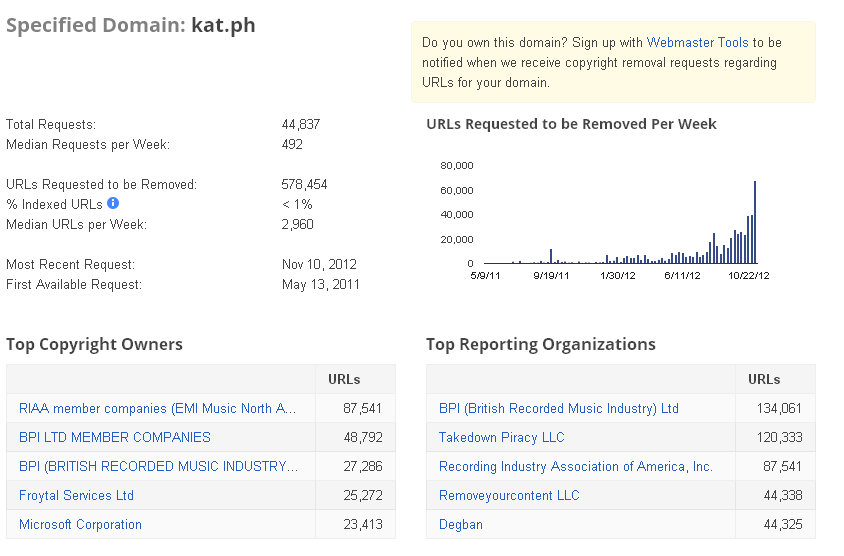
Having started demoting websites that receive “too many” DMCA notices, you’d think that Google has finally gotten into rights holders’ good books. But as expected, they’re still not happy.

Their protest this time does seem to have some merit though, as a quick browse of some Google search results still show the “majors” (The Pirate Bay, isoHunt, KickassTorrents) still ranking relatively well, at least for certain terms, despite Google having promised that the major piracy sites (the ones receiving the most DMCA notices) would be demoted. Rights holders naturally sounded the alarm, and the first to their rescue has been the UK government, which has launched a review into Google’s latest anti-piracy attempt.

KickassTorrents' Google DMCA stats

KickassTorrents may have received more than half a million DMCA takedown requests, but it only represents less than 1% of their total indexed pages, which may or may not be enough to affect search results

Almost all webmasters will be familiar with the frustration of trying to work out how Google actually ranks search results, and how strange some of the results are, especially when it comes to websites that are clearly breaking Google’s rules and yet still rank highly. Google’s algorithm is so complicated, I doubt any single person working for the Mountain View company actually knows just how it all works. In the article I’ve linked above, I’ve tried to offer a brief overview of how a ranking for a webpage is derived, based on “good” and “bad” quality signals. I would guess that “DMCA notices” would fall into the “bad” quality signal, but it’s only one of possibly thousands of weighted signals, and just because a website has over 1 million DMCA notices, it doesn’t automatically mean that pages on the site will never rank. One of the most important “good quality” signals is user satisfaction, and people searching for pirated movies will be very satisfied by the “majors”, and these websites would also have a lot of relevant back-links, which is also another very important good quality signal. At the moment, it does look like Google may very well need to adjust just how important the DMCA signal is, to avoid torrent sites from still dominating certain search results. In fact, just doing a quick search today seems to reveal a totally new set of results for the same keywords, with the majors nowhere in the top 10 – maybe Google has responded already!

But even if Google does the impossible and removes every single piracy related torrent or streaming site from its index (note that is has never promised to remove sites, only demote them), I doubt rights holders would be fully satisfied. Because deep down they know that, as much as they want to make Google a scapegoat in all of this, Google and other search engines have never been a big contributor to the web piracy problem. Most traffic (probably upwards of 80-90%) to the majors are not search related traffic at all, but from people who already know of the site (called direct referrals).

Rights holders may be hoping that Google can do more to combat torrent sites, but for direct download sites like RapidShare, these site’s own policy of “self-harm” appears to be enough for now. This “self-harm” policy, implemented by many file hosting websites appears to be exactly what the rights holders had hoped would happen when it lobbied the US government to take action against Megaupload. RapidShare this week took the most drastic action yet, by implementing a daily download limit for shared files. For uploaders using free RS accounts, their uploads now have a daily download limit of 1GB, but even those on paid accounts cannot share more than 30GB of files in any given day. Private file sharing remains unlimited.

These changes comes after last week’s removal of the download speed cap, which has been in place since Megaupload’s demise as a way for RS to drive away the piracy related traffic that was looking for a new home. What this change effectively means is that RapidShare has now moved towards (or back to?) being more of a personal file sharing tool, rather than a public one, regardless of whether the content in question is pirated or not. If you need to share a largish PDF file, one that does not contain confidential information with a few people, then RapidShare still works great. But if you’re a software developer and you were using RapidShare to distribute your files, then you need to think again, even if you use a paid account. 1GB may sound like a lot, but for a typical 5MB download (which is actually the average size of downloads on Digital Digest), that’s only 200 downloads per day. If you’re an indie filmmaker distributing your own film … then forget about it!

Of course, RapidShare will argue that their service was never meant to replace proper file/download hosting, which can be quite expensive as the GBs really do add up. But the fact is that many indie content producers have relied on them in the past, and they will no longer be able to do so.

Disregarding the collateral damage, while the anti-piracy effect of this move may be exactly what rights holders wants, but this will only drive indie content developers towards BitTorrent, something that’s already happening. And the “mainstreaming” of BitTorrent is probably not what rights holders want at all.

——

Microsoft Kinect

Will Microsoft use the Kinect camera as a new form of insidious DRM?

An interesting/disturbing patent application emerged this week, one made by Microsoft, in which the company plans to use Kinect to enforce a new sinister form of DRM. The DRM would enforce a new kind of rights management under which users pay not just for a time limited usage of video content (ie. a rental), but would also have to pay for each additional user that watches the video. The patent suggest a way for Kinect to detect how many people are watching, and limit playback or charge the users more when a certain number is reached.

Now, patent applications are a dime a dozen, and most are for ideas that will never become reality, so it’s not really worth getting all worked up about this at all. But you just know that some suit somewhere in Hollywood actually thinks this is a great idea. As consumers, we have to be vigilant and we have to let rights holders know what is and isn’t acceptable – pay-per-viewer is definitely not an acceptable trend.

If anything, the trends has moved away from transaction based rental and purchasing, and towards the all-you-can-eat variety. Adding “viewer based transactions” will be a serious step backwards.

Gaming

As mentioned earlier, NPD has released October’s US video game sales report, and the Xbox 360 yet again was the most dominant console, having managed to grab 56% of the home based console market share.

Wii U ZombiU

Can the Wii U’s more “hardcore gamer” focus win back gamers from the Xbox 360 and PS3?

The Xbox 360 sales figures still represent a 31% decline compared to the same month last year. With the holiday period coming up, Microsoft will hope sales will start to pick up, because declines like this point to the need of a new console. I’m still hoping a good set of Wii U results, when it’s released in mid November, will prompt the company to start releasing hardware sales results again (I think they may do it if sales exceed that of the Xbox 360, but then perhaps if that happens, Microsoft will become less forthcoming with their own results).

But don’t discount the Xbox 360 just yet – the launch of Halo 4 might be at just the right time going into the holiday period, and none of the previews so far indicate that the Wii U is, graphically at least, that much more powerful than the 360 and PS3. So for the Wii U, it all depends on whether the tablet controller can be used to full effect, and whether that’s enough of a differentiator to make it stand out. Well at the very least, Nintendo’s flagship console will no longer be considered a technological throwback (not until the PS4 and Xbox 720 comes out anyway).

That’s all for this week. Have a good one, and see you in seven.

Weekly News Roundup (28 October 2012)

Sunday, October 28th, 2012

So Windows 8 has been released. Having used the OS for a whole of zero minutes, I can offer my expert opinion that it is indeed a new version of Windows that offers some differences to the previous version, but also that some things remains the same. There are apparently quite a few good things in it, as well as some bad, and that if you really want it, you can get it by paying money for it. So that’s my 15 second review, hope it was very helpful!

If that wasn’t so helpful, then perhaps I can be a little bit more helpful with what you’re actually here for – the weekly news review. Let’s get started.

Copyright

The Finnish arm of Netflix managed to get itself into a little bit of a copyright trouble this week as subscribers found that the subtitles used for one particular TV series came from a fan-subtitle site. Netflix might have used pirated subtitles for the sci-fi TV series, Andromeda.

Netflix

Netflix Finland makes a boo boo by using pirated subtitles

Nobody knows how Netflix, who pays a lot of money to license official subtitles, ended up using subtitles created by DivX Finland (and you knew it was their sub because the subtitles displayed their website’s URL as part of the credits). Netflix have promised to launch an official investigation, and have temporarily removed the entire series from their system, but the folks at DivX Finland (probably no stranger to copyright issues) found the situation extremely ironic no doubt.

Copyright law I believe treats translations (and transcriptions) as derivative work, and that would still require the owner’s permission for distribution. The translation itself, as it does involve creativity, is also protected by copyright, copyright that Netflix infringed when it used DivX Finland’s subs without permission.

I have an extra interest in subtitle and subtitle download sites because I believe that my website was one of the first, if not *the* first website to host the download of DivX subtitles files (this would be June 2000, when DivX Digest was launched and user submitted/ripped subtitles were made available for download for a few dozen different TV shows and movies). The section only lasted about 3 month and at its peak, it contained about 500 different subtitle files – I discontinued the service due to potential copyright issues, and as I was doing all the updates manually at that time, it was also becoming too much work. Better organized websites had started to appear at that time as well, so I let them do their thing.

iPhone 5 and iPad Mini

By the quirks of the copyright law, jailbreaking an iPhone is okay, but jailbreaking a tablet is a no no

Some might argue that fan made subtitles should be considered fair use, especially if it’s the kind of thing that improve accessibility. It’s a shame nobody put the case forward to the US Copyright Office for their once-every-3-years copyright review, but given the results of the latest review, it was unlikely they would have been accommodating. The latest review sees the jailbreaking of smartphones continue to be exempted from copyright laws, but the arbitrary nature of these exemptions meant that “tablets”, despite sharing the same operating system as smartphones in most cases, are not part of the exemption.

The reasoning the Library of Congress gives for this oversight is that they found the definition of “tablet” too broad, as it could encompass things like laptop computers (more of a problem now that Windows 8 is out) or even e-book readers. For e-books though, DRM ripping remains legal, and now even in the case where DRM-free versions of the same books are already available.

But movie lovers mostly miss out. While DVD (and Blu-ray) ripping received a few more exemptions in the cases of educational use, non commercial use, and criticism and analysis, ripping for “space-shifting” (for example, to convert a DVD to a format playable on an iPad) remains illegal. This is despite the fact that everyone does it with little or no harm to anyone concerned, a fact made clear by Public Knowledge, one of the consumer rights groups that argued for an exemption for ripping.

The EFF also petitioned for video game console hacking to be exempted, but their appeal also failed to convince the US Copyright Office. In another blow, unlocking of phones purchased after January 2013 will also no longer be exempted.

In my opinion, these complicated and often arbitrary exemptions can be made a lot simpler if one simply followed the rule that any act that has no serious commercial implications (eg. DVD ripping for home use) should be considered fair use, as is everything in which the social benefits outweigh any commercial concerns. And all fair use should be legal, with specific exemptions being made for really popular acts in order not to criminalize a huge percentage of the population. How hard is that?

High Definition

With Mozilla all but signalling defeat in the battle to keep H.264 out of the HTML 5 specs back in March, the inevitable  is happening as Mozilla announced that the desktop version of Firefox will be getting OS-level native H.264 support soon. The mobile version of Firefox has already made this move, but with Flash still being a viable option on desktops, there was less urgency in adding in “native” H.264 support.

Mozilla’s beef with H.264 is that it doesn’t fit in with the open-source, royalty free nature of Firefox. But H.264 has become an industry standard as you’ll be hard pressed to find a modern device that doesn’t support H.264 these days (just as you would be hard pressed to find one that supports Mozilla’s favoured alternative, WebM).

Having OS based native support ultimately means that Flash won’t be needed. So in the end, it was really the choice between two evils. Flash and H.264, with H.264 winning in the end – not the worst result, if you ask me.

And I suppose I should talk about the iPad mini, at least from the point of view of HD video. There’s no doubt that 7-8″ tablets are the perfect consumption platform for video, which is why Amazon has the Kindle Fire, and why Google has the Nexus 7. I keep on getting the feeling that Apple will soon drop a bombshell that will completely shakes up the digital video rental and subscription streaming markets.

Gaming

Ubisoft has been making a concerted effort to distance the company from their past anti-piracy controversies, at least that’s what they said a couple of weeks ago. So you would expect the company to be extra careful to avoid any more anti-piracy related mishaps, at least for a short while. Well, the calm lasted about 6 weeks, as this week, Ubisoft enraged paying customers yet again by forgetting to include the CD key in retailed boxed PC versions of their new game, Rocksmith.

It took about a week for Ubisoft to respond, and even then, some customers were still left without a playable game for an extended period of time after going through the process. For those affected, they would need to provide proof of purchase to Ubisoft via their tech support website, which can be problematic for some if they’ve already discarded their receipt before realising Ubisoft’s mistake. Ubisoft has promised to compensate affected users with a free DLC (worth a whole $2.99), but it might very well be a case of too little too late for a company that couldn’t afford any more anti-piracy related scandals.

Sony PS3 Hacked

The “LV0” master keys leaked for the PS3 may prove the most costly to Sony yet, and make all future attempts to secure the console a very difficult proposition

Another gaming company that’s been trying to distance themselves from past issues is Sony, and their attempt to dig their way out from the various hacking scandals. But Sony does not appear to have any more luck than Ubisoft, with the news this week that a new set of master keys have been leaked for the PS3, keys that may make all future attempts to secure the console futile.

The new leaked keys, dubbed the “LV0” keys, could potentially prevent Sony from being able to secure the console again via a new firmware patch, which has been the go to solutions since the initial hack of the console, and when Sony managed to at least partially re-secure the console via the 3.56 firmware release.

While it’s disingenuous to blame these hacking attempts on Sony’s decision to pull support for Other OS, a popular PS3 feature (for the hacking community) that allowed Linux to run on the console – it’s very likely that the PS3 would still have been hacked due to the poor programming choices made by the security programmers – but it seems Sony’s decision to turn their backs on the hacking and modding community, having earlier promoted the console’s versatility and specifically the Other OS feature, does seem to have cost them. It certainly engergised the hacking community, and what we’re seeing now is the result.

Alrighty then, that’s it for the week. Back in seven with more news you can miss and it still won’t make a difference to anything in your life at all!

Weekly News Roundup (14 October 2012)

Sunday, October 14th, 2012

Welcome to the two hundred and sixty third weekly news roundup – may the news be ever in your favour. Yes, I’ve recently watched and read The Hunger Games (and the other two books in the trilogy too), stories that are right up the alley for a self confessed post-apocalyp-fanatic like myself. My favourite character in the book is Buttercup. Why does Buttercup have to be a black (and white) cat in the movie, not gonna lie, kind of ruined the movie.

It’s one of those weeks where everything appears perfectly calm, and then everything sneaks up upon you in the last minute. A couple of stories have been intentionally left to next week in case there’s a drought of stories. Let’s get started.

Copyright

Sometimes you read a story and you can’t help but feel sick to your stomach at the whole copyright lobbying machine that has been created by the unholy marriage between the copyright lobby and the US government. Attorney General Eric Holder this week revealed that the DoJ has been spending tax payer money helping the music and movie industries spread their propaganda overseas, or to state it in a more neutral manner, to help “educated” thousands of foreign judges, prosecutors, investigators and even policymakers.

Eric Holder

Attorney General Eric Holder is proud of the fact that the DoJ has been “educating” foreign judges, prosecutors and policymakers on copyright issues

In other words, the DoJ, at tax payer expense, has been peddling the often exaggerated “facts” that have no doubt been provided directly by the likes of the MPAA and RIAA, all in the name of helping to keep America’s economy strong (by helping these industries holding on to outdated business models, and denying the potential of the Internet).

What made me sick though was suddenly remembering what SOPA/PIPA would have allowed the DoJ to do – to go into these foreign jurisdictions and sue IP “thieves” (again using tax payer funds) on behalf of the likes of Sony and Fox (who obviously can’t afford to hire their own lawyers). They would be putting their case in front of foreign judges that they have already spent vast sums “educating”, judges that will rule based on laws made by policymakers that the DoJ have also been “educating”. Well it’s a shame for them though that SOPA/PIPA didn’t pass, isn’t it?

And it’s not as if the US even needs to educate other countries in how to be totally over-the-top when it comes to copyright enforcement – these other countries have their own lobbyists too, you know. Like the UK’s Federation Against Software Theft (FAST), and their attempt to stop 4G piracy before it even starts.

Despite the high cost of 4G bandwidth, FAST says that this could become a real problem sometime in the future, and therefore, it is asking the regulators to take a serious look at this and other technologies. No doubt the “other” may eventually include public Wi-Fi hotspots, regulations on which may very well kill off these ever more useful services.

So despite almost no evidence that any technological measures have worked so far, let’s all just concentrate on implementing more technological measures for technology that has barely been launched yet. And instead of thinking about what you can do with new technology, let’s first work out what you definitely shouldn’t be allowed to do first!

Spotify Logo

Spotify helping to reduce piracy? The stats seems to point that way …

It’s this kind of backwards thinking that, I think, has hampered any real effort to combat online piracy. And a new study confirms that, in most cases, fighting piracy should be done by giving the people what they want, not stopping them doing what they’re already doing. Against staying in the UK, Musicmetric’s Digital Music Index report found that music BitTorrent piracy rates were more likely to decrease  in regions that has access to Spotify, than in regions that did not have the freemium based streaming service.

Out of the top 10 countries that saw the fastest decreasing music BitTorrent rates, 5 of them had Spotify. Out of the top 10 countries that saw rising music BitTorrent usage, only one of them had access to the service. Interestingly, the odd one out on this occasion was France, the country with one of the toughest anti-BitTorrent regimes in place!

But you don’t need a degree in, well, anything to know that competing with piracy does a better job of defeating it than simply trying to prevent it. Spotify does that in spades, and that’s why it’s so popular.

Megabox Screengrab

A screengrab of the upcoming Megabox website, highlighting “exclusive artists” including ‘The Black Keys’, ‘Rusko’, ‘Two Fingers’ and ‘will.i.am’

What may also become popular is Kim Dotcom’s next venture, Megabox. This week, Dotcom revealed that coding for the new music downloading website is 90% complete. The news that the “new Mega” might launch this year, before even the extradition proceedings have been completed for Dotcom, should rightly annoy the U.S. prosecutors handling the case. Megabox, for those that don’t know, aims to cut out the middleman, the record industry championed by the RIAA (who was probably instrumental in getting Megaupload taken down), and to connect music fans directly with artists. Artists will get 90% of all revenue earned via advertising associated with the site, as well as from direct music purchases. As for fears Megabox will face the same fate as Megaupload, Kim Dotcom assures us that this will be “impossible”.

What also isn’t possible, at least right now, is for Doctom and Megaupload to extricate themselves from the criminal case pending in the U.S. A judge this week ruled against Megaupload’s motion to dismiss, siding with prosecutors who believe that it is indeed possible to launch proceedings against a company that doesn’t actually have an U.S. office. There are still some procedural concerns though that the judge has left open for future examination of the dismissal question, including the actual handing over of the charging documents that prosecutors have failed to do so far. With extradition proceedings pending until early next year, any permanent ruling over the motion to dismiss will have to happen afterwards.

Gaming

It’s that time of the month again. For 21 months in a row now, the Xbox 360 has been crowned the best selling home based console, beating the PS3 and the Wii (probably in this order) in the NPD monthly sales report. With both Sony and Nintendo tight lipped again about their sales figures, there will be no NPD analysis this month again. The September reporting period may also have included (or just missed out on) a couple of days of sales for the PS3 Super Slim, but no statement was forthcoming from Sony at the current time.

For the Xbox 360, it managed to sell 270,000 units, down some 38.4% compared to the same month a year ago. Even with the decline in sales, it managed to account for 49% of home based console sales, meaning that even when you combine the Wii and PS3 numbers, they’re only a tiny bit more than just the 360 number by themselves.

Not long to go until the Wii U, so Microsoft better make the most out of their current “victories”.

That’s that for the week. See you again in seven days.