Archive for the ‘Gaming’ Category

Weekly News Roundup (30 May 2010)

Sunday, May 30th, 2010

Welcome to another edition of the WNR. Didn’t post a blog or article during the week, you can’t seriously expect me, lazy as I am, to do it two weeks in a row, can you? In terms of news, it was relatively light as well. Just an update on my purchase of the Samsung 3D plasma TV – still no news of when it will be in stock, although I haven’t really asked. I probably should/will do so early next week, but there’s a definite stock shortage due to the World Cup or manufacturing problems, depending on who you talk to. I wouldn’t say that it’s the huge demand for 3D that’s causing stock shortages, but I think it’s more the price drops on the new 2010 models (compared to 2009 ones) that are making these TVs quite popular – when you can get a 63″ plus everything you and your family needs to watch 3D movies (4 pairs of glasses + 3D Blu-ray player, and even a 3D Blu-ray movie that’s not available to buy elsewhere) for lower than the price of last year’s 3D-less 58″ model, then demand will surely go up, plus with the World Cup around the corner, everyone wants a brand new big screen TV to watch it on (and being able to enjoy the 3D broadcast of the games is just a bonus). It’s just a shame that Samsung hadn’t anticipated this demand. Anyway, onto the news.

Copyright

Starting with copyright news, more bad news in court for BitTorrent indexer isoHunt as a judge ordered permanent injunctions against isoHunt, and gave music labels and movie studios various ways to stop isoHunt from providing torrents of copyrighted content.

isoHunt Lite

isoHunt Lite, an attempt to show isoHunt is just a search engine, has failed to impress the courts

One of which is that isoHunt must ensure they do not list any content based on lists provided by music/movie studios, and that the isoHunt search engine must be crippled when it comes to searching for words associated with piracy, such as “warez” or “cam”. This will make running isoHunt in its current form very difficult indeed, and it appears the judge was not pleased at recent efforts by isoHunt to show that it is really just a search engine, much like Google. The isoHunt Lite interface, which mimics the simplicity of search engines such as Google or Bing, and removes a lot of the functions normally associated with BitTorrent index websites (such as well defined categories for things like “TV shows” or “Movies” or “DVDR Rips”), and tries to paint a picture of isoHunt as a search engine, much like Google, and not a “provider” or host of pirated content. But the judge didn’t buy this argument, saying isoHunt still allows torrents for pirated content to be located, and that’s enough to grant the permanent injunction and force the limitations on torrent listing and searching. So what’s next for isoHunt? Nobody knows. The website is actually hosted in Canada, one of the axis of evil countries in the eyes of the copyright groups, but the owner is located in the US, and so they have to comply.

Moving over to the Britain. Details of how the UK  three-strikes system would work has finally emerged, after information released by regulators Ofcom. Apparently, there will be a big list of names and addresses of people that have been suspected of online piracy, and music and movie studios will have free access to this constantly updated list. Every time someone is caught potentially downloading pirated content, their name will be added to the list or the list amended to include the latest offence, and the offender will also be sent a letter warning them of their actions. The copyright holders cannot take legal action against the offender until three letters have been sent out (therefore, three-strikes). There will be an independent appeals process, although information on how it will work is still sketchy. The letters will address the issue of hacked connections, but it seems that if your connection has been used without your permission, that still counts as a strike. Two things may happen. One, the list will grow large rather quickly and Royal Mail will be kept busy. Or two, people will get their pirated content from places that Ofcom and others cannot monitor, and so the stats will show less piracy, with no real world effects. I know know, but it seems copyright holders may very well be content with the latter of these outcomes, since I guess a false sense of security is better than none, especially if you know there’s not much you can do to stop piracy anyway (other than, you know, innovate and stuff).

Movie studios may complain about other stealing their stuff, but are they also stealing other people’s stuff? A company has sued Warner Bros. for allegedly stealing their anti-piracy technology, relating to watermarking films. So has Warner Bros. pirated anti-piracy technology? I wonder if they can blame it on their hacked  Wi-Fi connection …

Starcraft II Screenshot

Starcraft II has removed LAN multiplayer, is it an attempt to reduce piracy?

And wading into the gaming DRM debate, Blizzard co-founder Frank Pearce say that game developers are wasting their time on adding DRM to games, time they should spend on improving the games, the gaming community and other innovations (there’s that ‘I’ word again). Pearce say that there’s no foolproof DRM system, and that it is such a tempting target for hackers and crackers, that even most complicated system (are you reading this Ubisoft) will be cracked eventually. Instead, game developers should try to add value to game purchases, and to promote gaming communities where gamers will want to have the legitimate version so they can be part of this community. Blizzard’s own eagerly awaited Starcraft II won’t use an Ubisoft like “always on” DRM system, but it has removed LAN multiplayer, which some say is an attempt to force people to use Blizzard’s Battle.net system, which would then ensure the players all have legitimate versions of the game. I don’t think there’s anything wrong with this approach, as long as offline play is still possible for the single player campaign.  There’s little sympathy for those that still want multiplayer with pirated versions of the game. There has been quite a few developers that have come out against DRM, so the movement is growing, but most of them are developers that are quite confident in their products and the “value added” content that’s only available to legitimate buyers. But I think the last few years have proved that people are willing to put up with a little bit of online based DRM if they see value in connecting online, such as on the Steam platform, Xbox Live or Battle.net. And in the end, this solution is more long lasting than any DRM that companies like Ubisoft can come up with.

High Definition

Onto HD news now. Corel’s WinDVD is the latest PC based Blu-ray playback solution to get 3D Blu-ray certification. Corel have promised that a free patch will be available for WinDVD Pro 2010 users to add 3D Blu-ray support later in the year, the same deal that Cyberlink announced earlier with PowerDVD.

NVIDIA has also announced that 3D Blu-ray support, in the form of GPU based decoding, will be available via a driver update for a most of their recent GPUs. 3D Blu-ray movies carry more data than traditional 2D movies, and so will require more processing power – with GPU assist, this reduces the need to rely on the CPU. Expect ATi/AMD to make a similar announcement soon.

Blu-ray 3D Logo

Only Blu-ray movies carrying the 3D Blu-ray logo are certified, and there's only a couple available, and none for standalone purchase

I think one of the best developments recently has been the certification of the 3D Blu-ray standard. Without it, every manufacturer would have used their own system, and there would have been no way to guarantee that a Blu-ray marked “3D” would play on all 3D Blu-ray players connected to 3D TVs. But luckily, we get a standard that includes a wide range of technologies, and so it seems all the bases are covered when 3D Blu-ray movies become available for general purchase. Unfortunately, there’s no definite 3D broadcasting standard, and there’s no standard for the 3D glasses that TVs use, with each manufacturer using their own systems for now. Speaking of 3D Blu-ray movies, there still isn’t a certified 3D Blu-ray movie that you can buy at the shops, except as part of Samsung’s 3D Starter Kit (which includes the certified 3D Blu-ray movie, Monsters vs Aliens). The glasses as part of the kit will only work with the new Samsung 3D TVs, but the included movie should work on any 3D Blu-ray player connected to any 3D TV, thanks to the 3D Blu-ray standard. The 3D kit comes free with Samsung 3D TVs in selected countries, including the US and Australia. Most of the other 3D Blu-ray movies are only available exclusively to other manufacturers, and you can’t even buy them even as part of a pack – for example, Panasonic is bundling the 3D Blu-ray version of Ice Age 3 and Coraline with their 3D TVs. Note that there is a “3D” version of Coraline available on Blu-ray, but it isn’t 3D Blu-ray certified – it only includes the anaglyph version of the movie, the one that requires those old red/blue glasses. The 3D Blu-ray certified version is the only one that will work with the modern 3D systems, mostly based on shutter glasses technology.

Coraline standard and 3D Blu-ray Comparison

Both say they have a 3D version of the film, but only the one on the right has the Blu-ray 3D certification

There’s still some debate as to whether plasma or LED/LCD is better for 3D. Early evidence suggest that plasma is, because pixel response times are much lower than LED/LCD, and if the response time is too high, then you’ll get what’s called the ghosting effect. There’s certainly not enough 3D TVs out on the market to make any firm conclusions though.

But one display technology that won’t do 3D, or anything else for that matter, is SED. SED, which stands for Surface-conduction Electron-emitter Display, was being developed by Canon as being the next big thing in TV, with blacks as black as the old cathode ray tube sets, but with the thickness of modern LCD TVs. But after lawsuits, patent claims and high production costs, Canon has decided to drop development of SED TVs. So that pretty much leaves OLED as the sole successor to LED/LCD and plasma TVs, which is not a bad thing, because if all research is dedicated to this technology, then we might see something available for purchase soon (that’s reasonably priced, more so than that Sony OLED TV anyway).

And straddling the line between HD and gaming news is Sony’s announcement of a partnership with HBO to stream shows to the PS3, at a cost of $2 to $3 per episode. If you think the price is high, then the worst is yet to come, as shows will be delayed 11 month from when they first premier on cable to when they are available on the PS3, making all of this rather pointless to be honest. But HBO must also straddle the line between distributing their shows on new platforms, and not offending current partners such as the cable operators. The Internet is changing things much more widely and quickly than anybody has anticipated, and if fast (as in 100 Mbps or faster), cheap Internet is available to everyone tomorrow, a lot of today’s established business models would seem rather outdated, including that of non interactive cable TV. Cable operators not investing in IPTV, on demand technology will find themselves in a very bad position in the near future.

And that’s all we have for this week. I can’t promise more next week, especially if I get delivery of my new Samsung 3D TV, which means I’ll be spending most of the time playing with it. If you see me post a mid-week blog or a new guide, then you’ll know I’ve received bad news about the availability of the TV. Have a good one.
Game Consoles – April 2010 NPD Sales Figure Analysis

Monday, May 17th, 2010

It’s that time of the month again, and NPD has released the April 2010 US video games sales figures for this little blog to analyse. March was a big month for the PS3, and all eyes are on the Sony console to see if it can repeat the stellar performance in April. NPD itself has a few changes, in that they are no longer counting PS2 sales (perhaps Sony should take the hint and formally declare it end of line), and they are also not providing all the figures for the top 10 game sales, which makes analysis a little bit more difficult. The figures are from NPD, a marketing research firm that releases games console sale data every month.

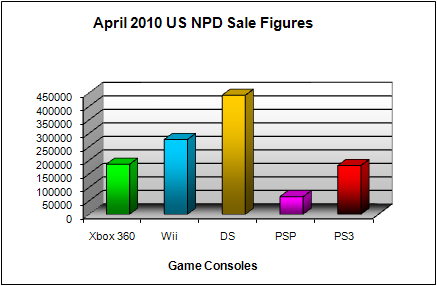
The figures for US sales in April 2010 are below, ranked in order of number of sales (April 2009 figures also shown, including percentage change):

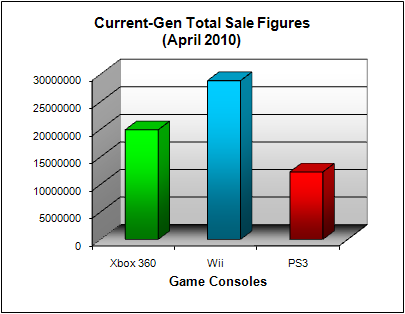
  • DS: 440,800 (Total: 41.7 million; April 2009: 1,040,000 – down 58%)
  • Wii: 277,200 (Total: 28.8 million; April 2009: 340,000 – down 18%)
  • Xbox 360: 185,400 (Total: 19.9 million; April 2009: 175,000 – up 6%)
  • PS3: 180,800 (Total: 12.3 million; April 2009: 127,000 – up 42%)
  • PSP: 65,500 (Total: 17.3 million; April 2009: 116,000 – down 44%)
NPD April 2010 Game Console US Sales Figures

NPD April 2010 Game Console US Sales Figures

NPD Game Console Total US Sales Figures (as of April 2010)

NPD Game Console Total US Sales Figures (as of April 2010)

My prediction from last month was:

I think the PS3 will outsell the Wii in April. This is based on the strong software numbers for March, plus the stock shortage issue being resolved finally which will give the PS3 a bump in sales. While there’s no new major PS3 exclusive in April, Super Street Fighter IV will be available, and based on the non Super version of the fighting game, the PS3 version should outsell the Xbox 360 version as well. Tom Clancy’s Splinter Cell Conviction, which is a console only exclusive for the Xbox 360 (there’s also a PC version), should do well, and God of War III should still be charting. So another good month for the PS3, with better hardware numbers, but probably slightly lesser software domination, for April.

What I failed to take into account was the Easter sales effect, and with Easter sales event coming in March this year, as opposed to April of last year, this accounts for quite a bit, but not all, of the sales drops recorded for April (compared to March). The double whammy is that while the Easter sales event happened in March, the Easter holiday period occurred in April, and so sales were further subdued as a result. And therefore, none of the consoles sold better in April than in March. The PS3 did not outsell the Wii. The PS3 didn’t even outsell the Xbox 360, but only losing to it narrowly. The game predictions were pretty much spot on, but with overall sales down 26% compared to April 2009 (21% of it attributed to Easter, probably), everything sold in fewer numbers.

The PS3 stock shortage appears to be continuing, at least when looking at Amazon. So this is perhaps one of the reasons why the PS3 isn’t dominating as it should based on recent game releases. This stock shortage has been going on far longer than it should have – I don’t know what the reasons are, but it can’t be helping Sony. PS3 sales still grew by 42% compared to the same month last year, but April 2009 was a bad month for the console, as it had the dubious record of being outsold by the PS2 during that particular month. What is more worrying for Sony is the PS2 and PSP. As mentioned earlier, the NPD has stopped tracking PS2 numbers, giving Sony a hint as to the future of the last-gen console. Perhaps it’s time Sony finally retires this ageing console, so they can concentrate all efforts on the PS3. They certainly won’t be concentrating efforts on the PSP, which has recorded yet another month of dismal sales. Recording what is the worst set of results since release, the PSP is seriously out of ideas, being outsold by the DS by almost a 7:1 margin this month, the total units sold gap between the DS and PSP has grown from 15.6 million units in April 2009 to 24.4 million just a year later.

The Xbox 360 continued to outsell the PS3, and continues to grow in a year-to-year comparison, a modest 6% increased compared to April 2009. If Sony is hoping to close the gap between the Xbox 360 and the PS3 total units sold in the US, then they’re doing about it the wrong way in regards to managing the stock shortage, and if anything, the gap has grown wider in recent month. And if Sony is hoping the PlayStation Move will help the PS3, then they have to hope Project Natal flops for the Microsoft console. E3, which will occur around this time next month, will give us a strong hint as to whether Move or Natal will dominate holiday sales based on the reception both demos get at the expo. But as long as the Xbox 360 is outselling the PS3, even if only by a small margin, Microsoft can’t be too unhappy with the results.

For Nintendo, the picture isn’t great this month. The DS recorded a huge 58% drop in sales compared to the same time last year, and even if you take into account the Easter effect, there’s still a drop in sales. The Wii continues to drop in sales, down 18% compared to last year. The Wii’s sales decline can be traced to April 2009, when it started to show signs of weakness. But the DS is still outselling the PSP easily, and the Wii is still outselling both the PS3 and Xbox 360 relatively easily, so it’s not time to panic yet for Nintendo. But they need something up their sleeves for the Wii if they want to continue to dominate after both Sony and Nintendo release their motion control systems.

On to software sales now. The month’s most popular title was Tom Clancy’s Splinter Cell: Conviction for the Xbox 360, outselling the number two title, which was also last month’s number two title, Pokemon SoulSilver, by more than a 2:1 margin. Conviction was a console exclusive for the 360. God of War III slipped to 5th place after last month’s monster 1st place finish. And as expected, Super Street Fighter IV on the PS3 outsold the Xbox 360 version, by a 1.3-to-1 margin – the previous Street Fighter game also sold more on the PS3 than on the Xbox 360. The usual Wii titles are in the mix, New Super Mario Bros, Wii Sports Resort and Wii Fit Plus, and also Just Dance, which refuses to go away. The other Xbox 360 title in 7th place was Battlefield: Bad Company 2, which outsold the PS3 version by around a 1.6-to-1 margin. Note that NPD did not provide figures for Wii Fit Plus this month, but knowing the sales numbers for the titles just above and below it, we can estimate sales at between 144,000 units and 166,000 units. For the sake of compiling market share percentage figures, sales for Wii Fit Plus can be  estimated to be 155,000, and if using this figure, the Wii games had 32.5% of the top 10 with 4 entries, closely followed by the Xbox 360 games on 31.2% for just two titles. The PS3 had two titles in the top 10, with 15.5% of the top 10 units sold. The two Pokemon DS titles accounted for the rest. It was interesting to note that both Final Fantasy versions not only disappeared from the top 10, they disappeared from the top 20 as well.

Here’s the complete list of the top 10 software sales:

  1. Tom Clancy’s Splinter Cell: Conviction (Xbox 360, Ubisoft) – 486,100
  2. Pokemon SoulSilver (DS, Nintendo) – 242,900
  3. New Super Mario Bros. Wii (Wii, Nintendo) – 200,300
  4. Pokemon HeartGold (DS, Nintendo) – 192,600
  5. God of War III (PS3, Sony) – 180,300
  6. Wii Sports Resort (Wii, Nintendo) – 179,000
  7. Battlefield: Bad Company 2 (Xbox 360, EA) – 166,000
  8. Wii Fit Plus w/Balance Board (Wii, Nintendo) – 155,000 (estimated)
  9. Just Dance (Wii, Ubisoft) – 144,000
  10. Super Street Fighter IV (PS3, Capcom) – 143,000

Prediction time. The PS3 shortage continues, and so it will still do poorly in sales I think, and probably outsold by the Xbox 360 with the hardware sales order remaining the same as this month. On the software front, the Xbox 360 version of Red Dead Redemption should be the top seller, with the PS3 version closely behind. Alan Wake, the much hyped Xbox 360 exclusive, should be in the top 10 as well. There might be room for the PS3 exclusive 3D Dot Game Heroes as well. Along with the usual Wii titles, the new Super Mario Galaxy 2 should rank in the top 10 as well. Overall sales should pick up compared to April, but probably still down year on year at least for the hardware figures.

See you next month.

Weekly News Roundup (16 May 2010)

Sunday, May 16th, 2010

No mid week blog or new guides, but plenty of news to make up for it. The NPD data for April is out, and it’s not looking like a good month for video games. I should have the analysis up by tomorrow, even with NPD providing less stats than before (only the top 5 games by units sold, and no more PS2 console numbers).

Copyright

Starting with copyright news as usual, the biggest news of the week was the RIAA’s victory in court over LimeWire, and it could very well signal the end of the file-sharing service popular for music downloads.

LimeWire Logo

LimeWire may be doomed due to recent court decisions

The judge awarded summary judgement to the RIAA, and judged the operators of LimeWire to be guilty of copyright infringement. Along with the Grokster verdict, this pretty much means the end of organized file-sharing services, although this verdict will have no effect on the wider P2P community, most of which are not funded or run by companies (which can be easily identified and sued), but by individuals.

And court decisions don’t always lead to action, as the MPAA has found out in their crusade to shut down The Pirate Bay. After several court decision in their favour, The Pirate Bay’s flag is still flying. The MPAA’s latest tactic has been to go after the ISP that hosts the BitTorrent indexing website, Cyberbunker. But even with the court decision, The Pirate Bay is still up and running, and so I’m not actually sure what is going on, and it appears Cyberbunker isn’t too sure either, having stated that they’ve received no notices from their solicitors to take any actions. If this affects The Pirate Bay, they will simply move to a new hosting provider, although which one, and where, remains to be seen.

Staying in Europe, a German court has found that Wi-Fi operators, including home users, are responsible for securing their connections and if their unsecured connection is used to commit a crime, such as downloading copyrighted content illegally, then the operators are responsible. I think this is a very tricky area, because many users are not aware of the need to secure their Wi-Fi connections. There are also cases where legacy devices means that a less secure Wi-Fi network has to be maintained. And even with safeguards, hackers may still find a way onto the network, and use its resources without authorization. And if this is the case, then the network operators are as much a victim as the content owners whose content was downloaded illegally from the connection, but because it’s easier to go after the operators, that’s what content owners are doing. It’s like someone stealing your car to use it to rob a bank, and because you left the keys inside, the court finds you guilty of armed robbery. Personally, I think WPA2 security should be enabled by default on Wi-Fi devices, as that’s the only way to encourage consumers to learn about the need to secure their Wi-Fi connections.

The Hurt Locker Poster

The producers of The Hurt Locker is suing thousands for illegally downloading the Oscar winning movie

More lawsuits, this time across the Atlantic over in the US. The producers of the Oscar winning film, The Hurt Locker, is suing thousands of individuals for downloading the film illegally. And once again, the firm known as the US Copyright Group is handling the case. They are the ones who has already engaged in mass litigation on behalf of a few independent filmmakers, including the infamous Uwe Boll, although they are facing some trouble with that case, with Time Warner Cable not playing along. TWC feels the US Copyright Group has reneged on an earlier promise to limit the flow of subpoenas for subscriber information, but now that they have requested details for 2100 subscribers all at one time, TWC feels this “discovery abuse”. For many anti-piracy firms, anti-piracy is about making money, and if you can get others to do your work, at their own cost, then it all adds up to more profits in the long run. The entertainment industry are aware of the bad name some of these firms give to anti-piracy efforts, as well as their monetizing policies, but these mass lawsuits are about fear as much as anything, and if they scare people away from illegal downloads, then that’s mission accomplished. Of course, it could just drive people to use encrypted networks and run blocking software, and thus makes it harder, if not impossible, for groups like the US Copyright Group to monitor downloads.

Adobe is adding DRM selectable output control to Flash, which could mean the end of Flash movie playback on non HDCP compatible devices. It’s all about giving content owners their security blanket, even if it comes at the cost of everyday customers.

And soon after Nintendo promised to fight piracy on the upcoming 3D version of their DS console, the 3DS, by implementing more anti-piracy features, they’ve also taken to court sellers of R4 flash carts. These flash carts allow illegally downloaded games to be played, as well as adding some additional features to the portable console (like video playback). Nintendo has previously requested the same company to cease and desist in selling these carts, and while the company complied at first, they also allegedly created a virtual mirror of their store and continued selling R4 carts on the new store. If this is the case, then your really can’t blame Nintendo for suing them, although there are still plenty of places where R4 carts can be purchased from. And you might have to agree that the DS’s success so far, easily beating Sony’s PSP, might have something to do with the ease in which pirated games can be played on the console, a fact that even Sony agrees when talking about its earlier PSP successes. If Nintendo really wanted to stop DS piracy, then it should have cracked down hard on R4 and earlier carts when they first came out, not several years later after the DS has successfully cornered market share. Maybe this is just the cynical side of me thinking that Nintendo’s timing may not be an accident …

It’s not all bad news in the courts though. President Obama’s nominee for the about to be open Supreme Court position may be someone that has at least considered the issue of fair use, and may have even fought for it in court against the very same entertainment industry that wants to see fair use killed off. Elena Kagan has been instrumental in hiring pro fair use people in her time as Dean of Harvard Law, and has argued for fair use against the entertainment industry in a case related to Cablevision’s attempt to create an online based PVR system. Of course, the Obama administration as a whole has been very friendly towards the RIAA and MPAA, but that’s no surprise considering Joe Biden has always been a friend of the copyright lobby.

Myth ASCII Logo Found In Max Payne 2 Steam Version

The Myth ASCII logo was found in the executable for the game Max Payne 2

Another game developer, this time Rockstar, has been found using game crack code, this time for the game May Payne 2. They needed to produce a version of the game that didn’t require the original game disc for Steam, and instead of creating their own no CD patch, they apparently used code from the game crack released by defunct group Myth. Ubisoft, the company now notoriously known for their harsh “always on” DRM scheme, has also done something similar, stealing code from active group RELOADED for the game Rainbow Six: Vegas 2. I won’t make judgement on who is stealing what, but the fact that game developers *need* “no-disc” patches created by crack groups suggest to me that the consumers wants something, and that something is less DRM. Last week I talked about the Humble Indie Bundle (which is now over, sadly), and that was really an experiment to see if giving consumers what they want – good pricing, no DRM, was really the way to go. The fact that this one week event raised more than $1.2 million suggest that it was a success, although Wolfire, the game company that ran the event, suggest that there were still a lot of people who still pirated the bundle, despite it costing only a penny. So the conclusion seems to be that some people will pirate games regardless of the cost, and Wolfire thinks that the convenience of pirate downloads may be the reason behind this phenomenon. But for those that did pay, most paid way more than the minimum amount, suggesting that people are still willing to pay for games, but please just don’t make it too difficult for them to do so.

But EA is not too concerned, and is determined to ban the sale of second hand games, so important to many gamers due to their limited funds. You can see why EA is concerned, since they do not get a cut of any second hand sales, and each person that buys the second hand game, is one less person that will buy the new game. Of course, if game pricing weren’t so ridiculously high, then maybe gamers won’t need to sell their games, or buy second hand ones. And if their games were any good, people also wouldn’t get rid of them after a month or two. EA’s solution is to sell digital distributed games that can’t be resold, or use one time voucher codes that enables multiplayer play, and second hand buyers must buy a new code if they want to play online.

High Definition

On to HD news now. Managed Copy is still pretty much non existent, despite the date after which MC becomes mandatory passing long ago. If MC is the compromise solution between being able to use the content in ways the consumers wants, but also taking into account the industry’s self interest, then it appears this compromise is one sided and that the content owners simply don’t want people to separate the content from the physical media. Or that with the 3D hype, CE firms are too busy to think about MC.

But one of the key components of MC is some kind of payment system that unlocks the managed copy (MC is not going to be free). At least this hurdle may be overcome with news that PayPal payments could soon be available for Blu-ray’s BD-Live system, as well as Internet connected TVs. This could also open up downloadable content for Blu-ray, DLCs being a success for video game consoles. The key to success for DLCs and Apps has been easy to manage micro payment systems, and this is one area in which Blu-ray has to improve.

And I know I promised to never mention the horrible Lord of the Rings Theatrical Trilogy Blu-ray again, but I must, since it has just received a price drop on Amazon.com (thanks to Digital Digest’s Amazon Blu-ray Price Index service, it’s easy to track when such price drops occur). And this has helped it to go up in the sales ranks as I type. The set is now $49.99, down from $63.99, which makes them alright value. Cynics will say the price drop confirms the failure of the set, while Warner will probably say that this was always planned and that any money they make before the Extended Editions come out will be a bonus for them (okay, maybe Warner probably won’t admit to this last part). Avatar is still selling like hotcakes (I’ve never bought a hotcake though, whatever it is). But every copy of Avatar sold adds to the carbon output due to the manufacturing process and paper, plastics used, something that’s not an issue with digitally distributed movies though.

Gaming

And finally in gaming, without talking about the awful April NPD figures, there’s still a few other news items. The PS3 “Other OS” thing is getting a bit boring to me, but it’s an serious issue for the US Air Force who may have foolish invested in thousands of PS3s thinking the “Other OS” feature would always remain.

They used the “Other OS” feature to install custom software which linked all the thousands of PS3s to act as a cheaply built supercomputer. Sony removing “Other OS” is not an issue as long as the USAF doesn’t upgrade their PS3s to the new firmware, but of course broken PS3s cannot be repaired without losing “Other OS”. They should have copies of the older firmware downloaded though, so perhaps it’s not a big issue until their fat PS3s are no longer repairable.

But there is a good lesson for consumers here. Always purchase something based on their “core” features, which for the PS3 means gaming and Blu-ray/multimedia playback. Any other features that are not main functions of the device may and probably will change over time. And if you’re relying on some kind of loophole or workaround to do something with the device that it wasn’t intended for, then that’s even more dangerous. And the lesson for device manufacturers is that don’t advertise features you don’t plan on supporting.

Xbox 360 with Natal Camera

Project Natal may be available in October

The PS3 is at least finally profitable for Sony, which means they will have more room to offer price cuts, although there are many reasons why they will be reluctant to do this (first being not wanting to go back to a loss state after finally becoming profitable, second being not wanting to make standalone Blu-ray players too poor in value in comparison). But perhaps including the PS Move accessories in a bundle without price rises may be on the cards. For the Xbox 360, it too is looking at adding 3D gaming, just like the PS3 will be doing in June. Project Natal is also set to launch later in the year, with rumors suggesting an October release date, which should give it plenty of time in the run up to the major holiday sales period. I still don’t know what to think of Project Natal – it’s certainly different, but that could lead to either success or failure if it isn’t implemented correctly. But I can see it being something people want to try out personally, as opposed to the PS Move, which anyone that have played the Wii would be familiar with, or more importantly, *think* that they would be familiar with (even if the overall experience is quite different thanks to the more accurate controller). You can read more about all of these stories in this forum thread.

Okay then, that’s that for the week. NPD analysis on Monday, perhaps some new guides or guide updates during the week, and of course, more news as always this time next week. Have a good week.

Weekly News Roundup (9 May 2010)

Sunday, May 9th, 2010

This week marks a milestone in my Blu-ray sales stats analysis, in that I finally have two year’s worth of stats analysed, graphed, poked, prodded and posted. So it was a perfect time to post my semi-regular Blu-ray – The State of Play analysis, which looks at sales trends and see if Blu-ray’s state is healthy or not. I would like you to read the analysis, and so give this poor website another much needed pageview stat, so I won’t reveal too much here other than say that if you want to see a very clear Blu-ray sales trend developing, then look at the analysis. Also, if you want to see how Avatar did in relation to other releases, it’s all in there as well.

As for the TV I talked about in the last WNR, I did the very uncharacteristic thing of pre-ordering it without having even looked at the set with my own eyes. This is the TV in question. Our 7000 series is the same as the US 8000 series. I had a very interesting experience trying to buy the TV. Went to the the Harvey Norman store in Nunawading, this is the place that I get most of my stuff from in the past, including my what looks very much overpriced Pioneer plasma TV about 5 and a half years ago. They didn’t have the plasma in stock yet (nobody has), but I wanted to pre-order anyway, so I asked the salesperson to give me a good price after telling him the best online price that I found, and basically got into an argument. The funny thing was *I* was the one trying to convince the salesperson why I would prefer to purchase from this store, as opposed to online, as the salesperson refused to even discuss prices, saying instead that if the price I found was so cheap, I should get it from that place instead. The fact that I was still there asking for their best price even after being told they couldn’t match the lowest price I found should have been a hint to the salesperson that I really did want to buy it from their store for a reason I guess the salesperson couldn’t fathom (hence why I had to try and explain why I wanted to buy from them). Also the fact that I was there to buy something that hasn’t even been released yet, should have been a sign that I was pretty serious about it. Thinking back now, I can’t fathom why I would want to buy the TV, or any other item in the future for that matter, from Harvey Norman Nunawading again. Anyway, I went to The Good Guys next door and got a great deal on the TV, and I think I just found a new store to buy all my stuff from.

Anyway, onto the news.

Copyright

Let’s start with the copyright news. With some of the secrecy surrounding the controversial global anti-piracy treat, the ACTA, being lifted thanks to efforts by the EU, the true and proper public debate on the treaty has started, although the powers that be won’t be listening anyway.

A senior counsel at Google, Daphne Keller, has attacked the ACTA for being “gollum like”. Google has their own reasons for opposing the ACTA, which will try to fight online piracy by getting rid of the “unwanted”, which is not good for Google’s business model since they want more and more people online, not less. Keller, speaking at a Standard University conference, questions why a treaty that was supposed to be about counterfeiting and border security has been turned into an online piracy thing. And she’s right too. Obviously, interest groups have hijacked the treaty negotiations to further their own goals, and all you have to do is to look at who is in support of the current draft of the ACTA to know who are the people behind this. In unrelated news, the MPAA hailed the ACTA as an “important step forward”. Hmm …

Selectable Output Control

The MPAA may finally get the FCC to approve their plan for Selectable Output Control, or basically adding DRM to TV broadcasts

The MPAA has been busy lobbying the FCC as well, and their efforts might be about to bear fruit. The FCC is about to give in to the MPAA’s demands and allow DRM to be added to TV broadcasts. This would allow the studios to selectively turn off the output of your TV or PVR for content that they don’t think you should be able to record. The MPAA argues that this is for innovation, since it allows them to release movies to the home much faster if they didn’t have to lose sleep over people recording and distributing their precious movies. This argument appears to have worked, despite many studios already releasing movies prior to DVD releases, with no considerable effects on piracy. But one things studios love is release windows, and this is yet another one. One window for movies at cinemas with 3D, another for cinemas without 3D, another for PPV, another for DVD sales, another for Redbox rentals and then another for Netflix streaming services. This all somehow is supposed to make them more money, and the principle of artificially creating supply issues is sound if one wants to maximize profits. Except piracy does exist, and movies are put online the moment (or several just before) they are released to the cinemas, and so all these artificial barriers the studios are putting up that stops consumers from buying, only ends up helping to push people towards piracy. But that’s okay, the ACTA will be here soon to solve that problem, and then all they have to do is to figure why banning people from the Internet, and thus denying them the opportunity to buy stuff on the Internet, may end up affecting their revenue.

The Humble Indie Bundle

The Humble Indie Bundle promotes the "pay whatever you want" model for game pricing ... and NO DRM!!

While the MPAA holds the view that more DRM, more laws, are the solution, a group of independent game developers  holds the view that fairer pricing, more innovation and no DRM may be the answer to gaming’s piracy problem. Partly to also help raise funds for the EFF, who is bravely fighting our battles against the RIAA, MPAA and all those in favour of more DRM, and also the Child’s Play charity, the game developers have released The Humble Indie Bundle. The bundle includes popular games including World of Goo, Gish, Lugaru HD, Aquaria and Penumbra Overture, and instead of paying the $80 retail price for the bundle, you, the consumer gets to decide how much you want to pay for it. And not everybody is paying just the minimum either. I’m not saying that this kind of “honor system” would really work for a mainstream game, but issues of pricing, ease of use, innovation should be addressed before extremely harsh DRM is even considered. It’s a fact that high prices promote piracy, as do consumer inconvenience caused by overly harsh DRM, and yet game publishers still whine about piracy and not knowing what causes it. You can either have a high price, and high piracy rate, or you can adjust your pricing model so that people don’t have a reason to pirate the game (and get rid of DRM too) – they’re trying to have it both ways, by having high prices and then trying to defeat piracy through technical or legal means, neither method proving to have any success at all. Sell games at $5 a pop, and piracy disappears tomorrow, guaranteed. And if you take advantage of the power of the Internet in terms of cheap and wide spread distribution, then game publishers can get more people to buy their games than ever before, and still end up on top in terms of revenue. This might even work for music and movies too.

NEC has developed a new tool that can detect copyrighted video clips using only 60 frames of content, which should aid the monitoring of  “three-strikes” and YouTube type copyright filters. Another technical measure that has cost millions of dollars to develop, which will no doubt be eventually circumvented.

High Definition

Let’s go on to HD news. Avatar has been making all the right and wrong headlines recently. The wrong headlines are the ones where the new Blu-ray DRM used on Avatar caused playback problems, which had to be quickly fixed by manufacturers via firmware updates (but some were quicker than others, unfortunately).

The right headline comes this week with the sales stats becoming available and analysed here. Avatar broke all records, but only marginally above the ones held previously by the week in which District 9 was released, in terms of both market share and sales revenue. Still, the results were very impressive, especially since we’re not in the holiday sales period at the moment. It was also interesting to see Lord of the Rings trilogy Blu-ray completely disappear from the top 10 – three movies whose combined box office is greater than that of Avatar by a significant margin, being released on Blu-ray for the first time, and now being outsold by 2 year old Blu-ray releases.

Samsung 3D Bundle

In Australia, Samsung is giving away for free all you need for 3D Blu-ray

The Avatar Blu-ray release is 2D only unfortunately, much to the chagrin of Avatar director James Cameron. The 3D version won’t be here until later in the year, or possible Spring 2011. The lack of 3D content right now is a huge argument against buying 3D TVs, which is a strange statement to make by someone who has just pre-ordered one. For people who are not actively looking for a new TV, then I suggest you wait until more 3D content is available, and until 3D technology matures and drops in price, which should all happen next year. The yet unreleased Panasonic 3D plasmas will probably have better 3D quality than the current Samsungs, which is now better than when they were first released thanks for improvements made in firmware updates. So the technology is still maturing, and since there’s hardly any real 3D content anyway, you’re not missing anything by waiting. However, for those that need to buy a new TV, and I’m one of them, then at the very least, you should demo the 3D TVs, most stores should have it set up, and decide for yourself how much it is worth. For me, 2D quality, price are still far more important than 3D and other features. For the Samsung I’ve chosen, 2D quality is pretty good (not the best, I know), and the price is fantastic, and so the 3D and all the free 3D stuff Samsung are giving away just makes the deal sweeter, but I wouldn’t buy this TV if neither 2D quality nor price were attractive. Of course, even if 3D isn’t a hit right now, will you want it in the future? Calculate how long you plan to use your current TV or your next purchase, and then ask yourself whether 3D will be important to you at the end of this period, and then you can decide whether 3D is something you want to buy right now.

The Flash vs HTML5 and H.264 vs open source codec war intensified this week after Microsoft formally declared their allegiance to HTML5 and H.264. For Microsoft, it’s a no brainer because while H.264 has royalty fees, its quality and industry support cannot be questioned, nor the fact that Microsoft is one of the patent holders behind H.264. Speaking of royalty fees, there’re not excessive, and you can find it explained here. Microsoft can easily afford it. Mozilla probably could too, but they will feel it’s an unnecessary expense, and one that doesn’t fit into their open source model. Even if royalties were waived for H.264, Mozilla might still have a hard time accepting the non open-source code for decoding H.264. Meanwhile, Apple may face an anti-trust investigation into the fact that it forces developers to use Apple’s development tools, as opposed to third party tools, when developing for the iPhone/iPad. This of course means Apple can prevent developers, like Adobe, from implementing certain tools for the iPhone/iPad, such as Adobe’s Flash. Apple’s boss Steve Jobs went on a rant last week attacking Flash for being a proprietary piece of software, which it is, but Apple’s no saint on this issue either. The iPhone/iPad are very much tethered devices (and I’m not talking about the 3G Internet type of tethering), meaning you can’t really use it without tying it to Apple’s services, and Apple is cracking down on jail-breaking.

Gaming

And finally in gaming, we have a couple of Sony news. First up is great news for Sony PS3 and PSP owners worried about protecting their consoles beyond the standard one year warranty period. Sony now offers a factory extended warranty plan that you can purchase directly from them.

For $45, you can extend the warranty of your PS3 by a further year. $60 buys you a two year extension. Similarly for the PSP, you can extended the factory warranty by one year or two for $30 or $40. And I would recommend people buy the 2 year extension for the PS3 due to the firmware update drive reading problem, which although not widespread, could be potentially costly if it happens outside the warranty period ($150 per repair). So $60 is well worth the price for the extra peace of mind.

The PS3 “Other OS” story continues to ramble on, with the story that Sony may have made legal threats against Geohots, the hacker who claimed he was able to hack the latest Sony firmware to allow “Other OS” to be kept. The PS3, like the iPhone/iPad, heavily relies on services that Sony provides, such as the ability to play online, and improvements via firmware updates. This is a relatively new concept, the constant firmware updates, and having features disabled if you don’t have the latest firmware. I mean how many firmware updates did you make to the PS2? And five year ago, would have ever consider updating the firmware of your TV? But it’s common place now. And all of this means the manufacturer has more control over how you use your Internet connected devices, and they can take away features just as they can add them. Remember when Amazon removed copies of 1984 from people’s Kindle devices remotely? It’s the same thing. It’s all as if we’re just renting devices from manufacturers like Sony, and that ultimately, they have full control of what you can and can’t do with the device you’ve paid for. I think consumers need to be made aware of what could potentially happen, whether features that were present when they purchased the device will always be present.

Okay, enough ranting for this week. See you next week with more rants, ramblings and a sprinkling of news.

Weekly News Roundup (2 May 2010)

Sunday, May 2nd, 2010

Ever since my current TV’s HDMI connection broke, I’ve been looking for a new TV. I almost got a Panasonic in February before discovering the black level problem, and other factors meant that I would be wiser to wait until buying a TV later in the year. Well, it is now later in the year, and what with the 3D hype and everything, I thought it wise to get a 3D ready TV since I could then test various 3D related products, something I found hard to with with the recent review of the 3D enabled new version of PowerDVD. Here in the land down under, the only 3D TV available right now is the new Samsung range, and their pricing is extremely good and I have my eye on the 58″ (the 63″ is a bit too big for my normal viewing distance, I think). The Sony 3D range would be too expensive, and I still prefer plasma, so that leaves only the Panasonic, which the whole black level things has made me think twice about buying a Panasonic TV, plus it’s not out yet and will most likely be more expensive. So barring any unforeseen events, I’ll probably buy the Samsung 58″ (it’s the Aus 7000 series, which is equivalent to the 8000 series in the US). Plus, Samsung is giving away all sorts of free stuff with the TV, including 2 pairs of active shutter 3D glasses and a 3D Blu-ray player, and 2 further pairs plus the 3D Blu-ray version of Monsters vs Aliens for those that get the TV quickly enough. If this is a preview of the type of promotions companies are going to be running for 3D TV, then the next few months could be a very good time to purchase a new TV, even a 2D one, which I’m sure will be discounted accordingly. Anyway, let’s get to the news.

Copyright

In Copyright news, the MPAA won an important court case against The Pirate Bay in what seems like ages ago, but The Pirate Bay is still up and running, and the MPAA are not too pleased.

The Pirate Bay is still going strong despite losing court cases, so the MPAA is not happy at all

The MPAA wanted TPB to be closed down, but all the co-founders did was to close down the tracker, and the MPAA now wants the co-founders to pay the court imposed fine for not closing down TPB. TPB’s ownership issue has always confused me. I don’t know who owns it and who’s running it, but it seems the co-founders say they aren’t really involved with the website anymore, and that closing down the tracker was probably the only thing they were able to do. But as we all know, trackers are far less important than previously. The MPAA’s various actions to close down trackers has meant the development of open trackers and also decentralised tracking technologies. In other words, the MPAA’s attacks have made BitTorrent much more resilient, and shutting down Torrent download websites or a few trackers won’t really stop file sharing. Even .torrent files are somewhat unnecessary now thanks to magnet links, and DHT means you don’t even need a tracker. And, as we’ve seen in the UK, France and other countries that have adopted three-strikes type laws, people will be moving to anonymous/encrypted BitTorrent services, and this will make even monitoring downloads a hard task for the MPAA. Maybe this will make them happier, you know, ignorance being bliss and all. But somehow, I doubt it. And when this happens, when the MPAA is powerless to stop BitTorrent file sharing or even to find out what people are downloading, then perhaps they’ll redirect their efforts back to tracking down the source of these uploads. While many files are uploaded by individuals, others are done so by well known groups, and it will be hard work for the MPAA to track down and stop these groups, which is probably why they’ve been focusing on the easier job of targeting downloaders.

The Pirate Bay itself has asked for a call to arms, for its users to fight the recently passed UK anti-piracy bill. They want people to speak out against a bill that, in their eyes, is a direct assault on human rights and people’s freedom of expression. The UK general election is just around the corner, but I’m not sure people are able to use this event to protest against the bill, since both major parties seem to support the new anti-piracy measures. Maybe a shock result like the one in Sweden, where The Pirate Party won a seat in the EU parliament, will be the best result from the elections. But for those still unconcerned about the new laws, just ask yourself if you think whether it is appropriate that the government should be spying on your activities, and thus sacrificing your right to privacy, for the sole purposes of protecting the profit of multinational corporations. Don’t buy into all the crap about piracy funding terrorism and crime, because the majority of pirated content are uploaded and made available free of charge, so how would terrorists and organised crime benefit from that? Counterfeit goods, now that’s something else altogether different and it’s big business to sell fake software, movies and games. But three-strikes does absolutely nothing to stop the sale of these goods, and in fact, may promote it further as people too afraid to download pirated content online, and too poor to be able to afford the real stuff, may seek cheap counterfeit goods offline.

Showing the complete lack of class, and the arrogance that we’ve expected from them, a meeting of anti-piracy groups has produced this pearl of wisdom, that child pornography is “great”. Great as in being a great scaremongering tool to use in their efforts to lobby governments, by saying that the same network where people download the latest episode of Stargate Universe is also the same place where child porn is apparently also easily accessible. What nonsense. Based on what I’ve read, downloading of most of these deplorable images and videos are done so  on the wider Internet, through public and private forums, private networks, the “darknet”. You certainly won’t find them (or torrents for them) on The Pirate Bay, or the Mininova of old (which didn’t even allow pornographic content of any kind). And does the groups that spy on users for three-strikes even monitor the transfer of child pornography, or images for that matter, or are their filters and tools only set up to detect pirated songs and movies? It’s scaremongering, and making light of an issue that is a million times more serious than college kids downloading a copy of The Hangover, and we’ve already heard from law enforcement agencies that laws like three-strikes actually makes their job of tracking down these criminals much harder, as monitoring of ordinary citizens will force more of them to encrypt their connections to protect their privacy, making it much harder to trace, monitor the truly illegal and dangerous activities of criminals.

And despite evidence that three-strikes actually increases piracy, at least in France, the IFPI, the global trade group for the music industry, says they have evidence that music industry revenue has risen in 2009 for countries where three-strikes has been passed. In countries other than France, at least. And while music industry revenue has risen in Australia, we don’t have three-strikes here, and a federal court even ruled that ISPs are not responsible for the downloads of its subscribers. Revenue increases in the UK also has no correlation to any new government anti-piracy initiatives, which did not pass until just recently. This once again shows how far groups like the IFPI, the RIAA and MPAA will use misleading, if not entirely made up, stats to further their crusade. Overall, the music industry globally recorded a 7% drop in sales. This might sound like a bad thing, but if you have a look at all the competition for our hard earned cash these days, everything from movies to gaming, 7%, with actual growth in 13 territories, is a great result. And all the other forms of entertainment has been seriously innovating, like 3D movies for example, and Blu-ray, and of course gaming, while the music industry has mostly stood still, apart from the move towards DRM-free digital sales, which the music industry was heavily resistant at first. Had they been a bit more enthusiastic at the beginning, they would be the ones with the revenue growth, not Apple with its iTunes store.

And one should not underestimate the amount of damage DRM did for the music industry, but unfortunately, it’s a lesson that the gaming industry is unwilling to learn from. News broke this week that Ubisoft’s “alway on” DRM has been broken. It took a while, given the relatively new status of the DRM, but it’s now finally broken, for both Assassin’s Creed II and Settlers 7. So Ubisoft is now left with an expensive DRM service that they have to keep on maintaining, that does not stop piracy, and whose sole purpose now is to make the overall experience more frustrating for legitimate customers. So basically the story for every single DRM system that has been released so far. When will they learn?

High Definition

On to HD news now. Avatar has been released and by all accounts, it’s a record breaker for Blu-ray. I will have the weekly numbers posted and analysed on Tuesday in usual place, but the early numbers suggest that overall Blu-ray market share could go above 30% for the first time, and may in fact be the best selling Blu-ray title of all time, even compared to titles like The Dark Knight or Star Trek that has been selling for much longer than a week.

Avatar Blu-ray + DVD Combo Cover

Avatar should break all Blu-ray records

The only reason that Blu-ray wouldn’t reach this historic milestone is that because Avatar is so popular, the DVD version is likely to sell in huge numbers as well. However, the Blu-ray package is a combo, which includes the DVD edition, and most retailers are either only stocking the combo version, or are pricing it only slightly above the plain DVD version, I suspect this will even make non Blu-ray buyers think twice about buying the DVD only version. I mean, the combo version will be much more future proof, and paying an extra $4 to get the Blu-ray version (the current actual pricing difference between the combo and DVD editions, on Amazon.com) makes the combo version the best value.

Meanwhile, the sub-standard Lord of the Rings trilogy Blu-ray has slipped to 19th on the Amazon Blu-ray charts, just barely outselling the 3 year old nature documentary Planet Earth. I’ll leave you to come up with the conclusion for this one.

Decoding of online HD videos on Macs can now be accelerated by the GPU thanks to Adobe’s new preview version of their upcoming Flash version. Name “gala”, the preview provides GPU assisted H.264 decoding for various Macs and Macbooks. Say what you will Flash, and Apple’s Steve Jobs had plenty to say about it (more on that later), but if you want multi-platform H.264 online video support with GPU acceleration, you can’t really beat Flash at the moment, and with the new 10.1 version released in the next month or two, you’ll be hard pressed to find a computer that can’t use its GPU chip to speed up H.264 video decoding. And it’s very much needed as well, because 720p is fast becoming standard for YouTube, and 1080p YouTube videos may finally be watchable on netbooks.

But Flash is still a proprietary third party plug-in, and Apple’s Steve Jobs is not a fan at all. Citing security issues, lack of stability, poor performance for mobile computing, and of course the proprietary nature of the software, Jobs heavily criticized Flash in an open letter published on the Apple website, explaining the lack of Flash support on the iPod Touch, iPhone and now the iPad. Jobs has a point, but Flash still lacks a competent competitors, even just in the limited field of online video, let alone richer applications, and so unless Apple provides an alternative (which would still be proprietary), or if the HTML5 mess is cleaned up, Flash is still very much needed. In fact, one of the bigger criticisms of the iPad has been the lack of Flash support, so perhaps this is Apple trying to deflect some criticism against their new device. Adobe hit back quickly, saying Apple should leave it to consumers to decide whether Flash is good or not, rather than impose the decision on them by not supporting Flash on their devices. They have a point, I think. Look, in a perfect world, we would have an open standard for Flash content, but we’re not there yet. I mean, the whole HTML5 mess, which I’ve tried to explain in this forum post, is only playing into Adobe’s hands.

For PC software news, x264, the popular open source H.264 encoder, is now officially Blu-ray compliant. x264 has been able to encode H.264 clips for use in Blu-ray compilation for some time now, but it has just passed official compliance tests, and so it is quite a big deal. This now allows Blu-ray movies to be converted to DVD, and still maintain Blu-ray compliance (at least for the video stream), and thus making the disc playable in most Blu-ray players (the PS3 apart).

Gaming

And finally in gaming, more PS3 firmware related news as the latest firmware adds the first steps towards making the PS3 3D capable for gaming. The 3D gaming feature will be available around June/July, but 3D Blu-ray support is only coming later in the year, unfortunately.

In the same update, Sony also laid the groundworks for Sony VAIO PC integration, allowing VAIO PCs to access content stored on the PS3 sometimes in the future.

3D Gaming on the PS3

PS3 will have 3D gaming support added via firmware soon, but it's what's been removed from the firmware that has fans angry

But as Sony adds more features via firmware, users are still displeased at the removal of the Other OS feature. The expected class action lawsuit has been launched. I think the issue most people have with the removal of Other OS is not so much that it was an essential feature, but rather, because Sony had promoted it so heavily, and removing something like this makes people insecure about Sony’s future intentions. Sony’s “It only does everything” tagline for the PS3 is not helping people get over the fact that, well, it no longer does what it did just a few months ago. The other major issue people have is that this effectively stops development on several very promising Linux based media center packages, which can turn your PS3 into a fully fledged media center, a much better one than the default Sony solution. A good third party media center software can really help the longevity of the console, just look at the original Xbox, which is still being used today thanks to software media center mods like XBMC. So while it’s understandable that Sony removed Other OS to prevent a way in for hackers, or the development of emulators, the price of losing a competent third party media center is just too high to pay, perhaps.

And that was that for the week. I’ll have more ranting and complaining for you next week, so until then, have a good one.