Archive for the ‘Nintendo Wii, Wii U, Switch’ Category

Weekly News Roundup (23 March 2008)

Sunday, March 23rd, 2008

Hello everyone on this Easter Sunday. I’ve never really gotten the connection that easter has with bunnies. I understand that it presents birth and re-birth that comes during spring and what better represents reproduction than rabbits (although rats could also have been used, but who wants to eat rat eggs, chocolate or otherwise?). But why chocolate eggs? If I can remember correctly from biology class, rabbits don’t lay eggs, and certainly not chocolate ones. But I guess it would be more appropriate than eating a chocolate resurrected Jesus.

With blasphemy out of the way, let get to the copyright news. An anti-piracy company in Italy has been found guilty of illegally spying on P2P users. Is it me or is piracy and privacy becoming more and more related, and not just because they share 85.7% of their letters. On the other end of the spectrum, Verizon in the US is helping P2P users who share legitimate files by making downloads faster. As someone who has some experience in file serving, P2P is extremely useful in the way that it can deal with increased capacity – in fact, the more users that download, the faster it becomes is ideal for sharing popular files (and it saves a bunch in bandwidth hosting costs as well). And even for illegal files, the reality isn’t as bad as the content holders want to portray. An Oxford economist has claimed that piracy actually helps to promote products, and may benefit the very companies that want it stopped. I often read posts where people say they pirated something, found it to be great, and then bought the product, usually something they would never have bought otherwise. Unfortunately, Australian ISPs might not think so and one ISP is already starting to crackdown on illegal downloads, threatening to cut off Internet connections for people who download pirated content excessively. This means the ISP will have to monitor people’s usages, which goes back to the 85.7% similar word “privacy”. But as usual, the media tend to take a sensationalist view of things, and the ISP in question has been doing this for over two years now without people noticing, but it’s still something people don’t want an ISP to be in charge of (and I think most ISPs don’t want to be in charge of monitoring usage either). Before moving onto HD, the news this week is that Slysoft has broken BD+ copy protection for Blu-ray. At least for the time being. In their press release, they are still (somewhat optimistically) hoping that this will help to bring HD DVD back from the dead, as they’ve always preferred HD DVD’s easier to break AACS copy protection to Blu-ray’s harder to break AACS & BD+ combination. And of course, they also stated that BD+ is still in its infancy, and that over time, it will be harder and harder to break.

Onto HD, finally some more movement in the area of PC Blu-ray/HD DVD playback. Corel (who purchased Intervideo) has just released the first version of WinDVD that supports Blu-ray and HD DVD playback. Dubbed WinDVD 9 Plus Blu-ray (despite the fact it plays HD DVDs too, but I guess that’s just the result of the format war ending), it also has build in video/DVD upscaling and all the usual features you would expect. I will be reviewing WinDVD 9 over the next week (thanks again to Corel for providing a reviewer copy), but from first impressions, I’m quite impressed. WinDVD 8, to put it mildly, was somewhat crap. It didn’t even install on my main work machine, and it was sluggish. The new WinDVD is definitely much more responsive. The best thing about it so far is that it supports older video cards for Blu-ray and HD DVD playback, something that PowerDVD Ultra failed to do on my ATi Radeon 9800 XT. Obviously, performance wasn’t great on my old computer, but it at least started playback as opposed to just giving me an error message about insufficient hardware. So even on a P4 3.2 GHz (not even Pentium D) with the mentioned 9800 XT, HD DVD playback (via the Xbox 360 add-on drive) worked without any tweaking (but choppy playback, of course), including all the interactive features. HDCP requirements for both Blu-ray and HD DVD states that VGA output is supported, if only at a lower resolution, so PowerDVD Ultra not starting playback is the software’s problem, not to do with copy protection. Hopefully PowerDVD 8, to be launched sometime next month I think, will fix these issues. WinDVD 9 Plus Blu-ray supports Profile 1.1 Blu-ray playback, but there’s a good chance a patch will be released soon to support Profile 2.0 (that’s the great thing about software based playback solutions – upgrading is easy). I’m predicting this because the PS3 is about to get its own software update to make it into (the first?) Profile 2.0 Blu-ray player. That’s good news to those who purchased the PS3 wanting it to be future proof (and to those, like me, that has been recommending it for the same reason). Of course, the one feature Blu-ray owners really want is DTS-HD MA decoding for the PS3, but I hear that it’s only a matter of time before it is available. I’ve also just published the Nero Vision 5 AVCHD authoring guide. AVCHD is basically like a mini Blu-ray, allowing you to encode 1080p content (with up to 7.1 Linear PCM audio) onto a DVD recordable (although you won’t be able to store too much content on a standard single layer DVD).

In gaming, the expected hoopla surrounding the release of GTA IV next month will no doubt intensify. I’ve just read some previews on IGN, and I can’t be anything but excited at the new version of my favourite gaming franchise. Microsoft Australia (and New Zealand) is giving people who pre-order GTA IV a special exclusive deal in which we get 500 Microsoft points to use on Xbox Live plus four exclusive GTA Gamerpics. I still haven’t decided whether I will get the 360 version or the PS3 version, but I’m leaning towards the 360 version due to the better controller and because Rockstar seems to suggest that the 360 version had been finished earlier (and hence, should be a bit better). I’ve seen Microsoft’s new Arcade bundle that includes both GTA IV and Halo 3 that will retail for $200 less than the cheapest PS3, and I think this bundle will sell extremely well (let’s just hope that MS finally has the 360 stock issue sorted out, because it was a pain trying to source a 360 during the holiday period). I put up the February US NDP game sales figure analysis a few days ago, so have a look if you’re interested in these kind of things.

And last but not least, the Roxio competition to win yourself an iPod Nano plus other cool Roxio prizes is still up and running, until the end of this month. I will have some reviews and guides up for some of the Roxio software on the site shortly as well.

Thanks for reading. See you next week.
Game Consoles – February 2008 NPD Sales Figure Analysis

Wednesday, March 19th, 2008

The February 2008 NPD game console sales figures for the US has been released. This month, all sides have claimed victory, and after reading this analysis, you might come to the same conclusion as well. You can read last month’s analysis here. The figures are from NPD, a marketing research firm that releases games console sale data every month.

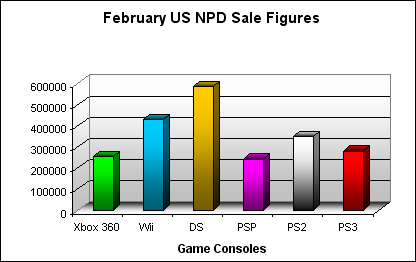
The figures for US sales in February are below, ranked in order of number of sales:

  • DS: 587,600 (Total: 18.5 million)  
  • Wii: 432,000 (Total: 8.1 million)
  • PS2: 351,800 (Total: 41.7 million)
  • PS3: 280,800 (Total: 3.8 million)
  • Xbox 360: 254,600 (Total: 9.6 million)
  • PSP: 243,100 (Total: 11 million)
  • NPD February 2008 Game Console US Sales Figures

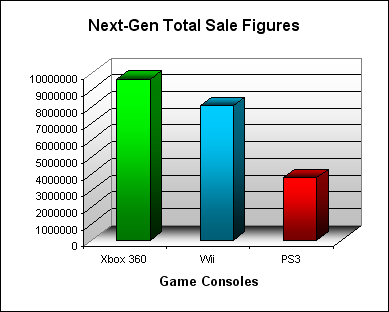
    NPD Game Console Total US Sales Figures (as of February 2008)

    Apparently, this month’s results showed that Nintendo, Sony and Microsoft are all winners. It’s obvious why Nintendo would claim this. Both the DS and the Wii sold in large numbers again, claiming first and second place. The DS claimed 71% of the portable gaming market, while the Wii claimed an equally impressive 45% of the next-gen console market, outdoing the previous two months’ efforts.

    Sony has also claimed victory because for the second month running, the PS3 outsold the Xbox 360. Last month it was by 39,000 units, this month 26,000 units. Since I started doing this feature on the blog, the PS3’s monthly market share has jumped from just under 11% (in September 2007) to now a very healthy 29%. The Blu-ray victory appears to have had the intended effect, and Sony will be pleased with its efforts so far in 2008.

    However, it may sound strange, but Microsoft has also claimed victory this month, despite coming last in the next-gen console war. As with last month, Microsoft is claiming stock shortages are the cause and that April will be the soonest that they can ensure stock is no longer a problem. Cynics might suggest that it’s just an excuse, while there does seem to be some data which suggest the claim has some validity. Regardless, the trend in the last few months have been decline in monthly market share for the 360, starting from September 2007: 45%, 36%, 35%, 37%, 30% and now finally, 26%. But to be fair, the one month that bucked the trend, December with 37%, was the month with the highest volume of sales, so if Microsoft had been expecting something like 33% in December, and got 37% instead, it does explain why they might be caught short-handed in January and now in February as well (that extra 4% equals more than 136,000 units). But excuses, whether real or not, can only last for so long and if the 360 does not outsell the PS3 in March or in April, then we will know who is telling the truth and who is not. So why is Microsoft still claiming victory? Well, it’s the software sales that will give Microsoft some encouragement.

    Five of the top 10 selling games in February were Xbox 360 titles, including previously PlayStation exclusive, Devil May Cry (4), which perhaps somewhat unexpectedly, outsold the PS3 version. The PS3 version of DMC4 was the only PS3 title to make the top 10, with 2 Wii titles, 1 DS and even 1 PS2 title making the top 10. The top 10 games sold in February were:

    1. Call of Duty 4: Modern Warfare (Xbox 360, Activision) – 296,200
    2. Devil May Cry 4 (Xbox 360, Capcom) – 295,200
    3. Wii Play (Wii, Nintendo) – 289,700
    4. Devil May Cry 4 (PS3, Capcom) – 233,500
    5. Guitar Hero III: Legends of Rock (Wii, Activision) – 222,900
    6. Mario and Sonic at the Olympic Games (DS, Sega) – 205,600
    7. Lost Odyssey (Xbox 360, Microsoft) – 203,600
    8. Turok (Xbox 360, Touchstone) -197,700
    9. Guitar Hero III: Legends of Rock (PS2, Activision) – 183,800
    10. Rock Band (Xbox 360, MTV Games, Electronic Arts) – 161,800

    So Microsoft do have something to smile about, and their earlier efforts to release the console before all others seems to have paid off. By having the most number of consoles, software sales will come naturally and Microsoft again was the most profitable company out of the 3. With almost exactly 50% of sales in the top 10, it’s hard not to be.

    Predictions tell us that the Xbox 360 will regain its lead over the PS3, although barely, with April being a better months for Microsoft. The release of GTA IV in late April will also be interesting, especially to gauge whether the PS3 version or the Xbox 360 version (with exclusive content) will sell better. A good GTA IV led sales campaign might just help one console to dominate the rest of 2008.

    See you next month.

    Weekly News Roundup (16 March 2008)

    Sunday, March 16th, 2008

    What a week it has been. The server problem was finally fixed, although not without a lot of fixing and tweaking as you would expect when you do a major server move. Also received a bunch of cheap HD DVDs that I had ordered in previous weeks, pretty much all the titles I’ve ordered have now been received (I just need to find some time to watch them, that’s all). And I also celebrated my birthday during the week as well. So it’s been a busy week, and if there seems to be less news stories than normal, that’s probably why.

    So let’s not waste any time and start with copyright news. The MPAA is at it again (I seem to use this phrase quite a lot. But blame the MPAA, not me). This time, they are against Net Neutrality, because it might hurt their plans to spy on everybody. Net Neutrality basically means leaving the Net alone and not placing restrictions on things like content types, connection modes and placing priority on certain types of content, while reducing priority on other “less desirable” content. Obviously, a restricted and regulated network will benefit the MPAA in their attempt to control how, when, where and what we download. Having big business tell us what we can and cannot do is, in my opinion, even worse than Big Brother type governments doing so … at least government are elected (in most countries).

    On to HD. Now that people have finally gotten around to the idea that Blu-ray is *the* HD format for the future, questions are starting to be raised. Even staunch Blu-ray advocates such as Bill Hunt from The Digital Bits are starting to ask the BDA to make changes, the very changes that made people choose HD DVD like prices, profiles. We’ve been flooded with news of Blu-ray prices rises, both for hardware and movies, but I think it’s too soon to tell what the general direction Blu-ray will be heading to next. If the BDA is serious about replacing SD DVDs with Blu-ray, then prices will drop. If they see Blu-ray as a money maker that is needed to replaced flagging DVD sales, then prices may not drop as quickly as one would like. There is a very interesting read on Gizmondo that highlights some of the problems that Blu-ray will be facing in the short and long term. It certainly is a pretty pessimistic look at things, but you would have to agree with their key points, which are: the cost of the format war means prices drops will hurt manufacturers and studios, profile confusion, and productivity problems. On that last point, the article raises something quite interesting in that they speculate Universal studios might be having trouble releasing their titles on Blu-ray due to the entire 2008 production stock already being allocated to other studios. In other words, Universal can’t release movies on Blu-ray because they can’t get production time in the already over capacity production lines. New lines are being built, but they cannot come online quick enough. Of course, this might all be speculation, but one thing is for certain: HD DVD would not have experienced this problem as all recent DVD production lines are capable of producing HD DVDs. And speaking of former HD DVD studios releasing titles on Blu-ray, Paramount is apparently set to re-release their previous Blu-ray titles (before they went HD DVD exclusive) again next week. Seems that they kept their Blu-ray stock, as opposed to pulping them as some rumours had suggested. Unfortunately, Universal never got into Blu-ray production, so it will be some time before you see The Bourne Trilogy on Blu-ray. Another problem for Blu-ray is that upscaled DVD performance continues to improve. Oppo this week officially announced their new DVD upscaler, the DV-983H, which early testing has showed to be possibly the best performing on the market today. From my experience, a fairly average/poor HD encode is often the same or worse than a decent DVD encode upscaled (case in point, T2 Extreme Edition DVD vs T2 HD DVD Australian version). Such decent DVD encodes look very “HD” when upscaled, but the general rule is that real HD, when given a proper encoding, will always look better. But just because it is better, doesn’t mean people are prepared to pay extra for it … think DVD-Audio and SACD, although better video quality is easier to sell than better audio quality.

    Meanwhile, HD DVD is selling quite well (the latest numbers showed a 10% market share jump for HD DVD in the US, even though the big sales haven’t really started, at least not at Australian “everything under $10” levels yet). For those that want to join in, keep an eye on this page and this page, as well as the blog. I wish somebody would release Australian sales numbers, because it must be at least 20:1 in HD DVD’s favour in the past few weeks. The Xbox 360 add-on drive is proving particularly popular due to its low price, but Microsoft this week denied again that they are working on a similar add-on for Blu-ray. 

    Before I move on properly to gaming, DivX support is coming to a lot more Blu-ray players than just the PS3. In fact, their support will be even better than the PS3’s (which is a bit strange). Anyone who has used the PS3’s DivX/XviD playback function will know that it is somewhat limited, with no DivX Ultra support, no support for GMC/Q-Pel and has a few other problems as well. But when a file does work, it plays beautifully. And while the PS3 has had a firmware update (adds nothing of significance, other than some gaming compatibility fixes), the next big update will be interesting if they add enhanced DivX support, as well as perhaps DTS-HD MA decoding (the one essential Blu-ray feature that the PS3 sorely lacks) and even Profile 2.0, although I believe the latter two will be more likely to come only after standalones with similar features are available.

    Now onto gaming proper, February’s US NPD figures are out and I will provide a full analysis in the next few days. Once again, all three gaming companies are claiming victory. Nintendo’s Wii sold the most, so they’re claiming they’re the best (with justification, IMO – but if I’m a bit sick and tired of seeing another story about how the Wii is helping the elderly, the injured and basically curing all disease and bringing world peace). Sony’s PS3 sold more than the Xbox 360, so they’re claiming victory too (mainly thanks to Blu-ray’s victory, I think). While Microsoft is still saying Xbox 360 stock shortages are affecting sales figures, and that they sold the most software and made the most profit, which they think is the most important. If Microsoft is really having stock problems, then what they say makes sense, since people are still choosing the 360 over the PS3 when it comes to multi-platform releases (Call of Duty 4, for example). It will be interesting to see which consoles gains most from the release of GTA IV, but I believe with the 360 install base much greater than the PS3 in the US, the 360 version of GTA IV, with the exclusive content, will probably sell more copies. I’ve yet to decide which version I would get (PS3 or 360), although I’m leaning towards 360 due to not having to buy another controller just to get rumble capabilities (and the fact that the 360 version was produced first, meaning it might play a little bit better). Once I assume 360 stock become plentiful again, Microsoft will fight the PS3 with further price cuts which will put pressure on Sony to follow. Expect to see a 360 GTA IV pack for less cost than the basic PS3, and it will sell like hotcakes.

    See you next week.

    Weekly News Roundup (24 February 2008)

    Sunday, February 24th, 2008

    Welcome to the first weekly news roundup post the HD format war. Upon hearing the news of the war’s end, did you let your emotions get the better of you, go up to complete strangers to hug and kiss them? And did you then get arrested and placed on probation for being a public nuisance? No? Umm … me neither. I didn’t do any of that, honest. 

    This week has all been about the end of the HD format war, so either there has been very little copyright news (or very little news that would be considered relevant/interesting), or that I haven’t been paying attention as usual. I’m sure the MPAA and the RIAA got up to their usual tricks, that some politicians took their money to support a new legislation, and that some hacker found some way to hack into some DRM. So basically nothing new.

    And of course, the big news of the week is that, yep you guessed it, Apple has dropped the price on the iPhone and iPod touch! Oh, and Toshiba also dropped something. I think it was called HD DVD. The news that HD DVD supporters didn’t want to hear, but probably thought was only a matter of time, did come on Tuesday (Japanese time). I’m sure Toshiba could have held on a little bit longer, but it would only be to wait for a miracle, that sadly, won’t happen now. You all know how I feel about HD DVD, and Blu-ray, and if you didn’t, you can read my latest thoughts (pre-Toshiba decision) here. While I’m sad that a consumer friendlier format like HD DVD didn’t work out, I’m not overly fussed as I’ve been supporting both formats for a while now. And by supporting, I don’t mean going onto Internet forums and gloating and posting FUD (fear, uncertainty and doubt) posts, but rather in the more practical way of forking over cash to buy stuff. So one format that I’ve bought into has died, the other has grown stronger as a result, which means I’ve not lost anything. In fact, not only have I not lost anything, I’ve picked up a few things too – like no less then thirteen HD DVD titles for an average of $USD 7.01 including postage (titles include Evan Almighty, Knocked up, Casino, Carlito’s Way, Jarhead, Rambo Trilogy, Deer Hunter, Apollo 13, Spartacus – and a few more items at the same low price which if not out of stock, includes Shaun of the Dead, Smoking Aces, The Kingdom and The Thing). The rush for these discounted Universal titles has created such as storm here in Australia that it caused disruptions to several leading online stores, and stock sold out within a matter of minutes. Which just goes to show that low prices is the most consumer friendly feature of all.

    Anyway, in the aftermath of Toshiba’s announcement, the HD DVD exclusive studios all eventually followed suit and headed towards the Blu camp. Both Universal and Paramount has announced that they will now support Blu-ray, with Universal unsure of what to do with their HD DVD lineup, while Paramount and Warner appears to be willing to continue releasing movies on HD DVD for the time being. So the chance of more bargains like the one I listed above from Paramount and Warner remains high, and my credit card awaits patiently as well. And for those slightly worried about not having a player to play their HD DVD discs, then the good news is that LG still plans on releasing dual format players for the future, possibly both standalones and computer drives. I suspect Samsung, which seem to do everything LG does, will continue to do so as well. And word is that Sharp will release a player too, since I think they provide the laser diode for these dual format players. What isn’t so clear is the details of Paramount and Universal’s switch to Blu-ray, like which titles will be available and when. I’m guessing 3 to 6 months before we see the first Blu-ray title, and for the Bourne Trilogy and Transformers to be in the starting lineup. There is also the chance that if Paramount still has some recalled Blu-ray versions of Blades of Glory and other titles that were shelved following their defection to HD DVD, that these might be released first. What is also not so clear is what Microsoft will do in regards to a Blu-ray add-on drive for the Xbox 360. The initial rumour was that one will be available within 6 months, but then Microsoft issued a (somewhat soft) denial for a drive being available in the short term. I guess they don’t want to be seen as supporting a Sony format, not when they’re still at war with them in the game console arena.

    So the focus now turns to whether Blu-ray can become the next digital video format to replace DVDs. Certainly the end of the format war, and format confusion, will help. I will go over two Digital Digest polls soon in regards to this issue, but suffice to say, Blu-ray has a long way to go before it can even call itself a competitor to DVD. Even with Blu-ray and HD DVD combined, discs sales have only been half of what DVD did after the same initial period. While player sales have been fine, thanks to cheap HD DVD players and the PS3, the low attachment rate of Blu-ray movies and the generally low rate of sale of HD DVD, has all contributed to the low disc sale figures. And the high prices when compared to DVDs won’t have helped (remember that when DVDs first came out, there was no “low price” alternative, because VHS often cost more, not less, than DVDs).

    And while I’ve harped on about Blu-ray manufacturing costs and such in the past, a new type of BD recordable could start to lower cost of BD blanks. Dubbed LHT BD-Rs, and developed by Taiyo Yuden, Mitsubishi and Maxell, these use organic materials to lower production costs. Unfortunately, and this has been somewhat of a Blu-ray trait, is that compatibility problems might occur with earlier players. Some players can be updated through firmware to read these new BD-Rs, while others will have to be replaced. Might be best to hold off buying a BD burner until something concrete materialises.

    I’ve also harped on about Blu-ray region coding and how it sucks, but there might be a solution now for the PC at least. Read my Blu-ray Region Free Guide to find tips on possibly making PowerDVD Ultra and WinDVD BD region-free for Blu-ray playback.

    And finally onto gaming, as promised, the January NPD figures have been released and analysed. While it looks like Blu-ray has helped the PS3 to beat the Xbox 360 and nearly beat the Wii, remember that both the Wii and 360 had serious stock shortage problems thanks to last month’s record sales figures for both consoles. The PS3 took advantage efficiently, but the Wii and 360 are still the consoles to beat, in the US at least. And thanks to consoles becoming more and more like PCs in terms of functionality (media sharing, Internet browsing, movie downloading …), PCs are now struggling to stay in the gaming market, at least here in Australia. For me, I’ve not played less games on the PC, but I’ve definitely played more on consoles (not surprising, considering the current 3 main consoles are the first ones I’ve owned since the SNES). I still prefer PC gaming, mainly because I prefer strategy games, and first person shooters using the mouse/keyboard combination. But I can definitely see the appeal of console games. And some say that the increased spending for console gaming has led to decreases for movies, which I would have to agree with. So in some way, the success of the PS3 as a game console might actually hurt Blu-ray.

    [PLEASE INSERT INTERESTING, IF NOT FUNNY, CONCLUSION TO ARTICLE. AND DO NOT FORGET TO MENTION “SEE YOU NEXT WEEK”]

    Game Consoles – January 2008 NPD Sales Figure Analysis

    Thursday, February 21st, 2008

    In the excitement over the end of the HD format war, I had almost forgotten about the January 2008 NPD game console sales figures for the US. As expected, sales dropped quite a bit after the Holiday sales, but were still quite respectable. You can read last month’s analysis here. The figures are from NPD, a marketing research firm that releases games console sale data every month.

    The figures for US sales in January are below, ranked in order of number of sales:

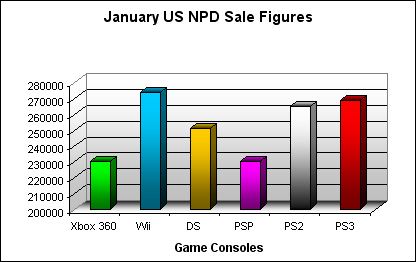
  •  Wii: 274,000 (Total: 7.7 million)
  • PS3: 269,000 (Total: 3.5 million)
  • PS2: 265,000 (Total: 41.3 million)
  • DS: 251,000 (Total: 17.9 million)  
  • Xbox 360: 230,000 (Total: 9.5 million)
  • PSP: 230,000 (Total: 10.8 million)
  • NPD January 2008 Game Console US Sales Figures

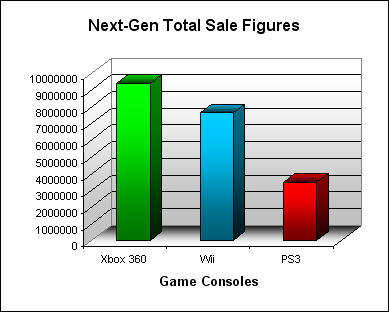
    NPD Game Console Total US Sales Figures (as of January 2008)

    There’s a bit of a controversy over this month’s figures. Microsoft has claimed that stock shortages, due to January stock being sold in December to cover the unexpected strong demand, has severely affected sales figures in the month. Nintendo has claimed the same reason for the low Wii sales numbers. This confirms my personal experience during December here in Australia, where most stores had no stock for Xbox 360 and Wii’s, while the only game console on sale was the PS3. Sony’s PS3 did not suffer from similar stock problems, and with the positive vibes coming from Warner’s decision to support Blu-ray exclusively, the PS3 recorded the first ever monthly victory over the Xbox 360. But as mentioned before, these numbers should be treated with some suspicion. And as such, I will limit my analysis for this month, which is also due to the low figures being reported as compared to last month.

    Probably more indicative of the actual market was software sales. It was another strong month for the Xbox 360, with 5 titles in the top 14, including the coveted number one spot (once again taken by the excellent Call of Duty 4). The Wii also had 4 top selling software in the same list, while the PS3 had two (one of them is, you guessed it, Call of Duty 4). The Xbox 360 therefore accounted for 40% of the top 14 selling software, Wii at 33% and the PS3 at 10%. If you look at the total console sales figure graph above, the ratios do look similar.

    Next month, hopefully, will see some figures that aren’t possibly affected by stock shortages. See you then.