Archive for the ‘High Definition (Blu-ray/HD DVD/4K)’ Category

Weekly News Roundup (6 November 2011)

Sunday, November 6th, 2011

Hope you had a great Halloween last Monday. We don’t celebrate Halloween much in Australia, although the prevalence of US entertainment programmes on television here meant that some kids here will have caught Halloween fever. Which is why I spent Monday night hiding from door knockers and pretending nobody was home, as we’re not big candy eaters and so stock levels were dangerously low for trick or treating purposes, particularly the latter.

Which is just as well, since it gave me more time to put the finishing touches on a new website I was making for Australians, called Faraway Deals. It’s my way of helping Aussies take advantage of the generous exchange rate, by helping them to spot the best movie and games deals and discount for shopping overseas. And by overseas, I mean the UK, since there are fewer region issues (Australia is in the same Blu-ray region as the UK, and we’re both PAL countries in terms of game regions), plus the exchange rate is even more favourable than compared to the practically worthless US dollar (hurrah for European debt crisis!)

Plenty of news to go through, so let’s get started.

Copyright

In copyright news, it’s been a busy week. Actually, almost all of the news that I’ll be talking about this week are copyright related, but with thing happening in the courts, in congress, and all of them potentially seismic changes.

We start with the slightly ridiculous: Justin Bieber. I never thought that I would have to talk about the “Biebster” here in the WNR, but this day and age, anything is possible. But nobody really expected Bieber to be caught in the middle of a copyright war, and I don’t think a single soul expected him to be on both sides of the war at the same time, if that’s even possible. The FreeBieber.org website was set up to protest the Commercial Felony Streaming Act (S.978), which would make it a streaming copyrighted video a felony. The link to Bieber is that he actually became famous on the back of a bit of copyright infringement, of the streaming kind as well, when he uploaded videos of himself singing popular, and copyrighted, songs on YouTube. Had Bieber done it after S.978, he might find himself facing 5 years in prison for having committed felony. And this kind of “copyright infringement” seems to be quite a preferred way to become famous online, maybe not Bieber famous, but YouTube famous (or infamous) at least (the alternative is to hire a production company to write you an original song, and we know how that can turn out). And how does this kind of copyright infringement, a felony under S.978, actually hurt anyone? Would people stop buying Chris Brown’s ‘With You’ just because one Justin Bieber uploaded his, poor recording quality, version of the song? And had the rights holders to ‘With You’ filled a takedown notice with YouTube and removed the Bieber version before people had a chance to view it, would the music world be better or worse without Justin Bieber? (on second thought, don’t answer that)

Anyway, Bieber was asked what he thought of FreeBieber.org and S.978, and obviously, as someone who got famous on the back of what is now potentially a felony (and not only that, anybody that embedded the video on his or her blog would also be committing a felony under S.978), he came out supporting the anti-S.978 movement. To the point where I think he got a bit overboard with the sentiment and recommended the incarceration of the US Senator that sponsored the bill. But at the same time, his lawyers were doing all they can to kill off FreeBieber.org, by sending a cease and desist letter to the people behind the website asking them to stop using Bieber’s image. Of course, the EFF stepped up to defend FreeBieber and attack Justin Bieber’s lawyers for not knowing about the First Amendment, especially when this is part of the core First Amendment rights, the freedom to espouse political views. I think Justin should get in contact with his lawyers and get them to tone it down a little, especially when FreeBieber.org isn’t actually hurting Bieber-nomics, and it may be helping to boost his rebellious image. And the website also serve to entertain those that like seeing pictures of Justin Bieber behind bars, so it’s a win-win.

Stop the E-Parasite Act Petition

Petition Obama to kill off the E-Parasite Act, by signing this petition

Despite all the ruckus over S.978, it isn’t even the most controversial copyright bill up for debate on Capitol Hill at the moment. That would be the E-Parasites bill, also known as Stop Online Piracy Act (SOPA), currently being mooted for debate in the House of Reps. I’ve already talked about SOPA in previous WNRs, so have a look if you need more background info. But this week has all been about opinions, and most of them are against SOPA, with op-ed pieces popping up everywhere, and with the pro-SOPA opinions most limited to the usual suspects, the MPAA and RIAA. Not only that, there’s no an E-Petition up and running to oppose SOPA, but unlike most other E-Petitions (which are only slightly more useful than completely useless), this one is being run on a website set up by the White House, and if 25,000 signatures can be obtained before the end of November, the promise is that the White House would take the time to seriously consider the petition. Practically speaking, the copyright lobby friendly White House won’t do a thing to stop SOPA, but 25,000 names is a nice and achievable goal (over 10,000 signatures already, in the first week), and if the power of the Internet can be harnessed and much more than 25,000 names added to the petition, then it will definitely send a message.

The ridiculous coddling of copyright interest isn’t just in the US though, over in the UK, ISP BT has to now officially block Newzbin2 this month, a court has ordered. This is despite Newzbin2’s “guilt” never properly tested in a court (the original verdict was for the original Newzbin, not the second incarnation, most likely run by totally different people), and Newzbin2 not having any sort of profile in the UK itself (as it’s based in a foreign country, run most likely by foreigners), and so not even jurisdiction is clear. But yet, BT will have to comply and use its child-porn filter to do the filtering, which really shows where the priority is these days, taking resources away from fighting child porn to use on anti-piracy. The ridiculousness of this ruling, which basically opens up the door for corporate backed censorship in the UK, is already getting the copyright lobby excited, with the music industry already signalling it will ask BT, and other ISPs, to start blocking The Pirate Bay. And with the precedent already set, getting other sites blocked should be much easier, although getting around the filter may be just as easy too.

And so with one ridiculous, overreaching bills and court rulings, after another, and with the copyright lobby working overtime (by working, I mean of course spending) and the statements they’ve made, you would think the piracy problem must be really killing the creative, copyright industries. Talks of hundreds of thousands of job losses, the threat of good content disappearing, movie studios and music labels going out of business, so surely, there should be plenty of facts just lying around to highlight the financial toll of online piracy. Well, there’s definitely “lying” anyway.
Copyright Industries Report: Real Annual Growth Rates

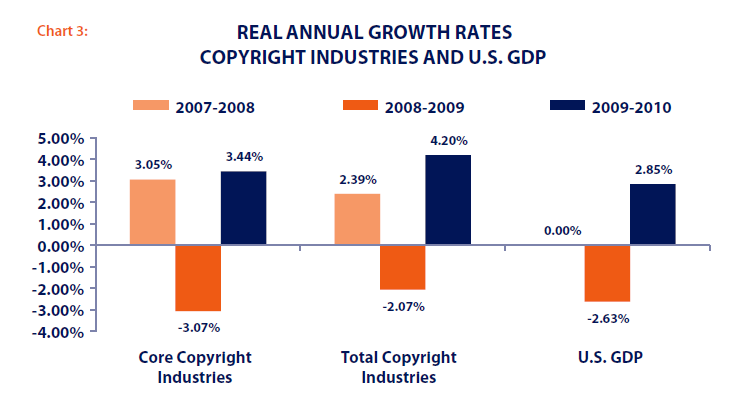
The copyright industries seems to be doing pretty well, according to a new report, despite "huge piracy problems"

You see the problem for the copyright industries, but really just to vocal ones that pay the salaries of the RIAA and MPAA, is that while they have to paint a bleak picture of the effects of piracy, they also have to highlight just how important they are to the economy, the US economy in particular. And to do that, they have to show how much money they contribute to the economy, and they have done it via a new report. The problem of course is, on the one hand they have to say “we’re important because we’re doing great”, and on the other hand they have to say “we’re not doing great because of piracy”. But as the report highlights, the core copyright industries have never had it better – they’re making more money despite the recession, and job losses have been relatively subdued compared to other industries. So where’s the online piracy induced disaster? Surely, with web piracy at an all time high, revenue should be down the drain compared to say 10 years ago, and while that may be true for the music industry, it has much more to do with people’s changing buying habits than actual piracy (people buy fewer albums, instead, buys more tracks – choice, if anything, is the real “killer” of the music industry it appears).

And speaking of job losses, the current Boogeyman that the RIAA/MPAA likes to use to scare politicians, pay in copyright industries are actually 15% to 27% higher than other industries. So much for massive job losses and not being able to afford to make new content, while other industries are “forced” to tighten belts by embrace the “work more for less” principle (*cough* exploitation *cough*).

The reason for the industry’s resilience against surging piracy rates may very well be due to the fact that piracy has a bigger effect on the segment of the “market” that traditionally don’t buy a lot of stuff. These people may have been participating in casual piracy, “borrowing” content from friends, or recording stuff from TV, or buying dodgy discs from street vendors, before Internet piracy became the easy way to get content for free. And if so, then the only real effect is that the increase in the amount of content these people have access to. And this can be a good thing too, as while the conversion rate, the rate at which people who get free content decide to buy the content, may be low, it’s still better than zero, and so piracy does lead to sales, and there are plenty of evidence to support this. At the very least, it gets people talking about the content in question, and it can create the kind of peer pressure that forces others to get the content, via legal means if they’re capable of doing so.

And it was surprising to see the same argument being used in court, but not by the defence, but by the judge, in making a ruling for a piracy case in Spain. Finally, the argument that not all piracy, if prevented, would have led to sales was used in a court of law, and accepted by the judge in question. The copyright industry, even as they wash their hands of the responsibility for protecting their own content (handing it to the government instead), should at the very least prove that they have actual, financial losses stemming from piracy, and if so, how much. If they cannot provide even a rough estimate, and not the kind of that RIAA/MPAA like to produce (1 x piracy = 1 x lost sale at highest retail price), of their own losses (and their own report seems to indicate not much loss going on at all), then they shouldn’t have a legal leg to stand on. And this wasn’t even the most controversial part of the Spanish judge’s ruling. The judge also came to the logical conclusion that piracy may actually help sales, for the very same reasons I explained above. Now, I’m sure this judge’s ruling will be appealed to the high heavens, but at the very least, in this one moment, we have some legal precedents being set that sets the bar that much higher, or at least even have a bar at all, for rights holder to prove their actual losses. Can’t prove it? Then no damages, it’s as simple as this.

And not being able to prove actual losses, and still intent on suing, should be punished. Just like the way notorious copyright troll Righthaven is being punished in courts right now. By not paying Wayne Hoehn and his lawyers the cost that was awarded against Righthaven, the judge has seen fit to nearly double the amount payable, from $34,000 to $63,700, for interests and additional incurred costs, and if Righthaven don’t pay up soon, then the court has ordered the US Marshals service to intervene if needed. While the judge’s ruling didn’t really reflect this point, but the fact that Righthaven (and their client, Stephens Media), still cannot prove the actual financial damage that comes from non profit bloggers posting a small segment of their newspaper articles, surely didn’t help their case.

And in the latest case of “DRM is teh suck”, we have RealNetworks’ decision to shut down support for their DRM portion of their online music service, Rhapsody. So all those that purchased tracks prior to July 2008 will have to quickly convert their tracks to audio CD, and then rip them back to a non DRM’d MP3, or they may lose the ability to listen to the songs they paid for, if they change or upgrade their computers. Once again, content holders force us to put up with annoying DRM, and at the first sign it becomes a pain to maintain, they ditch it and force us to jump through hoops again to retain the content we already paid for. It seems Rhapsody is not even providing any detailed instructions on how to do this conversion (other than the warning that if you don’t do it by tomorrow, bad luck), even though they should be providing DRM-free MP3 versions of DRM’d tracks, which isn’t even very hard to do since they already have them as part of their current music store. There ought to be a law to force rights holder to be responsible for their own DRM, that if they either provide indefinite support for DRM (which would probably fail most cost benefit scenarios), or if they decide to withdraw support, then they must ensure users get continued access to purchased content, if that means providing a DRM free version. Otherwise, to me, DRM is nothing but a fraud to make people pay multiple times for the same thing.

High Definition

In HD/3D news, we’ve had yet another near record week for Blu-ray market share, but looking closer, the numbers are less clear.

For the week ending 22nd October 2011, Blu-ray market share reached a near record of 38.87%, just shy of the 40.22% set a few weeks earlier. But both weeks had one thing in common, or rather two. One – for both weeks, the top selling title was a Disney release. And two, both were Blu-ray “exclusives”.

Pirates of the Caribbean: On Stranger Tides DVD Packaging

Combos are appearing in DVD packaging and is the only option for DVD owners, but are still counted as Blu-ray in the sales stats

I put the term exclusives in quotes because, while both titles (The Lion King and Pirates of the Caribbean: On Stranger Tides) had DVD versions that could be purchased, the sale of these versions would only count towards Blu-ray sales, because the DVD versions were locked inside combos. And the decision to count combos only as Blu-ray exclusives may have made sense when these were few and far between and aimed mainly at early or potential Blu-ray adopters, the situation has changed with these high profile releases, particularly the A-list ‘On Stranger Tides’, now using combos as an easy way to sell people what they don’t need and charge a slightly higher price for the privilege.

A combo is better value if you need both the Blu-ray and DVD version, but that’s not really the case for most people. For kids movies, like The Lion King, it perhaps makes a bit more sense, since you can give the DVD copy to your kids to destroy. But for A-list releases?

And even worse, these combos now come in DVD packaging (those taller boxes), and so are placed in DVD sections of stores. This ensures people buy the Blu-ray version even if they don’t need it, and I suspect some won’t even know what it is. But if they’re willing to pay for it, then it does provide them some future-proofing, and that’s not a bad thing, but really, these combos should be counted separately in sales, particularly ones that come in DVD packaging (or just count the ones that come in DVD packaging as DVD sales). Otherwise, my weekly Blu-ray vs DVD sales figure analysis will quickly lose what little meaning it has, and this possibly leads to more work for me, which is a terrible, terrible thing.

And on that note, let’s end this WNR and the end of my work on Sunday. See you next week.

Weekly News Roundup (23 October 2011)

Sunday, October 23rd, 2011

Welcome to yet another edition of the WNR, as we approach the final straight of 2011. I’m going to have to squeeze this one out in quick fashion, because I’m currently having a bit of bother with one of my servers (the one that hosts the forum), and so my attention is needed elsewhere. I really really really hate server management. I really do.

Copyright

Let’s get started with the copyright news for the week. It’s a well known fact that the current White House is very much a friend to the copyright lobby, then again, it’s hard to find a politician in Washington that isn’t, considering the fair and balanced way the RIAA/MPAA spreads their lobbying efforts.

Joe Biden and Victoria Espinel

Biden and Copyright Czar Victoria Espinel were instrumental in getting the copyright lobby their ISP 'graduated response' deal, new emails reveal

But a freedom of information request by a curious Internet security researcher has revealed just how much work the Obama administration is actually doing on behalf of the copyright lobby, helping them to get a good deal against America’s largest ISPs in the recent ‘graduated response’ deal. It appears that the newly appointed Copyright Czar, Victoria Espinel, was not only on perhaps too friendly terms with the RIAA/MPAA, but may have also neglected to involve other interested parties in the negotiations, such as consumer rights groups, until it was too late. Vice President Biden’s office has also been revealed as working hard to help the music and movie industries get the best deal, but this is no surprise because Biden’s pro-copyright views were well known before he teamed up with Obama.

So once again, we have a government elected by the people that is only looking out for the interests of private corporations, because in the end, lobbyists are more important than voters in Washington, it appears. And the most depressing thing about it all is that a change of administration won’t change things, and may actually make things worse, as the RIAA/MPAA have been clever in their lobbying, much like how Wall Street does it, by giving all major parties a piece of the pie. It’s precisely things like this that make people want to occupy streets, squares, and other public venues.

While not strictly copyright related, but you can’t rule it out, but Google’s decision this week to ban FrostWire from the Android Market has people talking. Well everyone, except Google themselves, as they still refuse to release the reason why file sharing app FrostWire was given the boot. It could be related to the recent troubles FrostWire had with the FTC, in which the FTC sued the makers of FrostWire for possible privacy violations – the crux of which is that FrostWire shares downloaded files by default, and while most people don’t mind or don’t care, the FTC thought it was problematic enough to take action. But the case has since been settled, with FrostWire long ago making the required changes to its software, including the Android version, and so Google’s recent decision is a strange one, especially as it comes almost immediately *after* the settlement of the FTC case.

But once again, the biggest criticism of Google is its lack of transparency and even basic communication. Anyone that has actually tried to reach a real person who works for Google will know how hard it is, and sometimes it’s just downright impossible. App makers are also not too unfamiliar with Google bans that defy explanation, and the only information they receive (if they receive anything at all) is some vague message about violation of the terms and conditions.

For now, the FrostWire app is still available on their website, but without a listing on Android Market, all those that purchased the app will find it difficult to update to the latest version, so the Google ban is also unfair to the more than million end users who have downloaded FrostWire so far.

Google G2 Android Phone

Steve Jobs accused Android of "stealing" from iOS, a new biography reveals

And while we’re talking about Android, did you hear about the latest revelations about what Steve Jobs thought of Google’s Android? In the authorized biography that is released this week, Jobs apparently went crazy when HTC released an Android phone that Jobs thought copied too much from the iPhone. Apparently, Jobs threatened to go “thermonuclear” to “right this wrong”, even if it meant spending “last dying breath” to do so. Fortunately, from what I read, Jobs made peace with Google towards the end, and so hopefully, he didn’t spend too much time thinking about the “stolen product” Android during his last days.

This isn’t the normal sort of copyright issue I post about here though, but it just goes to shows how trivial allegations of non commercial, home user copyright abuse is, when compared to what a corporation can get up to, at least according to Steve Jobs. I don’t know if Google really is guilty in this, but I think the smartphone market is better having someone like Android competing with iOS, and it forces Apple to make iOS better as well. And with Apple’s policy of not allowing others to use iOS, someone was always going to come up with an operating system that’s  “iOS for non Apple devices”, because it’s such a huge market segment to ignore.

Getting back on track again, we also have a brewing story this week that involves the Anonymous, AiPlex and WNR. Yes, this WNR. Last week, I received an email from AiPlex asking us to remove this particular WNR edition, because AiPlex weren’t happy at the way they were portrayed in the article. But if you read the article, all it did was report on then recent events, particularly quotes published in a TorrentFreak article that appears to show AiPlex engaged in some fairly illegal denial-of-service activity against torrent websites, as part of their anti-piracy strategy. AiPlex later denied either making the quotes or alleged they were misquoted, but it was too late, and then Anonymous decided to take matters in their own hands and launched the first in a series of attacks that still continues today. Of course, most people have forgotten about AiPlex, but their latest effort to “erase history” may very well re-ignite people’s interest in the company, as apparently, a lot of bloggers also received similar messages, reports TorrentFreak.

On my part, I’ve offered AiPlex space on the WNR and in our (currently down) forum to post their version of what happened, but I’ve not heard back from them since.

High Definition

In HD/3D news, it’s been a historic week for Blu-ray (well, the history was actually made a couple of weeks ago, but we’ve only just got the data now), as Blu-ray’s weekly market share went over the 40% mark for the first time ever.

The Lion King Blu-ray

The Lion King Blu-ray was released in four separate Blu-ray+DVD combo packs, and all sales are counted as "Blu-ray only"

It was down to a bit of statistical manipulation, but it’s still a significant milestone for the format. The statistical manipulation comes from counting Blu-ray + DVD combos as Blu-ray only, and with Disney’s policy of timed exclusives for the combo version (with no Blu-ray only version, and the DVD only version coming more than a month later), all it takes is a classic re-release to push Blu-ray market share to record levels. This time, it was The Lion King that was responsible, which was released with no less than 4 distinct editions, none of which was actually Blu-ray or DVD only. The release of Fast Five also helped greatly to take Blu-ray above 40%.

Will Blu-ray push through the 50% mark this year? It could in the next few weeks, but once the real holiday season starts in December, it will be more difficult as DVD sales are high as well during this period. Blu-ray revenue, for sure, should reach record levels towards the last few weeks of December, and will probably go over the $150 million mark for weekly sales.

But the biggest threat to Blu-ray is not DVD, but perhaps web based content, as a new survey shows that 20% in the US are already enjoying web content on their primary television sets, as opposed to just on the computer. And it’s largely thanks to Blu-ray that this is the case, since Internet connected Blu-ray players have helped the likes of Netflix expand their coverage. Game consoles are probably primarily responsible, but the PS3, which is also a Blu-ray player, has been key as well. So overall, Blu-ray has been the needed Trojan Horse to get web streaming into people’s homes, and the survey conducted by Boston’s Strategy Analytics seems to show it has worked. What I found interesting was that the rate of viewing web content on TVs in Europe was much lower, 10%, and I think that has a lot to do with the lack of available free content such as that offered by Hulu, and the lack of an almost ubiquitous service like Netflix being available.

The most attractive thing about web content is probably the on-demand nature of it, as you can choose what to watch and when. And if the right content is available at the right price, stats show that people are willing to pay, and this could help fight the online piracy problem as well. And with TVs now integrating online streaming support directly, web streaming should grow considerably.

But for cinema quality HD, Blu-ray is still the king at the moment, and will be until 100 Mbps fibre connections become more common.

Not much going on in gaming, and I really need to take care of the server situation, so this is as good a place to end this week’s WNR. See you next week.

Weekly News Roundup (16 October 2011)

Sunday, October 16th, 2011

Welcome to yet another edition of the WNR. Another rather quiet week news wise, so this would otherwise be a short WNR, except I might spend a bit of time talking about the latest NPD results later on in the gaming section.

Copyright

We start with copyright news as we usually do, and we start with a quite unusual story, one that I still don’t really know what to make of.

PC gaming piracy is a big problem, I think everyone can at least acknowledge this fact (whether ever more intrusive DRM is the solution to the problem, I think, is where the debate is at the moment), but if the goal of anti-piracy is to increase revenue, and intrusive DRM doesn’t seem to be producing, why not try something else?

Vigilant Defender Questionnaire

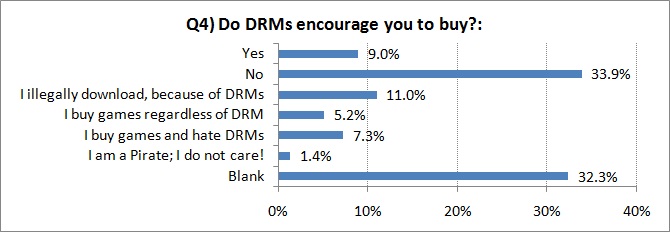
A sample result from the Vigilant Defender questionnaire, which shows that DRM not only does not really help encourage pirates to buy games, it may even drive them to pirate in the first place

Except, I probably wouldn’t try what startup anti-piracy firm, Vigilant Defender, has tried – to actually help the spread of pirated content. Yes, you heard right, the first step in Vigilant Defender’s experiment is to actually help seed a leaked beta version of the hit game, Deus Ex Human Revolution. The second step is slightly tricky, as the version of the beta they seeded was slightly modified to drop out of the game after the first few levels, and direct users to an online questionnaire, in which they were asked questions about why they decided to pirate the game. While data collection is essential to solving the piracy problem, especially given the industry’s often biased “research” on the matter, the key question asked of gamers was “what would you be willing to pay for this game”. Not only will the answer to this particular question prove useful in finding out just why people pirate, and what price point can influence the same people to go legit, Vigilant took this one step further and proceeded to offer downloaders the opportunity to buy the full game at a price determined by average answer to this particular question. And amazingly, 8% of all those who downloaded the modified leaked beta actually went on to buy the game, at the user voted average price of $24.99 (half of the retail price) and that’s actually quite a high rate of return for games, especially when the target demographic is often described by the industry as “criminals” and “freeloaders”.

In my opinion, what Vigilant Defender tried to do was very clever, even if they went about it perhaps in too much of a roundabout way. What they’re actually advocating is a system where users vote for the price they want to play, and where pirated versions of games actually become demos of sorts. The gaming industry may not want to believe it, but a lot of gamers do use pirated games as an extended demo, and many, I’m not saying all (or even anything close to a majority), to end up buying the full version if they like the game. Game publishers, on the other than, would rather prefer people buy games they don’t like by making sure they can’t test it fully before they buy it, and perhaps that’s how it used to work before Internet piracy became ubiquitous, this kind of business model no longer works. But on the other hand, by offering downloaders cheaper version of games, it’s perhaps encouraging downloads, and this kind of distribution model would be a hard sell for game publishers. But there’s definitely something here, and perhaps a little bit of tweaking could bring us a new distribution model that takes advantage of P2P networks such as BitTorrent to not only distribute the games, but to promote them. Imagine if games came with a thin layer of unobtrusive DRM that simply nagged users to buy the game from time to time, a DRM so not annoying that release groups don’t even bother to have it (so it remains in the pirated versions floating around the net). Users would then be given an offer to “upgrade” their pirated version to the full legit version for a discounted price, but the caveat is that their save games/profiles would no longer be compatible with the full version unless they pay the full price, or some kind of incentive that still makes buying games at full price an attractive proposition. And if you want pirates to help you sell games, then let them join some kind of commission based affiliate program, where for each downloader that “upgrades”, the seeder would get a small commission for their “help”.

The even easier alternative is to lower game prices and improve services for legitimate customers, so that piracy becomes more trouble than its worth.

For Vigilant Defender though, they have a slight problem on their hands at the moment since this Deux Ex experiment was not actually approved by the publishers of the game, Square Enix, which could land the anti-piracy company in a bit of bother with anti-piracy laws.

Bad news for Australians lately on the copyright front. Only a couple of weeks ago, we got our first taste of mass copyright lawsuits, and this week, our government signalled changes to our existing copyright law which would make it even easier for mass copyright lawsuits to happen. Namely, the Attorney-General wants to make it easier for rights holders (or agents of them) to match IP addresses to real identifies, by “streamlining” the legal process. In other words, due process has to go out the window to make Hollywood and the RIAA happy. Even the idea of a ‘graduated response’ system was mentioned, at a conference sponsored by the copyright lobby, of course. Still, there were some other proposed changes that were positive, such as extending “safe harbour” to protect more types of Internet businesses, rather than just ISPs – search engines like Google and Bing will benefit the most with this proposed change. But as long as politicians still continue to believe that a single IP address is evidence enough of a “crime”, and that the “crime” itself is costing the creative industries insane amounts of money and jobs, then politicians will always be on the side of the copyright lobby, made more likely by the uneven spreading around of lobbying cash from both sides of the issue.

High Definition

In HD/3D news, this week could prove an important one for advocates of managed copy, who want legal alternatives to “ripping”. UltraViolet has been talked about quite a lot, and this week, we finally get our first taste of this “in the cloud” based managed copy system. Unfortunately, the taste is not quite palatable.

Green Lantern UltraViolet via Flixster

UltraViolet from Warner Bros. is being distributed via Flixster, and it isn't a very convenient user experience

Warner Bros. released Horrible Bosses and Green Lantern with UltraViolet digital copy included, but the way Warner has decided to deploy UltraViolet is the biggest problem at the moment. The current WB process requires users to enter in a 12-digit redemption code online, which in itself is annoying, and then users will have to sign up to Flixster, and then install the Flixster app on the device they wish to view the UltraViolet copy. And it’s all wrapped up in various layers of DRM, as you would expect.

And as WB owns Flixster, and to add to the problem, when other studios release their version of UltraViolet, they will use their own distribution network. So right now, if you asked me on which devices an UltraViolet digital copy works on, I can’t tell you, because it will depend on each studio, and this is absolutely the wrong way to go about it. For UltraViolet to be viable, I think it really has to either tie in with iTunes, NetFlix, Amazon or one of the existing players in video distribution, or all the studios have to come together and come up with a single distribution method, with all of the major devices supported (the iDevices, Android system, game consoles and Blu-ray players, at least). And then, streamline the process so it’s as simple as scanning a QR code, or just a matter of inserting the UltraViolet Blu-ray or DVD into a UV compatible player – none of this 12 digit code nonsense, or having to figure out each studio’s UltraViolet system and having to have an account for each.

A two parter Sony related story, the first part goes here in the HD section I suppose. Sony has had to issue a massive recall/repair for 1.6 million LCD TVs they produced since 2008, apparently due to a fire risk in a faulty component. It’s not exactly what the company needs at the moment, but the “good” news so far is that there haven’t been any reports of actual injuries, and that the damage so far has been restricted to the TV set itself.

GamingLess costly for Sony, financial wise, but perhaps more costly in terms of image is the news that a further 93,000 Sony online network accounts have been “hacked”, in the latest security breach.


Fortunately for Sony, the breach which led to hackers gaining access to 93,000 accounts on the Sony Entertainment Network (SEN), PlayStation Network (PSN) and Sony Online Entertainment (SOE) networks appears to have originated elsewhere. According to Sony, hackers managed to source the email/password combinations for an unspecified (non Sony) online service, and proceeded to use the same login combination to try their luck on the PSN, and managed to get access to the 93,000 accounts. Sony have disabled 33,000 SOE accounts, while have forced password changes for the rest. Sony says that credit card info was not accessed during this attack, but personal information may have been.

While Sony is right that the data breach occurred elsewhere, the security issue here still lies with Sony, because allowing hackers to launch this type of massive attack can easily be prevented. Simply limiting failed login attempts from any individual IP address or range, which is standard practice, could have prevented the 93,000 accounts from being accessed. And some kind of “CAPTCHA” system, or human verification, would have prevented the hacker’s bot based login attempts. Both of these are common techniques used to prevent dictionary based attacks. And once again, it took Sony days to spot the unusual activity on their networks, when it really should be a matter of hours if not minutes.

NPD Game Console Total US Sales Figures (as of September 2011)

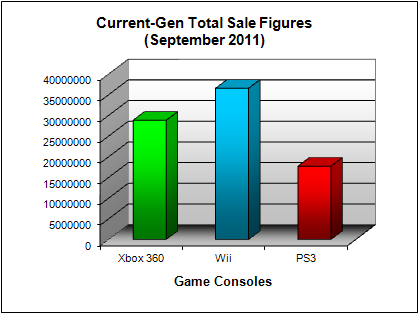
Life to date Xbox 360 sales in the US (in green) is catching up to Wii sales (in blue), but the PS3 (red) languishes in third place

But while Sony’s security problems have been highlighted recently, it doesn’t seem to have seriously affected the fortunes of the PS3, as price, as always, seems to be the main driving factor behind sales. So Sony’s $50 price cut to the PS3 in the middle of August has seen PS3 sales rise, although as the September 2011 NPD US video games sales analysis shows, the rise was not big enough to really endanger the Xbox 360’s position as the best selling console in the US. The gap has closed, however, between the PS3 and the Xbox 360, while the gap between the Wii and every other console seems to be widening. If the gap remains as big as it was during September, the Xbox 360 is set to overtake the Wii as the best selling home based console of this generation (in the US) within 39 month – but it will be well after the Wii U is introduced, so that’s what Nintendo are holding on to at the moment.

Alright, that’s enough for this week I think. Hopefully more of a newsworthy week this next one, and I have a feeling it will. Have a good one.

Weekly News Roundup (2 October 2011)

Sunday, October 2nd, 2011
Battlefield 3 Screenshot

I've been wasting time playing the Battlefield 3 Beta, and it's mostly fun, even if some technical issues can ruin the experience, plus the fact that I suck at it

I hope you’ve had a good week. We’ve just had Daylight Savings time turned on overnight, and of course, I forgot all about it as usual. I hate it when DST starts, you lose a precious hour that I could have used to do so many things. Like play the Battlefield 3 Beta. I think I’m officially the worst BF3 player in Australia, if not the world, mainly because I’ve not played much FPS multiplayer games before, let alone the more team oriented BF series. I’m such a complete noob, and if you’re just like me, then the first step to solving this problem is to admit you have a problem. The next steps would be to watch these two videos to find out how you can become a better BF3 player.

While I can’t really help you with any gaming related tips, but I can with some technical issues. My C2D E8500 + Radeon HD 6850 is not the best rig for BF3, but I find it playable at 1080p if I keep the detail settings on Auto. It still looks great, the odd glitches apart. But the biggest problems I’ve had to far is the looping sound crash problem (if it happens, you don’t need to do a hard reset, at least not in Windows 7, as you can press the “Windows” key on your keyboard to switch back to the desktop and use task manager to kill the bf3.exe process) – you’re most likely using on-board audio, which then suggest a Realtek chip, and updating the driver should be your first priority. The other issue I had was with the ATI drivers crashing, and I found that closing down any opened software does help (MSN Live Messenger is a particularly bad culprit). Both Nvidia and ATI have released preview drivers that is optimized for BF3 (it really does help), although it appears ATI have removed the drivers for some reason, but you can still find it here. Alright, enough BF3 nonsense, let’s get started with the news roundup.

Update: Just a bit more nonsense, the ever useful FRAPS tells me that @ 1080p on Auto (which was detected to be ‘High’ for my system), I can average around 40-45 FPS, with the occasional framerate drop, but nothing that makes it unplayable). I tested ‘Ultra’, and found that I could only get around 25 FPS outdoors, and just above 30 FPS indoors, less when there’s more action on screen (but it did look fantastic). I had to quit many times to my team’s displeasure to record these results for you (as BF3 beta won’t allow you to change video settings during games).

Copyright

Let’s start with copyright news for the week, we start with what is apparently a new strategy in anti-piracy enforcement online – $10 fines.

On the surface, this sounds like a much better idea than $3,000 settlement fees, but dig a little deeper, and you’ll find that it’s probably $10 you don’t need to pay. The reason Digital Rights Corp (DRC) can still profit from a $10 piracy fine, is that they don’t actually do any of the legal work required in order to get the $3,000 settlement fees. They don’t bother to match IP address to a real person, as they let the ISP do it, and until you actually click on the link in the email that the ISP forwards to you, and give them your credit card numbers for payment, DRC doesn’t even know who you are. And unless DRC goes to court to obtain a subpoena, they can never find out – but if they do go to court, then $10 won’t even come close to covering their costs. Still, it doesn’t stop DRC allegedly “warning” users that they could still face $150,000 fine, or ISP disconnection, both claims are not true, and a $10 fine is not going to get your account unbanned, if that’s what has already happened. DRC also appears to only represent older artists (most of them dead, actually), and so the likely target for their emails will probably be the elderly – those that can’t afford the $3,000 fine (so will fight it), but are also not technically knowledgeable enough to know that they probably don’t have to pay the $10 fine – a niche, but potentially profitable market sector.

Canada's Heritage Minister James Moore

Canada's Heritage Minister James Moore says that if people aren't prevented from backing up their own DVDs, the results could be "quite disastrous"

Across the border in Canada, the Conservative government there is trying, for the third time, to bring in harsh copyright laws that will try to mirror US laws, possibly as a way to get out of the “rogue nations” copyright list that the US produces every year. Taking from some of the worst aspects of the US DMCA, Canadians will find themselves on the wrong side of $5,000 fines if they even attempt to circumvent the “less-than-useless” DVD copy protection, even if it’s just to make their purchased disc playable. A totally useless clause that does nothing to prevent piracy, but strips away consumer rights, all in an attempt to make Hollywood happy. For me, any provision about DRM circumvention should distinguish between the various reasons for DRM circumvention (fair use), and also should take into account the strength of the DRM. If I simply wrote on a piece of paper “DRM – do not remove”, and stuck it on a DVD using sticky tape, it cannot be a crime to “rip” the “DRM” away, because it never worked in the first place. To me, these kind of laws offer legal protection to bad technical solutions, and threatens anyone who dares to test the system for security holes – this will end up hurting computer security, not help it. Imagine if the DVD people had allowed hackers to play around with DVD’s CSS copy protection and re-engineered it based on their feedback, maybe, just maybe, they would actually still have a DRM system that can’t be broken with 6 lines of Perl code, or code that can be printed onto a tie. And then there’s the introduction of a “notice-and-notice” scheme, which forces ISPs to forward infringement notices to end-users, which I guess is at least better than “notice-and-takedown”.

And maybe, in the end, the best way to prevent piracy is to actually compete with services being offered by pirates. After all, it seems to be the most effective anti-piracy method, at least in Sweden. A new Swedish survey has found that music piracy rates has decreased by 25% since the introduction of Spotify and other free streaming services. I dare the RIAA to find any DRM system that’s as effective as simply giving the people what they want. And let’s not forget that Spotify makes money too, which also means the music industry makes money too. Interesting was also the data that showed 40% switched from illegal and legal due to better selection of tracks. This is a huge clue to the music industry, and even to Hollywood, as to how to combat the piracy problem. The way Torrents work, particularly, depends on seeders and large enough swarms – both of which are unlikely to exist for rarer, older stuff. By offering greater selection of content from their archives, and at an attractive price, these “long tail” sales can potentially bring in a long of money. Do it as a package, that includes new content, for a small monthly fee, and you’ve got a competing product to piracy. Because if you can’t compete on price (it can’t get cheaper than free, although if the industry works together with ISPs to  offer free bandwidth, then that’s another way to compete on price), then you should at the very last compete on quality, and quantity, of the content being offered.

High Definition

In HD/3D news, of course, I can’t let this week pass without mentioning Star Wars. I was totally surprised that, in the week Star Wars was released, it wasn’t even the best selling Blu-ray title – that honour belonged to Thor.

Star Wars on Blu-ray

Star Wars on Blu-ray was not even the top selling Blu-ray disc for the week it was released in - beaten by Thor in the end

But with both Star Wars and Thor combined, Blu-ray market share did rise to an all time high, at nearly 35%, easily beating the previous record set by Avatar (around 27%). Of course, I think it’s still a little disappointing that “Star Wars week”, even with Thor included, didn’t even get close to beating the revenue figures set by “Avatar week”, although you do have to take into account the fact that the Star Wars boxset was quite expensive, and so in this economy, it’s a luxury most cannot afford. Plus, all the nonsense with the George Lucas changes might just have affected sales, because I know quite a few people who claim they’ve cancelled their pre-orders because of the “Nooooo” thing.

I didn’t pick it up either, mainly because I know if I do pick it up now, it will be probably a year before I have the time to watch it (got a backlog of about 2 dozen discs I’ve not yet watched – I mean, I only recently watched ‘No Country For Old Men’, and I got that in 2008 when it was first released!). Hopefully, it will either get cheaper or a better version will be released, by the time that I actually have time to watch them (and to be honest, I’ve watched the movies so many times that, it’s just now that exciting for me any more – maybe I’m finally growing up!)

A new report says that, by 2015, sales of DVD recorders will stop and be replaced by Blu-ray recorders. Make sense, and I think it won’t even take that long either. In fact, I don’t think even DVD players will be around for much longer when Blu-ray players start to drop below the magic $50 mark. I mean $25 for a DVD player, or $50 for a Blu-ray one (that, let’s not forget, also plays DVDs, and probably upscales too) – no brainer really.  And it doesn’t even matter if you have the other hardware to get the best out of Blu-ray, a lot of movies are now cheaper on Blu-ray or are released exclusively on the format, so Blu-ray is starting to make sense from a financial point of view too.

And while it doesn’t really fit into any of the three major categories of the WNR, I should mention Amazon’s Android based Kindle Fire tablet, which looks like an exciting product, mainly due to the low price. With Amazon backing Android, there’s finally a company with the content clout to compete with Apple, even if the Kindle Fire is probably not good enough to compete with the iPad 2. But not everyone needs a premium tablet, again I point to the economy, and so perhaps the Kindle Fire can find the right market niche to be a huge success. And Amazon are subsidizing the price a bit, by lowering their profit per unit (they claim that they do still make a profit on each unit sold), and this could be the tablet to compete with the generic brand budget Android tablets as well, which is also a big market segment.

Not much in gaming news this week, other than what I’ve already mentioned above BF3 at the top, so that brings us to the end of another, slightly abbreviated, WNR. See in next time.

Weekly News Roundup (25 September 2011)

Sunday, September 25th, 2011

Welcome to yet another edition of the WNR. Hope you’ve had a good week. It was mainly an uneventful week for me, except my graphics card broke early on the in the week, and so I had found the perfect excuse to do a little bit of upgrading. Faced with restrictions in budget, card length (my old Antec Sonata Designer case would only fit a card 23cm/9″ or less), power supply constraints (although my Antec EarthWatt 500W, with dual 17A rails on the 12V, is not the worst around), I eventually settled for a Radeon 6850, upgrading exactly +2,000 from my old Radeon 4850. While my Intel E8500 is now the bottleneck in certain games, it’s definitely great to be able to play most games at 1080p without having to turn down the details (or as in my old card’s case, all the way down to 1360×768 @ medium just so it doesn’t crash the faulty card). A quick, cheap, and not so nasty upgrade is sometimes a great way to give some life back to an old PC.

More than expected number of news items this week, so let’s get started.

Copyright

In copyright news, it’s hard to know where to begin. I guess we should start with the source of the problem, the money. More precisely, the money flowing into Washington and other capitals of the world, as the copyright lobby spends millions scaring politicians into believing  “net piracy plague” hype.

It was revealed this week that the MPAA spent $470,000 in lobbying in the last quarter alone, mainly to promote the hugely controversial PROTECT IP act, which if you’ve been following the WNR, you should already know that it has come under attack by a variety of professionals, from engineers, to entrepreneurs, to law professors. The idea of messing around with the foundation of the Internet, the domain naming system, just so the billion dollar movie industry can feel a little bit better, without actually solving any real problems, is I guess what these professionals are most concerned about. Basically, the MPAA has convinced politicians that the few harmless flies are actually killer bees, and that the only way to solve the problem is to launch a tactical nuclear strike (except in this analogy, the nuclear strike would probably solve the fly problem, whereas PROTECT IP won’t do anything to piracy).

What surprised me more was that, despite being only a fraction of the size of the movie industry, the music industry via its lobby group the RIAA actually spend almost three times as much money – $1.25M, in just one quarter. And somehow, this was still down on last year’s $1.4M, in the same quarter. Had the RIAA simply spend the money they’ve spent on lobbying and DRM, on actual innovation, they would have been the ones making the iPod and running iTunes, not Apple. Instead, they spend a million plus trying to get new legislation through that would allow labels to receive royalty from radio station airings – once upon a time, labels were happy to just get free airings for promotional purposes, but not any more I guess.

Rapidshare logo

RapidShare will hope its recent lobbying spending of $260,000 is enough to convince Washington politicians not to kill off the file sharing industry

The same story also showed some lobbying from the other side, specifically, by Rapidshare. If PROTECT IP passes, they have the most to lose, since they will probably be the first website to get filtered, after having appeared in all the copyright blacklists. There would be far too much collateral damage if lawmakers outlaw public file sharing, because while I do admit Rapidshare has its fair share of pirated files, it’s also an essential service for many others to share large files without having access to your own FTP server. I can’t see how you can have a public file sharing service without the problem of piracy cropping up, but it’s not as if Rapidshare doesn’t have tools for rights holders to get infringing files removed – it’s just that rights holders don’t want to have to do the work to get them removed. Automatic filters are easy to escape by real pirates, but makes false positives hard to avoid – think of the YouTube false positive copyright thing and times it by about 1,000, since at least with YouTube, some kind of audio/visual analysis could be performed, while it’s harder with generic files.

The world’s second most famous music pirate, Boston University student Joel Tenenbaum, is back in the news this week as the RIAA’s appeal of an earlier reduction in damages, to “only” $67,500, was rejected by the appellate court. But not because they supported the original jury rewarded $675,000, but because they thought that Judge Nancy Gertner has jumped to the constitutional issues  a bit too early in citing the reason for the reduction, when there were other legal recourse that should have been taken before going down this route. It appears that the appeals court agrees that $675,000 was inappropriate, and in their summary, even urged Congress to consider reducing the excessive statutory damages in relation to copyright infringement (but we’ll be lucky if Congress doesn’t do the opposite, and increase statutory damages). This is become a bigger issue, because back in the day, most copyright infringement lawsuits were related to commercial infringement, and so the statutory damages are relevant to those types of cases. Today, most copyright infringement cases relate to non commercial infringement, such as illegally downloading a 99 cent song for free, and so $150,000 per act of infringement doesn’t really fit the “crime” any more. A sensible copyright reform would introduce a new tier of penalties dealing specifically with non commercial infringement, because a fine of $150 per act is enough of a deterrent for those that actually fear the law on the matter (most don’t, even with $675,000 in damages as a potential outcome). And so for now, Tenenbaum faces $675,000 in damages again, which will of course be appealed.

But Boston University students aren’t the only ones having money trouble these days. Righthaven’s refusal to pay the $34,000 in legal fees it owns to Wayne Hoehn, possibly through lack of ability to pay, has forced Hoehn’s attorneys to petition the court to send US Marshals to seize Righthaven assets in response. Now that would be a beautiful sight to behold, wouldn’t it? Righthaven took the risk in trying to scare Hoehn into paying a settlement fee, only for Hoehn to refuse to lie down and fight his way to a win in court, and so it’s only fair that Righthaven should pay up. After all, they’re the ones who send letters threatening tens and hundreds of thousands in damages, if people don’t settle. They should have taken their own advice and settled, if they didn’t want to pay up (except I think the judge refused them the right to do so, heh).

Over to Europe right now, whose financial system should collapse any day now, but before then, there are some deck chair shuffling that needs to happen. In Italy, MPs from Berlusconi’s party (why is the guy still prime minster?) want to introduce the world’s first “one-strike” system, where people may get kicked off the Internet for just a single allegation of copyright infringement. Sometimes I think politicians are actually just using copyright as an excuse to kill off the Internet, as the Internet is  making it harder to rule against the wishes of the people. And also to hide your bunga bunga parties. You know what this is? It’s fascism. And we all know how Italians deal with fascists (well, eventually, anyway).

SFI Logo

The SFI's IP address being used for piracy should not be proof that the institute was engaged in piracy

On to Sweden, and the Swedish Film Institute has just gone through what hundreds and thousands of individuals have gone through, after the SFI was accused of pirating films because its IP address had been found in one of many BitTorrent swarms. It would be hard for the SFI to go with the “my router was hacked” excuse, because no hacking did occur, but because they operated a public Wi-Fi, and because the agency tasked with collection IP addresses aren’t cooperating with the SFI on the investigation, it has been extremely difficult for the SFI to find the source of the piracy. And if this doesn’t prove that an IP address does not equal the identity of the individual(s) who made the infringement, then nothing will. And if public Wi-Fi is now going to be the target of anti-piracy operations, then that’s taking a huge step backwards in terms of the Internet everywhere approach that we’ve become used to (and which many websites, like Facebook or FourSquare, rely on).

And this increasing perception gap between how the world works now, and how the copyright lobby/politicians want things to work, is probably why the German Pirate Party has won 15 seats in the Berlin regional elections. With their Swedish counterpart winning a seat in the EU parliament, pirate parties around the world could become the new Greens, as the issue of Internet privacy and rights become more and more important.

High Definition

In HD/3D news, next week should bring us the Star Wars numbers, an early signs show that it will be a big one. I’m a huge Star Wars nerd, having watched the originally trilogies at least 50 times altogether (and the new prequels trilogies about 6 times), but I’ve actually not pre-ordered the set. It’s not a protest at George Lucas or anything, but while Star Wars on DVD was a special moment for me, I’m a bit more meh about Star Wars on Blu-ray for some reason. Probably because, upscaled, the DVD edition still looks quite good, and from early reviews, while the Blu-ray version definitely looks better, the classic trilogies aren’t the “hi-defy” experience that many would be expecting. It’s not only the age of the film that the cause, but I think not going with a new transfer, given advances in technology since the last one, seems like a step backwards. Which is why I suspect we’ll get a new transfer in time for next year’s 3D version of the films, which means a new Blu-ray set (hopefully with the remastered films in 2D, as well as 3D), and so it’s hard to get too excited. I will still probably get it, I mean I got the LotR theatrical mess on Blu-ray.

Plus, I’m finding it difficult to get the time to watch movies these days, got a dozen or more on Blu-ray that’s still under shrink wrap.

For 3D news, this week, YouTube announced a new feature in which you can convert any existing or new uploaded 2D video to 3D. Cool if you like this sort of thing, but the 3D hype is definitely dying, and the 2D to 3D conversion could be the jump the shark moment for the format, because really, it’s an admission by YouTube that nobody is uploading any real 3D content.

GamingAnd finally in gaming, those that saw and agreed to the new PSN user agreement, without reading it (obviously didn’t watch that South Park episode), may realise that they’ve signed over more than they realised.

Sony apparently sneaked a clause which makes it a lot harder for people to join in one of the many class action lawsuit against Sony for the PSN data theft. Those that signed the agreement will have agreed to go through binding individual arbitration before being allowed to join any class action lawsuit, with a Sony appointed arbitrator. If you don’t sign the agreement, then you won’t be allowed to use PSN, but you can opt out of the arbitration only by sending a letter to Sony HQ detailing your wishes, and within 30 days of signing the original agreement, and of course, all of these details were “hidden” in the wordy user agreement. I’m not going to comment on whether this is an underhanded move by Sony or not, but all I will say is that this is exactly what you would expect from such a company, and probably why it’s such an attractive target for hackers.

Diablo III

Diablo III could be a great game, but Blizzard are doing all they can to ruin it with "always-on" DRM and MMO restrictions, without any of the MMO benefits, in the single player mode

Diablo III is an eagerly awaited game, and Blizzard has a great reputation as a game producer. But the company’s insistence on using always-on DRM, they say for anti-cheating purposes, not anti-piracy, could really hurt their reputation, not to mention sales of the game. A recent play of the beta version seems to show a lot of quirks related to the always-on DRM, including the inability to pause games, and game glitches whenever the connection goes down (and it went down a lot, thanks to the flaky beta Blizzard servers), and eventually users get  thrown back to the main menu, losing unsaved progress. Hopefully, the final version will not be as “crippled”, but without adding in a true offline mode, Blizzard is always going to set themselves up to fail. The good news is that there’s still a lot of time between now and the game’s release, so enough public pressure could make Blizzard do the right thing.

And that’s all that was for the week. I’m off to play Starcraft 2 in 1080p, extreme quality mode (which is more than playable at 50/60 FPS on my new 6850, at least when the on screen unit count isn’t too high). See you next week.