Archive for the ‘Video Technology’ Category

Weekly News Roundup (25 July 2010)

Sunday, July 25th, 2010

Hello. I’ve finally completed moving house, by completed, I of course mean that there’s still tons of stuff that needs to be moved over. But this is the first WNR at the new place. But the roundup must go on, as they say, despite aching limbs and a sleep deprived brain. One good thing about the move was that I was finally able to test Blu-ray 3D playback via PowerDVD 10 Mark II to my Samsung 3D plasma. More on that later.

Copyright

Let’s start with copyright news. The US Copyright Group is in the news again this week as they step up their campaign targeting thousands of web users accused of downloading pirated movies.

The latest development sees the USCG hiring the services of smaller law firms signalling the next phase of their plans – going to court. It was always understood that firms like the USCG would avoid going to court whenever possible, since the costs are higher and so are the risk (of losing, and hence, setting a precedent that could hurt future business). But it appears the USCG is pressing ahead anyway, no doubt going after those that are easy to beat in court. It may also be their way of showing that they do intend to go to court, a criticism that critics have used in the past to attack similar actions, and if they can get a few easy victories under their belt, maybe a high profile one, then this can be used to scare more people  into paying up. And as for working with the EFF to draft a user friendlier notice to send to suspected pirates, it seems the two sides just can’t get along and both may have to go and see the judge again to see how they can get things moving. This isn’t the biggest surprise in the world, as one side wants to make the notices are serious as possible to get people to pay up, while the other want the notice to be informative enough to allow people to defend themselves – it was always difficult, if not impossible, to meet both objectives.

The Last Vegas Review-Journal

The Last Vegas Review-Journal is suing those that use its articles without permission

While the USCG aren’t winning friends with web users, ISPs and rights groups, they are making friends in other media circles, and at least one law firm is now copying their strategy, except going after those who pirate newspaper articles, rather than movies. Suing hundreds of websites and blogs is Las Vegas based Righthaven, representing the owners of the Las Vegas Review-Journal. While most newspapers use DMCA takedown notices to get their full articles removed from forums and blogs, there is no money that can be made by taking this approach. But if the threat of a lawsuit, and the request for a pre-trial settlement works for the USCG on movie downloaders, then the thinking is that website owners will do the same as well, even when the offending content was posted by one of its users, not the website itself. The recent Viacom versus YouTube action showed that user generated websites do have protection from the safe harbor provisions under the DMCA, as long as they have a clear anti copyright infringement policy in place and enforces this policy consistently. So one might think this would apply to forums where users have posted full articles against forum rules, or blogs where users have made the same post in the comments. But the fear of an expensive lawsuit means that many will simply pay the settlement fee to avoid the trouble, although others are willing to challenge the claims in court. If this model works, expect all other newspaper owners to follow suit, as most of them are struggling to keep profits from dropping in what many calls a dying industry.

UPC

Irish ISP UPC is going to court to fight three-strikes

Moving to Europe now, it appears ISPs in many countries are not happy at their respective government’s three-strikes policies, and are going to court to fight it. Three-Strikes, or similar laws, may appear to be aimed at users who download pirated content, but it is in fact aimed at ISPs, making them responsible for monitoring and “sentencing”, for want of a better word, their own subscribers. The cost of the operation will have to be absorbed by the ISP, and mistaken identifies or other errors could even see the ISPs sued. The ISPs argue that since the music labels and movie studios are the one that will supposedly benefit from piracy being reduced, they’re the ones that should play a more active role in enforcing three-strikes. The content owners, however, will argue that they’re the victims in this and that ISPs should just pass on the cost to subscribers. The big question is if this wasn’t about the Internet, would government, who are normally clueless about Cyberspace, be so willing to give in to the demands of copyright holders? If people were committing copyright infringement via the telelphone, let’s say something silly like reading out loud books or newspaper articles to the person on the other end, should the telephone company then be tasked with spying on users’ conversations so they can put a stop to this illegal practice? Should the government then help to make spying legal and part of the copyright laws? ISPs are nothing more than utility companies, like the gas, electricity or telephone companies, and making them responsible for what their subscribers do with the service just doesn’t seem right. And if there are any technical advantage that make ISP level “spying” easier, then it would still be unfair to make ISPs bare the entire cost of the operation. It’s forcing one industry, and tax payer money,  to protect another industry’s revenue stream for no reason other than it’s the easy thing to do.

The Swedish Pirate Party wants to do something about ISP snooping though, and they are planning to launch their “Pirate ISP”, which will ensure no data about users if kept, so that their privacy is protected. The idea is nice, but I can already see the lawsuits and search, arrest warranty being typed up, probably before the ISP is even launched.

And when Hollywood is finished getting the government and ISPs to do their bidding, for free, they will turn their targets on those that try to innovate too much. Because innovation could eventually lead content being published without having to be controlled by publishers, and that spells bad news for revenue. Google TV is next in Hollywood’s cross-hairs it seems, as the new proposed system which aims to present a common interface for viewing media, online and offline, on TVs may just be too innovative for Hollywood’s liking. In their submission to the FTC, Hollywood studios claims that Google TV could potentially allow users to interact with both legal and illegal media, in the same interface, and that’s will encourage users to all become pirates. Instead of seeing how such an innovation could revolutionize the way people buy content on the Internet, and instead of supporting Google, a company with a history of knowing how to get money out of the Internet and its users, they yet again focus on the piracy issue and the issue alone. Just like how music labels refused to work with digital music retailers and instead focused on more and more complicated layers of DRM, and then having the likes of Apple iTunes swallow up a huge chunk of Internet related profit that otherwise would have gone to the labels, Hollywood appears to be making the same mistake.

UltraViolet DRM

DECE has a new name and logo: it's now UltraViolet, but it's still an new, annoying DRM

Instead, their solutions is, you guessed it, more DRM. Hollywood’s new fairer DRM scheme, supported by pretty much all the studios expect Disney (who have their own proprietary system in the works), is now called UltraViolet. How is it friendlier? Well, it plans to make DRM protected files more portable, working in more players and systems, but it still has the stench of DRM all over it, and thus, all the same usual problems: lack of universal compatibility, the need for online authentication, and don’t expect the files to work forever as there is no guarantee whatsoever that any DRM system will be kept supported and updated (at high cost by the DRM operators) forever. The IEEE is also working on their own “fairer” DRM, which will make digital files more like physical objects, in that ownership can be transferred, so sharing something with a friend could mean that you lose the ability to use the file forever if your friend do not return ownership back to you. The scheme, called P1817, could even work in conjunction with the monster that is UltraViolet, to make everything a bit fairer you see. The funny thing is that by acknowledging the need to make things fairer, content owners have just acknowledged that DRM, at least in past forms, have not been fair to users. I would go one step further and say that DRM is always unfair to users, so if you want them to accept it, make sure you give them back something in return. Whether’s that lower prices, better services, or even just less hoops to jump through, it is needed. Content owners should not take users for granted, as they may just go elsewhere (and if there’s no legal alternative, guess where they will be, and have been, heading to?)

High Definition

In HD/3D news, as mentioned in the introduction, I managed to get PowerDVD 10 Ultra 3D with the Mark II patch to play a Blu-ray 3D movie and have it display as proper 3D on my new Samsung 3D plasma TV.

It took a bit of work trying to get it to work, but I’ve posted the instructions here for those that want to give it a go. The 3D effects are great, even if you’re not getting full 1080p resolution, but that will only be possible when updated drivers are available for my ATI Radeon HD card. For now, it means I can play Blu-ray 3D movies in 3D without a standalone Blu-ray 3D player (although my free bonus one, part of a promotion Samsung were running here in Australia, should be on its way from Samsung, hopefully arriving before the PS3 gets its Blu-ray 3D update).

BDXL Logo

And sticking with the theme of logos ... BDXL won't play on existing Blu-ray players

But while I wait for my Blu-ray 3D player to arrive, it may already be obsolete, thanks to the idea of “upgradeable hardware” introduced by the Blu-ray format. The idea says that, like software, there may be a new version out every year and you would need to pay to get the new version, if you want the latest features. We’ve already had Profile 1.0, 1.1 and 2.0 players, and I guess Blu-ray 3D counts as 2.5 or something. And when BDXL movie discs arrive (if they arrive), then we’ll all need new players again (4.0, since 3.0 is already taken by the fairly unused Blu-ray audio format). It’s nice having 128GB capacity, but not so nice when I have to yet again upgrade my Blu-ray player, despite how cheap players have become. Even the always versatile PS3 won’t be able to support BDXL, since the only thing that the PS3 can’t update through software, the Blu-ray drive itself, will need to be updated. And soon after Blu-ray 4.0, we’ll have Super-Blu-ray 1.0, with Sony promising a 1TB disc using an even more powerful laser. Downloads, streaming, storage lockers … if only everyone had the bandwidth to make download a Blu-ray quality movie a matter of minutes, rather than hours (or weeks, in certain Internet backwaters,  like Australia), then we could get rid of the disc altogether, or burn our own discs by only replacing the optical drive in your computer, as opposed to an entire standalone player. It’s bad for the environment, bad for our wallets, and it’s just annoying.

But at least one thing to do with Blu-ray is going disc-less. Netflix streaming on the PS3 will finally work without a Blu-ray disc, and it only took a year after Netflix was first available on the PS3, and several after the Netflix was originally launched on the Xbox 360 (which had disc-less streaming from the get go). Better late than never, I suppose.

Gaming

And finally in the ever rarer gaming section, Microsoft has finally revealed the official Kinect pricing. Which is exactly the same as the unofficial pricing all the retailers have been using for months.

The only surprise, and a good one, is that the $149.99 price includes a free game, Kinect Adventures. But it was Microsoft’s other announcement which were a bit more interesting, like the new “Arcade”, the Xbox 360 4GB, which is basically the same piece of hardware as the new “Slim” Xbox 360 250GB, except without the 250GB HDD of course. The price for this new console is $199, but if you buy it with Kinect in a bundle, it will be $299, so that’s another $50 off Kinect’s pricing if you buy it with the new console. Some will say that this attempt to compete with the Wii is doomed to failure, because the Wii will be much cheaper. But the Xbox 360 doesn’t need to be the same price as the Wii, since it’s a much better console (certainly plays more types of games than the Wii, in HD too). There’s no Xbox 360 250GB Kinect bundle, which is a shame because that’s the one I would like to buy. Kinect pre-orders on Amazon jumped back to the top 5 after the pricing announcement on Wednesday, but has since dropped down to 21. The Move bundle is at 49th.

And that’s the news I have for this week. Sorry about the rushed nature of this WNR, what with all the mistakes and mindless rambling, moving house takes a lot out of a person. You didn’t notice any differences? That’s good then. What do you mean “it’s same crap as usual”? Huh? Anyway, here’s to a less crappy WNR next week.


Weekly News Roundup (18 July 2010)

Sunday, July 18th, 2010

It’s like London buses, they say, you wait ages for one and then two comes along. That’s what happened this week with mid-week blog posts – two of them in the same week! I finally updated a feature that I haven’t touched in more than a year’s time, with a new edition of the “If I were to buy a new computer today …” feature. This feature helps to satisfy (a small part) of my desire to buy new tech all the time, as I can live vicariously through my readers (the use of the plural version may be inaccurate) by researching and finding out what kind of system I would buy, if I were to buy one today. I think I enjoy the research more so than the actual new computer itself, for some odd reason. I posted a couple of specs for different systems, so while everyone will have their opinion on what’s best, this may be a good start for those that don’t like the research part.

The second blog post was the June NPD US video game sales analysis. It’s come quite soon after the May analysis, but that’s because the May figures were delayed by NPD. Some good news in there for Microsoft, as their Xbox 360 console beat pretty much everyone except the DS, thanks to the new Elite “slim” form factor. I’m definitely on the market for one of these new slims, but I’ll wait until the holidays period to pick up a bargain (perhaps a bundle with Kinect, who knows).

Not a whole lot of “new” news this week, but some follow-ups of previous stories, and I am running a bit late today/tonight, so I’ll get through things quickly (and if you want more stuff, you can read my *both* of my mid-week blog posts, of course).

Copyright

Starting with copyright news, despite the legal authorities trying to clamp down on law firms getting into the anti-piracy-for-money business, the pre-trial settlement style letter campaigns, more law firms are getting into the lucrative business it seems.

Ministry of Sound

7000 people who have downloaded a Ministry of Sound compilation in the UK will receive a letter soon asking them to pay £375 to settle the matter out of court

The most recent is Gallant Macmillan, who represent the copyright holders of Ministry of Sound albums, amongst others, and they will be asking for £375 from those suspected of pirated a particular MOS compilation. But they claim they are doing things a bit differently, perhaps to avoid a public backlash, or to prevent authorities from finding fault with their actions. The funny part is that the £375 actually includes the cost of the compilation itself, which normally retails for £8.75, and so suspected pirates can actually keep turn their illegally downloaded songs into legal songs by paying the settlement fee. An expensive way to buy music, for sure. And instead of a situation where the copyright holders aren’t dealing with the law firm directly, but through another party in between (possibly to avoid the bad publicity if it all turns sour), Gallant Macmillan will only directly represent the copyright owners who have intention to sue, and not just the the threat to sue with no real intention other than to get some money through settlement fees. The law firms will all say the high fees, compared to the actual cost to the copyright holders, is high due to investigative costs and other legal costs, but the real intention perhaps is to scare people into paying and maybe even scare them enough to stop them pirating in the future. Of course, for every person that is scared into submission, there are hundreds of thousands that will still go on downloading.

And if these “small time” lawsuits (or threats of one) can’t scare people, then perhaps the government can do so through some kind of global treaty like the ACTA. And scary it is. Claims that hundreds of thousands of people in the UK alone could be jailed if the ACTA is adopted as law, by making copyright infringement a criminal matter, not a civil one, and even making “attempted piracy” a crime (so do a search on Google for “Toy Story 3 torrent” and you may be headed for jail). But most scary of all is that it’s all very secretive, as if the government know that the people that they represent will not like what’s in the ACTA and have done everything they can to avoid the public knowing about it – the US negotiators have been the key backers of keeping the negotiations secret. However, when the EU Pirate Party (remember that they now have a member in the EU parliament) invited themselves to a meeting to discuss the ACTA, and then were told that not only are they not allowed to discuss any aspect of the meeting of the ACTA with the public (which may very well be illegal under the EU parliament rules), that even notes weren’t being taken for the meeting in case it gets leaked. And it is then that the Pirate Party walked out on the meeting in disgust. But the leaks do continue from people that find the secretive actions unacceptable, but the more we read about the ACTA, the more scary it becomes. But you can just imagine members of the RIAA and MPAA sitting in the shadows, smiling contently, watching as their wishes becomes reality. Sort of like Cancer Man in the X-Files (the first few seasons, anyway).

RIAA Logo

The RIAA is spending millions to get back thousands, fighting piracy through legal channels

And you can see why the likes of the RIAA and MPAA want government to take over their job of preventing piracy. Because it’s expensive, and relatively unproductive. The RIAA’s latest accounts showed that in 2008, they spent $17.6 million in fighting online piracy, but only got $391,000 back in damages. Of course, they’ll say that getting money back from past acts of piracy is not the main point, the main point is to stop future piracy. But I’ll leave you to judge whether their efforts in 2008 have paid dividends or not in 2010, whether piracy is more or less common now. But not everyone in the music biz thinks the fighting piracy head on will result in anything. Peter Jenner, president of the International Music Managers Forum, a group that present feature artist music managers, says that the current thinking about copyright enforcement is no different to the 1930’s thinking about alcohol enforcement, also known as prohibition. And both, he says, are laws that is “offensive” to the general public. Jenner proposes some kind of levy to help pay for content being shared online, much like how people in the UK pay their licensing fees for the BBC. I’m not sure I agree with a “piracy tax”, since it’s unfair on those that don’t download pirated stuff on the Internet, however if there is a legal, publicly owned point of distribution, say a BBC for the Internet, and where a small costs are paid to access a good amount of content, then perhaps the solution has some merit. Much like how free to air TV exists, perhaps a free to download service, paid for by taxes and levies, might also exist to provide a good amount of digital entertainment to those that cannot afford to pay for premium content on a subscription based service, much like subscription TV. Using the same analogy,  there will always be people who will try and succeed at getting “illegal cable”, but you can’t prevent all piracy, that’s just impossible.

And speaking of expensive lawsuits, Viacom’s billion dollar lawsuit has cost Google $100 million to defend (successfully, for now), Google’s CFO revealed. It’s money well spent (and peanuts to a company like Google, to be honest), and it’s an important victory for the Internet, not just Google. However, you can only imagine how much money was spent by Viacom, and you add both together, and apart from making a lot of lawyers happy, what else did it really achieve. Piracy is a cost to the economy, but sometimes anti-piracy is also a cost, and perhaps more costly if lawsuits had stopped websites like YouTube before it got off the ground.

High Definition

On to HD/3D news. The news last week was that the PS3 will get the Blu-ray 3D firmware sometimes in September. It’s good news for buyers of 3D TVs, and for 3D TVs in general, since it suddenly means there are millions of potential Blu-ray 3D capable players on the market all without people having to pay anything for it (other than the loss of the PS3’s Other OS feature).

Blu-ray 3D Logo

The PS3 will start supporting Blu-ray 3D in September, but it's not known whether there are any limitations imposed by the PS3's relatively older hardware

There’s still some confusion about whether HDMI 1.4 will be needed, since the HDMI hardware on the older PS3 predates even HDMI 1.3. But Sony seems to think that this won’t be a problem, and I guess you have to trust them on this, and they even went as far as saying “The [June] upgrade basically makes every PlayStation 3 HDMI 1.4 compatible”. I don’t remember anything about an update that made the PS3 HDMI 1.4 compatible, other than the “HDMI deep color” option added in 3.40. But as long as the HDMI hardware can handle high bandwidth transfers, then it should work perfectly with Blu-ray 3D, without having to limit the resolution for each eye to only 1080i or something. And as part of the announcement, 3D support for YouTube will be coming to the PS3 soon, which will be interesting. It’s either going to be the same kind of 2D to 3D feature that exists on Samsung, Sony and a few other manufacturer’s 3D TVs, or it will mean that YouTube will accept uploads of native 3D content in the future and display it as so. Interesting anyway.

Not much going on in gaming other than what I wrote for the NPD analysis.

And that’s another WNR for another week. I hope you have a good week ahead and see in at the same place, same time next week for another edition of the WNR.

Weekly News Roundup (13 June 2010)

Sunday, June 13th, 2010

What started as a pretty quiet week in terms of news turned a bit more busy in the last few days. E3, the US Copyright Group, Adobe, Sony all made the news later on in the week, whether it was new rumours, or new downloads, it’s all covered by this week’s Weekly News Roundup. Are you enjoying the World Cup? I’m not a big fan of the Vuvuzelas though, nor drums, bells, whistles, or anything else that makes artificial stadium noise. Cheering, singing, chanting, swearing, and the occasional round of claps, is what it’s all about. Hearing the crowd’s anticipation, nervousness, exhilaration, depression, makes the game a much better spectacle, and I think the players appreciates the interaction with the crowd as well. Vuvuzelas and other artificial noise drowns out all of these, and I think it takes something away from the beautiful game. But it also does drown out the Samsung plasma buzz, so silver lining and all.

Speaking of Samsung plasma TVs, I still haven’t gotten mine yet, so no watching the World Cup in 3D 🙁

Copyright

Starting with copyright news, the Canadian DMCA is still under consultation, but the IFPI, the RIAA’s International wing, has come out attacking the proposed changes as not going “far enough”. You know what, if the RIAA and their axis of evil friends don’t like it, then perhaps there’s something to like about the DMCA.

I think the RIAA’s biggest problem with the bill is that it finally makes CD ripping legal, and format shifting as well (so CD to MP3 => legal). But there’s nothing they can do about that now, since CDs don’t have DRM, a decision the RIAA may forever regret (not that having DRM actually stops piracy or anything, but at least it makes ripping them illegal in the eyes of the law, with the caveat that prosecuting someone for ripping their own CD/DVDs for personal use is likely to end up a futile endeavour).

But it again just highlights the stupidity of making the breaking of DRM illegal (exemptions apart), regardless of the intentions behind the attempted break. If CDs don’t have DRM, does it then make it legal to pirate CDs? Of course not. The music labels still have the same level of legal protection as movie studios when it comes to DVDs that do have DRM. And is DVD DRM preventing DVD ripping or piracy? Of course not. And with DVD (and even Blu-ray) DRM so easy to break, it’s about as useful in stopping piracy as making users read those unskippable copyright notices at the start of the disc. Of course, in the area of placing limits on what users can do with their own stuff, then it’s a huge success. While the some studios and anti-piracy agencies claim they would never sue anyone for breaking DRM for personal purposes, the fact is that if they wanted to, they can. It’s having this level of power and control that made the studios fall in love with DRM in the first place, not its value (or lack of it) in fighting piracy.

Freedom of Speech Censored

Just what is freedom of speech, and what is "making available" pirated downloads?

And just how far can this power grab by studios go? Well, if you live in the Netherlands, then it can go very far indeed. A Dutch court has just ruled that even talking about piracy may be a crime. The case relates to an Usenet community, in which the user “spots” potential downloads. Not by linking or anything, by simply talking about the general location of where downloads are located. Apparently, this is just as bad as linking, which is just as bad as hosting, in the court’s eyes. What’s next? Guilty of copyright infringement for even thinking about illegal downloads? Thought-crime anyone? I think this is another instance of legal authorities not really understanding the way the Internet works. The Internet was designed by the US military as a way for communications to still work even after a massive nuclear attack, and this works by building a “web” of connections, allowing every server to potentially route to every other. And not only is the underlying connection all connected, web pages containing links can also link to potentially every other website in the world, depending on how many links you want to hop to. And then there are search engines like Google, which aims to be able to link to every resource on the Internet. So what does all of this mean? It means that if direct hosting, direct linking, indirect linking and now even indirect discussions are all illegal, then by the way the Internet works, every site can potentially link to the illegal download in question, every router can potentially carry the illegal download to the end user, every search engine can potentially allow users to find the illegal download in question, and so every website on the Internet is illegal. I now finally understand why the CEO of Sony Pictures said that nothing good has come out of the Internet being invented.

The RIAA wants the assets of LimWire and its creator to be frozen, because they want to seek billions in terms of damages. Billions! I think I’ve said this before, but I would really love for the RIAA to prove just how they derive their claimed losses due to piracy, and the only way may very well be for all pirated content providers around the world to stop for a month, just a month, and see how much more money the RIAA makes during this time (if any). Then time this by 12, and then the RIAA will have their annual “loss” figure. Would I be surprised if this figure turns out to be negative, in that the RIAA may make *less* money as people stop listening to their music (illegally, for free) for a month and they lose the free publicity the Internet provides musicians? Not really.

ACLU

The ACLU is joining forces with the EFF to help users fight against mass BitTorrent lawsuits

The rest of the week was dominated by louder and louder condemnations of the way the US Copyright Group is going about its anti-piracy “pre-trial settlement” business. The EFF and ACLU are stepping in and they want a judge in charge of ruling on one of the USCG’s mass subpoenas to dismiss all but one of the subpoenas. They say that the USCG must present evidence that all of the John Does as part of the subpoena have been joined in the same lawsuit for a reason, that they were all part of the same transaction or have some kind of common connection. You see, some groups uses this kind of “subpoena spam” to greatly simplify things for themselves, and may only be using these subpoenas as a way to threaten people to pay up, with no real intentions of going to court. But the ACLU and EFF may very well want a full trial, and if they can get the right decision, then the USCG may have to stop their very lucrative business. If the ACLU/EFF can get in touch with many of those that claim they’re innocent of the acts that the USCG has charged them with, then perhaps winning a trial won’t be too difficult. These kind of mass mailings always catches a few innocents, those that have had their connection hacked, or IP spoofed, but most will pay up to avoid the trouble of going to court, especially when threatened with the possibility of $150,000 in damages that the USCG may seek. And the USCG is targeting more and more movies, with sources claiming that they are watching 300 illegally download films, and if they only record 500 IP addresses for each movie, then that’s 150,000 potential “pre-trial settlement” payments, and even if just 50% of those pay up the minimum amount required by the USCG, then we’re already taking about more than a hundred million dollars in terms of income.

This makes me think that something will be done about the USCG’s actions, but it will be something that’s even worse I think, as the government can use the actions of the USCG to justify things like three-strikes, which they will promise that any new laws will come with safeguards to prevent companies that seek to profit too much from anti-piracy activities without at least giving users some warning first. Three-strikes is better than one strike, after all. If I was the head of the MPAA, I would use groups like the USCG to do all sorts of nasty things and then use this mythical bogeyman as a way to scare people into thinking that something only slightly better, but still very bad (like three-strikes), is the right, better solution. It’s better, but it’s not good (take note Larry David), and it may eventually become worse.

High Definition

Onto HD/3D news. I know in my 3D Blu-ray – What’s it all about? blog post I mentioned the lack of 3D Blu-ray titles for general sale, but it seems I spoke too soon, because Sony are readying their first general release 3D Blu-ray movie to be made available June 22nd. The title is Cloudy With a Chance of Meatballs, and it will be followed shortly by others titles.

Cloudy With a Chance of Meatballs (Blu-ray 3D Version)

You can finally buy a Blu-ray 3D movie, but it's gonna cost you!

This is good news, and more “real 3D” content means it will be easier to benchmark the various 3D TVs so we can find out for sure which current technology, LED/LCD or plasma, is better for 3D, and which particular models are best at it. There’s a big question mark around using Samsung’s exclusive Monster vs Aliens, since some of the ghosting artifacts found when watching the movie may in fact be a problem with the movie encoding, as opposed to Samsung’s 3D technology. But it’s a bit pricey though, at $36 on Amazon, that’s twice as expensive as most other Blu-ray movies. Ouch.

3D notebooks will be everywhere, with Toshiba joining Acer and Asus, amongst others, to release a new 3D enabled notebook. This seems a bit gimmicky for me, even on top of the “gimmickiness” of 3D. 3D requires a big screen and controlled lighting environment for the best enjoyment, and I’m just not sure notebook screens can offer this. Plus, 3D gaming requires a lot of GPU power, and this is something that notebook cannot do, compared to desktops and consoles. But if these machines can be connected to 3D TVs and used as 3D Blu-ray players, then perhaps that’s where they may be useful.

Adobe has finally release version 10.1 of their Flash player. Despite the minor version number change, this one includes a lot of changes, and it took long enough to get from beta to gold as well. The most important new features is GPU assist support, which may make HD YouTube finally playable on certain netbooks and CULV laptops. My first impressions were that CPU usage was down, but playing a 1080p YouTube clip was still more processor intensive than playing a Blu-ray movie via PowerDVD, so hopefully more improvements can be made in this area (but the nature of the Flash plugin will always mean more overhead I suppose).

Blu-ray firmware updates are far too frequent it seems for the average user, many of whom don’t even know what a firmware is. This is one stumbling block for Blu-ray on its path towards mainstream acceptance. DVD players didn’t have this problem, and there’s always an inherent danger in firmware updates, since if the power goes out during the middle of an update, then the player could be fried unless it was well designed to prevent this sort of thing from happening (like some kind of firmware reset function).

Gaming

And finally in gaming, with E3 just around the corner, there’s plenty of rumours about what each of the major companies will be promoting during the show. I’ve collected some of the popular rumours in this post, with ratings on how likely each rumour will turn into fact.

We know Sony will be promoting Move, Microsoft will be promoting Project Natal (or whatever they’re calling it by this time tomorrow), but will the 3DS be the only thing Nintendo has to show? Nothing for the Wii? Nothing like a Wii 2 or Wii HD to steal Move/Natal’s thunder? I find it all hard to believe. Watch this space.

Speaking of the 3DS, some developers that have had a chance to play with the hardware say that it is as powerful as the Xbox 360 and PS3. Now I find this even harder to believe. Can the 3DS give Xbox 360, PS3 like graphics on the lower resolution screen, perhaps, since what will look good at 720p on a big TV, will look similar at much lower resolution on the smaller screen. So perhaps this is what was meant. But graphics has never been what the DS (or any of Nintendo’s other consoles) are about. And 3D without glasses could be fun.

For 3D with glasses, the PS3 now has some 3D games for you to try out, no firmware update required since the required update had already occurred in April, so all you need to do is to update the supported games themselves (if you’ve already purchased them). Some people who have tried it say it’s fantastic, of course I can’t test it for myself because my 3D TV hasn’t arrived yet 🙁

And so we come to the end of yet another Weekly News Roundup. E3, and perhaps another round of NPD figures (for May), will ensure the next issue of the WNR will be fairly gaming dominated, for a change. Have a good one.

Weekly News Roundup (6 June 2010)

Sunday, June 6th, 2010

What started as a way to avoid going through yet another week without doing any work, turned out to be a bit more work than I expected, but it was fun writing down all the things I’ve learned about 3D Blu-ray, and 3D in general, recently. Taking the form of an FAQ, my 3D Blu-ray – What’s it all about? blog posts looks at the basic principles behind 3D displays, and tries to clear up some common misconceptions behind the new technology (like whether you need HDMI 1.4 cables or not, if such a thing even exists). I’m sure I got some of it wrong, since there’s a lot of misinformation floating around. There’s also still quite a lot of stuff that I haven’t addressed, but I think I will save that for a full guide. Whether one should want 3D or not is a valid question, but I suspect with 3D technology relatively cheap to implement for TVs, there will come a time when 3D is a feature that comes with all the top-end TVs, whether you want it or not, and competition will ensure there isn’t a huge price premium to go along with it.

Copyright

Let’s start with the new review, and starting as usual with copyright news. A reader of our newsletter kindly pointed out that I forgot to mention the demise of Newzbin, a Usenet indexer website that was accused of copyright infringement and subsequently shutdown.

Newzbin 2 Logo

The "new" Newzbin is online after being brought down due in early May

The news did totally escape my attention for some reason, but there’s good news for fans of Newzbin, as it has been resurrected just this week. It was actually good timing on my part since when I first posted the story in the forum, the resurrection was just rumoured, but by the end of the week, it had become a reality. Apparently, the source code for the website was “leaked” a couple of weeks ago, and with the domain names transferred to a Seychelles based company, and semi-anonymous announcements of the resurrection by someone known only as Mr White, all the pieces were there for the resurrection. The new site, dubbed Newzbin 2, may even eventually feature more than just Usenet indexing, but extended to cover torrents as well. As for the legal questions surrounding the website, it will still exist, but it’s a question of whether the real owners can be found, or if the web host can be sufficiently threatened to pull the plug on the website.

Speaking of Usenet, it is a very frequently used place to download pirated content, despite all the media attention over BitTorrent. And this is one area that governments are a bit clueless about when it comes to copyright enforcement, with the agencies they’ve set up to monitor three strikes mostly ignoring this part of the online piracy trade. It just shows that whole anti-piracy crusade is nothing more than moral panic designed to make politicians feel like they’re doing something, even though they have no idea what exactly they’re doing, and give away our rights bit by bit to corporations. This trend started with the the US DMCA, and it’s been slowly exported to other countries around the world.

Canada is the latest country to adopt a US style DMCA, with the initial draft of the proposed changes finally released this week. But it’s not all bad news for consumers. The DRM provision that made the US DMCA so controversial is, unfortunately, still in. This means that if content has DRM, you can’t bypass the DRM to make backups (or to even use the damn thing). There are some exemptions, such as for research or parody, which provides at least some semblance of fair use. The changes proposed does finally give a clear legal position on the legality of time-shifting (recording TV shows for later viewing), format-shifting (ripping CDs to MP3s) and backups – all as long as you don’t break the DRM, of course. In other words, consumers have the right to do all the things they’ve been doing before, but if content owners start adding DRM to everything, then they can ensure these rights no longer exist and consumers have no say in the matter. What would have been better, and there is still time to make further changes, is to have an exemption for breaking DRM for the aforementioned fair use scenarios. DRM was always intended to stop piracy, it was and should never be used to prevent fair use, things like format shifting or time shifting. I mean, where is the danger in breaking DRM to make a backup, or to convert the DVD to DivX, as long as you only use the copy for personal use and don’t share the copy with anyone? There is no harm there, and nobody has ever been fined or gone to jail for this type of legal usage. If people want to share content illegally, then they are already breaking the law, and whether they broke DRM or not to do so is beside the point. So in Canada, there will be the situation where people can make unlimited copies of CDs or convert them to MP3 for personal use, yet if they do the same with DVDs, they’re breaking the law. The studios and music labels will point out that they’ve never gone after anyone for breaking DRM for personal use, but that’s also beside the point, since the law says it is illegal. Just because studios haven’t gone after someone for breaking DRM for personal use, doesn’t mean they will never, because if they do, they will win because of the DMCA.

The US Copyright Group

The US Copyright Group is at the center of the "pre-trial settlement" controversy in the US

The US Copyright Group, which sounds like an official organisation, but really is just a law firm that specialises in making money off anti-piracy activities, has been in the news a lot recently. Ars technica provided a rough breakdown of what the US Copyright Group could stand to make this year off these “pre-trial settlements”, and we’re talking about millions and millions of dollars here, so it is big business. While what they do isn’t illegal, there are ethical concerns, and groups like the EFF and ACLU are not happy with these types of actions, actions that others in the past have called “legal blackmail”. And it looks like the EFF and ACLU are stepping up their campaign to challenge this type of activity, and they may be preparing to reject one of these “pre-trial settlement” offers and take the thing to a full trial. This is the last thing groups like the US Copyright Group wants, because one, they could lose and that would set a bad precedent. And two, there’s not profit is a legal battle that could take months to resolve. But it looks like the EFF and ACLU want to prove a point in court, and this could be a very interesting trial indeed. Watch this space.

Somebody else wanting to have a fair trial is the 18-year old admin of a Danish BitTorrent tracker, whose home was searched in January this year, and now faces a legal claim of more than $260,000 by Danish anti-piracy agency, Antipiratgruppen. Antipiratgruppen’s opposition group,  Piratgruppen, has promised to aid 18 year old Jonas Laeborg financially.

And the Ubisoft “always on” DRM continues to make headlines, this week after analyst Michael Pachter publicly came out to support the controversial DRM measure. Those that have read my NPD US games sales analysis blog series will know of Mr Pachter, and this predictions that, well, don’t always pan out. But it seems Pachter felt the need to comment on Ubisoft’s annoying DRM, even though from his statements, it appears he’s not aware of the finer differences between what Ubisoft has done, and what other companies like Steam are doing. I’ll let you read the news story in full from the link, since some of the stuff that’s said is just too ridiculous and embarrassing to repeat on these pages. If there can be such a thing as a war of analyst, then we have the exact opposite opinion from the founder of gamesbrief.com, Nicholas Lovell, who labels Ubisoft’s DRM as “draconian”. He goes to question whether pirates are now having a better gaming experience than legitimate customers, and even suggests the slightly controversial idea of giving games away for free and making money off downloadable content, and using piracy as a way to promote games. Free games would be nice, but I don’t think game publishers even need to go this far. Cheap games is all that’s needed to stop piracy dead in its tracks, to nurture a new generation of paying gamers (much like how iTunes has nurtured a generation of paying music lovers, or basically what Steam is already doing with games). Stop trying to come up with ways to punish pirates, which almost always fails and only ends up punishing paying customers, and instead, try and entice them to go legit. And as for piracy promoting games, I think this already happens to a degree, and many that pirate games do eventually pay for the game, or at least the sequel or something. Companies spend insane amounts of money trying to generate Internet hype, viral marketing and all that, but game companies are getting it for free through piracy. Of course, if the game itself isn’t good, then the news of that spreads quickly as well, and sometimes I think that’s what game companies are really concerned about, that people will find out how bad their product is all without enough people being sucked in to pay full price for it. I think maybe movie studios may feel the same about bad movies being leaked online and thus failing to trick people into paying. The companies that are confident of their products tend not to worry too much about piracy, since they know enough people will buy it anyway.

High Definition

Let’s move onto HD news. I’ve already covered the 3D related HD stuff, so there’s nothing more to add on this front, other than to reiterate my opinion that people who haven’t seen 3D since the red/blue glasses days really should go and check out one of the 3D TV demos that are everywhere right now. It still may not be for you, but some I think will be surprised to find out just how impressive the whole thing is.

On the PC front, we have some interesting developments, and perhaps the emergence of a new form factor – the Blu-ray + SSD drive. Hitachi/LG is releasing a portable Blu-ray reader/DVD writer drive, that also contains a SSD drive. By combining two storage systems in one, it saves space inside today’s already cramped portable computing devices, and offers support for two of the latest storage techniques. The SSD drive can be used as a cache to speed up everyday operations, or use to store system files for almost instant system loading. I’m actually constantly surprised to see top of the range laptops and computer systems, the ones that cost $4000 or more, not including a Blu-ray drive at all. The premium for Blu-ray reader drives, or even writer drives, is so insignificant compared to say the cost of even high speed memory, that it’s just a mystery for me why Blu-ray drives aren’t standard already on *all* system, let alone the top-of-the-line gaming/multimedia systems. And even Sony has been guilty of this on their Vaio range, as I would have thought every Sony product would be including Blu-ray support by now.

Gaming

And finally in gaming, the section I’ve been ignoring recently, there’s still not a lot of news. But E3 is just around the corner, and the flood of news will follow short after. For this week though, there is only the news that Japanese PS3 owners will get the 3D gaming patch in the next few days – whether PS3 owners in other countries will get it or not, I have no idead.

Xbox 360 with Natal Camera

Project Natal, now white a white coloured camera accessory, needs E3 to be a total success

It’s good timing too, because some people already have their hands on 3D TVs, but without a lack of content, the PS3 3D games might just fill the void. And for those too cheap to pay for the games, there’s even a demo version of Motorstorm 2 that will have a 3D mode. However, there is still no firm date for 3D Blu-ray support, other than the now standard “before the end of the year” line from Sony.

As for E3, I guess I could still wait until next week to spill my thoughts on the whole Move/Natal thing, but I might just say it here. Microsoft is being very secretive regarding its Natal announcement, which makes me suspect that they’ve got something big lined up. With all due respect to Move, Sony has already said and demo’d quite a lot of the technology and games already, and with the “similarities” between it and the Wii, E3 probably won’t hold too many Move related surprises. But with Project Natal, we don’t know the  pricing, or even the final product name, or any other games other than Ricochet, so there’s a lot of work Microsoft needs to do at E3. It could be make or break time for Project Natal, and I think Microsoft realises this, hence all the secrecy, as if they’re saving everything all at the same time for a truly “shock and awe” unveil. Cynics, and fanboys of the other platforms, will say that the secrecy is because Microsoft knows Project Natal is a big fail that won’t really work, and is more laggy than a thing that has a large amount of lag. But those that have had recent plays with the technology, with the updated Ricochet mainly, have only good things to say about it, and this suggest to me Microsoft is confident it will work, but it wants maximum impact at E3. The fact that MTV is going to air the E3 Project Natal launch event is further evidence of this strategy. And with the World Cup, maybe will there be some kind of football/soccer based game demonstration in there. The caveat here is that I’m often wrong about these things, so I could be wronger than a thing that is very wrong indeed.

I don’t think Move is a game changer for the gaming industry, or even for the PS3, but Project Natal has the potential. And for the same reason, it could also fail miserably and take the Xbox 360 with it, so the next few weeks will tell us a lot about the outcome of the current gen console war.

I think that’s all I have for this week. Have a good one.

3D Blu-ray – What’s it all about?

Saturday, June 5th, 2010

To fulfill my duties as writer of this blog, I needed to write something during this week, since I hadn’t done anything last week. I didn’t really have any topics in mind, but all I’ve been reading about lately has been 3D this and 3D that, and I thought it might be worthwhile to join the hype wagon and write something about it. I’m still planning on writing a full 3D guide sometime in the unspecified future, so this blog post will try to keep it as a nice and simple FAQ type thing, in order to ensure people will actually still read the full guide if/when it is ever written.

What is 3D? How does it work?

Anaglyph 3D Glasses

What you used to wear to watch 3D ...

Well, we interact with a three dimensional world (well not really, if you count time as the fourth dimension), but watching stuff on TV has always been a 2D affair. The flirtation with 3D motion pictures is nothing new though. How does 3D work? Well, in real life, depth perception is helped by the fact that our eyes are apart, seeing slightly different set of images (try closing one of your eyes, then the other). Our brain then process these set of images and we see in 3D. 3D movies and TV works the same way, by somehow presenting each of our eyes with a slightly different image from a slightly different angle, and “tricks” our brain into thinking that the picture is somehow coming out of a flat screen. The trick unfortunately doesn’t work for all people, as some suffer from what’s called Stereoscopic blindness.

In the olden days, they used anaglyph type of 3D. This is the one with the cheap paper glasses with blue and red lenses. The way they get each eye to see something different is to project a blue-ish set of images and red-ish set of images onto the screen at the same time, and the blue/red lenses will filter out the corresponding colour, and thus provide each eye with different images to trick our brains. It works, but the colour is all washed out because, well, you’re filtering out the colours red and blue.

Samsung 3D active shutter glasses

... what you now wear to watch 3D!

Today’s 3D uses a similar principle, but instead of using colour filters, we used more advanced types of filtering. The ones with active glasses work by quickly blocking each lens (shuttering it), and so at any one moment in time, while wearing those glasses, we’re only seeing out of one eye. The movie screen or TV is synced to the glasses so that it also alternates between displaying the image for the one eye, and then for the other eye. So let say there are 60 frames in a second of video footage, then for the first frame, it will show the image intended for the left eye, and your glasses will block the right eye lens so that you’re only seeing the left eye image in your left eye. Then for the second frame, repeat the same for the other eye. And repeat. If the refresh rate (the number of frames per second) is high enough, then we won’t really notice that we’re only really seeing out of one eye at all times, and the two different images for each eye tricks our brain effectively. Do it quickly enough, and all you see on the screen (without the glasses) is a set of double images.

The other type uses passive glasses, where each lens is polarised differently to only allow certain types images through, and it’s the special film screen or TV that present these alternating types of  images in a way that. The effect is the same, in that each eye sees something different and the 3D effect is created.

Both of these techniques ensure you don’t get the washed out colours of the red/blue glasses.

Of course, with each eye only seeing effectively half the frames, the reduction frame-rate will cause the motion to be less smooth, as any gamer will know. To solve this problem, the refresh rate of the display has to be increased, double the normal rate in fact. For TVs, this means 120 Hz, compared to the normal 60 Hz.

3D without glasses? Why should I just wait for that?

This is another question I’ve seen asked a lot. There are prototype screens that can do 3D without glasses, and Nintendo’s upcoming 3DS portable console will also do 3D without glasses. Most of these use what is called the Parallax Barrier method, which put simply, uses a barrier in front of a normal screen with “slits” that allow certain pixels through depending on your viewing angle. In many ways, it’s similar to those lenticular 3D effects that you sometimes get on cups, free collector cards, and used as DVD/Blu-ray covers (on the US edition of the Harry Potter and the Half-Blood Prince Blu-ray, for example). And as each eye views the image from a slightly different angle, this means each eye is allowed to see different sets of pixels through the slits, and thus, create the 3D effect. So far so good. But the problem with blocking out pixels is that you see less of them at each moment in time. So parallax TVs so far only have 720p or lower resolution, and you’ll need a panel with far greater resolution than 1080p to produce the same 1080p 3D as seen via the 3D glasses. The other major problem is the limited viewing angles, with only a few sweet spots where the 3D effect works, move away a bit, or stand or sit down, and it doesn’t work.

So in terms of a technology for prime time viewing on large screen TVs, the Parallax Barrier method still has significant issues that needs to be resolved first, if they can be resolved at all that is.

What is 3D Blu-ray?

Blu-ray 3D Logo

This is the logo you need to ensure what you have is 3D Blu-ray compatible

3D Blu-ray is a new standard for Blu-ray designed specifically for showing 3D movies at home. It has been designed in a way that will ensure compatibility between the various technologies used to transmit/store 3D movie content, as well as the various way for watching 3D content, including using passive or active glasses. In essence, it tells  studios how to encode 3D movies on Blu-ray discs, and it also sets the way 3D Blu-ray players output the 3D Blu-ray movies so that it will work on all types of 3D TVs, the kind that uses passive glasses, or the kind that use active ones. It’s one of the most significant developments on Blu-ray, not just because that the standard was set so quickly with universal industry support, which is very rare these due to conflicting interests by, well, everyone.

In other words, if you buy a Blu-ray movie with the “Blu-ray 3D” logo, it should play perfectly on a Blu-ray player also marked with the same logo, and if that Blu-ray player is connected to a 3D TV that is compatible with 3D Blu-ray, then you can be guaranteed that it will all just work, even if you mix players and TVs from different manufacturers. So that Panasonic 3D Blu-ray player will work when connected to that Samsung 3D TV, and vice versa. However, if your Blu-ray player doesn’t say it is 3D Blu-ray compatible, then it isn’t – you will need a new Blu-ray player. Some players can be software/firmware updated to support 3D Blu-ray, like the PS3. But most can’t be updated. Some TVs have been sold in the past as “3D ready”, but the reality is that if you didn’t buy your 3D TV this year, it probably won’t work with 3D Blu-ray unless you read it on the manufacturer’s website that it will work, or that it will work with some additional accessories.

The specifics of how 3D video is stored on Blu-ray is beyond the scope of this simple blog post, but since you have to store two different set of images, one for each eye, the movies will be of a larger file size, although with optimization, it’s not twice as large, only perhaps 50% more in most cases.

As for connecting your Blu-ray player to your TV, now that’s a topic for a whole different section.

HDMI 1.4? Do I need it?

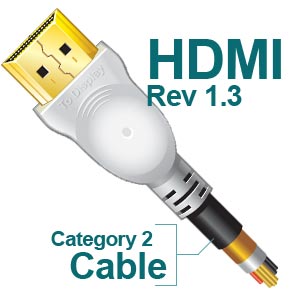
HDMI 1.3 Category 2 Cable

If this HDMI 1.3 cable is really Category 2, then it will work with 3D

There’s been a lot of confusion as to if you need HDMI 1.4 or not. Certainly, all the 3D TVs of this year and the 3D Blu-ray players will have HDMI 1.4, but make one thing clear – you do not need HDMI 1.4 for 3D. The evidence for this statement comes from the fact that the PS3, which features HDMI 1.3, can be upgraded via firmware to become 3D Blu-ray compatible. So if the PS3, with HDMI 1.3, can do 3D Blu-ray, there’s no reason why you need HDMI 1.4 to do Blu-ray either. Of course, this point is moot because all 3D hardware now are being sold with HDMI 1.4, and they will probably only work on hardware sold recently, which means everything will have 1.4 anyway. The major new feature of HDMI 1.4 are support for audio return channels (two way audio on the same cable), and Ethernet networking support built right into the cable itself.

In terms of cabling, you don’t need HDMI 1.4 cables. In fact, technically, there may not even be such a things as a HDMI 1.4 cable. What you need at the very least is a HDMI 1.3 cable that is rated category 2, or “high speed”. If you have such a cable, then 3D will work. Don’t believe me? Then believe the official HDMI website where it says “All High Speed HDMI cables will support 3D when connected to 3D devices”. The reason you might still want to get a HDMI cable rated for 1.4 is that they are guaranteed to work with 3D, and this may mean less hassle than trying to find out if the HDMI 1.3 cable you want to buy is “high speed” or not.

So if I don’t need HDMI 1.4, then why do I need a new 3D TV?

This is one question I see popping up on forums all the time. One of the requirements mentioned above is for your TV to do 120 Hz. Most TVs sold in the last few years can do this, some can even do 240 Hz, so why do you need a new TV?

The problem with previous 120 Hz displays is that, while they can display at 120 Hz, they can only accept a 60 Hz input. What happens internally on these TVs is that they do frame interpolation, or simply double the number of frames, to get the picture to display at 120 Hz, 240 Hz or even higher.

3D TVs are different in that they can accept a 120 Hz input and then display it as such. This is the only way to guarantee smooth motion during 3D, when each eye is only seeing half of the frames.

And of course for active shutter 3D displays (which represents the majority of 3D TVs on the market), it’s the TV that needs to sync with the glasses. An infrared signal between the TV and the glasses makes this happen, and your older TV will not have this capability. This is why glasses must be paired with the TV, and using Panasonic glasses on a Samsung TV won’t really work (well this is a bad example, because it actually does work if you turn the glasses upside down – but try using it on a Sony TV and it won’t work at all). There is a movement to get 3D glasses to be standardized, but don’t hold your breath.

Of course, if you older TV can accept 120 Hz inputs, and if there was some kind of dongle that adds the infrared communication between the TV and the glasses, then theoretically, this TV can be 3D ready. But there’s more profit in selling a brand new TV than a 3D dongle, so again don’t hold your breath waiting for such a solution.

LED/LCD versus Plasma – Which is better for 3D?

Panasonic 3DTV and 3D Blu-ray Player

Is plasma better for 3D than LED/LCD? Go to your nearest store to find out ...

According to the LED/LCD manufacturers, LED/LCD gives you the best 3D experience. According to plasma TV manufacturers, plasma TVs gives you the best experience. The companies that make both types of TVs, like Samsung and Panasonic, are staying relatively quiet during this much heated debate.

LED/LCDs are better with brightness, and with the glasses providing a slightly dimmer picture, brightness may be key for good 3D.

On the other hand, for pixel response times, plasma TV are much much better than even the best LED/LCD. Plasma TVs, such as the Panasonic, can claim 0.001 ms pixel response times, while LED/LCD TVs response times are several magnitudes above this. The reason why this is important for 3D is that because the TV is rapidly displaying different frames for each of your eyes, and the transition between the frames has to be quick enough or you’ll get what is known as the “ghosting effect” or crosstalk. In essence, your left eye may be seeing what the right eye should be seeing if it all doesn’t happen quickly enough, and that ruins the 3D effect. Plasma TVs will have a degree of crosstalk as well, and Panasonic has gone the step further to reduce the phosphorescence decay times, as to minimize or eliminate crosstalk. Other plasma TVs, like the Samsungs, did come with ghosting problems, but firmware updates seems to have improved it as well, although others suspect it’s actually the bundled movie, Monsters vs Aliens, that is causing the ghosting because it wasn’t encoded properly.

That’s not to say that LED/LCD can’t reduce crosstalk, and both Sharp and Sony have confidently stated that they have solved this problem for their 3D LED/LCD panels.

Size is also an issue, and the bigger the screen, and better the 3D effects will “draw you into” the action. And since plasma TVs are cheaper than LED/LCDs for larger sizes, that’s another factor to consider.

Whether this, or any of what I said, is true really depends on which TV you want to buy. The best way is to go to your local electronics store and test the TV you plan to buy – that’s the only way you can be sure if crosstalk is an issue with your TV. Remember that fluorescent lighting can affect certain TVs and cause ghosting to occur, so make sure you go to a score with a test environment that emulates the typical lighting in people’s homes.

3D content – where is it?

Samsung 3D Starter Kit

Electronic manufacturers are bundling 3D Blu-ray movies with their hardware, here's Samsung with Monsters vs Aliens

The short answer is that it isn’t here yet. There are some 3D test channels, some 3D test material you can download and play with, some 3D games, and a very small selection of 3D Blu-ray movies that seem to be exclusively tied to certain manufacturers, but the reality is that 3D content, which will be here in force, is umm, not here yet. It’s the chicken and egg situation, software or hardware first, and in this case, hardware is coming before software.

For 3D Blu-ray movies, there’s almost nothing substantial you can buy to play on your brand new 3D Blu-ray player and 3D TV. Samsung is including the movie Monsters vs Aliens in their 3D Starter Kit, which also comes with two pairs of 3D glasses. Panasonic is giving away Ice Age 3 and Coraline 3D Blu-ray’s with their TVs. And Sony will have Cloudy with chances of Meatballs on 3D Blu-ray. If you somehow got hold of all these movies (eBay is your friend), then they will all work on your 3D Blu-ray player + 3D TV regardless of which manufacturer(s) made them (thanks to the 3D Blu-ray standard). But with content so thin, manufacturers are holding onto these exclusives and not making them available for general sale, as a way to entice buyers to buy their stuff. Panasonic is chummy with the people behind the movie Avatar, so will they get the 3D Blu-ray version of Avatar and make it an exclusive? Nobody knows, but it could happen!

Update: Sony will release Cloudy With a Chance of Meatballs on 3D Blu-ray “this summer” for general sale, and possibly as soon as this month. In fact, you can already pre-order the UK version on Amazon UK, although US buyers need to be careful of Blu-ray region issues, since the release could be region B only and would not play on US machines (best wait for the US 3D Blu-ray version, which can’t be that far away).

Update 2: The US Blu-ray 3D version of Cloudy With a Chance of Meatballs is now available.

Panasonic's 3D Blu-ray giveaways

While Panasonic is giving away the 3D Blu-ray versions Ice Age 3 and Coraline with their hardware

But for lack of 3D content especially produced for 3D, if you have a Samsung or Sony 3D TV, then you can have unlimited 3D content by converting 2D broadcasts and movies into 3D, in real-time, on the fly. It isn’t real 3D because it’s not the filmmakers adding in 3D effects to the movie, it’s entirely the processor in your TV that is taking the images, analysing it, and then creating what it thinks should give you the best 3D depth effect. And it works!

It won’t give you the “in your face” type of 3D, but you will be able to see depth, and early accounts suggest that the conversion engine is pretty good at guessing which objects should be at the front, and which should be at the back. At the very least, it will give you some 3D stuff to look at while real 3D content is still arriving. Games, TV, DVDs, Blu-ray – anything can be 3D converted. And it even works with still pictures!

And for those still confused about real versus this kind of pseudo 3D, think DVD up-conversion, where DVDs can be upscaled to HD and still look damn good, even though it doesn’t look as good as real HD offered by Blu-ray movies. This is what the 2D to 3D conversion engine does – instead of HD up-conversion, it’s 3D up-conversion.

Some TVs can also convert 3D content back to 2D, with quality that is surely less than the original 2D version. So beware when you’re testing TVs at stores and the picture doesn’t look right, make sure the TV is playing a real 3D movie, and not doing any sort of 3D up-conversion, or 2D down-conversion if you’re testing the TV’s 2D capability.

Unfortunately, Panasonic TVs don’t have this capability, but hey, you’ll probably get Avatar 3D before anyone else, so it’s not all bad, and real 3D will be just around the corner anyway.

Do I need 3D?

Do you need anything? Do you really need that Blu-ray player? Do you really need to have a collection of 3000 movies at home? Do you need a 65″ TV when you already have a 55″?

I think this is a question only you can answer yourself. For some, 3D doesn’t even work because they are in the sizable minority that can’t see 3D. Others that suffer from sea sickness will find the experience intolerable as well. And many just don’t like having to put glasses on to watch movies (I, and other myopic and eye condition sufferers, have to put glasses on to see anything and everything).

Others will be thrilled about it and will be willing to pay the extra cost involved. The only advice I can give you is to try out the 3D demos that is (or will soon be) available at every major electronic retailer (just make sure you go to one that has the demo set up correctly, not using any sort of 3D up-conversion and with home lighting). Try it for yourself before you dismiss it entirely, and for those that haven’t seen a 3D movies since the blue/red glasses days, you owe it to yourself to try the new technology, which is entirely different to what you have experienced before.

2700+ words. Oh well, so much for keeping it nice and simple!