Archive for the ‘Video Technology’ Category

Weekly News Roundup (25 March 2012)

Sunday, March 25th, 2012

Welcome to another edition of the WNR. Two weeks ago, I mentioned I was working on a project for Digital Digest that should be ready in about two weeks time. Unfortunately, the same is still true today, as I’m still working on it, and it’s still (at least) two week away from being ready.

And the delay is totally unrelated to Skyrim, or the fact that I unceremoniously passed 100 hours of play time this week. Most of what I’ve been doing in the game this week has been very “chore-ish”, having spent most of yesterday’s playtime moving from my house in Whiterun to Riften – meaning multiple trips carrying the assortment of goodies and junk that I’ve been hoarding at my old house, fast travelling the many miles between the two hamlets, all the while not wearing any clothes as to clear up as much carrying weight as possible. Trust me, it’s not as fun as it sounds.

A couple of interesting stories to go through this week, so let’s get started.

Copyright

Google has dragged itself into the Megaupload affair by coming to the defence of Hotfile, or rather, the defence of the DMCA’s “safe harbor” provision.

The MPAA is currently suing Hotfile, and one of the argument that the industry trade body has made is that Hotfile should not be afforded the protection of “safe harbor”, due to the “rampant” nature of piracy that goes on on the file sharing website. Another argument is that Hotfile has not been cooperating with the MPAA fully in terms of providing the technical anti-piracy measures that the MPAA studios want. Google says both of these arguments are invalid because current case law does not strip away “safe harbor” based on “generalized awareness that unspecified (or even ‘rampant’) infringement is occurring”, and that there’s nothing in the law that says Hotfile must implement the type of content filtering that the rights holder requests, as the decision is mostly left up to the service provider.

Both of these arguments have been made against Megaupload too in the government’s criminal case against the file hosting website. And another key argument in the government’s case, which was also employed by the MPAA in the case against Hotfile, is that the website operators only removed content that had been specifically listed by the rights holder, and deliberately kept similar or even the exact same content on their network. Google argues that this is perfectly in-line with the spirit of the DMCA, with the burden of identifying infringing content belonging to rights holders (the only people that can decide which content should  be removed and which should be kept). The argument works a little better for Google’s assets, such as YouTube, than for Hotfile/Megaupload though – it’s often in the rights holder’s interest to keep some “infringing” content active on YouTube due to promotional reasons, while at the same time removing others (even if it’s the same video, re-uploaded). With Hotfile/Megaupload, it’s unlikely that, for example, Warner Bros. would want to keep a copy of The Dark Knight available for download, but in Google’s view, Hotfile did exactly what the DMCA demanded it to do, nothing less, but certainly nothing more than what’s required, such as removing content that was not specifically listed.

Rapidshare, in a German court, is also facing similar accusations, and as a result, it could be forced to implement drastic site-wide filtering for all uploads.

The issue of how proactive a service provider should be is at the heart of the DMCA “safe harbor” argument, with content holders now accusing Internet companies of “abusing” the protection afforded to them by the provision, by deliberately turning a blind eye to ongoing infringement just because it has not be specifically named. But the alternative is for service providers to “second guess” the intentions, and the legal rights, of content holders, to take a “better safe than sorry” approach, the collateral damage from such actions which will mean a lot of harm to innovation and creativity (and is ever more the problem on YouTube, with its automated “Content ID” system and false positives). I don’t know what the answer is, but draconian blanket bans and filtering can’t be the best solution out there, not when there’s still so much that content holders can do to make the legal option the more enticing one. The DMCA, conceived by the likes of the MPAA, is already far too biased towards rights holders at the expense of innovation and creativity – but it seems it’s still not biased enough, hence the “need” for PIPA/SOPA/ACTA.

Megaupload Copyright Demand

A letter is floating around in Europe "suing" users for uploading and downloading stuff to/from Megaupload

And the not so subtle bias in current copyright laws has also produced a climate of fear and uncertainty, with most people unaware of their actual rights when it comes to these kind of disputes. This has led to mass copyright lawsuits that use the fear, and sometimes the embarrassment, to “encourage” users to pay a pre-trial settlement fee to make the matter go away. It’s no wonder it’s been referred to as “legal blackmail”. But if you take this just one step further, something that many consider ethically suspect turns into an outright scam, and report this week suggest that Megaupload users are now being targeted. A fake mass copyright style letter is being sent to potential Megaupload users demanding a settlement fee, or the threat of a 10,000 euros lawsuit. The small matter of the law firm responsible for these letters not actually existing should be the first clue as to the validity of these claims, and also the fact that payments being made is going to a Slovakian bank account, for a law firm that’s supposed to be based in Munich.

Unfortunately, the MPAA’s actions may have only added to the believability of these scams , when they requested the web host of Megaupload to retain data, including user data, for future potential lawsuits. But even the MPAA knows the public’s distaste for this kind of thing, so they did make it clear that individual user lawsuits are not on the cards. A civil case against Megaupload and its “intermediaries”, on the other hand, now seems more than likely.

Moving on, Ubisoft this week hinted that the company might be suffering from a split-personality disorder when the company’s VP of Digital Publishing, Chris Early, spoke about intrusive DRM and how it’s doing paying customers a disservice. Not only that, Early says that Ubisoft really really wants to make DRM “go away” (I’ve got an idea where Ubisoft can put their DRM), and they think the best way to do it is through adding value to the legitimate gaming experience (they can start by not making the legitimate gaming experience a pain in the butt, thanks to their DRM). But what Early may be hinting at is the business model of MMO’s and how Ubisoft can learn from it, by incorporating some of the elements that keep people coming back (and paying) into the single player experience. I’m not sure ham-fisting MMO elements and the subscription model into single player games, along with a MMO’s requirement of always being online (which, for a single player game, is nothing more than a DRM. UbiDRM to be exact), is the best idea to be honest. Making better games, lowering the price, and providing online features, ongoing support, and exclusive content, might all be better solutions.

High Definition

Flags of truce came out this week in the HTML5 vs Flash vs H.264 vs WebM/Theora war, as Mozilla signaled their surrender. Sort of.

A little bit of background: The issue surrounds HTML5’s new ability to allow videos to embedded and played without the need to install third party plug-ins, like Flash. But just which video format HTML5 video would work with has been up for debate for a while now, with H.264 being the obvious choice (as it is the ones most used with Flash based videos today, and also an industry standard), but also the valid argument that the royalty and patent encumbered H.264 format isn’t ideal, especially since some of today’s most popular browsers are the open source variety. Mozilla, in particular, was strongly objected to H.264 support being made mandatory for HTML5 browsers. Google, sensing an opportunity, stepped up and produced the VP8 based WebM format. But the format failed to gain any traction, and so this week, Mozilla has had to do the unthinkable: start supporting H.264.

Browsers

Firefox will soon join Chrome, IE and Safari as browsers to support H.264

Mozilla made the announcement this week that they would have to now offer H.264 support, especially for their mobile based products, as they see no other way forward without supporting a format that’s even more entrenched in the mobile market than on desktop/standalones. While Mozilla would not be providing a built-in decoder, they would allow their Firefox browser to use existing software and hardware capabilities to decode H.264.

In my opinion, this was always going to be the likely outcome. Google’s half-hearted support for WebM, some say hypocritically considering their Android platform offers H.264 decoding as standard, was never going to be enough to out-muscle H.264, especially since none of the major hardware makers were even interested to offer WebM support. And with Apple firmly behind H.264, and everyone else trying to out-Apple Apple, WebM had little or no chance to succeed.

So what does this mean for the average user? It means that HTML5 video now has a greater chance to succeed and become a true replacement for Flash, and that’s probably a tick in the win column for everyone, even if this is a set-back for open-source video standards. MPEG LA, the licensing authority for H.264, for what it’s worth, has promised not to charge royalties for this type of H.264 usage for the foreseeable future, so H.264 is free for the time being without being “free”, if you know what I mean.

The Girl with Dragon Tattoo DVD disc art

A real disc or a pirated one? You decide ...

And finally, a story that feels a bit “PR-ish” to me, where Sony’s DVD disc art for their remake of “The Girls with the Dragon Tattoo” is confusing people into thinking they’ve been sold a pirated copy of the movie. The disc art resembles a home made Sony DVD-R with the title of the film printed on to make it look like it was written on with black markers, and it’s supposed to be a reference to the main character of the film, Lisbeth Salander, and her hacking ways. Those that purchased the Blu-ray+DVD combo version might be even more confused, since the Blu-ray disc art is fairly traditional, which makes the “DVD-R” stand out even more.

But a closer look reveals the MPAA rating, region info, and even some copyright text on the supposed home made “DVD-R”. And the “DVD-R” being a Sony branded one, of course alludes to the fact that they were the studio behind the movie. So would it really have fooled people into calling up Redbox or whoever to complain, as was claimed by some of the news articles? Maybe a surprise at first, sure, but to be completely fooled? I don’t think so. All has happened though is that this story has given the DVD set some free publicity, which is why I’m cynically leaning towards PR campaign on this one.

Alrighty then, that’s pretty much the week as I remember it. Must get back to my “move” in Skyrim, still got 90+ each of dragon bones and scales to move, as well as my assortment of 400 iron daggers. This could take a while … see you next week.


Weekly News Roundup (18 March 2012)

Sunday, March 18th, 2012

Welcome to another issue of the WNR. As promised, I put up the February US video game sales analysis earlier in the week. Nothing too surprising, just your usual “everything is doomed” set of stats. Is this a case of having a new normal, with the previous normal having been exaggerated by the success of the Wii, or something more sinister? With Microsoft saying this week they won’t be showing a new Xbox at E3 this year, and Sony in a similar state of mind, it will be up to the Wii U to save the coming holiday season it seems.

Work meant that my Skyrim adventures had to take a back seat this week, although I still had time to kill a vampire or two, a couple of giants (now much more easily dispatched via my legendary enchanted Daedric weapons), and the odd chicken via collateral damage.

Oh, it was also my birthday last week. I wonder at what age do you stop looking forward to your birthdays, and start dreading them because you’re getting older? For me, this happened on my 7th birthday.

Let’s get started with this WNR.

Copyright

Big news for US web users this week, as from July onwards, your ISP will officially start spying on your net activities for big content (ie. the RIAA and MPAA).

With very little evidence showing “graduated response” actually works to increase revenue, remembering that this, and not reducing piracy, is the ultimate goal, it will be interesting to see what the American version can amount to. It will be different to the French version though, in that each ISPs can decide to take whatever action it deems necessary, including no specific action and just a continuing series of warnings – with permanent account suspension not being considered so far.

It marks an important milestone in the war against piracy, and along with the RIAA’s victory over LimeWire a couple of years ago, the closing of Megaupload (and others) this year, you’d expect that piracy rates would start dropping, if it hasn’t already. Yet, all you continue to hear is how the industry is still losing billions of dollars every year, and how the problem is getting worse. With the RIAA and MPAA getting what they wanted this time, yet again, would it then be safe to conclude that, if a year from now and with revenue still not up significantly, that enforcing copyright may not actually lead to increased revenue? I’ve always found the idea of people hoarding tons of money saved from piracy, instead of simply spending the money on something else, quite funny. As is the idea of people spending more money than they actually have, when their supply of pirated content is cut off (which is an impossibility in itself).

But according to the likes of the RIAA and MPAA, piracy is a $58 billion dollar a year problem, and that if the piracy problem is magically solved somehow, creative industries would suddenly gain most of that back in revenue. But with the RIAA and MPAA already equating every single instance of copyright infringement to be worth at least $150,000,  via their much publicized lawsuits against students and single mothers, $58 billion may even seem a conservative figure. This “Copyright Maths” is the topic of a new TED speech by Rhapsody founder Rob Reid, a short must-watch video that shows how crazy the figures being thrown around really are. That an iPod classic can hold $8 billion worth of pirated songs based on the $150,000 calculation show how ridiculous it all it (a figure almost as ridiculous as the $40,000+ people are required to pay to fill up the same iPod with legal purchase).

And after the speech, Reid was asked what would be the best way to combat piracy. The answer was basically “give the people what they want”, by building legal services that people wanted to use, that makes piracy seem not worth the trouble. Do that, and the piracy problem will solve it self. Why go to the trouble of finding and downloading each song, when you have Spotify and millions of songs for instant gratification, for example. The same is probably even more true for movies, which are harder to download due to their larger file size (which also limits the amount of archived content that’s made available).

Kaleidescape

A full Kaleidescape set-up is for serious movie lovers, people unlikely to pirate movies (and more likely to overpay for them)

The problem is though that instead of giving people what they want, the movie and music industries are actually pursuing the opposite agenda. It cannot be better demonstrated than by the legal decision this week which banned Kaleidescape from selling its DVD and Blu-ray media servers. Piracy was just a convenient excuse for the body responsible for DVD copy protection, the DVD CCA, to legally pursue Kaleidescape, despite the core audience of Kaleidescape’s servers not being pirates at all. In fact, Kaleidescape demonstrated the amazing fact that, on average, each of their customers had a legal movie library of 500 titles or more. Considering the cost of these server set ups, it’s not hard to understand why this is the case, because their product is one for serious movie lovers with the required expendable income – and these people are not movie pirates. In fact, they’re probably the movie industry’s most hard-core customers.

So what does the industry have to gain by denying their biggest fans what they want?  The answer is of course “control”. They’re perfectly happy to let you “convert” your DVDs to a purely digital format, with Wal-Mart this week offering a “DVD to Ultraviolet” service for $2 (or $4 to “upconvert” your DVDs to a HD digital version). But as always, it comes with a catch. You’ll have to use the movie studio’s preferred platform, live with their DRM system, which then controls how you’ll be able to use your digital copy (which may even expire in time). It will invariably mean a worse user experience than something for enthusiasts like Kaleidescape, but a better experience may mean a loss of control, and that’s just not acceptable. And if all of this means they can charge you again and again for the same thing, then that’s just a sweet, sweet bonus.

High Definition

With the new iPad still making headlines, I thought I would jump on the bandwagon and write something about what could be considered Apple’s first HD tablet (1024×768 is not HD, as if it was, then it meant that I had HD on my first 486 computer).

With the new iPad resolution coming in at 2K, or 2048×1536, that’s a resolution higher than your average HDTV. Of course, a true enthusiasts won’t just see the fact that the screen would perfectly render a 1920×1080 resolution video with a couple of pixels to spare, they will of course wonder if you could expand the resolution of the video from 1920 to 2048 and use up all of the available pixels for a 2048×1152 video.

iTunes vs Blu-ray @ 1080p

iTunes 1080p compares well to Blu-ray, according to tests done by Ars Technica

But what may be more interesting is how Apple plans to distribute 1080p movies to the new iPad, as streaming of 25GB+ movies is not ideal, even with 4G. Ars Technica took the time to test several of iTunes’ new 1080p encodes, and compared it to the Blu-ray equivalent, and what they found was rather surprising – that somehow, a 5GB iTunes file isn’t 5 times worse in quality than a 25GB Blu-ray. By supporting the “High” H.264 profile, as well as increasing the “Level” support to 4.1, all now possible on the faster hardware of the new iPad (and iPhone 4S, as well as the updated Apple TV), the decoder can now be made to do more work, and the result is a more efficient encode. VUDU’s HDX does something similar to allow 1080p streaming on your average 10Mbps connection (Blu-ray, on the other hand, may require 30Mbps just for the video). Sure, you’ll lose a lot of fine detail, there will be banding and other aberrations, but that’s all moot on a 9.7″ screen. On a large screen TV connected via Apple TV, this may be an issue, but only for those serious about their movie watching, in which case, they would probably never consider Apple TV or iTunes 1080p anyway. For the rest, it’s “good enough”, and the convenience of it all makes up for everything else.

Mac Observer did similar tests but found wildly different results, so either Ars Technica did their test wrong, or Mac Observer did (or maybe video quality varies too much from movie to movie).

And with that, we come to the end of another WNR. See you next week.

Weekly News Roundup (26 February 2012)

Sunday, February 26th, 2012

Welcome to another edition of the Weekly News Roundup. I’ve just finished writing the PowerDVD 12 review, and it only took me a month! Writing the obligatory PowerDVD review has become a sort of ritual for me, as I’ve been doing it since pretty much version 1.0 of the software (it’s now version 12, not quite 12 years, but close to a decade at least). Over that time, the review has morphed slightly into a “how to” guide, or at the very least, an overview of the major functions. For this particular review though, I’ve completely restructured the review sections so that it’s a bit easier to read. Now all I have to do is to write the review for the comparable WinDVD 11, which is only overdue by 5 month!

Skyrim update: Just managed to get my Alchemy and Smithing levels up to 100, now to get Enchanting up to 100, and to get the relevant perks so I can start making awesome, unstoppable armor and weapons. Had to purchase another house so I could more easily manage my hoarding.

Copyright

We start the week with two stories that I briefly touched upon in the last WNR. First up, federal prosecutors have expanded the case against Megaupload, and revealed that over $50 million in “Mega assets” have been seized so far.

The newly added charges relate to the allegation that when content holders requested a file to be taken down, Megaupload merely removed the specified link to the file, without removing the actual file in question. This is problematic as the same file can be linked multiple times based on the way the Megaupload’s server works, and so Megaupload was doing “just the minimum” (or not even that) when it came to file removal, even though they could (and should) have done more.  It’s a lesson to other file sharing/user generated websites: take removal requests seriously if you want DMCA safe harbor to apply, otherwise, you might as well just ignore the take down request, since you’re not fooling anyone. Pro-active content removal will help to make the case that you do care about copyright infringement, but the law does not require such actions, other than for really obvious cases of infringement. Had Megaupload done what was needed, then the criminal case against them might have been impossible to establish. On an unrelated note, Kim DotCom, the owner of Megaupload, was released on bail this week.

The Pirate Bay

The Pirate Bay sails on as domain changes from .org to .se, to avoid unwanted US intervention

The Pirate Bay has had a busy February as well. Not only are they planning to remove all .torrent files, replacing them with Magnet Links instead, they’ve also changed domain names, from their original .org domain to .se. The reason for the change is fairly apparent – .org domain names comes under the authority of the United States, and so it could easily be seized by the US government (and I’m surprised they haven’t done so). The fact that a Swedish website wants to avoid falling under the jurisdiction of the United States is perfectly understandable to everyone. Everyone except for the RIAA, of course, who came on attacking TPB for blatantly trying to “escape U.S. laws”, the very same laws that doesn’t apply to a Swedish website anyway. The RIAA appealed again to xenophobics, using phrases such as “foreign rogue sites” and blabbing on about “American jobs”, despite music being a global industry, and piracy being a global problem. It’s something ‘Winston’ from The Pirate Bay spoke of when he wrote a response to the RIAA’s latest attacks, that the America-centric view coming from the likes of the RIAA and MPAA, that somehow only US interests are important. Via SOPA/PIPA, the RIAA and MPAA have also started pointing the finger at the rest of the world,  blame “foreigners” for all their copyright woes, despite research showing their own short-sighted greediness (ie. release windows) is at the heart of the problem.

Another thing that Winston touched upon is the disingenuous use of the phrase “creative community” by these trade groups that often only represent a small number of major labels and studios. The truth is that not only are they not the creative community (or any kind of community, as Winston points out), but they’re the ones that are most aggressive at exploiting and profiting from the same community, often at its expense (and that of real artists and real creativity).

And in order to keep exploiting and profiting, the major rights holders have shown they’re willing and capable of doing anything in order to keep the money rolling in. For them, little things like censorship, privacy and the right to innovate, if counter to their own interests, can all be sacrificed. Which is why despite various EU rulings on the possible illegality of web censorship, the music industry is still pursuing, and winning, their case against The Pirate Bay in the UK, and it’s looking increasingly likely that UK ISPs will soon be forced to block access to the website. Not that it would actually stop people visiting, since earlier blocked sites such as Newzbin2 are still being frequented by UK visitors using tools that were quickly developed to bypass the blocking filters – the operators of Newzbin2 says that 93% of their former UK visitors have continued to visit the website thanks to these new tools. There are also all sorts of jurisdictional issues involved, such as whether an UK ISP has the right to block access to a Swedish website to protect the interest of US companies.

And with the web now an integral part of most people’s lives, nobody wants to see it irrevocably damaged. But even so, I was really surprised to see so many people protesting the controversial ACTA (Anti-Counterfeiting Trade Agreement) treaty in the streets of Europe. And it’s working, with the EU suspending ratification of ACTA until the legal positions are studied in further detail, which should have been the case all along, as opposed to cowardly caving to corporate interests. The usual critics will demean these protests as “freeloaders wanting to keep the free stuff coming”, but people who say that are also devaluing the importance of critical issues of censorship and privacy, issues at the heart of any democracy. I guess in some ways this is a delayed response to the sacrifices that have been made in the last decade to these core issues, due to fears of terrorism. I strongly agree that people who would sacrifice freedom for security deserve neither, but at the very least, that response is an understandable human one (even if it is the wrong one). But sacrificing freedom for the benefit of a select few mega-corporations is just not acceptable, and I’m glad others feel the same way too. Freedom and democracy is worth protecting at the expense of everything else, in my opinion.

High Definition

With this WNR coming in a little bit short, I have a bit more room to share a few recent thoughts about where things are headed in terms of home entertainment.

Amazon VOD

VOD is the future of TV, as once viewers get a taste of the power of choice, they won't want to go back

While I’ve long been a supporter of Internet based streaming, and the benefits of video-on-demand, I’ve not really had much experience using it, since we’re pretty behind the rest of the world here in Australia when it comes to these sort of things. Having got a Kindle Fire to do a bit of development work, I soon became absolutely hooked to Amazon Prime SVOD. It’s really my first taste at what Americans have been enjoying for a while now (and with better services than Amazon Prime, and not having to route it through a VPN), and it completely confirms for me what, up until that point, had largely been a theory – that we’re on the verge of a major revolution in how we watch TV and movies. It’s not so much what we watch, as what we have access to. It feels incredibly powerful and freeing to know that you have access to, for example, every episode of Star Trek ever made (which is available for unlimited streaming on Amazon Prime, as long as you pay the $79 per year membership fee), and the phrase “there’s nothing on” could very well become extinct if the technology continues to advance, and if content holders continue to support innovation in this area. And once you go VOD, you don’t really want to go back to a time where executive in suits determine what you should watch, and when.

And it’s a huge financial opportunity as well for all involved. From an advertising point of view, ads can be targeted, interactive and non repetitive, and the tiered subscription model provides value, as well as ensuring stability revenue wise (compared to a model based purely on ads). That nearly 1 in 3 American households now regularly enjoy streaming content on their TV (so not just something you do on a tablet, or a computer, but in the living room) shows that people want it. It’s now up to the tech companies and the rights holders to knock out a deal that would make the ability to access everything an affordable reality, and I look forward to the day this is all available in Australia.

On that bright note, it’s time to say goodbye to this issue of the WNR. Have a good one, and see you next week.

Weekly News Roundup (25 December 2011)

Sunday, December 25th, 2011

Welcome to this Christmas Day edition of the Weekly News Roundup. I know I said that there might not even be an issue of the WNR this week, as the news might dry up, but it’s actually turned out to be the opposite, so I have to spend Christmas Day writing the WNR in absolutely humid conditions, and also in the middle of a hail storm – looks like I’ve definitely not been nice this year!

Further evidence of me being naughty in 2011 is the fact that all I seems to be getting from the Steam “Winter” Holiday Sale’s Great Gift Pile are lumps and lumps of coal. Other people are getting free games, or really useful coupons, but all I get is coal, and coupons for games I already have. Just in case anyone asks, here’s my Steam profile, so you can check out the games I have and the ones I’ve been playing. Add me as a friend if you like, but I must admit that while I love Steam games, I’ve not been a very active member of the community (and I’ve only just figured out how to create a custom URL for my profile).

Copyright

Anyhow, let’s not waste too much time, as I’d hate to be still writing come Boxing/St. Stephen’s Day. Starting with copyright news, let’s first cover the fallout from last week’s revelation that IP addresses belonging to the RIAA have been used to download pirated songs, movies and even software.

RIAA Piracy Logo

RIAA caught pirating, but they say somebody else did it

The RIAA responded to the allegations with that old excuse of “someone else did it”. Having long argued that a single IP address is evidence enough to identify web pirates, the RIAA did not like being on the other end of the pointy stick, instead coming out with some vague explanation about “third party vendors” and the like. Did these “third party vendors” also only have a single intact arm?

But I’m going to do something controversial and believe in the RIAA’s explanation. Large organisations often have IP addresses within a leased IP block that they provide to third party vendors in order to obtain some kind of service, and so the RIAA’s excuse may very well be valid. Other organisations also caught recently came up with other explanations, such as their IP being spoofed, or that they were downloading only as part of research. And you know what, in the giving mood I’m in, I’m going to believe them all. Because all of these explanations, and some are improbable, are all not impossible, and this is why IP addresses should not be used as evidence of copyright infringement, without knowing the exact intent and establishing that significant downloading (and uploading) has actually occurred. You don’t go ahead an charge a car’s owner just because their car’s plate identified during the commission of a crime – you investigate the owner, see if there’s motive/intent, and of course, see if the car or the plate was stolen.

Louis CK's PayPal Account

There's something perverse about seeing a million dollars in a PayPal account - Louis better get it out of there before PayPal does something naughty

Before we get to all the SOPA stuff, which again dominated the week, let’s continue the follow-ups to last week’s stories. Louis CK’s DRM-free experiment has had an update, and after 12 days of sales, Louis has revealed that sales have reached the million dollar mark (with a screenshot of a PayPal account with the said million dollars – better get the money out of there quick Louis, you know what PayPal is like). So that’s a lot of money, despite rampant piracy, which just goes to show that piracy can never really be stopped, but you can still make decent money if you do the right things. The hype over the experiment has obviously increased the visibility of the show, which explains the high piracy rate, but for artists and performers, reaching people sometimes is just as important, if not more important, than actually making money. And through piracy, Louis CK might have just gained quite a few more fans, and that can only be good for business in the long run. And with Louis donating a large chunk of the money to charity, another large chunk to employees as a bonus, this experiment definitely has a happy ending (for Louis as well, as he’s keeping $220,000 for himself to, in his own words, to “do terrible, horrible things with and none of that is any of your business”). If Louis wants to continue the experiment, perhaps the next time, he can use a “pay what you want” model like the Humble Bundles, as this may help to convert more pirates to payers, as $5, while not expensive, is still quite a lot for a lot of people in this economy, to spend on comedy videos.

So while Louis, his staff, and his charities are all having a merry Christmas, there’s been one naughty boy that’s not having such a nice one. Righthaven’s long, excruciating death continues this week, with news that their website’s domain name has just been seized. And not only that, it may very well be auctioned off to pay creditors. If I had money, I would buy the domain name, and put up a DHS style seizure notice on it warning others from trying to profit using the sue-for-settlement approach. Maybe even linking to a cheesy video explaining why you’re even just for thinking about getting into the sue-for-settlement business. And for Righthaven to lose their own domain name, when they’ve been (without standing) threatening to take away other people’s domain names – I don’t know if that’s justice, or irony. Probably both.

Now for the SOPA stuff. With SOPA under intense pressure, the boss of the MPAA, former US Congressman and Senator Chris Dodd gets back to what politicians (and lawyers) are best at doing to defend SOPA: lying (or at least exaggerating the truth). Dodd, who recently said that China should a model the US should refer to for Internet censorship, now says that if we don’t do something about piracy, the US could end up like Sweden, Egypt or Spain, where their local film industries are “gone”. Not just shrunk, or hurt, but “gone”. And of course, none of it is actually true. These countries still churn out tons of films, and in Sweden’s case, films that have made more than a hundred million worldwide, which is rare for non US based films. Ever heard of ‘The Girl With The Dragon Tattoo’ or ‘Let the Right One In’? The original Swedish productions, which has “inspired” recent remakes, were all big hits. And both Egypt and Spain have produced more films in the last few years, not less (or at least up to 2011 for Egypt, when domestic conflict probably will have reduced film production). And this was probably the last notable defence of SOPA for the week, as the rest of the stories are all about the opposition to SOPA.

If the Internet is good at producing one thing, it’s comedic music videos. And the anti-SOPA protest movement were enriched with not one, but two new protest songs this week. One is from activist Dan Bull, while the other is from the composer of the “Obama Girl” hit. This is the kind of creativity, the kind of freedom of speech, that may very well be endangered if SOPA is passed into law, because the very sites that help to host and promote these kind of original videos, will be the ones under attack by SOPA – the same platform that allows for creativity,  can often also allow pirated content to be hosted as well (in fact, I think you can safely say that YouTube wouldn’t have a been a hit had it not been for the pirated stuff that were dominant during the website’s early days).

Also joining in the protest was Scribd, a document upload and sharing website that has become incredibly useful as a way to embed documents in the same easy manner as videos. But it too would be under attack by SOPA, as it operates on a business model not too different from “rogue” sites such as Megaupload or Rapidshare. I’m sure there are lots of copyrighted content on Scribd, but SOPA punishes an entire website for the act of a very small minority of individuals (outside of the control of the website), and Scribd has a lot to lose if SOPA becomes law. Which is why on Wednesday, Scribd chose to randomly censor words from the billions of documents they hosts, an act of protest to hopefully get people to understand the threat posed by SOPA, and its likely impact on the Internet.

Reddit Closed Logo

Reddit may have to close if SOPA is passed, due to the compliance cost associated with the controversial legislation

Joining Scribd on the potential list of sites that will be hurt by SOPA is Reddit, one of the Internet’s largest communities. The general manager of the website says that if SOPA passes, then Reddit would probably have to close down, due to the legal requirement to make the website compliant with SOPA. With millions of new posts to go through, the team of roughly 11 staff, mostly engineers, would not be able to keep up with the moderation duties required and there would be no choice but to close the website down. This is because, under SOPA, just a single bad link out of the millions of posts would be enough to mark the entire domain for seizure, and with millions and millions of posts, no doubt containing potentially tens or even hundreds of thousands of links to infringing content, that’s probably enough to mark the site as “dedicated to piracy” under the SOPA terms. And when that happens, all that would be then needed would be a content owner to request Reddit.com be blocked, and that would be that. Multiply that by however many user-generated websites there are on the Internet, and you can start to see the full damage that SOPA could cause.

But one tech company that has been outspoken in its support for SOPA has been domain registration and hosting company, GoDaddy. And ironically with Reddit being threatened, it was a post on Reddit that has now helped to reverse the company’s stance on SOPA. A post asking for a boycott of GoDaddy quickly gained popularity, with the likes of the Cheezeburger company (as in “I can has cheezeburger”), and even Wikipedia, all threatened to move their domain registration from GoDaddy to other providers on the 29th. Facing the prospect of losing potentially thousands of customers, GoDaddy relented and dropped their support for SOPA, although they have not formally dropped their support for the equally dangerous Protect IP Act, so the protest could be still on. Update: Apparently, tens of thousands of domain names have already been moved away from GoDaddy, as people are still not convinced of GoDaddy’s position on SOPA (they’re not anti-SOPA, they’re just not supporting it “right now”).

And so GoDaddy joins the list of companies and organisations not backing SOPA, but it was company that should have never supported it anyway. But when the Heritage Foundation also expressed their disapproval of SOPA, that was my “WTF” moment of the week. The Heritage Foundation, a right-wing think-tank, has been as pro-copyright as anyone, and so for them to speak out against SOPA, and as influential as they are amongst conservatives (having just hosted a presidential nominee debate for the Republicans), they must have had some serious reservations about SOPA. And they did. Mainly with how the government will given the power to censor websites, and also search engine results, in effect, censoring the flow of information. Hopefully, Republicans in the House and Senate will now think twice about voting for SOPA, or face being chastised by the Heritage Foundation for being anti free speech.

And in the same news article that I wrote, there was also a bit about Ashton Kutcher coming out against SOPA, but he was never really going to support it, considering his profile on the Internet, and his involvement with start-ups.

But probably the best argument against SOPA, and one that even content holders can possible agree with, is that SOPA probably won’t even work, despite the threat of collateral damage it poses. This week, we had the news of another Firefox add-on that looks set to defeat SOPA’s DNS filtering before it’s even launched, so for anyone serious about pirating, SOPA stops nothing. Nothing except actually ensure that new DNS protocols, designed to prevent DNS spoofing, cannot be implemented. As I’ve mentioned before, if the government was as serious about defeating Internet fraud as they are about helping to prop up a dying business model, then there could be a lot more economic gain to be made by preventing Internet fraud.

Okay, the rain is really coming down now, and the thunder appears to be getting closer. That’s probably a good sign that I should end this edition of the WNR, before the power goes out.  Merry Christmas, and see you next week.

Weekly News Roundup (20 November 2011)

Sunday, November 20th, 2011

Not a week with a lot of news, and a lot of important news. Oh, and welcome to another edition of the WNR by the way. Early in the week, I also completed the October 2011 NPD analysis, which showed once more the strength of the Xbox 360 in the US, once again the stop selling console for the month. Battlefield 3 was the best selling game as expected, but it’s looking more like the case that the game was rushed to market to beat Modern Warfare 3, at least on the PC platform. The copy I ordered from the UK finally arrived, and while it’s a bit more stable than the beta, but not by much. For one, I had the sound looping/stuttering problem, which was solved by changing the affinity of the bf3.exe process in Task Manger to a single core – seems to be a common problem but one that remains unfixed by DICE/EA. It’s a shame, because otherwise, this is a game trying to bring in new things to the FPS shooter genre, while Modern Warfare 3 seems all very samey samey. Alright, let’s get started.

Copyright

There is only one issue that dominated this week’s headlines, and it’s SOPA. I bet the politicians that sponsored the Stop Online Piracy Act didn’t expect the kind of public backlash that has happened, but if you try to mess with the Internet, expect a reaction.

I’m going to do this a bit different, so I’ll just briefly go through the news stories covering the week’s events, and then provide a bit more analysis on the whole thing. We start off with the EFF’s warnings against the dangers of SOPA, including ones that others haven’t thought of. Apparently, the bill is so broad that it calls into the legality of a lot of existing Internet tools and standards. Tools and standards like VPN, SSH could all be ruled illegal, as all could be used to bypass SOPA filters (and the legislation makes any tool that does that illegal). But with VPN, SSH, businesses would no longer be able to do anything securely on the Internet, and it could potentially cripple the economy. Of course, I’d doubt the government would have the guts to go after VPNs or SSH, but because the legislation is worded so badly, it gives the government the power to do so, and the copyright industry might just go after VPN and encrypted/anonymous downloading services if people start using these as ways to bypass SOPA.

As the Congressional hearing on SOPA was this week, Internet companies decided to make a stand this week against SOPA. The majors (Google, Facebook, Twitter, Yahoo, eBay, AOL, LinkedIn, Mozilla and Zynga) all signed an open letter to Congress urging them to reconsider SOPA, with many others also urging Congress not to pass SOPA. And they need to stand up because their own interests may be hurt by SOPA, and they will be made the targets of copyright infringement as SOPA tries undo the DMCA’s ‘safe harbor’ provision. Plus, a lot of these firms have been fighting the good fight trying to support free speech in countries that want to curtail it, and if the US passes such a “draconian” (terms used by Google’s Eric Schmidt to describe SOPA) legislation, then the US loses its moral high ground on the matter, making global Internet censorship a step closer to reality.

American Censorship Infographic

This long infograph shows the full result of American Censorship Day, a day in which the Internet decided to fight back against pro-copyright interests

And finally, we have the hearing. A show trial if there ever was one, with one token voice against SOPA compared to the 5 that supported it. The US Chamber of Commerce was involved, as were drug company Pfizer (perhaps to try and highlight the counterfeiting aspect of the bill, but we all know it’s about movie and music downloads). As a rule of thumb, you should be against pretty much everything the US Chamber of Commerce supports, as the official sounding group is nothing more than a big business lobby group. Google was the only anti-SOPA voice as part of the very very small witness pool for such an important legislation, and even it was supportive of the “financial blockade” part of SOPA. No consumer, rights, public interest  groups were called up to testify. But while these groups, and other tech companies, were not heard at the hearing, they made their voices heard in other ways, as the day of the hearing was officially declared as the American Censhorship Day. The event, in which Digital Digest was proud to take part in, was supported by more than 6,000 other websites, including Mozilla (where I first heard about this event), in which websites blacked out their logos and linked to americancensorship.org or offered a splash page where site visitors could contact Congress to tell them to stop supporting SOPA. Tumblr did the best work by making it easy for people to make phone calls to Congress. But it was you and people like you in the end that made the most difference, with over 1,000,000 emails sent to Congress, 3,000 hand-written letters via sendwrite.com, and more than 87,000 phone calls to Congress, with some 1,293 hours spent talking with actual representatives (that’s 161 representatives talking non-stop for 8 hours!). Amazing effort by everyone!

Whether it will make a difference, I don’t know. But we already have Nancy Pelosi on the Democractic side and Darrell Issa on the Republican side tweeting their opposition, or at least reservations of SOPA, so that’s some progress I suppose. Also, the petition put up on the White House’s own petition website has now officially gone over the 25,000 signatures required for an official response from the White House, and the number of signatures is still climbing – 41,463 at last count. While I’m sure the response will emphasize the importance of stopping piracy and protecting jobs, basically a MPAA/RIAA press release, but at the very least, it tells those in the position of power that we are watching them, judging them, and if they choose to side with corporations against the interest of the people, we will make them accountable for their actions.

So the battle-lines have been drawn. Congress and the White House now needs to decide whether to act in the interest of the people that actually elected them, or in the interest of one industry (at the expense of another). The truth is that the Internet and Internet related industries account for more of the economy than the movie and music industries combined, and these industries are just as creative, if not more so, than Hollywood and the four major music labels, which create nothing, but merely profit from the work of real artists. They’re the middlemen in an era where their usefulness is diminishing by the day, and they know it too, and desperate enough to do anything to keep their dying business model alive, even if it means having to curtail the growth of the Internet. The US Chamber of Commerce is involved because they’re for anything that takes away the rights of consumer and give it to big business, like tort reform (watch HBO’s Hot Coffee documentary to find out why you should care). This is so much more than just about piracy.

LimeWire Logo

Does CNET deserve to be sued for allowing people to download LimeWire?

I’m still not quite sure if FilmOn’s Alki David is serious about suing CNET for copyright infringement, or whether he’s trying to make a point after CNET’s parent company, CBS, sued his FilmOn for copyright infringement. Probably a bit of both perhaps, as David re-files his copyright infringement lawsuit against CBS/CNET for their distribution of the, now illegal, LimeWire software. Doing as he promised back in July when the lawsuit was withdraw, the lawsuit has been re-filed with more plaintiffs added, and it alleges that CNET profited from distributing LimeWire, and even promoted the use of it by providing tips and instructions on how to use it for site visitors. If David is trying to make a point, then I do agree with him that big media often acts hypocritically when it comes to copyright infringement, often stealing ideas, entire works from others, while blaming all their woes on college kids and other downloaders. But looking at this case in isolation, and as an operator of a download website, I can’t really see any merit in the case. LimeWire the network may be illegal, but the software that connects to it is just a tool, and should be no more illegal than say a browser that can also be used to download pirated content. And it’s yet another situation where apportion of blame seems to be far too wide ranging, because if individuals who shared songs on LimeWire is guilty of copyright infringement, and that extends to the operators of the network due to the court decision, then extending it further to third party websites that distributed the software means you might as well also sue the ISP that allowed the download to happen, and so on. The blame has to stop somewhere.

High Definition

In HD/3D news, the fallout from WB’s botched launch of UltraViolet continues, with reports that Flixster, the app used to delivery WB’s UltraViolet movies, is giving away iTunes vouchers for those that complain about not being able to get the digital download/streaming working.

The idea behind UltraViolet seemed sound. One central system employed by all the movie studios (except Disney) that enables buyers of DVD/Blu-ray versions of movies to get a digital copy/stream version of the movie instantly, available to view on a variety of devices.

The actual implementation leaves a lot to be desired. As far as I know, it seems while UltraViolet is indeed one central system, and that all your “owned” movies are listed under one UltraViolet account regardless of which studios (other than Disney) you purchased disc was from, the actual delivery mechanism is left up to each studio. WB has chosen their own Flixster app to do the delivery, but a lot of people are having trouble with it.

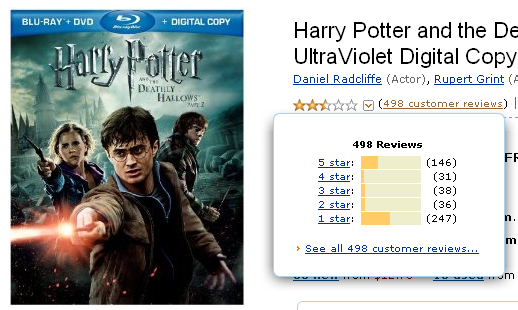
Harry Potter and the Deathly Hallows Part 2 Blu-ray UltraViolet edition Amazon Ratings

200+ "one star" ratings for the UltraViolet Blu-ray edition of the latest Harry Potter movie, as people protest WB's poorly thought out implementation of the new cloud based digital copy service

The way it should work is that UltraViolet should act like the new iTunes, where it not only tracks your movie collection, but also delivers the movies via a single app, or better, just downloads that are compatible with multiple devices. There should only be one signup needed, and that’s when you use UltraViolet for the very first time. After that, it’s all about adding movies to your UltraViolet collection, and that should be done through the simplest method possible (barcode/QR code scanning from a tablet/phone, for example).

Otherwise, you’ll end up like the current WB rollout, where people are so angry they’re posting one-star reviews on Amazon to protest against UltraViolet, and where you have to give out iTunes vouchers, when Apple is actually one of the main competitors to UltraViolet. Hollywood really does get in its own way sometimes, especially when it comes to the whole Internet thing (remember when they thought that nobody wanted a Blu-ray player with an Internet connection and made the feature optional?)

Stop fighting the Internet, and embrace it, you stupid fools. Advice for all, I think.

And that’s probably a good note to end this edition of the WNR on. See you next week.

P.S: Black Friday sales on next week. It looks like the sale has already started with Star Trek: Original Motion Picture Collection [Blu-ray] already on sale for about $24 cheaper, with The Lord of the Rings: The Motion Picture Trilogy Extended Edition [Blu-ray] also going on sale at $27 cheaper (might be even cheaper tomorrow, when the sale officially starts for this item).