Archive for the ‘Video Technology’ Category

Weekly News Roundup (11 August 2013)

Sunday, August 11th, 2013

Welcome to the latest edition of the WNR, filled with the copyright, high def and gaming goodness that you know and love. Nothing much new to update from my end. I ordered a Chromecast a few weeks back from Amazon (to ship it to Australia via one of those relay shippers), but alas, the lack of stock is becoming a bit frustrating. I’ve received numerous notices from Amazon about the shipping date, giving me all sorts of different information, so who know when I’ll get one. Not that it’s of that much use to me in Australia, since the built-in Netflix support appears to used hard-wired DNS settings, which rules out geo-unblocker services until the device can be hacked or an easy workaround found (which I’ll definitely write about on streambly if/when it is found). Anyway, the news.

CopyrightNot this again. I guess the Obama administration has run out of things to do, now that it’s commerce department is again trying to revive one of the most controversial parts of the very controversial SOPA bill – to make unauthorized streaming a felony.

Megaupload's Mega Song was blocked on YouTube by UMG

Getting your video removed by YouTube could be the least of your worries, under new plans that could make the offense a felony

If all of this sounds familiar, then it’s because it is. Check out this WNR from November 2011, in which the same issue was discussed due to an independent piece of legislation urging for the same (which was then rolled up into the mega monstrosity that was SOPA and PIPA). The obsession that the creative industries, via their political lackeys, have with the whole streaming/felony thing comes down to the fact that unauthorized reproduction and distribution of copyrighted works is counted as a felony, whereas public performances (such as streaming) is only counted as a misdemeanor. This is the discrepancy that all these various proposals attempt to address, to uniformize (I’ve been assured that this is an actual word) and to unify the differences . I guess it must be an OCD thing.

While I do agree that many of the people posting soul destroying covers of what was once a great song should indeed be locked up, I’m not sure that copyright infringement should be the main reason for doing so. I will also note that this is the same administration that is defending the unauthorized reproduction, distribution and streaming of every conversation that everyone has ever had (where’s my damn copyright protection?), and that these changes may see YouTubers get harsher sentences than the people who destroyed the global financial system.

Technological solutions to piracy don’t usually work well, but when they are capable of causing collateral damage, they become dangerous. That’s what copyright news website TorrentFreak found out this week when their website was blocked by Sky UK’s court mandated piracy filter using a flaw that can allow virtually any website to be blocked.

Apparently, when an already blocked website, such as TV torrent indexer EZTV, changes their DNS settings to point to another IP address (regardless of whether the IP address actually belongs to the website or not), Sky’s system automatically adds the new IP address to the list of blocked addresses. This means that EZTV could in fact add Google’s IP addresses to their DNS, and Sky’s system will block access to Google for its four million customers.

This is what happens when you replace due process with an automated system, a badly programmed one at that. Even the full legal system with its due process is by no means infallible to unjust outcomes, but one where there is zero accountability and legal recourse was always bound to fail, with or without a serious flaw like this one. Technology can improve efficiency if used correctly, but taking legal short cuts is not making the process more efficient, just more flawed.

High Definition

Blu-ray and digital revenue is helping to offset the decline in DVD sales and rental revenue, according to new data released by the DEG. While packaged media sales declined by an alarming 13% in the second quarter of 2013, compared to the same quarter a year ago, overall revenue remained relatively steady.

Netflix Blu-ray Rentals

Netflix’s streaming business is booming, while its disc rental business is in a steady decline

This is largely due to Blu-ray sales again showing double digit growth, 15% in the first six months of 2013 compared to the first half of 2012; and also digital revenue rising by an impressive 24% in the same period (with electronic sellthroughs up an amazing 50%). Subscription based Internet streaming was a particular highlight within the digital umbrella, with spending up 32.13%.

For Blu-ray, sales of new releases was up 19%, compared to only 8% for catalog/classic releases.

Rental revenue continues to decline, by 5.5% for the first half of 2013. So while Netflix streaming was growing by 30%+, its disc rental business was most likely in a relatively steep decline, as subscription rental revenue for the whole industry declined by 21%.

The same data also showed that 5 million new Blu-ray players were sold in the first half of 2013, bringing the total number households with at least one Blu-ray players in the U.S. to 61 million.

In short, Blu-ray, digital good; DVD, rental bad.

Gaming

The Xbox One received a much needed boost, literally, this week as Microsoft officially revealed that the Xbox One’s GPU speed has been upped from 800MHz to 853MHz. This 6.6% performance boost gets the Xbox One’s performance a little bit closer to the PS4, but the PS4 still looks set to easily be the more powerful machine.

Pure GPU shader throughput on the PS4 is still expected to be nearly 40% greater than that of the Xbox One, even after this latest GPU speed bump. And this is despite the Xbox One being $100 dearer than the PS4 at launch, but most of that is due to the inclusion of Kinect 2.0 with every console.

Xbox One Forza 5

Xbox One’s GPU speed increased to close the gap on the PS4

On paper, this seems to give the PS4 a huge advantage when it comes to the game’s visual quality; but in reality, developers of multi-platform games tend to go with the lowest common denominator, as opposed to doing extra work (which costs extra $$$) on one particular platform to leverage its hardware advantage. But as developers become more accustomed to working on both consoles, they might begin to find less resource consuming ways to get the best out of the PS4, and so expect later stage PS4 games to look better than their Xbox One counterparts. And of course, PS4 exclusives will be able to take advantage much earlier on.

I’m 80% certain at this point that I probably won’t buy an Xbox One, not until it’s a bit cheaper at the very least. At the same time, I’m maybe 80% certain that I will own a PS4 before I own an Xbox One. Microsoft’s DRM snafu; the price difference; and the hardware superiority, the latter two being in favor of the PS4, is what is largely responsible for my stance.

That’s it for the week. Hope you enjoyed it. See you next week.
Weekly News Roundup (28 July 2013)

Sunday, July 28th, 2013

Well here’s a badly kept secret: introducing Digital Digest’s new sister site, streambly. streambly is an Australian based website dedicated to all things streaming. It features the latest news on the world of video, audio and game streaming, and also features how-to guides on how to get the best out of legal streaming options. I say it’s not a well kept secret because I’ve already linked to it here a couple of times, but only just remembered that I haven’t actually bothered to introduce it. Well, consider it introduced!

Which is just as well, as there are quite a few streaming related news in this week’s WNR.

CopyrightHere’s an idea: instead of getting lobbyists to write copyright laws, why not let the people that will be most affected by the laws to write them? That’s exactly what’s happening in Finland, with the country’s first crowdsourced copyright bill now submitted for review, and a potential vote in their parliament in early 2014.

More than a thousand people have helped to write and vote on the various provisions in this draft bill, and volunteer lawyers have gone over every inch of the document to ensure it complies with existing Finnish and EU regulations. And with 50,000 people publicly backing the proposed legislation, under Finnish law, the parliament will now have to vote on it.

While Finland isn’t exactly the center of the world when it comes to copyright law, those that have been reading this feature might remember a story involving a 9 year-old girl and her Winnie the Pooh laptop, seized during a police search of her home. Yep, that was in Finland, in the country where downloading a MP3 is felony in the same category as manslaughter and violent rioting. No surprise then that the current copyright laws introduced in 2006 were written with the “help” of the copyright lobby.

But these new proposed laws, dubbed the Common Sense in Copyright Act, will help to restore the balance by finally giving the people a say in the matter, not just industry interests. Of course, the new laws have to be voted in first, which will probably take place in early 2014. At that time, we’ll find out just how many Finnish politicians are in the pockets of the copyright lobby.

IPREDator

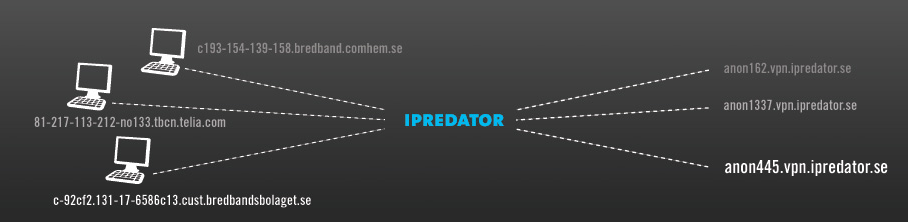
iPredator becoming the prey of financial providers, including PayPal, who suspended iPredator’s account last week

Lobbying politicians is only part of the copyright lobby’s job description – lobbying private businesses is the other, including the financial providers that help piracy websites to pay their bills. And these providers may be launching their own war against piracy, with iPredator the latest victim. Only weeks after one of their main payment providers ceased support for the Pirate Bay linked VPN provider, this week, PayPal suspended iPredator’s account and froze its funds.

While no explanation has been given, the VPN service’s links to The Pirate Bay may have played a part in the banning; iPredator was launched by the same people that founded The Pirate Bay. iPredator allows people in countries where The Pirate Bay is blocked to continue accessing the site, and to download torrents anonymously.

Speaking to TorrentFreak, co-founder of The Pirate Bay and iPredator Peter Sunde says that a secret blacklist may exist, and that iPredator may have been put on it, according to one payment processor that Sunde talked to. If true, this may be further proof of the existence of a secret war against piracy, waged by commercial interests outside of the purview of the legal system.

High Definition

A trio of Netflix related news this week, two of them having to do with Android. You’ve probably heard of Google’s Chromecast device by now, the $35 device dubbed “Netflix on a stick” by some, even though it actually does a lot more (or a lot less, depending on how you look at it). Our sister site Streambly covers the story in more detail, but think of Chromecast as an easy way to get videos that stream on your Android tablet or smartphone (or in your Chrome browser) to stream on your TV.

Google Chromecast

This little $35 device might make a big splash, as Google gets into the media streamer business (sort of)

It does a lot more than being “Netflix on a stick” because it also supports YouTube, Google Play and mirrors whatever your Chrome browser (even the desktop/PC/Mac version) displays on your TV. And that’s just for now, and as soon as more developers add Chromecast support to their apps, the $35 device will seem even better value.

It does a lot less than being “Netflix on a stick” because, unlike other media streamers, you’ll still need a compatible Android device or a computer running Chrome in order to actually get Netflix to run. You can simply plug and play with a Roku, for example, but you’ll need to do a bit more work to get Netflix running via Chromecast.

While it’s not available in Australia, I’m eager to get my hands on one. For one, this could be the cheapest way yet to get Netflix up and working in Australia – with Chrome and the free Hola unblocker extension, you save money by not having to pay for a geo-unblocker, or a media streamer if you don’t have one already.

Chromecast definitely got most of the spotlight last week, but it wasn’t the only Android/Netflix announcement. For those wondering why Netflix quality sucks on tablets and to a lesser extent, on smartphones, it’s because the resolution is limited to a sucky 480p. The culprit, unsurprisingly, is DRM and the lack of support for it on these portable devices. But with the rollout of Android 4.3, 1080p Netflix playback is finally coming to Android.

The new Nexus 7 device will be the first tablet to support Netflix 1080p, but only because it’s the first and only 1080p Nexus tablet, and only Nexus devices will have access to 4.3 in the short term. As 4.3 rolls out to more 1080p tablets (and smartphones), more and more devices will start to support 1080p too.

Breaking Bad Promo

Breaking Bad is breaking onto Netflix UK and Ireland, with the final episodes available on a next-day basis

It doesn’t really surprise me that DRM has been what’s holding back HD Netflix playback, even the 720p kind, and the DRM requirement will have been one that’s been placed on Netflix by Hollywood. It’s the kind of shortsighted and paranoid thinking Hollywood is famous for, as if somehow enabling 720p Netflix playback on tablets will somehow cause a piracy pandemic. Somehow.

And lastly, UK viewers will be happy to learn that the final season of Breaking Bad will be coming to Netflix UK and Ireland within a day of the shows original airing in the US. It’s quite a coup for Netflix, considering how eagerly awaited the final few episodes of Breaking Bad is. No luck for Netflix users elsewhere though, not unless you get yourself a Netflix region selector service like Unblock-Us (hint, hint). Australian BB fans can of course head over to streambly where you can find helpful guides on how to sign up and use Netflix (and also get access to Netflix UK/Ireland), just in time for the August 12/13 debut of the final season.

OK, that’s enough cross promotion for this week. See you in seven.

Weekly News Roundup (7 July 2013)

Sunday, July 7th, 2013

Welcome to another WNR. Another fairly quiet week this one, so a nice an short WNR for y’all. I’m still PS3-less, as I switched my Netflix device from the PS3 to my Samsung smart TV. It’s a shame that the Samsung Netflix app isn’t as updated as the one on the PS3, and less usable in my opinion. I’ve also been playing around with switching the Netflix region, a feature that’s part of my Unblock-Us subscription. It’s amazing how much more content you can get access to if you switch regions (currently watching Dexter from scratch on Netflix UK, which isn’t available on Netflix US). For $4.99 Canadian, I’d say it’s a good investment even for those in the US that don’t normally need a geo-unblocker.

On to the WNR.

CopyrightThere was more EA/Maxis DRM drama this week as one of their old games, Darkspore, became unplayable due to DRM server bug. The problem was so bad that Steam was forced to remove the game from sale temporarily.

Darkspore

Darkspore’s DRM related “blackout” shows server based single player games are a bad thing

This latest server bug was eventually fixed, although other bugs, like the infamous 7300x server bug, may remain unfixed forever. That’s the problem with single player games with server connection requirements – even though you may have paid full price for the game, you’re only really getting half of the game, if that. The other half, the server based one, could at any time cease to work, and you’re left with possibly nothing or a very limited experience, even in single player mode. It’s expensive for publishers to keep and maintain game servers, and at some point, the financial cost of maintaining the servers will start to outweigh the cost of keeping gamers happy and you know what happens next.

It would at least be better if these server based single player games are cheaper than “standalone” ones, but normally they’re not.

Overall, it hasn’t been a good week for gaming companies as Ubisoft’s user database was hacked this week. User names, email and hashed passwords were all accessed, prompting Ubisoft to send out emails urging users to reset their passwords. If you were one of the affected users, and you used the same password on other sites, it’s probably a good idea to change those passwords too. This is despite the leaked passwords being stored in an encrypted form, which is difficult (but not impossible), to reverse back to clear form (especially if your password isn’t complex enough).

Luckily, no payment information was stolen, at least according to Ubisoft. There’s also no information as to the motive behind the attack, whether it has anything to do with the game publisher’s previously controversial DRM stance (most likely not though).

It’s quite annoying that every gaming company these days seems to have their own login system. It’s all very inefficient, not just for us users, but for each company having to secure all these user databases (not very well, I might add).

High Definition

Studios are eager to push 4K video as the next evolution of home video, now that the 3D hype has largely died down, and Blu-ray has become more or less mainstream. But behind the main intent of trying to squeeze more money out of consumers lies an equally important intent to introduce new layers of copy protection to the masses. So at the Anti-Piracy and Content Protection Summit in Los Angeles last week, Sony Pictures CTO Spencer Stephens took the opportunity to outline some of the DRM measures he wants to see in 4K’s future, a Dystopian vision of home “entertainment” if there ever was one.

Killzone 4

4K video could be a Trojan Horse for new forms of DRM

Online authentication before each playback, digital watermarked content that includes trackable personally identifiable data of the purchaser/purchase device, a new version of HDCP that limits the length of cables between the player and the display, and unique title-by-title protection that reduces the chance of a single hack or flaw making all content vulnerable in one go.

You’d think Sony would have learned something from the whole PS4 DRM victory, but I suspect what Sony’s consumer electronics people think about DRM, and what their studio/content people think about it, are very different things.

And that was the week, basically. Told you it was quiet. Let’s hope this coming week is a bit more interesting. Talk to you again, same time, same place.

Weekly News Roundup (9 June 2013)

Sunday, June 9th, 2013

Well, I’ve had better weeks. The only thing worse than going to bed straight after watching the Red Wedding, is going to bed after watching the Red Wedding with a mild fever. The dreams. The haunting dreams!

The next two days consisted of me trying to keep “stuff” coming out of two distinctly different orifices on my body, and only successfully preventing one of these scenarios. No Game of Thrones dreams the next night, but for the life of me, I could not remember how to actually fall sleep (and was a bit hazy on the reason for sleeping as well). I knew  it involved filling in a form and the procurement of specific coupons, but nothing I tried worked.

I’m all better now, including the ability to not only sleep and sleep excessively. Which is why I probably should get started on this WNR.

CopyrightProcessor manufacturer ARM fired a new salvo in the DRM arms race (sorry), with the company introducing a new video processor that adds built-in hardware DRM.

Leveraging the company’s existing TrustZone technology, which has been used in the past to protect sensitive transactions, ARM’s new Mali-V500 video processor will feature DRM code that shifts all video processing away from potentially vulnerable software and hardware onto the protected processor itself. This means even the operating system will be excluded from handling video decoding code, allowing the played video to be protected even on rooted systems. The least powerful of the range of V500 processors will still be powerful enough to handle the decoding of 1080p video at 60 FPS.

ARM Chipset

ARM gets DRM – video processor will exclude even the OS from video decoding to secure the video

That’s in theory anyway. TrustZone has proven to be less than secure in the recent past.

For me, as long as the DRM, in software or hardware form, does not interfere with what users want to do with the content, and works in a transparent manner, then I don’t really mind it too much. But if TrustZone prevents “untrusted” video players from handling protected video files, or it breaks interoperability, then this is exactly the kind of consumer unfriendly DRM that will end up hurting sales and promoting piracy in the long run. And another factor that I haven’t considered before is the extra processing power needed to decrypt content, which mean extra power requirements. And that goes for all DRM schemes, most of which adds extra processing to protect content that will ultimately get ripped anyway. I wonder how much electricity is wasted every year by DRM that doesn’t even work. Even if you don’t believe in climate change, that extra electricity usage will definitely be costing you financially, not to mention adding more fuel to the impending “global resource war” fire, the main source of global conflict these days.

See, I told you DRM was destroying the world.

——

For those in the U.S. trying to escape the six-strikes regime by moving to a non participating ISP, Warner Bros. is not letting you get away that easy. Reports have emerged that users on these ISPs have started receiving warning notices warning of up to $150,000 in damages (per infringed title) if they do not get a “legal release” for the low low price of $20 (with free shipping for a limited time).

Apparently, Warner is working with a firm called Digital Rights Corp (DRC), which I have talked about on here before (I think) to locate and contact infringers. Unlike other similar schemes, DRC does not actually try to find out the contact details of the suspected pirate, but rather, sends a DMCA notice (along with the legal release offer) to the ISP for them to process. The ISP then matches an IP address to the subscriber’s information, and forwards the entire notice to the subscribers.

Doing it this way avoids having to go through the courts, which have been less than friendly to these type of actions in recent times. But it also means that WB/DRC cannot actually carry through with their legal threat until they do go through the court system.

High Definition

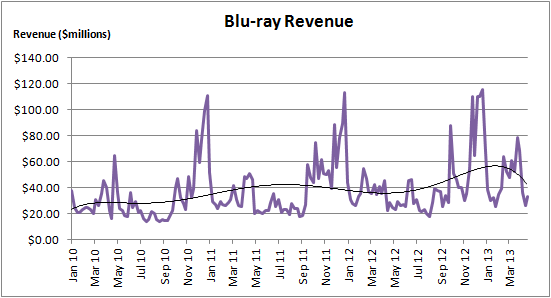
Two short news items in HD this week. Cyberlink has announced that they’re developing a H.265 codec (or more commonly known as HEVC). I’ve discussed HEVC before, and it’s actually quite an exciting upgrade to H.264, promising the same visual quality for half the bandwidth.

I would guess the main potential application for HEVC would be 4K streaming or broadcast. With 4K viewing requiring new hardware, it’s the perfect time to introduce a new codec as well.

Blu-ray Revenue Growth - January 2010 to April 2013

Blu-ray Revenue Growth – January 2010 to April 2013

Cyberlink estimates their codec will be available to consumers sometime in 2014.

Need a Blu-ray disc that lasts 1,000 years? Enter the M-DISC. The 25GB disc works in any Blu-ray reader, but is able to withstand much more than your typical disc. Even if you don’t need it to last the whole 1,000 years, the extra tough disc means it’s more impervious to harsh environmental conditions that will typically kill normal discs, such as extreme heat, light and humidity. The M-DISC will be available in August from RITEK and Imation resellers.

And finally, don’t forget to read my (slightly late) Blu-ray: The State of Play report, which looks back at the last 12 month of Blu-ray sales data. Spoiler alert: Blu-ray has done pretty well!

Gaming

I guess they couldn’t wait until E3. Neither could anybody else, for that matter. Microsoft has finally revealed details about the changes to game licensing, authentication and even Kinect piracy, for their Xbox One console in a detailed blog post.

I don’t use bullet points a lot in the WNR, but I think for the sake of readability, I shall give it a go. For game licensing, here are the changes:

  • Game licensing moves from disc based to digital based. Your games are stored on the disc you buy, but also in the mythical cloud.
  • This means you can access your game library on any Xbox One console that is connected to the Internet.
  • For your primary console, you or your family members do not need to log in to play games.
  • Up to 10 family members can be attached to your account, and they will all have unlimited access to your entire gaming library, on any Xbox One console (even if the console is not in your home)
Xbox One Forza 5 Game Box

Trading and reselling used Xbox One games is up to the publisher, but rentals won’t be possible any more

For used games:

  • Games can be traded, sold or even gifted to a friend, but only if the publisher allows for it.
  • Trading and selling can be done at the retailer level, again, up to the publisher
  • Gifting can be done to anyone on your friends list (who has been there for at least 30 days), and also only if the publisher allows for it
  • No support for game rentals

So basically, it’s up the publisher what you can and cannot do with your used games, with Microsoft providing the tools to do so. For their part, Microsoft has stated they will not receive any financial compensation for these kind of activities. You will also be unable to rent Xbox One games in the future.

For authentication:

  • Offline gaming is limited to 24 hours (not sure if this is 24 hours of gaming, or 24 hours since the last authentication – probably the latter) on the primary console. For other consoles that have access to your library, offline gaming is limited to a single hour.
  • The restriction only applies to gaming, not Blu-ray or TV or any other function.

And finally, for Kinect privacy (some of the concerns were a bit tinfoil-hatty, if you ask me):

  • You can control what Kinect can see and hear, which means you can turn off things like auto sign-in.
  • Your conversation is not being recorded and uploaded (were people really concerned about this?)
  • When your Xbox One is off, the only command that Kinect is listening for is “Xbox On” (I have a Samsung smart TV that has the same function, when in standby mode), and you can turn this off too if you want (same with the Samsung TV)

So more information, which is good, but perhaps knowing more doesn’t help the fact that there are some fundamental and painful changes. It’s interesting to see Microsoft already shifting the used game restriction responsibility/blame off to publishers, but they’re the enablers in all of this, so they’re not blameless. It does give publisher what they’ve always wanted, a hand in the used game trade, how they will reward Microsoft for giving them this will determine whether this is a huge mistake for Microsoft, or a huge incentive for publishers to prioritize the Xbox One. Of course, if nobody ends up buying a Xbox One, then it won’t really matter how accommodating the platform is to publishers.

As for online authentication, it’s something that has had to happen with the move to digital. But 24 hours doesn’t seem long enough to me, and the 1 hour offline limit on non-primary consoles is pretty bad. I always have my game consoles connected to the Internet, as they’re pretty useless these days if you aren’t connected, so it doesn’t really affect me personally all that much. And I’d much rather a once a day online authentication, than having to find the disc, insert it and wait for it load every time I want to play. Change the 24 hours to 72, and increase the 1 hour limit on non-primary consoles to 24, and it seems much fairer to me.

Microsoft does state that they will listen to further consumer feedback and adjust these policies, but they would say that, wouldn’t they?

Judging by the reaction, gamers are still not happy (or even madder, if that was possible). It is now up to Microsoft to convince gamers that the Xbox One, despite all these restrictions, will offer a better experience. And they can start trying at E3 next week.

That’s it! All done. See you next week.

Weekly News Roundup (19 May 2013)

Sunday, May 19th, 2013

Welcome to another edition of the WNR. I think I’m getting a little bit too excited about the new season of Arrested Development, coming exclusively to Netflix this time next week. I’ve got my unauthorised Netflix subscription up and running ready for the final countdown, preparing myself with a pre-launch binge watching of the previous season that I hope won’t turn out to be a huge mistake, and when May 26 rolls around, I’ll be ready to say “annyong” to all 15 glorious episodes of the new season.

Before I can do that, I’ll have to get through this week’s WNR.

CopyrightSo it’s “Hollyweb” here we come. The W3C this week formally approved the use of the Encrypted Media Extensions (EME) to the HTML5 standard, which opens the door for DRM to be officially infected into HTML5 videos. EME won’t actually handle the DRM itself, but it’s a standardized framework that allows third-party DRM support.

The W3C says this is actually good for the open web because since DRM isn’t going away, the alternative would be an increasingly closed off web reliant upon proprietary systems to DRM’d video delivery (so basically what’s happening now). Even without EMEs, someone will find someway to squeeze DRM into HTML5, but the framework won’t be standardized or open or managed by the W3C. Or worse, DRM’d videos like Netflix would simply move off the open web, and be confined to the “walled gardens” of apps.

Hollywood: Stop DRM in HTML5

It’s Hollyweb, here we come, as HTML5 given the DRM go-ahead

Opponents of the move would point out that Flash and Silverlight, the two main proprietary systems used for DRM’d video delivery right now, are dying a slow death and a DRM-free HTML5 video standard would have forced a rethink on the whole DRM thing, for better or worse. But perhaps the W3C does have a point, in that the current climate would never allow DRM-free copyrighted videos to be distributed by Netflix, Hulu and others. If Flash and Silverlight officially dies or no longer works, and if DRM isn’t a viable option in HTML5, then just like the W3C predicts, we will lose the ability to use Netflix and Hulu and others via the web.

As expected, a lot of anger is being directed at the W3C, and the proponents of EME, Netflix, Google, Microsoft among others. But it’s important to remember that given a choice, none of these groups actually want DRM. Only Big Content is obsessed with DRM, and as long as they’re in the powerful position of being gatekeepers for the content we want, we will always have DRM. Let’s not forget who the enemy is.

And the enemy this week has been busy promoting its vision for Hollyweb, and how if you ignore the problems of DRM, unskippable ads, the arbitrary and fleeting nature of what is and isn’t available, and the sometimes high cost of it all, then there’s no way anyone should ever want to pirate. The MPAA this week launched a new website WheretoWatch.org to promote all the legal alternatives to piracy, providing a summary for most of the online based video services available today. It’s a slight change in tactics for the MPAA in their CRusade Against Piracy (CRAP™), designed to counter the argument that legal alternatives aren’t present.

Except that’s not the argument at all. The argument is that the legal alternatives, while definitely present, aren’t nearly good enough.

The problems? Content, for one. Netflix is probably the best, and certainly the most popular of the legal alternatives, but can you really honestly say that it has all the content that a typical web pirate would be looking for? I would actually say it’s the opposite, in that what Netflix has is all the stuff that pirates aren’t looking for. This isn’t a bad thing though, because due to the way BitTorrent transfers work, the “nobody wants to download” stuff are usually the ones that are quite hard to pirate as there just aren’t enough seeders normally. And sure, Hulu Plus has a lot of recent content, but that brings us to the second issue: ads.

WheretoWatch.org

Plenty of options, but none that will satisfy people like piracy will, even if you don’t consider the pricing discrepancy

Now, advertising is needed, that’s not a question. But when you have to sit through four 30-second unskippable commercial breaks for every 20 odd minutes of content, and when the ads are pretty much just the same set, then it gets boring rather quickly. And this is despite having paid a monthly subscription fee for content you could have recorded on TiVo for free.

And that’s only when the service you want allows you to pay for it in a standalone manner. Try and get HBO Go without a cable HBO subscription, and see how far you get.

For the content that you really want, cost then becomes the biggest obstacle. For example, the HD version of Life of Pi on the Australian iTunes costs $29.99, but you could have purchased the limited edition Blu-ray 3D/Blu-ray/DVD/Digital Copy edition last week for less than $27. Where is the sense in this, and is it Apple’s fault, or the fault of 20th Century Fox, the distributor of the film? The regional price gouging is not new, and even government sponsored investigations into this issue seems to have had no effect on this greedy practice.

But the biggest problem with WheretoWatch.org is the fact that it is almost completely useless for someone, like me, who isn’t in the United States. Almost all of the services listed are US only, and only a couple out of the rest are actually available in Australia (and usually with reduced content). The fact that the MPAA went to all this trouble and still managed to forget anyone who isn’t in the US is precisely the reason why piracy rates outside of the US are much much higher. The MPAA being a US based organisation can be used to excuse the US-centric nature of WheretoWatch.org, but this misses the point that the MPAA are also representatives of the owners and gatekeepers of the content that those of us outside of the US want to watch. I’m sure we would all pirate less in Australia is we had HBO, or Hulu, or Netflix, without having to go down the geo-unblocking route.

The problem with legal access will be a key point in a new proposed reform of France’s copyright laws. With HADOPI three-strikes proving to be entirely ineffective in stopping piracy and hugely unpopular, a new report titled Culture-Acte 2 aims to re-balance copyright law to address the shortcomings of HADOPI. While “three-strikes” will be kept under the recommendations, the report also calls for making films and TV shows to be available on on-demand services far quicker than the current 36-month average. There’s also suggestion of a smartphone/tablet tax of 1%, to help fund the reforms.

In my mind, the current piracy problems are almost entirely due a supply and demand issue. Demand is high, but supply is limited and restricted, all of it intentionally in order to squeeze more out of a particular market. This would normally work to keep prices and revenue high, but once piracy becomes an alternative supplier, one that’s super cheap as well, then the artificial supply limitations and restrictions only end up driving more “customers” to piracy. And due to DRM, lack of interoperability and other issues, the legal product is often inferior to the illegal version, compounding the issue further. There’s also a deep lack of understanding into the preferred method of consumption, with the “all-you-can-eat” nature of the web naturally encouraging consumers to want the same with their video consumption needs, but with the option usually unavailable for the content that people actually want, the new release content.

I’m not sure if the government can or should legislate how the demand should be met by supply, but punishing consumers for wanting something better doesn’t seem like the solution to me.

——

A new study has found that the game industry’s own reported piracy figures may be magnitudes higher than the real piracy rate. Shocking! What a total surprise!! [INSERT SARCASM SMILEY].

The new study by professors at the Aalborg University and the Copenhagen Business School found that while piracy rates were still quite high, 12.6 unique downloaders in a 3 month period, it wasn’t nearly as high as the 10 million downloads per month that the industry has been touting.

The discrepancy is easy to understand though. The industry figures are often released by groups, like the ESA, whose main mission is to publicize the severity of the piracy problem. This kind of self-interest promotes biased conclusions, intentionally or otherwise. This new study aims present the most objective figures so far independent of any industry interests.

It was also interesting to note that the top piracy countries were the likes of Romania, Croatia, Greece, Portugal and Hungary – looking at the availability and price of legal alternatives in these countries may yield further clues as to why so many people choose to pirate games in these countries. Hey, maybe all these countries need is their own version of WheretoPlay.org [ANOTHER SARCASM SMILEY]

Gaming

The April NDP report is out, reporting on US video game sales for the month. As has been the trend recently, the report doesn’t make good reading.

The Xbox 360 was the most popular console yet again, but having only sold 130,000 units (45% down compared to a year ago), it was hard for Microsoft to celebrate this fact. Even with only 130,000 units sold, it still represented 42% of current generation home based console sales, meaning the Wii, Wii U and the PS3 added up to maybe less than 180,000 units. No matter how you split this (I’d say 35,000, 45,000 and 100,000 respectively), it doesn’t look good for any involved.

Wii U

The Wii U is dying a slow death. Will new Zelda and Mario games help?

The Wii, PS3 and Xbox 360 figures are forgivable, but the Wii U’s slow decline into obscurity is disheartening. EA, the biggest game publisher in the world, said this week that they did not have a single Wii U game in development, and one EA engineers even called the console “crap” and said that it was less powerful than the Xbox 360. It’s definitely not looking good for Nintendo at the moment.

Anyway, we’ll find out more about the Xbox 720/Durango/Infinity this week. Being the last of the “next-gen” consoles to launch, all eyes are on Microsoft to see if they can up the ante on what’s on offer from Nintendo (shouldn’t be too hard) and Sony (much harder).

On that note, we come to the end of this WNR. Hope you’ve enjoyed reading it. See you next week.