
Archive for the ‘News Roundup’ Category

Weekly News Roundup (12 February 2012)

Sunday, February 12th, 2012
Skyrim Screenshot

I might be spending way too much time playing Skyrim ...

Week 2 of my Skyrim adventure sees me fighting a dragon, two wolves, two bandits, a conjurer and a bear, all at the same, inopportune, time. It also saw an incredibly laborious trek at walking speed (thanks to having to carry too much dragon bones and scales), from the site of my latest dragon slaying, to my horse, which was “parked” quite a distance away at the nearest watchtower. Yes, I could have dropped a few items and fast travelled back home, but I’m a level 46 hoarder in the game, so I must loot everything (and I mean everything, as my prized collection of forks and plates will attest to).

Wait, what? WNR? Oh yes, that. Um, yeah I guess I better get started, not that we have much to go through since, well, as you can see I had a lot of other things to do during the week.

Copyright

Following up on last week’s story about Ubisoft’s DRM foolishness – apparently, the server migration didn’t go as smoothly as Ubisoft had hoped.

Gamers soon reported that games that were supposed to be unaffected by the server outage, like Driver: San Francisco and Anno 2070, were somehow being affected as well.

It seems to be me that game publishers are happy to burden paying gamers with ridiculous levels of DRM, forcing them to jump through hoops just to play the games they’ve already paid for, but aren’t willing to step up the plate to make any sort of guarantees in regards to the uptime of authentication servers. I think publishers may find that paying for authentication servers with 99.99% uptime, an industry norm, and having to keep them running for the life cycle of the game (say 8 years), might actually cost a lot more than not having DRM, considering the actual DRM may require a licensing fee as well if it isn’t developed in-house. And since the DRM doesn’t stop piracy anyway, I do wonder how these companies even justify the expenditure to their shareholders.

And the problem with online based DRM is that you’re really at the mercy of those who control the DRM servers. When the publisher decides that it’s no longer in their financial interest to keep the DRM servers running, then your games will simply stop working. And if you try to remove the DRM yourself, you could fall foul of the DMCA.

Now, I love Steam, and I free admit I have purchased way too many games from them in the various sales. But the greatness of the Steam platform sometimes makes me forget that, in the end, it really is just another form of online DRM. Sure, they do have an offline mode, and Steam makes the authentication part mostly invisible, and then makes up for it by giving gamers more value-added features. But it also means a catastrophic loss if you’re unable to access your Steam account, if it was stolen by a hacker for example, or having it banned by Steam. And this is exactly what happened to Russian gamer gimperial, who had his Steam account banned for no apparent reason, and only managed to get it re-instated after the story of his plight made headlines. The thing is, had gimperial purchased his games the old fashioned way, on DVDs from retail stores (and those games didn’t use Steam), it’s unlikely that just a single ban of an online account would result in all of his games being unplayable.

There are several things Steam could do to alleviate the potential suffering of gamers. They should start by investing some of their vast amounts of revenue into having a telephone support line, as it’s much better to deal with a real person in real-time to resolve problems such as an unwarranted account banning, then via email. They should also outline clearly which specific offences can lead to an account banning, and when accounts are banned, the user should be notified of the reasons (so at the very least, they know not to make the same mistake the next time). And then top it up by having a transparent appeals process. And it’s not just Steam, but all online services should really have something like this (I’m looking at you Google), because losing any of your online accounts these days can be a traumatic event that creates extreme difficulties for your professional, and personal, lives.

ACTA Protest

Europeans are protesting the controversial ACTA treaty, which will force countries to adopt harsh measures to combat online piracy

While the hoopla over SOPA/PIPA is dying down, our friends in Europe (and elsewhere) have not been resting on their laurels, and protests continue as I type, in Poland, the Czech Republic, France, England, Croatia, and many other places, against the controversial ACTA copyright treaty. Thousands of people are protesting what they’re calling an unprecedented level of surveillance the treaty will encourage member countries to adopt, something many haven’t seen since the days of the communist bloc. But instead of being watched by Big Brother for the benefit of the ruling party, it’s now surveillance to help (largely) American corporations, which is a little bit better I suppose, but also a little bit worse (for example, it’s impossible to overthrow a foreign corporation). And just like with SOPA/PIPA, victory is possible, now that Germany has already distanced itself from signing the treaty. The message seems to be clear – “It’s not acceptable to sacrifice the rights of freedom for copyrights,” words spoken by Thomas Pfeiffer of the German Greens party.

The fact that Hollywood, one of the key backers behind ACTA, seems to be targeting Europe shouldn’t come as a surprise to anyone. Hollywood will claim the focus is due to the fact that piracy rates in Europe are much higher than say in the United States (after all, it is home to The Pirate Bay). But a new study seems to suggest that it may very well be Hollywood’s own fault for the higher than normal piracy rates in Europe, and it’s all down to something called a “release window” (or really just a fancy way of saying “delayed releases”). The reasons for the delays varies. Sometimes it’s due to short term greed, the delay in negotiating better distribution deals (if the movie or TV show becomes a big hit in the US, then studios are in a much better position to negotiate if they wait), and having multiple release windows (eg. one for Blu-ray/DVD, one for subscription TV, one for free-to-air TV) allows studios to have tiered licensing rates. Sometimes it’s also due to localization issues, subtitles and dubs and the like. But it’s mostly, entirely avoidable. The new study found that the longer the release window, the higher the financial loses that the industry has largely blamed on pre-release piracy.

More importantly, pre-release piracy seems to have little effect in the US, suggesting that people are not choosing pre-release pirated versions (usually poor quality) over the cinematic experience, which makes sense if you think about it. And it also suggests there’s less urgency in the US to be able to watch a movie before it is officially released, whereas the urgency seems to be much more, um, urgent in international markets, especially if the movie has already been released in the US.

And I think the Internet is largely to blame for this urgency. The good old watercooler discussion has now moved online, and it’s now global, so the need to be able to join in online conversation about the latest movie, or the latest episode of a hit TV show, or even the latest game (Skyrim!), means people need the content, and they needed it yesterday. If they can’t get it legally, in the time-frame they want or at the price they can afford, then they’ll seek alternatives. And it just happens that piracy is the most available alternative there is. I believe there’s a huge, untapped market that can be exploited if content creators removed the artificial barriers for international releases, and by providing localization as quickly as possible. Or basically what Valve’s Gabe Newell said a couple of months ago, with proof of the success of this strategy in the fact that the notorious piracy market that is Russia is now Steam’s second largest market in Europe. Content creators should strive to make content available cheaply and quickly, before they go trampling on people’s basic rights to enact laws that will do very little to combat piracy in the long term.

There also exists the potential to monetize piracy, and while the industry might want to hold the moral high ground, at some point, they have to accept that piracy, no matter what you do, will always exist. And you might as well make money off it. As usual, Apple are pioneering the way forward, at least with the music industry, via iTunes Match. The service aims to “convert” pirated downloads into legitimate copies, all for the small price of $25 per year. And with license holders getting a share of the cash, they’re largely happy to get something that they wouldn’t have got before.

And I also think there exists a third potential revenue source – getting people to pay for thing they didn’t think they wanted, by presenting something that appears to be really good value. Steam makes this work via sales and relying on stupid people like me to buy crap games, yes even games like Duke Nukem Forever, just because it’s cheap. But not all cheap games are crap, and some have even become my favourites, leading me to buy sequels (albeit also at discounted prices). Steam, and the publishers that take part in sales, know that cheap games have promotional value, especially if a sequel is just around the corner, and so cheap games becomes a sort of discovery incentive. Piracy also enables discovery, with the incentive being that it’s all free.

Amazon Prime Instant Videos

An Amazon Prime membership, for $79 a year, gives you unlimited access to a library of 15,000 titles

What’s my point? Well, after getting a Kindle Fire and getting hooked on the free content that the free one month trial of Amazon Prime offered (with 15,000 movies, documentaries and TV shows on offer, unlimited free steaming for Prime subscribers), I recently signed up to a year’s membership for $79. Most of the content on there I wouldn’t consider buying, nor would I consider piracy (although some probably would) – but having had access to it for a month, I determined that $79 per year is good value for what I’m getting. That’s $79 content holders would never have gotten if they hadn’t made the content available for “free” on Prime. And on a related note, the fact that people paid for premium Megaupload accounts so they could download more pirated content suggests that even pirates are willing to pay, as long as you present them with something that’s is seen as having good value.

Speaking of Megaupload, with the file hosting industry still scrambling to ensure their own safety, it’s interesting to note that RapidShare, a leader in the field, has been calm throughout. After all, why wouldn’t they be, as they were removed from the RIAA/MPAA’s “notorious markets” list last year having been on it the previous year. So what exactly is RapidShare doing right, that Megaupload and other websites have not done? Education and enforcement, seems to be key. Education means educating those in positions of power about what RapidShare’s business model is all about (ie. not about piracy), and RS’s lobbying activities in Washington won’t have gone unnoticed. It also means actually ensuring their business model is not dependant on piracy, so no rewards program for major uploaders or referrers.

And possibly more important is the need to show content holders the site’s copyright policies aren’t just for show. RapidShare has a well staffed abuse department, that not only aims to deal with takedown requests in a timely manner, but also seeks out and removes infringing content pro-actively. Does RapidShare still host pirated content? Of course they do. But they have a business model based on legitimate usage, and they have a working anti-piracy policy, and that’s all that’s required really from a legal point of view – nowhere in any law, except for the failed SOPA/PIPA, does it say that a website has to ensure that it’s 100% clean of pirated content, an impossible tasks these days due to the user generated nature of website content.

Gaming

Gaming wise, the NPD figures for January are out, and they don’t make good reading. In fact, it’s so bad that analysts are even questioning the validity of the data. I haven’t had time (I know, I know) to fully digest (I know, I know) all the figures yet, but I’ll do that and write up the analysis as usual early next week.

Despite not wanting to write a lot, and not having much to write about, I’ve somehow gone over the 2000 word mark, so I think that’s as good a time as any to stop writing. See you next week.

Weekly News Roundup (5 February 2012)

Sunday, February 5th, 2012

Welcome to another edition of the Weekly News Roundup. So nearly 7 days and 25 more hours of Skyrim later, I have come to one conclusion: Skyrim is horribly, terribly, addictive! Which is just as well, as it hasn’t exactly been a busy news week (it’s funny how the slow news weeks always coincides with weeks in which I’ve been pre-occupied with other stuff).

Copyright

We start with some disappointing news. Last week, a petition was set up on the White House’s own petition website asking for MPAA’s chairman, Chris Dodd, to be investigated for bribery after the former Senator’s controversial statements (Dodd has threatened to stop writing cheques for politicians who dared to oppose SOPA, live on Fox News).

With the petition getting the required number of signatures to warrant a White House response, in only a week, everyone was waiting to see what the response would be. Unfortunately, the White House’s early response was not what everyone was hoping for. The White House’s only response was a refusal to comment because the petition  “requests a specific law enforcement action”, and the site’s policy wouldn’t allow that. So unless someone can reword the petition as to not request a specific law enforcement action, but merely to seek comments on whether it is acceptable for the head of an influential lobby group to be making these kinds of statements, the White House, and Dodd, looks to be spared of public embarrassment on a technicality.

With most of focus these past few months on the appropriateness, or inappropriateness, of the legal solutions to the web piracy problem, perhaps one key point has been forgotten: has piracy actually hurt the industries that are spending millions to lobby for the new laws? Even some of the key anti-SOPA campaigners often stress the need to take action against the web piracy problem (just not agreeing with SOPA/PIPA), but if you look at the creative landscape today, and the business opportunities all around, are things really that bad?

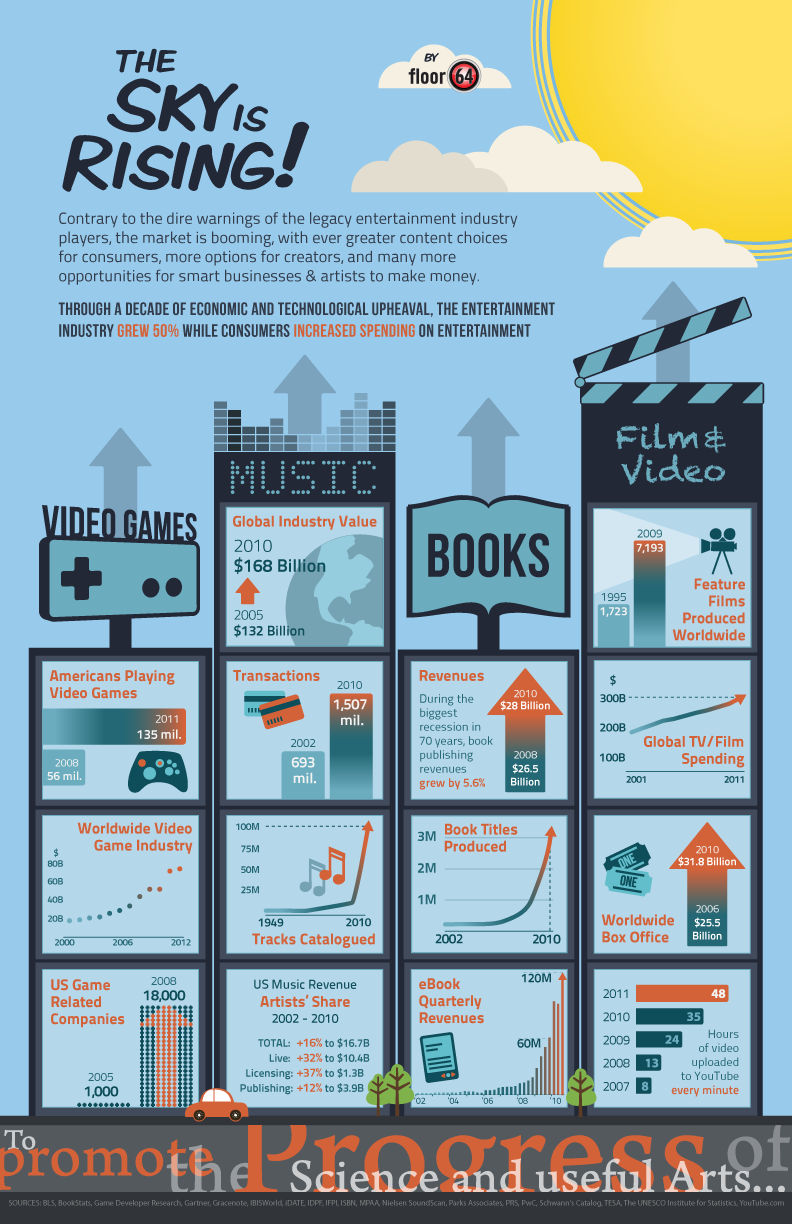
The Sky Is Rising Infographic

A new report says that a decade of web piracy has not hurt creativity at all, far from it

And this is exactly what a new report (or infographic for those that don’t want to read), titled The Sky is Rising, is looking into – the actual impact that a decade of web piracy has had on the creative industries – books, video games, movies and of course, music. And the results may be surprising, at least to those calling for tougher action on the web piracy “problem” with the aim of protecting the “incentives” for creativity. But far from the doom and gloom that the lobbyist have been telling politicians, it seems this has been a decade *for* creativity. More books are being produced than ever (not a surprising conclusion, thanks to online services that now allow anyone to sell their books), and thanks to services like iTunes and Netflix, the average consumer can get access to more movies, TV shows and music than ever possible. Even the video game boom of the 2000’s has somehow managed surpassed the great video game boom of the 80’s and 90’s, if not in quality of games (Skyrim and a few others excepted), than at least in quantity and revenue. Smartphones have revolutionized the way software is sold through small, cheap apps that almost any developer can publish and profit from (yours truly included) , and thanks to the Humble and other bundles (and Steam), the indie game industry have never had it better. And then there’s YouTube, and the hours upon hours of original videos that are uploaded every second to the site. Of course, a lot of the benefits from this particular boom time has not benefited the traditional gatekeepers of content, your major movie studios and music labels. Which is not necessarily a bad thing. To say that what’s bad for your Universal’s would be equally bad for the artists that continue to create, would be at the very least simplifying the issue at hand, if not an outright lie.

Now, I wouldn’t go as far as saying that web piracy has enabled all of this. In my opinion, web piracy provides benefits to creativity, by allowing content to be consumed by more people than ever, but it does have a negative financial impact too. But to cripple the Internet and to use drastic measures to attempt (but ultimately fail) to solve the web piracy problem, may end up hurting creativity, and providing little if any financial gains. Internet based platforms that empower individuals to publish original content may very well be the ones hurt most by draconian copyright laws, and so solutions that herald themselves as saviours of creativity, may become its worst enemy. The strange thing is that if this happens, if creativity on the Internet is killed off by the likes of SOPA and PIPA, it’s the traditional gatekeepers that may be the beneficiaries, despite not having actually stopped the web piracy problem. And maybe this is what they were hoping for all along.

It’s always worth remembering that the main principle behind copyright is not to protect profits, and certainly not the profits of license holders and gatekeepers who are usually not the creators of content. Copyright has always been about protecting innovation, the public’s need to be able to participate in cultural and informational exchange, and the encouragement of creativity. And the Internet, even including the unsavoury elements, have largely helped this cause, even if the likes of Sony and EMI have not been the primary beneficiaries of these changing times.

And so this brings us to two stories that somehow bring together the odd pairing of Neil Young and Angry Birds, but both carrying the same message, that maybe the positive effects of piracy can outweigh the negative effects. Neil Young spoke at the D: Dive into Media conference about the effects of web music piracy, and it appears the the music legend is not at all concerned (and more worried about the poor quality of said illegal downloads, than anything else). Young theorizes that web piracy is basically the new radio, a new way for music lovers to listen to new songs for free, and a great way for musicians to promote their new music. There are parallels in history that supports Young’s theory, in that the music industry was very much up in arms against radio when it was first introduced, just like they were up in arms about people making mixtapes when cassette tapes was first available. The technology may be new, but the music industry’s response isn’t.

Before web piracy, the choice for someone may have been to consume (listen, play, read, watch …), or to not consume – based on what they can afford, and what they think they like. Promotional activities back then were all about getting people to choose to consume, and these promotions usually involved a huge financial cost to buy air time, ads, generate hype and the like.

In the Internet era, and thanks to piracy, consumers now longer have to make this sacrifice – they can get it for free, if they can’t afford it, and if they hear bad reviews about something, they can still check it out without the need to be an idiot and pay for it. And promotions and hype are generated organically as a result, for good stuff, or stuff so bad that it becomes good.

But my point would be that as long as people are still spending money and spending more every year (and by all accounts, courtesy of The Sky Is Rising report, this has been the trend), then does it really matter how much they’re getting for free? Or rather, it does matter, because this is perhaps when piracy actually becomes a discovery tool, helping people to discover things they never thought they would like, and eventually encouraging them to spend money on things they never thought they would.

Angry Birds

Angry Birds developer says piracy isn't a problem as long as it helps build the brand and win over fans

And if publishers really want to get pragmatic about web piracy, then it should all be about weighing the positives against the negatives, the potential loss of short term revenue, versus the potential discoveries made by people that probably never intended to buy – in other words, does it help to build the brand? And according to the developers of Angry Birds, Rovio, this is exactly why piracy may be helpful. Rovio’s chief executive Mikael Hed makes a great point about differentiating between “customer” and “fan”. A fan may not have been a customer (thanks to piracy), but it does not mean they won’t be a customer in the future. And similarly, just because someone buys something and become a customer, it doesn’t mean they will continue to be one if you put out inferior product after inferior product, all glued together by a botched DRM, for example. And Hed concludes that by growing the fanbase, even if some of it is done via piracy, will help to grow the business. Lose those fans, through ridiculous pricing, DRM, attempts to coerce legislators into passing new draconian laws, and see you business crumble.

Hed does mention that Rovio learnt a lot from the music industry about what *not* to do in regards to piracy, but I think maybe there’s another company that’s more closely related to what Rovio does, that they can also “learn” from. Ubisoft will next week put on a public demonstration of just why their DRM sucks and sucks so hard, as the company’s planned move of web services from a third party provider, to their own infrastructure, will mean a lot of their games, including single player ones, won’t be available during the transition. Almost all of their online based games will be affected, and half a dozen games, including Assassin’s Creed, Splinter Cell Conviction and Tom Clancy’s H.A.W.X. 2, will be totally unplayable, online or offline, thanks to the DRM requirements.

So not only were Ubisoft short-sighted to not see the need, from the get go, to have their own web service infrastructure despite the overuse of web based DRM, they apparently does not possess the technical knowhow to offer a smooth, disruption free, transition either. If this is what a planned outage is like, I would hate to see the kind of damage an unplanned outage can do – even Amazon took a week to completely fix their cloud services outage last year, and they actually knew what they were doing. As expected, people with pirated versions won’t be affected at all – has there been a game company that has done more to promote piracy than Ubisoft? The Pirate Bay should give them an award or something …

Unfortunately, talking about games has only made me think of Skyrim, and I’m afraid I will need my fix again pretty soon. So on that note, see you next week.

Weekly News Roundup (29 January 2012)

Sunday, January 29th, 2012

Welcome to another edition of the WNR. I hope you’ve had a good week, that the FBI hasn’t stormed your home, seized your prized car collection and that you haven’t had bail denied by a judge. Me? I’ve somehow talked myself into getting a (admittedly cheap) copy of Skyrim (on the PC, of course), despite knowing that I really don’t have the time to play a game that has managed to destroy millions of hours of productivity since it was released. But curious as to what the hype was all about, I  talked myself into playing “just a few minutes”. 20 hours of Skyrim later …

Quite a bit to get through, and with the steel ingots and leather strips not making themselves into armor and requiring my urgent attention, let’s get started!

Copyright

The fallout from the Mega story last week continues, as file hosting websites scramble this week to “clean up” their services, or simply to shut up shop.

This is probably what federal prosecutors, and the content holders urging them to take action, had been hoping for. With thousands of illegal download links now put out of commission, some permanently, it does seem like a major victory in the war against web piracy. Although whether this actually leads to any revenue increases, the whole point behind stopping piracy, time will tell.

For the music industry, this is the second major breakthrough against web piracy in just over a year, along with October 2010’s closure of LimeWire. But it appears that despite what the NPD calculated to be a 46% decline in the number of downloaders shortly after the LimeWire closure, and with less songs downloaded per individual when comparing to the same period a year ago, music revenue for 2011 hasn’t actually increased much at all. In fact, it remains 3% down compared to 2010, when LimeWire (up until October at least) was fully operational. The rate of decline has slowed, but you would think that with such a dramatic decline in piracy rates (nearly half of the people downloading pirated music were using LimeWire to do it just before it was closed down), and the RIAA’s warning of billions upon billions of damage caused by piracy, that it would have at least helped the industry get back into growth. So it will be interesting to see, now that piracy through file hosting services has decreased, what effect it actually has on revenue.

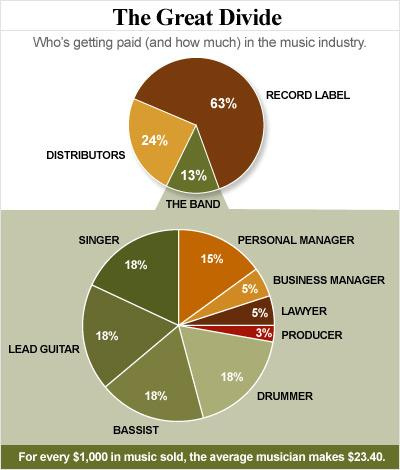
Record label vs artists profits

Apparently, only $23 out of every $1000 made on music sales actually goes to the musician, on average (source)

This is of course assuming the main aim behind the targeting of Megaupload was in fact to do with piracy, as it was noted this week that Megaupload was already making plans to take on the music industry head on, in plans that could cause the major labels more damage than piracy ever could. The plan involves a new website called Megabox, which allowed unsigned artists to completely bypass music publishers, and market directly to music fans, with 90% of the revenue going back towards the artist. Even free (ie. pirated) downloads would generate money for the artists, as Megaupload promised to share the very income, earned from downloads, that got them into trouble last week. And if Megabox works, then it would have been a big blow to the majors, and would have seriously questioned their relevance in the age of the Internet, when “naturally” generated hype is more valuable than any kind of promotion that labels could come up with. And with technology enabling artists to sell directly, without having to invest a lot in infrastructure (or they can leave it to tech companies to handle that side of things), artists no longer have to see a majority share of their revenue going to record labels. If there’s one thing the labels fear more than web piracy, it’s this, and while it might require one to be wearing a “tin-foil-hat” to think that this was the only reason behind the Mega take-down, it’s probably a nice little bonus the record industry got out of the whole thing. But while the likes of the RIAA can stop Megabox, they can’t stop innovation and progress, not forever, and a major shift in the way content is packaged, sold and distributed is on its way, if it isn’t here already.

While the Mega stories were very much dominating the headlines, the temporary demise of SOPA was still on people’s minds. One of those minds was EMI’s VP of Urban Promotions, Craig Davis. In a Q&A session with the Reddit horde, Davis expressed largely personal views that seemed to differ quite a bit from the general line of thinking coming out of the music industry these days, in that legislation is the only way forward to deal with the web piracy problem. Perhaps highlighting the internal divisions within the music industry on how to handle the web piracy problem (something we don’t usually get to see, with the RIAA’s loudspeakers drowning out all other opinions), Davis personally opposes SOPA, and says that piracy is more of a service issue, than a pricing one, mirroring what Valve’s Gabe Newell said a few months ago. In fact, Davis specifically mentions Newell as having the right idea when it comes to fighting web piracy. By focusing too much on the pricing issues behind piracy, major content holders often come to the conclusion that there is no real way to “compete” with pirated downloads, as they could not offer their content for free (although I would argue that piracy itself carries a cost, in terms of legal risk, technical and safety issues, and a moral cost, and so for legal content to compete, it does not have to be free, it only needs to be seen as good value). But by concentrating on service, innovation, basically by making legal options more attractive in more ways than just on price, then “legit” could compete with “free”. And perhaps Newell’s Steam could offer guidance to the music, and movie industries as to how to best leverage the positive aspects of the Internet, and how to compete with piracy – Steam’s legendary sales, it’s active community of gamers, and value added features, all help it not only compete effectively with pirated downloads, but also traditional retailers.

But innovation always carries a risk, a risk that, historically, the music and movie industries havn’t been willing to accept. Whenever something new hits the block, whether it’s home audio taping, or VCRs, these industries have resisted change and has tried to sue their way out of the problem. Eventually though, they did accept that change was inevitable, embraced innovation, and has come out better for it. But what’s different this time though is the incredible power lobbyists now hold over elected officials and the systemic corruption in D.C., and this now offers entrenched major content holders another “solution” – to legislate their way out of trouble. Most in D.C. have  gotten so used to using money to buy policies, that they no longer sees anything wrong with it. Which is probably why former US Senator, and current MPAA head, Chris Dodd was so transparent in his attack against political opponents of SOPA, literally threatening to stop writing checks for them come election time. That he simply didn’t see any problem with the head of a lobby group threatening to stop paying politicians if a favourable law wasn’t passed, shows just how “comfortable” the Washington crowd has gotten with the way things are done over there (or it may just be because Dodd is stupid). But while Dodd may not have felt that there was anything wrong with his statement, others did, and using the same tactic that has already worked against SOPA, people are signing a new petition on the White House’s “We the People” petition website to ask for a full investigation of Dodd for bribery. With 25,000 signatures required within 30 days for the White House to officially issue a statement on the petition, 30,000 signatures were promptly recorded in just a week (that’s the Internet for ya). The fact that the White House will now have to issue on statement of Dodd’s alleged improprieties, regardless of what the statement actually says, should be hugely embarrassing for the MPAA Chairman. Or it could be much much more serious.

Anno 2070 Screenshot

Anno 2070 looks great, but just pray that you don't need to change your GPU, or the game's DRM could lock you out

With so many big issues being discussed, trust Ubisoft to still somehow steal the headlines via yet another incident with one of their controversial DRM choices. When review site Guru3D went about using Ubi’s Anno 2070 in a hardware benchmark test, they found that the 3 PC activation limit also applied when the GPU was changed, and so having barely started their test, they had used up all of their activations. Having calculated that they would need 7 copies, or 21 activations, to finish their testing, Guru3D contacted Ubisoft about this potential “bug” with their DRM, but Guru3D were promptly told that not only was this normal and intentional, Ubisoft wouldn’t be providing the 7 copies needed to finish their testing. So Guru3D did what any self respecting website would have done – they published the entire detail of their ordeal for the Net public to judge, and the expected public backlash eventually forced Ubisoft to back down and allow for GPU changes. Ubisoft came out with the usual statement saying that very few people were affected by this particular problem with their DRM, which is probably true considering the game only came out in November, and I don’t think many would have changed their GPUs twice during this period. But the problem with DRM is that it’s forever, so were Ubisoft really expecting PC gamers, of all people, to not frequently change their GPU or other parts of their hardware? Or maybe they just didn’t think their games were that good for people to be still playing it for more than a couple of month. For now though, while GPU changes are exempt from requiring new activations, other hardware are still being included, and so don’t be surprised if this problem pops up again at a later date.

Gaming

And on that note, we move to gaming. For some reason, all the Xbox 720 rumours decided to out themselves this week.

Of course, there cannot be an Xbox rumour without mentioning Blu-ray, and the next Xbox (which I hope will be more imaginatively named than “Xbox 720”) will apparently have a Blu-ray drive. Whether it plays Blu-ray movies or not, remains to be seen though, since the Wii U will have a “Blu-ray like” drive, that won’t play movies.

Xbox 720 Mockup

Just one of the many Xbox 720 mock-ups floating around the net

On the GPU front, a Radeon 6000 series chip might be used. This actually feels too “new” of a chip for a console that’s supposed to be released next year, since the Wii U is only using a Radeon 4000 series. The reason why console manufacturers use older chips, other than the maturity of the product line, is due to the time it takes to engineer an existing off the shelve solution for a game console, the cost involved in using the state-of-the-art GPU, and the fact that optimizations mean console GPUs don’t need to be as powerful as their PC counterparts.

The most controversial rumour involves Kotaku’s reveal that the next Xbox could ban the playing of second hand games. Publishers have long complained that second hand games are cannibalising sales, as gamers can “share” the same copy and game stores profit from each transaction – only one payment from these transactions is made to publishers, right at the start. Publishers have come up with various ways to solve this problem, for example, a voucher system (but that don’t really works for limiting the multiplayer component of games). So if Microsoft really wanted to please publishers, and get them to release more exclusives for the platform, then having a system that ensures second hand games won’t work will do the job. Although I think this will backfire and hurt sales, and the platform, in the long run.

Nothing much more happening this week, at least no in the real non-Skyrim world, so we come to the end of another WNR. See you next week.

Weekly News Roundup (22 January 2012)

Sunday, January 22nd, 2012

Welcome to this Chinese New Year(‘s eve) edition of the Weekly News Roundup – the CNY(e) ed. of WNR, if you will. The alphabet soup continues, with more news on SOPA, PIPA, and a big one about MU, so with little time left in the year of the Rabbit, let’s get started.

Copyright

In another week in which the copyright related headlines dominated the news, we start with reaction to last week’s White House statement on SOPA. The reaction from none other than media mogul Rupert Murdoch.

The controversial media owner wasn’t afraid to be controversial when it came to talking about the SOPA/PIPA controversy, accusing Obama of being beholden to his “Silicon Valley paymasters”, and calling Google a “piracy leader”. But for many, the fact that Murdoch is supporting SOPA/PIPA, is probably enough to push them to the other side of the debate.

Wikipedia Blackout

Wikipedia, and thousands of other websites, blacked out their content for most of January 18 - a protest that got the attention of DC politicians

Which is probably why so many joined in on the January 18th day of action, which saw websites, including this one, black out their content to protest the votes on the controversial bills scheduled for 24 January. Even the newly obtained Righthaven.com, obtained via court appoint receiver auction last week, joined in the fun with a hilariously redacted letter to the MPAA (still not quite sure what the squid is all about). While thousands of websites joined in, the website that had the most influence on proceedings was probably Wikipedia. The website took the unprecedented step of blacking out all of their English language pages for 24 hours. When it was all over, and with everyone realising just how important Wikipedia has become in their lives, many also found out just exactly what SOPA was and what it could do. Some have criticized Wikipedia for participating in online activism, when the online encyclopaedia is supposed to be position neutral. This may be true, but when the very environment under which Wikipedia exists, and its own existence comes under threat, then there may be a need for a bit of activism. With people flooding elected official’s websites, emails, phone lines, calling on them to not support SOPA/PIPA, the power of the Internet was on full show.

And the protest seems to have had an almost instant effect, with key supporters of both SOPA and PIPA pulling out, and it became apparent pretty aoon that both bills were, in effect, dead in the water. With the 24 January deadline coming ever closer, the two sponsors of the bills, Rep Lamar Smith (R-Texas) and the senior senator for Vermont, Patrick Leahy, decided to postpone both bills, indefinitely. It was a political necessity, as they would say, for now at least. Chances are, the same bills with only minor changes, and very likely with different names, will be reintroduced at some later point when the heat dies down, but for now, this was still a major political victory for the Internet. The tech sector, who have largely stayed out of the political arena, may have also realised the power of lobbying – whether this is a good thing or a bad thing, that remains to be seen. It’s an unfortunate reality in today’s political environment that political lobbying is so effective, but for too long, politicians have only been hearing one side of the story, and perhaps this will help even things up a bit.

Of course, the MPAA was fairly incensed at both the blackout, and the fact that their bill, and I’m using “their” correctly and intentionally, was sunk. Chris Dodd, who has had a difficult learning period as the new Chairman of the MPAA, came out attacking the blackout as a “dangerous gimmick … designed to punish elected and administration officials who are working diligently to protect American jobs from foreign criminals”, obvious inferring that politicians against SOPA/PIPA are negligent in their duties in stopping criminals, and playing to the xenophobic crowd, added the quantifier “foreign” just in case. Dodd also attacked the decision to pull the bills, again using all the right keywords, describing the entire Internet as a “safe haven for foreign thieves”. And showing his experience as a Washington player, Dodd warned his former colleagues not to “ask me to write a check for you when you think your job is at risk”, demonstrating in one sentence the undue influence of money in US politics, and the entertainment lobby’s masterful manipulation of democracy through it.

MegaUpload Seized

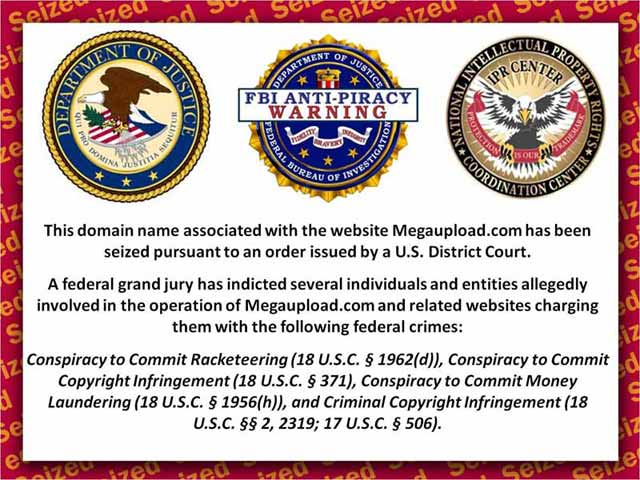
MegaUpload's domain has been seized on order of Federal prosecutors, who say the website engaged in racketeering and money laundering

But before the champagne bottles had emptied, an even bigger story broke, as it was revealed that Megaupload, one of the web’s largest properties, had been shut down. In a simultaneous, multi-national, law enforcement action, involving FBI agents in the US, and law enforcement in the Netherlands, Canada and New Zealand, servers were seized, offices raided, an the founder of Megaupload and some of his employees were also arrested. In the court documents filed so far, incriminating emails (that were obtained, somehow) showed that the people running Megaupload were well aware of the nature of their service, in that it was being used by pirates, and sought to continue to profit from the activities. But then, only an idiot, or maybe a DC politician, won’t have known what Megaupload was all about just by searching for a few MU links on Google.

I’ve not had a look at all the emails, only some of the more serious ones being posted here and there, but to me, this whole MU case strikes me as a civil matter, not a criminal one. For example, what makes MU different enough to the ongoing MPAA vs Hotfile trial – if anything, Hotfile appears to be even more “guilty”, as they were paying pirates directly based on the popularity of their uploads. And as for incriminating emails, we’ve seen it all before in the Viacom vs YouTube case – despite the existence of these so called  “smoking gun” evidence, as Viacom liked to call them, Google/YouTube eventually won the case on DMCA Safe Harbor grounds. So for those that are saying the government’s case against MU is rock solid, I think it might be a bit too early to judge, as the legal documents revealed at this stage only shows one side of the story, the government’s side. When MU provides their version of events, things might no longer be as black and white, and their lawyers might just cloud the issue enough to make the most serious criminal charges (like the racketeering and money laundering charges) go away.

And their version of events might just include testimony from the many that used MU’s service legitimately, and most are pretty angry at the excessive amount of force and haste the government seems to have used in taking down MU. You cannot deny that MU had substantial non-infringing uses, and that could provide MU protection under the Betamax verdict, but it all depends if the infringing aspects are enough to negate MU’s legitimate uses, and how complicit the owners and operators of MU were.

I also think part of the strategy here is to scare the rest of the online storage industry into taking copyright enforcement more seriously, even if the government doesn’t ultimately win the case against MU. With SOPA/PIPA on hold for now, online storage services will need to take a good look at the DMCA, and make sure their compliance is genuine. That should be enough to keep the FBI away, for now, while most likely, tons of pirated content would still exist on these sites.

So a lot happening, and perhaps too much to digest in such a short period, but I’m sure both SOPA/PIPA, and MU, will be occupying the headlines for a while yet.

And on that note, we come to the end of this rather short WNR. Nothing left to say except, Xin Nian Kuai Le, Gong Xi Fa Cai (Happy New Year , Congratulations and be prosperous).

Weekly News Roundup (15 January 2012)

Sunday, January 15th, 2012

Just as I predicted, this last week turned out to be quite a busy one. On top of the CES announcements, SOPA developments, there was also the latest NPD figures, for video game sales in the United States for the month of December. I wrote up the analysis of it yesterday, and the consensus seems to be that the video game industry is in trouble. Sure, December sales were quite disappointing, notably for Nintendo, but if you add up sales for both November and December for the other two companies, sales were actually up compared to a year ago. The Wii’s decline is not totally unexpected though, an innovative control system aside (which is no longer unique, or the most innovative), the other parts of the system, particularly the online and multimedia parts, are just not good enough any more. People now expect game console to do more, thanks to the healthy competition between the Xbox 360 and the PS3, and the Wii simply no longer delivers.

There’s plenty more to through though, so let’s not waste more time.

Copyright

In copyright news, we start with an update to last week’s story about Reddit’s campaign to dislodge Rep. Paul Ryan for his SOPA support. With the campaign only just starting, it’s already had an immediate effect, with Ryan this week coming out with a definitive statement on SOPA, and promising to vote against the bill if it comes up in the house.

But the Pull Ryan campaign is not about to unveil a “Mission Accomplished” banner on an aircraft carrier, not just yet, as the movement seeks to expand its goals to force other legislators to take the same stance.

Recent developments may mean Ryan’s new stance may change once more, now that the backers of the bill, Rep Lamar Smith (who, this week, has been caught in his own copyright scandal, as his website may have committed a copyright violation in regards to the use of an image), and his Senate counterpart, Sen. Patrick Leahy, have signalled their intention to remove the DNS filtering provision of SOPA (and PIPA). There’s no denying this is a victory in the ongoing fight against SOPA, but it’s also a wise political move by Smith and Leahy, by removing the most controversial section of SOPA, the one area in which there seems to be universal opposition to (apart from the likes of the MPAA, of course, which came out defending DNS filtering). And in typical Washington fashion, the door was left open for DNS filtering to be put back in, at some later time when people might not be as worked up about SOPA as they are now.

In other words, the fight against SOPA continues, because as bad and dangerous as DNS filtering is, the other parts of SOPA (and PIPA) aren’t much better either. Even with DNS filtering removing, the bill would still give the government, and the entertainment industry, way too much power to take down websites, block IP addresses, sue website owners, financially assault websites, and force search engines to censor the Internet. Don’t be fooled by this latest back down – the fight must continue!

The White House

The White House replies to petition calling for opposition to SOPA, with vague messages of support for the anti-SOPA movement

In late breaking news, which I’ll cover in more detail next week after some more careful analysis (hah!), remember that petition that more than 50,000 people signed on the White House website asking for SOPA to be opposed? The way the White House’s petition website worked is that, if a certain number of signatures were recorded, the White House promised they would release an official statement on the petition topic. And just today, the White House did just that. Some sections of the media have already reported this as a big win for the anti-SOPA movement, but having quickly read the response, it’s not exactly an overwhelming rejection of SOPA, nor is it a promise to veto the bill by the President’s office (and to be fair, neither of these responses was likely to be forthcoming from a White House that has been pro-copyright from day one). The only part of SOPA that the White House clearly comes out against is ironically the part that has just been removed – the DNS filter provisions. The direct quote from the response on DNS filtering is as follows:

Our analysis of the DNS filtering provisions in some proposed legislation suggests that they pose a real risk to cybersecurity and yet leave contraband goods and services accessible online. We must avoid legislation that drives users to dangerous, unreliable DNS servers and puts next-generation security policies, such as the deployment of DNSSEC, at risk.

The rest of the response provides only vague clues about the White House’s official position on SOPA, with promises to continue “vigorously defending an open Internet based on the values of free expression, privacy, security and innovation”, but also containing phrases like “existing tools are not strong enough to root out the worst online pirates beyond our borders”. For what it’s worth, the organizer of the petition and random signers are being invited to a conference to discuss the issue further, a bit of good PR, but the cynic in me still believes one or both of SOPA and PIPA will get passed, with most of it intact, and once the storm blows over, the rest will get added back in.

But if the SOPA impasse continues, Sega may have found a new way to solve the problem: do a hard reset! That was the answer given to a gamer via email when he asked Sega what their position on SOPA was, you know the generic tech support answer for solving an unknown problem: reboot. It’s unfortunate that Congress and the Senate can’t be rebooted, not until November anyway.

nojellyfish

This is the mysterious image that now appears on the home page of righthaven.com, after it was sold at auction to pay off the firm's debts

In the latest Righthaven development, the firm’s domain name has been sold for $3,300 by the court appointed receiver to the Switzerland based Stefan Thalberg. The domain name now points to a website with the intriguing title “Take Back the Right(Haven)”, and with the even more tantalising hint (which can be viewed via the HTML source code) of “Does your current provider possess a spine?”. Time will tell what it all means. Meanwhile, more of Righthaven’s assets will be put up for auction soon, as the appeals court rejects the firm’s last minute pleas for mercy.

Last week, I reported on the way the MPAA report piracy losses, and how they may be double or even triple counting losses based on figures that were already exaggerations. The MPAA strikes back this week, by claiming triple counting is a perfectly reasonable way of counting piracy losses, and once again compared piracy to shoplifting. The MPAA also attacked tech blog Ars Technica for ‘Challenging Efforts To Curb Content Theft’, which might just become illegal if SOPA is passed. Of course, blogs like Ars Technica, TorrentFreak, and even this one, do challenge efforts to curb piracy, but only those that are simply unreasonable – whether’s it’s intrusive DRM, or taking away people’s rights to free speech and privacy, or suing individuals for millions of dollars. The MPAA would be wise to not equate opposition to unreasonable copyright protection, to opposition to all copyright protection, because if they come up with a reasonable model to reduce piracy, for example, by making content more available, with less restrictions, and at the more reasonable price, the kind of things that people have been calling for, then we would not oppose them. And it’s exactly this kind of hyperbole, the “you’re either with us or against us” attitude, the “billion dollar” worth of damages that they keep on quoting (despite their rebuttal clearly stating they know exactly what those figures they keep on quoting actually means, that they are used as a measure of change in activity, rather than actual estimated losses), the use of the term “theft” when “potential lost sale” is a much more appropriate term (theft, including car theft and shoplifting, usually doesn’t leave the original item untouched), which makes people dismiss the industry’s attempts to find a solution to the web piracy problem. But maybe the truth is just not as sexy, but rather paints a picture of a well off industry that creates most of its own problems by being too reluctant to embrace change (remember when the MPAA came out comparing VCRs to the Boston Strangler, or when the RIAA said home taping would kill the music industry?).

And ignoring research which doesn’t fit into their agenda isn’t helping either. When NBC Universal hired research firm Envisional to conduct research on the effects and causes of web piracy, the firm came up with some conclusions that did not fit into the usual message about web piracy (in that web pirates are criminals, robbing the poor old struggling entertainment industry of money and jobs). They subsequently chose to cherry pick the parts of the research that they did like, so they could continue on with their Chicken Little “sky is falling” scare campaign, ignoring the most poignant aspects of the research results. What Envisional found was that the industry themselves were to blame for a lot of the problems associated with web piracy, such as the lack of legitimate content, the lack of support for overseas markets, and pricing problems. And at the CES, Envisional’s head of piracy intelligence, David Price, reiterated the fact that the industry has to do a lot more before it can blame everyone else for their woes. Price cites Netflix as the right way to combat piracy, as it’s already had a huge effect on the number of people using BitTorrent networks, but only in the United States where the service has only been available until recently. Netflix, just like iTunes, has come about by not fighting the Internet, but by embracing what it brings, and it’s interesting that neither solutions were industry created solutions, but comes from the same tech sector that the entertainment industry now want to curb via legislations such as SOPA. The industry’s fear of change has only benefited those that dared to innovate, it seems.

Steam Ripoffs

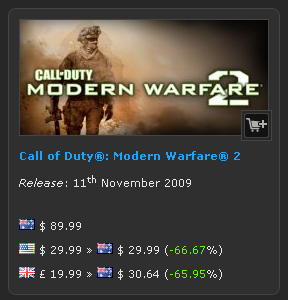
Australians are expected to pay $60 more for some games due to greedy publishers

And it’s not just fear, but greed also, that’s contributing to their downfall. Instead of making legitimate content as widely available as possible, for reasonable prices, movie and TV studios have tried using DRM, region controls and other methods to divide up the world into multiple markets, so they can extract as much money from each market as possible. While this brings them more money in the short term via exclusive and timed deals, the real effect is that some consumers no longer have the legal option to obtain new content in timely fashion, and at a price that’s fair. For example, here in Australia, we have to wait months for new episodes of TV shows to get down here, and for games, we have to pay double or sometimes triple the prices people pay in the US or the UK. Before the Internet, people simply just had to put up with this. But there are so many choices now, and the so the real long term effect of their short term policies has been to push people toward these alternatives. VPNs allows Australians to access US content faster and cheaper, while overseas shopping websites allow imports at reasonable prices, taking away business from local retailers. And of course, there’s piracy, illegal as it may be, but still an alternative for many.

And things like DRM, region control, and even legislations like SOPA, have been the industry’s response to people’s acceptance of alternative choices, and the industry continues to hamper the new legal alternatives (such as having release delay windows for Netflix and Redbox) under the guises of fighting piracy. All in an ultimately vain effort to protect their dying business models, by attempting to put the genie back into the bottle, by rolling back innovation.

High Definition

At the end of the day, money talks (as we stealthily move the discussion to the high def section). DEG (The Digital Entertainment Group)’s latest home video figures confirm exactly what I’ve just been talking about, that the Internet has drastically changed the way people consume content, and it’s only going to get “worse” for the industry if they do not adapt. Digital distribution revenue was up 55% for 2011, while physical media sales were down 13% – the industry’s revenue as a whole declined 2%. The revenue now earned by the likes of Netflix and Redbox could have easily been retained by the studios themselves, if only they had the foresight to see the potential of the Internet.

And even when the industry tries to innovate, like with UltraViolet’s cloud based movie storage, their own greed and insecurities are again their biggest enemy. UltraViolet, something that I think almost everyone agrees is a good idea on paper (the ability to buy a movie, as opposed to the media it comes on, and having a cloud stored copy that you can download or stream to your multiple devices), has been crippled by DRM, with each studio greedily attempting to promote their own distribution service, as opposed to working together on a single platform to make it easier for consumers. Just the fact that Disney is going out on their own and coming up with their own digital locker service, as opposed to joining the UV coalition like the other five major studios, shows how insecure and greedy they can be. It’s not exactly Blu-ray vs HD DVD, but it may actually be worse, with each studio preferring their own distribution service for UV (or their own version of UV), whether it’s WB via Flixster, Sony via the PSN (maybe), or the unknown studio that has just teamed up with Amazon – when the sensible solution is to use Netflix (and iTunes, if only Apple could have been convinced to join the UV coalition) or to come up with a new distribution service all UV partners would use. Netflix, sensing the confusion, may actually be withdrawing from the UV coalition, possibly to pursue their own version of the service (which all the studios will probably have to use when they’ve managed to destroy UV due to their own selfish interests).

Samsung BD-E6500

Samsung's new Blu-ray player will be able to "convert" discs to digital, on the UltraViolet platform

Still, UltraViolet was a big topic at the CES. The most interesting announcement so far, other than Amazon’s participation, was the Samsung Blu-ray player that would somehow convert discs to digital. People can insert their favourite movie, and through a couple of clicks of the remote, buy or redeem the UltraViolet version, with technology that would be able to tell the difference between a legitimate store bought version, and rental/pirated versions. I don’t think charging people for yet another version of a movie they already own would be that popular, since I think if the best idea behind UltraViolet was the one that allows people to finally buy movies, instead of a version of the movie on a particular media. In my opinion, people who already have a legitimate DVD or Blu-ray should be given a free copy in the UV cloud. This may be hard to achieve though for existing discs, since many lack an unique identifier that can prevent a group of people sharing a single store-bought copy, and then getting the UV version without paying for the content, but surely this should be possible for all future copies pressed. Just add an unique identifier for each disc that can be linked to your single UV account (with each UV account being able to support multiple devices you own/have access to), and once that disc is inserted, the Blu-ray players reads the identifier, automatically registers online with your UV account, and your UV copy is available to use. It shouldn’t be any more difficult that that, really.

Make it easy for the consumer, and the money will come.

And on that note, we come to the end of another WNR. Hope you’ve enjoyed this one, and see you next week.