Archive for the ‘News Roundup’ Category

Weekly News Roundup (18 November 2012)

Sunday, November 18th, 2012

Welcome to the pre-Black-Friday-Deals-Week WNR. I went kind of crazy with last year’s Amazon BF Blu-ray sales, obsessively listing and updating the latest Blu-ray deals despite almost nobody, other than myself, actually reading what I was writing. This year’s discount calendar has already been leaked, but there’s almost nothing there that actually interests me, so I don’t think I’ll be as obsessed as I was last year. It also helped that most of the good Blu-ray deals last year happened at a good time zone for people here in Australia, and that most of the discs listed were region-free (this time, there seems to be quite a few Fox Blu-ray deals, which are all region-locked). Amazon UK is doing their BF thing as well and I’ll check them out, but stock seems to be quite limited last year, although this only makes it more exciting in my opinion.

News was a bit more plentiful this week, so let’s get started.

Copyright

The RIAA has responded to a recent report that found P2P users, those that downloaded a lot of pirated music, were also bigger spenders generally. Instead of denying the link, something that’s hard to do when other studies back up the same assertions, the RIAA appears to have created their very own straw man argument, that P2P usage is not the *cause* of increased music spending.
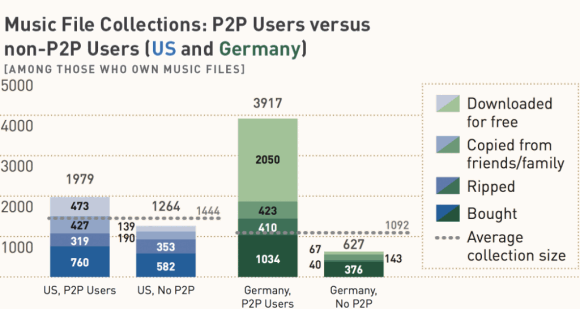
American Assembly - Copy Culture Survey - Music File Collections: P2P Users vs non-P2P Users (US And Germany) Source: American Assembly

The RIAA responds to American Assembly’s Copy Culture Survey, claiming there’s no causation link between P2P usage and increased purchasing (not that a lot of people made those links)

I’ve read a few articles that reported on the issue, as well as writing and commenting on the story myself, but at no point did I find an article that seem to suggest P2P usage was the cause behind the same user’s bigger spends. What most correctly identified, and a point which the RIAA concedes, is that P2P users were more engaged users, bigger music fans, and so naturally, they also purchased more stuff. Or as I originally wrote when responding to the report, “people who download a lot of music actually love music, probably more so than people who don’t download as much. And music lovers buy more music.”

But now that the RIAA has mentioned it, maybe there is a causation link between piracy and spending. If we take piracy as a music discovery service, than perhaps it’s this unlimited access to music that creates more engaged users, rather than simply a case of piracy being more attractive to already engaged users. Perhaps people whose music experience is limited by their budget cannot ever become as big fans as those that choose to exceed this limit, even if it means doing things illegally.

Regardless of whether this is true or not, the fact is that pirates are also the music industry’s best customers, and marginalising and disregarding this core group might reduce piracy rates, but will not help you increase revenue. It might even do the opposite, especially when the industry is keen to kick these very same people offline.

But one iOS app developer is taking the whole notion of “attacking your customers” to a new level, with their range dictionary apps auto-tweeting to user’s Twitter accounts with a self-confession to pirating the app. The only problem? It’s doing it for users that paid for the app, as well as those that are using pirated versions!

Naming and shaming pirates it not a new thing, but for some reason, these attempts always seem to backfire spectacularly. I guess in the excitement (or anger) of adding this feature, testing the implementation wasn’t the top priority. A tip: if you’re going to name and shame, make sure you’re not the one that ends up feeling shameful.

Piracy is a big problem for app developers, although just like other forms of piracy, I’m not sure if every act of piracy equals a lost sale. But surely pissing off your loyal customers is as costly if not more so than piracy. And then there’s the issue of privacy. Would I trust a developer that developed a secret function to access my Twitter feed, even if it only does it when it detects a pirated copy? Competition is fierce in the app sector, so armed with the knowledge that one app has this privacy issue, and another app doesn’t, I know which one I would choose.

As a side point, that Apple allows this sort of thing to happen (maybe they don’t, and the app developer, Enfour, may get into further trouble for their app’s secret feature) is also slightly disturbing. At least with Android, apps have to list all permissions upfront, and users can choose to disregard any app simply based on the permission list.

——
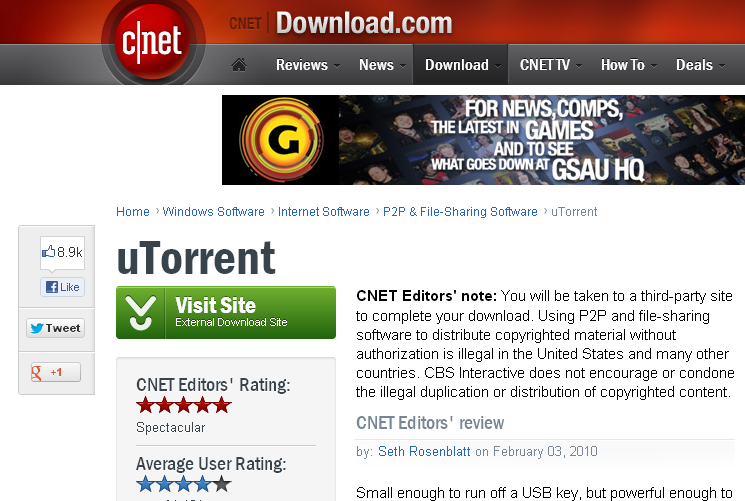
CNET Download.com uTorrent

Alki David’s lawsuit against Viacom/CBS/CNET for distributing LimeWire has now dragged uTorrent and other BitTorrent clients into it, by claiming CNET may be promoting infringing activities by promoting software like uTorrent

David Alki’s lawsuit against CBS/CNET has taken a nasty turn as Alki and his coalition of musicians decide to drag generic BitTorrent clients into the battle as well. In the latest filings, the plaintiffs alleges that CNET’s Download.com is still engaged in the same kind of wrongness as they did with LimeWire, this time by promoting and distributing BitTorrent clients like uTorrent. Even news articles talking up the legal aspect of BitTorrent are attacked for being propaganda pieces to help legitimize something Alki and co. says should be banned.

In the unlikely event that the judge agrees with the plaintiff’s position, this could very well spell the end for other file transfer protocols, including Usenet and FTP. Even HTTP, the backbone of the world wide web (it’s how web pages are transmitted) may be under threat, since I’m sure a significant percentage of HTTP traffic is also related to copyright infringement. In other words, I don’t think Alki and co. have a legitimate leg to stand on with this one.

In fact, when LimeWire was ruled to be illegal, the judgement did not extend to Gnutella or BitTorrent, both protocols that were part of the LimeWire network. Just like how Megaupload’s shutdown did not affect the status of HTTP, which Megaupload relied upon. So until a court rules against every and all BitTorrent clients, they remain perfectly legal.

Shortly after publishing the news article (and writing the above), I received an email from Alki David in which he linked to an interview he conducted with TorrentFreakin response to this latest development in the lawsuit. In the interview, David tries to explain the rationale behind this  latest move. David says that he isn’t against P2P software and software makers at all, but instead, he is against the way Viacom/CBS/CNET on one hand pursues the most heavy handed anti-piracy initiatives, and on the other hand “perpetuating file-sharing for their own gain”.

“Viacom is the same company that lobbied for SOPA and arrests, sues and fines kids like Joel Tenenbaum hundreds of thousand of dollars for downloading a handful of songs. The same people who want to have Richard O’Dwyer extradited from the UK for doing something that in the UK is not illegal!

Viacom is the same company that paid millions of dollars to companies like Media Defender and Artists Direct to monitor and police file-sharing whilst these companies profited from porn sites being exposed to young kids looking for other types of content,” David told TorrentFreak, before adding, “I do NOT think that torrent makers should be held liable. They can distribute but not promote the illegal use of their software.”

While David does make a good point, about the hypocritical stands that big content often takes towards copyright infringement (ie. they think it’s perfectly fine if it’s in their interest, or hoy Sony’s fervent use of DRM to protect CDs and DVDs, despite being one of the bigger manufacturers of blanks that pirates were using), I find it hard to believe that CNET would publish anything other than generic how-tos on BitTorrent, and that their legal department would allow the promotion of the illegal uses of BitTorrent. That BitTorrent clients do have legitimate uses, unlike say LimeWire, means that unless CNET wrote how-tos on how to find illegal music and movie torrents, they’re not really doing anything wrong.

His suggested solution to the piracy problem will surely cause more controversy as well. “I would send the ISP of the websites an invoice for a small fee (say 5 dollars) for each torrent download to give to the rights holders. The ISP would have to collect from the customer or pay it themselves,” explained David.

High Definition

It seems you don’t have to be a victim of piracy on a massive scale in order to lose a billion dollars every year – you can do it by playing to the rules too. According to rival Netflix, Amazon is losing up to $1 billion a year on content licensing. Netflix says they are aware of the losses because they’ve been competing with Amazon with quite a few content distribution deals. For the record, Netflix currently pay $2.1 billion for content every year. $2.1 billion divided by Netflix’s $7.99 x 12 annual fees equal 21,902,377, which kind of makes sense considering the service’s 20-30 million subscribers. Amazon has a lot fewer subscribers, but still have to license the same amount of content if they need to compete, hence the losses. Netflix had the luxury of allowing their content library to grow naturally, Amazon has the more difficult task of having to catch up in a very short period of time.

All of this seem to confirm that, despite their whining about the Internet, it’s boom times for Hollywood at the moment, thanks to competition between Amazon, Netflix and the other players, and some of them overpaying for content just to catch up or gain an advantage over the others.

That’s all folks for the week. Enjoy your Black Friday shopping if that’s your thing, and see you next week.

Weekly News Roundup (11 November 2012)

Sunday, November 11th, 2012

Another very quiet week, no doubt due to the focus on the election and the recriminations afterwards. I didn’t do too badly with my predictions though, 48 out of 50. Technically 49 out of 50, since I changed my mind just before the election and (literally) put my money on Colorado staying blue – so I only managed to get Florida wrong (mainly because I overestimated the Cuban vote for Republicans). I’m no Nate Silver, but considering I was mainly going with gut and educated guessing, I certainly did a lot better than most pundits out there.

Towards the end of the week, the October NPD results came in for video game sales in the US. Once again, not enough data to actually write a full analysis, so I’ll briefly cover it in this WNR. I’m hoping that the Wii U is successfully launched and Nintendo find it reasonable again to provide sales data, which assuming Microsoft continues to do the same, means we might have enough data for a full analysis again. I miss writing the NPD updates 🙁

Onto the news …

Copyright

Having started demoting websites that receive “too many” DMCA notices, you’d think that Google has finally gotten into rights holders’ good books. But as expected, they’re still not happy.

Their protest this time does seem to have some merit though, as a quick browse of some Google search results still show the “majors” (The Pirate Bay, isoHunt, KickassTorrents) still ranking relatively well, at least for certain terms, despite Google having promised that the major piracy sites (the ones receiving the most DMCA notices) would be demoted. Rights holders naturally sounded the alarm, and the first to their rescue has been the UK government, which has launched a review into Google’s latest anti-piracy attempt.

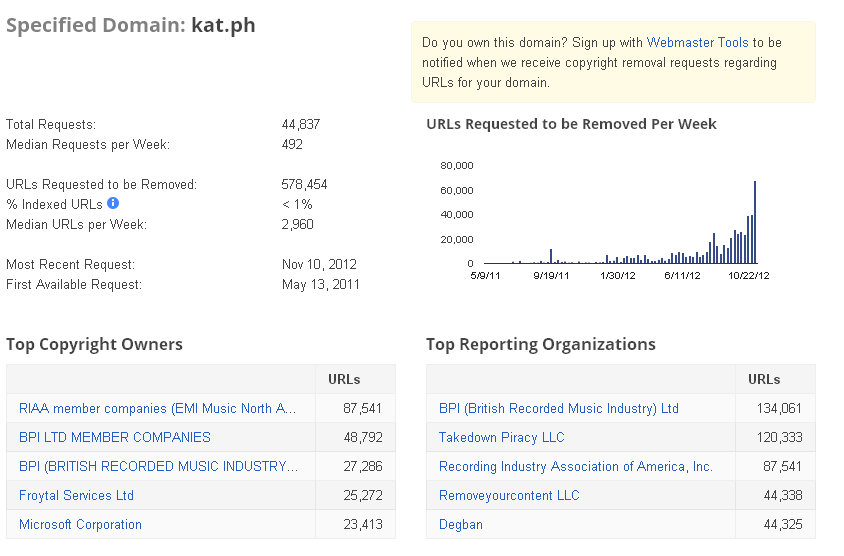
KickassTorrents' Google DMCA stats

KickassTorrents may have received more than half a million DMCA takedown requests, but it only represents less than 1% of their total indexed pages, which may or may not be enough to affect search results

Almost all webmasters will be familiar with the frustration of trying to work out how Google actually ranks search results, and how strange some of the results are, especially when it comes to websites that are clearly breaking Google’s rules and yet still rank highly. Google’s algorithm is so complicated, I doubt any single person working for the Mountain View company actually knows just how it all works. In the article I’ve linked above, I’ve tried to offer a brief overview of how a ranking for a webpage is derived, based on “good” and “bad” quality signals. I would guess that “DMCA notices” would fall into the “bad” quality signal, but it’s only one of possibly thousands of weighted signals, and just because a website has over 1 million DMCA notices, it doesn’t automatically mean that pages on the site will never rank. One of the most important “good quality” signals is user satisfaction, and people searching for pirated movies will be very satisfied by the “majors”, and these websites would also have a lot of relevant back-links, which is also another very important good quality signal. At the moment, it does look like Google may very well need to adjust just how important the DMCA signal is, to avoid torrent sites from still dominating certain search results. In fact, just doing a quick search today seems to reveal a totally new set of results for the same keywords, with the majors nowhere in the top 10 – maybe Google has responded already!

But even if Google does the impossible and removes every single piracy related torrent or streaming site from its index (note that is has never promised to remove sites, only demote them), I doubt rights holders would be fully satisfied. Because deep down they know that, as much as they want to make Google a scapegoat in all of this, Google and other search engines have never been a big contributor to the web piracy problem. Most traffic (probably upwards of 80-90%) to the majors are not search related traffic at all, but from people who already know of the site (called direct referrals).

Rights holders may be hoping that Google can do more to combat torrent sites, but for direct download sites like RapidShare, these site’s own policy of “self-harm” appears to be enough for now. This “self-harm” policy, implemented by many file hosting websites appears to be exactly what the rights holders had hoped would happen when it lobbied the US government to take action against Megaupload. RapidShare this week took the most drastic action yet, by implementing a daily download limit for shared files. For uploaders using free RS accounts, their uploads now have a daily download limit of 1GB, but even those on paid accounts cannot share more than 30GB of files in any given day. Private file sharing remains unlimited.

These changes comes after last week’s removal of the download speed cap, which has been in place since Megaupload’s demise as a way for RS to drive away the piracy related traffic that was looking for a new home. What this change effectively means is that RapidShare has now moved towards (or back to?) being more of a personal file sharing tool, rather than a public one, regardless of whether the content in question is pirated or not. If you need to share a largish PDF file, one that does not contain confidential information with a few people, then RapidShare still works great. But if you’re a software developer and you were using RapidShare to distribute your files, then you need to think again, even if you use a paid account. 1GB may sound like a lot, but for a typical 5MB download (which is actually the average size of downloads on Digital Digest), that’s only 200 downloads per day. If you’re an indie filmmaker distributing your own film … then forget about it!

Of course, RapidShare will argue that their service was never meant to replace proper file/download hosting, which can be quite expensive as the GBs really do add up. But the fact is that many indie content producers have relied on them in the past, and they will no longer be able to do so.

Disregarding the collateral damage, while the anti-piracy effect of this move may be exactly what rights holders wants, but this will only drive indie content developers towards BitTorrent, something that’s already happening. And the “mainstreaming” of BitTorrent is probably not what rights holders want at all.

——

Microsoft Kinect

Will Microsoft use the Kinect camera as a new form of insidious DRM?

An interesting/disturbing patent application emerged this week, one made by Microsoft, in which the company plans to use Kinect to enforce a new sinister form of DRM. The DRM would enforce a new kind of rights management under which users pay not just for a time limited usage of video content (ie. a rental), but would also have to pay for each additional user that watches the video. The patent suggest a way for Kinect to detect how many people are watching, and limit playback or charge the users more when a certain number is reached.

Now, patent applications are a dime a dozen, and most are for ideas that will never become reality, so it’s not really worth getting all worked up about this at all. But you just know that some suit somewhere in Hollywood actually thinks this is a great idea. As consumers, we have to be vigilant and we have to let rights holders know what is and isn’t acceptable – pay-per-viewer is definitely not an acceptable trend.

If anything, the trends has moved away from transaction based rental and purchasing, and towards the all-you-can-eat variety. Adding “viewer based transactions” will be a serious step backwards.

Gaming

As mentioned earlier, NPD has released October’s US video game sales report, and the Xbox 360 yet again was the most dominant console, having managed to grab 56% of the home based console market share.

Wii U ZombiU

Can the Wii U’s more “hardcore gamer” focus win back gamers from the Xbox 360 and PS3?

The Xbox 360 sales figures still represent a 31% decline compared to the same month last year. With the holiday period coming up, Microsoft will hope sales will start to pick up, because declines like this point to the need of a new console. I’m still hoping a good set of Wii U results, when it’s released in mid November, will prompt the company to start releasing hardware sales results again (I think they may do it if sales exceed that of the Xbox 360, but then perhaps if that happens, Microsoft will become less forthcoming with their own results).

But don’t discount the Xbox 360 just yet – the launch of Halo 4 might be at just the right time going into the holiday period, and none of the previews so far indicate that the Wii U is, graphically at least, that much more powerful than the 360 and PS3. So for the Wii U, it all depends on whether the tablet controller can be used to full effect, and whether that’s enough of a differentiator to make it stand out. Well at the very least, Nintendo’s flagship console will no longer be considered a technological throwback (not until the PS4 and Xbox 720 comes out anyway).

That’s all for this week. Have a good one, and see you in seven.

Weekly News Roundup (4 November 2012)

Sunday, November 4th, 2012

Welcome to November. Not much news this week, despite a very active search. You have to think that Hurricane Sandy might be partially responsible for the relative news lull, although with the US election coming up too (and Halloween), there’s only so much news cycle to go around. As usual, the best way to help Hurricane Sandy victims is to donate via the Red Cross, as they’re best placed to get goods and supplies to people that need it the most.

So without a lot of news, I’ll be talking out of my you-know-what about a wider range of topics that are of interest, but not necessarily stuff that’s usually talked about here (or stuff that wasn’t important enough to get its own news article, but still nevertheless interesting). Since I’e already mentioned the US election, I might as well post my electoral vote prediction. I’m a huge election nerd, although I don’t think I’ve paid as much attention to this presidential election as the last one, it’s still “fun” to make a few predictions or two. I don’t think Romney has much of a chance to be elected president, and I don’t think this election is as close as the media wants us to believe (a close election = better ratings, no doubt). Based on the polls and analysis I’ve read, I think only Florida, Colorado and Virginia are really up for play, and even winning all three won’t really help Romney without Ohio, which I think is just out of reach.

Anyway, we’ll find out one way or another on Tuesday, which is also Melbourne Cup day here. I might just put money where my mouth is on Tuesday with a flutter on horses and the election in which one of the candidate’s wife owns a horse.

Oh yes, the news. Here we go …

Copyright

When Megaupload was shuttered by the US government back in January, the entire file hosting industry went crazy overnight it seems trying to position themselves away from being the next target of legal action. Those at RapidShare must have been quietly please at the prescient decisions they had already taken to move away from the, often unfair, association of the services they provide to web piracy. But even RapidShare, having been removed from the MPAA/RIAA’s “bad websites” list a year earlier, was taken aback at scale of the Megaupload seizure and reacted, and possibly overreacted, by throttling free downloads to a snail paced 30 kB/s.

Rapidshare logo

RapidShare removes download speed throttling for its free download service, originally put in after Megaupload’s seizure to repel pirates from using RapidShare as a replacement

It was only until this week that RapidShare felt safe enough to remove this throttling, but only because they have “more efficient” measures on the way, to be announced towards the end of 2012. I guess there just had to be a more efficient way of repelling pirates than to mangle their own services, even for those that were using the site legally.

In my mind, the whole industry is still in “freaked out” mode over the Megaupload thing, forgetting that the law is actually on their side as long as they properly enforce the DMCA, and do not reward users for uploading popular (aka pirated) files. RapidShare, perhaps because they were always one of the larger targets, I think have gone overboard with their anti-piracy initiatives. I don’t think they’ll ever convince rights holders that they warrant the right to exist, so doing what’s required is, well, all that’s required.

The only person not freaking out appears to be the person most affected, Kim Dotcom. He has promised that the next Mega-project, Megabox, will be launched in January, almost exactly a year after Megaupload’s seizure. This too may be an overreaction to the seizure, trying to get back into a game which may already be lost, but at least it’s not a cowardly reaction.

Speaking of overreactions, the UK’s Telegraph has a blog in which the blogger, James Rhodes, described his experience attending Sony’s Skyfall (trailer) premier in London, and how he felt more like a suspected terrorist than an invited guest, thanks to the anti-piracy measures being deployed.

It’s no longer a surprise to see cinema stewards spying on you during a session with night vision goggles, but when Rhodes was warned via leaflet, and email, that “physical searches of your belongings and person” was going to happen at the premier, he must have wondered if he was actually going to a premier, or to a high security facility (like MI6 HQ perhaps)? And what dangerous things were the security guards looking for? Digital cameras and smartphones, most likely, or any other recording devices (I wonder if legal weapons such as knives were actually allowed to be carried inside, which would be kind of ironic).

To me, all of this paranoia shows us just how insecure movie studios are these days. But not about piracy – it has always been around – but about the quality of their films. They do produce a lot of crap these days (and at a much higher cost than ever before, thanks to lazy and liberal use of CGI), and so I guess it’s only natural that their first reaction to their own films is that people aren’t going to pay for them if they don’t have to. But the truth is that good films, like Skyfall according to reviews, don’t have a lot to fear from pirates at all, especially not during theatrical release. Going to a cinema and watching a movie on the big screen has no real illegal alternatives, and if people are not going, it’s more to do with their perception of the fees being not worth it due to the poor quality of the film, the presentation, or just the high cost of it all. Studios have taken filmgoers for granted for too long, and when market forces and competition (yes, piracy is a competitor, if not for the theatrical run, then for the home video release at least) calls on them to up their game and produce better (even if it means fewer) products, they have been far too arrogant in their assumption that all their misfortune is completely down to “thieves”.

Every industry has to adjust to changing consumer demands. Why should be the film industry be any different?

High Definition

A major change is happening with the home video market, but for the most part, studios have embraced it, if not 100% enthusiastically. Everyone thought that the logical successor to DVDs would be Blu-ray, but I think the actual successor is streaming video – from the sales figures, in which every percentage in decline in DVD is matched by an increase in streaming (with Blu-ray doing its own thing, mostly), it seems this is very much the case.

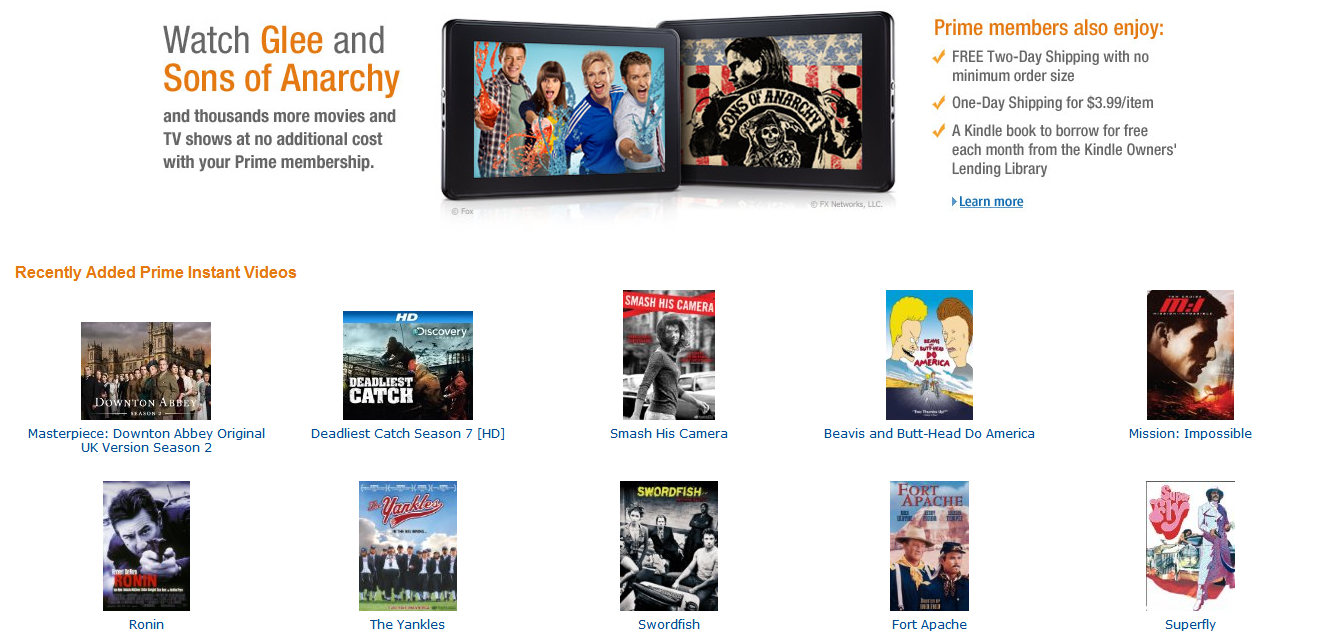
Amazon Prime Instant Video - New Additions

Amazon Prime is gaining market share at the expense of Netflix, but it’s still a long way off from being truly competitive

As a keen subscriber of Amazon’s Prime Instant Streaming service, I’ve personally seen the service grow from a handful of good shows and movies to a service that, as long as it continues to grow, may one day challenge the behemoth that is Netflix. There’s still not enough TV shows and new release content, but it’s getting there, and thanks to the Kindle Fire, Amazon has its own hardware platform to promote the service as well (a strategy that has worked so well, that both Google and Apple have both decided to play catch-up).

And a new survey seems to confirm that Amazon Instant is fast becoming a player in the lucrative subscription VOD market, with 22% of those surveyed now a member, up 5 points from seven month ago. That’s still nowhere near Netflix’s dominant position of 82%, but Netflix’s share has shrank 9% during the same period, which might be a cause for concern for the company.

For transactional VOD, Apple’s iTunes is still the most popular platform, with 16% of those surveyed having purchased content. This only represents a single percentage point growth, so there’s definitely more potential in SVOD (I still think Apple will have a say in this, at some point).

For devices used to consume content, for the first time, the iPad overtakes connected Blu-ray players as the most popular platform (32% vs 31%, changed from 25% vs 33% back in February). No doubt Amazon’s decision to release an iOS app for their streaming service might have played a factor here, as few Blu-ray players actually support Amazon Prime. Amazon has so far revealed no plans to have an Android version of their streaming app, most likely in an effort to prevent the cannibalization of Kindle Fire sales, even though this would greatly help with the adoption of the streaming service – this is where it still fails to properly compete with Netflix, which is available everywhere. Still, the Kindle Fire platform has proven a success for Amazon, if for no other reason than the fact that both Google and Apple have copied Amazon’s play with their own 7″-ish, video friendly tablets.

Disney Star Wars

Star Wars joins the Disney family … hope the new films are better than the prequels

So I’m betting you’ve heard about the almost too strange to be true story of the sale of Lucasfilms to Disney, and the release of more Star Wars movies starting in 2015. Reaction to the announcement has been all over the place, as the thoughts of Disney getting their hands on Star Wars left a bad taste in people’s mouths. I’m actually quite positive about the whole thing, because I think George Lucas has taken the Star Wars franchise as far as he can (and it was good to read that Lucas plans to donate all of the $4b earned from the sale to a foundation focused on education).

Everyone and their Kowakian monkey-lizard seems to wanting Joss Whedon to write and direct the next Star Wars, the director having directed Disney’s hottest and most recent success, The Avengers (which I finally watched this week, after catching up on all the other related movies – it was a pretty solid film). I’m a big fan of Whedon, and I think he would do a great job on Star Wars (and if offered the chance, I don’t see how any self-respecting geek could turn down the opportunity). With my luck, it will be Michael Bay! Although I did have a dream once where the New Republic’s latest and greatest battlecruisers go into battle with the Imperial remnants, in what seem to be a very one sided battle against their ageing  Star Destroyers. But the seemingly normal Star Destroyers suddenly transform into something much more dangerous, showing exactly what the Imperials have been up to since the Battle of Endor. Return of the Empire!

(Makes “call me” gesture in the general direction of Bob Iger)

That’s it for the week. Have a nice one.

Weekly News Roundup (28 October 2012)

Sunday, October 28th, 2012

So Windows 8 has been released. Having used the OS for a whole of zero minutes, I can offer my expert opinion that it is indeed a new version of Windows that offers some differences to the previous version, but also that some things remains the same. There are apparently quite a few good things in it, as well as some bad, and that if you really want it, you can get it by paying money for it. So that’s my 15 second review, hope it was very helpful!

If that wasn’t so helpful, then perhaps I can be a little bit more helpful with what you’re actually here for – the weekly news review. Let’s get started.

Copyright

The Finnish arm of Netflix managed to get itself into a little bit of a copyright trouble this week as subscribers found that the subtitles used for one particular TV series came from a fan-subtitle site. Netflix might have used pirated subtitles for the sci-fi TV series, Andromeda.

Netflix

Netflix Finland makes a boo boo by using pirated subtitles

Nobody knows how Netflix, who pays a lot of money to license official subtitles, ended up using subtitles created by DivX Finland (and you knew it was their sub because the subtitles displayed their website’s URL as part of the credits). Netflix have promised to launch an official investigation, and have temporarily removed the entire series from their system, but the folks at DivX Finland (probably no stranger to copyright issues) found the situation extremely ironic no doubt.

Copyright law I believe treats translations (and transcriptions) as derivative work, and that would still require the owner’s permission for distribution. The translation itself, as it does involve creativity, is also protected by copyright, copyright that Netflix infringed when it used DivX Finland’s subs without permission.

I have an extra interest in subtitle and subtitle download sites because I believe that my website was one of the first, if not *the* first website to host the download of DivX subtitles files (this would be June 2000, when DivX Digest was launched and user submitted/ripped subtitles were made available for download for a few dozen different TV shows and movies). The section only lasted about 3 month and at its peak, it contained about 500 different subtitle files – I discontinued the service due to potential copyright issues, and as I was doing all the updates manually at that time, it was also becoming too much work. Better organized websites had started to appear at that time as well, so I let them do their thing.

iPhone 5 and iPad Mini

By the quirks of the copyright law, jailbreaking an iPhone is okay, but jailbreaking a tablet is a no no

Some might argue that fan made subtitles should be considered fair use, especially if it’s the kind of thing that improve accessibility. It’s a shame nobody put the case forward to the US Copyright Office for their once-every-3-years copyright review, but given the results of the latest review, it was unlikely they would have been accommodating. The latest review sees the jailbreaking of smartphones continue to be exempted from copyright laws, but the arbitrary nature of these exemptions meant that “tablets”, despite sharing the same operating system as smartphones in most cases, are not part of the exemption.

The reasoning the Library of Congress gives for this oversight is that they found the definition of “tablet” too broad, as it could encompass things like laptop computers (more of a problem now that Windows 8 is out) or even e-book readers. For e-books though, DRM ripping remains legal, and now even in the case where DRM-free versions of the same books are already available.

But movie lovers mostly miss out. While DVD (and Blu-ray) ripping received a few more exemptions in the cases of educational use, non commercial use, and criticism and analysis, ripping for “space-shifting” (for example, to convert a DVD to a format playable on an iPad) remains illegal. This is despite the fact that everyone does it with little or no harm to anyone concerned, a fact made clear by Public Knowledge, one of the consumer rights groups that argued for an exemption for ripping.

The EFF also petitioned for video game console hacking to be exempted, but their appeal also failed to convince the US Copyright Office. In another blow, unlocking of phones purchased after January 2013 will also no longer be exempted.

In my opinion, these complicated and often arbitrary exemptions can be made a lot simpler if one simply followed the rule that any act that has no serious commercial implications (eg. DVD ripping for home use) should be considered fair use, as is everything in which the social benefits outweigh any commercial concerns. And all fair use should be legal, with specific exemptions being made for really popular acts in order not to criminalize a huge percentage of the population. How hard is that?

High Definition

With Mozilla all but signalling defeat in the battle to keep H.264 out of the HTML 5 specs back in March, the inevitable  is happening as Mozilla announced that the desktop version of Firefox will be getting OS-level native H.264 support soon. The mobile version of Firefox has already made this move, but with Flash still being a viable option on desktops, there was less urgency in adding in “native” H.264 support.

Mozilla’s beef with H.264 is that it doesn’t fit in with the open-source, royalty free nature of Firefox. But H.264 has become an industry standard as you’ll be hard pressed to find a modern device that doesn’t support H.264 these days (just as you would be hard pressed to find one that supports Mozilla’s favoured alternative, WebM).

Having OS based native support ultimately means that Flash won’t be needed. So in the end, it was really the choice between two evils. Flash and H.264, with H.264 winning in the end – not the worst result, if you ask me.

And I suppose I should talk about the iPad mini, at least from the point of view of HD video. There’s no doubt that 7-8″ tablets are the perfect consumption platform for video, which is why Amazon has the Kindle Fire, and why Google has the Nexus 7. I keep on getting the feeling that Apple will soon drop a bombshell that will completely shakes up the digital video rental and subscription streaming markets.

Gaming

Ubisoft has been making a concerted effort to distance the company from their past anti-piracy controversies, at least that’s what they said a couple of weeks ago. So you would expect the company to be extra careful to avoid any more anti-piracy related mishaps, at least for a short while. Well, the calm lasted about 6 weeks, as this week, Ubisoft enraged paying customers yet again by forgetting to include the CD key in retailed boxed PC versions of their new game, Rocksmith.

It took about a week for Ubisoft to respond, and even then, some customers were still left without a playable game for an extended period of time after going through the process. For those affected, they would need to provide proof of purchase to Ubisoft via their tech support website, which can be problematic for some if they’ve already discarded their receipt before realising Ubisoft’s mistake. Ubisoft has promised to compensate affected users with a free DLC (worth a whole $2.99), but it might very well be a case of too little too late for a company that couldn’t afford any more anti-piracy related scandals.

Sony PS3 Hacked

The “LV0” master keys leaked for the PS3 may prove the most costly to Sony yet, and make all future attempts to secure the console a very difficult proposition

Another gaming company that’s been trying to distance themselves from past issues is Sony, and their attempt to dig their way out from the various hacking scandals. But Sony does not appear to have any more luck than Ubisoft, with the news this week that a new set of master keys have been leaked for the PS3, keys that may make all future attempts to secure the console futile.

The new leaked keys, dubbed the “LV0” keys, could potentially prevent Sony from being able to secure the console again via a new firmware patch, which has been the go to solutions since the initial hack of the console, and when Sony managed to at least partially re-secure the console via the 3.56 firmware release.

While it’s disingenuous to blame these hacking attempts on Sony’s decision to pull support for Other OS, a popular PS3 feature (for the hacking community) that allowed Linux to run on the console – it’s very likely that the PS3 would still have been hacked due to the poor programming choices made by the security programmers – but it seems Sony’s decision to turn their backs on the hacking and modding community, having earlier promoted the console’s versatility and specifically the Other OS feature, does seem to have cost them. It certainly engergised the hacking community, and what we’re seeing now is the result.

Alrighty then, that’s it for the week. Back in seven with more news you can miss and it still won’t make a difference to anything in your life at all!

Weekly News Roundup (21 October 2012)

Sunday, October 21st, 2012

Welcome again. Hard to believe 2012 is almost at an end. If the world is really going to end soon, then it does seem very quiet considering what is about to happen. The calm before the solar-flare-induced-mega-storms perhaps. While we wait for the obligatory twenty-storey high mega-tsunamis to arrive, the rise of Blu-ray continues unabated (I know, shit segue). The release of The Avengers on Blu-ray for the last week of September has allowed Blu-ray to post a record set of market share figures. For that particular week, 44% of all discs sold in the United States were Blu-rays, with The Avengers movie itself getting a Blu-ray sales share of 71.65%, selling more than 2 copies on Blu-ray or Blu-ray combo for every DVD version sold. There are still a couple of big releases coming, and with the holidays tending to favour Blu-ray over DVD if recent trends hold, the magical 50% mark may very well be broken in 2012. As long as the world doesn’t end before then.

An okay-ish news week, not too much, but a few interesting ones to waddle through. Let’s get started.

Copyright

I’m a huge Star Trek fan, and one of the most remarkable things about the series, from the Original Series, to the barely bearable Enterprise, is how it manages titillate us with visions of how we can all benefit from future technologies (some of which have even become reality, for example the earlier communicators and flip phones, or more recently, the Padd and iPad). Having grown up with The Next Generation, the technology that excited me the most (other than the Holodeck, which was an offshoot of the same technology) was the replicator. To be able to create matter from energy, and thus be able to create anything you want at the touch of a button, is to me, the holy grail of science and a technology that will change the way everything works.

The Pirate Bay 3D Ship Model

3D printing could solve world hunger and make a medical breakthrough one day, but DRM is casting its shadow on yet another promising technology

So the emergence of 3D printing, for me, is an exciting one. While the current generation of 3D printers are severely limited in scope in relation to what they can and cannot create (remember back to the first ever 2D printer, and how limited they were compared to printers of today), it feels like the start of something new and brilliant. And when The Pirate Bay launched their “physibles” section, to allow schematics to be shared, downloaded and printed, with their altruistic, perhaps right now unrealistic aim of being able “print food for hungry people”, it seems that we might be heading towards something really exciting.

And then reality sets in.

This week, a company headed by a former Microsoft CTO has been granted a patent that will add DRM to physibles, to prevent the unauthorised printing of everything from plastic toys, to edible foods, even to human skin. The terribly exciting future has just been shacked to the horribly restrictive past.

Just imagine, Captain Picard ordering a cup of Tea, Earl Grey, Hot, and instead of a cup of delicious tea appearing, the English tea drinking Frenchman is instead asked to key in the serial number for both the tea and the cup it comes in, before waiting for the ship’s computer to receive, via subspace, the authorisation unlock code that would permit good old Jean-Luc to be able to finally enjoy his cup of tea. Of course, the created objects would just have to be programmed, within its molecules, to self-destruct or to do something even more horrible if Picard does not return the items promptly back to the replicator for disassembling after enjoyment, as this is a condition that’s been written down in the 60 page license agreement that Picard had to agree to before being allowed to even order the drink.

Even the Ferengi aren’t that avaricious, I suspect.

American Assembly - Copy Culture Survey - Music File Collections: P2P Users vs non-P2P Users (US And Germany) Source: American Assembly

People who pirate a lot of music, have more music and buy more music. Not rocket science, but still doesn’t seem to be well understood within the music industry.

To the credit of the music industry, they moved on from DRM pretty quickly, if not quietly. Although it’s probably something they still regret to this day. What they haven’t moved away from is their desire to punish their enemies: the music downloaders that they call “thieves”. But a new comprehensive study has found that, perhaps to the surprise of only the music industry themselves, people who pirate a lot of music are also the music industry’s best customers.

There seems to be this idea that there are two mutually exclusive groups of people, downloaders and buyers, when in reality, people who buy also download. And if you think about it, it isn’t all that surprising that people who download a lot of music actually love music, probably more so than people who don’t download as much. And music lovers buy more music.

And this is where I think the industry’s anti-piracy strategy fails, because by trying to kick pirates off the net, they may end up keeping their best customers from being able to continue buying. The correct strategy, in my opinion, starts with identifying the reasons why people that buy a lot of music also chooses to download some of them at the same time. It will be a complicated answer, but I don’t think it’s in anyone’s interest to simply labels these people as “thieves”.

Do they only buy content that they’re sure is “good”, and use piracy as a way to discover new content (might this explain why for music, Spotify is doubly good in allowing people to use it instead of piracy to discover music, and at the same time monetize the free streaming)? Did they simply run out of money and did not want to stop experiencing new music? Is it an issue of availability, ease of use? The answers to these question should then determine what the anti-piracy strategy should be.

The study also revealed that music downloading is actually a much smaller problem than traditional piracy methods, including sharing with friends/family and good old CD ripping. This corresponds with the RIAA’s own research on the matter and it kind of makes a mockery of the claim that the music industry’s sufferings started with the emergence of the Internet. You do have to wonder if there’s another agenda in play for putting so much focus on the web piracy, rather than just a major case of scapegoating. Perhaps by exaggerating the Internet piracy problem, the industry can get policymakers to step in and help protect their dying business model. And perhaps the right lobbying will also give the industry more control over content distribution on the Internet to ensure a bigger than warranted slice of any eventual pie.

And in the eagerness of help, policymakers ended up creating copyright laws that either don’t reflect real world situations, or are so heavily biased, cause everyone to become hysterical about the whole thing. ISPs and web hosts have been the front lines of this war, unfairly so in many cases (ISPs are no different to telephone companies, and web hosts are akin to landlords that rent store-fronts to businesses – neither of them should be made liable for what their customers/tenants get up to, especially when they cannot be aware of what’s going on without taking extraordinary measures, such as spying on their customer/tenants). And their fear of getting sued has allowed some ridiculous situations to develop.

Just this week, web host ServerBeach deactivated an account hosting 1.45 million educational blogs because of a single DMCA notice for a single page on just one of these blogs. This particular example may point more to a communications breakdown between web host and client, as opposed to being simply a case of copyright hysteria, but ServerBeach’s written DMCA policy still seems to be a case of deactivate first, ask questions later. ISPs and web hosts need to know their “safe harbor” rights, and should be willing to defends these rights even as rights holders try to water it down to suit their own agendas.

The Pirate Bay Cloud Hosting

The Pirate Bay moves to the cloud to create a more resilient, more raid-proof version of the website. Source methodshop.com @ Flickr, Creative Commons

And if web hosts can get into a tizz about a single link on a single page on one of 1.45 million blogs, then you do wonder sometimes how the hell The Pirate Bay manages to find web hosts willing to host their stuff. But the TPB folks seems to be well aware that this is either already a problem or will be in the near future, and so they’ve turned to the mythical cloud for their solution. Moving The Pirate Bay’s website to the cloud does seem like the most sensible thing to do for the website that’s often the target of law enforcement, and also victims of their own success (being so popular and all, the logistics of keeping the website online, on a budget, cannot be easy).

By using virtual machine instances on cloud providers in different countries, and with everything to and from the cloud encrypted (un-snoopable, and with the cloud provider probably not even aware of what is actually being hosted), a new layer of resilience, privacy and security has been added, and all apparently for a lower cost than before. If one cloud provider goes down, another can be sourced easily and a new instance can be made up and running in short order. Replicate this that a couple of times more, and trying to kill TPB would then be as difficult as slaying the mythical Hydra – cut off one head, and two more will take its place.

All the unwanted attention that TPB has be getting, with authorities trying to trap the elusive website with ever more elaborate mousetraps, seems to have only produced one thing: a better mouse!

And now for the best part of the WNR – the end of it! See you next week.