Archive for the ‘PS3, PS4’ Category

Weekly News Roundup (8 April 2012)

Sunday, April 8th, 2012

So my pretty half-hearted attempt at an April Fools Day joke did actually fool a few people, although as you’ll read later on in this WNR, that little made up news article might really have been a preview into the future.

It’s been two weeks since my last mention of Skyrim, but rest assured, I’m still playing. 125 hours through, I think I’m about half way through the available quests (but having only completed just 2 of the questlines so far). Well worth the $50 or so I spent on the game (compare that to, say, your typical 2 hour movie on Blu-ray for $20, it’s excellent value).

Now onto the news …

Copyright

Staring with copyright news, I’ve made the point before that, despite conventional logic, decreasing piracy should not be the end goal of anti-piracy – instead, the goal should be to increase revenue.

And I’ve also made the argument that I don’t think all piracy leads to revenue loss – in fact, I think most acts of piracy don’t actually lead to any loss in sales, as these acts are performed by people who really don’t buy a lot of stuff, or don’t have the resources to buy any more.

Hadopi Report

France's "Hadopi" three-strikes law seems to have dramatically reduced piracy, without actually increasing revenue

With anti-piracy efforts around the world ramping up, and the closure of several well known (alleged) piracy haunts, it would be extremely interesting to see the full financial impact of this expected piracy reduction, some say by as much as 40% in specific sectors (music, for one, after the closure of LimeWire). And so when Hadpoi, the French agency tasked with managing their “three-strikes” regime, released a report detailing the success of the program, with headline making statements such as “69% reduction” in piracy rates, this might have been just what was needed to see the real relationship between piracy and revenue. But while the report made ever bigger claims about the effect the regime had on piracy, what was sorely missing though were hard evidence of a rise in revenue, which as I’ve noted above, should have been the real goal of the whole exercise.

And while Hadopi might have been coy on the financial side of things, it just happens that most industry financial figures are public and available online. Looking at the French music and movie industry, and their performances in 2011 compared to 2010 (a full year with “three-strikes” in effect), the figures, if interpreted in a silly way, may actually point to the opposite: that piracy may have been helping sales!

The French recorded music industry recorded a contraction of 3.9% in 2011, while the movie industry didn’t fare much better, with revenue down 2.7%. In fact, the music industry’s loss was actually greater than the global average of 3%, possibly significant given that most of these other countries still have laws that are perceived to be much weaker than France’s.  Of course, to come to the conclusion that piracy was helping to fuel sales would be silly, and a mis-use of stats, and I guess it would also be slightly disingenuous to say that the piracy reduction didn’t have a positive effect on revenue. But what is clear is that there isn’t a 1:1 relationship between piracy and revenue loss, certainly not to the extent that the content industries have been trying to tell us.

What may be true is that the ever changing digital scene may have had a greater impact on the fortunes of both industries than the forced habit change of pirates in France. The music industry’s figures did show a dramatic increase in digital download revenue, higher than the global average, and that may be interpreted as a positive effect from “three-strikes”. But on the other hand, the introduction and adoption of new digital services such as Spotify, may actually be the main driving factor behind increasing sales. Similarly, while physical disc sales for the movie industry were down, VOD and other digital services recorded huge growth. So what may be actually happening is that new services are finally giving people, who used to pirate, the convenience (and the price point) they were craving. Unfortunately, most of these services probably earn less for their respective industries than compared to physical sales – sales that these industries had more control over. So innovation appears to be winning the war against piracy (who’d have thunk it?), but by being overly cautious and being overly obsessed with anti-piracy and DRM, the industries that had most to gain from this digital revolution can now only watch from the sidelines as companies like Apple, Amazon and Netflix take over a large part of the distribution process (and as a result, a large portion of the profits too). You snooze, you lose.
Viacom Logo

Viacom is still trying to fight YouTube, despite today's YouTube being totally different to the one it sued

It’s still not too late for them though, as they still control the content. As long as they realise the errors of their ways, and start embracing change, instead of fighting innovation, the content industries can still come out ahead as they have done with every technological transition that they have initially opposed. But that’s probably a little too optimistic, as these industries believe they’re in a fight for their lives, and they won’t quit until it’s probably too late. Take Viacom, who this week won an appeal to have their lawsuit against YouTube re-heard in court. The problem is that the YouTube that Viacom wanted to sue no longer exists, things have moved on piracy wise on the site, partially via threats such as their original lawsuit, but mostly due to changing user habits – and it is now a platform that companies like Viacom should want to be part of. Viacom, for their part, has been making the efforts, signing deals with Google to distribute their content via YouTube and Google Play and such, but you don’t really know if it’s them truly embracing the trend, or doing so reluctantly because everyone else is doing it (but still secretly want things back to the way it was). And if they do want to embrace services like YouTube, then why not just drop a lawsuit that they probably can’t win anyway?

Chris Dodd

MPAA chief Chris Dodd still holds out hope for SOPA/PIPA, and may have to "Bully" some tech companies into line to support future legislation

If the industry could only chill out and become a little bit less paranoid about piracy, perhaps we wouldn’t have the types of limitations, via geo-restriction, timed release windows and DRM, that technology providers have to contend with. And without these limitations, we may finally have a product or service that’s better than piracy, maybe not with a straight price comparison, but would be convenient and non-intrusive enough for people to not bother with torrents. Having access to all episodes of Stargate SG-1 via a $7.99 per month Netflix account, as opposed to downloading all the DVD-rips, for example (and an example that seems to be actually working in practice right now, judging by the relatively small number of leechers for the complete rip of the series on The Pirate Bay). But perhaps this too is far too optimistic, with MPAA’s chairman Chris Dodd this week still holding on to the hope that SOPA and PIPA will eventually pass through Congress (my April Fools Day joke news article aside), suggesting we haven’t seen the end of Hollywood and the record industry’s support for short-sighted and draconian non-solutions to the web piracy problem. Unfortunately, Dodd’s statement itself may not be considered that optimistic, as there are signs in the last few weeks (from the White House and beyond) that support is building again for SOPA like legislation. Meanwhile, the MPAA will certainly try to “Bully” more politicians into supporting it, while making sure this time these supporters won’t backflip just because a million or ten  come out in opposition to any proposed legislation. We all need to get ready for another fight.

Speaking of paranoid, the MPAA’s latest fear is that Megaupload would somehow get access to the data stored on their (former) servers and would somehow re-launch Megaupload, perhaps in another jurisdiction. Considering the fact that the Megaupload guys actually want to avoid prison, I suspect there’s little, if any chance Megaupload could be relaunched. But this latest MPAA manoeuvre will make it harder for users to get back their legitimate files, not that the MPAA cares or anything.

Gaming

In gaming news this week, I wrote a brief round-up of the latest “PS4” and “Xbox 720” rumours, starting with more creative names for both next-gen consoles.

Sony’s next console will have the codename Orbis, while Microsoft has chosen Durango. Orbis and Durango (sounds like two characters from a kid friendly adventure game), seems to have more similarities than differences, with both reported to be using AMD technology to drive both the CPU and GPU.

Not only that, both consoles seem keen to deploy some kind of anti second-hand game system, where each disc is locked to an account, and money needs to be paid (to Sony and Microsoft, who up until now have not been part of the second hand trade) to unlock a disc for another account. The latest rumours even sees Microsoft’s Durango borrow from Ubisoft’s playbook, with a requirement for a constant-on Internet connection (hope it isn’t true, because that would suck).

With neither console scheduled to make an appearance until late 2013, it’s perhaps a bit too early to take any rumours that seriously at this stage. Not that you should take anything I write seriously, April Fools or otherwise.

And on that serious/not serious note, that’s all I have for you this week. It’s not much, but it will have to do until next week. Happy Easter, Passover, and any other religious or non religious holidays that I may or may not be aware of.
Game Consoles – February 2012 NPD Sales Figure Analysis

Tuesday, March 13th, 2012

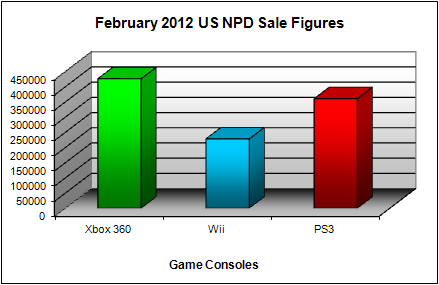
The monthly NPD video game sales analysis makes a return this month, after last month’s absence. Today, we look at the US video game sales stats for February 2012, based on figures compiled and “released” by NPD. With January’s rather poor showing, all eyes were on the February results, to see if January was just an aberration, or the start of a new downwards trend. Last February was a great month for game sales, with hardware unit sales up for all consoles compared to a year before – but given the bad January results, nobody is expecting the same this time round.

As NPD no longer releases full hardware sales figures, this feature is reliant on the game companies, namely Microsoft, Nintendo and Sony, to release their set of figures and based on “statement math” (that is, arithmetically calculate missing figures based on statements made). For February 2012, these are the statements made by the gaming companies:

  • Nintendo revealed that 228,000 Wiis were sold in February (via PR email)
  • Microsoft revealed 426,000 Xbox 360 units were sold, with 42% of the home based console market share (source)
  • Sony did not reveal any figures for the PS3

A little bit of “statement maths” tells us that 360,000 PS3s were sold, a good enough result for Sony that I thought they might have wanted to publicize a bit more.

And so the figures for US sales in February 2012 are below, ranked in order of number of sales (February 2011 figures also shown, including percentage change):

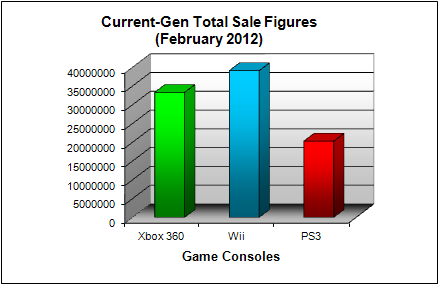
  • Xbox 360: 426,000 (Total: 33.3 million; February 2011: 535,000 – down 20.4%)
  • PS3: 360,000 (Total: 20.3 million; February 2011: 403,000 – down 10.76%)
  • Wii: 228,000 (Total: 39.1 million; February 2011: 454,000 – down 49.8%)
NPD February 2012 Game Console US Sales Figures

NPD February 2012 Game Console US Sales Figures

NPD Game Console Total US Sales Figures (as of February 2012)

NPD Game Console Total US Sales Figures (as of February 2012)

There was no prediction last month, as there wasn’t a full analysis.

While sales of all the consoles were up compared to the dismal January, all consoles continue to sell much less than the same time last year, but for different reasons.

For the Xbox 360, still relatively comfortable as the best selling console of the month, the decline has a lot to do with the dissipating hype over Kinect, and the novelty of the new Xbox 360 form factor, which was still in play last year. With Kinect Star Wars not coming until April (and even then, it doesn’t look as if it will make a huge impact, sales wise), the Kinect unlikely to lift Xbox 360 sales beyond helping it stay ahead of the PS3.

For Sony, the PS3 had the smallest year-on-year decline of the home based consoles, and comprehensively beat the Wii by just over 130,000 units, both facts that I had assumed Sony would have wanted to promote, but they remained oddly silent on PS3 figures, only commenting on the PS Vita, which managed to sell 225,000 units. With nothing really hyping up PS3 sales this time last year, the 10% or so decline might be the one that best show the industry’s overall decline. Whether this is due to market saturation, the end of a generation cycle, economic conditions, it’s all hard to say.

But it’s definitely the end of a cycle for Nintendo’s Wii, and the Wii U can’t come soon en0ugh for the company. A near 50% decline year-on-year is a bad result no matter how you look at it, and in terms of hardware, and innovation, the Wii now looks like a very dated piece of tech. With no multimedia and very little online functions to prop up the console’s usefulness, as is the case with the Xbox 360 and PS3, the Wii was always more prone to the “gathering dust in the closet” effect.

Software wise, it was another slow month as the lack of any A-list releases probably also hurt hardware sales. Final Fantasy XIII-2 was the top selling new release, despite technically being released in January (but counted in the February reporting period). Modern Warfare 3 remained the top seller for the month. The only platform exclusive to make the top 10 below was Sony’s update of Twisted Metal, coming in at 9th. Here’s the full software sales chart for February (new releases for February 2012 in bold):

  1. Call of Duty: Modern Warfare 3 (Activision, Xbox 360, PS3, Wii, PC)
  2. Final Fantasy XIII-2 (Square Enix, Xbox 360, PS3)
  3. UFC Undisputed 3 (THQ, Xbox 360, PS3)
  4. Kingdoms of Amalur: Reckoning (EA, Xbox 360, PS3, PC)
  5. Just Dance 3 (Ubisoft, Wii, Xbox 360)
  6. NBA 2K12 (Take-Two Interactive, Xbox 360, PS3, PS2, PSP, Wii, PC)
  7. Soul Calibur V (Namco, Xbox 360, PS3)
  8. Elder Scrolls V: Skyrim (Bethesda, Xbox 360, PS3, PC)
  9. Twisted Metal 2012 (Sony, PS3)
  10. Battlefield 3 (EA, Xbox 360, PS3, PC)

Time to make a prediction. March is traditionally a slightly slower month than February, so while the year-on-year downward trend may continue, there is the release of an A-list title in Mass Effect 3. The hardware sales order should remain the same.

See you next month.

Weekly News Roundup (11 March 2012)

Sunday, March 11th, 2012

Welcome to another edition of the WNR. I hope you’ve had a good week. Me? I’ve been busy with a secret project for Digital Digest, something I hope I can unveil in a week or two. Well, it’s not really a secret, but it’s not ready for public consumption just yet. It will be a relatively small change on the scale of things, but hopefully one that will make navigating the website a little bit easier.

As such, I haven’t really been playing much Skyrim this week. I might also be playing the game the wrong way, because I now have quite a backlog of major and minor quests that’s going to be a pain to clear (and I keep on picking up new ones). Sometimes having too much to do in a game can be a frustrating experience too.

The New iPad

It's better, but what I want to know is what are the new things I'm able to do with the new hardware, that I couldn't do on the iPad 2

I suppose I should also mention the iPad 3, oops, I mean the “new iPad”. It seems I’m not the only one that’s under-whelmed by Apple’s new tablet offering (and not the only one to cringe at the “resolutionary” pun either). There’s really nothing wrong at all with the new iPad – it’s faster, it’s a little bit heavier than the iPad 2 but does not affect usability, the screen is a beauty and the price is right too. So why am I under-whelmed? For me, it’s the lack of “the new things you can do with it” that’s under-whelming – a sharper screen is better, but how does that translate into a new way to use the iPad?

Apple’s strength has always been in selling what you can do with its hardware, rather than the hardware itself (which traditionally hasn’t been state-of-the-art – see Mac vs PC debate). For example, Apple didn’t sell the fact that the iPad 2 had a front facing camera, it sold the concept of FaceTime. The iPod also wasn’t the first digital music player, but Apple sold it, alone with iTunes, as a new way to buy music. I won’t even need to mention what the iPhone meant, but even the incremental 4S upgrade introduced Siri, a new way to use your smart device that unexpected failed to make the transition to the new iPad (not yet, anyway). Imagine if Apple had launched the iPhone 4S without Siri – that, to me, is what the new iPad feels like.

With that said though, the new iPad still looks like a no brainer for people who want an easy to use tablet, so it will sell in droves regardless. But I just think Apple could have marketed it a bit better, to at least give us a glimpse of what the faster processor, better screen is capable of, that makes the iPad 2 obsolete. But maybe that’s not the strategy this time, as perhaps the major change this time is the introduction of a new budget iPad model – the old iPad 2. Good enough for most people, and at $399, it will offer serious competition to budget Android tablets.

Anyway, let’s get started on the news roundup.

Copyright

The impact of the Megaupload seizure continues to reverberate this week, as the MPAA now wants to use the seizure as proof of guilt in its own court case.

Back when the Mega-seizure happened, I mentioned the MPAA’s civil lawsuit against Hotfile, and how Hotfile and Megaupload’s business models were very similar. I suggested that if no criminal case had been brought up against Hotfile, and that the matter was largely proceeding on civil grounds, then what makes Megaupload so different that the FBI needs to get involved. This week though, the MPAA made the same argument, but the one on the other side of the coin, that because Hotfile and Megaupload were so similar, Hotfile is just as guilty, and so the court should hand down a summary judgement on the matter. The MPAA is using the fact that because a court has granted federal prosecutors the right to take such drastic actions against Megaupload, that there is already enough evidence to suggest that their business model would not stand up to scrutiny in a court of law. There’s is some merit to the argument, but the government has yet to prove its case against Megaupload in a court of law, no matter how convincing their (one sided, it has to be said) arguments have been so far.

The curious thing is that if the MPAA is granted a summary judgement against Hotfile, then this decision could be used in the Megaupload trial as some sort of precedent, even though the summary judgement may have only occurred due to the Megaupload case. It’s a kind of circular logic that could very well have been orchestrated by the MPAA (since the MPAA are one of the key instigators of the Megaupload takedown), to kill two birds with one stone.

The scale of the Mega-takedown has also had consequences for other governments and law enforcement agencies not wanting to look weak on copyright (I’m sure the likes of the RIAA and MPAA have been pressuring them to match the efforts shown by the US government). The Swedish government has no doubt been under a lot of pressure to take action against “Swedish” website The Pirate Bay, particular now that the website has switched to using a Swedish .se domain name. What the Swedish government wasn’t aware of was that investigative notes were being leaked to the operators of The Pirate Bay. And from those leaks, it appears a new series of raids and arrests might be occurring soon. Having already been raided once, which took the website down for a whole three days, the new Pirate Bay seems to be designed to be much more resilient, much harder to take down (and easier to get back up again). The cat and mouse games between the authorities and TPB has only managed to create a stronger mouse – the cat simply hasn’t been able to keep up.

Hadopi Logo

French "three-strikes" has been working for two years now, but where's the evidence it's actually "saving" the music and movie industry?

Staying in Europe, last week, the UK High Court handed down a ruling that paves the way for ISPs to block access to The Pirate Bay. This week, another ruling against ISPs paves the way for the UK’s own version of “three-strikes” to go ahead, as the Court of Appeal upheld the legality of such a system. Not that there’s any evidence to suggest that  graduated response, the technical term for “three-strikes”, actually works. I recently read that the French version of three-strikes, nicknamed Hadopi (after the government agency responsible for it) is costing as much as $90 million per year to run. Whereas the only evidence of the program’s success so far, that has been presented by rights holder, is a measly 5% increase in revenue for iTunes over a 2 year period. Considering that iTunes sales worldwide (and with most countries not having a three-strikes regime) went up 36% year-on-year based on Q3 2011 results, the measly 5%, over a 2 year period, seems quite insignificant, and might even point to the opposite conclusion if we’re being cavalier with our statistical analysis. To me, graduated response simply isn’t worth it from a financial point of view, and it’s definitely not worth it when you factor in loss of privacy and other rights.

Losses due to piracy has always been a debatable subject. Whether someone who pirated software ever intended to buy the same thing is almost impossible to predict, as it’s really hard to know what people are wiling and unwilling to pay for. Take Warner Bros. latest idea, their “Disc to Digital” program. The program asks DVD owners to drive to a retail store, hand their original disc to a clerk, who runs the disc through a special machine that eventually produces a purely digital version of the disc, for use on iPads and whatnot (complete with DRM, of course). WB thinks people are willing to not only go to the trouble of doing this, as opposed to simply ripping it at home, but that they’re also willing to pay for the same movie twice. And so if people are not doing it WB’s way, and they’re not making this extra profit, then WB will simply count this as “lost” revenue, and blame it all on home DVD ripping.

Public Knowledge - "Legal DVD Ripping" alternative

Warner Bros. "Disc to Digital" program vs traditional DVD ripping, compared

If you think WB’s legal DVD ripping solution is convoluted, then you’re not alone, because public interest group Public Knowledge also think it’s ridiculous to suggest that consumers would embrace this “alternative”. PK is currently petitioning the US Copyright Office to legalize DVD ripping, and one of the arguments put forward by movie studios, against the idea, is that legal alternatives exist – WB’s “Disc to Digital” being one of the examples referenced by the MPAA. There’s obviously a demand for DVD ripping, even the movie industry accepts this is the case, as otherwise, they wouldn’t be offering their own solution to the problem. But if this is the industry’s idea of adapting to consumer demand, then it really just highlights again how out of touch they have become, and how we really shouldn’t trust their idea of “lost revenue”.

And finally in copyright, a story about our good friends Righthaven, and possible one of the last ever stories on the infamous copyright firm. This week, a judge granted the request to auction off most of Righthaven’s existing copyrights, including the very rights they obtained for sue-for-settlement purposes. Without having any rights to the content they’re pursuing bloggers and non-profits for copying, it really puts an end to all of their pending lawsuits (and appeals), and this, more than anything, is a mortal blow for the firm. Unless Righthaven can manage a revival of Lazarushian proportions, I suspect the next story I write on the firm will be its obituary.

Gaming

In gaming news, the NPD stats for February 2012 are out, and it looks like I *will* be able to write an analysis for it thanks to there being enough data.

The Xbox 360 won the month again, although both the PS3 and Wii recovered from the January lows. All are down compared to the same month last year though. The lack of any really good releases, and the fact that we may be getting towards the end of the current generation’s sales cycle (or at least well past the midway point), suggests that sales won’t be picking up until the next-gen comes out.

Speaking of next-gen, the latest rumour says the Xbox 720 or whatever may in fact be disc-less. So definitely no Blu-ray playback if that’s the case, although I think physical media are still very much needed to distribute multi Gigabyte games to millions of gamers given the current state of high speed (ie. 40Mbps or faster) broadband saturation. The same argument exists for HD movies, which is why Blu-ray discs will still be around for a while yet.

I think that covers everything for this week, so have a nice one and see you in seven.

Weekly News Roundup (19 February 2012)

Sunday, February 19th, 2012

Welcome to the latest edition of the WNR. It’s a shame that the leap day doesn’t fall on a Sunday this year, as it would make an awesome collector’s edition of the WNR – as such, it’s on possibly the most boring day of the week:  Wednesday.

I know I promised the NPD analysis last week, but it turns out there just wasn’t enough data to compile one, thanks to both Nintendo and Sony keeping mum on hardware figures (no doubt because they have crap numbers). Only Microsoft released figures for its Xbox 360 console (the least worst of the bunch). So it seems January 2012’s NPD analysis will have to be replaced with a much shortened version, which you’ll find in the “Gaming” section below.

In terms of news, there were only a couple of interesting ones, and a few late breaking ones that I will cover briefly in this edition, but in more detail in the next. So don’t be surprised at the brevity of this WNR (and it totally didn’t have anything to do with the fact that I’ve now put in 50+ hours in Skyrim).

Copyright

The likes of the MPAA and RIAA have compared web piracy to a lot of things, but I’ve always wondered why they haven’t compared it to some kind of infectious disease, as I think The Piracy Pandemic® has a certain ring to it.

It’s a great comparison not just because the content holder set their hyperbole engine into overdrive by comparing web piracy to something deadly and scary, but also on two other major points. One, just like an infectious disease, piracy spreads quickly, and it does so in poorer countries with greater virulence. And also just like viruses, piracy adapts to any measures you employ to try and stop it, whether it’s a technical measure, or a legal one. The more you try to fight it, the more likely it will mutate into something that’s more resistant.

The latter of these two points was demonstrated, twice, this week. Decentralisation has been a continuing trend in piracy (Megaupload and sites of similar ilk are actually quite a throwback to the early days of piracy, where everything was hosted on centralised HTTP websites), but despite decentralisation being the major driving force behind the creation of BitTorrent, two major centralised components still hold it back from truly being decentralised. The inherent weakness in BitTorrent file sharing is the existence, and the necessity, for centralised trackers and a centralised “indexer” website that catalogues the available downloads, like The Pirate Bay. This website would also host .torrent files, and while these files are small by any standard, the sheer number of them ensures that the total size of the website and database can be quite large. Taking down a tracker can cause downloads to cease to work, as peers would not be able to find each other, and taking down websites like The Pirate Bay would mean that you won’t even able able to find the torrents to get you started. These two weaknesses have often been exploited by content holders, with past lawsuits able to bring down popular trackers, and BitTorrent indexers such as Mininova.

The Pirate Bay Magnet Links

The Pirate Bay will remove .torrent files by the end of this month, encouraging users to use Magnet Links (show above with the little magnet icon) instead

This week, The Pirate Bay announced steps which will mitigate these two risks, although the actual technical measures used to solve these two problems have existed for some time already. The Pirate Bay, at the end of this month, will remove .torrent files for any torrents that has over 10 peers and will use Magnet Links instead. A Magnet Link is simply a web URL, a string of text that once loaded into your BitTorrent Client of choice, will give the client just enough information to be able to download the actual .torrent file from users that are already sharing the torrent. And using the DHT (Distributed Hash Table) technique, Magnet Links don’t need trackers in order to download the .torrent files (and the actual download most likely won’t need trackers as well, thanks also to DHT). But for The Pirate Bay, the best thing about switching to a Magnet Link based website is the fact that they no longer need to host .torrent files (well, not as many as before, anyway), and this allows the hosting, and bandwidth, requirements of The Pirate Bay to be reduced to the point where the entire website can probably fit onto a small USB thumb drive (removing all .torrent files, a user has already demonstrated the ability to reduce The Pirate Bay’s Magnet Link database to only 90MB). This will help more TPB mirrors to be set up, and to allow the website to be moved from host to host more easily, thus making the website more resilient to take-downs. There’s also something quite perverse about being able to “download” the entire Pirate Bay to your hard-drive.

And even in the event of The Pirate Bay finally being taken down, there’s now a plan B. A new BitTorrent client, Tribler, aims to remove the any need for websites like The Pirate Bay, and remove the one last centralised component of the largely decentralised BitTorrent download process. Tribler does this by moving the torrent indexing component into the BitTorrent swarm itself, and allow you can search for torrents right within the client. Even things like reviews, comments, and the obligatory removal of fake torrents, can all be done within the client. Tribler, developed by researchers at Delft University, is also open source, and that makes it more resilient, as if one variant of the client is taken down by authorities, others will pop up almost instantly (and probably with more features). What this essentially means is that BitTorrent, via Tribler, is now unstoppable. Or to put it even more succinctly, and to quote the head of the Tribler project, “The only way to take it down is to take The Internet down.”

Tribler

Tribler - the new BitTorrent client that claims to be unstoppable

Now, just because BitTorrent downloads cannot be stopped, it does not mean that you can’t be forced to stop using BitTorrent, as the major flaw in Tribler is that it still allows authorities, and those seeking to profit from (anti) piracy, to track your IP address. So the next evolution of BitTorrent, in my mind, will be one that allows peers to communicate anonymously – that is, to allow sharing without making the IP addresses public at any point in the process. The external pressure heaped towards downloaders, from law firms such as US Copyright Group, and also the rights holder’s push for graduated response, will no doubt have already pushed clever developers into tackling this very problem, and I don’t expect we’ll have to wait too long for this next evolution. And once it arrives, BitTorrent will be anonymous, unstoppable, and it will spell “game over” for both technical and legal methods to stop the downloading.

This scenario both scares me, and excites me. It scares me because, with no way to stop downloaders, things could get out of hand very quickly. But it also excites me because, without any technical or legal recourse, content holders might finally have admit to the need to compete with piracy, and we may finally see the entire industry put everything behind innovating their way out of the problem. Consumers will be the main beneficiary, and I look forward to new and brilliant ways to consume content, legally. Of course, this should have been the way forward since the first torrent was uploaded, and it would have been easier to compete back then, compared to a time when BitTorrent may have become truly unstoppable.

Going back to the point I made earlier about Megaupload being an outdated way of hosting pirated downloads, the closure of R&B/hip hop blog RnBXclusive this week shows why centralisation is dangerous. But what’s more dangerous is the pattern that’s emerging with law enforcement actions against websites suspected of copyright infringement – the fact that law enforcement agencies appear to be acting as the private police force for the entertainment industry without questioning the one-sided evidence presented to them – evidence that has often not stacked up in court. Time and time again, websites were taken down with the full force of the law, but still managed to be difficult to prosecute, or in the case of the similarly themed DaJaz1 (taken down by US Homeland Security as part of Operation In Our Sites), the case might not even end up in court. This is why due process exists and why it’s needed, for the evidence to be tested in a court of law before guilt is determined, and action is taken.

And to add insult to injury, visitors to rnbxclusive.com were initially threatened with messages that mentioned “an unlimited fine” and “a maximum penalty of up to 10 years” in prison for anyone who simply downloaded some songs from the website. A Big Brother style warning of the “capability to monitor and investigate you” was given an extra dimension of fear, by displaying the visitor’s IP address on the home page (a simple enough thing to do in php, but still scary enough for the less technical minded). These threats have since been removed from the website, no doubt due to complaints about the potentially misleading statements which could get SOCA (UK’s Serious Organised Crime Agency), the organisation that took charge of seizing the website, into trouble. But it’s the kind of hyperbole we’re used to seeing from the entertainment industry, the most likely ghost writers behind the now removed messages.

One of the entertainment industry’s tactic is to portray everyone who does something against their interest as criminals, even if it’s something as simple as ripping your own legally purchased DVD. I reported a couple of months ago on the efforts by public interest group Public Knowledge to make DVD ripping legal. They argued that due to the increasing number of devices that don’t play DVDs, such as tablets and smartphones, consumers need to be given the right to rip their own legally purchased movie discs. The fact that everyone who wants to do it is already doing it, means that making DVD ripping illegal under the DMCA is pointless at best, and at worse, criminalizes an activity that falls under fair use. With PK having made their submission to the US Copyright Office, which reviews submissions for exemptions to existing copyright laws every three years, the MPAA has just responded with quite an absurd argument *for* keeping DVD ripping illegal: it gives consumer more choice!

RealDVD

If Public Knowledge manages to get a DVD ripping exemption from the US Copyright Office, then it's still too late to save innovative software like RealDVD, which was sued into oblivion by the MPAA

What the MPAA is saying is that since consumers don’t have the legal option to rip their own DVDs, then the legal option to get the movie you already paid for, on other devices, is to simply re-purchase the movie again. And again and again. Consumers can “choose” to pay for the same movie on their iPhone, “choose” to pay for the same movie again on Android, and then “choose” to pay for the same movie once more on their PS3, for example.

Far from being a convincing argument, this is precisely PK’s argument for making DVD ripping legal, that consumers shouldn’t be made to fork out money for the same content over and over again, due to a legal measure designed to do something else. This is a perfect example of piracy laws being misused by content holders, for their own financial benefit, to take away a consumer’s rights. The fact that many movies are not even available on legal platforms further destroys the MPAA’s false arguments about “choice”.

I sincerely hope the US Copyright Office does the right thing and extends the exemption for CD ripping to cover DVDs and Blu-rays too. The reason that The US Copyright Office even asks for submission of exemptions is to prevent exactly this sort of thing – short sighted copyright laws that harm fair use and innovation.

The Megaupload case has also had some new developments in the last few days, although nothing that bodes well for Mr DotCom. More charges have been laid, and $50 million in Mega assets have been seized so far. Without insider knowledge, it’s hard to tell if this is an attempt to shore up the fed’s case before going to court, or if it’s some kind of tactic designed to force a favourable settlement. Copyright cases are not always easy to prove, see Viacom vs YouTube, and given the theatrics that has transpired so far, losing the case is not an option for federal prosecutors.

Meanwhile, the Pirate Bay and RIAA have been engaged in verbal warfare, with The Pirate Bay responding to an article by the RIAA that called it “one of the worst of the worst”. More on both of these late breaking stories next week.

Gaming

As mentioned earlier, due to Sony and Nintendo withholding hardware figures for the PS3 and Wii, I don’t have enough data to write up a full NPD analysis, so you’ll have to put up with a simplified version here.

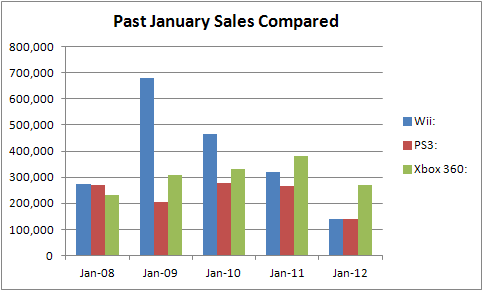
NPD January Comparison

NPD January 2008 to 2012 Compared - things are bad across the board, it seems (January 2012 figures for PS3/Wii estimate only)

Microsoft was the only one brave enough to release data, with the Xbox 360 selling 270,000 units, down 29% from a year ago. Microsoft also mentioned that it held 49% of the current-gen console market. A little maths then tells us that the PS3 and Wii sold a *combined* 281,000 units. With the PS3 and Wii selling in similar numbers usually, that’s around 140,000 units for each, which is way down compared to the previous January’s 319,000 (Wii) and 267,000 (PS3).

These companies can only hope that January was a fluke, and that sales will pick up again.

Game sales were just as bad, with the number one selling title, Modern Warfare 3, only shipping 386,000 units – at the same stage of sales, Black Ops managed 750,000 (although MW3 sold more copies in the preceding months, it’s now flat in terms of sales to Black Ops), and Modern Warfare 2 managed 658,000 during its January period. And considering MW3 was the top seller, it means the other titles in the top 10 were much worse.

Overall, it’s the worst January since 2004.

The results are so bad that analysts are still debating the whys of it, with Wedbush Securities analyst Michael Pachter even questioning the validity of the data.

Maybe people are playing too much Skyrim to have time to buy any new games, just a thought!

And on that sour note, we come to the end of another WNR. Hope you enjoyed it, and see you next week.

Game Consoles – December 2011 NPD Sales Figure Analysis

Saturday, January 14th, 2012

Welcome to the December 2011 edition of our regular NPD US video game sales analysis. In this feature, we look at video game sales, both hardware and software, for the month of December 2011 based on data collected by the NPD. December is traditionally the most important period of the year, where a huge percentage of the entire year’s sales occur. And as a result, there is no month more important than December, and it’s a great way to gauge the general state of the video gaming industry. Last year, the Wii has the holiday time winner, easily beating the Xbox 360, and 12 month is a long time for a game console. Read on the find out if the Wii continued its tradition of holiday success, and whether the industry as a whole had a good holiday period. Or not.

As NPD no longer releases full hardware sales figures, this feature is reliant on the game companies, namely Microsoft, Nintendo and Sony, to release their set of figures and based on “statement math” (that is, arithmetically calculate missing figures based on statements made). For December 2011, these are the statements made by the gaming companies:

  • Nintendo did not reveal any figures for December 2011
  • Microsoft revealed “more than” 1.7 million Xbox 360 hardware units sold, with 46% of the home based console market share (source)
  • Sony did not reveal any figures for December 2011

With only the above information, it becomes impossible to work out the estimated numbers for both the Wii and the PS3. Luckily, analyst Michael Pachter again came to the rescue, via Twitter, stating the Wii sales were in fact 55% down from the same month a year ago. With this piece of crucial information, we are then able to deduce the Wii numbers, and from this and the 46% market share figure quoted by Microsoft, we are then able to estimate the PS3 numbers too.

And so the figures for US sales in December 2011 are below, ranked in order of number of sales (December 2010 figures also shown, including percentage change):

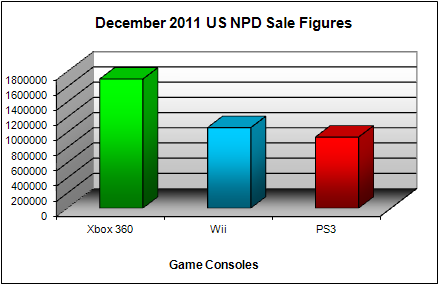
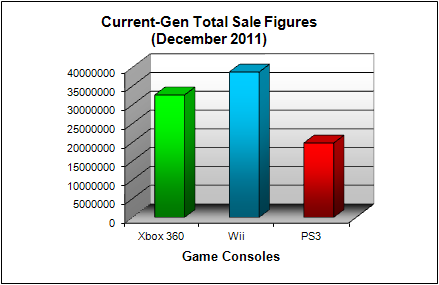
  • Xbox 360: 1,700,000 (Total: 30.9 million; December 2010: 1,860,000 – down 8.6%)
  • Wii: 1,060,000 (Total: 37.7 million; December 2010: 2,360,000 – down 55%)
  • PS3: 936,000 (Total: 18.9 million; December 2010: 1,210,000 – down 22.6%)
NPD December 2011 Game Console US Sales Figures

NPD December 2011 Game Console US Sales Figures

NPD Game Console Total US Sales Figures (as of December 2011)

NPD Game Console Total US Sales Figures (as of December 2011)

My prediction from last month was:

Same hardware ordering, and a software chart that looks very similar to this month’s, so there’s nothing much to add to that really.

While the software chart has a lot of titles that were there in November, the hardware ordering actually changed, with the PS3 dropping back down to third place, after finishing above the Wii last month.

Overall, looking at the figures above, and the “sea of red”, December 2011 has been nothing short of a disastrous month for video game sales, especially compared to last December. As mentioned earlier, a huge percentage of sales occur in December, but this last particular December did not even out do the previous month, when historically, this has almost always been the case. In fact, for hardware sales, the raw numbers were at its lowest since 2005.

Microsoft was probably the “winner”, if you can call it that (more like the smallest loser), with only an 8.6% drop in console sales, and level in sales with November. The NPD pointed to the strength of the Xbox 360 throughout the year, saying that the Xbox 360 platform accounted for nearly 40% of annual physical retail sales, across all categories. Still, if you count November and December together as one period, then 2011 has been good to the Xbox 360, with 3.4 million consoles sold, compared to 3.23 million a year ago. Microsoft probably had hoped the Kinect Star Wars game and console bundle would have made it in time, helping to push the console, and Kinect, to the next level, but the delay to the game means that there were no real A-list Kinect titles for this holiday period (unless you count Kinect Sports 2, and Dance Central 2, as A-list titles).

Despite finishing as the third most popular console, the PS3 was probably in second place overall, when you look at the year-to-year decrease figure, as well as performances across both November and December. Nearly 1.84 million PS3 consoles were sold during November and December, compared to 1.74 million consoles in 2011. So the good news is that, things are not that bad, while the bad news is that, the Xbox 360 appears to be pulling further ahead in the United States, where during the same period, it had almost twice as many sales (and more console sales during the holiday period, means more game sales for the rest of next year, and also means a strengthening multiplayer community, the growth of which relies on people using the same console as their friends).

So the real loser is, once again, Nintendo. The Wii, previously the unstoppable juggernaut during December sales, is no more, and is relegated to a distant second place behind the Xbox 360. For November and December, 1.92 million Wiis were sold, compared to 3.63 million in 2010 – in fact, more Wiis were sold in December of 2010 alone, than November an December of 2011 combined! A 55% year-on-year drop shows that the Wii is no longer the “must-have” video game gift, with some of the sales going to the Xbox 360 (not many, looking at the figures above), and possibly lots of sales going to things like tablets and smartphones, the new home of casual gaming.

And that’s probably the best way to look at things for the video game industry as a whole, for the most recent holiday period. The industry has benefited from the Wii becoming a must-have gift item for the last several holiday periods. Kinect has contributed to the same phenomenon, but it just hasn’t been the same. And with so many other gadgets to distract the holiday shopper, and also the economy, the decline can almost been seen as a return to normal, after a couple of years of extraordinary performance led by the Wii. Maybe the Wii U will bring back the same thing next year, but expectations must be readjusted.

As for software sales, it was also down compared to December 2010. MW3 led the chart again, with Skyrim dropping to third after the resurgence of Just Dance 3. Interestingly, looking at total sales for 2011, the ordering of the top 3 was exactly the same as the December top 3, showing that Call of Duty, and perhaps surprisingly, Just Dance, were the top 2 franchises for 2011. Mario Kart 7 on the 3DS was the only new entry into the top 10 in December. Here’s the full software sales chart for December (new releases for December 2011 in bold):

  1. Call of Duty: Modern Warfare 3 (Activision, Xbox 360, PS3, Wii, PC)
  2. Just Dance 3 (Ubisoft, Wii, Xbox 360)
  3. Elder Scrolls V: Skyrim (Bethesda, Xbox 360, PS3, PC)
  4. Mario Kart 7 (Nintendo, 3DS)
  5. Battlefield 3 (EA, Xbox 360, PS3, PC)
  6. Madden NFL 12 (EA, Xbox 360, PS3, Wii, PS2, PSP)
  7. Assassin’s Creed: Revelations (Ubisoft, Xbox 360, PS3, PC)
  8. NBA 2K12 (Take-Two Interactive, Xbox 360, PS3, PS2, PSP, Wii, PC)
  9. Super Mario 3D Land (Nintendo, 3DS)
  10. Batman: Arkham City (Warner Bros, Xbox 360, PS3)

Predicting January is always difficult, as the post holiday lull will be here, and there would usually be stock issues (although with the low sales this year, maybe this won’t be an issue). I suspect, other than huge drops in console sales figures for all consoles, the PS3 will probably regain 2nd place, with the Xbox 360 still the top selling console. A subdued month as well for software sale.

See you next month.