Archive for the ‘News Roundup’ Category

Weekly News Roundup (22 April 2012)

Sunday, April 22nd, 2012

So, are you underwhelmed or what? Of course, I’m talking about the new re-designed Digital Digest homepage (and a couple of other section home pages, as well as the top navigational bar), that “little project” I first hinted at a couple of weeks ago (I told you it was “little”). The old homepage had been designed for yesterday’s lower resolution monitors, and so it was a bit too narrow and a bit too long. It’s now been simplified to highlight the most important stuff, namely news and software updates. And there’s also a new News section to go along with these changes (as well as changes to the actual news pages). The top navigational bar, and even our site logo, has also been renovated, with the top bar taking a little bit less vertical space, and reducing the number of links shown there by highlighting only the most important sections. A few pages remain unchanged, as I ran out of time with my self imposed deadline of yesterday, so I’ll slowly re-work these pages to get them into line.

Despite a busy week in which I also had to exchange my Samsung plasma TV for a new one due to an unrepairable fault (so getting a nice and new 2012 model 60″ on Monday as a no-cost replacement, which is an alright outcome), I also managed to write the March 2012 US video game sales analysis, which you can read here. Nothing too surprising, with the Xbox 360 still leading, although the PS3 is catching up a bit. Mass Effect 3 dominated the month and sold 4 times as many copies on the 360 than on the PS3 (in the US, at least).

Onto the news roundup then …

Copyright

Starting with copyright news for the week, Google guy Sergey Brin issued a warning this week that web freedoms are in peril, thanks to increasing attack by interested parties.

Apple and Facebook

Apple and Facebook, the root of some of the evil, according to Google's Sergey Brin

Those interested parties of course include the entertainment industry, who are increasingly painting themselves into a corner as the enemy of the Internet (which I personally don’t think is a very good strategy), governments who do the bidding of the entertainment industry, and perhaps controversially, the likes of Apple and Facebook, according to Brin. The inclusion of the two tech giants, and Google competitors, may seem a bit cynical, but Brin’s main point is that the closed, proprietary nature of Apple/Facebook (probably needs to add Amazon to the list too) means that they have full control of what can and cannot be done on their platforms, which goes against the principles of the open web. But while Google embraces open source and should be commended for it, anyone who makes websites will know that Google themselves are not exactly that transparent when it comes to a lot of issues, and their practical monopoly on the search market gives them the same sort of power that Apple/Facebook derive from having more proprietary platforms.

With Apple under fire for eBook price fixing from the DoJ, and Apple firing back by calling Amazon a monopoly, a lot of what Brin is saying does make a lot of sense. The role that DRM plays in all of this is actually quite interesting. Even though it was originally designed to prevent piracy, DRM these days are far more effective at solidifying monopolies and preventing competition. By locking proprietary formats to hardware platforms, and tying DRM to these proprietary formats, it all sounds a bit more sinister than simple copyright enforcement. Most publishers are stupid and paranoid enough to actually want the DRM, but this insatiable appetite for unreliable technology is also driving out the small players from the market, one such small player revealed this week. The cost of DRM, the actual financial cost, is quite large for a new start-up – often in the tens of thousands, not even including the technical knowledge requirements. This means that as long as publishers are still keen on DRM (to offer them that false sense of security they crave), it benefits the big guys at the expense of the smaller players, and the monopolistic situation this creates in the end probably hurts the publishers more than had they not used DRM (DRM mostly only prevents casual piracy, the type where people share the same eBook with friends, as opposed to straight up piracy where pirate groups can easily circumvent DRM and upload the content online for all the enjoy).

AFACT vs iiNet

AFACT vs iiNet, The Final Chapter - the good guys, iiNet, wins in the end in your typical Hollywood style ending. Ironic.

Good news, that may soon turn to bad in Australia – our second largest ISP here managed to actually win a copyright case against the Hollywood-backed AFACT. So for now at least, ISPs have been found to be largely not responsible for the actions of its subscribers. The High Court also found that ISPs does not need to deal with infringement notices that are not accompanied by a court order – going totally against the precedents being set in other countries, where ISPs have been made the scapegoats in the war against piracy. And as this was a High Court decision, the highest court in the land, the win is final, and no more appeals can be granted. An obviously embarrassed AFACT, who have long been accused of taking orders directly from the MPAA (with Wikileaks documents showing that’s exactly what happened with this legal case), will now deploy a new tactic. They have blamed the existing copyright laws for not being biased enough towards rights holders, and want them changed so that, in the future, they could easily win lawsuits such as this one. This is where the possible bad news may come from, as the government bails out the AFACT by implementing new laws. So it’s just like that old saying, if you can’t beat them, have the rules changed so you can!

I’ve always felt that making ISPs liable for the activities of their users, especially when most ISPs don’t even have the capability to monitor the user’s downloads, was suspect. I’m not quite sure if the phone or electricity company analogy fully applies to ISPs, but I don’t think it’s that far off. These companies, like ISPs, provide a service to users, and users are liable for how they use the service. The only difference is that ISPs are made to be different under the DMCA (there’s no DMCA or equivalent for the phone company, for example), but they really shouldn’t be. The content holders will argue that it’s much easier for ISPs to spy on their subscribers and to stop their illegal activities. But just because it’s easy, does it really mean that it should happen? By all means, the ISP should take action if there’s a corresponding court order, but for “infringement notices”, which are merely untested allegations, why should the ISP be liable for something that’s hasn’t even been established to be illegal yet?

Rapidshare logo

RapidShare is rapidly turning into the MPAA and RIAA's best friend, with a new manifesto that destroys the rights of its users to appease its new friends

There’s probably a better term for it, but for me, the issue of web piracy has suffered from a lot of “legal slippage”. What I mean is that, because the problem has been so widespread, and the impact of the problem so exaggerated by the usual suspects, there’s this acceptance that corners need to be cut in order to “streamline” the legal process. So due process is out, and even basic distinctions like “evidence” and “proof” has been blurred to the point where “allegation” has become “guilt”. The lobbyists have pushed for this outcome, the government has been supportive, and the tech companies have been scared into accepting it all. Which is why it was disappointing, but not too surprising, to read RapidShare’s manifesto on “Responsible Practices for Cloud Storage Providers”, a defeatist piece of article that signals the surrender of the cloud storage industry to the power of the entertainment lobby. According to the manifesto, of the various aspect of DMCA takedown request, including its validity, the only factor that actually matter is the actual formatting. If it’s properly formatted, then RapidShare says that the takedown request should be deemed valid, even if it’s for something ridiculous like removing open source software. So, in RapidShare’s eyes, it’s perfectly reasonable for me to get a competitor’s RapidShare account closed down as long as I submit a *properly formatted* DMCA request, and if my request turns out to be invalid, then it’s up to my competitor to prove that it is (in RapidShare’s own words, it’s up to the user to explain “why the suspicions are unfounded”), and for them to take legal action against me for filing a false request (if I was stupid enough to use my real name in the first place). This must give the business users of RapidShare real confidence in the reliability of the service.

Worse yet, those same business users that use RapidShare to privately store and share commercially confidential information should be even more worried about RapidShare’s stated policy of reserving the right to “inspect” the files for users who have failed to prove their innocence.

What, no strip searches?

High Definition

Nothing much happening HD wise, although this one story about Sony’s upcoming archival storage format was interesting, mostly due to the reaction to it.

Sony’s announced a new archival storage format, based on the Blu-ray format, that aims to offer 1.5TB of storage. It does it in a pretty old fashioned way, by putting as many as 12 discs into the same cartridge unit (so 12 times 125GB BDXL equals 1.5TB). By the time I saw the story, it had already gathered a lot of attention, which I thought was weird for a product aimed mainly at broadcasters and corporations. A lot of the comments were the usual “why pay $$$ for this when you can get a 1.5TB HDD for $79” and the like, and as much as I like to bash Sony, and I really do, I felt compelled to write the story just so I can clarify a few things here.

A 1.5TB HDD will definitely be cheaper than Sony’s proprietary drive and disc cartridge system, but they’re for entirely different purposes. For archival storage, data retention is everything, and an active system like a hard-drive with mechanical bits and bobs is not best. So optical discs do have a few advantages here, and you can’t really blame Sony for using Blu-ray as the basis of this new format. Putting 12 discs in a cartridge may seem like a “dumb” solution, especially since it appears the cartridge simply act as a carousel system, and doesn’t allow for parallel writes and reads (so only one disc is extracted from the cartridge and written/read at a time), but for archival purposes where you’re only likely to write to disc once (and, if things go well, never actually read the damn thing), it gets the job done. Using an active hard-drive for archival storage is suicidal, unless it’s part of a well maintained array of discs, which doesn’t seem to make much sense from an economics point of view.

I also did a bit of research to see if SSDs are more suited to these kind of tasks, considering mechanical drives are on the way out – but SSDs data retention may actually be worse if you don’t get the right type of drive, as the electrons used to “store” the data may leak to the point where the data simply disappears (this info comes via a web forum, so it may in fact be made up). So it seems optical discs, at least for archive purposes, do have a role to play, although whether they’re better than current tape based systems, I don’t know and really don’t care to know since I’ve already spent way too much time researching and writing about something that’s not even remotely interesting to most people.

But for those that are interested in these kind of things, here’s a forum thread that may help you waste a few hours of your life.

That’s probably as good a place to stop writing, so I can stop wasting your time, but mainly because I’ve run out of things to write about. See you next week.


Weekly News Roundup (15 April 2012)

Sunday, April 15th, 2012

Welcome to another edition of the WNR. Not a very busy weeks judging by the number of news stories, so hopefully we can get this done rather quickly. I’ve been busy working on that little update for Digital Digest, which I promise will be launched next week, even if it’s still only half-completed (to be fair, it’s more like 80% completed). And you know I’m serious about meeting this rather artificial deadline by the fact that I didn’t even play that much Skyrim this past week!

One development that came too late in the week to be included was the March NPD results, and I’ll write the full report early next week.

Copyright

Let’s start with the copyright news, starting with the revelation that, even within the MPAA itself, not everyone was convinced that SOPA was the right solution for the web piracy problem.

SOPA Protests

It seems the anti-SOPA/PIPA sentiment was also alive and well within the MPAA itself (photo credits: Alain-Christian @ flickr)

When the anti-SOPA Internet Society hired a former MPAA executive, there was a bit of a controversy as you would expect. This prompted the MPAA’s former chief technology policy officer, Paul Brigner, to come out and explain a few things about his new appointment, including his apparent opposition to SOPA/PIPA. It seems Brigner left the MPAA at least partially because he felt SOPA was not the right solution to the piracy problem, and that SOPA and other “mandated technical solutions” are not “mutually compatible with the health of the Internet”. If the MPAA can’t even convince it’s own tech policy officer of the merits of SOPA, perhaps it really doesn’t have much merit at all.

But you get the feeling that the MPAA will never be fully satisfied until they get the power to not only squash any website it wants, but also to force others (like ISPs, governments) to help them do most of the heavy lifting. They will have ruined the Internet by then of course, probably only to find out that piracy has not only not slowed, but it has shifted to other parts of the Internet that can’t be easily controlled or legislated. And that, without argument, would be a far worse situation than what the one today.

It appears “blowback” invariably happens every time the copyright lobby launches a new crackdown, especially using technological measures. Every DRM has been met with an even stronger anti-DRM. Going after torrent sites have only resulted in more resilient torrenting methods. Which seems to indicate that going after video embedding, the MPAA’s latest manoeuvre, may backfire as well. The MPAA is getting itself involved in a legal showdown that originally only involved an adult entertainment company, Flava Works, and myVidster, a website that allowed people to post and share their video embeds, but  now includes the likes of Google, Facebook, the EFF, and of course, the MPAA. The tech giants saw the original court ruling, which was in favour of Flava Works, as severely flawed, setting a precedent that could have huge repercussions for the entire Internet. The judge in the case failed to make the distinction between linking/embedding, and hosting, something that could make Google Images liable for the copyright infringement of any image in its database for example, or make Facebook sharing a legal minefield. There was also the issue of a “repeat infringer” policy, or Flava Works’ claim that myVidster did not have one, and how it relates to linked/embedded and hosted infringement. It seems to me that the DMCA is rather unclear about what a “repeat infringer” is, and it seems the law leaves service providers and Internet intermediaries to define what it actually means and what kind of policy to implement, even if it is one not to the satisfactory of content holders. And since myVidster did have a working DMCA take-down process, and that it did not host anything, the ruling seems a bit harsh. Also, you have to question why Flava Works went after myVidster, instead of going after the hosts of the actual videos, the dime a dozen porn tube sites. The responsibility cannot keep on flowing downwards until you get to someone that’s easier to sue.

Hotfile

Hotfile's expert says the most downloaded files on their network were two open source files

An anti-MPAA theme seems to be developing this week, since the only other copyright story is also MPAA related. This one has to do with the MPAA’s lawsuit against Hotfile, where the MPAA, using their own expert, argued that 90% of all downloads on Hotfile were infringing content, and that the Hotfile had few, if any, legitimate uses. This week it was revealed that Hotfile’s own expert, Duke University law professor James Boyle, found that this really wasn’t the case at all. Professor Boyle found that in actual fact, the two most downloaded files on Hotfile were actually open source software, with more than 1.5 million downloads between them. And while the “90%” figure wasn’t entirely debunked, and I think it’s hard to argue against the fact that a large percentage of total downloads on file hosting sites like Hotfile and Megaupload are of the infringing nature, I think in terms of the sheer number of different uploads (ie. not taking into account the number of downloads), I suspect there is also a large percentage of non infringing files on these networks (your typical spreadsheet, Word doc, PDF, home videos and other files too large to share via email, that may very well only be downloaded once, but still a key reason why people use file hosting sites).

This really is another grey area in the law. Take an extreme example where 90% of all different files on Hotfile were non infringing, but 90% of all downloads were infringing, then would Hotfile’s non infringing uses make it legal, assuming the website had a working DMCA process? How much is too much, and how much is “enough” when it comes to anti-piracy?

High Definition

I read an interesting article this week on Forbes’ blog, where the headline was “Sony’s Blues Caused By Blu-ray”, a rather controversial title if you ask me.

The actual article, despite the headline, did cover more than just Blu-ray, and it did raise a couple of interesting points. So are Sony’s recent woes caused by Blu-ray? The recent woes being the global layoffs and the lack of profitability, of course, but to blame it on Blu-ray seems a bit counter-intuitive, considering Blu-ray seems to be the only recent success for Sony.

But what the Forbes blog, written by contributor Stephen Pope, was perhaps trying to say is that while Blu-ray is a victory for Sony, it just wasn’t a big enough victory to help the company stay profitable, and that in the end, it may even only a fleeting victory, considering the growing popularity of streaming vs discs.

Sony Blu-ray

Sony's Blu-ray victory may be short lived, as consumers are keen to move onto streaming (photo credits: mroach @ flickr)

I’ve long held the believe that Sony lost its dominance in the gaming sector by allowing the Xbox 360 to be a viable successor to the PS2, due to the one year delay in releasing the PS3 and the high initial cost of the hardware – both factors very much related to the included Blu-ray support. So while the PS3 helped Sony win the HD format wars, it also hindered Sony in keeping their dominance in the gaming arena. Looking at the current range of multi-platform games and the quality difference between the PC/Xbox 360 DVD version of the PS3 Blu-ray version, it seems the Blu-ray disc’s superior capacity has done little to actually benefit the gaming experience. And while the platform exclusives do try and make the best use of Blu-ray, they just aren’t selling enough to make a huge difference compared to the mega multi-platform franchises of Call of Duty or FIFA or GTA.

And streaming certainly does look like the future, if only for the fact that discs and the drives that read them are just not compatible with today’s portable devices. There is also a trend to consume more content (often for less money), and the physical cost and space that discs (and their packaging) requires, puts a limit on this consumption (while raising the price of it – last year, the average price people paid for streaming content was 51 cents, compared to $4.72 for discs). And access, with discs being limited to what you have purchased or what your rental outlet has in stock, just can’t compete with a streaming digital library of hundreds of thousands of titles that will never “run out of copies” (or suffer from bad scratches).

And even in terms of data storage, the 50GB Blu-ray offers, or even the 100+GB of BDXL pales in comparison to the TBs of data people need these days for their digital needs. So you have a multi-TB drive the size of a small book versus shelves full of BDs that you have to take time to burn, label, organize, that actually costs many more times than the drive – even in data storage, Blu-ray may be too little, too late.

So Pope certainly makes a few valid points, although I would say the biggest problem for Sony is that it is neither the design powerhouse that is Apple (Sony is at times too preoccupied with things like copy protection to consider things like ease of use, in my opinion), nor can it compete in the value stakes with the likes of Samsung (a company that’s also doing more on the innovation front than Sony, in my opinion).

Gaming

For gaming, the March NPD was yet another victory for the Xbox 360 (that’s 15 months in a row where the Xbox 360 has been the top selling home based console), although being the best of a bad bunch may not be such a meaningful award.

Also interesting was the news that Mass Effect 3 sold 4 times as many copies on the Xbox 360 than on the PS3 (I’m assuming this is North America only). This is perhaps a special case because the game carries on your saved progress from the last game in the series, not helped by the fact that the original game wasn’t even available on the PS3 (instead, relying on an interactive comic to record the key decision carried over from the first game). Also not helping is the fact that the PS3 is getting itself a rather bad reputation for having inferior multi-platform games, not just on ME3, but also on the other mega franchises such as Skyrim and CoD.

And I guess I also have to mention Skyrim’s upcoming Kinect support for the Xbox 360 version. The preview video looks pretty cool, although it looks like the game will only take advantage of Kinect’s voice support (and so the same features can probably be replicated via the PlayStation Eye’s microphone, if Sony really wanted it to happen by giving Bethesda some financial incentives, or making it really easy programming wise to do so. Some of the new Kinect features are already available via PC mods though, with a normal microphone, or even via the Kinect connected to your PC).

Screaming Fus Ro Dah at your TV is probably the geekiest thing anyone will do this year!

The unrelenting force of my addiction to Skyrim means that, just by mentioning it, I now have the sudden urge to play it for another hour or two. Which of course means we’ve come to the end of this WNR. See you next week.

Weekly News Roundup (8 April 2012)

Sunday, April 8th, 2012

So my pretty half-hearted attempt at an April Fools Day joke did actually fool a few people, although as you’ll read later on in this WNR, that little made up news article might really have been a preview into the future.

It’s been two weeks since my last mention of Skyrim, but rest assured, I’m still playing. 125 hours through, I think I’m about half way through the available quests (but having only completed just 2 of the questlines so far). Well worth the $50 or so I spent on the game (compare that to, say, your typical 2 hour movie on Blu-ray for $20, it’s excellent value).

Now onto the news …

Copyright

Staring with copyright news, I’ve made the point before that, despite conventional logic, decreasing piracy should not be the end goal of anti-piracy – instead, the goal should be to increase revenue.

And I’ve also made the argument that I don’t think all piracy leads to revenue loss – in fact, I think most acts of piracy don’t actually lead to any loss in sales, as these acts are performed by people who really don’t buy a lot of stuff, or don’t have the resources to buy any more.

Hadopi Report

France's "Hadopi" three-strikes law seems to have dramatically reduced piracy, without actually increasing revenue

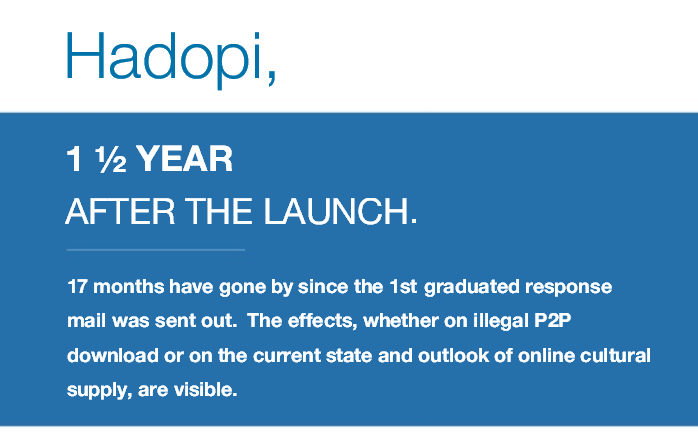
With anti-piracy efforts around the world ramping up, and the closure of several well known (alleged) piracy haunts, it would be extremely interesting to see the full financial impact of this expected piracy reduction, some say by as much as 40% in specific sectors (music, for one, after the closure of LimeWire). And so when Hadpoi, the French agency tasked with managing their “three-strikes” regime, released a report detailing the success of the program, with headline making statements such as “69% reduction” in piracy rates, this might have been just what was needed to see the real relationship between piracy and revenue. But while the report made ever bigger claims about the effect the regime had on piracy, what was sorely missing though were hard evidence of a rise in revenue, which as I’ve noted above, should have been the real goal of the whole exercise.

And while Hadopi might have been coy on the financial side of things, it just happens that most industry financial figures are public and available online. Looking at the French music and movie industry, and their performances in 2011 compared to 2010 (a full year with “three-strikes” in effect), the figures, if interpreted in a silly way, may actually point to the opposite: that piracy may have been helping sales!

The French recorded music industry recorded a contraction of 3.9% in 2011, while the movie industry didn’t fare much better, with revenue down 2.7%. In fact, the music industry’s loss was actually greater than the global average of 3%, possibly significant given that most of these other countries still have laws that are perceived to be much weaker than France’s.  Of course, to come to the conclusion that piracy was helping to fuel sales would be silly, and a mis-use of stats, and I guess it would also be slightly disingenuous to say that the piracy reduction didn’t have a positive effect on revenue. But what is clear is that there isn’t a 1:1 relationship between piracy and revenue loss, certainly not to the extent that the content industries have been trying to tell us.

What may be true is that the ever changing digital scene may have had a greater impact on the fortunes of both industries than the forced habit change of pirates in France. The music industry’s figures did show a dramatic increase in digital download revenue, higher than the global average, and that may be interpreted as a positive effect from “three-strikes”. But on the other hand, the introduction and adoption of new digital services such as Spotify, may actually be the main driving factor behind increasing sales. Similarly, while physical disc sales for the movie industry were down, VOD and other digital services recorded huge growth. So what may be actually happening is that new services are finally giving people, who used to pirate, the convenience (and the price point) they were craving. Unfortunately, most of these services probably earn less for their respective industries than compared to physical sales – sales that these industries had more control over. So innovation appears to be winning the war against piracy (who’d have thunk it?), but by being overly cautious and being overly obsessed with anti-piracy and DRM, the industries that had most to gain from this digital revolution can now only watch from the sidelines as companies like Apple, Amazon and Netflix take over a large part of the distribution process (and as a result, a large portion of the profits too). You snooze, you lose.

Viacom Logo

Viacom is still trying to fight YouTube, despite today's YouTube being totally different to the one it sued

It’s still not too late for them though, as they still control the content. As long as they realise the errors of their ways, and start embracing change, instead of fighting innovation, the content industries can still come out ahead as they have done with every technological transition that they have initially opposed. But that’s probably a little too optimistic, as these industries believe they’re in a fight for their lives, and they won’t quit until it’s probably too late. Take Viacom, who this week won an appeal to have their lawsuit against YouTube re-heard in court. The problem is that the YouTube that Viacom wanted to sue no longer exists, things have moved on piracy wise on the site, partially via threats such as their original lawsuit, but mostly due to changing user habits – and it is now a platform that companies like Viacom should want to be part of. Viacom, for their part, has been making the efforts, signing deals with Google to distribute their content via YouTube and Google Play and such, but you don’t really know if it’s them truly embracing the trend, or doing so reluctantly because everyone else is doing it (but still secretly want things back to the way it was). And if they do want to embrace services like YouTube, then why not just drop a lawsuit that they probably can’t win anyway?

Chris Dodd

MPAA chief Chris Dodd still holds out hope for SOPA/PIPA, and may have to "Bully" some tech companies into line to support future legislation

If the industry could only chill out and become a little bit less paranoid about piracy, perhaps we wouldn’t have the types of limitations, via geo-restriction, timed release windows and DRM, that technology providers have to contend with. And without these limitations, we may finally have a product or service that’s better than piracy, maybe not with a straight price comparison, but would be convenient and non-intrusive enough for people to not bother with torrents. Having access to all episodes of Stargate SG-1 via a $7.99 per month Netflix account, as opposed to downloading all the DVD-rips, for example (and an example that seems to be actually working in practice right now, judging by the relatively small number of leechers for the complete rip of the series on The Pirate Bay). But perhaps this too is far too optimistic, with MPAA’s chairman Chris Dodd this week still holding on to the hope that SOPA and PIPA will eventually pass through Congress (my April Fools Day joke news article aside), suggesting we haven’t seen the end of Hollywood and the record industry’s support for short-sighted and draconian non-solutions to the web piracy problem. Unfortunately, Dodd’s statement itself may not be considered that optimistic, as there are signs in the last few weeks (from the White House and beyond) that support is building again for SOPA like legislation. Meanwhile, the MPAA will certainly try to “Bully” more politicians into supporting it, while making sure this time these supporters won’t backflip just because a million or ten  come out in opposition to any proposed legislation. We all need to get ready for another fight.

Speaking of paranoid, the MPAA’s latest fear is that Megaupload would somehow get access to the data stored on their (former) servers and would somehow re-launch Megaupload, perhaps in another jurisdiction. Considering the fact that the Megaupload guys actually want to avoid prison, I suspect there’s little, if any chance Megaupload could be relaunched. But this latest MPAA manoeuvre will make it harder for users to get back their legitimate files, not that the MPAA cares or anything.

Gaming

In gaming news this week, I wrote a brief round-up of the latest “PS4” and “Xbox 720” rumours, starting with more creative names for both next-gen consoles.

Sony’s next console will have the codename Orbis, while Microsoft has chosen Durango. Orbis and Durango (sounds like two characters from a kid friendly adventure game), seems to have more similarities than differences, with both reported to be using AMD technology to drive both the CPU and GPU.

Not only that, both consoles seem keen to deploy some kind of anti second-hand game system, where each disc is locked to an account, and money needs to be paid (to Sony and Microsoft, who up until now have not been part of the second hand trade) to unlock a disc for another account. The latest rumours even sees Microsoft’s Durango borrow from Ubisoft’s playbook, with a requirement for a constant-on Internet connection (hope it isn’t true, because that would suck).

With neither console scheduled to make an appearance until late 2013, it’s perhaps a bit too early to take any rumours that seriously at this stage. Not that you should take anything I write seriously, April Fools or otherwise.

And on that serious/not serious note, that’s all I have for you this week. It’s not much, but it will have to do until next week. Happy Easter, Passover, and any other religious or non religious holidays that I may or may not be aware of.

Weekly News Roundup (1 April 2012)

Sunday, April 1st, 2012

I know what the date is, and no, I’m not going do something for it. The expectation is always too high, and I can never live up to it. Besides, all the interesting ones have been done, and the rest, I’m fairly sure, constitute libel. So nobody is making a fool out of anyone else for this year, not Digital Digest anyway.

Or maybe I’m just luring you into a false sense of security …

But before we get into any April based tomfoolery, which may or may not happen, let’s get through the news roundup first.

But before that even, a linky link to Digital Digest’s “new” Facebook page, or rather, the same page with the new Timeline thingy on it that has been forced upon all of us by all knowing Facebook. The timeline feature is definitely quite interesting, and if I have the time, I might just start adding a few of Digital Digest’s milestones into the timeline (having only added in one entry for the launch of the website back in 1999, so far). I’ve never been a big fan of Facebook’s user interface, but I must say this timeline thing does look good.

Copyright

First, a follow-up to a story from last week regarding RapidShare. I mentioned last week, in a brief sentence, that RapidShare may soon be forced to filter all user uploads due to a recent court decision. Apparently, this is not actually  the case at all.

What had happened is that the groups suing RapidShare in Germany, a collection of book and music rights groups, had released a statement celebrating their “victory”, despite the court having not yet released the full written verdict. But now that the written verdict has been released, it paints a rather different picture, one that RapidShare says gives them an important victory as well.

Now I’m aware of the spin that is probably being produced by both sides, but it’s clear the the verdict wasn’t the clear victory the rights holders had hoped for. What the court did, at least according to RapidShare, was to recognise RapidShare’s overall business model as a legal one, while at the same time asking RapidShare to do more on the issues of copyright infringement. The court says that RapidShare needs to actively seek out links to infringing content (hosted on its servers) by visiting the common haunts for these types of things – popular forums, blogs, websites and such, and remove said content once it is aware of the likely legal status of the upload. This is opposed to scanning each and every download, without knowing anything about the legality of the download (which, according to the European Court of Justice, may constitute a violation of privacy rights). But RapidShare says they’re already doing exactly this, and so for them, the court’s verdict won’t actually affect them too much. Despite this, RapidShare still plan to appeal the decision on the grounds that while they think these measures are a reasonable part of their business strategy, they don’t believe the court has the right to order websites to comply.

Hotfile

Hotfile will soon scan all uploads for pirated content, but it may be too little, and too late, as far as the MPAA is concerned

Another file sharing host is taking a different approach to anti-piracy, although it might be too late, if not too little. A press release alerted me to the fact that Hotfile will start using Vobile’s vCloud9 scanning solution to scan uploads for infringing content. Apparently, the technology employs a database of known file “fingerprints”, and can even scan compressed archives to see if the upload contains infringing content. This comes after the company recently changed its affiliate program to no longer pay based on download volume (ie. heavily favoured towards pirated downloads), but instead, when uploads result in the downloader signing up to a premium account, and uploaders get a commission on that. With the MPAA still insistent on a summary judgement against Hotfile in its lawsuit, this may all be too late, and it’s probably too little as well when it comes to what the MPAA really wants (which is to shut down Hotfile and make an example out of them, probably).

For those that take an interest in things like DVD and Blu-ray copy protection, as well as region coding and stuff, you should be well aware that Fox are one of the “hard-asses” when it comes to these sort of things. Being pretty much the only studio that consistently makes its US Blu-rays region locked (even Sony has seen the light, and forgoes region control for catalogue releases), and having early on declared their support for Blu-ray based solely on the format’s preference for tougher copy protection methods (all of which has since been cracked, of course), you’d expect that Fox, and its parent company, to be the last one to have a copyright scandal. Which was why it was very ironical to see News Corp embroiled in its own piracy scandal this week, as claims were made by BBC’s Panorama program, and also separately by an Australian newspaper, that a (former) subsidiary of News Corp may have helped to fuel piracy of competitor’s services in order to gain an unfair market advantage. Apparently, the subsidiary, NDS, helped to crack rival pay TV networks’ encryption cards, and then helped to ensure the cracked codes got into the hands of people who sell pirated services. News Corp, and NDS, have both denied these allegations, but both the BBC and the Australian paper, the Australian Financial Review, say they have gathered a lot of evidence on this (with the AFR saying that this investigation has been four years in the making). With the Australian government already considering launching its own official investigation into this incident, this could be a story to watch out for.

And finally for this week’s copyright section, I have a story that hits pretty close to home. Actually, it hits directly at home like a guided missile, and for the fun of it, takes out a few neighbouring properties too.  This week, the home page of Digital Digest, and two PowerDVD related pages, were removed from the Google search results due to a DMCA take-down request filed by Guardlex.com. You can read the full story here, and the DMCA notice here on Chilling Effects if/when it’s ever made available, but the gist of it is that Guardlex, probably working on behalf of Cyberlink (the makers of PowerDVD) to take down results related to pirated downloads of PowerDVD, took down our pages as part of a DMCA notice that included thousands of other URLs. The thousands of URLs also included well known legitimate websites such as Cnet’s download.com, Afterdawn, Softonic.com and other clearly legal URLs, including a dozen URLs from Cyberlink’s own website (including their home page!).

Digital Digest DMCA Google

The Digital Digest home page have been removed from the Google results due to the DMCA complaint that does not seem to be valid at all

The whole DMCA removal process with Google goes something like this. When Google receives a DMCA notice, and if the notice has all the proper documentations, they immediately remove the URL from their search results (and you’ll see the “In response to a complaint we received under the US Digital Millennium Copyright Act, we have removed … message at the bottom of any search results page that has removed results – do a search for “PowerDVD” right now, and you’ll see 3 such messages, meaning 3 URLs were removed). Some time later, could be days or weeks, Google informs the owner of the removed page(s), assuming they have a webmaster central account with Google, of the take-down. And a few days after that, Google may send the website owner the actual DMCA notice. You then have the option to file a counter-notification, and if Google does not receive any further notice on this matter within 14 working days, the URLs get reinstated back into Google’s index.

So even in the case of a mistaken identity, as was the case here I believe, it may take weeks to get it all sorted, with financial and a reputation loss that cannot be avoided. Under the DMCA, if I’m the victim of a mistaken take-down, I can sue for damages. The problem is that this is rarely worth the time and trouble when you factor in legal fees, and so DMCA agents can get away with these innocent and sometimes not so innocent mistakes, most of the time. This is probably why 57% of all DMCA claims made to Google are by companies out to “get” their competitors, and that 37% aren’t even valid claims. It’s clear that the DMCA is currently being abused by rights holders, and that was always going to happen if you have the level of bias present in these sets of laws.

And so it scares me very much to think that rights holders still say the DMCA is not biased enough, and they want something like SOPA or PIPA to make it even easier to take down entire websites, just for a few bad pages that may not even be bad. Sure, the major backers of the bills will say it’s only for “foreign rogue” websites, and that they will promise not to abuse it, but can you really trust them? And even if you can, can you trust all the people and companies that will have access to SOPA/PIPA, to not abuse it in the same way they’re currently abusing the DMCA?

High Definition

A couple of WNR’s ago, for an issue where I ran out of stuff to write, I enthused about how great streaming video-on-demand was, and how it look destined to be the future of home video.

It seems that the future is going to get here sooner than I though. The latest research via IHS Screen Digest (no relations) says that streaming has just overtaken discs as *the* way to watch movies and TV shows at home, having increased by about 140% in the last year alone. 3.4 billion viewings were made on streaming media, compared to only 2.4 billion on DVDs and Blu-ray, for 2011.

What was more interesting is that, on average, people only paid 51 cents for each streaming title, while they paid $4.72 for discs. The cost of an Internet connection and bandwidth is probably not counted for streaming, which will increase the cost, but I think the main idea is that people watch more on streaming, especially unlimited streaming offers, because they have access to more content for a far lower price than compared to “owning” content.

Netflix vs Blu-ray

Is Netflix going to doom Blu-ray? Maybe not now, but you can't dent that VOD is the best way to access and maintain a huge library of titles

Of course, this story has led to people saying the end of nigh for Blu-ray, but until true Blu-ray quality 1080p can be streamed to most people’s homes, the reality is that Blu-ray is still very much needed.

But for those that don’t really care that much about seeing a few extra pixels or “owning” content, or for content that can’t benefit from the full bandwidth HD treatment, then $7.99 per month for Netflix may be a much better deal than having a collection of hundreds or even thousands of discs (just making available the shelving space is a pain, trust me).

But for me, having something physical to hold on to that won’t refuse to play simply because my Internet connection is down, is still worth the extra $4.21.

And with that, we come to the end of another WNR. See you next week.

Weekly News Roundup (25 March 2012)

Sunday, March 25th, 2012

Welcome to another edition of the WNR. Two weeks ago, I mentioned I was working on a project for Digital Digest that should be ready in about two weeks time. Unfortunately, the same is still true today, as I’m still working on it, and it’s still (at least) two week away from being ready.

And the delay is totally unrelated to Skyrim, or the fact that I unceremoniously passed 100 hours of play time this week. Most of what I’ve been doing in the game this week has been very “chore-ish”, having spent most of yesterday’s playtime moving from my house in Whiterun to Riften – meaning multiple trips carrying the assortment of goodies and junk that I’ve been hoarding at my old house, fast travelling the many miles between the two hamlets, all the while not wearing any clothes as to clear up as much carrying weight as possible. Trust me, it’s not as fun as it sounds.

A couple of interesting stories to go through this week, so let’s get started.

Copyright

Google has dragged itself into the Megaupload affair by coming to the defence of Hotfile, or rather, the defence of the DMCA’s “safe harbor” provision.

The MPAA is currently suing Hotfile, and one of the argument that the industry trade body has made is that Hotfile should not be afforded the protection of “safe harbor”, due to the “rampant” nature of piracy that goes on on the file sharing website. Another argument is that Hotfile has not been cooperating with the MPAA fully in terms of providing the technical anti-piracy measures that the MPAA studios want. Google says both of these arguments are invalid because current case law does not strip away “safe harbor” based on “generalized awareness that unspecified (or even ‘rampant’) infringement is occurring”, and that there’s nothing in the law that says Hotfile must implement the type of content filtering that the rights holder requests, as the decision is mostly left up to the service provider.

Both of these arguments have been made against Megaupload too in the government’s criminal case against the file hosting website. And another key argument in the government’s case, which was also employed by the MPAA in the case against Hotfile, is that the website operators only removed content that had been specifically listed by the rights holder, and deliberately kept similar or even the exact same content on their network. Google argues that this is perfectly in-line with the spirit of the DMCA, with the burden of identifying infringing content belonging to rights holders (the only people that can decide which content should  be removed and which should be kept). The argument works a little better for Google’s assets, such as YouTube, than for Hotfile/Megaupload though – it’s often in the rights holder’s interest to keep some “infringing” content active on YouTube due to promotional reasons, while at the same time removing others (even if it’s the same video, re-uploaded). With Hotfile/Megaupload, it’s unlikely that, for example, Warner Bros. would want to keep a copy of The Dark Knight available for download, but in Google’s view, Hotfile did exactly what the DMCA demanded it to do, nothing less, but certainly nothing more than what’s required, such as removing content that was not specifically listed.

Rapidshare, in a German court, is also facing similar accusations, and as a result, it could be forced to implement drastic site-wide filtering for all uploads.

The issue of how proactive a service provider should be is at the heart of the DMCA “safe harbor” argument, with content holders now accusing Internet companies of “abusing” the protection afforded to them by the provision, by deliberately turning a blind eye to ongoing infringement just because it has not be specifically named. But the alternative is for service providers to “second guess” the intentions, and the legal rights, of content holders, to take a “better safe than sorry” approach, the collateral damage from such actions which will mean a lot of harm to innovation and creativity (and is ever more the problem on YouTube, with its automated “Content ID” system and false positives). I don’t know what the answer is, but draconian blanket bans and filtering can’t be the best solution out there, not when there’s still so much that content holders can do to make the legal option the more enticing one. The DMCA, conceived by the likes of the MPAA, is already far too biased towards rights holders at the expense of innovation and creativity – but it seems it’s still not biased enough, hence the “need” for PIPA/SOPA/ACTA.

Megaupload Copyright Demand

A letter is floating around in Europe "suing" users for uploading and downloading stuff to/from Megaupload

And the not so subtle bias in current copyright laws has also produced a climate of fear and uncertainty, with most people unaware of their actual rights when it comes to these kind of disputes. This has led to mass copyright lawsuits that use the fear, and sometimes the embarrassment, to “encourage” users to pay a pre-trial settlement fee to make the matter go away. It’s no wonder it’s been referred to as “legal blackmail”. But if you take this just one step further, something that many consider ethically suspect turns into an outright scam, and report this week suggest that Megaupload users are now being targeted. A fake mass copyright style letter is being sent to potential Megaupload users demanding a settlement fee, or the threat of a 10,000 euros lawsuit. The small matter of the law firm responsible for these letters not actually existing should be the first clue as to the validity of these claims, and also the fact that payments being made is going to a Slovakian bank account, for a law firm that’s supposed to be based in Munich.

Unfortunately, the MPAA’s actions may have only added to the believability of these scams , when they requested the web host of Megaupload to retain data, including user data, for future potential lawsuits. But even the MPAA knows the public’s distaste for this kind of thing, so they did make it clear that individual user lawsuits are not on the cards. A civil case against Megaupload and its “intermediaries”, on the other hand, now seems more than likely.

Moving on, Ubisoft this week hinted that the company might be suffering from a split-personality disorder when the company’s VP of Digital Publishing, Chris Early, spoke about intrusive DRM and how it’s doing paying customers a disservice. Not only that, Early says that Ubisoft really really wants to make DRM “go away” (I’ve got an idea where Ubisoft can put their DRM), and they think the best way to do it is through adding value to the legitimate gaming experience (they can start by not making the legitimate gaming experience a pain in the butt, thanks to their DRM). But what Early may be hinting at is the business model of MMO’s and how Ubisoft can learn from it, by incorporating some of the elements that keep people coming back (and paying) into the single player experience. I’m not sure ham-fisting MMO elements and the subscription model into single player games, along with a MMO’s requirement of always being online (which, for a single player game, is nothing more than a DRM. UbiDRM to be exact), is the best idea to be honest. Making better games, lowering the price, and providing online features, ongoing support, and exclusive content, might all be better solutions.

High Definition

Flags of truce came out this week in the HTML5 vs Flash vs H.264 vs WebM/Theora war, as Mozilla signaled their surrender. Sort of.

A little bit of background: The issue surrounds HTML5’s new ability to allow videos to embedded and played without the need to install third party plug-ins, like Flash. But just which video format HTML5 video would work with has been up for debate for a while now, with H.264 being the obvious choice (as it is the ones most used with Flash based videos today, and also an industry standard), but also the valid argument that the royalty and patent encumbered H.264 format isn’t ideal, especially since some of today’s most popular browsers are the open source variety. Mozilla, in particular, was strongly objected to H.264 support being made mandatory for HTML5 browsers. Google, sensing an opportunity, stepped up and produced the VP8 based WebM format. But the format failed to gain any traction, and so this week, Mozilla has had to do the unthinkable: start supporting H.264.

Browsers

Firefox will soon join Chrome, IE and Safari as browsers to support H.264

Mozilla made the announcement this week that they would have to now offer H.264 support, especially for their mobile based products, as they see no other way forward without supporting a format that’s even more entrenched in the mobile market than on desktop/standalones. While Mozilla would not be providing a built-in decoder, they would allow their Firefox browser to use existing software and hardware capabilities to decode H.264.

In my opinion, this was always going to be the likely outcome. Google’s half-hearted support for WebM, some say hypocritically considering their Android platform offers H.264 decoding as standard, was never going to be enough to out-muscle H.264, especially since none of the major hardware makers were even interested to offer WebM support. And with Apple firmly behind H.264, and everyone else trying to out-Apple Apple, WebM had little or no chance to succeed.

So what does this mean for the average user? It means that HTML5 video now has a greater chance to succeed and become a true replacement for Flash, and that’s probably a tick in the win column for everyone, even if this is a set-back for open-source video standards. MPEG LA, the licensing authority for H.264, for what it’s worth, has promised not to charge royalties for this type of H.264 usage for the foreseeable future, so H.264 is free for the time being without being “free”, if you know what I mean.

The Girl with Dragon Tattoo DVD disc art

A real disc or a pirated one? You decide ...

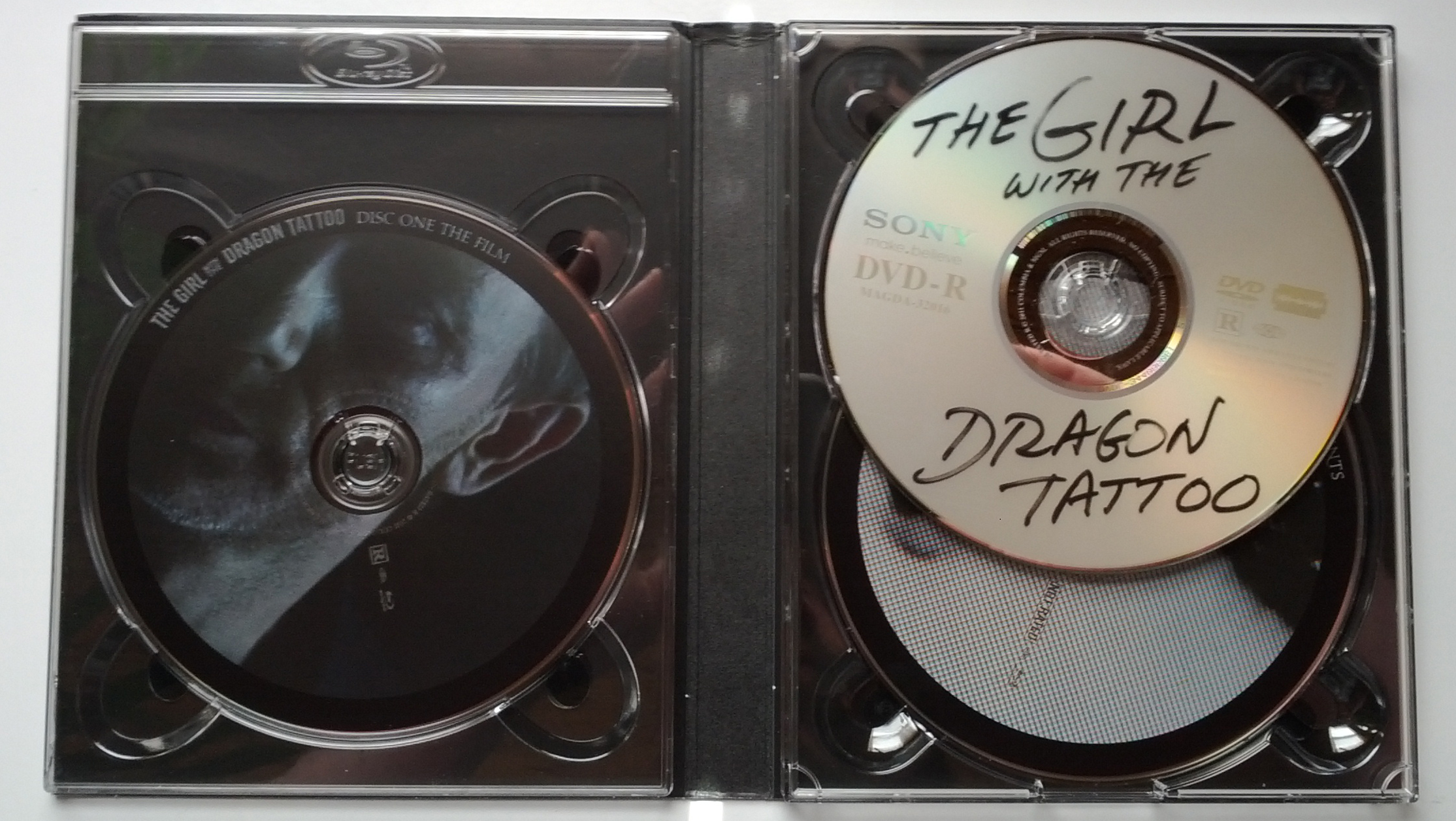
And finally, a story that feels a bit “PR-ish” to me, where Sony’s DVD disc art for their remake of “The Girls with the Dragon Tattoo” is confusing people into thinking they’ve been sold a pirated copy of the movie. The disc art resembles a home made Sony DVD-R with the title of the film printed on to make it look like it was written on with black markers, and it’s supposed to be a reference to the main character of the film, Lisbeth Salander, and her hacking ways. Those that purchased the Blu-ray+DVD combo version might be even more confused, since the Blu-ray disc art is fairly traditional, which makes the “DVD-R” stand out even more.

But a closer look reveals the MPAA rating, region info, and even some copyright text on the supposed home made “DVD-R”. And the “DVD-R” being a Sony branded one, of course alludes to the fact that they were the studio behind the movie. So would it really have fooled people into calling up Redbox or whoever to complain, as was claimed by some of the news articles? Maybe a surprise at first, sure, but to be completely fooled? I don’t think so. All has happened though is that this story has given the DVD set some free publicity, which is why I’m cynically leaning towards PR campaign on this one.

Alrighty then, that’s pretty much the week as I remember it. Must get back to my “move” in Skyrim, still got 90+ each of dragon bones and scales to move, as well as my assortment of 400 iron daggers. This could take a while … see you next week.