Archive for the ‘PS3, PS4’ Category

Game Consoles – October 2009 NPD Sales Figure Analysis

Saturday, November 14th, 2009

We’re nearing the two busiest months of the year in November and December. Last month, we saw the PS3 take top spot thanks to the price cut and the new Slim model. At that time, I questioned the longevity of this bump in sales, whether it was a long term thing thanks to the lowered price, or whether it was a temporary bump due to people upgrading their existing consoles to the Slim. This month’s figures should give us a better idea as to what has occurred. The figures are from NPD, a marketing research firm that releases games console sale data every month.

The figures for US sales in October 2009 are below, ranked in order of number of sales (October 2008 figures also shown, including percentage change):

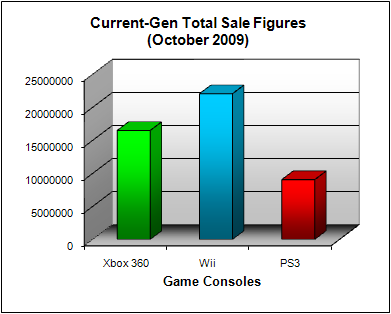
  • Wii: 506,900 (Total: 22.1 million; October 2008: 803,000 – down 37%)
  • DS: 457,600 (Total: 34.4 million; October 2008: 491,000 – down 7%)
  • PS3: 320,600 (Total: 9.1 million; October 2008: 190,000 – up 69%)
  • Xbox 360: 249,700 (Total: 16.5 million; October 2008: 371,000 – down 33%)
  • PSP: 174,600 (Total: 15.9 million; October 2008: 193,000 – down 10%)
  • PS2: 117,800 (Total: 44.7 million; October 2008: 136,000 – down 13%)
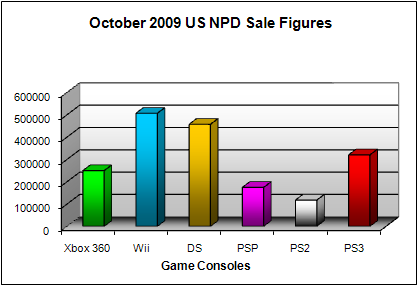
NPD October 2009 Game Console US Sales Figures
NPD October 2009 Game Console US Sales Figures

NPD Game Console Total US Sales Figures (as of October 2009)

NPD Game Console Total US Sales Figures (as of October 2009)

My prediction from last month was:

It’s time to make a prediction of October 2009’s results. For my money, I’ll say that the order of the hardware sales will remain the same, although the Wii numbers will be closer to the PS3 numbers. The PSP Go debuts, but based on an Australian report about the poor sales figures (a couple of hundred sales per week in an entire country, is not the best), the impact of the PSP Go may be muted. Sony will continue to have good month, but this time backed up in software sales as well with Uncharted 2. It might not sell enough to top the number one title, which might be Wii Sports Resort. Wii Fit Plus might take a place in the top half of the charts as well. I expect FIFA 10 to show up in one of more flavors in the top 10. Borderlands might make a showing too.

Some right, some wrong. The biggest surprise, if you can call it that, was that the Wii price cut managed to do enough to unseat the PS3 from the top spot. Part of this was also due to the price cut, Slim induced sales bump not lasting as long as one would expect. This is true of the Xbox 360 price cut as well, and if November wasn’t such a bumper month for sales, it might also be true for the Wii as well next month. My predictions about PSP Go sales being relatively subdued was also correct, with combined PSP sales of both the old and new models actually dropping compared to last month (but dropping less than it would have been had the PSP Go not been released). For my software predictions, I was right about Uncharted 2 doing well for Sony, but wrong about it not taking the number one spot. It did, and quite comfortably. Wii Sports Resort failed to keep its sales up, and was beaten in the end by Wii Fit Plus. FIFA 10 did show up, albeit in last place, but Borderlands did well on the Xbox 360 at least.

So let’s take a look at the PS3 numbers first. After a great month in which it took top spot amongst the home consoles for the first time since I’ve started analyzing the figures, it quickly felled back down again, but at least it managed to beat the Xbox 360. We’ll still need a couple of months to see if the price cut has any long term effects, but one thing is for certain, that last month’s bump for the PS3 had parts of it which were very temporary in nature. I would expect a price cut to be more long term, and the introduction of a new model to be more short term (due to the number of people who upgrade, which only occurs once), and so one can conclude that what made the PS3 the number one selling home based console in September was down to a fairly even combination of both events (price cut and new model), but that the temporary has started wearing off for October. Certainly those that expected the PS3 to be selling over the Wii from last month onwards were a bit too optimistic in their predictions, perhaps. In any case, Sony can still be extremely happy with the results, as the PS3 recorded what was the only year-on-year sales increase of all the consoles (more on that later).

The Wii’s sales bump is welcome news for Nintendo in what has been a fairly miserable year, especially in the last quarter. The price cut, while occurring in the last month, seems to have had the full effect in October as the Wii was the only console to record growth compared to September. But the overall picture is still not a happy one for Nintendo, as the year-on-year sale of the Wii saw a huge 37% drop, the largest of any console. Part of this was due to how incredibly the Wii was selling this time last year, way above any expectations. The other part is the slow decline in Wii sales that has occurred over 2009. At least the DS is still doing relatively well, keeping a firm grip on the number one spot and only recording a small year-on-year drop.

The Xbox 360 figures are again not looking great for Microsoft. A huge year-on-year drop breaks the trend for 2009, in which the Xbox 360 was pretty much the only console to record year-on-year growth (or negligible losses in a couple of months). This suggest the PS3 price cut has really hurt the Xbox 360 where it counts, and the fortunes have been reversed for the two consoles post the PS3 price cut, as the PS3 was the one recording large year-on-year sales drops up until the price cut. With Project Natal not coming until this time next year, later than PS3’s motion controller, which might be able to steal the Natal thunder if it’s properly integrated with the PS3 Eye and with useful software, time is running out for Microsoft to do something. To be fair, it was always a difficult struggle for the Xbox 360 to beat the PS3, and it has outperformed everyone’s expectations up until this point. Price cuts had allowed the Xbox 360 to outperform the PS3, but price cuts are not something that can go on forever, and given similar prices, the PS3 with its Blu-ray functionality and more advanced design will always win. So it may not be a case of the Xbox 360 losing to the PS3, but rather, both consoles finding their rightful place now that the PS3 ridiculous pricing has been removed as a factor. For Microsoft, Natal is a step in the right direction, but the November 2010 release date may just be too late to change things. The only thing that Microsoft has in its arsenal is the larger install base of the Xbox 360 over the PS3 in the US, which should at least mean that it will take some time before the PS3 finds parity, and will still allow them to sell software in good numbers until then. And the better multiplayer platform in Xbox Live over the PlayStation Network, and add to that the larger install base, does still give the Xbox 360 some momentum (the “if my friends are already on the 360, I have to be on it too” principle). Making Xbox Live Gold free is probably the only other weapon left for Microsoft to use.

Looking at sales as a whole, October performed badly compared to September and certainly compared to the same time last year. There might be a recession related thing going on at the moment, or just the lack of really big titles, but the stimulus given by the price drops, or new models being released, seems to be the only things keeping the figures from sliding further down. Things will be on the up in November for sure, but the numbers will be extremely interesting to see if there is a year-on-year growth or decline, and whether how well the PS3 numbers do compared to the Wii (and to a lesser extent, the Xbox 360), both to see if temporary factors were responsible for the Wii’s sales increase this month, and again to confirm the longevity of the PS3 price cut boost.

Moving on to software, things are slightly better, although a year-on-year decline was still the order of the day. The top title was a PS3 title for only the second time since I’ve started keeping track (the previous one was Metal Gear Solid 4 in June 2008). Uncharted 2 was the top selling title in question, and being an exclusive, that’s exactly where it should be. But compared to last month’s number one, which was also a follow-up game in a series and also a platform exclusive (Halo 3: ODST), the sales are still somewhat disappointing (Halo 3: ODST outsold Uncharted 2 by a ratio of nearly 3 to 1). Getting more out of platform exclusives, especially high profile ones such as the Uncharted series, whether that’s through more extensive marketing or other tactics, is something Sony can work on to better its software sales. There was only one other PS3 title in the top 10, NBA 2K10, a multi-platform release. There were only two Wii titles in the top 10, Wii Fit Plus as predicted and Wii Sports Resort, which saw sales drop compared to last month. The rest, apart from one DS title, was all Microsoft. 5 titles in the top 10, and even though the highest placed was only third, it still managed to grab 44.3% of total sales, the third best set of results in 2009. Wii games accounted 25.1% of the top 10, and the PS3 was third once more with 25% of sales.

Here’s the complete list of the top 10 software sales:

  1. Uncharted 2: Among Thieves (PS3, Sony) – 537,000
  2. Wii Fit Plus (Wii, Nintendo) – 441,000
  3. Borderlands (Xbox 360, Take-Two) – 418,000
  4. Wii Sports Resort (Wii, Nintendo) – 314,000
  5. NBA 2K10 (Xbox 360, 2K Sports) – 311,000
  6. Halo 3: ODST (Xbox 360, Microsoft) – 271,000
  7. NBA 2K10 (PS3, 2K Sports) – 213,000
  8. Forza Motorsport 3 (Xbox 360, Microsoft) – 175,000
  9. Kingdom Hearts 358/2 Days (DS, Square Enix) – 169,000
  10. FIFA 10 (Xbox 360, EA Sports) – 156,000

Prediction time. This is a hard one. Sales will go up considerably compared to October, that’s for sure. The DS will be top, the number two spot will be closely fought between the PS3 and Wii, although I’m leaning towards the Wii winning that battle right now. The Xbox 360 is 4th, followed by the other two PlayStation consoles. Call of Duty: Modern Warfare 2 will be the number one selling game, and the controversial game will be a record seller if the hype is anything to go by. The Xbox 360 version of this multi-platform game should be the one occupying the top spot. Other titles that will do well for the Xbox 360 include Assassin’s Creed II and the console platform exclusive Left 4 Dead 2. For the Wii, a new Super Mario Bros game will always be a hit, and it could give CoD: MW2 some competition (although mainly for the PS3 version, one suspect). Dragon Age: Origins, from the same people that gave us Mass Effect, could make the top 10 as well, since I’ve been hearing a lot about this game recently.

See you next month.

Weekly News Roundup (8 November 2009)

Sunday, November 8th, 2009

Some weeks you couldn’t buy a news story, this week, there’s enough for two weeks. Don’t really know why, perhaps the MPAA is upping their lobbying efforts, or the courts have resumed their cases, and parliaments are reconvened to pass new legislations. Who knows. On my end, I finished the review for WinDVD 2010 as promised. A summary? Well, I’d rather you read the full review, but suffice to say there are things that I like about WinDVD, and there are some things that its competitors have done that it has not. Is it a great Blu-ray player? Yes it is. Can it be better, that’s a yes too.

Copyright

Copyright news first, and there are quite a few to go through. Right after my last WNR, news came that torrent tracker UK-T was shut down, and some kind of police action was involved, but as no anti-piracy agency had claimed responsibility at that time, nobody was really sure what went down. Still not really sure what happened, but from leaked reports, it suggest that the police had raided the homes of several of the site’s admins. The database was wiped before the police could get their hands on it, and so the subscribers are safe. One tracker down, only 362,621 to go.

Demonoid: Tracker back online. Database corruption, or something more sinister?

Demonoid: Tracker back online. Database corruption, or something more sinister?

But while one torrent tracker was down, another came back up. Demonoid has been down for ages now, supposedly due to a database problem, but the tracker is at least up again, if not the main website. I’ve noticed that several torrent sites have experienced similar database problems recently, so it could be just a coincidence, or perhaps something more sinister? If it was just an accident, then these accidents have actually done more to stop torrent sites than all the legal actions. Take The Pirate Bay for example. The latest attempt to shut the site down, or at least prevent access to it in Norway, has failed. The entertainment lobby had asked the Norwegian court to get Norway’s largest ISP Telenor to shut down access to the torrent site, but the court said “Nei” as they didn’t think an ISP should be the one deciding which websites its customers get access to, and which it should block. And the implication of this ruling is that ISPs are not really responsible for what their customers get up to, since if they were, then the court would have told them to shut off access. To me, this is common sense,  and Telenor’s spokesman’s analogy of not being able to sue a ladder manufacturer because someone used the ladder to commit a burglary again seems to make sense to me. But common sense is in short supply these days when it comes to the copyright debate.

The failed attempt to shut down The Pirate Bay again deals another blow to the MPAA and their friends, but do they really want the torrent site to be shut down? According to a new study, they should be careful of what they wish for, because during the few days that The Pirate Bay was down, the number of torrent trackers and websites dramatically increased, and downloading continued. The way modern torrent clients work, even without a working tracker, downloads can continued thanks to a technology called DHT (Distributed Hashed Table), or so called trackerless downloads. The download speed is sometimes affected, but not always. And with TPB down, many sees it as an opportunity to become the new TPB, and so naturally, the number of torrent and trackers will surge during this period. It just shows how hard it is to actually try and stop file sharing, and I think it may actually be impossible. All the resources that have been spent on trying to stop file sharing seems like a big waste to me. And even more so when you consider the stats that show that people who download illegal songs actually spend more on music than those who don’t. This again seems like common sense to me, because people who download music (legally, or illegally) are the ones that love music, and many are using free downloads as a way to search for new songs and artists. This “buy before you try” argument has been made for other content as well, like games, although the percentage that converts from try to buy is rather low, nevertheless, there is a percentage. Music especially I think is something that you do need to try before you buy, that’s why we have radio stations that broadcast songs, for free. The music industry, and others, should be exploiting this phenomenon to their advantage instead of trying to shut it down. Spotify, the free online music service, seems to signal a possible future direction, basically taking the radio model online.

The MPAA's propaganda ministry is busy these days

The MPAA's propaganda ministry is busy these days

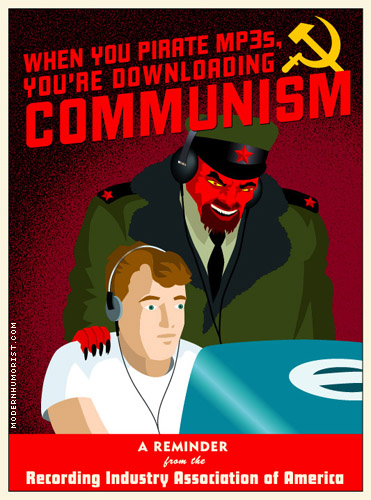
There’s still more copyright news, we’re barely half way through. The MPAA has been busy lobbying the FCC for various things. And as a concerted campaign, they had the US 60 Minutes broadcast a copyright propaganda film that tried to link file sharing with organized crime. There are links between counterfeit goods and physical media piracy with organized crime, but online file sharing that’s mostly free? The downloading communism poster immediately springs to mind (see right). More propaganda as the MPAA says the Internet will die if piracy is not stopped. This is the same MPAA that has been trying to kill the Internet for ages now, that its members and supporters have publicly stated their wish that the Internet had never existed, so why are they so worried about its health now? And the MPAA is not just happy pushing their agenda on the US, they’re going global as well. You can just see their dirty fingerprints over the proposed copyright treaty that will be discussed in South Korea this month. The worst part is that the treaty is being kept super top secret, even though it affects everyone. Of course, the Internet being the Internet, part of the discussions were leaked and it was indeed what we fear most. Three-strikes, global DMCA, ISP policing … are just some of the MPAA’s favourite things, and all will be tabled at the secret discussions later this month. Sigh.

Scumbag

Sarkozy's defence of major US corporations' interests has even led to a fight with the EU

Three-strikes and ISP policing, very popular at the moment, but the EU has decided that something needs to be done to protect consumer rights, even if what they did was not nearly enough. But it’s a start. The EU has decided that Internet access is a basic right, and as such, cutting people’s connections off will require more than just an email from the MPAA. The EU has ruled that a fair process must be in place before bannings can occur, which is less than the full criminal trial that consumer and Internet advocates had first wanted. This all came after France wanted to introduce something that legalized their three-strikes plan (the original one that didn’t require the judicial system, which their own constitutional council found to be, well, unconstitutional), and that angered pretty much everyone at the EU, and the battle has been fought ever since, leading to this latest compromise. Just what has happened to France, a country that I’ve always considered to be quite liberal and would usually be at the front lines fighting *against* the three-strikes nonsense, and not on the side of mega US corporations. Freedom and liberty is also another thing I associate with France, but they just seem to be one the wrong side of that as well because time and time again, it has been shown that copyright laws have been abused to stifle free speech and the critics of corporations. The Electronic Frontier Foundation even has a Hall of Shame for the companies and organizations that have abused copyright laws for their own (non copyright related) benefits. It just shows that when laws are so biased towards one side, they are prime candidates for abuse. And for me it’s hard to digest the fact that a country like France is in there arguing to make these laws even more one sided, and even more open to abuse. But with a guy like Sarkozy at the helm, now using the nations divisions for his political gain, no one expect anything less really. Hall of shame indeed.

The global DMCA thing is particularly annoying, although not that much of an impact since most countries have adopted some draconian form of it. One country is Denmark, and one citizen is doing his unique way of protesting the illogical nature of the laws. Under the DMCA, or the Danish equivalent, any attempt (even unsuccessful) at breaking DRM is considered illegal. However, Danish law allows for DVDs to be ripped for legal home use, and so the two Danish laws actually conflict each other. This is why Henrik Andersen confessed his “crimes” of ripping hundreds of his legally purchased DVDs for use in his home theater setup, to a Danish anti-piracy agency. Under the DMCA, Mr Andersen is guilty and should be fined, if not jailed. But just whose interests has he actually hurt? Certainly not the movie studios that he purchased his DVDs from.

Still more copyright stuff, bear with me. The third week of the Australian AFACT vs iiNet trial continues, and please refer to my summary forum post to keep yourself updated on this rather important trial, possibly the most important in the world right now concerning the copyright issue, as it seeks to decide if ISPs should be turned into copyright cops.

And in all this bad news, there’s a glimmer of hope for a fair solution that everyone can live with. Google/YouTube is finding that their compromise solution to the copyright issue, of sharing revenue with content owners if they choose not to remove stuff from YouTube, might be working. And working well, as a third of all their YouTube revenue is coming from this trial program. And it’s not just the extra revenue, the exposure on YouTube leads to more business opportunities for content owners, like the case of Mr Bean, the popular UK comedy series, in which the content owners decided to keep the user uploaded clips online, as opposed to removing it, and then found that it actually led to deals with TV stations countries that have never heard of Mr Bean before. So a bit of technical piracy actually led to a successful TV deal, and all while still making money from YouTube  profit sharing. And yet others, like Viacom, are still hell bent on suing YouTube into oblivion. Shorted sighted or what?

High Definition

Well that was a big section wasn’t it. On to HD news now, although it’s still copyright related, I’m afraid. Managed Copy, the so called legal solution to movie ripping, will soon be upon us. December 4th marks the date that MC becomes a reality on Blu-ray.

Managed Copy in a Pioneer demo for the movie Bolt

Managed Copy in a Pioneer demo for the movie Bolt

I’m excited about MC, because it signals the first step that the movie industry has taken to legitimize the need for people to be able to separate the movie from the disc that it came on. With today’s increasingly digital world and sophisticated home theater solutions, being able to have everything as pure digital data is increasingly useful. Imagine having all your DVD and Blu-ray movies stored digitally and accessible with a few clicks of your remote. It makes categorizing easier, searching even more so, and it will be faster as well, and quieter due to the lack of a spinning optical drive. But to make this reality requires you to break several laws at the moment, but MC might be just what is needed to solve this problem.

But while I’m excited, the movie studios are less so apparently, as there’s just no support for MC despite the December 4th deadline. I suppose this is something whose success and popularity will only be apparent after it has been introduced, and just like the “Digital Copy” feature that the movie studios have only now grown to love, it’s going to take a time before they overcome their fears. And this could be the feature to keep Blu-ray in the game when it eventually goes head to head with digital distribution  (with Best Buy the latest to get into the digital download market). Whether you get it from the Internet, or from a USB stick, or on a Blu-ray disc, in the end, it’s the digital movie that’s important, not the way it arrives to your home. And for HD content, Blu-ray disc (sent via the postal system) may still be the best solution, from a cost and even speed perspective (see pigeon test).

Gaming

And lastly in gaming, Sony’s losses from the PS3 have now topped $4.6 billion. But Sony is hoping to add perhaps a couple of more billions to this figure, as the more they lose, it means the more PS3 consoles they are selling, and that’s a good thing for them in the long term, if extremely hurtful in the short. In the post I made there are also links to the losses being made by Nintendo and Microsoft. The amazing figures for Nintendo, in which they’ve been in profit every year since the stats were first available, shows that even though they’ve had a few failed consoles in between, their strategy of concentrating on fun first, and technology second, is still paying off.

And that’s the news for this week. I’m willing to bet that next week will be super quiet as news sources regurgitate this week’s news items in various flavours. Oh, I got my graphics card back from warranty (the first one, with the broken fan). It’s now working great and the average temperature was about 10 degrees (Celsius) lower than when I first got the card, meaning that even when the fan was spinning, it was still overheating.

Game Consoles – September 2009 NPD Sales Figure Analysis

Tuesday, October 20th, 2009

As 2009 winds down, the video gaming industry is actually just getting started. From now onwards, you will see huge increases in video game sales from month to month, but with the economic situation as it is, comparison with previous years may still point to a disappointing holiday season. But there are other factors at play here, most noticeably Sony’s new PS3 Slim, and the corresponding price cuts for all the home based consoles. So September 2009 is an extremely interesting month where the stats will tell us a lot about whether 2009 can be salvaged, or whether it will remain a disappointing year on the video gaming front. The figures are from NPD, a marketing research firm that releases games console sale data every month.

The figures for US sales in September 2009 are below, ranked in order of number of sales (September 2008 figures also shown, including percentage change):

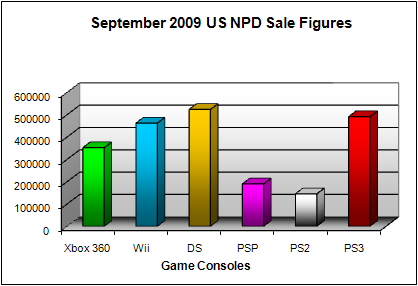
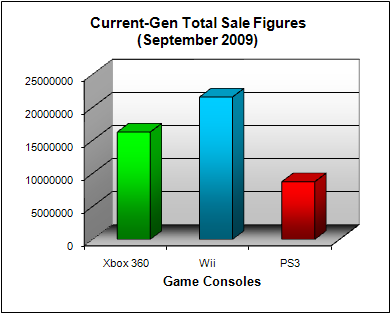
  • DS: 525,200 (Total: 33.8 million; September 2008: 537,000 – down 2%)
  • PS3: 491,800 (Total: 8.7 million; September 2008: 232,000 – up 112%)
  • Wii: 462,800 (Total: 21.6 million; September 2008: 687,000 – down 33%)
  • Xbox 360: 352,600 (Total: 16.3 million; September 2008: 347,000 – up 2%)
  • PSP: 190,400 (Total: 15.7 million; September 2008: 238,000 – down 20%)
  • PS2: 146,000 (Total: 44.6 million; September 2008: 173,000 – down 16%)
  • NPD September 2009 Game Console US Sales Figures

    NPD September 2009 Game Console US Sales Figures

    NPD Game Console Total US Sales Figures (as of September 2009)

    NPD Game Console Total US Sales Figures (as of September 2009)

    My prediction from last month was:

    So for a concrete prediction, I would say the PS3 to outsell the Xbox 360 and the Wii, and the number three being contested between the Xbox 360 and the Wii (too close to call, at this point). The PSP Go is coming in October, so we won’t see the numbers until November. Halo 3: ODST should top the charts next month, followed by Wii Sports Resort. The Beatles game should sell well too, although the Wii SKU may outsell the PS3/Xbox 360 ones.  At least one SKU of Batman: AA should still chart, although whether it’s the Xbox 360 or the PS3 version is too close to call at the moment as well (Xbox 360 users will be fully occupied by Halo 3: ODST to think about buying other games, I feel).

    Mostly right, a couple of minor mistakes. As predicted and expected, the PS3 managed to beat the Wii to second place, but it wasn’t enough to unseat the DS as the number one selling game console. I predicted that the Wii and Xbox 360 would be neck and neck, which wasn’t the case, but when I made the prediction, Nintendo had not yet announced the Wii price cut which helped it to at least hold on to third place. The software predictions are mostly correct, even down to the uncertainty as to which platform for Batman: AA was going to win (it was the PS3, beating the Xbox 360 version that finished just outside of the top 10). The Wii version of The Beatles: Rock Band did not outsell the Xbox 360 version though.

    So the big news of course are the PS3 numbers, which are simply put, head and shoulders, and a couple of body length, above last month pre-price cut/Slim numbers. There is a seasonal bump from August to September – one can work out just how much by looking at the PSP/PS2 numbers, which weren’t affected by new models or price cuts – this seasonal bump turns out to be around 35%.  Now taking this into account, the PS3 numbers are still about a 100% improvement compared to last month, and this is the amount that the Slim and price cut contributed. Now, how much of it was Slim based, and how much of it was price cut based, is impossible to tell with the numbers I have. The PS3 numbers are also a 112% improvement upon last year’s numbers, which is quite amazing. However, the jump in sales may only be a temporary spike, and it will be useful  to see next month’s numbers before coming to any conclusions. There won’t be a sales drop next month compared to this one, as the holiday season heats up and increases sale naturally, but the question would be how close Wii and Xbox 360 sales are to the PS3, whether the PS3 can hold on to second place or even get first. What is clear though is that the combination of a price cut and a new PS3 model has revived the flagging fortunes of the PS3, although whether this kicks of a period where the PS3 starts to dominate, or whether the Wii and Xbox’s market saturation will prevent this dominance, is a question that can only be answered in a few month’s time.

    The biggest loser, and why total hardware sales are still down compared to the same time last year (despite the positive PS3 numbers), is the Wii. Another month in which the Wii managed to sell less than the same time last year, this time by 33%, is just not good enough for Nintendo. The price cut came a bit late to make a huge difference, so Nintendo will hope that its full effects will be felt next month. But what has driven Wii sales, the novelty factor, is starting to wear off. And it will only get worse as Sony and Microsoft debut their own motion systems, especially Microsoft’s Natal which seems a lot more “next-gen” than either the Wii or the PS3 motion controller.

    Microsoft, now the least popular of the home consoles, may seem like the biggest loser, but if you look closely at this month’s numbers, they still have something to be happy with. While I don’t think the Xbox 360 Elite is priced competitively enough to combat the PS3, and I don’t think the Arcade can battle with the Wii, it’s clear that by having these two price points, Microsoft want to take on both Sony and Nintendo. It’s not working too well. What would have made more sense was to drop the Pro bundle to Arcade prices, get rid of the HDD-less Arcade model, and price the Elite at much less than the PS3 Slim. But you do get the feeling that any price cut is only a temporary measure until Microsoft unveil Natal, which should push it ahead of the PS3 and the Wii in terms of the novelty factor at least. But as I mentioned above, the other numbers, which is basically the software numbers, are quite encouraging actually, obviously helped by the platform exclusive Halo 3: ODST. In fact, 32% of the total video gaming revenue belonged to Microsoft products (hardware, software and accessories) this month, the single most contribution of any console. For the top 10 software, Microsoft dominated with 64.7% of the revenue, the most dominant performance since I started collecting data, even beating the month when Wii Fit was released in which Nintendo dominated with 61% of the top 10. So it’s not all bad news, and the lead they’ve built up over the PS3 over the last few years should allow them to keep their lead for at least another couple of years, and that’s assuming the PS3 performs as well as this month from now on.

    So let’s move onto the software stats. My prediction of Halo 3: ODST and Wii Sports Resort occupying the number 1 and 2 spots respectively was a pretty easy one to make, and it was correct. Halo 3: ODST’s numbers were amazing, making it the 6th best selling SKU launch of all time, very good for a title that was only available on one platform, and an add-on to boot. There was room for 4 more Xbox 360 titles in the top 10. The only slight point of concern was that the PS3 version of Batman: AA outsold the Xbox 360 version, something that rarely happens for multi-platform releases, but the PS3 version did have exclusive content, and as I said last month, the Xbox 360 gamers might have been too busy with ODST to think about Batman: AA. There were only two Wii games in the top 10, gone are the days when Wii Play, Wii Fit and Mario Kart would all make regular appearances. These games have had a good run, but if Wii software sales are to improve, then the platform needs a string of must-have third-party games. Forget about a string, there hasn’t been even a couple of third-party Wii games that can be called “must-have”, so that’s a worrying point for Nintendo. For the PS3, the hardware bump did not translate over to software, with only two titles in the top 10. Madden NFL 10 on the PS3 did well to bridge the gap between it and the Xbox 360 version, but even the Wii version of the Beatles Rock Band game outsold the PS3 version, and so it did not place in the top 10. And as mentioned before, Batman: AA was the other PS3 entry in the top 10, beating the Xbox 360 version which finished 11th (sales figures unknown, but probably just over 200,000, and maybe about 10,000 copies short of the PS3 version). Microsoft’s dominance meant a 64.7% share of the top 10, with the Wii  getting 16.8% (plus 6.7% for the single DS game in the list), and the PS3 on 11.8%.

    Here’s the complete list of the top 10 software sales:

    1. Halo 3: ODST (Xbox 360, Microsoft) – 1,520,000
    2. Wii Sports Resort (Wii, Nintendo) – 442,900
    3. Madden NFL 10 (Xbox 360, EA) – 289,600
    4. Mario & Luigi: Bowser’s Inside Story (DS, Nintendo) – 258,100
    5. The Beatles: Rock Band (Xbox 360, EA) – 254,000
    6. Madden NFL 10 (PS3, EA) – 246,500
    7. Marvel: Ultimate Alliance 2 (Xbox 360, Activision) – 236,000
    8. Batman: Arkham Asylum (PS3, Eidos) – 212,500
    9. Guitar Hero 5 (Xbox 360, Activision) – 210,800
    10. The Beatles: Rock Band (Wi, EA) – 208,600

    It’s time to make a prediction of October 2009’s results. For my money, I’ll say that the order of the hardware sales will remain the same, although the Wii numbers will be closer to the PS3 numbers. The PSP Go debuts, but based on an Australian report about the poor sales figures (a couple of hundred sales per week in an entire country, is not the best), the impact of the PSP Go may be muted. Sony will continue to have good month, but this time backed up in software sales as well with Uncharted 2. It might not sell enough to top the number one title, which might be Wii Sports Resort. Wii Fit Plus might take a place in the top half of the charts as well. I expect FIFA 10 to show up in one of more flavors in the top 10. Borderlands might make a showing too.

    See you next month.

    Weekly News Roundup (18 October 2009)

    Sunday, October 18th, 2009

    It’s been a busy week news wise, so there’s no problem at all filling up the 2,000 odd words required, I mean necessary, for this edition of the Weekly News Roundup. However, as I was feeling quite the stats nerd during the week, I decided to get out the spreadsheet software and then tabulate and graph the Blu-ray sales that I’ve been gathering since May 2008, you know, just for fun. The analysis doesn’t contain too many surprises, but for those who want to know just how much Blu-ray sales have increased, it may be worth a read. Anyway, on to the news, of which there’s quite a few.

    Copyright

    Starting with copyright news, anti-piracy has become a real business, that’s not too surprising. But has the business of fighting piracy become more profitable than actually stopping piracy?

    That’s what one anti-piracy firm thinks, and it even made a presentation showing just how more profitable it can be, for them and content owners alike, to allow piracy to continue and to make money off it by suing people, or threatening to sue them, for copyright infringement. They estimate that a quarter of all people they scare pay the penalty that they’ve arbitrarily set, and each successful claim is worth hundreds of legitimate downloads in terms of profit. This follows a rather candid interview that was given by a similar anti-piracy outfit not too long ago, where they revealed that they’ve put out content on P2P networks to lure people in, and they’ll only go after the people who they can make a good profit from. Stopping piracy, seems to be a distant second objective to making a bundle of cash by exploiting people’s fears about going to court, people’s lack of knowledge of the law, and the anti-piracy crusade that content owners are hell bent on pursuing. And your government is not only allowing it, but probably helping and profiting from it as well. Is this really acceptable?

    Speaking of governments and unacceptable practices, have you heard about the proposed anti-counterfeiting/piracy treaty, that will be discussed in South Korea next month by several leading countries. The plans that could cause your iPod or laptop to be searched at the airport for suspect pirated content, or make file sharing illegal, or use legislation to turn ISPs into copyright cops? You haven’t heard of it? Well, that’s no surprising, because the US government is making sure nobody knows about the proposals until they’ve been passed, citing “national security” reasons. Only a handful of selected individuals were privy to what’s on the agenda, and even they had to sign non-disclosure agreements beforehand. Has counterfeiting and piracy, and not even the kind that takes place on the seas, become such a major issue that it’s being treated in the way as the war against terrorism or the war against drugs, and no public discussion is even allowed on the subject? Incidentally both of the wars I’ve mentioned just now seems to be the never ending types of which winning is all but a distant dream at the moment – a glimpse into the future of the war against downloads perhaps.

    Ringtones is a public performance, just one of the many zany things that the ASCAP claims

    Ringtones are a public performance, just one of the many zany things that the ASCAP claims

    But before the governments can agree on how long to lock people up in Gitmo for downloading the latest Miley Cyrus album or a screener of Zombieland, the RIAA and MPAA have to do things the hard way. One method they’ve tried before is to attack BitTorrent networks, using techniques such as “piece attack” and “connection attack”, both of which designed to frustrate the downloading experience for other users. However, a study has shown that despite the millions of dollars given to anti-piracy firms to implement these methods, they do not work, and at best, they are a minor annoyance to downloads for only a couple of minutes. More millions down the drain, millions that could have been used to give people what they want, which is cheap, accessible music and movies. Instead, they’re doing things like trying to get royalties from ringtones, or to charge people to listen to the 30 second previews on iTunes. This, and many other claims, are being rejected even by the copyright friendly courts, as the ASCAP found out this week. The content owners, and the people who have been profiting from royalties, are doing everything they can to hold on, even asking Congress to make it a law so that they never lose their cash cow. Instead of embracing change, they’re fighting it, and you wonder how long they can go on doing the same thing. The longer that legitimate and comparable alternatives to illegal downloads are not implemented, the more likely that illegal downloads will be accepted as acceptable practice by the general public.

    And many things that have been adopted as common practice, such as recording TV shows to your VCR/DVR or ripping your CDs to MP3, are now considered legal. But they won’t be legal if the Canadian group Access Copyright have anything to do with it, and they propose that any of these acts should carry a fee that goes toward the content owners, or at least the people who profit from giving out licenses, such as Access Copyright. It seems that the copyright debate has gone all the way back to pre Universal vs Betamax times, and the content owners are still trying to fight innovation, even if that particular innovation (the ability to record stuff) is a couple of decades old already.

    Nobody likes the MPAA, not even the studios that it represents

    Nobody likes the MPAA, not even the studios that it represents

    This anti innovation drive has a lot of people angry, and has given agencies such as the MPAA quite a bit of bad PR. So what do they do about it? Instead of calling it “anti-piracy”, anti-piracy is now called “content protection“. Protecting the content from those pesky and annoying people called customers, perhaps, and also protecting profits again innovation. The studios are also unhappy at the MPAA’s approach, calling it not aggressive enough. The shift in strategy will mean that the MPAA will now go after ISPs and network operators, to clamp down on the spread of information from a higher level. Yes, this should make them more popular. And this brings us quite nicely into the iiNet trial, the landmark “studio versus ISP” case that could determine the future of the Internet. It’s the second week of the trial, and you can read the summary in the linked post. Suffice to say, if ISPs are to become copyright cops with the power to kick people off the Internet, then you have to wonder, due to the ever increasing importance of the Internet to people’s way of life (and work), whether this infringes on people’s rights in a democratic society. Finland has just made 1 Mb broadband a basic legal right for anyone who lives in the country, and they will up the speed to 100 Mb by 2015. This seems to be the direction many countries are going towards, making Internet a basic utility just like power or water. But if the Internet is a basic utility, then how does the three-strikes system (or as in the iiNet case the “one-strike” system) affect this basic legal right. Can you be denied water or electricity because you’re a suspected criminal? Can the government deny anyone the ability to make a phone call, and even so, is it something they can enforce at all unless that person is in prison, or under house arrest. And in the end, will any of this actually protect the profits of billion dollar movie and music studios, or will kicking people off this brand new global distribution platform actually hurt profits in the long term. And why is the government doing anything to protect profits of private companies anyway, especially at the tax payer’s expense?

    But let’s end this section on a slightly happier, and sane, note. Danny Boyle, director of Slumdog Millionaire and 28 Days Later says that perhaps the best way to fight piracy is to cut movie prices, because the cinema still has something unique to offer in terms of the viewing experience, compared to a poor quality screener. It’s a crazy suggestion, so it might just work. Or we can just ban the cinema, so nobody can bring a camera into the cinema and record it. Problem solved!

    High Definition

    In high definition news, the CEO of Netflix says that DVDs may be on the way out. But instead of Blu-ray replacing the format, it will actually be streaming. Of course, he’s referring to movie rental, not sale-through, and his director of corporate communications had to soften the statement by saying that growth is positive on all the formats.

    Netflix CEO Reed Hastings based his opinions on the fact that more and more people are opting for the cheapest DVD rental plan, while still keeping the most fully featured streaming option. I think the convenience of streaming, instant access, no need to wait for the disc in the mail and post it back, might be the reason for this shift. But until HD streaming becomes an affordable reality for everyone, which means bandwidth speed and allowance will have to increase, Blu-ray is still the only show in town if you want the best quality HD movies.

    TDK's 100 GB Blu-ray Disc: May not work on current Blu-ray players

    TDK's 100 GB Blu-ray Disc: May not work on current Blu-ray players

    What may be not so good for Blu-ray, or actually Blu-ray owners, is the news that 50+ GB discs may not be compatible with current players. So if the movie studios ever decide to use 100 GB discs, say for TV series box sets, then Blu-ray owners will have to upgrade their Blu-ray players again. And I say again because many have already had to upgrade their profile 1.0 players to 1.1 or 2.0, to access features like PiP and Internet content. Chances are, this won’t ever happen, because it will just hurt the format too much if people are yet again forced to adopt new hardware with new disc drives, which further highlights just how out of date the idea of using discs is in the age of digital distribution. And I don’t think people mind having a bunch of discs in a box set, as I think it actually makes it look like more value.

    China Blue HD, which is HD DVD for China, is being imported into Europe, along with cheap movies. Can’t see the studios being happy about it, since they licensed movies to CBHD for sale in China only, and the cheap player that comes with a dozen free movies may confuse buyers when they’re out there shopping for Blu-ray.

    And for Trekkies or Trekkers, and those who don’t mind a bit of DRM, then this might be for you: A Starfleet badge shaped USB thumb drive with a copy of the latest Star Trek movie on it? How can one resist!

    Gaming

    Not much going on in gaming, as everyone is waiting for the delayed NPD stats (due on Thursday, but has been delayed until Monday). It is expected that the Sony PS3 will jump to first place, from third, for the first time since its launch in 2006. Most expect the Wii to be second, with the Xbox 360 third. Microsoft has already came out with a pre-emptive attack on the numbers, calling it a temporary bump and saying that the 360 will still be the number one selling console for 2009.

    2010 is looking like a decisive year for this generation. Sony has it’s Wii like motion system, but Natal may trump it as the must have casual gaming gadget. Nintendo has been quiet, which makes me suspect they’ve got something up their sleeves.

    The NPD analysis for September 2009 should be posted sometime during the week, so until the next edition of the WNR, I hope you’ve had a good time reading this, have a good week and don’t forget to tip the waiter.

    Weekly News Roundup (11 October 2009)

    Sunday, October 11th, 2009

    How was your week then? Mine? Pretty much more of the same really, kind of boring, but at the same time still feel like there just isn’t enough time to do everything I wanted to do. Must also get more sleep. But before I can do that, I’ll have to churn out this week’s WNR, and there’s quite a bit to go through.

    Copyright

    Let’s start with copyright news, as if I have to say this since every issue of WNR has started with copyright news, and the graphics to the left of this sentence sort of hints at it a bit.

    This week is the week that the high profile “movie studios versus ISP” trial started in Australia, with the MPAA backed AFACT and Australian ISP iiNet going head to head in court over allegations that iiNet “allows” its users to pirate stuff. There’s all sorts of arguments and statements being thrown around in court over the week, too much to go through all of them here in great detail (check out the link for more details). The AFACT doesn’t think iiNet is doing all it can to stop piracy, and iiNet claims that this whole thing has been a set up by the AFACT to get its day in court. The AFACT claims over 90,000 acts of infringements occured on iiNet’s network over the period of time they monitored activities, while iiNet believes this number is exaggerated and inaccurate due to the way the AFACT counted them (they counted partial downloads, even by the same person downloading the same file over time, as separate infringements). iiNet also revealed they were sent thousands of infringement notices by the AFACT over the course of a week, far too many for iiNet to be able to verify and process and they believe this “infringement spam” was a deliberate ploy by the AFACT to ensure iiNet would fail to remove users from its network and hence, “allow” piracy to occur.

    I’m obviously a biased individual, but everything that iiNet has said so far makes sense. The plain facts, and the AFACT will agree, is that there’s a lot of piracy going on. A lot! But to get ISPs to police the thousand of infringement notices per week  is just really unfeasible, even if the ISP in question does not verify any of the notices and simply ban users at the first sign of trouble, which could then lead the ISP into legal trouble as the innocent users that got kicked of can sue for compensation. It’s easy for groups like the AFACT to produce a list of IP addresses of offending users, since they can just monitor the IP addresses on torrents, but the ISP will have to go through the data, match the IP address and the timestamp with user information, and then take action. But as IP addresses can be spoofed, and that just because an user’s IP address was on a torrent, it does not mean they downloaded it successfully or even intended to download it in the first place, or gave authorization to the person to started the download. Only the police have the resources and authority to get to the bottom of such allegations, and I doubt they will have time to investigate potentially tens of thousands of cases per week. Which is why going after the downloaders is such a stupid idea in the first place. Anyway, I’ll be posting more updates on the iiNet trial every week, but a decision in the case is unlikely to be had this year. Obviously, the AFACT would love a win here, but even if they lose, it may give them just enough to push the government into adopting some kind of three-strikes legislation to ensure this “travesty” doesn’t go on for much longer.

    Sarkozy gives a big thumb up to DVD piracy when it suits him

    Sarkozy gives a big thumb up to piracy ... when it suits him

    And the chance of such a legislation becoming a reality in Australia is quite high given what has happened with France adopting similar laws (pending appeal in their Constitutional Council). A big supporter of the laws,  is French President Sarkozy. But a French paper has revealed this week that Sarkozy is in fact a big supporter of piracy as well, but when it benefits himself. He allowed his staff to make 400 pirated copies of a movie about himself so he can give it out to diplomats to promote how great he is or something. His staff even went as far as making photoshoped jackets for the DVDs that removed the logo of the official distributor, so obviously they knew what they were doing was wrong, yet still did it. If downloading a pirated movie three times gets you thrown off the Internet and possibly into jail for 2 years, under the law that Sarkozy supports, then how many years will distributing 400 copies, which is way worse than downloading, get? By my calculations, it should be about 500 years.

    The Pirate Bay has just been chased out of the Netherlands, after their version of the MPAA, BREIN, successfully sued TPB’s web host, a tactic that seems to be working. TPB was chased out of Sweden using similar tactics. And last week, even Google did their bit to kill of TPB, by removing the home page listing for the website from its index due to a DMCA complaint – luckily, the listing was quickly restored, possibly due to the public backlash.  The Pirate Bay website seems to have relocated to the Ukraine, in a bunker style hosting center that claims to be able to withstand a nuclear attack. The question is, can it withstand a MPAA attack? Let’s wait and see how the Ukrainian courts deal with this issue. As for the proposed Pirate Bay sale, there’s a lot of confusion as to what’s happening, because the handover was supposed to have occurred already.

    Viacom is still after YouTube, but may have the "smoking gun" evidence they need to win the case

    Viacom is still after YouTube, but may have the "smoking gun" evidence they need to win the case

    Still continuing with the theme of lawsuits, Viacom claims to have the “smoking gun” in their legal battle with Google/YouTube. Viacom got hold of some internal emails which suggested that YouTube managers were aware of the unauthorized content issue, but refused to take action. There were also claims that YouTube employees may have also uploaded unauthorized content themselves. Google/YouTube want to attack this case on the basis that Viacom employees had uploaded content for promotional purposes, and as such, it was impossible for them to know which clips were authorized and which were not. What interested me was that Viacom obviously knew the positive effects of YouTube, and thus were employing people to upload promotional clips. You can argue that they also benefit from unauthorized clips as well. I wonder would they be happier or angrier if YouTube banned all Viacom clips from their website, which would definitely solve the piracy problem for Viacom, but is this what they really want? It seems that these media companies want to exploit YouTube’s user base, but only if they have full control over what happens, which is not how YouTube or similar websites work – it’s the lack of control, the total freedom and spontaneity of the content and the users who upload them that makes or breaks sites like YouTube. If the content owners don’t realise this fundamental shift in the relationship between content owners and content users, then they’re in for a rough ride.

    Still more lawsuit news, this time it’s the MPAA versus Real Network’s RealDVD case. An injunction was granted against the sale of RealDVD earlier in the year, but Real Networks is appealing the decision. It’s unlikely to be successful, since an injunction is the “safe” thing to do pending the verdict, but it’s also a “nothing to lose” situation for Real, which has already spent a bundle in legal costs, an appeal won’t make much of a difference now.

    And from the “another way to solve the piracy problem without rooms full of lawyers” section, here’s Spotify’s solution – music renting. By paying a small monthly fee, customers gets to download up to 3,333 different ad-free songs at any given time to their PCs, iPhones or Android phones for offline enjoyment, but they lose access once they stop paying the subscription fee. It’s not an ideal solution, especially since DRM is involved, but it’s certainly cheaper than buying 3,333 songs, and less likely to involve you going to court.

    High Definition

    Onto high def news, Blu-ray is probably not coming to the Macs anytime soon. The well sourced blogger who first broke the news that Blu-ray may be coming, then later posted that, well, it’s probably not.

    Either move would have been understandable. Adding Blu-ray make sense, since Blu-ray is not that popular in the computing arena, but every PC has the ability to support it, unlike Macs.  Apple is also on the board of the Blu-ray group, and has done a lot of work to promote high definition video. On the other hand, Apple’s iTunes and Apple TV strategy means that they prefer online distribution over disc based distribution, so Blu-ray may be seen as a competitor.

    Consumers only want 3DTV and 3D Blu-ray if it is cheap or at no extra cost

    Consumers only want 3DTV and 3D Blu-ray if it is cheap or at no extra cost

    People may still be getting use to HD being standard, but already the next “big thing” in home entertainment is being hyped: 3D. Unfortunately, consumers don’t seem to be buying the hype, at least now right now, because a study has shown that there’s very little interest in 3DTV or 3D Blu-ray, not unless it comes at little or no cost to the consumer, which defeats the whole purpose of having something new. It is a bit gimmicky, but I personally like these kind of gimmicks, and I think 3D has a place in the home, even if it doesn’t exactly reach mainstream popularity.

    Toshiba's Cell Regza TV: Records 8 HD channels at the same time!

    Toshiba's Cell Regza TV: Records 8 HD channels at the same time!

    What may be popular with consumers is the new generation of TVs. No, I’m not talking about higher than 1080p resolution sets, but rather, TVs that allow you to do more than just watch TV. Panasonic and Samsung went with Internet capable TVs that allows you to watch YouTube videos, check out the weather, and all sorts of other things without leaving the comfort of your couch. Toshiba is doing something different, mainly because it can. Toshiba owns the Cell processor that the PS3 uses, and they’ve been talking about it for a while, but they’ve finally managed to find a good use for it on their TVs. Their new Cell Regza range can record up to 8 channels of HDTVs at once to the internal 3TB HDD, for up to 26 hours. This means that if you missed on anything in the last day and a bit, on up to 8 channels, you can go back and watch it without having to torrent it. The powerful Cell processor also allows the TV to show 8 different channels at once. We don’t even have 8 HD channels here in Australia, but this would be extremely handy to have in lieu of a dedicated TiVo like set top box.

    Gaming

    And finally in gaming, I posted about firmware induced problems for the PS3 last week, and it turns out I’m not the only one who wants answers, because a class action lawsuit has been launched against Sony regarding the problematic 3.00 (and 3.01) firmware.

    I think people sue too much over in the US, and I think this is certainly something that probably shouldn’t waste the court’s time, but if it gets Sony to be a bit more careful about their firmware releases, or to come clean on why the drive freezing and no more disc reading problem seems to only come after firmware updates, then the effort would have been worth it.

    The lawsuit is certainly going to divide the PS3 owners, some of which like me have personally experienced the problem first hand, while others don’t believe it’s actually real. It is certainly rare enough, but not so rare as to never happen, to have caused this divide. What I don’t like is the PS3 fans, that haven’t yet experienced this problem, claiming it’s all made up to make Sony look bad or it’s caused by people not knowing how to use their PS3s. I take these quotes from postings on the official PS3 board to illustrate this phenomenon:

    The “you’re all Sony haters making this up, or you’re too stupid to own a PS3” brigade:

    I still think many failures are cases of what’s called “future shock”. You have a rather sophisticated piece of electronics and users really don’t know how to operate it properly.

    The “I’ve had this happen to me” group’s response:

    And I think that’s a pretty ridiculous thing to assume. What’s to “operate”?, it’s a closed system!  That’s more like a lot of the unsubstantiated claims and misinformation I’ve been reading…on this board in particular. For some reason. Especially from people who think because there’s nothing wrong with their unit, everbody who’s does is either lying or too incompetent to know how to plug it in.

    It’s real. It’s rare. It may already be a non existent issue in the new redesigned PS3 Slim. But it’s not right for Sony to charge people to repair something that I can think is almost certainly a manufacturing or design defect (either in hardware, or in the firmware), and it’s certainly not the owner’s fault.

    Alright, that’s it for the week. More news next week, definitely more iiNet stuff, possibly NPD stats for game console which may see the PS3 become the number one seller, beating the Wii for the first time. See you then.