Archive for the ‘PS3, PS4’ Category

Weekly News Roundup (11 July 2010)

Sunday, July 11th, 2010

Hope you’ve had a good week. It’s been busy again for me, but mostly non website related stuff. So no mid week blog again, but I am working on something (honestly), and it should be up early next week. It was a relatively busy news week, so let’s get started.

Copyright

In copyright news, the big news occurred late in the week and it relates to one of the infamous RIAA lawsuits. Infamous due to the amount of damages awarded to the billion dollar industry trade group. The latest decision relates to the smaller of the damages (“only” $675,000), awarded against PhD student Joel Tenenbaum.

Joel Tenenbaum now "only" has to pay $64,000 for downloading 30 songs

The judge for the case, Nancy Gertner, has finally ruled on the damages awarded by the jury and has reduced what experts have called an “unconstitutional” amount. The new amount is now only a tenth of the original amount, at $67,500, or $2,250 per song. Interestingly, this is exactly the same amount per song that was awarded against single mother Jammie Thomas, after the judge in that case also reduced the amount of damages. However, even this amount was critisized by Gertner as “severe” or “harsh”. Despite this, the RIAA is not pleased at the judge’s decisions, and they have stated their desire to contest the ruling. I’ve previously analysed the original verdict and the original amount of damages, and it’s easy to see why the judge would think it was excessive. If you take into account the retail cost (not price) or songs, and the number of people that Tenenbaum or Thomas provided a full copy of the songs to, then it would take years of continuous sharing on a fast connection in order to rack up the amount of damages that the RIAA was originally awarded. There is punitive damages, but you have to question when so many people are doing exactly the same as Tenenbaum and Thomas, why only go after these two individuals? So the RIAA’s intent was to make an example out of these two, but I’m not sure the court appreciates this, especially when these two hardly represents the most notorious of song sharers, or someone who actually profited from their illegal activities. Perhaps the RIAA chose poorly when deciding to go after a student and single mother. I guess it’s better than trying to shake down 10 year old girls.

The Pirate Bay survives another day in Belgium at least

The “good” court news continues with a news item that was just posted today. A Belgian court has ruled that ISPs don’t need to cave in to the demand by anti-piracy agencies to shut down access to The Pirate Bay. It’s a big blow to The Belgian Anti-Piracy Federation (BAF), who had wanted the court to order the ISPs to blocks its subscribers from accessing The Pirate Bay. Instead, the court sided with the ISPs, which believe that it isn’t the place for Internet service providers to place judgement on whether websites can or cannot be viewed by its customers. The BAF obviously strongly disagreed, calling it the legal protection of “illegal websites”. It’s becoming clearer that anti-piracy groups wish to circumvent legal establishments entirely in their crusade against copyright infringement on the Internet. And this is exactly why they wish to avoid going through the legal system, since the result can often be quite unpredictable. The truth is that only a court can decide whether something is illegal or not, and only the legal system can provide avenues of appeal to make the system fair. What anti-piracy agencies are proposing, with some success, will remove many of the basic legal rights people have been enjoying for the last few hundred years, all in the name of a “speedy resolution” and an extremely biased outcome. This is a threat to the fundamental principles behind democracy and rule of law, and I’m always surprised that so called democratic governments go along with the demands of the industry without raising any of these issues, but I guess that’s easy to do when the same industry bombards you with scary figures about the “real cost” of piracy, some figures that have no basis in reality at all.

But not all government take the approach that everything the copyright holders say is correct. The Brazilian government is proposing changes to their own copyright laws that will copy aspects of the US DMCA, but at the very least, they are also considering the issue of fair use. Where the US DMCA practically overrules fair use whenever any kind of DRM is used, the Brazilian model will ensure that DRM can only be used on content that actually warrants protection, and that once materials fall into public domain, then the DRM should “naturally” wither away. A sort of timed DRM system, that automatically shuts off once copyright holders lose their rights on the content. It would also make it an offence for DRM to restrict access to content that otherwise should not have restrictions, such as public domain content, and that if DRM exists on such content, users will be free to hack away at it to remove it or disable it as they see fit. While it would still be illegal to circumvent DRM for copyrighted content, these provisions at least take into account the side effects of DRM, its ability to lock content forever and affect the way the content can be used. It’s one thing for DRM to prevent copying, but many rightsholders are using it as a way to shape way users use the content, and copyright laws should not permit this if these actions interfere with fair use. For example, if a publisher releases songs that can only be played on a certain device, thanks to DRM, and they secretly make deals with the device manufacturer, then how is this good for competition and thus the economy?

The 3DS will feature stronger anti-piracy features that are making publishers excited

And then we have publishers that are obsessed with DRM, to the point where if a good system isn’t available, they choose not to publish content to that system. Speaking of Nintendo’s new 3D DS console, the 3DS, THQ VP of global publishing expressed his excitement at the new 3D technology, but was even more impressed by Nintendo’s promised new anti-piracy technology, citing THQ’s reluctance to publish new titles for the original DS console due to piracy reasons. Now this strikes me as having exactly the wrong attitude. Or perhaps the right attitude when a publisher is not confident in the quality of its products. While popular games get pirated more, popular games also sell more. It’s only the poor games that almost always have a higher piracy-to-sales ratio, and in an industry where quality hasn’t always been the top priority (think of the number of poor to absolutely unplayable games being released every year), piracy is hurting. Of course, DS piracy has been made extremely easy by the use of R4 flash carts, but I’m absolutely certain that without the “easy to pirate” factor, the DS would be less successful than it is today. And it is this success that creates the large userbase in which game publishers can take advantage of, buy only if they produce good games that people want to buy. It seems too often anti-piracy measures are used not to stop piracy, but to stop people finding out too easily or too soon how crap something is, and this goes for content like movies and music too, not just games.

High Definition

Let’s move on to the HD/3D news. The big news of the week was Cyberlink’s release of the “Mark II” patch for PowerDVD 10 Ultra 3D users. The patch adds Blu-ray 3D support, making it the first Blu-ray 3D solution for the PC that is available for general sale.

PowerDVD 10 Ultra 3D Mark II Blu-ray 3D Options

PowerDVD 10 Ultra 3D adds Blu-ray 3D support

So for those with Nvidia’s GeForce 3D Vision technology, or a suitable 3D TV to connect to, then Blu-ray 3D is now possible with a PC based solution (and if you have the right GPU, it may even be hardware accelerated). Of course, the lack of Blu-ray 3D content means there’s not much to use PowerDVD 10 Ultra 3D Mark II on. Due to various reasons on my end, I cannot test Blu-ray 3D playback on PowerDVD Mark II with my Samsung 3D TV yet, so that’s a shame. PowerDVD 10 does include support for anaglyph red/cyan glasses, and I tried the 3D effects on the Monsters vs Aliens Blu-ray 3D disc, and it worked remarkably well (obviously poor colour reproduction, but that’s to be expected with an anaglyph system).

Speaking of software updates, Sony has finally put a date on the launch of the Blu-ray 3D update for the PS3, with Sony reps stating that it will be made available sometime in September. Once again, the PS3 has shown why its flexible architecture makes it a great Blu-ray player, if not the best (to be fair, standalones have caught up in terms of loading speed and versatility, although 2D players still can’t be upgraded to 3D mostly). What will be interesting to see is if the PS3’s older HDMI port can handle the increased bandwidth required by 3D, whether it can provide 1080p to each eye. In theory, it should, but we’ll have to wait and see.

But not everyone is interested in 3D, not even in tech-loving Japan. A recent survey showed that only 31% of those surveyed were interested in 3D TVs, with most citing cost, lack of content and having to wear uncomfortable glasses as major turn offs. I would also add that there are many that just haven’t experienced the new wave of 3D technologies (including 3D filmmaking), instead remembering back to the bad old days of red/cyan glasses as a benchmark for 3D performance. 3D definitely isn’t for everyone, and after playing around with my 3D TV, I would say that I definitely don’t want to watch hours and hours of content with the shutter glasses on, but it’s definitely something worth trying out for yourself. And it’s easy to get a demo, since every electronic store will surely have a 3D display set up by now thanks to the 3D hype. Of course, the cost requirements will be high right now, and many just don’t feel like replacing their recently purchased 2D Blu-ray player with a 3D player.

HDBaseT

HDBaseT could take over from HDMI and use your existing cabled home networking setup

While recently purchased 2D Blu-ray players may already be considered obsolete, thanks to the bad precedent set by the introduction of Blu-ray profiles (ie. constantly upgraded specifications for hardware), HDMI itself may be obsolete, thanks to a new connection format called HDBaseT. The genius behind HDBaseT is that it’s entirely dependent on current technology – it users Ethernet cabling and ports, but instead of transferring data, it transfers audio and video (and data, like HDMI 1.4). The advantage is that because almost every device these days already have an Ethernet port, then turning that port into something that can also take audio/video would seem to make sense. And with HDMI not so good a long distances, the HDBaseT’s cable length of 100m should solve this problem as well. In fact, people are already using Ethernet cabling to extend HDMI, so this is really just taking an existing solution and turning it into a standard. With Sony, Samsung and LG backing the format, could it threaten HDMI? I for one don’t think so because HDMI is too well established. At best, HDBaseT will complement HDMI, but HDMI is here to stay. The bigger question is why didn’t we just move straight to something like HDBaseT, since HDMI has far too many shortcomings (like handshake issues, length issues, confusing version numbering, non hot pluggable …)

There really isn’t a lot of new things in gaming, unless you count the news that Hulu Plus on the PS3 won’t require PlayStation Plus as gaming news (which I don’t), so this is as good as any place to end this week’s WNR. Have a nice week and see you in 7 days.


Weekly News Roundup (4 July 2010)

Sunday, July 4th, 2010

It’s been a busy week on my end. The first piece of good news is that my Samsung 3D TV finally arrived, and it was delivered to me on Wednesday. I haven’t had much time to play around with it, but early impressions are very good indeed. Not sure I’m a huge fan of the 3D though, I’ve always felt it was a bit gimmicky, but I’m only buying the TV for the 2D – the 3D is a nice bonus that will keep me entertained for a bit and allow me to experiment with a few things (like perhaps providing some 3D trailers for you all to download in the near future). I also got a bit of work done, to my surprise. The much delayed NPD US video games sales figures for May were finally made available, and my analysis of it is here. No big surprises, but the video game industry is not immune to economic conditions, and so is still suffering. June will be interesting because the Xbox 360 “Slim” went on sale in the middle of the month, and we have the E3 hype as well. And in terms of other news, there were a few as well, so let’s get started (and finish quickly, so I can go play with my new TV).

Copyright

Let’s start with the copyright news. A couple of weeks ago, the judge in the isoHunt copyright cased allowed the MPAA to submit keywords that would be censored on the BitTorrent search engine, but now the founder of isoHunt, Gary Fung, says that instead of trying to stop piracy, it’s now bordering on censorship, or at least an attempt to completely cripple isoHunt, even for the legal stuff.

Mininova.org Pageview Ranking (Alexa.com)

Alexa's pageview ranking for Mininova shows that it's not easy for torrent sites to go legit

Part of Fung’s argument is that very keywords include common words such as “21” or “Dad”, as these are words used in movie titles. If you had a list of every movie title, then surely that would cover so many words as to make the search engine completely non effective. A more logical and fair way to do it would be to remove common words from the list of “banned” words, and to only block phrases, as opposed to just words (so “Born on the Fourth of July” would get blocked, but the keywords “Born”, “Fourth” and “July” aren’t blocked). But this decision was never about logic or fairness. It’s interesting to analyse the decision again given the recent YouTube ruling. Of course, YouTube’s main purposes contains a lot more “fair use” than say a Torrent download website, but the important aspect of the YouTube ruling was the copyright holders are partially responsible to locate and remove infringing content (after all, only they can decide what’s infringing, and what’s not), and putting it all on the website operator is not fair. So if isoHunt had a policy where they block out the obvious pirated torrents, and then add a function to allow studios to request removals of others, then that would be enough. Of course, whether isoHunt would still be viable as a commercial operation, without pirated content, is up for debate. Mininova was never the same after it removed all of its infringing content, but it’s still a relatively big website, although that may fade due to incoming links being removed and stuff.

US Immigration and Customs Enforcement Badge

ICE Officers raids and seize assets from nine websites suspected of offering pirated content

Following last week’s announcement of a crackdown on online piracy,  US Immigration and Customs (ICE) has acted quickly this week to close down and seize the assets of nine websites suspected of offering pirated content for online streaming. It’s good to see the government reacting so quickly to a current ‘crisis’, as opposed to say waiting days and weeks to get a response through. Like Katrina and BP’s Gulf of Mexico disaster. It’s good to know where the US government’s priorities are in these dangerous times, what with Hollywood studios on the verge of bankruptcy and everything. The other crime wave affecting the US right now is of course college students downloading films. And this is why Congress in 2008 passed the Higher Educational Opportunity Act which, amongst other things, forced educational institutions to join the fight against online piracy, or face the risk of losing federal student aid. This act has now come into effect. So if US colleges don’t spend their own money and time stopping students from downloading The (new) Karate Kid, then they’ll lose funding and will have to close down. Sounds like a fair compromise to me, risking education of the next generation to prevent them from downloading MP3s. It’s definitely fair to the music labels and movie studios, who don’t have to move an inch now and can get colleges to do their anti-piracy work for them, all for the price of a few lobbyists.

This week was also when the judge overseeing one of the US Copyright Group’s mass lawsuits was to decide on a challenge from the ACLU/EFF as to the legality of putting so many defendants in the same lawsuit. Unfortunately, the US Copyright Group won their motion, although the ACLU/EFF also had a few victories of their own. So the judge has decided it is okay to put a bunch of people together, most of whom have never communicated directly or indirectly with each other, in the same lawsuit. But the USCG must now also work wit the ACLU/EFF to draft a warning notice (to forward to people listed in the lawsuit), and this is where the ACLU/EFF will ensure that the notice contains plain English and perhaps contain language that doesn’t  scare people into paying for the pre-trial settlement, if they really do believe they’re innocent. The judge also ruled on Time Warner Cable’s motion to quash the subpoenas, as it violated a previous agreement with the USCG to limit the number of requests per month. The judge ruled just shy of a complete quashing, but did rule that the agreement was valid and that the USCG must limit request to 28 per month, which should really slow down USCG’s efforts (although they’ll probably just pick IP addresses from other ISPs to “sue”).

High Definition

Onto HD (3D) news (I really should update the “section graphics” to your left, or above if you’re reading the newsletter, to include 3D). For those hoping Blu-ray would arrive soon on the Apple range of hardware, well, your wish is unlikely to be answered.

Still no Blu-ray on Apple Macs ... not if Jobs has anything to say on the issue

Apple boss Steve Jobs has once again, this time in an email, showed his disdain for the Blu-ray format, predicting it will be beaten by digital downloads and streaming services. He compared Blu-ray to all those “failed” HD audio formats, none of which has managed to replace CDs, let alone MP3 and other digital formats that has replaced CDs. As you may recall, he previously called Blu-ray a “bag of hurt”, due to the licensing requirements of the format. When the person communicating with Jobs stressed that Blu-ray does have uses in data and video archiving, Jobs was quick to point out that streaming and digital rentals means that you don’t need massive amounts of local storage for movies. And I guess for data archiving, with the price of external HDDs dropping so quickly, these offer good portability, and excellent value for money, compared to Blu-ray discs, you have to say. Even USB drives are approaching capacities beyond that of your typical dual-layer Blu-ray, which may explain why the Blu-ray people have added BDXL and larger capacity discs to the specifications (unfortunately, they’re not backwards compatible, so new burning hardware is needed to take advantage – a disadvantage that USB drives don’t have).

I could have put the next piece of news under gaming, but it’s probably more relevant here. The much rumoured Hulu subscription service is now a reality, and it’s coming to a whole host of devices, including the PS3, Xbox 360, and TV and Blu-ray players from Samsung, Vizio and Sony. PS3 owners will be amongst the first to get it, with the $9.99 monthly cost possibly on top of the PlayStation Plus service cost (rumoured only). Xbox 360 owners may be the last to get it however, but don’t fret, the best Hulu experience may yet be on the 360, as Hulu are working to make the service Kinect compatible (so gesture, voice commands to control the Hulu interface). All of this means nothing to me because Hulu isn’t “available” in Australia, even though I have a Samsung TV and soon will have a Samsung 3D Blu-ray player (free by redemption), both of which are capable of supporting Hulu.

And a further blow to Adobe this week as adult website Digital Playground announced that they may choose HTML5 over Flash. It seems a lot of websites now have to make the choice, because supporting both may be expensive, and Google’s WebM/VP8 now means websites don’t have to sacrifice quality (too much) if they choose the HTML5 codec.

Gaming

And finally, in gaming, a new PS3 firmware is available. Firmware 4.0 adds Facebook support and support for the new subscription based PlayStation Plus platform. After criticizing Xbox for asking users to pay for Xbox Live Gold, it seems Sony finally saw the light and decided to have a go at their own premium platform.

Luckily, multiplayer gaming is still free, as are many other features, but as speculated above, some of the premium features like Hulu may require the Plus platform.

A brief look at Amazon shows that Kinect is still selling better than Move. But the latest news is that Kinect may only offer two player simultaneous play, even if it does support tracking of up to 6 players. What this means is that up to 6 players can “join” the game, but 4 will have to wait their turn at any one time, while two can play. The limited angle of the camera lens may be responsible, as well as the hardware requirements of processing too many people at the same time. This would appear to make the Wii or Move the platform of choice for 2+ player motion gaming, but the PS3 only supports 7 connected devices, including any other controllers or wireless devices, so 4 player simultaneous play with both Move and Navigator (“remote” and “nunchuck”) is not possible either. Plus it would also cost quite a bit to get it going. Of course, there’s still no actual official confirmation, the information on hand is from leaked specifications which may or may not be final. But since none of the demos so far has been for four players, and the limited angle of any camera system, I suspect this to be true.

And that’s the news for this week. More for you next week I should hope. Until then, have a good one.

Oh, almost forgot to mention that today, 4th of July, is a very special day indeed. Yes, it is the birthday of Digital Digest, in its 11th year. I don’t plan on making a big deal of it like last year, so much so that I’ve nearly forgotten!

Game Consoles – May 2010 NPD Sales Figure Analysis

Friday, July 2nd, 2010

Slightly later than usual, due to NPD releasing their figures later, but better late than never. Or is it. With Awful April out of the way, everyone was keen to find out whether the next month be Merry or Miserable May. Once again, NPD is not providing PS2 sales numbers and only the top 5 game sales have sales figures. The figures are from NPD, a marketing research firm that releases games console sale data every month.

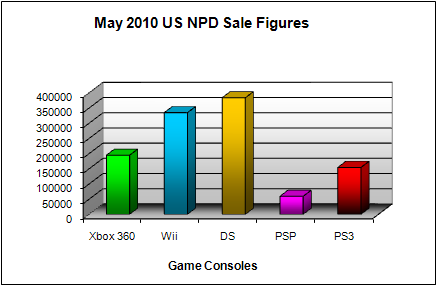
The figures for US sales in May 2010 are below, ranked in order of number of sales (May 2009 figures also shown, including percentage change):

  • DS: 383,700 (Total: 42.1 million; May 2009: 633,500 – down 39%)
  • Wii: 334,800 (Total: 29.2 million; May 2009: 289,500 – up 16%)
  • Xbox 360: 194,600 (Total: 20.1 million; May 2009: 175,000 – up 11%)
  • PS3: 154,500 (Total: 12.4 million; May 2009: 131,000 – up 18%)
  • PSP: 59,400 (Total: 17.3 million; May 2009: 100,400 – down 41%)
NPD May 2010 Game Console US Sales Figures

NPD May 2010 Game Console US Sales Figures

NPD Game Console Total US Sales Figures (as of May 2010)

NPD Game Console Total US Sales Figures (as of May 2010)

My prediction from last month was:

The PS3 shortage continues, and so it will still do poorly in sales I think, and probably outsold by the Xbox 360 with the hardware sales order remaining the same as this month. On the software front, the Xbox 360 version of Red Dead Redemption should be the top seller, with the PS3 version closely behind. Alan Wake, the much hyped Xbox 360 exclusive, should be in the top 10 as well. There might be room for the PS3 exclusive 3D Dot Game Heroes as well. Along with the usual Wii titles, the new Super Mario Galaxy 2 should rank in the top 10 as well. Overall sales should pick up compared to April, but probably still down year on year at least for the hardware figures.

I think most of what I posted came true, which is a rarity indeed. The PS3 stock shortage did hinder sales to the point where even growth compared to the same time last year was muted, although still comfortably up. I don’t know what’s the issue with Sony’s PS3 production, but the problem appears to have been sold for June already. Perhaps they were saving stock for an expected bump in sales in June, due to E3 and the announcement of Move, but who knows. For Sony’s other console (the one that still matters to the NPD), the PSP, sales are not doing too well, once again a 40+% drop in sales against a year before. The PSP really hasn’t decided what it wants to be, unlike the DS which has firmly established itself as the portable console of choice for an ever younger audience (of both genders, importantly). With iPhones, iPads and all sorts of portable devices, the traditional gaming demographic (young males) may be finding a dedicated console a bit of an overkill. Nintendo was wise to market the DS to anyone but the traditional gaming demographic.

The Xbox 360 continues to do well, once again outselling the same month last year, and outselling the PS3, which is all you can ask for really. The E3 surprise announcement of the new “slim” Elite and the subsequent almost immediate release means June was probably a good month for the Xbox 360, the new console having secured top of the sales charts for the last week or so at least on Amazon. The early pre-order numbers for Kinect is promising, certainly gathering a bit more interest on Amazon than the PlayStation Move, but these figures mean nothing right now – only when both add-ons get closer to their release date, will we then be able to see just which will be the most popular, and which will help generate console and software sales.

For Nintendo, a year-on-year growth for the Wii is rare these days, and so it was a good month. Unfortunately, DS sales dropped rather alarmingly again, that’s 58% and now 39% drops in sales, but this was up against the release of the DSi last year, and so it’s somewhat understandable. Nintendo will hope the 3DS will be the next must have console.

Speaking of Move, Kinect and the 3DS, I’ve just put up a poll asking which of these interest you the most – you can vote in it here.

Onto software sales now. As expected, Red Dead Redemption was top, with the Xbox 360 version not quite outselling the PS3 version by 2:1, but the days where the number of Xbox 360 consoles sold had a 2:1 margin over the PS3 are also gone as well (it’s now 1.62 to 1, which stacks up quite neatly to RDR’s 1.66 to 1 sales ratio for the Xbox 360 version). And as I noted last month, Super Mario Galaxy 2 also ranked in the top 10, at a high 3rd place too, just a few thousand units shy of 2nd place. This was one of three Wii titles in the top 10, the other two being the usuals (Wii Fit Plus and New Super Mario Bros.). The Xbox 360 did one better with 4 titles in the top 10, the exclusive Alan Wake as expected (but did poorly than I think what Microsoft would have wanted for such a hyped up game). The PS3 had two titles, including RDR and the multi-platform UFC 2010: Undisputed, which went close to outselling the Xbox 360 version of the same game. But without full figures for all the top 10 software sales, there’s no other analysis that I can provide, such as overall market share, but it would be safe to say that the Xbox 360 led the way, with the Wii in second place, and the PS3 in third.

Here’s the complete list of the top 10 software sales:

  1. Red Dead Redemption (Xbox 360, Take-Two) – 945,900
  2. Red Dead Redemption (PS3, Take-Two) – 567,100
  3. Super Mario Galaxy 2 (Wii, Nintendo) – 563,900
  4. UFC 2010: Undisputed (Xbox 360, THQ) – 221,200
  5. UFC 2010: Undisputed (PS3, THQ) – 192,300
  6. Wii Fit Plus w/Balance Board (Wii, Nintendo)
  7. New Super Mario Bros. Wii (Wii, Nintendo)
  8. Alan Wake (Xbox 360, Microsoft)
  9. Pokemon SoulSilver (DS, Nintendo)
  10. Skate 3 (Xbox 360, EA)

It’s time to make my usual predictions. With the PS3 stock shortage crisis over, PS3 sales should rise. The Xbox 360 would otherwise have been relegated to third place amongst the home consoles, but the new “slim” Elite may save the day, and maybe even sell enough to keep it above the PS3. I keep on expecting either the PS3 or Xbox 360 to outsell the Wii, but it hasn’t happened very often, and June is probably the same, although it has a greater chance than previous months. Not a huge month for new game releases though, so RDR may remain in the charts, with Super Mario Galaxy keeping up sales and possibly stealing a march on the RDR games.

See you next month (or sooner, if NPD don’t again delay the stats).

Weekly News Roundup (27 June 2010)

Sunday, June 27th, 2010

A combination of a busy week for me personally, and a relatively quiet news week (World Cup related?), means there’s not much going on this week. There is so little this week that there is good justification for not even publishing a WNR this week. Well, not exactly that little going on, but the lazy side of me almost convinced me to skip. Unfortunately for you, I decided in the end to write this edition instead, so you’ll have to put up with even more ranting (given the absence of real news) than usual.

Copyright

Starting with copyright news, I know I just said a paragraph ago that nothing much happened, except something really big did happen during the week, something of a landmark perhaps in the struggle between copyright holders and the Internet.

Viacom Logo

Viacom will be licking their wounds after having their massive lawsuit against YouTube thrown out of court

The big news was of course the judge’s decision to throw out Viacom’s lawsuit against Google’s YouTube. The judge decided that Viacom didn’t really have a case at all, not when YouTube is protected by the “safe harbor” provisions found within the DMCA. Safe harbor provides protection to publishers like YouTube as long as they show an adequate effort in trying to prevent copyright infringement. YouTube has always had a policy of removing copyrighted content if the copyright holders complain, and so the judge thought this was more than adequate. The fact that YouTube revealed Viacom employees may have been secretly uploading copyrighted content for promotional purposes may also have helped YouTube’s case. To be fair, this decision wasn’t a total surprise. Nearly defunct video sharing website Veoh won a similar lawsuit against the Universal Music Group, and that set the precedent to allow YouTube to get this victory this week. What this all means is that the court system now recognises that it may be impossible for mega websites like YouTube to completely prevent unauthorised copyrighted material appearing on their website, but that as long as they have a working policy in place, then the copyright holders should also share the burden of identifying and removing unauthorised content. The copyright holders, as always, want others to do their job because they believe that this problem was created by the Internet and the companies that profit from them, which to be fair, is a valid point. However, the same Internet has also provided many benefits and new opportunities to the same copyright holders, and it’s not anyone else’s fault if they choose not to take advantage.

Of course, Viacom will appeal, and who knows how the next judge will rule, especially in a technology based court case – the decision is very much based on how the judge grasps the technical issues. However, even Viacom must admit that YouTube’s anti-piracy tools are much more advanced than when Viacom first decided to sue, so perhaps part of their objectives has been achieved already, to make YouTube take copyright more seriously. When it comes to copyright, the current YouTube is much more copyright holder friendly, almost too friendly, what with the recent bout of “Downfall Hitler” parody removals. Perhaps this win will allow YouTube to readjust their removal policy to be a bit more balanced.

BPI Logo

Is the BPI planning to sue Google, and if they were, will they still do it after Viacom's court setback?

While Google has just successfully escape one lawsuit (for now), techdirt believe that they may be set up for another one, this time over in the UK by the BPI. They analysed the way the BPI filled DMCA notices, and noticed the odd way in which it was done which reminded them of the way Viacom operated. The plan seems to be to get Google to be responsible for removing pirated content on file hosting networks such as RapidShare, again an attempt by copyright holders to get others to do their hard work. Of course, this was before the Viacom decision was handed down, so even if the BPI had plans to sue Google, they may be reconsidering now.

There seems to be many ways to fight piracy, but nobody has really consulted the public as to what they think will help reduce piracy. PC Advisor ran a poll, and like many similar polls, the results are always interesting. The public mostly understands the wishes of copyright holders to stop piracy, but most of them feel that this can be achieved via better pricing and better services, something I’ve echoed on these pages frequently. Of course, consumers always want to pay less for more, but the digital revolution actually allows for this to happen without hurting bottom lines (and may even help enhance it). Very few people will completely agree with the industry’s current anti-piracy strategy, which ranges from “legal blackmail” (as described by politicians in the UK, in response to actions by groups similar to the US Copyright Group’s mass litigation/pre-trial settlement mailings) to lobbying, or rather, scaring politicians to pass illogical and draconian laws to help the industry protect its income (do any other industries get the same level of support, from all major political parties, as the music and movie industries?)

Vice President Joe Biden

Here's a picture of Vice President Joe Biden thinking hard about how he can be of even more help to his RIAA/MPAA buddies

But when lobbyist speak, the politicians listen, and the Obama administration has been very good friends with the RIAA and MPAA for the first part of their term in office. Vice President Biden, a long time friend of the RIAA, launched the White House’s new anti-piracy crackdown this week. Once again, Biden likened online piracy to actual store theft, and this time even increased the hyperbole by adding physical violence/damage to the equation. “This is theft, clear and simple. It’s smash and grab, no different than a guy walking down Fifth Avenue and smashing the window at Tiffany’s and reaching in and grabbing what’s in the window,” said Biden. Well, I think it’s a bit different to that actually. For the Tiffany’s example, there is actual physical damage (I would say this, in the online world, would equate to server hacking and damage of some kind), plus, what is stolen cannot be replaced without additional cost to the owner of the goods. This is simply not true with digital downloads, because the “original” has not been moved or damaged in any way. If anything, it’s more like someone walking into Tiffany’s, looking at a design for an engagement ring, and then going home and recreating the exact same ring at their own cost. This is also a sort of copyright theft, in that the design of the ring was “stolen”, and you could argue that Tiffany’s lost money due to a lost sale. But as you can see, this is very different to grabbing a brick and smashing up Tiffany’s to steal a ring. It’s hard to tell if Biden said this because he really wanted to help his RIAA/MPAA buddies, or whether he really believes this to be the case. If the latter is correct, then we’re all in big trouble, because paying lip service to your friends in politics is at least common place (although you may say ignorance is common place as well).

The administration’s new initiative did have any real specifics, but hinted at supporting industry attempts to get the ACTA shoved down the throat of citizens around the world, and even offered some kind of support for the controversial actions of the US Copyright Group. You would expect liberal institutions like the ACLU and the EFF to be in agreement with the Obama administration, but both have come out against the actions of the USCG, going as far as filing a friend of the court brief to prevent the USCG lumping thousands of defendants into the same lawsuit. The judge then asked USCG to explain why they did this, and the USCG now has replied to the court saying that the BitTorrent infrastructure is what made them do it. It argues that users of the same swarm upload and download from each other simultaneously while trying to obtain a full copy of the file in question, and so that’s how the defendants are linked. Of course, there’s no evidence that any of the defendants were part of the same swarm at all, and this also highlights one of the often ignored technical points of BitTorrent file sharing – that most users do not upload an entire copy of the file to any other user, only pieces, which when looked at as a piece of data, is completely useless. The technical argument to make here would be that because each users is only contributing a very small part of the pirated file, then perhaps the damages should reflect this as well. And if an user somehow managed to download a full copy of the file without providing any uploads, and thus only break the law in respect to obtaining pirated material, and not “make available” such materials, would their actions be more or less damaging than someone who uploaded hundreds of full copies of the same file? If you buy a pirated DVD from a stall, did you commit the same crime as the stall vendor who produced and sold the pirated DVD? These are all interesting questions I would like to see addressed in a full trial, but that’s something the USCG do not want, apparently.

Samsung 3D Bundle

Where is my damn 3D TV, Samsung?

That’s all the copyright news I had, and there isn’t much going on in terms of Blu-ray, 3D or gaming, certainly not as much as I would have to write about if I had my 3D TV at home, instead of still being on pre-order. Come on Samsung, don’t disappoint me.

There is actually a bit of gaming news that I didn’t post online, and that’s rumours of the Xbox 360 Kinect being priced at $119.95, as opposed to the widely believed price point of $150. The $150 Kinect is already selling quite well, certainly better than the PlayStation Move, so a cheaper Kinect might do even better. I do remember some Microsoft dude hinting that people will be very happy with the eventual Kinect pricing, which I suspect means the official pricing will be lower than what Amazon and others think it is now. If the news is still slow next week, then I will write up something about my thoughts on Move, Kinect and the Wii. It is my opinion that the Wii is actually a big failure *if* you do not count Nintendo’s software contributions to it, and it’s very unlikely Nintendo will help out  Sony and Microsoft to make fun games for the Move/Kinect. Can Sony and Microsoft succeed where Nintendo has failed, to get third party publishers to produce great games that utilize each company’s motion control system, and if they fail in the same was in this regards as Nintendo, can Sony and Microsoft do what Nintendo can do with titles like Wii Sports, Wii Fit and Mario Kart?

That’s all for this week. I warned you there wasn’t much happening didn’t I? Hoping for more stuff next week …

Weekly News Roundup (20 June 2010)

Sunday, June 20th, 2010

The World Cup is taking up a lot more of my time than I had estimated earlier, despite the paucity of good football on show. I was expecting a mid week update for the NPD figures, but NPD are delaying the release of the numbers until later. Technical difficulties are blamed, or may be they were too busy watching the World Cup too. Other may also have been busy with the games, because there isn’t a whole lot of news this week either (again, it could just be because I haven’t been looking as hard).

Copyright

Let’s start with copyright news. Bad news for UK HDTV viewers, as Ofcom officially agrees to the BBC’s demand to add DRM to all upcoming HDTV equipment. The BBC used the same argument as the MPAA when they also wanted DRM to be added to TVs, and guess what, it worked.

The BBC argued that having DRM means they can bring more high value content to people’s screen via free to air TV. Of course, the lack of DRM hasn’t prevented them, and others, from bringing the same high value content before, and the way Ofcom has set out this thing, people with older PVRs (or ones that don’t belong to the Freeview standard) will still be able to record the DRM’d content most likely. So what’s the whole point of this? Basically just like any other DRM scheme, to give copyright holders a false sense of security, which in their opinion, is better than none.

LimeWire Logo

LimeWire is sued again

It’s been a bad time for LimeWire, as they’ve been sued again, just a week after the RIAA claimed that they deserve billions of dollars of damages stemming from LimeWire’s operation. This time, it’s the National Music Publishers’ Association that is doing the suing. The billions in damages that the RIAA want is simply ridiculous. It’s basically saying that the people who downloaded music illegally on LimeWire’s network and zero dollars in the process would have otherwise spent billions of dollars has LimeWire not existed. It’s like saying, using an analogy that the industry just loves, that a car thief would have paid full sticker price for a car if he hadn’t stolen one. At least with the car, there is actual physical loss (the car owner loses something that can’t be replaced without spending more money)  – there is none with digital files, not when the owner can make infinite copies at no cost.

And it seems I’m not the only one that thinks the industry’s estimates for losses are greatly exaggerated, to put it mildly. Experts testifying before the US International Trade Commission are saying exact this. The best quote I’ve found is this one, made by Harvard Professor Fritz Foley: “It seems a bit crazy to me to assume that someone who would pay some low amount for a pirated product would be the type of customer who’d pay some amount that’s six or 10 that amount for a real one.”

The very type of people who would get pirated content at low cost (or for free) is exactly the type of people that probably can’t afford to pay for the legitimate version. This isn’t always true, but with so much content available at varying cost, you’ll have to be a millionaire to be able to afford to pay the cost of stuff that web pirates are downloading for free. And yet, the industry seriously believe that if they can just wipe out piracy completely, then all those people who aren’t paying for stuff will automatically start paying full price for everything. And what are these pirates doing with all these lost billions every year if they’re not spending it on legitimate buys? They must be laughing all the way to the bank where their vast amount of savings are stored, savings that are the result of not having to pay $0.99 for songs.

At the hearing, which was organised by the USITC at the request of the US Senate’s Finance Committee (who are trying to work out how much blame China should get in terms of Intellectual Property damage), some experts even expressed the controversial view that counterfeit goods actually helps the economy by employing people and making it possible for financially challenged people to spend money on stuff, even if it is just a fraction of the retail price. By extension, it will be interesting to find out if web piracy is also contributing to the economy, in terms of advertising, creating product hype and contributing to people spending money on Internet services (this point the copyright holders will agree with, as they have continuously blamed ISPs for profiting from piracy).

Nintendo 3DS

The Nintendo 3DS will play 3D games without glasses, and store games internally

A IEEE working group is trying to create a new DRM standard that at least gives consumers some rights when it comes to managing their own content. The goal is to basically ensure once people purchase digital content with DRM, they are entitled to the same rights as people who purchase something physical. Including the ability to “loan” out your digital content to a friend. So to mirror a non digital physical object (say a VHS tape, if people still remember those things), the  content cannot be duplicated (without quality loss), but can be loaned out as the “ownership license” is temporarily transfered to your friend, but with the risk that your friend might then pass on the “ownership” to others (ie. lose your tape, the bastard), and thus prevent mass distribution/sharing. It all sounds reasonable in principle, but the whole point of digital is that you have more flexibility than physical objects/media, and getting rid of the one of the major advantages of digital content seems kind of self-defeating to me. I still believe that the best way to prevent people from obtaining content illegally is to give them good reasons to pay for content, which includes things such as access to a superior catalog of content, additional services that pirates can’t offer, along with prices that are so reasonable that it makes pirated content look decidedly bad value in comparison.

And that may be what Nintendo is doing with their new 3DS console when it comes to the fight against piracy. Instead of releasing a new DRM scheme (which Nintendo may still do), they are copying some of features of the flash carts that have made piracy so easy. One of the more important features that flash carts provide is the ability to store you games digitally on file, instead of having to carry all your carts with you. A flash cart with a 4GB SD memory ca4rd can carry 50 or even 100 games, without it, you’ll have to carry a small briefcase just to fit in all your game carts. But the 3DS will finally allow you to “install” games to the internal memory, and not only that, you won’t even need the original cart to play the games (unlike the “install to HD” features of PS3/Xbox 360 games. And if Nintendo can create some kind of official homebrew environment, maybe an Apps store type feature, then they relegate flash cart usage to game piracy only, and it makes their case against them that much stronger, and makes their fight against piracy much more effective.

High Definition

Let’s move onto 3D/HD news. To follow up on last week’s news of Cloudy with a chance of Meatballs being the first general sale Blu-ray 3D title, it’s good to see that the price for this title has already started to drop on Amazon.com

The $36 original price has already dropped to $28, and hopefully it will drop further. And it appears my suspicious were correct in relation to the Monsters vs Aliens Blu-ray 3D, in that the crosstalk/ghosting problem may be a problem of the movie encoding. Early tests with the “Cloudy” 3D on Samsung TVs seems to show much much less ghosting, so the encoding may really be the source of the problem. If so, Samsung needs to get the movie remastered as quickly as possible, because it’s making their 3D TVs look much worse than their competitor’s.

Gaming

Gaming wise, we’ve learned a lot more about Kinect, Move and the 3DS during E3. The 3DS will be able to produce 3D without glasses using the Parallax Barrier method I think, and I’ve updated my 3D Blu-ray – What’s it all about blog post/FAQ with one of more frequently asked questions of recent – why can the 3DS do 3D without glasses when we still have to wear them to watch 3D on TV? The short answer is that the Parallax Barrier technology is just not ready for big screen TVs and home viewing.

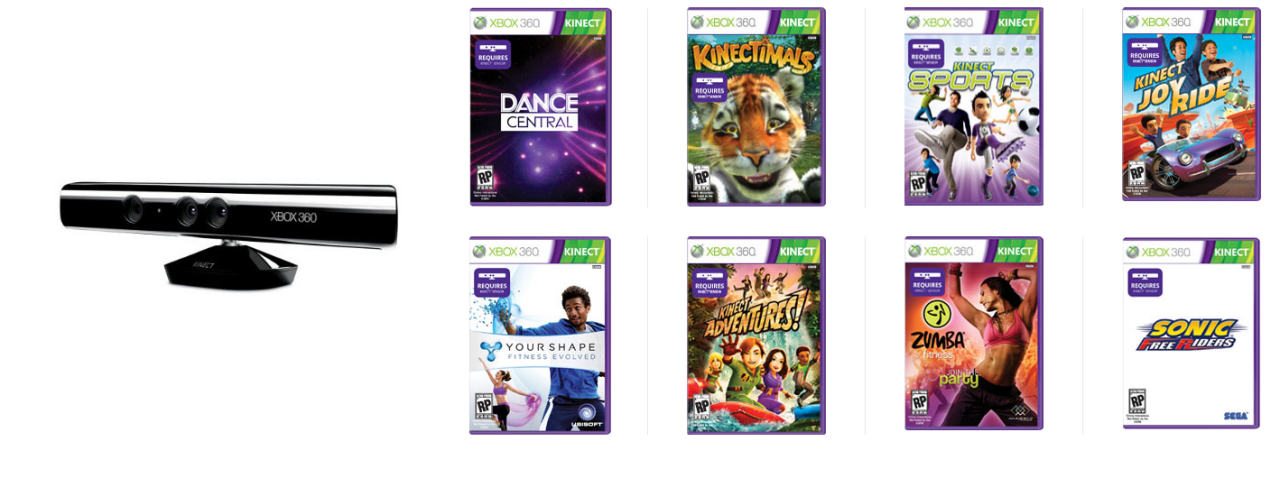
Xbox 360 Kinect Lineup

Microsoft unveiled their somewhat uninspiring lineup of Kinect games at E3

As for Kinect, the overall verdict seems to be: impressive hardware, uninspired game line up. And you can probably say the same for the Move as well, apart from the fact that Sony has marketed the product to hardcore gamers, along with casual/family gamers, with some success. It’s interesting watching the Microsoft presentation, where they split the event into two, the first part for hardcore gamers (Metal Gear Solid, a new CoD game, Halo Reach), and the second part was very casual/family oriented. I think we just have to accept that Kinect is not meant for hardcore gamers and move on. I don’t know why some Xbox 360 gamers are complaining about Kinect destroying the 360 as a console for serious gamers – it’s not as if Microsoft or publishers will stop making the games aimed at hardcore gamers just because Kinect is out. It’s best to think of the Xbox 360 as a console that has two personalities, and you can choose which of these personalities you want to identify with.

We did get a Xbox 360 Slim, and that seemed to have gathered more excitement than the Kinect, but mainly because the news came out of nowhere really, and that it’s already shipping as I type. Included is a larger 250GB HDD, built-in Wi-Fi just like the PS3, but with Wireless-N support built in, and well, it’s smaller and Microsoft says its quieter as well.

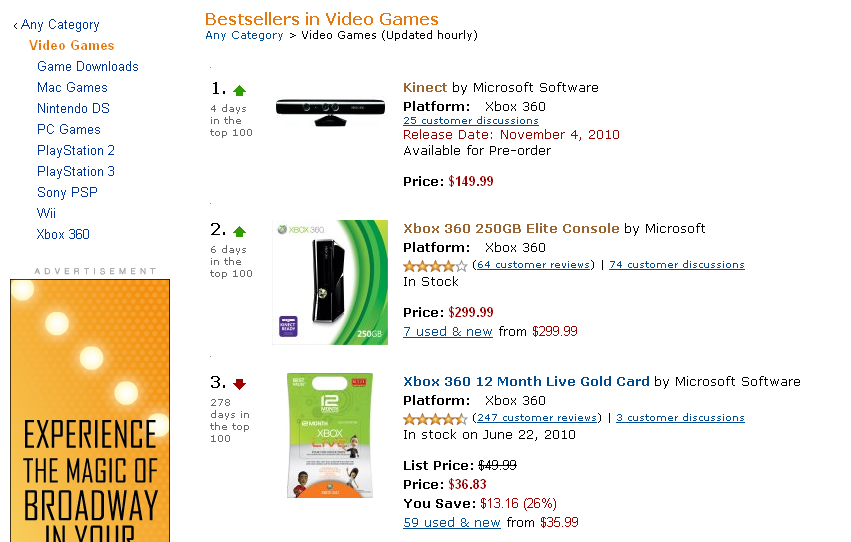
Xbox 360 Kinect and "Slim" are top sellers on Amazon

Xbox 360 Kinect and "Slim" are top sellers on Amazon

While the Kinect pricing hasn’t been officially announced, pretty much everyone thinks its $150. This price is the retailer’s estimate of the final pricing only though, so don’t be surprised if it’s lower (or higher). Amazon already has it up for pre-order (if the price does drop, Amazon will always give only charge you the lowest price during the entire pre-order period), and along with the Xbox 360 Slim, both are top of the sales charts at the moment. Both Kinect and  Move have been in the top 100 for 4 days – Move is currently 49th in the sales charts. And the fact that Move is available 2 month earlier than Kinect, and yet the Kinect is still outselling the Move, bodes well for Microsoft. Perhaps the novelty factor of Kinect is also helping to drive sales, as opposed to the common conception that the Move is basically an upgraded Wii.

The Xbox 360 slim, or rather more accurately, the new Xbox 360 Elite is genuinely doing well though, having been top of the sales chart every since it was put up. June could end up being a very good month for Microsoft in terms of the NPD sales figure. As for me, I’m definitely getting the “Slim”, but probably as part of a Kinect bundle, hoping Microsoft bundles the camera device with the new Elite console at no extra cost. And I know I’ve rubbished and questioned previous rumours of a Blu-ray drive for the Xbox 360, mainly because I think it’s a giant fail if Microsoft released a Blu-ray drive for their  noisy console which just makes for a lousy comparison with the PS3, which can also play games on Blu-ray disc.

The New Xbox 360 Elite

The new Xbox 360 Elite being released this week was a total surprise

For those that think the $149.99 price point for Kinect is too high, you have to consider the fact that this is the price for 4-player simultaneous play. If you want to do 4 players with Move, the minimum cost is $250 ($99 wand + camera bundle, plus 3 more wands at $50 each). Even for 2 players, you will need at least $150 ($99 want + camera bundle + $50 wand), and up to $250 if the game requires two wands for each player. And that’s not even including the Navigator controller (aka the Move Nunchuck) for $30 each, although it’s apparently optional as you can use a standard PS3 controller to perform the same actions (if you don’t mind holding the controller with only one hand). And then you’ll have to find a place to store all of these accessories. Of course, we still wait for Microsoft’s official announcement (in August, at Gamescom), and the final price could very well be $99 (or as I mentioned before, bundled with the Elite for free).

Anyway, that’s enough writing for this week. Got to rest up for watching some World Cup action later on. The boring football does make me feel sleepy, but I guess that’s what the Vuvuzelas are for, to keep people awake!