Archive for the ‘Gaming’ Category

Weekly News Roundup (31 October 2010)

Sunday, October 31st, 2010

Welcome to the Halloween edition of WNR. In this issue, you’ll read about extra scary stories about how big business is taking away your civil rights with the support of both major sides of politics, how your privacy is being invaded by greedy corporations, and how enterprising law firms are planning to make millions by suing you for downloading porn (whether you did it or not).

So basically the same as usual, I guess.

Actually, it’s not the same as usual, because there has been a real lack of news this week. I have to say some of it is down to me being extra busy this week, but I really did try and find news, honest! And I guess you might also be busy what with the last minute costume changes, the stocking up of rotten eggs/toilet paper, or if you’re just high on candy, so let’s make this quick.

Copyright

In Copyright news, LimeWire has finally closed its doors. After it lost a major lawsuit in May, the consensus was always that it would be only a matter of time before the music sharing website had to close down, but the dreaded change finally took place this week.

LimeWire Website Closed

Visitors of LimeWire were shown this official notice this week

If you go to the LimeWire website now, you’ll see an official notice simply saying that the website is under a court injunction to stop distributing the LimeWire software, with a link to the actual court orders. The owners of LimeWire still plans to launch a legal version of the website/tool, much like how Napster went legit, but that all depends on the amount of damages that LimeWire has to pay.

With LimeWire gone, the illegal music sharing world is very much now just a collection of Torrent sites and P2P networks, nothing to centralised that it can be sued out of existence anyway. And however much money has been spent fighting websites like LimeWire, the issue of piracy still exists, and it was only through innovation (iTunes, cheaper tracks,  no DRM, Spotify …), that there is actually some proper “competition” to illegal downloads. But if the industry keeps on pushing, and force people to adopt new ways to download that more effectively hides their activities, then there aren’t going to be big, soft targets like LimeWire (or even The Pirate Bay) to sue any more, and all while the downloads continue. So for their sake, I hope they do take innovations seriously and try different models, even if some will ultimately fail, because what they’re doing now certainly isn’t succeeding (despite the court “victories”).

And a couple of issues ago, I mentioned the Warner lawsuit against Triton Media (that’s the Triton Media of Scottsdale, Arizona, not the Triton Media Group that comes up top in the Google results). Well, this week, Warner has won its case against Triton. A refresher on what the case was about – basically, Triton Media acted to provide advertising to websites that possibly hosted illegal streams and downloads, and at the same time, it also ran its own possibly illegal streaming website. And instead of acting like a traditional online advertising company, Triton apparently went the extra step of helping to act as a sort of match-maker in matching potential advertisers to websites. And it’s these actions that has ultimately led them to lose the case.

The dangers of this precedent is that it could then allows studios to sue the likes of Google and Yahoo, both of whom have their own advertising networks. With so many publishers signing up to Google and Yahoo’s advertising programs, and with so many ads being served for all kinds of keywords and on all kinds of web pages, it should be easy for studios to find advertising links to illegal streaming/downloads, advertising showing up on searches for illegal downloads, and advertising revenue flowing to publishers of these sites. Suing a small fish like Triton will make it easier to sue a big fish like Google. But unlike Triton, Google has no personal, one on one relationship with most of its publishers and advertisers. And Google certainly don’t run their own video streaming website that may be serving up pirated content … oops, forgot about YouTube. In any case, there seems to be a shift towards suing revenue sources for piracy websites, but it still won’t stop those that are not engaging in piracy for profit, which I think would account for the majority of downloads these days.

Which brings up to a rather strange story this week. A developer who says he has come up with an anti-piracy platform has decided to protest the fact that nobody in the industry seems to be taking him seriously by, wait for it, turning his anti-piracy tool into a MP3 download website. Apparently, the tool allows for instant monitoring and searching of source of illegal content, and so would allow content owners to easily identify where pirated copies existed, and get them removed (it appears to be a tracking tool for HTTP based piracy, not for Torrents). But when the developer, only known as Dominic, was ignored by the various anti-piracy organisations after demonstrating his tool, the same tool that found illegal downloads now served them up to anyone who wanted them, as a form of protest. And it appears his stunt worked, sort of, and he has had to remove the downloads after a cease and desist notice from the Australian Music Industry Piracy Investigations organisation was sent to his web host.

Apart from ignoring the potential of his anti-piracy tool (which, if the served up MP3s were any example, it works quite well), Dominic also protest what he sees as “contradictions, corruptions, ignorance, and an overwhelming fear of change” that’s rife in the entertainment industry. From his work, he has also identified companies and even governments that advertise on websites that distribute illegal content (he has a list of them up on his website), some of them the very companies “going after mums, dads, kids, ISP’s, and pretty much anyone else they can think of” when it comes to illegal downloads.

PlayStation Phone

These leaked images from engadget shows the PlayStation Phone is real!

And unfortunately, that was pretty much that in terms of news this week. I know, it’s barely three stories. I guess I could have mentioned something about the Sony PlayStation phone (as a recent convert to Android, adding dedicated game controls makes perfect sense), anything on the Black Friday sales, or even the news that Spotify may be closing in on a deal that could see the service arrive in the US. But hopefully, there will be more next week.

So for the rest of the WNR, I shall dazzle you with some Blu-ray sales graphs, showing you whatever you want to see depending on your point of view, something that stats and graphs are very good at showing. See you next week.

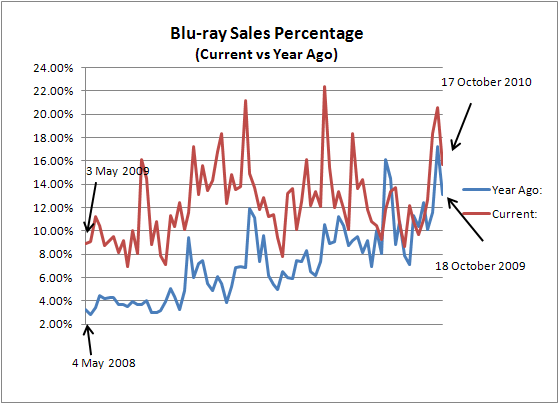
This first graph shows year-on-year comparisons for weekly results based on Blu-ray’s market share. Notice how the differences have narrowed in recent month, mainly on the backs of the previous year’s figures shooting up.

Blu-ray Sales Percentage - Year-on-Year Comparison

Blu-ray Sales Percentage - Year-on-Year Comparison

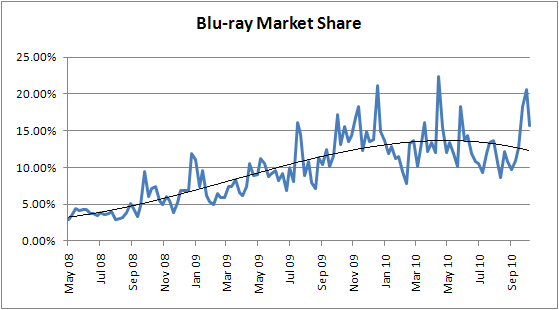
This second graph simply show Blu-ray market share over time, note the flattening trend, but as with any sort of sales, there are seasonal variations and we’ve yet to his 2010’s peak month.

Blu-ray Market Share As of October 17th 2010

Blu-ray Market Share

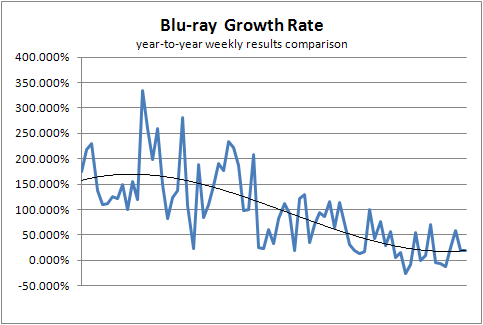
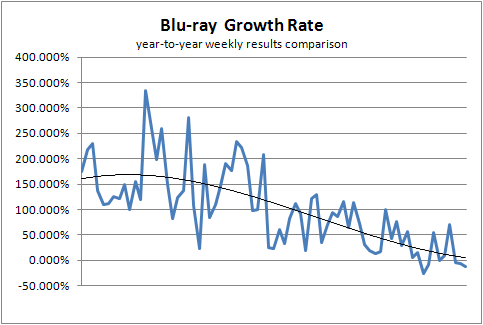
And this third graph shows the Blu-ray growth rate, basically taking weekly market share figures and comparing them to the same week a year ago, and then plotting the growth (or decline). Again, notice how growth has slowed, and there even a few weeks of decline, but things will pick up again slightly in the next few months. And as with measuring any kind of growth, a slow down doesn’t necessarily mean a bad thing, because going from 5 to 10 may be a 100% increase, but going up by the same amount from 10 to 15 is only a 50% increase.

Blu-ray Growth Rate as of October 17th 2010

Blu-ray Growth Rate

Game Consoles – September 2010 NPD Sales Figure Analysis

Tuesday, October 19th, 2010

I broke the bad news in the last Weekly News Roundup, that NPD will no longer be releasing unit sales figures publicly, which makes writing this analysis feature ever more difficult. But thanks to leaks, I am still able to present some kind of analysis this week, although with many figures missing. Still, it should be enough to paint a broad picture of the video gaming industry in the US for September 2010. All the figures are collected and calculated by NPD, but the posted figures are leaked by manufacturers and other analysts (the PS3 and Wii figures were released by Wedbush Morgan analyst Michael Pachter). PSP and DS figures were unavailable for this month.

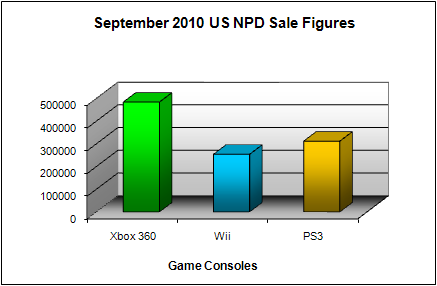
The figures for US sales in September 2010 are below, ranked in order of number of sales (September 2009 figures also shown, including percentage change):

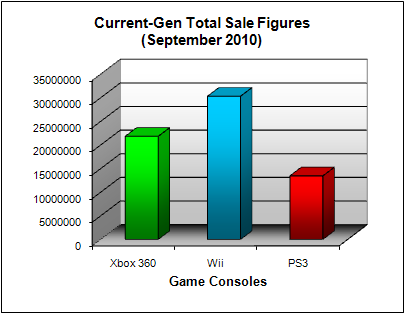
  • Xbox 360: 483,989 (Total: 21.8 million; September 2009: 352,600 – up 37%)
  • PS3: 312,000 (Total: 13.5 million; September 2009: 491,800 – down 37%)
  • Wii: 254,000  (Total: 30.3 million; September 2009: 462,800 – down 45%)
NPD September 2010 Game Console US Sales Figures

NPD September 2010 Game Console US Sales Figures

NPD Game Console Total US Sales Figures (as of September 2010)

NPD Game Console Total US Sales Figures (as of September 2010)

My prediction from last month was:

September = Halo Reach. That’s what next month will be all about. The fact is that, as I type, the top four items in Amazon’s Video Games section are all Halo Reach related (standard, limited, legendary editions, plus the 360 Halo Reach console bundle), just shows how dominant it will be in September’s figures. So expect the Xbox 360 to remain on the top of the console pile hardware wise too, and possibly the best month since, well, the last Halo release. Halo Reach will overshadow Sony’s launch of the Move unfortunately, although it’s doing well to just hang in around 10th, or just outside of it. The Sports Champions bundle should be counted in the software charts (in the same way Wii Fit Plus is in there), so it should be in the top 10 (especially when the top 3 will be condensed into a single entry for Halo Reach). It will be a very interesting month, I feel.

Heh, it really was an interesting month, although I definitely didn’t predict that NPD would stop releasing unit sales figures (although they had threatened to do so on many occasions before). But September was all about Halo Reach, that’s for certain, and thanks to it, Xbox 360 sales were up compared to the same time last year, the only console to record year-on-year growth. Not quite recording breaking sales figures for the Xbox 360, but it was the best month in 2010. And yes, it did overshadow Sony’s PlayStation Move, although it did well enough to help accessories sales to grow, despite Sports Champions either not in the top 10 or not counted as software.

To expand on the Xbox 360 figures, it had year-on-year growth of 37%. The timing of the Slim version of the console, and the console’s exclusive big hitter of the year, Halo Reach, couldn’t have been planned any better. And with Kinect going on sale soon, the next few months could all be about the Xbox 360, unless Sony or Nintendo pulls one out of the hat (ie. price cuts). It’s worth noting that the 37% year-on-year growth is on top of a 2% year-on-year growth experienced for the same month last year, so consistent growth is why the Xbox 360 is now looking pretty healthy indeed.

Many might be shocked to see the huge drop in sales for the PS3, but there is no concern. September 2009 was the first full month that included PS3 Slim and the price cut into the figures, and so comparing a year old SKU to a brand new and (at that time) recently discounted SKU, is not really fair (just like this time next year, the Xbox 360 year-on-year figures would probably show a decline, unless Kinect really takes off, and I mean to like earlier Wii levels).  And this is why I’ve always mentioned a caveat when talking about the huge year-on-year growth figures experienced in the last year, since we were not comparing apples to apples, but rather cheap slims to expensive fats, and that if you look at sales figures from two years ago, sales figures aren’t up by a huge percent normally. Which is why, despite the year-on-year sales drop, the PS3 actually had a good month and was up 34% compared to two years ago (very much comparable to the Xbox 360’s 39%, when comparing the same period). And this is why it took second place, ahead of the Wii. Without detailed stats, I can’t tell much well the Move bundle performed, but the accessories sector grew by 13%, the only sector to grow (both console hardware and software sales were down, 19 and 8 percent respectively), and I would suspect a large part of it is due to the Move. And some of the 34% growth compared to 2008 is probably down to Move, since for last month, the same comparison (August 2010 to August 2008) only yielded a 22% sales growth.

So the news just gets worse for the Nintendo Wii. Down 45% from last year, which at that time was down 33% from 2008 (so from 2010 to 2008, that’s a decline of 64%!). But the Wii still has a 8.5 million hardware lead over the Xbox 360, and so even at the current rate of decline, it will take some effort for the Xbox 360 to take the lead, but not an impossible task if Kinect manages to win over the casual gaming crowd. This, I believe, is the first time both the Xbox 360 and the PS3 has outsold the Wii, and it’s definitely not a good sign, especially this is the first month in which a competitor’s motion gaming system hit the market. The Wii 2 can’t arrive soon enough for Nintendo.

Onto software sales. Without unit sale stats, I can only give you the top 10 ranking, and this ranking is for title based, and does not separate them into individual SKUs or platforms, making the rankings much less useful as a tool to compare the different platforms, less they be platform exclusives. But I do have the sales figure for Halo Reach. The last Halo instalment sold 3.3 million copies, only the third game to do so (the other two were Modern Warfare 2, and Halo 3), and this figure didn’t even include the games that were bundled with special editions of the Xbox 360 console. So despite having more platform exclusives, the PS3 did not completely overwhelm the Xbox 360 in terms of software sales this year, thanks to Xbox 360 exclusives such as Halo series, and well selling multi-platformers like MW2. Here’s the new chart:

  1. Halo: Reach (Microsoft, Xbox 360) – 3,300,000
  2. Madden NFL 11 (Electronic Arts, Xbox 360, PS3, PS2, Wii, PSP)
  3. Dead Rising 2 (Capcom, Xbox 360, PS3, PC)
  4. NHL 11 (Electronic Arts, Xbox 360, PS3)
  5. FIFA Soccer 11 (Electronic Arts, Xbox 360, PS3, PS2, PSP, NDS)
  6. Kingdom Hearts: Birth By Sleep (Square Enix, PSP)
  7. Mafia II (Take-Two, Xbox 360, PS3, PC)
  8. Spider-Man: Shattered Dimensions (Activision Blizzard, PS3, Xbox 360, NDS, Wii)
  9. Metroid: Other M (Nintendo, Wii)
  10. Call Of Duty: Modern Warfare 2 (Activision Blizzard, Xbox 360, PS3, PC)

I loathe to make a prediction, because there might not even be figures next month to check whether I was right or not, but if there are figures, then I expect the Xbox 360 to still hold a sales lead over the PS3, which will outsell the Wii again. The new Fallout game, Fallout New Vegas, should do very well, with more copies being sold for the Xbox 360 (not that we have any way of telling). Fable III, the Xbox 360 exclusive, should also do well and again help the Xbox 360 console sales just like this month’s exclusive. And just checking Amazon right now, the Kinect bundle is in the top 10, which bodes well for the kit when it is released in November.

See you next month (maybe).

Weekly News Roundup (17 October 2010)

Sunday, October 17th, 2010

Let’s start this relatively quiet week with some bad news. It is very likely I will have to cease updating a long running feature here. Sorry to stop all of you from leaping for joy at the demise of the WNR, I’m sorry to say that’s not what I’m posting about. Instead, it’s the NPD US video game sales analysis, in its 38th monthly edition already, but it looks like 39th may very well never arrive. You see, NPD is no longer releasing hardware and software unit sales numbers, and this makes writing an analysis very difficult. Luckily, there may be some data leaks by manufacturers, publishers and other analysts with access to the NPD numbers, and when that happens, an analysis may still be posted. So far for this first month, there does seem to be some leaks, so the 39th NPD analysis may very well be posted early next week.

Anyway, let’s start going over the news in this, as previously mentioned, relatively quiet week.

Copyright

In copyright news, the Irish High Court has dealt a blow to the music industry’s attempts to shift responsibility of online piracy unto ISPs.

The court ruled that provider UPC was not responsible for what users do on its network, as Ireland had not yet implemented the EU directive on copyright. The next step for the music industry is to cry to the government and get them to help stop the nasty ISPs from hurting their billion dollar profits, and I’m sure they’ll find a sympathetic ear. As I’ve mentioned a billion times before, I don’t get the argument of the record and movie industries. If ISP should be made responsible for subscriber downloads, then why not the phone company, as most downloads are still done via good old phone lines and exchanges. What about the companies that maintain the routers and switches for the Internet – illegal traffic has to pass through their hardware eventually, so why not make them responsible too? So it’s only the websites that host torrent files (which don’t directly link to pirated content), the users who upload and download, and ISPs that the music/movie industries hold responsible (maybe Google and other search engines as well), but everybody else gets a free pass? Will hard-drive makers get sued too because they keep on making bigger hard-drives that are used to store pirated files? Where does the buck stop?

This is a question they can never answer, because the industry is passing on responsibility of fighting piracy to others, even though they are the only ones to benefit from any action taken. Governments can be lobbied take some of the responsibility, but other private companies are not just going to sit by idly and let the music/movie industries get away with it. And if the government, via new laws, make ISPs responsible, then what they are effectively doing is subsidizing the very profitable music and movie industries by taking money out of the Internet industry, just because one industry has a better lobbying organisation than the other. But I believe the saviour of the music/movie industry, if they need saving at all, will lie in the Internet domain, and so there’s more reason for them all to work together, giving users more innovative solutions, as opposed to working against each other while fighting the futile fight against piracy, while consumers are the ones hurt by all of this (either the lack of innovation, or financial and legal consequences, even for those that don’t pirate music and movies). But that’s just me.

Media Copyright Group Website

Media Copyright Group is being sued by US Copyright Group for Trademark Infringement

And speaking of companies not working together for the common good, more evidence this week that copyright law firms don’t really respect copyright, as they steal (or allege others of stealing) from each other. The US Copyright Group is suing the Media Copyright Group for stealing their name, even though they have different names. This is after the USCG was caught earlier in the year stealing another copyright law firm’s website design, and even earlier when UK copyright law firm ACS:Law accused of another UK copyright law firm of stealing their mailing templates. But I’m not surprised that these firms are suing for each other, or that some of them don’t respect copyright. Because first of all, and just like the Scorpion and the Frog fable, it’s in their nature to sue anyone and anything. And second of all, they don’t respect copyright because their work means that they don’t need to respect copyright, because it’s all about the money. In fact, these law firms would have no business if piracy was stopped tomorrow, so it’s actually in their interest for piracy to continue. Is it going too far to even suggest that these firms are making money off piracy? Well, all I know is that when home users download a torrent, and subsequently upload portions of it while they’re downloading, they’re not making a profit from the operations, other than saving the money of purchasing the content. Some torrent website may make some money through advertising, but overall, online piracy is one “industry” that’s not really about making a profit – unlike the industries that has sprouted up to combat it.

But if money is to be made from piracy or anti-piracy, then Google wants a piece of it too. Instead of giving in to movie studio demands to take responsibility for sites in its vast index (by this principle, Google may very well be responsible for all the world’s ills at the moment thanks to all the websites it indexes. Except for News Corp sites. So that’s one less evil Google is responsible for, I guess), it has suggested, shock horror, that studios may need to pay a little bit of money to reduce piracy and improve the studio’s bottom line. I’m sure the studios are outraged at the suggestion that they would have to pay for actions that benefit only themselves. Crying to Congress about it may be their only hope!

An update on The Pirate Bay appeals case, it has now concluded and a decision is expected on November 26th. I have deliberately avoided covering this trial because I suspect there is only one outcome, and that the original verdict will be upheld. Or maybe I was just too lazy to keep track of it, I don’t know.

High Definition

Not much happening in HD/3D land, except that Iron Man 2’s stats came out, and while it was impressive, it did not really outsell the likes of Avatar.

Iron Man 2 Blu-ray/DVD Combo

Iron Man 2 sold more copies on Blu-ray than on DVD, well sort of

What the Blu-ray version did manage to do was to get more than 50% of the market share, not the first time this has happened, but the first time for such a high profile release during the first week of release. In other words, when Iron Man 2 became available at retail outlets, most people purchased the Blu-ray or Blu-ray/DVD combo version, as opposed to the DVD only version. While this may suggest that Blu-ray has now replaced DVDs as the dominant format, there are a couple of caveats to this stat. First of all, overall Blu-ray market share is still only around 10% to 15% (it was up to 18% for Iron Man 2 week), mainly because not all titles are release yet on Blu-ray, but largely because people are being very selective when buying Blu-ray editions, as opposed to DVD editions. It’s all about the expected picture/audio quality I suppose.

Another important thing to note is that with the current pricing, it’s very bad value to buy any of the DVD-only editions, especially if one plans to upgrade to Blu-ray any time in the next couple of years. The reason for this is that the Blu-ray single disc version of Iron Man 2 was only priced a single dollar more than the equivalent DVD-only edition. The Blu-ray/DVD combo was even better value, at only $2 more than the 2-disc DVD edition. Now, even if I didn’t have a Blu-ray player, if the pricing differential was so insubstantial, I would never buy the DVD only editions. For $2 more, I can future proof my movie collection right now, and although I miss out temporarily on the extra features on the second DVD if I didn’t have a Blu-ray player, in return, I get two copies of the same movie, as opposed to just one. At the end of the day, even if I didn’t have a Blu-ray player, I still get to enjoy the movie on DVD and I will know that when I get a Blu-ray player, I won’t have to re-buy the movie. Of course, I think what has happened is that people were buying the single disc DVD version, as opposed to the combo version, which works out to be around $8 in savings. Still, when the two disc DVD edition costs more than the cheapest Blu-ray version ($5 more), if this doesn’t convince people to go and get a Blu-ray player, then I don’t know what will. The consumers that aren’t convinced will be difficult to convert into the Blu-ray cult, I think.

But Inception will be released in December, and I think that’s will be the title to beat for 2010.

Sony has announced its range of Google TV supporting TVs and Blu-ray players. It’s basically the tried and failed Internet TV platform, but now with a Google twist to make everything just a bit easier to use. Add the eventual support for the Android marketplace, and it can even become a surprisingly capable gaming platform for simple casual games. This convergence thing, that people, including me, were talking about years and years before, seems to be happening right in front of our eyes. Is a Sony TV with Google TV really just a TV, or a computer that can access the Internet, or a PVR that can record TV shows, or a games console? It only does everything, I suppose … oops, wrong company’s slogan.

Gaming

And finally in gaming, as mentioned above, the lack of NPD stats make the NPD stats analysis feature a bit more difficult to write. But I have some experience in writing much about nothing, so maybe I’ll manage.

But for September’s figures, I think I will still be able to come up with an analysis because of some of the leaked numbers, which suggests the Xbox 360 won the month easily again, while both the Wii and PS3 were actually down compared to a year ago, 45 and 37 percent respectively. The PS3 numbers might surprise a few people, since it has seen huge year-on-year growth recently, but as I mentioned in the last few NPD posts, we’re finally comparing apples with apples, or rather, slims with slims (whereas before, we were comparing the low priced slims with the high priced fats) – and as I have been trying to explain, the recent PS3 sales figures aren’t that impressive at all when you take this into account, and September’s figure prove this point.

Halo Reach

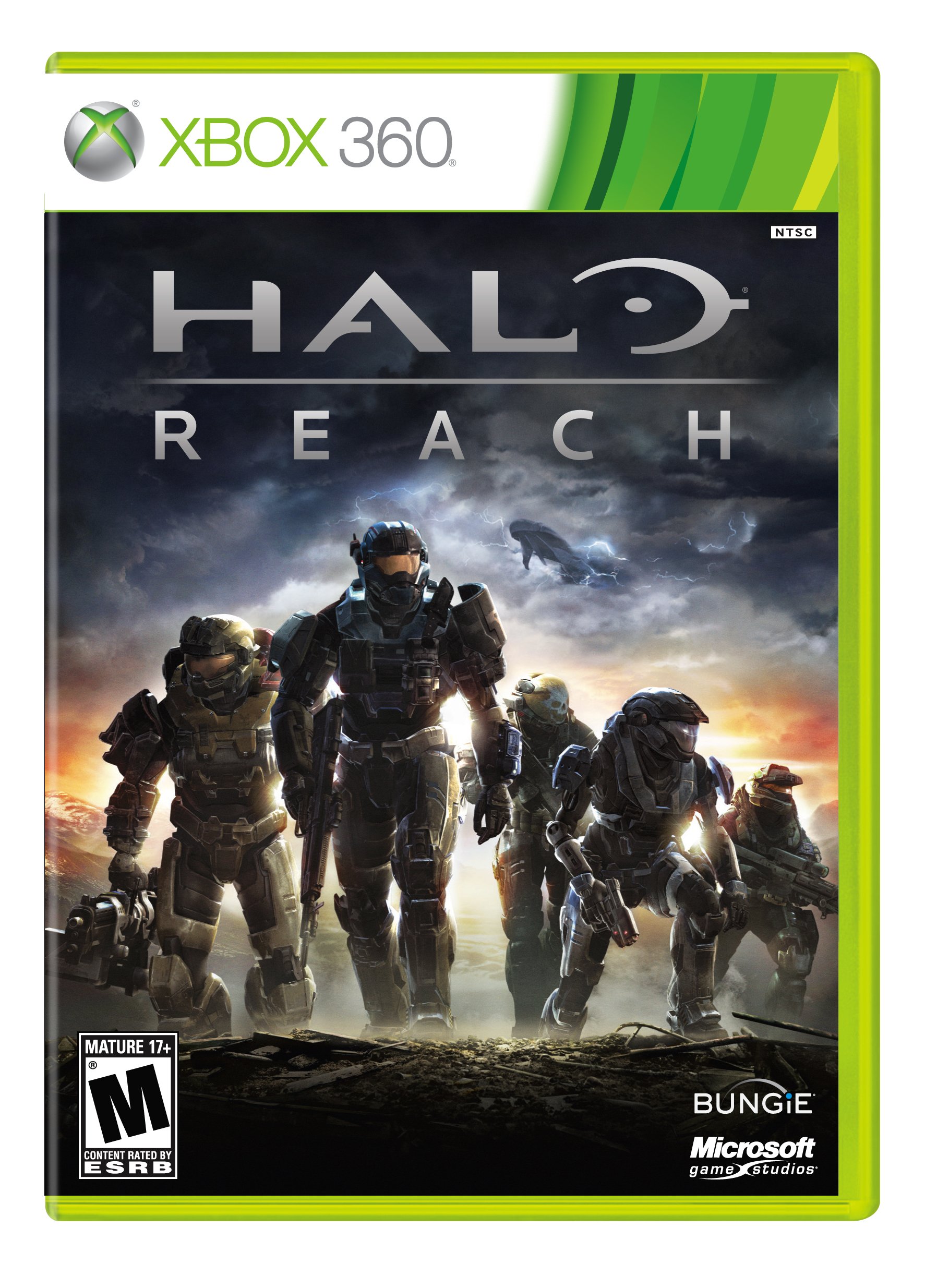
Halo Reach has become one of only three games to sell over 3 million copies in the first release month

The other interesting fact was that Halo Reach sold more than 3.3 million copies, only the third title ever to sell more than 3 million copies in the first month (in the US) – the other two are Modern Warfare 2, and the previous major Halo game, Halo 3. No specific figures were available for the Move, but the accessories sector grew compared to last year, the only one to do so, and this means the Move bundle probably sold well, but not well enough to have dragged the PS3 console sales any higher.

Anyway, I better stop writing before this turns into a fully fledged NPD analysis.

In other gaming news, Sony has a new way to combat the use of the PS Jailbreak device – new games, such as the new Medal of Honor, will come with firmware updates that disable the device, and if you want to play these games, you are forced to install the firmware. A typically heavy handed action by Sony, but it will probably work. Until someone pirates a hacked version of MoH that won’t require the new firmware, that is.

And that’s it for this week. Not a lot of news as I mentioned, but hopefully enough to tide you over until next week. So until then …

Weekly News Roundup (10 October 2010)

Sunday, October 10th, 2010

Welcome to the 10/10/10 edition of the WNR. I’m always weary when writing dates, since different regions use different ordering and it’s easy to confuse the day, month and year completely (which is why I always use the full name for the Month, and the year in four digits – as per the title of this post), so it’s good that, for one day of this year, I can throw caution to the wind and write the date anyway I want without any consequences. And to think, we only have two more years left of this, before we have to wait another another 89 years (think about it).

From my intro, you may have concluded that this was yet another quiet news week, hence the need to write gibberish. But there’s actually a few things to go through, not much, but a few. So the gibberish was merely coincidental, and regular readers would surely have gotten used to the gibberish by now. So let’s get started.

Copyright

Starting with copyright news, we’ll start with what was very late news last week, in that the controversial ACTA has reached a basic agreement, and there has been more analysis since then about the new draft (final draft?) of this agreement.

TorrentFreak reckons that the new ACTA draft now tries shoves much less crap down our throats than what is was earlier, so I guess that’s good news. Ah, I remember like it was yesterday when I first heard of the ACTA, about how custom officials were going to search through my iPod looking for pirated songs, that ISPs were going to be forced to monitor all of our Internet usage just in case we do something the RIAA/MPAA don’t want us to do, and that the island of Manhattan was going to be closed and fenced off like a giant prison, with all the caught copyright infringers sent there to fend for themselves (this last part may not be true). It seems that the current version of the ACTA is very much a watered down version compared to previous drafts, and I guess that’s one positive of global politics, is that things rarely get done when so many countries are involved. Hurray for petty political bickering.

Hadopi Logo

French Three-Strikes is up and running, with the first users receiving notification this week

But even without a global treaty forcing countries to take copyright control seriously by building giant island prisons, some countries are taking action anyway. France is a pioneer in this field. The country that gave us the French Revolution, has now been sold to the highest corporate bidder, in this case, the joint bid from the music and movie industries, and France’s Three-Strikes revolution has started. In case you’ve been living in a cave, or have had your Internet disconnected because you pirated one episode too many of Desperate Housewives (in which case, you would already know all about Three-Strikes, so skip the next half a sentence or so), the Three-Strikes systems give copyright infringers three chances to clean up their act before their Internet is disconnected. The first of the strikes has been sent out by HADOPI, and so the experiment begins. Will piracy stop? Or will people simply start using sources of pirated content that HADOPI can’t monitor? And if the piracy rate drops, will the music and movie (and software) industry make more money? Only time will tell, but I suspect the only real effect will be the increasing amounts of anger experienced by the Internet public.

Which explains why Operation Payback, 4chan/Anonymous’s global Internet attacks on those perceived to be on the wrong side of the great copyright crusade. I haven’t even kept track of all the organisations that Operation Payback has targeted, I think their most recent target was in Spain, but as they “group” has proclaimed, the attacks will continue until they’re less angry, and things like Three-Strikes won’t really help in this respect.

Getting caught in the cross-hairs in all of this is fair use. There are many reasons why copyright should be respected, and there are also many situations where protecting the public interest is more important than protecting “potential” profits for copyright holders. The Library of Congress’ National Recording Preservation Board has made a passionate plea for changes to the copyright law so cultural preservation, particularly for audio recordings, isn’t being hampered by copyright holders too protective over their content. Due to the various laws and amendments made to the copyright act, giving copyright holders ever increasing power and time to hold on to their content, many recordings made early last century are in danger of failing to be preserved because copyright holders aren’t releasing content that clearly has no commercial value any more. Some recorded vaudeville performance, for example, are destined to be lost forever as greedy copyright holders refuse to release recordings to the public domain, despite there being no market for such content since the 1930’s. It’s easy to forget that copyright laws were invented to protect the public interest, as much as the rightsholders, which is why copyright do expires, so content can fall into public domain and be preserved forever. DRM, another invention of copyright holders, may be even more harmful than any laws that exist. It’s very much unlikely any DRM protected content can be decoded in some distant future. We don’t even have to imagine that far to see how dangerous DRM can be, people who purchased content from one of the many failed online music stores that used DRM will know exactly how hard it is to recover their purchases, even after just a couple of years. Luckily, most DRM measures are fairly ineffective, and so easily breakable, but that won’t always be the case.

Killers Movie Poster

Hollywood may be making less money on bad movies than ever before, due to the Internet and online piracy

So with the copyright crusade taking many victims, what exactly are the rightsholders trying to achieve? This week, we had MPAA execs come out and explain their reasoning for fighting piracy. Apparently, even the MPAA is aware that piracy cannot be eliminated, saying that “Piracy has always been and will always be with us”. You see, the MPAA’s aim is only to reduce it so much so that they “can make enough revenue in a legitimate market to recoup expenses and continue to make new movies”. You see, behind the record profits, movie studios appear to be struggling to bring out movies, because it’s hard to even recoup expenses at times. The proof is right here if we look hard enough, I mean there hasn’t been a Saw movie since 2009, and who is to say six Saw films is really enough? Of course, movies like Inception are the “Exceptions”, it’s a real struggle for a lot of movies to make back the money that went into making them. You see the reason is that, simply, most of the movies that Hollywood produces are, how do I put it, crap! In the past, when people couldn’t just download crappy movies, they actually had to pay for a ticket before walking out in disgust twenty minutes in, and this meant a lot more movies were able to “recoup expenses” and so allow studios to  “continue to make new movies”. And before people knew how to rip DVDs (that whole six month before people discovered you could break DVD’s ineffectual CSS copy protection by simply breathing in its general direction), they may get tempted by the cover and buy the crappy movies, whereas now they can simply download it and delete it twenty minutes through in disgust, and hence provide no income at all to struggling studios, who are now forced to having to actually make good movies that people will want to pay to see, like The Dark Knight, Avatar and Inception. But Chris Nolan is only one guy, and who know when James Cameron will make another movie. So it’s no surprise really that Uwe Boll’s Far Cry was one for the first movies to get into the sue-for-settlement game, is it?

There must have been something in the water last week, because yet another victim of the piracy trade also came out to suggest that, maybe, piracy isn’t the only reason for lost profits. Nintendo’s CEO refused to blame piracy for lost Wii, DS sales, believing that good games will still sell regardless of piracy. Interesting. So people pay for good stuff, and pirate the not so good stuff? Who would have thunk it! The reality is that people who can’t afford to buy will probably pirate, in which case no profit has been lost a result. There’s only probably a very small minority that will always pirate, even if they can afford to pay. And so I think most of the revenue losses come from the fact that people are not buying things that are not worth the money being paid, and with so much good stuff out there competing for our hard earned dollar (even if it is worth less and less every day, if you’re earning the US kind), buyers are a lot more picky. And piracy, rightly or wrongly, allows many to “sample” goods without having to feel cheated by paying for the full sticker price, and in most cases, the goods are as they suspected, not worth the money being asked for it. But producers will argue that without people buying the poor quality junk, then these purchases can’t subsidize the cost of producing good quality stuff, and that’s true. So some kind of balance has to be reached where perhaps producers can make the junk cheap enough to tempt us to go against our better judgement, while keeping the good stuff cheap enough so that not too many people fall into the “can’t afford it, so must pirate it” category.

And an update on everyone’s favourite newspaper copyright lawyers, Republican Senate candidate Sharron Angle is ready to settle her Righthaven lawsuit which alleged that she posted some newspaper’s articles without permission somewhere. It’s a shame, I was hoping for a real legal battle, but I guess in the middle of an election campaign, that was never likely to happen.

High Definition

In 3D/HD news, Iron Man 2 was released a short while ago and the figures suggest that it will be one of the best selling titles on Blu-ray ever, which is exactly what the format needed after a sluggish few weeks recently – the stats will be posted on Tuesday at the usual place.

Toshiba 20GLI 20" Glasses Free 3D TV

Toshiba's 20" Glasses-Free 3D TV is expensive at $3000

For 3D lovers, there was some exciting news this week as Toshiba released its first glasses-free 3D TVs. If you’ve read my earlier blog post/FAQ about 3D, you shouldn’t be too surprised about glasses-free 3D TVs, but as I mentioned before, there are a lot of drawbacks to this technology currently. For example, the Toshiba 3D TVs only allow 3D effects from nine fixed viewing positions – if none of these positions matches your sitting positions, then you can forget about the 3D effect. Now, new versions of the same technology is enabling greater number of viewing angles, I think I read somewhere one even offers 64 viewing positions, but for me, it’s not so much finding a sweet spot, as staying there for the whole duration of the movie (and making sure you don’t move your head too much). Of course for some, that may still be a better compromise than wearing dorky glasses.

Another problem, which the Toshiba releases make clear, is the cost of the technology. 3D effects rely on each eye seeing something different to trick our brains into thinking we’re looking at something in 3D. Glasses work by quickly shuttering the LCD so that we’re only seeing out of one eye at any one time (it’s synced to the TV so that each eye is seeing that they’re supposed to be seeing – all of this is done very quickly so we don’t notice that we’re really only seeing out of one eye), but the image we see out of each eye will be the full resolution of the TV. However, with these glasses-free TVs, it relies on barriers that block out different pixels on the TV depending on the angle of your vision (with each eye seeing something different, because of the different viewing angles). This blocking of pixels means that each eye is not seeing the full resolution of the TV, and so in order to created an HD image, more pixels are needed than what is normally required. For the larger Toshiba 20″ 3D TV, four times the number of pixels of a 1080p TV was needed to create only a 720p picture (essentially, the panel is a 2160p one, if my maths is correct), and this is why this small TV costs nearly $3000. Not only is the panel expensive to produce, the processor needed to manage this many pixels also needs to be powerful (Toshiba uses their Cell technology, the same processors that power the PS3).

But you see the problem now though. If it ever becomes cheap enough to produce 2160p TVs to make  these 720p  glasses-free 3D TVs affordable, then people will start to want 2160p 3D (or at the very least, 1080p 3D), which would already be possible then with 3D glasses. This, plus the viewing angle problem, means that there’s still a lot of development needed for this technology. Although the smaller 12″ model would definitely make a very cool digital photo frame.

Gaming

And half way lodged between movies and gaming, PS3’s Netflix will go disc free this month, with the PS3 Netflix app soon to be available meaning users of Netflix no longer has to insert the what must now be very worn Blu-ray disc into their PS3s to access Netflix’s streaming service (as CrunchGear noted, it’s extremely ironic that an online streaming service still required a disc to work).

And for those with money to burn in this economy, you can now pay Best Buy to upgrade your PS3’s firmware. For $30, Best Buy’s Geek Squad will press left on the PS3 controller until the “Settings” icon is highlighted, go down to “System Updates” option and press “X” for you. I know the US dollar worth less than the paper its printed on these days, but $30 is still $30. Yes, a firmware update is a bit more complicated than just pressing a bunch of buttons  (but not much though), since you do need the PS3 to be connected online first, but I suppose people that want PS3s will probably know how to do that already. In any case, those buying PS3s as gifts for others may not know what the deal is, and so may pay for this just to have peace of mind, and I think that’s probably the demographic Best Guy is going for. It is funny though reading through the list of “benefits” you get for your $30 – I mean, you’d be crazy to not want the “system runs smoother” functionality. Joking aside though, if PS3 firmware updates are breaking the Blu-ray drive as some have claimed (or launched a class action lawsuit for), then maybe paying $30 isn’t such a bad idea if Best Buy covers the cost of whatever happens due to a bad update (ie. the $150 Sony charges to fix the PS3 if something did go wrong).

Alright then, that’s it for this week.  I have it on good authority that, yes, there will be new events occurring  next week in which an article will be written and published to inform the general public, and thus creating something called “news”. And I shall do my best not to skip over the really important ones due to sheer incompetence and/or laziness. Have a good one.

Weekly News Roundup (3 October 2010)

Sunday, October 3rd, 2010

There’s a surprising amount of news to get through, most of them coming in the last few days, while previous week’s news stories continue to provide the goods, which just goes to show that it’s rather foolish to be overconfident in dealing with the Internet masses, because a train doesn’t run you over when it’s late, and coffee doesn’t turn into acid over time (see Andrew Crossley remarks regarding Operation Payback, if you don’t get the reference).

Copyright

We’ll start with the repercussions of Operation Payback, which should occupy a fair bit of the copyright section this week (and promises to occupy more of it in the following weeks, until Anonymous’ anger subsides, if it subsides).

The leaked ACS:Law emails are still providing a wealth of information on how one of the most notorious copyright settlement firms operate. There was at first the details about just how much money have been made so far, and how much money is expected to be earned as more and more people fall foul of the settlement notices. As I noted last week, the entire business is motivated by money, which isn’t necessary wrong, except there’s very little emphasis on stopping piracy, apart from the side effects of these types of lawsuits. You get the feeling that if it was possible to somehow encourage piracy, so this little business can continue for a while longer, then some of the less reputable law firms may just do this. After all, if it’s all about the money, then it will all end when people stop pirating stuff.

And as if to further proof the point I made above (or maybe the more likely explanation is that I made the point above so I can segue nicely into a new paragraph … but I’m not that clever!), not only do certain law firms care little for actually stopping piracy, they themselves are engaging in it for their own commercial gain, which is way worse than people who can’t afford to buy movies downloading pirated copies. Again, uncovered from ACS:Law’s email archives, is a little incident involving another law firm, Tilly, Bailey and Irvine, which sought help from ACS:Law in regards to starting their own copyright settlement business. But instead of taking mailing templates and creating their own unique ones based on the ones provided, Tilly, Bailey and Irvine decided it would be easier to just use the templates without license. Geeze, it’s easy to get caught in this piracy things isn’t it? ACS:Law’s Andrew Crossley, which has overnight become one of the most famous, or is that infamous, people in the Internet world, wasn’t happy at TBI’s actions, and I guess it was pretty silly for TBI to commit acts of copyright infringement against a copyright law firm.

What was more interesting though was that TBI ceased their copyright settlement operations after discovering the negative side of all that money – the bad publicity. This is nothing news, as the father of copyright settlement law firms in the UK, Davenport Lyons, also quit from the game for the same reasons. TBI mentioned that the extra resources needed to deal with the bad publicity took them by surprise a bit, even though it really shouldn’t. This could point to a way to fight off the copyright settlement vultures, because while not all care about bad publicity, some do and public pressure can be effective. Most of these law firms practice traditional law as well, and if their copyright settlement stuff is hurting their other business, then that may make them think twice.

Cornered! Poster

Cornered! is the latest movie the USCG is suing downloaders for

Which may be why the law firm Dunlap, Grubb, & Weaver created the US Copyright Group, as to separate their copyright settlement stuff from the rest of their work. It’s not really working though, not if you consider the bomb threat they received this week, which luckily turned out to be a false alarm. With the economy the way it is, people don’t need a mass mailing telling them to pay up hundreds and thousands of dollars for a movie that costs less than ten, and it’s understandable some people may just go too far. Also, the irony of their association with the movie The Hurt Locker, could point to just a prank. But this isn’t stopping the USCG, as they filed more Doe lawsuits this week, for two more movies. Low Orbit Ion Cannons and bomb threats can’t stop the USCG, although some judges can, and this week, the USCG had to deal with a small setback in one of their ‘Hurt Locker’ lawsuits. The reason is not important, it was a jurisdiction problem, but it does show that the court is not always on the USCG’s side, and that the growing public anger may in fact make judges examine the USCG’s case (or lack of one) a bit more carefully in the future.

Back to Operation Payback for a moment, it is still very much going on, with many more firms and organisations being targeted, including one here in Australia (the AFACT). The effectiveness of the LOIC as a DDoS tool is debatable, since it’s apparently easy block, but the successful attacks so far have been from sympathizing groups and individuals, it appears. The ACS:Law email leak is still so far the crowning achievement of the operation, although it very much happened by accident. If we can put aside the debate about the legality of such protest actions, the message is clear though. People don’t like the way they’ve been treated in this copyright crusade. and they’re speaking out. They no longer want to be just labelled a “criminal” and treated, by governments and groups like the MPAA/RIAA, as if their concerns are not legitimate. And even criminals have rights, rights that our governments have been too eager to give away to protect the interests of the rich and powerful entertainment lobby. There are real reasons why piracy is rampant, and it may not even have anything to do with pirated goods being cheap or free. If we believe the copyright holder’s argument that they are losing money to piracy, then it means that people who can afford to pay are not, and are deciding to choose something that’s illegal and dangerous instead. But then if the reality is that the people downloading are the ones that can’t afford to pay, then what is actually lost by the copyright holders? And if it’s because pirated content is easier to get hold of then paid for content, then who is to blame for this? Pirates for making things too easy, or copyright holders who makes things too hard for consumers? If there is to be a debate on copyright, these are the issues that need to be examined. And maybe, just maybe, a solution can be found.

Democractic Underground Logo

Progressive political forum Democractic Underground has been hit with a Righthaven lawsuit

And now back to the lawsuits. The newspaper copyright trolling continues with Righthaven hitting a fairly large target this time. Left wing political forum Democratic Underground has been hit by such a lawsuit, when supposedly one of their users posted an article from one of the newspapers that Righthaven represents. But if Righthaven was expecting a prompt payment of the settlement fee, then they may need to think again when suing an Internet, political savvy opponent, which has since brought the EFF to help out with their defence and counter-suit. Democratic Underground, as a forum, should have protection under the DMCA’s safe harbor provision because they do have strict rules in regards to copyright, but I suspect they will go beyond this technical defence and question the very nature of these types of lawsuits when it comes to preventing freedom of speech, which is exactly what a political forum provides. But the DMCA is actually an issue, because normally, the newspaper in question can request an article to be removed by filling a simple DMCA notice, but obviously, there’s no profit in that. With the rate ads are paying (ie. not much), one can argue that newspapers are not losing much at all when people copy their articles verbatim (but usually with a link to the original article), but the positive effects of having their work publicized and if the link to the original article has been posted, the positive effects in terms of search engines, which bring in more people to their website, should all be considered. Which is why before Righthaven, newspapers often requested full articles to be removed, but were happy with excerpts and definitely happy with links to the original article. But the settlement fees earned means that it’s much more profitable to sue, than to reason. In any case, I expect Democratic Underground to put up one hell of a fight, with assistance from the EFF, and if I was Righthaven, I would regret very much regret picking such a target instead of some poor blogger.

The EFF has had a minor victory this week too, forcing the proposed Combating Online Infringement and Counterfeits Act to be delayed in the Senate, after they organized 87 prominent Internet engineers and pioneers to write an open letter attacking the act. Apparently, what the government is proposing, in order to help out their music and movie studio buddies, may actually break the entire Internet. Which is just exactly what you would expect from them really, and I mean both sides of politics, and like puppy dogs, they’re all competing with each other to earn the attention of their masters. If there was some place where they could fire a nuke at, to stop online piracy, they would have done it already, it’s what I’m getting at. So while the US Senate was busy doing what it does best, which is to do nothing, the controversial ACTA treaty reached a significant milestone with a basic agreement being reached, which may force the Senate’s hands (not that they need any forcing).

And The Pirate Bay appeals trial started this week too, after delays over accusation of bias. Well, when before you even start the trial, the judges have already had accusations of bias aimed at them, and none of them recused themselves, then that’s not really a good start, and I don’t expect any positive result. But on the other hand, any negative result probably won’t affect TPB’s operations anyway, so what’s the point really.

And from the same people that wanted phone ring-tones to be considered a form of public performance, the ASCAP which represents composers and publishers, has tried to get a court to say that a download is also a public performance, despite downloads not making any noise apart from the “ding” when it completes (depending on your browser/settings). The court denied their “ring-tone” arguments, and they denied their download arguments too. If I was a member of the ASCAP, I would be embarrassed at their actions, going out and making an ass of themselves in court. The ASSCAP perhaps? If they get their way, pretty much, even humming a tune would be a public performance, and eventually, even thinking about a song may be mean having to pay royalties.

High Definition

Moving onto 3D/HD news. The news this week was that Blu-ray penetration has reached 17%. There has been some pretty poor stats recently for Blu-ray sales in the US at least, but I’m not surprised at this figure at all.
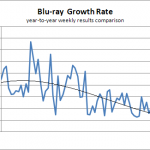
Blu-ray Growth Rate (up to September 19, 2010)

Blu-ray's growth rate has slowed recently due to lack of hit releases

But whether this 17% can be turned into 80/90%, or whatever DVDs have, that’s another question. Without top new releases, Blu-ray hasn’t been growing as fast as previously, but with the best titles coming thick and fast in the next few month, that could change. I’m still mostly confused as to the intentions of studios when it comes to Blu-ray. Do they want it to completely replace DVDs, and then suffer the same problem as DVDs in terms of ever dropping revenues (until Purple-Ray or whatever next comes out), or are they positioning Blu-ray as a complementing format to DVDs, one that is sold at a premium to slow down the decline of movie prices? With current pricing, it seems studios want Blu-ray to completely replace DVDs (for example, the Iron Man Blu-ray+DVD combo can be had for less than the two disc DVD set at some places, or only a couple of dollars more elsewhere), because the premium is shrinking to the point where it doesn’t exist for many titles. On the other hand, not all titles are being released on Blu-ray, so it seems studios are not that keen on Blu-ray totally replacing DVDs.

3D Blu-ray will probably up the pricing a bit, or at least that’s what studios hope will happen. But in time, it too will drop in price to the point where 3D editions will be included with the standard 2D release. So it seems to me that getting people to pay more for the same stuff isn’t a long term solution, but perhaps getting people to buy more for less per item may be the way to go.

Or you can just charge $30 per movie and hope someone is stupid enough to pay for it. That’s Hollywood’s new plan, after they got the FCC to agree to break analogue outputs, so they can release movies faster to the home, before it’s available on Blu-ray/DVD. It’s basically another release window, this time delivered without a disc, but most likely heavily DRM infested. And it appears to be for a single viewing only. I talked about solutions to the piracy problem further up in this WNR, but if this is the solution (analogue DRM + stupidly high pricing + more DRM), then they really need to stop coming up with them. You can see how they think this might work too – $30 is less than what a family pays to watch the movie at the cinemas, but more than what they would pay for the Blu-ray/DVD. Or they can just download it for free, without the DRM too. You see where the problem is?

Gaming

And finally in gaming, Nintendo thinks it may have found the solution to the piracy problem on the DS – the upcoming 3DS will have new anti-piracy updates that happen automatically in the background, any time the DS is connected online.

While I believe the innovations offered by the 3DS, that is the glass free 3D screen, will be enough to ensure it sells extremely well when it is released early next year, I don’t really think the anti-piracy features will really stop piracy. I’m sure some hacker somewhere is already salivating at the prospect of disabling the 3DS’s automatic updates, and open up the portable console to mass piracy like that experienced by the DS.

Gaming on the iPhone

Smartphones like the iPhone is becoming a threat to portable game consoles like the Nintendo DS

But even despite the piracy, the DS sells quite a few games, and it’s a good earner for Nintendo. It’s just not as a good earner as the piracy stats suggests. But I think Nintendo’s biggest problem isn’t flash carts, but smart phones. While DS games are mostly still longer, phone games are becoming more sophisticated, and sometimes, people only want to play a short game. And certainly, the price is more appealing. And the range of games, especially on the iPhone, makes the DS range of games look pitiful by comparison, and all the big game studios have already signed up to produce games for the iPhone (and soon to Android I think), not to mention the many indie game producers. So what Nintendo needs is to open up an apps space for the DS, one that allows indie producers to have a go as well, so homebrew doesn’t have to be confined to illegal flash carts. An online marketplace with cheap games will help keep things fresh, and I think Nintendo will be surprised how much more people spend when they’re only paying a buck or two for games – most likely more sales than if games were prices at ten times this price. Micro-transactions are the future.

That’s all I’m going to write this week. I suspect next week will be quite boring as the Internet media rehash most of the interesting stories from this week over and over again. Look at me, I’m already making excuses …