Weekly News Roundup (11 September 2011)

September 11th, 2011

It’s hard to believe it’s been 10 years already. So much has changed since then, hasn’t it? I remember I was watching The West Wing, of all shows, when the breaking news alert interrupted the episode (and I never did finish watching that episode until I purchased the DVD box set, some 8 years later).

As for news this week, not a lot, but good in quality always makes up for quantity. And after last week’s acidically toned mega long post, I think this week’s will be a lot “better”, well, hopefully shorter anyway.

Copyright

Copyright news up front, I’ll start with a news post that I’m actually quite proud of, because I actually spend like more than 10 minutes “researching” it (aka copying what others reputable news organisations have posted), and it also involved use of arithmetic and statistics, two of my favourites things based on the stuff I like to write on a regular basis (NPD analysis, and weekly Blu-ray stats analysis).

Big DVD Collection

This is what the MPAA thinks a movie pirate's movie collection will look like if they stopped pirating, by spending $1,000 more every year on legal goods

But full credit to the MPAA for releasing the info-graphic that I based my “analysis” on, which came to the conclusion that, if the MPAA’s numbers in regards to piracy rates and the cost to the economy are true, it means that every pirate would be spending $1,000 more every year buying legal content. The MPAA’s “statistics” are mostly conjecture, and (in my opinion, wildly inaccurate) estimations. Because you can’t really estimate losses due to piracy, because this would require knowing what pirates would do if they did not pirate any more. This is impossible to calculate because, one, you can’t guess what a group of largely independent people will and will not do, and two, there’s not way to stop piracy and force these people to “do the right thing”. But let’s give the MPAA the benefit of the doubt and let’s say their figures are correct, then what the MPAA is effectively saying is that probably 25% of all Net users in the United States are pirates, and that each pirate is costing the creative industries $1,000 per year, per person, to get to the $58 billion yearly losses that the MPAA mentions. If the MPAA counts every instance of copyright theft as a loss of revenue for the full price of said product, then $1,000 is probably about right. But this is misleading to the extreme, as it would be like saying if jewel thieves didn’t steal $1m worth of diamonds from a jewellery store, they would have purchased the $1m worth of diamonds (I wanted to use my usual car theft analogy, but I think I’ve gone over my allowed quota for the year). And any theft analogy is incorrect anyway, as file sharing is not theft – it’s not paying for stuff you should have, like reading a magazine at a news stand without paying, but it’s quite different than say shoplifting the same magazine.

What’s more disturbing for me, as opposed to a rather harmless, but propaganda-ish infographic, is the MPAA getting involved at the law enforcement level when it comes to anti-piracy operations, even those that are outside of the US. Of course, infographics and misleading stats help the MPAA scare politicians into giving them this sort of access, so this cannot be discounted either. What brings me to this is the news this week that newly leaked Wikileaks documents show the MPAA and the IFPI, two lobby groups, all involved in high level discussions with South Korean anti-piracy law enforcement agencies, and with ICE detailing their operations against warez topsites, the sites that are acts as the point of origin for pirated content on the Internet. On one hand, you might say that having an industry group involved in tackling the industry’s own problems makes sense, but if it’s the industry’s problem, then why is a government agency and two governments, spending precious tax payer resources, to tackle the problem that many experts say are the industry’s own creation anyway, due to outdated business models? This whole idea comes from politicians believing that copyright theft *is* a $58 billion per year problem, but it isn’t, and it’s not costing 300,000 jobs a year. If you want to make such flimsy conclusions from nothing but wild guesses, then I have a few more I would like to make, such as that piracy creates jobs by allowing website operators to make money to provide  content to people who had no means to pay for it in the first place. And the people enjoying pirated content end up spending their money on other more essential services and products, and their money won’t end up in the pockets of greedy studios who are already making record profits, or end up giving more money to rich, spoilt Hollywood stars and autotuned pop musicians.

And if the government is to spend tax payer resources to help a well to do industry, while others are struggling, and to do it at the expense of one of the most innovative and fast growing industries, the Internet industry, then this will hurt the economy even more. Which is why a “who’s who” of the Internet business has come out attacking the MPAA/RIAA backed PROTECT IP act, which, despite the controversy, is gaining support in Congress (lobbying money helps soothes the aches from migraines, back aches, and lack of conscience). The founders of Twitter, Zynga, FourSquare, and key people from StackExchange, LinkedIn, and Tim O’Reilly, yes, *that* Tim O’Reilly, has signed a letter asking Congress not to go ahead with PROTECT IP, as it could hurt small Internet businesses, and the broad nature of the act means that it could hurt innovation as well. This comes after more than 100 law professors also signed an open letter asking Congress to reconsider, and after Internet pioneers and top engineers also writing a similar letter urging caution when it comes to messing around with DNS. Hmm, it seems that open letters are not a very effect form of mass action, or the US is run by politicians that don’t care for expert opinion as much as they care about where their next campaign contribution is going to come from. Or both.
Righthaven R.I.P.

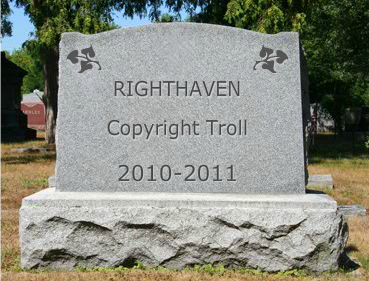
Is Righthaven about to file for bankruptcy?

But there’s also good news for those that believe in karma, as Righthaven might have to file bankruptcy due to their recent legal and financial setbacks. Not only has judges started to see through Righthaven’s scheme, which in my opinion, is nothing more than a money making scheme, they’ve started punishing Righthaven by rewarding damages *against* the firm. Righthaven’s biggest mistakes is that they haven’t been able to avoid going to court, and they haven’t been able to do so because the people they’re suing weren’t willing to give up so easily. It’s one thing to sue movie pirates, but to sue those that are interested enough in the news to copy/paste articles and post it on their own blogs, is just asking for trouble. These are clearly opinionated people, who love a good fight, and will stand up for themselves out of principle, even if it end up costing them more money in the process – and these are not the right “targets” for mass copyright lawsuits. And then there’s the news that Righthaven’s second largest client, MediaNews Group, has now pulled out, leaving Stephens Media, which are also the money behind Righthaven, as their only big client. And even that money may no be as forthcoming as before, as Righthaven have apparently asked a judge if they can delay paying the $34,000 or so they owe to one of the “targets”, as they’re having trouble coming up with the cash. If Righthaven does go under, nobody would shed a tear for them, as to paraphrase the new MediaNews Group chief, it was a stupid idea to being with.

It’s not the first time Christofer Sundberg has spoken out against gaming DRM, but it’s always good to hear from developers on the issue. Sundberg is the founder of Avalanche Studios, the makers of the Just Cause series amongst other games. And this week, Sundberg let the world know what he thought of the latest trend in using “always-on” DRM. Suffice to say, he’s not a big fan, mainly because in his opinion, in this day and ages when piracy is rampant and people have a lot of “choice”, even if some are illegal, if publishers are not providing extra incentive for consumers, then they’re doing something wrong. “Always-on” DRM in fact takes away incentive for consumers to pay for games, and even those that do, will have to rely on pirate solutions to play the game without annoying interruptions. For Sundberg, it’s also about trust, and he believes that “always-on” DRM basically says to the paying customer: “Thank you for buying our game, we trust you as far as we can throw you”. Instead, developers and publishers should listen to gamers, even though that don’t buy the games, more – listen to their suggestions, make them feel like part of the development process (because they are a part of it, the end “using it” part of it at least). But Sundberg also stated that it’s mostly up to publishers as to what kind of DRM to use, and if Avalanche’s publishers decide to use “always-on” DRM, there’s not much he can do about it, even if his whole studio will be up in arms against such a move. And this also reminds me to play Just Cause 2 a bit more, since I haven’t really played it after getting it on Steam – I’m such a reverse pirate when it comes to games sometimes, I buy a lot (usually on sale), and then never play them!

High Definition

In HD/3D news, it’s a contractual obligation for the  WNR to cover a rumour about Blu-ray coming to the Xbox 360 at least once twice a year, and so with much regret, I bring you the latest rumour.

To be fair, it now makes a lot more sense for Blu-ray on Xbox 360 than even just a year (and a bit) ago, mainly due to the new, slimmer, quieter, faster, stronger (and now less shiny) Xbox 360. And with games coming on multiple DVDs, perhaps Blu-ray is also finally needed for games, although due to noise and loading speed issues, it’s always better to install games to the built-in HDD – so you really only need to do a single disc swap for a game that requires 2-discs, during the install process, and while Blu-ray removes the need to do this, the extra cost of getting the add-on drive would negate any benefit when it comes to gaming, leaving only the benefit of being able to play Blu-ray movies. But with Blu-ray standalone players available for so cheap these days, you can get a budget standalone for the expected $50 cost of the add-on, and so having a Blu-ray add-on doesn’t even make that much sense for movies either. And with Blu-ray competing against Microsoft’s preferred streaming platforms, that’s another reason why Microsoft is in no hurry to launch a Blu-ray enabled Xbox 360.

Gaming

And that brings us finally to gaming. The NPD report for August is out, and I should have the analysis up in a few days. While only Microsoft and Nintendo provided hardware data for this month, Microsoft again provided some extra info that allows for the PS3 numbers to be deduced.

Despite the PS3 $50 price cut (coming in at the middle point of the month), the Xbox 360 was still comfortably the best selling home based console of the month, selling some 41% more units than the now discounted PS3. This is probably why Sony felt the need to withhold sales data yet again, because many, including myself, predicted the PS3 to at least give the Xbox 360 a run for its money this month, but it did not happen. Maybe, with a full month of discounting on hand, the PS3 will put up more of a fight, but September is a huge month for the Xbox 360 due to the release of Gears of War 3, and with Battlefield 3 and MW 3 coming in October and November respectively, these will again heavily favour the Xbox 360, so it looks to be a good holiday period for the console, even if Kinect Star Wars has now been delayed until after Christmas.

And on that note, I shall end this week’s WNR. See you in a week’s time.
Weekly News Roundup (4 September 2011)

September 4th, 2011

We’re in the final stretch, nearing the end, it’s so sad it has to come so soon. It feels I’ve only gotten to just know you, yet we have to part soon. So so soon. 2011, I hardly knew ye.  It is kind of ridiculous how quickly 2011 has gone by, although I guess not so much for people of Australia, New Zealand, Tunisia, Egypt, Libya, Japan, Syria, Somalia, the US, and pretty much everywhere else and for everyone else that’s had something major happen to them in 2011, natural or otherwise. You know what 2011? I don’t think me, and many others, will miss you all that much to be honest.

With an intro like that, you might think that there’s again not much news happening, but actually, this week is quite news-tastic I have to say. So let’s not waste more word count on the intro, and get into the news straight away.

CopyrightAs you would expect, we start with copyright news. What do you think would be needed to convince everyone that copyright protection on the Internet has gotten a bit out of control? That copyright laws are so biased towards copyright holders these days that it’s totally unfair for the rest of us? What would it take for people to realise that there is this huge overreaction to the “piracy” problem? The answer? When a 13 year old Pakistani takes down Bieber and Gaga.

While neither the age, nor the jurisdiction, of the person responsible to taking down the official Vevo uploaded music videos of these mega stars has been confirmed (yeah, as if anything sprung out of the Internet’s 24 hour rumour mill  ever becomes confirmed, or need confirmation for it to become fact), but the now banned YouTube user iLCreation, did just that, and it took quite a while for YouTube to react, and only when Vevo (owned by music industry giants Sony and Universal Music) took a more proactive role in getting the video reinstated, did the videos resurface again. If it was someone else, like you and me, and not two of the 4 major record labels asking for reinstatement, then perhaps those videos would never again be seen again (which, to be fair, is not a total disaster). Google/YouTube will be asking themselves how it happened and what they can do to prevent it happening again, although they can conveniently blame the victims here, Sony and Universal (and Warner and EMI), for forcing YouTube to be over-sensitive to copyright concerns in the first place. Just like planking and cone-ing, perhaps takedown-ing could be the next big YouTube thing, where people can compete and see who can take down the most popular legal videos, and for how long. It’s not incitement if I have no real power of persuasion. Or an audience.

Google

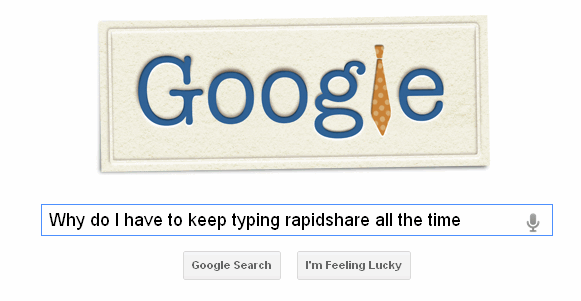
By making people type "RapidShare" out manually, has Google really stopped piracy?

So it was either a well calculated thing, timing wise, or an extraordinarily poor one, that Google this week announced that they’re winning the war against piracy. Unfortunately missing the “Mission Accomplished” banners aboard an aircraft carrier stage, Google nevertheless delivered a report on their progress on their various anti-piracy tools, processes and features, all designed to help content holders feel a little more safer at night, and a little less litigious during the day. I don’t know if the number of acts of piracy that removing the keywords “rapidshare” from Google’s auto-suggest and auto-complete function is even quantifiable, but Google seems to think it’s helped. And they’ve now made it possible for content owners to request and have removed infringing content within 24 hours, in which time Google’s lawyers have to fully examine each DMCA takedown request, do the relevant background research, contact the relevant technical departments to implement the ban, all the while filing the appropriate paperwork to record the entire incident to allow for future appeals. I’m imagining some kind of poultry factory farming scenario with chickens replaced by lawyers, and feed replaced by a conveyor belt of  money (well, they are still lawyers), and the produce being the “In response to a complaint we received under the US Digital Millennium Copyright Act, we have removed 1 result(s) from this page. If you wish, you may read the DMCA complaint that caused the removal(s) at ChillingEffects.org.” message you see now and then below Google search results. The next step for Google, as hard as it may be, would be to actually prevent themselves from profiting from piracy websites. If they can do this, maybe they will then get a nice and shiny badge from the MPAA and RIAA for all their efforts, even if it may not actually stop any lawsuits or anything (but the lawyer factory farm would definitely pay for itself if that happens).

From willing self-harm, to full on murder, we move onto the news that Hotfile has been ordered to hand over pretty much everything in their possession to the MPAA, to presumably help them build a stronger case against the file hosting website. Hotfile described this early on as “murder by litigations”, and when the MPAA asked the Judge whether it was okay to do it to Hotfile, the judge this week basically said “alright”. And so, Hotfile will now have to hand over the IP address of every uploader and downloader, even for files that are perfectly legal and for users outside of the jurisdiction of the court. And as if injury wasn’t enough, insult had to be added, as Hotfile will also have to hand over a bunch of financial information. It appears though that the MPAA isn’t really that interested in suing individuals, although the very top affiliate probably should start seeking legal advice, but for other uploaders and downloaders, they’re only requested the 3 of the 4 sets of decimal numbers, or enough to identify the country of origin only (I suppose jurisdiction does become an issue after all). Not attempting to win understatement of the year award or anything, but things aren’t looking good for Hotfile.

BayFiles

Pirated downloads will definitely exist on BayFiles, even if they follow the law to the letter as promised

But while one file hosting company may be on the way down, another is only just getting started, and it has a pair of famous founders. The names of Peter Sunde and Fredrik Neij might sound familiar, and it’s because they’re two of the co-founders of The Pirate Bay. And together, they’ve launched BayFiles, a new file hosting service that will compete with the likes of RapidShare, and for now at least, Hotfile. Just what the music industry and Hollywood needs, another TPB production, and now an even easier way to upload files and share them with others. But they needn’t be too worried, at least no more worried than they are towards the likes of RapidShare. So still very much worried I suppose. BayFiles will comply fully with the DMCA, and will be as legit as any file hosting service can be, removing files and banning accounts when requested to do so, but not before. And that’s the crux of the issue though, is that the content holders want websites like BayFiles to do the “search and destroy”, while websites like BayFiles, who are mostly more than happy to ‘destroy’, want content holders to at least do the ‘search’ (as they’re really the only ones who know, with absolute certainty, what we are searching for in the first place). But any S&D operations performed by BayFiles, and staying in the vernacular for now, will have a high chance of  “collateral damage”, blocking and removing perfectly innocent files just because it was named wrong, or had the wrong bits and bytes in it (to be fair, if you’re really going to go and name a ZIP file containing your work related spreadsheet as “rise_of_the_planet_of_the_apes_dvd_screener.zip”, then perhaps you need more help than a file hosting service can provide, or you really do want to get fired, and are working towards this noble goal by implementing your own reverse boss button). And if services like BayFiles do not exist, then it’s back to the days of spending half an hour sending an 8MB attachment only to get a rejection notice because the recipient is blocking the type of attachment, the size of the attachment, or has a full inbox, and then you get mad and smash your monitor with your keyboard, and gets fired immediately on the spot and has to have security escort you out of the building, after which you go to the nearest bar, gets drunk as a skunk, passes out on the sidewalk outside of your former employer’s building, only to wake up the next day, in your urine stained work clothes, as your former co-workers pass you by on their way to work and look at you with both pity and disgust – you check your phone and there are dozens of text messages from your wife, with the last one saying “I’ve had enough, I’m leaving and taking the kids”. All of this because of the MPAA/RIAA.

Speaking of urine stains (never really thought I would ever write this phrase in the WNR), Wikileaks (heh, leaks) has served up yet another delicious piece of Australian info, regarding the Australian Federation Against Copyright Theft’s (AFACT) lawsuit against Australia’s third largest ISP, iiNet. I say Australia, but I really mean America, because it turns out, surprise surprise, the MPAA was the brains behind the lawsuit, even though I had simply just assumed that to be the case anyway in my past reporting without any actual evidence or sources (journalist see, journalist do, journalist no have time for background checking). Anyway, it turns out I was right after all, and leaked US Embassy cables show not only did the MPAA run the show, they also wanted nobody else to know it was them running the show, except if I “knew”, then I gather everybody else “knew” as well. So it wasn’t so much the Australian Federation Against Copyright Theft as it was Americans Forcing Australians into a Court Trial (it’s the best I can do with my severely mushy brain today, as I was sure there’s a better word starting with ‘F’ I could use here). The cables also revealed that the MPAFACT didn’t want to sue our largest ISP, that would be the evil behemoth of a corporation known as Telstra (aka Helstra, Tel$ra, a***holes – note the three asterisks, for we here in Australia use the more civilized British form of English, you jumper wearing, lift using, petrol guzzling lorry driving barbarians), because Telstra was a company willing to “fight hard and dirty, in court and out” – touche.

And now for something completely different. Valve’s Gabe Newell is no fan of DRM, except when his company uses it, and he’s once again attacking other companies for taking DRM far too seriously. It seems a curious trends that famous gaming people, most of them work for companies that have a great track record for delivering excellent games, are all not too fussed about DRM, and yet the companies that are well know for coming out with disappointing release after release are the ones hell bent on making the paying customer’s experience as painful as possible all in the name of fighting piracy (I’m excusing Blizzard from the list, even though they’re messing around with “always on DRM” for Diablo III, as they say they’re not doing it for anti-piracy, just for anti-cheating). And while pointing out that Valve’s Steam platform is practically one big DRM engine that locks gamers to the Steam platform, forces users to wait ages to download game updates before playing, allows publishers to use their own DRM on top of Steam’s DRM, and all sorts of nasty DRM like symptoms, you still have to say that gamers, generally, still like the Steam platform. Getting the ‘Steam’ out of a game is not easy if there are no official non-Steam versions of the game, but otherwise, it’s not intrusive DRM on the level of SecuRom or UbiDRM. And while the Steam platform, as with any platform really, is a pain to have to be locked to, there are other benefits such as in pricing (Steam sales are awesome. AWE$OME!!), achievements for games that support it, in-game browsing for those that, like me, prefers to cheat our way to gaming success via walkthoughs, the newly added screenshot taking thingy, and lots of other cool features. You either hate it, or you learn to live with it and eventually love it, but at least some do love it, unlike the totally unnecessary UbiDRM (yes, Ubisoft do provide an enhanced online experience with features that some may like, such as online game saves, and these feature do need an Internet connection – but for every single second of play? It’s like one of those competitions where you can win a car if you’re the last person to take your hands off of it, except here, your “prize” is the ability to play the game you purchased with your hard earned money). But basically what Newell is saying is that as long as gamers are happy, you can get away with a lot of DRM-like stuff, and you know, that’s fair enough.

High Definition

In HD/3D news, oh George, what have you done again. Mr. Tweak It is at it again, and the new Blu-ray version of the Star Wars trilogy (and the crappy prequels), will be different again to the DVD version, which is different to the Special Edition VHS, which is different to the original theatrical release.

You know you’re an a*** when you’ve got an entire Wikipedia page devoted to the thoughtless changes you’ve made to your own film, and but I guess critics of fanboys like myself do have a point in that it is “his film”, after all. Actually no, they’re not right. It’s not his film, no more than Citizen Kane was Orson Welles’ film, no more than the Statue of David belonging solely to Michelangelo. Film is a shared medium, and our combined experiences when viewing essential the same piece of content is what makes it one of the greatest icons of the 20th century. It would be like if Leonardo Da Vinci rose up from the dead and started making changes to the Mona Lisa! The civilized world would be outraged if that were to happen, also slightly frightened by the sight of a zombie Renaissance Man, and slightly confused wondering why he hasn’t decomposed completely by now.

Vader Nooooo!!!

Lord Vader's reaction when he heard that Lucas was messing around with the original trilogy again

So when, in the last WNR, I mentioned that George Lucas would change creepy puppet Yoda in Episode I to the slightly comical digital version used in Episode II and III, I didn’t really give a crap because, I mean, it’s Episode I. Nobody cares about the prequels, and Mr. Lucas should feel free to chop and change all he wants – maybe he will eventually make the worst movies ever made watchable. But if you go and change Return of the Jedi, and not only that, but probably the most important scene in the entire film universe, by mirroring a line of “dialogue” taken from one of the worst scenes in the entire Star Wars film universe, and already the butt of a many Internet jokes, then you’ve officially gone over to the dark side and nothing, not even adding “No” in post-production, can redeem you. This is the changed scene by the way, so for those that are curious, but don’t want to buy the expensively priced Blu-ray set to find out how disappointed they should be.

Look, some will say the reaction to the change is an overreaction, and they may be right. But why change, what for me, was a perfect scene. The pleading of the son, the true evilness of the master unmasked, and the silent, determined, change of heart from the father, from the dark side back to the light. Perfect. Vader does not need dialogue to make it clear what was going through his mind, why he was doing what he was doing, and the silence actually enhances the scene. Well, not any more. In the words of Simon Pegg, what a f**king shame.

GamingAnd finally in gaming, Sony is taking advantage of the recent PS3 price cut by doing some rebranding, and distancing themselves from the whole PSN fiasco. Nothing too drastic, but it seems the arrogant and slightly misleading (from a class action lawsuit perspective) “It Only Does Everything” has been changed to “Long Live Play”, and the awkward and curiously name Qriocity service has been renamed Music Unlimited, and along with the PSN, now all fall under the Sony Entertainment Network banner, along with Movie Unlimited for, um, movies. Only the PSN doesn’t follow the naming convention, yet, so don’t be surprised if it’s renamed Gaming Unlimited at some point, although not now because it would be far too obvious a PR exercise right now.

For the slogan change, it’s good Sony are trying to move way from the previously, highly arrogant and, plainly false one from before. But a cheetah doesn’t change its spots overnight, not if the leopard has anything to say about it, and another Sony exec has been caught calling the Xbox 360 “inferior technology”, and accusing Microsoft of using developer requirements to protect the aforementioned inferior technology. The Sony exec was responding to a Microsoft exec saying how multi-platform titles were usually better on the Xbox 360 because of Xbox Live and DLC exclusives. Both have their points, but Microsoft’s console was not the “inferior technology” that has had to drop prices recently just so it can stop being third in a three way race.

Wow, that was a bit longer, and more caustic, than I thought it would be. On some days, you get into this groove when writing, and you know what, it’s fun to just go along with it, enjoy it, until the very real threat of defamation lawsuits pull you back a bit. This was one of those days.

See you next week.

Weekly News Roundup (28 August 2011)

August 28th, 2011

Welcome to another edition of the WNR. Hope you’ve had a good week. There are finally a couple of interesting news items to talk about this week, not enough to make up for the last two week’s lull though. As much as I don’t like the RIAA and MPAA, and the mass copyright law firms,  they do provide a lot of news. Without them, there would be hardly any news to write about, for that, I’m grateful.

CopyrightSo let’s start this week’s RIAA hate with the story that, one of the four major backers of the RIAA, EMI,  “lost” their lawsuit again cloud hosting website MP3tunes, although they could still end up the winners.

While the judge ruled in MP3tunes favour, allowing the website’s business model to continue, the judge still found MP3tunes and its founder guilty of several more specific cases of copyright infringement, mostly relating to MP3tunes’ sideload.com website, which allows music found on the net to be loaded into people’s cloud accounts without doing the manual download and upload routine (so a sideload, basically). MP3tunes had in its favour a strong policy against copyright infringement, and they mostly responded to DMCA takedown requests and acted promptly. And this allowed them to call on DMCA’s “safe harbor” provisions. It’s actually a good lesson for web businesses these days to take DMCA requests seriously, because in this case, the judge basically ruled that due to the existence of the DMCA and “safe harbor”, the responsibility for identifying infringing content falls to content owners, not the website operator. And this makes sense, because only the owner can identify their own “goods”, and only they can decide whether there’s need to pursue a course of action.

sideload.com

Sideload.com was sued by EMI as part of the MP3tunes lawsuit, and the judge found copyright infringement had occurred in some cases

And this is an important decision, because recent judgements, and mooted government legislation, have more frequently identified website operators, your Googles, YouTubes and Megauploads, as being responsible for having some kind of passive anti-piracy system, to remove offending content even without the content owner’s intervention. This is  of course something content owners would want, because it means less work. But such a system would always be “false positive” heavy (there’s no way websites can know if you actually did have permission to upload the content or not), and there are also privacy issues (for example, if you uploaded a ZIP file to Megaupload, do they have permission to unzip and read your files to check for copyright infringement?), and self-censorship is a dangerous road to take. This decision is also a confirmation that the cloud hosting business model can work, but only if copyright protection is taken seriously by the cloud host.

Where MP3tunes lost was that some of the anti-piracy actions weren’t strong enough, for example, removing links on sideload.com for infringing content, but not actually removing the already “sideloaded” versions of the same songs from people’s cloud accounts. The founder of MP3tunes had also sideloaded some infringing songs, the judge found, and that could mean that EMI could still yet receive a good sized damages amount.

While EMI was busy losing one lawsuit, they, and the other three majors, were busy suing others. The four majors, and 25 other labels, have decided to sue TubeFire, a website that allows people to download YouTube videos.

If you’re first reaction is like mine, then it would be something like “what?”. YouTube download services have existed almost as long as YouTube, and there are so many out there that I don’t think anyone even considered them to be a source of piracy. I mean, when you upload something to YouTube, you kind of expect people to view it, for free, so why does Universal, EMI, Sony, Warner think TubeFire deserve to be sued? Apparently, people are downloading officially uploaded music videos and, I don’t know, viewing them or something, and that has angered the four major labels, and 25 other labels that are also part of the suit. It’s probably because their music video sales on iTunes has been affected or something – if they’re that concerned, then don’t (officially) upload to YouTube.

And since YouTube doesn’t have any serious DRM that prevents “downloading”, is it really illegal? Also, while downloading copyrighted YouTube video does occur, what about all the legal uses where people download non copyrighted video, or download for delayed “offline” viewing, a sort of time shifting if you will? And why TubeFire, and not the dozens of other websites and download tools? And what about browsers, who also “download” the video before it plays, the only difference is that they don’t allow people to keep the “download” beyond the current browser session? It is, in my opinion, a ridiculous lawsuit, especially when a lot of these online video download services do nothing more than a URL rewrite, with the download actually occurring from the original location (because even online video needs a “source” file, and a lot of download tools simply allow people to download this source file – so in effect, it’s the online video site that’s offering the download).

And the whole idea behind a music video is to promote music sales (do people buy a lot of music videos?), so does it really matter if people are downloading or streaming the videos, from a promotional perspective? Free creates hype, and that’s really an immeasurable benefit, but hugely important these days.

Fox content on Hulu

Fox content on Hulu (free) will be delayed by 8 days, and this has caused piracy to surge for Fox shows

Which is why Fox’s withdraw from the free edition of Hulu is surprisingly, to say the least. Hulu was created to offer free catch-up content, usually delayed just a single day after the original airing, to both help fuel Internet hype for shows, and to compete with pirated downloads of the same shows. Instead of people downloading pirated shows in the hundreds of thousands, people can instead go to Hulu to enjoy a totally legal alternative, and most are more than happy to put up with the ads, which then allows revenue to flow back to the networks. It’s a win-win situation, which is why Fox’s decision to delay free airings on Hulu to 8 days, instead of one, seems to be me like a self inflicted wound. For one, nobody would bother with a 8 day delayed airing – it might as well be 8 months in today’s “instant” culture. People will just find alternatives, and piracy being the prime choice. TorrentFreak wanted to test this theory, that Hulu prevents piracy, and conversely, no Hulu can cause piracy, and it seems they’ve found a correlation. Of two Fox shows (Hell’s Kitchen and MasterChef), pirated downloads on BitTorrent networks increased by 114% and 189% respectively compared to before the Fox Hulu change. So instead of earning ad revenue for Hulu airings, Fox has simply “forced” users to migrate back to BitTorrent.

Fox says they’re doing it because they want to promote certain cable services that bundle Fox shows with paid for Hulu accounts that still allows users to get access to Fox shows in a timely manner. But to me, this seems like a short sighted move for a quick hit of sponsorship money, and for all the things that “promote” piracy, actions (or inactions) of content owners probably has the biggest effect. It’s like the Netflix price rises, and what the lady says at the end of this video. People don’t want to pirate stuff if they have a legal alternative, but if you take away that alternative, well …

So, on to copyright law firms. The US Copyright Group has sued a deceased for piracy of the film “The Hurt Locker”. To be fair, the USCG are only the intermediaries, the real blame goes to the producers of “The Hurt Locker”. And to be fair again, the dead seemed like the next logical target, after the blind, and then the elderly, were both sued for download porn videos. If only zombies could be sued (and if they were real). High profile mistakes aside, who knows how many other mistaken lawsuits have been filed, which is always likely to be the case with such a scatter-gun approach to lawsuits. I mean, when your only piece of real evidence is a set of numbers (the IP address), which only at best gives you the subscriber account, and not the name of the actual person that made the download, then that’s not really evidence in my opinion. And for the argument that people should be held responsible for their own Internet connections, including securing it against unauthorised usage, that would be like saying if you forgot to lock your car and somebody used it to commit a crime, you would be held responsible.

The USCG’s other big client, Nu Image, producers of ‘The Expendables’, has made a drastic change in their suing strategy as well. They’ve dropped all remaining defendants from ‘The Expendables’ lawsuit, but before we celebrate a major victory against mass copyright lawsuits, Nu Image are not finished yet with suing ‘The Expendables’ downloaders. Instead of clumping all defendants in a single case and then getting the bulk of it thrown out for jurisdiction issues, Nu Image plan to re-file numerous smaller lawsuit in different locations, and thus avoid the jurisdiction issue. And not only that, they’re going to file lawsuits for downloaders of more of their films, including ‘Drive Angry’, ‘The Mechanic’ and the still-in-theaters ‘Conan the Barbarian’. You know, if Nu Image spent more time actually producing “good” films, perhaps they might not need to spend so much time and money on suing downloads. Just a thought.

High Definition

In Blu-ray/3D news, Star Wars is going to be available on Blu-ray soon, and the first Star Wars release is a big event for any video format.

Star Wars on Blu-ray

Star Wars getting released for the first time on any new video format is a big deal

But with every new release of Star Wars, there’s always the threat that George Lucas might do more “tweaking” to the Star Wars films, especially the original trilogy (the prequel trilogy, nobody really cares about). So when Lucas hinted that there would be new stuff on the Blu-ray release, fans got, understandably, a bad feeling about it all. An all digital Yoda is probably coming for Episode I, but imagine the outcry if the puppet Yoda in the original trilogy was replaced with a digital one (for consistency, you see)? Not even Lucas would dare to do that of course, but this is the Internet, this is Star Wars, and so there will be hysteria at any and all rumours. To be fair, the puppet Yoda in Episode I looked weird and out of place, so a digital Yoda in that film (and that film only) is welcomed. There are also other improvements, for example, you get to see more of Episode I due to better transfer techniques that allows more of the picture to be shown on the screen (yeah, more Episode I, that’s what fans want!). Lucas also continues to “rewrite history” by removing special effects mistakes in the original trilogy, including the infamous Wampa puppeteer arm in Empire. While some fans would welcome the removal of obvious mistakes, some others are happy with the originals the way they are (even the pre-Special Edition editions, which I was hoping would be included on the Blu-ray), while most simply don’t mind either way, probably.

Is DVD on the way out? Well, it’s definitely not on the way in. A new study seems to suggest it is, but it was only really looking at portable DVD players, which the research say is being replaced by video capable smartphones and tablets. Common sense really, the same reason people no longer carry their portable electronic Sudoku player, their MP3 player, their PDA, and their pig destroying avian targeting contraptions.

As for the future of the DVD format? Every Blu-ray player is also a DVD player, so I think it will be around for a while yet.

Not much in gaming, so skipping …

And that brings us to the end of this WNR. Have a good one.

Weekly News Roundup (21 August 2011)

August 21st, 2011

Another relatively quiet week, but I did manage to get the NPD analysis done, for July 2011 sales, and you can view it here. Sorry for the lack of news, but I and the others that contribute news can only write about what’s there, and there wasn’t much there this week.

CopyrightBut quantity isn’t everything, so let’s start with some interesting copyright news. In the MPAA’s eyes, anyone that says anything positive about online piracy is as guilty as those that download movies, steal cars and shoplift stuff.

And even when they’re not being positive about piracy, but merely pointing out the observation that, given the current economic conditions, piracy may become a more socially acceptable activity, the MPAA has to go into full attack mode and silence anyone, this time, it’s GigaOM’s co-editor Janko Roettgers, that dares to present the idea that a lot people who pirate movies are just ordinary citizens. For you see, the MPAA has to portray pirates as “scum”, people that are not like good, decent, voting folks, first to portray web piracy as a serious crime that needs the government and industry’s full attention, and also to ensure the politicians they’re financially lubricating are not scared into passing laws that may affect a huge percentage of their electorate.

Download a Car

If you could download a car, there would be no more car thefts

The problem for the MPAA though is that, they’ve made similar observations in the past, including by their former boss, Dan Glickman, who correctly noted that “the current economic crisis makes this problem [piracy] much more serious than before” a couple of years ago. This time, the MPAA published an opposing piece, also on GigaOM (which came under some criticism for allowing the MPAA to do this, but it’s free speech, and it should be allowed, no matter how much we disagree with the opinion presented). But once again, we have the MPAA’s (represented by Alex Swartsel) comparing web piracy to shoplifting. But as I explained in the forum, web piracy and shoplifting cannot really be compared at all. Shoplifting means a physical loss for the store owners, as well as a potential lost sales, but not from the shoplifter, but from not being able to sell the item that is no longer there. For digital piracy, there is no such “loss” for the “store owner”, as pirates are only taking away a copy of the item that’s on sale, not the actual item itself. The only potential loss is in lost sales, but only if the pirate would have purchased the item anyway (you know, that old argument). Stores in London are complaining about their goods being looted, but I’m sure they’re not worried about the same looters not coming back to the stores and not buying their stuff because they’ve managed to get it for free.

And many of the actual lost sales from piracy are mainly because the consumer is unable to obtain the item, either in a timely manner, or in the format they want. DRM and release windows have seriously hampered the ability of the average consumer to purchase and enjoy content. And this is a point that the CEO of one of the New Zealand’s largest ISPs, TelstraClear, is pointing out. Allan Freeth goes one step further and actually attacks any laws protecting rights owners as legislation that artificially props up their business model, one that is obviously not working as well as before, if not failing completely. Freeth even cites surveys that TelstraClear conducted, asking its users why they pirate stuff, and one answer that kept on coming up was that people often had to wait days, weeks and even months to watch the same content people in the US already had access to (and then free access online via catch-up services like Hulu). This is something that I can sympathize with, living in Australia, where we’re also treated badly in terms of release Windows. Even the “fast tracked” shows are often a week or two behind the US airing schedule, and in this day and age of “instant”, that might as well be an eternity. Freeth also said that pricing as an issue, and if people can’t afford to consume your content, then don’t blame them for seeking free alternatives.

There was a development in the Viacom-v-YouTube lawsuit this week as well, as one of the major partners of Viacom in this case has withdrawn from it, after agreeing to a private settlement with YouTube owner Google. The National Music Publishers’ Association (NMPA) will no longer be part of the Viacom appeal, and Google in return, will allow music publishers (those that help song writers publish their works, as opposed to recording studios that publish recordings of these same works) to participate in their revenue sharing program, something the NMPA cites wasn’t possible before. It’s a win for Google, and it signals problems for the Viacom appeal, especially if they continue to lose partners this way.

And in DRM news, Ubisoft has backtracked and now promises not to implement “always-on DRM” in their upcoming game, Driver: San Francisco. This is only weeks after Ubisoft claimed “always-on DRM” was a huge success, despite the measure only hurting paying gamers that get their game cut off if their Internet connection decides to flake out a bit (which is an unavoidable phenomenon). I guess it wasn’t such a big success after all, or at least not enough of a success for Ubisoft to justify the lost sales from the huge public backlash. But while always-on is not longer an requirement for the latest game in the Driver series, online authentication at game launch is still very much on the cards. I’m not a huge fan of any DRM, but authenticate at launch is fine by me, as long as there’s a true offline mode (but this doesn’t seem to be the case for Driver).

Not much news in 3D/HD, so let’s skip it and move quickly onto …

Gaming

… gaming. And the big story of the week was Sony announcing a price cut for the PS3. It’s only $50, but this could be a significant factor in sales over the coming months, leading up to Christmas. And this is probably the right move at the right time, because as you can see in my NPD analysis, the PS3 is now in a distant third place amongst the home based consoles in the US at least.

PS3 Price Cut

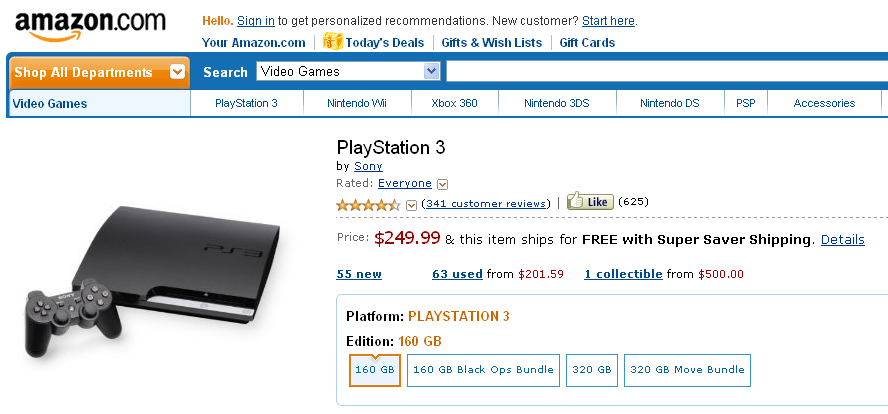
The PS3 price cut has already helped PS3 sales on Amazon increase by more than 400%

The price cut seems to be happening elsewhere in the world as well, where it has to be said that the PS3 isn’t doing too badly at all. Australia sees one of the bigger price cuts, $AUD 150, which is about $USD 145, but even with this huge cut, our PS3 is still more expensive than the US PS3 (so you can imagine how overpriced it used to be). Still, I’ve seen some stores starting to sell the 160GB version for just under $300, which is better, but still $60 more than the US pricing.

And that brings us to the end of yet another very short WNR. But it means I’ve allowed you to have more time to do other things, so really, you should be grateful. See you in 7.

Game Consoles – July 2011 NPD Sales Figure Analysis

August 17th, 2011

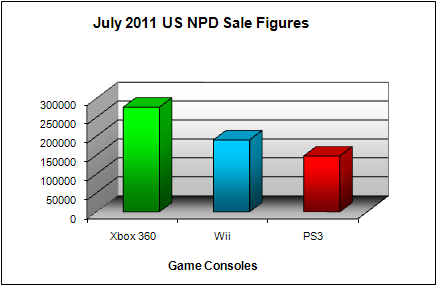
Welcome to the July 2011 edition of the NPD US video game sales analysis. For July, only Microsoft provided actual figures for hardware sales, stating 277,000 units of the Xbox 360 was sold, and that their console accounted for 45% of the home based console market share. Later on, Wedbush Securities analyst Michael Pachter revealed that Wii sales had dropped 25% compared to the same month last year. With these three facts, we can then deduce the PS3 sales figures, for which Sony has yet again remained silent on. For those that are new to this, this analysis looks at US video games sales figures compiled by NPD, unreleased by NPD due to pressure from the gaming companies, but then leaked by various sources, including gaming companies, if/when it suits them.

The figures for US sales in July 2011 are below, ranked in order of number of sales (July 2010 figures also shown, including percentage change):

  • Xbox 360: 277,000 (Total: 28.1 million; July 2010: 443,500 – down 38%)
  • Wii: 190,500 (non official estimate) (Total: 36.1 million; July 2010: 253,900 – down 25%)
  • PS3: 148,000 (non official estimate) (Total: 17.3 million; July 2010: 214,500 – down 31%)
NPD July 2011 Game Console US Sales Figures

NPD July 2011 Game Console US Sales Figures

NPD Game Console Total US Sales Figures (as of July 2011)

NPD Game Console Total US Sales Figures (as of July 2011)

My prediction from last month was:

I think the Xbox 360 will experience its first year-on-year decline in ages, but still comfortably stay at the top of the home based console hardware sales charts, leaving the Wii and PS3 to fight it out for second and third place, and I think the Wii might be better positioned to win for some reason. It’s NCAA Football season again, so it will be the top seller, but otherwise, not a huge month for games again.

An almost perfect prediction, a rare event indeed. The Xbox 360 did experience its first major year-on-year decline, and it actually was the biggest fall out of the three home based consoles, but despite this, it still managed to comfortably be the best selling home console for July 2011, which is on record as the worst performing month since October 2006. And as I had predicted, the Wii won the fight against the PS3 for second place, but in full honestly, both of these consoles performed horribly, adding to the misery that is July. And new hit games were far a few between in July, and so game sales slumped as well.

As expected, the Xbox 360 saw its first major year-on-year decline since 2009 (I think). It is expected because this time last year, the new Xbox 360 “Slim” had just been released, and the sales surge from this event actually managed to give the console a 119% lift in sales compared to July 2009. So obviously, with no new consoles in July 2011, year-on-year sales dropped as a result, and I suspect this will continue for a few more month. The Xbox 360 was still the best selling home based console, with a massive 45% of the home based console market share for July – that it sold almost twice as many units as the PS3 is testament to its growing dominance.

Despite a price drop, the Wii languished in a distant second place, dropping 25% in sales from the same month last year (which was even compared to July 2009). There’s not much positive things one can say about the Wii, and coupled with alarmingly decreasing DS/3DS sales (prompting Nintendo to drop prices on the 3Ds only a couple of month after release), Nintendo will hope there are no delays to the release plans of the Wii U.

As for the PS3, this appears to be the worst month since July 2009, with a 30% sales drop compared to last year. And unlike the Xbox 360, the PS3 really has no excuses. There’s still growth between 2009 and 2011 (of around 20.5%, compared to the Xbox 360’s 36.5%), but this is comparing the pre-Slim and pre-price cut PS3, with the current one. Which is probably why Sony has just announced a price cut for the PS3, which should allow sales to surge a bit.

So overall a pretty bad month for video games, but with the economy the way it is and with most of the consoles many years into its release cycle, it’s probably not unexpected. For games, it’s been a quiet month as well, with NCAA Football dominating as it usually does at this time of the year. Just Dance 2 for the Wii continues to show off its staying power in the top 10, this time coming 5th. Here’s the full software sales chart for July:

  1. NCAA Football (Take 2, Xbox 360, PS3)
  2. Cars 2 (Disney, NDS, Wii, Xbox 360, PS3, PC)
  3. Call of Duty: Black Ops (Activision Blizzard, Xbox 360, PS3, Wii, NDS,PC)
  4. Lego Pirates of the Caribbean (Disney, Wii, Xbox 360, NDS, PS3, 3DS, PSP, PC)
  5. Just Dance 2 (Ubisoft, Wii)
  6. Major League Baseball 2K11 (Take 2, Xbox 360, Wii, NDS, PS3, PS2, PSP, PC)
  7. Zumba Fitness (Majesco, Wii, Xbox 360, PS3)
  8. Fallout: New Vegas (Bethesda, Wii, Xbox 360, PS3)
  9. New Super Mario Bros. (Nintendo, NDS)
  10. Mortal Kombat (Warner Bros., Xbox 360, PS3)

Prediction time. With the PS3 price drop coming in just a few days ago, this is just the sort of major event that makes predictions extremely difficult. There’s no doubt in my mind that the PS3 won’t come last again (Wii has the third spot amongst the home based consoles locked up), but the main question is can the PS3 outsell the Xbox 360? The price cut being only $50, and with no new console coming with the price cut like two years ago, maybe it will just come short, but it will be a close run race that’s for sure. For games, again, there’s nothing really of note. Usually at this time of the year, Madden NFL dominates, but with the Madden NFL 12 coming at the end of August, it may not have enough time to make such a major impact this time, although it will probably still be the best seller based on pre-orders alone. No More Heroes: Heroes’ Paradise for the PS3 and Deus Ex: Human Revolution seems to be the only two other notable releases in August.

See you next month.


About Digital Digest | Help | Privacy | Submissions | Sitemap

© Copyright 1999-2012 Digital Digest. Duplication of links or content is strictly prohibited.