Weekly News Roundup (9 October 2011)

October 9th, 2011

ImgBurn 2.5.6.0

ImgBurn 2.5.6.0 has just been released

A pretty quiet week in terms of news, with one big news story. I am of course talking about the premature death of Steve Jobs. But since then, on almost every web forum that I visit, there has been discussions on the reactions to his death. For me, Jobs was a brilliant business man that shaped the many industries he was part of – you can say that he didn’t invent digital music players, smart-phones or tablets, but you can’t deny that he made them devices that everyone wanted, which is perhaps the hardest task of all. And that’s why he will be a great loss to the IT and consumer electronic industries.

As for other news, as mentioned earlier, it was a pretty quiet week. I want to mention that a new version of the ever useful ImgBurn software has been released this week as well (and you can download the latest version here). Digital Digest helps to host the official website and download links for ImgBurn, and combined with some networking issues (which has just been resolved, thanks to a concerted effort by me and the tech support team at my web host, SoftLayer), there might have been some interruptions to parts of our website in the last few days, and so I would like to apologise for any inconveniences caused. It’s all good now though, so let’s get started with the WNR.

Copyright

And as usual, we start with copyright news. In fact, copyright news is all we have this week actually, so this will be a pretty short WNR. We start with possibly good news for those “named” in the original ‘The Hurt Locker’ mass copyright lawsuit, as more than 22,000 defendants has been voluntarily dismissed by the people behind the lawsuit, the producer of the film, Voltage Pictures (represented by everyone’s favourite law firm, the US Copyright Group).

Of course, many of the 22,000 might have already paid up to settle the case, and so perhaps, it’s not such great news, or even news. Unfortunately, more than 2,300 IP addresses, and some named defendants, are still part of the lawsuit. I don’t even like to use the term “defendant”, because an IP address is not enough to link a person to the alleged crime. But until the legal establishment clue up to just how the Internet works, and the copyright lobby continue to mislead those in charge about the technical aspects of copyright infringement, we’ll just have to put up with the likes of Voltage and USCG.
Kill the Irishman - Movie Poster

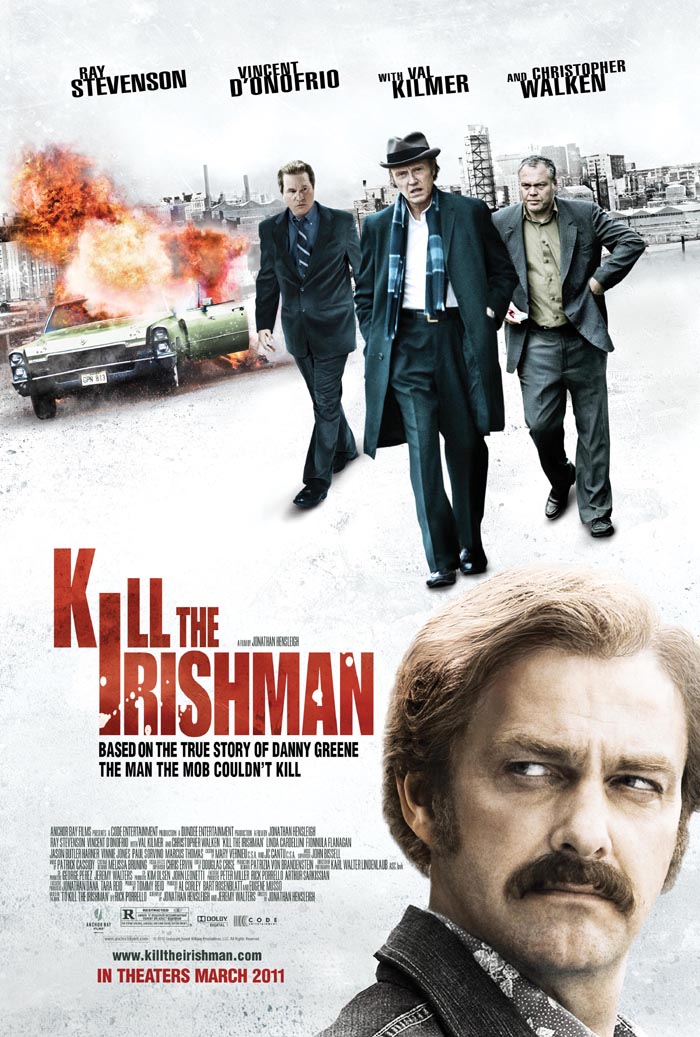
An Australian firm is following the footsteps of firms in the UK and US by using downloaders of the film 'Kill the Irishman'

Even those not in the United States, it seems. The big news here in Australia this week was that mass copyright lawsuits have reached their way down under, and up to 9,000 IP addresses have been found to have downloaded the film, ‘Kill the Irishman’. The firm Movie Rights Group (MRG) is Australia’s answer to the USCG, and they are pursuing the case for the producers of the film, and have already contacted ISPs to get the contact details of subscribers. But MRG appears to want to do things a bit different, have deliberately avoided including IP addresses in the lawsuit that appears to be from public Wi-Fi networks, or basically anything that could cause them trouble in court, and that’s probably a smart move (Righthaven take note). I don’t think we have a statutory damages system in Australia for copyright infringement, and so MRG will have to be a bit creative with their warnings of just how much people could be fined if they do not settle the case by paying the required settlement fee. And MRG will have to be careful, as the judges here aren’t always as friendly to the copyright lobby as judges in the US, not that I think MRG will even try to take a single case to court anyway (not really worth the risk or the financial expenditure, again, Righthaven take note). Unfortunately, ISPs here seem to be more than willing to pass on user details, and I think the verdict from the AFACT vs iiNet trial might be influencing their decision here – a trial that ISP iiNet won, but there were enough decisions in there to allow MRG’s operation to move forward.

Now, some have already questioned the motives of firms like the USCG and MRG, in that many believe they don’t really care about stopping piracy, and that their operations are nothing more than ones designed to generate revenue. But even if their motives are purely about stopping piracy, is piracy a big enough problem to warrant such a response? And would you not expect film distributors Miramax would be the first to argue that, yes, piracy is indeed the biggest problem facing the film industry. But apparently, that’s not so, says Miramax CEO Mike Lang. Instead, Lang says, in a keynote discussion session at the MIPCOM conference with Netflix’s content officer Ted Sarandos, that market monopolies, such as the one that Apple enjoys in the the music business, is the biggest danger. One might say that Netflix is quickly developing a monopoly of their own, if they don’t have one already, but Lang does point out that Miramax made deals with both Netflix and Hulu, in the hope that increased competition would help prevent an Apple iTunes like monopoly forming for the movie industry as well. On the issue of piracy, both men agreed that, it’s not as big an issue as others in Hollywood believes (or wants others to believe). Both men identified innovation, or the lack of it, as one of the driving factors behind web piracy, and that increased innovation should help fight the piracy problem. Sarandos interestingly noted that most people don’t actually want to pirate content (except for maybe college students, he joked), and that they’ve been, in some ways, forced to do so due to the industry not being able to respond to their needs quickly enough. If there’s prove of wisdom in Sarandos’ words, then all you have to do is to look at the growing strength of Netflix to see that, if there is a legitimate service at a good price, people will pay that price.

But it appears that the only real innovations that Hollywood has come up recently has been one form of DRM or another, or great services crippled by DRM. And new research show that the use of DRM could actually increase piracy rates. Professors from Rice and Duke University have released a paper arguing that if content holders stopped using DRM, this will actually lead to a drop in piracy rates. This might seem counter-intuitive, but as I’ve spoken about many times before in the WNR, DRM only really affects paying customers, since other than the selected few hackers that have to deal with it and try to remove it, the majority of the pirating population never have to even think about DRM (and many paying customers also resort to piracy so they don’t have to think about DRM as well). And so you have a technology that doesn’t work to stop piracy, and only affects paying customers, and this makes pirated products more attractive than legitimate buys, and how does this not help to increase the popularity piracy? The marketing professors also noted, from their own research, that decreasing piracy does always lead to increased revenue, and that in some cases, the reverse is true – lower piracy equals lower sales! Again, this doesn’t surprise me, because piracy allows people to test products and content before they buy, and while many won’t bother to pay for it, some will, and will do it with confidence.

So if DRM may actually cause piracy, why not ban it? Which is what the European Greens and the European Free Alliance, of which the Pirate Party is a member of, thinks should be done in Europe. The Greens have released a new position paper on copyright reform, and in it, they call for the ban of DRM. Their argument is slightly different to that of the University professors’, in that the Greens believe that DRM allows corporations to overrule existing copyright laws, especially in the area of fair use, and that is a threat to government wishing to provide a fair and balanced copyright platform. But the most interesting change the Greens have proposed is the complete legalisation of file sharing of copyrighted content, but only if the file sharing is personal,non commercial. Basically, if the Greens’ proposal becomes law, it would be legal to download music, movies and games from file sharing networks such as BitTorrent, as long as money did not exchange hands. Yeah, I can just see the RIAA, MPAA embracing these changes. The fact is that tougher copyright laws have not worked to stop piracy, and it has only allowed the likes of the USCG and MRG to take advantage, sucking money out of both consumers and the creative industries, while piracy continues to climb. As the Greens see it, the only way to solve the piracy problem is to increase competition, force content holders to compete with pirates by taking away their technical and legal solutions (none of which has worked, BTW), and so force content holders to start innovating, force them to offer a superior service and superior products, as opposed to punishing legitimate consumer, the innocent people who get caught up in mass copyright lawsuits, and investing in expensive DRM solutions that don’t even work. The net effect is to force companies to learn from the likes of Apple and Netflix, and let go of their ageing and dying business models, and I don’t think that can be a bad thing.

Not much happening that’s interesting enough in the other topics, so this brings us to the end of this fairly short WNR. See you next week.


Weekly News Roundup (2 October 2011)

October 2nd, 2011
Battlefield 3 Screenshot

I've been wasting time playing the Battlefield 3 Beta, and it's mostly fun, even if some technical issues can ruin the experience, plus the fact that I suck at it

I hope you’ve had a good week. We’ve just had Daylight Savings time turned on overnight, and of course, I forgot all about it as usual. I hate it when DST starts, you lose a precious hour that I could have used to do so many things. Like play the Battlefield 3 Beta. I think I’m officially the worst BF3 player in Australia, if not the world, mainly because I’ve not played much FPS multiplayer games before, let alone the more team oriented BF series. I’m such a complete noob, and if you’re just like me, then the first step to solving this problem is to admit you have a problem. The next steps would be to watch these two videos to find out how you can become a better BF3 player.

While I can’t really help you with any gaming related tips, but I can with some technical issues. My C2D E8500 + Radeon HD 6850 is not the best rig for BF3, but I find it playable at 1080p if I keep the detail settings on Auto. It still looks great, the odd glitches apart. But the biggest problems I’ve had to far is the looping sound crash problem (if it happens, you don’t need to do a hard reset, at least not in Windows 7, as you can press the “Windows” key on your keyboard to switch back to the desktop and use task manager to kill the bf3.exe process) – you’re most likely using on-board audio, which then suggest a Realtek chip, and updating the driver should be your first priority. The other issue I had was with the ATI drivers crashing, and I found that closing down any opened software does help (MSN Live Messenger is a particularly bad culprit). Both Nvidia and ATI have released preview drivers that is optimized for BF3 (it really does help), although it appears ATI have removed the drivers for some reason, but you can still find it here. Alright, enough BF3 nonsense, let’s get started with the news roundup.

Update: Just a bit more nonsense, the ever useful FRAPS tells me that @ 1080p on Auto (which was detected to be ‘High’ for my system), I can average around 40-45 FPS, with the occasional framerate drop, but nothing that makes it unplayable). I tested ‘Ultra’, and found that I could only get around 25 FPS outdoors, and just above 30 FPS indoors, less when there’s more action on screen (but it did look fantastic). I had to quit many times to my team’s displeasure to record these results for you (as BF3 beta won’t allow you to change video settings during games).

Copyright

Let’s start with copyright news for the week, we start with what is apparently a new strategy in anti-piracy enforcement online – $10 fines.

On the surface, this sounds like a much better idea than $3,000 settlement fees, but dig a little deeper, and you’ll find that it’s probably $10 you don’t need to pay. The reason Digital Rights Corp (DRC) can still profit from a $10 piracy fine, is that they don’t actually do any of the legal work required in order to get the $3,000 settlement fees. They don’t bother to match IP address to a real person, as they let the ISP do it, and until you actually click on the link in the email that the ISP forwards to you, and give them your credit card numbers for payment, DRC doesn’t even know who you are. And unless DRC goes to court to obtain a subpoena, they can never find out – but if they do go to court, then $10 won’t even come close to covering their costs. Still, it doesn’t stop DRC allegedly “warning” users that they could still face $150,000 fine, or ISP disconnection, both claims are not true, and a $10 fine is not going to get your account unbanned, if that’s what has already happened. DRC also appears to only represent older artists (most of them dead, actually), and so the likely target for their emails will probably be the elderly – those that can’t afford the $3,000 fine (so will fight it), but are also not technically knowledgeable enough to know that they probably don’t have to pay the $10 fine – a niche, but potentially profitable market sector.

Canada's Heritage Minister James Moore

Canada's Heritage Minister James Moore says that if people aren't prevented from backing up their own DVDs, the results could be "quite disastrous"

Across the border in Canada, the Conservative government there is trying, for the third time, to bring in harsh copyright laws that will try to mirror US laws, possibly as a way to get out of the “rogue nations” copyright list that the US produces every year. Taking from some of the worst aspects of the US DMCA, Canadians will find themselves on the wrong side of $5,000 fines if they even attempt to circumvent the “less-than-useless” DVD copy protection, even if it’s just to make their purchased disc playable. A totally useless clause that does nothing to prevent piracy, but strips away consumer rights, all in an attempt to make Hollywood happy. For me, any provision about DRM circumvention should distinguish between the various reasons for DRM circumvention (fair use), and also should take into account the strength of the DRM. If I simply wrote on a piece of paper “DRM – do not remove”, and stuck it on a DVD using sticky tape, it cannot be a crime to “rip” the “DRM” away, because it never worked in the first place. To me, these kind of laws offer legal protection to bad technical solutions, and threatens anyone who dares to test the system for security holes – this will end up hurting computer security, not help it. Imagine if the DVD people had allowed hackers to play around with DVD’s CSS copy protection and re-engineered it based on their feedback, maybe, just maybe, they would actually still have a DRM system that can’t be broken with 6 lines of Perl code, or code that can be printed onto a tie. And then there’s the introduction of a “notice-and-notice” scheme, which forces ISPs to forward infringement notices to end-users, which I guess is at least better than “notice-and-takedown”.

And maybe, in the end, the best way to prevent piracy is to actually compete with services being offered by pirates. After all, it seems to be the most effective anti-piracy method, at least in Sweden. A new Swedish survey has found that music piracy rates has decreased by 25% since the introduction of Spotify and other free streaming services. I dare the RIAA to find any DRM system that’s as effective as simply giving the people what they want. And let’s not forget that Spotify makes money too, which also means the music industry makes money too. Interesting was also the data that showed 40% switched from illegal and legal due to better selection of tracks. This is a huge clue to the music industry, and even to Hollywood, as to how to combat the piracy problem. The way Torrents work, particularly, depends on seeders and large enough swarms – both of which are unlikely to exist for rarer, older stuff. By offering greater selection of content from their archives, and at an attractive price, these “long tail” sales can potentially bring in a long of money. Do it as a package, that includes new content, for a small monthly fee, and you’ve got a competing product to piracy. Because if you can’t compete on price (it can’t get cheaper than free, although if the industry works together with ISPs to  offer free bandwidth, then that’s another way to compete on price), then you should at the very last compete on quality, and quantity, of the content being offered.

High Definition

In HD/3D news, of course, I can’t let this week pass without mentioning Star Wars. I was totally surprised that, in the week Star Wars was released, it wasn’t even the best selling Blu-ray title – that honour belonged to Thor.

Star Wars on Blu-ray

Star Wars on Blu-ray was not even the top selling Blu-ray disc for the week it was released in - beaten by Thor in the end

But with both Star Wars and Thor combined, Blu-ray market share did rise to an all time high, at nearly 35%, easily beating the previous record set by Avatar (around 27%). Of course, I think it’s still a little disappointing that “Star Wars week”, even with Thor included, didn’t even get close to beating the revenue figures set by “Avatar week”, although you do have to take into account the fact that the Star Wars boxset was quite expensive, and so in this economy, it’s a luxury most cannot afford. Plus, all the nonsense with the George Lucas changes might just have affected sales, because I know quite a few people who claim they’ve cancelled their pre-orders because of the “Nooooo” thing.

I didn’t pick it up either, mainly because I know if I do pick it up now, it will be probably a year before I have the time to watch it (got a backlog of about 2 dozen discs I’ve not yet watched – I mean, I only recently watched ‘No Country For Old Men’, and I got that in 2008 when it was first released!). Hopefully, it will either get cheaper or a better version will be released, by the time that I actually have time to watch them (and to be honest, I’ve watched the movies so many times that, it’s just now that exciting for me any more – maybe I’m finally growing up!)

A new report says that, by 2015, sales of DVD recorders will stop and be replaced by Blu-ray recorders. Make sense, and I think it won’t even take that long either. In fact, I don’t think even DVD players will be around for much longer when Blu-ray players start to drop below the magic $50 mark. I mean $25 for a DVD player, or $50 for a Blu-ray one (that, let’s not forget, also plays DVDs, and probably upscales too) – no brainer really.  And it doesn’t even matter if you have the other hardware to get the best out of Blu-ray, a lot of movies are now cheaper on Blu-ray or are released exclusively on the format, so Blu-ray is starting to make sense from a financial point of view too.

And while it doesn’t really fit into any of the three major categories of the WNR, I should mention Amazon’s Android based Kindle Fire tablet, which looks like an exciting product, mainly due to the low price. With Amazon backing Android, there’s finally a company with the content clout to compete with Apple, even if the Kindle Fire is probably not good enough to compete with the iPad 2. But not everyone needs a premium tablet, again I point to the economy, and so perhaps the Kindle Fire can find the right market niche to be a huge success. And Amazon are subsidizing the price a bit, by lowering their profit per unit (they claim that they do still make a profit on each unit sold), and this could be the tablet to compete with the generic brand budget Android tablets as well, which is also a big market segment.

Not much in gaming news this week, other than what I’ve already mentioned above BF3 at the top, so that brings us to the end of another, slightly abbreviated, WNR. See in next time.

Weekly News Roundup (25 September 2011)

September 25th, 2011

Welcome to yet another edition of the WNR. Hope you’ve had a good week. It was mainly an uneventful week for me, except my graphics card broke early on the in the week, and so I had found the perfect excuse to do a little bit of upgrading. Faced with restrictions in budget, card length (my old Antec Sonata Designer case would only fit a card 23cm/9″ or less), power supply constraints (although my Antec EarthWatt 500W, with dual 17A rails on the 12V, is not the worst around), I eventually settled for a Radeon 6850, upgrading exactly +2,000 from my old Radeon 4850. While my Intel E8500 is now the bottleneck in certain games, it’s definitely great to be able to play most games at 1080p without having to turn down the details (or as in my old card’s case, all the way down to 1360×768 @ medium just so it doesn’t crash the faulty card). A quick, cheap, and not so nasty upgrade is sometimes a great way to give some life back to an old PC.

More than expected number of news items this week, so let’s get started.

Copyright

In copyright news, it’s hard to know where to begin. I guess we should start with the source of the problem, the money. More precisely, the money flowing into Washington and other capitals of the world, as the copyright lobby spends millions scaring politicians into believing  “net piracy plague” hype.

It was revealed this week that the MPAA spent $470,000 in lobbying in the last quarter alone, mainly to promote the hugely controversial PROTECT IP act, which if you’ve been following the WNR, you should already know that it has come under attack by a variety of professionals, from engineers, to entrepreneurs, to law professors. The idea of messing around with the foundation of the Internet, the domain naming system, just so the billion dollar movie industry can feel a little bit better, without actually solving any real problems, is I guess what these professionals are most concerned about. Basically, the MPAA has convinced politicians that the few harmless flies are actually killer bees, and that the only way to solve the problem is to launch a tactical nuclear strike (except in this analogy, the nuclear strike would probably solve the fly problem, whereas PROTECT IP won’t do anything to piracy).

What surprised me more was that, despite being only a fraction of the size of the movie industry, the music industry via its lobby group the RIAA actually spend almost three times as much money – $1.25M, in just one quarter. And somehow, this was still down on last year’s $1.4M, in the same quarter. Had the RIAA simply spend the money they’ve spent on lobbying and DRM, on actual innovation, they would have been the ones making the iPod and running iTunes, not Apple. Instead, they spend a million plus trying to get new legislation through that would allow labels to receive royalty from radio station airings – once upon a time, labels were happy to just get free airings for promotional purposes, but not any more I guess.

Rapidshare logo

RapidShare will hope its recent lobbying spending of $260,000 is enough to convince Washington politicians not to kill off the file sharing industry

The same story also showed some lobbying from the other side, specifically, by Rapidshare. If PROTECT IP passes, they have the most to lose, since they will probably be the first website to get filtered, after having appeared in all the copyright blacklists. There would be far too much collateral damage if lawmakers outlaw public file sharing, because while I do admit Rapidshare has its fair share of pirated files, it’s also an essential service for many others to share large files without having access to your own FTP server. I can’t see how you can have a public file sharing service without the problem of piracy cropping up, but it’s not as if Rapidshare doesn’t have tools for rights holders to get infringing files removed – it’s just that rights holders don’t want to have to do the work to get them removed. Automatic filters are easy to escape by real pirates, but makes false positives hard to avoid – think of the YouTube false positive copyright thing and times it by about 1,000, since at least with YouTube, some kind of audio/visual analysis could be performed, while it’s harder with generic files.

The world’s second most famous music pirate, Boston University student Joel Tenenbaum, is back in the news this week as the RIAA’s appeal of an earlier reduction in damages, to “only” $67,500, was rejected by the appellate court. But not because they supported the original jury rewarded $675,000, but because they thought that Judge Nancy Gertner has jumped to the constitutional issues  a bit too early in citing the reason for the reduction, when there were other legal recourse that should have been taken before going down this route. It appears that the appeals court agrees that $675,000 was inappropriate, and in their summary, even urged Congress to consider reducing the excessive statutory damages in relation to copyright infringement (but we’ll be lucky if Congress doesn’t do the opposite, and increase statutory damages). This is become a bigger issue, because back in the day, most copyright infringement lawsuits were related to commercial infringement, and so the statutory damages are relevant to those types of cases. Today, most copyright infringement cases relate to non commercial infringement, such as illegally downloading a 99 cent song for free, and so $150,000 per act of infringement doesn’t really fit the “crime” any more. A sensible copyright reform would introduce a new tier of penalties dealing specifically with non commercial infringement, because a fine of $150 per act is enough of a deterrent for those that actually fear the law on the matter (most don’t, even with $675,000 in damages as a potential outcome). And so for now, Tenenbaum faces $675,000 in damages again, which will of course be appealed.

But Boston University students aren’t the only ones having money trouble these days. Righthaven’s refusal to pay the $34,000 in legal fees it owns to Wayne Hoehn, possibly through lack of ability to pay, has forced Hoehn’s attorneys to petition the court to send US Marshals to seize Righthaven assets in response. Now that would be a beautiful sight to behold, wouldn’t it? Righthaven took the risk in trying to scare Hoehn into paying a settlement fee, only for Hoehn to refuse to lie down and fight his way to a win in court, and so it’s only fair that Righthaven should pay up. After all, they’re the ones who send letters threatening tens and hundreds of thousands in damages, if people don’t settle. They should have taken their own advice and settled, if they didn’t want to pay up (except I think the judge refused them the right to do so, heh).

Over to Europe right now, whose financial system should collapse any day now, but before then, there are some deck chair shuffling that needs to happen. In Italy, MPs from Berlusconi’s party (why is the guy still prime minster?) want to introduce the world’s first “one-strike” system, where people may get kicked off the Internet for just a single allegation of copyright infringement. Sometimes I think politicians are actually just using copyright as an excuse to kill off the Internet, as the Internet is  making it harder to rule against the wishes of the people. And also to hide your bunga bunga parties. You know what this is? It’s fascism. And we all know how Italians deal with fascists (well, eventually, anyway).

SFI Logo

The SFI's IP address being used for piracy should not be proof that the institute was engaged in piracy

On to Sweden, and the Swedish Film Institute has just gone through what hundreds and thousands of individuals have gone through, after the SFI was accused of pirating films because its IP address had been found in one of many BitTorrent swarms. It would be hard for the SFI to go with the “my router was hacked” excuse, because no hacking did occur, but because they operated a public Wi-Fi, and because the agency tasked with collection IP addresses aren’t cooperating with the SFI on the investigation, it has been extremely difficult for the SFI to find the source of the piracy. And if this doesn’t prove that an IP address does not equal the identity of the individual(s) who made the infringement, then nothing will. And if public Wi-Fi is now going to be the target of anti-piracy operations, then that’s taking a huge step backwards in terms of the Internet everywhere approach that we’ve become used to (and which many websites, like Facebook or FourSquare, rely on).

And this increasing perception gap between how the world works now, and how the copyright lobby/politicians want things to work, is probably why the German Pirate Party has won 15 seats in the Berlin regional elections. With their Swedish counterpart winning a seat in the EU parliament, pirate parties around the world could become the new Greens, as the issue of Internet privacy and rights become more and more important.

High Definition

In HD/3D news, next week should bring us the Star Wars numbers, an early signs show that it will be a big one. I’m a huge Star Wars nerd, having watched the originally trilogies at least 50 times altogether (and the new prequels trilogies about 6 times), but I’ve actually not pre-ordered the set. It’s not a protest at George Lucas or anything, but while Star Wars on DVD was a special moment for me, I’m a bit more meh about Star Wars on Blu-ray for some reason. Probably because, upscaled, the DVD edition still looks quite good, and from early reviews, while the Blu-ray version definitely looks better, the classic trilogies aren’t the “hi-defy” experience that many would be expecting. It’s not only the age of the film that the cause, but I think not going with a new transfer, given advances in technology since the last one, seems like a step backwards. Which is why I suspect we’ll get a new transfer in time for next year’s 3D version of the films, which means a new Blu-ray set (hopefully with the remastered films in 2D, as well as 3D), and so it’s hard to get too excited. I will still probably get it, I mean I got the LotR theatrical mess on Blu-ray.

Plus, I’m finding it difficult to get the time to watch movies these days, got a dozen or more on Blu-ray that’s still under shrink wrap.

For 3D news, this week, YouTube announced a new feature in which you can convert any existing or new uploaded 2D video to 3D. Cool if you like this sort of thing, but the 3D hype is definitely dying, and the 2D to 3D conversion could be the jump the shark moment for the format, because really, it’s an admission by YouTube that nobody is uploading any real 3D content.

GamingAnd finally in gaming, those that saw and agreed to the new PSN user agreement, without reading it (obviously didn’t watch that South Park episode), may realise that they’ve signed over more than they realised.



Sony apparently sneaked a clause which makes it a lot harder for people to join in one of the many class action lawsuit against Sony for the PSN data theft. Those that signed the agreement will have agreed to go through binding individual arbitration before being allowed to join any class action lawsuit, with a Sony appointed arbitrator. If you don’t sign the agreement, then you won’t be allowed to use PSN, but you can opt out of the arbitration only by sending a letter to Sony HQ detailing your wishes, and within 30 days of signing the original agreement, and of course, all of these details were “hidden” in the wordy user agreement. I’m not going to comment on whether this is an underhanded move by Sony or not, but all I will say is that this is exactly what you would expect from such a company, and probably why it’s such an attractive target for hackers.

Diablo III

Diablo III could be a great game, but Blizzard are doing all they can to ruin it with "always-on" DRM and MMO restrictions, without any of the MMO benefits, in the single player mode

Diablo III is an eagerly awaited game, and Blizzard has a great reputation as a game producer. But the company’s insistence on using always-on DRM, they say for anti-cheating purposes, not anti-piracy, could really hurt their reputation, not to mention sales of the game. A recent play of the beta version seems to show a lot of quirks related to the always-on DRM, including the inability to pause games, and game glitches whenever the connection goes down (and it went down a lot, thanks to the flaky beta Blizzard servers), and eventually users get  thrown back to the main menu, losing unsaved progress. Hopefully, the final version will not be as “crippled”, but without adding in a true offline mode, Blizzard is always going to set themselves up to fail. The good news is that there’s still a lot of time between now and the game’s release, so enough public pressure could make Blizzard do the right thing.

And that’s all that was for the week. I’m off to play Starcraft 2 in 1080p, extreme quality mode (which is more than playable at 50/60 FPS on my new 6850, at least when the on screen unit count isn’t too high). See you next week.

Weekly News Roundup (18 September 2011)

September 18th, 2011

The NPD analysis for August 2011 was written up by me during the week, and you can read it here. My (possibly flawed) maths predicts that the PS3, thanks to the $50 price cut, would have nearly matched or even exceeded the Xbox 360 unit sales figure, had the $50 price cut arrived earlier in August (and if the sales increase effect has been consistent throughout August). At $250, the PS3 is great value, considering it’s a competent Internet enabled media hub and Blu-ray player. The only problem is that Internet enabled media hubs and Blu-ray players (sometimes the same device) are not too expensive these days, and a lot of TVs have them built-in. So really, game consoles should be judged on their merits as game consoles, and I have to say both the Xbox 360 and PS3 are equal in these regards. So there’s really no real urgency to have a Blu-ray add-on drive for the Xbox 360, even though I had a dream last night they were already available to buy in the shops.

Copyright

Let’s not waste any time and start with the copyright news. I spent Tuesday writing a news article, which could really have been a blog entry by itself, debunking the series of pro-copyright stories I was seeing in our local News Corp controlled media, all based on a press release from the Intellectual Property Awareness Foundation (IPAF), a foundation I’ve never heard of before.

Turns out, the IPAF’s board has includes from a News Corp controlled company, Foxtel, which just happens to have a virtual monopoly on the subscription TV market (the MPAA is also on the IPAF board). Said monopoly would be seriously hurt if the market was opened up via the Australian government’s proposed high speed fibre network (NBN), which via multi-casting, would force Foxtel to actually compete. Which is why The Australian, a News Corp newspaper, has been running anti-NBN stories almost every day for the past year or so. The piracy issues comes via a recent story which tried to link the NBN to increases in piracy (fast Internet = torrentz, lol), which may be the case. But piracy is also competing with subscription TV, which despite the high fees (USD$50 per month for the most basic subscription), still carries tons of ads and worse, new release movies and TV shows aren’t even part of the standard package (you’d have to pay up to USD$120 a month to access new movies and TV shows, and then, only selected shows – HBO shows like True Blood are delayed by weeks if not month, despite subscribers having to pay for the privilege – as I said, monopoly).

Three Strikes

The MPAA backed IPAF may be using misleading stats to suggest ISP intervention would solve the piracy problem, while another interpretation of the same data shows the reverse

And so when the IPAF claims that via a survey of some 1,600 Australians,  72% would stop net piracy if their ISPs started to send warnings against infringing activity, the so called “strikes” of a “three-strike” system. This seem to suggest that “three-strikes”, or graduated response, would be quite a success in Australia. The problem is that similar surveys in the UK and France, one is considering three-strikes, while the other has already adopted it, show that the actual percentage of affected users is in the range of 4% to 6%, nothing like the 72% the IPAF is claiming. And so when you look closely at the data, it seems the IPAF’s conclusion is extremely flawed, if not the polar opposite to what is actually being claimed. This is because while 28% did say they would not stop pirating stuff on the Internet if their ISPs started warning them, only 22% of the same group of people actually say they had ever used file sharing tools for piracy. While the 22% is not the entire number for all types of Internet piracy, as it does not include direct downloads, streaming, but file sharing tools like BitTorrent clients are the only tools that ISPs can monitor, and so it is the relevant number to look at. But it seems, from the survey data, that the 22% of people who used file sharing to pirate things before ISP intervention, would actually increase to 28% after ISP intervention (the 28% that are firmly saying they won’t stop pirating after ISP intervention).

Of course, this would be the wrong conclusion to draw from the data, just as it would be wrong for the IPAF to claim that 72% would stop pirating due to ISP intervention, because 78% aren’t even using piracy methods that could be tracked by ISPs, or have ever pirated anything at all. This is because 28% that say ISP intervention won’t stop their pirating behaviours may not be the same 22% that were pirating before – the survey can be interpreted in many different ways without knowing the overlap between the data points. The only piece of survey data that would actually have been useful – that is out of the 22% using file sharing tools for piracy, how many would actually stops after ISP intervention – is missing. Is it missing because this was a flawed survey, or is it missing deliberately because the data points didn’t match the conclusion that the IPAF had wanted when they commissioned the study, nobody really knows.

But the only conclusion you can really draw is that ISP intervention would not be the cure-all that the industry thinks, or at least want others, to believe it is. So that’s two debunks in two week, after last week’s MPAA info-graphic claiming pirates would spend an extra $1,000 if they were forced to stop pirating. An important point I missed in regards to last week’s debunk is that, when the MPAA claims $xxx billions lost to the US economy due to piracy, is it really lost? Or are people just spending it on other things, things they cannot pirate as easily as say a movie or a MP3 or a software package? And if they indeed spent that “extra” $1,000 on things like groceries, and other living expenses, or even other entertainment products such as eating out at a restaurant or new furniture, then nothing, absolutely nothing, is lost to the US economy. And even in the extreme case where they put the extra $1,000 in the bank, then that money eventually gets put back into the economy anyway via the bank’s investments. And so the “$58b loss to the US economy due to copyright theft” only makes sense if the American people are somehow hiding the $58b they’ve saved via piracy under their mattresses, with no present or future intention to actually spend the money. And for all the problems with the US economy at present, the average citizen having too much employment, earning too much money and not spending it, in my opinion, is not a problem.

And so I feel that the financial implications of the Internet piracy problem has been exaggerated. While there is definitely a financial impact from piracy, make no mistake about it, there’s also an impact on the economy, probably a greater one, from an industry that refuses to adopt to the new way of doing business on the Internet. And unfortunately, some of the new ways of doing business, the ways that consumers have chosen, are not as profitable as before (at least not as profitable to the same companies as before). Take music, for example. Album sales have been the mainstay of the music industry for years, and accounts for a large majority of their revenue. But now, in the MP3 age, track sales are what it’s all about, and naturally, the music industry will have to accept lower profits. And a large part of the new revenue streams are going to different companies too, Apple for one gets money for both hardware and downloads. And instead of accepting the new reality, and trying harder to get people to spend more money buying more tracks (a difficult task, because think of all the albums you’ve purchased, and how many tracks from these albums that you never actually wanted to pay for), they’ve laid the blame on piracy, and spent huge amounts of money trying to solve the piracy problem, through technically insane ideas such as DRM, and through political lobbying. The movie industry are in better shape because selling, renting movies, whether done via tape, disc or downloads, is basically still the same thing. Revenue may take a hit because people do expect cheaper and cheaper offerings (and because movies and TV shows are more expensive to make these days, and not necessarily better for it), but there’s also the potential there to extra more money from people by making them consume more, as the consumption process is much easier than before (you don’t even have to get up from your couch to buy/rent a movie, if you have the right set up). But, unfortunately, the movie industry is also blaming piracy for all their problems (despite earning record profits year after year).

And so they’ve paying vast sums of money to agencies such as the Dutch BREIN to fight piracy cases in court, and to lobby others to “get in line” when it comes to piracy issues. BREIN’s latest campaign sees them urging payment providers such as PayPal to do more on web piracy, including seizing funds for websites that BREIN says are conducting in copyright infringement. The thing is, if BREIN has a court order, I’m sure payment providers such as PayPal would be more than willing to oblige, but is BREIN really saying that in the absence of a court order, that PayPal should still take action, just because BREIN has a “bad feeling” about the website? This seems to be the case, because BREIN also wants PayPal to help identify the operators of “bad” websites – if they don’t even know who is running the website, and where these people are located, I seriously doubt they can convince a court to issue an order to freeze funds. Basically, it’s the same old tactic of shifting responsibility to more and more companies, as if there’s one thing agencies such as BREIN hates more than piracy, it’s actually having to work hard to stop piracy.

Jeremy Hunt

UK's Culture Secretary Jeremy Hunt says ISPs, search engines, advertisers and payment providers are all responsible for net piracy

But at least BREIN are paid to do and say the things they do and say, but when politicians come out with the same sort of rubbish, then it’s much more worrying (but to be fair, they may also be paid by the industry to do and say the things they’re doing and saying).  This week, the UK’s Culture Secretary Jeremy Hunt, that’s Hunt with an H, delivered a speech at the Royal Television Festival in which he also repeated some of the same statements (threats?), that BREIN has been talking about, saying that payment providers, and advertisers, should do more to stop web piracy. Hunt labelled piracy “a direct assault on the freedoms and rights of creators of content to be rewarded fairly”, and suggested that the only solution would be to launch a direct assault on the freedoms and rights of all citizens, as he wants to “streamline” the legal process in regards to copyright infringement, another way of saying that due process should be curbed to make it easier for people to be prosecuted for copyright theft. Hunt also thinks that search engines and ISPs should filter and block content, but only at the say so of the court, although Hunt did suggest that even websites that merely “promote unlawful distribution of content” could be targeted as well.

Staying in Europe, we have the story that the EU has extended music copyright from 50 years to 70 years, meaning that recordings made in 1961 whose copyright would expire this year, would now get a reprieve until 2031. Which unfortunately means I have to mention Cliff Richard in the WNR for the first, and hopefully, the last time. This is because Sir Richard is actually the man leading the fight to allow musicians to live off their past successes just a bit longer, and probably an appropriate representative to these kinds of artists. To be fair, this isn’t really much of a problem, because it’s not easy to live off something you did 50 years ago, and if the only thing stopping you from continuing to do it for another 20 years  is some arbitrary limit, then maybe the artists do have a point. The problem is with the more obscure works, where there’s no more financial benefit in said work to remain copyright protected, then there’s a real danger of the work being lost forever, simply because there’s also no financial benefit to preserving the masters in good condition by the recording label. The record labels won’t release the songs, won’t spend money to preserve, and artists cannot get the copyright back on their own work. The new EU law changes does allow artists to renegotiate copyright on such works after 50 years, but many works fall into this situation a lot sooner than 50 years.

We also have more development in the Hotfile lawsuit. Typical with these kind of lawsuits, the defendants will usually launch a counter suit in order to try and get the other side to back down on certain demands, and Hotfile have just done this, although it seems they do have a few legitimate gripes with the way Warner Bros. “abused” their anti-piracy tool. It seems that Hotfile did have a working anti-piracy system, in which rights holders can get a ‘Special Rightsholder Account’ that allows them to delete shared files independently of Hotfile. A Warner Bros. rep was given such an account, but instead of deleting the identified infringing content, even files that Warner did not hold rights to, all because the name of the file was similar to a work that did belong to Warner Bros. Also interesting was that WB actually approached Hotfile to set up an affiliate relationship, in which removed files would be linked to a Warner Bros. online store. And Hotfile alleges that, due to this financial incentive on Warner’s behalf, they removed a popular open source file and replaced it with a link to their online store. I don’t think Hotfile will get anywhere, and even if they win, it won’t negate the fact that they’re probably going to be punished severely by the court for their “promotion” of piracy related activities (giving money to people who upload the most popular files, seems not such a great idea considering the common knowledge that the most popular files are probably one of the 2 P’s – porn or pirated. Or both). But it’s interesting to see that Hotfile at least had a working relationship with some rights holders, and the tools for removing infringing content has been in place all this time.

Not much a happening in HD/3D, and I’m already a bit over my word limit, so let’s skip it and move onto …

Gaming

… gaming. And nothing much happening here either, other than what I’ve already covered about the NPD stats. There was one interesting news story, but one that only affects Australian gamers, for now. Microsoft has saw the need to discount the Xbox 360 here in Australia, by only AUD$ 50, compared to the PS3’s AUD$150 discount.

But shops are already selling both consoles way below their recommended retail prices, and if the internal Microsoft data reveals that the PS3 is starting to outsell the Xbox 360, I suspect we’ll see the price cut extended to other regions as well. The only reason why I don’t think Microsoft will cut prices in the US is that they do have enough games lined up to ensure the Xbox 360 probably wins this holiday period, so any discount now would worsen the inventory situation, which always flares up at this time anyway. The only thing worse than not being able to sell enough consoles due to low demand, is to not be able to sell any consoles because you don’t have enough stock due to high demand.

My brain, my eyes, my fingers all hurt, so it must be time to stop writing for this week. See you in seven.

Game Consoles – August 2011 NPD Sales Figure Analysis

September 13th, 2011

Welcome to the August 2011 edition of the NPD US Video Game Sales Analysis, where we look at video game sales, both hardware and software, for the month of August 2011 based on data collected by the NPD. Half way through August, Sony surprised the market with a $50 price cut for all of its PS3 models, and so for the first time, we can actually analyze the effect of this price cut and see if it allows Sony’s PS3, languishing in third place amongst the home based consoles, to make a much needed comeback.

As NPD no longer releases full hardware sales figures, this feature is reliant on the game companies, namely Microsoft, Nintendo and Sony, to release their set of figures and based on “statement math” (that is, arithmetically calculate missing figures based on statements made). For August 2011, these are the statements made by the gaming companies:

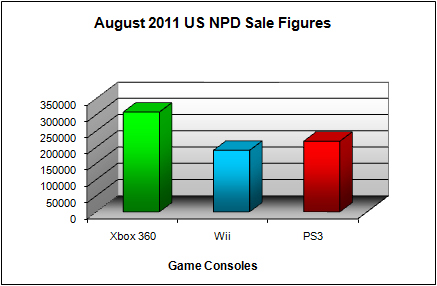
  • Xbox 360 sold 308,000 units, “maintaining the # 1 console spot in the U.S. for 2011” (source: @majornelson)
  • Xbox 360 holds 43% home based console market share (Microsoft statement)
  • Wii sells “more than 190,000” units (Nintendo press release)
  • Sony blames “inventory restraint” for sales in the first half of August, but “PS3 hardware sales were very strong the last two weeks of the month following the $50 price cut” (Sony statement)

Knowing both the Xbox 360 and Wii hardware numbers, and also knowing that the Xbox 360 held 43% of the home based console market share, the PS3 hardware sale is calculated to be an estimated 218,000 units.

And so the figures for US sales in August 2011 are below, ranked in order of number of sales (August 2010 figures also shown, including percentage change):

  • Xbox 360: 308,000 (Total: 28.4 million; August 2010: 356,700 – down 14%)
  • PS3: 218,000 (Total: 17.5 million; August 2010: 226,000 – down 4%)
  • Wii: 190,000 (Total: 36.3 million; August 2010: 244,300 – down 22%)
NPD August 2011 Game Console US Sales Figures

NPD August 2011 Game Console US Sales Figures

NPD Game Console Total US Sales Figures (as of August 2011)

NPD Game Console Total US Sales Figures (as of August 2011)

My prediction from last month was:

With the PS3 price drop coming in just a few days ago, this is just the sort of major event that makes predictions extremely difficult. There’s no doubt in my mind that the PS3 won’t come last again (Wii has the third spot amongst the home based consoles locked up), but the main question is can the PS3 outsell the Xbox 360? The price cut being only $50, and with no new console coming with the price cut like two years ago, maybe it will just come short, but it will be a close run race that’s for sure. For games, again, there’s nothing really of note. Usually at this time of the year, Madden NFL dominates, but with the Madden NFL 12 coming at the end of August, it may not have enough time to make such a major impact this time, although it will probably still be the best seller based on pre-orders alone. No More Heroes: Heroes’ Paradise for the PS3 and Deus Ex: Human Revolution seems to be the only two other notable releases in August.

The PS3 didn’t come last, and the Wii did, but this was an easy prediction to make. But it appears I overestimated the effect of the $50 price cut, and with Xbox 360 sales growing compared to July, the race wasn’t a “close run” one at all, with the Xbox 360 still comfortably retaining first place amongst the home based consoles.  For software, Madden NFL 12’s delay meant that it was not even included in August’s stats as it fell outside of the NPD August sales window (August is counted as a 4 week reporting period by the NPD, lasting from the 31st of July to the 27th of August), while of the two notable new releases, Dues Ex: Human Revolution was predictably the top selling title.

Let’s focus first on the PS3 numbers, and just how much of an effect the $50 price cut has had. On the surface, it looks like the effect was minimal, but dig a little deeper, and the sales bump will seem a bit more robust. Since the price cut only occurred half way through August, the first thing we need to do is to establish a marker for pre price cut sales. Generally (and historically) speaking, there is very little difference between July and August sales, but August tends to sell a few more consoles than July. Since nothing dramatic actually occurred for the Xbox 360, and the only effects being negative (due to price drop of PS3, encouraging more gamers to buy the PS3 over the Xbox 360), the rise of 360 units from 35-day reporting period of July to the 28-day reporting period August 0f roughly 11% could indicate “normal” seasonal growth.

Or not. So let’s take half of this number and say that, had the PS3 not had a price cut, it too would have grown 5.5%. This would make PS3 sales roughly 156,000 units for the whole month of August, or 5,571 units per day, had the price drop not occurred. The price cut was announced on the 16th of August, and so leaving the price cut only 12 days to affect the August NPD figures (again due to the premature end of the NPD reporting period at the end of august), with the first 16 days of the month “business as usual”. This means that prior to the price cut, 89,143 PS3 units were sold, leaving 128,587 being sold after the price cut. This means an increase from 5,571 units per day to 10,716 units per day (127,587 divided by the 12 days of the price cut) after the price cut, practically doubling sales as a result. This means that had the PS3 price cut lasted for the whole 28 day reporting period, PS3 sales would be almost exactly 300,000 units, only 8,000 units shy of the Xbox 360. Had I simply assumed that PS3 sales would have stayed completely flat between July and the first 16 days of August, PS3 unit sales may have reached as high as 311,000 units.

September would have told us a lot more about the full effect of the PS3 price cut, but the Xbox 360 exclusive ‘Gears of War 3’ should help Xbox 360 hardware numbers more than any other PS3 release would do for the PS3 hardware numbers. And with similar high profile releases that generally favour the Xbox 360 in the coming month, the bump from the PS3 price cut may just fall short of making the PS3 more popular than the Xbox 360 during this holiday period.

For the Xbox 360, a solid 11% rise from July to August allowed it to sit comfortably as the best selling home based console, but as noted earlier, it could have been different if the PS3 price cut had come earlier. Hardware sales are down some 14% compared to the same month last year, but again, this is mostly due to the “Slim” sales bump back then.

For the Wii though, August was just as bad as July, and it looks like from this point onwards, it will be third place out of three.  The Wii declined the most compared to August 2010 than any of the other consoles, which means that the rumours surrounding the rushing of the Wii U to market, and the “development hell” (source: n4g.com) that ensues, might show Nintendo is more worried about the Wii decline than they’re letting on.

For game sales, August was a disappointing month, due to the lack of new releases, and the delay of Madden NFL 12 to the September reporting period. So Deus Ex: Human Revolution was actually best selling title across all platforms, even though it was only released for 5 days in the August reporting period. The ‘Just Dance’ franchise continues to be the best selling Wii exclusive titles, but in better times, a Nintendo first party title, like Mario Kart (now bundled with consoles) or Wii Play would have been one of the titles. Here’s the full software sales chart for August:

  1. Deus Ex: Human Revolution (Square Enix, Xbox 360, PS3, PC)
  2. NCAA Football (Take 2, Xbox 360, PS3)
  3. Call of Duty: Black Ops (Activision Blizzard, Xbox 360, PS3, Wii, NDS,PC)
  4. Phineas and Ferb: Across the 2nd (Disney, NDS, Wii, PS3)
  5. Cars 2 (Disney, NDS, Wii, Xbox 360, PS3, PC)
  6. Just Dance Summer Party (Ubisoft, Wii)
  7. Just Dance 2 (Ubisoft, Wii)
  8. Lego Pirates of the Caribbean (Disney, Wii, Xbox 360, NDS, PS3, 3DS, PSP, PC)
  9. The Legend of Zelda Ocarina of Time 3D (Nintendo, NDS)
  10. Zumba Fitness (Majesco, Wii, Xbox 360, PS3)

Time to make a prediction. I think the Xbox 360 will still come out as the top selling console for September 2011, mainly due to ‘Gear of War 3’, but the PS3 will definitely come closer than it did this month, and with ‘Resistance 3’, it too might benefit from a platform exclusive. The Wii will be third. Games wise, ‘Gear of War 3’ looks set to be a top seller, despite being a platform exclusive release. ‘Resistance 3’, on the other hand, doesn’t look to have the same effect, although it will still sell well. Combined platforms sales may even push ‘Dead Island’ to the top of the charts.

See you next month.


About Digital Digest | Help | Privacy | Submissions | Sitemap

© Copyright 1999-2012 Digital Digest. Duplication of links or content is strictly prohibited.