Archive for the ‘Electronics’ Category

Weekly News Roundup (16 October 2011)

Sunday, October 16th, 2011

Welcome to yet another edition of the WNR. Another rather quiet week news wise, so this would otherwise be a short WNR, except I might spend a bit of time talking about the latest NPD results later on in the gaming section.

Copyright

We start with copyright news as we usually do, and we start with a quite unusual story, one that I still don’t really know what to make of.

PC gaming piracy is a big problem, I think everyone can at least acknowledge this fact (whether ever more intrusive DRM is the solution to the problem, I think, is where the debate is at the moment), but if the goal of anti-piracy is to increase revenue, and intrusive DRM doesn’t seem to be producing, why not try something else?
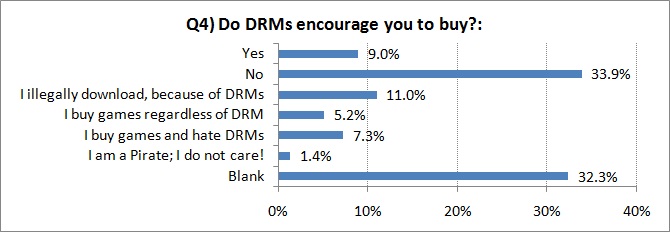
Vigilant Defender Questionnaire

A sample result from the Vigilant Defender questionnaire, which shows that DRM not only does not really help encourage pirates to buy games, it may even drive them to pirate in the first place

Except, I probably wouldn’t try what startup anti-piracy firm, Vigilant Defender, has tried – to actually help the spread of pirated content. Yes, you heard right, the first step in Vigilant Defender’s experiment is to actually help seed a leaked beta version of the hit game, Deus Ex Human Revolution. The second step is slightly tricky, as the version of the beta they seeded was slightly modified to drop out of the game after the first few levels, and direct users to an online questionnaire, in which they were asked questions about why they decided to pirate the game. While data collection is essential to solving the piracy problem, especially given the industry’s often biased “research” on the matter, the key question asked of gamers was “what would you be willing to pay for this game”. Not only will the answer to this particular question prove useful in finding out just why people pirate, and what price point can influence the same people to go legit, Vigilant took this one step further and proceeded to offer downloaders the opportunity to buy the full game at a price determined by average answer to this particular question. And amazingly, 8% of all those who downloaded the modified leaked beta actually went on to buy the game, at the user voted average price of $24.99 (half of the retail price) and that’s actually quite a high rate of return for games, especially when the target demographic is often described by the industry as “criminals” and “freeloaders”.

In my opinion, what Vigilant Defender tried to do was very clever, even if they went about it perhaps in too much of a roundabout way. What they’re actually advocating is a system where users vote for the price they want to play, and where pirated versions of games actually become demos of sorts. The gaming industry may not want to believe it, but a lot of gamers do use pirated games as an extended demo, and many, I’m not saying all (or even anything close to a majority), to end up buying the full version if they like the game. Game publishers, on the other than, would rather prefer people buy games they don’t like by making sure they can’t test it fully before they buy it, and perhaps that’s how it used to work before Internet piracy became ubiquitous, this kind of business model no longer works. But on the other hand, by offering downloaders cheaper version of games, it’s perhaps encouraging downloads, and this kind of distribution model would be a hard sell for game publishers. But there’s definitely something here, and perhaps a little bit of tweaking could bring us a new distribution model that takes advantage of P2P networks such as BitTorrent to not only distribute the games, but to promote them. Imagine if games came with a thin layer of unobtrusive DRM that simply nagged users to buy the game from time to time, a DRM so not annoying that release groups don’t even bother to have it (so it remains in the pirated versions floating around the net). Users would then be given an offer to “upgrade” their pirated version to the full legit version for a discounted price, but the caveat is that their save games/profiles would no longer be compatible with the full version unless they pay the full price, or some kind of incentive that still makes buying games at full price an attractive proposition. And if you want pirates to help you sell games, then let them join some kind of commission based affiliate program, where for each downloader that “upgrades”, the seeder would get a small commission for their “help”.

The even easier alternative is to lower game prices and improve services for legitimate customers, so that piracy becomes more trouble than its worth.

For Vigilant Defender though, they have a slight problem on their hands at the moment since this Deux Ex experiment was not actually approved by the publishers of the game, Square Enix, which could land the anti-piracy company in a bit of bother with anti-piracy laws.

Bad news for Australians lately on the copyright front. Only a couple of weeks ago, we got our first taste of mass copyright lawsuits, and this week, our government signalled changes to our existing copyright law which would make it even easier for mass copyright lawsuits to happen. Namely, the Attorney-General wants to make it easier for rights holders (or agents of them) to match IP addresses to real identifies, by “streamlining” the legal process. In other words, due process has to go out the window to make Hollywood and the RIAA happy. Even the idea of a ‘graduated response’ system was mentioned, at a conference sponsored by the copyright lobby, of course. Still, there were some other proposed changes that were positive, such as extending “safe harbour” to protect more types of Internet businesses, rather than just ISPs – search engines like Google and Bing will benefit the most with this proposed change. But as long as politicians still continue to believe that a single IP address is evidence enough of a “crime”, and that the “crime” itself is costing the creative industries insane amounts of money and jobs, then politicians will always be on the side of the copyright lobby, made more likely by the uneven spreading around of lobbying cash from both sides of the issue.

High Definition

In HD/3D news, this week could prove an important one for advocates of managed copy, who want legal alternatives to “ripping”. UltraViolet has been talked about quite a lot, and this week, we finally get our first taste of this “in the cloud” based managed copy system. Unfortunately, the taste is not quite palatable.

Green Lantern UltraViolet via Flixster

UltraViolet from Warner Bros. is being distributed via Flixster, and it isn't a very convenient user experience

Warner Bros. released Horrible Bosses and Green Lantern with UltraViolet digital copy included, but the way Warner has decided to deploy UltraViolet is the biggest problem at the moment. The current WB process requires users to enter in a 12-digit redemption code online, which in itself is annoying, and then users will have to sign up to Flixster, and then install the Flixster app on the device they wish to view the UltraViolet copy. And it’s all wrapped up in various layers of DRM, as you would expect.

And as WB owns Flixster, and to add to the problem, when other studios release their version of UltraViolet, they will use their own distribution network. So right now, if you asked me on which devices an UltraViolet digital copy works on, I can’t tell you, because it will depend on each studio, and this is absolutely the wrong way to go about it. For UltraViolet to be viable, I think it really has to either tie in with iTunes, NetFlix, Amazon or one of the existing players in video distribution, or all the studios have to come together and come up with a single distribution method, with all of the major devices supported (the iDevices, Android system, game consoles and Blu-ray players, at least). And then, streamline the process so it’s as simple as scanning a QR code, or just a matter of inserting the UltraViolet Blu-ray or DVD into a UV compatible player – none of this 12 digit code nonsense, or having to figure out each studio’s UltraViolet system and having to have an account for each.

A two parter Sony related story, the first part goes here in the HD section I suppose. Sony has had to issue a massive recall/repair for 1.6 million LCD TVs they produced since 2008, apparently due to a fire risk in a faulty component. It’s not exactly what the company needs at the moment, but the “good” news so far is that there haven’t been any reports of actual injuries, and that the damage so far has been restricted to the TV set itself.

GamingLess costly for Sony, financial wise, but perhaps more costly in terms of image is the news that a further 93,000 Sony online network accounts have been “hacked”, in the latest security breach.

Fortunately for Sony, the breach which led to hackers gaining access to 93,000 accounts on the Sony Entertainment Network (SEN), PlayStation Network (PSN) and Sony Online Entertainment (SOE) networks appears to have originated elsewhere. According to Sony, hackers managed to source the email/password combinations for an unspecified (non Sony) online service, and proceeded to use the same login combination to try their luck on the PSN, and managed to get access to the 93,000 accounts. Sony have disabled 33,000 SOE accounts, while have forced password changes for the rest. Sony says that credit card info was not accessed during this attack, but personal information may have been.

While Sony is right that the data breach occurred elsewhere, the security issue here still lies with Sony, because allowing hackers to launch this type of massive attack can easily be prevented. Simply limiting failed login attempts from any individual IP address or range, which is standard practice, could have prevented the 93,000 accounts from being accessed. And some kind of “CAPTCHA” system, or human verification, would have prevented the hacker’s bot based login attempts. Both of these are common techniques used to prevent dictionary based attacks. And once again, it took Sony days to spot the unusual activity on their networks, when it really should be a matter of hours if not minutes.
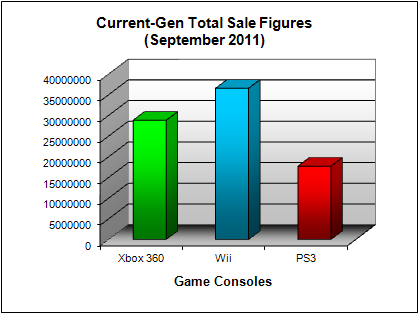
NPD Game Console Total US Sales Figures (as of September 2011)

Life to date Xbox 360 sales in the US (in green) is catching up to Wii sales (in blue), but the PS3 (red) languishes in third place

But while Sony’s security problems have been highlighted recently, it doesn’t seem to have seriously affected the fortunes of the PS3, as price, as always, seems to be the main driving factor behind sales. So Sony’s $50 price cut to the PS3 in the middle of August has seen PS3 sales rise, although as the September 2011 NPD US video games sales analysis shows, the rise was not big enough to really endanger the Xbox 360’s position as the best selling console in the US. The gap has closed, however, between the PS3 and the Xbox 360, while the gap between the Wii and every other console seems to be widening. If the gap remains as big as it was during September, the Xbox 360 is set to overtake the Wii as the best selling home based console of this generation (in the US) within 39 month – but it will be well after the Wii U is introduced, so that’s what Nintendo are holding on to at the moment.

Alright, that’s enough for this week I think. Hopefully more of a newsworthy week this next one, and I have a feeling it will. Have a good one.


Weekly News Roundup (2 October 2011)

Sunday, October 2nd, 2011
Battlefield 3 Screenshot

I've been wasting time playing the Battlefield 3 Beta, and it's mostly fun, even if some technical issues can ruin the experience, plus the fact that I suck at it

I hope you’ve had a good week. We’ve just had Daylight Savings time turned on overnight, and of course, I forgot all about it as usual. I hate it when DST starts, you lose a precious hour that I could have used to do so many things. Like play the Battlefield 3 Beta. I think I’m officially the worst BF3 player in Australia, if not the world, mainly because I’ve not played much FPS multiplayer games before, let alone the more team oriented BF series. I’m such a complete noob, and if you’re just like me, then the first step to solving this problem is to admit you have a problem. The next steps would be to watch these two videos to find out how you can become a better BF3 player.

While I can’t really help you with any gaming related tips, but I can with some technical issues. My C2D E8500 + Radeon HD 6850 is not the best rig for BF3, but I find it playable at 1080p if I keep the detail settings on Auto. It still looks great, the odd glitches apart. But the biggest problems I’ve had to far is the looping sound crash problem (if it happens, you don’t need to do a hard reset, at least not in Windows 7, as you can press the “Windows” key on your keyboard to switch back to the desktop and use task manager to kill the bf3.exe process) – you’re most likely using on-board audio, which then suggest a Realtek chip, and updating the driver should be your first priority. The other issue I had was with the ATI drivers crashing, and I found that closing down any opened software does help (MSN Live Messenger is a particularly bad culprit). Both Nvidia and ATI have released preview drivers that is optimized for BF3 (it really does help), although it appears ATI have removed the drivers for some reason, but you can still find it here. Alright, enough BF3 nonsense, let’s get started with the news roundup.

Update: Just a bit more nonsense, the ever useful FRAPS tells me that @ 1080p on Auto (which was detected to be ‘High’ for my system), I can average around 40-45 FPS, with the occasional framerate drop, but nothing that makes it unplayable). I tested ‘Ultra’, and found that I could only get around 25 FPS outdoors, and just above 30 FPS indoors, less when there’s more action on screen (but it did look fantastic). I had to quit many times to my team’s displeasure to record these results for you (as BF3 beta won’t allow you to change video settings during games).

Copyright

Let’s start with copyright news for the week, we start with what is apparently a new strategy in anti-piracy enforcement online – $10 fines.

On the surface, this sounds like a much better idea than $3,000 settlement fees, but dig a little deeper, and you’ll find that it’s probably $10 you don’t need to pay. The reason Digital Rights Corp (DRC) can still profit from a $10 piracy fine, is that they don’t actually do any of the legal work required in order to get the $3,000 settlement fees. They don’t bother to match IP address to a real person, as they let the ISP do it, and until you actually click on the link in the email that the ISP forwards to you, and give them your credit card numbers for payment, DRC doesn’t even know who you are. And unless DRC goes to court to obtain a subpoena, they can never find out – but if they do go to court, then $10 won’t even come close to covering their costs. Still, it doesn’t stop DRC allegedly “warning” users that they could still face $150,000 fine, or ISP disconnection, both claims are not true, and a $10 fine is not going to get your account unbanned, if that’s what has already happened. DRC also appears to only represent older artists (most of them dead, actually), and so the likely target for their emails will probably be the elderly – those that can’t afford the $3,000 fine (so will fight it), but are also not technically knowledgeable enough to know that they probably don’t have to pay the $10 fine – a niche, but potentially profitable market sector.

Canada's Heritage Minister James Moore

Canada's Heritage Minister James Moore says that if people aren't prevented from backing up their own DVDs, the results could be "quite disastrous"

Across the border in Canada, the Conservative government there is trying, for the third time, to bring in harsh copyright laws that will try to mirror US laws, possibly as a way to get out of the “rogue nations” copyright list that the US produces every year. Taking from some of the worst aspects of the US DMCA, Canadians will find themselves on the wrong side of $5,000 fines if they even attempt to circumvent the “less-than-useless” DVD copy protection, even if it’s just to make their purchased disc playable. A totally useless clause that does nothing to prevent piracy, but strips away consumer rights, all in an attempt to make Hollywood happy. For me, any provision about DRM circumvention should distinguish between the various reasons for DRM circumvention (fair use), and also should take into account the strength of the DRM. If I simply wrote on a piece of paper “DRM – do not remove”, and stuck it on a DVD using sticky tape, it cannot be a crime to “rip” the “DRM” away, because it never worked in the first place. To me, these kind of laws offer legal protection to bad technical solutions, and threatens anyone who dares to test the system for security holes – this will end up hurting computer security, not help it. Imagine if the DVD people had allowed hackers to play around with DVD’s CSS copy protection and re-engineered it based on their feedback, maybe, just maybe, they would actually still have a DRM system that can’t be broken with 6 lines of Perl code, or code that can be printed onto a tie. And then there’s the introduction of a “notice-and-notice” scheme, which forces ISPs to forward infringement notices to end-users, which I guess is at least better than “notice-and-takedown”.

And maybe, in the end, the best way to prevent piracy is to actually compete with services being offered by pirates. After all, it seems to be the most effective anti-piracy method, at least in Sweden. A new Swedish survey has found that music piracy rates has decreased by 25% since the introduction of Spotify and other free streaming services. I dare the RIAA to find any DRM system that’s as effective as simply giving the people what they want. And let’s not forget that Spotify makes money too, which also means the music industry makes money too. Interesting was also the data that showed 40% switched from illegal and legal due to better selection of tracks. This is a huge clue to the music industry, and even to Hollywood, as to how to combat the piracy problem. The way Torrents work, particularly, depends on seeders and large enough swarms – both of which are unlikely to exist for rarer, older stuff. By offering greater selection of content from their archives, and at an attractive price, these “long tail” sales can potentially bring in a long of money. Do it as a package, that includes new content, for a small monthly fee, and you’ve got a competing product to piracy. Because if you can’t compete on price (it can’t get cheaper than free, although if the industry works together with ISPs to  offer free bandwidth, then that’s another way to compete on price), then you should at the very last compete on quality, and quantity, of the content being offered.

High Definition

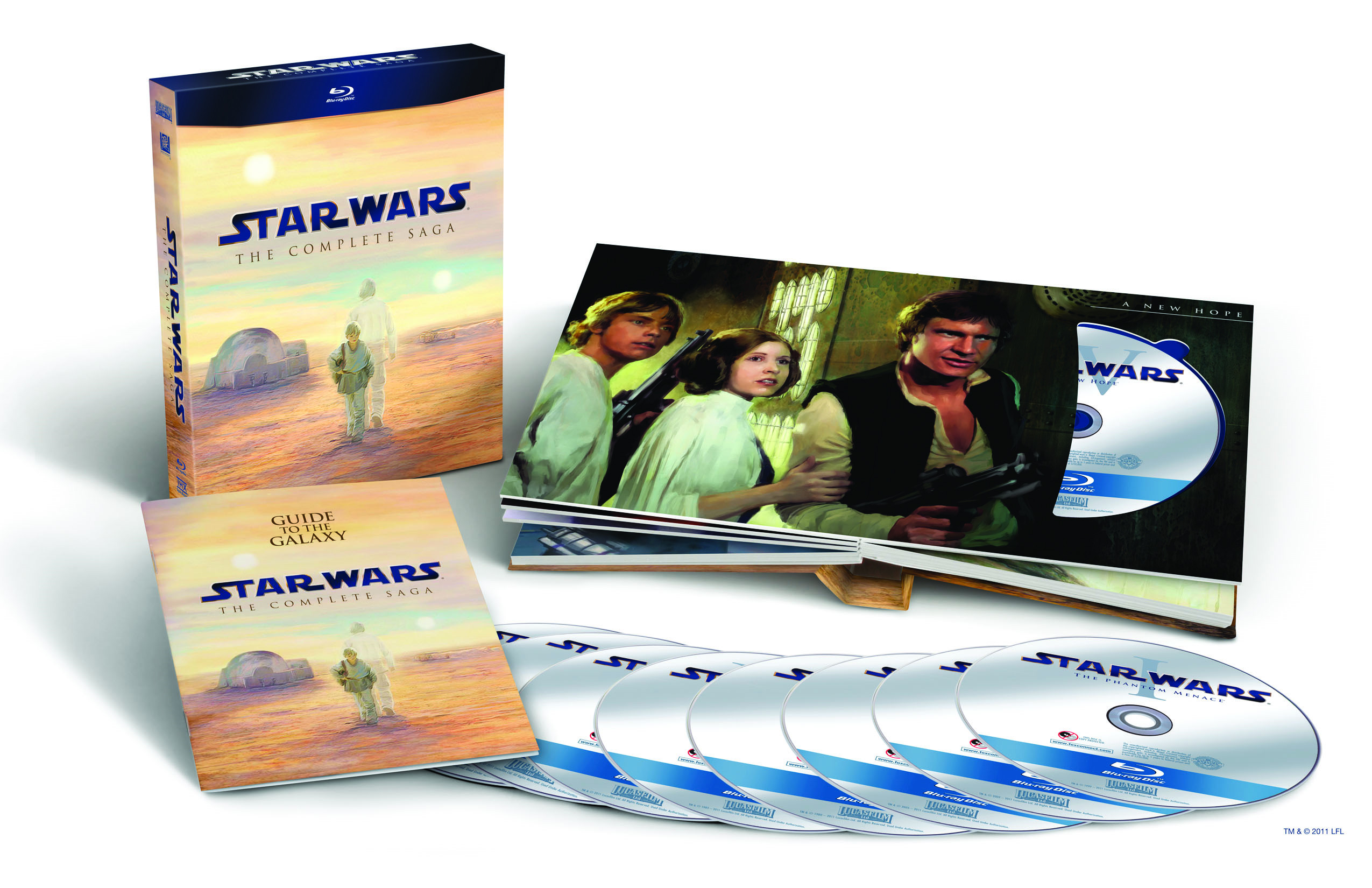
In HD/3D news, of course, I can’t let this week pass without mentioning Star Wars. I was totally surprised that, in the week Star Wars was released, it wasn’t even the best selling Blu-ray title – that honour belonged to Thor.

Star Wars on Blu-ray

Star Wars on Blu-ray was not even the top selling Blu-ray disc for the week it was released in - beaten by Thor in the end

But with both Star Wars and Thor combined, Blu-ray market share did rise to an all time high, at nearly 35%, easily beating the previous record set by Avatar (around 27%). Of course, I think it’s still a little disappointing that “Star Wars week”, even with Thor included, didn’t even get close to beating the revenue figures set by “Avatar week”, although you do have to take into account the fact that the Star Wars boxset was quite expensive, and so in this economy, it’s a luxury most cannot afford. Plus, all the nonsense with the George Lucas changes might just have affected sales, because I know quite a few people who claim they’ve cancelled their pre-orders because of the “Nooooo” thing.

I didn’t pick it up either, mainly because I know if I do pick it up now, it will be probably a year before I have the time to watch it (got a backlog of about 2 dozen discs I’ve not yet watched – I mean, I only recently watched ‘No Country For Old Men’, and I got that in 2008 when it was first released!). Hopefully, it will either get cheaper or a better version will be released, by the time that I actually have time to watch them (and to be honest, I’ve watched the movies so many times that, it’s just now that exciting for me any more – maybe I’m finally growing up!)

A new report says that, by 2015, sales of DVD recorders will stop and be replaced by Blu-ray recorders. Make sense, and I think it won’t even take that long either. In fact, I don’t think even DVD players will be around for much longer when Blu-ray players start to drop below the magic $50 mark. I mean $25 for a DVD player, or $50 for a Blu-ray one (that, let’s not forget, also plays DVDs, and probably upscales too) – no brainer really.  And it doesn’t even matter if you have the other hardware to get the best out of Blu-ray, a lot of movies are now cheaper on Blu-ray or are released exclusively on the format, so Blu-ray is starting to make sense from a financial point of view too.

And while it doesn’t really fit into any of the three major categories of the WNR, I should mention Amazon’s Android based Kindle Fire tablet, which looks like an exciting product, mainly due to the low price. With Amazon backing Android, there’s finally a company with the content clout to compete with Apple, even if the Kindle Fire is probably not good enough to compete with the iPad 2. But not everyone needs a premium tablet, again I point to the economy, and so perhaps the Kindle Fire can find the right market niche to be a huge success. And Amazon are subsidizing the price a bit, by lowering their profit per unit (they claim that they do still make a profit on each unit sold), and this could be the tablet to compete with the generic brand budget Android tablets as well, which is also a big market segment.

Not much in gaming news this week, other than what I’ve already mentioned above BF3 at the top, so that brings us to the end of another, slightly abbreviated, WNR. See in next time.

Weekly News Roundup (28 August 2011)

Sunday, August 28th, 2011

Welcome to another edition of the WNR. Hope you’ve had a good week. There are finally a couple of interesting news items to talk about this week, not enough to make up for the last two week’s lull though. As much as I don’t like the RIAA and MPAA, and the mass copyright law firms,  they do provide a lot of news. Without them, there would be hardly any news to write about, for that, I’m grateful.

CopyrightSo let’s start this week’s RIAA hate with the story that, one of the four major backers of the RIAA, EMI,  “lost” their lawsuit again cloud hosting website MP3tunes, although they could still end up the winners.

While the judge ruled in MP3tunes favour, allowing the website’s business model to continue, the judge still found MP3tunes and its founder guilty of several more specific cases of copyright infringement, mostly relating to MP3tunes’ sideload.com website, which allows music found on the net to be loaded into people’s cloud accounts without doing the manual download and upload routine (so a sideload, basically). MP3tunes had in its favour a strong policy against copyright infringement, and they mostly responded to DMCA takedown requests and acted promptly. And this allowed them to call on DMCA’s “safe harbor” provisions. It’s actually a good lesson for web businesses these days to take DMCA requests seriously, because in this case, the judge basically ruled that due to the existence of the DMCA and “safe harbor”, the responsibility for identifying infringing content falls to content owners, not the website operator. And this makes sense, because only the owner can identify their own “goods”, and only they can decide whether there’s need to pursue a course of action.

sideload.com

Sideload.com was sued by EMI as part of the MP3tunes lawsuit, and the judge found copyright infringement had occurred in some cases

And this is an important decision, because recent judgements, and mooted government legislation, have more frequently identified website operators, your Googles, YouTubes and Megauploads, as being responsible for having some kind of passive anti-piracy system, to remove offending content even without the content owner’s intervention. This is  of course something content owners would want, because it means less work. But such a system would always be “false positive” heavy (there’s no way websites can know if you actually did have permission to upload the content or not), and there are also privacy issues (for example, if you uploaded a ZIP file to Megaupload, do they have permission to unzip and read your files to check for copyright infringement?), and self-censorship is a dangerous road to take. This decision is also a confirmation that the cloud hosting business model can work, but only if copyright protection is taken seriously by the cloud host.

Where MP3tunes lost was that some of the anti-piracy actions weren’t strong enough, for example, removing links on sideload.com for infringing content, but not actually removing the already “sideloaded” versions of the same songs from people’s cloud accounts. The founder of MP3tunes had also sideloaded some infringing songs, the judge found, and that could mean that EMI could still yet receive a good sized damages amount.

While EMI was busy losing one lawsuit, they, and the other three majors, were busy suing others. The four majors, and 25 other labels, have decided to sue TubeFire, a website that allows people to download YouTube videos.

If you’re first reaction is like mine, then it would be something like “what?”. YouTube download services have existed almost as long as YouTube, and there are so many out there that I don’t think anyone even considered them to be a source of piracy. I mean, when you upload something to YouTube, you kind of expect people to view it, for free, so why does Universal, EMI, Sony, Warner think TubeFire deserve to be sued? Apparently, people are downloading officially uploaded music videos and, I don’t know, viewing them or something, and that has angered the four major labels, and 25 other labels that are also part of the suit. It’s probably because their music video sales on iTunes has been affected or something – if they’re that concerned, then don’t (officially) upload to YouTube.

And since YouTube doesn’t have any serious DRM that prevents “downloading”, is it really illegal? Also, while downloading copyrighted YouTube video does occur, what about all the legal uses where people download non copyrighted video, or download for delayed “offline” viewing, a sort of time shifting if you will? And why TubeFire, and not the dozens of other websites and download tools? And what about browsers, who also “download” the video before it plays, the only difference is that they don’t allow people to keep the “download” beyond the current browser session? It is, in my opinion, a ridiculous lawsuit, especially when a lot of these online video download services do nothing more than a URL rewrite, with the download actually occurring from the original location (because even online video needs a “source” file, and a lot of download tools simply allow people to download this source file – so in effect, it’s the online video site that’s offering the download).

And the whole idea behind a music video is to promote music sales (do people buy a lot of music videos?), so does it really matter if people are downloading or streaming the videos, from a promotional perspective? Free creates hype, and that’s really an immeasurable benefit, but hugely important these days.

Fox content on Hulu

Fox content on Hulu (free) will be delayed by 8 days, and this has caused piracy to surge for Fox shows

Which is why Fox’s withdraw from the free edition of Hulu is surprisingly, to say the least. Hulu was created to offer free catch-up content, usually delayed just a single day after the original airing, to both help fuel Internet hype for shows, and to compete with pirated downloads of the same shows. Instead of people downloading pirated shows in the hundreds of thousands, people can instead go to Hulu to enjoy a totally legal alternative, and most are more than happy to put up with the ads, which then allows revenue to flow back to the networks. It’s a win-win situation, which is why Fox’s decision to delay free airings on Hulu to 8 days, instead of one, seems to be me like a self inflicted wound. For one, nobody would bother with a 8 day delayed airing – it might as well be 8 months in today’s “instant” culture. People will just find alternatives, and piracy being the prime choice. TorrentFreak wanted to test this theory, that Hulu prevents piracy, and conversely, no Hulu can cause piracy, and it seems they’ve found a correlation. Of two Fox shows (Hell’s Kitchen and MasterChef), pirated downloads on BitTorrent networks increased by 114% and 189% respectively compared to before the Fox Hulu change. So instead of earning ad revenue for Hulu airings, Fox has simply “forced” users to migrate back to BitTorrent.

Fox says they’re doing it because they want to promote certain cable services that bundle Fox shows with paid for Hulu accounts that still allows users to get access to Fox shows in a timely manner. But to me, this seems like a short sighted move for a quick hit of sponsorship money, and for all the things that “promote” piracy, actions (or inactions) of content owners probably has the biggest effect. It’s like the Netflix price rises, and what the lady says at the end of this video. People don’t want to pirate stuff if they have a legal alternative, but if you take away that alternative, well …

So, on to copyright law firms. The US Copyright Group has sued a deceased for piracy of the film “The Hurt Locker”. To be fair, the USCG are only the intermediaries, the real blame goes to the producers of “The Hurt Locker”. And to be fair again, the dead seemed like the next logical target, after the blind, and then the elderly, were both sued for download porn videos. If only zombies could be sued (and if they were real). High profile mistakes aside, who knows how many other mistaken lawsuits have been filed, which is always likely to be the case with such a scatter-gun approach to lawsuits. I mean, when your only piece of real evidence is a set of numbers (the IP address), which only at best gives you the subscriber account, and not the name of the actual person that made the download, then that’s not really evidence in my opinion. And for the argument that people should be held responsible for their own Internet connections, including securing it against unauthorised usage, that would be like saying if you forgot to lock your car and somebody used it to commit a crime, you would be held responsible.

The USCG’s other big client, Nu Image, producers of ‘The Expendables’, has made a drastic change in their suing strategy as well. They’ve dropped all remaining defendants from ‘The Expendables’ lawsuit, but before we celebrate a major victory against mass copyright lawsuits, Nu Image are not finished yet with suing ‘The Expendables’ downloaders. Instead of clumping all defendants in a single case and then getting the bulk of it thrown out for jurisdiction issues, Nu Image plan to re-file numerous smaller lawsuit in different locations, and thus avoid the jurisdiction issue. And not only that, they’re going to file lawsuits for downloaders of more of their films, including ‘Drive Angry’, ‘The Mechanic’ and the still-in-theaters ‘Conan the Barbarian’. You know, if Nu Image spent more time actually producing “good” films, perhaps they might not need to spend so much time and money on suing downloads. Just a thought.

High Definition

In Blu-ray/3D news, Star Wars is going to be available on Blu-ray soon, and the first Star Wars release is a big event for any video format.

Star Wars on Blu-ray

Star Wars getting released for the first time on any new video format is a big deal

But with every new release of Star Wars, there’s always the threat that George Lucas might do more “tweaking” to the Star Wars films, especially the original trilogy (the prequel trilogy, nobody really cares about). So when Lucas hinted that there would be new stuff on the Blu-ray release, fans got, understandably, a bad feeling about it all. An all digital Yoda is probably coming for Episode I, but imagine the outcry if the puppet Yoda in the original trilogy was replaced with a digital one (for consistency, you see)? Not even Lucas would dare to do that of course, but this is the Internet, this is Star Wars, and so there will be hysteria at any and all rumours. To be fair, the puppet Yoda in Episode I looked weird and out of place, so a digital Yoda in that film (and that film only) is welcomed. There are also other improvements, for example, you get to see more of Episode I due to better transfer techniques that allows more of the picture to be shown on the screen (yeah, more Episode I, that’s what fans want!). Lucas also continues to “rewrite history” by removing special effects mistakes in the original trilogy, including the infamous Wampa puppeteer arm in Empire. While some fans would welcome the removal of obvious mistakes, some others are happy with the originals the way they are (even the pre-Special Edition editions, which I was hoping would be included on the Blu-ray), while most simply don’t mind either way, probably.

Is DVD on the way out? Well, it’s definitely not on the way in. A new study seems to suggest it is, but it was only really looking at portable DVD players, which the research say is being replaced by video capable smartphones and tablets. Common sense really, the same reason people no longer carry their portable electronic Sudoku player, their MP3 player, their PDA, and their pig destroying avian targeting contraptions.

As for the future of the DVD format? Every Blu-ray player is also a DVD player, so I think it will be around for a while yet.

Not much in gaming, so skipping …

And that brings us to the end of this WNR. Have a good one.

Weekly News Roundup (14 August 2011)

Sunday, August 14th, 2011

Another pretty quiet news week, and once again, NPD has “released” stats for US video game sales in July 2011. More on the later though, let’s get through the small number of interesting news items this week in this relatively short WNR.

CopyrightIn copyright news, a couple of weeks ago, the story of a 70-year-old grandma being “caught” downloading video porn by a copyright law firm made the headlines.

Wi-Fi Security

If you have a Wi-Fi connection, you need to use WPA2 encryption

This week, a blind man is accused of doing the same. In a scenario that is likely to be repeated over and over again, the man, only known as Doe 2057, suspected that the Wi-Fi router his wife set up might not have been secured, which possibly led to neighbours abusing the connection to download Japanese porn, despite the man living in a “very upscale building”. Before we get to the rights and wrongs of copyright law firms, people really need to be more careful with their Wi-Fi routers. By not securing it, anyone could connect and use up your Internet bandwidth, and that’s actually a best case scenario. Worst case, they would have access to your network, and hence any file shared on the network. The same also applies to routers that use the default password (or no password). And I think router makers have to take some responsibility as well, as far too many routers ship with factory settings that do not have security turned on or use the easily broken WEP protocol – it makes them easy to install, a bit more compatible with older wireless devices, but a little bit of hand-holding in the set up software wouldn’t make the process that much more difficult either.

But with nobody taking any responsibility, the large majority of consumers ignorant of the need to secure their routers, copyright law firms are taking advantage of biased copyright laws. It’s certainly opportunistic, you have to say. The problem is that to actually fight the charges, as Doe 2057 found out, it’s usually more expensive than just paying the on average $2,500 settlement fee. And the copyright law firms know this, and have exploited it beautifully. It was also revealed this week that the number of people being “sued” this way, in the United States lone, has reached over 200,000, according to stats being kept by TorrentFreak. That’s half a billion dollar worth of settlement fees, but assuming not everyone pays up, it’s still a 8 figure amount that many law firms would be delighted to take in over the course of several years. If you ever get caught, you should definitely check out EFF’s page on mass copyright lawsuits, and learn about your options.

A new study seems to show that good games are pirated more, which might sound like common sense to you and me, but nevertheless the study “confirms” it as fact. Except it sort of doesn’t. The TorrentFreak article on this study has more details, including the top 10 list of most pirated games, there are a few cases, such as the awful TRON Evolution game, that still managed to be popular with pirates, despite being unpopular with critics. Similarly, the fairly average and not all all popular (sales wise) ‘Two Worlds II’ managed to get into the top 10, and the hugely popular Starcraft II wasn’t the most pirated game (Fallout: New Vegas was, which is fair enough I suppose). I would actually like to see a study that tries to find a correlation between game sales, piracy rates and the quality of the game. What I would like to know is that if high quality games have a higher or lower ratio of pirated copies versus paid for copies. And then take into consideration things like the exclusive online features of the game (eg. Starcraft II’s Battle.net support), as well as any DRM employed (eg. Ubisoft games). I think the results may be very interesting.

Speaking of DRM, Walmart is pulling out of the digital music business according to leaked memos, and this has implications for those that purchased DRM’d music from them prior to 2007 (before they went DRM-free). Luckily, Walmart seems to be doing the right thing and will keep the DRM servers online (they learned the hard way about turning off DRM authentication, back in 2008 when they tried it and met with strong public condemnation). But how long will they do it? Indefinitely? At some point, Walmart will decide unilaterally that it no longer needs to maintain DRM authentication, and all those “purchases” would be made invalid. The sensible thing for Walmart seems to be to transfer the DRM’d songs to DRM-free version, which should not really be that difficult, but I suppose it means extra licensing costs. It again highlights the problem with DRM, not only for consumers, but for content providers having to get locked in to a proprietary system for an undefined number of years.

High Definition

In Blu-ray/3D news, I posted a 3-in-1 news story just yesterday on developments in the 3D world.

The first of the three is not really that interesting, a story about 3D glasses vending machines outside of selected cinemas in California. The fact that people may pay $70 for a pair of passive 3D glasses out of a vending machine, in this economy, just seemed funny to me.

Samsung 3D active shutter glasses

A standard for 3D glasses could help end consumer confusion and lead to cheaper glasses, but will it help 3D uptake?

The second story is slightly more interesting, but let’s talk about the third one first, which is about AT&T’s U-verse no longer carrying the ESPN 3D channel, due to low consumer demand. The blame is either with lack of 3D devices being sold, or lack of interest, and both could be true. The thing is, 3D is a gimmick, and one that perhaps you might want to give it a go from time to time, but the majority of TV watching will be in 2D.

Back to that second story, and this one is about a new standard for active 3D glasses being formed by Panasonic, Sony and Samsung, three of the biggest manufacturers of 3D. Panasonic hinted at this quite a while ago, especially when it found that Samsung’s active 3D glasses can actually workon Panasonic sets, but only if you wear them upside down, the ridiculousness of this probably prompted a rethink by these manufacturers. They also plan to address a major problem with home based active glasses, in that they’re mostly based on infra-red or RF signals, both of which are susceptible to interference, and in the case of IR, line of sight issues. Hopefully, with a standard in place, and other manufacturers signing up, the cost of 3D glasses can decrease over time.

Gaming

And finally in gaming, as mentioned earlier, the July NPD figures have been released. Microsoft, as usual, were the first to provide actual hardware sales figures, not surprisingly because their Xbox 360 was the best selling home based console yet again. They also made it interesting by announcing the market share figures, at 45%, which meant that as long as one Nintendo or  Sony release figures for the Wii or PS3, then we would know the sales number for the other (based on a simple calculation).

Unfortunately, neither companies came out with any figures, and it was left to Analyst Michael Pachter to come up with the good, via a sneaky reference to the Wii’s year-on-year result. So once I get all the maths done, I should have the NPD analysis up.

Alright, another short-ish WNR, but if there’s no interesting news, then there’s no interesting news, it’s not as if I can make it up or anything. Or maybe I can?

See you next week.

Weekly News Roundup (7 August 2011)

Sunday, August 7th, 2011

A pretty light week in term of news, and since I’m running a bit behind, let’s see if I can wrap this one up quickly.

CopyrightStarting as usual with the copyright news, we start with the MPAA’s win against Zediva, as the judge in the case handed down a preliminary injunction against the “innovative” video rental service.

Zediva Promo

Zediva is a great deal for consumers, but it can only do it by using loop holes that Hollywood is trying to close

A little background info. Zediva’s service works by allowing you to rent physical discs, but instead of sending the disc to you like what Netflix would do, they do what Netflix’s other service does, by offering you a streaming version of the same movie. Zediva then reserves the disc you “rented”, and removes it from circulation. Or basically as Zediva puts it, you rent the disc, and they play it for you over the Internet (imagine a DVD player with a really really long cable). Why did Zediva do this? They did this – and this is where I think Zediva’s downfall will be – to avoid having to pay licensing fees for streaming content.

You see, the problem is that Zediva’s motivations, it seems to me, are born out of trying to avoid paying these licensing fees and release restrictions, and make more money than they would otherwise. If this is Zediva’s real motivation, then good luck to them, but I don’t think they have a snowball’s chance in hell with their case. And in the judge’s summary of the ruling, it’s made quite clear that the judge sees real problems with Zediva’s argument, and that if Zediva was allowed to continue operating, it could harm the existing video-on-demand industry, Netflix included.

Now, it could be debated that what Zediva is doing actually does not hurt Hollywood if you compare it to traditional disc rental, but that it does hurt Hollywood studios when compared to what they can make from streaming deals, and even Zediva won’t deny this, as after all, their business model is to save on licencing costs. This then leads to the debate as to why streaming should cost more than traditional rentals, why Hollywood should choose to not only “tax” new innovative distribution methods, but to place artificial limits (like a 30-day embargo to help increase disc rental income), when these help to fight piracy. But that’s their business decision, and they may be right or wrong, but that’s not for Zediva to decide. So people get pissed off with Redbox waiting times for new releases, or the somewhat hysterical reaction to the Netflix price increases (best encapsulated in this video), and it might hurt Hollywood more to be too greedy when it comes to streaming licensing fees and release schedules, if people do decide to “screw it” and use BitTorrent.

Pron magazine/website Perfect 10 is making legal headlines again this week, twice actually, as they launch yet another lawsuit against yet another online company, this time Megaupload. As you may or may not know, Perfect 10 has in the past sued Microsoft, Google, Amazon, the middle of these three recorded a win against Perfect 10 this week in which the Ninth Circuit court rejected Perfect 10’s appeal over an earlier decision favouring the search giant. But while courts are reluctant to rule about top tech companies that have been Perfect 10’s target before, they may be more favourable to ruling in Perfect 10’s favour against Megaupload, especially since the MPAA’s case against similar file hosting provider, Hotfile, seems to be going okay. So I wouldn’t be surprised if this turns out to be Perfect 10’s first victory, but it all depends on how frequently their content has been uploaded by users of Megaupload, and if it’s not frequent at all, why Perfect 10 didn’t file DMCA notices to get those content removed, instead of launching a lawsuit (“to make more money” is not an excuse the court would accept, I think).

Diablo III

Diablo III will use 'always-on' DRM, but not for anti-piracy, says Blizzard

Good will amongst gamers is something every game developer needs, and up until this week, Blizzard, the makers of the addictive World of Warcraft and Starcraft series,  probably thought that the had enough good will stored in the bank to pull a nasty surprise. But, as Blizzard will admit, they might have miscalculated. What happened was that Blizzard announced the next episode in another one of their addictive franchises, Diablo III, would have “always-on” DRM, meaning gamers won’t be able to play the game offline, even for a couple of seconds. So Blizzard decided to do a Ubi, and as I talked about last week, nobody likes Ubi DRM. The funny thing was that Blizzard probably never intended to do this as a form of anti-piracy, but only as an anti-cheating feature. This may very well be true, but Blizzard could have avoided this whole controversy (and still used “always-on” DRM) by including an offline mode, much like how Test Drive Unlimited 2 does it (offline and online progress are recoded separately). The statements made by Blizzard immediately after the backlash began didn’t help either – executive vice president of game design Rob Pardo’s statement about there being other games to play when people are offline, for example on long plane trips, was the most ill-conceived of them all (yes, “other games” that people will buy instead of your games).

So it’s a lesson for Blizzard and any other company that chooses to use draconian DRM, for whatever reason – beware of the backlash, which might ultimately hurt revenue more than a couple of extra pirated copies would have (or the cost of adding an offline play mode).

High Definition

In Blu-ray/3D news, exciting news, sort of, although it’s technically neither HD nor 3D (not yet anyway).

I’ve been talking up UltraViolet for a while now, and it’s not like me really to voice my support for anything Hollywood comes up with, especially if it’s wrapped up in all sorts of DRM, which UltraViolet will no doubt be. But for me, UV is a huge shift in the way we “buy” movies, and it comes just at the right time when cloud storage is all the rage.

UV, simply puts, turns buying a movie into really buying a movie. The idea is that, instead of buying a movie on each platform, on disc, then on iTunes,  then another version for your Android device … instead of doing this, you buy the license to watch the movie, and then you get access to all the versions via the cloud, for all of your popular devices. It’s like Digital Copy, except it’s all done in the cloud. So when you buy a Blu-ray movie at Walmart, you can instantly get the movie to play on your Android phone, as long as you have a good Internet connection. And at home, instead of finding and popping the disc in or pre-ripping it to your media player, you can just fire up your TV’s UV app, and watch all your purchased movies from the cloud.

Flixster for iOS

Flixster is already available on a variety of mobile devices, and so, it's the natural fit for delivering and managing UltraViolet

The big news this week in regards to UV is the first announcement of UV compatible movies, as Warner Bros. announced both Bad Bosses and Green Lantern will feature UV support. I’m not surprised at all WB is one of the first companies to announced UV support, as they’ve always been quite open to new formats, having supported VCD in Asia, and HD DVD before they decided not to. And WB’s recent acquisition of Flixster is starting to make sense as well, as it seems Flixster is the app that WB plans to use to allow users to manage and watch UV content. As Flixster is already available on a wide variety of mobile devices, it’s an easy decision for WB to use it for UV.

What was more interesting was that WB also announced that it would even be possible for users to bring in their old DVDs to retailers, and have them “enable” access to the UV version of the movie. I don’t know how this will work, or whether there might be a way to do it without having to go to the store, but it does sound interesting. And as mentioned earlier, I really hope TV and console manufacturers embrace UV as well, as this would allow me to digitally stream my movie collection without ripping (also need studios and ISPs to work out some kind of deal to offer free bandwidth for watching UV movies).

In related news, Time Warner owned HBO plans to make available console versions of the HBO Go app, which is great news for those that are actually in the regions that can access HBO Go, which sadly does not seem to include Australia (we miss out on Hulu as well … boo!). The announcement also mentioned other “connected devices”, which sounds a bit vague, but hopefully will include things like Blu-ray players and TVs, for easy peasy catch-up viewing.

Gaming

And finally in gaming, Sony has, as expected really, announced a strong degree of integration between their upcoming portable console, the PlayStation Vita, and the PS3.

This will include the ability to use the Vita as a controller for the PS3 (so allowing the touch surface, gyroscope, microphone, camera … all to be used to control PS3 games), plus the PS3 can also send graphics data to the Vita to display. Sounds familiar? It should, because this is exactly how the Wii U controller would work.

PlayStation Vita

PS Vita will offer Wii U like features, much earlier than Nintendo's console

With the Vita coming to the US probably early next year, and the Wii U much later than that, it’s a shot across the bow for Nintendo, if not directly at them. The only issue is the price. At the expected price of $249, and add the $299 cost of the PS3, yes, you might have a system that rivals some of the innovative parts of the Wii U, but might be more expensive, and not have as good  graphics as the Wii U (which must surely be an ironic situation for both Sony and Nintendo). But then again, the Vita can be used as a standalone gaming console far far away from the Wii U (the Wii U controller also allows independent play, but only within close proximity to the main Wii U console). So a Vita + PS3 combination could in fact replace the Wii U + DS combination, and if that’s true (and if graphics quality is discounted as a factor), then Sony becomes the better value proposition. And a PS3 price drop, or a PS3 + Vita bundle, may help.  Of course, Nintendo knows how to make fun games, and Sony struggles at times, and this could be the deciding factor.

For the Xbox 360, they’re going in a totally different direction, which could work for and against them. But Microsoft has demonstrated Windows Phone integration with Kinect and the Xbox 360, so they’re planning something similar too – and it will be even better value for those already with Windows Phones.

So we come to the end of another WNR. Hope you enjoyed this issue, and see you next week.