Archive for the ‘Copyright’ Category

Weekly News Roundup (16 January 2011)

Sunday, January 16th, 2011

Welcome to another edition of the WNR. There’s quite a bit to cover this week, but I must of course do the customary promotion for the latest NPD analysis, which I posted yesterday for the US December video game sales results. The Wii did particularly well, despite being 38% down compared to last year (which was a kind of freak result, considering the sales pattern both before and after that particular month), so there’s still life left in the old dog yet. And even though the Xbox 360 had its best ever month for sales, it still couldn’t quite get over the Wii, although it did comfortable outperform the PS3, which might just have to settle for third place in this generation’s console wars. Anyway, back to the news roundup …

CopyrightStarting with copyright news, the PS3 hack saga took a very non surprising turn this week as Sony finally got its lawyers involved, and filed lawsuits both the group that released the hack, fail0verflow, and geohot, the hacker that later released a custom firmware, based on the hack, that allows homebrew to be run on the PS3.

The legal documents linked make interesting reading, and Sony has approached the lawsuit from a lot of different angles, even suing for “trespass”. People who are more informed in regards to the law will have, surprisingly, a more informed opinion as to the merit of the case, as well as Sony’s chances of winning it. But at the heart of the issue is whether the DMCA was really violated, and the motivations of the hackers in question. Sony attempted to paint geohot as a someone trying to exploit this for financial gain (just because geohot once made some casual remarks about the need for Sony to hired someone like him if they wanted to keep their future consoles safe from hacking – Sony interpreted this as a form of financial blackmailing, or something). Both hacking groups were keen to point out that their hacks were not aimed at opening up the console for piracy, but there is no denying that the hack will do exactly this, although mostly without further assistance from either geohot or fail0verflow. But I think it’s a stretch for Sony to link any financial motives to the hacking – these were clearly hacks encouraged by the removal of Other OS, more than anything else, and it’s unlikely any of those sued is going to profit from the hacks, unless you count fame as a financial reward. Still, I think this has the makings of a epic court battle, with both sides committed to fighting for what they believe is right, and it could have seriously implications on copyright, the DMCA, DRM and hacking in general. Watch this space.

Bandit.fm Top 20

Buying individual tracks is now more popular than albums, which means less profit for record labels

The UK music industry has just released figures showing that music sales, by unit, reached an all times high or 281.7 million songs. You would think they’d happy with this result, but they’re not, and they’re blaming piracy. While unit sales was up dramatically, 27% compared to just a year before, actual revenue was down, mostly due to dropping CD sales. But if there ever was a figure showing that the music industry’s declining profits were nothing to do with piracy, then it was these sets of figures, despite what the BPI’s (the UK’s version of the RIAA) conclusions. The increase in individual unit sales shows people buying more than ever, but only in terms of single tracks. This is largely thanks to the digital revolution in music,  iTunes stores and whatnot. Even without considering the ageing CD format (first demonstrated nearly 35 years ago!) and how out of place a physical medium is for music these days, the fact that most CDs are albums is also why CD sales are declining. With digital music purchases, you can buy only the music you want, as opposed to a whole album with only a couple of good songs, and you can even create your own albums, which makes those compilation CDs seems quite lame by comparison. And add to the fact that Apple, via iTunes, now get a huge chunk of the profit because the music industry was too slow to adapt to this digital revolution and set up their own online stores, this is what accounts for falling profits, not piracy. And you know what? I think record labels should just accept the fact that things aren’t as good as before, and move on. They’ve long exploited artists, who get very little of the money from song sales by the way, and their dying business model should not be protected. Piracy has been an easy scapegoat for the music industry, that’s all.

And it’s an easy to accept scapegoat too. Because people are downloading pirated songs, a lot of them, but of course, nobody has actually attempted to find out the real cost of piracy. Not the ridiculous figures of “$200 billion” a year, by multiplying the number of downloads by the full retail cost of each download, but actually examining just what percentage of people would have otherwise paid for the content had the content not been available for piracy? Nobody in the industry is conducting such a study because they know the results will not be in their favour, because they know that people are buying music and movies more than ever (remember that before DVDs, hardly anybody purchased movies), and they will then have to find another convenience scapegoat to blame for their woes. It seems the entertainment industry has shifted their cross-hairs over to online storage websites such as RapidShare and MegaUpload, the new scapegoats in their war against online piracy, as it’s much easier to sue companies like RapidShare/MegaUpload, than the thousands of BitTorrent indexes run by individuals without even a postal address. And again, incredible claims are being made, which basically is suggesting that sites RapidShare do nothing other than host and share illegal content, when I think (from my usage of these services anyway) most of the usages are perfectly legitimate (ie. sharing large, legal, files that otherwise would be difficult via email).

One convenient scapegoat was the so called “analog hole”, in which movie studios warned of the dire consequences of not closing the loophole which allowed people to record digital content, like Blu-ray’s, via analog output which have very little in terms of content protection (since it’s a lot harder to deploy content protection without using some kind of digital system). This is how they scared the FCC into adding selectable output control to analog outputs, and this is why we have the stupid rule in which it’s impossible for upscaled DVDs to be played over component legally. And this is also why, for the Blu-ray specifications, something called ICT was added. ICT stands for Image Constraint Token, which is simply something that the studios invented so they can block HD analog output. Due to public pressure, they put off the introduction of ICT until a later date, except that later date has just passed (January 1st, 2011), and ICT is now in effect. What this means is that for all Blu-ray players made after January 1st, they will no longer be allowed to output HD via component output – the resolution is now limited to only 540p, which is basically SD resolution. For those with older Blu-ray players, they too will be affected when new Blu-ray movies carrying ICT will also only be played at limited resolutions. So it’s HDMI, or no HD. And in 2013, it will be illegal for Blu-ray players to have analog outputs at all. This is fine for the vast majority, who is happily using the HDMI connection on their Blu-ray players. But there are still those with older TVs, or even those with home cinemas that employ expensive, but older, projectors that can display a perfectly great picture, but just doesn’t have the required HDMI input (projectors were much slower to adopt HDMI than TVs). The Blu-ray people will say that this is all to help the transition to digital, since analog can’t be supported forever. And that’s a valid argument. But is it really necessary to ban analog outputs to achieve this, when as I already mentioned, the vast majority have switched over to digital already without the need for any coercion. And if the argument is that analog makes piracy more a problem – I don’t know a single instance of piracy over component output, simply because it’s very very easy to pirated a Blu-ray movie via digital means, which also has the added bonus of 0% quality degradation. For me, this is the industry’s paranoia about piracy at its worst – imagining a problem that doesn’t exist, and implementing a “solution” that hurts legitimate consumers more than it actually helps to prevent the problem.

UltraViolet DRM

UltraViolet aims to provide consumers cross-format ownership of content, but at a price

For me, the industry is at its best when it is coming up with solutions to real, not imaginary, problems. DVDs were invented so people could buy movies without worrying that the quality would degrade after too many viewings, as it was the case with VHS tapes. Blu-ray was invented so people could have something to watch on their new HDTVs, and that they would get a cinematic experience at home as close as possible (in terms of visual/aural quality) to the original cinema presentation. Digital downloads and streaming, despite the industry’s reluctance, also helped to solve real problems. And the industry’s latest effort, which has somehow managed to earn the support of pretty much all the big names both in the movie industry and the computing industry, is something called UltraViolet. On the surface, it looks (and is) another layer of DRM, the last thing we need. But this DRM’s aim is different than what has come before. Instead of trying to prevent piracy, UV attempts to solve a problem that has bothered people since the introduction of DVDs – the fact that people are buying the movie that’s locked to a particular format, as opposed to simply buying the movie. Well, locked legally anyway, thanks to DRM, and if people wanted to transfer their DVD movie to another non DVD device, then they could only do it illegally. The introduction of Digital Copy helped to alleviate some of the concerns, but it’s a very flawed implementation. UV attempts to solve this problem by making you buy the movie, not the format, and once that movie is added to your ‘digital locker’, you can then have access to multiple formats of the same movie, and even access to new formats as they’re being introduced to the market). And you can even share your ‘digital locker’ with up to 6 people, and across up to 12 different devices. You can read up on just how UV might work here.

But while the idea behind it is good, the problem is that we, as consumers, are still handing a lot of power over to the studios. Instead of having a physical DVD in my hands, and (albeit illegally) convert that to work on my iPhone, UV means it’s the studios that now have the ultimate control. The current implementation might allow you to share with 6 friends and 12 devices, but what’s to say that it will always be this generous. Or that you won’t have to pay extra whenever a new format is released (say for your iPhone 6)? Or, if the studios get desperate enough one day, that they force everyone to re-pay or they will cancel access to your digital locker – that may be unlikely, since they’ll get sued seconds after sending out the emails demanding this “ransom”, but the user agreement that you entered with them might just allow this to happen. But these worries aside, the goal behind UV seems to be a good one, and I think if it’s implemented correctly, it will greatly help reduce casual piracy, and the need to purchase multiple formats of the same movie, although it’s hard to see what the studios get out of letting people buy less stuff. I mean these are the same studios that make you purchase 5 different “special, limited, platinum, ultimate, definitive” editions of the *same* movie on the *same* format, every couple of month!

Everyone’s favourite anti-piracy law firms, US Copyright Group, and the bunch that’s suing people for downloading Batman XXX and other pornos, are joining forces. It’s becoming harder for these law firms because of a little thing called jurisdiction, and so they have to form alliances with firms in other geographical areas and help sue for each other, to lower costs and ensure profit steams.

And everyone’s favourite anti-piracy agency, Aiplex, is in the news again, this time over their hilariously worded threat that was emailed to TorLock, a BitTorrent indexer that is actually paying users that spot fake torrents in their index. Creating fake torrents is one of the tools in their anti-piracy toolkit, although one that doesn’t really work. But Aiplex’s apparent anger is hard to understand, and also their claim that it’s not cool to pay people and remove torrent files for content that you don’t own. So this means I can’t pay people $1 every time they *don’t* watch a Michael Bay film, even though I’m sure I could save billions of brain cells by doing so, and it also means that TorLock can’t remove torrent files (that they don’t own) when requested to do so by firms like Aiplex, right? [insert confused smiley]

High Definition

In HD/3D news, the CES has been pretty much a non event for the Blu-ray format. This could be interpreted as bad news because it’s no longer the cool new thing that it once was, or it could just be because it’s mainstream status means, it no longer needs to be the cool new thing.

But there was one interesting new tech for Blu-ray, and one that makes the outlandish claim to improve upon the clarity of Blu-ray movies just by using a new, fancy type of HDMI cable (and Monster were not even involved!).

DarbeeVision comparison

This before and after image shows DarbeeVision's HD enhancement at work

DarbeeVision claims to just do that, by using a special technique that creates a “drop shadow” for each frame of the Blu-ray image, which creates a kind of effect that our brains interpret as more detail. The HDMI cable part comes from the ability to embed the image processor directly into the cable, and so by connecting your Blu-ray player to your TV using the $150 cable, you can enjoy DarbeeVision’s added sharpness (the current system, which uses a set top box that sits between your player and TV, costs $1,500). I’ve even posted some before and after images here, for those that want to see if it really works or not. Interesting concept, but I’m not sure cinephiles will appreciate fake, digitally added, details (but the Average Joe would probably love it).

And as mentioned in this section a couple of months back, Apple has finally removed VLC for iOS from iTunes. The incompatibility between open source licensing, and Apple’s draconian licensing scheme (even for free software), claims another victim.

While not specifically HD news (more H.264 news), Google’s decision to no longer support H.264 for HTML5 in their Chrome browser is one that will have huge implications for online HD video streaming. This definitely shifts the momentum towards Google’s own WebM format or to a lesser extent, Ogg Theora, but WebM may suffer a similar fate to H.264, as disputes over patent claims could endanger the rollout of HTML5. Most video compression technologies are based on very similar principles that will almost certainly have been patented by someone at some stage, and experts feel WebM is not the open, patent/royalty worry free format that Google is promoting it as. While Microsoft has responded harshly to this decision, this move is really aimed right at Apple, which is going forward with HTML5 support for all their iDevices, but with H.264 support, since they’re huge fans of the format that they own lots of patents for (Microsoft owns a lot of patents on it too). Imagine if Google made the next version of YouTube HTML5/WebM only – then none of the iDevices will be able to browse the new version of YouTube, with Google’s Android phones being the main beneficiary of this scenario!

Gaming

And finally in gaming, Kinect will be coming to the PC officially – just not any time soon. Microsoft’s CEO Steve Ballmer hinted at Windows support for Kinect, but did not want to release and specific timelines.

Some say that Kinect won’t work with PCs, because of the distance issue – people sit much closer to computers than TVs, and Kinect requires a lot of space. But that’s mainly because the current range of Kinect games all require leg tracking, while Microsoft has already hinted that there will be Kinect games where you can play just by sitting down, so these games might just work on Windows. And waving your hands to flick through pages and pages of a boring financial report using Kinect might just make the experience bearable!

And that’s enough words for this week (fastly approaching 3000!). Have a good one.

Weekly News Roundup (9 January 2011)

Sunday, January 9th, 2011

How has the first full week of 2011 been treating you? Good I hope. Lots of news this week, but I’ve found an easy solution against having to write a lot of news articles this week: ignore the CES!! The plans is to cover some of the more interesting news out of the CES here, in a very brief fashion, but to be honest, I haven’t been keeping track of the developments as closely as I should because the dozen or so games I picked up during Steam’s Holiday Sale aren’t going to play themselves! Right?

CopyrightLet’s star with copyright news. I attempted to destroy the optimism gained from the new year by writing about what could have been, had the powers that be not made the the financial aspect of copyright more important than the social aspect, in my piece titled A Sad New Year For Copyright.

Sadly, this is one aspect of copyright that’s not been discussed a lot recently, with the focus more on the details (DRM, court cases …). There’s a very important reason why copyrights expire, and a lot of people have forgotten about it. The US Library of Congress has already warned of the risks of copyright and copyright technology getting out of control and hurting cultural preservation, this was in reference to audio recordings, but the same warning applies to every other type of media. I mean can you imagine, due to the use of DRM and lawsuits, that in 95 year’s time, when the copyright for Transformers 2 or something expires, that nobody actually has a copy of the movie preserved without DRM that can be played at that time. On second thought, this may not be such a bad thing …

But seriously, it’s only the blatant disregard for copyright law, and the ever faster pace of technological progress and the increasing ease of information sharing (which has long since made current copyright laws outdated, even the recent changes), that is ensuring cultural preservation is not at severe risk. But how many early 20th century, but still copyrighted content, has been lost forever (something the Library of Congress says has already happened), and think of the copy protected games from the early 90’s that would not be playable today (even with legacy emulators) had pirates not cracked the DRM back then? Piracy making a contribution to cultural preservation? Why not!

Intel Insider

Intel Insider is not DRM according to Intel, it is "content protection"

You may notice that I used the term ‘DRM’ to refer to copy protection from decade old games, when people weren’t using the term DRM at all. DRM stands for Digital Rights Management, and in my mind, it refers to any kind of technology in which our ability to manipulate digital media is restricted. Perhaps I’m wrong. I mention this because of the controversy surrounding Intel’s announcement of a new technology called Intel Insider, designed to secure online HD video streaming. It’s built into the hardware of Sandy Bridge processors, and so everyone has been referring to it as hardware DRM. Fearing the consumer backlash, Intel’s Nick Knupffer took the time to post an entire blog explaining why Intel Insider is not a DRM. Nick says DRM is about things like preventing people copying the movies and distributing it online, or setting a limit on how long someone can watch a rented piece of content. Intel Insider, Knupffer says, is “an extra layer of content protection” (direct quote from his blog entry), and that Intel Insider will be even more important when things like Intel’s wireless display technology, WiDi, takes off to “prevent pirates from stealing movies remotely just by snooping the airwaves”. So basically, in Nick’s own words, Intel Insider is designed to stop piracy, and offer hardware content protection. And that’s not DRM? And in Nick’s update of the blog, which came after “strong feelings in the comments” (haha), he refers to the fact that HDCP (which Intel also owns, and was cracked last year BTW) is everywhere already anyway. And that makes it better? HDCP, the DRM (sorry, “content protection”) for HDMI is one of the worst things ever, and if Intel Insider is a new take on HDCP (to protect Intel’s “content protection” related licensing revenue stream that must have taken a hit when HDCP was hacked), one that is built into every new CPU, then that’s even worse than I had first imagined. Bring on AMD’s Bulldozer then (unless it also sucks up to the entertainment industry with its own version of hardware DRM, sorry, “content protection”). But what pleased me most about this whole incident was that Intel and other companies now realises that DRM is a bad thing that they must use PR and spin to soften the negative impact it has on consumer sentiment. That’s progress, I suppose.

An update on the Ubisoft DRM, sorry “content .. wait, no, this one really is DRM, I think. Anyway, Ubisoft says they have not given up completely on UbiDRM, and they may still use it for future games on a case by cases basis, that it is still effective, and that it cannot be defeated, and that its enemies are committing suicide under the walls of Ubisoft HQ.

The Expendables

The USCG is now planning to sue those that download The Expendables

Everyone’s favourite copyright law firm is starting the new year with a bang, and now planning to sue people for downloading The Expendables. The recent setbacks suffered by the US Copyright Group, and the bad publicity they’ve received, seems to not have had a huge effect, as Nu Image Films, the production company behind The Expendables, sought out USCG’s services. Just like how the anti-piracy lobby is now going after the revenue sources of online piracy, going after the revenue source of firms like the USCG seems to me like the best way to stop these mass lawsuits. Tie them up in paperwork, make them actually do the lawyer-y stuff that costs a lot of time and money (like proving actual damages, or even actual infringement), seems to me the best way to stop mass lawsuit law firms.

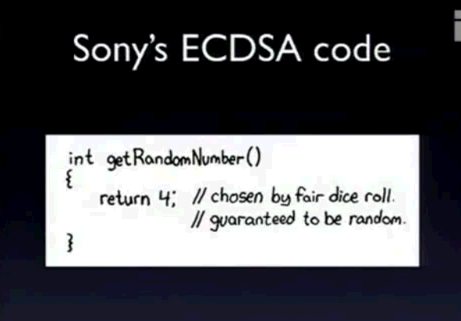
But by far the biggest copy protection related news this week was the hacking of the PS3. The fascinating story (well for a computer geek anyway) behind the hack is well worth watching the video here (especially the slide where Sony’s random number generator algorithm is explained), but the implications of this hack are rather big. The leak of the master key basically destroys the PS3’s ability to tell what’s an authorised piece of code, and what is not, and so in other words, pirated games can now be made to appear as if it was a legally, store bought version. This is stuff Sony have nightmares about, and makes the PS3 the least protected console currently on the market, completely reversing the position in just a few months time. And not coincidentally, it all started when Sony announced they would remove the Other OS feature from old PS3 (new “Slim” PS3 never had this feature), and this is when hackers around the world decided that hacking the PS3’s copy protection system would be the right thing to do. And the funniest thing is that Sony removed Other OS because they feared it would *eventually* be used for piracy, and this pre-emptive actions seems to have been the cause of opening up the console to massive piracy. Whatever limited piracy that could have been achieved with Other OS (which was all theoretical), can now be achieved without Other OS, all thanks to hackers wanting to bring back Other OS to the PS3. Awesome. And since the leak of the master key, progress on opening up the PS3 has moved along at a brisk pace, with tools for creating custom firmware already available, and at least one video demo of homebrew running on the latest, now jailbroken, firmware for the PS3. Sony issued the expected overly-optimistic evaluation of the situation (“committing suicide under the walls of Sony HQ”, etc …), but they know they’re beat. Solving the problem would probably require Sony to release new version of the hardware with a new key system (not just a new key), and there’s always the risk they will make *all* existing games unplayable due to the need for a new key system (a risk, I’m sure, Sony wouldn’t mind taking, given their track record on creating DRM related problems). Detecting modified consoles and banning them from PSN could also be on the cards.

But I actually think this will be good for the PS3. It makes the console even more versatile, and let’s be honest, piracy is one of the key drivers behind hardware sales. But of course, a strong selling PS3, and mass game piracy, won’t make Sony’s financial situation any better (it will be worse, actually). But at least the PS3 will be popular!

High Definition

In HD/3D news, Blu-ray broke through the $100m weekly sales barrier according to stats released this week. Of course, this is more an estimate, than actual sales figures, but it is still a sort of milestone for the format.

Blu-ray’s growth this year has been significant, but a lot of it is really just making for DVD’s losses, and not always capable of replacing all the lost sales. In fact, DVD sales are down 16% for 2010 compared to 2009, and despite Blu-ray’s revenue growth of 53%, total home video revenue is down 3%. But 3% is better than the 7.6% decline in 2009 (compared to 2008), and following the trend in everything last year, “not as bad” is the new “good”. Growth in digital media continues, with digital movie sales up 17%, and vide0-on-demand up 21%. And with Blu-ray, digital, and rentals, all taking away sales from DVD, it’s not surprising then that DVD sales are down. The problem for the industry is whether it can create more revenue, not just make up for lost ones, but in the current economic climate, and with some many other rivals in the entertainment space (games and gadgets of all kinds), maybe a 3% decline really is good news.

Star Wars on Blu-ray

Star Wars is coming to Blu-ray in September

And to the big news, from the CES I’ve been ignoring no less, is that Star Wars is coming to Blu-ray. Wait, hang on, didn’t we already know this? Yes, but we now have a release date, or rather, the month in which the release will happen: September 2011! Unfortunately, if you want all the new extra features and all that, you’ll have to buy the pack with the prequels in it too. They make you buy it, but you can’t force you to watch it (they haven’t invented the DRM to do this yet), so I guess it’s alright. At $90 at Amazon at the moment (purchase links, which will help out this poor blogger financially, plus videos of the launch/launch trailer are available here), it’s not the worst value in the world (not the best either).

Some of the other interesting things I’ve picked up from the CES news include the world’s first Wireless HDMI Blu-ray player, from Philips. Now all that’s needed are TVs that actually support Wireless HDMI. But if the wire-free future doesn’t interest you, how about a super wide future? 21:9 TVs, using the resolution 2560×1080, seems to be one of the highlights of the CES, with both Philips and Vizio announcing new models. Why is 21:9 good I hear you ask? Well, most movies are made using the aspect ratio 2.35/2.39/2.40 to 1, which roughly equals 21:9. You’ll then be able to watch these movies, like Star Wars, without those pesky black borders on the top and bottom of the screen. So what’s bad about 21:9? Well, you know how you have to watch old TV shows with the black border on the left and right? Well, with 21:9 TVs, you’ll have to watch all HDTV broadcasts this way as well, since these broadcasts, and many other movies, employ the 16:9 ratio, which wouldn’t fit into 21:9 TVs without black borders on the sides (unless you prefer seeing a very squashed picture). So these TVs are obviously aimed at home theatre fanatics, who probably have a automatic flip system installed so they can switch between 16:9 and 21:9 TVs depending on what they watch (and it’s only these people that can afford these TVs at the moment anyway).

Gaming

And finally in gaming, while Sony is busy doing damage control over the PS3 hack, Microsoft have had a happier time at the CES, announcing a couple of Kinect related news of interest.

First up is Microsoft’s bold claim of 8 million Kinects “sold”, but it was “sold” in the same way Sony says that 4.1 million Move was “sold” – it was 8 million Kinects shipped, not sold, but probably more than 5 million sold for Microsoft in the first 60 days of sales, beating the previous target which was already revised up (from the original target of 3 million). It’s an impressive set of results. Microsoft also launched Avatar Kinect, which nothing to do with blue people tails, but rather, it’s a way to do video chat without video. Instead of having a video of my ugly face, I can use my much prettier avatar and do a virtual chat with groups of people at a selectable virtual environment. And the Kinect camera is able to pick up not only my body motions, it can also pick up some basic facial expressions too.

And so when gamers make that angry face because their new Xbox 360’s are scratching their Kinect Adventures disc, it will all be picked up by the camera. All that Kinect related jumping is probably what’s causing the disc scratching, which is why it’s a must to install games to the HDD, and those with 4GB Kinects … do yourself (and your console) a favour and buy the 250GB accessory (or if you’re braver than me, buy the cheaper unofficial variety).

And here are some leaked pics of the upcoming Nintendo 3DS, which looks exactly like the official pics release earlier in the year, except with a lot poorer photography.

That’s all for now. Must rest for epic gaming session. Haven’t been outside in 4 days. Oh noes, soft drink and junk food supplies almost running out. And other hardcore gamer stereotypes.

See you next week.

A Sad New Year For Copyright

Tuesday, January 4th, 2011

The new year has just come, and a new year is usually filled with optimism and renewal. But certain things should not be renewed, and due to an unfortunate law passed in 1978, and amended 20 years later in 1998, they have been.

This is in reference to the 1978 passing of the (US) Copyright Act of 1976, which extended the maximum 56 years in which works could be copyrighted (from the date of publishing), to 70 years from the author’s passing, and the 1998 amendment that extended the original 56 years to 95, for works published between 1950 and 1963.

The Fellowship of the Ring

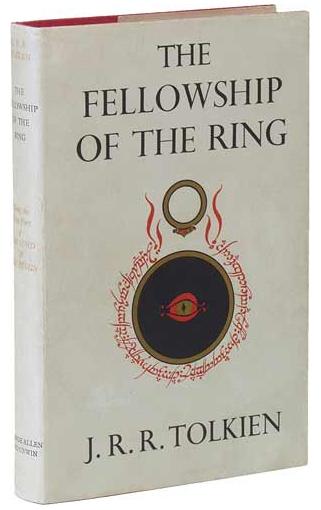
The Fellowship of the Ring would be in the public domain now based on pre-1978 laws

Without these two changes, works published in 1954 would have just become public domain on January 1st, and it includes books such as The Lord of the Flies, the first two Lord of the Rings books, Samuel Beckett’s Waiting for Godot, Dr. Seuss’ Horton Hears a Who!, Tennessee Williams’ Cat on a Hot Tin Roof; and movies such as On the Waterfront, Hitchcock’s Rear Window, Akira Kurasawa’s Seven Samurai, Disney’s 20000 Leagues Under the Sea and many more distinguished titles. We would then be able to read these books on our iPads and Kindles, or download and watch these movies on our computers, and all legally, without the need to pay.

With the original laws, authors would automatically have a 28 year hold on the copyright, which then can be renewed once for another 28 years, to 56 years. But now, we’ll have to mostly wait until 2050 until these works reach public domain.

But is this really a bad thing?

Copyright was designed to balance the need to protect the copyright holder’s interests in earning revenue from his or her works, and also the need for cultural preservation and enabling greater access to the classics. This prevents obscure works from being lost forever due to greedy copyright holders, and it also allows the greatest works of a past generation to be enjoyed in the public domain, for the benefit of all. But the ever increasing bias towards the copyright holder, means that the more noble, and arguably more important needs of society and civilization are being ignored.

But what would the likes of Tolkien, or Beckett or Hitchcock think of the current laws. Surely, they would be pleased that their works are “protected” for that much longer, and that if they were still alive today, they would still be able to rely on copyright revenue from these works. But according to the Copyright Office’s own stats for the pre-1978 days, only 7% of book authors renewed their copyright after the 28 year limit, and for other forms of works, only 15% bothered to do so. Had the copyright laws not been changed in 1978, it’s very likely that 85% of works produced since 1982 would now be in the public domain! But instead, we have to wait until 2077.

And instead, it’s the revenue of copyright holders that are being protected ahead of cultural interests. Except that facts shows us revenue, especially for books, dry up very quickly after the original publication for most works. And so works disappear into the void, and become known as orphan works – works that are still copyrighted, but not available commercially since the cost of publication and distribution greatly outweighs any potential revenue that can be derived from them. And so everybody loses.

Further reading:

http://www.law.duke.edu/cspd/publicdomainday/pre1976

Weekly News Roundup (2 January 2011)

Sunday, January 2nd, 2011

Welcome to this side of 2011, and the first WNR of the new decade. It is a new decade right? Because there was no year zero and all that nonsense. As expected, not a whole lot of news this week, but still actually more than I expected. Which is good, as otherwise, I would have had to do one of those awful “2010 year in review” pieces, and I hate doing those (mainly because I can barely remember what I wrote last week, let alone the whole year). So let’s not waste any time (one of my new year resolutions).

CopyrightStarting with a new year in copyright news, unfortunately it’s still the same old crap of government using *our* tax money to defend the business interests of an industry still relying on a old, decaying business model.

NYC Piracy Campaign

Piracy will cost New York a lot of money ... a lot in tax payer handouts to the MPAA

This time, it’s the city of New York, which is launching a new tax payer funded anti-piracy campaign. Not only is the campaign funny, in a stupid way, it is also severely misleading, and made worse by the fact that the city is struggling to balance its budget as it is, without spending a huge chunk of it helping out movie studios which has just had a record year in terms of profits. The MPAA used their usual scare campaign with made up figures such as “40% of camcorded pirated films come from New York”, a statement they made a couple of years ago (and then only days after claiming that “70%” of the same films come from Canada). This campaign uses the same scary figures, such as suggesting that if you pirate films, you’re putting 900,000 jobs in NYC in jeopardy. Not buying a movie that I wasn’t going to buy anyway, apparently, equals job losses. Nothing to do with austerity, cutting the city’s budget, and putting people out of a job just when the economy needs people to buy things (but that’s a debate for another blog, me thinks).

In any case, the fact that the MPAA can squeeze money out of a city that barely has the funds to even clean up the snowed in streets, shows just how powerful and successful their lobbying efforts, and that of their sister group, the RIAA, have been recently – both groups spent more than two millions dollars on lobbying combined in the last quarter alone. But lobbying can go both ways, and it appears that the under attack Rapidshare, which was recently listed by the RIAA/MPAA as a “notorious” website for piracy, is using some of its earnings to good effect, by lobbying the US government themselves so they can be treated fairly. The cyber locker company feels that they already have a takedown policy in place, a feature that the RIAA/MPAA could easily use to bring down pirated content, and so it makes them not so different to websites like YouTube, which relies on user uploaded content, and also suffers from users uploading copyrighted content. But we all know that while the RIAA/MPAA talks big about the consequences of piracy (twenty billion jobs lost every year!), but they aren’t really prepared to the hard work of actually stopping piracy online. Because going through the millions of uploads every day on RapidShare, most of them being legal, would take a lot of work indeed. Even suing is risky in that you could lose. And so it’s easier to just lobby the US government, which seems incapable of taking any other position other than the one the RIAA/MPAA wants them to take. And again, this all assumes that Internet downloads are seriously hurting both industries, and not their outdated business model (and it’s even debatable whether either industry are hurting at all, what with record profits and everything).

More news on mass litigation. Time Warner Cable has been accused of being a haven for pirates, after the company was sticking with an earlier agreement to only provide 10 IP to subscriber matches per month, making mass litigation against TWC customers almost impossible (if 5,000 people are sued,  it would take 41.7 years to get all of their info from TWC). But why does TWC have to do the hard work for law firms whose only interest is to make money, and having others do most of the work for them? In the newspaper mass lawsuits, Righthaven has defended the fact that they were suing non-profits for copyright infringement. Moral objections aside (yes, taking money away from charities and non-profits to make lawyers rich), Righthaven argues that just because people or organisations are not making money off re-posting newspaper articles, it doesn’t mean they can’t be sued for it. And they’ve also attacked the “fair use” defence, which some defendants have used. The argument is that because the newspaper provides sharing links and email sharing features, it means the newspaper is actively encouraging sharing, and so this makes copying the articles alright. I’m actually in somewhat of an agreement with Righthaven on this issue (shock, horror), since there’s a big difference between linking to an article and copying its contents (even if you do link to the original article). But there is also a big difference between a partial copying of the article, with link back to the original, and a full copy, but this is one distinction that Righthaven is not making when it is choosing its targets. In any case, I think it would be a mistake to use this fair use defence, as I don’t think it will stand up in court. Instead, one should concentrate on the actual damages being caused to the newspapers in question, and perhaps even highlight the positives of copying (making the article well known, improving the authoritativeness of the source, and if a link to the original was provided, extra “foot traffic” to the newspaper’s website). The reality is that newspapers aren’t losing a lot of money from people copying their articles – they’re losing a lot of money because they can’t solely rely on online advertising revenue to pay for costs, not if they make their news free. Which is why iPad and tablet subscriptions seems to be the next big thing, and my advice to them is that to concentrate less on suing potential customers, and actually try to give them attractive products they’re willing to pay for. Don’t abuse your online reputation for a quick buck, a short term decision that could cost you big in the long run.

Unfortunately, copyright gone mad is not a phenomenon that’s only limited to the US – it’s happening in Europe as well. The latest has Germany declaring war on kindergartens for daring to teach children songs, without paying royalty to the music labels. They want kindergartens to pay up every time they copy the lyrics of songs or the songs themselves, in their effort to educate the next generation. So far, they’re not actually preventing children from singing songs without paying royalty, but you know it’s only a matter of time before they do it. Pretty soon, even humming a song in public will be considered a public performance with royalty attached. Although this sounds far fetched and ridiculously, it isn’t that far from the truth when even ringtones have already been claimed by copyright groups as a public performance.

The other big news of the week was that the Windows 7 Phone DRM has already been broken. But that’s the nature of DRM isn’t it? If it can be used/played, then being copied isn’t so different that it can’t be eventually performed, even with ridiculous DRM in place. The only real way to stop copying is to stop the content being used in *any* way at all via DRM, something Sony is obviously working towards (see last week’s news about the DRM on the Salt DVD).

High Definition

Not much in HD/3D news, so despite promising not to do a year in review type of thing, I might just have to do it. But I’ll keep it short in the interest of writer and reader.

Blu-ray and DVD pricing on Amazon.com

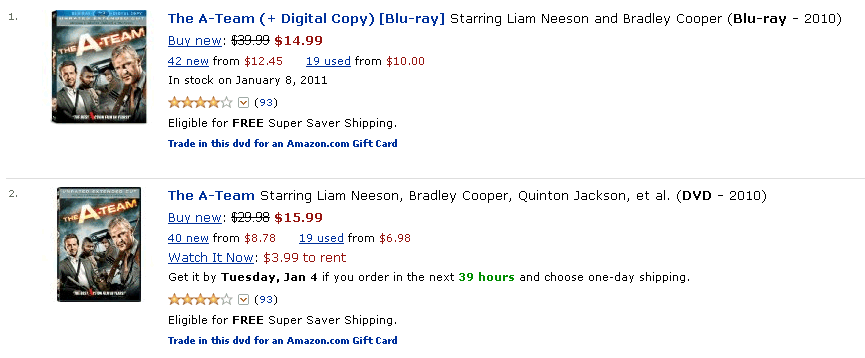
Blu-ray movies are starting to be priced cheaper than their DVD counterparts

So Blu-ray ended the year on a high, with records broken, although not really a huge advance on last year, despite aggressive pricing (can’t remember the number of times I’ve come across where the more fully featured Blu-ray version is cheaper than the DVD version, and sometimes the Blu-ray+DVD combo version is cheaper too). In my mind, the aggressive pricing indicates that studios are now prepared to let Blu-ray become a mainstream format, as opposed to a premium format that sells side by side with cheaper DVDs. This is good for consumers I think, since we’ll be able to get more (resolution, content) for less, something that may not be true if Blu-ray remained a premium product. 3D Blu-ray, on the other hand, seems to be fizzling out due to greedy studios and 3D TV manufacturers. For me, having the Avatar 3D Blu-ray on general release will help the 3D Blu-ray format take off, and make Fox a lot of money in the process, but making it a Panasonic exclusive gives 3D critics something legitimate to complain about. When 3D is already a hyped up, content scarce and gimmicky feature, the last thing it needs is content exclusivity. The whole point of 3D Blu-ray was to have a common format that allows for cross-brand compatibility, but exclusivity kills this in the most artificial way possible.

Gaming

In gaming, two pieces of DRM related news, and surprisingly, it’s all good (for the consumer, that is). It makes for a good end for 2010, and bodes well for 2011, I suppose.

The first piece of “good” news is that Ubisoft may have finally realised that making buyers of your games jump through hoops to play your games, may not be the best financial strategy, especially when it doesn’t stop piracy, and the pirated versions offer a better experience than the legitimate version. Through recent patches, Ubisoft has removed the requirement for an always-on Internet connection for the games Assassin’s Creed 2, and Splinter Cell: Conviction. Hopefully, it will be expanded to cover all their games. The DRM now only authenticates at every game start up, and does not come on during actual gaming.

In fact, while taking advantage of the Steam Holiday Sales (which is still going on as I type, with the big final day of sales coming tomorrow/in a few hours time depending on where you are), I noticed a lot of people avoiding UbiDRM games, even when they were offered for peanuts. Hopefully, Ubisoft has noticed this trend and that’s why they’ve reversed their previous stance.

Speaking of Steam’s sales, it’s confirmed to me the benefits of digital copies, particularly during sales. I’ve taken part in sales of physical goods, games in particular, in the last month, and there are so many more problems associated with that old model compared to the digital only model. First of all, stock is limited, meaning if you don’t rush in, you’ll miss out. And then, delivery is an issue, especially during the holidays, and especially during the adverse weather conditions experienced around the world right now. But with Steam, they can sell unlimited copies of a game at a low price without having to worry about stock levels, and delivery is instant. Although because Steam’s servers has been pounded by people downloading the dozens of games they’ve all purchased, downloads are not very quick at the moment, if it starts at all. That’s a problem, and hopefully Steam will bring more mirrors and CDNs online, to avoid the same congestion next year (they really need to work with ISPs to come up with some kind of local mirroring system).

Sony PS3 Hacked

A stupid error on Sony's part means that the PS3 is now hacked

The second piece of good news, at least for those that are cursing Sony for removing “Other OS” from the PS3, is that due to a serious security flaw in the PS3 authentication system, hackers were able to obtain the PS3’s private cryptography key, which for lay persons like myself, it means that the PS3 has been cracked, big time. The private key allows any application to be signed and accepted by the PS3 as a legitimate piece of code, meaning anything can now be run on the PS3, whether it’s pirated games, or a custom version of Linux used to turn the PS3 into a more fully featured media center. The irony is that Sony removed “Other OS” to pre-empt piracy, and if was this single act that spurred the hacking community’s best and brightest to completely destroy the PS3’s DRM system, and thus open the system up to unrestricted piracy. The PS3 – it really does do everything now.

While this will now open up the PS3 to pirated games, and turning it from one of the most secure game platforms to the least secure in a single stroke (or in this case, a single variable that should have been randomized, and not made a constant), it will also allow the continued development of custom HTPC solutions for the vastly powerful PS3 hardware, turning it into one of those must have pieces of kit, but only if you use custom software (like the original Xbox, and the subsequent XBMC development). And that, in the long run, probably helps the PS3 more than it hurts it. Maybe.

As for a roundup of 2010 for gaming? It’s quite simple really. Wii dying, PS3 hacked to pieces, Xbox 360 Slim FTW, and Kinect is actually pretty good.

And that’s that for the first ever issue of the WNR for 2011. The thought of having to bring out another 51 issues of WNR for this year alone makes me weep slightly inside, but a little ranting every week is good for the soul. Or something.

Weekly News Roundup (26 December 2010)

Sunday, December 26th, 2010

Welcome to this lovely Boxing Day, St Stephen’s Day, or simply day after Christmas, edition of the WNR, which is also the last of this year. As expected, the eggnog and alcohol filled week meant that the news was pretty light, so hopefully we’ll get through this one and it will be relatively painless.

CopyrightIn copyright news, the repercussions of the Cyber Monday Homeland Security/ICE raid is still being felt, and there’s more evidence to suggest that it was the RIAA/MPAA that were calling the shots in this one, and HS/ICE basically did whatever these industry groups told them to do.

dajaz1.com

dajaz1.com closed down by Homeland Security, and just like OnSmash.com, it was a website many in the industry supported, but one which the RIAA hated

The New York Times has started to investigate the websites that were closed, and at least one other website was like OnSmash.com, which only posted so called infringing material after being provided said material, via leaks, by artists and even the labels themselves. It seems that the RIAA, for some reason, resented this type of websites, and were intent to use this opportunity to have these websites closed down, even though there are plenty of higher profile targets. Perhaps these blogs bypassed the more mainstream promotional routes that RIAA members had financial interests in, or that these kind of promotional tactics are being deployed by smaller, independent labels outside of the reach of the RIAA, and they wanted to deal a blow to their competitors,  but it certainly seems that the reasons had very little to do with piracy.

But in order for Homeland Security and ICE to be used in this way by the RIAA, as a private security force, there has to be some level of incompetence or corruption going on. Ars technica has done further investigation into the agent in charge of this operation, as well as the affidavits filed for the case, and incompetence, as opposed to a vast conspiracy, seems more likely. The agent in charge, Andrew T. Reynolds, does not even have 2 years worth of experience the field of IP crime, and before that, he was only a “student trainee”. And the affidavits themselves were filled with phrases such as “according to the MPAA”, and some of the statements in relation to the cost of piracy are almost word for word reproductions of statements made in the past by the MPAA. For example, this is what Special Agent Reynolds said in the affidavit:

“Based on my participation in the investigation, I have learned that there is a ‘domino effect’ to online piracy… Domestic industries lose approximately $25.6 billion a year in revenue to piracy, the domestic economy loses nearly 375,000 jobs either directly or indirectly related to online piracy, and American workers lose more than $16 billion in annual earnings as result of copyright infringement.”

And this is what former MPAA Dan Glickman said in 2009:

“Copyright industries in the US lose $25.6 billion a year in revenue to piracy, the U.S. economy loses nearly 375,000 jobs either directly or indirectly related to the copyright industry, and American workers lose more than $16 billion in annual earnings”

It seems pretty clear the RIAA and MPAA were pulling the strings behind this investigation, and that Special Agent Reynolds’ inexperience made him extremely easy to manipulate.

MasterCard Law Enforcement

MasterCard has announced itself the new Internet Police, helping the RIAA/MPAA in stopping online piracy

If it wasn’t bad enough that the RIAA and MPAA now seems to control the  government, subverting due process, other companies are coming out to do the same, including MasterCard. After their recent controversial stance against Wikileaks, they’re on a roll by announcing that they will now help the RIAA and MPAA stop online piracy by stopping financial services for websites suspected of providing piracy. This is genius! Bypass the government and the courts entirely, and big corporations can now determine guilt and innocence, with zero appeals process unless you want to take MasterCard to civil court. And immediately, the RIAA has demanded that MasterCard take action against Megaupload. Megaupload, like any cyber locker websites, allows users to upload and share any files. Of course, some, and maybe quite a bit of the files being shared are of an infringing nature (Megaupload say they host over a billion legitimate files though), but like YouTube, Megaupload do have a takedown policy. Of course, if the RIAA were to take Megaupload to court, then the outcome will be very unpredictable, as similar cases against Rapidshare has yielded mixed results. And so when faced with uncertainty in the courts, why not just bypass it completely!

Megaupload has vowed to fight on, and questioned the circumvention of due process as an attack on democracy itself. “Will it be them (MasterCard), rather than elected governments, who decide what’s right and what’s wrong”, asked Bonnie Lam of Megaupload.  The fact is that Megaupload does have a mechanism for removing pirated content, but because it takes too much work for the RIAA/MPAA to track every illegally uploaded file, they’re bypassing the system completely, the very system that they demanded via the DMCA legislation. And you can see where this will lead to eventually. Imagine an ISP that refuses to implement the RIAA/MPAA’s plan for three-strikes, and then MasterCard swoops in and cuts off support for the ISP, claiming that the ISP obviously supports piracy. Or if Hollywood gets annoyed at Redbox for renting things to cheaply, why not just get MasterCard to swoop in again. And so on. It’s corporate intimidation, nothing more, and all because they want to stop the phantom piracy plague, but don’t want to actually do the hard work, or any work.

And it all comes down to the “$25.6 billion a year” that MPAA’s Dan Glickman referred to, and Special Agent Reynolds copy/pasted into “his” affidavit. Except there isn’t $25.6 billion, and there never was. It’s taking the suspected number of pirated downloads, inflate this number by a few factors, and then times the full retail costs of said content, and arriving at this fantasy figure. In other words, it’s saying that if piracy is stopped completely, that the group people (in the US only) who have otherwise been spending a total of $0 per year will now suddenly start to spend $25.6 billion per year, despite near 20% underemployment in the US. According to the FBI, 794,616 cars were stolen in 2009, with the average cost of the cars being at $6,505, or a combined total of $5.2 billion. I don’t see the auto industry claiming this $5.2 billion as lost sales, and how ridiculously would it be if they did try.

This brings up to the list of the most pirated movies of 2010. By my own calculations, the top 10 movie torrents resulted in 92.5 million downloads, and at the price of $20 per movie, that’s $1.85 billion right there. Of course, looking at the actual box office of these movies, you come to some strange conclusions. Avatar was top, as expected, but there was also room in the top 10 for the likes of Green Zone, which did poorly at the box office. Now, there can be several conclusions from this. The MPAA conclusion would be that piracy helped to reduce Green Zone’s box office, and so that’s $154.6 million in lost ticket sales in the US alone, despite the fact that Green Zone only recorded $95 million in *worldwide* ticket receipts. The sensible conclusion may be that a lot of those who downloaded this movie belong to the “wouldn’t pay for it, but would probably watch it if it was free” category, and that some of those that downloaded, and actually liked it, may have gone on to purchase the DVD or Blu-ray. And despite having being downloaded 16 million times, Avatar was still the best selling movie of all time. In fact, Avatar did almost three times as much business as The Lord of the Rings: Return of the King back in 2003, the third most popular movie of all time. Given that movie piracy is now a lot worse now than back in 2003, and adjusting for inflation, is piracy really a $25.6 billion dollar problem in the US alone? So Avatar should have done, what, six times as much business as the Oscar winning RotK? Avatar wasn’t *that* good!

Moving on to DRM, and again, Sony is making DRM headlines for the wrong reason. A new Sony DVD DRM appears to lock up DVD players to the point where it comes difficult to even eject the damn disc (so you can throw it at something in frustration). The new DRM appears on the Salt DVD. Incidentally, Salt was the 10th most downloaded movie of 2010, with 6.7 million downloads. Looks like this new DRM worked really well in stopping piracy. Now only if they can make a disc that won’t play at all, on any player, then maybe the piracy problem will be solved once and for all.

High Definition

In HD/3D news, the big news this week was the announced Blu-ray sales figures for the week ending 12th December, which is now officially the best week ever for Blu-ray, thanks largely to Inception. Of course, these stats are more estimates than actual sell-through numbers, but still, this all sounds very reasonable as the previous record was also set around this time, last year.

Of course, we then see a bunch of news articles about the rise of Blu-ray, and the fall of DVD. Which is true. Blu-ray sales, for the week ending 12th December, rose by 35.37%, with Blu-ray market share up nearly 54%. DVD sales, on the other hand, dropped by more than $85 millon for the same week. You see what I did there? I compared a very impressive percentage increase number for Blu-ray with an even more impressive (in a bad way) dollar figure for DVD. But when you add up the gain, and the loss, what do you get? That’s right, a $60.82 million dollar *loss* in combined DVD/Blu-ray revenue. Blu-ray may be surging, but it’s not surging fast enough at all, because 35% increase on $70 million is not enough to counter the 19% decrease on $442 million. Supposedly, downloads and streaming accounted for some of the DVD losses too.

And with reports that Wal-Mart was selling the Blu-ray+DVD combo version of Inception at only a single dollar over the 2-disc DVD-only version of the same movie, it’s not surprising why people are choosing the Blu-ray+DVD version over the DVD-only version. As a Blu-ray early adopter, I’m pretty much only buying movies on Blu-ray these days. One reason for this is that Blu-ray offers the chance to buy the best version of the movie available, whereas DVD represent buying into an obsolete format in terms of quality. But the main reason is that price wise, there’s almost nothing between DVD and Blu-ray these days, and in fact, the Blu-ray version is often cheaper. It’s almost as if Blu-ray has become the “budget” choice, or at least the better value choice, and so it’s not surprising to see Blu-ray sales increasing. It may come as a surprise to some in the entertainment industry, but lower price equals better sales (and less piracy as a result, I suspect).

Gaming

Which brings us to gaming, and the annual Steam Holiday Sales. If publishers ever wanted prove that lower prices equals more sales equals greater revenue, then the stats provided by Valve (operators of Steam) should have publishers changing their sales tactics (except we know they won’t).

Steam Holiday Sales

Steam's sales produce remarkable results, evidence that cheaper games will earn more for publishers, and also help to reduce piracy

Valve has figures that show when games are discounted by 75%, this lead to an amazing 1470% sales increase on average. That’s 15.7 times the sales, by charging a quarter of the previous price, which equates to almost 4 times as much in raw revenue. The extra buyers are coming no doubt from people who may have otherwise pirated the game, and so this is a very successful example of how the entertainment industry can convert piracy into dollars. Pirates are still gamers, movie or music lovers, and they do have money to spend. Just not as much as the industry wants to extract from them, but something is still better than nothing, and a lot of something adds up. With A-List games such as CoD: Black Ops or StarCraft II, they benefit less from price reductions (as people are buying them regardless), but the Steam figures show that even a 10% price reduction resulted in 35% increase in sales (or 1.2 times the revenue, compared to the unreduced price), so there exists a balance between pricing and piracy. But with average or even poor games, where people don’t feel justified in paying $60+, then a more aggressive price reduction could actually do wonders for revenue. People pay money for crap all the time (Slanket!), so it’s about finding the right price that people are willing to pay, even knowing the game is a bit crap.

And speaking of cheap games, The Humble Indie Bundle #2 event ended, with $1.8 million dollar worth of sales (or is that donations), beating the last event quite easily. On average, people paid $7.83 for the pack, even though they could have paid a lot less if they wanted to.

And the same thing applies to movies, and music. Price all movies at $5 on Blu-ray and $3 for permanent downloads, then see online piracy eliminated without the need to manipulate any Homeland Security and ICE agents, or heavens forbid, get MasterCard to swoop in.

And on that note, thus end WNR for 2010. Hope you’ve had a good year, and that the next one will be much better. An early Happy New Year to everyone.