Archive for the ‘Video Technology’ Category

Weekly News Roundup (16 March 2008)

Sunday, March 16th, 2008

What a week it has been. The server problem was finally fixed, although not without a lot of fixing and tweaking as you would expect when you do a major server move. Also received a bunch of cheap HD DVDs that I had ordered in previous weeks, pretty much all the titles I’ve ordered have now been received (I just need to find some time to watch them, that’s all). And I also celebrated my birthday during the week as well. So it’s been a busy week, and if there seems to be less news stories than normal, that’s probably why.

So let’s not waste any time and start with copyright news. The MPAA is at it again (I seem to use this phrase quite a lot. But blame the MPAA, not me). This time, they are against Net Neutrality, because it might hurt their plans to spy on everybody. Net Neutrality basically means leaving the Net alone and not placing restrictions on things like content types, connection modes and placing priority on certain types of content, while reducing priority on other “less desirable” content. Obviously, a restricted and regulated network will benefit the MPAA in their attempt to control how, when, where and what we download. Having big business tell us what we can and cannot do is, in my opinion, even worse than Big Brother type governments doing so … at least government are elected (in most countries).

On to HD. Now that people have finally gotten around to the idea that Blu-ray is *the* HD format for the future, questions are starting to be raised. Even staunch Blu-ray advocates such as Bill Hunt from The Digital Bits are starting to ask the BDA to make changes, the very changes that made people choose HD DVD like prices, profiles. We’ve been flooded with news of Blu-ray prices rises, both for hardware and movies, but I think it’s too soon to tell what the general direction Blu-ray will be heading to next. If the BDA is serious about replacing SD DVDs with Blu-ray, then prices will drop. If they see Blu-ray as a money maker that is needed to replaced flagging DVD sales, then prices may not drop as quickly as one would like. There is a very interesting read on Gizmondo that highlights some of the problems that Blu-ray will be facing in the short and long term. It certainly is a pretty pessimistic look at things, but you would have to agree with their key points, which are: the cost of the format war means prices drops will hurt manufacturers and studios, profile confusion, and productivity problems. On that last point, the article raises something quite interesting in that they speculate Universal studios might be having trouble releasing their titles on Blu-ray due to the entire 2008 production stock already being allocated to other studios. In other words, Universal can’t release movies on Blu-ray because they can’t get production time in the already over capacity production lines. New lines are being built, but they cannot come online quick enough. Of course, this might all be speculation, but one thing is for certain: HD DVD would not have experienced this problem as all recent DVD production lines are capable of producing HD DVDs. And speaking of former HD DVD studios releasing titles on Blu-ray, Paramount is apparently set to re-release their previous Blu-ray titles (before they went HD DVD exclusive) again next week. Seems that they kept their Blu-ray stock, as opposed to pulping them as some rumours had suggested. Unfortunately, Universal never got into Blu-ray production, so it will be some time before you see The Bourne Trilogy on Blu-ray. Another problem for Blu-ray is that upscaled DVD performance continues to improve. Oppo this week officially announced their new DVD upscaler, the DV-983H, which early testing has showed to be possibly the best performing on the market today. From my experience, a fairly average/poor HD encode is often the same or worse than a decent DVD encode upscaled (case in point, T2 Extreme Edition DVD vs T2 HD DVD Australian version). Such decent DVD encodes look very “HD” when upscaled, but the general rule is that real HD, when given a proper encoding, will always look better. But just because it is better, doesn’t mean people are prepared to pay extra for it … think DVD-Audio and SACD, although better video quality is easier to sell than better audio quality.

Meanwhile, HD DVD is selling quite well (the latest numbers showed a 10% market share jump for HD DVD in the US, even though the big sales haven’t really started, at least not at Australian “everything under $10” levels yet). For those that want to join in, keep an eye on this page and this page, as well as the blog. I wish somebody would release Australian sales numbers, because it must be at least 20:1 in HD DVD’s favour in the past few weeks. The Xbox 360 add-on drive is proving particularly popular due to its low price, but Microsoft this week denied again that they are working on a similar add-on for Blu-ray. 

Before I move on properly to gaming, DivX support is coming to a lot more Blu-ray players than just the PS3. In fact, their support will be even better than the PS3’s (which is a bit strange). Anyone who has used the PS3’s DivX/XviD playback function will know that it is somewhat limited, with no DivX Ultra support, no support for GMC/Q-Pel and has a few other problems as well. But when a file does work, it plays beautifully. And while the PS3 has had a firmware update (adds nothing of significance, other than some gaming compatibility fixes), the next big update will be interesting if they add enhanced DivX support, as well as perhaps DTS-HD MA decoding (the one essential Blu-ray feature that the PS3 sorely lacks) and even Profile 2.0, although I believe the latter two will be more likely to come only after standalones with similar features are available.

Now onto gaming proper, February’s US NPD figures are out and I will provide a full analysis in the next few days. Once again, all three gaming companies are claiming victory. Nintendo’s Wii sold the most, so they’re claiming they’re the best (with justification, IMO – but if I’m a bit sick and tired of seeing another story about how the Wii is helping the elderly, the injured and basically curing all disease and bringing world peace). Sony’s PS3 sold more than the Xbox 360, so they’re claiming victory too (mainly thanks to Blu-ray’s victory, I think). While Microsoft is still saying Xbox 360 stock shortages are affecting sales figures, and that they sold the most software and made the most profit, which they think is the most important. If Microsoft is really having stock problems, then what they say makes sense, since people are still choosing the 360 over the PS3 when it comes to multi-platform releases (Call of Duty 4, for example). It will be interesting to see which consoles gains most from the release of GTA IV, but I believe with the 360 install base much greater than the PS3 in the US, the 360 version of GTA IV, with the exclusive content, will probably sell more copies. I’ve yet to decide which version I would get (PS3 or 360), although I’m leaning towards 360 due to not having to buy another controller just to get rumble capabilities (and the fact that the 360 version was produced first, meaning it might play a little bit better). Once I assume 360 stock become plentiful again, Microsoft will fight the PS3 with further price cuts which will put pressure on Sony to follow. Expect to see a 360 GTA IV pack for less cost than the basic PS3, and it will sell like hotcakes.

See you next week.

Weekly News Roundup (2 March 2008)

Sunday, March 2nd, 2008

The month that can never make up its mind as to how many days it should have is finally over. Down with February. Long live March. I love March, not just because it’s the month that contains my birthday, but this is usually the time that I start to feel like the new year is officially here, and now in transition mode as per January, or the confused-as-to-how-many-days-it-has mode that is February.

The fallout from HD DVD’s death continues. Analysts have finally caught onto what I’ve been saying for months now, that Blu-ray’s victory owes much to the BDA’s love for copy protection, as it does to any other factors like the PS3. With DRM being public enemy number one these days, it’s funny to see DRM winning a major format war. I think Toshiba should have promoted the more consumer friendly nature of HD DVD more to the public, in terms of both region coding and less DRM, but I do understand why they didn’t. To do so would have opened another battlefront with DRM and region coding loving studios like Fox. It seems Toshiba really did not like the studio’s way of doing things, and they have now officially released DVD region-free firmware for several of their HD DVD players (or the XE1 at least, install 2.5 first and test to make sure, since once you go to 2.8, getting back to 2.5 is hard and only 2.5 has the region free patch) on their website (at least their Australian website). Unfortunately, it was this pro-consumer, anti-studio attitude that eventually lost the war for them. While as a HD DVD supporter, Warner was not our best friend in the format war, but at least you have to commend them for not supporting region control. Universal and Paramount too. F*ck Fox and their region coded and BD+ discs. Speaking of region control, there is now a new software for the Nintendo Wii that breaks region control (PAL and NTSC) games to work on your Wii. Simply insert the disc, it does its work, eject the disc and insert your game disc. Not sure if Nintendo intend to close this loophole with a firmware patch, or whether they even care about enforcing region control or not.

In HD news, the fallout from HD DVD’s death … wait, I’ve already used this line. Anyway, the big news for HD DVD supporters mourners this week has been Paramount’s (and Dreamwork’s) rather harsh decision to pull all their upcoming HD DVD releases. Just like what they did when they pulled Blu-ray support, with total disregard for consumers. If it wasn’t for their region-free stance, they have done nothing to help either HD format with both low quantity and quality releases. In my last blog entry, I talked about fire sales, and with Paramount stopping HD DVD releases, I think their fire sale will be coming shortly. I’ve started a thread in the forum to talk about HD DVD fire sales, and I will be posting news of any new fire sales there, and in the usual places. The fire sales here in Australia have attracted a lot of buyers (some genuine, while the people who bought 350 discs and 5 copies of each movie trying to take advantage of genuine buyers are scum of the Earth), me included. It’s surprising, but I feel lucky that I’ve bought into HD DVD, as the cheap $8 discs is something so rare, it hasn’t even happened regularly to DVDs yet (at least no in Australia). For the HD DVD movies I’ve bought to be released on to Blu-ray would take months, if not years, and it would still probably be the exact same content, but at 5 times the price. The only risk now is having discs, but not being able to source a player if people’s current players die. But that may not be a problem for long, as HD DVD might live on partly in another format. The DVD Forum (the official body that controls the DVD format) is continuing its support for the China-only CH DVD format, which is basically HD DVD with a different set of software. If CH DVD is a success, then chances are, one will be able to source a HD DVD player without too much problem in the future, which bodes well for those that have dipped their feet into the HD DVD fire sales.

Moving onto Blu-ray now, those worried about price rises now that Blu-ray has no competition will be startled to see a new Blu-ray player being priced at nearly $17,000! Obviously this is not a sign of things to come, but it’s still funny the price some people are willing to pay. I bet it’s not even Profile 1.1. Better news for those of us who don’t earn 7 figure incomes, Sony has announced two new Blu-ray players to be released in the latter part of the year. Both might eventually be BD-Live (Profile 2.0) compatible, although the cheaper of the two players, the BDP-S35,  might not have enough persistent storage to quality as a BD-Live compatible player, without you adding external storage through a USB thumb key. Not the most elegant solution, so I think the more expensive BDP-S550 is the way to go. It even has 7.1 analogue audio output, plus on-board decoding of all the major HD audio formats, so it looks like a good one. The more cynical side of me thinks Sony held back the news of these players until the format war looks to have ended, as it did not want to upset fellow CE manufacturers in the BDA. Now that Sony owns the one and only HD format, it looks like they won’t just sit back and let the other companies take advantage. Monopoly time …

Netflix is also set to take advantage of the conclusion of the format war. They will quadruple the number of Blu-ray titles available to rent, but may raise monthly subscription prices as a result. They’ve been harping on about raising prices for ages now, so don’t be too surprised when it happens. And while not strictly HD news, the people over at Secrets of Home Theater and Hi Fi have released an updated review for the PS3’s video playback performance. The previous review was criticized for only testing the then most updated firmware, which did not even include DVD upscaling. But unfortunately, the new result based on the latest firmware did not improve the scores by much. I’ve tried to explain the situation in the link above, and I think most people feel the same way: The PS3 is an excellent Blu-ray player, a more than adequate DVD upscaling player, but don’t expect it to compete with top of the line dedicated upscaling players as that’s not what it is designed to do.

To segue effortlessly from HD/video to gaming, this middle of the road story about the PS3’s new PlayTV (turns the PS3 into a DVR) feature will be DRM free. Good for Sony for taking a sensible approach to DRM for once. Let’s just hope people don’t take advantage of Sony’s lapse and turn the PS3 into the mother of all video piracy machines.

Segueing now to gaming completely, LucasArts will now produce games on the PS3 and then port it over to the 360, as opposed to doing it the other way. I don’t think this is because they luuurve the PS3 more than the 360, it just make more sense from the developer’s point of view to do this as it will mean better games for both platforms. Developers have often complained about porting 360 games to the PS3, since the PS3 has several design bottlenecks that is not easily solve when doing ports. It’s much better to design the game for a system that is more restrictive, and then port it over to the less restrictive/easier environment. And finally, Dead Rising, the game I’m still playing at the moment and the game that I played so much that caused my 360 to RRoD, has been sued for infringing the copyrights of the Dawn of the Dead franchise. So let’s see, Dead Rising is a game about a zombie outbreak and survivors holding up in a shopping mall. Dawn of the Dead (both movies) is about a zombie outbreak and survivors holding up in a shopping mall. Sorry, but I just don’t see the connection.

Over the next week, I will be bringing you details of a new competition that I will run on Digital Digest, prizes courtesy of Roxio, the makers of the famous Popcorn and MyDVD series. The prize includes copies of their latest DVD production, copying and conversion software, as well as a grand prize of an iPod. More details when they are available.

Okay, that’s it from me for this week – I’m going back to look for more HD DVD fire sale details, credit card in hand …

The Wireless Home Theatre (and beyond)

Thursday, January 24th, 2008

A couple of weeks ago, I promised to write a blog on new wireless video technology, and here it is.

There are a few competing standards, but for the purpose of this article, I will ignore yet another possible format war (wish it was this simple), and just concentrate on how wireless can help transform the home theatre.

Wire MessAnybody who has a home theatre will know that cabling is the biggest headache. Every device these days seems to need a power cord (that’s a given), some video/audio cords (if you’re lucky, it’s just a single HDMI cable, if you’re not, it’s a 3 pronged component cable plus 6 pronged analogue audio cables), and possibly an Ethernet cable too. Then you will probably have a switch, hub or receiver to distribute all the connected equipment to your display, not to mention a few connections directly to the display. What all this means is just a bunch of cables, possibly very messy.

But imagine if all the video and audio cables are replaced by wireless – and technology is now ripe to allow high bandwidth short distance wireless transmission (see UWB). These new types of wireless technology is all about high bandwidth, offering more than a hundred times the bandwidth of current wireless networking technology, at the expense of range. One of the wireless formats, WirelessHD, allows for 2 Gbit/s up to 20 Gbit/s transfer rates, which is more than enough for today’s video applications (HDMI is 10.2 Gbit/s). The range is anywhere between 5 to 10 meters, which compares favourably to wired connections. WirelessHD is supported by LG, Matsushita (Panasonic), NEC, Samsung, Sony and Toshiba – so pretty much everybody.

WirelessHD Logo

There will be a time when new equipment will have WirelessHD or something similar built in. Hopefully, the standard will be backwards compatible with both DVI and HDMI. Older equipment can be wireless-enabled by simply plugging in a wireless dongle to the existing wired connection port (eg. connect two dongles to each older device’s HDMI port – instant wireless HDMI connection is made). And add 802.11n wireless network support in place of Ethernet, and you now only have a single power cable to deal with.

And it’s not just for home theatres, imagine not having to connect your PC monitor to your PC using wires. Many people already have wireless keyboards and mouse, so the next natural step is the wireless monitor (although you still need a power cable). And of course, your PC will be able to connect wirelessly to your home theatre display, as long as it’s not too far away.

I for one welcome high bandwidth wireless technology, especially in the HD arena. Look out for WirelessHD and other products to be released throughout the year.

ATI Radeon HD 3870 versus NVIDIA 8800 GTS 512 MB

Saturday, December 29th, 2007

Not too long to go until 2008. For some reason, I keep on thinking it’s already 2008. Whenever a new year is reached, I usually feel quite strange writing out the new year in dates, but for some reason, I just don’t feel that way with 2008. Strange.

I’ve previously blogged about the GeForce 8800 GT, calling it the card that everyone has been waiting for (a bit of an exaggeration, I know). In the last month, both ATI and NVIDIA have released new/updated cards that I think is worth blogging about, because these cards now give serious competition to he 8800 GT.

ATI Radeon HD 3870First from ATI is the Radeon HD 3870 (3850 also available). I remember a time when ATI meant the fastest GPU that you can buy. But recently, NVIDIA has managed to keep ATI at arm’s length when it comes to performance, with the Radeon HD 2xxx series being rather disappointing. The 3870 aims to correct this. Unfortunately, it doesn’t really come close, and the low recommended price of the unit suggests even ATI knows this. 3D performance wise, you will be better off with any of the 8800 series – the performance of the 3870 is certainly better than that of the 2xxx series, but that’s not really saying much. But in video performance, especially HD acceleration, the 3870 is probably the best card available on the market, as it features ATI’s AVIVO HD and UVD acceleration. Both H.264, and possibly more importantly, VC-1, receive full hardware accleration, which will be much appreciated when people start to watch Blu-ray or HD DVD movies on your computer. You certainly can’t beat the price, so it would be a good card to built a home theatre PC around, a system that will give you excellent HD playback, as well as fairly decent gaming (which past HTPCs were mostly incapable of). The card comes with HDMI output, so ATI’s thinking behind the card is also HTPC oriented. You can read a full review of the 3870 and 3850 here.

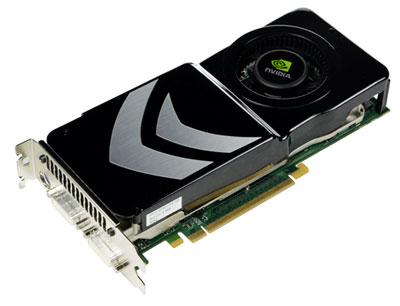
NVIDIA 8800 GTS 512 MBThe other new GPU is actually just a refresh of an existing range, the 8800 GTS. The original 8800 GTS came in 320 and 640 MB varieties. Some will remember that I recommended this GPU for the first “If I were to buy a computer today” feature back in September. It now uses a version of the G92 chip first introduced in the 8800 GT, and scales back the RAM from 640 MB to 512 MB. The new chip uses the 65 nm process, as compared to the 90 nm process in previous chips, so clock speed can now be ramped up to levels exceeding the GTX version and closer to the Ultra. In other words, it’s just a more efficient chip and the reason why the 8800 GT performs so well. The reduced process means more power efficiency and a cooler chip, which allowed the 8800 GT to be a single height card (but the 8800 GTS is a double height card like the Radeon HD 3870). But what does this all mean? Well, it simply means the 8800 GTS 512 MB is a kick-ass card 3D wise that will often outperform the more expensive 8800 GTX. In video/HD wise, it gives you the same acceleration as the 8800 GT, which in itself was a big improvement over the acceleration offered by all the other 8800 GPUs. Pricing wise, it should be closer to the 320 MB version of the GTS, rather than the 640 MB version – it’s about $100 more than the 3870, and about $50 more than the GT. You can read a full review of the 8800 GTS 512 MB here.

So how does the new 8800 GTS compare to the Radeon HD 3870? NVIDIA’s PureVideo HD does not support full VC-1 hardware accleration (it only supports partial acceleration), so the video performance is not as good as the 3870. So instead of close to zero percent CPU utilization, you might be seeing something like 10 to 15% on say mid-range Intel CPU. For those with slower CPUs, the 3870 might be a good choice to prevent CPU spikes that cause break-ups in playback. Otherwise, the 8800 GT/GTS will offer more than enough acceleration power to give you smooth playback.

But if gaming is a concern, than both the 8800 GT and GTS 512 MB are simply better choices. The latest games, like Crysis or Call of Duty 4, all require massive amounts of power and the 3870 is just not able to give you that. You feel that the 3870, had it been released about a year ago, would have been the card to have, but it really feels like too little too late from ATI at this time. For about $50 or $100 more, you can get the GT or GTS which will provide 15 to 25% better performance – the GT is even more suitable for a HTPC environment since it is a single height card and even a passive cooling version is available. The inferior HD acceleration found on the NVIDIA range is something I hope NVIDIA will address soon, but it’s not a huge deal considering the low price of mid to high range CPUs these days.

As for whether you should get the GT or GTS, it really depends on how much you are willing to pay for the extra 3D performance. For $50 more, it’s probably not a huge risk to go with the GTS.

Weekly News Roundup (23 December 2007)

Sunday, December 23rd, 2007

Welcome to the penultimate WNR of 2007. I love the word penultimate, I once thought that it was just a short way of saying the phrase “the pen is mightier than the sword”. I think I know what the word means now. It’s been a relatively quiet week, mainly because I haven’t been paying much attention as I’ve been writing my penultimate buyer’s guide for Blu-ray and HD DVD.

First up in copyright news is a legal analysis of the Sony BMG rootkit scandal, a look at why a company would try and do something so stupid and harmful to themselves. Speaking of doing harm to yourselves, TorrentSpy has lost their case against the MPAA because they were found to have destroyed evidence. If only they had been upfront about it, it might have made a more interesting and penultimately more successful legal battle. As someone who has personally being involved in a legal battle, I can honestly say that being truthful is your best weapon, especially if you truly believe you were correct in doing whatever you did to get you into trouble. Once you start destroying evidence and being evasive, it becomes a reflection of your guilt and the lawyers on the other side, as well as judges, can see it as clear as day.

Next up is HD  news. Digital Playground is releasing their first ever Blu-ray adult title after having released about a dozen ones on HD DVD. Ironically (or not), the movie “Pirates” is a spoof the popular Blu-ray hit “Pirates of the Caribbean”. Digital Playground was initial format neutral before giving up Blu-ray due to resistance within the US to adult Blu-ray disc pressing. They have now gone back to Blu-ray due to user demand, and Sony’s less harsh views towards pornography. The PS3 has been upgraded to Profile 1.1 as expected (so all those who took my advice about buying the PS3 for profile upgradability will be happy to read this news). The same update, also as I had predicted (in a forum post somewhere), also included DivX/XviD support, although initial tests show that it’s a bit disappointing compared to the 360’s support (no GMC/QPel support, which makes it equivalent to a standalone player from about 2 years ago). Meanwhile, hackers have redirected the Blu-ray website to point to the HD DVD one. Will Blu-ray supporting hackers retaliate? Are there any Blu-ray supporting hackers? I would think not many due to Blu-ray’s love for DRM, but you never know. And it’s been a bad week or two for Warner Brothers, as no less than three of their new Blu-ray releases contain glitches that will require disc replacement. I wonder how they managed to produce Blu-ray discs that were actually HD DVDs (don’t they use different manufacturing presses?), and how duplicated discs managed to get past quality assurance. Putting my Michael Bay Tin Foil Hat® on for a second, could this be a signal of Warner’s decision to go format exclusive early in the new year? Perhaps they just don’t care for Blu-ray as much as they do for HD DVD. Maybe the extra manufacturing cost and lower yields for Blu-ray discs means less money and time for QA? Or perhaps the Blu-ray manufacturing plant has had one hell of a Christmas party a few weeks ago that people are still being affected by it. Who knows. It is curious that they have not managed to stuff up any HD DVD discs, which have had the same number of releases as Blu-ray ones from Warner. HD DVD had glitches with the first batch of combo discs, but that was understandable since it was a new type of disc. Blu-ray’s recent glitches also include Disney’s “Pirates: Curse of the Black Pearl”, which had framing problems, and a replacement program is available for the disc.

In gaming news, most gaming sites now have results up for their “games of the year”. Halo 3 is on almost everybody’s list, as is Bioshock. Super Mario Galaxy is a sure thing as well. Mass Effect has received lots of awards and critical acclaim, and I’m not surprised at all after discovering the developer’s previous effort, Knights of the Old Republic II, a year or two ago. You can submit your vote for the game of the year on Digital Digest here. And having just tried the Call of Duty 4 demo on my 3 year old PC, I was surprised to find that it ran quite smoothly even though I was barely able to get Call of Duty 2 running in 640×480 on the same computer a year ago. And it looked quite good too, unlike most new games that I play on my aging system. And in something I will talk about more next week, there are a few new GPUs from ATI and NVIDIA that improves 3D performance and HD video acceleration – will they take the crown away from the 8800 GT, my currently recommended GPU? Find out next week.

See you next week.