Archive for the ‘Video Technology’ Category

Weekly News Roundup (22 November 2009)

Sunday, November 22nd, 2009

Just a reminder that our Womble EasyDVD competition is still open for entries. Since the competition was posted, Womble has actually released a new version of their MPEG Video Wizard DVD software, and the first prize of this competition include this latest version, which has basically combined the features of all of Womble’s previous software titles (not including EasyDVD, of course) into the same package (so no more “DVD-less” version of MVW, and MPEG2VCR). Not a huge news week, but there were some follow-ups to previous news stories.

Copyright

First up in copyright news, a recent trend has seen companies take advantage of the one sided copyright laws around the world to make money from “stopping” piracy. It’s actually not so much stopping, as that wouldn’t be good for business, but rather, using legal threats to get people to cough up. I posted about companies like DigiProtect and DigiRights Solutions doing exactly this sort of thing, and refining their business down to a fine art in terms of who to threaten, based on their ability and willingness to pay up, for example.

The funny thing was that most of the information I found in regards to these organisations were from interviews and presentations that people from these companies gave, quite openly. Obviously, there are still large parts of what they do that these companies would still rather keep secret. But secrets have a way to become well known facts thanks to the Internet, and now we have leaked documents showing us the inner workings of such an operation. One thing revealed was that, due to bad publicity, one law firm has already pulled out of this business, but it appears most of their staff went to a new law firm that obviously didn’t mind the bad publicity. Another thing revealed is the strategy to sue people who downloaded pirated porn, as the extra embarrassment and the instinct for most people to want to make the issue go away, whether they downloaded the porno or not, becomes extra incentive for people to pay the required amount. From everything that’s been released, leaked or public confessions, it’s clear that these companies prey on people’s fears of lawsuits, or public embarrassment, in order to maximize profit. But if these companies are acting within the law, then there’s nothing legally wrong with what they’re doing, even if it feels like bullying. It’s the laws themselves that allow for these things to happen, and it will continue to happen as long as these laws are biased towards one side.

And so the bullying goes on. Michael Fricklas, general cousel at Viacom,  has even admitted that suing downloaders is bullying. With the resources available to mega corporations like Viacom, suing individuals is the kind of one sided fight that really isn’t a fight at all. “Terrorism”, is what Mr. Fricklas called it. In the same candid discussion to a bunch of students at Yale, Mr. Fricklas also attacked DRM, at least the older kinds, as “really bad”, preferring fair use as the way forward. It’s all very nice to hear, but this is from the same company that is suing YouTube for people who upload videos that help to promote Viacom’s content, so you’d have to take all of this with a grain of salt. Obviously suing YouTube/Google is a bit more challenging and less like bullying than suing an individual, but YouTube now allows for “fair use” with its profit sharing programs, so why hasn’t Viacom dropped their lawsuit?

Verizon is the latest ISP to bow down to RIAA demands to pass on infringement notices

Verizon is the latest ISP to bow down to RIAA demands to pass on infringement notices

Speaking of lawsuits, the Australian AFACT vs iiNet trial continues, with closing statements by iiNet being made over last week. For those that haven’t been keeping track, the lawsuit centers around movie studios wanting to make ISPs responsible for their customer’s downloads, unless the ISPs act as copyright cops for the studios. The week 5 update thread for the trial is here. iiNet is at least making a stand, unlike ISPs in the US that have already bowed to the demands of the RIAA to pass on infringement notices to customers, the latest major ISP to do so is Verizon. The notices are designed to scare people enough so they stop downloading, but as such, Verizon and co have no plans to pass on customer details to the RIAA, and the RIAA has not indicated that they wish to pursue individual in court, something they’ve already said they would stop doing. So just how much fear these infringement notices will instill is debatable, unless the RIAA is really naive enough to think that some of the downloaders are actual unaware that what they’re doing is illegal, and that these notices serve as a timely reminder.

Oh, and remember that Lily Allen story from a couple of months ago where the singer publicly came out to support the industry’s attempts at copyright clampdown, and was subsequently, how would you kids say it, “pwned” in the process when it was revealed that she distributed pirated songs herself on her website? Anyway, the latest pearl of wisdom from Miss Allen is that she is absolutely fine with people downloading her songs illegally, as long as they burn the songs to CDs and then sell them on. Yes, that’s right, it’s not a typo. You see, if you sell these illegally obtained songs, and thus commit real piracy by profiting from it, you are actually just giving value to these songs, and so that’s alright.

The latest update in The Pirate Bay saga (I still have no idea whether they’ve been sold or not) is that the tracker is now officially dead and won’t be rising again. But thanks to the active pursuit of the RIAA and MPAA, new BitTorrent technology means that trackers are no longer really necessary, which means the decentralization of BitTorrent is approaching completion. When it does, BitTorrenting will be practically unstoppable. And with Magnet links, you don’t even need .torrent files anymore, so really, sites like The Pirate Bay can now only need to provide a link consisting of what appears to be a random set of letters and numbers, and really, can they be sued for that?

High Definition

In HD news, Warner has a new offer that allows you to trade in your old DVDs for Blu-ray movies. You don’t get the Blu-ray movies for free, but they are discounted. It’s a nice idea in theory, but only a small range of less than spectacular Blu-ray movies are available, and the discounts don’t add up to much if you’re already getting them cheaply from Amazon.

Blu-ray + DVD + Digital Copy is becoming a very popular combination

Blu-ray + DVD + Digital Copy is becoming a very popular combination

It appears that the studio’s new weapon to promote Blu-ray is to try and kill of DVDs as soon as possible. The trade in offer is one thing, but Universal’s plans to introduce Blu-ray/DVD combos, just like Disney, will probably do more wean people off DVDs especially if their plan to discontinue the DVD only versions of these movies is true. It’s very likely though that these combos would come at a higher price than their DVD only cousins, and I’m not sure if that actually helps to put people onto Blu-ray or to put them onto piracy. It doesn’t really seem fair to “tax” DVD owners for the sake of promoting Blu-ray.

And following YouTube’s announcement that 1080p video is now available, and it is (hover your mouse over the HD icon and select between 720p and 1080p), there’s more good news on this front. I talked about the performance implications, in that 50% of an Intel C2D E8500 is going to be kept busy decoding the 1080p video, but the good news is that now both Nvidia and ATI will offer GPU acceleration support for Flash video, which should see that 50% fall below 10%. All ATI Radeon HD 4000 series cards and the new 5700 and 5800 (and newer) cards will be supported, as well as most Nvidia cards since the 8000 series. While we’re not talking about Blu-ray quality video, but it really is a significant step towards digital delivery of HD content. Once bandwidth becomes cheaper and connection speeds improve, there doesn’t seem to be any reason why Blu-ray quality video can’t be delivered online.

There’s a bunch of PS3 news, some of it HD related, but I’ll post them in the gaming section …

Gaming

And lastly in gaming, PS3 firmware 3.10 has been released. This firmware adds Facebook support, which also came to the Xbox 360. But what’s a PS3 firmware without a chorus of complains, and this one seems to be particularly nasty from reading posts on the PS3 boards. I haven’t updated my firmware since 2.43, and don’t plan to unless some must have Blu-ray update arrives, or that Sony finally owns up to the problem and come up with some sort of solution that everyone is satisfied with, because I’m not paying $250 to repair it if things goes badly, which I suspect it will.

If the GeForce 3D kit is any indication, 3D Blu-ray will have quite a few hardware requirements

If the GeForce 3D kit is any indication, 3D Blu-ray will have quite a few hardware requirements

One of the “must have Blu-ray updates” might be for the 3D feature, which Sony says that PS3s will be able to support via a “simple” firmware update. Of course, you’ll still need a bunch of other equipment before you can have a 3D home theater experience, so it might be something to look out for if you’re buying a new TV (look for specific support for 3D, or failing that, at least 120 Hz refresh).

Another new to Blu-ray feature is a new Digital Copy feature Sony plans to introduce that copies the movie straight off the Blu-ray disc to your PS3 and then onto your PSP. The previous method required a PC, with a special DVD-ROM and unlock codes. Still, all these are just temporary solutions until Managed Copy arrives for Blu-ray on December 4th. There’s some confusion as to what December 4th means for Managed Copy, but the summary is that after this date, all new Blu-ray releases will have to support Managed Copy. What this means is a bit vague at the moment since the hardware (and software) for MC is not set to arrive until next year, but suffice to say that any movie released after December 4th should allow you to make a managed copy from them eventually. It is mandatory, meaning all discs must support it, and it took a fight to get MC being made as a mandatory requirement, so at least that’s some of the confusion out of the way. The news post for all three of these PS3 stories, none of which has much to do with gaming mind, can be found here.

And that was the week that was. Have a nice one.

Weekly News Roundup (15 November 2009)

Sunday, November 15th, 2009
Making a DVD menu is made simpler by Womble EasyDVD

Making a DVD menu is made simpler by Womble EasyDVD

As expected, following last week’s news blitz, this week has been relatively quiet. Which is a good thing because I managed to fill the gap with a new DVD authoring guide for Womble EasyDVD. Having played with the software for a week, I can say that it’s very easy to use and mostly intuitive. There are a couple of missing features such as subtitle support and multiple audio support, which I hope Womble can fix in future releases (this being their first effort after all, so you can’t have everything), but it’s mostly what you would expect, and the menu creation offers a bit more flexibility than your average authoring suite, without ever going into the semi-pro territory (complete with the much steeper learning curve) of tools like DVD-lab Pro. The other thing that was available this week was the October NPD US video game sales stats, I wrote the analysis for it yesterday here. The PS3 didn’t manage to sell over the Wii as it had in September, but it’s the Xbox 360 that’s the loser in terms of the recent price wars it seems, although it’s doing fantastically in software (for now, thanks to its larger install base). The coming months should give us an even clearer picture of what’s in store for 2010, and Microsoft will be hoping to see similar scenes as last year this time as people enthusiastically grab their cheaper holiday bundles. But I wouldn’t bet on it. Anyway, onto this week’s news.

Copyright

In copyright related news, the BBC’s proposal for adding DRM to their HD broadcasts has been denied by the British Office of Communications. But the idea isn’t entirely dead and the proposed DRM scheme may appear later on, with existing hardware likely to support such a DRM scheme if it is ever introduced.

The MPAA are still of course campaigning vigorously in the US to try and get the FCC to allow them to introduce  Selectable Output Control. The old “pro consumer” argument was brought out, to argue for SOC’s use in bringing new release movies faster to the home if the studios were more confident of its resistance to piracy. Many studios are already doing this without the fake security blanket that is SOC. But SOC is just a trojan horse for the MPAA, because once you can control one aspect of how someone watches TV, you can then control all aspects of it eventually. If the MPAA and their cohorts can get away with banning all  TV recordings, then does anyone really doubt that this is exactly what they would do? Pro consumer indeed.

Further prove that movie studios really don’t give a crap about the people that are supposedly their customers – a free community Wi-Fi service that brings tremendous benefits to a huge number of people has been shut down all because of a single piracy complaint, from Sony (who else?). It’s a case of the studios exploiting people’s fear over lawsuits, and an innovation that helps the local economy, local law enforcement, small businesses and visitors is attacked and destroyed. Obviously the people who decided to shut down the network, as the cost of adding anti-piracy filters is excessive, must shoulder some of the blame for this over reaction, but the MPAA’s reaction to the story shows the depth of their arrogance. Instead of calling for a reasoned approach and balanced response, that a single movie download does not constitute a widespread piracy operation, they used the occasion to further spread their anti-piracy propaganda. But that’s what they are. They are an industry lobby group and they’re paid to say and do these things. What is really wrong is politicians and others in power taking their word as gospel, and acting without taking into consideration the serious consequences  for issues like privacy, and the economic damage that would occur if the MPAA’s wishes were turned into reality.

iiNet's freezone: damned if you do, damned if you don't

iiNet's freezone: damned if you do, damned if you don't

It’s week 4 of the Australian AFACT vs iiNet trial, and it was closing statements time.  Once again, you can check out a summary of the week’s events here, but the arguments from both side remain the same. The AFACT thinks iiNet is basically a piracy provider, even suggesting that  the ISP’s use of phrases such as “happy downloading” was in fact an encouragement for people to download the latest Harry Potter movie. And even iiNet’s attempt at promoting legal content, through their freezone service, was attacked. You would think the movie studios should be delighted that ISPs are providing quota-less downloads for legal content as a way to to provide further incentives to go the legal route, but you would be wrong. The argument is that because quota is not used, it leaves more free quota for downloading pirated movies. The same argument was made for iiNet increasing download quotas for their customers, as the AFACT assumes anyone who needs a large download quota must be a movie pirate. This “sky is falling” and “you’re a pirate until proven otherwise” attitude that these lobby groups have adopted is working wonders in their political lobbying activities and have proved useful in the legal arena as well in the past. Our only hope is the judge can see through these exaggerated truth to balance the need for anti-piracy and the need to protect consumer rights, and the rights of ISPs to operate without being burdened by the responsibility to prevent piracy. Surely the industry that profits, often in record amounts, from the movies and TV shows that are being pirated should be the ones responsible, at least financially, for the anti-piracy operations, not the ISP or its subscribers. Either put up, or shut up.

Most independent game developers say that piracy is not a significant problem, at least for now, according to the latest survey. While most fear that it can become a big problem in the future, only 10% felt that it was a serious problem at the moment. One thing to note about  piracy, including games and movies, is that people who do have the ability to pay for content will usually do so. It is only those that never had any intention to pay for anything, some because they don’t have the capability, that are the more dedicated when it comes to sourcing pirated content online, and these people were never likely to provide any sort of income for the content owners, now or in the future. So the key is to at the very least increase the number of people who have the capability to pay for content, and that can only be achieved through pricing changes. Digital distribution allows this to occur without the cost being a huge issue (certainly compared to physical media and the associated costs like packaging, shipping  …), and even more reasonable pricing can open up previously untapped markets, such as developing countries where piracy rates are even higher. Or the alternative is to fight against logic and try to stop all piracy through technology that has proved inconvenient at best, and completely unworkable at worst, or through ever harsher legislation that completely disregard some of society’s basic principles in relation to justice and human rights.

Microsoft banning 1 million Xbox 360 accounts over suspected system modding (which allows for piracy) may seem excessive, but console piracy is actually not a huge problem and that’s worth examining. The anti-piracy success is largely to do with technology, all games consoles carry some form of DRM for games and being closed systems, they are easier to enforce (unless somebody decides to mod their Xbox 360, that is). The DRM systems used are also fairly straight forward, usually just a DVD check, and with digital downloads being available, even the DVD check won’t be necessary anymore. There are still many aspects of the DRM system that are inconvenient, such as when one needs to move from one console to another, but there are at least solutions and workarounds. And I guess more reasonable pricing comes into it. Games are expensive, but given the number of hours of entertainment they provide, it’s still better value compared to your typical movie or MP3. Consoles are also now very good at providing demos for new games, thus eliminating the need for people to “play before they pay” (which I admit is often used as an excuse for piracy, and play doesn’t always lead to pay). They certainly aren’t going out there lobbying the government to throw people off the Internet for downloading games, or getting ISPs to work as their spies, or suing individuals for using pirated games.

High Definition

HD news now. Not much on Blu-ray to report, but the holiday season is upon us and there will be a steady stream of big releases to give the format a big boost. But HD is more than just Blu-ray, and the future of HD may be SD.

Blockbuster tries SD digital rental

Blockbuster tries SD digital rental

Not SD, as in standard definition, but SD as in the memory storage format. Blockbuster is trialling a new way to rent movies by allowing customers to download them to their SD memory cards. These movies expire after 30 days if unwatched, or 48 hours after the first viewing. Obviously DRM is involved, but further details are a bit sketchy. If compatibility with hardware players, then the DRM used may be the SD card’s own internal DRM system, CPRM. This would then allow the actual video file to be unencrypted, and playable in a wide variety of players, probably. The lack of DRM on your common USB stick may be why they didn’t go with the more common format.

The other path for HD is digital distribution. The main stumbling block has always been bandwidth, and also processing power (many of the Netbooks you see today will struggle with 1080p content). But YouTube is not waiting around for things to catch up, and will roll out 1080p playback support next week. The link to the left has a couple of further links to test videos that you can already use to see if your system is fast enough for 1080p. On my Intel C2D E8500, I recorded 40 to 50% CPU usage, which is reasonable, but you can see why some Netbooks will struggle. With GPU assisted decoding (unfortunately Flash does not yet support ATI based solutions), the CPU usage can be greatly reduced. This was proven when I downloaded the YouTube 1080p video (about 100 MB for 4 minutes worth) and used PowerDVD 9 to play it back (as it supports GPU assisted decoding). CPU usage dropped to below 10%, and my ATI Radeon HD 4850 was hardly worked (about 5% usage) despite the CPU savings. So it seems for 1080p video delivered through YouTube, most modern computers should be able to handle it, some better than others depending on whether GPU assist is available or not now or in the future. The bandwidth usage is reasonable, roughly the same as downloading a DVD movie (so the 1080p quality isn’t as good as say Blu-ray, not really close yet), but it will still use a large chunk of people’s quotas.

Gaming

And lastly in gaming, not much to link to, except for the NPD analysis, which I’ve already linked to above. I think we finally have a proper console war on now, where there’s not much between the three top consoles, the Wii, Xbox 360 and PS3. The Wii has the superior hardware numbers, but is weak on games, especially third party ones and ones that appeal to hardcore gamers. The PS3 has only started to do well to suggest it may take top spot eventually, but there’s still some catching up to do both in hardware and software. The Xbox 360 is enjoying software sales, at least in the US, for now, but it won’t last forever if it the last two months becomes a trend and they continue to sell less consoles than the PS3. But they have a great multi-player community and that counts for more and more these days. And of course, Natal, which may be beaten to the punch, innovative software wise, by PS3 Eye Pet (a new category of games, using the buzz word  “augmented reality”) . But if Eye Pet is a success, then that may actually bode well for Natal, since it plans to offer similar things but in a more mainstream, and technologically advanced fashion. The only problem is the late release date, now semi confirmed as November 2010, which may be too late to help if things stay the way they are.

See you next week.

Weekly News Roundup (8 November 2009)

Sunday, November 8th, 2009

Some weeks you couldn’t buy a news story, this week, there’s enough for two weeks. Don’t really know why, perhaps the MPAA is upping their lobbying efforts, or the courts have resumed their cases, and parliaments are reconvened to pass new legislations. Who knows. On my end, I finished the review for WinDVD 2010 as promised. A summary? Well, I’d rather you read the full review, but suffice to say there are things that I like about WinDVD, and there are some things that its competitors have done that it has not. Is it a great Blu-ray player? Yes it is. Can it be better, that’s a yes too.

Copyright

Copyright news first, and there are quite a few to go through. Right after my last WNR, news came that torrent tracker UK-T was shut down, and some kind of police action was involved, but as no anti-piracy agency had claimed responsibility at that time, nobody was really sure what went down. Still not really sure what happened, but from leaked reports, it suggest that the police had raided the homes of several of the site’s admins. The database was wiped before the police could get their hands on it, and so the subscribers are safe. One tracker down, only 362,621 to go.

Demonoid: Tracker back online. Database corruption, or something more sinister?

Demonoid: Tracker back online. Database corruption, or something more sinister?

But while one torrent tracker was down, another came back up. Demonoid has been down for ages now, supposedly due to a database problem, but the tracker is at least up again, if not the main website. I’ve noticed that several torrent sites have experienced similar database problems recently, so it could be just a coincidence, or perhaps something more sinister? If it was just an accident, then these accidents have actually done more to stop torrent sites than all the legal actions. Take The Pirate Bay for example. The latest attempt to shut the site down, or at least prevent access to it in Norway, has failed. The entertainment lobby had asked the Norwegian court to get Norway’s largest ISP Telenor to shut down access to the torrent site, but the court said “Nei” as they didn’t think an ISP should be the one deciding which websites its customers get access to, and which it should block. And the implication of this ruling is that ISPs are not really responsible for what their customers get up to, since if they were, then the court would have told them to shut off access. To me, this is common sense,  and Telenor’s spokesman’s analogy of not being able to sue a ladder manufacturer because someone used the ladder to commit a burglary again seems to make sense to me. But common sense is in short supply these days when it comes to the copyright debate.

The failed attempt to shut down The Pirate Bay again deals another blow to the MPAA and their friends, but do they really want the torrent site to be shut down? According to a new study, they should be careful of what they wish for, because during the few days that The Pirate Bay was down, the number of torrent trackers and websites dramatically increased, and downloading continued. The way modern torrent clients work, even without a working tracker, downloads can continued thanks to a technology called DHT (Distributed Hashed Table), or so called trackerless downloads. The download speed is sometimes affected, but not always. And with TPB down, many sees it as an opportunity to become the new TPB, and so naturally, the number of torrent and trackers will surge during this period. It just shows how hard it is to actually try and stop file sharing, and I think it may actually be impossible. All the resources that have been spent on trying to stop file sharing seems like a big waste to me. And even more so when you consider the stats that show that people who download illegal songs actually spend more on music than those who don’t. This again seems like common sense to me, because people who download music (legally, or illegally) are the ones that love music, and many are using free downloads as a way to search for new songs and artists. This “buy before you try” argument has been made for other content as well, like games, although the percentage that converts from try to buy is rather low, nevertheless, there is a percentage. Music especially I think is something that you do need to try before you buy, that’s why we have radio stations that broadcast songs, for free. The music industry, and others, should be exploiting this phenomenon to their advantage instead of trying to shut it down. Spotify, the free online music service, seems to signal a possible future direction, basically taking the radio model online.

The MPAA's propaganda ministry is busy these days

The MPAA's propaganda ministry is busy these days

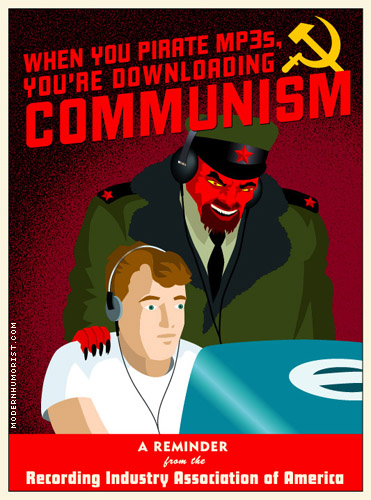
There’s still more copyright news, we’re barely half way through. The MPAA has been busy lobbying the FCC for various things. And as a concerted campaign, they had the US 60 Minutes broadcast a copyright propaganda film that tried to link file sharing with organized crime. There are links between counterfeit goods and physical media piracy with organized crime, but online file sharing that’s mostly free? The downloading communism poster immediately springs to mind (see right). More propaganda as the MPAA says the Internet will die if piracy is not stopped. This is the same MPAA that has been trying to kill the Internet for ages now, that its members and supporters have publicly stated their wish that the Internet had never existed, so why are they so worried about its health now? And the MPAA is not just happy pushing their agenda on the US, they’re going global as well. You can just see their dirty fingerprints over the proposed copyright treaty that will be discussed in South Korea this month. The worst part is that the treaty is being kept super top secret, even though it affects everyone. Of course, the Internet being the Internet, part of the discussions were leaked and it was indeed what we fear most. Three-strikes, global DMCA, ISP policing … are just some of the MPAA’s favourite things, and all will be tabled at the secret discussions later this month. Sigh.

Scumbag

Sarkozy's defence of major US corporations' interests has even led to a fight with the EU

Three-strikes and ISP policing, very popular at the moment, but the EU has decided that something needs to be done to protect consumer rights, even if what they did was not nearly enough. But it’s a start. The EU has decided that Internet access is a basic right, and as such, cutting people’s connections off will require more than just an email from the MPAA. The EU has ruled that a fair process must be in place before bannings can occur, which is less than the full criminal trial that consumer and Internet advocates had first wanted. This all came after France wanted to introduce something that legalized their three-strikes plan (the original one that didn’t require the judicial system, which their own constitutional council found to be, well, unconstitutional), and that angered pretty much everyone at the EU, and the battle has been fought ever since, leading to this latest compromise. Just what has happened to France, a country that I’ve always considered to be quite liberal and would usually be at the front lines fighting *against* the three-strikes nonsense, and not on the side of mega US corporations. Freedom and liberty is also another thing I associate with France, but they just seem to be one the wrong side of that as well because time and time again, it has been shown that copyright laws have been abused to stifle free speech and the critics of corporations. The Electronic Frontier Foundation even has a Hall of Shame for the companies and organizations that have abused copyright laws for their own (non copyright related) benefits. It just shows that when laws are so biased towards one side, they are prime candidates for abuse. And for me it’s hard to digest the fact that a country like France is in there arguing to make these laws even more one sided, and even more open to abuse. But with a guy like Sarkozy at the helm, now using the nations divisions for his political gain, no one expect anything less really. Hall of shame indeed.

The global DMCA thing is particularly annoying, although not that much of an impact since most countries have adopted some draconian form of it. One country is Denmark, and one citizen is doing his unique way of protesting the illogical nature of the laws. Under the DMCA, or the Danish equivalent, any attempt (even unsuccessful) at breaking DRM is considered illegal. However, Danish law allows for DVDs to be ripped for legal home use, and so the two Danish laws actually conflict each other. This is why Henrik Andersen confessed his “crimes” of ripping hundreds of his legally purchased DVDs for use in his home theater setup, to a Danish anti-piracy agency. Under the DMCA, Mr Andersen is guilty and should be fined, if not jailed. But just whose interests has he actually hurt? Certainly not the movie studios that he purchased his DVDs from.

Still more copyright stuff, bear with me. The third week of the Australian AFACT vs iiNet trial continues, and please refer to my summary forum post to keep yourself updated on this rather important trial, possibly the most important in the world right now concerning the copyright issue, as it seeks to decide if ISPs should be turned into copyright cops.

And in all this bad news, there’s a glimmer of hope for a fair solution that everyone can live with. Google/YouTube is finding that their compromise solution to the copyright issue, of sharing revenue with content owners if they choose not to remove stuff from YouTube, might be working. And working well, as a third of all their YouTube revenue is coming from this trial program. And it’s not just the extra revenue, the exposure on YouTube leads to more business opportunities for content owners, like the case of Mr Bean, the popular UK comedy series, in which the content owners decided to keep the user uploaded clips online, as opposed to removing it, and then found that it actually led to deals with TV stations countries that have never heard of Mr Bean before. So a bit of technical piracy actually led to a successful TV deal, and all while still making money from YouTube  profit sharing. And yet others, like Viacom, are still hell bent on suing YouTube into oblivion. Shorted sighted or what?

High Definition

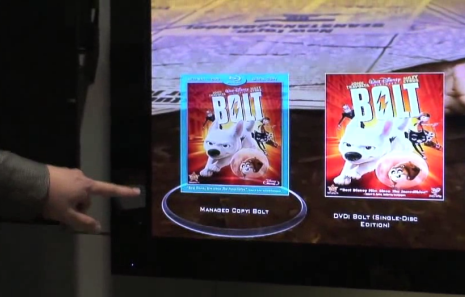
Well that was a big section wasn’t it. On to HD news now, although it’s still copyright related, I’m afraid. Managed Copy, the so called legal solution to movie ripping, will soon be upon us. December 4th marks the date that MC becomes a reality on Blu-ray.

Managed Copy in a Pioneer demo for the movie Bolt

Managed Copy in a Pioneer demo for the movie Bolt

I’m excited about MC, because it signals the first step that the movie industry has taken to legitimize the need for people to be able to separate the movie from the disc that it came on. With today’s increasingly digital world and sophisticated home theater solutions, being able to have everything as pure digital data is increasingly useful. Imagine having all your DVD and Blu-ray movies stored digitally and accessible with a few clicks of your remote. It makes categorizing easier, searching even more so, and it will be faster as well, and quieter due to the lack of a spinning optical drive. But to make this reality requires you to break several laws at the moment, but MC might be just what is needed to solve this problem.

But while I’m excited, the movie studios are less so apparently, as there’s just no support for MC despite the December 4th deadline. I suppose this is something whose success and popularity will only be apparent after it has been introduced, and just like the “Digital Copy” feature that the movie studios have only now grown to love, it’s going to take a time before they overcome their fears. And this could be the feature to keep Blu-ray in the game when it eventually goes head to head with digital distribution  (with Best Buy the latest to get into the digital download market). Whether you get it from the Internet, or from a USB stick, or on a Blu-ray disc, in the end, it’s the digital movie that’s important, not the way it arrives to your home. And for HD content, Blu-ray disc (sent via the postal system) may still be the best solution, from a cost and even speed perspective (see pigeon test).

Gaming

And lastly in gaming, Sony’s losses from the PS3 have now topped $4.6 billion. But Sony is hoping to add perhaps a couple of more billions to this figure, as the more they lose, it means the more PS3 consoles they are selling, and that’s a good thing for them in the long term, if extremely hurtful in the short. In the post I made there are also links to the losses being made by Nintendo and Microsoft. The amazing figures for Nintendo, in which they’ve been in profit every year since the stats were first available, shows that even though they’ve had a few failed consoles in between, their strategy of concentrating on fun first, and technology second, is still paying off.

And that’s the news for this week. I’m willing to bet that next week will be super quiet as news sources regurgitate this week’s news items in various flavours. Oh, I got my graphics card back from warranty (the first one, with the broken fan). It’s now working great and the average temperature was about 10 degrees (Celsius) lower than when I first got the card, meaning that even when the fan was spinning, it was still overheating.

Weekly News Roundup (13 September 2009)

Sunday, September 13th, 2009

I managed to get the August 2009 US video games sales analysis done, based on NPD stats as usual. August was an interesting month, with the PS3 price cut and the PS3 Slim announcements, plus the Xbox 360 price cut as well. September may prove to be even more interesting, with the PS3 Slim official going on sale right at the beginning of the month and the Xbox 360 price cut in full focus as well. But August was, in most areas, as expected, but Nintendo has got to be worrying a bit because it might lose its steady hold on second place in the hardware charts, and may even slip back to as much as fourth, depending on how successful the Xbox 360 price cut is. Other than that, it was a pretty quiet week with the US Labor Day holiday meaning no news for a couple of days. This allowed me to finally complete GTA IV, to gain the 100% completion stat (don’t believe me? Go to the Rockstar Social Club’s GTA IV 100% page, and search for my nick, LastMinuteGoal, which is the 3895th global entry if you sort by “joined”). Read it and weep (you read it, I weep as I realise the amount of time I’ve wasted trying to get this stat).

Copyright

Let’s start with copyright news in this very quiet week, which means I’ll have to ramp up my rant-o-gizmo to fill the space. I can also write completely meaningless sentences that occupy a lot of space, which makes this WNR look more content rich at first glance, but not too much as to make it too boring to read or too much like the ramblings of a mad men, which does nobody any favours, unless of course you’re auditioning for the TV show of the same name, which I have yet to watch a single episode of, although I’ve been meaning to. I’ve heard good things about it.

With the above 85 useless words out of the way, do you still remember the Amazon Kindle thing? Well, it was a huge PR disaster for Amazon as they deleted 1984, of all books, from people’s Kindle e-Book reader remotely without their permission. They’ve apologised, issued refunds, and lots of other things, but the latest should finally settle matters once and for all. Or at least Amazon hopes so. They’ve promised to replace copies of the deleted books, this time with authorised copies, and this should restore people’s notes that were also lost when Amazon pulled the plug. Those that no longer want the books can choose to receive $30 gift certificates instead. It’s nice of them, but it’s too little too late, and while I doubt Amazon would pull a stunt like this in the future for fear or further backlash, but the fact of the matter is that the ability to do so remains, and DRM is still evil.

Redbox: Hollywood's latest target in their crusade against innovation

Redbox: Hollywood's latest target in their crusade against innovation

Hollywood’s latest target is Redbox, the DVD rental vending machine. Universal Studios, Fox and Warner Bros. have threatened to stop the supply of movies to Redbox, so they will no longer be able to rent out movies from these studios. Redbox had earlier made deals with Paramount and Sony, but the demands of these other studios were designed to basically to put Redbox out of business, and so at the moment, no deal seems likely. Amongst the demands are that Redbox destroy all rental copies they no longer need, which previously they sold cheaply on the second hand market. I won’t mention the environmental impact of this, but since Redbox has already agreed to this demand with Paramount and Sony, this wasn’t the major point of contention. What Universal and co. wanted was 40% of all of Redbox’s profit from the rental business as royalty, which is simply ridiculous and something they do not demand from other rental businesses. Also, they want to price fix the rentals to ensure it doesn’t go below $1.00 per night. And as if these demands weren’t enough, the studios also want Redbox to only rent movies 45 days after release, so as not to hurt the straight sales business. You might wonder why the studios want Redbox to fail? It could be because Redbox’s cheap rentals means less profits for studios, or that it might really hurt their sales business (although in my experience, people who buy movies will always buy them, and people who rent will rarely buy them, regardless of how many days you delay the availability of rentals). But I think it’s because studios fear losing control, and Redbox’s business model means studios have less and less control over how their discs are sold. It doesn’t matter if it benefits consumers, or that this could lead to bigger and better things, even for studios, as Redbox expands and perhaps gets into the digital download kiosk business. Change is what the Hollywood studios fear, change to their traditional business models for which they’ve gotten very rich on over the years. And it’s not the first time Hollywood has challenged innovation, as they did with VCRs (it was also Universal Studios, back then versus Betamax), DVRs, HDTV (see last week’s story on selectable output control), digital movie storage systems (like Kaleidescape) and digital downloads.

The British Academy of Songwriters, Composers and Authors, one of the musician organizations opposed to a three-strikes system

The British Academy of Songwriters, Composers and Authors, organizations opposed to a three-strikes system

And it’s not just Hollywood, the music industry is even worse at dealing with change. The whole DRM’d music fiasco, which eventually forced the studios to back down, was a total waste of time and money. And now, their crusade against Internet users seems to be succeeding, at least when it comes to lobbying governments for three-strike Internet banning systems. But the studios claim they are only looking after the musicians, whose hard work does deserve to be rewarded, but do musicians really think that banning potential customers and fans from the Internet is really the solution? They do not. At least not the UK ones, as groups representing the likes of Sir Elton John and Sir Paul McCartney have made it clear that they vehemently opposed to any such plans to ban people from the Internet. The Featured Artists Coalition, the British Academy of Songwriters, Composers and Authors and the Music Producers Guild have all called the three-strikes system as “extraordinarily negative”. They believe there are other ways to raise profits, like through integration with video games like the Guitar Hero series, and they are right. Video gaming is a growing business, often at the expense of music sales, as interactivity is what people crave these days. There are also other solutions, such as a subscription download system, or more focus on music video digital downloads, but just like Hollywood, the music studios want to protect their old way of doing things, which has also served them well, but perhaps no longer cuts it in today’s digital world.

Movies, music – software is another product that’s experiencing growing piracy. But again, the industry fails to grasp and take advantage of the changes in people’s needs, and their latest attempt at an anti-piracy video, dubbed the worst ever, proves this. It only shows how out of touch these industries are when it comes to dealing with piracy, and how they totally fail to connect to the current generation by using a modified campaign from the 90’s (against floppy disk piracy, no less) to fight piracy. The fact that the video compares a college student sharing some DVDs with professional pirates who are arrested and sent to prison, just shows how they are not grasping at the difference between piracy for profit and personal piracy. They’re also still assuming people do it because A, they don’t think they’ll get caught, and B, that they don’t know it’s illegal. They do know it’s illegal, and maybe they do think they won’t get caught (and statistically, they’re right), but most do it because they can’t afford to do anything else if they really really need a piece of software, or music or movie (academically, or even for social reasons, as you want to keep up with friends who do use said software or have watched and listened to the movie or music). It’s not an excuse, that is true, but it’s also a fact. The legal alternative is of course for the people who cannot afford it to not use it, but does that really help the software, music or movie industry? They don’t get any extra profit from people not using their products, and they certainly lose a lot of the Internet based hype surrounding tools like Photoshop, or the latest movie, or music video. And from the loss of this, they  actually lose more money as a result. Of course, they could discount things to make it affordable, so that every person who pirates it now will become a loyal customer. And I suspect for a $300 piece of software, the number of people who pirate it will greatly outnumber the people who buy it, possibly by a factor of 100 to 1 – and so the companies can reduce prices by a factor of 100 (to $3) and still make the same amount of money, but they only need to reduce prices by a much smaller factor, and they will actually come out ahead. Would you still pirate Windows 7 if you could buy a copy for $49, as opposed to $199?

High Definition

Let’s move on to high def news. Sony is the latest manufacturer to add video streaming support to their Blu-ray player. This is actually kind of a big news, for the founding father of Blu-ray to adopt support for a form of video distribution that is seen as a competitor to Blu-ray, and perhaps even eventual successor once bandwidth catches up. Sony will add Netflix, YouTube and Slacker support to the BDP-N460.

Sony's BDP-N460 will feature Netflix, YouTube and Slacker integration

Sony's BDP-N460 will feature Netflix, YouTube and Slacker integration

In the same news post, LG also announced that they’re adding Vudu support via a firmware update to their Blu-ray player range, which already includes impressive support for Netflix, YouTube and CinemaNow, as well as Wifi capabilities and support for home network media streaming. Samsung has been equally busy adding everything from YouTube support to MKV playback and USB drive input. It seems the disc playing capabilities of these players have been relegated to almost a side feature, as these “media boxes” (for want of a better description) can do a lot of things that were once limited to a cumbersome HTPC, or games consoles. And this is good for the consumer as they get these for no added cost, and great for the video streaming companies that can forgo expensive and usually ineffective set-top-box rollouts. And it’s all thanks to BD-Live, or rather, the requirement of BD-Live to include Internet connection capabilities on players (and to a lesser extent, Bonus-View, which requires on-board storage that can be used for video streaming, as well as downloads). And BD-Live being available so quickly after Blu-ray’s introduction is, in a small part, thanks to HD DVD’s mandatory Internet connection requirement, without which the Blu-ray people might not have had the competitive urge to ad what could be seen as a entry point or a Trojan Horse for a competing distribution service.

Gaming

And lastly in gaming, Sony is still feeling great after the successful launch of the PS3 Slim, and the price cut that went along with it. What they’re not feeling too great about is perhaps the reaction to the PS3 3.00 firmware, which has disappointed a lot of PS3 owners. I know I talked about this last week, but this week, even Sony admitted that some of the changes brought about by the new firmware has been a failure, like the changes to the friend list, and they’ve suggested that changes are being made. So 3.01 shouldn’t be too far away, but it’s nice to know that they do respond to feedback, which they haven’t done enough in relation to firmware updates. And whoever thought that using a major version number like 3.00 was a good idea without introducing any major new features, should be sacked. It wasn’t even as if the previous firmware had reached 2.99 and there was no way to go by to 3.00, and even then, they should have done a 2.991. Don’t raise people’s expectations, especially when it comes to fanboys that have very active imaginations when it comes to pre-emptive gloating about how great the new firmware is going to be when it comes out.

So that’s all for this week. Should be more news next week, and with GTA IV out of the way, I might even bother to search the net and find some, although that Monopoly Cities Streets thing has been interesting me enough to suggest I might have found something else to occupy myself (please don’t put hazards on my streets, pretty please!). See you then.

Weekly News Roundup (9 August 2009)

Sunday, August 9th, 2009

Another relatively quiet week. There are actually lots of news stories, but most of them say the same things, are followups to (or just really really late versions of) previous week’s news stories, and some are nothing more than PR fluff pieces. I try to filter out these kinds stories, and only report on the important, interesting ones. When I’m not busy playing games that is. Or rather than playing, let’s say “fixing” instead, because that’s what playing GTA IV feels like. Rockstar’s PC efforts have always been poorer cousins of the console versions, but GTA IV in its current state takes the bugginess to a whole new other level. Read my blog post to find out more about how to fix or work around some of the more annoying bugs, but nothing I wrote really helps to make the problems go away, only to make them slightly more manageable.

Copyright

In Copyright news, the owner of Filesoup, one of the oldest torrent sites around, has been arrested. His home was raided, things left in a complete mess, he was denied a phone call or access to legal council for 7 hours, and the Filesoup website is still up and running.

The owner's may have been arrested, his home raided, but the Filesoup.com remains online

The owner's may have been arrested, his home raided, but the Filesoup.com remains online

Since when did these sorts of copyright infringements, something that at worst only does monetary damage to billion dollar corporations, become such a serious offence that the police need to get involved? Are there no terrorist left to capture? No murderers to apprehend? The copyright lobby has been telling governments around the world scary bed time stories in an effort to scare them into doing things against the very principles of democracy, against the constitutions of their respective countries, and against normal legal procedure, and it’s all working. And that’s just the ones that get to court – governments at the behest of copyright agencies are still trying to bring in a 3 strike system where they can get rid of this little thing called due process entirely. But the ones that do get to court, are even more notorious, just like the recent two cases with the 6 and 7 figure damages being rewarded against defendants that probably don’t even have 6 or 7 thousand dollars in their names.

The rewards were so outrageous, that even copyright lawyers representing the content owners are not too happy at the damages being rewarded, fearing it may backfire. Content owners want to use these damage rewards to deter future infringements, but too much money and it may force the courts and the government to step in a put a limit on things, due to the public backlash. But does anyone really thing this will stop piracy? Every copyright warning message, yes including those annoying ones you can’t skip on DVDs, point out the possible consequences of piracy – a large fine and even prison time, but why do people still pirate stuff? Is it because they have no alternative, as they can’t afford it, like the cost of filling up your average iPod with purchased music? Is it because illegal downloads are easier and more user friendly, not having to go to shops to buy DVDs, and no DRM? Or as in some cases, you aren’t being allowed to purchase something until the content owners have maximised their profits through rental agreements, TV licensing, tiered releasing, and that the only alternative becomes downloads?

This is an example of an Xbox 360 mod kit. Some mod kits are the first step towards making Xbox 360's play backup games

This is an example of an Xbox 360 mod kit. Some mod kits are the first step towards making Xbox 360's play backup games

But the law is on the side of content owners, ever since they pushed the DMCA through the US congress, on the back of fears that the digital revolution was going to bring about the end of capitalism as we know it. And the politicians believed them, even easier to do so when you have large contributions to smooth your doubts. The latest case is that of an Xbox 360 modder has been arrested and could face 10 years in prison, thanks to the DMCA. See under the DMCA, you don’t have to actually do damage to anyone to break this law. All you have to do is to circumvent copyright protection, regardless of how badly implemented the copy protection may be, or what you intend to do after copy protection has been broken. I could mod my Xbox 360, and then smash it up so that it won’t work anymore, and yet, I’ve still broken the DMCA (if I was an American, of course). Or take a more common situation, where I mod my Xbox 360 so I can play backups of my legally purchased games that the Xbox 360 keeps on scratching (through the well known design fault, or just through daily abuse). Now if I do this, then who am I hurting exactly? Not Microsoft or the game publishers, because I’m still buying games from them. In fact, the only one I may have hurt is myself as I might have just voided my warranty. And I’m actually helping Microsoft by not bringing in the console to repair the disc scratching problem. But I’ve still broken the DMCA and I could face big fines and time in prison. Some countries have laws where you’re guilty until proven innocent – the DMCA simply assumes you’re guilty in all situations.

Speaking of game consoles, Nintendo’s DS is one of the most pirate friendly consoles around, thanks to flash carts. Nintendo still makes big money from the DS though, and the DS’s popularity is probably directly linked to the ease in which you can play backup or pirated games on it. The DSi, Nintendo’s update for the DS, was supposed to address this by introducing frequently firmware updates that disables flash carts from being used. The latest version, 1.4, managed to do to almost all known flash carts, but it only took a week for the flash cart manufacturers to bring out their own firmware update that made piracy possible again. If you can play it, you can copy it (and play the copy) – that’s that conclusion I’ve come up with after many years of observing various copy protection methods. Again, it goes back to the point of how one stops piracy, and perhaps some of the things I listed above like looking at prices, release schedules, and making purchases easier, are way more effective than firmware updates. Or even putting your hands up and admitting, okay our system is pirate friendly, but that’s why it’s so popular and it’s something we have to live with.

The Australia ISP, iiNet, is still engaged in legal battle with Australia’s own MPAA/RIAA, the AFACT. iiNet is now seeking help from industry bodies to testify on its behalf that ISP in general are helpless to stop the torrent of copyright abuses that its customers are guilty of. If one takes a view that things like human rights, privacy, are important, then ISPs shouldn’t be spying on their customers on anyone’s behalf, just like phone companies shouldn’t be recording and listening in on your phone calls just to see if you’ve been saying naughty things. Now the police, through a court order, may be able to perform eavesdropping (and I see monitoring Internet usage the same as phone tapping, actually even more effective because you get a much more complete picture of a person’s activities) – private companies cannot, and no court would grant a private company the right to spy on an individual, no matter how serious the offence is (because if it is the private company petitioning the court, then it is only a civil matter, not a criminal one). So if McDonald’s can’t tap my phone to find out why I’ve stopped eating Big Macs, why should Warner Bros. get the right to monitor my downloads to see if I’ve stopped buying their movies?

High Definition

Copyright rant over (is it me, or is the Copyright section getting longer and longer, and rantier and rantier?). On to HD news. Not much this week, but just some continuing trends that may concern the Blu-ray people.

On the surface, Blu-ray has a great week thanks to Watchmen. According to the sales stats, Blu-ray has its best week since The Dark Knight, again thanks to a Warner release. Part of the reasons for the good numbers may be because the PS3 special edition of the Watchmen game, which came with the Blu-ray version of the movie – I have no idea if sales of these packs were included in the stats though (the game itself did rather average business, so it may not matter). There are a couple of even bigger releases this year, including Star Trek, Transformers 2, Terminator Salvation – movies that will definitely do well on Blu-ray, not only because they were big movies at the box office, but these are exactly the types of movies to attract early adopters, HT enthusiasts, and the PS3 demography.

The Panasonic DMP-BD80K is one of the Blu-ray players getting Amazon VOD streaming

The Panasonic DMP-BD80K is one of the Blu-ray players getting Amazon VOD streaming

So what’s the bad news? Panasonic is going to include Amazon video-on-demand in its Blu-ray players, as part of the VieraCast service which already streams YouTube videos. Why is that somehow bad news? Well, it’s not bad news. It’s news to be concerned about, because that’s the third major Blu-ray manufacturer to include video streaming, after LG and Samsung chose to support Netflix. It’s good news for Blu-ray because players are now more fully featured and attractive to buyers. It may be bad news in the future if this video streaming thing takes off and Blu-ray becomes nothing more than a sideshow in the home theater arena. I doubt this will happen because you’ll get tons of people like me who like discs. But I also like things on demand, and a subscription service for unlimited access to a huge movie library works out to be cheaper than buying each movie individually eventually. But that’s for something to worry about in the future, because Blu-ray quality HD streaming is years away from becoming available in every home. But the movement towards video streaming is gathering pace, you cannot deny this.

While not HD specifically, Google has purchased On2, which makes several video codecs including the VP6, VP8. This is all part of the browser video wars that I brought up a few weeks ago. Nothing to concern your average net user, but developers and video enthusiasts will be interested to see if an open source video codec, like Ogg Theora, can take center stage, or will a commercially effort like H.264 win out. Google likes Ogg, and it can now use the expertise and technology purchased through the On2 deal to help out Ogg to improve quality, where H.264 is still  a better choice than Ogg. I love open source, but I also like H.264 for its quality and wide acceptance, but I don’t see how the consumer can be hurt by having a couple of alternatives, including an open source one.

Gaming

Not much happening in gaming. We’re still waiting for the Sony PS3 Slim announcement, and maybe something will happen next week, or the week after, in this front.

PS2 owned the original Xbox and it was expected that the PS3 would do the same to the Xbox 360 (stats from Wikipedia)

PS2 owned the original Xbox and it was expected that the PS3 would do the same to the Xbox 360 (stats from Wikipedia)

Now when fanboys argue, they use stats. One of the stats is that Sony’s PS3, while only doing half the sale of the Xbox 360 in the US, is actually only slightly behind the 360 in worldwide numbers, thanks to strong sales in Japan and stronger sales in Europe (compared to the US). And this is all despite the PS3 being released a year later than the 360. Now this seems to suggest that the PS3 isn’t doing as badly as the media portrays (including this blog, if you can call it part of the “media”), and it will lead fans of the PS3 to say that there’s a media bias in play here. The figures are not wrong, and neither is the conclusion that the PS3 is on level terms when it comes to worldwide sales, but for this to be “good news” for Sony, it assumes one thing: that the Xbox 360 was supposed to sell on even terms with the PS3. The actual fact was that the PS3 was expected to outsell the Xbox 360 handsomely, even with the delayed release – if the PS2 versus Xbox is any indication, an 8 to 1 sales ratio wouldn’t have been a surprise. The Wii kind of made a mess of the scene, since nobody figured Nintendo was going to be in it, let alone win it, but ignore the Wii and the PS3 was still supposed to sell a lot better than the Xbox 360, with US and worldwide numbers more in line with what we are currently seeing in Japan, where the Xbox 360 struggles badly.

But this hasn’t happened. And Microsoft’s gamble of launching a faulty, less sophisticated console a year earlier seems to have paid off. If at the end of this console generation, Microsoft can claim a 1 to 2 sales ratio (that’s one Xbox 360 for every PS3 sold), then they’ve done tremendously well and made huge strides into the gaming industry, of which Sony has much more  experienced with. If the Xbox 360 can sell on level terms with the PS3, then that’s something even the most optimistic Microsoft projections wouldn’t have dared to proclaim just 3 years ago. But of course, the Wii will outsell both combined.

Okie dokie. That’s the news/rant for the week. More next week.