Archive for the ‘News Roundup’ Category

Weekly News Roundup (18 April 2010)

Sunday, April 18th, 2010

I managed to ramble my way through a mid-week blog post about the future of TV. The focus on fighting piracy has so far centered on stopping the flow of illegal content, and punishing those that download them. I argue that a better strategy is to provide new unique, innovative services that betters piracy in terms of providing convenience. It is true that people download pirated stuff because it’s free, but let’s admit it, they also do it because sometimes it’s just really convenient. And as I said in the future of TV blog post, if the legal outlets are not beating pirated content  on convenience (and quality), then that’s something that should be addressed. My next mad rambling will be about the future of movie viewing and collection, which came to me in a dream last night.

Copyright

There’s a few news stories to go through, so let’s get started with the copyright news. Let’s get the really really outrageous stuff out of the way first, and leave the normal level of outrageous stuff for later on.

The MPAA Is Watching You

The MPAA Is Watching You

The MPAA and RIAA has proposed several new anti-piracy measures, a wish list if you will, to the Office of Intellectual Property Enforcement. Had this list been released a couple of weeks earlier, then surely people would have guessed wrongly that this was some kind of April Fools joke, but the MPAA and RIAA are not joking around. ISP level monitoring of suspicious content, permanent blocking of websites that the MPAA/RIAA suspects may be engaging in piracy, and the “best” suggestion of all is the creation of a spyware tool that sits on users’ computers, actively scanning and deleting suspected pirated content. Note my use of “suspicious” and “suspect” – without a court of law ruling for or against, that’s what all of this is. But the copyright holders and groups like the MPAA and RIAA that represents them want allegations to become evidence, for mere suspicion to become guilt, and using the government and public resources to circumvent due process. Through money and fear based lobbying, the MPAA and RIAA can achieve its goals, and this is a real threat to everyone’s freedoms and to democracy itself. This is not an exaggeration. When they are proposing things like search and seizure of people’s laptops and MP3 players at airports due to the potential of finding pirated content on them, when they want to ban people and websites from the Internet and so cut off the most potent form of communication for their opponents, to control what people can do and can’t do in their own homes with their legally purchased items, to go as far as proposing a software that monitors people’s usage of their personal computers – these are not exaggerations. The fact that the public has been kept in the dark regarding the ACTA global anti-piracy treaty is further evidence of this threat. This nice rant by CNET blogger Molly Wood says as much, in a less mad rambolic way, in a new blog entry that’s a call to arms to stop the emerging copyright police state. “Copyright police state” describes exactly what the MPAA/RIAA is seeking to create, because it’s the only way they can ensure their future, their power, is guaranteed. Otherwise they may have to, you know, change and adapt, and that stuff is hard.

And when governments are clueless about the legislations they’re passing, then the dystopic future that we all fear becomes one step closer to reality. Case in point, the newly passed UK anti-piracy bill, passed politicians that actually think an IP address is an “Intellectual Property address”, has already been exploited by scam artists scaring people into paying “pre-trial settlements”. See, this is what happens when you pass laws that bypass due process, because without the legal checks and balances, anyone can exploit the system for their own gain, and citizens who have had their rights stripped away no longer feel able to defend themselves, and so fall prey to these sort of scams. The malware itself pretends that it is being sent on behalf of well known law firms which have been engaging in “pre-trial settlement” mailings. This isn’t the only malware out there right now pretending to be some kind of anti-piracy measure, and there’s news of one in Japan where it also asks for “pre-trial settlements”, and users face the embarrassment of having their browser history published if they do not pay up. And if they do pay up, their credit card details are stolen as a result. Well, what does that tell you about these requests for “pre-trial settlements” from legitimate organisations, in that people confuse them with genuine blackmail attempts. The good news is that yet another law firm has withdrawn from this kind of activity, due to a public backlash.

But the most frustrating thing about all of this is that it won’t stop piracy at all. There are already many techniques which exists that allows people to bypass the measures put in place so they can download pirated content to their heart’s content. And by pushing people towards these harder to monitor areas of the net, it will make piracy stronger and these short sighted measures will only end up hurting the copyright holders more in the long term.

High Definition

In HD news, PS3’s 3D Blu-ray support will not be coming until later the year. 3D will be coming to the PS3 in June, but only for 3D games. This would seem to be Sony’s way to give their and others 3D standalones a chance at retail, since I don’t think technical reasons  are what’s responsible for the delay in 3D Blu-ray support. So for early adopters, you’ll have to look elsewhere to get your 3D movie fix.

Blu-ray 3D Logo

Blu-ray 3D won't be coming to the PS3 until later in the year

Fox and Universal have made a deal with Netflix to provide more content for online streaming, but new releases will be delayed by 28 days. It’s the kind of deal Netflix and alternative distributors like Redbox have had to accept, as studios try to maximize their DVD and Blu-ray sales revenue by giving them an exclusive release window.

Speaking of alternative distributors, Seagate and Paramount are trying something new, by pre-loading movies on portable hard-drives that Seagate sells. These movies aren’t free though, they still need to be paid for and unlocked to be viewed, and as with any DRM, interoperability limitations mean these files won’t play on too many other devices. It’s an interesting idea, but the only effort that this method saves the consumer is the actual download process, which between all the DRM unlocking and the need to find a compatible player for the DRM’d file, isn’t a very inconvenient step in comparison.

The HTML5, H.264, browsers debacle continues to confuse, with Google now adding to the format confusion by making the VP8 video codec open source. Google recently absorbed On2, the company that makes the VP series of codecs. Google says that by making VP8 open source, this provides an alternative to browser makers that don’t want to pay for the proprietary H.264, but also don’t think the free Ogg Theora format is good enough in quality. If Google can convince the likes of Nvidia, ATI and Intel to provide GPU based hardware acceleration or decoding assist for VP8, then perhaps we do have a viable alternative, but it’s hard seeing anyone take on H.264, which has firmly established itself as the industry standard codec (H.264 is used by YouTube, Blu-ray, Apple, to name a few of the format’s supporters). The MPEG-LA needs to waive royalties for H.264 support for browsers, which I think is the quickest way to resolve this issue, as opposed to introducing and promoting yet another video format in VP8.

Gaming

And finally in gaming, last week I mentioned that Amazon UK refunded an user who complained the PS3 now no longer supporting the “Other OS” function, despite it being promoted as one of the features of the PS3 in Amazon’s sales description.

Sony has now officially confirmed they will not be subsidizing retailers that give out these kind of refunds, and so Amazon UK either has to continue to provide refunds out of their own pocket, or most likely, stop providing refunds. Class action lawsuit time?

And I know the March NPD figures are out, and I will post the analysis as soon as possible, probably tomorrow. The Xbox 360 lost the number one spot as expected, but still managed to beat the PS3. But Sony stole the show with a strong showing in software sales, also as expected.

That’s all for this week. Talk to you again  in 604800 seconds.

Weekly News Roundup (11 April 2010)

Sunday, April 11th, 2010

How was your week? Mine was busy, but not so much working on the website, so no mid week blog post or new articles to promote in the intro paragraph of the WNR for this week. So let’s do the most efficient thing and get straight into the news.

Copyright

Let’s start with copyright news. The Consumerist published the account of one user with the THQ/Volition game Red Faction Guerrilla, which once again is the story of how DRM prevented a legitimate paying customer from enjoying the product he/she purchased, and once again piracy became the only solution.

Red Faction Guerrilla PC DVD-ROM

Red Faction Guerrilla DRM caused user to resort to piracy

The user tried his or her best to get THQ/Volition to resolve the issue, who didn’t want anything to do with it and instead referred the user to Microsoft, which maintains one of the DRM system used by Red Faction Guerrilla. But Microsoft then asked the user to go back to THQ/Volition, and so the only solution left was to download a pirated copy of the game, just so the user can enjoy the game that he or she paid for.

First of all, it’s totally irresponsible for game publishers to bring out poorly implemented DRM and then not provide support for it. It’s exactly this kind of attitude that make buying games not worth the trouble, since you’re not getting any extra services compared to pirated version. This is especially true for PC games, most of which will barely run without crashing on half of the PCs out there, mostly due to poor programming. What is more annoying is that game publishers justify these kind of stories, which are becoming increasingly common, by saying that this prevents piracy. But does it? Only the recent Ubisoft effort has managed to stifle pirates, but it may only be a temporary reprieve. But most other forms of DRM have been comprehensively cracked, and as I’ve analysed in my PC DRM discussion blog post, the only thing DRM manages to is to give publishers a false sense of security, to make them feel like they’re doing something. The argument is that why should publishers make it easy for pirates, but the problem is that they also make it harder for legitimate paying customers. The only kind of DRM that is acceptable is one that does not cause paying customers any inconvenience – if this means that it will be less effective against pirates, then so be it. I mean, it’s like asking people to accept a lock to your front door that occasionally locks out the owner, and then rewrite the law to make it illegal to try and break the lock (so you can get into your own home). And then to add insult to injury, the lock maker refuses to offer any help in trying to fix the problem, mostly because they know they can’t do much to fix it. In the real world, nobody would accept any of this, but somehow when it comes to DRM, we’re supposed to be okay with it all.

And it’s not okay to just say “well, the user resolved the issue after downloading the pirated copy”. What that user did was still highly illegal, and he or she may get caught and face big fines, even prison – all while having tried to do the decent thing in the first place. There are now more and more firms that have been set up to take advantage of the unfair copyright laws to go after users that have attempted to download pirated content, and if the user who wrote in to the Consumerist was caught, then that would mean a double whammy – having paid for the game and then “fined” for piracy of it. Of course, the actions of these firms is another point of contention with the current set of biased copyright laws. These companies are only interested in making money, or monetizing, off piracy, not preventing it – this is not an educated guess, but it’s very much out in the open and these firms openly admit to the fact that they’re only there to take advantage of copyright laws to make a quick buck. You may call the actions of these firms legal blackmail, but as long as the law allows it, then they’re not doing anything wrong. What is wrong is a law that can find an user guilty just because they attempted to download pirated content. Up to the point an user downloads something to their computer, it could be the case where no damages has actually been made against the copyright holders. Only until that user starts to enjoy the content in question, then that’s when possible damages could have occurred, but of course only if the user has intentions to purchase the content in the first place. The situation is a little bit more complex in relation to BitTorrent, since you’re uploading while you’re downloading, so you are “making available” pirated content. But for straight HTTP downloads, this is pretty straight forward. Imagine a scenario where I download an illegal copy of a movie from RapidShare, and then upon completion, I delete the file right away without viewing it – what harm exactly did I do to the copyright holders of the movie? But even with BitTorrent, you’re only sharing small chunks of the file in question, unless you become a seeder and share the file for an extended period, you’re not contributing much at all to the sharing process (as leechers who are annoyed at the lack of seeders, will agree).

The Digital Economy Bill passes through the British House of Commons

It’s these nuances that legislation, like the recently passed UK Digital Economy Bill, do not cover sufficiently, as the people writing the laws usually often do not have a clue how the Internet works, let alone sub-networks like BitTorrent. Politicians equate the Internet with distribution channels such as books and movies, where they say censorship and monitoring needs to occur to prevent harmful content being distributed, and that copyright holders get their deserved rewards. But the Internet is really more like the telephone system. Should the government monitor your phone calls just to see if you’re talking about something wrong? And then ban you from using the phone if they find you doing something they, or rather the corporations that they serve, don’t like? It’s these real world examples that exist in which politicians should be drawing parallels with when writing new legislation, but their ignorance is exploited by lobbyist and then we get things like the DMCA and now the DEB. The DEB was passed without any serious debate, because I think the MPs involved wouldn’t know what to say even if they cared enough to say something.

And the Net Neutrality debate will be yet another one in which political entities will have the final say despite not being able to fully understand just what it’s about, the issue has come to the fore because the FCC lost a court case in which they wanted to see if they could enforce Net Neutrality standards, but it appears it is beyond their scope.Even for someone who has done reading on the issue, and generally speaking, somewhat knowledgeable on this interweb thingy, I can’t say I’m fully versed in all the arguments on this front, although I’m definitely in the “pro Net Neutrality” camp at the moment. The reason is that movie studios, via ISPs, can implement all sorts of nasty anti-piracy measures if Net Neutrality was defeated, and ISPs will have the power, whether intentionally or not, to promote preferred content and push other content aside into web “ghettos”. The highest bidder will ensure their content gets full speed access, while other content will have to share a very limited bandwidth pool, for example. ISPs are already doing this with P2P filtering and throttling, and it’s a dangerous road to go down.

The greatest thing about the Internet is that any idiot can write something (say, a weekly news roundup, for example), get it published and read by anyone, without limitations being imposed by the powers that be (ie. big media). You can’t do this on radio, and you can’t get things shown on TV unless you hand over a big wad of cash (and even then, it might not be enough). With the Internet, there’s no such limited, but if Net Neutrality is preserved, then this power to publish will be in jeopardy. While not really the same issue, but the increased frequency in which videos are being removed from YouTube due to false allegations of copyright abuse shows what could happen if your right to publish is at the hands of a powerful entity (in YouTube’s case, it’s the copyright holders and Google arbitrarily sometimes deciding whether a video stays or goes). I bring up YouTube because I want to segue to the next story about the removal of RedLetterMedia’s hilarious, accurate, and sometimes disturbing, movie reviews, the most famous (or infamous) of which is the Star Wars Episode One review. The reviews are quite long and uses a lot of footage from the movies, but this kind of fair use is allowed. The auto scanning tools used by firms that scour YouTube for copyright abuse (so they can make money off copyright holders when they take action to get the videos removed) are usually not smart enough to distinguish between genuine fair use and blatant piracy, and so this is probably why the review was removed. Luckily, they were put back up soon after, but only after much public outrage. For the videos that are not as popular, then the less audible outrage will often fail to make an impression, no matter how many times you email YouTube asking for your account to be re-enabled. And our power to publish diminishes the more big media comes to try and control our Internet.

High Definition

Let’s move onto high definition news. The Blu-ray specifications has seen some additions this week, although it’s not something that should concern most Blu-ray owners, especially those that are using Blu-ray for movie playback, as opposed to archiving and other computing based applications.

The changes are the addition of two new sub-formats to Blu-ray, called BDXL and IH-BD. BDXL increases the capacity of Blu-ray discs to 128 GB for write-once discs, and 100 GB for write-many discs. Unfortunately, BDXL is not backwards compatible with currently Blu-ray drives, and so it will unlikely be used for publishing movies. Expect BDXL to be supported by certain Blu-ray writer drives for PCs, but not used extensively except by specialist applications such as data archival. IH-BD is a similarly specialist sub-format, where the Blu-ray discs has both read-only and writable layers on the same side, allowing important data to be stored on the read-only layer, while the writable layer allows for the entry of new data. This is actually something I had expected the original Blu-ray specifications to include, since I think these kind of discs has great potential. Imagine a Blu-ray game disc that allows all the saves and changes to be made to the disc itself, and you can carry it from console to console without having to import/export your save files.

Lord of the Rings: Fellowship of the Ring Blu-ray Screenshot

Fellowship of the Ring on Blu-ray is chock full of Digital Noise Reduction, note the lack of grain in the background

The Lord of the Rings theatrical trilogy on Blu-ray has been released, and reviewed on Blu-ray.com. While the review says that it is still something people should want, they also referred to the lack of the extended edition content, lackluster extra features and poor video quality for Fellowship in particular. It is still the best quality version of the Lord of the Rings movies to date, but it isn’t the definitive version that people that had already purchased several different versions of the movie had expected. So hold on to your theatrical edition DVDs, as these can still look pretty good on a quality upscaling player, and then wait to grab the extended edition Blu-rays when they arrive later in the year, hopefully with the Fellowship video quality issues fixed. As far as I’m concerned, the Lord of the Rings movies are made for Blu-ray, and it should deserve the attention of the best of Blu-ray releases, that we known Warner are capable of producing (the Blade Runner 5-disc set, for example). Instead, they’ve been treated worse than some second rate B-movies, and keeping the extra features on DVDs in this set, instead of transferring to Blu-ray, and not even bothering creating new disc art other than to slap on the Blu-ray logo, just shows how much of a rushed effort this was. Which is strange because Warner/New Line had plenty of time to create a proper Blu-ray set. But I guess they’re saving that for the eventual quadruple dip release. The sales stats for LOTR will be available next next Tuesday, and it will be interesting to see if it was a huge seller or not. A title like this should easily be one of the best selling titles ever on Blu-ray. Right now, I can see it winning the week in terms of sales, but even that is not certain.

Lord of the Rings: Fellowship of the Ring HDTV

Lower bitrate HD broadcast version of Fellowship, without DNR problems - compared it side by side with the screenshot above

Also a note on combo discs. Blu-ray stats usually count Blu-ray/DVD combo discs as Blu-ray only, and with more studios releasing movies in a single, combo only edition  (Disney, for example), this can lead to inflated figures for Blu-ray as even those that only want the DVD version are forced to get the combo and then counted as a Blu-ray buyer in the stats. And even when a “DVD only” version is available, these are often priced not very competitively compared to the Blu-ray version (usually only a couple of dollars cheaper), and again this favours the Blu-ray stats. It would be better if combos were not counted as part of either DVD or Blu-ray stats, maybe even having their own separate stats. This would actually be quite useful when it comes to stats analysis, and may point to whether we should have more combos or not, since I think they’re a good idea and should become standard during the transition from DVD to Blu-ray.

Gaming

And finally in gaming, Sony may yet regret their decision to remove the “Other OS” option from the PS3. Some say it was due to cost cutting, as keeping up support for the “Other OS” function in every firmware update is troublesome to the extreme.

Some think the recent work towards making Linux based emulators has Sony worried about people using the PS3 to play illegally downloaded games, and maybe even emulated PS2 games. But most others feel it is an preemptive strike that those aiming to hack the PS3, and amongst the most infamous is Geohot, who has just shown us a video of firmware 3.21 (the one without “Other OS”) running Other OS.

Regardless of the reason for removing Other OS, many PS3 owners are unhappy, since this was a well advertised feature of the console, and many feel that Sony remotely removing the feature is a bad precedent that could see other features removed. One user did complain to Amazon UK, who just happened also to be a moderator at the Neogaf forum, and amazingly, he got a refund from Amazon for 20% of the cost of his PS3 purchase. He cited European laws regarding product descriptions. No doubt others will try the same, and it’s unknown if Amazon or Sony will be paying up, if they continue to do so (I suspect not).

Sony, for example, could easily disable Blu-ray playback via a firmware update, to help promote their standalone players. Of course, this is as likely to happen as Sony releasing a free PS2 emulator on Xbox Live for Xbox 360 owners, and if they do this, then expect the world’s largest and most successful lawsuit ever – full refund for all PS3 owners, yeah!

Now to a firmware update of a different, more traditional nature – you know, one that actually adds features. Xbox 360 owners will now be able to use flash drives to complement existing Xbox 360 storage, allowing things like downloadables, games saves to flash drives that have 1 GB to 16 GB capacity. A large range is supported, although Microsoft and Sandisk will be releasing “official” flash drives for the Xbox 360 (but at about double the price of non official drives). PS3 owners have had the ability to swap out the built-in hard-drive themselves without having to void their warranty, so while the PS3 storage capacity cannot be upgraded using an official solution, they’ve always been able to increase storage at an extremely low price point (compared to flash drives or the over priced Xbox 360 hard-drive add-on).

That’s it for the week. I will try to post a mid week blog or something so I won’t appear to be lazying through yet another week.

Weekly News Roundup (4 April 2010)

Sunday, April 4th, 2010

I thought about posting some kind of April Fools post, but these are always tricky (in more than one sense of the word). There’s always the chance that people will see right through it, or that nobody will even read it, let alone get tricked by it. And then there’s always the chance that whatever you made up is considered libelous, and then you’ll have to go to court and all that stuff. You can always make up stuff about yourself, but after a stupid joke I posted a while back about quitting the WNR, and having been flooded with emails in response to it, I’m a bit weary. So no 3D version of the WNR is coming, I’m not going to stop writing it because I’ve been offered a job by the MPAA, Sony isn’t renaming Blu-ray to HD DVD to get more DVD owners to upgrade, The Pirate Bay isn’t going to go legit (yet), Microsoft Natal will not require you to wear a body suit, etc …

I finished the review for PowerDVD 10. There used to be very little between WinDVD and PowerDVD, but right now, PowerDVD has added a lot more features that WinDVD just does not have. 3D, movie collection manager, online features, Twitter/Face book support – it’s all making PowerDVD a better value package, and more future proof. I also noted some performance improvements in the new PowerDVD version, although it may be down to better ATI drivers than anything else. Apart from that, not a huge week for news, not for real news anyway, so let’s get on with it.

Copyright

In copyright news, the Ubisoft DRM story refuses to go away, and this time, it’s because the DRM server refuses to serve anyone here in Australia, for some unknown reason.

Australian buyers of Settlers 7, which is one of the new Ubisoft games that utilises a DRM that requires a constant Internet connection, found that they could not connect to the DRM server. Ubisoft claims its some kind of issue with linking authentication keys with multiplayer profiles, so basically acknowledging it is in fact a DRM related problem. Once again, legitimate paying customers have to suffer. But this DRM appears difficult to crack, since a lot of the files you need to play the game are stored on the DRM servers, and so, it’s not something you can trivially crack. It’s certainly harder than EA’s effort with Command & Conquer 4. So for now, paying customers that can’t play the game have no choice but to wait for Ubisoft to fix the problem. For a big problem like the Australian one, Ubisoft may respond eventually (certainly not in a very quick fashion). For more obscure problems that only affect a few users, do you really think Ubisoft is going to bother to do anything about it? For those that are unlucky, waiting for the hackers to do something may be your best chance, and this is despite paying for the game.

While this DRM is simply annoying, there’s a new DRM in Japan that’s simply embarrassing – made more so because it was for an adult game. What happened was that the makers of the game released a fake crack on the bittorrent networks, and when installed, it takes a screenshot of your desktop and posts it online at a public website. The only way you can get the screenshot removed is to admit to the fact that you are a pirate. Technically speaking, this isn’t much of a DRM, as a trojan. There are trojans that take a screenshot of your browser while you’re entering your credit card info, for example, and this is no different. Not sure this would go down well in other countries though, since trojans and other malware, despite the intentions, may be illegal. The fake installer does come with a service agreement that spells out exactly what the program does, but hardly anybody reads those, right? And do pirates deserve this kind of treatment? Perhaps they only have themselves to blame.

Warner Bros. Anti Piracy Intern Job Description

Want to work for Warner Bros. to help them catch 'em dirty rotten pirates?

If all of this pirate catching sounds like fun to you, then Warner Bros. may just have a paying job for you. They are asking for applications to a position called “anti-piracy intern”. What you have to do is to catch pirates, send infringement notices, go undercover and join private torrent websites so you can spy on their activities, and even write bots (which may just one day turn into the trojan described above). No experience, other than knowing how to download pirated content, is needed, and there’s plenty of people with this kind of experience. And I’m sure to prove that what you downloaded was indeed pirated, you’ll have to enjoy it first to make sure that it is the real thing, and you get paid while doing all of this. Sure, you may have to turn in your friends and make new ones with the goal of getting evidence of their illegal activities, but that’s what being undercover is all about.

Mass litigation, or the threat of litigation, has been under the spotlight in the UK, with several law firms being investigated for possible deceptive practices. However, that hasn’t stopped the same things being tried in the US, with thousands being accused of piracy and asked to pay a settlement fee or go to court. It’s the same old trick – get a bunch of IP addresses of people who connected to the torrent tracker (but with no evidence that any of them downloaded a complete copy of the film), get their addresses from the ISP through a court order, and then send out letters demanding payment or face going to court, and those too scared to lawyer up will pay up. And there’s almost always no intention of going to court by the suing party, for fear of a unfavourable judgement, because they know they’re on shaky grounds when it comes to the case itself. This latest US effort, headed by a firm called the US Copyright Group, also has the cooperation of  a few independent filmmakers, including the infamous Uwe Boll.

Uwe Boll

Don't download Uwe Boll films illegally. It's not worth it. Really, it isn't.

For those that don’t know, Uwe Boll is the worst filmmaker in the world. That’s not an exaggeration at all. When you make one bad film, like the director of Gigli, that’s understandable, and in defence of Martin Brest, the director of Gigli, he also directed the excellent Scent of a Woman and the funny Beverly Hills Cop. But when you consistently pour out crap movies like Uwe Boll has done, many with no more than 2 or 3 stars on IMDb, then it might just be time to give up the trade. Some movies are so bad that they’re good. Boll’s movies are so bad, they’re worse. So it was no surprise that Boll would be involved in this, as this is probably his best chance to make some money from his movies. What is surprising, and disturbing, is that people are downloading Uwe Boll movies online. Maybe it seemed exciting and different at first. Maybe your friends are doing it too. Maybe you think you’ll only do it once. But don’t be fooled. Uwe Boll movies are bad. Really bad. Just say no to Uwe Boll movies.

As if being sued by Viacom wasn’t enough, YouTube might be facing lawsuits from others, this time, software companies. Apparently, YouTube is now a popular destination for those wanting to pirate software, as there are now tons of videos on how to get things illegally. The reason is that videos on YouTube occasionally make it to the top of Google’s ranking due to Google’s preferential treatment of YouTube, and this allows pirates to get hits to their websites and also to make money directly from Google. When Google paid Twitter so it can display Twitter feeds within Google, usually near the top of the search results, it resulted in an increase of Twitter spam to similar effect. And spam or scam or piracy, getting to the top of Google could be very profitable. Speaking of the Google/Twitter deal, the more cynical minded might have seen it as an attempt by Google to sabotage Twitter by making it more of a spam target, which will help Google’s own Buzz in the process. Hmm…

High Definition

Again, not much happening in HD/Blu-ray world. It’s still too early to get really into 3D, and there hasn’t been the steady stream of A-list titles, like during the last quarter of 2009, that’s making the headlines.

The 3D stuff, I’m still not sure how to feel about it. On one hand, I would like to have it, but then I think of the cost, the discomfort of wearing those glasses, and I’m not sure how often I would actually use it as a result. I’ve set up a poll on this very issue here. Speaking of polls, the last one I ran was about Blu-ray for the PC. 58% of those surveyed, in this very unscientific poll, said they won’t be getting a Blu-ray drive for their PC anytime soon. Nearly 26% said they already have a drive, with a further 15% saying they might get one soon. I’m not sure what this means, but I thought it was interesting.

Gaming

And in gaming, although it could possibly be in the copyright section, the PS3’s new firmware update has removed Linux and “other OS” support from the fat PS3s. The PS3 Slim had this option removed from release, but the older fat PS3s could still run Linux, which was opening up all sorts of new applications, particularly in the area of game emulation.

Some say this is a cost cutting move, as continued software support for “other OS” was delaying PS3 firmware development. Others, again the more cynical, may suggest this is a pre-emptive strike at hackers, who are just beginning to get the better of the PS3’s anti-piracy features. And the aforementioned game emulator developments would not be in Sony’s interest either, since it sells classic games via the PlayStation store.

PS3 Install Other OS

The PS3's "Install Other OS" feature is no more

There’s only a small number of people who use Linux on the PS3, so this won’t affect many people. However, Sony had promoted the PS3 as a console that could do everything, and the “Other OS” feature was one they promoted heavily. Another was the fact that Sony promised to add  new features via software, but it seems they’ve done the opposite here. It’s because of this that the angry noises at this announcement are louder than what Sony might have expected. The rumours that PS2 backwards compatibility might be the next one to go, and if that were the case, then Sony should expect far louder levels of disapproval. Although if they did it, they might make it up to gamers by creating a software emulator for the PS2 that can be purchased from the PS store (and free for those with consoles that had hardware backwards compatibility). I suspect if a PS2 emulator is to arrive, it will be after Sony officially declares the end of line for the PS2.

And that’s all I have for the week. More next week hopefully, although my new MPAA job will mean less free time to find news.

(still just kidding)

Weekly News Roundup (28 March 2010)

Sunday, March 28th, 2010

A relatively quiet week either because of a serious lack of news or a serious lack of interest from yours truly in finding and posting news. Also didn’t manage to finish the PowerDVD 10 review (it’s a third done, I promise!), again probably due to a lack of interest (not a lack of interest in the new PowerDVD version though, which, although I’m kind of giving away the ending here, is pretty nice). Anyway, let’s get through the available news quickly today because I’m sensing my lack of interest growing yet again …

Copyright

Let’s start with copyright news. The Viacom vs YouTube stoush (or fight, for you non Australian/NZ readers) was the focus of a couple of news stories this week, thanks to court documents that are now public.

Viacom Logo

Viacom has damaging internal YouTube emails ...

Viacom presented several very damaging internal YouTube emails, many from before they were purchased by Google, that made it pretty obvious the YouTube operators were aware of the piracy problem, and didn’t really want to do too much about it because it might hurt their business (which, basically, was trying to get YouTube popular as quickly as possible so they can sell it for a good price). If YouTube are to lose this trial, then these emails will have been key, I think. Some of them even pointed to the fact that one of the founders may have uploaded infringing material himself, although I don’t think this will be as damaging as the stuff where the founders discuss how getting rid of the pirated stuff will mean that the majority of their traffic will disappear overnight. And all that stuff about wanting to increase visitor rates so they can get a quick sale provides the financial motive behind “allowing” piracy to continue.

YouTube Logo

... While YouTube claims Viacom secretly uploaded copyrighted videos to its website

YouTube tried to fight back with claims that Viacom employees secretly uploaded infringing videos to the website for promotional reasons, sometimes even disguising the video by making it poorer quality as to generate user buzz. I don’t think this is any surprise, just like it isn’t much of a surprise that millions and millions of dollars are spent on creating viral videos made to look like home made amateur stuff. For me, the crux of the issue is damages. Did the upload of infringing videos damage Viacom? Well, if their own employees were made to upload videos themselves, then that would suggest that not much damage, and in fact, benefits are reaped from the action. Of course, YouTube also benefits from ad revenue and such, but companies like Viacom can’t have it both ways. Would Viacom like it if YouTube banned all postings related to Viacom content on YouTube tomorrow? If the YouTube uploads ever become a replacement for watching the shows on TV, or buying them from iTunes or on DVDs, like torrents, then perhaps Viacom has a serious issue. But if it’s just clips, then that feels to me like free advertising. I can understand why rights holders like Viacom are scared about this, because even if it is advertising, they are losing control. Of course, YouTube now gives rights holders much more control over content, and have been much more aggressive in taking down content, so a large part of the lawsuit is no longer an ongoing concern. And a good chunk of the most popular videos now contain much more original work than before. It’s very possible that had Viacom not launched a lawsuit, they wouldn’t bother launching one given the current situation, but this action is still very much about what happened before, and YouTube might still get into trouble for that.

The rest of the week’s copyright stories were about PC gaming DRM again. Undeterred by the public backlash against Ubisoft’s use of “always-on Internet” DRM, EA copied the system for the game Command & Conquer 4, but reports of problems with the DRM system sprang up immediately after release, so much so that EA had to set up a dedicated thread on their forum to deal with it. Both systems require an active Internet connection, and any drop outs or even a simple routing error means the game stops dead and you can retry the connection, or quit the game, and any unsaved progress is most likely lost. What I find irresponsible is that these companies were well aware users could lose game progress, and yet didn’t bother to design a “constant save” system, where the game progress is automatically saved at short intervals to prevent loss of progress. The fact that EA’s own website editor described the DRM as a “fail”, because he lost saved progress as well, shows just how badly this whole thing has been handled. But then again, if companies like Ubisoft or EA truly cared about the paying gamer’s playing experience, or at least cared more about it than some kind of crusade against piracy, then they would never have created such a flawed system which, time and time again, has shown that it just doesn’t work for many reasons (one is that Internet technology is not stable and mature enough yet for such a system to work).

One of the major reasons why this kind of system won’t work is also on the server end, because nobody, not even the big website like Google and Yahoo with their billion dollar hosting complexes can guarantee the kind of uptime that can serve gamers around the world 24/7, 365. Ubisoft’s claim that their DRM servers were attacked shows that servers go down and go down for long periods sometimes. Ensuring they’re always up will require a huge amount of money and effort, probably costly enough to make this exercise not really worthwhile to game publishers, and this is where they will cut corners and the paying gamer suffers as a result. Ubisoft, in a response to the backlash, has offered affected customers free downloadable content or a choice of free games, but that just proves that even Ubisoft knows what’s happened isn’t acceptable, and it still doesn’t solve or prevent future downtime. If you’re going to introduce such a system, then at the very least, you have to guarantee that everything works flawlessly at your own end.

High Definition

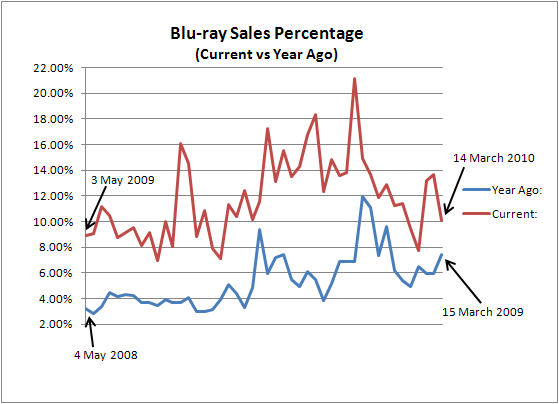
Not much happening in HD/Blu-ray world. I suppose I should post an update on the Blu-ray market share situation, for those not following my forum thread on this very issue. The summary is that Blu-ray is doing very well at the moment.

Blu-ray Sales Percentage 2008 to 2010 (Updated 14th March 2010)

Blu-ray market share is up from last year

The slightly more detailed answer is that Blu-ray market share has at least double since this time last year. The huge range of hit releases towards the end of 2009 really helped, with a greater concentration of A-list releases due to the preceding writer’s striker that delayed a couple of developments and releases. But largely, and this is backed up regularly in the stats, it’s all down to pricing. Whenever there is a sale of certain titles, these titles now consistently outsell the DVD versions, sometimes by such a huge margin that the DVD version might as well not exist. This is not surprising because in these sales, the Blu-ray version of the movie are often cheaper than the DVD version. Add to the fact that some users are obviously upgrading their collection from DVD to Blu-ray, and that the DVD version has been on sale forever for some of these movies (nearly full saturation, for some of them), it then becomes less surprising that the Blu-ray version can outsell the DVD version by 10 to 1 at times. For new releases, the difference between DVD and Blu-ray pricing has reduced as well, and sometimes the Blu-ray version is cheaper than the equivalent DVD edition (the Blu-ray version usually has the same amount or more content than the 2 disc DVD edition), and so it makes the decision much easier for consumers that already have Blu-ray players. Star Trek, District 9 are two titles that come to mind with this kind of pricing, and market share were close to 50%. But when the pricing differences are larger, in that the DVD edition is much cheaper, then Blu-ray market share drops, but is still higher than this time last year. So this evens out to make Blu-ray market share double what it was a year ago, and DVDs are still outselling Blu-ray’s by between a 9-to-1 and 8-to-1 margin. Look at the market share stats for selected individual Blu-ray movies, and you would think that Blu-ray’s market share is now greater than DVD’s.

The Lord of the Rings Trilogy Blu-ray protest is still going strong, and I would really love to see the sales figures and see if it has been affected by people’s displeasure at having to double-dip (or is that quintuple-dip). Certainly, the Amazon.com sales rank, of between 50 and 60 (which translates to around 15 to 20 on the Blu-ray sales charts), suggest that it isn’t selling as well as it should, because when they first announced LOTR on Blu-ray, I thought that this would be something every single Blu-ray owner would buy and would hit number one as soon as pre-orders were up. Of course, it might still happen, since Amazon is only one source, and there are many who don’t care about the extended edition (and those that do care, but are too impatient to wait).

Panasonic VIErA TH-P50V10A

Panasonic plasmas may have a bug that makes blacks turn to dark gray after a few hundred hours

And while I haven’t reported it here, I’ve just been researching the Panasonic plasma black level problem. For those that don’t know, many Panasonic plasma owners found that the black level of their sets suddenly increased once the TV has been viewed for a number of hours (300, 500, 1000 …), in that the black blacks become dark gray. What appears to have happened is that the software that adjusts the voltage levels being fed to the plasma cells is “not optimized”. The voltage needs to be increased over time to prevent plasma cells from locking up, until the cells stabilize around after 3 years or so. Instead of increasing voltage slightly to prevent the cells from locking up, the increased was too much and too sudden, and so increased the black levels unintentionally. While black levels do change even when the voltage adjustment is correct, it should be so minimal as to make it virtually impossible to detect via normal human vision.

The confusion is compounded by the fact that some people will notice it, while others won’t, as it depends on your viewing conditions. For example, those that watch TV in complete darkness will notice is more than those that watch with ambient lighting. Many purchased the Panasonic because of its superior blacks, so it’s understandable why many feel disappointed. At first, people felt that this could be addressed through a firmware update, but Panasonic has now said that this is intentional and not a problem at all, although at the same time stating they’ll do things different for the to be released 2010 models. But because this problem is hard to spot for some, it’s still unknown whether it affects all Panasonic models, in all territories, of just the 2008/2009 Panasonic models in the US.

I’m in the market for a new plasma, and this is disappointing news, since I had my eyes set on a Panny. But between the Samsung “buzzing” problem, the expensive LED LCDs with their limited viewing angle and blooming effect, and the now extinct Pioneer Kuro, there’s not much to choose from, and that the Panasonic, even with the potentially buggy software, might still be the best performer for your money (obviously not the ultra expensive models, which also seems to suffer from the same problem). The only other alternative  is to wait for the new 2010 models to be released, then wait until somebody has managed to test it for a few thousand hours, and see if it suffers from the same problem.

Gaming

And finally in gaming, Nintendo says the PlayStation Move is very much “Wii-Too”. This could be in response to Sony’s PlayStation commercial which mocks both the Wii and Natal, but the statement made by Nintendo America’s President might have preceded the ad in question.

I think if you ask the average Joe, who hasn’t read up on the Move, I think you’ll get a similar response.  Is this a bad thing? Maybe not. It makes it easier to sell the concept, since it’s already a widely accepted one, but it also makes it harder to stand out, even though there are clear differences between the two systems.

But in the end, only the games will determine which succeeds or fails. If the Wii has taught us anything, is that it’s not wise to get caught up in the technology of it all. The games are still all that matters, and nobody has cracked it except for Nintendo at the moment.

And that’s about all the interest I can muster for today. See you next week.

Weekly News Roundup (21 March 2010)

Sunday, March 21st, 2010

Some big software news this week. First up, DivX Plus 8 was released, all the tools in the package got updated, including the DivX Player, Converter. As usual, there’s a free codec pack for those only wanting to play DivX (and now MKV/H.264) movies. Then there was a new version of ImgBurn, with a suitably impressive, and long, list of changes. And finally, PowerDVD 10 was released, with some exciting new features – a brief overview in this blog post to tide you over before the full review is up, but if you like 3D stuff, this one’s for you.

But wait, there’s more. I managed to sneak in a new PS3 related guide over the week as well. This one uses AVIAddXSubs and lets you add subtitles to AVI files that will show up on the PS3. And not only that, you can add up to 8 subtitles per AVI file, and they can be switchable (obviously), and even turned off. All without having to re-encode the AVI file, and all taking only a minute or two per subtitle stream.

And let’s not forget, we still have news to go through.

Copyright

In Copyright news, in a surprising turn of events, content owners no longer wants to call people who download their content illegally “pirates”. Not because they’ve had a change of heart and realised that there’s isn’t a huge connection between a penniless college student downloading a copy of  District 9, and the often violent, on the seas theft of commercial shipping.

Jack Sparrow

Jack Sparrow: ruining a perfectly good word for music and movie studios

It’s all because, apparently, “piracy” is just too sexy a word to describe the horrific act of downloading bits of data from the Internet. It’s all Johnny Depp’s fault, I suppose, for making piracy look like good fun. Maybe the studios should sue Disney and Mr. Depp. Others have already speculated on what other words can be used to describe the inhumane act of downloading a copy of a file that can be copied an infinite number of times. Something that truly describes the full horror and the the immoral act of what we used to call piracy. File murdering? Song raping? Movie genocide?

These kind of hard decisions have to made somewhere, and soon, the rights holder may have a new global body to standardise these sort of things, if they get their way with the ACTA. Recent leaks suggested that a new body will be set up to oversee the global anti-piracy ACTA treaty, and that this body will be free to make changes to the treaty without governmental interference. In fact, the government won’t even be involved, unless by special invitations. US trade reps, allegedly, calls this body a necessary step to keep out consumer interest groups from ongoing copyright discussions. It’s becoming increasingly clear that these so called anti-piracy laws are nothing other than a desperate attempt to preserve the outdated business model of certain copyright holders, and through a scare campaign and big money lobbying, the various governments are nothing but props in this stage play. And now they want their own “OPEC”, so they can force their demands on the rest of the world and keep profits flowing.

The people, consumers, music lovers, movie fans, are increasingly being marginalized, even though they’re the ones paying the salaries of the government agencies so keen to hand over people’s rights to corporations, and they’re also the ones paying for the big bonuses that the music and movie studio bosses are no doubt getting. Speaking of disenfranchised, 10,000 UK voters have protested to their Members of Parliament about the controversial Digital Economy Bill, which is being rushed through parliament without debate at the insistence of the music and movie industry. So an unpopular bill may get passed without public consultation or even a debate (which would mostly have been an one way one anyway), while the corporations cheer the outcome that they’ve engineered. Is this still a democracy?

Command & Conquer 4 - Back

I couldn't find a higher resolution version of the back of the box, so one of the sections of the extremely small text says "Persistent internet connection required"

Gaming DRM is back in the spotlights this week, when EA announced that their new game, Command & Conquer 4, will use a similar DRM system to Ubisoft’s, which means an “always on” Internet connection requirement. Lose your Internet, or if the EA servers go down, then the game will kick you out. To be honest, none of this is really new, as many companies have tried “always on” DRM, and all have failed. Internet connectivity may have improved, but there are still many, me included, that don’t have access to a 100% stable Internet connections, certainly not stable enough to guarantee that a 2 hour gaming session won’t be interrupted. Futuremark’s Jaakko Haapasalo said it well last week – there are just so many games these days, and even on the PC, it’s still a relatively competitive industry. So if people don’t think they can play C&C 4 properly, then they’ll skip it for something else, or wait until it’s been “bargain binned” before buying. Why the game companies, who are already competing with *free* pirated games, want to add another thing that makes their product less attractive, I just don’t know.

High Definition

In HD/Blu-ray news, I previously mentioned LG’s Blu-ray player, which is one of the few that doesn’t have 3D in it, and instead, adds an HDD. The new player is now available to buy, and what was interesting was to see that it includes CD ripping.

Not that CD ripping on a standalone device is new, many can do it, but having it on a Blu-ray/DVD player just reminds you how useful it would be if the player could also rip DVDs and Blu-rays. I know there are piracy movie genocide issues to consider, but the convenience would be much appreciated. But the movie studios don’t trust their paying customers, so we’ll just have to be happy that they even let us watch the movie at all, after paying for it.

I recently talked about how you may not want to buy the soon to be released Lord of the Rings on Blu-ray (the comments/ratings protest on Amazon is still going strong, I see – I don’t know if sales will be affected, but it’s only 65th on the best seller list right now), now there’s also reason why you may want to wait on Avatar as well. Despite the director’s wishes, Avatar on Blu-ray released in April won’t be the 3D version, and you’ll have to wait for the (first of many, no doubt) “Ultimate” version coming in November, in time for the holiday season. That one will have 3D and more extra features, and maybe even a longer cut, no doubt. This is actually a bit more understandable than the decision to not release the extended version of the LOTR movies, since I doubt many people would have the equipment to play the movie in 3D right now, or even in November. And it’s not as if the extended cut of the film has been released for years beforehand already, so a double dip here is understandable. But I recommend you do an “one and a half dip”, rent the Blu-ray if you really want to watch the movie right now, and then buy the Ultimate Extended Special Collector’s 3D Extreme edition to be released later in the year.

Redbox about to become Blu, when Blu-ray movies are added to the collection

And you may just be able to rent Avatar on Blu-ray on a Redbox vending machine, since Blu-ray is now being added to fill the empty spaces in these machines. Unfortunately, the studios are still keen on trying to kill, or at least curb, Redbox, which they accuse of committing Content Manslaughter (act where studios profits are affected – at least it’s not murder). Studios insist on a 28 day window between releases making their way to Redbox vending machines, which the studios think will help their profits, but DVDGuy thinks will actually just encourage movie genocide. Feels to me like another self inflicted wound on behalf of the studios, since they can easily work together with Redbox and profit together.

There’s some musing from Microsoft about Blu-ray and the Xbox 360, but I’ll save that for the often neglected gaming section. But Microsoft did make another headline during the week when they revealed that IE9 will feature HTML5 support, which isn’t a surprise, but will also support the H.264 codec. Which isn’t that surprising either, since Microsoft owns several patents on H.264 and so they would like to see it succeed. Plus, they can easily afford to pay for the H.264 licensing costs just by digging for spare change in Steve Ballmer’s sofa. Mozilla’s Firefox won’t support H.264 though, since it’s against their open source principles, plus it also costs money. So that’s Chrome, IE and Safari in the H.264 camp, Firefox, Opera and Chrome (again) in the Ogg Theora camp.

Gaming

And finally in gaming, with the PlayStation Move still making headlines, Sony are keen to keep the hype going and have released a TV ad that, well is either very funny, or very arrogant. Or both.

Spot the Difference

Spot the Difference

It portrays one of their VPs communicating all the way from the future, in November of this year (when the Move is released), and mocks the Wii’s for its limited playing style, and the button-less design of Natal. Of course, the “inferior” Wii is kicking the PS3’s butt on so many levels, why Sony wanted to make the comparison, I don’t know. Also, if Sony’s idea of “the future” is November, then maybe they’re even more shortsighted than I thought. This from the same company that dismissed the Wii before they wanted to be just like one. At least Microsoft is trying to be different with Natal, although sometimes different is just another word for “not very good”.

But Sega doesn’t seem to think so. They think the Natal really has potential and that we’ll see “brilliant innovations” in the next year or two. Sega plans to make games for both the Move and Natal, but it’s quite clear that they are a bit more excited at taking advantage of Natal, but only if they can solve the lag issue.

And Microsoft says that Blu-ray has ruined the PS3, at least until now that is. While I would like to say that this was Microsoft’s attempt at hitting back at Sony for the Natal mockery, but the truth is that Microsoft made this statement earlier than the ad itself. A lot of people will disagree with this statement, because many see Blu-ray as the one saving grace of the PS3 while its prices were sky high, and now that prices have come down, Blu-ray could be decisive. While I agree with this wholeheartedly, the fact is that the PS3 would be doing a lot better right now if it was cheaper, but it couldn’t be cheaper because of Blu-ray support, and so, Microsoft is partially correct as well. The PlayStation brand has gone from 80% market domination in the last round, to only 20% of the home console market in the current generation (in the US), and while it still has time to catch up, you can’t say that the PS3 has been as successful as the PS2, and that’s given the Wii and the Xbox 360 some room to breathe. I’m sure Sony doesn’t regret the decision, because it won them the HD format war, and that will bring its own rewards – they just had to sacrifice the PlayStation brand to do it, and they will hope it’s only a temporary setback.

And on that note, I shall end this week’s WNR. Expect much much less stuff next week, in relation to new software releases, guides or even news, although I shall faithfully attempt to get the PowerDVD review online as soon as possible. And by faithfully attempt, I mean whenever I feel like it. See you next week.