Archive for the ‘Xbox 360, Xbox One’ Category

Weekly News Roundup (9 August 2009)

Sunday, August 9th, 2009

Another relatively quiet week. There are actually lots of news stories, but most of them say the same things, are followups to (or just really really late versions of) previous week’s news stories, and some are nothing more than PR fluff pieces. I try to filter out these kinds stories, and only report on the important, interesting ones. When I’m not busy playing games that is. Or rather than playing, let’s say “fixing” instead, because that’s what playing GTA IV feels like. Rockstar’s PC efforts have always been poorer cousins of the console versions, but GTA IV in its current state takes the bugginess to a whole new other level. Read my blog post to find out more about how to fix or work around some of the more annoying bugs, but nothing I wrote really helps to make the problems go away, only to make them slightly more manageable.

Copyright

In Copyright news, the owner of Filesoup, one of the oldest torrent sites around, has been arrested. His home was raided, things left in a complete mess, he was denied a phone call or access to legal council for 7 hours, and the Filesoup website is still up and running.

The owner's may have been arrested, his home raided, but the Filesoup.com remains online

The owner's may have been arrested, his home raided, but the Filesoup.com remains online

Since when did these sorts of copyright infringements, something that at worst only does monetary damage to billion dollar corporations, become such a serious offence that the police need to get involved? Are there no terrorist left to capture? No murderers to apprehend? The copyright lobby has been telling governments around the world scary bed time stories in an effort to scare them into doing things against the very principles of democracy, against the constitutions of their respective countries, and against normal legal procedure, and it’s all working. And that’s just the ones that get to court – governments at the behest of copyright agencies are still trying to bring in a 3 strike system where they can get rid of this little thing called due process entirely. But the ones that do get to court, are even more notorious, just like the recent two cases with the 6 and 7 figure damages being rewarded against defendants that probably don’t even have 6 or 7 thousand dollars in their names.

The rewards were so outrageous, that even copyright lawyers representing the content owners are not too happy at the damages being rewarded, fearing it may backfire. Content owners want to use these damage rewards to deter future infringements, but too much money and it may force the courts and the government to step in a put a limit on things, due to the public backlash. But does anyone really thing this will stop piracy? Every copyright warning message, yes including those annoying ones you can’t skip on DVDs, point out the possible consequences of piracy – a large fine and even prison time, but why do people still pirate stuff? Is it because they have no alternative, as they can’t afford it, like the cost of filling up your average iPod with purchased music? Is it because illegal downloads are easier and more user friendly, not having to go to shops to buy DVDs, and no DRM? Or as in some cases, you aren’t being allowed to purchase something until the content owners have maximised their profits through rental agreements, TV licensing, tiered releasing, and that the only alternative becomes downloads?

This is an example of an Xbox 360 mod kit. Some mod kits are the first step towards making Xbox 360's play backup games

This is an example of an Xbox 360 mod kit. Some mod kits are the first step towards making Xbox 360's play backup games

But the law is on the side of content owners, ever since they pushed the DMCA through the US congress, on the back of fears that the digital revolution was going to bring about the end of capitalism as we know it. And the politicians believed them, even easier to do so when you have large contributions to smooth your doubts. The latest case is that of an Xbox 360 modder has been arrested and could face 10 years in prison, thanks to the DMCA. See under the DMCA, you don’t have to actually do damage to anyone to break this law. All you have to do is to circumvent copyright protection, regardless of how badly implemented the copy protection may be, or what you intend to do after copy protection has been broken. I could mod my Xbox 360, and then smash it up so that it won’t work anymore, and yet, I’ve still broken the DMCA (if I was an American, of course). Or take a more common situation, where I mod my Xbox 360 so I can play backups of my legally purchased games that the Xbox 360 keeps on scratching (through the well known design fault, or just through daily abuse). Now if I do this, then who am I hurting exactly? Not Microsoft or the game publishers, because I’m still buying games from them. In fact, the only one I may have hurt is myself as I might have just voided my warranty. And I’m actually helping Microsoft by not bringing in the console to repair the disc scratching problem. But I’ve still broken the DMCA and I could face big fines and time in prison. Some countries have laws where you’re guilty until proven innocent – the DMCA simply assumes you’re guilty in all situations.

Speaking of game consoles, Nintendo’s DS is one of the most pirate friendly consoles around, thanks to flash carts. Nintendo still makes big money from the DS though, and the DS’s popularity is probably directly linked to the ease in which you can play backup or pirated games on it. The DSi, Nintendo’s update for the DS, was supposed to address this by introducing frequently firmware updates that disables flash carts from being used. The latest version, 1.4, managed to do to almost all known flash carts, but it only took a week for the flash cart manufacturers to bring out their own firmware update that made piracy possible again. If you can play it, you can copy it (and play the copy) – that’s that conclusion I’ve come up with after many years of observing various copy protection methods. Again, it goes back to the point of how one stops piracy, and perhaps some of the things I listed above like looking at prices, release schedules, and making purchases easier, are way more effective than firmware updates. Or even putting your hands up and admitting, okay our system is pirate friendly, but that’s why it’s so popular and it’s something we have to live with.

The Australia ISP, iiNet, is still engaged in legal battle with Australia’s own MPAA/RIAA, the AFACT. iiNet is now seeking help from industry bodies to testify on its behalf that ISP in general are helpless to stop the torrent of copyright abuses that its customers are guilty of. If one takes a view that things like human rights, privacy, are important, then ISPs shouldn’t be spying on their customers on anyone’s behalf, just like phone companies shouldn’t be recording and listening in on your phone calls just to see if you’ve been saying naughty things. Now the police, through a court order, may be able to perform eavesdropping (and I see monitoring Internet usage the same as phone tapping, actually even more effective because you get a much more complete picture of a person’s activities) – private companies cannot, and no court would grant a private company the right to spy on an individual, no matter how serious the offence is (because if it is the private company petitioning the court, then it is only a civil matter, not a criminal one). So if McDonald’s can’t tap my phone to find out why I’ve stopped eating Big Macs, why should Warner Bros. get the right to monitor my downloads to see if I’ve stopped buying their movies?

High Definition

Copyright rant over (is it me, or is the Copyright section getting longer and longer, and rantier and rantier?). On to HD news. Not much this week, but just some continuing trends that may concern the Blu-ray people.

On the surface, Blu-ray has a great week thanks to Watchmen. According to the sales stats, Blu-ray has its best week since The Dark Knight, again thanks to a Warner release. Part of the reasons for the good numbers may be because the PS3 special edition of the Watchmen game, which came with the Blu-ray version of the movie – I have no idea if sales of these packs were included in the stats though (the game itself did rather average business, so it may not matter). There are a couple of even bigger releases this year, including Star Trek, Transformers 2, Terminator Salvation – movies that will definitely do well on Blu-ray, not only because they were big movies at the box office, but these are exactly the types of movies to attract early adopters, HT enthusiasts, and the PS3 demography.
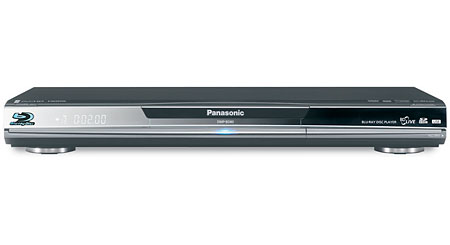
The Panasonic DMP-BD80K is one of the Blu-ray players getting Amazon VOD streaming

The Panasonic DMP-BD80K is one of the Blu-ray players getting Amazon VOD streaming

So what’s the bad news? Panasonic is going to include Amazon video-on-demand in its Blu-ray players, as part of the VieraCast service which already streams YouTube videos. Why is that somehow bad news? Well, it’s not bad news. It’s news to be concerned about, because that’s the third major Blu-ray manufacturer to include video streaming, after LG and Samsung chose to support Netflix. It’s good news for Blu-ray because players are now more fully featured and attractive to buyers. It may be bad news in the future if this video streaming thing takes off and Blu-ray becomes nothing more than a sideshow in the home theater arena. I doubt this will happen because you’ll get tons of people like me who like discs. But I also like things on demand, and a subscription service for unlimited access to a huge movie library works out to be cheaper than buying each movie individually eventually. But that’s for something to worry about in the future, because Blu-ray quality HD streaming is years away from becoming available in every home. But the movement towards video streaming is gathering pace, you cannot deny this.

While not HD specifically, Google has purchased On2, which makes several video codecs including the VP6, VP8. This is all part of the browser video wars that I brought up a few weeks ago. Nothing to concern your average net user, but developers and video enthusiasts will be interested to see if an open source video codec, like Ogg Theora, can take center stage, or will a commercially effort like H.264 win out. Google likes Ogg, and it can now use the expertise and technology purchased through the On2 deal to help out Ogg to improve quality, where H.264 is still  a better choice than Ogg. I love open source, but I also like H.264 for its quality and wide acceptance, but I don’t see how the consumer can be hurt by having a couple of alternatives, including an open source one.

Gaming

Not much happening in gaming. We’re still waiting for the Sony PS3 Slim announcement, and maybe something will happen next week, or the week after, in this front.
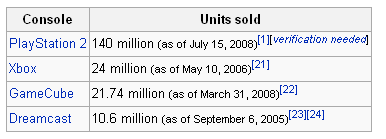
PS2 owned the original Xbox and it was expected that the PS3 would do the same to the Xbox 360 (stats from Wikipedia)

PS2 owned the original Xbox and it was expected that the PS3 would do the same to the Xbox 360 (stats from Wikipedia)

Now when fanboys argue, they use stats. One of the stats is that Sony’s PS3, while only doing half the sale of the Xbox 360 in the US, is actually only slightly behind the 360 in worldwide numbers, thanks to strong sales in Japan and stronger sales in Europe (compared to the US). And this is all despite the PS3 being released a year later than the 360. Now this seems to suggest that the PS3 isn’t doing as badly as the media portrays (including this blog, if you can call it part of the “media”), and it will lead fans of the PS3 to say that there’s a media bias in play here. The figures are not wrong, and neither is the conclusion that the PS3 is on level terms when it comes to worldwide sales, but for this to be “good news” for Sony, it assumes one thing: that the Xbox 360 was supposed to sell on even terms with the PS3. The actual fact was that the PS3 was expected to outsell the Xbox 360 handsomely, even with the delayed release – if the PS2 versus Xbox is any indication, an 8 to 1 sales ratio wouldn’t have been a surprise. The Wii kind of made a mess of the scene, since nobody figured Nintendo was going to be in it, let alone win it, but ignore the Wii and the PS3 was still supposed to sell a lot better than the Xbox 360, with US and worldwide numbers more in line with what we are currently seeing in Japan, where the Xbox 360 struggles badly.

But this hasn’t happened. And Microsoft’s gamble of launching a faulty, less sophisticated console a year earlier seems to have paid off. If at the end of this console generation, Microsoft can claim a 1 to 2 sales ratio (that’s one Xbox 360 for every PS3 sold), then they’ve done tremendously well and made huge strides into the gaming industry, of which Sony has much more  experienced with. If the Xbox 360 can sell on level terms with the PS3, then that’s something even the most optimistic Microsoft projections wouldn’t have dared to proclaim just 3 years ago. But of course, the Wii will outsell both combined.

Okie dokie. That’s the news/rant for the week. More next week.

Weekly News Roundup (26 July 2009)

Sunday, July 26th, 2009

Didn’t have anything interesting to write about, so no mid-week blog. But I did go back to an old article I wrote for DVD Flick and updated it for the latest version, which now supports menus and stuff. It’s now a great little tool for AVI to DVD (or any video format to DVD, really), as long as you’re not too fussed about making the menu look really customized. And best of all, it’s all free and really really simple to use. Maybe it’s just me, but more and more of the best software around are actually the free (or open source) ones. Anyway, lots to get through in the news roundup so let’s go.

Copyright

In Copyright news, the week’s major talking point has been about Amazon’s SNAFU and the implications it has regarding DRM. As you may have heard, some third party reseller on Amazon sold several Orwell e-books for Kindle, but it turned out they did not have permission to do so. So what did Amazon do? They used a not so well known DRM feature of Kindle to, without the permission of the user, erase all copies of the unauthorised books off people’s Kindle devices. Without permission. Without warning. This, my friend, is DRM at its worst.

Amazon's 1984-esque screw-up means Big Brother is not only watching, it's also erasing your books

Amazon's 1984-esque screw-up means Big Brother is not only watching, it's also erasing your books

Sure, in this particular situation, the erasure was probably justified, although ironic in the extreme considering the titles that were erased (‘1984’, in particular – Big Brother must be so proud). But that’s not the point. The point is that Amazon at a moment’s notice can erase all of your purchases. Now why would they do that? They wouldn’t, not unless they want to be hit with hundreds of thousands of lawsuits all at once. But the point is that they could, and they have proved that they can this time, and there will be many similar future situation which will force Amazon or publishers to do this again. They wouldn’t be able to do the same with hard copies, and so it would be the seller or Amazon that will have to pay damages, rather than the customer who bought the item in good faith. The truth is that with these kinds of DRM, you’re not buying, you’re only renting or licensing, as you are bound by the license agreement which you agreed to when purchasing the books. Anyway, the whole thing caused quite a stir, even though this isn’t the first time Amazon has done this, but the media just loved the ‘1984’ references. Amazon’s boss had to issue a public apology. DRM again shows it’s true evilness.

DRM may still be alive on e-books and other media, but it’s pretty much dead on music. There is watermarking, which is a form of DRM, but it’s something people are willing to live with (at least those that do use the content lawfully, and not hold intentions to distribute illegally). But generally speaking, the kind of DRM that is on Kindle is dead for music, so much so that the RIAA has came out and declared DRM dead. Or did they? It made good copy so all the news agencies (and websites) ran with the story, but the actual quote was not as harsh as the headlines, but the RIAA did still admit the fact that DRM was largely gone from download services. So basically it’s dead, right?

Well, as one of our forum members pointed out, it’s not entirely dead. There are still music download services that employ DRM, but nobody really uses them, not when they can get DRM-free tracks. One new service which just launched and still uses DRM is Kazaa, the notorious file sharing service now gone legit. You can all you can eat music, but the DRM restricts playback to PCs (and a limited number of them as well), so it’s virtually useless before it is even launched. All you can eat music is good, but not if it’s limited to PCs, and as this requires DRM, it also means you’re effectively subscribing or renting the music, not purchasing. An all you can eat purchase account for DRM-free music is what the industry needs to really grow the download business. Prevent illegal sharing with watermarking and other methods, sure, but don’t make people jump through hoops just to buy something that’s less entertaining and value than many other forms of entertainment (this is why video gaming is growing at the expense of music, for example).

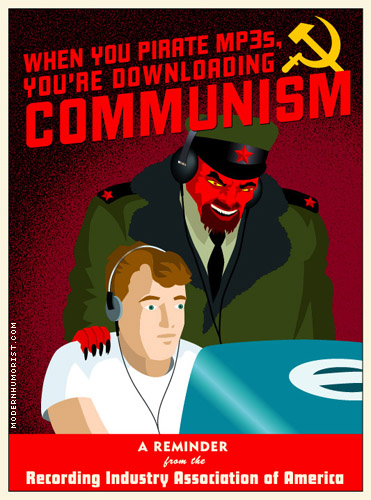
Pirating MP3s may not lead to communism, but DRM certainly takes a page out of the little red book

Pirating MP3s may not lead to communism, but DRM certainly takes a page out of the little red book

I guess you can see the theme of the week so far has been the difference between buying something and owning it, with all the rights associated with it, like the ability to actually not get it taken away from you without your permission, and the ability to re-sell it. That’s owning property. What DRM introduces is licensing, which is nothing new, but DRM allows licenses to be enforced strictly, such as remote erasure of the content. So the question is, is copyright anti-property? I think it is, and I think that’s been the core of the issues which people are against. Starting with DRM on DVDs, which prevented people from making backups of their DVDs, something they could do with CDs and all other media before that. And bit by bit, people’s rights are being taken away from them, and as Kindle-gate shows, companies now have the right to come into your home (in a way) and take away your purchases without your permission. People bleat on all the time about the evils of Communism in regards to the lack of personal ownership, but is this any better (or any different)?

Back to the lawsuits. The co-founders and the (ex) spokesman of The Pirate Bay have filed a lawsuit against Dutch anti-piracy agency BREIN, in response to a lawsuit filed by BREIN in which the only communication was through a Twitter tweet. BREIN apparently also accused the former TPB guys of launching denial of services attacks against their websites, which the TPB guys are counter-suing on the basis that this isn’t true and may constitute slander. They also claim that the original BREIN lawsuit continued numerous errors and should never have been filed in the first place. An agency having a better time is the Italian FPM group (where have all these groups come from, all of a sudden), which claims they have forced Mininova to remove 20,000 torrent links and many other sites to do the same. Mininova is fighting a legal battle themselves of course, and they have been hinting at trials of a system to allow torrent removals by content owners, I guess trying to prove that there is a system in place to handle piracy, and it should be up to content owners to police their own content (as otherwise, how would anyone know what belongs to whom)?

High Definition

Moving on to HD news, the big rumour of the week (and as of right now, still unconfirmed), is that Toshiba is joining the Blu-ray bandwagon, which in many fanboy’s eyes will signal final and irrefutable victory over HD DVD.

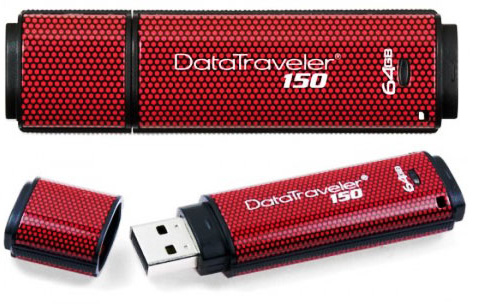
64GB USB drives are already here, bigger than the biggest Blu-ray disc, and is rewritable

64GB USB drives are already here, bigger than the biggest Blu-ray disc, and is rewritable without special hardware - could it be used for movie distribution?

I must make clear that Toshiba have not confirmed any of this, issuing a no comment which may be suggestive of some smoke, if not the fire. The question is, does this story make sense? In my opinion, yes it does. Toshiba was always unlikely to skip Blu-ray entirely, unless Blu-ray died a quick death. They make TVs and DVD players, and so Blu-ray is the natural next step for them. However, this does not mean that their focus on the post-Blu-ray technologies, such as downloads, streaming or flash memory distribution, have been abandoned. I for one feel that Toshiba getting back into the game at this time may in fact be due to the fact that these new technologies are finally mature enough for the marketplace, as seen with LG and Samsung’s Netflix integration. USB drive capacity has already exceeded that of Blu-ray, and offer better value than Blu-ray recordables even at this nacent stage. And with more and more companies launching USB thumb drive movie distribution services, this may be the right time for Toshiba to embrace Blu-ray, but also sneakily introduce these post-Blu-ray technologies through the back door and use Blu-ray to launch their own ideas about what the future of movie distribution will look like. Is it also a coincidence that the companies mentioned so far, LG, Samsung and Toshiba, as well as Microsoft with its Netflix Xbox 360 strategy, are all HD DVD proponents? And with Netflix in 9% of US homes already, thanks largely to the expansion of their online streaming service through game consoles and Blu-ray players, it shows people may be ready to start embracing online video streaming. Sure, Blu-ray quality HD streaming and downloads will have to wait another generation, waiting for the Internet infrastructure to catch up, but Blu-ray quality (and even better than Blu-ray quality) movie distribution via flash memory is already possible now.

For the short term though, 3D TV and movies are also seen as the next big thing. James Cameron’s new movie ‘Avatar’ aims to bring new 3D filming techniques and the concept of a 3D movie to mainstream audiences, to make 3D less of an optional experience, and make it *the* experience at the cinema. ‘Avatar’ is definitely the most expensive 3D movie produced thus far, there is no doubt about that. Along with the Blu-ray group trying to establish a standard for 3D Blu-ray movies, and with Nvidia joining the “game” with its GeForce 3D Vision kit, to bring 3D to the home computer, there is certainly a movement towards making 3D mainstream. But my view is that while 3D can be popular, it cannot be mainstream until one invents a technology that doesn’t require glasses. It’s just too much trouble, regardless of  the payoff.

Gaming

And finally in gaming, Microsoft has announced the next Dashboard update will be on August 11th, bringing a bunch of new features including better movie streaming, more avatar related content (achievements which give clothing and props sounds very interesting to me), and even games on demand. It’s not just movies that are moving to a media-less distribution method, it seems.

Sony’s PS3 Slim is rumoured to be unveiled soon as well, if the rumours are true that is. Sony will be making announcements in August, which should see either the rumours confirmed or denied. Again, there is a bit too much smoke without even a small fire at this stage. The big question will be how much cheaper will this new PS3 be? Because if it’s just the same price, then I don’t see the point.

I think that’s all the news for this week. More DRM bashing, digital distribution championing and PS3 price cut pining next week. See you then.

Weekly News Roundup (19 July 2009)

Sunday, July 19th, 2009

Welcome to another edition of the Weekly News Roundup. Come to think of it, I really should have numbered the WNR editions (for example, WNR #57), so I can easily refer to each. Yes, I could go and count each WNR and then start using edition numbers (there are 94 according to the WordPress category post count), but screw it.

A busy week this week, since I actually bothered to do some work. I started a new series called “The History of Digital Digest” to celebrate the 10th birthday of this website. Part 1 was posted this week, and it talks about how Digital Digest was launched, and some tidbits that have never been made public before. The June 2009 NPD figures came out and as usual, I have posted the full analysis. It marks another month in which the only happy party is Microsoft, as it was the only company yet again to have any sort of year-on-year growth. The Wii is still the best selling console (portables not included), but the PS3 is struggling, in hardware and software numbers. All could be fixed by the magical elixir known simply as “a price cut”, but it’s going to take a while for Sony to figure it out I suppose. Yes, they lose more money if they cut prices without cutting manufacturing cost, but how much money are they losing by being 3rd in the console race at the moment? And game sales, the stable of console manufacturer income, is very much dependant on hardware numbers – this is why most game console are sold at a loss. Just bite the damn bullet, Sony. Anyway, onto the WNR proper …

Copyright

Starting with Copyright news, continuing with The Pirate Bay coverage, or perhaps better expressed as “The Death of The Pirate Bay” coverage, the company that has bought TPB has hired a new man to helm the (in)famous website – step up Wayne Rosso, who is now courting the RIAA and MPAA and trying to make nice.

Wayne Rosso aims to destroy, I mean fix, The Pirate Bay by making it legal

Wayne Rosso aims to destroy, I mean fix, The Pirate Bay by making it legal

In a stomach churning interview, Rosso calls his best buddies at the RIAA and MPAA “unbelievably supportive” and vows to “turn over a legitimate new leaf” to make TPB completely legal. Rosso plans to do this by introducing some kind of fee, which will be used to pay the content owners – the fee can be reduced if users contribute P2P resources. I don’t see how this can work, because you cannot still offer pirated material even if you charge a fee and pass that on to the content owners, so the content would have to be legal and so will become limited by the content that content owners are willing to provide (so expect lots of DRM), which defeats the whole purpose of the website because there are already tons of sites offering the purchase of legal (and DRM infested) downloads. So if it wasn’t clear as to what will become of the TPB, it’s now pretty clear that TPB, as we know it, will end. At least if the intentions of the new owners are met – the only glimmer of hope is that often intentions give way to financial reality, and keeping TPB as it is might be more profitable.

The original founders of TPB have moved on it seems, and they’ve mentioned some political ambitions. The Swedish Pirate Party’s recent successes will no doubt fuel the political movement, with the Swiss Pirate Party being launched this week. There is already an Australia Pirate Party, although what Australia needs is an Internet Party. An Australian Internet Party is very much needed at the moment to help guide and oversee the government’s efforts to complete the National Broadband Network, as well as to keep them in line in terms of issues such as the Internet Filter Scheme. And such a party is needed even more so now that the government here has suggested that they might want to implement a three-strike anti-piracy system. A political voice is very much needed in Australia to fight the government on this issue, and a sizable number of votes in the next election could force the government into acting sensibly when it comes to these issues. And yes, I’m pointing my accusing fingers at you, Senator Conroy, recent winner of the Internet Villain of the Year award.

Continuing with the theme of posting people's pictures for this WNR, here's Stephen Fry

Continuing with the theme of posting people's pictures for this WNR, here's Stephen Fry

From politics to celebrities, noted Internet addict and actor Stephen Fry has launched an attack on the anti-piracy industry, specifically in relation to them going after TPB. The usual thing to do when celebrities speak is to wince, but Mr. Fry makes a lot of sense in his interview with the BBC and he’s Internet and real life celebrit-ism would be a good way to promote the injustices that are occurring all around us. One of the things that can quickly solve the piracy problem, as well as make users happy, would be an all-you-can-eat type music (and eventually, movies or games) download service. Charge $20 per month, sign up a couple of hundred million users worldwide, and let them download all the music they want. Would anybody still bother to pirate stuff? And if they can sign up hundreds of millions of users, which I think is not totally impossible, then that’s billions worth of revenue per month. With these kind of services, the users that download absolutely everything will be subsidized by the users that don’t download much, and because it’s all digital anyway, there’s no limit as to how many copies you sell, as opposed to selling CDs and physical content.

The alternative is to continue this fight against users, websites, and ISPs. While none of the actions actually solve the problem of piracy. All these legal and technological (DRM) measures have done is to force the implementation of new technologies that makes pirating easier, more private and harder to stop. With the imminent demise of TPB, public torrent trackers are the next big thing and the more public trackers there are, the harder it will be to shut down piracy. Meanwhile, the MPAA has vowed to attack and keep on attacking torrent websites, and for example, has vowed to chase isoHunt founder Gary Fung for the rest of his life, to try and claim the damages rewarded to the MPAA. So if Mr. Fung starts a new business, then the MPAA won’t be too far behind. If Mr. Fung gets a new job, then the MPAA will want a share. And so on, and so on.

High Definition

In HD news, there’s no much on Blu-ray that I found interesting, although there’s a bit about it that’s more to do with gaming and so it covered later on. All I know is that Blu-ray sales figures, as covered in this thread, shows that Blu-ray sales are fluctuating wildly between being excellent, and like last week, not being much better than the same time last year.

You will of course read more stories on how Blu-ray has grown a million percent in 2009 or something and compares that to drop in DVD sales and the come up with the conclusion that Blu-ray has won. But the fact is that Blu-ray has nowhere to go but up, and 2008 was a poor year for Blu-ray until the very end. DVD sales have nowhere to go but down, thanks largely not to Blu-ray but to increased spending on video games. And the increases in Blu-ray sales, as I’ve mentioned numerous times before, are nowhere near sufficient to make up for the loss in DVD income. Blu-ray wins when it reaches 51% market share compared to DVDs, and not a day sooner, in my books.

In slightly related news, Microsoft’s new version of the Silverlight platform now supports H.264 (and AAC), bringing it in line with the rest of the industry. There is no doubt now that H.264 is now the industry standard codec for video compression. Or is it? HTML 5 was supposed to anoint an official video codec, but due to pressure from various sides, it has backed down from naming such a format. Wikipedia wants to use Ogg Theora, Apple wants H.264, some of the browser makes prefer Ogg as well, but Google likes H.264 too and supports both in Chrome. Ogg Theora is open source and so it should be supported, but H.264 has so much industry support and it can’t be ignored. And I know what you’re going to say and “who cares” is not an acceptable solution to this puzzle.

Gaming

And finally in gaming, and yes we have some notable gaming news this week finally, of course it’s time and an appropriate place to plug my June 2009 NPD analysis again. Really, it’s good reading especially if you like graphs and stuff.

Microsoft guy Aaron Greenberg says Sony distracted by Blu-ray

Microsoft guy Aaron Greenberg says Sony distracted by Blu-ray

Responding to the positive news from the June 2009 NPD figures, Microsoft is claiming all sorts of victories, while saying that the reason the PS3 is behind at the moment is largely due to Blu-ray. Can’t really argue with that, because Sony turned one of the most successful gaming platforms (PS2), that also came with a DVD player, into one of the most successful Blu-ray players, that also came with gaming capabilities. The change in focus is what did them. Now this isn’t to say that there’s no way back for Sony, far from it. A temporary, and largely avoidable setback aside, the solution to the problem is very simple. And they could do it through the PS3 slim, if it is real. This video seem to suggest that it is. A PS3 Slim that costs less might be just what the doctor ordered for Sony.

In any case, Microsoft will try to ride on this wave of success for as long as possible, and with the much more welcomed Windows 7 coming soon, this could prove a strong period for Microsoft. And perhaps to tie together the two potential successes, Project Natal may make an appearance on the PC as well. Games for Windows Live has tried to tie together the Xbox 360 with the PC, and  something like Natal would definitely help. And not all applications for Natal will be for gaming, as even on the Xbox 360, Natal is being used for everything from video chatting to media navigation.

Okay, that’s all for this week. More “History of Digital Digest” next week, some kind of mid-week rant I suppose, and another issue of the WNR same time next week. See you then.

Game Consoles – June 2009 NPD Sales Figure Analysis

Saturday, July 18th, 2009

Another month, and another edition of the NPD Video Games Sales Figure Analysis. The last few months has seen the video game industry hit hard by the current economic woes, with sales numbers retreating. Elsewhere, there’s talk of green shoots and a recovery, but has it happened in the video game industry? June’s figures should provide further evidence as to whether the slump is easing, or it just beginning. The figures are from NPD, a marketing research firm that releases games console sale data every month.

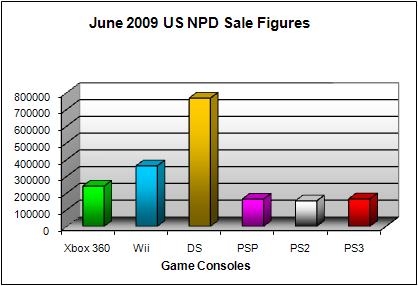
The figures for US sales in June 2009 are below, ranked in order of number of sales (June 2008 figures also shown, including percentage change):

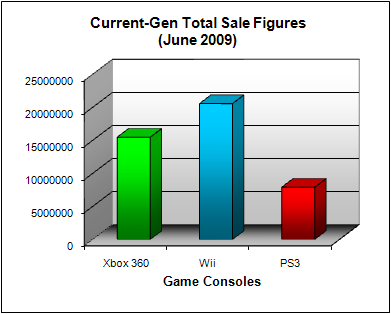
  • DS: 766,500 (Total: 32.1 million; June 2008: 783,000 –down 2%)
  • Wii: 361,700 (Total: 20.6 million; June 2008: 666,700 – down 57%)
  • Xbox 360: 240,600 (Total: 15.5 million; June 2008: 219,800 – up 9%)
  • PS3: 164,700 (Total: 7.9 million; June 2008: 405,500 – down 59%)
  • PSP: 163,500 (Total: 15.3 million; June 2008: 337,400 – down 52%)
  • PS2: 152,700 (Total: 44.2 million; June 2008: 188,800 – down 19%)
NPD June 2009 Game Console US Sales Figures

NPD June 2009 Game Console US Sales Figures

NPD Game Console Total US Sales Figures (as of June 2009)

NPD Game Console Total US Sales Figures (as of June 2009)

My prediction from last month was:

So the prediction is the same as this month, with the PS3 numbers slightly higher still but maybe not high enough to beat the Xbox 360. I can see Prototype (the Xbox 360 version) being the top seller for the month, and it will be interesting to see how it stacks up against inFAMOUS which has received better review ratings (although the “100″ ratings given out by a few places are a bit over the top).

The PS3 numbers were higher, yes, but it wasn’t nearly enough to beat the Xbox 360. Prototype (as you will see below) was this month’s top seller, and it stacked up pretty well against inFAMOUS, which slipped all the way back to tenth. Had the game’s release been bought forward a few week, or pushed back to be released in June, then inFAMOUS may have even made a couple of spots higher in May, or even 2nd spot in June. Sony made the same mistake with Killzone 2. And yes, the “10” ratings is still over the top for what is a very good game, but not “perfect”.

While we’re talking about Sony, let’s look at their figures. Again, and continuing the trend since November of last year (that’s 8 months in a row, for those that are counting), all three PlayStation platforms undersold the same month a year ago. The economy (combined with Sony’s phobia of a price drop) has a lot to do with it, but that’s mainly the PS3 – Nintendo and Microsoft have been able to get year-on-year increases from time to time. The PSP Go won’t be released until October, which may be the first chance that Sony will get to break this trend of year-on-year shrinkage. But the PS2 has definitely had its time and official retirement can’t come sooner. Maybe when it is officially gone, Sony can concentrate fully on the PS3 and we’ll finally see a price cut. The PS3 Slim? I’ll believe it when I see it for pre-order on Amazon.

Nintendo’s DS (or DSi, to be more precise), it selling well, which bodes well for Sony’s PSP Go when it finally gets released in October – and the DSi isn’t even a brand new system, just an update. The Wii, however, is struggling a bit. By struggling, it still managed to easily beat the Xbox 360 and the PS3, but next month’s Wii MotionPlus plus the MotionPlus enable games such as Wii Sports Resort and EA Tennis, should maybe give the Wii a slight bounce. But a bounce might not occur at all, as the Wii’s extraordinary sales record may be to blame – has everyone who wants a Wii got one already? The saturation point may have been reached.

So the only people happy this month are Microsoft, with the Xbox 360 recording yet another year-on-year growth, and no price cut this month either.  9% growth isn’t something to be sneezed at, not for this year, and it shows that Microsoft has been shrewd in its price cutting strategy, as well as the wooing of game developers that has been a core strategy since inception. Just count the number of PlayStation exclusives that are no longer, and then count the reverse, and you can see why the Xbox 360 is winning against the PS3 (for now, at least). To read an interview in which Microsoft’s joy is revealed, click here. And with Natal coming next year, the momentum is there for the Xbox 360. The only thing it has to fear, and no it’s not fear itself, but rather a largish PS3 price cut. But Sony are doing all they can to help Microsoft on this front, so who says that friendly competition no longer exists in today’s world. Make that really really friendly competition.

Onto software. More good news for Microsoft, relatively good news (and some bad ones) for Nintendo, and the same story for the PS3. As predicted my yours truly, Prototype for the Xbox 360 was this month’s number one title. Last month’s number one, UFC 2009: Undisputed for the Xbox 360, managed to hold on to the number two spot. And yet, there were still room for two more Xbox 360 titles, Fight Night Round 4 and Red Faction: Guerrilla. For the Wii, the EA Sports Active Bundle continues to sell well, just slightly above the Wii MotionPlus enabled Tiger Woods PGA Tour 10 (a good preview for what will happen next month, when the Wii Sports Resort gets released bundled with the MotionPlus, and this could spur on sales for Tiger Woods 10 and EA’s Grand Slam Tennis). Wii Fit and Mario Kart round out the Wii top 10’s, but what’s missing is what is interesting: no Wii Play for the first time since, forever (well February 2007 anyway). Maybe time for a new Wii Play bundle that includes the MotionPlus?

And so onto the PS3. Well, Prototype, June’s top hit, was not a hit on the PS3 and I think we all know why: inFAMOUS. Activision will not be happy, but it was just too much asking gamers to buy both the exclusive (and better rated) inFAMOUS and Prototype being so close to each other’s release dates. No wonder Activision threatened to pull support for the PS3 just last month. Prototype was 13th on the top 20 list, 3 places behind inFAMOUS. inFamous should have done much better than it did, for a critically acclaimed exclusive, but just how many PS3 owners are hard core gamers is not an easy question to answer. Certainly less so than the ratio of hardcore versus casual gamers for the PS2 (and the Xbox 360. But that’s partly because the PS3 can do so much, if you want to provide a bit of damning by faint praise. The PS3’s only other top 10 entry was Fight Night Round 4, which gave it at least some good news because it sold very close to the Xbox 360 version, despite the 360’s 2:1 hardware ratio over the PS3. So maybe that hardcore gamer ratio isn’t so bad after all. Overall, the Xbox 360 had 45.9% of the top 10, the Wii had 38.9% and the PS3 had 15.2%. Here’s the complete list of the top 10 software sales:

  1. Prototype (Xbox 360, Activision) – 419,900
  2. UFC 2009 Undisputed (Xbox 360, THQ) – 338,300
  3. EA Sports Active (Wii, EA) – 289,100
  4. Tiger Woods PGA Tour 10 (Wii, EA) – 272,400
  5. Wii Fit w/Board (Wii, Nintendo) – 271,600
  6. Fight Night Round 4 (Xbox 360, EA) – 260,800
  7. Fight Night Round 4 (PS3, EA) – 210,300
  8. Mario Kart w/ Wheel (Wii, Nintendo) – 202,100
  9. Red Faction: Guerrilla (Xbox 360, EA) – 199,400
  10. inFAMOUS (PS3, Sony) – 192,700

So what will July bring? More of the same, or will be see a Wii bounce? I’m going to bet on a slight increase in Wii sales, but not enough to bring it back to the same levels from earlier this year. The software charts should see domination from the Wii MotionPlus enabled titles, notably Wii Sports Resort. NCAA Football should do well too, so it would be between these two titles that the number one spot is jostled for. Otherwise, business as usual, with an overall uplift as we get closer to the holiday period.

See you next month.

Weekly News Roundup (5 July 2009)

Sunday, July 5th, 2009
Digital Digest is 10 Years Old!

Digital Digest is 10 Years Old!

Digital Digest is 10 years old! The actual birthday was yesterday, and I know it was 4th of July and that’s because I deliberately chose an easy to remember date to make public the very first version of Digital Digest (then known as DVDigest – you can see a screenshot of it here). My original thinking behind Digital Digest was that, as I was very active on newsgroups and forums back then answering people’s questions in regards to DVD playback (mainly focused on the Asus v3400 graphics card), that having a website where I can post all my answers and people can read that would save me time. After 10 years and countless hours of work later, I think my plan might have backfired just a little. Still, it’s been mostly enjoyable and I don’t think I would rather be doing anything else.

Anyway, to celebrate the 10th anniversary, I thought I would set up a competition where you can win some Amazon.com Gift Cards. There are 10 prizes in total (you know, for the 10 years and all), and entry is as simple as giving me your name and email address. No super easy or super hard questions to answer, or secret codes to hunt for on the website. I’ll randomly draw the winners at the end of the month, good luck to all those who enter.

Anyway, onto the news for the week, there’s a bit to cover.

Copyright

Let’s start with the copyright news. The Pirate Bay is still dominating the copyright news this week. There was a big announcement that caused a lot of stir, but it was preceded by some interesting news in regards to a new site that TPB wants to launch.

The new site in question is a YouTube style video sharing site, except there won’t be any copyright filters to contend with. It won’t make big media happy, but YouTube is only YouTube because people share copyright stuff, not in the sense of piracy, but using clips and music in their own videos. If you can really make YouTube 100% copyright compliant, then there won’t be many videos left at all.

The Pirate Bay changes owners: is this the end?

The Pirate Bay changes owners: is this the end?

So good news in that TPB is undeterred by the lawsuits and will continue with their crusade to “free” the Internet of the shackles of excessive copyright control. Then the news broke that The Pirate Bay has been sold to a new company, and that new company wants to focus on legalizing TPB. Confusion reigned, and we still don’t know what’s going on. On one hand, the statements made by the new owners seem to indicate that TPB would go legit, which basically means it’s going to turn into a completely different site, other than the domain name. On the other hand, there were statements made later on that suggested this won’t make much of a difference at all. The backlash was immediate, and not too dissimilar to the one after the Mininova content filter blog post made a couple of months ago. It does seem a bit ungrateful that this tremendously useful resource that people have been using, for free, for so many years and then the minute something changes (and we’re not even sure what the changes mean yet), it becomes torch and pitchfork time. But I guess that’s the nature of the business, in that people expect free stuff and they won’t like it when it’s taken away. Keep a close eye on this story and let’s give the benefit of the doubt to the TPB founders for the time being.

And let’s not forget that the bad guys in all of this is the RIAA, MPAA and all these other copyright groups that refuses to embrace the Internet for what it is, and accept that piracy is part of their business model now, and without it (and without the Internet “hype” effect, they’d be making much less money than they are right now). But it’s yet another victory for the RIAA in their lawsuit against Usenet.com. Well, at least the lawyers are happy, and people who pirate stuff are still pirating stuff, possibly more easily than before. But at least they’re not going after individuals in lawsuits anymore, although the three-strikes rubbish is not that much better. And if more proof was needed that going after individuals doesn’t work, then have a look at a new study by Which? computer magazine in the UK, which managed to easily find 20 users accused of piracy that are apparently innocent. There’s been lots of these kind of falsely accused stories in the past, and because IP addresses are not the best way to track down individuals. IP addresses can be easily faked, and even if they are genuine, it only proves that someone using a particular connection at that time was possibly downloading pirated material, it does not prove that which person did it or whether it was done with permission of the owners of the connection.

But this all assumes that illegal downloads are a bad bad thing, but the reality is that many people have no other alternative than to download, such as downloading TV shows. EngadgetHD looks at the top 10 reasons people download illegal TV shows. From my experience, especially here in Australia, people are almost forced to download because the traditional outlets such as TV stations or DVD are just too slow – some shows are shown years after they were originally broadcast in the US, and some (like The Sopranos) never shown properly at all. And because DVD releases have to be months after TV broadcasts, the shows that are purchased by the TV station but never shown might never make it onto DVD. The situation is a lot better now these days than just a few years ago, and I think online piracy is the reason for this improvement. So piracy is not always a bad thing, if it gives the right people a kick up the butt, for the right reasons. The simplest way to fight against piracy is to make legal alternatives available, that are better and not a total ripoff. Do this, and piracy will slow down. Don’t do it, and people will flock to what’s the best and fastest, which right now is clearly piracy.

High Definition

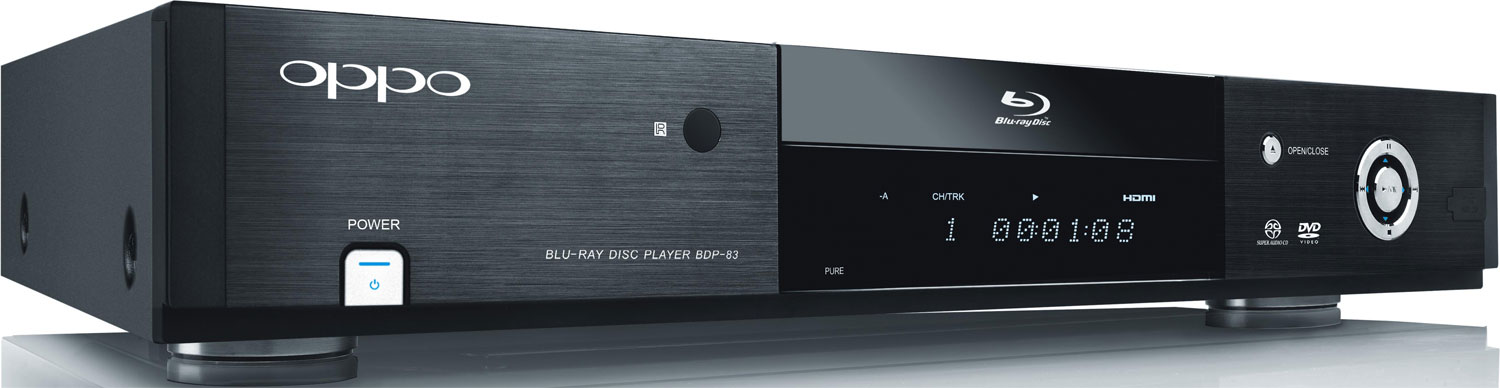
Let’s move on to HD news now. Oppo has released its new Blu-ray player. It features high-end features such as SACD and DVD-Audio playback, plus the superior video processing for both Blu-ray and DVD upscaling that Oppo is famous for.

Oppo BDP-83: The most fully featured Blu-ray player so far?

Oppo BDP-83: The most fully featured Blu-ray player so far?

Plus, there is the possibility of a region-free firmware (for both Blu-ray and DVD), and it could be the must-have Blu-ray player for the year. Elsewhere, it has all the features most Blu-ray players have, including Profile 2.0 compatibility – there’s not Netflix streaming though. And it’s not that expensive either, not for the amount of features you get. Those with huge DVD collections should really consider getting this player as it will seriously improve the longevity of your DVD collection with the superior upscaling capabilities, while allowing you to sample what Blu-ray can offer. It’s available for under $500 from Amazon right now.

Speaking of Netflix streaming on Blu-ray players, the Examiner looks at whether on demand content is going to replace physical media. I don’t see why both can’t co-exist together, like on the aforementioned Blu-ray player, but certainly on demand content is going to eat into the profit streams of physical media. I think physical media still has a place, for backup, and for those like me that still prefer something solid to represent my movie collection. The situation may be analogous to the one between snail mail  and emails. There was always the talk that email will replace traditional mail, but while the good old letter has suffered, it still has an important place in our new digital world. Just like physical media will have in the world of tomorrow.

Gaming

And finally in gaming, lots of rumours as usual. For the Xbox 360, the latest rumours suggest that the Pro pack is being phased out, and the Elite will become the new “pro”, with a Natal bundle being the new Elite. More rumours of PS3 price cuts, and the rumours regarding the PS3 slim still won’t go away. You can read about all of these rumours here.

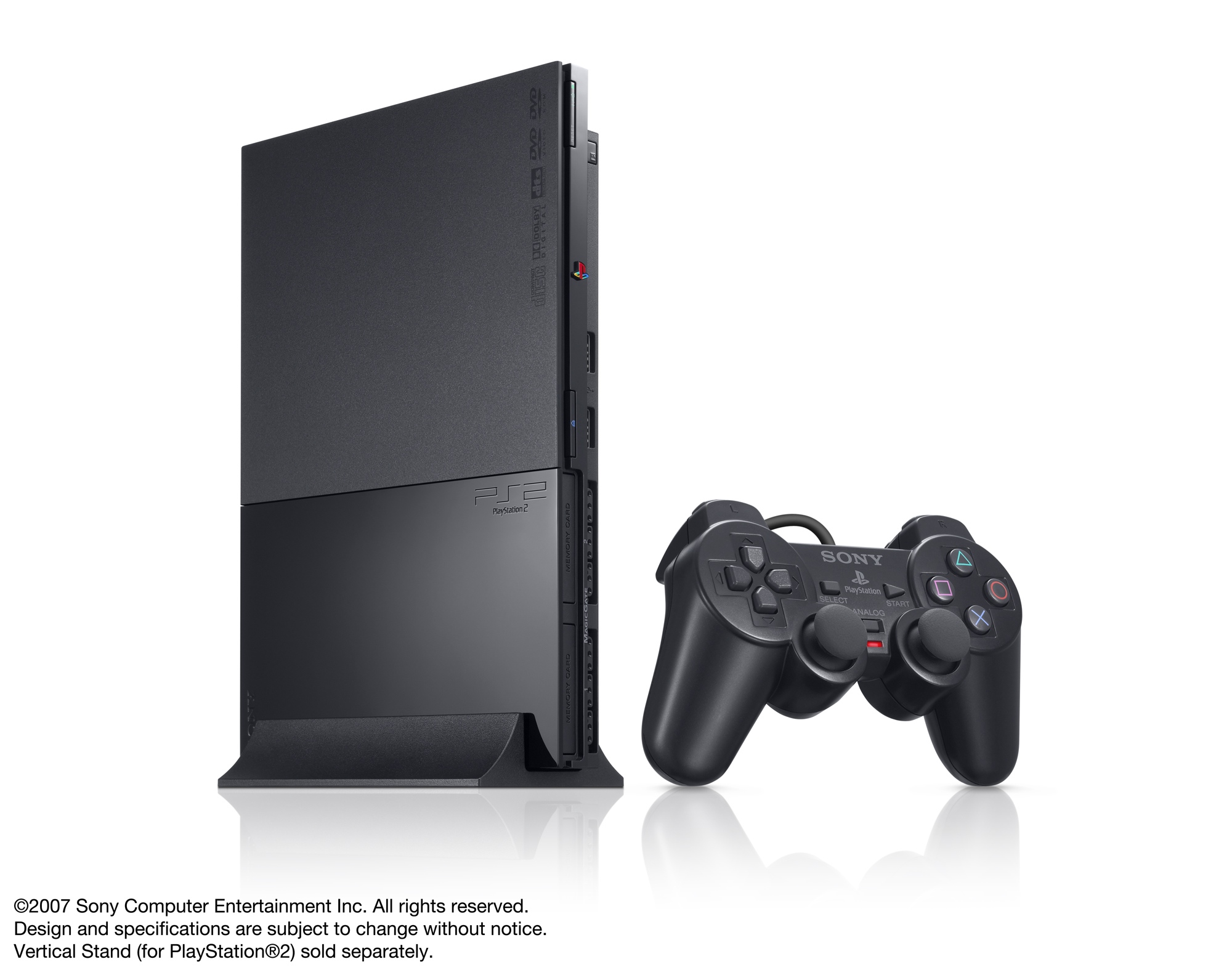
Is PS2 compatibility coming to the PS3? Is this the end for the PS2?

Is PS2 compatibility coming to the PS3? Is this the end for the PS2?

The second rumour is about PS2 compatibility coming back to the PS3, either to all existing consoles, or to the PS3 slim. If Sony plans to phase out the PS2, and it’s about time they did, then this makes perfect sense. With software emulation more of a possibility than when the PS3 first launched (where PS2 compatibility required extra, and expensive, hardware), it won’t add to the cost of the PS3, while Sony can even sell the emulation software in the PS Store. Plus, they can then start selling PS2 games in digital form for PS3 owners, just like on the Xbox 360 or Wii. So this is one rumour that might be true, and if Sony isn’t even considering this option, then somebody should smack them in the back of the head.

And is Project Natal racist? The news broke that people with darker skin tones might have trouble playing Natal due to one person’s experience at the E3 demo. It’s an interesting headline, but I don’t think there’s an issue, because surely darker clothing would affect the accuracy of Natal much more than darker skin. A calibration tool might be what Natal needs, and users might have to calibrate the cameras (due to change in lighting) before usage to ensure accuracy is improved.

So that’s it for the week. Ten years, it’s gone by rather quickly I must say. Even this feature, the Weekly News Roundup, is nearly 2 years old (in September), even though it feels like I only started doing this last month. Or maybe it feels this way because I really don’t know what I’m doing, which is probably true. Anyway, see you next week as I incompetently try to produce another edition of the WNR. See you then.