Archive for the ‘Gaming’ Category

Game Consoles – 2010 NPD Sales Figure Year In Review

Tuesday, February 22nd, 2011

As promised, this is the 2010 year in review for US video games sales, based on figures provided by NPD. Due to the NPD withholding many figures towards the end of 2010, this year in review will be pretty short, with a sole focus on the hardware sales figures.

The total sales figures as estimated by the NPD for 2010 are as follows, listed in the order of best selling console to worst:

  • Wii: 7,069,900
  • Xbox 360: 6,764,089
  • PS3: 4,333,500

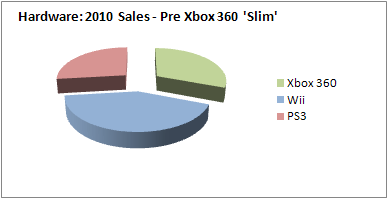
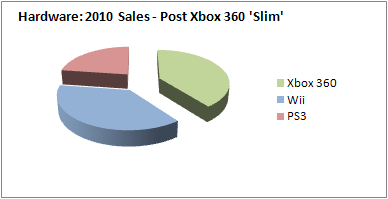
The major even that occurred in 2010 include the release of the Xbox 360 “Slim”, some Wii price cuts, and the release of Sony’s Move and Microsoft Kinect motion gaming add-ons for their respective consoles. Kinect and Move may have had some effect on PS3 and Xbox 360 sales, they occurred too late in the year to really make a huge impact for either console. But by far, the even that had the most impact was the release of the slim version of the Xbox 360, with took the industry by surprise when it was announced at E3. A picture tells a thousand words, or at least a few hundred, and the following graphs best illustrate the effect of the Xbox 360 “Slim” on console sales:

NPD 2010 Hardware Sales - Pre Xbox 360 "Slim"

NPD 2010 Hardware Sales - Pre Xbox 360 "Slim"

NPD 2010 Hardware Sales - Post Xbox 360 "Slim"

NPD 2010 Hardware Sales - Post Xbox 360 "Slim"

As you can see, the “Slim” had a huge effect on Xbox 360 sales, and it affected both PS3 and Wii sales. Before the “slim”, the 30.74% of consoles sold were the Xbox 360 (42.42% for the Wii, 26.84% for the PS3). After the “slim”, it was 39.56% (37.66% for the Wii, 22.78% for the PS3). Which shows that the Xbox 360 gains came more from the decline in sales of the PS3, than the Wii, although that’s simplifying things too much since each console’s gain/decline could be entirely independent from the sales results of the other consoles.

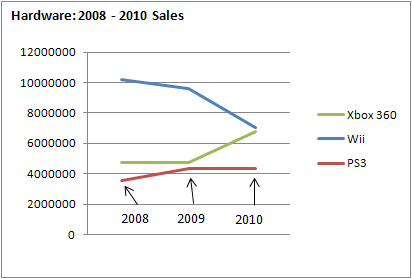
But looking at a single year’s results is too much looking at it in a vacuum – without looking at the past years’ performances, we can’t really see the big picture. And the following graph tries to plot the trend in sales, and why the Wii is in trouble:

Console Sales: 2008 - 2010

Console Sales: 2008 - 2010

The Wii’s steady decline is quite alarming, and shows just how close the Xbox 360 came to outselling the Wii in 2010, and if the early 2011 results are any suggestion, the Xbox 360 is set to become the best selling console in the US in 2011, surpassing the Wii for the first time since the release of Nintendo’s console. PS3 sales mostly remained level from 2009 to 2010, the actual decline in sales is only 1,000 units. The exact percentage changes are as follows (positive indicates growth, negative indicates decline):

  • Xbox 360:
    • From 2008 to 2009: 0.75%
    • From 2009 to 2010: 41.78%
  • Wii:
    • From 2008 to 2009: -5.67%
    • From 2009 to 2010: -26.31%
  • PS3:
    • From 2008 to 2009: 22.3%
    • From 2009 to 2010: -0.02%

The sales bump thanks to the PS3 Slim in 2009, as you can see from the above figure, is only half as big as that gained by the Xbox 360’s “slim”, although the Xbox 360 “slim” had a couple of months more than the PS3 “slim”. But it’s clear that Wii’s decline actually accelerated in 2010.

So what can we conclude from these figures? Nothing that’s not already quite obvious, that the Wii isn’t doing to well, while the Xbox 360 was the real winner of 2010, with the PS3 sales remaining completely flat.

Weekly News Roundup (20 February 2011)

Sunday, February 20th, 2011

Another week, another WNR, but not before I do my usual promotion of the January NPD US video game sales analysis post, apologise for still not writing the 2010 NPD year-in-review that I promised a month ago, and then blame it all on some game I’ve been wasting my time on (finished Fallout New Vegas BTW, now moved onto the new iteration of the classic timewaster, Civilization V, and also finally completing some unfinished business/achievements in Dead Rising). Anyway, regarding the January NPD figures, I mentioned that the Xbox 360’s success (most popular console again) is now largely to do with Kinect, but some other commentators have rightly pointed out that Microsoft spent half a billion dollars promoting the 360 and Kinect, so the small sales increase compared to last year has come at a high price, literally. However, it’s useful to point that that total retail spending on the Xbox 360 in January reached $551 million, so Microsoft can easily afford to splash the cash to promote Kinect.

Alright, let’s get to the news roundup, I’ve got the Americans civilization to destroy afterwards, having spent the last 20 years surrounding their territory with Giant Death Robots.

CopyrightStarting with copyright news, isoHunt is the target of yet another lawsuit, this time by the record industry as it seeks $4m in damages, and the closure of the BitTorrent indexer.

BitTorrent indexers are an interesting category of websites. On one hand, they’re basically search engines, like Google or Bing. On the other hand, they mostly allow you to search for pirated content, and so while they do not host pirated content, they do provide the tools to be able to find and start downloading pirated content. And most of the torrents on these indexers are piracy related, that’s a fact that can’t really be denied. So it’s quite easy to see why the MPAA and RIAA like to go after indexer, and because isoHunt is located in a country that isn’t so far from the HQs of these two industry lobbies (it’s closer than Sweden, anyway), it becomes a natural target.

Tribler

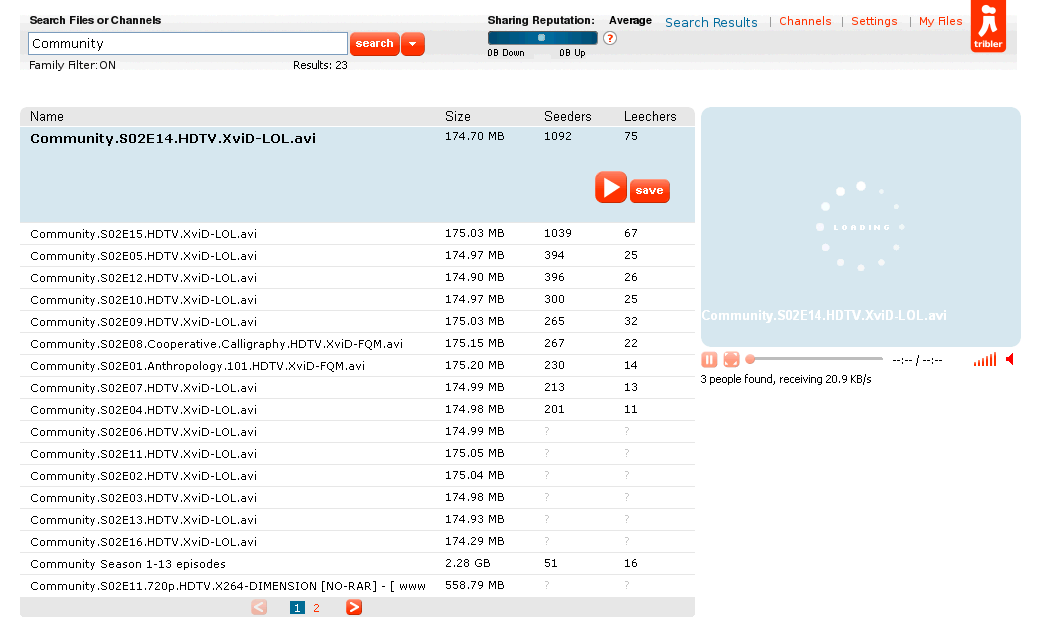
Decentralized indexing is the next big thing for BitTorrent clients, and it will make shutting down torrents much much harder

Indexers are really the last centralized system for piracy left, with everything else decentralized in an attempt to avoid being shutdown (magnet links, DHT …). The only thing left now is to make indexing decentralized too, and it’s only a matter of time before all the major torrent downloaders incorporate something this feature. An open sourced BitTorrent client with decentralized indexing like Tribler is something the MPAA and RIAA should be very afraid of because it will be almost impossible to shut down, but it’s exactly what their actions are driving users towards. But I think it will be good if we get to a point where Internet piracy cannot be stopped, because perhaps finally, the industry will wake up and find better ways to combat online piracy than lawsuit after lawsuit and government intervention.

Looking at a country where online piracy already seems impossible to stop, Spain, the government’s attempts to stop people downloading pirated content is meeting with heavy resistance since piracy has become mainstream. And even famous actors like Javier Bardem, who came out to support the government’s initiative, wasn’t spared from the public’s anger. Bardem was booed and had eggs thrown at him for supporting the government. But even some in the Spanish film industry are against the government’s plans to introduce tougher penalties for downloaders, including the president of the Spanish Film Academy, Álex de la Iglesia. Well former president, since he resigned his post to protest against the government’s actions. Iglesia says that innovation, not litigation or legislation, is key to fighting piracy. And that viewers, even those viewing pirated content, should be respected because they’re the only reason the film industry even exists. I think piracy being accepted as something mainstream isn’t actually a very good development, because I still believe creators should profit from their creations. And this is why innovation must come before other countries face the same fate as Spain, and I believe innovation can save the film industry.

And litigation may become a lot harder as courts start to question the very basis of copyright lawsuits that are based on IP address evidence. Former copyright law firm ACS:Law, who tried desperately to avoid having to go to court, is in court and the judge is asking all the wrong questions, from ACS:Law’s perspectives anyway. The questions being asked relate to the IP address, and whether this single piece of evidence is really enough for a copyright lawsuit. Finally, we have judge that appreciates the technical subtleties between an IP address and an actual unique identifier of a person, because as the judge rightly states, an IP address at best identifies the account holder of the Internet connection, not the actual downloader. There’s also the issue of IP addresses being spoofed, or more commonly, connections being used without authorization. The judge then asks about an unauthorized access to the ISP account, or even authorized access but unauthorized usage, and whether this falls under the authorization clause of copyright law. If you lend your car to someone who says he’s using it to go the store to get a few things, and then he goes and robs the store, are you an accomplice? The copyright lobby and law firms say so, the judge is not so sure.

And an update on a story reported here back in December, Matt Drudge of Drudge Report has settled with Righthaven over the unauthorized use a photo on the website. Righthaven had requested $150,000 in damages plus the seizure of Drudge’s domain names for the extremely naughty use of a single photograph on the website. No detail of the settlement has emerged, so it’s an unknown how much Drudge had to pay, or even if any payment was involved. My personal opinion is that Drudge should have put up much more of a fight, because the lawsuit is unreasonable in asking so much for a single photo. Had Drudge put up the same amount of resistance as fellow political website Democratic Underground, then perhaps the settlement wouldn’t have been necessary – Righthaven has tried to extract itself from the Democratic Underground lawsuit, fearing that they may actually have to go to court and face the same kind of questions that ACS:Law in the UK is facing (not to mention the extra cost, which goes against the business model).

Not much happening on the HD/3D front this week, so we’ll skip straight to the gaming section, which is good because all of the gaming stories are copyright related anyway.

Gaming

The first news I posted for this last week was the Crysis 2 leak scandal. What happened was that someone, probably someone on the development team, leaked a pre-release version of the eagerly awaited Crysis 2 game, and of course, hours later, millions of people were trying to download it.

Crysis 2 Leaked Screenshot

A almost full version of Crysis 2 has been leaked, but don't blame the pirates, blame the person who leaked it

EA, the game’s publisher, took the unusual step to address this issue in their blog, blaming it all on online piracy and pirates as you would expect them to do. But that’s like blaming the people who are reading the Wikileak leaks, as well as the people who published the leak cables, and not the actual person that leaked it. For me, this isn’t an issue about piracy at all, this is an issue about not protecting your products properly, and the fault lies with Crytek and EA. A lot of those that downloaded the pre-release version would still buy the game, and those that had already planned to buy or ordered, would still download just because it’s kind of cool to be able to get the pre-release version.

Despite EA’s blame game, PC piracy is actually decreasing, says the new president of the PC Gaming Alliance, Matt Ployhar. Ployhar says that it’s mostly due to new game design, where MMO games like WoW means that piracy really isn’t possible, and also value-added content and services. Steam is the example that I always go to, and it’s a good example of how innovation can work. I mean, this is a company that got into the PC game sales business when everyone was saying it was doomed, and they have flourished thanks to the very Internet that publishers were blaming for the industry’s demise. Things like showing off your list of games to friends, your achievements, the social aspect of gaming, value-added and exclusive content and features, and of course, reasonable pricing, all counts in the end. As for DRM? Ployhar is on the sidelines when it comes to whether publishers should deploy strong DRM or not. But he does say that many legitimate users do break DRM to get a better gaming experience, something I can personally attest to having used cracks to escape the need to insert the game DVD every time (which is why I now prefer Steam games, since you can get the same thing legally – plus the in-game browsing is a big plus point, considering how crap I am at most games and how much help I need during play).

And finally, an update on the PS3 Jailbreak situation. Sony has, as expected, started to ban those with hacked firmware on PSN. Harsh, perhaps, but hardly unexpected. I’m just surprised Sony didn’t insert a virus into hacked PS3s that make them blow up, because you know that was probably their first choice of action until their lawyers talked them out of it. With the PS3 coming last in console sales in the US yet again, Sony can ill afford to take the focus away from their upcoming games, and onto this legal mess. Although with that said, none of this is new. Microsoft went through this, so have Nintendo with all of their consoles, and Sony are really lucky that it hasn’t happened to them until now. What they shouldn’t do is to overreact, which let’s be honest, is something Sony are famous for. Unfortunately, launching the lawsuits and trying to sue those that even watched the hacking video on YouTube does seem like a typical Sony overreaction (although the hack itself is unprecedented, in its totality and completeness, but that’s Sony’s own fault for having crap security).

Alright, that’s another WNR done with. Back to Civ 5 and blowing the smithereens out of the American cities with my stealth bombers equipped carriers (yes, it is possible to have stealth bombers to be stationed on a carrier despite the game not allowing you to do it direct. Simply build a plain old bomber first, base it on a carrier, and then upgrade to a stealth bomber).

Game Consoles – January 2011 NPD Sales Figure Analysis

Saturday, February 19th, 2011

I know I promised the 2010 year in review post, weeks ago, but rest assured, it’s still coming. I had hoped I would get around to it before the January NPD figures came out, but it looks like I waited too long! In any case, let’s get the January 2011 NPD done before worrying about 2010. Once again, there were enough leaks to present us with enough data to get January’s NPD analysis up. For those that are new to this, this analysis looks at US video games sales figures compiled by NPD.

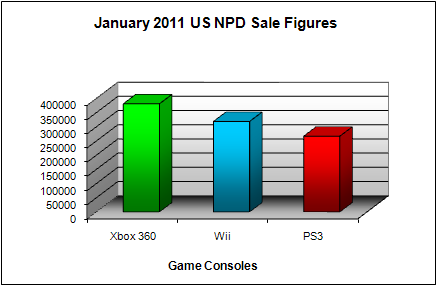
The figures for US sales in January 2011 are below, ranked in order of number of sales (January 2010 figures also shown, including percentage change):

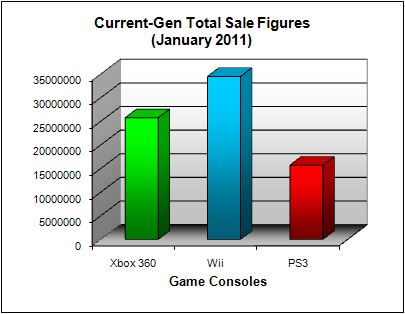
  • Xbox 360: 381,000 (Total: 25.8 million; January 2010: 332,800 – up 14.4%)
  • Wii: 319,000  (Total: 34.5 million; January 2010: 465,800 – down 31.5%)
  • PS3: 267,000 (Total: 15.7 million; January 2010: 276,900 – down 3.6%)
NPD January 2011 Game Console US Sales Figures

NPD January 2011 Game Console US Sales Figures

NPD Game Console Total US Sales Figures (as of January 2011)

NPD Game Console Total US Sales Figures (as of January 2011)

My prediction from last month was:

I loathe to make a prediction for next month, but I think the Xbox 360 will probably gain back the number one spot, and a very familiar top 10 for software as well.

And gained it back it did. In fact, the Xbox 360 even outsold the DS this month, making it the best selling video games console of any kind. It was also the only console to receive a year-on-year sales increase. The software chart does have a few new entries though, and we’ll discuss this later on as per usual.

Obviously, Microsoft are very pleased with the sales result for the first month of 2011, and it bodes well for the console for the rest of the year. With a 14.5% year-on-year increase, it shows that the console is more than just “the one with the least number of lost sales”, and that the Xbox 360’s market share is actually growing. And this has to be largely thanks to Kinect, as there are simply no other explanations for it (the sales bump from the “Slim” should have dissipated by now, and there hasn’t been any recent price cuts either). Of course, Black Ops may be responsible for some of the sales, but Modern Warfare 2 would have been equally responsible for sales this time last year, and so it can be ruled out as a factor for the sales increase. And with strong software sales (combine revenue on the Xbox 360 makes it the top selling platform once again, in the US).

The Wii continues its 30%+ year-on-year decline, which is alarming because the sales decrease does not seem to have slowed compared to the same time last year (January 2010 was down 31% as well compared to January 2009). The rapid and steady decline should encourage Nintendo to consider bringing out the Wii 2 sooner than what they had planned before. It’s still doing relatively okay in terms of software sales, with Just Dance 2 doing enough to actually earn 2nd place in the combined-platforms top 10 (which is difficult to achieve for a single-platform release like Just Dance 2). But even this is slightly alarming, in that for dancing games, the Kinect will most likely offer the better experience in the future (the Michael Jackson Kinect Experience game should tell us whether this theory is true or not). The Wii is a Xbox 360/Kinect price cut away from being totally wiped out, in my opinion, as price is really the only reason why it continues to outsell at least the PS3.

Speaking of the PS3, the recent PS3 hacking issue could be a distraction Sony can do without, because once again, its flagship console came last place in the home console charts (not counting the PS2, which it appears, nobody is counting any more, certainly not the NPD). But on the software front, there are at least a couple of bright spots, Little Big Planet 2 and the console exclusive DC Universe Online.  But instead of bridging the gap between it and the Xbox 360, the gap is actually getting wider, although Sony is definitely doing better in worldwide sales numbers (but the Xbox 360 is showing signs of improvement there as well). It doesn’t exactly help that the PS3 is still the most expensive console around, and even though some of the extra price is justified due to the Blu-ray playback functionality, which has just recently been upgraded for Blu-ray 3D, the ever decreasing cost of standalone players means that it’s becoming harder and harder to justify the PS3’s price premium. At the very least, Sony should be looking for price parity between its console and the Xbox 360.

In software, the top 10 does have a few titles from last month, but there are also a couple of new entries, the most notable being Dead Space 2, Little Big Planet 2, Dance Central and DC Universe Online. Three of these titles were platform exclusive (for consoles anyway), with two of them belong to the PS3. Which is why Sony can’t be too unhappy with the results. The other platform exclusive was Dance Central, a Kinect title, and this is the first Kinect title I think to make it into the top 10 “all-platforms” chart, which is hard for a platform exclusive, and Dance Central is more than just a platform exclusive, since it also requires an optional add-on accessory (if 20% of Xbox 360 owners have Kinect, and the Xbox 360 accounts for 34% of the console market, then it means only 7% of gamers could actually play Dance Central, and that’s not even including PC and portable console gamers). The leaks have also resulted in some actual numbers for software sales, with Black Ops selling 750,000 copies, Dead Space 2 selling 441,000, and Zumba Fitness selling “over 300,000” units. Anyway, here’s the full software sales chart for January:

  1. Call of Duty: Black Ops (Activision Blizzard, Xbox 360, PS3, Wii, PC, DS)
  2. Just Dance 2 (Ubisoft, Wii)
  3. Dead Space 2 (EA, Xbox 360, PS3, PC)
  4. Little Big Planet 2 (Sony, PS3)
  5. Zumba Fitness: Join the Party (Majesco, Wii, Xbox 360, PS3)
  6. NBA 2K11 (Take-Two Interactive, Xbox 360, PS3, Wii, PS2, PSP,PC)
  7. Assassin’s Creed: Brotherhood (Ubisoft, Xbox 360, PS3)
  8. Dance Central (MTV, Xbox 360)
  9. Michael Jackson: The Experience (Ubisoft, Wii, DS, PSP)
  10. DC Universe Online: The Next Legend Is You (Sony, PS3, PC)

So, prediction time. My brain tells me the hardware ordering will be the same, but my heart tells me there could be some surprises. A resurgence for the Wii? Xbox 360 suffering a sales slump after the holidays? PS3 sales up thanks to Killzone 3? Speaking of Killzone 3, it is one of *the* titles for February, while Bulletstorm seems to be selling well right now, along with Marvel vs Capcom 3. And the recent hits will be in the top 10 too.

As for the 2010 review, I will aim to get it up during the week, but again, it’s a busy week for me so I can’t guarantee anything. Actually, I’ve already got all the graphs done and the conclusion is already pretty clear, so it may just be a very short analysis since there’s not a lot of data to play with, especially during the last few months of 2010.

See you soon.

Weekly News Roundup (13 February 2011)

Sunday, February 13th, 2011

Sorry for the slightly late edition of the WNR, couldn’t be helped unfortunately. Luckily, there weren’t too many news stories this week, especially if you really count the whole PS3 jailbreak saga as just one story, so hopefully we can get through this rather quickly.

And don’t forget our Facebook/Twitter competition where anyone who likes/follows will enter into the draw to win some $20 Amazon gift cards. The more likes/follows, the more prizes (up to 15 GCs – I have to save the rest of the website earnings  for food), and from the current count, I should be handing out something like 7 or 8 of these GCs. So get clicking, and good luck!

CopyrightLet’s start with the copyright news. Last week. I talked about how increasing access to content reduces piracy, and if you take the same principle and use it for the other side, then decreasing access should lead to more piracy.

Sky Atlantic

Making TV shows exclusive to a subscription channel could increase piracy

Which is exactly what experts are warning now that the UK has a new subscription channel that has made a lot of shows, previ0usly available on free-to-air TV, a channel exclusive. It means that for popular shows like Boardwalk Empire, the only way to actually watch these shows is to sign up to Sky Atlantic, or wait until the show hits DVDs/Blu-rays. Legally, that is. Illegally, well, you won’t really have to wait more than 2 hours after the original US airing date to find torrents posted everywhere for that particular episode. In fact, I bet that the torrent release schedule probably beats the airing schedule of Sky Atlantic, probably even by days or even weeks. So release windows, exclusive broadcasts, and no legal free option will only really drive people to pursue less than legal options. Those more adventurous (and technical minded) will go for torrents, while there are still plenty of file sharing and streaming sites that offer the rest the ability to watch the shows without the associated legal risk (since most of the legal focus is on BitTorrent downloads these days). Now, somebody will benefit financially from exclusivity and release delays, but it all seems very short term to me, and the reason why TV piracy is on the up. It’s more understandable for US cable based shows, that were never really on free-to-air anyway, but for shows that air in the US on the big networks, there’s no reason why these shows shouldn’t be shown simultaneously around the world (taking into account time zone differences). Do that, and I think piracy rates will be lowered by quite a bit. Yes, pirated shows don’t have ads, which is a big draw card, but with PVR/DVRs and a little bit of fast forwarding, it’s probably worth the pain to avoid the risk of receiving a letter from an opportunist law firm.

Hotfile

Hotfile is being sued by major Hollywood studios for promoting web piracy

Speaking of file sharing sites like Hotfile, Hotfile has just been sued by the MPAA and five movie studios it represents. Now, I don’t think anyone can deny that there are lots of pirated files on Hotfile, but it is an upload service, and it’s the users that populate their servers. Like how people upload pirated Viacom clips to YouTube, and look how that turned out for Viacom, in the court room. The MPAA claims that Hotfile rewards users for uploading pirated movies and TV shows, because Hotfile has an affiliate program where you can earn movie depending on how popular your downloads are and how many of your downloaders sign up for the premium service. Now, I think it’s also fair to admit that many pirates are probably making money this way, but then again, in my line of work, I see a lot of software publishers that also use Hotfile and other file hosting services to save money on file hosting, as well as make a couple of bucks back. So Hotfile’s affiliate program really is just about growing their business and rewarding their customers, whomever they may be, and can you really blame a business for trying to do this? As for the ratio of legal to illegal downloads? I have no idea. But what can a company like Hotfile do to fight piracy, other than not exist (which is the MPAA’s preferred option – in fact, I think they’d rather the Internet not exist either, the same opinion also held by quite a few dictators around the world right now). They can try and filter based on file names, but all users will do is to name their downloads sdkj3489sd.zip or something similar, and piracy will continue. They can actively scan downloads, but pirates can then simply password protect and/or encrypt files (if they’re not doing it already), and piracy will continue. Hotfile can put in a system where copyright holders can submit removal requests, but they already have such a system which the MPAA studios appears to be not very fond of (mainly because it means they will actually have to do a bit of work themselves). So what’s a digital file locker hosting website to do? What can they do? They can get sued, apparently. And the likes of RapidShare and MegaUpload are surely not immune from similar lawsuits, although it’s understandable why the MPAA chose a lower profile website like Hotfile to sue, since it’s like RapidShare, which already has a lot of experience in the courts, will put up a much stronger fight.

6,500 people have been added to the “The Expendables” mass lawsuit. Nothing really surprising there, because as long as you have producers who don’t care about public opinion and a negative backlash, law firms like the US Copyright Group will continue to have clients.

The PS3 jailbreak stuff will be posted under the Gaming section as per usual.

High Definition

In HD/3D news, again, not a lot happening. I did catch a few 3D Blu-ray titles on sales at Amazon and elsewhere online recently, and so even without Fox/Panasonic’s mean-hearted/short-sighted-ness in making Avatar 3D an exclusive (now selling for a little bit less on eBay, around $150).

The one I was tempted to buy was Piranha 3D. I loved the original Piranha movies, and this latest edition of the latest remake has both the 2D version, as well as the anaglyph version (red/blue glasses version), in addition to the 3D Blu-ray version, so it’s a good introductory package for 3D (because you can always go back to the 2D version in case 3D is not for you, or if you don’t have a 3D Blu-ray system right now, you can still enjoy the old fuzzy, washed out colours, style 3D with the cheap paper glasses).

While neither HD or 3D related, I did post a news item about publishers moving away from Apple’s iTunes towards Android and other more open marketplaces. While software restrictions are the real issue right now, it also I guess applies to movies, and some of these movies might be HD (I’m really stretching here, aren’t I). Basically, you have Apple who wants to control everything and then some, and it may be their right since they did produce the excellent iDevices in question, and most of their income is derived from having so much control. And there’s also the issue of quality control too. But being able to play any movie you want simply by using a USB cable to copying it, like you would do with any USB storage device, means that Android phones appeal to those who simply cannot stand iTunes or the idea of being locked to the software. And for publishers, it means they can publish without having to hand over 30% for every transaction, or to have to abide by Apple’s stupid licensing restrictions, which requires even free software have use Apple’s DRM (hence the whole VLC player for iOS debacle).

Gaming

And finally in gaming, most of the news as you may have guessed relates to Sony’s legal action against the security researchers who uncovered the major security hole within Sony’s own security infrastructure, and famous/infamous PS3 hacker George Hotz, who did the awful thing is re-enabling homebrew on the PS3 (but not piracy).

The week started with Sony attempting to get the likes of YouTube and Twitter to hand over user information in relation to anyone remotely related to the PS3 hack, even those who simply watched the hacking video on YouTube. Their intention was to expand the case to include anyone who releases or distributes custom firmware and other security hacks. Basically, a fishing expedition. But one that was ultimately denied by the judge for the case.

I might have some sympathy for Sony if they only went after those that release firmware that included the ability to play copied games. But to go after fail0verflow, basically just a security research team, and also geohot, who has time and time again denounced piracy and went out of his way to ensure his custom firmware cannot play pirated games, it seems Sony have chosen the wrong targets really. And then to try and go after Linux hackers like Graf_Chokolo, whose sole aim was only to bring Linux back to the PS3, a feature that Sony once fully supported, it just seems unnecessary.

Major Nelson: Twitter Battleship

Major Nelson pokes fun at Sony's Kevin Butler "Battleship" SNAFU

And then Linux community responded by fooling fake PS3 VP and twitter personality Kevin Butler into re-tweeting a hacked PS3 security code. Embarrassing, and even Xbox 360’s Major Nelson poked fun at the incident, but what’s more worrying for Sony is that all of these are taking attention away from the console and the great games that they will have out this year, and that’s something they can’t really afford at the moment, not when the race with the Xbox 360 is so close and with the threat from Kinect hanging around.

And speaking of Kinect, the PlayStation Move’s creator (Dr. Richard Marks) seems a bit jealous of the attention Kinect has gotten with the PC community, and wants something similar for the Move, except to make it even more accessible. I suppose this means that instead of having access to just the raw data, some of the software and processing algorithms may be opened up too, if Dr. Marks is able to overrule Sony’s “we don’t like anyone poking their heads under the hood” stance. Of course, what most interested the programmers was the potential of Kinect, and how different it was to any consumer tech on the market (something like this would otherwise be thousands and thousands of dollars, for the professionals market). The Move, while somewhat innovative, is really just a more accurate Wii, and programmers have already had their fun with hacking the Wii-mote when it first came out. If anything, the PlayStation Eye is a more interesting device, but one that still can’t compare to the Kinect in terms of innovation.

And so, we come to the end of another edition of the Weekly News Roundup. Enjoy your week!

Weekly News Roundup (6 February 2011)

Sunday, February 6th, 2011

Welcome to a new month, the month with arguably the hardest to spell name (Febuary? Februarey?), and also the hardest to remember in terms of  number of days it has (hint, it’s not 30 or 31, and it’s not always the same every year either). February is what you would call “high maintenance”, if it were a person.

The promised Facebook/Twitter competition should be launched in the next day or two. There’s nothing you actually need to do, if you’re already liked our Facebook page and/or followed us on Twitter, you’ll automatically be entered into the draw to win some Amazon gift certificates (those that signed up before early will receive a better chance to win). Full details to be posted when I make it up. Before then, we have this week’s news to go through, so let’s get started.

CopyrightIn copyright news, the big headline of the week, at least according to the MPAA, was that almost a quarter of the world’s web traffic was piracy related.

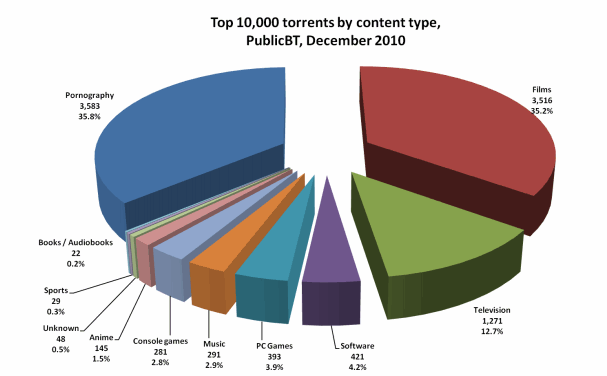
To be honest, I had expected a lot more than that, considering that out of the big files you can download, Linux ISOs aside, I can’t really think of a lot of legal content that’s 8GB or 12GB in size, whereas many pirated games are. Without iTunes HD movie downloads, and Steam, the quoted 23.8% of global traffic being pirated related, could have been a lot higher. The study was commissioned by NBC Universal, but it was the MPAA that screamed the loudest at the findings. Except, as usual, they missed some really important points in the report. One interesting note was that the US actually had a lower piracy rate than the rest of the world, which is strange because most of the pirated  stuff comes from the US (movies, TV shows, games), and what with the poor economy and relatively cheap Internet, you just expected the US to be the lead in terms of piracy. Another interesting result was that only 2.9% of downloads on the BitTorrent networks that the study monitored were for music, with films and TV accounting for nearly half of the downloads (and 35.8% being pornography).
Envisional Piracy Study - Break down by content type

Music torrent downloads only count for a very small percentage of downloads, according to the Envisional report (graph credits: Envisional report)

The theory is that the US has greater access to legal content, and so there’s less reason for many to get content via illegal sources. This is definitely true with TV shows, since Hulu and the other streaming networks, which block access from outside the US, means that there’s almost no reason to download torrents of the latest episodes. The low number of music downloads could be because that torrents have never been the best way to download music, not when LimeWire was around anyway. But it could also be because music availability is greater in the US, and that music, unlike movies and especially TV shows, don’t suffer from the same sort of delay releases and release windows, that actively prevents people from purchasing in order to maximize profits for publishers from different channels. In this day and age, having to wait a whole week before you have access to the latest episode of say The Office or even months before you can buy Boardwalk Empire on DVD/Blu-ray, just doesn’t work. When your friends or co-workers are downloading/streaming illegally and then discussing the latest episodes, you almost have to download/stream it yourself. And porn? Well, nobody wants to have to pay for porn, or to have something less than innocent show up on their credit card statement, so that’s another reason why it’s so popular.

So the fact that “it’s free”, while I do agree has a lot to do with why pirated content is so attractive, but there are clearly other factors in play that should not be ignored, if one is really intent on reducing online piracy. Unfortunately, groups like the MPAA and RIAA’s goal is to eventually get legislation that guarantees their revenue stream, and online piracy just happens to be a convenient excuse at the moment. It’s an easy argument to convince ignorant politicians, unaware of just what the Internet is all about. With all the studies being done, none has even tried to find out the real financial cost of piracy, not the billions upon billions imagined by the MPAA/RIAA. Not in the US anyway. But a Japanese government backed think-tank has looked at the problem, and has found some interesting answers. In regards to Anime and online streaming and P2P downloads via the popular (in Japan) Winny software tool, the study found that these kinds of piracy not only did not hurt DVD sales, it actually helped. YouTube uploads of Anime episodes actually helped to generate more sales, while P2P downloads did not hurt sales at all, only rentals. The promotional effects of YouTube uploads, even of full episodes, has been known for a while now, and you’d be hard pressed to find one publisher that doesn’t utilize YouTube for promotional purposes. And as for P2P downloads, with DVDs so cheap and online piracy so easily accessible for so long, people who still buy DVDs will always buy DVDs (or Blu-rays), in my opinions, because if free and easy hasn’t convinced you do break the law, nothing will (and for people who like to collect things, like me, buying and downloading are two totally separate things).

Don't Make Me Steal

Reasonable demands, or blackmail?

And the findings of these reports don’t really contradict a study by Warner Bros. back in December, where the conclusion there seem to be that a lot of people downloading pirated TV shows and movies are downloading the foreign dubbed version, which would otherwise not be available via legal means. And that by not fulfilling the needs of the market, that legitimate consumers are being pushed into pursuing content via other means, including illegal means. Which brings us to this week’s most interesting copyright related news story – the Don’t Make Me Steal manifesto. What is it? Well, it’s basically a list of demands, that if met, the people who signed the manifesto would all promise not to download pirated movie of TV content. It sounds a bit like a threat, which is why it’s controversial (and I don’t think the “Don’t Make Me Steal” title is a good one, because in the end, nobody “makes” you steal, it’s still a choice, even if it is sometimes the most sensible one).  But these are not really unreasonable demands. They’re not demanding everything be free, and actually, a lot of demands match up perfectly to what the recent studies have concluded, that a lot of people are being under-served. Removing release windows, reasonable pricing (buying DVD/Blu-rays should not cost more than a movie ticket, and rentals should not cost more than a third of the same ticket), greater access to dubs and subtitles, no DRM, and a lot of others things I suspect that the movie/TV industry will eventually figure out on their own and implement. So if this manifesto can change the debate from one of “how should we punish those that pirate stuff” to “how do we encourage people not to pirating stuff”, then it has served its purpose. It shows there are plenty of things movie and TV studios can do to reduce piracy, and they should at least give these suggestions some serious thought before trying to shift the blame and responsibility to everyone else.

All of this comes as the number of individuals sued by mass piracy lawsuits reached 100,000 in the US alone. Both piracy and anti-piracy, in my opinion, has gotten out of control, and the only real solution is to examine the real causes behind piracy. Or it will end up becoming a futile fight, where the process becomes a daily grind of trying to put out millions of fires with no positive effect towards actually solving the problem, something that was addressed well by the TV show The Wire (in relation to the war on drugs, but the idea is the same). How many websites do you have to get Homeland Security to shut down before the war on piracy can be won? How many civil rights do we have to sacrifice in order for the entertainment industry to keep their dying business model? How many people must be sued for illegal downloads before people stop downloading? And how long would all of these actions take before the problem is solve. Years? Decades? Never?

And not wanting to enjoy schadenfreude, Intel’s problems with Sandy Bridge seems like karma biting back for putting in hardware DRM into the new chip, and then for not even admitting it was DRM, even though it clearly was. The actual problem appears not to be that serious, it’s a flaw on the motherboard chipset that Sandy Bridge CPUs rely on, and it has to do with the SATA2 controller part which will fail over time for a small percentage of chips. Disabling the rogue transistor, or simply use the provided SATA3 ports instead, would be a simple workaround, at least until Intel can provide details on how they plan to fix the problem. Still, had Intel spent more time testing Cougar Point, instead of getting all giddy at the prospect of adding hardware DRM, maybe they could have avoided the potential billion dollar problem.

High Definition

Onto HD/3D news, not a whole lot happening really in the world of Blu-ray or 3D. But for general HD, and I know I’m stretching a bit here, then the news that Microsoft plans to solve Google’s H.264 problem may be somewhat interesting.

Google Chrome

Google dropping HTML5 H.264 support for Chrome may be an attempt to hurt Apple

Google dropped support for H.264 as part of its HTML5 implementation, and this means that HTML5 videos that use H.264 would not actually work on Google’s Chrome browser, which is a shame. Google quotes wanting to support “open software” as the reason, despite the fact that they’re the biggest supporters of the closed Adobe Flash software, being the only browser to bundle Flash with the default download. But Microsoft has been actively trying to get people to use H.264 for HTML5, no doubt because they own lots of patents on the format, and so they’ve released a Chrome extension that brings back H.264 support, for those with Windows 7 anyway (which has H.264 decoding built natively into the OS). They did the same thing for Firefox a couple of months ago, so this move wasn’t unexpected. And Google can hardly complain, considering their stance towards Flash.

You may ask what is Google’s motive behind dropping H.264, if it wasn’t for the sake of “openness”? Some would say it’s because they want people to use their own WebM format, for which Google owns the patents on (but has decided, for now, not to charge royalty). Maybe. But Google’s real target, in my opinion, is Apple. Apple loves H.264, they also only support HTML5 (not Flash) on their iDevices, and being a fairly closed system in which Apple has control over everything, it’s unlikely WebM support will be implemented without Apple’s permission for these devices and Safari in general. So Google’s move alienates Apple, while their own Android platform still manages to support H.264, Flash and WebM, with hardware acceleration too even. To me, this is a calculated move against Apple, forcing Apple to either accept WebM and implement hardware support for it, or to live with an YouTube app that runs poorly on iDevices. And Google’s alliance with Flash, and Apple’s anti-Flash stance, just further confirms what I and many others think.

Of course, there’s no guarantee that WebM will be adopted, not even by YouTube. In fact, this move most likely benefits Adobe and Flash, since it then becomes the only way to tie everything together, and get everything working, especially since Adobe has already announced they will add WebM support to Flash. And H.264 will be here to stay, as long as Flash is here to stay, and as long as Blu-ray and iTunes still exists.

Gaming

Another week, and the cat and mouse game between Sony and PS3 hackers continue. Sony brought out the 3.56 firmware to counter the hacked 3.55 firmware, but the process of hacking 3.56 has already begun and it’s a matter of when, not if, it will get hacked (because once the master key and the method it can be obtained became public, it’s really game over for that security platform).

PS3 3.56 Error Message

The unfortunate message that PS3 owners with upgraded HDDs are experiencing

And as expected, Sony’s war against hackers has caused its first piece of collateral damage, with PS3 owners that have upgraded their hard-drives being the first set of victim. Sony active encourages people to upgrade the PS3’s hard-drive, and even provides instructions on how to do it online (and it doesn’t void warranty either). They did this to counter the over-priced Xbox 360 hard-drive add-ons. But people who installed 3.56 found that their upgraded HDDs would no longer work, with a “The data is corrupted” error, even after reformatting. Apparently, Sony re-released 3.56 just now and it might have fixed the problem, but you need the original HDD to first upgrade to the new 3.56 (Sony didn’t call it 3.57 because they didn’t want to admit to their mistake? It’s not the first time either …), and then upgrade your HDD. Those without the original HDD (which has to still retains the original formatting) are still stuck with a bricked console, unfortunately. 3.57 will hopefully be here next week, but who knows.

So once again the advice is don’t upgrade your PS3’s firmware until at least a week after release. Yes, it’s a week that you may not be able to play online (or even certain games offline, which prevents play without an active PSN connection, which of course requires the latest firmware). I think if Sony is intent on releasing firmware updates so frequently, the least they should offer is a window in which both old and new firmware versions can be used, although I suppose there are huge technical issues related to supporting two firmware versions at the same time on PSN.

So that’s it for another week. Hope you’ve enjoyed this issue of the WNR. Have a good one and see you at the same time next week.