Archive for the ‘NPD Analysis’ Category

Game Consoles – January 2008 NPD Sales Figure Analysis

Thursday, February 21st, 2008

In the excitement over the end of the HD format war, I had almost forgotten about the January 2008 NPD game console sales figures for the US. As expected, sales dropped quite a bit after the Holiday sales, but were still quite respectable. You can read last month’s analysis here. The figures are from NPD, a marketing research firm that releases games console sale data every month.

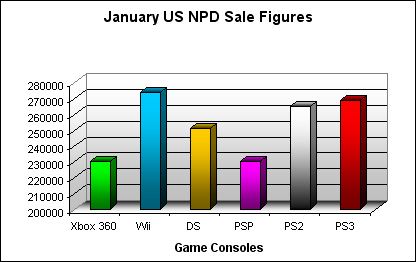
The figures for US sales in January are below, ranked in order of number of sales:

  •  Wii: 274,000 (Total: 7.7 million)
  • PS3: 269,000 (Total: 3.5 million)
  • PS2: 265,000 (Total: 41.3 million)
  • DS: 251,000 (Total: 17.9 million)  
  • Xbox 360: 230,000 (Total: 9.5 million)
  • PSP: 230,000 (Total: 10.8 million)
  • NPD January 2008 Game Console US Sales Figures

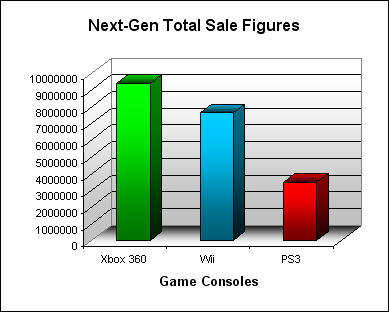
    NPD Game Console Total US Sales Figures (as of January 2008)

    There’s a bit of a controversy over this month’s figures. Microsoft has claimed that stock shortages, due to January stock being sold in December to cover the unexpected strong demand, has severely affected sales figures in the month. Nintendo has claimed the same reason for the low Wii sales numbers. This confirms my personal experience during December here in Australia, where most stores had no stock for Xbox 360 and Wii’s, while the only game console on sale was the PS3. Sony’s PS3 did not suffer from similar stock problems, and with the positive vibes coming from Warner’s decision to support Blu-ray exclusively, the PS3 recorded the first ever monthly victory over the Xbox 360. But as mentioned before, these numbers should be treated with some suspicion. And as such, I will limit my analysis for this month, which is also due to the low figures being reported as compared to last month.

    Probably more indicative of the actual market was software sales. It was another strong month for the Xbox 360, with 5 titles in the top 14, including the coveted number one spot (once again taken by the excellent Call of Duty 4). The Wii also had 4 top selling software in the same list, while the PS3 had two (one of them is, you guessed it, Call of Duty 4). The Xbox 360 therefore accounted for 40% of the top 14 selling software, Wii at 33% and the PS3 at 10%. If you look at the total console sales figure graph above, the ratios do look similar.

    Next month, hopefully, will see some figures that aren’t possibly affected by stock shortages. See you then.

    Game Consoles – December 2007 NPD Sales Figure Analysis

    Friday, January 18th, 2008

    December is traditionally the biggest month in terms of game console sales, and December 2007 was not exception. The numbers have come in, and they round off an amazing year of growth for the gaming industry, despite the heavy competition (perhaps the high definition people can learn something from putting consumers first and still be able to win regardless of competition). You can read last month’s analysis here. The figures are from NPD, a marketing research firm that releases games console sale data every month.

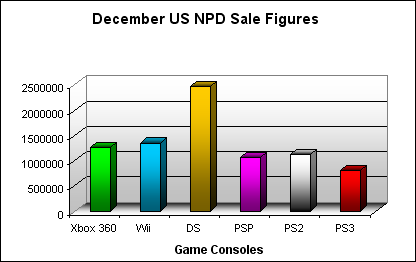
    The figures for US sales in December are below, ranked in order of number of sales:

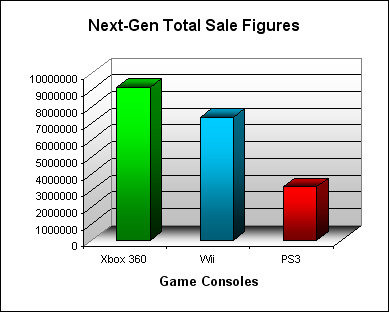
  • DS: 2,470,000 (Total: 17.6 million)  
  • Wii: 1,350,000 (Total: 7.4 million)
  • Xbox 360: 1,260,000 (Total: 9.2 million)
  • PS2: 1,120,000 (Total: 41 million)
  • PSP: 1,060,000 (Total: 10.5 million)
  • PS3: 797,600 (Total: 3.2 million)
  • NPD December 2007 Game Console US Sales Figures

    NPD Game Console Total US Sales Figures (as of December 2007)

    So a bumber month and year for the gaming industry. Good for them, because they’ve managed to be competive (format war), while not forgetting that their primary audience is not game developers or distributors, but the actual gamers themselves. Just look at all the great and original games released in 2007, not to mention some new and innovative hardware in the form of the PS3 and Wii (notable mention to the Xbox 360 as well, although it really was the innovation of 2006, but it has stood the test of time well despite the well known hardware problems).

    Another great month for the Wii, and as we all know if stock wasn’t an issue, the figures would be much higher. The Xbox 360 continues to sell well despite competition from the Wii and the now lower priced PS3. And while I have not covered it here, the 360 has three of the top 10 selling games of 2007, including the number one Halo 3 and the December number one Call of Duty 4 (and it seems readers of Digital Digest agree as well). What is more encouraging for Microsoft is that the other two top 10 titles were multi-platform releases that were also available on the PS3. The PS3, on the other hand, did not have a single title in the December and annual top 10 list, although the PS2 did have three titles in the annual list too. Which brings us to the PS3 – December was a great month for the console as it nearly doubled the last month’s results, which in itself was a quadrupling of the October results. But at this point, the PS3 *has* to sell well since it’s still trying to find some market share due to it being a relatively new console. The results are encouraging, although probably not as good as Sony had hoped (while the PS2 results were probably better than they expected – the PS2 to PS3 upgrade path does not seem to be tread as often as Sony likes). This month’s next-gen sale percentages show that the 360 held 37% of the next-gen market (up from 34.7% last month), the Wii with 39.6% (down from 44.3%) and the PS3 rose to 23.4% (up from 21%). This appears to suggest that both the PS3 and Xbox 360 made gains at the disadvantage of the Wii, and the 360’s near 40% share will be good reading for the people at Redmond. Total sales figures to date suggests the Xbox 360’s lead has shrunk to 46.5% (down 2%), with both the Wii (37.3%, up 0.5%) and PS3 (16.2%, up 1.5%) gaining. This is probably to be expected as the Xbox 360 was on the market a year earlier, and it’s natural for the other consoles to now slowly take back their share of the market. The question is when will the percentage settle down, and what will the market look like then … but this might take another year or two yet.

    The portable market was again dominated by the DS. The previous month’s impressive 73/27 split has now increased to 77/23 for Nintendo. With these impressive sales figures, one wonders if Microsoft will join in and release their own handheld.

    2007 has been a great year for gaming. It’s unlikely that 2008 will be as good, since 2007 saw both the Wii and PS3 storm onto the market, and with no new consoles being scheduled for 2008, it will be mainly up to the PS3 to see if it can catch up to the Xbox 360.

    See you next month.

    Game Consoles – November 2007 NPD Sales Figure Analysis

    Friday, December 14th, 2007

    The figures have just come out and there are some interesting developments, as predicted last month. November is always a crucial months for sales figures because this is when the traditional holiday sales period begins – to do well now in console sales will bode well for next year’s software sales. You can read last month’s analysis here. The figures are from NPD, a marketing research firm that releases games console sale data every month.

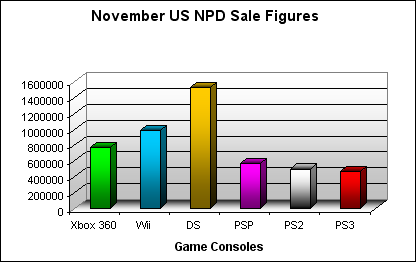
    The figures for US sales in November are below, ranked in order of number of sales:

  • DS: 1,530,000 (Total: 15.1 million)  
  • Wii: 981,000 (Total: 6 million)
  • Xbox 360: 770,000 (Total: 7.9 million)
  • PSP: 567,000 (Total: 9.4 million)
  • PS2: 496,000 (Total: 39.9 million)
  • PS3: 466,000 (Total: 2.4 million)
  • NPD November 2007 Game Console US Sales Figures

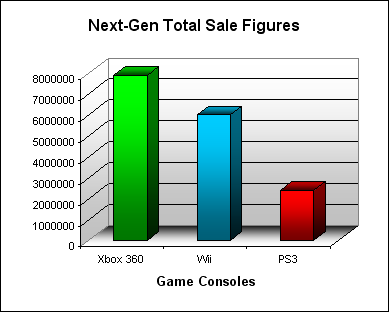
    NPD Game Console Total US Sales Figures (as of November 2007)

    The first thing that strikes you as compared to previous months is the surge in sales for the Nintendo DS. It has gone from being second place, behind the Wii, to being top by a huge margin – a 234% increase as compared to last month! Otherwise, all the consoles have sold in greater numbers – the total sales of all game devices rose nearly 150% as compared to October’s figures.

    The Wii has had a great month, nearly shifting a million units despite stock shortages. The Xbox 360 is doing quite well as well, easily breaking October’s record (October being “Halo 3” month). PS3 sales nearly quadrupled (285% increase), thanks to the new 40 GB PS3 and on going promotions. But even such an increase, the next-gen market is still being dominated by the Wii and 360, with the 360 still holding a healthy lead over both the Wii and PS3 in terms of total consoles sold in the US. This month’s next-gen sale percentages show that the 360 held 34.7% of the next-gen market (down from 36.4% last month), the Wii with 44.3% (down from 51.6%) and the PS3 rose 21% (up from 12%). What it appears to show was that the PS3 sales gained market share mainly at the expense of the Wii and to a much lesser extent, the 360 – the lack of Wii stock might be a contributor here. Total sales figures to date suggests the Xbox 360’s lead has shrunk to just below 50% (48.5%, down 2.3%), with both the Wii (36.8%, up 1.1%) and PS3 (14.7%, up 1.2%) gaining, albeit by only slightly more than 1% each. 

    The portable market was dominated by the DS, and Sony will be disappointed that PSP sales did not increase as much as DS sales (the previous month’s 62/38 split in sales is now a much more impressive 73/27 split for the Nintendo handheld).

    The real problem for the PS3 now is not so much dominance of the Wii – Wii gamers are not always going to translate into PS3 gamers – but rather the way Xbox 360 is managing to hold on to it’s impressive lead. I’m sure Sony execs and fanboys alike expected 360 sales to slowly decline after the release of the PS3, but instead, sales have increased by a good amount, most likely due to the strong exclusive software lineup. The good news for Sony is that the PS3 is gaining market share, but perhaps too slowly for Sony’s liking – even though PS3 sales went up 285% in a single month, due to the 360 sale also rising (but at a slower rate), this incredible quadrupling of sales would only give PS3 parity with the 360 if it continues to make the same gains as it did this month. For this to happen is unlikely, since this month saw a jump in sale largely due to the price drop associated with the once off release of a new cheaper version of the console. If Sony can continue the price drops, then they could pull even within 2008, but whether Sony can afford to do it or not is another matter. And this will just spur more price cuts by Microsoft too, and they could afford it by recouping money lost from strong games sales. However you look at it, Microsoft’s decision to launch their console a year earlier has been a gamble that’s paid off – they’ve got themselves a very strong foothold in the console market, and it has set up a great platform for them to launch their next console (as opposed to launching the 360 off the very limited success of the original Xbox).

    As for Nintendo, let’s just say that those who hold Nintendo stock will have a very happy Christmas indeed.

    See you next month.

    Game Consoles – October 2007 NPD Sales Figure Analysis

    Saturday, November 17th, 2007

    It’s that time of the month again, and NPD figures have been released (almost didn’t happen this month). As explained in last month’s analysis, NPD is a marketing research firm that releases games console sale data every month.

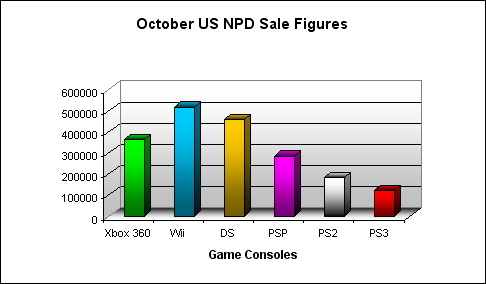
    The figures for US sales in October has just been released, and here they are ranked in order of number of sales:

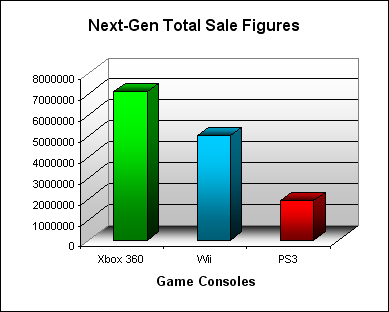
  • Wii: 519,000 (Total: 5 million)
  • DS: 458,000 (Total: 13.6 million)
  • Xbox 360: 366,000 (Total: 7.1 million)
  • PSP: 286,000 (Total: 8.8 million)
  • PS2: 184,000 (Total: 39.4 million)
  • PS3: 121,000 (Total: 1.9 million)
  • NPD October 2007 Game Console US Sales Figures

     NPD Game Console Total US Sales Figures (as of October 2007)

    The Wii strikes back this month after last month’s slightly higher than normal Xbox 360 figures due to the release of Halo 3. This means that Nintendo is dominating both the next-gen (are we still calling it that, or is it “current-gen” now?) console and hand-held console market. The PS3 is still struggling, although November’s figures should improve quite a bit due to the 40 GB PS3. PSP sales hold steady, while PS2 sales showed a slight drop.

    The next-gen market is still being dominated by the Wii and the 360, with the PS3 unable to make any sort of significant dent into the market place. The Wii held 51.6% of the market, while the Xbox 360 slipped to 36.4% after the high from Halo 3 subsided, with the PS3 improving slightly to 12%. For total next-gen console sales, the Xbox 360 still holds a commanding 50.7% of the market, with the Wii quickly catching up at 35.7% and the PS3 steady at 13.6%. Note that these figures are highly rounded, +/- 0.5% variation to the actual figures may be present.

    The portable market saw Nintendo retain the lead, and the most popular portable game of the week was Zelda: Phantom Hourglass.

    Next month will be very interesting indeed with the new cheap 40 GB PS3 coming into play. Early figures suggest that sales have doubled for the PS3, but probably not enough to push it past the Xbox 360 – a strong 360 games line up including Mass Effect might blunt some of the gains made by Sony, and Microsoft has its own discounts coming into effect.

    See you next month.

    Game Consoles – September 2007 NPD Sales Figure Analysis

    Monday, October 22nd, 2007

    This is another regular feature that I might run on this blog. Every month, marketing research firm NPD releases sales figures for game consoles (including portables).

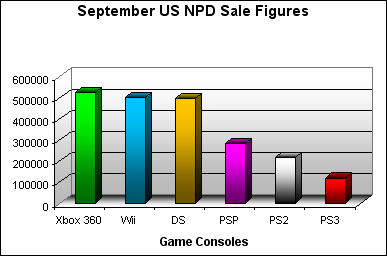
    The figures for US sales in September has just been released, and here they are:

    • Xbox 360: 527,800 (Total: 6.8 million)
    • Wii: 501,000 (Total: 4.5 million)
    • DS: 495,800 (Total: 13.2 million)
    • PSP: 284,500 (Total: 8.6 million)
    • PS2: 215,000 (Total: 39.3 million)
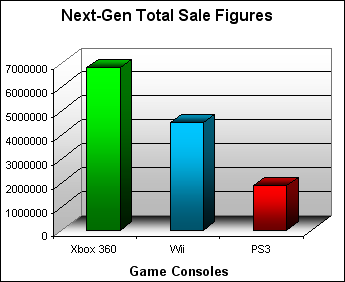
    • PS3: 119,400 (Total: 1.87 million)

    NPD September 2007 Game Console US Sales Figures

    NPD Game Console Total US Sales Figures (as of September 2007)

    You don’t have to be a rocket scientist to know that the PS3 isn’t doing too well at all. Some have claimed that the PS3 is selling at the same rate as the Xbox 360 when it first came out last year. But this isn’t 2006 anymore – back then, nobody cared about “next-gen” or HD gaming. And sales figures are only worthwhile when you compare them to that of your closest competitors. With that in mind, September saw the Xbox 360 grab  46% of the next-gen market share, the Wii was close at 44.6% and the PS3 way behind on 10.4%. Of course, September was an exceptionally good month for the Xbox 360 due to the release of Halo 3, so sales of the console will drop in the coming months. Looking at total sales figures, the Xbox 360 still leads with 51.6%, the Wii at 34% and the PS3 at 14.2%. Sony has gone from a 80+% domination of the previous-gen market with the PS2 (which is currently still doing very well) to a minuscule share of the next-gen market and this must be worrying for Sony. The only consolation is that since the PS2 is still doing well, when it is finally discontinued, there might be a large group of upgraders to the PS3. But this is still a long time away, and there is no guarantee that these PS2 users will all grab themselves a PS3, considering many of them might have already gone down the Xbox 360 route. Cheaper PS3’s will help, but when price is the only factor, the Xbox 360 and Wii are both still in a more advantageous position having been released for longer, selling in greater numbers and have the greater chance of discounting. And obviously, the number of quality games for the Xbox 360 is what is really driving sales, and with the highly rated Mass Effect Xbox 360 exclusive coming out in November, the holidays period looks like a good one for the Xbox 360.

    In the portable market, the PSP continues to sell well, even though the Nintendo DS is still selling at a 3:2 ratio. I’m sure Sony would be much happier if the PSP and PS3 sales figures were reversed, but the PSP, Sony’s first portable game machine, is holding it’s own against portable heavyweights Nintendo. The reason why the PSP is doing so well might come down to the fact that the Nintendo DS isn’t really competing on all fronts with the PSP – the DS cannot match the PSP’s music and movie playback capabilities, for example, and if Nintendo’s “games first” philosophies stay true, it’s unlikely that their next portable will be able to compete in these areas either.

    See you next month.