Weekly News Roundup (6 June 2010)

June 6th, 2010

What started as a way to avoid going through yet another week without doing any work, turned out to be a bit more work than I expected, but it was fun writing down all the things I’ve learned about 3D Blu-ray, and 3D in general, recently. Taking the form of an FAQ, my 3D Blu-ray – What’s it all about? blog posts looks at the basic principles behind 3D displays, and tries to clear up some common misconceptions behind the new technology (like whether you need HDMI 1.4 cables or not, if such a thing even exists). I’m sure I got some of it wrong, since there’s a lot of misinformation floating around. There’s also still quite a lot of stuff that I haven’t addressed, but I think I will save that for a full guide. Whether one should want 3D or not is a valid question, but I suspect with 3D technology relatively cheap to implement for TVs, there will come a time when 3D is a feature that comes with all the top-end TVs, whether you want it or not, and competition will ensure there isn’t a huge price premium to go along with it.

Copyright

Let’s start with the new review, and starting as usual with copyright news. A reader of our newsletter kindly pointed out that I forgot to mention the demise of Newzbin, a Usenet indexer website that was accused of copyright infringement and subsequently shutdown.

Newzbin 2 Logo

The "new" Newzbin is online after being brought down due in early May

The news did totally escape my attention for some reason, but there’s good news for fans of Newzbin, as it has been resurrected just this week. It was actually good timing on my part since when I first posted the story in the forum, the resurrection was just rumoured, but by the end of the week, it had become a reality. Apparently, the source code for the website was “leaked” a couple of weeks ago, and with the domain names transferred to a Seychelles based company, and semi-anonymous announcements of the resurrection by someone known only as Mr White, all the pieces were there for the resurrection. The new site, dubbed Newzbin 2, may even eventually feature more than just Usenet indexing, but extended to cover torrents as well. As for the legal questions surrounding the website, it will still exist, but it’s a question of whether the real owners can be found, or if the web host can be sufficiently threatened to pull the plug on the website.

Speaking of Usenet, it is a very frequently used place to download pirated content, despite all the media attention over BitTorrent. And this is one area that governments are a bit clueless about when it comes to copyright enforcement, with the agencies they’ve set up to monitor three strikes mostly ignoring this part of the online piracy trade. It just shows that whole anti-piracy crusade is nothing more than moral panic designed to make politicians feel like they’re doing something, even though they have no idea what exactly they’re doing, and give away our rights bit by bit to corporations. This trend started with the the US DMCA, and it’s been slowly exported to other countries around the world.

Canada is the latest country to adopt a US style DMCA, with the initial draft of the proposed changes finally released this week. But it’s not all bad news for consumers. The DRM provision that made the US DMCA so controversial is, unfortunately, still in. This means that if content has DRM, you can’t bypass the DRM to make backups (or to even use the damn thing). There are some exemptions, such as for research or parody, which provides at least some semblance of fair use. The changes proposed does finally give a clear legal position on the legality of time-shifting (recording TV shows for later viewing), format-shifting (ripping CDs to MP3s) and backups – all as long as you don’t break the DRM, of course. In other words, consumers have the right to do all the things they’ve been doing before, but if content owners start adding DRM to everything, then they can ensure these rights no longer exist and consumers have no say in the matter. What would have been better, and there is still time to make further changes, is to have an exemption for breaking DRM for the aforementioned fair use scenarios. DRM was always intended to stop piracy, it was and should never be used to prevent fair use, things like format shifting or time shifting. I mean, where is the danger in breaking DRM to make a backup, or to convert the DVD to DivX, as long as you only use the copy for personal use and don’t share the copy with anyone? There is no harm there, and nobody has ever been fined or gone to jail for this type of legal usage. If people want to share content illegally, then they are already breaking the law, and whether they broke DRM or not to do so is beside the point. So in Canada, there will be the situation where people can make unlimited copies of CDs or convert them to MP3 for personal use, yet if they do the same with DVDs, they’re breaking the law. The studios and music labels will point out that they’ve never gone after anyone for breaking DRM for personal use, but that’s also beside the point, since the law says it is illegal. Just because studios haven’t gone after someone for breaking DRM for personal use, doesn’t mean they will never, because if they do, they will win because of the DMCA.

The US Copyright Group

The US Copyright Group is at the center of the "pre-trial settlement" controversy in the US

The US Copyright Group, which sounds like an official organisation, but really is just a law firm that specialises in making money off anti-piracy activities, has been in the news a lot recently. Ars technica provided a rough breakdown of what the US Copyright Group could stand to make this year off these “pre-trial settlements”, and we’re talking about millions and millions of dollars here, so it is big business. While what they do isn’t illegal, there are ethical concerns, and groups like the EFF and ACLU are not happy with these types of actions, actions that others in the past have called “legal blackmail”. And it looks like the EFF and ACLU are stepping up their campaign to challenge this type of activity, and they may be preparing to reject one of these “pre-trial settlement” offers and take the thing to a full trial. This is the last thing groups like the US Copyright Group wants, because one, they could lose and that would set a bad precedent. And two, there’s not profit is a legal battle that could take months to resolve. But it looks like the EFF and ACLU want to prove a point in court, and this could be a very interesting trial indeed. Watch this space.

Somebody else wanting to have a fair trial is the 18-year old admin of a Danish BitTorrent tracker, whose home was searched in January this year, and now faces a legal claim of more than $260,000 by Danish anti-piracy agency, Antipiratgruppen. Antipiratgruppen’s opposition group,  Piratgruppen, has promised to aid 18 year old Jonas Laeborg financially.

And the Ubisoft “always on” DRM continues to make headlines, this week after analyst Michael Pachter publicly came out to support the controversial DRM measure. Those that have read my NPD US games sales analysis blog series will know of Mr Pachter, and this predictions that, well, don’t always pan out. But it seems Pachter felt the need to comment on Ubisoft’s annoying DRM, even though from his statements, it appears he’s not aware of the finer differences between what Ubisoft has done, and what other companies like Steam are doing. I’ll let you read the news story in full from the link, since some of the stuff that’s said is just too ridiculous and embarrassing to repeat on these pages. If there can be such a thing as a war of analyst, then we have the exact opposite opinion from the founder of gamesbrief.com, Nicholas Lovell, who labels Ubisoft’s DRM as “draconian”. He goes to question whether pirates are now having a better gaming experience than legitimate customers, and even suggests the slightly controversial idea of giving games away for free and making money off downloadable content, and using piracy as a way to promote games. Free games would be nice, but I don’t think game publishers even need to go this far. Cheap games is all that’s needed to stop piracy dead in its tracks, to nurture a new generation of paying gamers (much like how iTunes has nurtured a generation of paying music lovers, or basically what Steam is already doing with games). Stop trying to come up with ways to punish pirates, which almost always fails and only ends up punishing paying customers, and instead, try and entice them to go legit. And as for piracy promoting games, I think this already happens to a degree, and many that pirate games do eventually pay for the game, or at least the sequel or something. Companies spend insane amounts of money trying to generate Internet hype, viral marketing and all that, but game companies are getting it for free through piracy. Of course, if the game itself isn’t good, then the news of that spreads quickly as well, and sometimes I think that’s what game companies are really concerned about, that people will find out how bad their product is all without enough people being sucked in to pay full price for it. I think maybe movie studios may feel the same about bad movies being leaked online and thus failing to trick people into paying. The companies that are confident of their products tend not to worry too much about piracy, since they know enough people will buy it anyway.

High Definition

Let’s move onto HD news. I’ve already covered the 3D related HD stuff, so there’s nothing more to add on this front, other than to reiterate my opinion that people who haven’t seen 3D since the red/blue glasses days really should go and check out one of the 3D TV demos that are everywhere right now. It still may not be for you, but some I think will be surprised to find out just how impressive the whole thing is.

On the PC front, we have some interesting developments, and perhaps the emergence of a new form factor – the Blu-ray + SSD drive. Hitachi/LG is releasing a portable Blu-ray reader/DVD writer drive, that also contains a SSD drive. By combining two storage systems in one, it saves space inside today’s already cramped portable computing devices, and offers support for two of the latest storage techniques. The SSD drive can be used as a cache to speed up everyday operations, or use to store system files for almost instant system loading. I’m actually constantly surprised to see top of the range laptops and computer systems, the ones that cost $4000 or more, not including a Blu-ray drive at all. The premium for Blu-ray reader drives, or even writer drives, is so insignificant compared to say the cost of even high speed memory, that it’s just a mystery for me why Blu-ray drives aren’t standard already on *all* system, let alone the top-of-the-line gaming/multimedia systems. And even Sony has been guilty of this on their Vaio range, as I would have thought every Sony product would be including Blu-ray support by now.

Gaming

And finally in gaming, the section I’ve been ignoring recently, there’s still not a lot of news. But E3 is just around the corner, and the flood of news will follow short after. For this week though, there is only the news that Japanese PS3 owners will get the 3D gaming patch in the next few days – whether PS3 owners in other countries will get it or not, I have no idead.

Xbox 360 with Natal Camera

Project Natal, now white a white coloured camera accessory, needs E3 to be a total success

It’s good timing too, because some people already have their hands on 3D TVs, but without a lack of content, the PS3 3D games might just fill the void. And for those too cheap to pay for the games, there’s even a demo version of Motorstorm 2 that will have a 3D mode. However, there is still no firm date for 3D Blu-ray support, other than the now standard “before the end of the year” line from Sony.

As for E3, I guess I could still wait until next week to spill my thoughts on the whole Move/Natal thing, but I might just say it here. Microsoft is being very secretive regarding its Natal announcement, which makes me suspect that they’ve got something big lined up. With all due respect to Move, Sony has already said and demo’d quite a lot of the technology and games already, and with the “similarities” between it and the Wii, E3 probably won’t hold too many Move related surprises. But with Project Natal, we don’t know the  pricing, or even the final product name, or any other games other than Ricochet, so there’s a lot of work Microsoft needs to do at E3. It could be make or break time for Project Natal, and I think Microsoft realises this, hence all the secrecy, as if they’re saving everything all at the same time for a truly “shock and awe” unveil. Cynics, and fanboys of the other platforms, will say that the secrecy is because Microsoft knows Project Natal is a big fail that won’t really work, and is more laggy than a thing that has a large amount of lag. But those that have had recent plays with the technology, with the updated Ricochet mainly, have only good things to say about it, and this suggest to me Microsoft is confident it will work, but it wants maximum impact at E3. The fact that MTV is going to air the E3 Project Natal launch event is further evidence of this strategy. And with the World Cup, maybe will there be some kind of football/soccer based game demonstration in there. The caveat here is that I’m often wrong about these things, so I could be wronger than a thing that is very wrong indeed.

I don’t think Move is a game changer for the gaming industry, or even for the PS3, but Project Natal has the potential. And for the same reason, it could also fail miserably and take the Xbox 360 with it, so the next few weeks will tell us a lot about the outcome of the current gen console war.

I think that’s all I have for this week. Have a good one.

3D Blu-ray – What’s it all about?

June 5th, 2010

To fulfill my duties as writer of this blog, I needed to write something during this week, since I hadn’t done anything last week. I didn’t really have any topics in mind, but all I’ve been reading about lately has been 3D this and 3D that, and I thought it might be worthwhile to join the hype wagon and write something about it. I’m still planning on writing a full 3D guide sometime in the unspecified future, so this blog post will try to keep it as a nice and simple FAQ type thing, in order to ensure people will actually still read the full guide if/when it is ever written.

What is 3D? How does it work?

Anaglyph 3D Glasses

What you used to wear to watch 3D ...

Well, we interact with a three dimensional world (well not really, if you count time as the fourth dimension), but watching stuff on TV has always been a 2D affair. The flirtation with 3D motion pictures is nothing new though. How does 3D work? Well, in real life, depth perception is helped by the fact that our eyes are apart, seeing slightly different set of images (try closing one of your eyes, then the other). Our brain then process these set of images and we see in 3D. 3D movies and TV works the same way, by somehow presenting each of our eyes with a slightly different image from a slightly different angle, and “tricks” our brain into thinking that the picture is somehow coming out of a flat screen. The trick unfortunately doesn’t work for all people, as some suffer from what’s called Stereoscopic blindness.

In the olden days, they used anaglyph type of 3D. This is the one with the cheap paper glasses with blue and red lenses. The way they get each eye to see something different is to project a blue-ish set of images and red-ish set of images onto the screen at the same time, and the blue/red lenses will filter out the corresponding colour, and thus provide each eye with different images to trick our brains. It works, but the colour is all washed out because, well, you’re filtering out the colours red and blue.

Samsung 3D active shutter glasses

... what you now wear to watch 3D!

Today’s 3D uses a similar principle, but instead of using colour filters, we used more advanced types of filtering. The ones with active glasses work by quickly blocking each lens (shuttering it), and so at any one moment in time, while wearing those glasses, we’re only seeing out of one eye. The movie screen or TV is synced to the glasses so that it also alternates between displaying the image for the one eye, and then for the other eye. So let say there are 60 frames in a second of video footage, then for the first frame, it will show the image intended for the left eye, and your glasses will block the right eye lens so that you’re only seeing the left eye image in your left eye. Then for the second frame, repeat the same for the other eye. And repeat. If the refresh rate (the number of frames per second) is high enough, then we won’t really notice that we’re only really seeing out of one eye at all times, and the two different images for each eye tricks our brain effectively. Do it quickly enough, and all you see on the screen (without the glasses) is a set of double images.

The other type uses passive glasses, where each lens is polarised differently to only allow certain types images through, and it’s the special film screen or TV that present these alternating types of  images in a way that. The effect is the same, in that each eye sees something different and the 3D effect is created.

Both of these techniques ensure you don’t get the washed out colours of the red/blue glasses.

Of course, with each eye only seeing effectively half the frames, the reduction frame-rate will cause the motion to be less smooth, as any gamer will know. To solve this problem, the refresh rate of the display has to be increased, double the normal rate in fact. For TVs, this means 120 Hz, compared to the normal 60 Hz.

3D without glasses? Why should I just wait for that?

This is another question I’ve seen asked a lot. There are prototype screens that can do 3D without glasses, and Nintendo’s upcoming 3DS portable console will also do 3D without glasses. Most of these use what is called the Parallax Barrier method, which put simply, uses a barrier in front of a normal screen with “slits” that allow certain pixels through depending on your viewing angle. In many ways, it’s similar to those lenticular 3D effects that you sometimes get on cups, free collector cards, and used as DVD/Blu-ray covers (on the US edition of the Harry Potter and the Half-Blood Prince Blu-ray, for example). And as each eye views the image from a slightly different angle, this means each eye is allowed to see different sets of pixels through the slits, and thus, create the 3D effect. So far so good. But the problem with blocking out pixels is that you see less of them at each moment in time. So parallax TVs so far only have 720p or lower resolution, and you’ll need a panel with far greater resolution than 1080p to produce the same 1080p 3D as seen via the 3D glasses. The other major problem is the limited viewing angles, with only a few sweet spots where the 3D effect works, move away a bit, or stand or sit down, and it doesn’t work.

So in terms of a technology for prime time viewing on large screen TVs, the Parallax Barrier method still has significant issues that needs to be resolved first, if they can be resolved at all that is.

What is 3D Blu-ray?

Blu-ray 3D Logo

This is the logo you need to ensure what you have is 3D Blu-ray compatible

3D Blu-ray is a new standard for Blu-ray designed specifically for showing 3D movies at home. It has been designed in a way that will ensure compatibility between the various technologies used to transmit/store 3D movie content, as well as the various way for watching 3D content, including using passive or active glasses. In essence, it tells  studios how to encode 3D movies on Blu-ray discs, and it also sets the way 3D Blu-ray players output the 3D Blu-ray movies so that it will work on all types of 3D TVs, the kind that uses passive glasses, or the kind that use active ones. It’s one of the most significant developments on Blu-ray, not just because that the standard was set so quickly with universal industry support, which is very rare these due to conflicting interests by, well, everyone.

In other words, if you buy a Blu-ray movie with the “Blu-ray 3D” logo, it should play perfectly on a Blu-ray player also marked with the same logo, and if that Blu-ray player is connected to a 3D TV that is compatible with 3D Blu-ray, then you can be guaranteed that it will all just work, even if you mix players and TVs from different manufacturers. So that Panasonic 3D Blu-ray player will work when connected to that Samsung 3D TV, and vice versa. However, if your Blu-ray player doesn’t say it is 3D Blu-ray compatible, then it isn’t – you will need a new Blu-ray player. Some players can be software/firmware updated to support 3D Blu-ray, like the PS3. But most can’t be updated. Some TVs have been sold in the past as “3D ready”, but the reality is that if you didn’t buy your 3D TV this year, it probably won’t work with 3D Blu-ray unless you read it on the manufacturer’s website that it will work, or that it will work with some additional accessories.

The specifics of how 3D video is stored on Blu-ray is beyond the scope of this simple blog post, but since you have to store two different set of images, one for each eye, the movies will be of a larger file size, although with optimization, it’s not twice as large, only perhaps 50% more in most cases.

As for connecting your Blu-ray player to your TV, now that’s a topic for a whole different section.

HDMI 1.4? Do I need it?

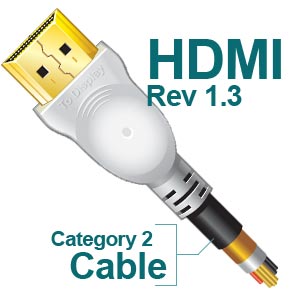
HDMI 1.3 Category 2 Cable

If this HDMI 1.3 cable is really Category 2, then it will work with 3D

There’s been a lot of confusion as to if you need HDMI 1.4 or not. Certainly, all the 3D TVs of this year and the 3D Blu-ray players will have HDMI 1.4, but make one thing clear – you do not need HDMI 1.4 for 3D. The evidence for this statement comes from the fact that the PS3, which features HDMI 1.3, can be upgraded via firmware to become 3D Blu-ray compatible. So if the PS3, with HDMI 1.3, can do 3D Blu-ray, there’s no reason why you need HDMI 1.4 to do Blu-ray either. Of course, this point is moot because all 3D hardware now are being sold with HDMI 1.4, and they will probably only work on hardware sold recently, which means everything will have 1.4 anyway. The major new feature of HDMI 1.4 are support for audio return channels (two way audio on the same cable), and Ethernet networking support built right into the cable itself.

In terms of cabling, you don’t need HDMI 1.4 cables. In fact, technically, there may not even be such a things as a HDMI 1.4 cable. What you need at the very least is a HDMI 1.3 cable that is rated category 2, or “high speed”. If you have such a cable, then 3D will work. Don’t believe me? Then believe the official HDMI website where it says “All High Speed HDMI cables will support 3D when connected to 3D devices”. The reason you might still want to get a HDMI cable rated for 1.4 is that they are guaranteed to work with 3D, and this may mean less hassle than trying to find out if the HDMI 1.3 cable you want to buy is “high speed” or not.

So if I don’t need HDMI 1.4, then why do I need a new 3D TV?

This is one question I see popping up on forums all the time. One of the requirements mentioned above is for your TV to do 120 Hz. Most TVs sold in the last few years can do this, some can even do 240 Hz, so why do you need a new TV?

The problem with previous 120 Hz displays is that, while they can display at 120 Hz, they can only accept a 60 Hz input. What happens internally on these TVs is that they do frame interpolation, or simply double the number of frames, to get the picture to display at 120 Hz, 240 Hz or even higher.

3D TVs are different in that they can accept a 120 Hz input and then display it as such. This is the only way to guarantee smooth motion during 3D, when each eye is only seeing half of the frames.

And of course for active shutter 3D displays (which represents the majority of 3D TVs on the market), it’s the TV that needs to sync with the glasses. An infrared signal between the TV and the glasses makes this happen, and your older TV will not have this capability. This is why glasses must be paired with the TV, and using Panasonic glasses on a Samsung TV won’t really work (well this is a bad example, because it actually does work if you turn the glasses upside down – but try using it on a Sony TV and it won’t work at all). There is a movement to get 3D glasses to be standardized, but don’t hold your breath.

Of course, if you older TV can accept 120 Hz inputs, and if there was some kind of dongle that adds the infrared communication between the TV and the glasses, then theoretically, this TV can be 3D ready. But there’s more profit in selling a brand new TV than a 3D dongle, so again don’t hold your breath waiting for such a solution.

LED/LCD versus Plasma – Which is better for 3D?

Panasonic 3DTV and 3D Blu-ray Player

Is plasma better for 3D than LED/LCD? Go to your nearest store to find out ...

According to the LED/LCD manufacturers, LED/LCD gives you the best 3D experience. According to plasma TV manufacturers, plasma TVs gives you the best experience. The companies that make both types of TVs, like Samsung and Panasonic, are staying relatively quiet during this much heated debate.

LED/LCDs are better with brightness, and with the glasses providing a slightly dimmer picture, brightness may be key for good 3D.

On the other hand, for pixel response times, plasma TV are much much better than even the best LED/LCD. Plasma TVs, such as the Panasonic, can claim 0.001 ms pixel response times, while LED/LCD TVs response times are several magnitudes above this. The reason why this is important for 3D is that because the TV is rapidly displaying different frames for each of your eyes, and the transition between the frames has to be quick enough or you’ll get what is known as the “ghosting effect” or crosstalk. In essence, your left eye may be seeing what the right eye should be seeing if it all doesn’t happen quickly enough, and that ruins the 3D effect. Plasma TVs will have a degree of crosstalk as well, and Panasonic has gone the step further to reduce the phosphorescence decay times, as to minimize or eliminate crosstalk. Other plasma TVs, like the Samsungs, did come with ghosting problems, but firmware updates seems to have improved it as well, although others suspect it’s actually the bundled movie, Monsters vs Aliens, that is causing the ghosting because it wasn’t encoded properly.

That’s not to say that LED/LCD can’t reduce crosstalk, and both Sharp and Sony have confidently stated that they have solved this problem for their 3D LED/LCD panels.

Size is also an issue, and the bigger the screen, and better the 3D effects will “draw you into” the action. And since plasma TVs are cheaper than LED/LCDs for larger sizes, that’s another factor to consider.

Whether this, or any of what I said, is true really depends on which TV you want to buy. The best way is to go to your local electronics store and test the TV you plan to buy – that’s the only way you can be sure if crosstalk is an issue with your TV. Remember that fluorescent lighting can affect certain TVs and cause ghosting to occur, so make sure you go to a score with a test environment that emulates the typical lighting in people’s homes.

3D content – where is it?

Samsung 3D Starter Kit

Electronic manufacturers are bundling 3D Blu-ray movies with their hardware, here's Samsung with Monsters vs Aliens

The short answer is that it isn’t here yet. There are some 3D test channels, some 3D test material you can download and play with, some 3D games, and a very small selection of 3D Blu-ray movies that seem to be exclusively tied to certain manufacturers, but the reality is that 3D content, which will be here in force, is umm, not here yet. It’s the chicken and egg situation, software or hardware first, and in this case, hardware is coming before software.

For 3D Blu-ray movies, there’s almost nothing substantial you can buy to play on your brand new 3D Blu-ray player and 3D TV. Samsung is including the movie Monsters vs Aliens in their 3D Starter Kit, which also comes with two pairs of 3D glasses. Panasonic is giving away Ice Age 3 and Coraline 3D Blu-ray’s with their TVs. And Sony will have Cloudy with chances of Meatballs on 3D Blu-ray. If you somehow got hold of all these movies (eBay is your friend), then they will all work on your 3D Blu-ray player + 3D TV regardless of which manufacturer(s) made them (thanks to the 3D Blu-ray standard). But with content so thin, manufacturers are holding onto these exclusives and not making them available for general sale, as a way to entice buyers to buy their stuff. Panasonic is chummy with the people behind the movie Avatar, so will they get the 3D Blu-ray version of Avatar and make it an exclusive? Nobody knows, but it could happen!

Update: Sony will release Cloudy With a Chance of Meatballs on 3D Blu-ray “this summer” for general sale, and possibly as soon as this month. In fact, you can already pre-order the UK version on Amazon UK, although US buyers need to be careful of Blu-ray region issues, since the release could be region B only and would not play on US machines (best wait for the US 3D Blu-ray version, which can’t be that far away).

Update 2: The US Blu-ray 3D version of Cloudy With a Chance of Meatballs is now available.

Panasonic's 3D Blu-ray giveaways

While Panasonic is giving away the 3D Blu-ray versions Ice Age 3 and Coraline with their hardware

But for lack of 3D content especially produced for 3D, if you have a Samsung or Sony 3D TV, then you can have unlimited 3D content by converting 2D broadcasts and movies into 3D, in real-time, on the fly. It isn’t real 3D because it’s not the filmmakers adding in 3D effects to the movie, it’s entirely the processor in your TV that is taking the images, analysing it, and then creating what it thinks should give you the best 3D depth effect. And it works!

It won’t give you the “in your face” type of 3D, but you will be able to see depth, and early accounts suggest that the conversion engine is pretty good at guessing which objects should be at the front, and which should be at the back. At the very least, it will give you some 3D stuff to look at while real 3D content is still arriving. Games, TV, DVDs, Blu-ray – anything can be 3D converted. And it even works with still pictures!

And for those still confused about real versus this kind of pseudo 3D, think DVD up-conversion, where DVDs can be upscaled to HD and still look damn good, even though it doesn’t look as good as real HD offered by Blu-ray movies. This is what the 2D to 3D conversion engine does – instead of HD up-conversion, it’s 3D up-conversion.

Some TVs can also convert 3D content back to 2D, with quality that is surely less than the original 2D version. So beware when you’re testing TVs at stores and the picture doesn’t look right, make sure the TV is playing a real 3D movie, and not doing any sort of 3D up-conversion, or 2D down-conversion if you’re testing the TV’s 2D capability.

Unfortunately, Panasonic TVs don’t have this capability, but hey, you’ll probably get Avatar 3D before anyone else, so it’s not all bad, and real 3D will be just around the corner anyway.

Do I need 3D?

Do you need anything? Do you really need that Blu-ray player? Do you really need to have a collection of 3000 movies at home? Do you need a 65″ TV when you already have a 55″?

I think this is a question only you can answer yourself. For some, 3D doesn’t even work because they are in the sizable minority that can’t see 3D. Others that suffer from sea sickness will find the experience intolerable as well. And many just don’t like having to put glasses on to watch movies (I, and other myopic and eye condition sufferers, have to put glasses on to see anything and everything).

Others will be thrilled about it and will be willing to pay the extra cost involved. The only advice I can give you is to try out the 3D demos that is (or will soon be) available at every major electronic retailer (just make sure you go to one that has the demo set up correctly, not using any sort of 3D up-conversion and with home lighting). Try it for yourself before you dismiss it entirely, and for those that haven’t seen a 3D movies since the blue/red glasses days, you owe it to yourself to try the new technology, which is entirely different to what you have experienced before.

2700+ words. Oh well, so much for keeping it nice and simple!

Weekly News Roundup (30 May 2010)

May 30th, 2010

Welcome to another edition of the WNR. Didn’t post a blog or article during the week, you can’t seriously expect me, lazy as I am, to do it two weeks in a row, can you? In terms of news, it was relatively light as well. Just an update on my purchase of the Samsung 3D plasma TV – still no news of when it will be in stock, although I haven’t really asked. I probably should/will do so early next week, but there’s a definite stock shortage due to the World Cup or manufacturing problems, depending on who you talk to. I wouldn’t say that it’s the huge demand for 3D that’s causing stock shortages, but I think it’s more the price drops on the new 2010 models (compared to 2009 ones) that are making these TVs quite popular – when you can get a 63″ plus everything you and your family needs to watch 3D movies (4 pairs of glasses + 3D Blu-ray player, and even a 3D Blu-ray movie that’s not available to buy elsewhere) for lower than the price of last year’s 3D-less 58″ model, then demand will surely go up, plus with the World Cup around the corner, everyone wants a brand new big screen TV to watch it on (and being able to enjoy the 3D broadcast of the games is just a bonus). It’s just a shame that Samsung hadn’t anticipated this demand. Anyway, onto the news.

Copyright

Starting with copyright news, more bad news in court for BitTorrent indexer isoHunt as a judge ordered permanent injunctions against isoHunt, and gave music labels and movie studios various ways to stop isoHunt from providing torrents of copyrighted content.

isoHunt Lite

isoHunt Lite, an attempt to show isoHunt is just a search engine, has failed to impress the courts

One of which is that isoHunt must ensure they do not list any content based on lists provided by music/movie studios, and that the isoHunt search engine must be crippled when it comes to searching for words associated with piracy, such as “warez” or “cam”. This will make running isoHunt in its current form very difficult indeed, and it appears the judge was not pleased at recent efforts by isoHunt to show that it is really just a search engine, much like Google. The isoHunt Lite interface, which mimics the simplicity of search engines such as Google or Bing, and removes a lot of the functions normally associated with BitTorrent index websites (such as well defined categories for things like “TV shows” or “Movies” or “DVDR Rips”), and tries to paint a picture of isoHunt as a search engine, much like Google, and not a “provider” or host of pirated content. But the judge didn’t buy this argument, saying isoHunt still allows torrents for pirated content to be located, and that’s enough to grant the permanent injunction and force the limitations on torrent listing and searching. So what’s next for isoHunt? Nobody knows. The website is actually hosted in Canada, one of the axis of evil countries in the eyes of the copyright groups, but the owner is located in the US, and so they have to comply.

Moving over to the Britain. Details of how the UK  three-strikes system would work has finally emerged, after information released by regulators Ofcom. Apparently, there will be a big list of names and addresses of people that have been suspected of online piracy, and music and movie studios will have free access to this constantly updated list. Every time someone is caught potentially downloading pirated content, their name will be added to the list or the list amended to include the latest offence, and the offender will also be sent a letter warning them of their actions. The copyright holders cannot take legal action against the offender until three letters have been sent out (therefore, three-strikes). There will be an independent appeals process, although information on how it will work is still sketchy. The letters will address the issue of hacked connections, but it seems that if your connection has been used without your permission, that still counts as a strike. Two things may happen. One, the list will grow large rather quickly and Royal Mail will be kept busy. Or two, people will get their pirated content from places that Ofcom and others cannot monitor, and so the stats will show less piracy, with no real world effects. I know know, but it seems copyright holders may very well be content with the latter of these outcomes, since I guess a false sense of security is better than none, especially if you know there’s not much you can do to stop piracy anyway (other than, you know, innovate and stuff).

Movie studios may complain about other stealing their stuff, but are they also stealing other people’s stuff? A company has sued Warner Bros. for allegedly stealing their anti-piracy technology, relating to watermarking films. So has Warner Bros. pirated anti-piracy technology? I wonder if they can blame it on their hacked  Wi-Fi connection …

Starcraft II Screenshot

Starcraft II has removed LAN multiplayer, is it an attempt to reduce piracy?

And wading into the gaming DRM debate, Blizzard co-founder Frank Pearce say that game developers are wasting their time on adding DRM to games, time they should spend on improving the games, the gaming community and other innovations (there’s that ‘I’ word again). Pearce say that there’s no foolproof DRM system, and that it is such a tempting target for hackers and crackers, that even most complicated system (are you reading this Ubisoft) will be cracked eventually. Instead, game developers should try to add value to game purchases, and to promote gaming communities where gamers will want to have the legitimate version so they can be part of this community. Blizzard’s own eagerly awaited Starcraft II won’t use an Ubisoft like “always on” DRM system, but it has removed LAN multiplayer, which some say is an attempt to force people to use Blizzard’s Battle.net system, which would then ensure the players all have legitimate versions of the game. I don’t think there’s anything wrong with this approach, as long as offline play is still possible for the single player campaign.  There’s little sympathy for those that still want multiplayer with pirated versions of the game. There has been quite a few developers that have come out against DRM, so the movement is growing, but most of them are developers that are quite confident in their products and the “value added” content that’s only available to legitimate buyers. But I think the last few years have proved that people are willing to put up with a little bit of online based DRM if they see value in connecting online, such as on the Steam platform, Xbox Live or Battle.net. And in the end, this solution is more long lasting than any DRM that companies like Ubisoft can come up with.

High Definition

Onto HD news now. Corel’s WinDVD is the latest PC based Blu-ray playback solution to get 3D Blu-ray certification. Corel have promised that a free patch will be available for WinDVD Pro 2010 users to add 3D Blu-ray support later in the year, the same deal that Cyberlink announced earlier with PowerDVD.

NVIDIA has also announced that 3D Blu-ray support, in the form of GPU based decoding, will be available via a driver update for a most of their recent GPUs. 3D Blu-ray movies carry more data than traditional 2D movies, and so will require more processing power – with GPU assist, this reduces the need to rely on the CPU. Expect ATi/AMD to make a similar announcement soon.

Blu-ray 3D Logo

Only Blu-ray movies carrying the 3D Blu-ray logo are certified, and there's only a couple available, and none for standalone purchase

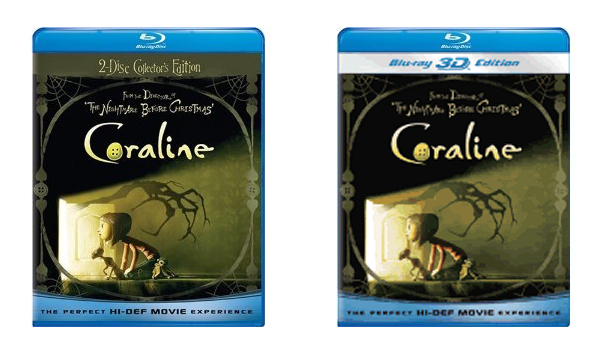
I think one of the best developments recently has been the certification of the 3D Blu-ray standard. Without it, every manufacturer would have used their own system, and there would have been no way to guarantee that a Blu-ray marked “3D” would play on all 3D Blu-ray players connected to 3D TVs. But luckily, we get a standard that includes a wide range of technologies, and so it seems all the bases are covered when 3D Blu-ray movies become available for general purchase. Unfortunately, there’s no definite 3D broadcasting standard, and there’s no standard for the 3D glasses that TVs use, with each manufacturer using their own systems for now. Speaking of 3D Blu-ray movies, there still isn’t a certified 3D Blu-ray movie that you can buy at the shops, except as part of Samsung’s 3D Starter Kit (which includes the certified 3D Blu-ray movie, Monsters vs Aliens). The glasses as part of the kit will only work with the new Samsung 3D TVs, but the included movie should work on any 3D Blu-ray player connected to any 3D TV, thanks to the 3D Blu-ray standard. The 3D kit comes free with Samsung 3D TVs in selected countries, including the US and Australia. Most of the other 3D Blu-ray movies are only available exclusively to other manufacturers, and you can’t even buy them even as part of a pack – for example, Panasonic is bundling the 3D Blu-ray version of Ice Age 3 and Coraline with their 3D TVs. Note that there is a “3D” version of Coraline available on Blu-ray, but it isn’t 3D Blu-ray certified – it only includes the anaglyph version of the movie, the one that requires those old red/blue glasses. The 3D Blu-ray certified version is the only one that will work with the modern 3D systems, mostly based on shutter glasses technology.

Coraline standard and 3D Blu-ray Comparison

Both say they have a 3D version of the film, but only the one on the right has the Blu-ray 3D certification

There’s still some debate as to whether plasma or LED/LCD is better for 3D. Early evidence suggest that plasma is, because pixel response times are much lower than LED/LCD, and if the response time is too high, then you’ll get what’s called the ghosting effect. There’s certainly not enough 3D TVs out on the market to make any firm conclusions though.

But one display technology that won’t do 3D, or anything else for that matter, is SED. SED, which stands for Surface-conduction Electron-emitter Display, was being developed by Canon as being the next big thing in TV, with blacks as black as the old cathode ray tube sets, but with the thickness of modern LCD TVs. But after lawsuits, patent claims and high production costs, Canon has decided to drop development of SED TVs. So that pretty much leaves OLED as the sole successor to LED/LCD and plasma TVs, which is not a bad thing, because if all research is dedicated to this technology, then we might see something available for purchase soon (that’s reasonably priced, more so than that Sony OLED TV anyway).

And straddling the line between HD and gaming news is Sony’s announcement of a partnership with HBO to stream shows to the PS3, at a cost of $2 to $3 per episode. If you think the price is high, then the worst is yet to come, as shows will be delayed 11 month from when they first premier on cable to when they are available on the PS3, making all of this rather pointless to be honest. But HBO must also straddle the line between distributing their shows on new platforms, and not offending current partners such as the cable operators. The Internet is changing things much more widely and quickly than anybody has anticipated, and if fast (as in 100 Mbps or faster), cheap Internet is available to everyone tomorrow, a lot of today’s established business models would seem rather outdated, including that of non interactive cable TV. Cable operators not investing in IPTV, on demand technology will find themselves in a very bad position in the near future.

And that’s all we have for this week. I can’t promise more next week, especially if I get delivery of my new Samsung 3D TV, which means I’ll be spending most of the time playing with it. If you see me post a mid-week blog or a new guide, then you’ll know I’ve received bad news about the availability of the TV. Have a good one.

Weekly News Roundup (23 May 2010)

May 23rd, 2010

As promised, the NPD analysis for April was put up first thing on Monday. Looking at the stats, it’s easy to come to the wrong conclusion that video games sales are dying in the US, but just like with Blu-ray sales a few weeks ago, the different timing of Easter in 2010 compared to 2009 has meant some weird month to month comparison data. If May turns out as worse as April, then you may begin to worry. In terms of guides, I’ve added a “new” TVersity Setup Guide. It’s not new of course because other guides that I’ve written before, like the PS3 H.264 Conversion Guide had already included TVersity setup instructions, but because so many guides had the same set of instructions, and some were updated and others were simply outdated, I thought it was a better idea to just combine all of these into one guide and then refer the other guides to this one. It will make updates much less painful, and I’ve also taken the time to add a few more tips to make the whole process a little bit easier. Anyway, let’s get on with the news.

Copyright

In Copyright news, it was revealed that the MPAA spent $370,000 in the first quarter of 2010 lobbying the US government. That may sound like a lot, but it’s actually down from the previous quarter, and from a year ago.

Now, what this means, I don’t know. Maybe the MPAA is spending less because its members are making less (unlikely). Maybe they’re spending less because they’re not as concerned about piracy anymore (unlikely). Or maybe they’re spending less because the government is more in line with their thoughts that ever before, and so they don’t need to pay as much to get their way. Getting the FCC to buy their claim about TV DRM helping to get movies earlier on TV may have cost them the majority of these lobbying efforts, but it was surely worth the money. Of course, now that the FCC has agreed that movie studios gets to decide whether you can watch/record something or not on your own TV, the MPAA is not so sure that bringing movies to your TV earlier, which was the whole “benefit” side of the TV DRM coin,  is such a good idea anymore. Cinema owners were always going to be against something which reduces their showing window, and while the MPAA has tried to shorten the window, they’re not going to do anything that endangers the cinema business, which is one of the few areas that has seen significant growth recently (thanks to 3D showings, mostly). So basically people will be stuck with TV with DRM, losing the ability to record stuff that they could before, and all for nothing in return. Nice one, FCC.

The Swedish Pirate Party has come to the rescue of The Pirate Bay by providing bandwidth for the BitTorrent index website

The MPAA had another victory during the week, against The Pirate Bay again, but as again, it was a minor and eventually inconsequential victory. At best. Last week, they got a German court to order the web host of TPB to cut off connections to the BitTorrent indexing website, and while it took a while for the web host, Cyberbunker, to agree, they eventually did it and TPB was down once more. And a day later (possibly less than this), it was up again. Hooray. And apparently, the Swedish Pirate Party has stepped up to offer hosting for The Pirate Bay, and so the next time the MPAA tries to shut down TPB, it will be a political issue, as well as a legal one. The Pirate Party is willing to defend the TPB, saying the website is “legitimate” and calling on Hollywood to end the “cat and mouse” games with the website. The Pirate Bay buys bandwidth from other web hosts, and so it’s very likely that the next step for the MPAA would be to go after the Pirate Party’s web hosts, which might effectively shut down both The Pirate Party website, along with the TPB, somethings that the courts may be a bit more reluctant to do. Or not.

Bringing together the previous story about the MPAA’s lobbying efforts and this latest attack on The Pirate Bay, US lawmakers published a report in which it identified The Pirate Bay as one of six “notorious” piracy websites, which also included file hosting website RapidShare. isoHunt, Mp3fiesta, RMX4U and even Chinese search engine giant, Baidu, were all named and shamed. Both RapidShare and Baidu were interesting inclusions. The latter being China’s version of Google, which begs the question, whether the real Google is next under the crosshairs of the US Congress (or perhaps its lobbying efforts have prevented it so far). It’s certainly true for a lot of people searching for pirated stuff, Google may be the first destination they visit, which usually allows them to find the relevant web pages on sites like The Pirate Bay or isoHunt. The thing is, if you’re going to go after indexing/linking websites like The Pirate Bay (who link, but do not host, pirated content), and because the Internet is all about one site linking to another, then Google may be just as guilty as The Pirate Bay or isoHunt, although it may be more “second-degree” linking, rather than the “first-degree” linking. But linking is still linking, and it once again highlights just the fine line between a legitimate business enterprise, and what the MPAA/RIAA considers the root of all evil. The RIAA welcomed the US congressional report, which is no surprise, considering their lobbying efforts probably paid for it.

Rapidshare logo

RapidShare has been targeted by the US Congress for providing pirated content as it wins an important court victory this week

And while RapidShare was being targeted by the US Congress, they had better luck in the courts, as the District Court of California found them not guilty of copyright infringement in a dispute with copyright holders Perfect 10. It’s an important decision, which Perfect 10 might appeal, and this time highlights the fine line between file hosting and file sharing. There are lots of pirated content on RapidShare, but like image hosting websites, it’s really up to the user to decide how they use RapidShare, and most I suspect use it legally for sharing large files that wouldn’t get through most email servers. Certainly, as the webmaster of Digital Digest, I’ve observed lots of independent software publishers that use RapidShare to host their perfectly legal downloads, to save on bandwidth costs. Of course, there are also users who upload and download a lot of pirated content, and this is becoming a more and more popular route with the global clampdown on P2P services worldwide. Does RapidShare remove pirated content on request? They do. But are they able to ensure that pirated content never appears on their site? I think, with millions of uploads per day (probably), that’s going to be a tough task. I think the simple fact is that online piracy may be impossible to prevent, and if this is the case, then content owners need to think of other ways to combat it. I know they don’t want to use the word “compete”, and they are right in that why should they have to compete with people that break the law and don’t play fairly, but it’s reality and it’s something they need to accept as soon as possible, or risk missing out on the opportunities the Internet presents.

The US Copyright Group may be facing up to a legal battle with the Electronic Frontiers Foundation, as the non-profit digital rights advocates signal their intention to fight the mass litigation and pre-trial settlement mailings organised by the anti-piracy firm. The EFF is hiring lawyers which may seek to duke it out with the US Copyright Group in court over one of their mass litigation attempts, possible over The Hurt Locker. And then we’ll see if the US Copyright Group has the guts to go head to head in court with the EFF, or are they just in this to rake in the pre-trial settlement fees. The MTV website also revealed a couple of interesting notes about the producer of The Hurt Locker, Nicolas Chartier, noting a rather nasty correspondence between Chartier and someone who emailed in complaining about the mass litigation attempt. And yes, this is the same Nicolas Chartier that was banned from attending the Oscar ceremonies for breaking the award campaigning laws.

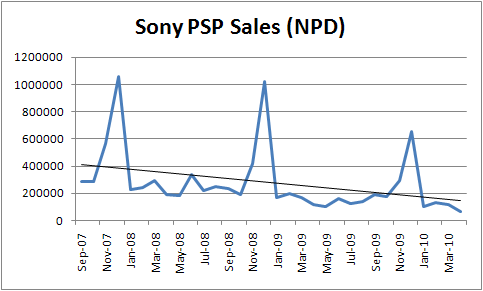
Sony PSP Sales (NPD Figures)

PSP sales have been steadily decreasing. Is piracy responsible?

And finally, Sony says that piracy is the biggest problem for their troubled PSP portable games console. The April NPD analysis I linked to at the top does suggest that the PSP is in trouble, dropping a massive 44% in sales compared to April of 2009, and it has been steadily decreasing in sales for quite a while now. However, I don’t really buy Sony’s line that the PSP’s troubles are caused by piracy, even though I do believe their claim that piracy is robbing them of revenue. Nintendo a few weeks ago also complained about piracy on the DS as a revenue killer, and I believe them because DS piracy is notoriously easy, thanks to the easy availability of DS flash carts. But DS hardware sales are still going strong, certainly much stronger than the PSP (more than 6 to 1 margin in the latest sales figures). So how come the DS hardware seems to thrive despite piracy, and the PSP, which is actually harder to hack than the DS in terms of getting pirated games to work, is hurting so badly. The same goes for the PS3, which has not yet been fully hacked to allow pirated games to work, yet it it constantly being outsold by the Wii and Xbox 360, both of which are much easier to hack. I’m guessing that while piracy is an issue, it is not *the* issue, and that Sony needs to look inwards before they start blaming their own failures on others. Things like poorer pricing, poorer online experience, the very “young male” dominated marketing of both the PSP and PS3, as opposed to the more inclusive effort to get the casual gaming crowd, may all be contributing factors to the success and failure of each console.

High Definition

Let’s move on to HD news. And by HD, that also includes 3D apparently because 3D is truly everywhere, and all the Blu-ray, HDTV manufacturers are releasing their 3D stuff around this time.

Cyberlink, the makers of PowerDVD, has posted an article on Tom’s Hardware which is essential reading for anyone who wants to know just how all this 3D stuff works, and what you’ll need to get it to work for you at home. Which reminds me that I should probably post something similar, since this is one area that I’ve been researching on a bit now because of my recent pre-order of a 3D TV. I would like to say that I did most of my research before I made the impulse buy, but that would be a lie. Although to be honest, I would have bought an equivalent model without 3D if one existed, which is becoming rarer as manufacturers are adding the relatively cheap to include 3D function into their top of the line TVs, which then allows them to raise prices. So if you want the best 2D quality, you’ll probably have to buy a more expensive 3D TV.

Google’s Chrome browser support H.264, Theora and VP8, so one might expect them to be neutral in the HTML5 video codec war. But they’re not staying neutral for long, as they launch WebM, the renamed VP8, to become an official open source competitor to the industry standard, but proprietary, H.264. Early testing, from the developers of x264, suggest that WebM, or VP8, isn’t as good as H.264, but that’s as to be expected considering how established H.264 is. It was also the developer’s technical, not legal, opinion that VP8 may fall foul of H.264 patent claims, something to keep an eye on for the future. But one thing is clear though, VP8 is better than Ogg Theora, and with both Mozilla and Opera supporting WebM/VP8, that’s probably that for Theora in terms of becoming the official HTML5 video codec, so we’re realistically now down to just two: H.264 and WebM.

But if you really must have H.264 on Firefox, then Wild Fox may be for you. It’s a fork in the Firefox development that will allow for H.264 decoding, as long as you’ve got a H.264 decoding codec installed on your PC. But its legal status may be under question, since this probably violates the H.264 licensing agreement in quite a few countries, while possibly staying perfectly legal in others.

As for gaming, there’s not much else going on except for the NPD analysis. E3 will be here soon, and Microsoft will unveil Project Natal proper, and then the Move vs Natal war will finally begin. Of course, fanboys have been fighting the same war for a while now, it will just go into overdrive come next month. Fun times.

And that’s all I have to say this week. More next week. Have a good week.

Game Consoles – April 2010 NPD Sales Figure Analysis

May 17th, 2010

It’s that time of the month again, and NPD has released the April 2010 US video games sales figures for this little blog to analyse. March was a big month for the PS3, and all eyes are on the Sony console to see if it can repeat the stellar performance in April. NPD itself has a few changes, in that they are no longer counting PS2 sales (perhaps Sony should take the hint and formally declare it end of line), and they are also not providing all the figures for the top 10 game sales, which makes analysis a little bit more difficult. The figures are from NPD, a marketing research firm that releases games console sale data every month.

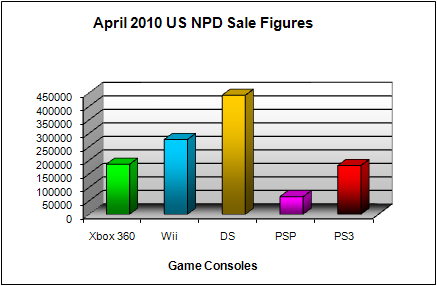
The figures for US sales in April 2010 are below, ranked in order of number of sales (April 2009 figures also shown, including percentage change):

  • DS: 440,800 (Total: 41.7 million; April 2009: 1,040,000 – down 58%)
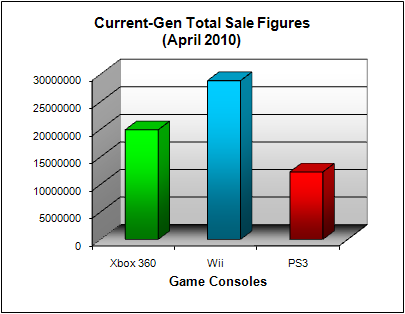
  • Wii: 277,200 (Total: 28.8 million; April 2009: 340,000 – down 18%)
  • Xbox 360: 185,400 (Total: 19.9 million; April 2009: 175,000 – up 6%)
  • PS3: 180,800 (Total: 12.3 million; April 2009: 127,000 – up 42%)
  • PSP: 65,500 (Total: 17.3 million; April 2009: 116,000 – down 44%)
NPD April 2010 Game Console US Sales Figures

NPD April 2010 Game Console US Sales Figures

NPD Game Console Total US Sales Figures (as of April 2010)

NPD Game Console Total US Sales Figures (as of April 2010)

My prediction from last month was:

I think the PS3 will outsell the Wii in April. This is based on the strong software numbers for March, plus the stock shortage issue being resolved finally which will give the PS3 a bump in sales. While there’s no new major PS3 exclusive in April, Super Street Fighter IV will be available, and based on the non Super version of the fighting game, the PS3 version should outsell the Xbox 360 version as well. Tom Clancy’s Splinter Cell Conviction, which is a console only exclusive for the Xbox 360 (there’s also a PC version), should do well, and God of War III should still be charting. So another good month for the PS3, with better hardware numbers, but probably slightly lesser software domination, for April.

What I failed to take into account was the Easter sales effect, and with Easter sales event coming in March this year, as opposed to April of last year, this accounts for quite a bit, but not all, of the sales drops recorded for April (compared to March). The double whammy is that while the Easter sales event happened in March, the Easter holiday period occurred in April, and so sales were further subdued as a result. And therefore, none of the consoles sold better in April than in March. The PS3 did not outsell the Wii. The PS3 didn’t even outsell the Xbox 360, but only losing to it narrowly. The game predictions were pretty much spot on, but with overall sales down 26% compared to April 2009 (21% of it attributed to Easter, probably), everything sold in fewer numbers.

The PS3 stock shortage appears to be continuing, at least when looking at Amazon. So this is perhaps one of the reasons why the PS3 isn’t dominating as it should based on recent game releases. This stock shortage has been going on far longer than it should have – I don’t know what the reasons are, but it can’t be helping Sony. PS3 sales still grew by 42% compared to the same month last year, but April 2009 was a bad month for the console, as it had the dubious record of being outsold by the PS2 during that particular month. What is more worrying for Sony is the PS2 and PSP. As mentioned earlier, the NPD has stopped tracking PS2 numbers, giving Sony a hint as to the future of the last-gen console. Perhaps it’s time Sony finally retires this ageing console, so they can concentrate all efforts on the PS3. They certainly won’t be concentrating efforts on the PSP, which has recorded yet another month of dismal sales. Recording what is the worst set of results since release, the PSP is seriously out of ideas, being outsold by the DS by almost a 7:1 margin this month, the total units sold gap between the DS and PSP has grown from 15.6 million units in April 2009 to 24.4 million just a year later.

The Xbox 360 continued to outsell the PS3, and continues to grow in a year-to-year comparison, a modest 6% increased compared to April 2009. If Sony is hoping to close the gap between the Xbox 360 and the PS3 total units sold in the US, then they’re doing about it the wrong way in regards to managing the stock shortage, and if anything, the gap has grown wider in recent month. And if Sony is hoping the PlayStation Move will help the PS3, then they have to hope Project Natal flops for the Microsoft console. E3, which will occur around this time next month, will give us a strong hint as to whether Move or Natal will dominate holiday sales based on the reception both demos get at the expo. But as long as the Xbox 360 is outselling the PS3, even if only by a small margin, Microsoft can’t be too unhappy with the results.

For Nintendo, the picture isn’t great this month. The DS recorded a huge 58% drop in sales compared to the same time last year, and even if you take into account the Easter effect, there’s still a drop in sales. The Wii continues to drop in sales, down 18% compared to last year. The Wii’s sales decline can be traced to April 2009, when it started to show signs of weakness. But the DS is still outselling the PSP easily, and the Wii is still outselling both the PS3 and Xbox 360 relatively easily, so it’s not time to panic yet for Nintendo. But they need something up their sleeves for the Wii if they want to continue to dominate after both Sony and Nintendo release their motion control systems.

On to software sales now. The month’s most popular title was Tom Clancy’s Splinter Cell: Conviction for the Xbox 360, outselling the number two title, which was also last month’s number two title, Pokemon SoulSilver, by more than a 2:1 margin. Conviction was a console exclusive for the 360. God of War III slipped to 5th place after last month’s monster 1st place finish. And as expected, Super Street Fighter IV on the PS3 outsold the Xbox 360 version, by a 1.3-to-1 margin – the previous Street Fighter game also sold more on the PS3 than on the Xbox 360. The usual Wii titles are in the mix, New Super Mario Bros, Wii Sports Resort and Wii Fit Plus, and also Just Dance, which refuses to go away. The other Xbox 360 title in 7th place was Battlefield: Bad Company 2, which outsold the PS3 version by around a 1.6-to-1 margin. Note that NPD did not provide figures for Wii Fit Plus this month, but knowing the sales numbers for the titles just above and below it, we can estimate sales at between 144,000 units and 166,000 units. For the sake of compiling market share percentage figures, sales for Wii Fit Plus can be  estimated to be 155,000, and if using this figure, the Wii games had 32.5% of the top 10 with 4 entries, closely followed by the Xbox 360 games on 31.2% for just two titles. The PS3 had two titles in the top 10, with 15.5% of the top 10 units sold. The two Pokemon DS titles accounted for the rest. It was interesting to note that both Final Fantasy versions not only disappeared from the top 10, they disappeared from the top 20 as well.

Here’s the complete list of the top 10 software sales:

  1. Tom Clancy’s Splinter Cell: Conviction (Xbox 360, Ubisoft) – 486,100
  2. Pokemon SoulSilver (DS, Nintendo) – 242,900
  3. New Super Mario Bros. Wii (Wii, Nintendo) – 200,300
  4. Pokemon HeartGold (DS, Nintendo) – 192,600
  5. God of War III (PS3, Sony) – 180,300
  6. Wii Sports Resort (Wii, Nintendo) – 179,000
  7. Battlefield: Bad Company 2 (Xbox 360, EA) – 166,000
  8. Wii Fit Plus w/Balance Board (Wii, Nintendo) – 155,000 (estimated)
  9. Just Dance (Wii, Ubisoft) – 144,000
  10. Super Street Fighter IV (PS3, Capcom) – 143,000

Prediction time. The PS3 shortage continues, and so it will still do poorly in sales I think, and probably outsold by the Xbox 360 with the hardware sales order remaining the same as this month. On the software front, the Xbox 360 version of Red Dead Redemption should be the top seller, with the PS3 version closely behind. Alan Wake, the much hyped Xbox 360 exclusive, should be in the top 10 as well. There might be room for the PS3 exclusive 3D Dot Game Heroes as well. Along with the usual Wii titles, the new Super Mario Galaxy 2 should rank in the top 10 as well. Overall sales should pick up compared to April, but probably still down year on year at least for the hardware figures.

See you next month.


About Digital Digest | Help | Privacy | Submissions | Sitemap

© Copyright 1999-2012 Digital Digest. Duplication of links or content is strictly prohibited.