Weekly News Roundup (6 November 2011)

November 6th, 2011

Hope you had a great Halloween last Monday. We don’t celebrate Halloween much in Australia, although the prevalence of US entertainment programmes on television here meant that some kids here will have caught Halloween fever. Which is why I spent Monday night hiding from door knockers and pretending nobody was home, as we’re not big candy eaters and so stock levels were dangerously low for trick or treating purposes, particularly the latter.

Which is just as well, since it gave me more time to put the finishing touches on a new website I was making for Australians, called Faraway Deals. It’s my way of helping Aussies take advantage of the generous exchange rate, by helping them to spot the best movie and games deals and discount for shopping overseas. And by overseas, I mean the UK, since there are fewer region issues (Australia is in the same Blu-ray region as the UK, and we’re both PAL countries in terms of game regions), plus the exchange rate is even more favourable than compared to the practically worthless US dollar (hurrah for European debt crisis!)

Plenty of news to go through, so let’s get started.

Copyright

In copyright news, it’s been a busy week. Actually, almost all of the news that I’ll be talking about this week are copyright related, but with thing happening in the courts, in congress, and all of them potentially seismic changes.

We start with the slightly ridiculous: Justin Bieber. I never thought that I would have to talk about the “Biebster” here in the WNR, but this day and age, anything is possible. But nobody really expected Bieber to be caught in the middle of a copyright war, and I don’t think a single soul expected him to be on both sides of the war at the same time, if that’s even possible. The FreeBieber.org website was set up to protest the Commercial Felony Streaming Act (S.978), which would make it a streaming copyrighted video a felony. The link to Bieber is that he actually became famous on the back of a bit of copyright infringement, of the streaming kind as well, when he uploaded videos of himself singing popular, and copyrighted, songs on YouTube. Had Bieber done it after S.978, he might find himself facing 5 years in prison for having committed felony. And this kind of “copyright infringement” seems to be quite a preferred way to become famous online, maybe not Bieber famous, but YouTube famous (or infamous) at least (the alternative is to hire a production company to write you an original song, and we know how that can turn out). And how does this kind of copyright infringement, a felony under S.978, actually hurt anyone? Would people stop buying Chris Brown’s ‘With You’ just because one Justin Bieber uploaded his, poor recording quality, version of the song? And had the rights holders to ‘With You’ filled a takedown notice with YouTube and removed the Bieber version before people had a chance to view it, would the music world be better or worse without Justin Bieber? (on second thought, don’t answer that)

Anyway, Bieber was asked what he thought of FreeBieber.org and S.978, and obviously, as someone who got famous on the back of what is now potentially a felony (and not only that, anybody that embedded the video on his or her blog would also be committing a felony under S.978), he came out supporting the anti-S.978 movement. To the point where I think he got a bit overboard with the sentiment and recommended the incarceration of the US Senator that sponsored the bill. But at the same time, his lawyers were doing all they can to kill off FreeBieber.org, by sending a cease and desist letter to the people behind the website asking them to stop using Bieber’s image. Of course, the EFF stepped up to defend FreeBieber and attack Justin Bieber’s lawyers for not knowing about the First Amendment, especially when this is part of the core First Amendment rights, the freedom to espouse political views. I think Justin should get in contact with his lawyers and get them to tone it down a little, especially when FreeBieber.org isn’t actually hurting Bieber-nomics, and it may be helping to boost his rebellious image. And the website also serve to entertain those that like seeing pictures of Justin Bieber behind bars, so it’s a win-win.

Stop the E-Parasite Act Petition

Petition Obama to kill off the E-Parasite Act, by signing this petition

Despite all the ruckus over S.978, it isn’t even the most controversial copyright bill up for debate on Capitol Hill at the moment. That would be the E-Parasites bill, also known as Stop Online Piracy Act (SOPA), currently being mooted for debate in the House of Reps. I’ve already talked about SOPA in previous WNRs, so have a look if you need more background info. But this week has all been about opinions, and most of them are against SOPA, with op-ed pieces popping up everywhere, and with the pro-SOPA opinions most limited to the usual suspects, the MPAA and RIAA. Not only that, there’s no an E-Petition up and running to oppose SOPA, but unlike most other E-Petitions (which are only slightly more useful than completely useless), this one is being run on a website set up by the White House, and if 25,000 signatures can be obtained before the end of November, the promise is that the White House would take the time to seriously consider the petition. Practically speaking, the copyright lobby friendly White House won’t do a thing to stop SOPA, but 25,000 names is a nice and achievable goal (over 10,000 signatures already, in the first week), and if the power of the Internet can be harnessed and much more than 25,000 names added to the petition, then it will definitely send a message.

The ridiculous coddling of copyright interest isn’t just in the US though, over in the UK, ISP BT has to now officially block Newzbin2 this month, a court has ordered. This is despite Newzbin2’s “guilt” never properly tested in a court (the original verdict was for the original Newzbin, not the second incarnation, most likely run by totally different people), and Newzbin2 not having any sort of profile in the UK itself (as it’s based in a foreign country, run most likely by foreigners), and so not even jurisdiction is clear. But yet, BT will have to comply and use its child-porn filter to do the filtering, which really shows where the priority is these days, taking resources away from fighting child porn to use on anti-piracy. The ridiculousness of this ruling, which basically opens up the door for corporate backed censorship in the UK, is already getting the copyright lobby excited, with the music industry already signalling it will ask BT, and other ISPs, to start blocking The Pirate Bay. And with the precedent already set, getting other sites blocked should be much easier, although getting around the filter may be just as easy too.

And so with one ridiculous, overreaching bills and court rulings, after another, and with the copyright lobby working overtime (by working, I mean of course spending) and the statements they’ve made, you would think the piracy problem must be really killing the creative, copyright industries. Talks of hundreds of thousands of job losses, the threat of good content disappearing, movie studios and music labels going out of business, so surely, there should be plenty of facts just lying around to highlight the financial toll of online piracy. Well, there’s definitely “lying” anyway.
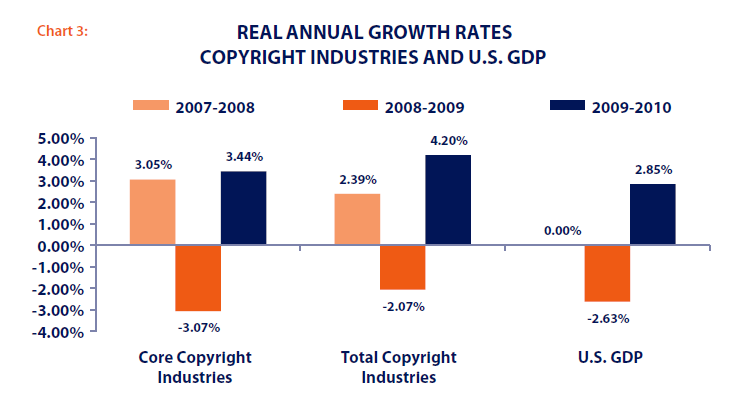
Copyright Industries Report: Real Annual Growth Rates

The copyright industries seems to be doing pretty well, according to a new report, despite "huge piracy problems"

You see the problem for the copyright industries, but really just to vocal ones that pay the salaries of the RIAA and MPAA, is that while they have to paint a bleak picture of the effects of piracy, they also have to highlight just how important they are to the economy, the US economy in particular. And to do that, they have to show how much money they contribute to the economy, and they have done it via a new report. The problem of course is, on the one hand they have to say “we’re important because we’re doing great”, and on the other hand they have to say “we’re not doing great because of piracy”. But as the report highlights, the core copyright industries have never had it better – they’re making more money despite the recession, and job losses have been relatively subdued compared to other industries. So where’s the online piracy induced disaster? Surely, with web piracy at an all time high, revenue should be down the drain compared to say 10 years ago, and while that may be true for the music industry, it has much more to do with people’s changing buying habits than actual piracy (people buy fewer albums, instead, buys more tracks – choice, if anything, is the real “killer” of the music industry it appears).

And speaking of job losses, the current Boogeyman that the RIAA/MPAA likes to use to scare politicians, pay in copyright industries are actually 15% to 27% higher than other industries. So much for massive job losses and not being able to afford to make new content, while other industries are “forced” to tighten belts by embrace the “work more for less” principle (*cough* exploitation *cough*).

The reason for the industry’s resilience against surging piracy rates may very well be due to the fact that piracy has a bigger effect on the segment of the “market” that traditionally don’t buy a lot of stuff. These people may have been participating in casual piracy, “borrowing” content from friends, or recording stuff from TV, or buying dodgy discs from street vendors, before Internet piracy became the easy way to get content for free. And if so, then the only real effect is that the increase in the amount of content these people have access to. And this can be a good thing too, as while the conversion rate, the rate at which people who get free content decide to buy the content, may be low, it’s still better than zero, and so piracy does lead to sales, and there are plenty of evidence to support this. At the very least, it gets people talking about the content in question, and it can create the kind of peer pressure that forces others to get the content, via legal means if they’re capable of doing so.

And it was surprising to see the same argument being used in court, but not by the defence, but by the judge, in making a ruling for a piracy case in Spain. Finally, the argument that not all piracy, if prevented, would have led to sales was used in a court of law, and accepted by the judge in question. The copyright industry, even as they wash their hands of the responsibility for protecting their own content (handing it to the government instead), should at the very least prove that they have actual, financial losses stemming from piracy, and if so, how much. If they cannot provide even a rough estimate, and not the kind of that RIAA/MPAA like to produce (1 x piracy = 1 x lost sale at highest retail price), of their own losses (and their own report seems to indicate not much loss going on at all), then they shouldn’t have a legal leg to stand on. And this wasn’t even the most controversial part of the Spanish judge’s ruling. The judge also came to the logical conclusion that piracy may actually help sales, for the very same reasons I explained above. Now, I’m sure this judge’s ruling will be appealed to the high heavens, but at the very least, in this one moment, we have some legal precedents being set that sets the bar that much higher, or at least even have a bar at all, for rights holder to prove their actual losses. Can’t prove it? Then no damages, it’s as simple as this.

And not being able to prove actual losses, and still intent on suing, should be punished. Just like the way notorious copyright troll Righthaven is being punished in courts right now. By not paying Wayne Hoehn and his lawyers the cost that was awarded against Righthaven, the judge has seen fit to nearly double the amount payable, from $34,000 to $63,700, for interests and additional incurred costs, and if Righthaven don’t pay up soon, then the court has ordered the US Marshals service to intervene if needed. While the judge’s ruling didn’t really reflect this point, but the fact that Righthaven (and their client, Stephens Media), still cannot prove the actual financial damage that comes from non profit bloggers posting a small segment of their newspaper articles, surely didn’t help their case.

And in the latest case of “DRM is teh suck”, we have RealNetworks’ decision to shut down support for their DRM portion of their online music service, Rhapsody. So all those that purchased tracks prior to July 2008 will have to quickly convert their tracks to audio CD, and then rip them back to a non DRM’d MP3, or they may lose the ability to listen to the songs they paid for, if they change or upgrade their computers. Once again, content holders force us to put up with annoying DRM, and at the first sign it becomes a pain to maintain, they ditch it and force us to jump through hoops again to retain the content we already paid for. It seems Rhapsody is not even providing any detailed instructions on how to do this conversion (other than the warning that if you don’t do it by tomorrow, bad luck), even though they should be providing DRM-free MP3 versions of DRM’d tracks, which isn’t even very hard to do since they already have them as part of their current music store. There ought to be a law to force rights holder to be responsible for their own DRM, that if they either provide indefinite support for DRM (which would probably fail most cost benefit scenarios), or if they decide to withdraw support, then they must ensure users get continued access to purchased content, if that means providing a DRM free version. Otherwise, to me, DRM is nothing but a fraud to make people pay multiple times for the same thing.

High Definition

In HD/3D news, we’ve had yet another near record week for Blu-ray market share, but looking closer, the numbers are less clear.

For the week ending 22nd October 2011, Blu-ray market share reached a near record of 38.87%, just shy of the 40.22% set a few weeks earlier. But both weeks had one thing in common, or rather two. One – for both weeks, the top selling title was a Disney release. And two, both were Blu-ray “exclusives”.
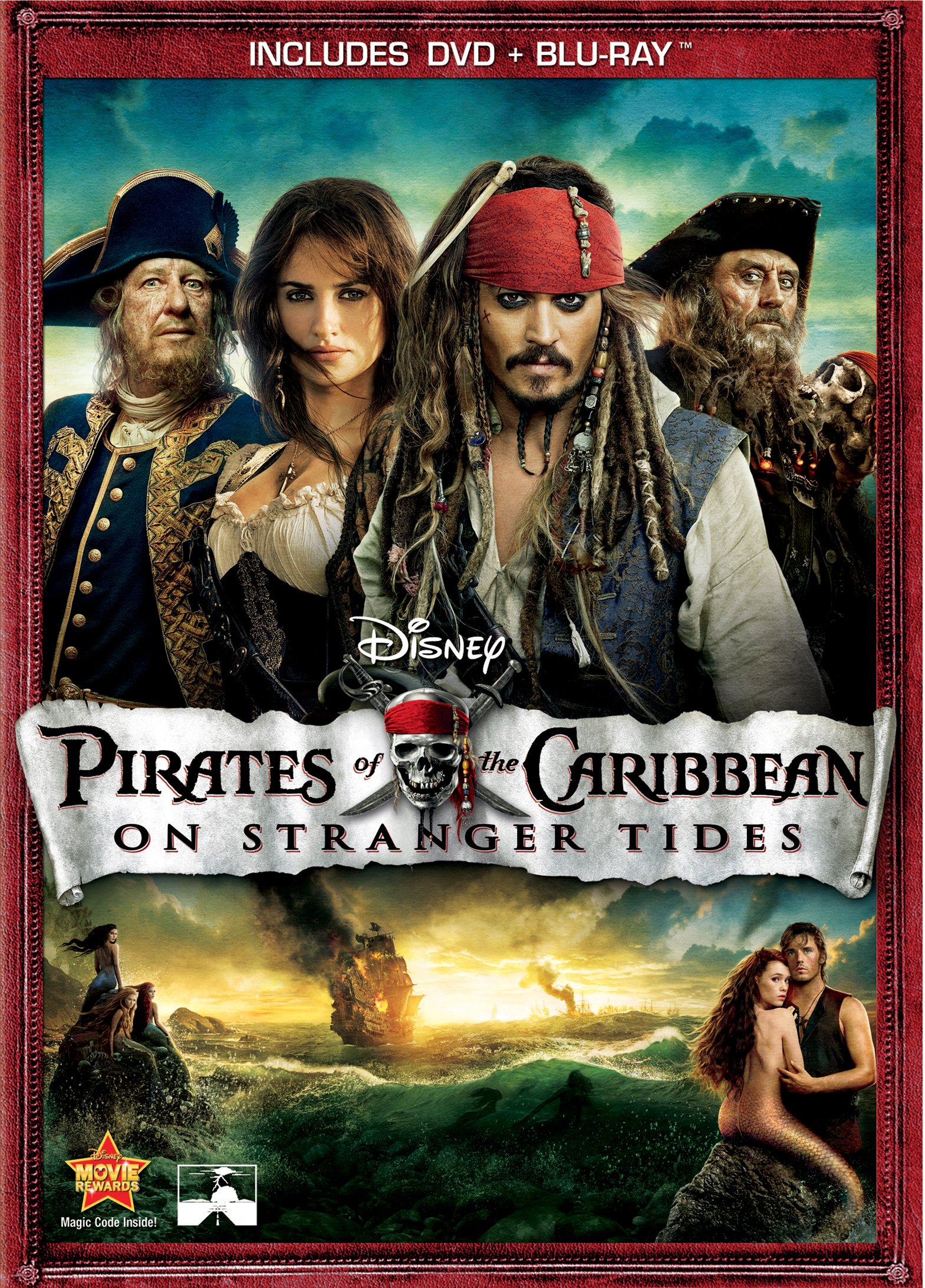
Pirates of the Caribbean: On Stranger Tides DVD Packaging

Combos are appearing in DVD packaging and is the only option for DVD owners, but are still counted as Blu-ray in the sales stats

I put the term exclusives in quotes because, while both titles (The Lion King and Pirates of the Caribbean: On Stranger Tides) had DVD versions that could be purchased, the sale of these versions would only count towards Blu-ray sales, because the DVD versions were locked inside combos. And the decision to count combos only as Blu-ray exclusives may have made sense when these were few and far between and aimed mainly at early or potential Blu-ray adopters, the situation has changed with these high profile releases, particularly the A-list ‘On Stranger Tides’, now using combos as an easy way to sell people what they don’t need and charge a slightly higher price for the privilege.

A combo is better value if you need both the Blu-ray and DVD version, but that’s not really the case for most people. For kids movies, like The Lion King, it perhaps makes a bit more sense, since you can give the DVD copy to your kids to destroy. But for A-list releases?

And even worse, these combos now come in DVD packaging (those taller boxes), and so are placed in DVD sections of stores. This ensures people buy the Blu-ray version even if they don’t need it, and I suspect some won’t even know what it is. But if they’re willing to pay for it, then it does provide them some future-proofing, and that’s not a bad thing, but really, these combos should be counted separately in sales, particularly ones that come in DVD packaging (or just count the ones that come in DVD packaging as DVD sales). Otherwise, my weekly Blu-ray vs DVD sales figure analysis will quickly lose what little meaning it has, and this possibly leads to more work for me, which is a terrible, terrible thing.

And on that note, let’s end this WNR and the end of my work on Sunday. See you next week.

Weekly News Roundup (30 October 2011)

October 30th, 2011

Welcome to this Halloween-eve edition of the Weekly News Roundup, where you’ll read scary stories that will send chills down your spine, give you nightmares night after night, and bring forth the disturbing thoughts from the deepest and darkest part of your soul. Stories like, um, a new proposed copyright bill, and I guess something about a new jailbreak device for the PS3. Okay, not quite as scary as I first thought, perhaps.

Copyright

Starting with the copyright news as has been the custom, Halloween eve or otherwise, and we have a scary thing to report, and that’s the US House of Representative’s newly produced copyright bill, dubbed the Stop Online Piracy Act (SOPA).

Roll of money

What a typical US voter looks like, judging by what/who the politicians really listen to

First off, the title of the bill is misleading, because online piracy cannot be stopped, as history has shown us, through legislation or technical measures – people will just find a way around it as usual. But the “people’s representatives”, you know, the guy with only 9% approval these days, are trying their best to ensure the good money lobbyist have spent produce something worthy of the $$$, and so we have SOPA. SOPA is similar to the stalled PROTECT IP Act, which was stalled after one Senator with common sense (there had to be one, after all) decided that sacrificing the tenets of democracy to appease the movie industry wasn’t the right thing to do. SOPA will give the government the power to seize the assets of one industry at the behest of the most powerful members of another competing industry, namely the members represented by the RIAA and MPAA, all because of the stronger lobbying power of that industry. That’s democracy at work, folks.

And the bill extends not only to websites and domain names in the US (I think this bill will kill US jobs as webmasters and businesses mitigate the risk of domain seizures by moving their business elsewhere), it also applies to foreign websites (they might as well just write “The Pirate Bay” into the bill, if they haven’t already). And in the spirit of shifting responsibility of copyright enforcement away from the actual copyright holders towards the government, as the bill will allow the US government to lead the charge overseas and file injunctions against “bad” websites on behalf of studios like Sony and Fox. Because as you know, these small businesses don’t really have the financial resources, nor teams of lawyers, that can handle this sort of stuff, so tax payers will have to do the right thing and help out of course.

But while SOPA will make the US government the public face of copyright enforcement, the government is already doing plenty behind the scenes, specifically, in Russia. Russia’s application to join the WTO faces many hurdles, but if they are seen as friendly copyright enforcement, it will make the MPAA/RIAA happy, and then they will stop whispering bad things about Russia (which has already helped to put the country onto the “notorious piracy market” list) to the US government, which will then drop (some) opposition to Russia’s application. And so the Russia government is now making an example of two admins of the defunct BitTorrent tracker, Interfilm. The married couple now faces up to 6 years in a Russian prison, as the MPAA claims the trackers has caused as much as $1.25 billion in damages (although under Russian law, the couple may only be liable for $16,000). International diplomacy and politics in action, comrades.

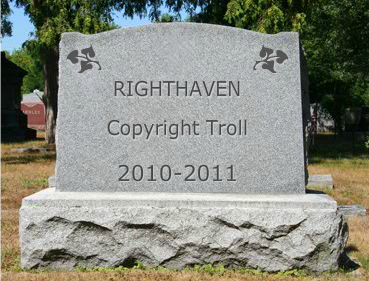
Righthaven R.I.P.

This gravestone picture detailing Righthaven's possible demise is appropriate given it's Halloween-eve and all, despite having being used only last month. Plus Righthaven sort of sounds like Raven, which is very Halloween-y

But it’s not all bad news this week. With the threat of bankruptcy looming, Righthaven has somehow gotten themselves into more trouble this week, as a judge has ruled against the firm in the biggest ruling yet – $120,000 in costs that Righthaven will have to pay to Thomas DiBiase, a former prosecutor that Righthaven tried to sue for the use of an article by the Las Vegas Review-Journal. Remember that Righthaven has already said they are having trouble paying just the $35,000 ruled against them, to the point where they may have to declare bankruptcy, so $120,000 is going to be a bit more difficult. At this point, and I know I shouldn’t, I almost feel sorry for Righthaven. While what they’re trying to do is despicable, in my opinion, the way they have done is, really, just stupid. And I have a soft spot for stupid people, or law firms. The key to settlement-for-profit is to find the right marks, I mean, defendants. You pick the ones that are less likely to put up a fight, and more likely to pay up. So it’s a no go suing poor people, people with knowledge of the law (like, for example, a former prosecutor), people who have the connections to mount a good defence (for example, a former prosecutor), and people or groups that are not part of a charity, non profit, or public service organisation (for example, a former prosecutor who runs a non profit websites providing details about unsolved murder cases as a public service). Other law firms have been selecting defendants carefully and wisely, so it’s no secret. But the biggest problem with Righthaven’s approach is that, copying newspaper articles is not in the same league as copying music or movies. The people who download music and movies illegally, and their motives for doing so, are very much different to people who copy/paste newspaper articles for discussion, public discourse, or information sharing, usually without any financial benefit to themselves.

Over here in Australia, opposition to our local variety of  “copyright trolling” seems to be growing, as the boss of an ISP has signalled the company’s intention to fight the “scum” (he’s words, not mine) who are trying to profit from allegations of copyright infringement. John Linton, chief of ISP Exetel says the ISP is now taking measures and investing $200,000 in the process to do some unspecified work to make it harder for the “blackmailing scum” to target their customers. It will be interesting to see if other ISPs follow suit.

And to add to the growing movement against draconian anti-piracy measure, whether it’s legal or technical, Valve’s Gabe Newell is once again highlighting that the only way to prevent online piracy may very well mean that publishers have to compete with pirates, by doing the controversial thing of actually improving services. Once again, Newell highlighted the success Valve’s Steam platform has had in the pirate haven known as Russia, a country that publishers have said would be impossible to make money from due to rampant piracy, but is now Steam’s second largest continental European market. Apart from more reasonable pricing, the key was localisation, according to Newell, to provide Russian translated games to gamers before the pirates do, as opposed to the publisher’s tradition of waiting 6 months or more to bring out a local version. Publishers want to eliminate piracy, but they don’t really want to do the hard work of making a better (or in Russia’s case, a usuable) product. It seems you can’t have your cake and still eat it (even if the cake is a lie).

And even in the area of pricing, it seems publisher may be able to compete with pirates too. Competing with “free” isn’t impossible it seems, as Newell says their pricing experiment with the now “free-to-play” Team Fortress 2 has paid off big time, with 20% to 30% of those playing it (for free) paying for in-game stuff. Mostly hats, I guess. Just goes to show that people are willing to pay for anything if they decide, and not publishers, if there’s value in it. A variation on “free-to-play” may very well be “pay-what-you-want”, and I would love to see Steam try this one out.

High Definition

In HD/3D news, there’s not much going on, although Blu-ray market share remains suitably high and above the 30% level that, a few weeks ago, would have set new records.

However, I do have a story about Zediva’s ongoing battle with the MPAA. Zediva offered a service where people rent physical DVDs, but the company streams the DVD to users via the web, as opposed to sending them the disc.  This week, a judge ruled that what Zediva is doing is not legal and has granted the MPAA a permanent injunction, as it’s just a (not so clever) way to avoid having to pay web streaming licensing fees to movie studios, as no licensing is needed for physical disc rental. This story is only HD related because of the company’s plans (former plans now, perhaps) to stream Blu-ray movies in the future too. Zediva also has to pay the MPAA $1.8 million in damages.

Hulu

Hulu is not available in Australia and many other countries due to the lack of a global licensing scheme, which sucks for us Australians

Licensing is an interesting issue that I wanted to talk about for a while, but not about what Zediva was trying to do, which was a bit too obvious an attempt to avoid paying the fees, and offered users no real benefits compared to traditional web streaming at all  (with all of the benefits belong to Zediva). But licensing right now, I feel, is holding back innovation. The lack of a truly “global” licensing scheme means that companies like Netflix can’t truly call themselves global giants, and the likes of Amazon can’t offer overseas customers the same experience with their Kindles, even though they allow overseas buyers to buy the devices. The greed of copyright holders, wanting to eke out as much as possible from each market individually, is even hurting  some of their own initiatives, such as the recently rolled out UltraViolet cloud based digital copy scheme, which is yet again a geo-limited (AKA US and, maybe if you’re lucky, Canada, only) service. And here in Australia, we don’t have Netflix, barely a Kindle presence, no Hulu or Spotify, and UltraViolet won’t really help us (yet), and with most of these services actually making money for studios in the US, it’s a huge opportunity they’re missing out on, just so they can get a couple of thousands more from putting pressure on local distributors (which then forces prices up for local content, and pushes people towards grey imports, or even piracy).

GamingAnd finally in gaming, it appears another jailbreak device has been released for the PS3 which circumvents Sony’s latest attempts to lock down the console.



PS3 gamers with consoles still using firmware 3.55 or older can grab the $50 Jailbreak 2 device, and play games released after firmware 3.60, which feature security fixes that prevented the use of the original jailbreak device. And so the cat and mouse game between Sony and hackers continues (although maybe Sony are the mice in this analogy).

That’s it for this week. I’m really tired after a bad night’s sleep, so most likely, I will have no recollection of ever writing any of the above by tomorrow.

Weekly News Roundup (23 October 2011)

October 23rd, 2011

Welcome to yet another edition of the WNR, as we approach the final straight of 2011. I’m going to have to squeeze this one out in quick fashion, because I’m currently having a bit of bother with one of my servers (the one that hosts the forum), and so my attention is needed elsewhere. I really really really hate server management. I really do.

Copyright

Let’s get started with the copyright news for the week. It’s a well known fact that the current White House is very much a friend to the copyright lobby, then again, it’s hard to find a politician in Washington that isn’t, considering the fair and balanced way the RIAA/MPAA spreads their lobbying efforts.

Joe Biden and Victoria Espinel

Biden and Copyright Czar Victoria Espinel were instrumental in getting the copyright lobby their ISP 'graduated response' deal, new emails reveal

But a freedom of information request by a curious Internet security researcher has revealed just how much work the Obama administration is actually doing on behalf of the copyright lobby, helping them to get a good deal against America’s largest ISPs in the recent ‘graduated response’ deal. It appears that the newly appointed Copyright Czar, Victoria Espinel, was not only on perhaps too friendly terms with the RIAA/MPAA, but may have also neglected to involve other interested parties in the negotiations, such as consumer rights groups, until it was too late. Vice President Biden’s office has also been revealed as working hard to help the music and movie industries get the best deal, but this is no surprise because Biden’s pro-copyright views were well known before he teamed up with Obama.

So once again, we have a government elected by the people that is only looking out for the interests of private corporations, because in the end, lobbyists are more important than voters in Washington, it appears. And the most depressing thing about it all is that a change of administration won’t change things, and may actually make things worse, as the RIAA/MPAA have been clever in their lobbying, much like how Wall Street does it, by giving all major parties a piece of the pie. It’s precisely things like this that make people want to occupy streets, squares, and other public venues.

While not strictly copyright related, but you can’t rule it out, but Google’s decision this week to ban FrostWire from the Android Market has people talking. Well everyone, except Google themselves, as they still refuse to release the reason why file sharing app FrostWire was given the boot. It could be related to the recent troubles FrostWire had with the FTC, in which the FTC sued the makers of FrostWire for possible privacy violations – the crux of which is that FrostWire shares downloaded files by default, and while most people don’t mind or don’t care, the FTC thought it was problematic enough to take action. But the case has since been settled, with FrostWire long ago making the required changes to its software, including the Android version, and so Google’s recent decision is a strange one, especially as it comes almost immediately *after* the settlement of the FTC case.

But once again, the biggest criticism of Google is its lack of transparency and even basic communication. Anyone that has actually tried to reach a real person who works for Google will know how hard it is, and sometimes it’s just downright impossible. App makers are also not too unfamiliar with Google bans that defy explanation, and the only information they receive (if they receive anything at all) is some vague message about violation of the terms and conditions.

For now, the FrostWire app is still available on their website, but without a listing on Android Market, all those that purchased the app will find it difficult to update to the latest version, so the Google ban is also unfair to the more than million end users who have downloaded FrostWire so far.

Google G2 Android Phone

Steve Jobs accused Android of "stealing" from iOS, a new biography reveals

And while we’re talking about Android, did you hear about the latest revelations about what Steve Jobs thought of Google’s Android? In the authorized biography that is released this week, Jobs apparently went crazy when HTC released an Android phone that Jobs thought copied too much from the iPhone. Apparently, Jobs threatened to go “thermonuclear” to “right this wrong”, even if it meant spending “last dying breath” to do so. Fortunately, from what I read, Jobs made peace with Google towards the end, and so hopefully, he didn’t spend too much time thinking about the “stolen product” Android during his last days.

This isn’t the normal sort of copyright issue I post about here though, but it just goes to shows how trivial allegations of non commercial, home user copyright abuse is, when compared to what a corporation can get up to, at least according to Steve Jobs. I don’t know if Google really is guilty in this, but I think the smartphone market is better having someone like Android competing with iOS, and it forces Apple to make iOS better as well. And with Apple’s policy of not allowing others to use iOS, someone was always going to come up with an operating system that’s  “iOS for non Apple devices”, because it’s such a huge market segment to ignore.

Getting back on track again, we also have a brewing story this week that involves the Anonymous, AiPlex and WNR. Yes, this WNR. Last week, I received an email from AiPlex asking us to remove this particular WNR edition, because AiPlex weren’t happy at the way they were portrayed in the article. But if you read the article, all it did was report on then recent events, particularly quotes published in a TorrentFreak article that appears to show AiPlex engaged in some fairly illegal denial-of-service activity against torrent websites, as part of their anti-piracy strategy. AiPlex later denied either making the quotes or alleged they were misquoted, but it was too late, and then Anonymous decided to take matters in their own hands and launched the first in a series of attacks that still continues today. Of course, most people have forgotten about AiPlex, but their latest effort to “erase history” may very well re-ignite people’s interest in the company, as apparently, a lot of bloggers also received similar messages, reports TorrentFreak.

On my part, I’ve offered AiPlex space on the WNR and in our (currently down) forum to post their version of what happened, but I’ve not heard back from them since.

High Definition

In HD/3D news, it’s been a historic week for Blu-ray (well, the history was actually made a couple of weeks ago, but we’ve only just got the data now), as Blu-ray’s weekly market share went over the 40% mark for the first time ever.

The Lion King Blu-ray

The Lion King Blu-ray was released in four separate Blu-ray+DVD combo packs, and all sales are counted as "Blu-ray only"

It was down to a bit of statistical manipulation, but it’s still a significant milestone for the format. The statistical manipulation comes from counting Blu-ray + DVD combos as Blu-ray only, and with Disney’s policy of timed exclusives for the combo version (with no Blu-ray only version, and the DVD only version coming more than a month later), all it takes is a classic re-release to push Blu-ray market share to record levels. This time, it was The Lion King that was responsible, which was released with no less than 4 distinct editions, none of which was actually Blu-ray or DVD only. The release of Fast Five also helped greatly to take Blu-ray above 40%.

Will Blu-ray push through the 50% mark this year? It could in the next few weeks, but once the real holiday season starts in December, it will be more difficult as DVD sales are high as well during this period. Blu-ray revenue, for sure, should reach record levels towards the last few weeks of December, and will probably go over the $150 million mark for weekly sales.

But the biggest threat to Blu-ray is not DVD, but perhaps web based content, as a new survey shows that 20% in the US are already enjoying web content on their primary television sets, as opposed to just on the computer. And it’s largely thanks to Blu-ray that this is the case, since Internet connected Blu-ray players have helped the likes of Netflix expand their coverage. Game consoles are probably primarily responsible, but the PS3, which is also a Blu-ray player, has been key as well. So overall, Blu-ray has been the needed Trojan Horse to get web streaming into people’s homes, and the survey conducted by Boston’s Strategy Analytics seems to show it has worked. What I found interesting was that the rate of viewing web content on TVs in Europe was much lower, 10%, and I think that has a lot to do with the lack of available free content such as that offered by Hulu, and the lack of an almost ubiquitous service like Netflix being available.

The most attractive thing about web content is probably the on-demand nature of it, as you can choose what to watch and when. And if the right content is available at the right price, stats show that people are willing to pay, and this could help fight the online piracy problem as well. And with TVs now integrating online streaming support directly, web streaming should grow considerably.

But for cinema quality HD, Blu-ray is still the king at the moment, and will be until 100 Mbps fibre connections become more common.

Not much going on in gaming, and I really need to take care of the server situation, so this is as good a place to end this week’s WNR. See you next week.

Weekly News Roundup (16 October 2011)

October 16th, 2011

Welcome to yet another edition of the WNR. Another rather quiet week news wise, so this would otherwise be a short WNR, except I might spend a bit of time talking about the latest NPD results later on in the gaming section.

Copyright

We start with copyright news as we usually do, and we start with a quite unusual story, one that I still don’t really know what to make of.

PC gaming piracy is a big problem, I think everyone can at least acknowledge this fact (whether ever more intrusive DRM is the solution to the problem, I think, is where the debate is at the moment), but if the goal of anti-piracy is to increase revenue, and intrusive DRM doesn’t seem to be producing, why not try something else?

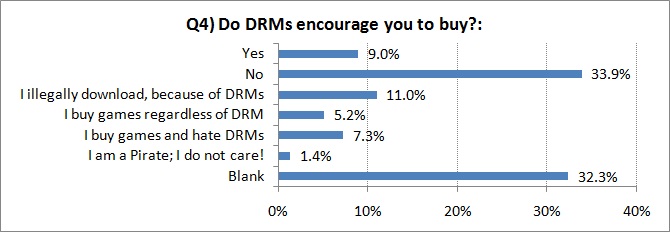
Vigilant Defender Questionnaire

A sample result from the Vigilant Defender questionnaire, which shows that DRM not only does not really help encourage pirates to buy games, it may even drive them to pirate in the first place

Except, I probably wouldn’t try what startup anti-piracy firm, Vigilant Defender, has tried – to actually help the spread of pirated content. Yes, you heard right, the first step in Vigilant Defender’s experiment is to actually help seed a leaked beta version of the hit game, Deus Ex Human Revolution. The second step is slightly tricky, as the version of the beta they seeded was slightly modified to drop out of the game after the first few levels, and direct users to an online questionnaire, in which they were asked questions about why they decided to pirate the game. While data collection is essential to solving the piracy problem, especially given the industry’s often biased “research” on the matter, the key question asked of gamers was “what would you be willing to pay for this game”. Not only will the answer to this particular question prove useful in finding out just why people pirate, and what price point can influence the same people to go legit, Vigilant took this one step further and proceeded to offer downloaders the opportunity to buy the full game at a price determined by average answer to this particular question. And amazingly, 8% of all those who downloaded the modified leaked beta actually went on to buy the game, at the user voted average price of $24.99 (half of the retail price) and that’s actually quite a high rate of return for games, especially when the target demographic is often described by the industry as “criminals” and “freeloaders”.

In my opinion, what Vigilant Defender tried to do was very clever, even if they went about it perhaps in too much of a roundabout way. What they’re actually advocating is a system where users vote for the price they want to play, and where pirated versions of games actually become demos of sorts. The gaming industry may not want to believe it, but a lot of gamers do use pirated games as an extended demo, and many, I’m not saying all (or even anything close to a majority), to end up buying the full version if they like the game. Game publishers, on the other than, would rather prefer people buy games they don’t like by making sure they can’t test it fully before they buy it, and perhaps that’s how it used to work before Internet piracy became ubiquitous, this kind of business model no longer works. But on the other hand, by offering downloaders cheaper version of games, it’s perhaps encouraging downloads, and this kind of distribution model would be a hard sell for game publishers. But there’s definitely something here, and perhaps a little bit of tweaking could bring us a new distribution model that takes advantage of P2P networks such as BitTorrent to not only distribute the games, but to promote them. Imagine if games came with a thin layer of unobtrusive DRM that simply nagged users to buy the game from time to time, a DRM so not annoying that release groups don’t even bother to have it (so it remains in the pirated versions floating around the net). Users would then be given an offer to “upgrade” their pirated version to the full legit version for a discounted price, but the caveat is that their save games/profiles would no longer be compatible with the full version unless they pay the full price, or some kind of incentive that still makes buying games at full price an attractive proposition. And if you want pirates to help you sell games, then let them join some kind of commission based affiliate program, where for each downloader that “upgrades”, the seeder would get a small commission for their “help”.

The even easier alternative is to lower game prices and improve services for legitimate customers, so that piracy becomes more trouble than its worth.

For Vigilant Defender though, they have a slight problem on their hands at the moment since this Deux Ex experiment was not actually approved by the publishers of the game, Square Enix, which could land the anti-piracy company in a bit of bother with anti-piracy laws.

Bad news for Australians lately on the copyright front. Only a couple of weeks ago, we got our first taste of mass copyright lawsuits, and this week, our government signalled changes to our existing copyright law which would make it even easier for mass copyright lawsuits to happen. Namely, the Attorney-General wants to make it easier for rights holders (or agents of them) to match IP addresses to real identifies, by “streamlining” the legal process. In other words, due process has to go out the window to make Hollywood and the RIAA happy. Even the idea of a ‘graduated response’ system was mentioned, at a conference sponsored by the copyright lobby, of course. Still, there were some other proposed changes that were positive, such as extending “safe harbour” to protect more types of Internet businesses, rather than just ISPs – search engines like Google and Bing will benefit the most with this proposed change. But as long as politicians still continue to believe that a single IP address is evidence enough of a “crime”, and that the “crime” itself is costing the creative industries insane amounts of money and jobs, then politicians will always be on the side of the copyright lobby, made more likely by the uneven spreading around of lobbying cash from both sides of the issue.

High Definition

In HD/3D news, this week could prove an important one for advocates of managed copy, who want legal alternatives to “ripping”. UltraViolet has been talked about quite a lot, and this week, we finally get our first taste of this “in the cloud” based managed copy system. Unfortunately, the taste is not quite palatable.

Green Lantern UltraViolet via Flixster

UltraViolet from Warner Bros. is being distributed via Flixster, and it isn't a very convenient user experience

Warner Bros. released Horrible Bosses and Green Lantern with UltraViolet digital copy included, but the way Warner has decided to deploy UltraViolet is the biggest problem at the moment. The current WB process requires users to enter in a 12-digit redemption code online, which in itself is annoying, and then users will have to sign up to Flixster, and then install the Flixster app on the device they wish to view the UltraViolet copy. And it’s all wrapped up in various layers of DRM, as you would expect.

And as WB owns Flixster, and to add to the problem, when other studios release their version of UltraViolet, they will use their own distribution network. So right now, if you asked me on which devices an UltraViolet digital copy works on, I can’t tell you, because it will depend on each studio, and this is absolutely the wrong way to go about it. For UltraViolet to be viable, I think it really has to either tie in with iTunes, NetFlix, Amazon or one of the existing players in video distribution, or all the studios have to come together and come up with a single distribution method, with all of the major devices supported (the iDevices, Android system, game consoles and Blu-ray players, at least). And then, streamline the process so it’s as simple as scanning a QR code, or just a matter of inserting the UltraViolet Blu-ray or DVD into a UV compatible player – none of this 12 digit code nonsense, or having to figure out each studio’s UltraViolet system and having to have an account for each.

A two parter Sony related story, the first part goes here in the HD section I suppose. Sony has had to issue a massive recall/repair for 1.6 million LCD TVs they produced since 2008, apparently due to a fire risk in a faulty component. It’s not exactly what the company needs at the moment, but the “good” news so far is that there haven’t been any reports of actual injuries, and that the damage so far has been restricted to the TV set itself.

GamingLess costly for Sony, financial wise, but perhaps more costly in terms of image is the news that a further 93,000 Sony online network accounts have been “hacked”, in the latest security breach.

Fortunately for Sony, the breach which led to hackers gaining access to 93,000 accounts on the Sony Entertainment Network (SEN), PlayStation Network (PSN) and Sony Online Entertainment (SOE) networks appears to have originated elsewhere. According to Sony, hackers managed to source the email/password combinations for an unspecified (non Sony) online service, and proceeded to use the same login combination to try their luck on the PSN, and managed to get access to the 93,000 accounts. Sony have disabled 33,000 SOE accounts, while have forced password changes for the rest. Sony says that credit card info was not accessed during this attack, but personal information may have been.

While Sony is right that the data breach occurred elsewhere, the security issue here still lies with Sony, because allowing hackers to launch this type of massive attack can easily be prevented. Simply limiting failed login attempts from any individual IP address or range, which is standard practice, could have prevented the 93,000 accounts from being accessed. And some kind of “CAPTCHA” system, or human verification, would have prevented the hacker’s bot based login attempts. Both of these are common techniques used to prevent dictionary based attacks. And once again, it took Sony days to spot the unusual activity on their networks, when it really should be a matter of hours if not minutes.

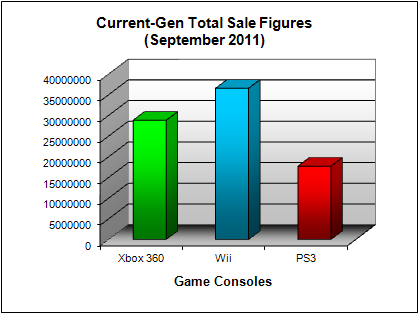
NPD Game Console Total US Sales Figures (as of September 2011)

Life to date Xbox 360 sales in the US (in green) is catching up to Wii sales (in blue), but the PS3 (red) languishes in third place

But while Sony’s security problems have been highlighted recently, it doesn’t seem to have seriously affected the fortunes of the PS3, as price, as always, seems to be the main driving factor behind sales. So Sony’s $50 price cut to the PS3 in the middle of August has seen PS3 sales rise, although as the September 2011 NPD US video games sales analysis shows, the rise was not big enough to really endanger the Xbox 360’s position as the best selling console in the US. The gap has closed, however, between the PS3 and the Xbox 360, while the gap between the Wii and every other console seems to be widening. If the gap remains as big as it was during September, the Xbox 360 is set to overtake the Wii as the best selling home based console of this generation (in the US) within 39 month – but it will be well after the Wii U is introduced, so that’s what Nintendo are holding on to at the moment.

Alright, that’s enough for this week I think. Hopefully more of a newsworthy week this next one, and I have a feeling it will. Have a good one.

Game Consoles – September 2011 NPD Sales Figure Analysis

October 15th, 2011

Welcome to the September 2011 edition of our regular NPD US video game sales analysis, by my calculation, the 53rd edition of this feature. In this feature, we look at video game sales, both hardware and software, for the month of September 2011 based on data collected by the NPD. The PS3 price cut took place half way through August, but in the September data, we now having a full month worth of PS3 sales at the now $50 lower price point, so we can finally see if it was able to beat the Xbox 360, which it might have done in August if the price cut had taken place a bit earlier. But the Xbox 360 has an ace up its sleeve this month, as we see a new version of one of its major exclusive franchises, Gears of War. Read on to find out who wins September.

As NPD no longer releases full hardware sales figures, this feature is reliant on the game companies, namely Microsoft, Nintendo and Sony, to release their set of figures and based on “statement math” (that is, arithmetically calculate missing figures based on statements made). For September 2011, these are the statements made by the gaming companies:

  • Nintendo reveals the Wii sold 240,000 units, with 260,000 3DS consoles, and 145,000 DS (via PR email)
  • Microsoft revealed 438,000 Xbox 360 hardware units sold, with 42% of the home based console market share (source)
  • Sony did not reveal exact figures, but said that the PS3 hardware sale increase 20% year-on-year (Sony statement, via Senior Director of Corporate Communications at SCEA, Patrick Seybold)

Unfortunately for this month, Microsoft and Sony’s statements do conflict with each other a bit. Using Microsoft’s statement, PS3 sales can be deduced to be 364,857 units, but according to Sony’s own statement, the figure is more like 374,400 (20% more than September 2010’s 312,000). Obviously, there are rounding errors from all the company’s statements, so giving Sony the benefit of the doubt, we’ll presume the PS3 sales figure for September 2011 is the higher 374,400.

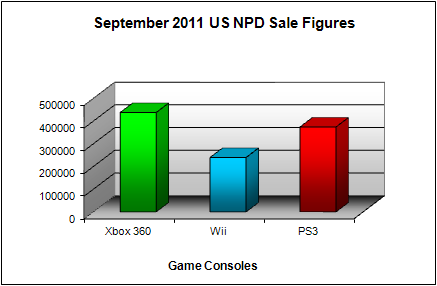
And so the figures for US sales in September 2011 are below, ranked in order of number of sales (September 2010 figures also shown, including percentage change):

  • Xbox 360: 438,000 (Total: 28.8 million; September 2010: 483,989 – down 9.5%)
  • PS3: 374,400 (Total: 17.7 million; September 2010: 312,000 – up 20%)
  • Wii: 240,000 (Total: 36.6 million; September 2010: 254,000 – down 5.5%)
NPD September 2011 Game Console US Sales Figures

NPD September 2011 Game Console US Sales Figures

NPD Game Console Total US Sales Figures (as of September 2011)

NPD Game Console Total US Sales Figures (as of September 2011)

My prediction from last month was:

I think the Xbox 360 will still come out as the top selling console for September 2011, mainly due to ‘Gear of War 3′, but the PS3 will definitely come closer than it did this month, and with ‘Resistance 3′, it too might benefit from a platform exclusive. The Wii will be third. Games wise, ‘Gear of War 3′ looks set to be a top seller, despite being a platform exclusive release. ‘Resistance 3′, on the other hand, doesn’t look to have the same effect, although it will still sell well. Combined platforms sales may even push ‘Dead Island’ to the top of the charts.

I got the hardware ordering spot on, although it really wasn’t that hard to predict what was going to happen. The PS3 did get closer to the Xbox 360 sales, but it’s clear now that the 360 is now the dominant console in the US, and not even a PS3 price cut can affect its status it seems (unless that price cut was a more substantial $100, for example). For the game predictions, Madden was actually the top selling title, followed by Gears of War 3. And ‘Dead Island’ did manage to put its way high up in the charts, in 3rd place. Resistance 3, on the other hand, only finished 7th, not the worst result, but the average critical response to the game may have had some effect.

So the Xbox 360 continues its winning streak, by not only becoming the dominant home based console, but it’s also the best selling console for September, period. Looking at the life to date sales numbers, the Xbox 360 continues to pull ahead of the PS3, and continues to get closer to the Wii, to the point where the difference between the Wii and 360 numbers is actually less now than the difference between the 360 and PS3 numbers. Because of the Xbox 360’s dominance with multi-platform releases in North America, namely that if the same game is on multiple platforms, the Xbox 360 version is usually the most popular, the hit releases planned for the next few month starting with Batman: Arkham City and Battlefield 3 next month, and MW3 and Elder Scrolls V: Skyrim in November, will all benefit the Xbox 360 more. The it appears that the 360’s exclusives, such as Halo and Gears of War, appear to be far more popular than the PS3’s line up, including ‘Resistance’ this month.

But you cannot say the PS3 performed badly for September – after all, it was the only console to see year-on-year growth, but just like how the other consoles found it difficult to compete with the PS2 in the last generation, the PS3 is having a hard time trying to catch up to the Xbox 360 (and Wii, for the early parts anyway) in this generation (although the gap between the consoles is much less pronounced than the last generation). Taking off my fanboy hat for a moment, the truth is that both the PS3 and Xbox 360 are excellent game consoles with excellent game line ups and fantastic multimedia capabilities. Each console has their own pros and cons, and thanks to the Xbox 360’s head-start, the Wii’s (then) innovative control system, and the PS3’s Blu-ray drive, we now have a much more balanced set of competitors, and that can only be good for gamers, who should consider themselves lucky to be able to enjoy so many great games in the last few years.

The Wii, right now, is the only loser, but it’s not something Nintendo are unaware of, and the Wii-U will set to address many of the shortcomings of the Wii console, but also maintain Nintendo’s reputation for producing fun, family based games.

For game sales, Madden’s delay from August to September allowed it to rule the roost for the month, but Gears of War 3 would be considered the best selling Xbox 360 game for the month, the Madden ranking includes all platform sales. Dead Island was the only original franchise in the top 10, and it did well to come in 3rd, but it also shows that, unlike movies, gaming sequels are actually welcomed by gamers, and usually are huge improvements on the original, not just an opportunity to cash-in (take note Hollywood). FIFA’s high ranking highlights the growing popularity of “soccer” games, beating NHL 11, something it didn’t do last year this time. And a 10th place for Warhammer 40,000: Space Marine is a good result for the franchise. Electronic Arts are the real winners, with 3 of the top 10 titles belonging to them, and the all important first place too. Here’s the full software sales chart for September:

  1. Madden NFL 12 (EA, Xbox 360, PS3, Wii, PS2, PSP)
  2. Gears of War 3 (Microsoft, Xbox 360)
  3. Dead Island (Deep Silver, Xbox 360, PS3, PC)
  4. FIFA 12 (EA, Xbox 360, PS3, Wii, PS2, PSP, 3DS)
  5. NHL 12 (EA, Xbox 360, PS3)
  6. Deus Ex: Human Revolution (Square Enix, Xbox 360, PS3, PC)
  7. Resistance 3 (Sony, PS3)
  8. Lego Star Wars III: The Clone Wars (LucasArts, Wii, NDS, Xbox 360, 3DS, PS3, PSP, PC)
  9. Call of Duty: Black Ops (Activision Blizzard, Xbox 360, PS3, Wii, NDS,PC)
  10. Warhammer 40,000: Space Marine (THQ, Xbox 360, PS3, PC)

Time to make my usual prediction. I think the hardware situation will remain largely the same. Games wise, Batman: Arkham City and Battlefield 3 go head to head, with Forza 4 on the Xbox 360 possible making the top 10 as well as a platform exclusive.

See you next month.


About Digital Digest | Help | Privacy | Submissions | Sitemap

© Copyright 1999-2012 Digital Digest. Duplication of links or content is strictly prohibited.