Archive for the ‘Movies’ Category

Weekly News Roundup (26 August 2012)

Sunday, August 26th, 2012

Welcome to another edition of the weekly news roundup. Been out and about on this Sunday, went to the local store to by a copy of The Hunger Games and Battleship on Blu-ray (feeling quite ashamed about buying both, to be honest, but both are for my niece – The Hunger Games for obvious reasons, and Battleship because Rihanna is in it – although Battleship, I’ll admit, is a guilty pleasure for me too).

As for the WNR, a few bits and pieces to get through, so let’s get started.

Copyright

Following up on last week’s story regarding Google’s new anti-piracy policy, in which they will start demoting websites that receive too many DMCA notices, the two sites that will be most affected by these changes, The Pirate Bay and isoHunt, have both responded to this latest “setback”.

The Pirate Bay reiterated their earlier view that this kind of censorship will not only not affect their popularity, but may in fact drive even more direct traffic to the world’s most famous torrent indexer. It is their fame, or in marketing speak, their “brand”, that allows them to not rely on search engines at all. And if people searching Google for torrents find that results aren’t what they’re expected, they’ll soon teach themselves to go to The Pirate Bay directly. The losers in this likely scenario would be the smaller, niche torrent sites, although if they’re small enough to avoid DMCA notices, then they’ll also benefit from these changes.

The Pirate Bay

The Google DMCA demotions won’t sink The Pirate Bay – it might even help the website become even more popular, the site says

Gary Fung over at isoHunt similar expressed his meh-ness at these changes, citing that while they have a greater share of visitors coming from Google than TPB (21%, vs at most 10% for TPB), the fact that “isohunt” and “isohunt.com” are the most common incoming search terms (would be surprised if this wasn’t also the case with TPB), means that people are not using Google as a discovery tool for piracy at all (ie. they already knew about about sites like isoHunt and TPB, but were just too lazy to bookmark or type the full domain names, or weren’t sure about the spelling and just wanted to make sure).

But just because neither websites are likely to be severely affected by these changes, it doesn’t mean that they’re not fully against these changes. TPB, via their blog, says it is disturbing that one private industry is able to dictate what another industry, some might say an even more successful industry (but with a less powerful lobby), can and cannot do. Fung raises the good point that a valid DMCA notice, by Google’ definition, only means that the formatting of the submission is correct, and that no counter notification had been filed – it does not mean that the claim is genuine (Google cannot possibly check all 5.7 million+ takedown requests). Webmasters will also only be notified of any incoming DMCA notices if they have a Google webmasters account. So it is more than possible to file a false DMCA notice about a perfectly innocent web page, and if the website’s owner does not have a Google webmasters account, then he or she will never even know about this notice, which, in Google’s eyes, is still perfectly valid.

Shortly after Google’s announcement, Hollywood (via their copyright lobbying group, the MPAA) welcomed Google’s latest initiative, but still said that Google can still do more. But according to award winning tech journalist David Pogue, Hollywood should care less about what others are doing to “promote” piracy, and worry more about what the industry is doing right now to equally promote piracy. Writing an opinion piece in Scientific American, Pogue lambasts Hollywood for reacting to the imminent death of DVD rentals by retreating further away from its successor, online digital rentals. Instead of embracing the Internet, Pogue says for whatever reason (in my opinion, most likely fear), Hollywood has started putting up all sorts of barriers online to prevent people from paying for legal content. Barriers that includes unfair release windows, shortened rental times, and the reduced availability of content compared to a traditional brick & mortar store (and this totally goes against common sense, because digital is supposed to allow for a greater selection due to lack of need for physical space).

Pogue interestingly points out that out of the top 10 most pirated films of 2011, none of them are actually available for rental online at this very moment (although a couple is available as part of Netflix’s streaming offering). And if Hollywood thinks that the modern day consumer’s appetite for content can be controlled by limiting what’s available, then that’s a sadly outdated notion, because the Internet does offers people alternative. True, many of them are illegal, but the reality is that people don’t care. Through legislation and technical measures, Hollywood is hoping they can put the genie back into the bottle, but as Pogue concludes, perhaps the simpler solution is to simply embrace the Internet and “keep making money”.

But it doesn’t help when you not only *don’t* give your own customers what they want, you also label them as “scumbags” and “bandits” for simply wanting more than what you offer them. Both of these terms were used by the CEO News Limited, the Australian wing of Rupert Murdoch’s media empire. Uncle Rupert is not a huge fan of this Interweb thingy, and an even lesser fan of web piracy (once calling Google a piracy leader on Twitter), and it seems this has rubbed off on News Limited’s CEO, Kim Williams.

Controversially, Williams said that the web piracy problem makes the English riots of 2011 “look like children stealing [candy] from a shop”. A tasteless comparison if only for the fact that the same riot caused the death of five people. While I admit that a lot of content is downloaded illegally these days, as far as I can tell, places like Amazon, Steam, Netflix, and even offline ones like Walmart, are still doing pretty well, certainly better than the smashed, burnt down and robbed stores that bore the brunt of the London riots. And that’s the key difference between traditional theft, and the theft of intellectual property – one has a real economic cost attached, the other merely has a theoretical “lost sale” cost. One is taking, the other is copying, like photocopying a text book at the library, versus shoplifting the same book from a book store.

But one area in which a comparison to the English riots may have merit is that things like riots, and large scale unauthorised downloading, don’t simply happen in a vacuum. As much as those in positions of power want to write it all off as criminals committing crimes, the root of the problem is always much more complicated. The disenfranchisement and injustice that people were feeling, whether a legitimate gripe or just the sense of it (both equally real in people’s minds) is what was behind the riots. And the sense of unfairness in pricing, availability that people are feeling towards the provision of video entertainment, while a much less severe and a much more “first world” problem, may also be the root of this “piracy scourge”. Basically the same thing Pogue alluded to in his article.
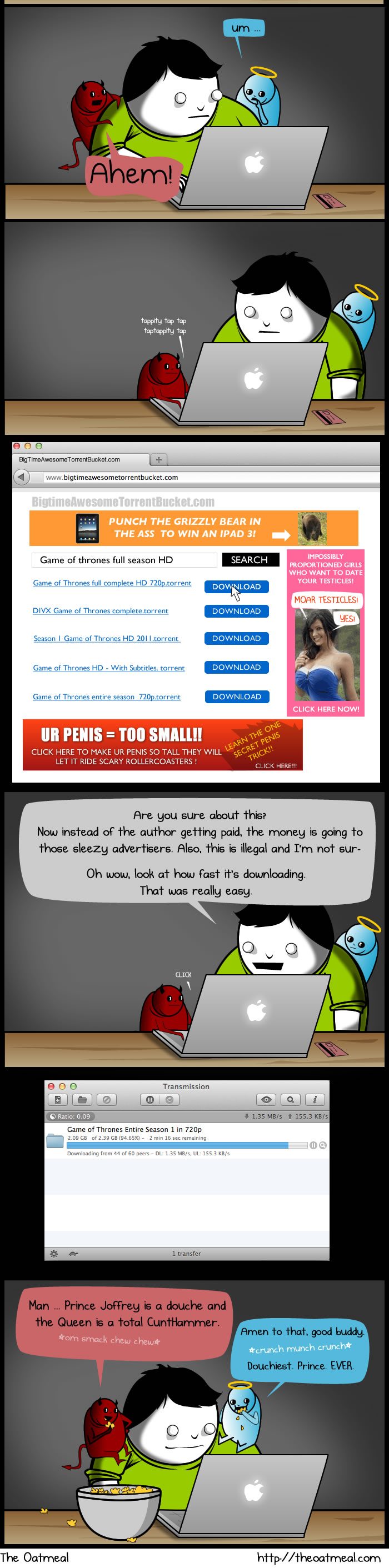
The Oatmeal: Game of Thrones

Games of Thrones is pirated a lot in Australia because legal ways to watch the show in a timely manner hasn’t been provided by the only cable TV player in town, partially owned by News Limited, whose CEO calls pirates “scumbags” and “bandits”

So I guess it won’t surprise you that News Limited, the company that part-owns Australia’s *only* cable TV network (Foxtel, who recently absorbed the regional based Austar), is notorious for the putting up the very same barriers that Pogue talks about. Australia has the highest piracy rate for Game of Thrones, mainly because exclusive broadcasters Foxtel, in their infinite wisdom (or trying to save a buck on the distribution deal), not only decided to move Game of Thrones to a premium cable package (fair enough), but also decided to not show any of the episodes until the US season had ended, thus ensuring everybody, and I mean everybody (that I know of at least), pirated the show. The situation has improved recently with the delay decreased to a single week, but a week long delay in this day and age of Twitter spoilers and whatnot might as well be a year. The nature and popularity of the show also meant that none of the free-to-air networks dared to show the uncensored version, nor can they afford the buy the show in all honesty, and so “scumbags” and “bandits” were created en masse as a result.

This is also the same Foxtel that allows so many ads on their basic channels, that one wonders what they’re paying for exactly (I pay for an equivalent of USD $100+ per month for a package that doesn’t even include movies), other than the mostly old repeats of repeats that you can get on Netflix for $7.95 (but we don’t have a Netflix equivalent here with the same amount of content, so VPNs and proxies are very popular here, which I’m guessing News Limited’s Kim Williams thinks we’re total d*cks for using).

——

The “sue for settlement” industry haven’t been making the headlines much recently, what with our beloved Righthaven dying a not so pretty death and all. Leave it to the Germans though to do what no other has dared, or wanted, to do – to publicly humiliate up to 150,000 names of individuals and organisations that are alleged to have downloaded infringing content, including hardcore porn  titles that include delightful numbers such as “Amili Learns to Swallow” and “Alone Among Brutal F***ers”. And I guess if you were to do it properly (the public humiliation, not the porn, although I’m sure the list also contains those that downloaded from the popular public humiliation porn category), you’d have to humiliate those that will be most embarrassed by these mere allegations, which is why the law firm, Urmann, plans to focus on naming and shaming churches, police stations and embassies of Middle Eastern countries.

Privacy and defamation issues (although German law is on the side of Urmann on this one too, which allows law firms to publish the names of those accused by its clients), and also ignoring the slightly racial tones that comes from picking on foreigners, the fact that it seems somewhat public places are being named suggests there might be quite a few IP addresses associated with public/shared Wi-Fi. Not that “sue-for-settlement” firms in the past have cared this issue in the past.

The German Pirate Party is said to be “shocked” at this latest development, and net vigilante group Anonymous is already sharpening their knives with the ominous statement that they will “take care of it”. I still fail to see what the whole point of the exercise is (again, the public humiliation, not the porn) – after all, the *threat* of public humiliation is the main business model behind these kind of “lawsuits”, but if you carry out with the threat, you also remove any incentive for people to pay.

But I’m sure they know what they’re doing. Right?

And that’s pretty much it for the week. See you next week!
Weekly News Roundup (19 August 2012)

Sunday, August 19th, 2012

Welcome to another edition of the WNR. NPD “released” its July 2012 sales stats for US video game sales, but unfortunately, only Microsoft again chose to divulge its hardware sales stats. So no July NPD analysis, which is a shame, but there wasn’t any real surprises anyway. I’ll talk a bit about it in the gaming section below.

Another pretty full news week, so let’s get started …

Copyright

So much for “do no evil”. Google gave in to the demands of the MPAA and the RIAA this week by signalling it is ready to start self-censoring its own results to reduce the visibility of alleged piracy websites. Without going as far as removing suspected websites, Google will start demoting any website that receives an unspecified number of DMCA notices.

Google DMCA Demote

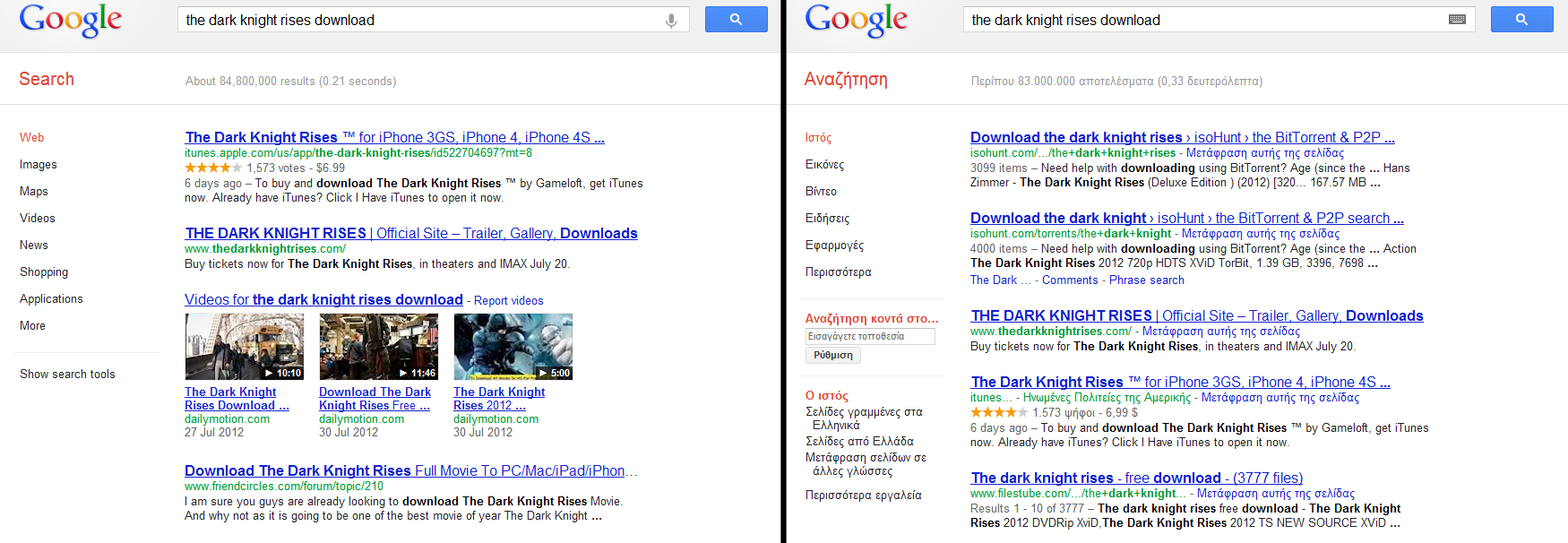
Google has started demoting websites that receive too many DMCA notices, the image on the left shows the demoted rankings, while the image on the right (for the yet unchanged Greek version of Google) shows the previous rankings

It’s own YouTube website, and “major brands” will apparently be exempt from this new rule (webmasters have long suspected there’s one rule for the web top 100, and another rule for the rest), but the rest will now have to live in fear of the system, which is already being massive abused by those seeking an unfair advantage (57% of all filed notices, according to a Google report from 2006), and made even more attractive as a “black hat” weapon of choice now that the entire domains of competitors can be demoted. Since Google started releasing DMCA stats, the number of DMCA notifications has risen from about a million per month, to now over 4!

Except none of this will work to stop piracy, because people aren’t turning into pirates just because they see some links to The Pirate Bay on Google. I don’t know if it’s naivety, a head in sand attitude, or a deliberate attempt to muddy the waters, but the idea that good, people are being fooled and misled into downloading pirated content online is, to put it simply, hogwash. People pirate and they do it willingly, and knowingly. And they spent a lot of effort learning and honing their piracy skills. They will most likely alredy have go-to places to get their piracy fix, or custom search engines that does more work separating the wheat from the chaff, so the idea that they’re all relying on Google to find the S01E08 of The Newsroom is simply a fantasy.

But despite Google’s proactive steps in reducing piracy, the MPAA/RIAA still wants more. In a joint submission to the US Copyright Czar, the MPAA and the RIAA have called on the government to do even more in the CRusade Against Piracy (CRAP™), including going all “Megaupload” on websites like The Pirate Bay. Basically a wish-list and a preview of what the copyright landscape could be like if the MPAA/RIAA get their way, the submission also talks about increasing criminal sentences for copyright offences, including making the unauthorised streaming of videos a felony.

Showing that they’ve not quite given up on SOPA/PIPA, the submission also calls for tighter control of domain names, including those outside of the jurisdiction of the US government. The groups also say that the government needs to go out and threaten private businesses like domain name registrars, search engines, and advertising agencies and get them to fall in line with the MPAA/RIAA’s vision of copyright enforcement. So it’s simply not good enough for Google to only demote websites that have yet to be proven, in a court of law at least, of doing anything wrong – no, the MPAA/RIAA says search engines like Google must “delist rogue sites”. Note the use of the term “rogue”, the same type of language that’s also being used to describes countries like North Korea and Iran, and I don’t think this is a coincidence either.

Feeding into the paranoia and hysterics that aims to paint college kids downloading movies as something much more serious, the MPAA/RIAA also strategically brings “organized crime” and “gangs” into the equation in this submission. But as far as I know, Tony Soprano purchased his copy of The Godfather, and it may be just me, but I just can’t imagine the Crips and the Bloods getting into the torrent search engine business.

High Definition

The wait is finally over. The kind people at Fox studios have finally allowed their customers to buy Avatar on Blu-ray 3D, for a price that isn’t a ridiculous 3 figure number.

Fox’s deal with Panasonic, where the electronic giant has exclusive rights to distribute the Blu-ray 3D version of Avatar with the 3D electronics, was one of the more controversial movie deals in recent times. Coming just at a time when Blu-ray 3D needed a launch title that could only come from the most acclaimed and most financially successful 3D movie of all time, the exclusivity deal meant that the format lacked a killer title available in stores that would have helped the format’s early adoption. As such, Blu-ray 3D hasn’t taken off in the way that electronic manufacturers and movie studios had hoped.

Avatar 3D Blu-ray Panasonic Exclusive

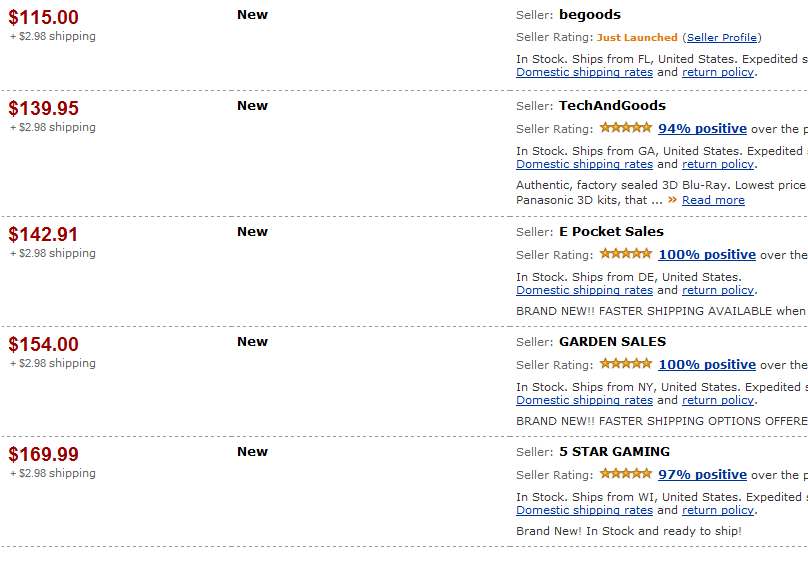
The Panasonic exclusive version of Avatar on Blu-ray 3D is still fetching 3 figures on eBay and Amazon, but the retail version will be available in October

With that said though, while people aren’t using 3D as much as studios would have liked, they’re still buying them because the price premium of 3D over 2D ranges between inconsequential and non-existent. Try and find a top of the range 2D TV that isn’t also 3D, and you’ll struggle. And when there’s only a $20 difference between a 2D Blu-ray player and its 3D equivalent, consumers don’t really have to make any hard choices.

Still, the retail release of Avatar on Blu-ray 3D should help the format break all kinds of records when the disc is released in October. The price is a bit higher than your average Blu-ray movie, $28 at Amazon, but it’s definitely better than paying $128 for it on eBay, right?

But don’t bet on this Blu-ray 3D Limited Collector’s edition to be the most definitive 3D version of the film to arrive on disc. The fact that this release might not even feature the extended cut means that Fox is already planning a quadruple dip of the film sometime in the near future.

Even for the 2D version, it’s only a matter of time before we see the 4K or whatever version of the film on possibly a new disc format, or if bandwidth issues are resolved, via streaming or download. Projects like Australia’s NBN and Google Fiber will aim to fix for the bandwidth issue once and for all with the move to fibre optics, which has almost an unlimited capacity to carry TB/s and beyond, but another solution is to increase the efficiency of the delivery codec. Which is why it was interesting to read about the news of a new format being officially approved by the Moving Picture Experts Group (MPEG), which promises to provide the same visual quality as H.264 with only half of the bandwidth needed.

H.264 is already super efficient, so it’s hard to believe that something could come along and double that efficiency, but HEVC, or H.265, aims to do just that through more computational intensive algorithms. Mobile applications would probably benefit the most from H.265/HEVC, due to their inherent bandwidth limitations, although faster (and more power hungry) devices may be needed to decode the video.

The other main beneficiary from a more efficient codec would be the web streaming industry, finally allowing the likes of Netflix to do true Blu-ray quality streams on connections less than 20 Mbps.

For other applications, 4K is an obvious candidate, but 4K only really benefits super large screens (say 80″ or above), and it’s an overkill for anything smaller. And if staying at 2K or 1080p resolution, the increased efficiency of H.265/HEVC may allow for same bitrate, but higher quality encodes, although you’ll get diminishing returns on any quality improvement for Blu-ray encodes, many of which are already visually flawless to the average viewer.

Gaming

Blizzard’s Battle.net has become, perhaps, one of the most tempting targets for hackers in recent times. Not only does the company hold a heck of a lot of data for a heck of a lot of people, Blizzard also holds tons of financial information for all those subscribers to WoW, and all those buyers/sellers on Diablo III’s Auction House. And the company’s stance towards “always-on” DRM for D3 meant that anyone who pokes holes in their security will instantly receive a lot of “web cred” for their efforts.

Blizzard Security Notice

Blizzard was hacked last week, with a ton of user information stolen in the process.

So unsurprisingly, Battle.net was hacked this week, with a heck of a lot of data being stolen in the process, including emails, (encrypted) passwords, security questions/answers, and even data related to the mobile authenticator that’s supposed to prevent hackers from getting into your account. The scale of the breach is actually quite spectacular, with the email addresses of every Battle.net account (except for those in China – probably on different servers) being leaked, and pretty much all accounts on the North American servers being compromised further.

Just the other week, Blizzard was boasting about how effective “always-on” DRM has been in preventing piracy, which has meant the company has made record amounts of money selling the hit game. It’s a shame that they didn’t invest enough of their loot (using it in the Diablo III sense) in protecting their users, but when you treat your customers as criminals by forcing draconian DRM on them, their rights were never that important to start with.

And as mentioned in the intro, the July NPD report was released, with the Xbox 360 once again riding high among the home based consoles, selling 203,000 units. But it was still 26.7% down compared to the same month last year, although the other home based consoles probably didn’t fare much better (the Wii in particular). The holiday sales period is coming up soon, and with the Wii U out around that time, it will be interesting to see if the Xbox 360 and PS3 will make a comeback, or take a further hit, when sales ramp up for this period.

But a price discount could do wonders for the two ageing consoles, especially when up against the compartively pricey Wii U.

That’s that for the week. See you in seven!

Weekly News Roundup (5 August 2012)

Sunday, August 5th, 2012

Hope you’ve been enjoying the Olympics. Hasn’t been such a great one for those watching here in down under though, don’t know what’s wrong, but you know *something* is definitely wrong when New Zealand manages to get more gold than you do. I haven’t really been watching though, not really my thing as I’ve mentioned before. Too much commitment given the time differences, and I’ve got to get my body ready for a grueling season of English football watching once the Olympics are finished.

Without further ado, whatever this “ado” substance is, let’s get started with the weekly news roundup.

Copyright

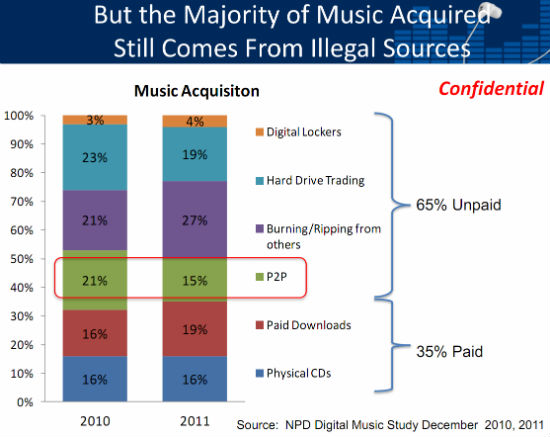
Much is made of the impact the Internet piracy has had on the music industry, the creative industry that is perhaps suffering the most from the “piracy scourge”, but it appears the music industry has been keeping a big secret from everyone: that online downloads do not appear to be the major source of pirated music!

NPD Digital Music Study

Online piracy is not the main source of illegal music files, according to research referenced by the RIAA

In fact, 70% of all pirated music are sourced from offline methods, according to newly leaked data from NPD courtesy of an RIAA report. And despite all the hoopla surrounding the closure of Megaupload, all digital lockers combined only contributed to 6% of illegal music sources. Instead, traditional CD ripping/burning and hard-drive trading still rule the roost when it comes to illegal music sharing. Of course, music found in traded hard-drives may have come from online source in the first place, but it appears most people’s first port of call for pirated music is their friends and families, not the Internet.

This set of data was marked confidential, and probably for good reason. If the public were made aware the actual contributions online piracy made to the pirated music scene, they might label the industry’s efforts against online music piracy as disproportional and inappropriate, and far from the rise of the Internet piracy being the downfall of the industry, there might be other factors that are in play. It’s almost as if the industry is using Internet piracy as a catch-all excuse for all of their woes, but I’m sure those in the music business have more class and honor than that.

One of the most disproportional responses to the online piracy problem has been the introduction of “graduated response”, or more commonly known as “three-strikes”, regimes – the most notorious one being the French “Hadopi” regime. Hadopi was a pet project for former President Sarkozy, but the newly elected socialist government of France appears to be less keen to continue on with the program. New cultural minister Aurelie Filipetti says Hadopi is too expensive (12 million euros per year) for the results it has obtained so far (still awaiting the first actual disconnection I believe, with 340 out of the millions of monitored users awaiting “sentencing” after being caught out for 3 times), and that it has failed in its goal to help promote legal alternatives.

And even if Hadopi had produced bannings, Filipetti says that this kind of punishment appears to be “disproportionate” compared to the seriousness of the crime.

I firmly believe the success of programs like Hadopi should to be judged not on how many people it bans or even how many people have stopped pirating because of it – it should only be judged on the basis of whether it has helped to increase revenue for the creative industries. If revenue has not increased as a result of three-strikes and other anti-piracy measures, then these measures have no real value other than being an affront to personal privacy. The failure of these programs to produce the required financial gains will also poke serious holes in the industry’s figures regarding losses due to piracy, and it would prove that not all acts of piracy would have otherwise generated a sale had piracy been prevented.

——

Uplay 2.0.4 Update

Users are advised to updated Uplay to version 2.0.4 or newer, to prevent Ubisoft’s infamous DRM and online platform from acting like a rootkit

Another week, another Ubi DRM controversy. Following the Steam Summer Sale disaster a few weeks ago where Ubisoft’s Uplay online and DRM service failed to accommodate the surge in game buyers, this week, Uplay is caught up in its own Sony style rootkit scandal.

The Uplay installer comes with a browser plug-in that’s automatically installed. But when curious Google engineer and Ubisoft game buyer Tavis Ormandy examined the plug-in further, he found that the plug-in not only allowed Uplay games to be launched, it allowed *everything* to be launched from a browser window. This is bad news because this could allow, for example, malicious websites to use the plug-in to launch anything and effectively take control of your computer. Unintentionally, Uplay had become the very definition of a rootkit.

Ubisoft was quick to release an update that fixed this vulnerability, so if you have Uplay on your system, then you’re advised to update Uplay as soon as possible, and do it with your browser closed as to allow the update to occur For now, there have been no reports of actual damages of unauthorised access by hackers via the Uplay plug-in, but if there are, I’m sure lawsuits will be launched promptly.

——

A few weeks ago, I wrote about a new study which alleges a music industry led anti-innovation crusade against Internet start-ups following the legal victory against Napster. In the study, it is alleged that most of the money earned from successful lawsuits went on to fund other lawsuits, in a sort of Ponzi Scheme that ran and ran until the money expectedly ran out. Artists and rightsholders, those the music industry points to as the real victims of piracy, apparently saw little of the “loot”. It seems nothing much has changed when it comes to the modus operandi of the industry, as it’s been revealed this week that even in the event record labels manage to recover the damages they won from The Pirate Bay lawsuit (some half a million euros worth), they will again refuse to share it with the “real victims”.

Not that there’s anything to share yet or perhaps ever, as new legal documents state pretty clearly that authorities have had little success and little hope of ever recovering the full amount of damages, as unsurprisingly enough, the individuals named in the lawsuits had little asset to seize (so much for the financial gain angle that Big Content says is behind most piracy operations).

If any money is recovered, the legal document says seized funds will be put to use to sue others, just like in the post Napster days. The difference being that, thanks to the industry’s efforts, piracy has become much more resilient than in the days of Napster or even LimeWire. The good news for the industry (sort of) is that legal downloads are also more prevalent. Although due to the industry’s obsession with piracy and their anti-innovation crusade, the lack of investment in innovation and forward thinking has allowed an opening for tech companies like Apple and Amazon to come in and take a huge chunk of the distribution cash cow.

High Definition

And it seems to very same trend is being repeated with the movie industry (I guess no lessons were learnt).

The major studio’s beloved Blu-ray format continues to grow solidly, even with the holiday release season, which traditionally provides a big jolt to spur growth in market share, still yet to arrive. Even with Blu-ray movie prices continuing to drop, revenue has also been increasing, suggesting unit sales are up significantly. Some of Blu-ray’s growth has come at the expense of DVDs, as expected, but it appears that digital distribution is the main reason why DVD revenue continues to fall, and digital has been the real success story of the last couple of years.

Amazon Prime Instant Video - New Additions

With more and more titles being added every couple of weeks, Amazon Prime Instant Video is fast becoming a major player in the subscription streaming scene currently dominated by Netflix – both there’s plenty for everyone it seems – revenue are up 430% in a year!

New figures released by DEG, The Digital Entertainment Group, shows remarkable growth for all things digital. While revenue from transactional VOD services (where each request for a video is a separate payment/transaction – basically services like Vudu and the non Prime version of Amazon Instant Video) was only up modestly, some 11.6% (comparable to the rise in Blu-ray spending of 13.3%), the real growth has been in subscription VOD services like Netflix (and the Prime version of Amazon Instant Video).

An amazing 430% growth was recorded, made more amazing by the fact that this isn’t just some paper growth, but actual revenue exceeded $1.1 billion just for the first 6 month of 2012. Subscription VOD now accounts for 13% of all home video spending!

Actual Blu-ray revenue wasn’t made available by DEG (only that total physical disc spending was $3.7 billion), but data from other sources such as Home Media Research puts Blu-ray spending at just under $892 million for the first 25 weeks of the year. This means that in all likelihood, spending on subscription VOD services have now overtaken Blu-ray spending for the first time ever (this time last year, subscription VOD spending was only $208 million).

Not that I want to make this somewhat apples and oranges comparison – both delivery platforms are aimed at quite different demographics, and at the moment (due to lack of high quality HD content on streaming services), neither are really competing with each other. But once ultra speed broadband services, such as the recently priced Google Fiber are more prevalent, this could change again. For me, VOD streaming is a game changer, much more so than Blu-ray. It seems subscription VOD has the ability to not only cannibalize DVDs, but possibly rental too, and if the bandwidth issue can be solved, it can take on Blu-ray as well.

Here in Australia, the government is investing in the next-generation fibre broadband for 93% of all premises, providing up to 100 Mbps residential services at first with the capability of supporting Google Fibre like 1 Gbps speeds in the near future. It’s a fantastic and visionary project, but unfortunately, political games will most likely see the project scrapped before it’s completely finished. But in the off chance that it is completed, the ability for most homes in Australia to stream one or more Blu-ray quality streams without saturating the entire connection would most likely see the convenience of streaming win over the humble optical disc. One can dream, at least.

Speaking of dreaming, it’s fast approaching midnight and it’s probably time to call it a day on this edition of the WNR. Hope you enjoyed reading it. See you next week.

Weekly News Roundup (29 July 2012)

Sunday, July 29th, 2012

So the Olympics are under way. Didn’t watch the opening ceremony myself, not really my type of thing really, but by all accounts, it was pretty good. It’s even better in 3D apparently, but 3D is not my type of thing either. If either or both are just your type of thing, then you’ll be in for a treat, and there’s nothing like a major sports event to help sell a load of TVs, this time, 3D TVs in particular. But by all accounts, the 3D hype has been steadily dying, and it definitely hasn’t turned out to be the “must-have” tech that TV makers envisaged.

Let’s get this WNR started …

Copyright

Having skirted the issue of whether the “always-on” Internet requirement for hit game Diablo III was for anti-piracy, anti-cheating/hacking, or was a genuine attempt to make a better game with better features, the makers of the game, Blizzard, this week finally admitted that the controversial “feature” is, at least partially, for anti-piracy. For the rest of us, this merely confirms what we thought all along.

Diablo 3 - Error 37

Anti-piracy is in fact one of the reasons why Blizzard chose to use always-on DRM for its game, Diablo III

For anti-DRM activists though, the worst thing about Blizzard’s DRM is that it actually works. Not so much as a way to stop cheating or hacking, but it has worked to help delay efforts to pirate the game, and that has contributed to the record sales figures the game has recorded. While the disastrous launch of the game, and subsequent gamer complaints (such as lag, even when playing a single player game), will have hurt the company, at the end of the day, it’s the bottom line that counts and Diablo III is a huge success whichever way you look at it. Of course, what works for Diablo III may or may not work for other games. Diablo III was a highly anticipated game, a decade in waiting, and so when you get gamers *that* desperate, *and* when you do produce a good game when looking beyond the DRM, it seems gamers are more than willing to jump through dozens of DRM encumbered hoops and still call the game great. Try and do that to, say, a new gaming IP, a less anticipated sequel, and then fail to actually produce a good game, then gamers *will* vote with their wallet. It seems for now, DRM is not so much a deal breaker, but it does add to the game’s list of existing negatives. Add those negatives together and if the positives don’t outweigh them, then you’re in trouble!

Japanese DVD Ripping Magazine

A DVD ripping magazine for sale in Japan has seen four journalists behind it arrested thanks to Japan’s tough new copyright laws

Now I’ve never wanted to live in Japan – too crowded and busy for my liking – but there’s now even less reason for me to want to move there, because it seems I won’t last too long in the land of the rising sun before I’m arrested for crimes against copyright. After the Japanese parliament passed laws that could see people watching the wrong YouTube video go to prison for 2 year’s time, this week, police arrested four journalists for the heinous act of writing and selling a magazine. A magazine that did feature guides about DVD ripping and a cover disc that included some commonly available DVD ripping tools, but nevertheless, just a magazine. This is also the same set of new laws sees most Linux distributions getting banned in the country, as most include the libdvdcss library, used to allow DVD playback, but can also be used for DVD ripping. It’s almost as if companies like Sony were given powers to write the country’s copyright laws, and along with Germany as you’ll read about below, both countries are doing their best to show us what a pro-copyright dystopic future lies in wait for the rest of us, if rights holders get exactly what they want.

And if you happen to own a smartphone in this future, then apparently, you’re a no good stinking thief of a pirate. At least that’s what a group representing German rights holders think, because it’s demanding a piracy tax on any and all storage mediums, including the memory built into your smartphone or tablet. The group, ZPUe, wants tech vendors to pay them €36 ($USD 43) per smartphone sold, and it wants retroactive payment dated back to 2008. It also wants €9 for external HDDs bigger than 1TB.

You can tell this has nothing to do with protecting the rights of content holders, and all having to do with a big money grab (made possible thanks to biased copyright laws), because it seems ZPUe is not calculating these “damages” based on the size of the storage and how people use that storage, but just the average price of the devices themselves. Otherwise a 16GB or 32GB iPhone should not attract 4 times as much “tax” as a 2TB HDD, and with the popularity of iTunes, I suspect the majority of iPhone users don’t even pirate music or movies. It’s also a blatant attempt at double taxing by charging for every copy of the same song or movie stored on different devices – someone who stores pirated songs on their external HDD and then transfers them to their iPhone will effectively get taxed twice.

I don’t know what’s going on in Germany, but it appears the country’s copyright laws are truly f*@ked up. There have been reports of people being forced to pay thousands for an unsubstantiated claim of infringement, GEMA, their music royalty collection agency, banning official music videos on YouTube from being watchable in Germany (with users having to rely on proxies servers in China, the land of Internet freedom, in order to view content on YouTube that’s legal everywhere else), threatening legal action against kindergartens and schools for using modern music for singalongs (GEMA again), and recently, hiking up music broadcast rates by up to 2000% for nightclubs and restaurants (again, GEMA).

Speaking of schools, Australia’s National Copyright Unit (NCU) says that schools are paying millions per year in unnecessary copyright fees due to draconian laws that makes school pay for materials that does not even have copyright. With fair use laws being fairly limited here in Australia, teachers and schools are forced to pay copyright fees for everything from printing a web page, to saving a web document, or even asking students to print something at home.

Copyright protects the right of content creators (or licensees) to profit from their works (or that of someone else’s that they’ve licensed), but copyright was also created with the intention of protecting society’s right to access content for its benefit (which is why copyright was made to expire). For me, the latter is far more important than the former, because the argument that people will stop being creative if they can’t make money from their art is, frankly, nonsense. With less emphasis on protecting profits, what we will have though may be less attempts at money grabbing (eg. most Hollywood films), and that can be a detriment to the economy and entertainment, but it’s wrong to say that creativity always have to equal monetisation.

And sometimes monetisation can happen without any real creativity, at least nothing recent or current. Music’s big names including Elton John, Simon Cowell, Roger Daltrey and Pete Townshend have put their names on a letter addressed to British PM David Cameron, lobbying his government to introduce tougher copyright laws  to allow artists to “earn a fair return on their huge investments creating original content”. Apparently, the availability of pirated content online is making people nervous about buying from legitimate places, despite recent studies showing that people who pirate stuff are also the same people who buy legal content (but they do it nervously, perhaps).

The Sky Is Rising Infographic

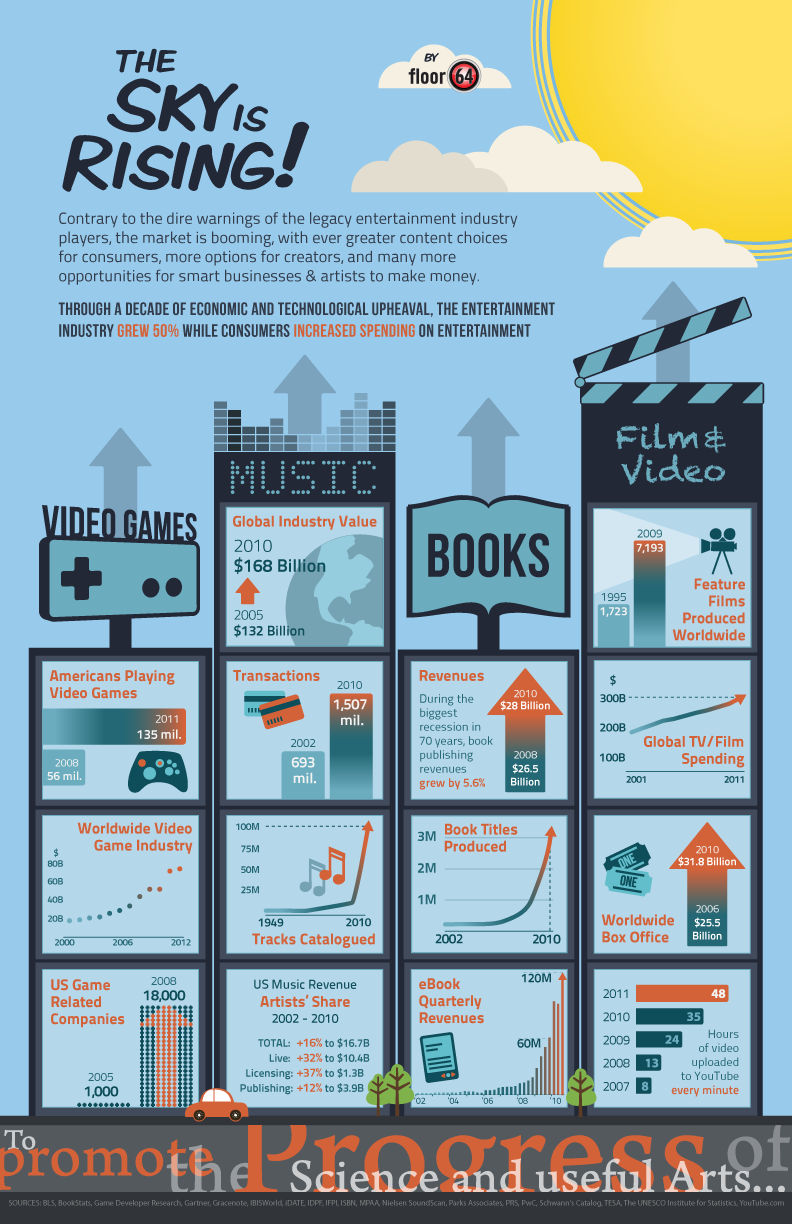
Some of Britain’s top musicians wants the government to crack down on copyright abuse to protect creativity, but creativity has been flourishing like never before, online

The stupid argument about piracy undermining buyer confidence aside, it’s interesting to note that the average age of the dozen or so people who signed this letter is 53. When was the last time Elton John, Roger Daltrey and Pete Townshend created anything even worth pirating (the odd remixes aside) – or are they blaming piracy for their increasing irrelevance to the music biz (which still creates new works and new stars at an amazing, almost hard to consume, pace)? Ageing rock stars believe they should continue to receive royalties for their ageing works, but when is enough enough? For an artists who has already made a large profit on their works, isn’t better now to let their works go free, so that it can be shared and re-mixed and re-used for eternity? It seems that, at some point, artists start caring less about what they’ve created, and start caring more about what they’re earning.

For me, the ease at which people can share stuff online, which the creative industries says is the catalyst for the piracy problem, has also been responsible for one of the greatest periods of creativity ever, and there are even studies and reports to prove this.

But again it goes to the definition of creativity, because what’s different about the Internet is that most acts of creativity there are not blatant attempts at monetisation. I think it has to do with the ability to publish, at almost no cost, on the Internet, versus the comparative high cost of traditional publishing – costs that have to be made back via monetisation. The thinking once upon a time was that creativity can only exists if there’s a financial incentive, but the Internet is proving this theory wrong, big time.

Just because Big Content can’t figure out how to make a buck out of it, it doesn’t mean that creativity isn’t flourishing online.

The quality of the created pieces, however, do vary quite a bit. You have well written blogs analysing the latest trends in copyright, HD and gaming. And then you have this one. But it’s free, so it’s probably worth the price of admission.

See you next week!

Weekly News Roundup (15 July 2012)

Sunday, July 15th, 2012

Happy belated Bastille Day. I’m not French. I don’t speak French, and I don’t really know anybody from France, but 14 is my lucky number, and so that’s the connection I have with the French. That and their fries are a personal favourite.

A couple of real eye openers that I will be covering in this week’s WNR, so without further ado …

CopyrightStarting with copyright news, Wikipedia’s Jimmy Wales has once against caught the ire of the MPAA by, well, not saying anything everyone else hasn’t been saying all along.

Wikipedia Blackout

Wikipedia went black to protest SOPA/PIPA, and founder Jimmy Wales says the site may do it again if Hollywood insists on censoring the web to solves its piracy problem

Speaking at the Wikimedia conference, Wales drew upon personal experience in trying to legally watch the latest episode of Game of Thrones and criticized content holders for not giving the people what they want (and not just to see Joffrey’s head on a spike). Wales also warned that Wikipedia might go dark again if the entertainment industry continues to see web censorship as the solution to everything.

None of Wales remarks were that controversial in my opinion, but anyone who doesn’t agree with the MPAA’s line about pirates being thieves will always be savaged by the lobby group, and the MPAA didn’t disappoint on this occasion. Once again, the MPAA compared downloads to “stealing”, but went one step further by attacking those who only pirate out of convenience (like say if I didn’t feel like jumping through a dozen DRM’d hoops just to satisfy the studio’s piracy paranoia, or I had to download something even though I had already purchased it, just due to ease of use issues). But look at it this way: when your own customers would rather break the law and be called “thieves” than buy your product due to the sole reason of convenience, then maybe, just maybe, you have some work to do before you take a sledgehammer to the Internet. Just a thought.

Of course, even if Hollywood can’t get the government that they’ve already paid for to pass pro-censorship legislation, they can always rely on the threat of legal action to force other private companies to self-censor. PayPal is the latest to demonstrate what a good boy it is when it comes to all this anti-piracy stuff, and it has created a set of new rules for file sharing/newsgroup websites that, effectively, prevent these sites from using PayPal services. In what is surely another nail in the coffin for the once thriving cloud uploading industry (a shame really, since the legitimate services they do provide are invaluable in my opinion), the new rules basically allow PayPal (not even content holders) to dictate what can and cannot be stored on any file sharing website that uses its services. One service provider that has been in talks with PayPal even suggests that PayPal wants full access to all the backend tools to monitor al file uploads, even legitimate, private and confidential ones – a demand that is frankly insane. It would be like if a bank wanted to read all pieces of mail going through private post office boxes (which the bank handles payments for), just so it can reduce its liability in case something dangerous or illegal was sent. Of course, the bank would never be held liable for anything like this, but on the Internet and with the copyright lobby pushing hard, PayPal can become liable (so I guess it’s not all their fault).

At this point though, nothing from PayPal surprises people any more, everyone has had bad experiences with PayPal, and it’s worthwhile to remember that they were the same people who enthusiastically dumped Wikileaks over the tiny bit of governmental pressure. Part of SOPA/PIPA was to give content holders even more power to force private companies like PayPal to do exactly this sort of stuff, but it looks like existing laws and corporate bullying tactics are more than sufficient to ensure exactly the same outcome. So between this and Megaupload, it just goes to show SOPA/PIPA isn’t needed at all.

Napster Logo

The death of Napster gave the RIAA the legal precedent and confidence to engage in a campaign of anti innovation in the years following, according to a new report

Speaking of Megaupload, the decision from this case could very well lead to the kind of landmark decision that will reverberate for years to come. And we don’t even need to look back that far to find how much of a hit on innovation such a decision, or a new set of biased laws, could be. A newly released report goes into detail on how the established music industry profited from now more than a decade ago’s Napster decision. Interviewing 31 leaders of digital music, including CEOs of some of digital music’s biggest firms, the report by Associate Professor Michael A. Carrier of Rutgers University School of Law attempts to show just how much of an effect a copyright decision can have on innovation.

On a high after the victory over Napster, the major music labels, represented by the RIAA, allegedly went on a crusade against all things Internet-y and innovative. By using the funds “earned” from one lawsuit, other websites and start-ups would be sued, until the funds, or suable start-ups, ran out. Not only that, the report alleges that labels strung along start-ups with “good” (and potentially status quo threatening) ideas by refusing to license content to them until these sites had enough traffic, and once they did, sued them for massive copyright infringement. But at the same time, labels were happy to receive huge up-front fees for start-ups they knew would never make it, or made licensing agreements that allowed labels to slowly bleed these new companies dry, the report further alleges. And instead of going after companies, labels would go after individuals associated with the companies, to perhaps add further intimidation for force a favourable outcome in any legal proceedings (although to be fair, everyone does this). Some in the rap business even spoke of physical intimidation,  “being hung out of windows” and things of that nature.

For me, this show why Apple was so bloody clever with the iPod. By making the hardware first, instead of the software/website, Apple made a device that people wanted, loved, and one that the music industry *had* to accept. Had they gone with opening the iTunes store first (and by allowing non Apple devices to buy and play songs), it’s very likely that they too would have been hindered in their attempt to innovate.

With both Hollywood and the recording industry now strongly supporting (if not leading) the case against Megaupload, perhaps both feel another major decision is required to chill the next round of innovation, such as Megaupload’s very own “music label circumventing” Megabox. This mustn’t happen, and I hope it won’t.

As for the actual Megaupload case, the extradition hearing against Kim DotCom, a German-Finnish citizen that ran a Hong Kong based business and currently living in New Zealand and is now being extradited to the US for some reason, won’t be heard until next year, so this one could take a while. DotCom has offered to go to the US voluntarily to avoid the need for an extradition hearing, but only if he gets access to his own frozen/seized funds to pay for mounting legal expenses.

High Definition

People who visit my house often complement, or make fun of, my “oversized” DVD, HD DVD and Blu-ray collection, which I always explain is perfectly reasonable and nowhere near as big as a lot of other people’s.

And now, I finally have proof that my collection is actually perfectly reasonable and I’m not at all an obsessed movie nut that must buy movies even though I only ever watch most of them once. Having spent $500,000 Australian dollars (which is about the same in US dollars), avid collector Greg (you thought that I was talking about myself for a second there, didn’t ya) has now put his entire collection of 50,000 CD, DVD and HD DVD titles, and some 3,500 Blu-ray titles, up for sale for “only” $55,000. Just the storage systems cost Greg $5,000, covers and sleeves another $12,000, and he’s including it all as part of the sale, as well as a HD DVD player, and a region A Blu-ray player.

Greg's Movie Collection

Greg from Sydney Australia shows what a real movie collector is like, and you can be just like him if you pay $55,000 to buy his entire collection!

Greg is selling because his flat is no longer big enough for his, possibly still growing, collection. Ironically, the $500,000 he did spend on the discs could have gone a long way to buying a bigger house, which could have housed his collection in a more permanent fashion (or $445,000 on the house, and $55,000 to buy someone else’s 50,000+ title collection). But I’m sure Greg, like all collectors, regret nothing. Although, as one commenter, it looks like Greg might have spent $500,000 to do what an $8 per month Netflix streaming account can do. Ouch, but not really 100% accurate, since I’m sure he has tons of titles that Netflix doesn’t have, some of them in glorious high def that Netflix can’t provide (yet), but perhaps there’s a good point there too about a new more efficient way to have a movie collection ($8 per month for 50 years, the lifespan of DVDs and Blu-rays, still works out to be less than what Greg paid just for his shelves).

In any case, it does make my collection look rather small by comparison. I’m just hoping the saying “size doesn’t matter” also applies to movie collections!

Gaming

Good news everyone. The NPD analysis will be back for June, as some intern somewhere probably screwed up and actually released some sales figures to allow for a proper comparison between the three major home based consoles, as well as a look at the sales figures for the new Vita portable. Will cover the results in detail in the next few days.

By my calculations, the PS3 sold just under 194,000 units in June, that’s almost 100,000 units more than the Wii, but also 63,000 units less than the Xbox 360. While the Wii has clearly dropped out of the race for the home console market, not by choice really, the PS3 still has a chance to compete with the Xbox 360 and get its user base up in time for the PS4 or whatever it will be called.

While the PS3 is actually pretty good value considering its media credentials, where the PS3 has really struggled though is in the lower end of the market, where the Wii used to dominate, and now the Xbox 360 with its cheaper 4GB console. So the news that Sony might release a 16GB version of the PS3, according to recently leaked photos and documents in Brazil, might not sound too surprising. Still very much a rumour at the moment, so I wouldn’t, say, bet your $500,000 movie collection on the news being true, but it would make a lot of sense if Sony really wanted to extend the life of the PS3. There’s still a market for the PS2 today, and that’s proof the low price strategy works.

What also works though is quitting while you’re ahead, which might be good advice for Sony, but I was talking more about this issue of the WNR to be honest. Any excuse to stop writing! See you next week.