Archive for the ‘Gaming’ Category

Weekly News Roundup (6 September 2015)

Sunday, September 6th, 2015

A lot of news this week, but as is the sign of the times, most of it had to do with streaming. The big news coming out of the IFA consumer electronics show in Berlin was Samsung’s unveiling of the world’s first UHD Blu-ray player. UHD is the next big hope for TV manufacturers, and maybe the last best hope for physical media.

Here’s the news roundup …

Copyright

The MPAA’s piracy paranoia has been highlighted again this week via detailed published on Amazon’s MPAA compliance page. With security guidelines that seems to have been taken from the CIA (with a few additional paranoia-fueled security precautions), the MPAA is taking no chances when it comes to having their content stolen (content, that Amazon helps to host on its AWS platform).

So baggy clothes are out, as are non transparent food containers (which you might use to hide storage devices). Random searches, body pat-downs are what employees at Amazon (those poor, poor souls) are expected to comply with, all in the name of preventing the very same movie leaks that happens all the time. I guess the MPAA must find the idea of pirates infiltrating Amazon, impersonating an employee (or maybe even actually getting a job there) so they can somehow hack into Amazon’s system, break through the encryption/security system that’s standard practice for hosting companies, all just to steal some pre-release content, all very plausible. Just as plausible as award season screeners DVDs that get sent to almost everybody getting ripped and put online? You’ll have to ask them.

Netflix Remote

Netflix 4K streaming getting ripped and uploaded online?

So instead of worrying about people putting USB drives in their sandwiches in non-transparent food containers, perhaps they should be more worried about Netflix’s 4K content somehow getting ripped and uploaded online, despite the use of a new copy protection mechanism (HDMI 2.0’s HDCP 2.2). Or maybe they should learn to stop worrying and love the bomb, the bomb in this scenario being things getting pirated. Okay, love is perhaps too strong of a word, but surely they must realise by now that if something can be used/played, it can be ripped. The sane approach would be to stop worrying about something that’s almost certainly going to happen, and learn to accept the fact and try to work around the problem. Then there’s the MPAA’s approach …

High Definition

Microsoft, Google, Netflix, Amazon, Intel, Mozilla and Cisco have joined forces. To do what? To come up with a new video codec, of course. So that’s software, hardware, networking, web services, video and content delivery and Internet software all covered, but despite this, the chance of something new coming in and taking over from HEVC, despite HEVC’s expensive and difficult to deal with licensing terms, appears slim. It’s very difficult to create a new codec and get the entire industry to accept it, especially when most, for all of its flaws, have already accepted HEVC and have adapted their strategy to deal with it. Then there’s the problem of patent claims, and it’s very hard to come up with any video codec these days without somebody trying to claim an existing patent from the myriad of technologies and concepts being used.

Good luck to them though, because the reality is that we really do need a viable royalty free alternative to HEVC.
The Kingsman Ultra HD Blu-ray

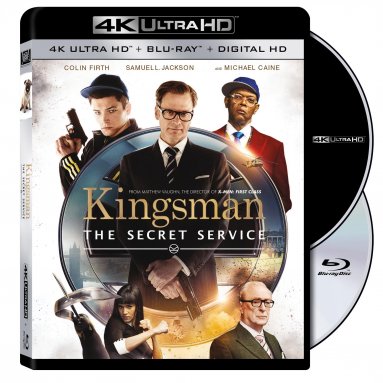
This is what 4K Ultra HD Blu-ray cover art will look like when discs become available early next year

The problem of HEVC royalties will be apparent with Ultra HD Blu-ray discs that will start being available towards the end of this year, as HEVC is one of the supported codecs for the format. At the IFA consumer electronics show in Berlin, Samsung this week unveiled the “world’s first” Ultra HD Blu-ray player, although with it not being available until early next year, it may not actually be the world’s first Ultra HD Blu-ray player available on the market.

Fox also took to the same stage to announce their Ultra HD Blu-ray movie line-up. New releases starting next year will be simultaneously available on standard Blu-ray, Digital HD and UHD Blu-ray, with catalogue titles like Exodus: Gods and Kings, Fantastic Four, Kingsman: The Secret Service, Life of Pi, and X-Men: Days of Future Past all being made available on the new disc format.

It’s difficult to predict whether UHD Blu-ray will be a success or not, give the hard time Blu-ray is having at the moment and the public’s growing predilection towards all things digital. So despite the big IFA show in Germany, a lot of the news stories I’ve written this week has been about streaming (and most streaming news these days gets published on my new site, Streambly). For example, Amazon’s move to allow offline playback for selected titles in their streaming library, I think, is huge news. It’s the one thing that still bugs a lot of people about streaming services, that there’s no easy way to access the content you’ve subscribed to when you’re away from a reliable Internet connection (or if your home Internet is temporarily down). To be honest, I’m surprised rights-holders allowed this to happen, since this really blurs the lines between streaming and downloading, and I would have thought this kind of thing would eat into their, and Amazon’s, transactional VOD and digital sell-through business.

Amazon, Netflix and Hulu Plus

Hulu, and Amazon too, adding new features, content to compete with Netflix

The other big news is Hulu’s addition of a $12 no-ads plan, which finally makes it acceptable to many who finds the idea of paying money and still having to put up with ads detestable. With Hulu also signing deals left and right – including stealing Epix from Netflix, which will bring a lot of hit movies to Hulu to strengthen the one area that Hulu is extremely weak on at the moment – it looks like Hulu is set to go head to head with Netflix full on. $12 might be higher than Netflix’s $9, but you do get a whole host of new TV shows with Hulu that you would otherwise have to wait a year or more for on Netflix, so if Hulu can get their movie offerings up to scratch, they may have a chance.

Gaming

So much for that rumour. The Xbox One Mini is not real. We now know it’s not real because Xbox boss Phil Spencer tweeted “not real” when asked about the possibly of a Blu-ray-less Xbox One. Good to know.

——

That’s it for this week. Remember to keep an eye on Streambly for streaming news (although most will only be relevant to Australian visitors). See you again soon.

 

Weekly News Roundup (30 August 2015)

Sunday, August 30th, 2015
John Oliver

It was a real pleasure seeing John Oliver in person at the Palais on Thursday

I had the good fortune (and quick online ticket ordering skills) to catch John Oliver performing at the Palais Theatre here in Melbourne last night – it was a fantastic show from a fantastic comedian. He really doesn’t like our Prime Minister, which isn’t all that strange because nobody likes him, not even people from this own political party. All very funny stuff.

This week’s news stories are not that funny. Not just because I’m not a particularly good comedian (or a comedian at all), but because these stories were never meant to be funny anyway. Most of the stories you read here carry a fog of sadness, and at best, they’re funny in a “I would laugh if this wasn’t so depressing” kind of way. I bet you can’t wait to read them now!

Copyright

Some more Windows 10 headlines this week, as it’s been revealed that some old games with outdated DRM won’t be supported by Microsoft’s new OS. Many of these old DRM toolkits were notorious when it comes to being security risks, and Microsoft has said enough is enough when it comes to these being supported on their brand new OS.

Windows 10

Windows 10’s default privacy settings are disconcerting

Unfortunately, Windows 10 is also getting a bit of notoriety due to Microsoft playing fast and loose with the new OS’s privacy rules. Apart from the bizarre Wi-Fi password sharing feature, which shares an encrypted hash of your Wi-Fi password with your email, Skype and Facebook contacts, via Microsoft’s server. Microsoft’s justification is that this means you no longer have to share your password with you people (which may be more insecure), but sharing anything with so many people, especially a group as diverse as your contacts list (many of whom on mine I’ve only ever talked to once, and probably only via email), can never be that secure. The fact that the password hash is also stored on Microsoft’s servers, is also troubling.

And with this, along with other troubling behaviour from W10, including sending the results of local searches to Microsoft, plus the company’s data sharing with a well known anti-piracy firm, and also add to this last week’s news story about Microsoft’s controversial service agreement changes, has now led to many torrent trackers banning users who use the OS.

It does seem like an overreaction to me, to ban an entire OS. Yes, the privacy in Windows 10 is an issue, but there are workarounds, plus some of the claims are more speculation than actual privacy intrusions (for example, Microsoft has been working with anti-piracy firm MarkMonitor for years, not just with Windows 10).

I’ve been using Windows 10 for a couple of weeks now (after accidentally agreeing to upgrade from 8.1 – stupid dialog box popping up while I was typing something), and it’s clearly Microsoft’s best OS since 7. More and more people will start to use it, and to ban everyone just because of a few problems, and a few misconceptions, doesn’t seem quite right.

——

Spotify Mobile

Please don’t mess with Spotify’s free plan – it’s the only thing keeping piracy at bay

Some in the music industry are not happy with Spotify, because the company isn’t earning much from the ads on the free tier of the subscription service, and so isn’t paying out much, despite the huge number of people listening to songs. Spotify argues that the free tier’s real competition is with radio (also free to listen) and piracy, and that it should be used as a promotional tool, rather than a revenue earner. Those in the music industry argue that this devalues their work, and ultimately affects their earnings.

So the pressure has been building on Spotify to drop their free tier, and basically do what Apple Music is doing – a long trial, but after that, it’s pay or go away. But Spotify warns that if this were to happen, the only real winner would be piracy.

To me, it’s clear that free Spotify’s real benefit is its anti-piracy effects. Not only does it help convert pirates to paying customers, through ad revenue, it also convinces others of the value of upgrading to a premium plan. And most importantly, it’s helping to create a new generation of music listeners that have never had to resort to piracy just to listen to a new song (Taylor Swift songs aside). And this has to be worth something to the music industry.

High Definition

Those keeping up with my weekly Blu-ray revenue updates will have noticed the very depressing trend lately. Lack or really good releases haven’t help, but Blu-ray revenue seems to have plateaued. But new data shows that discs are still quite popular, and still making studios most of their money when it comes to home entertainment. In fact, Nielsen’s data shows that 20% of users still exclusively buy movies on discs.

The data also shows that SVOD is changing how people watch their movies. It’s making them go to the movies less, and also buying less TV shows on discs. And I bet if you actually asked one of the respondents, they would tell you it’s also making them buy less crappy movies and TV shows, the kind of stuff that’s very prevalent on Netflix and others, and stuff you used to buy from the bargain bin (or go watch at the cinema, ideally using a discounted ticket offer, when there’s nothing else to do). I know it’s saved me a lot of money already, and that has made me far less guilty about my disc buying habits!

Gaming

Xbox One Controller

What is this obsession with adding or removing Blu-ray drives to Xbox consoles?

Add another one to the “Xbox One Slim” rumor pile. Or rather, this one is for the Xbox One Mini – a Xbox One console that removes the Blu-ray drive, making it only a digital only console.

I’m not sure I quite believe this one. While removing the Blu-ray drive is the easiest way to make the Xbox One both smaller and cheaper, I’m just not sure if we’re ready for a digital only game console. Maybe the Internet situation in the US is a lot better than here in Australia, but I wouldn’t want to wait ages to download GBs of game data. And what happens after you fill the HDD? Start deleting games and then re-download them later if you want to play them again – what a waste of time and bandwidth! A digital only game console would only work if it had a huge (I mean 5TB+) hard-drive, and when fiber broadband becomes the norm.

This particular rumour also brings back memories about the obsession of adding a Blu-ray drive to the previous Xbox console – a popular and long running rumour about a Blu-ray add-on drive for the 360. I’m sure it was mostly spread by PS3 fans, mocking 360 owners for not having Blu-ray capabilities and for Microsoft’s backing of HD DVD. But now that the Xbox has a Blu-ray drive, all the rumours are about getting rid of it. Kind of ironic!

——

That’s it for another week, same bat-time, same bat-channel, next week!

Weekly News Roundup (23 August 2015)

Sunday, August 23rd, 2015

So a week and a bit more back from vacay, and what happens? I get the flu, or some hideous mutated version of it. Eurgh. So this week’s WNR is going to be a bit more abbreviated than usual, since it’s very hard to type legible words when you’re coughing and sneezing at the screen all the time.

Copyright

BitTorrent Logo

The RIAA has a new target in its sights …

While this humble webmaster has difficulty writing coherent sentences, the RIAA apparently doesn’t have the same problem, as the copyright lobbyists for the music industry have written yet another letter (after writing one to CBS/CNET last week), this time to BitTorrent Inc, the makers of uTorrent.

The RIAA wants the company that developed the BitTorrent protocol to do more to fight piracy, which may includes building in a filter system for its popular uTorrent client in order to filter out pirated downloads. The RIAA’s letter cited all sorts of stats, all of which basically points to there being lots of piracy going on via BitTorrent. But in classic RIAA style blame shifting, they claim that BitTorrent Inc is somehow responsible for this.

BitTorrent Inc did invent the BitTorrent protocol, and they do publish one of the most popular BitTorrent clients out there, but at the end of the day, it’s just a file transfer protocol. HTTP is also just another file transfer protocol, and there’s a lot of pirated files being transferred via HTTP too, and downloaded via the most popular browser on the market, Google’s Chrome. This does not, however, mean that Tim Berners-Lee/CERN and Google should be made responsible for this, even if the ratio of legal/pirated content may be less of an issue on HTTP than on BitTorrent.

None of this finger pointing, whether at BitTorrent or CNET, actually addresses the question of why people pirate. And the answer to this question is a lot more complicated than “because they’re thieves” (especially when some the same “thieves” are also their best customers).

Windows 10

Microsoft’s ominous user policy changes may be a storm in a teacup, or something more sinister

Meanwhile, Microsoft is trying to make it less easy to “steal” games with an updated user agreement that apparently gives the Redmond firm the power to scan and disable “counterfeit games”. After our article on this was published, Microsoft issued a clarification that the newly added clause was mainly for security reasons, to allow Microsoft to remove “apps or content” whenever the company “deems your security is at risk”. I don’t know about you, but this statement seems even more ominous to me, especially the part about Microsoft affecting my “content”. Not to mention the fact hat security was not mentioned anywhere in the updated clause either.

One company that wish it had the legal authority and technical ability to disable content right now is Avid Life Media, the company behind Ashley Madison. The site’s data was hacked, posted online and exposed many who used the service to cheat on their partners. ALM is now using copyright law to try and remove the leaked data from online postings (sponge, a flood, trying to stop, etc…) – good luck with that!

What do I make of this whole situation? I guess it’s easy to sit here and laugh (plus cough and sneeze uncontrollably) at cheaters getting what they deserve, but the bigger issue for me is about the right to privacy. Those who cheat on their spouses may deserve the worst, but they may also have an expectation of privacy that we have to respect. Or do they give up this right because online data is well known for not being secure, and that users need to re-adjust their expectations as a result? This is something that I think deserves further debate.

Gaming

Another month, another NPD, and the PS4 once again beat the Xbox One, both in hardware and game sales. I think it’s safe to say that this will be the ongoing trend, and it’s probably not even worth mentioning NPD results unless something changes from this norm.

OUYE

It looks like the real deal, but don’t expect to play Call of Duty on this console

You might think all these monthly wins for the PS4 would be seriously depressing for the Microsoft camp, but it’s worth noting that the Xbox One is still selling better than the Xbox 360 at the same stage of their life-cycles. So it may be the case of the Xbox One being an excellent console, but up against an even better one in the PS4. The real losers in this generation, if the Wii U can even be considered to be in the same generation as the XBO/PS4, is Nintendo.

But what if you could combine the Xbox One and PS4 into the same console? Meet China’s OUYE, which rips off the outer casing of the PS4, rips off the Xbox One’s controller, and rips off the name and concept of Android microconsole OUYA. Note that Chinese company responsible for this monstrosity didn’t even bother to try and rip off the Wii U. Ouch.

——

67 coughs, 32 sneezes later, we come to the end of this WNR. Oh I’m sure there will be more news next week, but whether I’ll be healthy enough to write them up is another matter. Eurgh.

Weekly News Roundup (19 July 2015)

Sunday, July 19th, 2015

Welcome to another edition of the WNR. Windows 10 is just around the corner, and most believe it will be the Windows 7 to 8’s Vista (if you know what I mean). I’ve been using Windows 8 for about 4 months now, and it really isn’t as bad as people make out, although definitely not as good as it should be. So I’ll be upgrading to Windows 10 as soon as possible (and by as soon possible, I mean until others have tried it on the Surface Pro 3 and found no real problems with it).

Here’s this week’s news …

Copyright

Censorship

Piracy site censorship doesn’t stop piracy, and may actually give piracy sites a boost

There’s more evidence this week that piracy site censorship just doesn’t work. In fact, not only does it not work, it seems to actually help boost piracy, by giving undue publicity to sites that have been blocked. A new study from Italy gives evidence showing a dozen different sites all gaining in popularity after being blocked in Italy, including sites that had almost zero profile in the country prior to the banning. One site even managed to enjoy a 1000% (that’s one *thousand* percent!) increase in search engine traffic after the blocking took place, all largely thanks to the media (and online) attention gained by the block.

It’s almost as if the list of blocked sites has become a list of must-visit piracy sites, and the numerous proxies sites (many of which were set up to make easy advertising dollars) that spring up for these blocked sites also help with the visibility of these sites on search engines.

None of this will make any different to rights-holders though, since to them, any action, no matter how pointless, is better than actually addressing the real issues at hand. Embracing change and innovating is just too hard and risky, in their minds.

One unwanted change that might be happening is this: DRM for JPG. It sounds like a terrible idea at first thought, and it might just turn out to be one, but the standards committee, JPEG, says that the DRM will mainly be for privacy reasons. The DRM could be used, for example, to protect your private photos – and if these photos were to leak online, the original owners can simply activate the DRM controls and make the photos unviewable. It could also be used to prevent government surveillance, as one research paper noted recently (although my guess is that the encryption used in the DRM would be a trivial to break for any half competent government agency).

All of this sounds nice, but you just know that once the DRM is in there, privacy won’t be the only application for it. News and photo sites will use it to prevent copying of images (although they can’t prevent the simple print-screen), and porn sites may even use it to protect their content.

High Definition

The Simpsons Season 17 Blu-ray

Studios treating Blu-ray like a mass consumer format, when it was always just a niche format, along with inconsistent releasing has ruined the format, says Blu-ray producers

Blu-ray is a failure. This sounds strange coming from someone who has purchased hundreds of Blu-ray discs, and will continue to purchase them, but given the expectations behind the format, it certainly can’t be considered a total success. And this expectation, Blu-ray producers say, is exactly why studios have failed Blu-ray.

A panel of top Blu-ray producers at Comic-Con let loose on studios and how the Blu-ray format as mismanaged. They say that instead of being the next DVD, Blu-ray was always going to be a niche format, a format that only those that wanted to absolute top picture and audio quality would want. For most people, they say, DVD (and now downloads and streaming) is more than good enough.

But studios expected more, and they will label anything less than their expectations as a failure, including Blu-ray. The panelists fear that studios will make the same mistake with 4K Ultra HD Blu-ray, which they say is even more of a niche format than Blu-ray (fair enough, considering how few people will have 4K TVs by the time the new disc format launches at the end of the year).

The producers also criticised studio greed in relation to “double dipping” (making people buy the same content over and over again) and the lack of commitment to releasing (such as suddenly stopping releases of season box sets half way through the collection), all of which led to consumers losing confidence in the format.

And that confidence is shifting to other ways to watch content, such as streaming. With Netflix alone now accounting for 36% of all peak download traffic in North America, consumers are definitely voting with their feet. However, while Netflix is popular, a quick browse through their catalogue still shows just how much content isn’t on there. While some of it are on rival subscription streaming platforms, but even when you combine the content on Netflix, Amazon, Hulu and HBO Now, there’s still a huge swathe of content that’s missing, especially newer content. DVD and Blu-ray is the the studio’s platform of choice for these types of content, but it may not be the consumer’s choice.

New Netflix UI

Netflix is great, but most of the stuff you want to watch won’t be on there

And this is where piracy comes in – to fill the gaps between consumer demand and studio supply. Which is why I completely disagree with the statement made by Shaun James, the chief executive of Australian streaming platform Presto. James says: “It’s a really hard argument for a pirate to run when you’ve got a multitude of services from $10 per month, to say it’s too expensive, I can’t get it, I can’t afford it – that’s a really shallow argument.”

Shallow or Straw Man? Presto is the exclusive streaming providers for HBO content in Australia, but you cannot watch any new shows or even old episodes of Game of Thrones on it, because Presto’s owner, cable operator Foxtel, has locked up these programming exclusively to their cable platform. The cheapest package to get Game of Thrones in HD on Foxtel costs USD $40 per month, and requires a cable or satellite set up that isn’t available everywhere – so the argument “I can’t get it, I can’t afford it” still seem fairly valid.

With that said, there will always be people that are unwilling to pay for content no matter how cheap, or easily available, it is. These people are not the problem though, because you can’t lose money from people that were never going to pay.

Gaming

PS4 DualShock 4 Controller

PS4 leading in hardware and software sales

It’s not the hardware, it’s the games. When it comes to making money off video games, this is certainly true. This is why game companies often take an initial loss on the game console to gain market share, so they can easily recoup the losses via game sales and licensing.

And for the current generation, Sony is definitely the winner so far when it comes to market share. Ubisoft’s earnings reveal just how far ahead the PS4 really is at this stage, with 27 percent of Ubisoft’s game sales happening on Sony’s platform, compared to just 11% for the Xbox One (the 360 and PS3 were also on 11%, just to give you a comparison of how poorly the XBO is doing).

It’s not game over yet though for Microsoft’s console. The backwards compatibility addition should help, but only price cuts will help the Xbox One catch up.

——

And on that note, we come to the end of another WNR. Hope you’ve enjoyed reading. See you next week.

Weekly News Roundup (12 July 2015)

Sunday, July 12th, 2015

I guess I should update everyone on my experiment with using the Microsoft Surface Pro 3 as my desktop, laptop and Windows tablet replacement. Simply speaking, it’s fantastic. When the SP3 is in the dock accessory, connected to my monitor with my Logitech wireless KB/m setup (the Logitech MX Master is a thing of beauty, BTW – well for right handed people anyway), it feels exactly likely using a desktop. On the go, when I have the Type Cover on, it can be used just like any laptop (the screen is a bit smaller though, but it is a very lovely screen though) and it’s quite good considering it’s not a “real” keyboard/trackpad, but just a cover accessory attached to a tablet. I don’t use it in pure tablet mode  that much (that is, with the Type Cover removed or folded back), since it’s a too big and heavy to be used in the normal tablety way, although certainly still very usable.

Overall, it’s a great little device and more than capable for most types of work. And I’m really looking forward to Windows 10 as well, which will really make the device shine.

And no, I have not received any financial incentives from Microsoft to encourage me to make these positive statements (although I wouldn’t say no if they decide to send me a goodie or two, *hint* *hint*).

Also, this Star Wars Comic-con video almost made me weep sweet tears of joy! Just wanted to put it out there.

Ah, yes, the news roundup …

Copyright

CloudFlare Error Page

CloudFlare under attack, not by DDoS, but by the RIAA

Once again, the RIAA has been caught, and “reprimanded” (this time by a US District Court) for trying to get everyone else to do its own work and leaving a large mess of collateral damage in its wake.

The RIAA tried to get content delivery network CloudFlare to close down sites that were using domain names similar to the now defunct Grooveshark, the music streaming that the RIAA shut down last year. But instead of identifying infringing sites and notifying CloudFlare, the RIAA filed an injunction to force CloudFlare to close down any site that has the term “grooveshark” as part of its domain name.

This means that sites that are perfectly legal would have to be shut down, just because they had the “offending” keyword as part of their domain name. CloudFlare, who along with other service providers, quickly filed their opposition to the injunction, arguing that freedom of speech rights would be put at risk. CloudFlare even provided a real example of how the RIAA’s actions could have serious and unexpected consequences by pointing to protest site groovesharkcensorship.cf, which was set up specifically to protest the RIAA’s actions. This totally legitimate site that was exercising its free speech rights to criticize the RIAA was shut down due to the RIAA’s injunction, something I’m sure even the RIAA had not intended.

Luckily, the court sided with CloudFlare’s argument and ended the RIAA’s attempt again to make things easy for themselves (and screw the consequences).

It seems to me that the RIAA has started to lose the plot with their lawsuits. They’re not even going after actual infringing sites anymore – any site that even hints at being related or friendly to unauthorised music downloads is now a target. What hasn’t changed is the RIAA’s insistence on assigning responsibility to everyone else, and getting them to do the heavy lifting. It’s something that the District Court didn’t agree with though, saying that the onus is still on the rights-holders to identify infringing sites (after all, they’re the ones best placed to know whether their own properties have been infringed or not).

Concert crowd

Piracy brings fans to my concerts, says David Guetta

All of this misses the point anyway. The point has always been, and should always be about money being lost to piracy, and ways to minimize this. Spraying lawsuits everywhere does not really solve any problems, and the problem in the first place may not be as big as the record companies believe. If you don’t want to take my word for it, then listen to someone who actually works in the music industry, DJ and producer David Guetta. Guetta’s pragmatic views towards piracy are particularly refreshing – while he prefers an “ideal” world where there is no piracy and he gets paid (a lot more) for every download or listen, he also realises that piracy is not a zero sum game. Guetta says that piracy helps him to gain more fans that he otherwise wouldn’t get if these people were successfully barred from downloading illegally, and that these fans will spend money at some stage, whether it’s concerts or merchandise, or even re-buying the songs they’ve downloaded illegally to support the artist.

Of course, the record labels represented by the RIAA may not get some or all of the money that these downloaders will spend at some stage. But that’s because making music available to the listening public is a job that’s no longer worth as much as it once was (getting a song being heard by people, or published as a record, once upon a time, was a tough task – today, we have self publishing, and piracy can do some the promotional work that artists once had to rely on record labels to do). It’s called progress, and this is what the RIAA is trying desperately to fight.

——

Chrome Harmful Programs warning

Chrome blocks torrent sites, but not for the reason you think

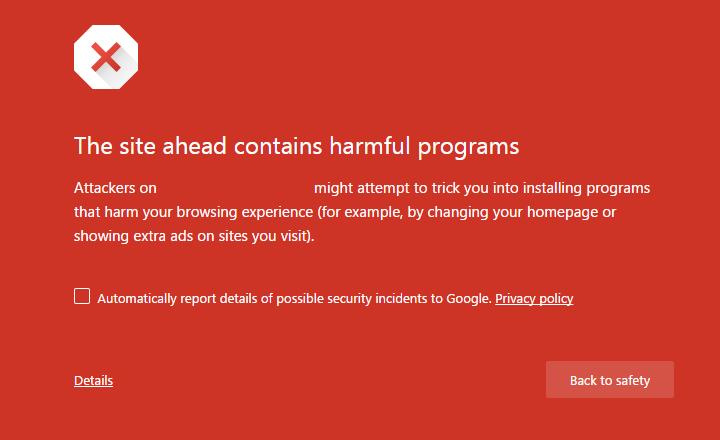
The news that Google’s Chrome browser has started to block pretty much all of the major torrent sites, including KickassTorrents, Torrentz and RARBG. The sites were blocked with a warning that these sites were offering “harmful programs”.

Website owners can normally check Google Webmaster Tools to see why their site was blocked, but the operators of these torrent sites could not find anything listed as being wrong.

So the first thought that many had was that this may be some kind of new anti-piracy measure being rolled out by Google, under coercion from the MPAA and others.

But the actual situation was much more simpler. The problem stems from advertising and sponsored links that these sites had, which may have linked to other sites that were offering the programs Google was warning about (specifically, Potentially Unwanted Programs, or PUPs, such as toolbar installers and other programs and offers bundled with installers). Google has been particularly sensitive in blocking these kind of sites recently, and perhaps a tweak in their algorithm flagged the torrent sites, most of which may have been using the same advertiser or software sponsor. The reason Google Webmaster Tools (GWT) did not show anything at first was because the information in GWT is delayed, something I have personal experience with in relation to false positive DMCA requests that I’ve had to deal with in GWT.

Most of the blocks have been removed now, once the sites in question dealt with the issue and submitted a review in GWT, but perhaps the bigger issue here is how easy it was for Google to block access to so many popular sites at once. It’s something that will give rights-holders bad ideas, and perhaps it also point to the monopolistic position Google now finds themselves in (Google Search and Chrome are the most popular platforms in their respective fields) – too much power concentrated in one company, whether that power was intentionally procured or naturally gathered, is never a good thing.

Gaming

PS4 CUH-1200 APU

A new PS4 model is lighter, uses less power and is quieter too

There’s a new updated PS4 model currently available (only) in Japan, and a teardown has revealed some significant updates with the hardware. An updated processor (still a 28nm chip though), RAM and other chips means power savings, which also means a quieter, slower spinning fan. This greener, quieter PS4 still retains the old form factor, so it’s definitely not the “slim” edition that some are convinced will be released soon (and if anything, this model refresh means it’s now less likely that a slim version will be coming soon, not after Sony has put in the effort to design this new model – the slim version will require a much bigger re-design that what’s found here). Expect this new PS4 model to make it ways to the US and other Western markets soon (before Christmas, I bet).

——

That’s it for this week. I’m going to go back and watch that Star Wars Comic-con video another 10 times. Oh yes. See you soon!