
Archive for the ‘Electronics’ Category

Weekly News Roundup (25 January 2009)

Sunday, January 25th, 2009

Today is Chinese New Year’s Eve, also the eve of Australia’s national day – celebrations here in Australia are going to be doubly big tomorrow, lots of flag waving and dragon dancing. I’m almost over my Shingles outbreak, not really feeling much discomfort anymore, although I’ve been quite busy lately with a new project that will soon be made public. It’s not a Digital Digest thing, but it’s related, and that’s all I shall say for now. But that’s not the only reason I was busy, because I had the December 2008 NPD figures to analyse plus write a yearly NPD roundup, both of which are now up. I love graphs.

CopyrightLet’s start with the copyright section, the last one of the Year of the Rat, which has been a pretty bad year (for us Monkeys, anyway). Unless you’ve been living (or is that hiding) under a rock for the last week, you should have seen the amazing pictures of the Obama inauguration. Change starts this week, but on the copyright front at least, things seems to be moving in a bad direction.

Obama is now the President, but will he stay true to his pro-consumer stance

Obama is now the President, but will he stay true to his pro-consumer stance

Another Obama pick for a top level position has been revealed as yet another anti-piracy advocate, previously working for the BSA. I must say that Obama, who said all the right things during the election campaign in regards to consumer rights, and had the backings of all the pro consumer rights groups, is really taking this whole “team of rivals” thing a bit too far with these picks. We all knew that Joe Biden was a friend of the RIAA, but all this pro big media stuff just doesn’t really fit in well with the rest of Obama’s agendas. Let’s once again hope that these moves are just there to balance out the administration’s views, and that in the end, it will be Obama’s pro-consumer views that will be the policies of the administration, not those of these anti-piracy advocates.

In the “taking copyright control too far” segment for this week, the website in the spotlight it YouTube. They are now apparently blocking material and then asking questions later, blocking legal material and forcing the rightful content owners to lodge a dispute before their content will be uploaded. That’s the problem with algorithm based copyright detection, it’s not very accurate, but to have a human pair of eyes look at everything would be cost prohibitive, unless the RIAA/MPAA want to foot the bill. YouTube is now offering downloads on selected videos, so you can imagine why they might be a bit more paranoid in regards to copyright.

The Dutch have commissioned a report which says that P2P actually benefits the economy. You know what, this doesn’t surprise me one bit. People used to the convenience of P2P will naturally consider other forms of legal Internet distribution. A track you downloaded off P2P illegally just might lead you to buy the album legally. Same with games, movies and all sorts of other things you can buy and download online. It’s like the modern day shareware floppy, try before you buy. Plus there are the other benefits to bandwidth saving and reduction is hosting costs, which will benefit businesses that host a lot of downloads.

High DefinitionIn High Definition news, I want to clear up something first. I get asked why this section is called “High Definition News” and not just “Blu-ray News”. Well, that’s mainly because while Blu-ray is obviously the main focal point of HD at the moment, HD covers much more than just Blu-ray. Topics such as H.264, HDTV, HD downloads, GPU acceleration and even 3D TV are all covered here, so calling it simply “Blu-ray” news would be a bit misleading. Besides, I’ve got the Blu-ray logo to represent this section, and the writing is in blue, so that should appease the fanboys somewhat I hope.

To prove the above, the first story I’m going to post is one about how 3D HDTV is going to fail. I’ve said something similar before, because as long as uncomfortable glasses are required, nobody is going to take it all that seriously. And when glasses aren’t required anymore (holographic vision? HDHV?), will Blu-ray or even TV still exist? Holorooms, perhaps?

Porn is driving the HD industry, Blu-ray and HD downloads included

Porn is driving the HD industry, Blu-ray and HD downloads included

Pornos. Now that has gotten your attention, it looks like you’re not the only one who is interested, because once again, porn is driving the new HD industry. However, the article mentions not only Blu-ray, but also HD downloads, which are possibly a better idea for porn as it’s easier to hide. It’s again interesting to see industry mention HD, but talking not only about Blu-ray, but about the emerging download market.

And they just might need downloads to exceed, because home video is suffering in the face of threats it now faces from the video gaming industry. Blu-ray may help get back some of the money that DVD sales have lost, but even Blu-ray is only alive because of a game console, and the more money people spend on Wii, 360 and PS3 hardware and software, that’s less money they have to spend on movies. It is now a highly efficient process to extract money from consumers, and so there’s little room to get people to spend more money, which is what Blu-ray was all about. Not more money, but money better spend, is what people want, and you can’t really beat the interactive goodness and the longevity the average game provides, rather than the (rather short) 2 hour movie, even if it is in glorious HD (and games are now too, don’t forget). 

GamingThis brings us nicely into gaming. Let’s start with something a little more tasteful, and that’s the news of another PS3 firmware update. Version 2.6 adds a photo gallery, plus DivX 3.11 support. As usual, wait until other willing guinea pigs have sacrificed their PS3s before attempting to update, and also be careful of the well known, but unacknowledged (at least officially), firmware update bug that’s borked more PS3s than any other problem, mine included.

Then we come to the less tasteful stuff, all from Sony (or at least SCE Chairman Kazuo Hirai) as they try to defend their pretty terrible set of figures from the latest NPD figures (all PlayStation hardware actually sold less in November and then in December, then the same months last year – the only game consoles to suffer this fate even in these harsher economic situations).  First up, he bashes the Xbox 360 and Wii by saying that the 360 will soon be forgotten, no doubt in the long shadow the PS3 will cast over the entire gaming industry (my words, not his), and that the Wii isn’t even considered a competitor to the mighty PS3. No, that doesn’t sound arrogant at all, why do you ask?
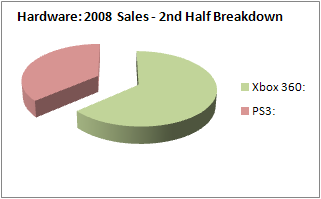
The "soon to be forgotten" Xbox 360 outsells the PS3 in 2nd half of 2008

The "soon to be forgotten" Xbox 360 outsells the PS3 in 2nd half of 2008

I mean the Wii has only outsold the PS3 by 7 million consoles in 2008 (in the US), which is actually more than the total number of PS3 sold (that’s right, the number of Wii’s sold minus the number of PS3’s sold in the US in 2008 is larger than the total number of PS3’s in existence over there). And the soon to be forgotten Xbox 360, which even outsold the PSP, let alone the PS3, only has double the number of consoles in people’s homes than the PS3, and only had 31% of the top 10 games sold last year, compared to the PS3’s mighty 5.77%.

And that’s not all folks. Hirai continues by saying that the PS3 has been made intentionally hard for programmers because they want developers to take longer to do what the PS3 is capable of doing, to extend the life of the PS3. Gobsmackingly hilarious, but it does explain why most multi-platform games are the same or better on the 360, despite the 360’s inferior hardware. So Sony are admitting they made things harder for everyone so developers can produce sub-standard games at first and only produce games that’s worthy of the PS3 later on, all to make the PS3 last longer? How about making games that are great and better than the competition from launch (I know, controversial), so you can establish yourself as the dominant console for years to come. And better graphics and less buggy controls is not what people want anymore – it’s the innovative concept of the games that people want, and you don’t need 8 cell processors to allow this to happen (cf. Wii).  Of course, their strategy worked perfectly for the PS2, but you only have to look at what other consoles the PS2 was in competition at that time, and what the PS3’s competitors are this time round, to see why it might not work for the PS3. Plus the pricing differences between these consoles. 

Say the PS3 is a superior piece of hardware. Say that the PS3 was the last console to be released compared to the Wii and 360. Say that the PS3 is better value because it is also a high quality Blu-ray player. But don’t try to justify your mistakes, and the PS3’s many flaws, by making stuff up like this. And I still hold up hope that all of this is just lost in translations stuff, and not really what it appears to be right now.   

Sorry for the rant, but I’m not alone in thinking Sony aren’t doing all they can to make the PS3 the best console on the market, and it’s hard to hear them say that this was all intentional and part of their plan.

Anyway, that’s all I have for this week. Hope the year of the Ox is as good for you as it appears to be for us Monkeys, and that ox (bull) is a good omen for the stock markets. See you next year/week.


Weekly News Roundup (18 January 2009)

Sunday, January 18th, 2009

Hello again. Yes, I’m still standing from my attack of the Shingles (hmm, title for new George Lucas movie perhaps?), although it was pretty bad earlier in the week. I got considerably better as the week went on, and I even had the energy to write a new guide for the newly released DivX Converter – the guide shows you how to make PS3/Xbox 360 compatible H.264/AAC videos using DivX Converter. It’s not the most feature rich encoding tool you’ll find, but if you need a quick and dirty H.264 encode, then it will do fine. Other than that, it was still a mostly quiet week.

CopyrightOn with copyright news, the makers of RealDVD are still feeling confident that they can beat the MPAA. The trial is set to start next month, and it will prove to be an important one. Real Networks do have a point in that their software actually adds more DRM to DVDs, and does not attempt to remove or circumvent any existing measures. There is a valid point in which the MPAA makes (shocking, I know) in relation to the CSS license, and whether Real are allowed to decode CSS in the way they’re doing, but on the point of copy protection, RealDVD doesn’t make the movie any easier to distribute online – in fact, it makes it harder and I can’t see how the MPAA can argue against this. To be fair, a sticker on the DVD telling me not to copy it is a stronger copy protection method that the weak CSS algorithm.

Only a couple of days until President-Elect Obama becomes President Obama. All eyes on the “change” that is supposed to be coming, and as posted last week, things are not looking great so far from a copyright perspective. However, things seems to be picking up on the Net Neutrality front and we might now get legislation to keep the Internet the way it is, as opposed to give control of it to big media and content owners.

High DefinitionIn High Definition news, the economic crisis hits home this week as Circuit City closes its doors. Living in Australia, I have had no dealings with Circuit City apart from protesting their decision to support the defunct DIVX format (not to be confused with the DivX codec), as opposed to supporting DVD way back in 1998. But it just goes to show that nobody is immune, and Sony are especially exposed to the downturn due to their high costs in promoting both Blu-ray and the PS3.

Circuit City has closed its doors

Circuit City has closed its doors

2008 has certainly been a year to forget for Sony, despite it getting off to a brilliant start. With the format war won, and PS3 sales beating the Xbox 360 back in February, things looked great. But then a couple of things happened (or didn’t happen), and Sony are now seen as one of the major losers of 2008. Blu-ray didn’t pick up as expected after HD DVD failed, and it has only now started to show it can hold its own against DVDs. In gaming, the Xbox 360 price cuts along with the never-ending Wii popularity meant that the only console the PS3 was able to beat was the PS2. And then the financial world collapsed, and all CE firms felt the impact, but especially Sony because they had two extremely expensive projects to support, both also facing serious competition from all over the place. Blu-ray seems to be standing on it’s own right now, although a lot of money is still being spent by Sony to promote it (see the Sony Blu-ray hardware promotions on Amazon.com). The PS3 still needs massive price cuts that will mean more losses for Sony in the short term at least. All they can do now is to keep their head down, take the loss and hope that in the meantime, the alternative media delivery systems and Nintendo/Microsoft haven’t taken control of the market by the time things improve.

Cheaper and cheaper DVDs are causing headaches for studios

Cheaper and cheaper DVDs are causing headaches for studios

The point of Blu-ray was always to prop up dropping DVD profits, but it doesn’t seem to have worked. The latest figures show that Blu-ray and DVD sales combined dropped by 5.5% compared to 2007. This is despite Blu-ray posting a 178% increase in sales, because DVD sales dropped 7.3%. In my follow-up forum post, I broke down the numbers and worked out that for every $1 increase in Blu-ray sales, there’s a $5 drop in DVD sales. The problem is that even though each Blu-ray makes more money, every cent someone spends on Blu-ray automatically means less money spent on DVDs. People are not buying the same movie on both DVD and Blu-ray, and why would they? And while Blu-ray movies are more expensive than DVDs, this does not always translate into more profit, after higher manufacturing costs plus promotional costs are factored in. Another problem is that Blu-ray movie pricing are dropping as well, along with DVDs, and so people are getting more for their money than before – so they’re naturally spending less because one can only physically watch so many movies in a time period. If I can now buy 10 movies a week instead of one due to price drops, then I might not buy 10 movies and spend the same amount of money because I don’t think I can watch 10 movies in a week. And once people get a taste for cheap movies, they are less likely to buy more expensive ones, even if it offers better quality. They’ll just end up spending less and less, and this is exactly what the studios are trying to prevent. The solution? I think they have to make it more convenient to search for and get movies into people’s homes. If that means promoting online purchasing and instant delivery, like how MP3s have taken over from CDs, then so be it. Blu-ray is just too similar to DVDs and while this familiarity is great for getting people to adopt the format, it also means that same problems that DVDs have are not solved. At best, it will buy some time for the industry to come up with a new way of doing things, but as the sales figures show, it’s not really helping much at the moment.

Or instead of going with the new, how about going with the extremely old? Panasonic thinks they’re onto a winner by combining good old VHS with Blu-ray. Seems a bit wrong to me, to be honest, a bit like still including a floppy drive with your latest i7 computer, at least one without a multi-card reader.

GamingAnd finally in gaming, Microsoft says they don’t plan on releasing a new console anytime soon. They can still do a bit to improve the Xbox 360, which can still play games that offer excellent quality visuals, although any recent PC can beat it for graphics these days. Two words Microsoft, ‘cool’ and ‘quiet’ – make these two qualities of the Xbox 360, and you really won’t need to release a new console in the short term.

3D is a big thing at this year’s CES, and Sony promises PS3 3D gaming. But wait, aren’t most PS3 games already 3D (or 4D, as Sony’s PR department claims)? No, these are actual 3D games where you wear those headache inducing glasses. This reminds me of the Asus VR-100 3D gaming system for the PC, and I nearly got one of those back in 1999. I’m all for immersion, but the Wii can do it with a $5 piece of equipment. And no headaches.

A sneak preview of one of the graphics in my 2008 review: hardware sales numbers

A sneak preview of one of the graphics in my 2008 review: hardware sales numbers

I should have the NPD figures for December 2008 up next week – it’s slightly delayed because I’m also writing the year in review which will feature lots of nice graphs. I probably shouldn’t tell you the conclusion before I publish the article, but I think it’s fairly easy to guess what it is anyway. The Wii is the big winner, obviously. It was twice as popular as the Xbox 360, which itself was almost twice as popular as the PS3. Nintendo is the even bigger winner because the big software hits were theirs (thanks to Super Smash Bros. Brawl, and the usual suspects of Wii Play, Mario Kart and Wii Fit). The Xbox 360 game developers were the other big winners. There was only the single PS3 title in the yearly top 10, and that was the PS3 version of GTA IV which sold 1.4m copies less on the PS3 than on the Xbox 360. Nine out of the twelve monthly number one games were Xbox 360 ones, two were Wiis, and only a single number 1 hit for the PS3 (MGS4).

Okey dokey, that’s it for this week. Hope 2009 has been pleasant for you so far, because it hasn’t really been that great for me thanks to the varicella-zoster virus. Curse you, stupid virii.

Weekly News Roundup (11 January 2009)

Sunday, January 11th, 2009

What a week. Despite the semi-holiday feeling of it all, a lot happened. DivX 7 with H.264 encoding/decoding was released, and there were some interesting news items as well. Unfortunately, I’m still suffering from illness, which has just officially been diagnosed as shingles. Do under 30’s get shingles? Apparently, they do, and it itches like hell (luckily, very little pain). So I’ll try to keep this WNR short as possible, because I need the rest.

Also, finally finished Fallout 3 with all achivements. Lovely game and the hours I spent playing it no doubt contributed to me getting shingles, but it was worth it.

CopyrightLet’s get on with it with some copyright news. The RIAA has dropped the controversial infringement monitoring firm MediaSentry, another sign of their new strategy to target ISPs instead of individuals. MediaSentry has been in the news many times due to their invasive techniques to gather evidence for prosecution, so I won’t shed a tear for them despite wanting to cry over my shingles related discomfort.

The Obama administration will be sworn in in a little more than a week’s time, but despite positive messages during the election campaign, the actions in regards to copyright has been much more negative. Two picks for important Justice Department and the AG’s office has been lawyers who are RIAA friendly or friendly to excessive copyright control legislations. Let’s hope this is just to balance out the administration’s pro-consumer policies, rather than just an extension of the status quo. But as I said when Obama was elected, and I am a huge supporter, is that one should not expect huge changes. This is because the lobbyist and interest groups have enourmous powers in Washington D.C, even more so than the Super Mutant Behemonth that will eventually inhabit the very same buildings as these lobbyists some years in the future.   

The other big copyright news of the week was the official death of music-DRM, as Apple announced they will go DRM free from April 1st. If this is not an extremely early April Fools trick, then one can safely say that the fate of music DRM has been sealed. Will gaming or movies be next? Let’s hope so, because as the as many people are finding out, DRM only really works to frustrate legitmate users, as one famous authors found out when trying to play his The Dark Knight DVD on this PC. DRM is one of the biggest cons of the 21st century so far, giving paranoid content owners a false sense of security at the expense of lost sales and consumer satisfaction.

High DefinitionIn High Definition news, fast growing electronic firm Vizio will have a sub-$150 Blu-ray player available soon. Blu-ray harware is still more expensive than DVD hardware, but I actually think prices have been a lot more reasonable recently, almost to the level of “cheap”. And even movie prices, when sales are on, are quite reasonable (the collapse of the British Pound has meant that buying from Amazon.co.uk in Australia is not a realistic proposition). So it looks like the ingredients for mass adoption is here already, no more excuses, and we’ll see in 2009 if Blu-ray has what it takes to take a huge bite out of DVD’s market share.

The problem right now, and one that will be solved by mass adoption, is that Blu-ray’s demographic is still very much concentrated in your typical enthusiast/early adopter/video gamer (thanks to the PS3). Male, likes action/sci-fi flicks, don’t mind paying over the odds for new releases. A great demographic for a premium video format, but not yet good enough to become a mainstream format. But to fully appreciate Blu-ray, you really need material to show it off, and that’s the action/sci-fi movies with booming surround sound. Not sure what one can get from watching romantic films in high def, and the extra details of skin imperfections might actually hurt.

And if BD doesn’t work, try 3D. At least that’s what the electronic manufacturers are thinking, with the on-going CES show giving us many 3D TV prototypes. 3D has always been used to generate interest when all else fails, but while I like 3D, I just don’t think the technology is here yet to fully show it off. If someone can make a 3D TV without the need for glasses, or at the very least, a 3D system that won’t make me nauseous (I’m nauseous enough right now, thank you very much) and has proper colours, then I’m all for it. Otherwise, a gimmick won’t help anyone. 

And as mentioned earlier, DivX 7 was released and I had a couple of blog posts that talked about it, including some early tests with the DivX Converter software that supports H.264 encoding. If you want to quickly get into H.264 without the fuss of configuring encoding options and such, then DivX Converter is recommended, as the produced files can be easily made to be PS3/Xbox 360 compatible in a minute or two (I might write a guide on how to get the MKV to MP4, using MKVtoolnix and MKVExtractGUI – edit: guide now up).

GamingAnd in gaming, nothing much is happening at the moment but the NPD figures should be out this week or next, and early reports suggest another win for the Wii, with the Xbox 360 in a distant second, and the PS3 doing not so well.  

Anyway, that’s all I have the energy for this week. Hope you have a itch free week, not much chance of me having one though.

Weekly News Roundup (4 January 2009)

Sunday, January 4th, 2009

Welcome to the first WNR of 2009. Hope your NTE celebrations were a riot, not literally like the house down the street from my place, but even so, I hope the police dogs didn’t bite too hard. I spent NYE being sick, probably the flu, and that totally ruined my evening of sitting on the couch and watching the fireworks on TV.

It’s still a relatively quiet week, although there are signs that the hangover is nearly over and that reporters are coming back to work. I might make some 2009 predictions/wishes if there’s not enough news.

CopyrightLet’s start the new year with some copyright news. The MPAA’s attempt the “plug the analogue hole” has meant resistance from the general public (no surprise), but now also meets the disapproval of the FCC Chairman. The good old MPAA, making enemies everywhere in 2008 and now in 2009 too. 

 That’s it for copyright news though. Told you it was slow. As for a prediction, or perhaps more precisely, a wish for 2009: I wish that DRM will die a horrible death, just like it did with MP3s, but this time for video and gaming. But I think this will only happen when a legitimate online delivery system is in place so the content owners can be happy with the extra revenue to not worry so much about DRM. There are a couple of important court cases that may come to a conclusion this year too, and the verdicts will determine largely how the copyright industry proceeds from this point. 

High DefinitionIn High Definition news, The Dark Knight continues to be the week’s top seller, outselling the new release The Mummy: Tomb of the Dragon Emperor by a 3 to 1 margin on Blu-ray. Warner’s catalogue title sale has meant that the top 20 titles by BD/DVD sales ratio has all been taken up by these titles. Could this be a sign of Blu-ray’s imminent conversion to a mainstream format? Or were these titles just really bad DVD sellers that have found some new life on Blu-ray?

Speaking of The Mummy movie, has anyone else noticed how too many of Brendan Fraser’s movies take place underground or involves being underground? “Encino Man” as frozen caveman buried in backyard; The Mummy movies of course; “Blast from the Past” buried in an underground bunker; “Journey to the Center of the Earth” obviously; “Bedazzled” where he makes a deal the Devil, who lives underground … there are also a few movies where he dies at the end, so technically, that’s going under ground too.

Blu-ray and DVD price breakdown

Blu-ray and DVD price breakdown

Anyway. A recent survey shows that Blu-ray buyers are still buying DVDs in droves, thanks to DVD’s lower pricing. There’s a nice graph in the article, where it shows that 66% of Blu-ray movies sold are over $20, whereas 83% of DVDs sold are under $20. If there’s any other way to show where the buying demographic for both formats differ, I would like to see it.  

LG had spiced up its Blu-ray player lineup by adding CinemaNow and YouTube support. Not long ago, Samsung released a Blu-ray player with Netflix support as well. As I have mentioned many times before, but possibly on the forum, is that the processing power these Blu-ray players have, plus the Internet connection capability in Profile 2.0 players, means that these players are ideally suited for online movie streaming. Digital distribution is coming, and that’s a prediction for 2009 that I have confidence in. To further drive the point, Toshiba is backing distributing movies on memory cards, some of which have now exceeded the size of single layer Blu-ray,  is re-writable and does not require special and expensive drives to read/copy discs. Downloads kiosks are being set up in stores where thousands of movies can be downloaded onto memory cards, like an alternative to iTunes or online downloading. While the movies are SD for now, Toshiba says HD is coming and so are set-top boxes to view them on. What chances that LG and Samsung will be one of the first to jump on the bandwagon and offer a Blu-ray player that also plays these types of movies?

NCR's DVD dispensing kiosk - USB memory drive version coming soon

NCR's DVD dispensing kiosk - USB memory drive version coming soon

I’m a big supporter of digital movie distribution, where the media is only important for holding the data, not as a format unto itself. Why does it matter if the movies comes on Blu-ray, or DVDs, or USB memory drives or even by carrier pigeons? It’s the digital data that’s important, and everything would be a lot easier if my movie collection was purely digital, and I can select and watch my movie collection without having to find the disc, pop it out, insert it into the player, wait for it to load, and then when I’m finished, put the disc back to where it belongs again. Then there’s the sorting, and possibly using software to categorize it, which is time consuming. With a digital library, I can do all of that at the click of a few buttons, and with an Internet connection, I have thousands of more movies available to buy instantly as opposed to shopping online or going to the shops and hoping they have the movie in stock. So I hope in 2009 we’ll see more movement towards this eventual goal. And despite what people are saying, Blu-ray is not under threat at all yet from this because HD movie delivery still requires more bandwidth being available, and a disc format will still be needed, just like USB memory drives (or carrier pigeons), in this digital future. 

Asus HDAV 1.3 will support Dolby TrueHD bitstreaming

Asus HDAV 1.3 will support Dolby TrueHD bitstreaming

Another LG innovation is the 480 Hz TV. I don’t know what watching Blu-ray will be like on such a TV, and I would like to find out. As long as it doesn’t have TruMotion or whatever LG calls their in-between animation technology, because they make movies look freakishly smooth. Judder is natural to film content and it should be present. Telecine Judder (from 3:2 pulldown) due to uneven frame doubling is not natural though, and TVs that can refresh at 48, 72, 96, 120, 240 and now 480 Hz should eliminate one of the biggest problems with watching film content on HDTVs. Hopefully, Telecine Judder will be eliminated in 2009. 

On the PC front, Asus has released the first sound card with Dolby TrueHD bitstreaming. ATI is doing good work with enabling HDMI on their graphics cards to also output digital audio, answering a question I posed many moons ago as to whether graphics card/chip manufacturers or sound card manufacturers will be responsible for the audio part of HDMI. Still, the progress has been slow and Blu-ray playback on PCs is still not the “must-have” feature that DVD playback was shortly after it came out. I expect more movement on this front in 2009, because the software players are already quite mature, and the emergence of a few free or open source tools for Blu-ray production, such as BD Rebuilder, could help to drive this segment of the market that I think the Blu-ray people have ignored against their own interests (just because all the PC companies supported HD DVD).  

GamingAnd finally in gaming, a new book reveals that the CPUs in the Xbox 360 and PS3 are actually cousins of sorts, and that Sony helped Microsoft develop the chip used in all Xbox 360’s, even if it wasn’t intentional.

The Xbox 360 has also been updated with a new 65nm GPU, as opposed to the hot 95nm GPU previously. The “Jasper” model of Xbox 360 is now available, and all Arcade models with built-in memory units are Jaspers. Pros/Premiums Jaspers are rare but they do exists,  and even one of our forum members managed to get one without even deliberately trying. My prediction for 2009 is that I will get one of these, or whatever the next Xbox 360 model is, because an Xbox 360 without HDMI is just not right.

As for a larger picture prediction, it’s hard to see the PS3 not climbing in sales if the stories about it becoming cheaper to produce is true. Even a small price cut at this point will drive sales upwards by quite a bit, so if Sony can bite the bullet and compete on prices with the Xbox 360/Wii, then they can still win this generation’s console war. But there’s a little voice at the back of my head (and not just due to the fever I have)  that reminds me of the story some time ago that said the PS3’s processor was great for a media player/hub, but not so much for a game console. Did Sony design the Cell intentionally for this, and are they paying the price for it now, along with the costly (in more than one sense of the word) Blu-ray drive?

Okay, that’s it for now. Back to bed for me for some much needed rest. See you next week.

Weekly News Roundup (28 December 2008)

Sunday, December 28th, 2008

Welcome to the last ever Weekly News Roundup.

For 2008, that is. And predictably, there was hardly any news this week. There was the story of the RIAA changing tactics in their fight against piracy. The Pirate Party in Sweden is gaining support, now surpassing the Green Party in membership. And that’s pretty much it for copyright news.

Hardly any Blu-ray news either, as people are still recovering from TDK fever. The only thing slightly related was the cost of making PS3s dropping, but still higher than the retail price. Sony are still losing money on each PS3 sold, so no wonder they’re not offering any price cuts. And video streaming is coming to the Wii, which means all current generation consoles now have video streaming capabilities, which suggest online based video delivery is here to stay.

And that was the week in news, oh well. So instead of looking at the week’s news, I thought it would be appropriate to do a quick yearly roundup. A proper annual review would takes 20 pages, so I’ll just quickly do the news items that I can still remember, which is not much.

Copyright2008 was a year in which lawsuits were filled left and right, by the RIAA, MPAA and their legion of evildoers across the globe. TorrentSpy was shut down, many others followed, but piracy rates still increased. 

Consumers finally said no to DRM in 2008

Consumers finally said no to DRM in 2008

2008 is also the year that DRM died. Unfortunately, it was limited to the music arena, but it’s still a good sign for the future. DRM still reigns supreme in video and gaming, but on the PC gaming front, the voices of discontent are now being heard, all thanks to EA’s mangling of Spore’s DRM. No PC game gets released these days without a debate on DRM, and I think that’s a healthy development and hopefully, 2009 will be the year DRM died in gaming as well.

At the end, the RIAA decided to change tactics and go after ISPs. It happened in Australia as well, with AFACT suing ISP giant iiNet. iiNet has promised to fight the charges, and we might see what happens in 2009. 

In politics, the George W. Bush White House, firmly on the side of the RIAA/MPAA, established a new Copyright Czar position which will make the government do the dirty work of the copyright industry. Barack Obama was elected President, and he promises a different approach to fighting piracy, but we will have to wait and see if he delivers on the promise. 

High DefinitionIn High Definition, a lot happened in 2008. The year started with a bang, with Warner Bros. ditching HD DVD and going Blu-ray exclusive. Wal-Mart followed, and a string of other companies too, and in February, Toshiba folded and abandoned HD DVD.

RIP, HD DVD

RIP, HD DVD

What followed was a series of fire sales, some of which are still going on, in which yours truly increased his high definition movie collection 15 fold for less money than a Blu-ray player (current pricing). Blu-ray was expected to completely overwhelmed the market, but nothing materialised, at least not what studios were expecting. Blu-ray’s 6% share in March (when HD DVDs were still being released) did not grow at all for the next 6 months. Then came Iron Man, and price cuts to hardware, and Blu-ray was gaining momentum again. The Dark Knight made sure 2008 was a good, but not brilliant, year for Blu-ray, with market share closer to 10%.

Blu-ray standalone prices tumbled towards the end of the year, coming close to HD DVD levels just before it folded, with some deals making them even cheaper than HD DVD players after HD DVD folded. The “players are too expensive” excuse can’t really be used anymore, but people are still not buying players in droves, and with slower PS3 sales, there’s still not nearly enough players in people’s homes. 2009 will be the year of Blu-ray, as the execs now say – we’ll have to wait and see.  

But time may be running out because online video distribution made huge strides in 2008. All three current generation consoles, the Wii, Xbox 360 and PS3, now support some form of online video rental/streaming. There are more than 33 million of these consoles in the US alone.  Netflix, Blockbusters, Microsoft, Sony, Nintendo, Apple, Amazon … are all now doing online video streaming, most of them with their own hardware players as well. If you ask anyone in the industry, they’ll tell you that online video is the next big thing in home video, but until bandwidth increases and its prices drop, we might still have a while to wait before HD video streaming becomes a reality. H.264 has firmly established itself as the video format of choice, and with the H.264 based DivX 7 coming next month, H.264 is truly becoming a mainstream video format and HD streaming using the highly efficient H.264 codec will make bandwidth requirements slightly less demanding. 

GamingAnd finally in gaming, 2008 was a great year for the gaming industry. There were so many hit titles, and my NPD yearly roundup to be published next month will have more details. GTA IV, Gears of War 2, Madden NFL 09, Super Smash Bros. Brawl – all titles that sold more than 1 million copies in the first month of release. The good news for Microsoft was that 3 of these 4 titles were Xbox 360 ones (the other one being for the Wii). The expected PS3 hits like LittleBigPlanet and MGS4 did not really do much for the console, while any old game on the Xbox 360 sold better. The Wii’s usual suspects, Wii Play, Mario Kart, and Wii Fit all helping it to stay number 2 in software sales. 

PS3: Losing momentum, losing sales, but not losing the high price tag

PS3: Losing momentum, losing sales, but not losing the high price tag

On the hardware front, the PS3 started with a bang, outselling the Xbox 360 for the first, and second, times in the first 3 month. Then a couple of months where both consoles were neck and neck, the Xbox 360 came back with a vengeance thanks to some smart price cuts and some hit game releases. But it was all a fight for (a distant) second place as far as Nintendo were concerned, as the Wii took top spot for 12 out of 12 months (we’re still awaiting December figures, but one can assume the Wii won by miles again). More than 2 million Wiis were sold in November alone.

The PS3 ended the year on a sour note (although the December figures might be better), with November of 2008 being a worth month than November of 2007, in terms of raw sales, which is not good news at all for a console that’s not supposed to have peaked yet. The lack of any price cuts, and with only a more expensive model being released for the holiday period, was what caused this. The high cost of making a PS3 is still hurting sales, but with the PS3 costs dropping, 2009 might be the year that the PS3 finally gets some prices cuts. And the good news is that the Xbox 360 can’t make any further drops, so it’s all set for PS3 making 2009 their year. 

So that was the year that was. If you listen to the marketing people, 2009 will be the year of Blu-ray, PS3, online video, H.264, and everything else in between. Nobody really knows what will happen, and I would dare make any predictions, but let’s just hope 2009 is a great year. Have a happy and safe holiday period, a Happy New Year and see you in 2009.