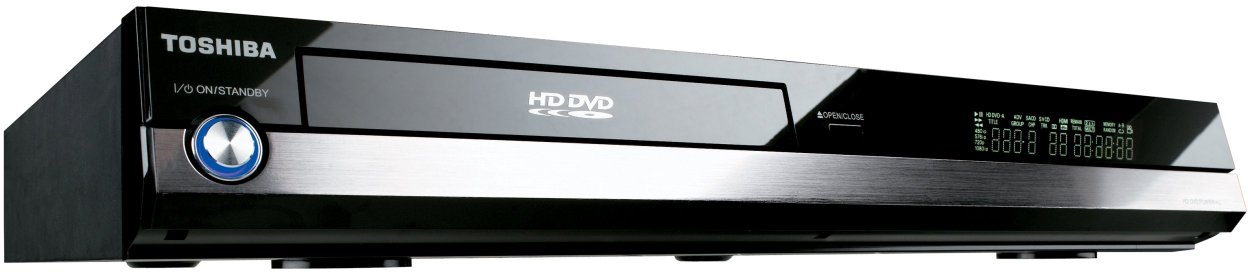
Sub $100 HD DVD Players – what is Toshiba’s plan?

November 7th, 2007

The news last week was all about Wal-Mart offering the Toshiba HD-A2 player for only $98 on their “secret” sale. Reports suggested that these super cheap HD DVD players were quickly sold out, some as soon as half an hour after they went on sale (thanks for the Internet for spreading news of this “secret” sale). Other retailers soon followed, including web stores like Amazon, and eventually even the newer model HD-A3 started to drop in price.

There’s a couple of things that need to be taken into account. First of all, the HD-A2 (the low end model from Toshiba, with only 1080i output, although it makes no difference to most people with 1080p TVs – see why) may very well turn into a superseded model. The “2” represents the second generation of HD DVD players, the current generation’s low end model is the HD-A3. Toshiba have yet to announced the discontinuation of the A2 though, and some of the players sold in the $98 sale have very recent manufacturing dates. Second, the sale was only for one day, it is not the new permanent retail price for low end HD DVD players, although it has helped to lower the price of the A3 as well (retail price of $299, now available for $199 at many places).

Toshiba HD-A2

With that out of the way, the $98 price for the HD-A2 is really nothing short of amazing. Remember that you get 5 free HD DVD movies by redemption with it too, and so, the player is practically free. The A2 also includes DVD upscaling, and while the upscaling quality is not as good as the much more expensive high end HD-XA2, it is on par with most DVD upscalers that you find for this price. I would say that even at $200, the HD-A2/A3 still represents good value if you are in the market for a DVD upscaler too.

It seems consumers agree, and that possibly 100,000 or more HD-A2’s were sold in the last week alone, nearly matching the total sales figure for the most popular Blu-ray player, the Sony’s BDP-S300.

So the question is how did Toshiba manage to get prices so low when Blu-ray players are still so expensive in comparison? How much money is Toshiba losing per player sold, or are the retailers selling below cost? And what does this mean for the HD format war?

Without one of the retailers coming clean, I don’t think we will ever find out just what went on behind the scenes to get prices so low. I think Toshiba would have wanted to get rid of old superseded stock, and this might have convinced them to lower prices per unit, perhaps at cost or lower. Wal-Mart, on the other hand, might have wanted to spur HD sales for the holiday season and so might have sold these players at cost too. All the other retailers probably followed suit because they don’t want to be left out. I don’t agree with some assertions out there that Toshiba is losing $500 per player. The cost established for the HD-A1 back in 2006 was over $600, but costs will have dropped considerably by now – one, because the HD-A2 is built entirely differently to the A1 (the A1 was built more like a computer, whereas the A2 is built as a standalone with the associated cost advantages – the A3’s build costs are even lower), and two, that while some of the $98 stock were made in Japan (where the A1/A2 was initially made I believe), these are now mainly Chinese made. Chinese made DVD players can be made for as little as $USD 10 (a few dollars more if you include licensing fees), and this was a couple of years ago. I’m not saying that HD DVD players can be made for $10, but $90 is certainly within reason. HD DVD standalones have sold way more units than Blu-ray standalones around the world (Blu-ray has a overall lead in sales due to the heavily subsidized PS3), and so it is safe to assume that HD DVD player pricing will be lower than Blu-ray player pricing, which itself is coming down fast too. There is also the factor of the Chinese CH DVD players, which I will talk about in detail in a later blog, but this new format uses many of the same components as HD DVD and by selling large quantities to the Chinese market, it will in turn help to lower production costs for HD DVD players too.

As to the HD format war, I don’t think this will have much of an impact in the grander scheme of things. 100,000 players is nothing compared to the number of DVD players sold every day. But what Toshiba had managed to do was to promote HD DVD and get people excited about it just in time for the holiday shopping season. For every person that picked up a $98 player, they are likely to buy a new more HD DVD movies in addition to the free movies they get (the Transformers HD DVD probably on top of their list) and that’s what Toshiba is counting on. The attachment rate (the number of movies sold to each player) of standalones is much higher than compared to consoles based HD players like the PS3 or the Xbox 360 (this is something I’ll also be talking about in another blog entry), and while Blu-ray has concentrated their efforts on the PS3, HD DVD has been hammering away at the standalone market. The momentum is certainly with HD DVD, and Blu-ray’s minor price cuts will look futile in comparison. At this early stage in the war, momentum is all you can ask for, really.

Weekly News Roundup (4 November 2007)

November 4th, 2007

So another Sunday, and another news roundup. There really ought to be some rule to forbid working on a Sunday, but then it would just mean more work on Mondays. There really ought to be some rule to forbid working on a Monday …

In copyright news, in a Slysoft newsletter, a claim was made that BD+ copy protection, the additional layer of copy protection that Blu-ray owners enjoy, will be defeated soon. Everybody probably still remembers the statement that Richard Doherty, (ex?) analyst at Envisioneering Group made in regards to BD+:

BD+, unlike AACS, which suffered a partial hack last year, won’t likely be breached for 10 years

Not exactly 10 years, but 0.5 years is not bad. Surprisingly, this was the only bit of important copyright related news for the week … the RIAA/MPAA must be on holidays. Although with so many OiNK replacement sites popping up, there will have a lot of work to do when they come back.

In HD news, Fox is set to release the very first BD 1.1 disc for the sci-fi movie Sunshine. This is the first Blu-ray disc to feature picture-in-picture technology, which has been present on HD DVD almost from day one. To access the feature, people will need to have a BD 1.1 player, of which there is only one on the market (in standalone form anyway), the newly released Panasonic DMP-BD30. PS3 owners should expect a firmware update to get themselves up to at least 1.1 standard (although the PS3 is good enough for 2.0 in any case). Will the disc play properly on 1.0 players? We will find out soon enough. The news this week has all been about HD DVD’s price drops. Several special Black Friday sales have ensured that not only did HD DVD standalones break the $200 barrier, it broke the $100 barrier too. $98 for a standalone HD DVD player from Toshiba (the superceded HD-A2) that has built in DVD upscaling and comes with 5 free HD DVD movies – that’s really just too good to be true. It sure beats spending $500+ here in Australia to buy a similar player that only comes with 3 movies. K-Mart has saw the trend, and will now offer the HD-A2 as their only HD DVD or Blu-ray standalone for sale this Christmas. They will still sell the PS3 (as well as the Xbox 360 HD DVD add-on) so talk of them going exclusive is not factual. The HD-A2 is not a bad player. It lacks 1080p output, but as this DigiWiki entry explains, it’s not a problem at all for people with 1080p displays while playing back film content. To continue with the HD DVD news, Toshiba has showed off their new HD DVD recorder, now supporting HD Rec, a format that uses H.264 to record to standard DVD discs, allowing 2 hours of HD content to be stored. Remember that Toshiba’s initial idea for HD was to use existing DVD/red laser technology and combine that with a new more efficient codec (H.264 of VC-1). It’s just as well then that Ritek will soon launch HD DVD recordable discs. Asus is also launching their quietest HD DVD-ROM drive yet, designed for home theatre PCs.

On that note, let’s move to gaming. Sort of. I’m very impressed with Nvidia’s new 8800 GT card as I noted in an earlier blog post. It combines the 3D performance of the 8800 GTS, with the HD acceleration of the 8600 GTS, and then makes the whole thing even more efficient as to even allow a passive cooled version for building an ultra quiet home theatre PC. Nvidia will be releasing a new GTS card too based on similar changes, so that might even more more attractive. And while ATI’s Radeon HD 2xxx series has been somewhat of a disappointment, you should never rule them out because you are only as good as your last GPU.

Now moving onto gaming properly, there was rumours that IPTV was coming to the Xbox 360 in the Fall update, but Microsoft has quashed the rumours by saying that it’s not in the Fall update, but will be here soon enough anyway. Another week and another developer, this time Midway Chicago’s studio head Mike Bilder, saying the PS3 is a pain in the ass to work with. But he does offer a solution – develop for the PS3 first to work around the problems, and then port over to the other systems. Specifically, he says:

Just, to be honest, the hardware differences in memory and processor on the PS3 vs. traditional PC and 360, it makes it a challenge, and it’s representative. Everybody’s having a challenge in the industry right now.

[And about using the PS3 as the lead development platform]

The difficulty you run into there, at least in the last generation, was that the Xbox was considerably more powerful than the PS2, and you found that people didn’t always take advantage of the hardware. Whereas with the PS3 and the 360, it’s certainly more of a level playing field, so I don’t think it’s necessarily a negative to put the PS3 first [as the lead development platform]. But it does help mitigate some of that risk in framerate, memory, technology, just the hardware differences.

That’s definitely a solution to a problem, find out what you can and cannot do on the PS3 first, and once the code is done, you can be sure that it will probably work on the other consoles too because they are a bit more flexible to work with than the PS3.  The quality will be the same too, according to Bilder, because there’s not much difference between the two main consoles (and the Xbox 360 development is flexible enough to allow ports to it to run quite well). Of course, smaller developers who don’t have the resources of Midway might simply skip the PS3 to work on platforms that have the biggest install base and with less development problems.

So that’s it then for a week that has been dominated by HD DVD news, with relatively very little news in other areas. If I didn’t know better, I would say that the HD DVD promotion machine has finally started rolling, and just in time for the holidays too. Blu-ray will come back next week with more news to counter, no doubt. See you then.

GeForce 8800 GT – The card everyone’s been waiting for?

October 31st, 2007

When I posted about my recommended computer specs back in September, I chose the 640 MB version of the GeForce 8800 GTS, but it was far from my first choice. I said at the time that:

… but what I want is a card that combines the HD acceleration (PureVideo HD or AVIVO HD) of the 8600 GTS (or HD 2400 XT) with the 3D performance of the 8800 GTS. Again, waiting 6 months will probably make this possible.

Well, I didn’t have to wait 6 months (although 6 months from the day that the 8800 series was first announced is more accurate), Nvidia has just announced the introduction of the 512 MB 8800 GT.

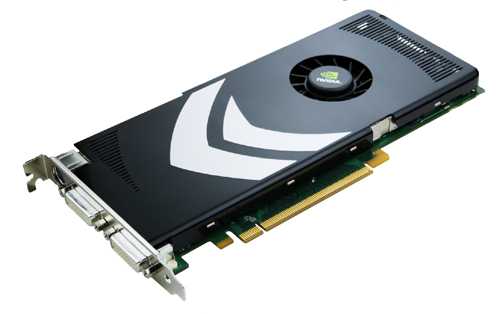
Nvidia 8800 GTSo what’s new in the 8800 GT? The 8800 GT has a new GPU, the G92. It is essentially a die shrink of the existing G80 GPU as found in the other 8800 series cards. The G80 required an external display chip to support the dual-link DVI outputs, but now the display chip is integrated into the GPU which significantly reduces manufacturing costs. The new GPU also supports PCIe 2.0, which doubles the available bandwidth. There are also lots of little changes associated with 3D performance, things like 112 SPs (compared to the GTX’s 128 SPs, and the GTS’s 96), core clock increase to 600 MHz (a 25 MHz increase on the GTX, but 12 less than the Ultra), shader clock at 1500 MHz (sames as the Ultra, and higher than the GTX), a 900 MHz memory clock (sames as the GTX, lower than the Ultra), 512 MB of RAM and a memory interface of only 256 bits (compared to the 384-bit of the Ultra/GTX, and 320-bit of the GTS). But forget all these specs, the important thing is that the GT plays the latest games and do it very well, basically on the same level as a 640 MB 8800 GTS, the card that I recommended only a month ago.

I have deliberately left out the best bit, and one bit that the 8800 GTS/GTX/Ultra was missing, which led me to be cautious in my previous recommendations. Where this feature is concerned, even the 8600 GTS was more preferable than the 8800. So what is it? Well, since this is a website/blog mainly about digital video, the feature I’m talking about is HD video acceleration, in particularly VC-1 and H.264 acceleration needed for HD DVD and Blu-ray playback. While the 8800 Ultra/GTX/GTS was super powerful for 3D gaming, it did not contribute much to video acceleration at all, and instead, sat idle while the CPU struggles to keep a steady framerate. With the 8500/8600 and now 8800 GT, the VP2 engine is used to provide full H.264 video decoding. Note that VP2 on the 8500/8600 only offers full H.264 acceleration – MPEG-2 acceleration (not really needed) and VC-1 acceleration is limited to only inverse transform, motion compensation and in-loop deblocking – I’m not sure if the situation has changed with the VP2 engine on the 8800 GT (unlikely), but H.264 is the most processor intensive codec of all three and the one that is most in need of acceleration. Full VC-1 acceleration would have been great, as most HD DVD movies and now even Blu-ray ones use VC-1, but I guess we will have to wait for the VP3 engine for that.

PARKLE GeForce 8800 GT Cool-pipe 3 Graphics CardSo my wish sort of came true. I wanted a graphics card with the 3D power of the 8800 GTS, and the HD video acceleration features of the 8600 GTS, and this is exactly what I’ve got in the 8800 GT. There’s even a passive cooled version of the 8800 GT, perfect for a HTPC setup that can even handle the latest games (a sort of “build-your-own” Xbox 360/PS3). The price is right too, positioned as an even cheaper replacement for the 320 MB 8800 GTS. It will be interesting to see what ATI can come up with to compete with the 8800 GT. And Nvidia themselves will launch a new GTS in November, so it might be worth it to wait and see a bit longer. And if you want to be a perfectionist, you might wish for HDMI output as well. But for the present, the 8800 GT is the GPU that I recommend for gaming and video enthusiasts.

For a roundup of Nvidia’s range of GPUs, please refer to this forum thread. You can read a full review of the 8800 GT here.

Weekly News Roundup (28 October 2007)

October 28th, 2007

Woohoo! Another weekly roundup. More work on a Sunday when I didn’t get a good night’s sleep in my hot non air-conditioned office. I’m not bitter, really, I’m not.

Anyway, in copyright news the MPAA has apparently hired a hacker to find out confidential information about the bittorrent site, TorrentSpy. I’m pretty sure hacking is illegal in the US. It may in fact be considered an act of terrorism. All those MPAA “piracy equals terrorism” posters finally start to make some sense. The big news of the week was the closure of the popular music bittorrent site, OiNK. There is already news that The Pirate Bay may start something similar to replace it. It will probably end up being something better and harder to close down too. Meanwhile on the other end of the spectrum, Amazon says its DRM free music sales has been a great success. No surprise really, considering DRM is completely useless in preventing piracy and its only purpose is to annoy consumers (and make healthy royalties for the company who invented the DRM engine). Now only if there were something similar for movies …

On to gaming news, US September sales figures have been released and it’s another bad month for the PS3 (read my in depth analysis of the figures here). I think I’ve posted enough about the problems with the PS3 over this last few days, that I don’t think I need go into it any further (although since my blog post, another developer has come out to say it’s a pain to work on the PS3). But at least Activision is standing by the PS3, saying that it is the most advanced console and that in 4 or 5 years time, people will see the difference. I’m not sure Sony can wait that long though, considering their gaming division losses taking the shine off their otherwise impressive profit figures. This week has all been about how bad the PS3 is, and I guess Microsoft is happy to just sit and enjoy the afterglow of the Halo 3 effect. But they are not resting on their laurels, and rumour is that IPTV might be coming to the Xbox 360 in the fall update (and since it’s fall already in the US, the update might not be that far away). It will probably be an U.S only affair though. Shame.

HD news now, the Transformers on HD DVD has sold well, although not as well as first claimed by Paramount. Blu-ray still held the week 51% to 49%, but how quickly that their 2-to-1 advantage shrank due to one single movie, and also the puny amount of HD discs sold compared to DVDs, means that these “figure wars” are really quite pointless. I’ve always maintained that consumers should adopt a format neutral stance and support both formats to ensure they don’t lose out, and Samsung is helping the cause by announcing more details on their updated dual-format player (which will be Blu-ray Profile 1.1 compatible, one of the first on the market to be). But if you don’t mind having two separate players, then HD DVD players have finally fallen below the magic $US 200 threshold. Wal-Mart, and now Circuit City, will be selling the superseded Toshiba A2 for under $200. That’s quite a decent price for a HD DVD player that also doubles as a fairly decent DVD upscaler (not as good as the more expensive XA2 though, but the Reon VX chip in that player puts it into the high-end class of DVD players). While $200 is tempting, I think prices will drop further. In the meantime, check out Amazon’s Xbox 360 HD DVD add-on drive deal (if you have an Xbox 360 that is) – you get Heroes Season 1 on HD DVD of $69.95 value, plus 5 other free HD DVD movies by redemption and all for under $180. Assuming each HD DVD is worth $20, that’s $170 worth of movies for $180, so the drive only costs $10 (and it doubles as a HD DVD-ROM drive for your PC too!).

That’s all folks from my hot non air-conditioned office. See you next week.

PS3 doesn’t suck as much as fanbois

October 27th, 2007

What am I doing writing three blog posts per week, especially when I have another one (weekly roundup) to write tomorrow? Well, you see, I’m a bit angry. And when I’m angry, I blog. PlayStation 3What started as a perfectly innocent *opinion* from an ex game developer for Harmonix (makers of Guitar Hero and Rock Band) on his blog about the difficulties of programming on the PS3, has turned into a fanboy fight-fest, mostly from PS3 fanbois and members of the Sony Defence Force blasting his *opinions* in the comments section. The funny thing is that Jason Booth, the developer/blogger in question, didn’t even suggest that the PS3 sucks, just that it’s difficult to programme for and that the expectation that PS3 games will own Xbox 360 games in the future might not be fully realised. Here are the points raised in the blog post:

  • PS3 has a slower fill rate than the Xbox 360
  • Multi-processor programming is too complicated to take full advantage of the Cell
  • Blu-ray is great for providing more space, but has a slower load time. It is now mainly used to store duplicate game assets to speed up load time and work around some of the other limitations of the PS3
  • Optimization for the PS3 is costly, and developers lack the resources to do it effectively
  • Code for the PS3 cannot be re-used for non-PS3 projects, so investment in PS3 coding is expensive

Now I’m not saying that all these points are valid. Some are probably not, but I can’t comment because I don’t work on game development. But the reaction to it has been, sadly, typical whenever someone says anything bad about a particular tech, in this instance, from PS3 fanbois. So what kind of reaction do we get from PS3 fanbois? That game developers, who sometimes work 18 hour days and basically live at the office, are lazy. That because Jason spelt “Blu-ray” wrong and that he started his career as a computer graphic artist means he knows nothing about programming. Some even suggested that his new work involves producing a product that will compete with Sony Home, and therefore, he is a bitter programmer who is going to get beat by Sony and is venting his anger. How could these people come out with these statements when most (if not all) of them have zero programming experience? And why personal attacks against someone who simply expressed his own opinions about a piece of tech? The comments posted are not all from fanbois though. There are a lot of anonymous postings from programmers with even more technical evidence of the PS3’s failings. As someone who graduated as a Software Engineer, but never really went to work in the field, I can understand some but not all of the points raised, but it seem to make sense. These programmers are posting anonymously because they fear this kind of backlash from fanbois, and more importantly, the spanking they will get from Sony which in turn might mean a loss of employment. But it’s not just anonymous programmers, some of the industry’s biggest names have all spoken out against the PS3’s design. Gabe Newell, the man behind the amazing Half-Life series and MD of Valve software, said earlier this year that:

The PS3 is a total disaster on so many levels, I think It’s really clear that Sony lost track of what customers and what developers wanted. I’d say, even at this late date, they should just cancel it and do a ‘do over’. Just say, ‘This was a horrible disaster and we’re sorry and we’re going to stop selling this and stop trying to convince people to develop for it.’

Then we have John Carmack, creator of Doom/Quake from ID Software, saying:

But the honest truth is that Microsoft dev tools are so much better than Sony’s. We expect to keep in mind the issues of bringing this up on the PlayStation 3… they’re not helpful to the developers… I suspect they’re not going to overwhelmingly crush the marketplace this time, which wasn’t clear a year ago.

And posted on this blog a couple of weeks ago, was this statement from BioWare President Greg Zeschuk:

If everyone’s waiting for this huge gap, it’s just not going to happen. By the end of this generation both PS3 and Xbox 360 will look awesome. Maybe 1 per cent of the population might be able to tell the difference between the two.

No surprise then that PS3 fanbois have already blasted all of these pioneers of gaming, some go as far as suggesting they’ve been bribed to say these things. I know who I would believe if I had to choose between Carmack/Newell/Zeschuk or Sony’s PR department and their legion of fanbois. What these experts are saying, is not that the PS3 totally sucks, but rather, that it’s not an easy piece of hardware to programme for. I’m sure the Xbox 360 and Wii have their own problems, but Sony seemed to have ignored the human element (ie. programmers) when they came up with their design for the PS3. I’m sure that if developers allocated more resources to the PS3, they could come up with games that will be as impressive if not more so than the Xbox 360 version. But the extra resources dedicated to make the game look good takes resources away from making the game fun to play and in the longevity stakes (see Lair, Heavenly Sword, Ratchet and Clank …). But even if you don’t believe these experts, then all you have to do is to look at reality (something that fanbois are unable to do, seemingly). The reality is that the Xbox 360 has the biggest market share, compared to the PS3’s pathetic 14% hold on the US market. The reality is that the Xbox 360 has more and better games so far, and that developers seem to develop more games and do it faster on the Xbox 360. The reality is that when cross-platform games are produced, these either look the same on either platforms, or in many cases, look and play better on the Xbox 360. That’s reality, and until it changes, nothing fanbois can say will make the PS3 a better game console.


About Digital Digest | Help | Privacy | Submissions | Sitemap

© Copyright 1999-2012 Digital Digest. Duplication of links or content is strictly prohibited.