
Weekly News Roundup (20 January 2008)

January 20th, 2008

Like sands through the hourglass, so are the roundups of our week. Or something like that.

Let’s not waste any time, starting with copyright news, it seems the studios have finally wised up and have started experimenting with managed copy. Managed copy is a concept that, instead of letting people make copies of DVDs and stuff for backup or portable use, the studios would make these copies available to you (with the cost included). Fox has demonstrated this feature on some of its new DVDs, including the Family Guy Blue Harvest DVD which will have a DRM’d iPod version of the feature on the disc. Last week, you’ll remember Sony demonstrating something similar with Blu-ray discs on PS3, and copying a version of the feature to the PSP. You have to say that this is much preferred to not being able to make copies at all, although I don’t think this goes far enough – it would be much better if perhaps a 1:1 copy of the feature can be made and stored on networked storage, and to allow standalones to playback these “ripped” features without the disc being present. I’m sure this can be done without encouraging casual piracy (for example, making a copy without owning the original), through some kind of registration/watermark/DRM system. One of these days I’ll have to write a blog entry on how this could work and why it will benefit users (and I do remember promising to write a blog on wireless HD last week, and I haven’t). A more disturbing news was the good old USB system is going to be updated to allow digital video transmission, to compete with the HDMI standard. The disturbing part is that DRM will be added (most likely HDCP) to allow this to happen, which sounds to me like an excuse to add DRM to a standard that didn’t have it before. Why do we even need USB for video anyway – all new AV devices use HDMI as the standard already.

Onto to HD, Amazon is running a competition where 60 fantastic prizes are going to be given over a month’s period (to US residents only, unfortunately). There will be 30 packs that include a Blu-ray player and 100 Blu-ray movies (so 30 players and 3,000 free movies to be given away), and the same for HD DVD. Entry links found here. You don’t need to buy anything to enter, so if you do live in the US, why not give it a go? Good luck. While Blu-ray and HD DVD are fighting a war, Apple has launched a new front in HD downloads through Apple TV. Microsoft already has something similar through Xbox Marketplace, and Sony will introduce something similar too for the PlayStation Store. Will these new distribution methods beat the good old optical disc? I think the problem is that HD downloads and HD content on Blu-ray or HD DVD are two completely different things – one is relatively bitrate limited low quality, while the other represents the best possible quality in A/V at the moment. People who have spent thousands of dollars on LCD/plasmas and surround sound system aren’t going to be terribly impressed by 8 Mbps 720p video with 5.1 channel audio, when they have access to 25 Mbps 1080p versions of the same feature with 7.1 lossless audio. And how will ISPs react to the increase in bandwidth of these new applications? If the infrastructure has been rolled out, then perhaps not much will change. But if the infrastructure is not capable enough of handling such traffic increases, then ISP will have to raise prices and lower bandwidth, like they have done here in Australia regularly over the last few years. Could this happen in the US as well? As for the format war, things continue to bubble, and Blu-ray still has the upper hands, especially the latest sales figures show a commanding 85/15 lead, a likely reaction to the Warner announcement. However, Paramount is still releasing discs for HD DVD, having just announced their 1st quarter release schedule, the same with Universal. If HD DVD can hold on to these two studios, then there will still be many releases that are exclusive to HD DVD, such as Beowulf, Cloverfield, Bee Movie … of course, whether these two studios remain HD DVD exclusive is something that only time will tell. Toshiba is still promoting HD DVD, and they have just dropped the retail pricing of the HD-A3 to around $150, and you can pick one up from Amazon (with 7 free HD DVD movies) for as low as $130 – check out Digital Digest’s Blu-ray/HD DVD deals page for more information on this and many other HD deals. $130 with 7 free movies for a HD DVD player that also does very good DVD upscaling is a bargain, considering that a good DVD upscaler will cost about the same without the free movies. Plus you will get access to whatever exclusives that may still exists for the format, for the time being anyway.

In gaming news, the December and 2007 NPD results are out and I’ve covered it in the previous blog post. Now some (including myself) have been confused by the numbers, which suggest the Xbox 360 widening it’s lead in December over the PS3, but shrinking in terms of overall market share to Sony’s console. This can be easily explained because while the Xbox 360 still enjoys a 3 to 1 lead, unless the monthly Xbox 360 sales numbers continue to have the same ratio to PS3 sales, then market share will continue to grow in PS3’s favor. Of course, if the 360 outsells the PS3 continuously, even if the margin decreases, all this means it that the PS3 will gain market share until a certain point and then stop gaining and at best, all it can look forward to is equal market share with the 360. Or something like that. The somewhat unexpected surge in 360 sales has meant a disruption to the usually reliable Xbox Live service. To make up for it, Microsoft will be giving away a free copy of the Xbox Live Arcade game, Undertow, to all Xbox Live users (both Silver and Gold members). The offer is only for a week, and starts right about now, so don’t miss out (Edit: it’s actually available from next Wednesday to Sunday).

That’s it for this week. Hopefully I will write that article about wireless HD next week, or maybe about managed copy as well. We’ll see.

Game Consoles – December 2007 NPD Sales Figure Analysis

January 18th, 2008

December is traditionally the biggest month in terms of game console sales, and December 2007 was not exception. The numbers have come in, and they round off an amazing year of growth for the gaming industry, despite the heavy competition (perhaps the high definition people can learn something from putting consumers first and still be able to win regardless of competition). You can read last month’s analysis here. The figures are from NPD, a marketing research firm that releases games console sale data every month.

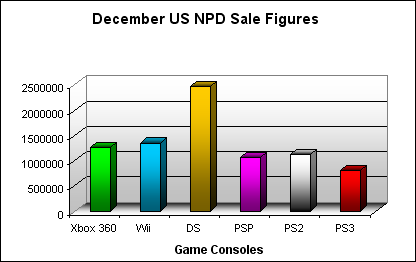
The figures for US sales in December are below, ranked in order of number of sales:

  • DS: 2,470,000 (Total: 17.6 million)  
  • Wii: 1,350,000 (Total: 7.4 million)
  • Xbox 360: 1,260,000 (Total: 9.2 million)
  • PS2: 1,120,000 (Total: 41 million)
  • PSP: 1,060,000 (Total: 10.5 million)
  • PS3: 797,600 (Total: 3.2 million)
  • NPD December 2007 Game Console US Sales Figures

    NPD Game Console Total US Sales Figures (as of December 2007)

    So a bumber month and year for the gaming industry. Good for them, because they’ve managed to be competive (format war), while not forgetting that their primary audience is not game developers or distributors, but the actual gamers themselves. Just look at all the great and original games released in 2007, not to mention some new and innovative hardware in the form of the PS3 and Wii (notable mention to the Xbox 360 as well, although it really was the innovation of 2006, but it has stood the test of time well despite the well known hardware problems).

    Another great month for the Wii, and as we all know if stock wasn’t an issue, the figures would be much higher. The Xbox 360 continues to sell well despite competition from the Wii and the now lower priced PS3. And while I have not covered it here, the 360 has three of the top 10 selling games of 2007, including the number one Halo 3 and the December number one Call of Duty 4 (and it seems readers of Digital Digest agree as well). What is more encouraging for Microsoft is that the other two top 10 titles were multi-platform releases that were also available on the PS3. The PS3, on the other hand, did not have a single title in the December and annual top 10 list, although the PS2 did have three titles in the annual list too. Which brings us to the PS3 – December was a great month for the console as it nearly doubled the last month’s results, which in itself was a quadrupling of the October results. But at this point, the PS3 *has* to sell well since it’s still trying to find some market share due to it being a relatively new console. The results are encouraging, although probably not as good as Sony had hoped (while the PS2 results were probably better than they expected – the PS2 to PS3 upgrade path does not seem to be tread as often as Sony likes). This month’s next-gen sale percentages show that the 360 held 37% of the next-gen market (up from 34.7% last month), the Wii with 39.6% (down from 44.3%) and the PS3 rose to 23.4% (up from 21%). This appears to suggest that both the PS3 and Xbox 360 made gains at the disadvantage of the Wii, and the 360’s near 40% share will be good reading for the people at Redmond. Total sales figures to date suggests the Xbox 360’s lead has shrunk to 46.5% (down 2%), with both the Wii (37.3%, up 0.5%) and PS3 (16.2%, up 1.5%) gaining. This is probably to be expected as the Xbox 360 was on the market a year earlier, and it’s natural for the other consoles to now slowly take back their share of the market. The question is when will the percentage settle down, and what will the market look like then … but this might take another year or two yet.

    The portable market was again dominated by the DS. The previous month’s impressive 73/27 split has now increased to 77/23 for Nintendo. With these impressive sales figures, one wonders if Microsoft will join in and release their own handheld.

    2007 has been a great year for gaming. It’s unlikely that 2008 will be as good, since 2007 saw both the Wii and PS3 storm onto the market, and with no new consoles being scheduled for 2008, it will be mainly up to the PS3 to see if it can catch up to the Xbox 360.

    See you next month.

    Weekly News Roundup (13 January 2008)

    January 13th, 2008

    Good afternoon. This is DVDGuy for Digital Digest and you’re watching the Weekly News Roundup Show. I hope you are enjoying your weekend wherever you are. Now here’s the news roundup for this week.

    Starting as usual with copyright news of sorts, Sony demonstrated at the CES the ability to use the PS3 to make copies of selected Blu-ray titles, for use in the PSP or Memory Stick. While not specifically stated, the copies would most likely be DRM protected to prevent further copying/uploading, and it appears this might not be an example of AACS managed copy, but something else entirely. This is a good start in terms of making DRM more consumer friendly, although we will most likely end up paying more for the right to do this. And just before we move onto HD, Blu-ray backers Lionsgate has come out to say publicly their reason for supporting Blu-ray: more DRM! This is not really new or surprising, as a win for Blu-ray was always going to be a loss for consumer rights, with the region coding, BD+ and various other anti-consumer “features” of Blu-ray. It is surprising that, with DRM being so unpopular right now that even staunch DRM supporters Sony BMG has just dumped it, that Lionsgate would actually admit that DRM is the main reasons for supporting Blu-ray, not the PS3, or advanced features, bigger storage space. Even though Lionsgate admit that DRM is unlikely to stop piracy and that the best way to fight it is offer better features and pricing to make official versions more attractive, they are still supporting a format mainly because it has more DRM.

    And on that note, we move onto HD. Oh boy, what a week it has been. Blu-ray supporters are still celebrating the death of HD DVD (slightly premature, IMO), while the wires has been full of news about the imminent about face of Paramount and Universal to ditch HD DVD (or at least ditch HD DVD exclusivity). Both companies have come out with statements of support for HD DVD, although Warner did the same not too long ago and supporting HD DVD does not mean not supporting Blu-ray. The Warner affiliated studios such as HBO and New Line have also come out with Blu-ray exclusive stances, which is not surprising considering they are owned by the same parent companies and that New Line has yet to release any HD DVDs of note. Meanwhile to add insult to injury, adult studios Digital Playground and Hustler have both ditched their HD DVD exclusive stance to support Blu-ray as well – although you will note that we broke the Digital Playground story 3 weeks ago, so this is more of a “kick them while they’re down” type of story, rather than an actual reaction to Warner’s decision. The good news continues for Blu-ray with the announcement of a sub-$300 Blu-ray Profile 1.1 player from Funai, hopefully a sign of things to come in the hardware pricing department. Not so good news for early Blu-ray adopters, especially those that aren’t aware of profiles, is the BDA’s attitude towards those that have helped it to possibly win the format war. Their “They knew what they were getting into” statement and revelation that the incomplete specification that is Profile 1.0 was rushed to the market to compete with the finalised specification of HD DVD, smacks of a statement that comes from someone who cheated and then got away with it. It seems good guys do finish last (and by “good guys”, I mean the people that were able to release a complete hardware specification, didn’t think consumers needed region coding and passed on shoving more DRM down the throat of users – you can read more of my ranting in my previous blog). Microsoft, ever so careful as to not stick their foot in too deep into the HD war, has distanced themselves from the Warner decision by indicating that a Blu-ray add-on drive for the Xbox 360 might be a possibility if HD DVD fails. Not exactly what Toshiba wanted to hear from one of it’s main partners. However, Microsoft appear to be not working on the Blu-ray add-on drive yet, and one might take quite a long time to be produced, if ever at all, due to the complications of BD-J. Actually while researching BD-J versus HDi, I came across this interesting forum post that dissected a story about the history for the HD format war – a very interesting read with input from Amir Majidimehr, who works for Microsoft and with some very inside knowledge about the formation of the HD formats. Did you know that the Blu-ray Technical Committee recommended HDi for use in Blu-ray instead of the harder to programme for and slower BD-J?

    But it’s nice to see that there are still some companies that are supporting HD DVD, blank media makers Ritek being one of them. Ritek demonstrated some quite funky new HD burning technologies, including the ability to make dual sided, dual-format (Blu-ray on one side, HD DVD on the other) blank media, as well as do-it-yourself HD DVD combos that contain both HD DVD (single and dual layer) and DVD content on a single disc. Home made combo discs can be quite useful for home users and businesses as they transition from DVDs to HD media (and don’t want friends/family/customers from getting a disc that they can’t play). Moving away from the HD format war to another format war, Panasonic has demonstrated wireless HD using their imaginatively named WirelessHD technology. This kind of technology, in my opinion, is extremely useful and I will write a blog entry on this next week. And when I say “another format war”, there is a rival but most likely incompatible system called Wireless HDMI. Panasonic also demonstrated the world’s largest plasma TV, at a massive 150″, or 9 times the picture area of a 50″ screen. All you need to get one is a second mortgage for your home, a Toshiba micro nuclear power plant to power it, a third mortgage to build the extension to your home to fit the damn thing in, and you’re set for some awesome TV viewing.

    On to gaming, Sony has claimed that they have sold 1.2 million PS3s during the holiday period. Meanwhile, Microsoft is claiming another type of record, claiming they will break revenues records for a game console in 2008, after selling more than 17.7 million Xbox 360’s so far. There is no doubt that the Xbox 360 is the most profitable console on the market today, mainly due to high games sales. The December NDP figures should be released soon so we can have a better look at how the 3 main consoles fared during the last month of 2007.

    And that’s the news for the second week of 2008. We will be back with more roundup next Sunday, so until then, have a good week. This is DVDGuy signing off.

    The HD Format War: End Game?

    January 9th, 2008

    So it’s a couple of days after Warner’s shock decision, and I think people have not yet fully digested (pun unintended) what has happened yet, and what this will mean.

    The latest rumours are suggesting that Paramount will now ditch HD DVD as well and go back to Blu-ray, and after the last round up rumours turned out to be true in regards to Warner, you can’t rule anything out at this stage. If Paramount does ditch HD DVD, then I think HD DVD will not survive the month.

    While I’ve already touched on the subject in my earlier blogpost about the Warner decision, but for this post, I want to concentrate on the future of HD, with the assumption that HD DVD had gone the way of the Dodo. What will we, as consumers, have to look forward to in the Blu-ray dominated market? Of course, these are just educated guesses, starting the assumption that HD DVD will fold, so please bear with me.

    First of all, I think Toshiba will start making Blu-ray players, maybe dual-format players to cater to some movies which may still be HD DVD exclusive. They may not be happy with the outcome, but they are not going to destroy their promising consumer electronics division just to hold a grudge. Microsoft has shielded themselves from the format war by being quite distant to it. Yes, the would prefer HD DVD have won, but they’ve left enough room to wiggle just in case HD DVD didn’t win. A Blu-ray add-on drive is a possibility, a dual-format drive as an upgrade to the existing HD DVD add-on drive might also happen.

    Sony has taken a huge risk in tying the success of the PS3 with Blu-ray. If either failed, both fails, but if either wins, both wins. It’s an “all or nothing” strategy that appears to have succeeded, although not without losing significant ground in the console war, to the Xbox 360. When you have so much to lose, you end up with the will to win at all cost – something that Toshiba and Microsoft lacked.

    A reminder again that this is all just an assumption and some guessing, not facts, and so we come to the assumed conclusion that Blu-ray wins the day. The market will be flooded in 2008 with Profile 1.1 players, dubbed “Bonus View”. If you want to access all the bonus features of a Blu-ray disc, you will have to throw out your Profile 1.0 player (about a million sold in the US so far) and upgrade to the new 1.1 player. Us consumers are fairly predictable – if there’s an upgrade that gives us what appears to be more features, we will often do so, because nobody wants to be left behind. Then in 2009, “BD-Live” (Internet connectivity) will be introduced in discs and then a whole new range of Profile 2.0 “BD-Live” players will be on the market. Time to upgrade again. You can of course avoid all of this by buying the PS3, as recommended by my Blu-ray and HD DVD Buyer’s Guide, as it can be theoretically upgraded in software to BD-Live and beyond (more than 3 different profiles? Now that’s a scary thought). By the time “BD-Live” players are everywhere, you won’t see too many “Bonus View” players for sale at all (except perhaps on eBay), so if you don’t want to be left behind, you have to upgrade again. This cycle might continue on if the market (that is, us consumers) accept it, since every upgrade means extending the time it takes for hardware prices to bottom out, as it did quite quickly with DVDs.

    On the region and copy protection front, BD+ will ensure hacking is limited to no more than specific discs and specific players. It will be highly inefficient for anybody to try and hack BD+ for all Blu-ray titles that uses it, meaning that for the first time, there is actually a copy protection mechanism that works (something that DVD does not have, although not for want of trying by the studios). This will eliminate the rent-and-copy crowd that is quite a large group when it comes to DVDs, which eats into disc sale profits and has been the ire of the studios for quite a while now. Discs will get managed copy, which means you can make (mostly inferior quality) DRM’d copies of discs for use in your iPod or PSP, or maybe even a DVD version. This is actually a good thing for consumers, except the cost of these different versions of the film will have been included in the cost of the disc and passed onto consumers (hopefully, there will be “standard” and “copy-enabled” versions of the same movie being released at the same time, with different pricing).

    And with BD+ in place, the typical way of getting region-free playback on PCs will no longer be valid, and so with strict hardware control and application of the new digital copy protection laws that most countries now have, region-free players will be a thing of the past if not due to technical difficulties, then due to legal difficulties. For the first time, studios now have a solid region control system (again, something that DVDs do not have) which allows them to delay releases in regions and create pricing differentials depending on local economic conditions. The US will get movies quickly and cheaply because that’s where the competition is, while the rest of the world will get movies when the rental, cable TV showing period is over, and at a price that seems awfully high compared to the US.

    So Blu-ray looks set to fix some of the “mistakes” that DVDs made, namely low hardware prices far too quickly, lack of proper region control and ineffective copy protection. It’s the optical format studios have been dreaming about since before DVD, not because of improved quality or any of the things we consumers look for, but for the added security of being able to control how and when people will be able to use your content. Of course, consumers will have to allow them to get away with it, and that’s not a certainty, especially with the hostility that has been shown towards audio DRM. There is still a chance that we can make Blu-ray a more consumer friendly format, but only if we put in the effort to make the studios know how we feel about region coding or DRM or any of these anti-consumer gimmicks, instead of accepting “BD-Live” as just another upgrade we had to have.

    Weekly News Roundup (6 January 2008)

    January 6th, 2008

    Welcome to this slightly later than usual weekly news roundup, the first for 2008. I actually nearly forgot today was roundup day, as the whole week has been a bit like the weekend.

    Starting with copyright news, as reported a bit earlier, the RIAA is still trying to ban CD ripping, completely ignoring fair use. CDs do not have copy protection mechanisms, so it’s not against the DMCA since nothing has been hacked or bypassed. And unless someone rips and upload the music online, nobody’s copyright has been violated either. Content owners have really lost sight of what copyright enforcement is about, and the constant targetting of their customers has had the unintended effect of making DRM public enemy number one. Keep it up guys, you’re doing a heck of a job destroying the reputation of DRM. Speaking of reputations, here’s another story of DRM gone mad, as changing your monitor might mean you lose access to your paid content. No wonder people prefer pirated stuff. And sort of in between copyright and HD, PowerDVD Ultra has been updated to be Blu-ray Profile 1.1 compatible, and it now supports BD+. Good news, on the surface. But to ensure BD+ cannot be bypassed, Cyberlink has now made it impossible to playback BD+ titles that do not have AACS (eg. if you were somehow able to bypass AACS through third party software, which I will not mention by name here), and also to playback any HD content (including both Blu-ray and HD DVDs)  from your hard-drive. If you want to keep these functionalities then you can skip the upgrade, but you will lose Profile 1.1 compatibility. So Blu-ray profiles have some use after all, to force people to accept harsher DRM or risk not getting to play advanced interactive content.

    And now moving onto HD, and this has been a huge week for HD news. Well just like the story of the boy who cried wolf, the wolf finally came. Warner Brothers has finally gone down the anti-consumer street and abandoned support for HD DVD, becoming Blu-ray exclusive after May 2008. I’ve already said what I feel about this change of stance in the previous blog, suffice to say, the reaction on some of the forums have been quite hostile. Blu-ray fanboys gloating, HD DVD fans fighting back, and others selling their HD DVD players on eBay. I feel the people selling their HD DVD gear is a bit premature, there are still going to be some twists and turns before the war is over. It all depends on what the DVD Forum, Toshiba, HP, Intel, Microsoft, Universal and Paramount decide to do about it – as you can see, this is a list of some of the biggest companies in the world (Universal and Paramount added together is bigger than the entire Blu-ray studio camp, minus Warner), I don’t think they got to where they are by just giving up at the first sign of trouble. And your HD DVD gear won’t suddenly stop working just because Warner has gone blu – there are still tons of movies you cannot get on Blu-ray, even some Warner ones. A good time to pick up cheap HD DVD hardware and movies though. More good news for Blu-ray though, as the first Blu-ray enabled Mac might premier at Mac World later this month. For PC users, there is a look at the various HD acceleration performances of the latest NVIDIA and ATI GPUs, which is worth a look if you are looking to upgrade or build a new computer for HD playback.

    And on that note, we move to gaming. Xbox Live users would have encountered some problems during the holiday period, as the Xbox Live servers were bogged down due to the ever increasing number of users (the holiday sales figures should be good for the Xbox 360 – several stores I went to just before Christmas were completely sold out of 360’s and Wii’s, with only some PS3s left). Microsoft has issued a “mea culpa” to Live users, and to make it up, will be offering a free Live Arcade game to all users (details to be made available soon). That’s nice of them, although it would be nicer if they had anticipated the increase in Xbox Live demand, especially so soon after it’s five year anniversary promotions.

    So that’s it for this week. Keep your eyes peeled to this blog for more fall out from Warner’s bombshell, to see how the HD DVD camp reacts. See you next week.


    About Digital Digest | Help | Privacy | Submissions | Sitemap

    © Copyright 1999-2012 Digital Digest. Duplication of links or content is strictly prohibited.
