Game Consoles – March 2009 NPD Sales Figure Analysis

April 21st, 2009

Welcome to another issue of the monthly NPD Sales Figure Analysis. This time, it’s for the month of March 2009. The video gaming industry has been recession proof so far, and not only that, seems to be growing at an incredible rate despite other industries struggling all around them. However, March 2009 may just serve notice to the industry that they are not immune to the global condition and that, while home entertainment will always be more robust during a recession, things like pricing are still important (take note Sony!). And I think this month’s figures will prove this point. The figures are from NPD, a marketing research firm that releases games console sale data every month.

The figures for US sales in March 2009 are below, ranked in order of number of sales (March 2008  figures also shown, including percentage change):
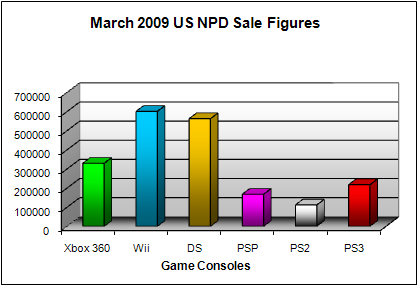
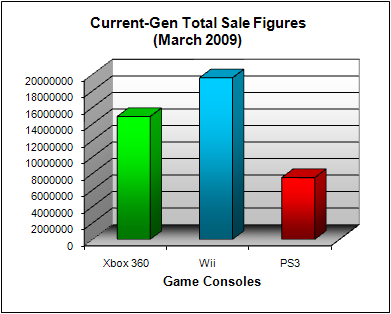
  • Wii: 601,000 (Total: 19.6 million; March 2008: 721,000 – down 17%)
  • DS: 563,000 (Total: 29.7 million; March 2008: 698,600 – down 19%)
  • Xbox 360: 331,000 (Total: 14.9 million; March 2008: 262,000 – up 26%)
  • PS3: 218,000 (Total: 7.5 million; March 2008: 257,000 – down 16%)
  • PSP: 168,000 (Total: 15 million; March 2008: 297,100 – down 43%)
  • PS2: 112,000 (Total: 43.8 million; March 2008: 216,000 – down 48%)
  • NPD March 2009 Game Console US Sales Figures
    NPD March 2009 Game Console US Sales Figures

    NPD Game Console Total US Sales Figures (as of March 2009)

    NPD Game Console Total US Sales Figures (as of March 2009)

    My prediction from last month was:

    My prediction for March 2009 would be that PS3 sales finally beat the 2008 equivalent, thanks largely to Killzone 2 and RE5 (March 2008 was also a very slow month). The ordering of the hardware sales would still remain the same though, as RE5 is no longer platform exclusive for the first time. It will be interesting on the software front, because you would imagine RE5 selling better on the 360, although perhaps only by the same margin as SFIV, and Killzone 2 should do better than the averagely rated (relatively speaking) Halo Wars. 

    Well I did get one thing right, which was that the order of the hardware numbers would remain the same. Unfortunately, every other piece of prediction was incorrect (although RE5 did sell better on the 360). My first prediction of the PS3 finally beating its 2008 numbers was sadly incorrect. In fact, none of the consoles did better than in 2008, except for the Xbox 360. All the red you see from the numbers above makes bad reading for the industry. Only Microsoft will be happy, but for how long? For the software predictions, I will take about them later.

    The PlayStation numbers look worse and worse. Not just the PS3, but also the PSP and PS2. It seems the PS brand is no longer capturing the imaginations of users, largely thanks to the innovative Wii, but I think the main issue is still price. Price is an issue highlighted very strongly this month. It is no wonder that the cheapest non-portable console, the Xbox 360, was the best selling and the only one to have year-on-year growth. Even in the portable arena, the cheaper Nintendo DS continues to soundly beat the more expensive and technically superior PSP – the PSP in particular seems to have peaked in sales and has allowed the Nintendo DS to completely dominate the portable market thanks to its broad spectrum marketing plans that target children of all ages and sexes, as opposed to the “typical” PlayStation user. The one bright spot, if you can call it that, is that out of all the drops, the PS3 dropped the least.

    The Nintendo consoles had an unexpected drop in sales as well, year-on-year. To be fair, nobody expected their surge in sales to last so long – the numbers will have to drop because they have nowhere else to go, not for so long anyway. It will be interesting to see next month if this was a blip (or if the whole month of March was a blip), or a new trend that’s emerging.

    Microsoft will be happy with the numbers again. 2009 has proved to be a good year so far, at least if the goal is to cement second place in the console wars. The Xbox 360 numbers are very encouraging thank to the year-on-year growth, and I think its status as the cheapest video game console on the market is finally paying dividends. Remember, this follows on from last month where it also had a sales surge (up 54% year-on-year – the biggest out of all consoles), and although it appears strange since nothing new has actually happened on pricing or bundling front, perhaps it’s just a case of the economy finally forcing people to buy the cheapest console, rather than the one that really want (Wii). I don’t think the people forced to do this will be entirely unhappy with their decision though, because value wise, the Xbox 360 is fantastic. And anyone that classify themselves more than just casual gamers will appreciate the range of games on the 360 as compared to the Wii.

    Software was a different situation, where March was actually quite a good month. Not as good as March 2008, but it had Super Smash Bros. Brawl that inflated the overall sales by selling 2.7 million – this month’s top selling game didn’t even break a million. But overall, it looks more positive than last month. As for my predictions from the last month, RE5 did sell better on the 360 over the PS3, but I was expecting SF IV type numbers (neck and neck between PS3 and 360), but it turned out to be more GTA IV (2-to-1 in favour of the 360). I was also wrong to say that Halo Wars would sell less well than Killzone 2, despite the former’s poorer rating. I guess franchaises sell, and Halo is bigger than Killzone. And it looks like the decision to release Killzone 2 in late February, as opposed to delaying the release date to the March reporting period, may have hurt Sony’s chances to grab more software market share. Killzone 2’s March sales was almost as well as February’s, but had they been combined, it would have taken it maybe to 3rd spot, just above Halo Wars (probably just short of it though). Instead, it’s 5th and 7th result, while still respectable compared to other PS3 titles in the past, looks pretty average when compared to the pretty average Halo Wars (scored only 82 on Metacritics, while Killzone 2 was  at a high 92). And while I casually mentioned the first GTA game on the DS last month, it didn’t even make the top 10, which perhaps shows that the DS does not have the same demographic as your typical GTA lover, further proven by the fact that a Pokemon game was number 2 on the chart. I wonder how well GTA would have done if it was a PSP exclusive?

    Microsoft’s recent resurgence sees them take top spot in sales, as well as being the most popular console in the top 10 with 36.5% of all sales in the top 10 belonging to the platform. Sony held on to second place with 3 titles in the top 10 (a record?), and 24.3% of the market share. Nintendo is the loser this month with 22.6%, down from the 50% average they’ve been achieving in the last 4 months. You do wonder how long before Wii Fit, Wii Play and Mario Kart are no longer automatic entries in the top 10. Here’s the complete list of the top 10 software sales:

    1. Resident Evil 5 (Xbox 360, Capcom) – 938,000
    2. Pokemon Platinum (DS, Nintendo) – 805,000
    3. Halo Wars (Xbox 360, Microsoft) – 639,000
    4. Resident Evil 5 (PS3, Capcom) – 585,000
    5. Wii Fit w/Board (Wii, Nintendo) – 541,000 
    6. MLB ’09: The Show (PS3, Sony) – 305,000  
    7. Killzone 2 (PS3, Sony) – 296,000
    8. Wii Play w/ Remote (Wii, Nintendo) – 281,000
    9. Mario Kart w/ Wheel (Wii, Nintendo) – 278,000
    10. MLB 2K9 (Xbox 360, Take-Two) – 205,000

    I have no idea what’s on sale next month. I could check, but I’m lazy. Suffice to say, I don’t expect the situation to change much, although hardware sales could improve. Can the PS3 outsell it’s 2008 self? I’m going to say yes again to that, even though I was wrong last month. This is because April 2008 was a bad month for the PS3, the first signs that it wasn’t going to beat the 360 in 2008 like the first few months had promised. Sony will hope April 2009 will be a better month.

    See you next month.

    Weekly News Roundup (19 April 2009)

    April 19th, 2009

    After last week’s WNR non starter, there’s definitely more news this week. And big news as well, as you will read later on. I posted something that looked very much like an advertorial for Amazon. But no, I was sadly not paid to write that piece, and while I do earn affiliate credits, you’ll find no such link in that particular blog post. What I posted is what I really feel, due to a recent incident involving a slightly damaged item, and I think it’s very hard these days to find a company that values the customer experience more so than the bottom line. 

    Copyright

    Let’s start with the copyright news. The big news of the week, and you will most likely have heard about it already, is of course Macrovision’s purchase of metadata firm Muze. Not the big story you were expecting huh? I guess I’m just a little hesitant to get to what is essential pretty bad news for everyone (we’ll come back to the Macrovision story later on).

    The Pirate Bay: found guilty, but not the end of the story

    The Pirate Bay: found guilty, but not the end of the story

    In mid-week, the news was that a verdict was due on Friday for the The Pirate Bay trial. Everyone eagerly awaited this news for the next few days, but when it hit, and although you can’t say it’s a huge surprise, it was still somewhat of a shock. The guys of The Pirate Bay were found guilty, each sentenced to a year in prison and fined $3.6 million. Was there ever a chance of another decision? But even so, the severity of the judgement meant that it was like a MPAA wet dream. But all is not lost. Cynthia, our forum’s Swedish expert, explains just what will happen next in the Swedish justice system:

    The first instance in the Swedish trial system is based on one Judge + 3 political elected “ordinary” people. The next step is to go to the higher court and that one is 3 judges + 2 political elected “ordinary people”. Most certainly this case will also end up in the highest court and in that one is at least 9 judges. 

    So the final verdict will take some years to come and during that time it looks as it will be business as usual from TPB.

    So this is by no means a final verdict. In fact, even has the TPB guys won, the decision would still have been appealed all the way to the highest court and it might be years before we finally know what the outcome could be. For now, TPB remains as it is, still offering thousands of torrents and a huge user base that is slowly moving towards anonymous file sharing, which will become impossible to track. So round one goes to the MPAA (or the Swedish equivalent/puppet organisation), but this one could still go either way.

    Going back to the Macrovision story. It appears they’ve purchase Muze, which collects and makes available meta data (or descriptive data) for media such as DVDs. What this means is that Macrovision could incorporate this into DVD players, and it would open up a new revenue stream for the company by putting in ads when you play DVDs that will recommend other movies based on what you’re watching. Privacy issues aside, this could become even more annoying than Macrovision analogue protection. 

    The MPAA’s use of hacking to retrieve information to sue the likes of TorrentSpy and TPB could come back to haunt them. Apparently, they used the services of a hacker to steal confidential information from these sites to use in their court case, and this illegal act could be used as a way to appeal the verdict, at least in the TorrentSpy’s case. Data theft is an even more serious problem than content theft on the Internet, and it just goes to show how low the MPAA may go to achieve their ultimate victory of stopping the well known torrent sites (of course, it won’t stop new torrent sites to be set up, many of which are already waiting in the wings in case the big ones fall).

    And in news that suggests DRM is still alive and well in the video arena, BBC’s UK HDTV broadcast will now employ DRM because this was the only way to allow Blu-ray recorders into the market. There will be tons of restrictions on what you can and cannot record, and how you can use the recorded content, which makes the whole thing all so useless to most users that they will probably go back to DVD recording (another victory for DRM over Blu-ray!). DRM is harmful not only to the sanity of the consumer, but it appears it is also harmful to entire industries. If Blu-ray recorders fail to sell because of these restrictions, then that will hurt the Blu-ray format, and also hurt the very same content owners that want to place these restrictions. Very short sighted thinking that will lead them to their doom if they do not change ways, like the music industry has had to do at the cost of wasting millions of dollars on useless DRM and lost of business.

    High Definition

    Onto high-def news, another form of DRM is region protection. DVD region protection proved to be the single most useless “feature” of the DVD format. And even the movie studios themselves eventually saw region control as fairly useless, as more and more movies are now released simultaneously around the world.

    Momitsu BDP-899: Region-free Blu-ray out of the box

    Momitsu BDP-899: Region-free Blu-ray out of the box

    So it was no surprise that region control went from mandatory to optional on the Blu-ray format, and completely removed from the HD DVD specs. Unfortunately, for some studios, “optional” was not in their vocabulary. And I’m mainly talking about Fox here. All Blu-ray movies from Warner (not including subsidiaries, some of which still employ region locking), Universal and Paramount are now region-free. Most Sony releases are region-free as well, with only certain new releases being locked. Disney is similar as well, except more of their titles are locked. The situation, you can say, has become even more confusing, because if you randomly buy some movies from the store, half of them might play overseas, while the other might not.

    The good news is that the first factory produced region-free Blu-ray player is soon to be available (not really though, because there had been players manufactured for certain countries that were region-free). Momitsu may not be a brand that everyone’s heard of, but it is a brand I’m familiar with as this was the brand of my first DVD upscaling player. Even then, they were pushing the boundaries by producing a DVD upscaler that could upscale over component and unprotected DVI output. It was also DVD region-free, of course. Their new region-free Blu-ray players seems to have all the features that you would want, plus of course the ability to play *any* Blu-ray movie you buy anywhere. For now at least, before the studios update their code perhaps to lock out Momitsu players. But hopefully, this will be a catalyst for more companies to start releasing region-free Blu-ray movies, which should be much less of a deal than region-free DVD players as it affects less movies.

    Gaming

    And finally, we get to Gaming news. The March NPD figures are out and it was a particularly bad month for the video gaming industry, at least in terms of hardware numbers. There were unexpected drops for almost all the game consoles, and perhaps it’s a sign that the economy is finally catching up with the gaming industry, which looked recession proof for the last 6 months. However, Microsoft’s Xbox 360 still managed to record a year-on-year growth, and as it is the cheapest console now available, perhaps that’s not too surprising. The full analysis will be coming early next week right here, of course. The PlayStation brand is still struggling, although it is doing well in Japan, but that’s what you get if you don’t give users a price cut. Sony will tout their superior attach rate for selected multi-platform hit titles, but overall attach rate still goes to the 360, and these “selected multi-platform hit titles” are still too rare to make any point. 

    And with this news, Microsoft have confidently proclaimed that they have won the console war. Well, second place anyway. I don’t know if this is perhaps a bit too early, but they’ve certainly made great strides compared to the last generation where the superior Xbox was beaten by the cheaper PS2 which was released earlier. Sounds familiar?

    Microsoft's RRoD and E74 errors gets more publicity, but the PS3's firmware bricking problem is serious and real

    Microsoft's RRoD and E74 errors gets more publicity, but the PS3's firmware bricking problem is serious and real

    But it’s not all good news for Microsoft (although you can argue it is good news for Xbox 360 owners), in that they have finally admitted that the other 360 hardware error, the E74 error, is part of the RRoD problem and will now be covered by the extended warranty. While you can’t argue with the fact that the 360 just isn’t a very well designed console, but at least Microsoft’s response to the problem, albeit a bit late on all fronts, is encouraging. Now if only Sony come clean on their firmware update “no disc drive” problem (and now, there are new problems involving fast spinning fans and then shutdown, to do with the latest 2.70 firmware)  that you will see thousands of posts on the official PS board with not a single official response. And the other fanboy comments that say “your stupid and you don’t no how to use your PS3” whenever someone posts a serious question about this problem is quite annoying. Yes, most of the posters of these problems are first time posters because like many people, myself included, I only signed up the PS3 board after I had a problem that I wanted to find out more information about. It’s not spamming, it’s not trolling, and the fanboy-ish reactions are really typical of the fever in which some people “support” their consoles. There are serious problems with the PS3 firmware update system, and you can go through the boards and see software engineers and other experts all chime in with their theory of why this is the case. Even for such a small blog such as this one, there’s already several people who have reported the same problem, so I think the problem could be affecting hundreds of thousands of machines. Sony needs to act now and stop charging people $150 to repair a problem that may not be their fault.

    So that’s my rant over for this week. Maybe I should rename this the Weekly News Rant. Ranting is good for the soul, good for your health. Or is that venting? Is venting and ranting the same? Am I ranting now? Or is that rambling? Why are there so many question marks in this paragraph?

    Why Amazon is great!

    April 17th, 2009

    A very simple premise for this blog post: Amazon is awesome.

    Now, no doubt many people will disagree, and Amazon is by no means without its problems, but if you buy lots of movies online like me, then buying from Amazon makes sense for several reasons.

    First of all, there is price. Let’s take buying Blu-ray movies, there are lots of online stores like DVD Empire or Barnes & Nobles that you can buy from, but in most situations, you’ll find Amazon has the best price. There are some specialist Blu-ray stores that will offer cheaper shipping, which in turn means a cheaper buy, but for the second reason below, you might still want to get it from Amazon even if it is slightly cheaper.

    The second reason is why I wanted to make this post. Let me explain what happened to me recently. Living in Australia, with the British Pound taking a beating in terms of exchange rates, I decided to buy some Blu-ray movies from Amazon UK. One movie was a gift for a friend. The price was good, but nothing to write home about, but I made my buy in any case. The goods arrived in super quick time, but upon opening the package, I found that the movie I bought as a gift was not shrinkwrapped. This would make it difficult, although not impossible, to give it away as a present.

    I contacted Amazon UK immediately, and got back an answer within hours. They were going to send out a replacement to me and I would no need to send back the original item as shipping was too expensive. Normally, they would do this straight away, but the guy handling the issue wanted to ask me first as this was a gift, and re-sending another copy might mean it would be too late – very thoughtful (the alternative was a refund). I said it was okay, since I did not have to give the gift until 2 weeks later, and my replacement was sent without an hour of my answer and arrived also in the same speedy manner as the original package.

    And this is why you should buy from Amazon, even if price is a bit higher – they have great policies in regards to exchanges and returns, and while I’m sure there are just as many horror stories about dealing with the customer service, it won’t be higher than other online stores. And if you get sent the wrong item, or a damaged one, then you too can be confident that your issue will be dealt with and a reasonable outcome will be sought. Unlike some stores where everything seems to be a fight.

    In the same period, I also had to deal with an Australian online store about an item I ordered but had not arrived for 3 weeks, even though normal shipping times were 2 or 3 days at most. Now I got the right resolution in the end, when they re-sent the item and I received it in within days. But I had to first, at their request, contact the post office, and make enquiries and other things before they would believe that the item was indeed lost, and not just held up somewhere. The post office request was met with deaf ears, since they normally only deal with senders, not receivers, and for that extra bit of customers service, the online store in question should have known this fact and sent out the replacement item straight away. But of course, not all stores can take the loss that a giant like Amazon can, so it’s understandable and since I got the resolution I wanted, it doesn’t matter too much (for a movie that I don’t have time to watch anyway).

    Anyway, the next time you shop online, I hope you take this into consideration, because it if has happened to me, then it might happen to you too.

    Weekly News Roundup (12 April 2009)

    April 12th, 2009

    Hello everyone. This weekend is the Easter weekend, so while not everyone celebrates this holiday, it was still a very slow news week. So slow that this week’s WNR will be much much shorter than usual, as we only have 4 stories to report on.

    I also didn’t have time to make a mid-week blog post, as I had some personal business this week (good news, mainly). Also, I’m working on something new for Digital Digest, which I think will be very interesting, if not entirely useful. All I can say is that it’s something to do with Blu-ray buying, and if you’re a cheapskate like me, you’ll appreciate it.

    But on with the news, or whatever there is available. The MPAA has hit back at a claim that 90% of consumers want RealDVD to exist. They claim, correctly, that the study was funded by Real Networks (sneaky buggers). But even if the funding came from Real, it does not suggest that the result isn’t correct, and I think if you asked most people, they won’t think RealDVD should be illegal and most will also think that being able to play DVDs without having to insert the disc all the time is a good thing.

    Apple’s iTunes is now 100% DRM free as Apple promised. But at the same time, they’ve introduced tiered pricing and all sorts of other things that may not be that consumer friendly. But no DRM is a good thing, and Apple should be applauded for making this move, even if it was a bit too late for my liking.

    But as one industry goes DRM free, another is still clinging on. Atari’s latest Riddick game is full of the latest anti-piracy features we’ve gotten familiar with over the least year:  online authentication; limited PC installs, and limited re-installs per PC (hardware based). The public response has been typical as well, the game is rated with only 1 star on Amazon.com, with most reviews attacking the DRM aspect. I don’t know if this game is a good game or not, but frankly, I won’t care and I won’t buy, not when there are so many other games to choose from. Why do publishers want to take attention away from their games with stupid DRM, although if the game really is bad, then perhaps taking attention away from it may be for the best after all.

    And finally (I told you it was a quiet week), Microsoft has a new anti-Apple commercial out and this one, ironically, uses Blu-ray to say why Windows is better than Mac OS. It is true though that you can play Blu-ray on Windows PCs with relative ease, but it is much harder (but not impossible) on Mac OS X. And because PCs are more easily upgraded, you can even turn your old computer into a Blu-ray player with a few minor purchases, which I did a couple of weeks ago to my old P4 system. And the irony of course comes from the fact that Microsoft supported HD DVD, while Apple sits on the board of the Blu-ray Disc Association.

    And that’s all the news I found (interesting) in the last week. Hopefully things will be back to normal next week. See you then.

    Weekly News Roundup (5 April 2009)

    April 5th, 2009

    Sorry for this somewhat late edition of the WNR. This daylight savings thing has me all confused, and despite the clocks going forward, I end up doing things later than before. The “2008 Game of the Year Poll” has been closed, and the results are in. My game of the decade, Fallout 3, did not win, but still came third which is pretty good for a game that doesn’t appeal to everyone’s tastes. Call of Duty: World at War won, followed by GTA IV – looks more like “best sellers of 2008”, rather than “best games of 2008” to me. Also, April Fools occurred during the week so chances are, some of the news you read below will have been made up. That in itself is not strange, because there’s made up news pretty much every week, but the only difference is that the made up stories this week have been done in the name of comedy, rather than about getting hits to your website.   

    Copyright

    Let’s get on with the copyright news because it’s already 8 pm, or 6pm, or something in between, I don’t know anymore thanks to the daylight savings (which has either ended or started, I don’t know either).

    Sweden has passed new Internet copyright laws and Internet traffic fell dramatically as a result. I’m surprised at the results to be honest, because this would suggest a huge majority of Swedish users are pirates, which goes against what I’ve read (and I think posted here) recently. However, there are already ways to ensure the authorities cannot track your usage, by using encryption, and so the more enterprising users are already downloading free games and movies without the eyes of the law prying into their activities. A new generation of smarter, faster, and more efficient pirates, is what this will breed. 

    X-Men Origins: Wolverine is already available to download, but who is to blame?

    X-Men Origins: Wolverine is already available to download illegally, but who is to blame?

    And then we had the big news of the new X-Men movie being leaked online a whole month before the official release date. I’m sure the Internet and Internet users will get all the blame, but really, how would they get access to an early unfinished print of the movie without some insider doing all the hard work? The Internet is responsible to distributing this movie in a timely and efficient fashion, as that’s what it is designed for, but it is the people who leak the movie that are the very people the MPAA should be going after, not the people who put them online or download them. Before the Internet, the leaked print would have been distributed on bootlegged VHS or DVD, or even in the original film containers – less widespread, but still damaging. Don’t blame the Internet for being good at what it is designed for, is all I’m saying.  

    And it’s not only the Internet that’s getting blamed, but also legitimate Internet companies, such as Yahoo and Google. News Corp’s Murdoch, a kingpin of traditional media, is blaming Yahoo and Google for being thieves when it comes to copyright. New media, such as Google’s YouTube, are bringing information and content to people in new ways which are harder to control compared to traditional media, and so it’s only natural for TV networks or movie studios to be afraid. There is maybe less money to be made, but then again, the audience has increased too. But the writing is on the wall for traditional media, and this includes perhaps newspapers, radio, as well as TV, and they will not be able to compete against the “what you want, when you want it” way that the Internet works. But what the Internet has is quantity and not necessarily quality, and this is perhaps an area that traditional media can expand into – to provide quality Internet content that you would want to pay for (or put up with ads). A high quality version of YouTube with the same quality guidelines and editing as your average TV network, as opposed to one that allows any idiot to post their Rickroll’s.  The same with newspapers, which needs to go back to offering quality that’s so good that people will want to subscribe and pay for it (along with the high quality services that you normally wouldn’t expect from a blog, for example). Still, it’s a challenge for the traditional media, and those unwiling or unable to change will be the losers. 

    High Definition

    Onto high-def news, it’s a somewhat quiet week. The only major news, and it was a bit of a shock, so much so that I still think it’s an April Fools joke, was that Netflix will increase Blu-ray rental prices by as much as $8 per month.

    NetFlix Blu-ray rental prices increased

    NetFlix Blu-ray rental prices increased

    Netflix has various subscription packages allowing you to have X number of discs rented at any one time. To upgrade one of these packages to include Blu-ray means you used to have to pay an extra $1 per month, regardless of what package you’ve chosen. But now, the extra Blu-ray surcharge is has been increased and it goes up depending on which package you’ve chosen. For their most expensive package, which allows 8 discs to be rented out at any time, you’ll need to pay an extra $8 to allow Blu-ray titles to be rented, which works out to be about an 16% increase to the monthly fee. That in itself is okay, except many of the Blu-ray discs you rent from Netflix will be so scratched, that they won’t be playable. Or you end up waiting months on end for a title to be sent out to you because so few of each title are available. Of course, the increase in fees will help in both regards, but other online rental firms aren’t charging more for Blu-ray, and I don’t think this will help Netflix (or Blu-ray).

    Which is all reason why I still think it’s an April Fools joke. But then again,  the Sony PlayStation price drop story also seemed like an April Fools, but it turned out to be sadly true, which brings us to …

    Gaming

    Gaming news – There was rumour going around early last week that Sony was going to make a global announcement in regards to the PS3. Of course, Sony denied that such an announcement was going to occur, but that’s expected and it did not rule out a PS3 announcement. And of course, if it is a major PS3 announcement, then it has to be about a price drop, right?

    Sony has dropped PS2 prices, but will this help it sell better against the Wii?

    Sony has dropped PS2 prices, but will this help it sell better against the Wii?

    But then Sony scheduled a press conference and more reliable sources said that, yes, it would be about the PlayStation game console. Everybody got excited, waited for the announcement, and yes, it was a price drop. It was just for the wrong PlayStation game console. That’s right, Sony has dropped PS2 prices to $99 (although many retailers were already selling at or below this price). The reasoning behind this was that it would make the PS2 competitive with the Wii. The past NPD monthly game console sales reports show that the PS2 is on its last legs, and down 60% compared to the same time last year. Will this price drop help it out?

    Maybe, but the real question is why would you want to help out the PS2 at this stage of its life cycle? Sony seems to think that the only reason the Wii is doing well is because it’s cheap. That’s not even remotely true. The Wii is now the second most expensive console on the market (the Xbox 360 Arcade is the cheapest), and it is on the only console not to have had a price drop or a hardware upgrade since release. People like the Wii because it’s fun and it has games that bring enjoyment to a wider range of people, not just hardcore gamers. The PS2 cannot offer this. Now Sony might introduce a Wii-mote like controller for the PS2, but if they can do this and not get sued by Nintendo, then why can’t they do it for the PS3, which already has a motion sensitive controller? And why bring attention to a dying platform, when you’ve got a new platform that could die if not given enough attention? The cost of dropping PS2 prices could have been used to give a small price drop to the PS3, in conjunction with offering a budget version of the PS3 with a smaller HDD or less non essential feature (no built-in wireless, for example). Or just bite the bullet and offer a big price drop to the PS3, take the temporary financial hit, but reap the rewards of better game sales in the future. But people, including myself, has said all this  before time and time again and all we get is a PS2 price drop.  

    Which is why I still think it’s an April Fools joke, and a cruel one at that.

    The only PS3 news was that firmware 2.7 being released. Sony is at least keeping its promise to add more and more features to the PS3 through software updates. This is a good idea, but it’s not unique since Nintendo and Microsoft, both to a lesser extent, have been doing the same through channel and dashboard updates. And it can’t last forever, because the hardware has limitations and if Microsoft releases the Xbox 720 with more powerful hardware, then Sony will have to abandon the PS3 and go make the PS4, because superior software can only do so much to catch up to  superior hardware.

    Super Smash Bros. Brawl on Wii, in 720p

    Super Smash Bros. Brawl on Wii, in 720p

    Nintendo could very well release an HD version of the Wii too, let not forget. But somebody has beaten them to it, although it may rest in a legal gray area. There is a Wii emulator out now that can run games at 720p, and it doesn’t use upscaling, rather, it renders the game using the emulator’s 3D engine at this higher resolution. And it works well and can make existing Wii games look very good indeed (videos). The Wii controller can already be used on the PC if you have a Bluetooth adapter, and so this could mean a potential way to play Wii games without even having a Wii game console. Although at the moment, you need a monster PC just to get average framerates. In any case, I’m not sure Nintendo will be too happy about this development, but it may show that people do want Wii in HD and maybe Nintendo can come up with something official on this front.

    Alright, that’s it for this week. It’s already either 11pm or 9pm or 10pm, so it’s late anyway. See you next week.


    About Digital Digest | Help | Privacy | Submissions | Sitemap

    © Copyright 1999-2012 Digital Digest. Duplication of links or content is strictly prohibited.