Archive for the ‘High Definition (Blu-ray/HD DVD/4K)’ Category

Weekly News Roundup (2 December 2012)

Sunday, December 2nd, 2012

Welcome to another WNR. Hope you’ve had an uneventful week. Not that uneventful here at Digital Digest HQ (which consists of a room, a desk and a computer with a creaking fan), as server troubles meant some downtime, and some data loss (which, thankfully, wasn’t extensive). An uneventful week sometimes is a good thing, and I think we take it for granted, and even complain too much about it, too often these days.

The data loss nearly meant that I had to re-write a news story, but because I post a copy of all news articles in our forum, some copy/paste got me out of trouble this time. Finding interesting news is hard enough these days, losing one you’ve finally managed to write is a royal pain. Anyway, let’s get started before the server decides it needs to make things eventful again.

Copyright

If you get rid of a website that had a lot of pirated movie downloads, then this potential major blow against online piracy should lead to increased box office revenue, right?
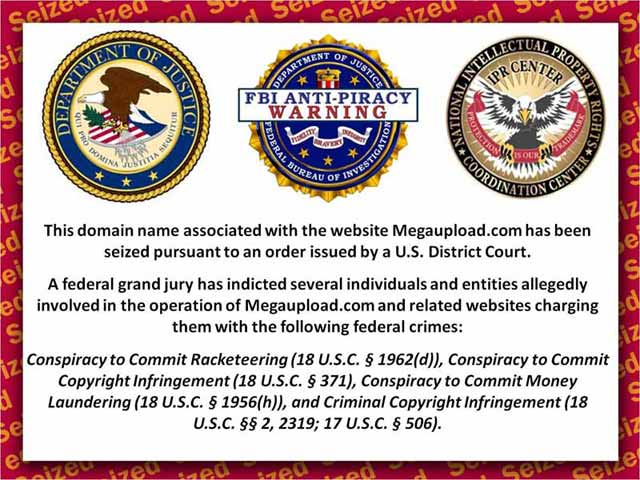
MegaUpload Seized

Did Megaupload’s seizure actually hurt the movie industry?

But what if piracy isn’t taking away money from the box office, but rather, it actually helps it? That is the surprising conclusion of a new research paper from the Munich School of Management and Copenhagen Business School, which found that after the closure of Megaupload, box office revenue actually shrank for certain movies as an indirect result. Using data for 1344 movies in 49 countries over a five-year period, the researchers specifically wanted to find out the financial gains for theatrical releases from the Megaupload closure, but instead, found that revenue shrank for all but the biggest movies.

The researchers attribute this “counter-intuitive finding” to the word-of-mouth and the discovery effect that piracy plays in today’s marketplace, with the findings confirming that small and medium budget movies do seem to benefit from this effect. Blockbusters, on the other hand, are already so well known that they don’t need or benefit from word-of-mouth (if anything, word-of-mouth can be detrimental for “bad” movies).

I find it hard to believe that the major Hollywood studios, via their own internal research, was not aware of this phenomenon. But hurting the smaller and independent studios, and at the same time helping out their own mega-blockbusters, isn’t exactly something you wouldn’t want, even if it had to be done under the guise of “anti-piracy”.

As expected, the MPAA have already replied by trying to debunk this study, and I’ll cover their response in full next week after I’ve gone through it in detail.

Before Hollywood lobbied the U.S. government to shut down Megaupload, it was busy trying to get the government to extradite the then 23 year-old Richard O’Dwyer, former admin of TV linking website TV Shack, to the U.S. to face criminal copyright charges. A very much one sided battle that involved Hollywood, the U.S. Department of Justice and even the Immigration and Customs wing of Homeland Security, against a uni student and his mother, was made a little bit less one sided when Internet heavyweight Jimmy Wales chimed in on the issue, launching an online appeal to try and stop the extradition.

The attention this move garnered seems to have worked wonders, as the U.S. government has agreed to take extradition off the table, in exchange for O’Dwyer agreeing to pay a small sum in compensation to rights holders. The details aren’t clear at the moment, but even though it will probably mean O’Dwyer admitting guilt, and paying that “small compensation”, it’s a far cry from the extradition, lengthy trial and possible prison sentence that the U.S. government (read the MPAA) originally wanted.

So you have to ask why this couldn’t have been the outcome from the get go. What was the U.S. government, and their movie studio allies, trying to prove by seeking extradition in the first place? To scare others into line  trying by making an example of O’Dwyer? Or perhaps they really did intend to prosecute (or is that persecute) to their full powers, but once again, the Internet and, well, public shaming, put an end to their plans.

Who knows. But at least Richard and his mother can finally breath a sigh of relieve.

——

Another week, another botched DRM, and this one hits pretty close to home for me as well. The makers of game making software GameMaker, a software package that has been widely pirated due to the high price of its full package (currently at $499), decided to add a new layer of DRM that replaces images in the game with pirate themed ones.

It’s not the worst DRM around, at least on paper – to annoy pirates but at the same time, being completely transparent to paying users. If there is such a thing as “good DRM”, this was probably it. It if worked as described. But DRM being DRM, and I think you’ve probably already guessed what happened next, legitimate customers started having their game sprites replaced too.

YoYo Games, the people behind GameMaker, was quick to release a patch, but time is money in game development, and any downtime, especially one that could have done permanent damage, is a costly one.

Sneak Peak

A very very sneaky peak screenshot of the upcoming iOS/Android game I’m making …

So why does this one hit close to home? It just happens that I’m actually currently making an Android/iOS game in GameMaker (having paid for the software, of course). And ironically, my game’s theme relates to pirates, piracy and the issue of copyright (there’s even a couple of anti-DRM messages in the game). Heh.

Luckily, I manage to skip the update that introduced this “bug”, and I also keep daily backups just to mitigate a potential disaster such as this one.

YoYo Game’s Mike Dailly did come forward and explain the rationale behind the DRM, which he acknowledges was never going to work to prevent piracy (only to “piss off” the pirates). While there’s probably room for funny DRM (I remember adventure games of old that killed off your character in hilarious fashion if the DRM check failed), but it will only remain funny if it can be guaranteed that only pirated users are affected. But that’s usually not possible. Or even if it’s possible, it never actually happens.

As for the game I’m making and when it will be available? Erm, “soon” is probably all that I can guarantee at the moment (and even then …).

High Definition

Another subscription VOD provider is about to join the marketplace, and while this isn’t really news per say, the fact that a few details about the new service being leaked online is. Redbox Instant by Verizon could cost a low $6 per month, if the leaked data (by accidentally making public help documents that was supposed to be part of a closed beta) is correct. For $8 per month, you not only get unlimited digital streaming, you also get 4 credits to use at any Redbox kiosk (credits that won’t roll over to the next month).

Redbox Instant by Verizon

Redbox Instant by Verizon will start competing with Netflix and Amazon in a couple of week’s time, by going down the same SVOD route, but bringing their network of kiosks into the equation too

While you may think that the market may not need another SVOD service, Redbox does bring something new to the table. While Netflix has disc rentals by mail, and Amazon has rental VOD along with free unlimited streaming, Redbox Instant brings its kiosk network into the equation. Redbox Instant will also have rental VODs for newer releases, thus offering three different ways to watch movies (and TV shows) via its services.

With the launch expected before the end of the year, current hardware partners lined up should see the Redbox Instant app available on iOS, Android, the Xbox 360 and selected Samsung mart TVs and Blu-ray players at launch. But without their own devices (à la Amazon), or the ubiquity of Netflix, Redbox Instant will definitely need more hardware partners, and more content, before it can be considered a real competitor to Amazon, let alone the behemoth that is Netflix.

While things are heating up in the US, here in Australia, it’s “not all roses”. Our only real subscription VOD provider is losing tons of money, because they can’t afford the content, and without content, very few people are signing up. Which is a shame, because the market is eager for something on the scale of Netflix here.

Alright folks, that’s it for this week. Have a good one!

Weekly News Roundup (25 November 2012)

Monday, November 26th, 2012

So despite saying that I’ve no interest in the Black Friday Blu-ray sales over at Amazon US and UK, some $400 later, I think I might have been wrong. I still maintain that the actual “lightning deals” put out by Amazon US this year has been fairly tame, with most of my buys coming via normal discounting. The Amazon UK sales were better, with some proper lightning discount (picked up the Prometheus to Alien evolution boxset, currently listed for $190 for pre-order on Amazon US, for only $43), and the Men In Black Trilogy. Plenty of stuff to tie me over well into the new year.

I didn’t just waste all of my time shopping for Blu-ray bargains. I actually did find some news this week!

Copyright

Should we really be surprised that the target of the latest anti-piracy police raid happens to be a 9-year-old Finnish girl? I don’t think so, because time and time again, anti-piracy agencies have shown that nothing is sacred in their pursuit of nasty, horrible web pirates.

Winnie the Pooh Laptop

The nerve center of a major piracy operation, according to the Finnish anti-piracy agency CIAPC

For the trouble of downloading a music album that did not work anyway, and for doing the right thing the very next day by buying the album in question, the reward is a police raid early in the morning, and the Winnie the Pooh laptop of the 9-year-old girl being confiscated for evidence. All because the father refused to pay a 600 euro “fine” and sign a non-disclosure agreement so the money grabbing remains a secret.

Normally, parents cannot be held liable for the actions of their children, but the shortcuts being taken by Finland’s copyright laws means that the Internet connection account holder, the father, would be liable for all authorized and unauthorized uses of the connection. Another shortcut? No need to prove anything, beyond a flimsy IP address, before police can search and seize (just what they expect to find on the laptop, a year after the fact, who knows). And that a legal copy of the album has already been purchased does not seem to matter, despite a loss of a sale being the most damaging thing a download can do (without considering the upload component, which may have been mere kBs in size, assuming the original download was even real or completed).

The worst part is that these anti-piracy agencies are so entrenched in their zealous believes (that what they’re doing is right and just), that they simply walk into controversies like this time and time again, with no shame at all.

The Department of Justice and the U.S. Immigration and Customs Enforcement’s (ICE) war on Internet piracy, through  “Operation In Our Sites”, has also been controversial to say the least. Not only has it not had any real effect on the web piracy problem, it did manage to seize domain names that is really shouldn’t have seized, mistakes that were magnified by the total lack of due process (which meant that the illegally taken domain names weren’t returned to its rightful owner until a full year after the seizure).

Unfortunately, there’s broad political support for this course of action, thanks to the liberal spraying of lobbying cash around in Congress and the Senate. But broad support does not equal unanimous support, and one congresswoman is trying to give website owners some extra protection against what she calls a new form of censorship (when domain seizures are accompanied by a total lack of due process). Rep. Zoe Lofgren (D-Calif.) is seeking help from reddit in writing a new bill to allow website owners advanced warning and the ability to mount a defence before any seizures occurs.

It’s exactly this kind of common sense bill that will no doubt be blocked by the usual suspects.

Derek Khanna

Derek Khanna, the RSC staffer thrown under the bus for having a sensible view on copyright

Across the isle, some Republicans haven’t been resting on their laurels either, although others may wish that they had. The Republican Study Committee (RSC), a caucus for conservative republicans, released an extremely sensible memo questioning the three major myths of copyright. One that copyright was created to help content creators monetize their works (actually, it was created for the greater public good, to encourage innovation and productivity), that copyright equals free-market capitalism (when it’s actually a government mandated entitlement system), and that the current copyright regime is working well to encourage productivity and innovation (when the reality is that copyright law is often used to smother innovation, and by legislating the protection of not only the right to earn revenue but the amount of revenue itself, this may lead to “rent-seeking” behaviour).

But just as the Internet woke up to probably the most sensible copyright statement made by any major party in who knows how long, the memo was unceremoniously pulled from the RSC website, and completely disavowed. Apparently, it had not been properly “reviewed” prior to publishing, and did not represent all opinions present within the RSC. Rumours of lobbyists (ie. the RIAA/MPAA) interfering persists, and really, would you be surprised?

Some have commented that this may be the Republican’s revenge for Hollywood’s pro Obama views, but while Hollywood stars, with the odd chair yelling exception, are all very much progressive-leaning, the industry itself has its money fairly evenly spread between the major parties, taking a leaf from the Wall Street playbook (or vice versa). But revenge or otherwise, what the memo represented was good, sound conservative principles, which in the light of day, doesn’t veer far away from the progressive view on the issue, even if the rationale may be very different. And this symbolizes exactly why US politics is so f***ed up at the moment, that both sides of politics can embrace the same point of view, and that it still can be easily dismissed because special interest has money invested.

High Definition

In Blu-ray news, Warner Archive Collection’s 2,000+ strong library of made to order titles will now start featuring Blu-ray titles, starting with just two this week. The collection features fairly rare and low demand titles that are made on demand, using recordable DVDs (and now Blu-ray discs) to fulfill each order. Discs are reasonably priced, usually under $20, with the two new Blu-ray movies (Gypsy and Deathtrap) being currently priced at $19.95.

To be honest, I had not been aware of Warner’s manufactured-on-demand store before, and it’s certainly an interesting take on the “video-on-demand” model. I do wonder whether the cost of producing new HD transfers for the Blu-ray films will be made back by sales, which I assume won’t be in huge numbers.

Gaming

With the Wii U release out of the way, time to shift the focus back on the Xbox 720 and the PS4. The latest Xbox 720 rumours still continue to re-iterate the same ones that have been making the rounds, including the obligatory Blu-ray drive, Kinect 2.0 and more CPU cores that you can shake a stick at.

Xbox World Jan 2013 Issue

The January 2013 issue of Xbox World has the latest Xbox 720 rumours, including a mock-up of what it could look like

The augmented reality glasses rumour isn’t new either, but they’ve been repeated again in this Xbox World magazine article, which is said to have been compiled by interviewing many “industry experts”. Somewhat new is the introduction of a toushscreen controller à la the Wii U controller, although with Microsoft actually having a tablet device of their own, perhaps integration is the wiser route to take.

Almost as quick as the Xbox 720 gets a Blu-ray drive, it’s set to lose it, and with it all support for optical media, when a “slim” version of the console is released 2 years into its life-cycle (which begins Christmas 2013, by the way). The “slim” will rely solely on streamed and downloaded games, the streaming perhaps coming from Microsoft’s own OnLive-like service, after the company had showed earlier interest in acquiring the gaming-on-demand service.

For CPU fans, the Xbox 720 may have a 4 hardware core CPU, each with 4 logical cores, for some serious 16-score gaming action.

Take what you read with a pinch, perhaps even a tbsp, of salt.

That’s it for the week. Time for me to take a rest and find a way to pay for the $400 worth of new Blu-rays that I really shouldn’t have bought. See you next week.

Weekly News Roundup (4 November 2012)

Sunday, November 4th, 2012

Welcome to November. Not much news this week, despite a very active search. You have to think that Hurricane Sandy might be partially responsible for the relative news lull, although with the US election coming up too (and Halloween), there’s only so much news cycle to go around. As usual, the best way to help Hurricane Sandy victims is to donate via the Red Cross, as they’re best placed to get goods and supplies to people that need it the most.

So without a lot of news, I’ll be talking out of my you-know-what about a wider range of topics that are of interest, but not necessarily stuff that’s usually talked about here (or stuff that wasn’t important enough to get its own news article, but still nevertheless interesting). Since I’e already mentioned the US election, I might as well post my electoral vote prediction. I’m a huge election nerd, although I don’t think I’ve paid as much attention to this presidential election as the last one, it’s still “fun” to make a few predictions or two. I don’t think Romney has much of a chance to be elected president, and I don’t think this election is as close as the media wants us to believe (a close election = better ratings, no doubt). Based on the polls and analysis I’ve read, I think only Florida, Colorado and Virginia are really up for play, and even winning all three won’t really help Romney without Ohio, which I think is just out of reach.

Anyway, we’ll find out one way or another on Tuesday, which is also Melbourne Cup day here. I might just put money where my mouth is on Tuesday with a flutter on horses and the election in which one of the candidate’s wife owns a horse.

Oh yes, the news. Here we go …

Copyright

When Megaupload was shuttered by the US government back in January, the entire file hosting industry went crazy overnight it seems trying to position themselves away from being the next target of legal action. Those at RapidShare must have been quietly please at the prescient decisions they had already taken to move away from the, often unfair, association of the services they provide to web piracy. But even RapidShare, having been removed from the MPAA/RIAA’s “bad websites” list a year earlier, was taken aback at scale of the Megaupload seizure and reacted, and possibly overreacted, by throttling free downloads to a snail paced 30 kB/s.

Rapidshare logo

RapidShare removes download speed throttling for its free download service, originally put in after Megaupload’s seizure to repel pirates from using RapidShare as a replacement

It was only until this week that RapidShare felt safe enough to remove this throttling, but only because they have “more efficient” measures on the way, to be announced towards the end of 2012. I guess there just had to be a more efficient way of repelling pirates than to mangle their own services, even for those that were using the site legally.

In my mind, the whole industry is still in “freaked out” mode over the Megaupload thing, forgetting that the law is actually on their side as long as they properly enforce the DMCA, and do not reward users for uploading popular (aka pirated) files. RapidShare, perhaps because they were always one of the larger targets, I think have gone overboard with their anti-piracy initiatives. I don’t think they’ll ever convince rights holders that they warrant the right to exist, so doing what’s required is, well, all that’s required.

The only person not freaking out appears to be the person most affected, Kim Dotcom. He has promised that the next Mega-project, Megabox, will be launched in January, almost exactly a year after Megaupload’s seizure. This too may be an overreaction to the seizure, trying to get back into a game which may already be lost, but at least it’s not a cowardly reaction.

Speaking of overreactions, the UK’s Telegraph has a blog in which the blogger, James Rhodes, described his experience attending Sony’s Skyfall (trailer) premier in London, and how he felt more like a suspected terrorist than an invited guest, thanks to the anti-piracy measures being deployed.

It’s no longer a surprise to see cinema stewards spying on you during a session with night vision goggles, but when Rhodes was warned via leaflet, and email, that “physical searches of your belongings and person” was going to happen at the premier, he must have wondered if he was actually going to a premier, or to a high security facility (like MI6 HQ perhaps)? And what dangerous things were the security guards looking for? Digital cameras and smartphones, most likely, or any other recording devices (I wonder if legal weapons such as knives were actually allowed to be carried inside, which would be kind of ironic).

To me, all of this paranoia shows us just how insecure movie studios are these days. But not about piracy – it has always been around – but about the quality of their films. They do produce a lot of crap these days (and at a much higher cost than ever before, thanks to lazy and liberal use of CGI), and so I guess it’s only natural that their first reaction to their own films is that people aren’t going to pay for them if they don’t have to. But the truth is that good films, like Skyfall according to reviews, don’t have a lot to fear from pirates at all, especially not during theatrical release. Going to a cinema and watching a movie on the big screen has no real illegal alternatives, and if people are not going, it’s more to do with their perception of the fees being not worth it due to the poor quality of the film, the presentation, or just the high cost of it all. Studios have taken filmgoers for granted for too long, and when market forces and competition (yes, piracy is a competitor, if not for the theatrical run, then for the home video release at least) calls on them to up their game and produce better (even if it means fewer) products, they have been far too arrogant in their assumption that all their misfortune is completely down to “thieves”.

Every industry has to adjust to changing consumer demands. Why should be the film industry be any different?

High Definition

A major change is happening with the home video market, but for the most part, studios have embraced it, if not 100% enthusiastically. Everyone thought that the logical successor to DVDs would be Blu-ray, but I think the actual successor is streaming video – from the sales figures, in which every percentage in decline in DVD is matched by an increase in streaming (with Blu-ray doing its own thing, mostly), it seems this is very much the case.

Amazon Prime Instant Video - New Additions

Amazon Prime is gaining market share at the expense of Netflix, but it’s still a long way off from being truly competitive

As a keen subscriber of Amazon’s Prime Instant Streaming service, I’ve personally seen the service grow from a handful of good shows and movies to a service that, as long as it continues to grow, may one day challenge the behemoth that is Netflix. There’s still not enough TV shows and new release content, but it’s getting there, and thanks to the Kindle Fire, Amazon has its own hardware platform to promote the service as well (a strategy that has worked so well, that both Google and Apple have both decided to play catch-up).

And a new survey seems to confirm that Amazon Instant is fast becoming a player in the lucrative subscription VOD market, with 22% of those surveyed now a member, up 5 points from seven month ago. That’s still nowhere near Netflix’s dominant position of 82%, but Netflix’s share has shrank 9% during the same period, which might be a cause for concern for the company.

For transactional VOD, Apple’s iTunes is still the most popular platform, with 16% of those surveyed having purchased content. This only represents a single percentage point growth, so there’s definitely more potential in SVOD (I still think Apple will have a say in this, at some point).

For devices used to consume content, for the first time, the iPad overtakes connected Blu-ray players as the most popular platform (32% vs 31%, changed from 25% vs 33% back in February). No doubt Amazon’s decision to release an iOS app for their streaming service might have played a factor here, as few Blu-ray players actually support Amazon Prime. Amazon has so far revealed no plans to have an Android version of their streaming app, most likely in an effort to prevent the cannibalization of Kindle Fire sales, even though this would greatly help with the adoption of the streaming service – this is where it still fails to properly compete with Netflix, which is available everywhere. Still, the Kindle Fire platform has proven a success for Amazon, if for no other reason than the fact that both Google and Apple have copied Amazon’s play with their own 7″-ish, video friendly tablets.

Disney Star Wars

Star Wars joins the Disney family … hope the new films are better than the prequels

So I’m betting you’ve heard about the almost too strange to be true story of the sale of Lucasfilms to Disney, and the release of more Star Wars movies starting in 2015. Reaction to the announcement has been all over the place, as the thoughts of Disney getting their hands on Star Wars left a bad taste in people’s mouths. I’m actually quite positive about the whole thing, because I think George Lucas has taken the Star Wars franchise as far as he can (and it was good to read that Lucas plans to donate all of the $4b earned from the sale to a foundation focused on education).

Everyone and their Kowakian monkey-lizard seems to wanting Joss Whedon to write and direct the next Star Wars, the director having directed Disney’s hottest and most recent success, The Avengers (which I finally watched this week, after catching up on all the other related movies – it was a pretty solid film). I’m a big fan of Whedon, and I think he would do a great job on Star Wars (and if offered the chance, I don’t see how any self-respecting geek could turn down the opportunity). With my luck, it will be Michael Bay! Although I did have a dream once where the New Republic’s latest and greatest battlecruisers go into battle with the Imperial remnants, in what seem to be a very one sided battle against their ageing  Star Destroyers. But the seemingly normal Star Destroyers suddenly transform into something much more dangerous, showing exactly what the Imperials have been up to since the Battle of Endor. Return of the Empire!

(Makes “call me” gesture in the general direction of Bob Iger)

That’s it for the week. Have a nice one.

Weekly News Roundup (28 October 2012)

Sunday, October 28th, 2012

So Windows 8 has been released. Having used the OS for a whole of zero minutes, I can offer my expert opinion that it is indeed a new version of Windows that offers some differences to the previous version, but also that some things remains the same. There are apparently quite a few good things in it, as well as some bad, and that if you really want it, you can get it by paying money for it. So that’s my 15 second review, hope it was very helpful!

If that wasn’t so helpful, then perhaps I can be a little bit more helpful with what you’re actually here for – the weekly news review. Let’s get started.

Copyright

The Finnish arm of Netflix managed to get itself into a little bit of a copyright trouble this week as subscribers found that the subtitles used for one particular TV series came from a fan-subtitle site. Netflix might have used pirated subtitles for the sci-fi TV series, Andromeda.

Netflix

Netflix Finland makes a boo boo by using pirated subtitles

Nobody knows how Netflix, who pays a lot of money to license official subtitles, ended up using subtitles created by DivX Finland (and you knew it was their sub because the subtitles displayed their website’s URL as part of the credits). Netflix have promised to launch an official investigation, and have temporarily removed the entire series from their system, but the folks at DivX Finland (probably no stranger to copyright issues) found the situation extremely ironic no doubt.

Copyright law I believe treats translations (and transcriptions) as derivative work, and that would still require the owner’s permission for distribution. The translation itself, as it does involve creativity, is also protected by copyright, copyright that Netflix infringed when it used DivX Finland’s subs without permission.

I have an extra interest in subtitle and subtitle download sites because I believe that my website was one of the first, if not *the* first website to host the download of DivX subtitles files (this would be June 2000, when DivX Digest was launched and user submitted/ripped subtitles were made available for download for a few dozen different TV shows and movies). The section only lasted about 3 month and at its peak, it contained about 500 different subtitle files – I discontinued the service due to potential copyright issues, and as I was doing all the updates manually at that time, it was also becoming too much work. Better organized websites had started to appear at that time as well, so I let them do their thing.

iPhone 5 and iPad Mini

By the quirks of the copyright law, jailbreaking an iPhone is okay, but jailbreaking a tablet is a no no

Some might argue that fan made subtitles should be considered fair use, especially if it’s the kind of thing that improve accessibility. It’s a shame nobody put the case forward to the US Copyright Office for their once-every-3-years copyright review, but given the results of the latest review, it was unlikely they would have been accommodating. The latest review sees the jailbreaking of smartphones continue to be exempted from copyright laws, but the arbitrary nature of these exemptions meant that “tablets”, despite sharing the same operating system as smartphones in most cases, are not part of the exemption.

The reasoning the Library of Congress gives for this oversight is that they found the definition of “tablet” too broad, as it could encompass things like laptop computers (more of a problem now that Windows 8 is out) or even e-book readers. For e-books though, DRM ripping remains legal, and now even in the case where DRM-free versions of the same books are already available.

But movie lovers mostly miss out. While DVD (and Blu-ray) ripping received a few more exemptions in the cases of educational use, non commercial use, and criticism and analysis, ripping for “space-shifting” (for example, to convert a DVD to a format playable on an iPad) remains illegal. This is despite the fact that everyone does it with little or no harm to anyone concerned, a fact made clear by Public Knowledge, one of the consumer rights groups that argued for an exemption for ripping.

The EFF also petitioned for video game console hacking to be exempted, but their appeal also failed to convince the US Copyright Office. In another blow, unlocking of phones purchased after January 2013 will also no longer be exempted.

In my opinion, these complicated and often arbitrary exemptions can be made a lot simpler if one simply followed the rule that any act that has no serious commercial implications (eg. DVD ripping for home use) should be considered fair use, as is everything in which the social benefits outweigh any commercial concerns. And all fair use should be legal, with specific exemptions being made for really popular acts in order not to criminalize a huge percentage of the population. How hard is that?

High Definition

With Mozilla all but signalling defeat in the battle to keep H.264 out of the HTML 5 specs back in March, the inevitable  is happening as Mozilla announced that the desktop version of Firefox will be getting OS-level native H.264 support soon. The mobile version of Firefox has already made this move, but with Flash still being a viable option on desktops, there was less urgency in adding in “native” H.264 support.

Mozilla’s beef with H.264 is that it doesn’t fit in with the open-source, royalty free nature of Firefox. But H.264 has become an industry standard as you’ll be hard pressed to find a modern device that doesn’t support H.264 these days (just as you would be hard pressed to find one that supports Mozilla’s favoured alternative, WebM).

Having OS based native support ultimately means that Flash won’t be needed. So in the end, it was really the choice between two evils. Flash and H.264, with H.264 winning in the end – not the worst result, if you ask me.

And I suppose I should talk about the iPad mini, at least from the point of view of HD video. There’s no doubt that 7-8″ tablets are the perfect consumption platform for video, which is why Amazon has the Kindle Fire, and why Google has the Nexus 7. I keep on getting the feeling that Apple will soon drop a bombshell that will completely shakes up the digital video rental and subscription streaming markets.

Gaming

Ubisoft has been making a concerted effort to distance the company from their past anti-piracy controversies, at least that’s what they said a couple of weeks ago. So you would expect the company to be extra careful to avoid any more anti-piracy related mishaps, at least for a short while. Well, the calm lasted about 6 weeks, as this week, Ubisoft enraged paying customers yet again by forgetting to include the CD key in retailed boxed PC versions of their new game, Rocksmith.

It took about a week for Ubisoft to respond, and even then, some customers were still left without a playable game for an extended period of time after going through the process. For those affected, they would need to provide proof of purchase to Ubisoft via their tech support website, which can be problematic for some if they’ve already discarded their receipt before realising Ubisoft’s mistake. Ubisoft has promised to compensate affected users with a free DLC (worth a whole $2.99), but it might very well be a case of too little too late for a company that couldn’t afford any more anti-piracy related scandals.

Sony PS3 Hacked

The “LV0” master keys leaked for the PS3 may prove the most costly to Sony yet, and make all future attempts to secure the console a very difficult proposition

Another gaming company that’s been trying to distance themselves from past issues is Sony, and their attempt to dig their way out from the various hacking scandals. But Sony does not appear to have any more luck than Ubisoft, with the news this week that a new set of master keys have been leaked for the PS3, keys that may make all future attempts to secure the console futile.

The new leaked keys, dubbed the “LV0” keys, could potentially prevent Sony from being able to secure the console again via a new firmware patch, which has been the go to solutions since the initial hack of the console, and when Sony managed to at least partially re-secure the console via the 3.56 firmware release.

While it’s disingenuous to blame these hacking attempts on Sony’s decision to pull support for Other OS, a popular PS3 feature (for the hacking community) that allowed Linux to run on the console – it’s very likely that the PS3 would still have been hacked due to the poor programming choices made by the security programmers – but it seems Sony’s decision to turn their backs on the hacking and modding community, having earlier promoted the console’s versatility and specifically the Other OS feature, does seem to have cost them. It certainly engergised the hacking community, and what we’re seeing now is the result.

Alrighty then, that’s it for the week. Back in seven with more news you can miss and it still won’t make a difference to anything in your life at all!

Weekly News Roundup (21 October 2012)

Sunday, October 21st, 2012

Welcome again. Hard to believe 2012 is almost at an end. If the world is really going to end soon, then it does seem very quiet considering what is about to happen. The calm before the solar-flare-induced-mega-storms perhaps. While we wait for the obligatory twenty-storey high mega-tsunamis to arrive, the rise of Blu-ray continues unabated (I know, shit segue). The release of The Avengers on Blu-ray for the last week of September has allowed Blu-ray to post a record set of market share figures. For that particular week, 44% of all discs sold in the United States were Blu-rays, with The Avengers movie itself getting a Blu-ray sales share of 71.65%, selling more than 2 copies on Blu-ray or Blu-ray combo for every DVD version sold. There are still a couple of big releases coming, and with the holidays tending to favour Blu-ray over DVD if recent trends hold, the magical 50% mark may very well be broken in 2012. As long as the world doesn’t end before then.

An okay-ish news week, not too much, but a few interesting ones to waddle through. Let’s get started.

Copyright

I’m a huge Star Trek fan, and one of the most remarkable things about the series, from the Original Series, to the barely bearable Enterprise, is how it manages titillate us with visions of how we can all benefit from future technologies (some of which have even become reality, for example the earlier communicators and flip phones, or more recently, the Padd and iPad). Having grown up with The Next Generation, the technology that excited me the most (other than the Holodeck, which was an offshoot of the same technology) was the replicator. To be able to create matter from energy, and thus be able to create anything you want at the touch of a button, is to me, the holy grail of science and a technology that will change the way everything works.

The Pirate Bay 3D Ship Model

3D printing could solve world hunger and make a medical breakthrough one day, but DRM is casting its shadow on yet another promising technology

So the emergence of 3D printing, for me, is an exciting one. While the current generation of 3D printers are severely limited in scope in relation to what they can and cannot create (remember back to the first ever 2D printer, and how limited they were compared to printers of today), it feels like the start of something new and brilliant. And when The Pirate Bay launched their “physibles” section, to allow schematics to be shared, downloaded and printed, with their altruistic, perhaps right now unrealistic aim of being able “print food for hungry people”, it seems that we might be heading towards something really exciting.

And then reality sets in.

This week, a company headed by a former Microsoft CTO has been granted a patent that will add DRM to physibles, to prevent the unauthorised printing of everything from plastic toys, to edible foods, even to human skin. The terribly exciting future has just been shacked to the horribly restrictive past.

Just imagine, Captain Picard ordering a cup of Tea, Earl Grey, Hot, and instead of a cup of delicious tea appearing, the English tea drinking Frenchman is instead asked to key in the serial number for both the tea and the cup it comes in, before waiting for the ship’s computer to receive, via subspace, the authorisation unlock code that would permit good old Jean-Luc to be able to finally enjoy his cup of tea. Of course, the created objects would just have to be programmed, within its molecules, to self-destruct or to do something even more horrible if Picard does not return the items promptly back to the replicator for disassembling after enjoyment, as this is a condition that’s been written down in the 60 page license agreement that Picard had to agree to before being allowed to even order the drink.

Even the Ferengi aren’t that avaricious, I suspect.

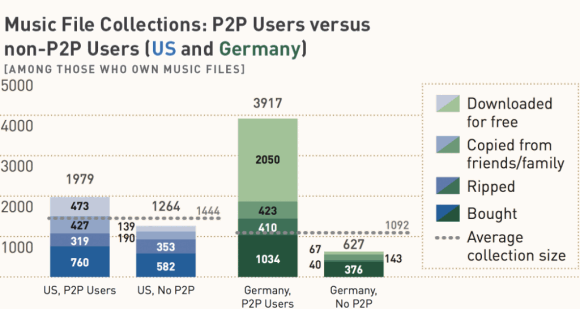
American Assembly - Copy Culture Survey - Music File Collections: P2P Users vs non-P2P Users (US And Germany) Source: American Assembly

People who pirate a lot of music, have more music and buy more music. Not rocket science, but still doesn’t seem to be well understood within the music industry.

To the credit of the music industry, they moved on from DRM pretty quickly, if not quietly. Although it’s probably something they still regret to this day. What they haven’t moved away from is their desire to punish their enemies: the music downloaders that they call “thieves”. But a new comprehensive study has found that, perhaps to the surprise of only the music industry themselves, people who pirate a lot of music are also the music industry’s best customers.

There seems to be this idea that there are two mutually exclusive groups of people, downloaders and buyers, when in reality, people who buy also download. And if you think about it, it isn’t all that surprising that people who download a lot of music actually love music, probably more so than people who don’t download as much. And music lovers buy more music.

And this is where I think the industry’s anti-piracy strategy fails, because by trying to kick pirates off the net, they may end up keeping their best customers from being able to continue buying. The correct strategy, in my opinion, starts with identifying the reasons why people that buy a lot of music also chooses to download some of them at the same time. It will be a complicated answer, but I don’t think it’s in anyone’s interest to simply labels these people as “thieves”.

Do they only buy content that they’re sure is “good”, and use piracy as a way to discover new content (might this explain why for music, Spotify is doubly good in allowing people to use it instead of piracy to discover music, and at the same time monetize the free streaming)? Did they simply run out of money and did not want to stop experiencing new music? Is it an issue of availability, ease of use? The answers to these question should then determine what the anti-piracy strategy should be.

The study also revealed that music downloading is actually a much smaller problem than traditional piracy methods, including sharing with friends/family and good old CD ripping. This corresponds with the RIAA’s own research on the matter and it kind of makes a mockery of the claim that the music industry’s sufferings started with the emergence of the Internet. You do have to wonder if there’s another agenda in play for putting so much focus on the web piracy, rather than just a major case of scapegoating. Perhaps by exaggerating the Internet piracy problem, the industry can get policymakers to step in and help protect their dying business model. And perhaps the right lobbying will also give the industry more control over content distribution on the Internet to ensure a bigger than warranted slice of any eventual pie.

And in the eagerness of help, policymakers ended up creating copyright laws that either don’t reflect real world situations, or are so heavily biased, cause everyone to become hysterical about the whole thing. ISPs and web hosts have been the front lines of this war, unfairly so in many cases (ISPs are no different to telephone companies, and web hosts are akin to landlords that rent store-fronts to businesses – neither of them should be made liable for what their customers/tenants get up to, especially when they cannot be aware of what’s going on without taking extraordinary measures, such as spying on their customer/tenants). And their fear of getting sued has allowed some ridiculous situations to develop.

Just this week, web host ServerBeach deactivated an account hosting 1.45 million educational blogs because of a single DMCA notice for a single page on just one of these blogs. This particular example may point more to a communications breakdown between web host and client, as opposed to being simply a case of copyright hysteria, but ServerBeach’s written DMCA policy still seems to be a case of deactivate first, ask questions later. ISPs and web hosts need to know their “safe harbor” rights, and should be willing to defends these rights even as rights holders try to water it down to suit their own agendas.

The Pirate Bay Cloud Hosting

The Pirate Bay moves to the cloud to create a more resilient, more raid-proof version of the website. Source methodshop.com @ Flickr, Creative Commons

And if web hosts can get into a tizz about a single link on a single page on one of 1.45 million blogs, then you do wonder sometimes how the hell The Pirate Bay manages to find web hosts willing to host their stuff. But the TPB folks seems to be well aware that this is either already a problem or will be in the near future, and so they’ve turned to the mythical cloud for their solution. Moving The Pirate Bay’s website to the cloud does seem like the most sensible thing to do for the website that’s often the target of law enforcement, and also victims of their own success (being so popular and all, the logistics of keeping the website online, on a budget, cannot be easy).

By using virtual machine instances on cloud providers in different countries, and with everything to and from the cloud encrypted (un-snoopable, and with the cloud provider probably not even aware of what is actually being hosted), a new layer of resilience, privacy and security has been added, and all apparently for a lower cost than before. If one cloud provider goes down, another can be sourced easily and a new instance can be made up and running in short order. Replicate this that a couple of times more, and trying to kill TPB would then be as difficult as slaying the mythical Hydra – cut off one head, and two more will take its place.

All the unwanted attention that TPB has be getting, with authorities trying to trap the elusive website with ever more elaborate mousetraps, seems to have only produced one thing: a better mouse!

And now for the best part of the WNR – the end of it! See you next week.