Archive for the ‘Xbox 360, Xbox One’ Category

2009 Game of the Year – Vote Now!

Friday, December 18th, 2009

Which game, console or PC based, do you think was the best game of 2009? There has been a lot of good games this year, and many deserve the title of “Game of the Year”, but there can only be one winner. I’ve tried to include all the likely candidates, but if I’ve missed any, please let me know through the comments.

You can vote for your game of the year here!

Weekly News Roundup (13 December 2009)

Sunday, December 13th, 2009

I’ve just finished compiling the November 2009 NPD US video game sales analysis. November is the second busiest month of the year, and competition between the three home based consoles has really hated up in the last couple of month, with the previously poorly performing PS3 challenging not only the Xbox 360 but also the Wii’s sales position, thanks largely to price cuts and the introduction of the PS3 Slim. But as you’ll read in the analysis, November was really only about one game, and that’s the controversial Call of Duty: Modern Warfare 2. I’ve played the controversial level in question, and I wouldn’t exactly call it disturbing. It’s about as disturbing as shooting computer generated characters can get, and you do plenty of that during the rest of the game anyway (even if they’re all supposed to be bad guys, whereas the people you shoot in the airport level are “good guys”). And there is the option to skip the level if one wishes anyway. If one wants disturbing, try playing Fallout 3 as a player with evil karma, and relying on cannibalism to survive from one day to another.

Copyright

Let’s start with copyright news. The second of the high profile RIAA versus civilians trial has just had its verdict finalized. Student Joel Tenenbaum now officially owes the recording industry $675,000 for 30 song downloads. The RIAA will be happy with how the trial went, although the negative publicity is something they probably wanted to avoid.

While feeling confident over the outcome, the RIAA ridiculously asked to censor Joel Tenenbaum’s speech, to prevent him from ever whispering the words “file sharing”, but the judge thought that this was a bit over the top, as there is this little thing called the US constitution that sort of frowns upon speech being blocked and proves that nothing is sacred when it comes to pursuing or protecting profits.

The Canadian Record Industry Association has been sued for copyright infringement

The Canadian Record Industry Association has been sued for copyright infringement

Nothing is indeed sacred, not even obeying the very principles that the recording studios are basing their fight on. Copyright, it seems, is only important if someone else breaks it. When studios have been doing it for nearly 30 years, then it’s no biggie. A class action lawsuit has been launched in Canada to sue the Canadian version of the RIAA for massive copyright infringement, with damages of up to $6 billion. Apparently, Canadian copyright laws allows copyright payment to occur after copyrighted works have been used, as long as they add the work to an updated list, and the studios have been exploiting this with back payment dating back to the 1980’s.  And the list is now 300,000, that’s 300,000 copyright works that the studios have made profits that they have yet to provide payment for, and that’s apparently fine as long as they promise to do so at some unspecified time in the future. Sounds like a good excuse that downloaders of pirated materials can use: “honestly, I was going to pay for it at some unspecified time in the future”.

A couple of weeks ago, a woman was arrested for recording a whole three minutes of the new Twilight movie. And she hadn’t even intended to record the movie for piracy, she simply recorded a small part of it while filming her sister’s birthday party, which took place at the cinema. But regardless, she was charged with a felony and faced three years in prison, I guess one for each minute of the film she recorded or something. New laws were introduced at the lobbying of the MPAA to punish cinema cam recording pirates, and as with most new copyright laws, intent is no longer important as it is much too difficult to prove, and the MPAA wants to put in as many shortcuts as possible when it comes to prosecuting pirates. In this instance, there was obvious no intent in pirating “New Moon”, and yet there was an arrest and charge, and it’s exactly what happens when shortcuts exists.  It was only until last week, and after public pressure and even support for the accused from the director of the new Twilight film, that the charges were finally dropped. The MPAA apparently didn’t want to go through with the trial. I guess no harm done, except for one ruined birthday party, a traumatized woman and apparently the lost recording of the party, as the recording has been confiscated (can’t let those three minutes get leaked out or anything). In unrelated news, US and Canadian cinema box office receipts show 2009 to be the most profitable year ever, finally breaking the $10 billion dollar mark and a whole billion dollar more than 2008. This online piracy thing seems to be really hurting the movie studios.

And yes, one can argue that while cinema income is up (I would guess that has a lot to do with the quality of releases this year, versus the strike affected 2008, plus the popularity of the cinema only 3D experience), disc sale income may be down because online piracy affects it the most. DVD revenue is down compared to last year, that’s for sure, but actual disc volume may not be down much in a recession year, it’s the drop in retail pricing that has affected DVD revenue more than piracy ever will. And with Blu-ray added in, total revenue is not as down that much at all. And that’s before you even take into account digital delivery. Put it this way, the increase in online piracy, and it has increased, has been much more dramatic than any decreases in either cinema or home video sales. And as I’ve just done the video game sales analysis, home console game sales have dropped compared to 2008 as well, but piracy for the Xbox 360, Wii and PS3 have always been quite low, certainly compared to DS and PC gaming. So it’s really questionable what percentage of the DVD revenue decreases can be blamed on piracy.

Speaking of video game piracy, EA’s CEO says that pirates are customers too, and they shouldn’t be ignored or attacked. Speaking about the increasing popularity of Downloadable Content (DLC), EA’s boss thinks that while pirates may be pirating the retail boxed versions, they are still paying for DLCs, mainly because it’s often inconvenient to download these illegally, especially if the games and DLCs are multiplayer oriented. If true, then I think all this proves is that people are willing to pay, just not as much as game publishers have been wanting for the boxed retail version. If full games were priced at the same price point as your typical DLC, would anyone actually bother to pirate them? And if PC piracy rates are as high as some claim, then we could be talking about hundreds of percentage point increases in sales, which would more than make up for the 50 to 80% drop in revenue per game. A bit simplistic perhaps, but the principle is sound I think (ie. cheap stuff sells more).

High Definition

Moving on to HD news. More details have been revealed about the implementation of Managed Copy by Scenic Labs, which produced the first three Blu-ray discs to feature Managed Copy. For fans of MC, it doesn’t look great to be honest, because while we already know that MC supporting hardware is some ways away, the actual implementation is nothing more than a serial number and an XML file at the moment. Ars technica’s headline describing Managed Copy being nothing more than “serial nos., prayer” probably says it best.

And even the instructions on how to obtain the ISAN serial number and the content of the XML file was something that Scenic Labs found hard to obtain, eventually having to contact the AACS-LA directly (they are responsible for the MC specs). At this rate, it could be another year or two before we see the first MC supporting hardware, and it’s very likely that by then, Scenic Lab’s discs might not even work with the future MC implementation. Scenic Labs have done the honorable thing and said that if their discs don’t work, they’ll give away free downloadable versions of their discs if one can prove ownership via a photo of the purchased discs. Not exactly 21st century level authentication, but it’s still much more realistic than relying on MC at this stage. One can only hope one of the electronic firms and studios, most likely Pioneer and Disney (both company’s products were seen in the recent demo of MC), will push ahead even if all the others seem disinterested. Having MC, and being able to make a 1:1 copy of the movie without the need to have the original disc, would be fantastic for home theater enthusiasts who have already built digital media servers full of content that they’ve had to rip illegally as no legal alternative existed. Of course, this means giving more control to consumers, and less to the studios, and this perhaps explains their reluctance in pushing forward with MC.

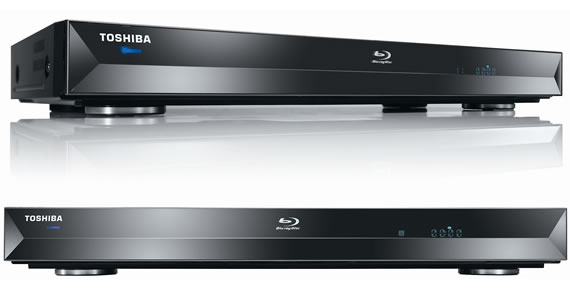
Toshiba's Blu-ray player is now available, but it's a bit underwhelming

Toshiba's Blu-ray player is now available, but it's a bit underwhelming

Toshiba’s first Blu-ray player has been released and reviewed. While it’s a quite capable Blu-ray player, it seems that’s all it is. There’s no video streaming, and it doesn’t even feature Toshiba’s XDE upscaling technology. It seems Toshiba was content to be conservative with their first Blu-ray player, which I guess is understandable in many ways following their failure with HD DVD.

The other bit of HD related news was that the WHDI specs have been finalized. Think of WHDI as wireless alternative HDMI, of which there are several competing formats. WHDI seems to be one of the better supported at the moment, with Sharp, Sony, LG, Hitachi, Motorola and Samsung all behind the format. Unfortunately, many of these companies also support the WirelessHD standard, of which Toshiba, Panasonic, Philips, NEC and Intel are additional supporters. You would think that these companies could just get together and adopt a single format, for the benefit of all, but you know that was never going to happen. And wireless technology is especially tough to get consensus it seems, what with Wireless N only taking about 50 years to get finalized or something.

Gaming

And in gaming, I guess I should talk a little bit more about the November US video games sales figures, although there’s not much I can add to what I’ve already posted in my analysis. A lot of people were surprised at the Xbox 360 figures, as was I, but I think the real surprise was the bias in Modern Warfare 2 sales on the Xbox 360, which outsold the PS3 version by more than the 2:1 margin that the 360 holds over the PS3 in hardware numbers. Almost one in four Xbox 360 owners in the US purchased a copy of the game, and that’s only the stats from the first 20 days of release.

Call of Duty: Modern Warfare 2 on the Xbox 360 sold more than 4 million copies in the first 20 days

Call of Duty: Modern Warfare 2 on the Xbox 360 sold more than 4 million copies in the first 20 days

The explanation for this, according to Microsoft, is Xbox Live, the multiplayer service. There is some truth in this, and it’s backed up by stats as well, where Xbox Live stats showed that 2 million unique users were online on MW2 launch day, and 5.2 million hours of gameplay was recorded. There is a kind of loyalty that exists with respect to multiplayer games, because if you’ve played the first game on Xbox Live or if your friends are all on it, you’ll have to get on it too, even if your favourite console in the PS3. Microsoft’s focus on improving Xbox Live has obviously paid off, compared to the somewhat lackluster approach Sony has taken with the PSN.

Over in the UK, apparently Xbox 360 sales are on the up as well, at least according to a popular voucher website. We’ll have to take this news with a pinch of salt, since official figures are not available to back this up, but if true, then the lower pricing of the Xbox 360 may be appealing to recession hit Europe and UK. And the introduction of Sky Player on the UK Xbox 360 may also be a factor.

Anyway, I think I’ve rambled on long enough. Have a great week and see you in seven days.

Game Consoles – November 2009 NPD Sales Figure Analysis

Saturday, December 12th, 2009

The second busiest month of the year for video games sales in November. And all eyes on this year’s figures to see if a late surge can improve the industry’s fortunes, which looked set to fail in beating 2008’s record year of profits. With the war between the Xbox 360 and PS3 finally heating up some, and the PS3 finally able to beat Xbox 360 sales, the important holiday period will be a key indicator of what’s to come in 2010. And having had a largely disappointing year, the Wii is also looking towards the holiday period, and some hit titles, to give it the boost it needs. And with the biggest game of the year, possibly in history (based on previous sales results), being released in November (Call of Duty: Modern Warfare 2), the figures this month are extremely interesting. You can read last month’s analysis here. The figures are from NPD, a marketing research firm that releases games console sale data every month.

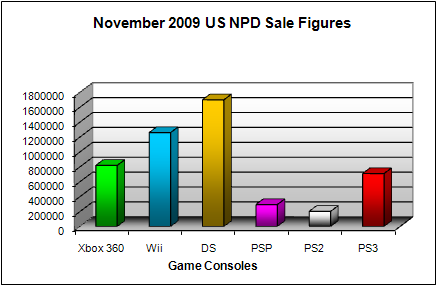
The figures for US sales in November 2009 are below, ranked in order of number of sales (November 2008 figures also shown, including percentage change):

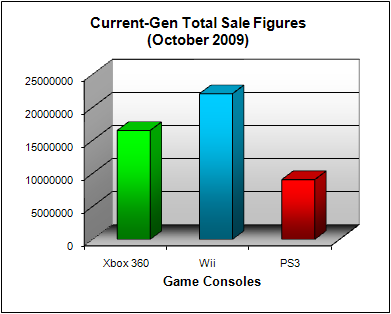
  • DS: 1,700,000 (Total: 36.1 million; November 2008: 1,560,000 – up 9%)
  • Wii: 1,260,000 (Total: 23.3 million; November 2008: 2,040,000 – down 38%)
  • Xbox 360: 819,500 (Total: 17.3 million; November 2008: 836,000 – down 2%)
  • PS3: 710,400 (Total: 9.8 million; November 2008: 378,000 – up 88%)
  • PSP: 293,900 (Total: 16.2 million; November 2008: 421,000 – down 30%)
  • PS2: 203,100 (Total: 44.9 million; November 2008: 206,000 – down 1%)
NPD November 2009 Game Console US Sales Figures

NPD November 2009 Game Console US Sales Figures

NPD Game Console Total US Sales Figures (as of November 2009)

NPD Game Console Total US Sales Figures (as of November 2009)

My prediction from last month was:

Sales will go up considerably compared to October, that’s for sure. The DS will be top, the number two spot will be closely fought between the PS3 and Wii, although I’m leaning towards the Wii winning that battle right now. The Xbox 360 is 4th, followed by the other two PlayStation consoles. Call of Duty: Modern Warfare 2 will be the number one selling game, and the controversial game will be a record seller if the hype is anything to go by. The Xbox 360 version of this multi-platform game should be the one occupying the top spot. Other titles that will do well for the Xbox 360 include Assassin’s Creed II and the console platform exclusive Left 4 Dead 2. For the Wii, a new Super Mario Bros game will always be a hit, and it could give CoD: MW2 some competition (although mainly for the PS3 version, one suspect). Dragon Age: Origins, from the same people that gave us Mass Effect, could make the top 10 as well, since I’ve been hearing a lot about this game recently.

I must admit that it’s easy to make a monthly prediction when, by the time you write it, half of the month has already gone by. But even then, I was wrong, although only about one thing. Most, including me, had predicted the Wii to struggle to beat the PS3, with the Xbox 360 4th overall, but it turned out that the Wii Manged to beat both the PS3 and Wii, and it was the PS3 that finished fourth. Every other thing I predicted came true, except that I thought the new Super Mario Bros Wii game would give at the very least the PS3 version of CoD: MW2 some competition, but the controversial Modern Warfare 2 managed to win handsomely in the software charts this month despite Mario, Luigi and co.

The DS had a huge month, especially when you compare it to the only other portable console, the PSP, and also as the PSP had a new version out recently that should have given it the momentum. Instead, the DS managed to be the number one selling console this month, and was able to beat last year’s record sales quite comfortably. The other piece of good news is that the Wii managed to hold on to second spot ahead of intense competition from the PS3 in the last couple of months, and it managed to do so quite comfortably as well. But even then, the Wii sold 38% less than the same time last year, and has been throughout the year. It was the single biggest drop in sales of all the consoles, but you have to take into consideration the record and unbelievable numbers that it was selling the year before. At the present rate and at the current stage of its release cycle, the Wii is still set to beat the PS2 as the most popular console ever, so Nintendo would not be worried, although they have less to be happy about than a year ago.

While almost everyone thought the PS3 would outsell the Xbox 360, especially given the results of the last two month, the actual result proved to be quite different. The Xbox 360 sold nearly 110,000 more units the than PS3, reversing the trend of the previous two month. There are many reasons for this. One is that because the Xbox 360 is cheaper, cheaper items tend to do better during the busy Thanksgiving holiday period, where the budget conscious buyers are out in force. DVDs had a similar surge in sales compared to the more expensive Blu-ray during the same period, for example. The one reason is simply Modern Warfare 2. While this game is a multi-platform release, the huge install base of the first game in the series on the Xbox 360 and the multi-player nature of the game, meant that many wanting to get the sequel *had* to get it on the Xbox 360, and the software charts will be further prove of this. Microsoft took advantage of this and had quite a few MW2 bundles out, which seems to have proved quite popular with gamers going by the hardware numbers. If not for MW2, I don’t think the Xbox 360 would have outsold the PS3. The Xbox 360 experienced a negligible 2% drop compared to the same month in 2008, so November 2009 sales were extremely positive considering how much of a record year 2008 was.

And so the PS3 came fourth, but had the single largest year on year improvement, with 88% better sales than the same time last year. Sony will claim, and have claimed, that the PS3 was the only home console to record year on year growth, and this is true. Except that the Xbox 360 only missed out on doing the same by a 20,000 units, and that PS3 sales were awful this time last year, it was hard for the PS3 not to improve. However, the PS3 didn’t get as much of a boost from a software release like the Xbox 360, and as I mentioned before, I think it would have beaten the Xbox 360 had MW 2 not been released. So these numbers are still extremely good, but the only real concern is that the gap between the Wii and PS3 seems to be widening again after that big bump in PS3 sales in September, thanks to the simultaneous release of the PS3 Slim and the price cut, seems to be dissipating. We’ll know more after the holiday period is over, and whether the PS3 can maintain its momentum, or whether it will need further price cuts to try and beat the Wii. To be honest, I think it’s already too late for the PS3 to win this generation, so the best it can do is to beat the Xbox 360, which seems likely. For Sony’s other consoles, I will be surprised if the PS2 is still around the same time next year, and the PSP is struggling badly even with the new PSP Go, dropping 30% in sales even with the new model. It’s too late now, but the PSP Go should really have been Sony’s response to the DS, which will now monopolise the portable gaming industry.

Overall, November 2009 did worse than November 2008. Some of it is due to the economic situation in the US. Quite a bit of it has to do with Wii sales dropping, although they were always going to drop at some stage (it’s better to think of the Wii’s first two years as simply extraordinary, and the current year’s sales as “normal”). 2008 was always going to be hard to beat, but 2009 is still the best year in sales outside of 2008, and that’s positive for the industry.

On to software sales now. The amazing figures for Call of Duty: Modern Warfare says it all really. Over 4 million copies of the game sold on the Xbox 360 alone, with 6 million combined for the two consoles, and not even counting the PC version and any console bundled versions. That’s amazing for any single game, and completely blows away all previous records, whether that was for GTA IV, or Halo 3 or the first Modern Warfare game. The Xbox 360 version easily outsold the PS3 version by more than a 2:1 margin, higher than the actual hardware ratio lead that the Xbox 360 enjoys, meaning that a higher percentage of Xbox 360 owners purchased this game compared to PS3 owners. The stats seem to show that one in four Xbox 360 owners purchased a copy of this game, and that’s only in the first month of release as well. Also contributing to this month’s amazing software sales figures is the new Super Mario Bros. game for the Wii, which managed to sell over a million copies as well. Assassin’s Creed II did well on both the Xbox 360 and PS3, with the Xbox 360’s lead less than 2:1, although still higher than many recent multi-platform releases which has seen the PS3 version almost sell on level terms with the Xbox 360 version, despite the lower hardware numbers. The Xbox 360 exclusive Left 4 Dead 2 also helped to improve the Xbox 360 software numbers. Overall, the Xbox 360 dominated the top 10, with 52.8% of all sales belonging to the platform. The Wii was second best with 27.1% of all top 10 sales, the PS3 with 20.1%.

Here’s the complete list of the top 10 software sales:

  1. Call of Duty: Modern Warfare 2 (Xbox 360, Activision) – 4,200,000
  2. Call of Duty: Modern Warfare 2 (PS3, Activision) – 1,870,000
  3. New Super Mario Bros. Wii (Wii, Nintendo) – 1,390,000
  4. Assassin’s Creed II (Xbox 360, Ubisoft) – 794,700
  5. Left 4 Dead 2 (Xbox 360, EA) – 744,000
  6. Wii Sports Resort (Wii, Nintendo) – 720,200
  7. Wii Fit Plus (Wii, Nintendo) – 697,000
  8. Assassin’s Creed II (PS3, Ubisoft) – 448,400
  9. Dragon Age: Origins (Xbox 360, EA) – 362,100
  10. Mario Kart w/ Wheel (Wii, Nintendo) – 315,000

Time to make a prediction. December hardware sales should be even higher than November’s based on past trend, but with MW 2 still selling in good numbers, it should help the Xbox 360. But I suspect it will be a closely fought race between the Xbox 360 and PS3 for the third place finish, behind the DS and Wii at first and second. Software wise, MW 2 should still be selling well, and should hold top spot, although Wii Fit Plus may make a surprise surge. But in all likelihood, both versions of MW 2 will probably beat New Super Mario Bros. Wii to furnish the top 3 spots. Overall software sales will be down, because it will be hard to beat this month’s figures.

See you next month.

Weekly News Roundup (15 November 2009)

Sunday, November 15th, 2009
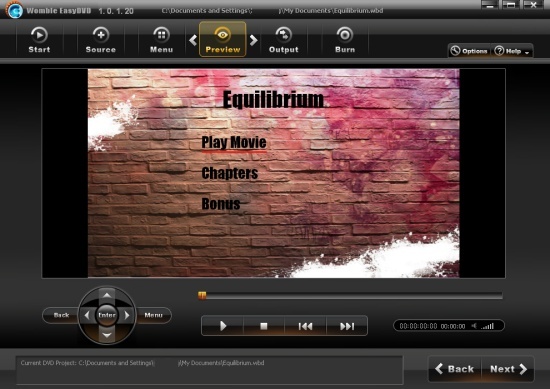
Making a DVD menu is made simpler by Womble EasyDVD

Making a DVD menu is made simpler by Womble EasyDVD

As expected, following last week’s news blitz, this week has been relatively quiet. Which is a good thing because I managed to fill the gap with a new DVD authoring guide for Womble EasyDVD. Having played with the software for a week, I can say that it’s very easy to use and mostly intuitive. There are a couple of missing features such as subtitle support and multiple audio support, which I hope Womble can fix in future releases (this being their first effort after all, so you can’t have everything), but it’s mostly what you would expect, and the menu creation offers a bit more flexibility than your average authoring suite, without ever going into the semi-pro territory (complete with the much steeper learning curve) of tools like DVD-lab Pro. The other thing that was available this week was the October NPD US video game sales stats, I wrote the analysis for it yesterday here. The PS3 didn’t manage to sell over the Wii as it had in September, but it’s the Xbox 360 that’s the loser in terms of the recent price wars it seems, although it’s doing fantastically in software (for now, thanks to its larger install base). The coming months should give us an even clearer picture of what’s in store for 2010, and Microsoft will be hoping to see similar scenes as last year this time as people enthusiastically grab their cheaper holiday bundles. But I wouldn’t bet on it. Anyway, onto this week’s news.

Copyright

In copyright related news, the BBC’s proposal for adding DRM to their HD broadcasts has been denied by the British Office of Communications. But the idea isn’t entirely dead and the proposed DRM scheme may appear later on, with existing hardware likely to support such a DRM scheme if it is ever introduced.

The MPAA are still of course campaigning vigorously in the US to try and get the FCC to allow them to introduce  Selectable Output Control. The old “pro consumer” argument was brought out, to argue for SOC’s use in bringing new release movies faster to the home if the studios were more confident of its resistance to piracy. Many studios are already doing this without the fake security blanket that is SOC. But SOC is just a trojan horse for the MPAA, because once you can control one aspect of how someone watches TV, you can then control all aspects of it eventually. If the MPAA and their cohorts can get away with banning all  TV recordings, then does anyone really doubt that this is exactly what they would do? Pro consumer indeed.

Further prove that movie studios really don’t give a crap about the people that are supposedly their customers – a free community Wi-Fi service that brings tremendous benefits to a huge number of people has been shut down all because of a single piracy complaint, from Sony (who else?). It’s a case of the studios exploiting people’s fear over lawsuits, and an innovation that helps the local economy, local law enforcement, small businesses and visitors is attacked and destroyed. Obviously the people who decided to shut down the network, as the cost of adding anti-piracy filters is excessive, must shoulder some of the blame for this over reaction, but the MPAA’s reaction to the story shows the depth of their arrogance. Instead of calling for a reasoned approach and balanced response, that a single movie download does not constitute a widespread piracy operation, they used the occasion to further spread their anti-piracy propaganda. But that’s what they are. They are an industry lobby group and they’re paid to say and do these things. What is really wrong is politicians and others in power taking their word as gospel, and acting without taking into consideration the serious consequences  for issues like privacy, and the economic damage that would occur if the MPAA’s wishes were turned into reality.

iiNet's freezone: damned if you do, damned if you don't

iiNet's freezone: damned if you do, damned if you don't

It’s week 4 of the Australian AFACT vs iiNet trial, and it was closing statements time.  Once again, you can check out a summary of the week’s events here, but the arguments from both side remain the same. The AFACT thinks iiNet is basically a piracy provider, even suggesting that  the ISP’s use of phrases such as “happy downloading” was in fact an encouragement for people to download the latest Harry Potter movie. And even iiNet’s attempt at promoting legal content, through their freezone service, was attacked. You would think the movie studios should be delighted that ISPs are providing quota-less downloads for legal content as a way to to provide further incentives to go the legal route, but you would be wrong. The argument is that because quota is not used, it leaves more free quota for downloading pirated movies. The same argument was made for iiNet increasing download quotas for their customers, as the AFACT assumes anyone who needs a large download quota must be a movie pirate. This “sky is falling” and “you’re a pirate until proven otherwise” attitude that these lobby groups have adopted is working wonders in their political lobbying activities and have proved useful in the legal arena as well in the past. Our only hope is the judge can see through these exaggerated truth to balance the need for anti-piracy and the need to protect consumer rights, and the rights of ISPs to operate without being burdened by the responsibility to prevent piracy. Surely the industry that profits, often in record amounts, from the movies and TV shows that are being pirated should be the ones responsible, at least financially, for the anti-piracy operations, not the ISP or its subscribers. Either put up, or shut up.

Most independent game developers say that piracy is not a significant problem, at least for now, according to the latest survey. While most fear that it can become a big problem in the future, only 10% felt that it was a serious problem at the moment. One thing to note about  piracy, including games and movies, is that people who do have the ability to pay for content will usually do so. It is only those that never had any intention to pay for anything, some because they don’t have the capability, that are the more dedicated when it comes to sourcing pirated content online, and these people were never likely to provide any sort of income for the content owners, now or in the future. So the key is to at the very least increase the number of people who have the capability to pay for content, and that can only be achieved through pricing changes. Digital distribution allows this to occur without the cost being a huge issue (certainly compared to physical media and the associated costs like packaging, shipping  …), and even more reasonable pricing can open up previously untapped markets, such as developing countries where piracy rates are even higher. Or the alternative is to fight against logic and try to stop all piracy through technology that has proved inconvenient at best, and completely unworkable at worst, or through ever harsher legislation that completely disregard some of society’s basic principles in relation to justice and human rights.

Microsoft banning 1 million Xbox 360 accounts over suspected system modding (which allows for piracy) may seem excessive, but console piracy is actually not a huge problem and that’s worth examining. The anti-piracy success is largely to do with technology, all games consoles carry some form of DRM for games and being closed systems, they are easier to enforce (unless somebody decides to mod their Xbox 360, that is). The DRM systems used are also fairly straight forward, usually just a DVD check, and with digital downloads being available, even the DVD check won’t be necessary anymore. There are still many aspects of the DRM system that are inconvenient, such as when one needs to move from one console to another, but there are at least solutions and workarounds. And I guess more reasonable pricing comes into it. Games are expensive, but given the number of hours of entertainment they provide, it’s still better value compared to your typical movie or MP3. Consoles are also now very good at providing demos for new games, thus eliminating the need for people to “play before they pay” (which I admit is often used as an excuse for piracy, and play doesn’t always lead to pay). They certainly aren’t going out there lobbying the government to throw people off the Internet for downloading games, or getting ISPs to work as their spies, or suing individuals for using pirated games.

High Definition

HD news now. Not much on Blu-ray to report, but the holiday season is upon us and there will be a steady stream of big releases to give the format a big boost. But HD is more than just Blu-ray, and the future of HD may be SD.

Blockbuster tries SD digital rental

Blockbuster tries SD digital rental

Not SD, as in standard definition, but SD as in the memory storage format. Blockbuster is trialling a new way to rent movies by allowing customers to download them to their SD memory cards. These movies expire after 30 days if unwatched, or 48 hours after the first viewing. Obviously DRM is involved, but further details are a bit sketchy. If compatibility with hardware players, then the DRM used may be the SD card’s own internal DRM system, CPRM. This would then allow the actual video file to be unencrypted, and playable in a wide variety of players, probably. The lack of DRM on your common USB stick may be why they didn’t go with the more common format.

The other path for HD is digital distribution. The main stumbling block has always been bandwidth, and also processing power (many of the Netbooks you see today will struggle with 1080p content). But YouTube is not waiting around for things to catch up, and will roll out 1080p playback support next week. The link to the left has a couple of further links to test videos that you can already use to see if your system is fast enough for 1080p. On my Intel C2D E8500, I recorded 40 to 50% CPU usage, which is reasonable, but you can see why some Netbooks will struggle. With GPU assisted decoding (unfortunately Flash does not yet support ATI based solutions), the CPU usage can be greatly reduced. This was proven when I downloaded the YouTube 1080p video (about 100 MB for 4 minutes worth) and used PowerDVD 9 to play it back (as it supports GPU assisted decoding). CPU usage dropped to below 10%, and my ATI Radeon HD 4850 was hardly worked (about 5% usage) despite the CPU savings. So it seems for 1080p video delivered through YouTube, most modern computers should be able to handle it, some better than others depending on whether GPU assist is available or not now or in the future. The bandwidth usage is reasonable, roughly the same as downloading a DVD movie (so the 1080p quality isn’t as good as say Blu-ray, not really close yet), but it will still use a large chunk of people’s quotas.

Gaming

And lastly in gaming, not much to link to, except for the NPD analysis, which I’ve already linked to above. I think we finally have a proper console war on now, where there’s not much between the three top consoles, the Wii, Xbox 360 and PS3. The Wii has the superior hardware numbers, but is weak on games, especially third party ones and ones that appeal to hardcore gamers. The PS3 has only started to do well to suggest it may take top spot eventually, but there’s still some catching up to do both in hardware and software. The Xbox 360 is enjoying software sales, at least in the US, for now, but it won’t last forever if it the last two months becomes a trend and they continue to sell less consoles than the PS3. But they have a great multi-player community and that counts for more and more these days. And of course, Natal, which may be beaten to the punch, innovative software wise, by PS3 Eye Pet (a new category of games, using the buzz word  “augmented reality”) . But if Eye Pet is a success, then that may actually bode well for Natal, since it plans to offer similar things but in a more mainstream, and technologically advanced fashion. The only problem is the late release date, now semi confirmed as November 2010, which may be too late to help if things stay the way they are.

See you next week.

Game Consoles – October 2009 NPD Sales Figure Analysis

Saturday, November 14th, 2009

We’re nearing the two busiest months of the year in November and December. Last month, we saw the PS3 take top spot thanks to the price cut and the new Slim model. At that time, I questioned the longevity of this bump in sales, whether it was a long term thing thanks to the lowered price, or whether it was a temporary bump due to people upgrading their existing consoles to the Slim. This month’s figures should give us a better idea as to what has occurred. The figures are from NPD, a marketing research firm that releases games console sale data every month.

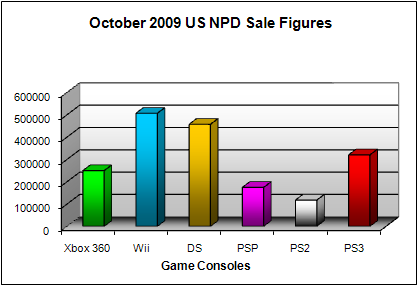
The figures for US sales in October 2009 are below, ranked in order of number of sales (October 2008 figures also shown, including percentage change):

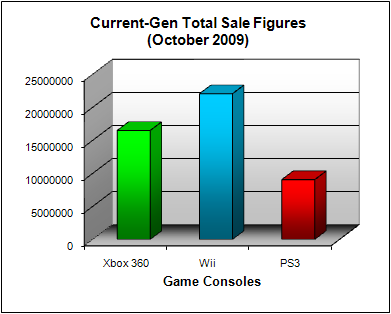
  • Wii: 506,900 (Total: 22.1 million; October 2008: 803,000 – down 37%)
  • DS: 457,600 (Total: 34.4 million; October 2008: 491,000 – down 7%)
  • PS3: 320,600 (Total: 9.1 million; October 2008: 190,000 – up 69%)
  • Xbox 360: 249,700 (Total: 16.5 million; October 2008: 371,000 – down 33%)
  • PSP: 174,600 (Total: 15.9 million; October 2008: 193,000 – down 10%)
  • PS2: 117,800 (Total: 44.7 million; October 2008: 136,000 – down 13%)
NPD October 2009 Game Console US Sales Figures

NPD October 2009 Game Console US Sales Figures

NPD Game Console Total US Sales Figures (as of October 2009)

NPD Game Console Total US Sales Figures (as of October 2009)

My prediction from last month was:

It’s time to make a prediction of October 2009’s results. For my money, I’ll say that the order of the hardware sales will remain the same, although the Wii numbers will be closer to the PS3 numbers. The PSP Go debuts, but based on an Australian report about the poor sales figures (a couple of hundred sales per week in an entire country, is not the best), the impact of the PSP Go may be muted. Sony will continue to have good month, but this time backed up in software sales as well with Uncharted 2. It might not sell enough to top the number one title, which might be Wii Sports Resort. Wii Fit Plus might take a place in the top half of the charts as well. I expect FIFA 10 to show up in one of more flavors in the top 10. Borderlands might make a showing too.

Some right, some wrong. The biggest surprise, if you can call it that, was that the Wii price cut managed to do enough to unseat the PS3 from the top spot. Part of this was also due to the price cut, Slim induced sales bump not lasting as long as one would expect. This is true of the Xbox 360 price cut as well, and if November wasn’t such a bumper month for sales, it might also be true for the Wii as well next month. My predictions about PSP Go sales being relatively subdued was also correct, with combined PSP sales of both the old and new models actually dropping compared to last month (but dropping less than it would have been had the PSP Go not been released). For my software predictions, I was right about Uncharted 2 doing well for Sony, but wrong about it not taking the number one spot. It did, and quite comfortably. Wii Sports Resort failed to keep its sales up, and was beaten in the end by Wii Fit Plus. FIFA 10 did show up, albeit in last place, but Borderlands did well on the Xbox 360 at least.

So let’s take a look at the PS3 numbers first. After a great month in which it took top spot amongst the home consoles for the first time since I’ve started analyzing the figures, it quickly felled back down again, but at least it managed to beat the Xbox 360. We’ll still need a couple of months to see if the price cut has any long term effects, but one thing is for certain, that last month’s bump for the PS3 had parts of it which were very temporary in nature. I would expect a price cut to be more long term, and the introduction of a new model to be more short term (due to the number of people who upgrade, which only occurs once), and so one can conclude that what made the PS3 the number one selling home based console in September was down to a fairly even combination of both events (price cut and new model), but that the temporary has started wearing off for October. Certainly those that expected the PS3 to be selling over the Wii from last month onwards were a bit too optimistic in their predictions, perhaps. In any case, Sony can still be extremely happy with the results, as the PS3 recorded what was the only year-on-year sales increase of all the consoles (more on that later).

The Wii’s sales bump is welcome news for Nintendo in what has been a fairly miserable year, especially in the last quarter. The price cut, while occurring in the last month, seems to have had the full effect in October as the Wii was the only console to record growth compared to September. But the overall picture is still not a happy one for Nintendo, as the year-on-year sale of the Wii saw a huge 37% drop, the largest of any console. Part of this was due to how incredibly the Wii was selling this time last year, way above any expectations. The other part is the slow decline in Wii sales that has occurred over 2009. At least the DS is still doing relatively well, keeping a firm grip on the number one spot and only recording a small year-on-year drop.

The Xbox 360 figures are again not looking great for Microsoft. A huge year-on-year drop breaks the trend for 2009, in which the Xbox 360 was pretty much the only console to record year-on-year growth (or negligible losses in a couple of months). This suggest the PS3 price cut has really hurt the Xbox 360 where it counts, and the fortunes have been reversed for the two consoles post the PS3 price cut, as the PS3 was the one recording large year-on-year sales drops up until the price cut. With Project Natal not coming until this time next year, later than PS3’s motion controller, which might be able to steal the Natal thunder if it’s properly integrated with the PS3 Eye and with useful software, time is running out for Microsoft to do something. To be fair, it was always a difficult struggle for the Xbox 360 to beat the PS3, and it has outperformed everyone’s expectations up until this point. Price cuts had allowed the Xbox 360 to outperform the PS3, but price cuts are not something that can go on forever, and given similar prices, the PS3 with its Blu-ray functionality and more advanced design will always win. So it may not be a case of the Xbox 360 losing to the PS3, but rather, both consoles finding their rightful place now that the PS3 ridiculous pricing has been removed as a factor. For Microsoft, Natal is a step in the right direction, but the November 2010 release date may just be too late to change things. The only thing that Microsoft has in its arsenal is the larger install base of the Xbox 360 over the PS3 in the US, which should at least mean that it will take some time before the PS3 finds parity, and will still allow them to sell software in good numbers until then. And the better multiplayer platform in Xbox Live over the PlayStation Network, and add to that the larger install base, does still give the Xbox 360 some momentum (the “if my friends are already on the 360, I have to be on it too” principle). Making Xbox Live Gold free is probably the only other weapon left for Microsoft to use.

Looking at sales as a whole, October performed badly compared to September and certainly compared to the same time last year. There might be a recession related thing going on at the moment, or just the lack of really big titles, but the stimulus given by the price drops, or new models being released, seems to be the only things keeping the figures from sliding further down. Things will be on the up in November for sure, but the numbers will be extremely interesting to see if there is a year-on-year growth or decline, and whether how well the PS3 numbers do compared to the Wii (and to a lesser extent, the Xbox 360), both to see if temporary factors were responsible for the Wii’s sales increase this month, and again to confirm the longevity of the PS3 price cut boost.

Moving on to software, things are slightly better, although a year-on-year decline was still the order of the day. The top title was a PS3 title for only the second time since I’ve started keeping track (the previous one was Metal Gear Solid 4 in June 2008). Uncharted 2 was the top selling title in question, and being an exclusive, that’s exactly where it should be. But compared to last month’s number one, which was also a follow-up game in a series and also a platform exclusive (Halo 3: ODST), the sales are still somewhat disappointing (Halo 3: ODST outsold Uncharted 2 by a ratio of nearly 3 to 1). Getting more out of platform exclusives, especially high profile ones such as the Uncharted series, whether that’s through more extensive marketing or other tactics, is something Sony can work on to better its software sales. There was only one other PS3 title in the top 10, NBA 2K10, a multi-platform release. There were only two Wii titles in the top 10, Wii Fit Plus as predicted and Wii Sports Resort, which saw sales drop compared to last month. The rest, apart from one DS title, was all Microsoft. 5 titles in the top 10, and even though the highest placed was only third, it still managed to grab 44.3% of total sales, the third best set of results in 2009. Wii games accounted 25.1% of the top 10, and the PS3 was third once more with 25% of sales.

Here’s the complete list of the top 10 software sales:

  1. Uncharted 2: Among Thieves (PS3, Sony) – 537,000
  2. Wii Fit Plus (Wii, Nintendo) – 441,000
  3. Borderlands (Xbox 360, Take-Two) – 418,000
  4. Wii Sports Resort (Wii, Nintendo) – 314,000
  5. NBA 2K10 (Xbox 360, 2K Sports) – 311,000
  6. Halo 3: ODST (Xbox 360, Microsoft) – 271,000
  7. NBA 2K10 (PS3, 2K Sports) – 213,000
  8. Forza Motorsport 3 (Xbox 360, Microsoft) – 175,000
  9. Kingdom Hearts 358/2 Days (DS, Square Enix) – 169,000
  10. FIFA 10 (Xbox 360, EA Sports) – 156,000

Prediction time. This is a hard one. Sales will go up considerably compared to October, that’s for sure. The DS will be top, the number two spot will be closely fought between the PS3 and Wii, although I’m leaning towards the Wii winning that battle right now. The Xbox 360 is 4th, followed by the other two PlayStation consoles. Call of Duty: Modern Warfare 2 will be the number one selling game, and the controversial game will be a record seller if the hype is anything to go by. The Xbox 360 version of this multi-platform game should be the one occupying the top spot. Other titles that will do well for the Xbox 360 include Assassin’s Creed II and the console platform exclusive Left 4 Dead 2. For the Wii, a new Super Mario Bros game will always be a hit, and it could give CoD: MW2 some competition (although mainly for the PS3 version, one suspect). Dragon Age: Origins, from the same people that gave us Mass Effect, could make the top 10 as well, since I’ve been hearing a lot about this game recently.

See you next month.