Archive for the ‘Xbox 360, Xbox One’ Category

Weekly News Roundup (19 February 2012)

Sunday, February 19th, 2012

Welcome to the latest edition of the WNR. It’s a shame that the leap day doesn’t fall on a Sunday this year, as it would make an awesome collector’s edition of the WNR – as such, it’s on possibly the most boring day of the week:  Wednesday.

I know I promised the NPD analysis last week, but it turns out there just wasn’t enough data to compile one, thanks to both Nintendo and Sony keeping mum on hardware figures (no doubt because they have crap numbers). Only Microsoft released figures for its Xbox 360 console (the least worst of the bunch). So it seems January 2012’s NPD analysis will have to be replaced with a much shortened version, which you’ll find in the “Gaming” section below.

In terms of news, there were only a couple of interesting ones, and a few late breaking ones that I will cover briefly in this edition, but in more detail in the next. So don’t be surprised at the brevity of this WNR (and it totally didn’t have anything to do with the fact that I’ve now put in 50+ hours in Skyrim).

Copyright

The likes of the MPAA and RIAA have compared web piracy to a lot of things, but I’ve always wondered why they haven’t compared it to some kind of infectious disease, as I think The Piracy Pandemic® has a certain ring to it.

It’s a great comparison not just because the content holder set their hyperbole engine into overdrive by comparing web piracy to something deadly and scary, but also on two other major points. One, just like an infectious disease, piracy spreads quickly, and it does so in poorer countries with greater virulence. And also just like viruses, piracy adapts to any measures you employ to try and stop it, whether it’s a technical measure, or a legal one. The more you try to fight it, the more likely it will mutate into something that’s more resistant.

The latter of these two points was demonstrated, twice, this week. Decentralisation has been a continuing trend in piracy (Megaupload and sites of similar ilk are actually quite a throwback to the early days of piracy, where everything was hosted on centralised HTTP websites), but despite decentralisation being the major driving force behind the creation of BitTorrent, two major centralised components still hold it back from truly being decentralised. The inherent weakness in BitTorrent file sharing is the existence, and the necessity, for centralised trackers and a centralised “indexer” website that catalogues the available downloads, like The Pirate Bay. This website would also host .torrent files, and while these files are small by any standard, the sheer number of them ensures that the total size of the website and database can be quite large. Taking down a tracker can cause downloads to cease to work, as peers would not be able to find each other, and taking down websites like The Pirate Bay would mean that you won’t even able able to find the torrents to get you started. These two weaknesses have often been exploited by content holders, with past lawsuits able to bring down popular trackers, and BitTorrent indexers such as Mininova.

The Pirate Bay Magnet Links

The Pirate Bay will remove .torrent files by the end of this month, encouraging users to use Magnet Links (show above with the little magnet icon) instead

This week, The Pirate Bay announced steps which will mitigate these two risks, although the actual technical measures used to solve these two problems have existed for some time already. The Pirate Bay, at the end of this month, will remove .torrent files for any torrents that has over 10 peers and will use Magnet Links instead. A Magnet Link is simply a web URL, a string of text that once loaded into your BitTorrent Client of choice, will give the client just enough information to be able to download the actual .torrent file from users that are already sharing the torrent. And using the DHT (Distributed Hash Table) technique, Magnet Links don’t need trackers in order to download the .torrent files (and the actual download most likely won’t need trackers as well, thanks also to DHT). But for The Pirate Bay, the best thing about switching to a Magnet Link based website is the fact that they no longer need to host .torrent files (well, not as many as before, anyway), and this allows the hosting, and bandwidth, requirements of The Pirate Bay to be reduced to the point where the entire website can probably fit onto a small USB thumb drive (removing all .torrent files, a user has already demonstrated the ability to reduce The Pirate Bay’s Magnet Link database to only 90MB). This will help more TPB mirrors to be set up, and to allow the website to be moved from host to host more easily, thus making the website more resilient to take-downs. There’s also something quite perverse about being able to “download” the entire Pirate Bay to your hard-drive.

And even in the event of The Pirate Bay finally being taken down, there’s now a plan B. A new BitTorrent client, Tribler, aims to remove the any need for websites like The Pirate Bay, and remove the one last centralised component of the largely decentralised BitTorrent download process. Tribler does this by moving the torrent indexing component into the BitTorrent swarm itself, and allow you can search for torrents right within the client. Even things like reviews, comments, and the obligatory removal of fake torrents, can all be done within the client. Tribler, developed by researchers at Delft University, is also open source, and that makes it more resilient, as if one variant of the client is taken down by authorities, others will pop up almost instantly (and probably with more features). What this essentially means is that BitTorrent, via Tribler, is now unstoppable. Or to put it even more succinctly, and to quote the head of the Tribler project, “The only way to take it down is to take The Internet down.”

Tribler

Tribler - the new BitTorrent client that claims to be unstoppable

Now, just because BitTorrent downloads cannot be stopped, it does not mean that you can’t be forced to stop using BitTorrent, as the major flaw in Tribler is that it still allows authorities, and those seeking to profit from (anti) piracy, to track your IP address. So the next evolution of BitTorrent, in my mind, will be one that allows peers to communicate anonymously – that is, to allow sharing without making the IP addresses public at any point in the process. The external pressure heaped towards downloaders, from law firms such as US Copyright Group, and also the rights holder’s push for graduated response, will no doubt have already pushed clever developers into tackling this very problem, and I don’t expect we’ll have to wait too long for this next evolution. And once it arrives, BitTorrent will be anonymous, unstoppable, and it will spell “game over” for both technical and legal methods to stop the downloading.

This scenario both scares me, and excites me. It scares me because, with no way to stop downloaders, things could get out of hand very quickly. But it also excites me because, without any technical or legal recourse, content holders might finally have admit to the need to compete with piracy, and we may finally see the entire industry put everything behind innovating their way out of the problem. Consumers will be the main beneficiary, and I look forward to new and brilliant ways to consume content, legally. Of course, this should have been the way forward since the first torrent was uploaded, and it would have been easier to compete back then, compared to a time when BitTorrent may have become truly unstoppable.

Going back to the point I made earlier about Megaupload being an outdated way of hosting pirated downloads, the closure of R&B/hip hop blog RnBXclusive this week shows why centralisation is dangerous. But what’s more dangerous is the pattern that’s emerging with law enforcement actions against websites suspected of copyright infringement – the fact that law enforcement agencies appear to be acting as the private police force for the entertainment industry without questioning the one-sided evidence presented to them – evidence that has often not stacked up in court. Time and time again, websites were taken down with the full force of the law, but still managed to be difficult to prosecute, or in the case of the similarly themed DaJaz1 (taken down by US Homeland Security as part of Operation In Our Sites), the case might not even end up in court. This is why due process exists and why it’s needed, for the evidence to be tested in a court of law before guilt is determined, and action is taken.

And to add insult to injury, visitors to rnbxclusive.com were initially threatened with messages that mentioned “an unlimited fine” and “a maximum penalty of up to 10 years” in prison for anyone who simply downloaded some songs from the website. A Big Brother style warning of the “capability to monitor and investigate you” was given an extra dimension of fear, by displaying the visitor’s IP address on the home page (a simple enough thing to do in php, but still scary enough for the less technical minded). These threats have since been removed from the website, no doubt due to complaints about the potentially misleading statements which could get SOCA (UK’s Serious Organised Crime Agency), the organisation that took charge of seizing the website, into trouble. But it’s the kind of hyperbole we’re used to seeing from the entertainment industry, the most likely ghost writers behind the now removed messages.

One of the entertainment industry’s tactic is to portray everyone who does something against their interest as criminals, even if it’s something as simple as ripping your own legally purchased DVD. I reported a couple of months ago on the efforts by public interest group Public Knowledge to make DVD ripping legal. They argued that due to the increasing number of devices that don’t play DVDs, such as tablets and smartphones, consumers need to be given the right to rip their own legally purchased movie discs. The fact that everyone who wants to do it is already doing it, means that making DVD ripping illegal under the DMCA is pointless at best, and at worse, criminalizes an activity that falls under fair use. With PK having made their submission to the US Copyright Office, which reviews submissions for exemptions to existing copyright laws every three years, the MPAA has just responded with quite an absurd argument *for* keeping DVD ripping illegal: it gives consumer more choice!

RealDVD

If Public Knowledge manages to get a DVD ripping exemption from the US Copyright Office, then it's still too late to save innovative software like RealDVD, which was sued into oblivion by the MPAA

What the MPAA is saying is that since consumers don’t have the legal option to rip their own DVDs, then the legal option to get the movie you already paid for, on other devices, is to simply re-purchase the movie again. And again and again. Consumers can “choose” to pay for the same movie on their iPhone, “choose” to pay for the same movie again on Android, and then “choose” to pay for the same movie once more on their PS3, for example.

Far from being a convincing argument, this is precisely PK’s argument for making DVD ripping legal, that consumers shouldn’t be made to fork out money for the same content over and over again, due to a legal measure designed to do something else. This is a perfect example of piracy laws being misused by content holders, for their own financial benefit, to take away a consumer’s rights. The fact that many movies are not even available on legal platforms further destroys the MPAA’s false arguments about “choice”.

I sincerely hope the US Copyright Office does the right thing and extends the exemption for CD ripping to cover DVDs and Blu-rays too. The reason that The US Copyright Office even asks for submission of exemptions is to prevent exactly this sort of thing – short sighted copyright laws that harm fair use and innovation.

The Megaupload case has also had some new developments in the last few days, although nothing that bodes well for Mr DotCom. More charges have been laid, and $50 million in Mega assets have been seized so far. Without insider knowledge, it’s hard to tell if this is an attempt to shore up the fed’s case before going to court, or if it’s some kind of tactic designed to force a favourable settlement. Copyright cases are not always easy to prove, see Viacom vs YouTube, and given the theatrics that has transpired so far, losing the case is not an option for federal prosecutors.

Meanwhile, the Pirate Bay and RIAA have been engaged in verbal warfare, with The Pirate Bay responding to an article by the RIAA that called it “one of the worst of the worst”. More on both of these late breaking stories next week.

Gaming

As mentioned earlier, due to Sony and Nintendo withholding hardware figures for the PS3 and Wii, I don’t have enough data to write up a full NPD analysis, so you’ll have to put up with a simplified version here.
NPD January Comparison

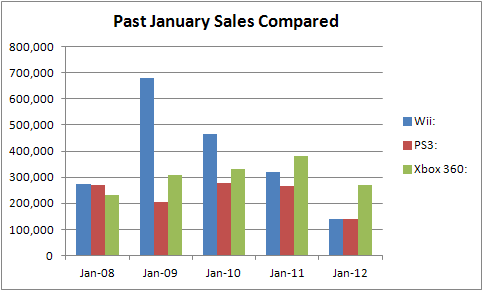
NPD January 2008 to 2012 Compared - things are bad across the board, it seems (January 2012 figures for PS3/Wii estimate only)

Microsoft was the only one brave enough to release data, with the Xbox 360 selling 270,000 units, down 29% from a year ago. Microsoft also mentioned that it held 49% of the current-gen console market. A little maths then tells us that the PS3 and Wii sold a *combined* 281,000 units. With the PS3 and Wii selling in similar numbers usually, that’s around 140,000 units for each, which is way down compared to the previous January’s 319,000 (Wii) and 267,000 (PS3).

These companies can only hope that January was a fluke, and that sales will pick up again.

Game sales were just as bad, with the number one selling title, Modern Warfare 3, only shipping 386,000 units – at the same stage of sales, Black Ops managed 750,000 (although MW3 sold more copies in the preceding months, it’s now flat in terms of sales to Black Ops), and Modern Warfare 2 managed 658,000 during its January period. And considering MW3 was the top seller, it means the other titles in the top 10 were much worse.

Overall, it’s the worst January since 2004.

The results are so bad that analysts are still debating the whys of it, with Wedbush Securities analyst Michael Pachter even questioning the validity of the data.

Maybe people are playing too much Skyrim to have time to buy any new games, just a thought!

And on that sour note, we come to the end of another WNR. Hope you enjoyed it, and see you next week.

Weekly News Roundup (29 January 2012)

Sunday, January 29th, 2012

Welcome to another edition of the WNR. I hope you’ve had a good week, that the FBI hasn’t stormed your home, seized your prized car collection and that you haven’t had bail denied by a judge. Me? I’ve somehow talked myself into getting a (admittedly cheap) copy of Skyrim (on the PC, of course), despite knowing that I really don’t have the time to play a game that has managed to destroy millions of hours of productivity since it was released. But curious as to what the hype was all about, I  talked myself into playing “just a few minutes”. 20 hours of Skyrim later …

Quite a bit to get through, and with the steel ingots and leather strips not making themselves into armor and requiring my urgent attention, let’s get started!

Copyright

The fallout from the Mega story last week continues, as file hosting websites scramble this week to “clean up” their services, or simply to shut up shop.

This is probably what federal prosecutors, and the content holders urging them to take action, had been hoping for. With thousands of illegal download links now put out of commission, some permanently, it does seem like a major victory in the war against web piracy. Although whether this actually leads to any revenue increases, the whole point behind stopping piracy, time will tell.

For the music industry, this is the second major breakthrough against web piracy in just over a year, along with October 2010’s closure of LimeWire. But it appears that despite what the NPD calculated to be a 46% decline in the number of downloaders shortly after the LimeWire closure, and with less songs downloaded per individual when comparing to the same period a year ago, music revenue for 2011 hasn’t actually increased much at all. In fact, it remains 3% down compared to 2010, when LimeWire (up until October at least) was fully operational. The rate of decline has slowed, but you would think that with such a dramatic decline in piracy rates (nearly half of the people downloading pirated music were using LimeWire to do it just before it was closed down), and the RIAA’s warning of billions upon billions of damage caused by piracy, that it would have at least helped the industry get back into growth. So it will be interesting to see, now that piracy through file hosting services has decreased, what effect it actually has on revenue.

Record label vs artists profits

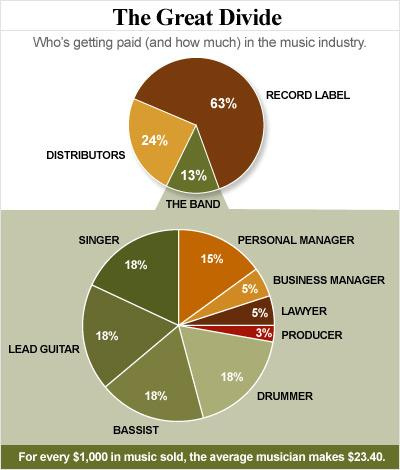
Apparently, only $23 out of every $1000 made on music sales actually goes to the musician, on average (source)

This is of course assuming the main aim behind the targeting of Megaupload was in fact to do with piracy, as it was noted this week that Megaupload was already making plans to take on the music industry head on, in plans that could cause the major labels more damage than piracy ever could. The plan involves a new website called Megabox, which allowed unsigned artists to completely bypass music publishers, and market directly to music fans, with 90% of the revenue going back towards the artist. Even free (ie. pirated) downloads would generate money for the artists, as Megaupload promised to share the very income, earned from downloads, that got them into trouble last week. And if Megabox works, then it would have been a big blow to the majors, and would have seriously questioned their relevance in the age of the Internet, when “naturally” generated hype is more valuable than any kind of promotion that labels could come up with. And with technology enabling artists to sell directly, without having to invest a lot in infrastructure (or they can leave it to tech companies to handle that side of things), artists no longer have to see a majority share of their revenue going to record labels. If there’s one thing the labels fear more than web piracy, it’s this, and while it might require one to be wearing a “tin-foil-hat” to think that this was the only reason behind the Mega take-down, it’s probably a nice little bonus the record industry got out of the whole thing. But while the likes of the RIAA can stop Megabox, they can’t stop innovation and progress, not forever, and a major shift in the way content is packaged, sold and distributed is on its way, if it isn’t here already.

While the Mega stories were very much dominating the headlines, the temporary demise of SOPA was still on people’s minds. One of those minds was EMI’s VP of Urban Promotions, Craig Davis. In a Q&A session with the Reddit horde, Davis expressed largely personal views that seemed to differ quite a bit from the general line of thinking coming out of the music industry these days, in that legislation is the only way forward to deal with the web piracy problem. Perhaps highlighting the internal divisions within the music industry on how to handle the web piracy problem (something we don’t usually get to see, with the RIAA’s loudspeakers drowning out all other opinions), Davis personally opposes SOPA, and says that piracy is more of a service issue, than a pricing one, mirroring what Valve’s Gabe Newell said a few months ago. In fact, Davis specifically mentions Newell as having the right idea when it comes to fighting web piracy. By focusing too much on the pricing issues behind piracy, major content holders often come to the conclusion that there is no real way to “compete” with pirated downloads, as they could not offer their content for free (although I would argue that piracy itself carries a cost, in terms of legal risk, technical and safety issues, and a moral cost, and so for legal content to compete, it does not have to be free, it only needs to be seen as good value). But by concentrating on service, innovation, basically by making legal options more attractive in more ways than just on price, then “legit” could compete with “free”. And perhaps Newell’s Steam could offer guidance to the music, and movie industries as to how to best leverage the positive aspects of the Internet, and how to compete with piracy – Steam’s legendary sales, it’s active community of gamers, and value added features, all help it not only compete effectively with pirated downloads, but also traditional retailers.

But innovation always carries a risk, a risk that, historically, the music and movie industries havn’t been willing to accept. Whenever something new hits the block, whether it’s home audio taping, or VCRs, these industries have resisted change and has tried to sue their way out of the problem. Eventually though, they did accept that change was inevitable, embraced innovation, and has come out better for it. But what’s different this time though is the incredible power lobbyists now hold over elected officials and the systemic corruption in D.C., and this now offers entrenched major content holders another “solution” – to legislate their way out of trouble. Most in D.C. have  gotten so used to using money to buy policies, that they no longer sees anything wrong with it. Which is probably why former US Senator, and current MPAA head, Chris Dodd was so transparent in his attack against political opponents of SOPA, literally threatening to stop writing checks for them come election time. That he simply didn’t see any problem with the head of a lobby group threatening to stop paying politicians if a favourable law wasn’t passed, shows just how “comfortable” the Washington crowd has gotten with the way things are done over there (or it may just be because Dodd is stupid). But while Dodd may not have felt that there was anything wrong with his statement, others did, and using the same tactic that has already worked against SOPA, people are signing a new petition on the White House’s “We the People” petition website to ask for a full investigation of Dodd for bribery. With 25,000 signatures required within 30 days for the White House to officially issue a statement on the petition, 30,000 signatures were promptly recorded in just a week (that’s the Internet for ya). The fact that the White House will now have to issue on statement of Dodd’s alleged improprieties, regardless of what the statement actually says, should be hugely embarrassing for the MPAA Chairman. Or it could be much much more serious.

Anno 2070 Screenshot

Anno 2070 looks great, but just pray that you don't need to change your GPU, or the game's DRM could lock you out

With so many big issues being discussed, trust Ubisoft to still somehow steal the headlines via yet another incident with one of their controversial DRM choices. When review site Guru3D went about using Ubi’s Anno 2070 in a hardware benchmark test, they found that the 3 PC activation limit also applied when the GPU was changed, and so having barely started their test, they had used up all of their activations. Having calculated that they would need 7 copies, or 21 activations, to finish their testing, Guru3D contacted Ubisoft about this potential “bug” with their DRM, but Guru3D were promptly told that not only was this normal and intentional, Ubisoft wouldn’t be providing the 7 copies needed to finish their testing. So Guru3D did what any self respecting website would have done – they published the entire detail of their ordeal for the Net public to judge, and the expected public backlash eventually forced Ubisoft to back down and allow for GPU changes. Ubisoft came out with the usual statement saying that very few people were affected by this particular problem with their DRM, which is probably true considering the game only came out in November, and I don’t think many would have changed their GPUs twice during this period. But the problem with DRM is that it’s forever, so were Ubisoft really expecting PC gamers, of all people, to not frequently change their GPU or other parts of their hardware? Or maybe they just didn’t think their games were that good for people to be still playing it for more than a couple of month. For now though, while GPU changes are exempt from requiring new activations, other hardware are still being included, and so don’t be surprised if this problem pops up again at a later date.

Gaming

And on that note, we move to gaming. For some reason, all the Xbox 720 rumours decided to out themselves this week.

Of course, there cannot be an Xbox rumour without mentioning Blu-ray, and the next Xbox (which I hope will be more imaginatively named than “Xbox 720”) will apparently have a Blu-ray drive. Whether it plays Blu-ray movies or not, remains to be seen though, since the Wii U will have a “Blu-ray like” drive, that won’t play movies.

Xbox 720 Mockup

Just one of the many Xbox 720 mock-ups floating around the net

On the GPU front, a Radeon 6000 series chip might be used. This actually feels too “new” of a chip for a console that’s supposed to be released next year, since the Wii U is only using a Radeon 4000 series. The reason why console manufacturers use older chips, other than the maturity of the product line, is due to the time it takes to engineer an existing off the shelve solution for a game console, the cost involved in using the state-of-the-art GPU, and the fact that optimizations mean console GPUs don’t need to be as powerful as their PC counterparts.

The most controversial rumour involves Kotaku’s reveal that the next Xbox could ban the playing of second hand games. Publishers have long complained that second hand games are cannibalising sales, as gamers can “share” the same copy and game stores profit from each transaction – only one payment from these transactions is made to publishers, right at the start. Publishers have come up with various ways to solve this problem, for example, a voucher system (but that don’t really works for limiting the multiplayer component of games). So if Microsoft really wanted to please publishers, and get them to release more exclusives for the platform, then having a system that ensures second hand games won’t work will do the job. Although I think this will backfire and hurt sales, and the platform, in the long run.

Nothing much more happening this week, at least no in the real non-Skyrim world, so we come to the end of another WNR. See you next week.

Game Consoles – December 2011 NPD Sales Figure Analysis

Saturday, January 14th, 2012

Welcome to the December 2011 edition of our regular NPD US video game sales analysis. In this feature, we look at video game sales, both hardware and software, for the month of December 2011 based on data collected by the NPD. December is traditionally the most important period of the year, where a huge percentage of the entire year’s sales occur. And as a result, there is no month more important than December, and it’s a great way to gauge the general state of the video gaming industry. Last year, the Wii has the holiday time winner, easily beating the Xbox 360, and 12 month is a long time for a game console. Read on the find out if the Wii continued its tradition of holiday success, and whether the industry as a whole had a good holiday period. Or not.

As NPD no longer releases full hardware sales figures, this feature is reliant on the game companies, namely Microsoft, Nintendo and Sony, to release their set of figures and based on “statement math” (that is, arithmetically calculate missing figures based on statements made). For December 2011, these are the statements made by the gaming companies:

  • Nintendo did not reveal any figures for December 2011
  • Microsoft revealed “more than” 1.7 million Xbox 360 hardware units sold, with 46% of the home based console market share (source)
  • Sony did not reveal any figures for December 2011

With only the above information, it becomes impossible to work out the estimated numbers for both the Wii and the PS3. Luckily, analyst Michael Pachter again came to the rescue, via Twitter, stating the Wii sales were in fact 55% down from the same month a year ago. With this piece of crucial information, we are then able to deduce the Wii numbers, and from this and the 46% market share figure quoted by Microsoft, we are then able to estimate the PS3 numbers too.

And so the figures for US sales in December 2011 are below, ranked in order of number of sales (December 2010 figures also shown, including percentage change):

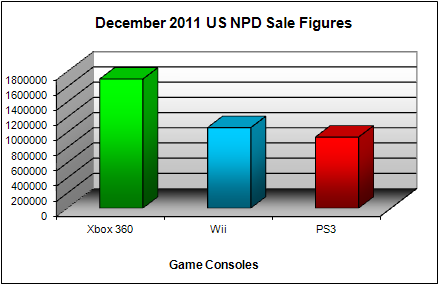
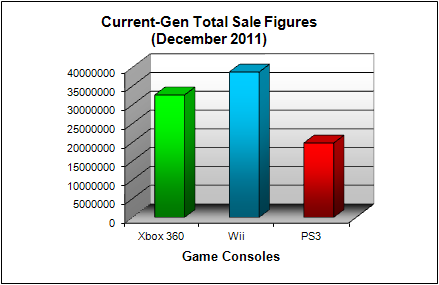
  • Xbox 360: 1,700,000 (Total: 30.9 million; December 2010: 1,860,000 – down 8.6%)
  • Wii: 1,060,000 (Total: 37.7 million; December 2010: 2,360,000 – down 55%)
  • PS3: 936,000 (Total: 18.9 million; December 2010: 1,210,000 – down 22.6%)
NPD December 2011 Game Console US Sales Figures

NPD December 2011 Game Console US Sales Figures

NPD Game Console Total US Sales Figures (as of December 2011)

NPD Game Console Total US Sales Figures (as of December 2011)

My prediction from last month was:

Same hardware ordering, and a software chart that looks very similar to this month’s, so there’s nothing much to add to that really.

While the software chart has a lot of titles that were there in November, the hardware ordering actually changed, with the PS3 dropping back down to third place, after finishing above the Wii last month.

Overall, looking at the figures above, and the “sea of red”, December 2011 has been nothing short of a disastrous month for video game sales, especially compared to last December. As mentioned earlier, a huge percentage of sales occur in December, but this last particular December did not even out do the previous month, when historically, this has almost always been the case. In fact, for hardware sales, the raw numbers were at its lowest since 2005.

Microsoft was probably the “winner”, if you can call it that (more like the smallest loser), with only an 8.6% drop in console sales, and level in sales with November. The NPD pointed to the strength of the Xbox 360 throughout the year, saying that the Xbox 360 platform accounted for nearly 40% of annual physical retail sales, across all categories. Still, if you count November and December together as one period, then 2011 has been good to the Xbox 360, with 3.4 million consoles sold, compared to 3.23 million a year ago. Microsoft probably had hoped the Kinect Star Wars game and console bundle would have made it in time, helping to push the console, and Kinect, to the next level, but the delay to the game means that there were no real A-list Kinect titles for this holiday period (unless you count Kinect Sports 2, and Dance Central 2, as A-list titles).

Despite finishing as the third most popular console, the PS3 was probably in second place overall, when you look at the year-to-year decrease figure, as well as performances across both November and December. Nearly 1.84 million PS3 consoles were sold during November and December, compared to 1.74 million consoles in 2011. So the good news is that, things are not that bad, while the bad news is that, the Xbox 360 appears to be pulling further ahead in the United States, where during the same period, it had almost twice as many sales (and more console sales during the holiday period, means more game sales for the rest of next year, and also means a strengthening multiplayer community, the growth of which relies on people using the same console as their friends).

So the real loser is, once again, Nintendo. The Wii, previously the unstoppable juggernaut during December sales, is no more, and is relegated to a distant second place behind the Xbox 360. For November and December, 1.92 million Wiis were sold, compared to 3.63 million in 2010 – in fact, more Wiis were sold in December of 2010 alone, than November an December of 2011 combined! A 55% year-on-year drop shows that the Wii is no longer the “must-have” video game gift, with some of the sales going to the Xbox 360 (not many, looking at the figures above), and possibly lots of sales going to things like tablets and smartphones, the new home of casual gaming.

And that’s probably the best way to look at things for the video game industry as a whole, for the most recent holiday period. The industry has benefited from the Wii becoming a must-have gift item for the last several holiday periods. Kinect has contributed to the same phenomenon, but it just hasn’t been the same. And with so many other gadgets to distract the holiday shopper, and also the economy, the decline can almost been seen as a return to normal, after a couple of years of extraordinary performance led by the Wii. Maybe the Wii U will bring back the same thing next year, but expectations must be readjusted.

As for software sales, it was also down compared to December 2010. MW3 led the chart again, with Skyrim dropping to third after the resurgence of Just Dance 3. Interestingly, looking at total sales for 2011, the ordering of the top 3 was exactly the same as the December top 3, showing that Call of Duty, and perhaps surprisingly, Just Dance, were the top 2 franchises for 2011. Mario Kart 7 on the 3DS was the only new entry into the top 10 in December. Here’s the full software sales chart for December (new releases for December 2011 in bold):

  1. Call of Duty: Modern Warfare 3 (Activision, Xbox 360, PS3, Wii, PC)
  2. Just Dance 3 (Ubisoft, Wii, Xbox 360)
  3. Elder Scrolls V: Skyrim (Bethesda, Xbox 360, PS3, PC)
  4. Mario Kart 7 (Nintendo, 3DS)
  5. Battlefield 3 (EA, Xbox 360, PS3, PC)
  6. Madden NFL 12 (EA, Xbox 360, PS3, Wii, PS2, PSP)
  7. Assassin’s Creed: Revelations (Ubisoft, Xbox 360, PS3, PC)
  8. NBA 2K12 (Take-Two Interactive, Xbox 360, PS3, PS2, PSP, Wii, PC)
  9. Super Mario 3D Land (Nintendo, 3DS)
  10. Batman: Arkham City (Warner Bros, Xbox 360, PS3)

Predicting January is always difficult, as the post holiday lull will be here, and there would usually be stock issues (although with the low sales this year, maybe this won’t be an issue). I suspect, other than huge drops in console sales figures for all consoles, the PS3 will probably regain 2nd place, with the Xbox 360 still the top selling console. A subdued month as well for software sale.

See you next month.

Weekly News Roundup (18 December 2011)

Sunday, December 18th, 2011

As the holiday period truly begins (and by use of the term ‘holiday’, I’m not trying to avoid saying Christmas or in any way take part in the largely fictional “war on Christmas”, rather as a shorthand for saying Christmas and New Year, and I guess having to explain it like this sort of negates the whole shorthand thing, but you can’t be too careful these days) … where as I, um, yes, as the holiday period begins, the news will dry up, and it’s even debatable whether next week’s issue of the WNR is still on or not. Regardless, the week before Christmas is also the last week in which the Copyright Scrooges can manoeuvre to get their beloved SOPA passed in Congress, and so it’s busier than normal.

The US video game sales figures for November was also released during the week, and you can read the full analysis here.

Copyright

Before we talk more about video games, let’s go through the week’s copyright news first. Once again, we see why money and politics shouldn’t really mix, as news that two Congressional staffers largely responsible for drafting SOPA/PIPA have now “managed” to get better jobs at the MPAA and the National Music Publishers’ Association, two copyright lobbying organisations.

While laws prevent these two from coming back and lobbying their former employees (as if that’s even needed), there are the usual Washington loopholes that still allow the two to have influence on Capitol Hill. The MPAA and the NMPA will argue that this is how it’s supposed to work, that the organisations have managed to secure the service of two very capable, and knowledgeable, people who are already familiar with the issues at hand. Everyone else will be made uncomfortable at yet another incident that highlights the incestuous relationship between lobbyists and politicians. While only the MPAA/NMPA and the two new employees will know what the real deal was, the reality is that the two helped to draft bills that (intentionally, or just incidentally) gave their future employers exactly what they wanted, convinced their old bosses to go along with it, and got new, higher paying jobs as a reward. Whether this was just the unintentional consequence of their actions, or something more troubling that involved more coordination between the involved parties, I don’t want to comment, but sometimes just the appearance of something like this is unacceptable for a truly democratic society, or at least it should be.

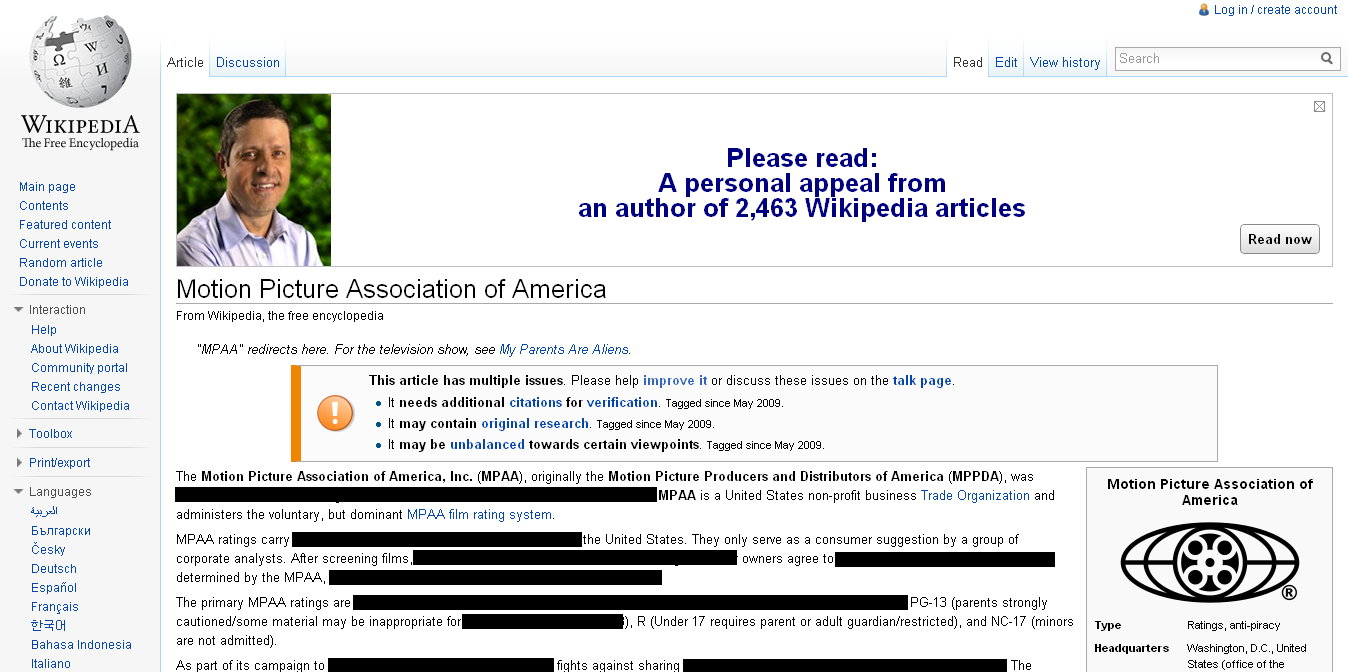
MPAA Wikipedia Page Censored

A mock up of what Wikipedia's anti-SOPA protest could look like, with sections or even entire pages blanked to show the dangers of Internet censorship

With breaking (well, by the WNR’s  standards anyway) news that further discussion of SOPA will have to wait until after the Congressional break, the anti-SOPA movement main gain an important ally before then, with Wikipedia threatening a day of action to protest the controversial copyright bill. The founder of Wikipedia, the man whose photo you see every couple of months on every Wikipedia page, Jimmy Wales, has suggested that Wikipedia might blank all of its pages, for a short period, to demonstrate against SOPA, something the Italian version of the encyclopaedia has already attempted to great success over a local issue. Right now, it’s all just discussions, because, as Wales rightly points out, doing something like this could have a huge impact on the web. I mean, would somebody please think of the children … who have to write school reports, and what the hell would they do without Wikipedia (and the copy/paste function)? Use another online encyclopaedia, or heavens forbid, go to the library?

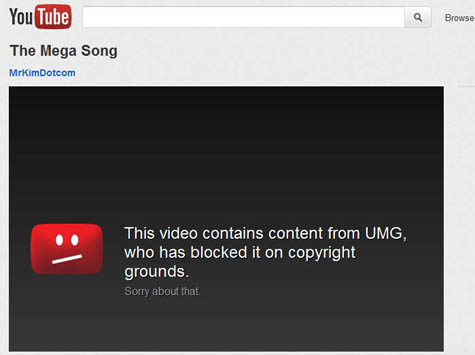
And for the anti-SOPA brigade (for all the work I’ve put into the cause, I must be a lance corporal by now, which ironically is also my rank in BF3 – I’m really really not good at the game), Christmas has come early thanks to Universal Music Group’s Scrooge-tastic act that helped to prove why content holders cannot be trusted with the power to censor the Internet. The story begins with the YouTube upload of Megaupload’s cheesy promotional video, starring some of today’s biggest stars, such as Kim Kardashian, P. Diddy, Will.i.am, Alicia Keys, Kanye West, Snoop Dogg, Chris Brown, and sung by Macy Gray. Using an original song, and with written agreements signed for all the stars, what Megaupload didn’t expect was for Universal Music Group (UMG) to abuse YouTube’s anti-piracy tool, to file an infringement report against the music video and have it censored. But that’s exactly what UMG did, although they now deny they did it for copyright reasons, hinting at some unknown agreement between two private companies (possibly relating to recordings of live performances), YouTube and Universal. Not that this makes it any better, of course, as the end result is that a perfectly legal video that presented views that UMG did not approve of (or rather, they don’t approve of Megaupload, period), and UMG had it taken down, which is the very definition of censorship. And because of an agreement between two other private companies (something SOPA would allow, as content holders can make agreements with financial providers to “kill” websites outside of the legal justice system), the tools/rules designed to handle copyright disputes was “abused” to censor free speech, however cheesy it was. What a wonderful demonstration of what a post-SOPA Internet world could be like.

Megaupload's Mega Song was blocked on YouTube by UMG

Megaupload's Mega Song was blocked on YouTube by UMG - innocent mistake, or censorship masquerading as a copyright take-down?

Megaupload was quick to file a lawsuit against UMG, and YouTube eventually did reinstate the video with the explanation that, yes, UMG did abuse its tool: “Our partners do not have the right to take down videos from YouTube unless they own the rights to them or they are live performances controlled through exclusive agreements with their artists, which is why we reinstated it.”

But the Streisand Effect ensures just the YouTube version, which was blocked for quite a while, now has over half a million views, and made #Megaupload a trending tag for a while on Twitter. Nice one UMG. And who knew controversy is such a great way to promote a music video, perhaps it’s something UMG can leverage to its own benefit the next time.

Speaking of promoting videos, very funny comedian Louis CK has done something that traditional media won’t be laughing at – he’s bypassing the normal distribution channels, and releasing his own video for $5, and without DRM. And it’s proven to be somewhat of a success, with CK taking in over $200,000 (profit after cost) in just 4 days. According to CK himself, that’s less than what he would have gotten from a traditional distributor, but he’s happy because more people have managed to get a legal version of his video, and nobody had to endure horrible DRM or annoying marketing (register here, register there, give us all your personal info, and then get spammed in your inbox forever). Some have argued that this is a bad development for media distribution, since by taking out the middle men, that’s fewer people being employed. And that argument has some merit, and I’ve long argued that the whole wholesale/distribution/retail chain will suffer, if it isn’t suffering already, due to the digital revolution. But there are strategies to adapt, but those too slow, too paranoid or too stubborn to change, that is the companies that insist on charging digital downloads at the same price as retail boxed version, and those that insist on DRM, will not survive this revolution. And the more they try to hold on to the dying model, the more artists will release themselves from the clutches of traditional media and do it their own way – the truth is that nobody wants to do it alone, unless they have to, and through DRM, bad pricing, and incessant marketing and all the things they’ve done to alienate consumers, traditional media are forcing artists to go it alone.

For now, Louis CK’s video is still selling, despite widespread piracy (not that DRM would have lessened it or anything), and Louis urges everyone to keep buying, as so he “can have shitloads of money”.

And buying, as opposed to torrenting, might also help you avoid public embarrassment, as a new website has been launched to try and embarrass torrenters by listing their IP address and the stuff they’ve downloaded, even the videos of the naughty kind. While downloading from a public tracker does have this risk, those with dynamic IPs may not care too much, still, I don’t think I can support any service that publishes data like this. It would be like if a website, say Google, decided to public its web logs, of which IP address searched for what and when, and that has huge privacy implications. Just because this website is seeking to expose illegal behaviour, doesn’t mean it isn’t a privacy violation.

With that said, it was funny that the website would be used to put anti-piracy groups under pressure, as opposed to the people who actually pirate. This is because the website allows you to search for any IP address, including say the IP address of movie studios, or anti-piracy lobbyists, or even the anti-piracy domain seizing Department of Homeland Security. It certainly was interesting to see staff at NBC-Universal downloading the excellent Game of Thrones, perhaps proving that network TV does know a good series when they see one, even if they don’t actually know (or dare) to reproduce it for their own networks. How about someone at Fox downloading Super 8, produced by another studio? Or the RIAA downloading the latest Kanye West album?

Of course, the right argument is that you cannot really hold the RIAA responsible just because one of their IP addresses was used to illegally download something. It could be by an employee, an ex-employee, a visitor who managed to get access to a network connection, or as some have already claimed, be an unlikely case of IP spoofing. And as long as the RIAA has an appropriate anti-piracy policy, and enforces it, then they shouldn’t be held responsible for the actions of individuals. But since the RIAA don’t think any of this applies to, say Google or ISPs, and that they need to pass tough legislation to punish these organisations, I can only conclude that, yes, the RIAA is guilty of copyright infringement, possibly on a massive scale, and they should be punished accordingly.

Gaming

Not much happening in 3D/HD, so let’s skip to gaming. The NPD sales figures for November presented no big surprises in the Xbox 360 outselling everything else, and I think it’s safe to say that it is currently the dominant console in the US, for this generation.

To be fair (or unfair), the PS3 is really the only loser in this generation, in the US or elsewhere, despite PS3 sales doing pretty well worldwide. I say this not to incite fanboy-on-fanboy violence, although that would be an effective way to cull their numbers, but simply because neither Nintendo nor Microsoft could have predicted their respective successes in this generation, which has come largely at the expense of the PlayStation brand. The fact that the PS3 will likely never outsell the PS2 is disappointing given the huge advantage the brand had over the offerings by Nintendo and Microsoft in the last generation, plus the advantage of also being a Blu-ray player (the DVD player in the PS2 being partially responsible for the unit’s success).

It was also interesting to see Modern Warfare 3 break all sales records, despite a struggling economy, wide spread piracy and everything. I’ve only secured my (PC) version recently, and only because it was below retail pricing, so pricing is important as ever. One issue that’s becoming more and more important is regional pricing, especially on Steam for non US buyers. Here in Australia, we get ripped off due to publishers (not Steam) setting higher prices than compared to say the US or the UK. This has led to others using VPNs to buy games from overseas (with the high risk of getting their Steam account banned), or buying from Russian based CD-key sites. It’s a lot of trouble for people to have to go through just so they can hand money to game publishers, and it’s easy to see why some might see piracy as a legitimate source for games, until prices drop to more reasonable levels. The globalised price competition is one of the downsides of a globalised marketplace for sellers, but they benefit from being able to access more markets and more customers than ever, and digital distribution strips away almost all of the manufacturing cost from things, so it should all even out in the end. But only if reasonable pricing policies are put in place, one that is fair to countries like Australia, and can also compete against piracy ($80 vs free is not competition, but $30 to make the guilt go away, plus access online services without fear of having an illegitimate key, might be).

I think that’s enough for this week. See you next week (maybe).

Game Consoles – November 2011 NPD Sales Figure Analysis

Tuesday, December 13th, 2011

Welcome to the November 2011 edition of our regular NPD US video game sales analysis. In this feature, we look at video game sales, both hardware and software, for the month of November 2011 based on data collected by the NPD. The holiday period truly begins at November, with the Black Friday sales, it comes an important indicator as to how each game console will do during the entire Holiday period. Last year, the Xbox 360 narrowly beat a resurgent Wii, while the PS3 languished in a distant third. Will this year be any different, and will the best selling game in the history of video games, Modern Warfare 3, help hardware sales? Read on the find out.

As NPD no longer releases full hardware sales figures, this feature is reliant on the game companies, namely Microsoft, Nintendo and Sony, to release their set of figures and based on “statement math” (that is, arithmetically calculate missing figures based on statements made). For November 2011, these are the statements made by the gaming companies:

  • Nintendo reveals the Wii sold 860,000 units, with “more than 795,000” 3DS consoles, and “more than 350,000” units of DS (via PR email)
  • Microsoft revealed 1.7 million Xbox 360 hardware units sold, with 49% of the home based console market share (source)
  • Sony said that the PS3 hardware saw a “70% increase” in sales (via Patrick Seybold, Sr. Direcrtor of Corporate Communications at SCEA)

Luckily, all the statement maths added up this month, since from Microsoft and Nintendo’s statements, we can deduce the PS3 numbers to be around 900,000, and that falls into line with Sony’s “70% increase” statement (increase compared to the same time last year).

And so the figures for US sales in November 2011 are below, ranked in order of number of sales (November 2010 figures also shown, including percentage change):

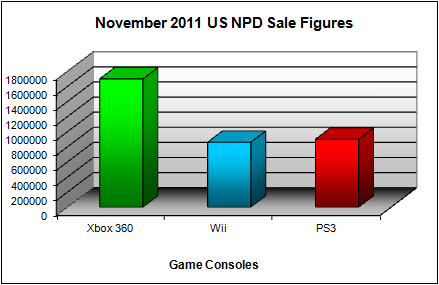
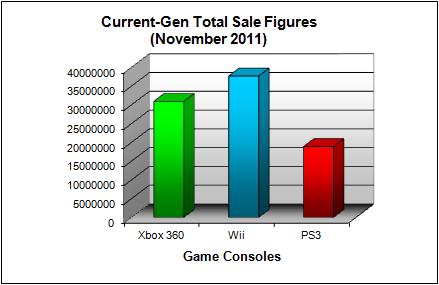
  • Xbox 360: 1,700,000 (Total: 30.9 million; November 2010: 1,370,000 – up 24%)
  • PS3: 900,000 (Total: 18.9 million; November 2010: 530,000 – up 70%)
  • Wii: 860,000 (Total: 37.7 million; November 2010: 1,270,000 – down 32%)
NPD November 2011 Game Console US Sales Figures

NPD November 2011 Game Console US Sales Figures

NPD Game Console Total US Sales Figures (as of November 2011)

NPD Game Console Total US Sales Figures (as of November 2011)

My prediction from last month was:

It’s the holiday period proper, sales will be way up, and Modern Warfare 3 will help in this regard as it breaks all records. The Xbox 360, the preferred platform of MW3 and also with a new Halo game being released, will be the clear winner yet again, but it will be interesting to see if the Wii can have one last good holiday period, and there’s a new Zelda game too, so that always helps. The PS3 does have Uncharted 3 though. If I have to guess, I would say the PS3 will beat the Wii. The top games will be the ones I’ve already mentioned, plus Skyrim.

I think the above paragraph actually sums up November quite well.

The Xbox 360 was easily the clear winner, but the margin of victory was larger than most has expected. Most expected the Xbox 360 to be the best selling console, but with only moderate growth compared to the same month last year, the first holiday period for Kinect and the new “slim” Xbox 360. But Microsoft surprised everyone with a series of key price cuts, bundles, and sales, and just like how the Wii’s second holiday period was even better than the first thanks to its status as a “must-have” family gift, perhaps the Kinect is doing the same for Microsoft this time round. In any case, a 24% increase in sales compared to last November is nothing to be scoffed at, especially when last November was an amazing 67% up compared to the previous November. Here in Australia, Microsoft has also been super aggressive in discounting the Xbox 360, to prices that are practically half that of just a few months ago, and the Kinect bundle also seeing huge discounts at selected retailers. If this is the same strategy employed in other countries as well, then the Xbox 360 should have a great holiday period, and not just in the US (perhaps this is Microsoft’s response to PS3 sales that have nearly or already caught up to the 360 global sales numbers).

The PS3 also had a great November, although nowhere near as good as the Xbox 360, with the 360 almost selling twice as many units. The 70% increase compared to last November looks spectacular, but one has to take into account that last November, the PS3 sold fewer units than in 2009 (25% down actually). Compared to 2009, PS3 sales are up around 26%, so at the very least, last year’s trend has been reversed with the key price cut that came in the middle of the year. Sony also promoted the fact that PS3 software sales are up 30%, and that, more so than hardware numbers, is what Sony really likes to see (although hardware numbers obviously do help to raise the software numbers, and that’s more of a case now than the first few years of the PS3, when many used it as a cheap way to get a Blu-ray player).

It looks like 2010 was the last great holiday period for the Wii. While sales are not bad this year, they’re nowhere near the million+ figures from yesteryear. And this will be the last holiday period for the Wii as Nintendo’s lead console anyway, with the Wii U set to play a key role this time next year. Still, to label the Wii as a “loser” or “dead” is doing the console a disservice, since it still nearly outsell the PS3, and nobody it calling it a “dead” console.

On to software. As expected, MW3 completely dominated the sales charts, with incredibly, 9 million units of the game selling on all platforms, with over a billion dollars in sales. Battlefield 3 fell to 3rd place as a result, but it’s still the best selling Battlefield game in the series. Skyrim, the game many are already calling game of the year, managed to get second place and that’s probably quite impressive for a game in this genre, and certainly in the Elder Scrolls series, where it’s only taken a month for the latest installment to sell without half a million of the last installment’s lifetime sales number. Assassin’s Creed: Revelations, Saints Row: The Third contributed to the strong software line-up for November, making it the best November on record, despite recent trend suggesting that wouldn’t have been the case. For platform exclusives, Uncharted 3 did extremely well to get up to 7th place with 700,000 units sold, ahead of the new Zelda game at 600,000. Super Mario Land 3D and Halo: Combat Evolved Anniversary didn’t make the combined platforms top 10, but would have easily made the top 10 separated by SKU. Here’s the full software sales chart for November (new releases for November 2011 in bold):

  1. Call of Duty: Modern Warfare 3 (Activision, Xbox 360, PS3, Wii, PC)
  2. Elder Scrolls V: Skyrim (Bethesda, Xbox 360, PS3, PC)
  3. Battlefield 3 (EA, Xbox 360, PS3, PC)
  4. Assassin’s Creed: Revelations (Ubisoft, Xbox 360, PS3, PC)
  5. Just Dance 3 (Ubisoft, Wii, Xbox 360)
  6. Madden NFL 12 (EA, Xbox 360, PS3, Wii, PS2, PSP)
  7. Uncharted 3: Drake’s Deception (Sony, PS3)
  8. Saints Row: The Third (THQ, Xbox 360, PS3, PC)
  9. The Legend of Zelda: Skyward Sword (Nintendo, Wii)
  10. Batman: Arkham City (Warner Bros, Xbox 360, PS3)

My prediction for December? Same hardware ordering, and a software chart that looks very similar to this month’s, so there’s nothing much to add to that really.

Except for the obligatory, “see you next month”!