Archive for the ‘NPD Analysis’ Category

Game Consoles – June 2011 NPD Sales Figure Analysis

Thursday, July 21st, 2011

Welcome to another monthly edition of the NPD Game Console Sales Analysis, this time analyzing the home based game console hardware and software sales for the month of June 2011. We’re once again one console short of having all the hardware sales statistics, and once again, it’s Sony that’s the lone holdout. But thanks to information released by the other manufacturers, mainly Microsoft, we can still estimate fairly accurately what Sony’s PS3 hardware sales numbers look like, and so the NPD analysis feature can continue for one more month. For those that are new to this, this analysis looks at US video games sales figures compiled by NPD, unreleased by NPD due to pressure from the gaming companies, but then leaked by various sources, including gaming companies, if/when it suits them.

The figures for US sales in June 2011 are below, ranked in order of number of sales (June 2010 figures also shown, including percentage change):

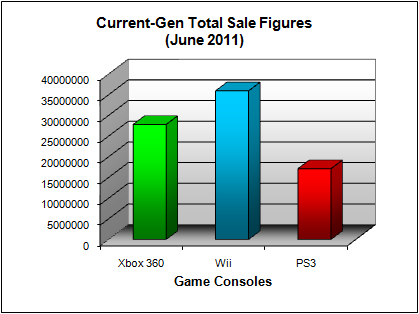
  • Xbox 360: 507,000 (Total: 27.8 million; June 2010: 451,700 – up 12%)
  • PS3: 276,000 (estimated) (Total: 17.1 million; June 2010: 304,800 – down 9%)
  • Wii: 273,000  (Total: 35.9 million; June 2010: 422,500 – down 35%)
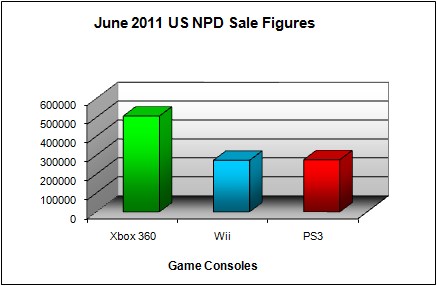
NPD June 2011 Game Console US Sales Figures
NPD June 2011 Game Console US Sales Figures

NPD Game Console Total US Sales Figures (as of June 2011)

NPD Game Console Total US Sales Figures (as of June 2011)

My prediction from last month was:

No big changes, so the same hardware ordering as this month. The new top selling games will be Infamous 2 and Duke Nukem Forever (on a side note, ‘Forever’ really is such an apt name for the game considering the development time), but the overall top sellers will be some of the same titles as in May.

If my estimation of PS3 hardware sales is correct, then I was wrong about the ordering of hardware sales, although it was a close run affair between the PS3 and the Wii. Software wise, both Duke Nukem Forever and Infamous 3 made their marks on the top 10, but more on that later.

Starting with the PS3 hardware estimation, I think it’s best I go over the estimation process, which ironically, were mostly based on statements made by Microsoft, since Sony made no mention of their hardware results this month. It all comes from the slightly vague Microsoft statement about having a “48% share of the overall current-generation console market share”. It’s vague because when Microsoft talks about “current-generation”, it’s unclear if they’re referring to all consoles, or just the home based consoles, but it should be the latter, since the former won’t make sense. And Microsoft should also be talking about June only, since for life-time wise, and even 2011-wise, the “48%” market share just doesn’t add up. And armed with the “knowledge”, and knowing both the Xbox 360 and Wii’s hardware stats, it’s then quite easy to estimate the PS3’s hardware sales number for June, which comes to around 276,000. And Microsoft’s other statement about nearly selling twice as many units as their nearest competitor seems to support this number, since any higher, and Microsoft wouldn’t have been able to make the claim without stretching the meaning of the term “nearly”.

At first glance, this seems to be a good result for Sony. PS3 hardware sales are up more than 100,000 units compared to the previous month, and it did beat the Wii, if the numbers are correct. So why didn’t Sony (loudly) pronounce these set of good results, and instead, went all quiet in their press release in regards to the hardware numbers? I can only guess is that there was no year-on-year growth for the PS3 in June, as June 2010 recorded higher sales for the console. If my estimation is correct, this breaks a 4 month trend in which the PS3 has seen year-on-year growth, and perhaps this is what Sony didn’t want to focus on (especially, given the PSN hack, media “hacks” will jump to the conclusion that the breaking of the trend is a direct result of the hacking outage). But more careful analysis shows that June 2010 was a better than usual month for the PS3, which I attributed back then to the clearing up of the PS3 stock shortage problem that hurt sales for the console throughout the first half of 2010 (June 2010 was 85% higher than June 2009). So for the PS3 to not perform as well in June 2011 as in June 2010, is really no big deal, and the decline was mild anyway, nothing like that of say, the Wii.

Which brings us to the Wii. 35% down compared to the same month last year, and nothing really positive can be said of the Wii, other than the fact that, for such a technologically inferior console, it’s done remarkably well and surely has already made Nintendo enough money. And with the Wii U already announced, the Wii’s results will become less and less important for Nintendo as they concentrate on the development of the Wii U.

And last, but certainly not the least, we have the tremendous Xbox 360 numbers. Nearly double that of last month’s results, and the only console yet again to show year-on-year growth. This is made more remarkable by the fact that, this time last year, the new “Slim” model came out, and the sales bump associated with it meant that it was always unlikely that the Xbox 360 would have any sort of year-on-year growth, but here we are. Now, some of this can be attributed to various bundling deals Microsoft had, including the deal where selected PC purchases get a free Xbox 360, and the fact that the “Slim” didn’t go on sale until midway through June 2010. So next month, we could see the first ever year-on-year sales decline for the Xbox 360 in quite  a while (versus last year’s sales bump), although it’s still a shoe-in to win the best selling console of the month award. Regardless, it’s been an impressive year for the Xbox 360, and the “Slim” has been a huge success, since it now makes the Xbox 360 the most balanced console in terms of price, performance (no more RRoD!), and audience (both hardcore and casual/family gamers are well catered for).

Onto software sales, or games. L.A. Noire retains top spot, as the new releases, Duke Nukem Forever and the PS3 exclusive Infamous 2 could not unseat the crime solving game. While Sony was remaining tight lipped about the PS3 hardware numbers, they rightly made a big deal about the performance of Infamous 2, which although third, is still the highest single-platform performer for June. It certainly did better than its predecessor, released in May 2009, and ranked only 5th, even though the chart back then was split based on platform specific releases, not like this month’s chart, which combines all platform sales for the same title as one listing. And releasing an exclusive earlier in the month, as opposed to in the last few days, does help it to climb the ranks. The other notable new entries for this month include the 3DS version of Zelda: Ocarina of Time, and Disney’s Cars 2. Here’s the full software sales chart for June:

  1. L.A Noire (Take 2, Xbox 360, PS3)
  2. Duke Nukem Forever (Take 2, Xbox 360, PS3, PC)
  3. Infamous 2 (Sony, PS3)
  4. Lego Pirates of the Caribbean (Disney, Wii, Xbox 360, NDS, PS3, 3DS, PSP, PC)
  5. Legend of Zelda: Ocarina of Time 3D (Nintendo, 3DS)
  6. Call of Duty: Black Ops (Activision Blizzard, Xbox 360, PS3, Wii, NDS,PC)
  7. NBA 2K11 (Take 2, Xbox 360, PS3, Wii, PS2, PSP, PC)
  8. Mortal Kombat 2011 (Warner Bros. Interactive, PS3, Xbox 360)
  9. Cars 2 (Disney, NDS, Wii, Xbox 360, PS3, PC)
  10. Just Dance 2 (Ubisoft, Wii)

Time to make the usual prediction. As mentioned earlier, I think the Xbox 360 will experience its first year-on-year decline in ages, but still comfortably stay at the top of the home based console hardware sales charts, leaving the Wii and PS3 to fight it out for second and third place, and I think the Wii might be better positioned to win for some reason. It’s NCAA Football season again, so it will be the top seller, but otherwise, not a huge month for games again.

See you next month.

Weekly News Roundup (17 July 2011)

Sunday, July 17th, 2011

A news-tastic week, and I guess we were due one. It’s a shame, because I was quite busy messing up my Paper (Star) Wars Android game update, in which I released not one, not two, but three versions of the app. It always happens like this though, you get ready to release an update, do all the testing you can, confident that it works, and then you release it only to find that it’s introduced even more bugs than before. But sometimes it’s hard to properly test an app that, according to Android Market, can be deployed on 430+ different Android devices. I added a crash report feature to the app, so that I can get a report every time it crashes, and so far, no new crash reports in the last 72 hours, so that’s something I guess. I also took the opportunity to add an official website for the app, which includes some getting started tips, and also Facebook and Twitter pages.

With plenty of news to go through, let’s get started.

CopyrightIn Copyright news, opposition to the controversial PROTECT IP act is gaining momentum, as this week, more than 100 law professors from around the United States have signed an open letter urging Congress to reconsider the new copyright legislation.

So we’ve had Internet pioneer, leaders in the field of technology, and now also law experts, all coming out attacking PROTECT IP. The law professors repeated the same warnings about messing with the Internet’s naming system, but more importantly, they argued that, from a freedom of speech point of view. But it won’t be the first time Congress has ignored expert advice in favour of lobbyist suggestions, and so, I’m not too hopeful that PROTECT IP will be defeated.

Fair Use

Fair use creates jobs, while tougher copyright may destroy them

And the politicians will not find it a difficult to support the RIAA and MPAA, because, as you know, it’s all about the jobs. The RIAA and MPAA have been arguing that tougher copyright protection means more jobs, and a politician in the current climate can’t afford to be seen as being anti-jobs, even if it is at the expense of being anti-free speech. But a new report by the Computer and Communications Industry Association (CCIA) shows that tougher copyright laws may actually have a negative effect on job creation, as it turns out, the US economy these days are very much driven by fair use related activities. Even I didn’t realise that fair use related industries accounted for 17% of the entire United States’ GDP, some $4.5 trillion in value added contributions. That’s much greater than the film and music business combined, and it makes sense when you see companies like Google, Facebook, Mozilla all embracing open source and taking advantage of fair use in some way.

PROTECT IP, in many ways, is just a protectionist measure in favour of the film and music business, and such measures always hurt other industries, and in this case, it’s the huge tech/Internet industry. But because one industry is more active in lobbying than the others, common sense does not always prevail in Washington. And just because the film and music business receives more protection, it doesn’t mean that they actually benefit financially as well, because tougher copyright laws does not equal more sales (and could even equal less).

If the US wants to see a real world example of tougher copyright laws, and the effect it has on revenue, they can simple look towards France, and see how their “Hadopi” three-strikes law (named after the agency, Hadopi, that is in charge of administering the program)  is working out. A new report shows the extraordinary level of monitoring that occurs, some 18 million incidents of piracy were recorded in just nine months. But out of the 18 million, only 470,000 users were sent “first-strike” emails, warning them of alleged copyright infringement being conducted via their Internet accounts. And then, in what seems to be strongest indication of the effectiveness of three-strikes, only 20,000 “second-strike” emails were sent out, suggesting that 450,000 people took the first warning the right way and “stopped” pirating. And at the end of it all, only 10 people were being considered for further action after reaching their third strike – so that’s millions spent to catch 10 people.

But despite what appears to be a 95% reduction in piracy (going from 470,000 first time offenders to only 20,000 second time offenders), there’s almost no information on the actual economic benefits of the reduction in piracy, if the reduction even exists. I can only assume that there has been no positive effect on music and movie sales in France as a result of three-strikes, because otherwise, the RIAA/MPAA would be using it as evidence that every country in the world should adopt graduated response. And just because people stopped being detected, it doesn’t mean they’ve stopped pirating – direct downloads have never been monitored by Hadopi, and it’s impossible for them to monitor BitTorrent usage if it’s done via a VPN either.

It makes perfect sense to me though, that if someone who couldn’t afford to buy a movie or a piece of music still remains in the same situation after tougher copyright laws are introduced, and as long as this is true, there can be no increase in revenue. People will stop enjoying content illegally, and if they can’t afford the legal version, they will simply stop enjoying the content entirely. And this reduces the word of mouth effect, and also prevents “upgraders”, those that download illegally and then purchase later because they really liked the content. And so, tougher copyright laws may actually lead to revenue loss. The truth of the matter is that movie home entertainment revenue is much higher than what it was before the Internet become popular, and so is gaming. And that while the music industry isn’t doing as well, increased competition from other sectors (such as movies and gaming), and the increasing popularity of purchasing music singles over albums, are all more accountable for the decline in revenue than just piracy. The music industry needs to stop blaming piracy on all of its problems, and the movie industry needs to stop pretending there is a problem (what with box office receipts at an all time high, and home entertainment revenue up significantly compared to 15 years ago).

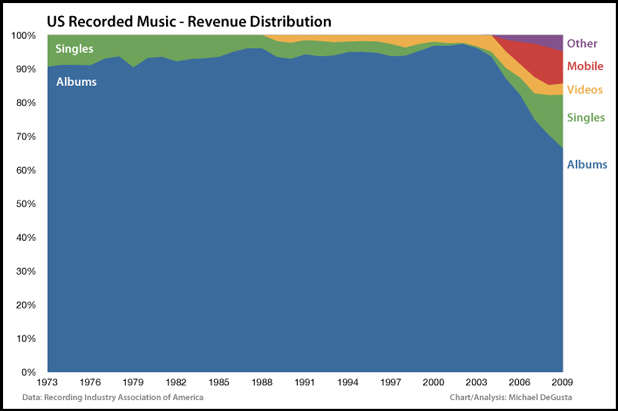
Music Industry Revenue by Content Type

This graph shows that music industry revenue has been dominated by album sales ...

Music industry revenue for albums on different formats

... and as you can see, albums were popular on CD but has been declining ...

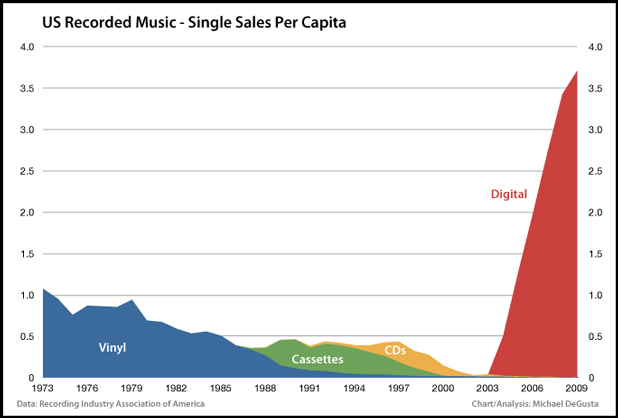
Music industry revenue for singles on different formats

... and this graph shows digital music is all about singles, which may explain the industry's revenue loss

The truth is that the way people consume content has changed drastically, and yes, a lot of that is due to the Internet. But with change, comes opportunity, and if the film and music industry aren’t interested in exploring the new opportunities, others will, and in this case, it has been the technology companies, like Apple and Netflix, that has benefited the most. And the latest to join their ranks may be Spotify, which has just been launched in the United States, albeit in a limited invitation only phase. Spotify attempts to address one of the fundamental shifts in media consumption, the lessening need to “own” music (well, people never owned music anyway, there merely licensed a recording of it), and the increasing need to consume (which makes owning far too expensive and time consuming to manage). So instead, people stream all the music they want in an on-demand fashion, for free if they’re willing to put up with ads. It’s completely legal, so no moral guilty as compared to piracy, plus the music industry can receive financial compensation. And those that do want to “own”, or at least rent, can buy one of Spotify’s paid for plans, with more money going towards the music industry. With Spotify, there’s almost no reason at all for pirating music.

Spotify Logo

Spotify is launching in the US, and there are now even fewer reasons for people to pirate music

And in a similar vein, UltraViolet for movies also attempt to change the way content is sold to more closely follow the consumer’s needs, an ambitious project that has the backing of more than 70 companies from a range of industries, with support, albeit reluctantly at certain aspects of it, from the movie industry. This week, UltraViolet licensing beings officially, and beta testing is also under way for an official launch later this year. If it works, it will finally allow movie lovers to buy the movie (or license it), as opposed to just buying the media that the movies comes on. It’s Digital Copy, but done right, with industry wide support, and done via the Internet.

And so, there is hope, that the music and film industry can embrace change and come out the other side stronger than before. Let’s just hope they don’t erode all of our civil rights, in a vain attempt to use legislation to stop copyright infringement, before then.

And finally, before we move on to other topics, the MPAA’s lawsuit against Hotfile has some new developments this week, as the judge in case threw out the MPAA’s claim of direct copyright infringement, simply on the grounds that Hotfile themselves did not upload any of the content that is considered to be infringing on the MPAA’s copyrights. However, the judge did feel Hotfile can be found guilty of secondary copyright infringement, of inducement to infringement by paying affiliates money for uploading popular content. I don’t think it will end well for Hotfile unfortunately, as the MPAA has chosen their target wisely, by choosing a file sharing host that actively promotes popular uploads with payment, and thus, encourage users  to upload pirated content.

High Definition

In HD/3D news, a new report suggests that Blu-ray will beat DVD by 2014 to become the most popular disc format around.

But even by then, Blu-ray’s gain in revenue would not have offset DVD’s loss, and so it will be digital media that saves the day. The report, from London-based Futuresource, says that at that time, physical media will still account for more than half of the industry’s revenue, but digital media won’t be too far behind, accounting for 46% of the market.

While Blu-ray only accounts for 13% of the sell-through market last year, it’s not too hard to believe Blu-ray will get close to 50% by 2014, especially if you look at recent data as listed in our weekly Blu-ray/DVD sales analysis. Blu-ray revenue, in the US at least, appears to be already above the 20% mark on average, and for some recent releases like ‘Sucker Punch’ have managed to has a first week Blu-ray market share way above this average (61.42% to be precise).

Blu-ray 3D Logo

Over 3.5 million Blu-ray 3D discs have been sold so far, but half of them were given away

There was also the news that 3D Blu-ray, despite the predictions of doom, has already sold some 3.5 million discs. Of course, half of these discs were given away with hardware, but with Avatar still not available for general sale on Blu-ray 3D, the number is still impressive. The main reason for the good result, and the good result of Blu-ray in general, is pricing. Blu-ray combos are now the best value packaging around usually, and with Blu-ray 3D “mega” combos becoming more popular (that is, the Blu-ray 3D version plus the Blu-ray 2D version, plus the DVD and Digital Copy versions), 3D is benefiting as a result.

What has decrease in value this week though is Netflix subscriptions, with price rises of up to 60% being announced. Netflix says the reason for the increase is due to their renewed focus on DVDs, by separating DVD and streaming into two separate, and cheaper plans (but at the same time, increasing the price of the combined plan). I suspect this price rise has to do with Netflix’s need to renegotiate digital rights for movies, with them having just agreed a new deal with Universal, and the need for a new deal with Sony. The rise in popularity of Netflix is obviously making studios feel they’ve not got the best deal they can, and they will want to squeeze as much out of Netflix as possible.

And before we move onto gaming, the news this week that new PS3s won’t be able to output Blu-ray in HD over component shouldn’t come as a surprise for those that read my news article on the Blu-ray analog sunset. Blu-ray’s copy protections system, AACS, mandated the removal of HD component support for all new players manufactured after January 1st 2011, and so the new PS3 model is just following the licensing agreement. The misinformation over HD being disabled even for games and streaming, is just that, misinformation.

Gaming

And in gaming, there’s actually not much, but I wanted to address the NPD issue again. The NPD report for June has just been released, and as been the case recently, it’s light on actual details, especially for hardware sales figures. But Microsoft and Nintendo have decided to released hardware sales figures for their consoles, once again leaving Sony as the holdout.

I’m hoping a leak will reveal the Sony PS3 numbers in the next few days, but even without the leak we can deduce that the PS3 probably didn’t do very well in June, despite Infamous 2 selling extremely well. First of all, the Xbox 360 was the most popular console with 507,000 units sold, while Nintendo revealed the sale of 273,000 Wiis. Microsoft’s statement mentioned their 507,000 was nearly twice as much as other home consoles, confirming the Wii number at least and pointing to the fact that the Wii was probably the second best selling console. And with Sony’s statement only pointing to the success of Infamous 2, with no acknowledgement of year-on-year growth for the PS3 (something they’ve been vocal about recently). In fact, Microsoft’s statement actually says the Xbox 360 is the only console to have year-on-year growth in June.

So the PS3 sold less than in June 2010 (304,800 units), and so the only issue is whether the PS3 outsold the Wii or not. Microsoft’s statement mentioned that the Xbox 360 held a “48% share of the overall current-generation console market share”, although it was unclear whether this referred to June or the whole of 2011 (it’s not lifetime sales, that’s for sure). Assuming it is for June, and for home based consoles only, then a little bit of maths puts the PS3 at 276,250 units (if 507,000 was 48%, extrapolate to 100%, then minus the known 360 and Wii numbers, to get the PS3 number).

But I hate guessing, so I’ll wait a few more days to see if there are any leaks to confirm my theory, but if not, then I’ll give Sony the benefit of the doubt for not mentioned they outsold the Wii, and use the estimated 276,000 figure.

That’s all for this news filled week. I suspect the next week will be very barren indeed news wise. See you next week.

Game Consoles – May 2011 NPD Sales Figure Analysis

Wednesday, June 15th, 2011

Thank the stars that through relatively good sales results, leaks and blind luck, that we have fairly accurate NPD sales stats for all three home consoles for the month of May 2011, and so our monthly NPD analysis continues for another month. With the PSN outage lasting for pretty much all of May (if you include the PSN Store outage), this month’s PS3 sales stats are particularly interesting to see if the outage has affected sales. E3’s major announcements have all been made, and so, it’s been a busy few weeks for gaming. For those that are new to this, this analysis looks at US video games sales figures compiled by NPD, unreleased by NPD due to pressure from the gaming companies, but then leaked by various sources, including gaming companies, if/when it suits them.

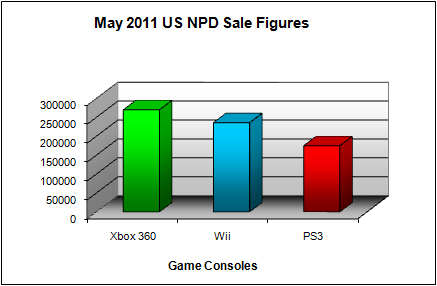
The figures for US sales in May 2011 are below, ranked in order of number of sales (May 2010 figures also shown, including percentage change):

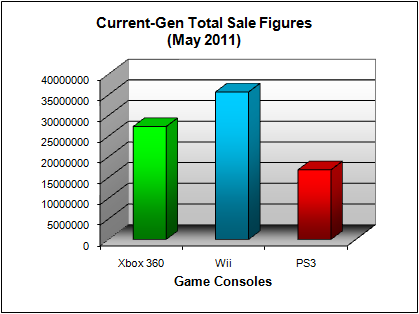
  • Xbox 360: 270,000 (Total: 27.3 million; May 2010: 194,600 – up 39%)
  • Wii: 236,000  (Total: 35.7 million; May 2010: 334,900 – down 30%)
  • PS3: 175,000 (Total: 16.9 million; May 2010: 154,500 – up 13%)
NPD May 2011 Game Console US Sales Figures

NPD May 2011 Game Console US Sales Figures

NPD Game Console Total US Sales Figures (as of May 2011)

NPD Game Console Total US Sales Figures (as of May 2011)

My prediction from last month was:

I don’t really want to make a prediction next month, because if I’m right, and that the PS3 number falls due to the PSN outage, then Sony won’t release the figures, and we don’t have an NPD. Regardless, I think the Xbox 360 would still be the top selling console, so it’s just a matter of how much the PSN outage hurts the PS3, and how much the Wii price cut helps the Wii. The biggest game new releases for May are L.A. Noire, Brink and LEGO Pirates of the Caribbean.

I should have stuck to my guns and not made any predictions, because it turns out that PS3 sales held and even rose compared to last month, and also compared to a year ago, and so Sony had no qualms about releasing the figures. It was Nintendo, strangely, that was the holdout until good old reliable Michael Pachter came to the rescue again and released the Wii numbers in an investor report. The Wii price cut did help the Wii to record a sales rise compared to April, thanks to the price drop. Ironically, it was the Xbox 360 that was the only home based console to record a drop in sales compared to April, but it was also the console that recorded by far the highest year-on-year growth – go figure! As for games, I did make the right prediction here, and even made it in the right order in terms of the top 3 sellers for May.

Let’s start with the PS3 numbers, which was the most anticipated set. The PS3, while still coming last in terms of sales, did record a year-on-year growth of 13%, as well as a minor increase in sales compared to April. This seems to suggest the PSN outage did not affect sales all that much. Sony also stated that this was the 4th month in a row that PS3 sales saw double digit growth, which is impressive considering the shenanigans of the last two month with the PSN. Apart from touting exclusives, Sony spent much of the time showing off their new portable, PlayStation Vita, as well as a PS3 3D TV that allows two player game play without a split screen, turning the 3D technology and glasses for 2D use.

Xbox 360 sales did fall compared to April, but compared to May 2010, hardware sales rose 39%, the highest out of all the consoles. The reason for the monthly fall may be due to April’s better than average result (which was 60% higher than April 2010, double the usual average). Certainly, looking at these numbers, the Xbox 360 looks the most healthy. For E3, Kinect was the focus, as it has been the catalyst behind the recent good results. Microsoft is promising all future first party titles will feature some Kinect features, which will be interesting. They also launched Kinect Labs, which is the Kinect app store. Kinect is keeping the Xbox 360 on top, and so it makes sense for Microsoft to concentrate on this area, especially since with the announcement of Wii U, we know that it is the sole console doing the “no controllers” thing.

That leaves the Wii, which could become the most sickly of all the consoles, despite outselling the PS3. The reason I say this is that given the trend of decline, around 30% compared to a year ago, by this time next year, it will be the worst selling home console. The trend has been pretty consistent, and it doesn’t look like it’s slowing at all. Which probably explains why Nintendo was the only company to unveiled a new home based console at E3, the Wii U. With no firm release date other than “sometime in 2012”, the Wii will have to suffer for a bit longer, but by the time that the PS3 does finally overtake the console the Wii U surely won’t be far away from release, which is probably what Nintendo is counting on. Certainly, it makes sense that Nintendo would be the first company out of the three to launch a new console, despite not being the first company to release their current generation consoles (Microsoft’s Xbox 360 was launched a year earlier). The Wii hardware is the oldest out of the three consoles, and it needed a refresh most urgently. The Wii U will feature hardware that’s 50% more powerful than the PS3, which sounds really impressive until you realise that the PS3 hardware is about 6 years old already (developed in 2005, launched in 2006), so 50% may not even be enough, because the next Microsoft or Sony console could again leave the Wii trailing behind in the graphics stakes. But graphics are not that important any more, considering the 6 year old PS3 still looks fantastic even on a 1080p screen. As for the Wii U’s innovative control system, with the controller that also doubles as a second screen, it certainly is different. It could be the difference that makes it a hit, or it could be just too complicated for the casual gaming market that’s used to the Wii’s simplicity. With that said, what Nintendo is promising could already be possible on the PS3 and Xbox 360 if you listen closely to recent announcement. Back in February, Microsoft announced that future Windows Phones (and tablets, I’m guessing), would come with Kinect interactivity, and with Sony launching Vita, it could also link to the PS3 in the same way the Wii U controller links to on screen action. Sure, it wouldn’t be a nice and polished package as the Wii U, but if either company can demo something similar on existing hardware before the Wii U launches, then that will steal a lot of Nintendo’s thunder. For me though, the Wii U is as much about innovation, as it is about getting back in favor with the hardcore gaming crowd.

Onto games. As predicted, the month’s top 3 sellers were L.A. Noire, Brink and Lego Pirates of the Caribbean, in this order. Nothing else on the list was of any surprise, so it’s probably not worth the trouble to discuss game sales any further, other than to add that combined, games sales are down 19% compared to last year, and that only the Xbox 360 recorded an increase in software unit sales (but that increase was only 1%, so it’s hardly a great result). Fewer games were released in May though, and genre specific releases that were not as good as what was present last year. The steady decline in physical disc sales may be attributed to digital sales (especially on the PC, which is included in the NPD figures), and probably also due to increased competition from smartphone/tablet gaming – something that Nintendo is hoping to address via Wii U (Sony via Android gaming phones, and Microsoft via Windows Phone Xbox 360 connectivity). Here’s the full software sales chart for May:

  1. L.A Noire (Take 2, Xbox 360, PS3)
  2. Brink (Bethesda, Xbox 360, PS3, PC)
  3. Lego Pirates of the Caribbean (Disney, Wii, Xbox 360, NDS, PS3, 3DS, PSP, PC)
  4. Portal 2 (Electronic Arts, Xbox 360, PS3, PC)
  5. Mortal Kombat 2011 (Warner Bros. Interactive, PS3, Xbox 360)
  6. Call of Duty: Black Ops (Activision Blizzard, Xbox 360, PS3, Wii, NDS,PC)
  7. Zumba Fitness: Join the Party (Majesco, Wii, Xbox 360, PS3)
  8. NBA 2K11 (Take 2, Xbox 360, PS3, Wii, PS2, PSP, PC)
  9. Just Dance 2 (Ubisoft, Wii)
  10. Lego Star Wars III: The Clone Wars (LucasArts, Wii, NDS, Xbox 360, PS3, 3DS, PSP, PC)

Prediction time? No big changes, so the same hardware ordering as this month. The new top selling games will be Infamous 2 and Duke Nukem Forever (on a side note, ‘Forever’ really is such an apt name for the game considering the development time), but the overall top sellers will be some of the same titles as in May.

See you next month.

Game Consoles – April 2011 NPD Sales Figure Analysis

Saturday, May 14th, 2011

We’re back! Well, for this month anyway. Following last month’s lack of PS3 numbers because Sony didn’t want people laughing at the fact that PS3 sales was actually negative for the month (Not Intended To Be A Factual Statement), the monthly NPD analysis had to be temporarily suspended. But we’re back, stronger than ever this month (erm, sort of), largely thanks to PS3 numbers not being so miserable that Sony decided to release some numbers again. It still didn’t really matter because the Xbox 360 still solidly outsold the PS3, but to be fair to Sony, given the month they’ve just had, everything looks like good news these days. For those that are new to this, this analysis looks at US video games sales figures compiled by NPD, unreleased by NPD due to pressure from the gaming companies, but then leaked by various sources, including gaming companies, if/when it suits them.

The figures for US sales in April 2011 are below, ranked in order of number of sales (April 2010 figures also shown, including percentage change):

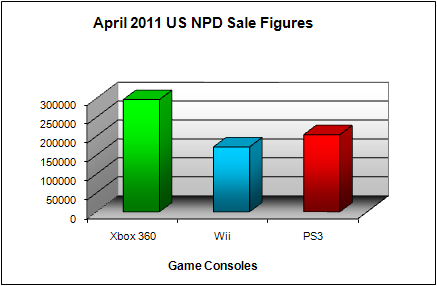
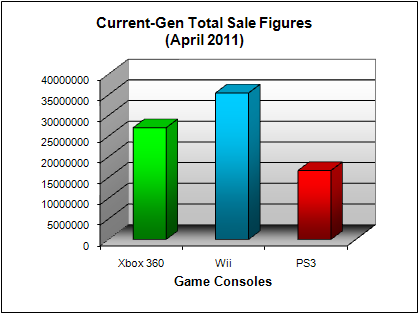
  • Xbox 360: 297,000 (Total: 27 million; April 2010: 185,400 – up 60%)
  • PS3: 204,300 (Total: 16.7 million; April 2010: 180,800 – up 13%)
  • Wii: 172,000  (Total: 35.4 million; April 2010: 277,200 – down 38%)
NPD April 2011 Game Console US Sales Figures

NPD April 2011 Game Console US Sales Figures

NPD Game Console Total US Sales Figures (as of April 2011)

NPD Game Console Total US Sales Figures (as of April 2011)

My prediction from last month was:

I didn’t make a prediction because I didn’t do a NPD analysis last month because of those ******* at Sony (possibly)

Note that some of the figures above are extrapolated, and somewhat based on guestimates. For example, I gave Sony the benefit of the doubt and gave the PS3 350,000 units sold for last month, so I could have an estimate for the total sales figures graph. And this month, Sony only said that the PS3 grew by “nearly” 13% compared to April 2010, and so I again gave them the benefit of the doubt and made the growth exactly 13%. But these figures have always been rounded up and down, and so they’re not that accurate, but accurate enough in terms of providing a general feel of what’s going on, allowing “analysts” like myself to extrapolate the data and make things up, basically.

So the Xbox 360 was the winner again, just like last month (the PS3 numbers weren’t present, but the Xbox 360 and Wii numbers were present, and presented in the gaming section of the April 24 edition of the Weekly News Roundup). In fact, Xbox 360 sales are 60% up compared to the same month last year, which is quite a result. This makes for the best month-to-month-a-year-ago result since last November, when the Xbox 360 recorded 67% growth. It’s hard to explain where the result comes from, but (and this is where the “make things up” thing comes in), with software sales higher than in April 2010 thanks to some a-list releases, and most of them, while being multi-platform, sold better on the Xbox 360 than any other console, and this probably helped hardware sales as well. Microsoft also said that Kinect sales were promising, with Michael Jackson: The Experience the pick of the Kinect new releases for the month.

And as mentioned earlier, the PS3 numbers were good enough for Sony to release figures for this month. This time last year, the Xbox 360 and PS3 were neck and neck (with the Wii way ahead in the lead … more on that later), but the Xbox 360 managed to outsell the PS3 comfortably this month, despite the PS3’s “near” 13% growth figure. Sony would point to this figure showing that the PSN outage for the last ten days of April did not really have a profound effect on sales, but we’ll only know the full scale of the damage in May’s NPD (no doubt if the numbers don’t go well, Sony will withhold the figures again, so we may never find out), when it is revealed that millions of PSN account details and some credit card numbers were leaked. Various sources are already posting information which shows increasing number of PS3 to Xbox 360 console trade-ins at retailers, an increasing number of gamers switching pre-orders from PS3 versions to Xbox 360 versions (for those that presumably owns both consoles), and Sony’s share of game sales dropping from 37% from before the PSN outage, to only 21% with the most recent data.

The Wii was the worst performer out of the home based consoles this month, with sales being 38% down compared to the same period last year, a somewhat consistent decline. Which is probably why the Wii has just received a price cut, and that Nintendo plans to announced the Wii 2 at E3 in less than a month’s time. Nintendo’s other consoles, including the new 3Ds, aren’t doing much better though, with the original DS once again outselling the more expensive 3Ds.

For games, Mortal Kombat was the best seller, followed by Portal 2. Mortal Kombat sold 900,000 copies on the two platforms, the Xbox 360 and PS3, on which it was released, and the Xbox 360 version most likely led the PS3 version in sales (as otherwise Sony would have mentioned that the top selling game of the month did best on their platform). Same with Portal as well, according to GfK-ChartTrack, despite the PS3 version having several exclusives, including a free PC version of the game, plus cross-platform gaming (according to released figures, the Xbox 360 version outsold the PS3 version by about a 1.5-to-1 margin). Michael Jackson The Experience also made the top 10, despite only the PS3 Move and Xbox 360 Kinect SKUs of the game being new in April (the other SKUs were released ages ago). Another game that didn’t make the top 10, but would have if a bundled version had counted as software, as opposed to accessories, sales was SOCOM 4. The “Full Deployment” bundle consisted of a Move controller and the Sharpshooter accessory, and had this bundle been included in the software numbers, SOCOM 4 would have made the top 10. As it is, the bundle was the highest ranking new accessory for the month. Here’s the full software sales chart for April:

  1. Mortal Kombat 2011 (Warner Bros. Interactive, Xbox 360, PS3)
  2. Portal 2 (Electronic Arts, Xbox 360, PS3, PC)
  3. Lego Star Wars III: The Clone Wars (LucasArts, Xbox 360, PS3, Wii, NDS, 3DS, PC)
  4. Call of Duty: Black Ops (Activision Blizzard, Xbox 360, PS3, Wii, NDS,PC)
  5. Tiger Woods PGA Tour 12: The Masters (Electronic Arts, Xbox 360, PS3, Wii)
  6. Crysis 2 (Electronic Arts, Xbox 360, PS3, PC)
  7. Just Dance 2 (Ubisoft, Wii)
  8. Michael Jackson The Experience (Ubisoft, Xbox 360, PS3, Wii, NDS, PSP)
  9. Pokemon White Version (Nintendo, NDS)
  10. NBA 2K11 (Warner Bros. Interactive, Xbox 360, PS3)

I don’t really want to make a prediction next month, because if I’m right, and that the PS3 number falls due to the PSN outage, then Sony won’t release the figures, and we don’t have an NPD. Regardless, I think the Xbox 360 would still be the top selling console, so it’s just a matter of how much the PSN outage hurts the PS3, and how much the Wii price cut helps the Wii. The biggest game new releases for May are L.A. Noire, Brink and LEGO Pirates of the Caribbean.

See you next month, hopefully.

Weekly News Roundup (24 April 2011)

Sunday, April 24th, 2011

No luck with waiting for leaks of NPD data, so I can continue with the NPD analysis, so it looks like that’s the end of that feature, which has been going on for more than two years already. Instead, I think what I will do is to combine the feature with the WNR, and just post whatever stats I can find in the gaming section below, starting with this issue. It appears the analysts that usually leak data has been warned, legally, not to do so by the NPD, who themselves are probably under pressure from certain gaming companies, which shall remain unnamed, that are often too ashamed of their sales results and don’t want the negative publicity.

Not too many interesting news stories this week, thanks to Easter I suppose, so let’s get started.

CopyrightIn copyright news, critics of the DMCA and harsher copyright laws have often warned that they can be used to prevent freedom of speech, and this week, we have a story that seems to perfectly illustrate the dangers of giving too much power to copyright holders.

Doctored Reviews

Doctored Reviews: A new website to help fight the practice of using the DMCA to remove bad doctor reviews

Apparently, there’s a company going around removing bad reviews of doctors written by their patients. The company, Medical Justice, provide the service to doctors that are concerned about their reputations being tarnished online, whether justly or unjustly. Doctors can force patients to sign an agreement prior to receiving medical care, and this agreement actually hands over copyright of the patient’s reviews over to Medical Justice, allowing the DMCA to be later used to remove bad reviews. Obviously, this is quite an underhanded practice, and it’s probably a good thing that certain websites now maintain a list of doctors that use the service of Medical Justice, as you can just refer to that list, assume these are all bad doctors, and *avoid* them. And many doctor review sites now ignore DMCA take-down requests of bad reviews, preferring to take this matter to court if necessary, and a couple of UCLA law professors have even set up a new website, Doctored Reviews, with the aim of publishing bad reviews of doctors that Medical Justice wants removed, probably hoping the matter goes to court. This is really only the latest example of copyright laws being abused this way, and if governments around the world continue to pander to the copyright lobby, then there will be more and more such cases in the future. Imagine buying a PC game, you agree to the EULA as you would normally do, except in the 200 page document you just agreed to, there’s a provision saying you hand over all online reviews of this game to the publisher, and this means they can use the DMCA to silence anyone who says a bad thing about the game. Nobody should be able to take away your rights so easily, which in my opinion, is a form of copyright infringement as well. And nobody should be able to use the DMCA or other copyright laws to settle non copyright related issues. But if governments are still intent on handing over *your* rights  over to corporations, then there’s not much we can do.

Anonymous

Anonymous takes on New Zeland, as the island nation passes new harsh copyright laws

The latest country to do is New Zealand, having rushed through legislation without much debate (seems to be a trend these days in relation to copyright laws, from the rushed Digital Economy Act in the UK, to the secretive ACTA discussions) to please the copyright lobby, lobbies that mostly represent non New Zealand interests. The latest story is actually about Anonymous’ plans to attack NZ government websites, but the bigger story is about the new copyright laws and how unbalance they can be. For example, the laws make owners of connections responsible for copyright infringement, something the entertainment industry has been pushing for. You see, it’s hard, if not impossible, to go after the person that actually committed the “crime”, because you would actually needs things like evidence. It’s like if a car was stolen to rob a bank, it’s would be far too hard to actually catch the people that stole the car and robbed the bank, so the police can make it easy on themselves by arresting the owner of the car. Hyperbole aside, the real implication of these ill thought out changes means the end of public Wi-Fi networks in New Zealand. So no more free Wi-Fi at McDonalds unless the fast food joint wants to accept responsibility for pirated downloads. Innovation and competition, has given away to protectionism of an industry that is trying so hard to avoid innovation and competition.

This is just the latest trend in copyright laws that goes against everything a democratic and lawful society is supposed to stand for. The over-exaggeration of the piracy problem by copyright lobby is directly responsible for these over-exaggerated responses by clueless governments being led down the wrong path by the smell of lobbying cash. And I’m convinced the copyright problem, much like every other problem, cannot be addressed until the root causes can be identified, and this starts with real stats and figures on the cost piracy, not “estimates” of “potential” losses (which mostly assume the cost of piracy equals the number of pirated items times the full retail cost of said item). Once we have a real understanding of the scale of the problem, we might then decide that enforcement in all but the most extreme copyright cases might not be in the public interest at all, due to the financial cost of it all. But if there is a substantial problem related to piracy, then no matter how serious the problem is, one should not have to sacrifice the basic tenets of society just to make the problem go away – the ends do not justify the means, especially when the “ends” is not even certain. Innocent until *proven* guilty, with the copyright holders responsible for having to proof that copyright infringement has occurred, and also to proof the extent of actual monetary damage. And they should have to do it in a court, with full rights of appeal for the alleged offender. We’re often told that piracy is just like stealing a car, but the problem is that car thieves actually have more rights than a downloader when it comes to copyright laws of countries like the UK and France, and now New Zealand. With a car theft, first of all, there is conclusive proof of material loss or damage, and then the police have to proof, beyond a reasonable doubt, who actually stole the car, arrest them, and then a judge decides the verdict, with the offender given full rights to argue his or her case, and then to appeal if needed. With downloads, the “victim” is the judge, the jury, and in some cases, the executioner (or at least they organize the execution, by forcing ISPs to act), and all before actual damages have even been proved. The argument is that proofing all of this is too hard, too time consuming, but when is taking shortcuts when justice is concerned ever the right thing to do? Anyone who wants to subvert justice this way should be considered an enemy of the state, an enemy of the people, but it’s the opposite right now, and so it’s no wonder you’ve got movements like Anonymous taking action against what they, and many of us, perceive to be an attack on our freedoms.

High Definition

The week ending 2nd April proved to be a milestone of sorts for Blu-ray, except it turns out the week after was even more, um, “milestonie”. Blu-ray finally broke through the 24% market share record, and the week after, it broke through the 25% as well (I still need to post up the analysis for that week, when it’s up, it will be on this page).

Unfortunately, combined revenue, of both DVD and Blu-ray sales, is actually quite disappointing. This is mainly because DVD sales continue to fall, quite dramatically at times, and the increase in Blu-ray sales haven’t really been enough to even slightly offset losses. It’s no good having $20 million increases in Blu-ray sales, when DVD losses are $100 million or more. The economy probably has a lot to do with it, and perhaps it just shows people are buying a smaller number of better and more expensive products (eg. Blu-ray), but buying less overall. Perhaps they’re turning to piracy, since you can only buy what you can afford. Maybe they’ve turned to digital distribution, Netflix and the like, or cheaper rentals via Redbox. Or maybe they’ve just stopped watching. It’s not as if there’s a dearth of free, legal, entertainment these days – just the free apps on smartphones can occupy someone for ages.

Which is why, as reported by one of our new news contributors, the Harry Potter and the Deathly Hallows Part 1 Blu-ray and DVD situation is so frustrating and unhelpful in the current climate. Not only are there 5 editions of the same movie across the two formats, two of the editions are exclusive to two different stores. And while Warner Bros may have maximized their revenue potential by signing lucrative exclusivity deals, it’s the consumer that ends up having less choice in terms of where to purchase, and more confusion as to which version to buy. I’ve always respected WB for being pioneers in adopting new video formats, they were one of the very few to support VCD, and a major backer behind HD DVD before they decided to abandon the format, and they also abandoned region coding for Blu-ray. But they botched the Lord of the Rings theatrical release, want to make us sextuple dip the LOTR franchise, and will probably do something similar with the HP franchise as well. But it’s their right, and it’s our right to not get sucked in and do more research before parting with our cash, that is if we decide to part with it at all.

Gaming

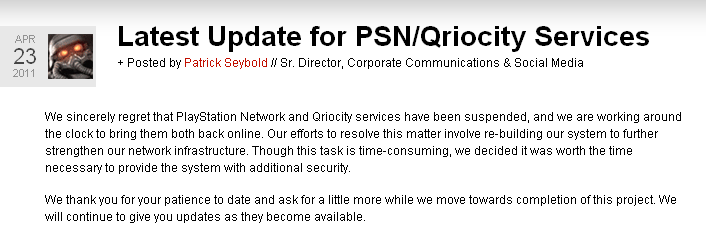
And finally in gaming, the story that everyone is talking about this week has to be the downing of the PlayStation network, which appears to be still down as I write. Of course, everyone pointed the finger at Anonymous, but group has said that they didn’t do it, or at least it wasn’t an official “op”.

PSN Down

The PlayStation Network has been down for the last few days, Sony says "external intrusions" are responsible

And with Sony being their usual selves when it comes to being transparent, there’s not a lot of information about just what went wrong, and what is being done to fix the problem. Speculating blindly, I think this is probably more hacking than denial-of-service. It doesn’t look like a DDoS, the traditional attack method of Anyonmous, because first of all, those are quite easy to stop, certainly would not take two or more days, and it would also mean completely dis-connectivity, but there are reports that people’s queued downloads are still downloading fine. So it looks like hacking, probably a security exploit that someone took advantage of and managed to get deep into the PSN infrastructure. The subsequent fixes to ensure whatever exploit is patched is probably what’s taking so long, so it looks like quite a serious, structural problem.

Now, you can blame the hackers, but just like with the PS3 hack, nobody could have done a thing to it if the exploit was not there in the first place, and exploit and weakness present due to programming errors on Sony’s part. Same with the PSN. The hackers may have tore your house down, but they wouldn’t have been able to so if it wasn’t made of straw, if you know what I mean. So Sony are ultimately responsible, and that’s the way it should be. However, since PSN is mostly a free service, nobody can complain really. Only those that paid for the PSN Plus should demand some kind of compensation, as would Xbox Live Gold users if XBL Gold ever went down for such a long time.

Anyway, it’s the last thing Sony needs, having come last again in last month’s US console sales. I’m going to assume this because otherwise Sony would have touted the fact that they beat the Wii, which sold just above 290,000 units (down 47% compared to March 2010) according to Nintendo. Microsoft did release the sales figures, mainly because they’re not ashamed of having come last I suppose, and with 433,000 (up 28% compared to March 2010), the Xbox 360 was once again the best selling home based console for March 2011, in the US. Only Sony knows just how bad the PS3 results were, although they did say that the PlayStation platform overall sales rose “double digits” compared to a year ago. This could mean anything though, especially with the PSP price drop, and again, I point to Sony not making a big deal of outselling the poor performing Wii as evidence of the PS3’s poor performance in March. And if that’s the case, the the PS3 re-starts its recent trend of sales declines compared to the same month last year, having had a pause in February. And recent events won’t have helped PS3 sales in April, I bet, but we may never find out.

So that’s it for the week, and for this very much abridged version of the monthly NPD analysis. See you next week.