Archive for October, 2007

GeForce 8800 GT – The card everyone’s been waiting for?

Wednesday, October 31st, 2007

When I posted about my recommended computer specs back in September, I chose the 640 MB version of the GeForce 8800 GTS, but it was far from my first choice. I said at the time that:

… but what I want is a card that combines the HD acceleration (PureVideo HD or AVIVO HD) of the 8600 GTS (or HD 2400 XT) with the 3D performance of the 8800 GTS. Again, waiting 6 months will probably make this possible.

Well, I didn’t have to wait 6 months (although 6 months from the day that the 8800 series was first announced is more accurate), Nvidia has just announced the introduction of the 512 MB 8800 GT.
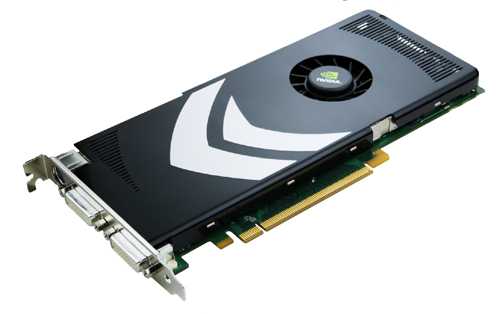
Nvidia 8800 GTSo what’s new in the 8800 GT? The 8800 GT has a new GPU, the G92. It is essentially a die shrink of the existing G80 GPU as found in the other 8800 series cards. The G80 required an external display chip to support the dual-link DVI outputs, but now the display chip is integrated into the GPU which significantly reduces manufacturing costs. The new GPU also supports PCIe 2.0, which doubles the available bandwidth. There are also lots of little changes associated with 3D performance, things like 112 SPs (compared to the GTX’s 128 SPs, and the GTS’s 96), core clock increase to 600 MHz (a 25 MHz increase on the GTX, but 12 less than the Ultra), shader clock at 1500 MHz (sames as the Ultra, and higher than the GTX), a 900 MHz memory clock (sames as the GTX, lower than the Ultra), 512 MB of RAM and a memory interface of only 256 bits (compared to the 384-bit of the Ultra/GTX, and 320-bit of the GTS). But forget all these specs, the important thing is that the GT plays the latest games and do it very well, basically on the same level as a 640 MB 8800 GTS, the card that I recommended only a month ago.

I have deliberately left out the best bit, and one bit that the 8800 GTS/GTX/Ultra was missing, which led me to be cautious in my previous recommendations. Where this feature is concerned, even the 8600 GTS was more preferable than the 8800. So what is it? Well, since this is a website/blog mainly about digital video, the feature I’m talking about is HD video acceleration, in particularly VC-1 and H.264 acceleration needed for HD DVD and Blu-ray playback. While the 8800 Ultra/GTX/GTS was super powerful for 3D gaming, it did not contribute much to video acceleration at all, and instead, sat idle while the CPU struggles to keep a steady framerate. With the 8500/8600 and now 8800 GT, the VP2 engine is used to provide full H.264 video decoding. Note that VP2 on the 8500/8600 only offers full H.264 acceleration – MPEG-2 acceleration (not really needed) and VC-1 acceleration is limited to only inverse transform, motion compensation and in-loop deblocking – I’m not sure if the situation has changed with the VP2 engine on the 8800 GT (unlikely), but H.264 is the most processor intensive codec of all three and the one that is most in need of acceleration. Full VC-1 acceleration would have been great, as most HD DVD movies and now even Blu-ray ones use VC-1, but I guess we will have to wait for the VP3 engine for that.
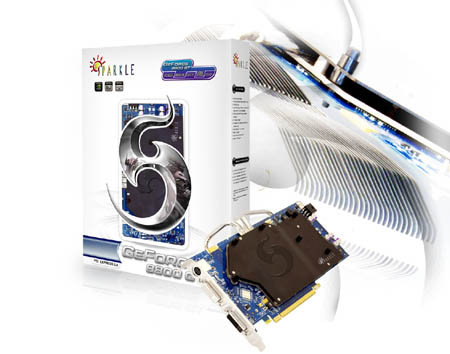
PARKLE GeForce 8800 GT Cool-pipe 3 Graphics CardSo my wish sort of came true. I wanted a graphics card with the 3D power of the 8800 GTS, and the HD video acceleration features of the 8600 GTS, and this is exactly what I’ve got in the 8800 GT. There’s even a passive cooled version of the 8800 GT, perfect for a HTPC setup that can even handle the latest games (a sort of “build-your-own” Xbox 360/PS3). The price is right too, positioned as an even cheaper replacement for the 320 MB 8800 GTS. It will be interesting to see what ATI can come up with to compete with the 8800 GT. And Nvidia themselves will launch a new GTS in November, so it might be worth it to wait and see a bit longer. And if you want to be a perfectionist, you might wish for HDMI output as well. But for the present, the 8800 GT is the GPU that I recommend for gaming and video enthusiasts.

For a roundup of Nvidia’s range of GPUs, please refer to this forum thread. You can read a full review of the 8800 GT here.

Weekly News Roundup (28 October 2007)

Sunday, October 28th, 2007

Woohoo! Another weekly roundup. More work on a Sunday when I didn’t get a good night’s sleep in my hot non air-conditioned office. I’m not bitter, really, I’m not.

Anyway, in copyright news the MPAA has apparently hired a hacker to find out confidential information about the bittorrent site, TorrentSpy. I’m pretty sure hacking is illegal in the US. It may in fact be considered an act of terrorism. All those MPAA “piracy equals terrorism” posters finally start to make some sense. The big news of the week was the closure of the popular music bittorrent site, OiNK. There is already news that The Pirate Bay may start something similar to replace it. It will probably end up being something better and harder to close down too. Meanwhile on the other end of the spectrum, Amazon says its DRM free music sales has been a great success. No surprise really, considering DRM is completely useless in preventing piracy and its only purpose is to annoy consumers (and make healthy royalties for the company who invented the DRM engine). Now only if there were something similar for movies …

On to gaming news, US September sales figures have been released and it’s another bad month for the PS3 (read my in depth analysis of the figures here). I think I’ve posted enough about the problems with the PS3 over this last few days, that I don’t think I need go into it any further (although since my blog post, another developer has come out to say it’s a pain to work on the PS3). But at least Activision is standing by the PS3, saying that it is the most advanced console and that in 4 or 5 years time, people will see the difference. I’m not sure Sony can wait that long though, considering their gaming division losses taking the shine off their otherwise impressive profit figures. This week has all been about how bad the PS3 is, and I guess Microsoft is happy to just sit and enjoy the afterglow of the Halo 3 effect. But they are not resting on their laurels, and rumour is that IPTV might be coming to the Xbox 360 in the fall update (and since it’s fall already in the US, the update might not be that far away). It will probably be an U.S only affair though. Shame.

HD news now, the Transformers on HD DVD has sold well, although not as well as first claimed by Paramount. Blu-ray still held the week 51% to 49%, but how quickly that their 2-to-1 advantage shrank due to one single movie, and also the puny amount of HD discs sold compared to DVDs, means that these “figure wars” are really quite pointless. I’ve always maintained that consumers should adopt a format neutral stance and support both formats to ensure they don’t lose out, and Samsung is helping the cause by announcing more details on their updated dual-format player (which will be Blu-ray Profile 1.1 compatible, one of the first on the market to be). But if you don’t mind having two separate players, then HD DVD players have finally fallen below the magic $US 200 threshold. Wal-Mart, and now Circuit City, will be selling the superseded Toshiba A2 for under $200. That’s quite a decent price for a HD DVD player that also doubles as a fairly decent DVD upscaler (not as good as the more expensive XA2 though, but the Reon VX chip in that player puts it into the high-end class of DVD players). While $200 is tempting, I think prices will drop further. In the meantime, check out Amazon’s Xbox 360 HD DVD add-on drive deal (if you have an Xbox 360 that is) – you get Heroes Season 1 on HD DVD of $69.95 value, plus 5 other free HD DVD movies by redemption and all for under $180. Assuming each HD DVD is worth $20, that’s $170 worth of movies for $180, so the drive only costs $10 (and it doubles as a HD DVD-ROM drive for your PC too!).

That’s all folks from my hot non air-conditioned office. See you next week.

PS3 doesn’t suck as much as fanbois

Saturday, October 27th, 2007

What am I doing writing three blog posts per week, especially when I have another one (weekly roundup) to write tomorrow? Well, you see, I’m a bit angry. And when I’m angry, I blog. PlayStation 3What started as a perfectly innocent *opinion* from an ex game developer for Harmonix (makers of Guitar Hero and Rock Band) on his blog about the difficulties of programming on the PS3, has turned into a fanboy fight-fest, mostly from PS3 fanbois and members of the Sony Defence Force blasting his *opinions* in the comments section. The funny thing is that Jason Booth, the developer/blogger in question, didn’t even suggest that the PS3 sucks, just that it’s difficult to programme for and that the expectation that PS3 games will own Xbox 360 games in the future might not be fully realised. Here are the points raised in the blog post:

  • PS3 has a slower fill rate than the Xbox 360
  • Multi-processor programming is too complicated to take full advantage of the Cell
  • Blu-ray is great for providing more space, but has a slower load time. It is now mainly used to store duplicate game assets to speed up load time and work around some of the other limitations of the PS3
  • Optimization for the PS3 is costly, and developers lack the resources to do it effectively
  • Code for the PS3 cannot be re-used for non-PS3 projects, so investment in PS3 coding is expensive

Now I’m not saying that all these points are valid. Some are probably not, but I can’t comment because I don’t work on game development. But the reaction to it has been, sadly, typical whenever someone says anything bad about a particular tech, in this instance, from PS3 fanbois. So what kind of reaction do we get from PS3 fanbois? That game developers, who sometimes work 18 hour days and basically live at the office, are lazy. That because Jason spelt “Blu-ray” wrong and that he started his career as a computer graphic artist means he knows nothing about programming. Some even suggested that his new work involves producing a product that will compete with Sony Home, and therefore, he is a bitter programmer who is going to get beat by Sony and is venting his anger. How could these people come out with these statements when most (if not all) of them have zero programming experience? And why personal attacks against someone who simply expressed his own opinions about a piece of tech? The comments posted are not all from fanbois though. There are a lot of anonymous postings from programmers with even more technical evidence of the PS3’s failings. As someone who graduated as a Software Engineer, but never really went to work in the field, I can understand some but not all of the points raised, but it seem to make sense. These programmers are posting anonymously because they fear this kind of backlash from fanbois, and more importantly, the spanking they will get from Sony which in turn might mean a loss of employment. But it’s not just anonymous programmers, some of the industry’s biggest names have all spoken out against the PS3’s design. Gabe Newell, the man behind the amazing Half-Life series and MD of Valve software, said earlier this year that:

The PS3 is a total disaster on so many levels, I think It’s really clear that Sony lost track of what customers and what developers wanted. I’d say, even at this late date, they should just cancel it and do a ‘do over’. Just say, ‘This was a horrible disaster and we’re sorry and we’re going to stop selling this and stop trying to convince people to develop for it.’

Then we have John Carmack, creator of Doom/Quake from ID Software, saying:

But the honest truth is that Microsoft dev tools are so much better than Sony’s. We expect to keep in mind the issues of bringing this up on the PlayStation 3… they’re not helpful to the developers… I suspect they’re not going to overwhelmingly crush the marketplace this time, which wasn’t clear a year ago.

And posted on this blog a couple of weeks ago, was this statement from BioWare President Greg Zeschuk:

If everyone’s waiting for this huge gap, it’s just not going to happen. By the end of this generation both PS3 and Xbox 360 will look awesome. Maybe 1 per cent of the population might be able to tell the difference between the two.

No surprise then that PS3 fanbois have already blasted all of these pioneers of gaming, some go as far as suggesting they’ve been bribed to say these things. I know who I would believe if I had to choose between Carmack/Newell/Zeschuk or Sony’s PR department and their legion of fanbois. What these experts are saying, is not that the PS3 totally sucks, but rather, that it’s not an easy piece of hardware to programme for. I’m sure the Xbox 360 and Wii have their own problems, but Sony seemed to have ignored the human element (ie. programmers) when they came up with their design for the PS3. I’m sure that if developers allocated more resources to the PS3, they could come up with games that will be as impressive if not more so than the Xbox 360 version. But the extra resources dedicated to make the game look good takes resources away from making the game fun to play and in the longevity stakes (see Lair, Heavenly Sword, Ratchet and Clank …). But even if you don’t believe these experts, then all you have to do is to look at reality (something that fanbois are unable to do, seemingly). The reality is that the Xbox 360 has the biggest market share, compared to the PS3’s pathetic 14% hold on the US market. The reality is that the Xbox 360 has more and better games so far, and that developers seem to develop more games and do it faster on the Xbox 360. The reality is that when cross-platform games are produced, these either look the same on either platforms, or in many cases, look and play better on the Xbox 360. That’s reality, and until it changes, nothing fanbois can say will make the PS3 a better game console.

H.264 – Taking over the world one codec at a time

Friday, October 26th, 2007

Regular readers will know I’m a big fan of MPEG-4 AVC/H.264. And it seems I’m not the only one, because pretty much every new device being released in supporting this new format. It would take too long to list them all, but the number of devices, websites and formats that are using H.264 is simply amazing. Just as a small sample of the widespread nature of H.264, you have devices like Apple iPod/iPhone/TV, Sony PSP, PS3, Xbox 360, Zune, and also websites such as YouTube, then you have to both Blu-ray and HD DVD formats – all rely on H.264.

I can’t recall a single video codec that has so much industry support in so little time. Perhaps DivX, but that was only because of pirated movie downloads all using it as the format of choice (now it’s XviD). And it’s only a matter of time before movie downloads are using H.264 too (some of the high quality HD TV episode downloads are already using it). The extensive support is mostly the world of Apple, which is a huge fan of the codec. Future applications for H.264 include HDTV broadcasts (imagine watching your favourite sports program in Blu-ray/HD DVD quality HDTV on your 1080p screen – wow!).  

If there was some kind of stock market for video codecs, then put your money on H.264 becoming the industry standard in the years to come.

If you want to find out more about H.264, have a look at this site I helped to set up. It’s got information and instructions on how to equip your computer with the right software to play H.264 movies, as well as some demo clips for you to download:

http://www.h264info.com

Game Consoles – September 2007 NPD Sales Figure Analysis

Monday, October 22nd, 2007

This is another regular feature that I might run on this blog. Every month, marketing research firm NPD releases sales figures for game consoles (including portables).

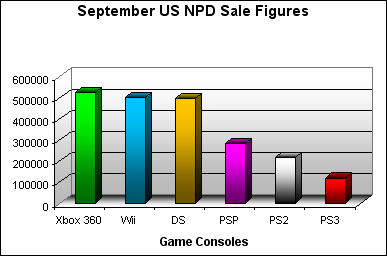
The figures for US sales in September has just been released, and here they are:

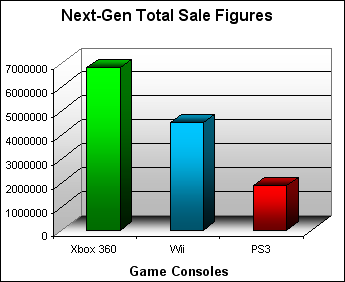
  • Xbox 360: 527,800 (Total: 6.8 million)
  • Wii: 501,000 (Total: 4.5 million)
  • DS: 495,800 (Total: 13.2 million)
  • PSP: 284,500 (Total: 8.6 million)
  • PS2: 215,000 (Total: 39.3 million)
  • PS3: 119,400 (Total: 1.87 million)

NPD September 2007 Game Console US Sales Figures

NPD Game Console Total US Sales Figures (as of September 2007)

You don’t have to be a rocket scientist to know that the PS3 isn’t doing too well at all. Some have claimed that the PS3 is selling at the same rate as the Xbox 360 when it first came out last year. But this isn’t 2006 anymore – back then, nobody cared about “next-gen” or HD gaming. And sales figures are only worthwhile when you compare them to that of your closest competitors. With that in mind, September saw the Xbox 360 grab  46% of the next-gen market share, the Wii was close at 44.6% and the PS3 way behind on 10.4%. Of course, September was an exceptionally good month for the Xbox 360 due to the release of Halo 3, so sales of the console will drop in the coming months. Looking at total sales figures, the Xbox 360 still leads with 51.6%, the Wii at 34% and the PS3 at 14.2%. Sony has gone from a 80+% domination of the previous-gen market with the PS2 (which is currently still doing very well) to a minuscule share of the next-gen market and this must be worrying for Sony. The only consolation is that since the PS2 is still doing well, when it is finally discontinued, there might be a large group of upgraders to the PS3. But this is still a long time away, and there is no guarantee that these PS2 users will all grab themselves a PS3, considering many of them might have already gone down the Xbox 360 route. Cheaper PS3’s will help, but when price is the only factor, the Xbox 360 and Wii are both still in a more advantageous position having been released for longer, selling in greater numbers and have the greater chance of discounting. And obviously, the number of quality games for the Xbox 360 is what is really driving sales, and with the highly rated Mass Effect Xbox 360 exclusive coming out in November, the holidays period looks like a good one for the Xbox 360.

In the portable market, the PSP continues to sell well, even though the Nintendo DS is still selling at a 3:2 ratio. I’m sure Sony would be much happier if the PSP and PS3 sales figures were reversed, but the PSP, Sony’s first portable game machine, is holding it’s own against portable heavyweights Nintendo. The reason why the PSP is doing so well might come down to the fact that the Nintendo DS isn’t really competing on all fronts with the PSP – the DS cannot match the PSP’s music and movie playback capabilities, for example, and if Nintendo’s “games first” philosophies stay true, it’s unlikely that their next portable will be able to compete in these areas either.

See you next month.