Site Downtime – What Happened?

January 22nd, 2013

Just putting up a quick post to explain the site outage over the weekend, which saw a series of unfortunate events combine to make this the longest downtime since the infamous datacenter fire of 2008.

And it’s all because of a stupid reverse DNS entry.

First up, sorry for the inconvenience of the last few days. But as frustrating it must have been for you, believe me, it was much more frustrating from where I was standing, being able to do very little while the site remained down.

Reverse DNS

What is Reverse DNS?

Before we get to what happened, a little backgrounder on what a reverse DNS entry is. I think most people already know what a normal DNS entry does, in that it translates the domain name (eg. example.com) to an IP address (eg. 1.2.3.4). A reverse DNS entry does the opposite, by telling people what domain name the IP address belongs to.

Reverse DNS entries are not really as useful as normal DNS entries, without which would make it impossible to use domain names (not just for web browsing, but also for emails). Reverse DNS entries are mostly to help humans find out quickly a domain name that’s linked to the IP address, and also for email servers for security purposes – most email servers will reject emails sent from IP addresses that do not have a reverse DNS record, although it doesn’t really matter what the record actually says.

Unlike normal DNS records, reverse DNS entries are not managed by the person who holds the domain name, but by ISPs and web hosts that owns the IP address. For web hosts, when they assigns an IP address to a server that you rent, they may change the reverse DNS entry to match the name of your server (for example, server1.digital-digest.com), which while not essential, looks nice at the very least.

So what happened?

Well, an IP address that no longer belonged to us, but once did, still had the reverse DNS record of the digital-digest.com domain name (while the reverse DNS record may have been assigned automatically to us when the server was procured, when the server was subsequently cancelled, the reverse DNS record apparently remained, for years afterwards). This IP address was being used by its new servers for a phishing scam. A company that investigates this sort of thing did a reverse DNS lookup and found that digital-digest.com was the entry. Using information from the WHOIS entry of digital-digest.com, this web security company subsequently sent emails to us and to our domain name registrar (and possibly others) to inform of the possible abuse going on. This is despite little or not effort apparently being made to check if the IP address did still belong to Digital Digest, which it did not.

Our domain name registrar then decided to suspend the domain name immediately, even though as the IP address was being used in the phishing links, suspending the domain name did nothing to actually prevent the phishing link from continuing to work (this is assuming that the domain name still had something to do with the IP address, which it no longer did).

A rough analogy would be the post office cancelling your mail deliveries because your old phone number, which is still listed in the most recent issue of the White Pages (as you had moved after it was published), was being used in a scam!

And while I was informed of the suspension shortly after it occurred, due to time differences (I was asleep at the time), I wasn’t to know until hours later. Unfortunately (and this is my fault entirely), I chose a domain registrar that did not have 24×7 tech support, and so the issue could not be resolved until Monday despite emails and unanswered phone calls.

Digital Digest Down

Without an active domain name, nothing would work even though the site itself was still running on the server

Adding to my bad fortune, Monday was a public holiday in the US, but luckily, somebody had turned up to work, read my email explaining that the IP address had nothing to do with this domain name anymore, and re-activated the domain name. The only piece of luck in this whole incident.

As nobody really came out of this incident with any credit, myself included, I shall forgo assigning blame. Suffice to say that lessons have been learnt and that I will be transferring my domain names to a different registrar, one that has 24×7 support.

The registrar I’m transferring to, Namecheap, was also one of the many involved in the anti-SOPA protests of last year. Protesting GoDaddy’s then support of SOPA last year, Namecheap hosted a promotion that gave away cheap domain transfers for one day, with some of the proceeds going to support Internet freedom groups. And coincidentally, today is Internet Freedom Day, celebrating the defeat of SOPA a year ago, and the same promotion is running again, with at least $0.50 (up to $1.50, depending on the number of transferred domains) from every cheap $3.99 domain transfer (normally closer to $10) going to the Electronic Frontier Foundation. Which makes the decision to switch registrars that much simpler for me 🙂


Weekly News Roundup (13 January 2013)

January 13th, 2013

It’s back to work for most people, which sucks, but at least there does seem to be news again. Yeah, that’s just what you need after your first week back at work, a long and ranty WNR to read!

I’ll try to keep this as painless as possible, so let’s not waste more time.

Copyright

A new study has proved what most of us suspected anyway, that DMCA take-downs, and even closing down the likes of Megapload won’t really do much in terms of reducing the availability of pirated downloads from cyberlocker sites.

The problem, according to the study, is that the moment you remove one upload, many others pop up in its place. And even removing entire file hosting websites, either through censorship, domain seizures or a well coordinated international law enforcement action like with the Megaupload shutdown, won’t work because new sites will just pop up the next day. In fact, the closure of Megaupload may have had a detrimental effect on efforts to curb cyberlocker piracy, because it has fragmented the upload scene to the point where uploaders are uploading to multiple cyberlocker sites to avoid any one being taken down. It’s like blowing up a big asteroid headed for earth, only for it to fragment into thousands of smaller and still dangerous pieces still coming at you.

In other words, the cat-and-mouse game between pirates and those seeking to reduce pirated uploads is being truly, fundamentally and comprehensively won by the mice. Not surprising when the ratio is probably something like 17,374 mice to every cat, mind you.

Rapidshare logo

RapidShare is forcing its users to go legit with transfer caps, which has only managed to force some of its users to transfer to competing services

So what’s the solution? RapidShare’s solution to keep pirated content off its network is to implement a transfer cap system that went into effect in late November. Since then, RapidShare’s pageview traffic appears to have dropped by more than a third, although it has no doubt led to probably an even greater reduction in the amount of pirated content on the network. But all this means is that piracy was shifted to other sites.

For those file hosting providers that are not self-policing, the study suggests that perhaps going after payment providers that some of the more blatantly pro-piracy cyberlockers may be more effective, but the best way the study concludes, as it always has been, is to innovate. Instead of trying to reduce piracy, reduce the demand for piracy by introducing good value, innovative services that people actually want to use. An obvious solution that the content industry seems totally oblivious to.

Innovation can be expensive and prone to disaster though. But part of the reason why the content industries don’t seem to innovate as much as, say, the IT industry, in my opinion, is that the content industries (especially the music and movie mobs) seem to enjoy special protection through copyright legislation. This means they have very little incentive to do anything new when there’s already legislation there to protect your ageing business model, and plenty of opportunity to pay for new legislation. This is the kind of thing borne out of the initial desire to “protect” capitalism by some misguided notion that this means giving corporations whatever they want, the kind of thing which actually leads away from the free market capitalism model that the politicians creating these kind of laws actually believe in.

This was something raised by Republican Study Committee (RSC) staffer Derek Khanna in his copyright memo, now simply referred to as that “sensible” one. You know the one that was canned almost instantly after it was published by the RSC, and possibly the catalyst behind the  firing of Derek. This week, Derek, now out of a job, was able to speak  for the first time about the entire ordeal.

Derek Khanna

Derek Khanna, the RSC staffer fired after writing a sensible memo on copyright, speaks out on his ordeal

The RSC canned the memo because it claimed that insufficient review had gone into the memo before it was published, but according to Derek, there was nothing out of the ordinary for the process that went into getting his memo published. If anything, it received more feedback than what is deemed necessary.

What was surprising to Derek, but hopefully not to readers of the WNR, was the backlash the memo received from the content industries. All Derek had wanted was to start a debate, but it seems that’s the last thing movie studios and record labels, long since a protected species under the guardianship of the political structure in Washington, wanted.

As for the firing, Derek was unable to speak candidly about it for obvious reasons, but according to the The Washington Examiner, Tennessee congresswoman Rep. Marsha Blackburn, who has close ties to the record industry due to her district’s geographical location in the suburbs of Nashville, was somewhat instrumental in kicking Derek out of the RSC. So for now, the record industry (and the movie industry) remains a protected species, but one that has had its instincts dulled to the point where it isn’t able to live unassisted in the wild, not with competing species the likes of Apple, Amazon, Netflix and Spotify all flourishing on their own abilities. This is not a sustainable situation, in my opinion.

High Definition

If you had to sum up this year’s CES using using 5 unique letters and a single number, then OLED and 4K is all you need. The 4K hype seems to be gathering pace especially quickly.

Almost all of the major TV manufactures announced both OLED TVs and 4K TVs (or TVs with both), even though in my opinion, OLED is going to be the one that makes the most immediate impact. Boring old 1080p OLED TVs can tap into the vast amount of existing HD content and improve them immediately, but the lack of native 4K content should keep 4K away from the mainstream for a while yet.

Samsung Curve OLED TV

OLED might make the more immediate impact between it and 4K, as exhibitors at this year’s CES show off their OLED TVs, including this curved one

Sony has seen the content problem, and devised their own solutions of sorts – “Mastered in 4K” Blu-ray movies. Soon, Sony will release movies mastered from pristine 4K transfers (which isn’t actually something that hasn’t been done before, by many other studios, eg. Jaws) with extra focus on quality through the use of extra bitrate (those old enough will remember Sony’s similar attempt with Superbit DVDs). These Blu-ray titles, when upscaled and displayed on 4K TVs, is said to present a “near 4K” picture, which is actually kind of cynical when you think about it. That you can fluff around with a, no doubt super looking, 1080p stream and make people believe it’s “near 4K” probably says more about the lack of perceivable difference 4K TV is going to make, especially if one isn’t sitting within touching distance of the screen, or aren’t in possession of a 85″ monster. It’s also questionable whether simply throwing bits at an AVC/VC-1 encoding will actually dramatically improve the picture, diminished returns and all that.

Well at the very least it’s better than Sony’s current solution to the lack of 4K content problem, notably “loaning” 4K TV owners with hard-drives pre-loaded with selected 4K content. Their upcoming online 4K video distribution service does sound a bit more promising though.

The truth of the matter is, due to the limited nature of the human perception system in relation to small details, 4K TVs aren’t going to be the game changer that HDTV was, not unless you go above a certain size (at which point the pixel spacing problem may rear its ugly head). OLED’s superb and vibrant colours and deep deep blacks will give you a much bigger “wow factor”, even with existing 1080p content of which there’s a plentiful supply of. Now combine OLED and 4K, and you may have something that’s really really tempting, as long as you can stomach the astronomical price tag, that is.

Gaming

The December US NPD numbers are out, and once again, the Xbox 360 was on top. This is despite the global situation being reversed, with Sony’s PS3 just having managed  to outsell the Xbox 360 in the worldwide race, despite the Xbox 360 having had a year’s head start. But the situation in the US is actually getting worse for the PS3, with Microsoft happily promoting the fact that its Xbox 360, which sold 1.4 million units in December, sold more than twice as many units as the unnamed next best non-portable console, which had to be the PS3 because the Wii and Wii U sold nowhere near 700,000 units (475,000 and 460,000 units respectively for the Wiis).

The Xbox 360’s 1.4 million units, while impressive, still represented a 17% decline compared to December from a year ago. Still, the decline was smaller than in recent months.

Overall, 2012 was a disappointing year for the gaming industry revenue wise, at least compared to 2011. The age of the current generation of consoles is a major factor, but the lack of new game releases, 29% less than 2011, also contributed to a very lackluster year. On average though, each SKU generated 8% more unit sales and 11% more revenue, so there’s definitely some silver lining in this cloud.

Well, that’s that for the first real news week of 2013. See you next week.

R.I.P Aaron Swartz

Weekly News Roundup (6 January 2013)

January 6th, 2013

Welcome to 2013. So another week without much going on, which is nice actually. Nice to be able to get a break and recharge the proverbial batteries ahead of a busy 2013. Let’s get started!

Copyright

A new report from the University of Southern California (USC) says that Google and, to a lesser extent, Yahoo, are aiding and even profiting from web piracy by providing ads to the top piracy websites. In a study that collected information on which ad networks the top piracy websites used (top websites based, ironically, on data that Google releases as part of its anti-piracy transparency efforts), the study found that Google was the second most popular ad network being used by these websites. Yahoo came 6th.

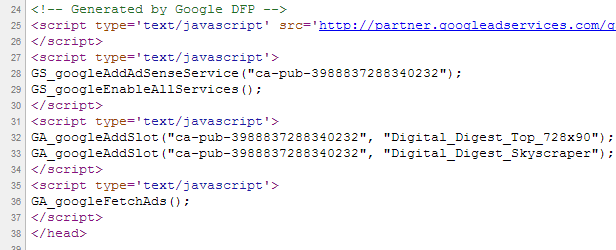
Google DFP Adcode

Just because a webpage has a Google adcode, it does not mean the displayed ad is served by Google or that Google profits from it

Google came out immediately to criticize the study for over-simplifying how web advertising works. The report was apparently compiled by scraping ad-code from piracy websites, and Google rightly points out that the presence of an ad network’s ad-code on a page does not necessarily mean that the network’s own ads are being served via the ad-code. The data apparently also includes Google’s DoubleClick ad-codes, but DoubleClick’s role in providing advertising differs significantly from Google’s main publisher advertising platform, AdSense. DoubleClick For Publishers (DFP) merely provides the tools for website publishers to place ads on their websites – the actual ads could be served from any ad network (including Google’s own AdSense). Even AdSense delivers ads from third-party ad networks. So while the USC report may have counted all AdSense and DFP ad-codes as being “Google ads”, the actual money making ads that is delivered via AdSense and DFP could have come from any other ad network.

Similarly, Yahoo’s Right Media platform offers similar functionalities as DFP, and have also been counted as part of Yahoo’s ad network for the report.

From my own experience, both Google and Yahoo have fairly tough anti-piracy policies. They will often reject sites right away if they suspect something is not right, and they have been known the suspend and seize funds from publisher accounts, sometimes over-zealously.

And unlike a lot of other ad networks that have a more hands-on role in sourcing and placing ads, Google at the very least leaves much of the decision to advertisers. So targeting the likes of Google and Yahoo seems slightly unfair given that advertisers, some of them being Hollywood studios, can choose to have full control over what gets placed where. Perhaps a list of top 10 advertisers on pirates sites may be much more informative, than simply blaming the tools that is used to show these ads. What’s next? Name and shame the web browsers used to visit piracy websites?

——

The first DRM story of 2013, and who would have guessed that it involves Sony! Ever the pioneers, not so much in terms of consumer technology (unlike the likes of Apple, Google, Microsoft, Nintendo, Netflix …), but ever the innovator in DRM technology, Sony has come up with a new way to annoy gamers with a new DRM that uses RFID tags to prevent the usage of used games.

RFID Tag

One of these RFID tags could be embedded into a Blu-ray disc, so that Sony can use it as a new form of anti used games DRM. Photo credit: JuditK @ Flickr, Creative Commons License

The RFID tag, embedded deep inside the game disc itself, would wirelessly interact with the console and store the unique information contained within the console onto the disc. And then when you try to play the disc on another console, the console would read the RFID tag, find that it’s been used on another console before, and prevent the use of the disc (unless perhaps you pay $$$ to Sony or the game publisher to get it unlocked again).

The same thing could be done via an Internet connection, but it seems Sony is thinking of offline ways to get its DRM into everything as well.

But this being a patent application means that it is just as likely to never see the light of day as an actual application, but you do have to give Sony credit in finding new and more annoying DRM.

Not that I want to give Sony ideas on how to make more money or anything, but if the real concern is that the second-hand games market is unregulated (ie. Sony and other game publishers don’t make $$$ every time a second hand game is sold), then why not create your own, regulated second-hand game trading environment? Preventing gamers from selling their old games is only going to reduce the budget of these gamers in terms of buying new games (and that won’t help anyone), so if the concern is that Sony and others aren’t getting a cut of the action, why not, you know, do something about it so you *can* get a cut of the action?

But this solution probably makes too much sense, is far too consumer friendly, and does not contain enough DRM goodness for Sony to ever consider something like it, probably.

That’s all for the week, the first of 2013. I suspect more will be forthcoming next week, what with the CES and all. So until then, have a great one!

Weekly News Roundup (2012 Roundup Edition)

December 30th, 2012

So as expected, it was a very quiet week. I took time out to do, well, basically as little as possible. And it was good. With the New Year just around the corner, I think I may try and do the same next week too, (lack of) news permitting.

Seeing this is the last WNR for 2012, I suppose it is also customary to have an end of year review of some sort, but I’m not sure I can remember all that’s happened to do it justice.

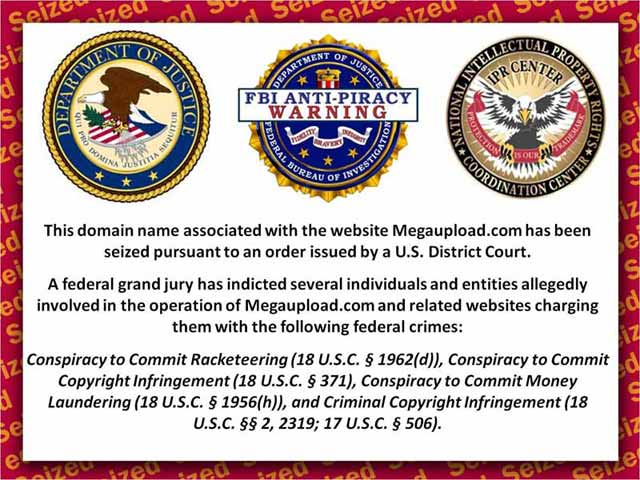
MegaUpload Seized

The Megaupload seizure in January helped set the tone for the rest of the year

I guess the two biggest events of the year actually happened right at the start of the year. First, SOPA (and PIPA) was stopped, and then almost in retaliation, Megaupload was also stopped by the powers that be. The rest of the year sort of pivoted around the events in January, but we also saw the usual stuff. The Pirate Bay was targeted again and again, and again, it remains fully operational, probably more resilient than ever. Censorship regimes propped up all over the place, most of them, if we’re being totally honest, were all attempt to shut down TPB (again, none of them really did much).

But for all the efforts to stop sites like TPB, either through litigation, legislation or technology, the emergence of new legal online services might finally be turning the tide against piracy. Spotify, Netflix, Amazon, and yes, even the industry’s much maligned UltraViolet service, all played a role in giving people a viable alternative to piracy. And Hollywood is just starting to get a taste of the fruits of embracing the Internet, something that perhaps will bring more common sense to the copyright debate in the coming year.

Netflix

Netflix remains dominant, but other players are entering the market and are catching up

I believe in this because I have seen the industry’s fear abate as the year went on. The emergence of digital streaming and download services has had a huge effect on DVD revenue, but far from the hysteria that I might have once expected, it was all quite calm and optimistic from the industry. Blu-ray’s ongoing success may have partially allayed fears, as was the slight “recovery” (or at least a slow down of the decline) for DVD, but I believe it was the mega million dollar deals being made in the subscription streaming sector that was helping to more than offset any losses in DVD revenue, that helped the industry see the light. Whether the exorbitant amounts being asked of companies like Netflix and Amazon, and the new Redbox Instant, is sustainable, I don’t know. There is definitely some “loss leading” going on, and Hollywood studios are definitely taking advantage, but there’s also a huge untapped market out there unaware or unable to use these services right now. Improvement in infrastructure, with the help of ISPs, and just more education, more support from the industry (in terms of getting content out there), will hopefully see the next boom in home entertainment.

Wii U ZombiU

The release of the Wii U capped off a largely disappointing 2012 for gaming revenue, but things may start to pick up again in 2013

For gaming, the boom that was the last few years pretty much ended in 2012. The Xbox 360, which had enjoyed months of year-on-year growth, was now on the decline. The PS3 followed suit, in second place to the Xbox 360, as it had been throughout most of this generation in the US. The Wii’s decline had started much earlier, and did not get better. There was not a single month in 2012 that was overly positive, in terms of hardware and game sales, and even the release of the Wii U could not generate the kind of optimism that had been prevalent in the last couple of years. I think 2013 is when the optimism will come back, when the next Xbox and the next PlayStation is unveiled, if not released. The Wii U has started the next gen rolling, but it’s always until most of the other players get involved that things start to heat up, and I think this will happen in 2013.

If not, then perhaps we’ve just been really spoilt with a couple of really great years for gaming, both in terms of the games produced, and also the record sales, which were far above the “normal” that even the most optimistic industry estimates had imagined. The new normal may not be as sexy, but as long as companies continue to produce great games, gamers like myself should consider ourselves lucky.

And this brings us to the only news item this week, and a sort of sad one, to some.

Gaming

The end of the year, and the end of an era. The first steps towards discontinuing the PS2 has started, with Sony stopping the shipment of the console in Japan once the current stock runs out, according to reports.

It’s been a glorious run for the nearly 13 year old console, having sold more than 150 million units and hosted a library of more than 10,000 games. It has survived through three console generations, ended the fortunes of Sega as a hardware maker, saw through the decline and the rise again of Nintendo, and the emergence of Microsoft as a key player in the industry. Even as late as 2008, it was still the most played console that year, according to Nielsen.

Sony PlayStation 2

The PS2 has had its time, but it will always be remembered as a gaming icon

But for all the successes of the PS2, Sony was unable to replicate it with its successor, the PS3. This was largely due to the advent of the casual gaming phenomenon largely led, in the home at least, by Nintendo’s Wii and largely misunderstood by Sony, and also the coming of age of Microsoft’s Xbox gaming platform via the Xbox 360. Sony also underestimated the demand for online gaming, something that had existed as an option on the PS2 but not fully embraced or centrally organized until some four years after Microsoft’s launch of their Xbox Live platform.

And while the emergence of DVD home video, of which the PS2 was one of the most affordable players during the early days of the format, helped the PS2 greatly in terms of penetration, the same could not be achieved to the same degree with the PS3 and Blu-ray. The expense of including Blu-ray playback also made the PS3 noncompetitive against the likes of the much cheaper (but inferior, technologically speaking) Wii or the one year older (and thus cheaper) Xbox 360. It was a pricing battle that Sony never managed to win until it was too late (when Blu-ray players were a dime a dozen, and the Xbox 360 had established a dominant lead, sans Blu-ray, in the US).

As for the PS2, we bid thee farewell. You had a great run, and you shall live on in our memories as a true gaming icon, alongside the likes of the Atari 2600, the NES, the Super NES and the Sega Genesis. Honorable mentions to the cult classic Dreamcast too.

So that’s it for 2012. Hope you’ve had a good year, and hope that 2013 will be better. See you next year.

Weekly News Roundup (23 December 2012)

December 23rd, 2012

The fact that you’re still reading this means that the world did not end. I for one feel disappointed. All that hype for nothing. Or maybe I was just disappointed that I actually had to write this WNR, although I guess between doing this and post-apocalyptic scrounging for canned goods all the while on the lookout for cannibals, this wins out. Slightly.

Maybe because people were too busy stockpiling supplies of toilet paper, long life milk and batteries, news was a bit light this week. So we should get through this pretty quickly, so you can get back to last minute frantic holiday shopping, or back to ignoring your relatives.

Copyright

The Office of the United States Trade Representative (USTR) has finally released their annual “notorious markets” list, listing all the best places where you can get your piracy fix, or something like that. Actually, it’s a list of copyright do-no-gooders, which is supposed to shame them into doing something or another. Or rather, it shames the governments of the countries that these websites or physical markets are located in.

No surprises really, with The Pirate Bay and isoHunt leading the BitTorrent indexer category. Also unsurprisingly, Megaupload and Demonoid does not grace this year’s list – other cyberlocker websites, including Rapidgator, Putlocker and the Ukraine based Ex.ua, are still listed.

Netflix

Netflix has done more to fight video piracy than the closure of Megaupload

I like how the document goes into great detail about the successes during year, most notably the Megaupload thing, but there’s hardly a mention of any positive effects in terms of trade and revenue, which is the whole point behind anti-piracy and counterfeiting, isn’t it? It’s been nearly a year since Megaupload was shuttered and the whole file hosting industry was shaken to its core, yet has anything really changed?

Spotify and Netflix seems to have far more effective at reducing piracy and increasing revenue than the closures of LimeWire and Megaupload respectively.

——

It took a while, and after a lot of threatening letters and whatnot, Warner Bros. and Intel (well, Intel’s daughter company Digital Content Protection) have finally launched a full scale lawsuit against a company that makes a HDCP circumvention device.

Some backgrounder on HDCP – it is the copy protection used in HDMI cables. Without a successful “handshake” between two HDCP compliant devices, video and audio functions via the cable will cease to function. If you’ve ever had a problem with a HDMI input not showing anything, and a problem that was fixed by restarting one or both of the devices involved, then HDCP was the culprit.

HDMI Cable

Is Hollywood really worried about people copying movies via HDMI cables?

Early DVI inputs did not support HDCP, and so many legacy devices (such as monitors, TVs, projectors) could not be made to work with newer devices that mandated the use of HDCP. HDCP is also responsible for preventing HDMI to component/VGA conversion. That is unless you manage to circumvent HDCP, which isn’t as hard as it sounds since it was successfully cracked back in 2010. And so a range of devices went on the market that finally allowed those still with HDCP-less DVI or component only devices to work with newer HDMI only ones, or to record things like PS3 gaming footgage for review or walkthroughs. I specifically won’t mentioned using HDCP-less HDMI to copy Blu-ray or DVD  movies, because nobody in their right mind would do this when there are far simpler solutions around.

Anyway, Warner and Intel have threatened to sue on many occasions, but if I’m not mistaken, this is the first time they’ve decided to actually take the next step. The company being sued is Freedom USA, an Ohio based company that manufacturers several such devices under the brands SIIG, SABRENT and CE Labs.

Of course, the fair use argument is strong in this case, in that an argument can be made that the primary use of these devices isn’t for copyright infringement (again, there are far easier ways to copy Blu-ray or DVD without having to record via a hacked HDMI stream), but to allow the use of legacy devices. How Warner Bros. and Intel can prove that Freedom USA’s devices were used to infringe the copyrights owned by Warner Bros., I just don’t know. Just because a device could be used in that way, doesn’t mean it is commonly used that way, or is the reason why people buy it. I suppose the argument could be made that cable shows are being recorded this way, but even with HDCP uncracked, analog copies can still be made easily by anyone with a semi-decent PC capture card.

High Definition

Remember when Walmart debuted their “disc to digital” program, and you had to bring your DVDs or Blu-ray to the store so you get the “privilege” to pay $2 to $5 for the SD or HD version of the film on VUDU? The service even stamps on some kind of ink on your disc as to ensure you don’t try to cheat them and try to use the same disc to buy multiple version of the digital copies.

Others simply ripped their DVD and Blu-ray with free software, with no need for fees or invisible ink, or even a car trip to the store.

Seeing the gap between these two consumer friendly/unfriendly extremes, Best Buy has started beta testing a way for consumers to do the disc to digital conversion at home. Users can pay a similar amount to get a UltraViolet version of their existing DVD film, or pay a little bit more to “upgrade” to the HD version, with 3,500 titles currently supported. Blu-ray discs are currently not supported though.

CinemaNow Disc to Digital

Convert your DVDs to UltraViolet digital copies using CinemaNow Disc to DIgital

So no car trip, and no need for invisible ink (are they really worried people are gonna pass around the same disc just to trick the store into accepting their $2 or $5, for a SD version that’s probably not even worth that much anyway). Still not as easy as ripping your own discs, but at least you do get a cloud hosted downloadable or streaming version that some may find more convenient than having to lug an external HDD around all the time.

I would never pay just so I can get a digital copy of a film I already own. I might buy the Blu-ray edition that comes with a UltraViolet copy, but I still prefer discs for the movies/shows that I like, and for the rest, I can probably rely on one of the subscription VOD services. I end up spending less on movies every year, and still end up watching more this way. Which is the way it should be.

And that’s it for the week. Have a Merry Christmas, Happy Hanukkah, or just a nice, relaxing (yeah right) few days off. See you next week, unless nothing happens during the week (a high probability).


About Digital Digest | Help | Privacy | Submissions | Sitemap

© Copyright 1999-2012 Digital Digest. Duplication of links or content is strictly prohibited.