Archive for the ‘Movies’ Category

New Huge Blu-ray sale at Amazon?

Monday, September 22nd, 2008

There have been reports (and here too) that Amazon is doing a 3 for 2 deal on *all* Blu-ray movies. That’s right, all Blu-ray movies (or at least a very large list of them). Some people who have ordered but not given the discount have contacted Amazon customer support and received them (see the forum threads I linked to).

If you’ve ordered 3 or more titles in the last day or so, it might be worthwhile to contact Amazon to see if you can get the discount applied (can’t hurt). If you want to join in the fun now, use this link to get to the Amazon Blu-ray portal and start shopping (be warned though, the promotion is said to last until October 1st, but you are taking a risk if the discount doesn’t show up at checkout – contacting CS may bring you the discount or it may not).

Update: Amazon has corrected their “error”, and you can no longer join in on this free for all (well “1 free per 2 buys” for all). Apparently, they sent out the wrong link for their current 3 for 2 promotion, and instead of linking to the proper page, they linked to the main Amazon/Blu-ray page or something, so hence they had to take a loss and honor all Blu-ray titles for the 3-for-2 deal, not just the 30+ titles that it was originally supposed to cover. Hope you managed to bag a bargain or two while the fun still lasted.

Weekly News Roundup (14 September 2008)

Sunday, September 14th, 2008

I haven’t had the best of luck in the last few months with technology. The main server’s hard-disk broke in March, then the entire data-center exploded in June. Both of my computers started acting up in August (managed to fix them both though), and now my PS3 is broken. And as covered on the blog, my Xbox 360 broke in January (well, that one was expected). Out of all the electronic equipment I’ve bought, including computers, only 2 devices have ever broken and required warranty service. Both were now-gen game consoles. Coincidence? Or perhaps just a side effect of the game console wars.

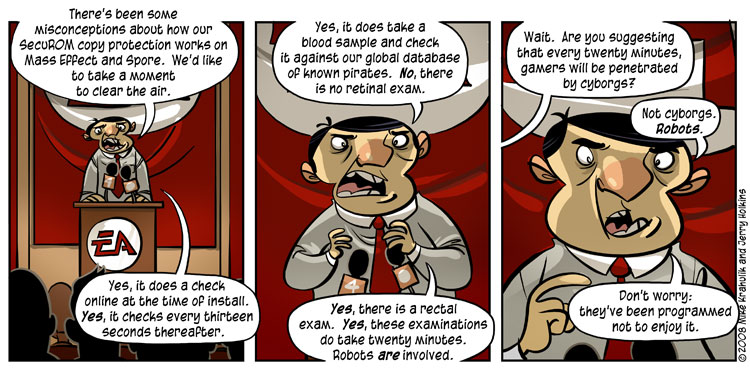
CopyrightCopyright news first. There’s a lot about the hit game Spore this week. Unfortunately, most of the coverage was not about how great the game is (and it is pretty good), but about the draconian DRM that EA felt the game needed. Not only is the game limited to 3 installs, it also limits each copy of the game to only one account, meaning you cannot install multiple copies of the game and play them at the same time on different computers. If you have two computers, you need to buy two copies. 

EA spokesman speaks about Spore DRM

EA spokesman speaks about Spore DRM

And about only being able to re-install the game 3 times – imagine if the game stuffs up and you need to re-install it, or if you’re running out of disk space and you uninstall the game only later you find that you want to play it again, or that you need to do an OS re-install and then re-install the game – is 3 times really enough? As expected, there was a backlash, most prominently on Amazon where Spore’s product rating had been reduced to a single star, the worst possible rating. Almost makes you want to get the pirated version just to avoid these stupid restrictions? That’s exactly what a lot of people are doing, including people who have purchased already, making Spore the most pirated game in history. Nice one EA.

Not content with ruining one hit game, EA wants to do it to Red Alert 3 as well. Red Alert 3’s DRM is limited to only 5 re-installs, needs online authentication, but at least it doesn’t require the CD to be present. If you need more re-installs, you’ll have to call EA tech support. Or you can just apply the no DRM hack, which I’m sure will pop up around the Net in no time. I like the public backlash in response to what EA is trying to do to PC gaming. It’s one thing to prevent piracy, but to inconvenience legitimate users in such a way is just stupid. Hopefully the no DRM movement, led by Stardock’s Sins of a Solar Empire, will gather pace and gaming DRM will be as unpopular as music DRM is right now. Speaking of Sins of a Solar Empire, it’s doing rather well, having sold over half a million copies despite having no DRM. The game also has low system requirements, which has also helped sales. Not bad for a game that doesn’t even have a storyline mode.

RealDVD: Legal DVD copying? But at what cost?

RealDVD: Legal DVD copying? But at what cost?

Back to digital video DRM. Real Networks is set to release a new software called RealDVD, which is the first commercial and legal DVD ripper on the market. What it does is rip DVDs to your hard-drive (well, duh), but it also adds a further layer of DRM on top to ensure the ripped DVD cannot be copied to another computer or distributed online. Obviously, it’s only playable on RealDVD’s software as well. Not sure how useful it will be, having these constraints. The limitation goes so far that even in a RAID mirror array where you swap one drive for another, the ripped files stop being playable as the hardware has changed. This makes backup impossible, so if your drive fails, you need to re-rip everything. External storage drives is the solution to allowing the same ripped DVDs to play on multiple computers, but each computer requires it’s own paid copy of RealDVD as well. RealDVD has noble intentions, but the way it has gone about things is totally wrong. And it may not even be that legal anyway.

What I would like to see is the DVD Forum get in on the act and produce a set of standards from which disc-less DVD playback can occur, even if it has to have some DRM to prevent copying. I would love to have a disc-less DVD library, where the first time you play it, you insert the disc into the player and you will get an option to make a copy of it to that certified central storage device for later disc-less playback on your standalone or HTPC running some licensed decryption software. Perhaps the central storage device can be encrypted to prevent copying and sharing *but not backup, and you would expect the storage device to employ some kind of RAID array anyway), and perhaps a requirement to have the original disc to be inserted after every 5 plays or something, to re-authenticate the copy. I think that’s a fair compromise.

Speaking of disc-less, there is talk that the good old CD is on the way out, to be replaced with downloads. CDs have been around for so long now, so it was always a matter of time before it gets replaced. And notice how CDs don’t have DRM, how quick ripping CDs became possible, and how long it has lasted as a format.

The MPAA is at it again

The MPAA is at it again

The RIAA/MPAA has been busy this week too. They seek to expand copyright laws to allow the Department of Justice to file civil suits against people who violate copyright, getting the government to use tax payer money to sue, well, the tax payers. There was another act that they tried to introduce which wants the US government to pressure country which they perceive to be weak on copyright protection. The MPAA also don’t want you to have cheap and flexible cable TV because they want to prevent a la carte pricing. Don’t know how this even relates to copyright, but it’s all part of the pursuit of greed the MPAA is really all about. A couple of week ago, I talked about Sony’s multi-DRM initiative, which the RIAA and MPAA are eager to be part of. All parties involved want to avoid the fate that befell music DRM, and they think they can do it by providing user-friendly DRM (an oxymoron if there ever was one), DRM that is “better than free”, as Sony Pictures CTO Mitch Singer described it. Excuse me while I throw up.

High DefinitionIn HD news, not much happening at all. The latest Nielsen VideoScan numbers for last week gave Blu-ray it’s best week since inception I think, with DVD sales down, but Blu-ray’s going up. Total sales, the figure which studios are interested in, is down though (as DVD’s sales drop was much larger than Blu-ray sales increase). The rise in Blu-ray sales was almost directly related to the Transformers Blu-ray edition. And as there was no equivalent DVD re-release, it explains the figures somewhat.

Microsoft’s Silverlight platform is set to ditch Microsoft’s own VC-1 codec and support H.264 (and AAC) audio. Not so much ditch, but to start supporting the major rival to VC-1 is significant I think. H.264 + AAC is really becoming the standard much like how MPEG-4 (A)SP/MP3 has been up until now.

GamingAnd in gaming, the NPD figures for August came out, but I haven’t had time to do a write up yet. The surprise was that Wii sales dropped by 20%, while the Xbox 360 beat the PS3, albeit narrowly. And Madden ’09 sales was through the roof, with a million copies being sold on the 360, easily making it the best seller of the month. I will have the full analysis up on Monday or Tuesday.

I know you’re expecting more, but that’s it for this week. Overall, a quiet week that was dominated by DRM news. It’s a shame though because DRM is evil and boring, and I would much rather be posting about a new piece of Blu-ray technology or a new killer Wii device that’s a must have. Perhaps next week then …

Weekly News Roundup (7 September 2008)

Sunday, September 7th, 2008

In the digital entertainment news world, the news items are represented by three separate, yet related, groups. Copyright news that deals with the legal ramifications of digital copyright, HD news that deals with the emergence of HD video, and gaming news that talks about the next generation game consoles. These are this week’s stories.

Dun. Dun.

CopyrightLet’s start with copyright news. In Italy, the MPAA’s president have been giving the Italians some advice on how to deal with piracy: get the ISPs to do your dirty and unconstitutional work. Not very original at all. The Italian courts have been quite reasonable in their dealings so far in relation to digital copyright, and they even said that downloading films, music or software is not a crime if it isn’t done for profit.

If the ISPs don’t get on board, than colleges will be the next target. It’s not the first time that the MPAA has blamed college students for their revenue losses. “What revenue losses?”, I hear you say, and you’re right, the movie industry has been making record profits of late. The “revenue” they refer to, of course, is the imaginary one that has been lost due to people pirating and not buying movies. This of course assumes that the college student that downloaded 500 movies would have paid for those if piracy had been prevented. Yes, I’m sure it’s is entirely plausible for a college student to have a $10,000 DVD collection on campus. And not only that, each student would have to have their own collection, as sharing a movie is also illegal according to the MPAA.

IsoHunt - taking the fight to Canada

IsoHunt - taking the fight to Canada

IsoHunt’s fight against the RIAA is now turning into a fight against the CRIA (Canadian version of the RIAA), but the first strike has been from IsoHunt. Taking an offensive step in the litigation process, IsoHunt has tried to explain how torrents work and why it shouldn’t be considered copyright infringement if a website only hosts the torrent files. The law lacks sufficient clarity when it comes to these types of issues, such as whether linking to a third-party site that hosts pirated material is the same as hosting the pirated content yourself. Second degree piracy, or something. Torrents are the same … you can link to a torrent file which is basically just a text file, but without the trackers, seeders and leechers, you can’t do anything with the torrent file. 

PlayTV - no DRM?

PlayTV - no DRM?

Sony’s new PlayTV add-on for the PS3, which adds TV recording facilities to the PS3, might be DRM free after all. How long before PlayTV recorded shows make their way onto the Internet and will Sony defend against charges that it is making devices that facilitates piracy? Or will Sony, one of the largest makers of blank media (and one of the largest uses of blank media is related to piracy, of course), turn a blind eye when they stand to make a profit from all this. DRM-free is the right thing to do, but the “holier-than-thou” attitude towards DRM from Sony is hypocritical from a company that has profited from piracy, like most other media/electronics/gaming companies.

High DefinitionLet’s have a look at HD news. Sony has came out with a bold prediction that Blu-ray will be the last optical format. Either they’re extremely confident that no technology will ever better Blu-ray in terms of storage, production costs, speed, or that they don’t think the good old optical disc has much life left, now that there are alternative methods of distribution. I’m more inclined to believe the latter, and it seems another Blu-ray backer, Samsung, agrees with this as well.

Samsung: Blu-ray only has 5 years left

Samsung: Blu-ray only has 5 years left

Samsung says that Blu-ray only has 5 years left (which, ironically, is just about the time that Blu-ray will overtake DVDs, by many other’s predictions), and after that, downloads and whatnot will take over. I have no idea what will happen, as downloads/streaming will depend a lot on how sound the Net infrastructure is and whether it can cope with the added demand (and the news that Comcast is starting to cap broadband usage suggests that the infrastructure is getting stretched). There’s also the slightly tricky issue of getting consumers on board, as without a simple plug and play device to download/stream movies, people will be turned off by it. But video on demand is the future, and by “on demand”, I don’t mean having a 10,000 Blu-ray disc movie library which you have to store, catalogue and search through whenever you want to watch a movie. Either way, it sounds like Sony may be onto only a temporary winner when it comes to Blu-ray.

Which is why it was so strange to see that the first movie on a possible Blu-ray killing distribution method, USB memory sticks, is actually a Sony movie. What with the PS3 ready to do video streaming as well, it looks like Sony is hedging its bets on both Blu-ray and purely digital distribution. And who can blame them?

Samsung's 240 Hz LCD

Samsung's 240 Hz LCD

Back to Samsung. They are saying that they will concentrate on new display technologies such as OLED TVs (thinner, brighter, better than LCD technology). 3D TVs without the need for goggles is another one to watch out for. Both Samsung and Sony are working on 240 Hz TVs, which will give motion that is so smooth, that it is very close to what our eyes can see in everyday motion. If you’ve ever watched a Blu-ray movie on a 120 Hz screen (especially compared to a 60 Hz one), you’ll know why this is a good thing. It’s just a shame that not all HDTVs are 120 Hz by standard, which is what I would have expected by now (if Blu-ray was more popular, I think 120 Hz would be too, as Blu-ray’s 24 FPS output is perfect for 120 Hz due to it being a multiple of 24).

GamingAnd finally in gaming, more Xbox 360 price cuts are coming, with the Arcade bundle now $199 and cheaper than the Wii as Microsoft tries to catch onto the casual gaming wave. I can’t complain about any price drops of course, but I wish they would upgrade the hardware to at least make it less noisy and more reliable (surely technological advances should allow for this to happen now without dramatic product cost increases).

GTA may be coming to the Wii as well, which kind of goes against the family friendly image of the Wii, but there are quite a few violent games on the Wii already.

And that’s it for this week. I’ve been busy with some mundane stuff recently, upgrading the forum software for one which is a pain in the proverbial due to all the modifications I’ve made to it. Hopefully, I can get it done by next week, or somehow wipe out the entire forum in the process, whichever comes first. To be continued …

Created by Dick Wolf.

Weekly News Roundup (31 August 2008)

Sunday, August 31st, 2008

I finally finished writing that guide I was talking about last week. The DVD-lab Pro Basic DVD Authoring Guide is one of the more complicated guides I’ve written recently, and also not aimed at beginners that most of my guides are about. DVD-lab Pro, while expensive compared to most other home based DVD authoring solutions, gives you a lot of power and flexibility that you only find in packages worth ten times as much. And it’s relatively easy to use too, once you get the hang of it, and surprisingly error free (no bugs, crashes or any of those things that you usually find with DVD authoring tools). If you need to make DVDs on a semi-professional level, then this is a great tool.

Okay, enough link/content promotion, let’s get on with the news. 

CopyrightIn copyright news, P4P, an upgrade to existing P2P technology whereby local peers are preferred over non-local connections, is a technology that is welcomed by ISPs in their fight against ever increasing bandwidth demands. Local bandwidth is cheaper, you see. But because of the local nature of things, it makes for greater control, and there are those who think that P4P might allow for better anti-piracy measures. Meanwhile, ISPs continue to fight against P2P, on bandwidth related reasons as well as pressure from content owners. Comcast’s anti-P2P stance has come under fire from the FCC, who says it “does not constitute reasonable network management” and that “the company’s discriminatory and arbitrary practice unduly squelches the dynamic benefits of an open and accessible Internet”. Nice comments from the FCC, I have to say.

Veoh - Victory in the Courts

Veoh - Victory in the Courts

Some more positive news in the copyright fight, online video site Veoh has had a copyright case against it (by an Adult entertainment company, no less) dismissed by a Californian Judge. The happiest people will be Google/YouTube, because this precedent could mean that the cases against them are dismissed too. While the courts (and the FCC) seems to be sending out the right messages, the politicians, once again, might be behind the times. With the US elections coming up in just over two months time, both the RIAA and the MPAA are converging on the two political parties’ conventions and lobbying like crazy, spending hundreds of thousands of dollars if needed. I talked about McCain’s views on copyright a couple of weeks ago, and now that the Democrats have chosen Joe Biden as Obama’s running mate, it’s only fair to point out Biden’s pro-RIAA and pro-FBI voting record as well. I know it’s as cynical as hell, but my experience with democratic elections is that you vote for the candidate you hate the least, or you think you will hate the least. Do a bit of research on the Republican and the Democrat’s records on copyright issues, decide which matches your own philosophies the closest (or at least which you find least repulsive), then make that one of the issues that will decide on who you vote for. And you should vote. Here in Australia, voting is compulsory, and you get fined if you don’t vote (of course, we have elections on a Saturday, so everyone has time to vote). Voting should be compulsory in all democracies, in my opinion.

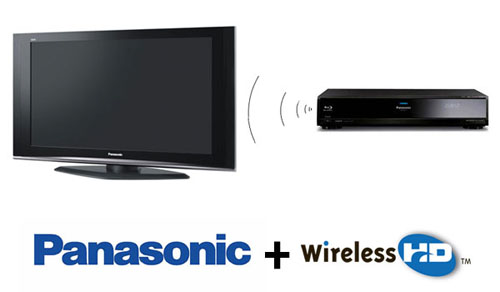
WirelessHD - WirelessDRM Included!

WirelessHD - WirelessDRM Included!

But while the politicians are doing their politicking, the content owners are still hoping DRM is the answer to all their prayers, despite the setback the music industry have had in trying to introduce DRM. Sony, the king of DRM, is once again at the center of it all by introducing a new multi-DRM content format for online movie downloads. Sure, on paper, the new DRM scheme sounds more reasonable, allowing any registered device to work with the DRM’d content, as opposed to forcing you to buy a copy for each device. But the real problem is that if one day they decide to change this policy, then they could do it with a push of a button, and re-write the terms of use of your previously “purchased” content. Just look at what happened with the various collapse of the music DRM stores, and how purchased content became useless once the authentication servers have been turned off. DRM is dangerous, and it should be banned. But not before WirelessHD, a new wireless HD video/audio transmission format, introduces yet another form of DRM. Sigh.

High DefinitionOnto HD news now. I wrote a mid-week blog that looked at the weekly Nielsen VideoScan Blu-ray/DVD sales figures. Hopefully this will become a regular feature in the future. Looking at the stats and graphs I’ve made, it doesn’t seem Blu-ray has made much of a dent at all in terms of either volume or percentage of the market compared to DVDs. DVDs will be here for a long time to come, unless studios decide to pull the plug on the format, which they won’t because it’s still too lucrative (still something like 14:1 sales ratio, in terms of revenue and probably higher in terms of units, at the moment). With upscaling DVD players becoming standard and better in quality, Blu-ray really needs to up the promotional work again.

Toshiba XDE - improved DVD upscaling

Toshiba XDE - improved DVD upscaling

Speaking of upscaling DVD, Toshiba is back into the A/V market with its XDE range of upscaling players, which I mentioned a couple of weeks ago. The players are getting some good promotion from Amazon and other retailers, certainly in the press too thanks for Toshiba’s headline making news earlier in the year. This week, some Taiwanese optical manufacturers have enquired about buying HD DVD patents from Toshiba. The analysis I’ve read suggest they want to do this because they want a stronger negotiation position with Sony in regards to Blu-ray licensing. But Toshiba is holding on to these patents, which either suggest that Sony paid Toshiba to not let HD DVD be promoted again, or that Toshiba has it’s own plans in terms of the China only HD DVD format. Toshiba are not one to give up so easily, it seems, and they’re already talking up beyond 1080p resolution video as well as wireless HDMI, which will be added to their devices next year. There’s also talk about 32 GB memory cards, which rivals Blu-ray for storage, is re-writable and probably cheaper given the prices of USB memory and memory cards these days. Looks like Blu-ray will have some competition in the marketplace when it comes to HD video.

And speaking of competition, the BDA is not happy that satellite and cable companies are using terms like “as good as Blu-ray” when it comes to describing the HD subscription services. Seems the BDA is ever edgier these days, when it comes to “as good as Blu-ray” type services that could render Blu-ray a sideshow in the HD video arena. LG is launching a DVD player that supports HD DivX video, so even Blu-ray supporters are looking at alternatives. The next version of DivX will use H.264, and an early alpha version of the encoder (in command line format), is already available. Blu-ray manufacturers will probably embrace this new format, since all their players can decode H.264, and thereby (with a little modification), DivX 7 as well. The disc-less home theatre dream that I have seems to be getting closer to reality, and if that becomes a reality, then it will be a nightmare for the BDA (unless they do the sensible thing and add managed copy, which make the actual Blu-ray disc just a carrier, like Toshiba’s 32 GB memory cards or portable hard-drive).

GamingAnd in gaming, the Wii has hurt the arcade industry a lot by bringing arcade style games to the home.The Xbox 360 is trying to reverse the trend by bringing Xbox 360 games to the arcade, with coin-ops build around a Xbox 360 console. It’s an interesting idea, and with a common controller interface, a wide variety of games available, it could be a winner. Unless it RRODs, of course.

The "other" Xbox 360 Arcade

The "other" Xbox 360 Arcade

As usual, details of the next PS3 firmware update has been leaked. Screenshot-grabbing, the rumours say, will be the main new feature of this update.

Okay, that’s it for another week. Don’t forget to read my DVD-lab Pro guide. There’s a 30-day trial version available from the official site, so it’s worth a go if you want to see if you can make better menus that what the commercial developers are making these days. Hannah Montana!

(I think he meant to say hasta mañana – ed)

Blu-ray Sales Analysis – May to August 2008

Friday, August 29th, 2008

This is going to be a new feature that will be published from time to time. A couple of months ago, I started collecting and posting weekly Blu-ray and DVD sales figures published in Home Media Magazine, and provided by Nielsen VideoScan, which looks at many retail outlets and provides sales the figures.

There’s a lot of misinformation when it comes to Blu-ray sales figures, mostly due to PR and marketing people doing their job. But these sales stats should provide a clearer picture of what is actually going on in the world of HD (vs SD), and how Blu-ray is doing when compared to DVD sales.

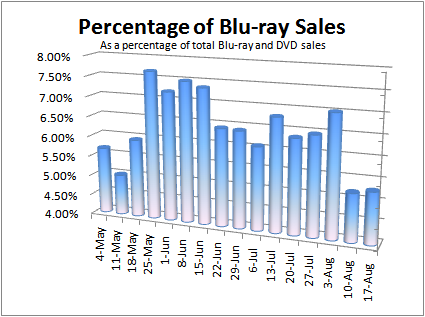
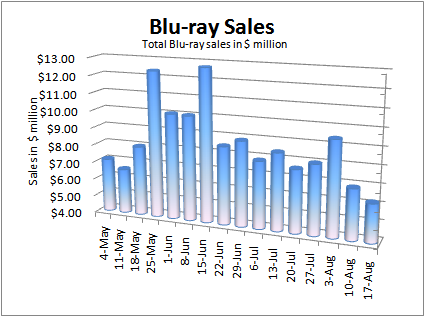
Let me first show you two graphs:

The first graph shows Blu-ray sales as a percentage of total sales (of both Blu-ray and DVD sales combined). The dates on the bottom corresponds to the weeks ending on these days. For example, for the week ending August 17th, Blu-ray sales accounted for 5.27% of total DVD and Blu-ray sales.

The second graph show the actual sales volume for the same time period (for example, for the week ending August 17th, $6.19m in sales was recorded for Blu-ray).

Since I only started collecting stats from May 4 for both Blu-ray and DVD sales, there’s nothing that I can publish from before this time. Just as well as May marked the last month that a HD DVD movie was scheduled to be released, so from this point on wards, the war is now between Blu-ray and DVD well and truly.

So what does these graphs tell us? Not a lot, apart from that it’s still early days and that Blu-ray sales are still struggling at this stage. Looking at both volume and percentage, August ended much like how May started. Blu-ray sales were between 5% and 8% of total sales. That’s respectable, but it’s hardly the kind of results that many expected after the death of HD DVD, at a time when Blu-ray has no like-for-like (HD on a disc) competitor in the marketplace.

There was a peak in June, most likely due to releases of certain blockbuster titles at those times. The peak in sales also corresponded with a peak in the Blu-ray vs DVD sales percentage, which suggest that Blu-ray sales is still largely dependent on what is available for sale. Because I think Blu-ray is still largely being supported by early adopters and the more serious movie collectors (those that buy movies on the release date, rather than wait for a few months for the eventual price drop – DVDs have a monopoly on these sort of sales, mainly because Blu-ray prices don’t drop with any conceivable pattern), this translates to bigger slice of the sales pie whenever a good release (that benefits from HD) is available. Look for Blu-ray sales to peak again when movies like Iron Man, The Dark Knight are released later in the year.

Just to expand on the point about budget movies, this is still an area that is dominated by DVDs. I recently purchased some movies including Revenge of the Nerds and Hot Shots! And I suspect the bulk of DVD sales are made up of titles such as these. These movies are not available on Blu-ray for one, and even if they were, they would be too expensive. And further more, even if they were just slightly higher in price, there’s very little benefit in watching these types of movies on Blu-ray (a lot of these films weren’t even recorded with multi-channel sound, and aren’t “important” enough to get the full proper HD transfer). This is why, I think, DVDs will be around for some time yet. I don’t know if Blu-ray sales can ever overtake DVDs, not until studios stop producing DVDs anyway. Most experts predict that Blu-ray vs DVD sales will reach 50-50 by 2012, so there’s still plenty of time for Blu-ray to reach this target. But many also predict other video delivery platforms, such as online streaming and downloading, might be of more interest to people by then.

Anyway, I’ll be back in a few months time with an update to this post. It will be interesting to see what effect The Dark Knight has on Blu-ray sales (I think this one will break all records). See you then.