Archive for the ‘Movies’ Category

Weekly News Roundup (22 November 2009)

Sunday, November 22nd, 2009

Just a reminder that our Womble EasyDVD competition is still open for entries. Since the competition was posted, Womble has actually released a new version of their MPEG Video Wizard DVD software, and the first prize of this competition include this latest version, which has basically combined the features of all of Womble’s previous software titles (not including EasyDVD, of course) into the same package (so no more “DVD-less” version of MVW, and MPEG2VCR). Not a huge news week, but there were some follow-ups to previous news stories.

Copyright

First up in copyright news, a recent trend has seen companies take advantage of the one sided copyright laws around the world to make money from “stopping” piracy. It’s actually not so much stopping, as that wouldn’t be good for business, but rather, using legal threats to get people to cough up. I posted about companies like DigiProtect and DigiRights Solutions doing exactly this sort of thing, and refining their business down to a fine art in terms of who to threaten, based on their ability and willingness to pay up, for example.

The funny thing was that most of the information I found in regards to these organisations were from interviews and presentations that people from these companies gave, quite openly. Obviously, there are still large parts of what they do that these companies would still rather keep secret. But secrets have a way to become well known facts thanks to the Internet, and now we have leaked documents showing us the inner workings of such an operation. One thing revealed was that, due to bad publicity, one law firm has already pulled out of this business, but it appears most of their staff went to a new law firm that obviously didn’t mind the bad publicity. Another thing revealed is the strategy to sue people who downloaded pirated porn, as the extra embarrassment and the instinct for most people to want to make the issue go away, whether they downloaded the porno or not, becomes extra incentive for people to pay the required amount. From everything that’s been released, leaked or public confessions, it’s clear that these companies prey on people’s fears of lawsuits, or public embarrassment, in order to maximize profit. But if these companies are acting within the law, then there’s nothing legally wrong with what they’re doing, even if it feels like bullying. It’s the laws themselves that allow for these things to happen, and it will continue to happen as long as these laws are biased towards one side.

And so the bullying goes on. Michael Fricklas, general cousel at Viacom,  has even admitted that suing downloaders is bullying. With the resources available to mega corporations like Viacom, suing individuals is the kind of one sided fight that really isn’t a fight at all. “Terrorism”, is what Mr. Fricklas called it. In the same candid discussion to a bunch of students at Yale, Mr. Fricklas also attacked DRM, at least the older kinds, as “really bad”, preferring fair use as the way forward. It’s all very nice to hear, but this is from the same company that is suing YouTube for people who upload videos that help to promote Viacom’s content, so you’d have to take all of this with a grain of salt. Obviously suing YouTube/Google is a bit more challenging and less like bullying than suing an individual, but YouTube now allows for “fair use” with its profit sharing programs, so why hasn’t Viacom dropped their lawsuit?

Verizon is the latest ISP to bow down to RIAA demands to pass on infringement notices

Verizon is the latest ISP to bow down to RIAA demands to pass on infringement notices

Speaking of lawsuits, the Australian AFACT vs iiNet trial continues, with closing statements by iiNet being made over last week. For those that haven’t been keeping track, the lawsuit centers around movie studios wanting to make ISPs responsible for their customer’s downloads, unless the ISPs act as copyright cops for the studios. The week 5 update thread for the trial is here. iiNet is at least making a stand, unlike ISPs in the US that have already bowed to the demands of the RIAA to pass on infringement notices to customers, the latest major ISP to do so is Verizon. The notices are designed to scare people enough so they stop downloading, but as such, Verizon and co have no plans to pass on customer details to the RIAA, and the RIAA has not indicated that they wish to pursue individual in court, something they’ve already said they would stop doing. So just how much fear these infringement notices will instill is debatable, unless the RIAA is really naive enough to think that some of the downloaders are actual unaware that what they’re doing is illegal, and that these notices serve as a timely reminder.

Oh, and remember that Lily Allen story from a couple of months ago where the singer publicly came out to support the industry’s attempts at copyright clampdown, and was subsequently, how would you kids say it, “pwned” in the process when it was revealed that she distributed pirated songs herself on her website? Anyway, the latest pearl of wisdom from Miss Allen is that she is absolutely fine with people downloading her songs illegally, as long as they burn the songs to CDs and then sell them on. Yes, that’s right, it’s not a typo. You see, if you sell these illegally obtained songs, and thus commit real piracy by profiting from it, you are actually just giving value to these songs, and so that’s alright.

The latest update in The Pirate Bay saga (I still have no idea whether they’ve been sold or not) is that the tracker is now officially dead and won’t be rising again. But thanks to the active pursuit of the RIAA and MPAA, new BitTorrent technology means that trackers are no longer really necessary, which means the decentralization of BitTorrent is approaching completion. When it does, BitTorrenting will be practically unstoppable. And with Magnet links, you don’t even need .torrent files anymore, so really, sites like The Pirate Bay can now only need to provide a link consisting of what appears to be a random set of letters and numbers, and really, can they be sued for that?

High Definition

In HD news, Warner has a new offer that allows you to trade in your old DVDs for Blu-ray movies. You don’t get the Blu-ray movies for free, but they are discounted. It’s a nice idea in theory, but only a small range of less than spectacular Blu-ray movies are available, and the discounts don’t add up to much if you’re already getting them cheaply from Amazon.

Blu-ray + DVD + Digital Copy is becoming a very popular combination

Blu-ray + DVD + Digital Copy is becoming a very popular combination

It appears that the studio’s new weapon to promote Blu-ray is to try and kill of DVDs as soon as possible. The trade in offer is one thing, but Universal’s plans to introduce Blu-ray/DVD combos, just like Disney, will probably do more wean people off DVDs especially if their plan to discontinue the DVD only versions of these movies is true. It’s very likely though that these combos would come at a higher price than their DVD only cousins, and I’m not sure if that actually helps to put people onto Blu-ray or to put them onto piracy. It doesn’t really seem fair to “tax” DVD owners for the sake of promoting Blu-ray.

And following YouTube’s announcement that 1080p video is now available, and it is (hover your mouse over the HD icon and select between 720p and 1080p), there’s more good news on this front. I talked about the performance implications, in that 50% of an Intel C2D E8500 is going to be kept busy decoding the 1080p video, but the good news is that now both Nvidia and ATI will offer GPU acceleration support for Flash video, which should see that 50% fall below 10%. All ATI Radeon HD 4000 series cards and the new 5700 and 5800 (and newer) cards will be supported, as well as most Nvidia cards since the 8000 series. While we’re not talking about Blu-ray quality video, but it really is a significant step towards digital delivery of HD content. Once bandwidth becomes cheaper and connection speeds improve, there doesn’t seem to be any reason why Blu-ray quality video can’t be delivered online.

There’s a bunch of PS3 news, some of it HD related, but I’ll post them in the gaming section …

Gaming

And lastly in gaming, PS3 firmware 3.10 has been released. This firmware adds Facebook support, which also came to the Xbox 360. But what’s a PS3 firmware without a chorus of complains, and this one seems to be particularly nasty from reading posts on the PS3 boards. I haven’t updated my firmware since 2.43, and don’t plan to unless some must have Blu-ray update arrives, or that Sony finally owns up to the problem and come up with some sort of solution that everyone is satisfied with, because I’m not paying $250 to repair it if things goes badly, which I suspect it will.

If the GeForce 3D kit is any indication, 3D Blu-ray will have quite a few hardware requirements

If the GeForce 3D kit is any indication, 3D Blu-ray will have quite a few hardware requirements

One of the “must have Blu-ray updates” might be for the 3D feature, which Sony says that PS3s will be able to support via a “simple” firmware update. Of course, you’ll still need a bunch of other equipment before you can have a 3D home theater experience, so it might be something to look out for if you’re buying a new TV (look for specific support for 3D, or failing that, at least 120 Hz refresh).

Another new to Blu-ray feature is a new Digital Copy feature Sony plans to introduce that copies the movie straight off the Blu-ray disc to your PS3 and then onto your PSP. The previous method required a PC, with a special DVD-ROM and unlock codes. Still, all these are just temporary solutions until Managed Copy arrives for Blu-ray on December 4th. There’s some confusion as to what December 4th means for Managed Copy, but the summary is that after this date, all new Blu-ray releases will have to support Managed Copy. What this means is a bit vague at the moment since the hardware (and software) for MC is not set to arrive until next year, but suffice to say that any movie released after December 4th should allow you to make a managed copy from them eventually. It is mandatory, meaning all discs must support it, and it took a fight to get MC being made as a mandatory requirement, so at least that’s some of the confusion out of the way. The news post for all three of these PS3 stories, none of which has much to do with gaming mind, can be found here.

And that was the week that was. Have a nice one.

Weekly News Roundup (15 November 2009)

Sunday, November 15th, 2009
Making a DVD menu is made simpler by Womble EasyDVD

Making a DVD menu is made simpler by Womble EasyDVD

As expected, following last week’s news blitz, this week has been relatively quiet. Which is a good thing because I managed to fill the gap with a new DVD authoring guide for Womble EasyDVD. Having played with the software for a week, I can say that it’s very easy to use and mostly intuitive. There are a couple of missing features such as subtitle support and multiple audio support, which I hope Womble can fix in future releases (this being their first effort after all, so you can’t have everything), but it’s mostly what you would expect, and the menu creation offers a bit more flexibility than your average authoring suite, without ever going into the semi-pro territory (complete with the much steeper learning curve) of tools like DVD-lab Pro. The other thing that was available this week was the October NPD US video game sales stats, I wrote the analysis for it yesterday here. The PS3 didn’t manage to sell over the Wii as it had in September, but it’s the Xbox 360 that’s the loser in terms of the recent price wars it seems, although it’s doing fantastically in software (for now, thanks to its larger install base). The coming months should give us an even clearer picture of what’s in store for 2010, and Microsoft will be hoping to see similar scenes as last year this time as people enthusiastically grab their cheaper holiday bundles. But I wouldn’t bet on it. Anyway, onto this week’s news.

Copyright

In copyright related news, the BBC’s proposal for adding DRM to their HD broadcasts has been denied by the British Office of Communications. But the idea isn’t entirely dead and the proposed DRM scheme may appear later on, with existing hardware likely to support such a DRM scheme if it is ever introduced.

The MPAA are still of course campaigning vigorously in the US to try and get the FCC to allow them to introduce  Selectable Output Control. The old “pro consumer” argument was brought out, to argue for SOC’s use in bringing new release movies faster to the home if the studios were more confident of its resistance to piracy. Many studios are already doing this without the fake security blanket that is SOC. But SOC is just a trojan horse for the MPAA, because once you can control one aspect of how someone watches TV, you can then control all aspects of it eventually. If the MPAA and their cohorts can get away with banning all  TV recordings, then does anyone really doubt that this is exactly what they would do? Pro consumer indeed.

Further prove that movie studios really don’t give a crap about the people that are supposedly their customers – a free community Wi-Fi service that brings tremendous benefits to a huge number of people has been shut down all because of a single piracy complaint, from Sony (who else?). It’s a case of the studios exploiting people’s fear over lawsuits, and an innovation that helps the local economy, local law enforcement, small businesses and visitors is attacked and destroyed. Obviously the people who decided to shut down the network, as the cost of adding anti-piracy filters is excessive, must shoulder some of the blame for this over reaction, but the MPAA’s reaction to the story shows the depth of their arrogance. Instead of calling for a reasoned approach and balanced response, that a single movie download does not constitute a widespread piracy operation, they used the occasion to further spread their anti-piracy propaganda. But that’s what they are. They are an industry lobby group and they’re paid to say and do these things. What is really wrong is politicians and others in power taking their word as gospel, and acting without taking into consideration the serious consequences  for issues like privacy, and the economic damage that would occur if the MPAA’s wishes were turned into reality.

iiNet's freezone: damned if you do, damned if you don't

iiNet's freezone: damned if you do, damned if you don't

It’s week 4 of the Australian AFACT vs iiNet trial, and it was closing statements time.  Once again, you can check out a summary of the week’s events here, but the arguments from both side remain the same. The AFACT thinks iiNet is basically a piracy provider, even suggesting that  the ISP’s use of phrases such as “happy downloading” was in fact an encouragement for people to download the latest Harry Potter movie. And even iiNet’s attempt at promoting legal content, through their freezone service, was attacked. You would think the movie studios should be delighted that ISPs are providing quota-less downloads for legal content as a way to to provide further incentives to go the legal route, but you would be wrong. The argument is that because quota is not used, it leaves more free quota for downloading pirated movies. The same argument was made for iiNet increasing download quotas for their customers, as the AFACT assumes anyone who needs a large download quota must be a movie pirate. This “sky is falling” and “you’re a pirate until proven otherwise” attitude that these lobby groups have adopted is working wonders in their political lobbying activities and have proved useful in the legal arena as well in the past. Our only hope is the judge can see through these exaggerated truth to balance the need for anti-piracy and the need to protect consumer rights, and the rights of ISPs to operate without being burdened by the responsibility to prevent piracy. Surely the industry that profits, often in record amounts, from the movies and TV shows that are being pirated should be the ones responsible, at least financially, for the anti-piracy operations, not the ISP or its subscribers. Either put up, or shut up.

Most independent game developers say that piracy is not a significant problem, at least for now, according to the latest survey. While most fear that it can become a big problem in the future, only 10% felt that it was a serious problem at the moment. One thing to note about  piracy, including games and movies, is that people who do have the ability to pay for content will usually do so. It is only those that never had any intention to pay for anything, some because they don’t have the capability, that are the more dedicated when it comes to sourcing pirated content online, and these people were never likely to provide any sort of income for the content owners, now or in the future. So the key is to at the very least increase the number of people who have the capability to pay for content, and that can only be achieved through pricing changes. Digital distribution allows this to occur without the cost being a huge issue (certainly compared to physical media and the associated costs like packaging, shipping  …), and even more reasonable pricing can open up previously untapped markets, such as developing countries where piracy rates are even higher. Or the alternative is to fight against logic and try to stop all piracy through technology that has proved inconvenient at best, and completely unworkable at worst, or through ever harsher legislation that completely disregard some of society’s basic principles in relation to justice and human rights.

Microsoft banning 1 million Xbox 360 accounts over suspected system modding (which allows for piracy) may seem excessive, but console piracy is actually not a huge problem and that’s worth examining. The anti-piracy success is largely to do with technology, all games consoles carry some form of DRM for games and being closed systems, they are easier to enforce (unless somebody decides to mod their Xbox 360, that is). The DRM systems used are also fairly straight forward, usually just a DVD check, and with digital downloads being available, even the DVD check won’t be necessary anymore. There are still many aspects of the DRM system that are inconvenient, such as when one needs to move from one console to another, but there are at least solutions and workarounds. And I guess more reasonable pricing comes into it. Games are expensive, but given the number of hours of entertainment they provide, it’s still better value compared to your typical movie or MP3. Consoles are also now very good at providing demos for new games, thus eliminating the need for people to “play before they pay” (which I admit is often used as an excuse for piracy, and play doesn’t always lead to pay). They certainly aren’t going out there lobbying the government to throw people off the Internet for downloading games, or getting ISPs to work as their spies, or suing individuals for using pirated games.

High Definition

HD news now. Not much on Blu-ray to report, but the holiday season is upon us and there will be a steady stream of big releases to give the format a big boost. But HD is more than just Blu-ray, and the future of HD may be SD.

Blockbuster tries SD digital rental

Blockbuster tries SD digital rental

Not SD, as in standard definition, but SD as in the memory storage format. Blockbuster is trialling a new way to rent movies by allowing customers to download them to their SD memory cards. These movies expire after 30 days if unwatched, or 48 hours after the first viewing. Obviously DRM is involved, but further details are a bit sketchy. If compatibility with hardware players, then the DRM used may be the SD card’s own internal DRM system, CPRM. This would then allow the actual video file to be unencrypted, and playable in a wide variety of players, probably. The lack of DRM on your common USB stick may be why they didn’t go with the more common format.

The other path for HD is digital distribution. The main stumbling block has always been bandwidth, and also processing power (many of the Netbooks you see today will struggle with 1080p content). But YouTube is not waiting around for things to catch up, and will roll out 1080p playback support next week. The link to the left has a couple of further links to test videos that you can already use to see if your system is fast enough for 1080p. On my Intel C2D E8500, I recorded 40 to 50% CPU usage, which is reasonable, but you can see why some Netbooks will struggle. With GPU assisted decoding (unfortunately Flash does not yet support ATI based solutions), the CPU usage can be greatly reduced. This was proven when I downloaded the YouTube 1080p video (about 100 MB for 4 minutes worth) and used PowerDVD 9 to play it back (as it supports GPU assisted decoding). CPU usage dropped to below 10%, and my ATI Radeon HD 4850 was hardly worked (about 5% usage) despite the CPU savings. So it seems for 1080p video delivered through YouTube, most modern computers should be able to handle it, some better than others depending on whether GPU assist is available or not now or in the future. The bandwidth usage is reasonable, roughly the same as downloading a DVD movie (so the 1080p quality isn’t as good as say Blu-ray, not really close yet), but it will still use a large chunk of people’s quotas.

Gaming

And lastly in gaming, not much to link to, except for the NPD analysis, which I’ve already linked to above. I think we finally have a proper console war on now, where there’s not much between the three top consoles, the Wii, Xbox 360 and PS3. The Wii has the superior hardware numbers, but is weak on games, especially third party ones and ones that appeal to hardcore gamers. The PS3 has only started to do well to suggest it may take top spot eventually, but there’s still some catching up to do both in hardware and software. The Xbox 360 is enjoying software sales, at least in the US, for now, but it won’t last forever if it the last two months becomes a trend and they continue to sell less consoles than the PS3. But they have a great multi-player community and that counts for more and more these days. And of course, Natal, which may be beaten to the punch, innovative software wise, by PS3 Eye Pet (a new category of games, using the buzz word  “augmented reality”) . But if Eye Pet is a success, then that may actually bode well for Natal, since it plans to offer similar things but in a more mainstream, and technologically advanced fashion. The only problem is the late release date, now semi confirmed as November 2010, which may be too late to help if things stay the way they are.

See you next week.

Weekly News Roundup (8 November 2009)

Sunday, November 8th, 2009

Some weeks you couldn’t buy a news story, this week, there’s enough for two weeks. Don’t really know why, perhaps the MPAA is upping their lobbying efforts, or the courts have resumed their cases, and parliaments are reconvened to pass new legislations. Who knows. On my end, I finished the review for WinDVD 2010 as promised. A summary? Well, I’d rather you read the full review, but suffice to say there are things that I like about WinDVD, and there are some things that its competitors have done that it has not. Is it a great Blu-ray player? Yes it is. Can it be better, that’s a yes too.

Copyright

Copyright news first, and there are quite a few to go through. Right after my last WNR, news came that torrent tracker UK-T was shut down, and some kind of police action was involved, but as no anti-piracy agency had claimed responsibility at that time, nobody was really sure what went down. Still not really sure what happened, but from leaked reports, it suggest that the police had raided the homes of several of the site’s admins. The database was wiped before the police could get their hands on it, and so the subscribers are safe. One tracker down, only 362,621 to go.

Demonoid: Tracker back online. Database corruption, or something more sinister?

Demonoid: Tracker back online. Database corruption, or something more sinister?

But while one torrent tracker was down, another came back up. Demonoid has been down for ages now, supposedly due to a database problem, but the tracker is at least up again, if not the main website. I’ve noticed that several torrent sites have experienced similar database problems recently, so it could be just a coincidence, or perhaps something more sinister? If it was just an accident, then these accidents have actually done more to stop torrent sites than all the legal actions. Take The Pirate Bay for example. The latest attempt to shut the site down, or at least prevent access to it in Norway, has failed. The entertainment lobby had asked the Norwegian court to get Norway’s largest ISP Telenor to shut down access to the torrent site, but the court said “Nei” as they didn’t think an ISP should be the one deciding which websites its customers get access to, and which it should block. And the implication of this ruling is that ISPs are not really responsible for what their customers get up to, since if they were, then the court would have told them to shut off access. To me, this is common sense,  and Telenor’s spokesman’s analogy of not being able to sue a ladder manufacturer because someone used the ladder to commit a burglary again seems to make sense to me. But common sense is in short supply these days when it comes to the copyright debate.

The failed attempt to shut down The Pirate Bay again deals another blow to the MPAA and their friends, but do they really want the torrent site to be shut down? According to a new study, they should be careful of what they wish for, because during the few days that The Pirate Bay was down, the number of torrent trackers and websites dramatically increased, and downloading continued. The way modern torrent clients work, even without a working tracker, downloads can continued thanks to a technology called DHT (Distributed Hashed Table), or so called trackerless downloads. The download speed is sometimes affected, but not always. And with TPB down, many sees it as an opportunity to become the new TPB, and so naturally, the number of torrent and trackers will surge during this period. It just shows how hard it is to actually try and stop file sharing, and I think it may actually be impossible. All the resources that have been spent on trying to stop file sharing seems like a big waste to me. And even more so when you consider the stats that show that people who download illegal songs actually spend more on music than those who don’t. This again seems like common sense to me, because people who download music (legally, or illegally) are the ones that love music, and many are using free downloads as a way to search for new songs and artists. This “buy before you try” argument has been made for other content as well, like games, although the percentage that converts from try to buy is rather low, nevertheless, there is a percentage. Music especially I think is something that you do need to try before you buy, that’s why we have radio stations that broadcast songs, for free. The music industry, and others, should be exploiting this phenomenon to their advantage instead of trying to shut it down. Spotify, the free online music service, seems to signal a possible future direction, basically taking the radio model online.

The MPAA's propaganda ministry is busy these days

The MPAA's propaganda ministry is busy these days

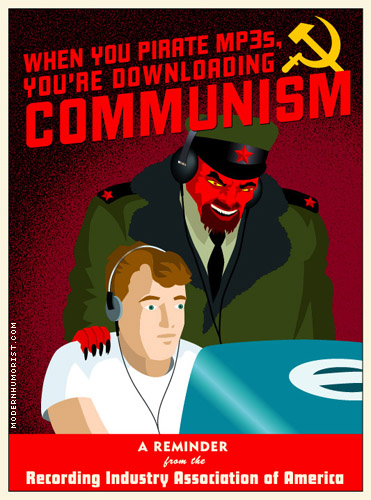
There’s still more copyright news, we’re barely half way through. The MPAA has been busy lobbying the FCC for various things. And as a concerted campaign, they had the US 60 Minutes broadcast a copyright propaganda film that tried to link file sharing with organized crime. There are links between counterfeit goods and physical media piracy with organized crime, but online file sharing that’s mostly free? The downloading communism poster immediately springs to mind (see right). More propaganda as the MPAA says the Internet will die if piracy is not stopped. This is the same MPAA that has been trying to kill the Internet for ages now, that its members and supporters have publicly stated their wish that the Internet had never existed, so why are they so worried about its health now? And the MPAA is not just happy pushing their agenda on the US, they’re going global as well. You can just see their dirty fingerprints over the proposed copyright treaty that will be discussed in South Korea this month. The worst part is that the treaty is being kept super top secret, even though it affects everyone. Of course, the Internet being the Internet, part of the discussions were leaked and it was indeed what we fear most. Three-strikes, global DMCA, ISP policing … are just some of the MPAA’s favourite things, and all will be tabled at the secret discussions later this month. Sigh.

Scumbag

Sarkozy's defence of major US corporations' interests has even led to a fight with the EU

Three-strikes and ISP policing, very popular at the moment, but the EU has decided that something needs to be done to protect consumer rights, even if what they did was not nearly enough. But it’s a start. The EU has decided that Internet access is a basic right, and as such, cutting people’s connections off will require more than just an email from the MPAA. The EU has ruled that a fair process must be in place before bannings can occur, which is less than the full criminal trial that consumer and Internet advocates had first wanted. This all came after France wanted to introduce something that legalized their three-strikes plan (the original one that didn’t require the judicial system, which their own constitutional council found to be, well, unconstitutional), and that angered pretty much everyone at the EU, and the battle has been fought ever since, leading to this latest compromise. Just what has happened to France, a country that I’ve always considered to be quite liberal and would usually be at the front lines fighting *against* the three-strikes nonsense, and not on the side of mega US corporations. Freedom and liberty is also another thing I associate with France, but they just seem to be one the wrong side of that as well because time and time again, it has been shown that copyright laws have been abused to stifle free speech and the critics of corporations. The Electronic Frontier Foundation even has a Hall of Shame for the companies and organizations that have abused copyright laws for their own (non copyright related) benefits. It just shows that when laws are so biased towards one side, they are prime candidates for abuse. And for me it’s hard to digest the fact that a country like France is in there arguing to make these laws even more one sided, and even more open to abuse. But with a guy like Sarkozy at the helm, now using the nations divisions for his political gain, no one expect anything less really. Hall of shame indeed.

The global DMCA thing is particularly annoying, although not that much of an impact since most countries have adopted some draconian form of it. One country is Denmark, and one citizen is doing his unique way of protesting the illogical nature of the laws. Under the DMCA, or the Danish equivalent, any attempt (even unsuccessful) at breaking DRM is considered illegal. However, Danish law allows for DVDs to be ripped for legal home use, and so the two Danish laws actually conflict each other. This is why Henrik Andersen confessed his “crimes” of ripping hundreds of his legally purchased DVDs for use in his home theater setup, to a Danish anti-piracy agency. Under the DMCA, Mr Andersen is guilty and should be fined, if not jailed. But just whose interests has he actually hurt? Certainly not the movie studios that he purchased his DVDs from.

Still more copyright stuff, bear with me. The third week of the Australian AFACT vs iiNet trial continues, and please refer to my summary forum post to keep yourself updated on this rather important trial, possibly the most important in the world right now concerning the copyright issue, as it seeks to decide if ISPs should be turned into copyright cops.

And in all this bad news, there’s a glimmer of hope for a fair solution that everyone can live with. Google/YouTube is finding that their compromise solution to the copyright issue, of sharing revenue with content owners if they choose not to remove stuff from YouTube, might be working. And working well, as a third of all their YouTube revenue is coming from this trial program. And it’s not just the extra revenue, the exposure on YouTube leads to more business opportunities for content owners, like the case of Mr Bean, the popular UK comedy series, in which the content owners decided to keep the user uploaded clips online, as opposed to removing it, and then found that it actually led to deals with TV stations countries that have never heard of Mr Bean before. So a bit of technical piracy actually led to a successful TV deal, and all while still making money from YouTube  profit sharing. And yet others, like Viacom, are still hell bent on suing YouTube into oblivion. Shorted sighted or what?

High Definition

Well that was a big section wasn’t it. On to HD news now, although it’s still copyright related, I’m afraid. Managed Copy, the so called legal solution to movie ripping, will soon be upon us. December 4th marks the date that MC becomes a reality on Blu-ray.

Managed Copy in a Pioneer demo for the movie Bolt

Managed Copy in a Pioneer demo for the movie Bolt

I’m excited about MC, because it signals the first step that the movie industry has taken to legitimize the need for people to be able to separate the movie from the disc that it came on. With today’s increasingly digital world and sophisticated home theater solutions, being able to have everything as pure digital data is increasingly useful. Imagine having all your DVD and Blu-ray movies stored digitally and accessible with a few clicks of your remote. It makes categorizing easier, searching even more so, and it will be faster as well, and quieter due to the lack of a spinning optical drive. But to make this reality requires you to break several laws at the moment, but MC might be just what is needed to solve this problem.

But while I’m excited, the movie studios are less so apparently, as there’s just no support for MC despite the December 4th deadline. I suppose this is something whose success and popularity will only be apparent after it has been introduced, and just like the “Digital Copy” feature that the movie studios have only now grown to love, it’s going to take a time before they overcome their fears. And this could be the feature to keep Blu-ray in the game when it eventually goes head to head with digital distribution  (with Best Buy the latest to get into the digital download market). Whether you get it from the Internet, or from a USB stick, or on a Blu-ray disc, in the end, it’s the digital movie that’s important, not the way it arrives to your home. And for HD content, Blu-ray disc (sent via the postal system) may still be the best solution, from a cost and even speed perspective (see pigeon test).

Gaming

And lastly in gaming, Sony’s losses from the PS3 have now topped $4.6 billion. But Sony is hoping to add perhaps a couple of more billions to this figure, as the more they lose, it means the more PS3 consoles they are selling, and that’s a good thing for them in the long term, if extremely hurtful in the short. In the post I made there are also links to the losses being made by Nintendo and Microsoft. The amazing figures for Nintendo, in which they’ve been in profit every year since the stats were first available, shows that even though they’ve had a few failed consoles in between, their strategy of concentrating on fun first, and technology second, is still paying off.

And that’s the news for this week. I’m willing to bet that next week will be super quiet as news sources regurgitate this week’s news items in various flavours. Oh, I got my graphics card back from warranty (the first one, with the broken fan). It’s now working great and the average temperature was about 10 degrees (Celsius) lower than when I first got the card, meaning that even when the fan was spinning, it was still overheating.

Weekly News Roundup (18 October 2009)

Sunday, October 18th, 2009

It’s been a busy week news wise, so there’s no problem at all filling up the 2,000 odd words required, I mean necessary, for this edition of the Weekly News Roundup. However, as I was feeling quite the stats nerd during the week, I decided to get out the spreadsheet software and then tabulate and graph the Blu-ray sales that I’ve been gathering since May 2008, you know, just for fun. The analysis doesn’t contain too many surprises, but for those who want to know just how much Blu-ray sales have increased, it may be worth a read. Anyway, on to the news, of which there’s quite a few.

Copyright

Starting with copyright news, anti-piracy has become a real business, that’s not too surprising. But has the business of fighting piracy become more profitable than actually stopping piracy?

That’s what one anti-piracy firm thinks, and it even made a presentation showing just how more profitable it can be, for them and content owners alike, to allow piracy to continue and to make money off it by suing people, or threatening to sue them, for copyright infringement. They estimate that a quarter of all people they scare pay the penalty that they’ve arbitrarily set, and each successful claim is worth hundreds of legitimate downloads in terms of profit. This follows a rather candid interview that was given by a similar anti-piracy outfit not too long ago, where they revealed that they’ve put out content on P2P networks to lure people in, and they’ll only go after the people who they can make a good profit from. Stopping piracy, seems to be a distant second objective to making a bundle of cash by exploiting people’s fears about going to court, people’s lack of knowledge of the law, and the anti-piracy crusade that content owners are hell bent on pursuing. And your government is not only allowing it, but probably helping and profiting from it as well. Is this really acceptable?

Speaking of governments and unacceptable practices, have you heard about the proposed anti-counterfeiting/piracy treaty, that will be discussed in South Korea next month by several leading countries. The plans that could cause your iPod or laptop to be searched at the airport for suspect pirated content, or make file sharing illegal, or use legislation to turn ISPs into copyright cops? You haven’t heard of it? Well, that’s no surprising, because the US government is making sure nobody knows about the proposals until they’ve been passed, citing “national security” reasons. Only a handful of selected individuals were privy to what’s on the agenda, and even they had to sign non-disclosure agreements beforehand. Has counterfeiting and piracy, and not even the kind that takes place on the seas, become such a major issue that it’s being treated in the way as the war against terrorism or the war against drugs, and no public discussion is even allowed on the subject? Incidentally both of the wars I’ve mentioned just now seems to be the never ending types of which winning is all but a distant dream at the moment – a glimpse into the future of the war against downloads perhaps.

Ringtones is a public performance, just one of the many zany things that the ASCAP claims

Ringtones are a public performance, just one of the many zany things that the ASCAP claims

But before the governments can agree on how long to lock people up in Gitmo for downloading the latest Miley Cyrus album or a screener of Zombieland, the RIAA and MPAA have to do things the hard way. One method they’ve tried before is to attack BitTorrent networks, using techniques such as “piece attack” and “connection attack”, both of which designed to frustrate the downloading experience for other users. However, a study has shown that despite the millions of dollars given to anti-piracy firms to implement these methods, they do not work, and at best, they are a minor annoyance to downloads for only a couple of minutes. More millions down the drain, millions that could have been used to give people what they want, which is cheap, accessible music and movies. Instead, they’re doing things like trying to get royalties from ringtones, or to charge people to listen to the 30 second previews on iTunes. This, and many other claims, are being rejected even by the copyright friendly courts, as the ASCAP found out this week. The content owners, and the people who have been profiting from royalties, are doing everything they can to hold on, even asking Congress to make it a law so that they never lose their cash cow. Instead of embracing change, they’re fighting it, and you wonder how long they can go on doing the same thing. The longer that legitimate and comparable alternatives to illegal downloads are not implemented, the more likely that illegal downloads will be accepted as acceptable practice by the general public.

And many things that have been adopted as common practice, such as recording TV shows to your VCR/DVR or ripping your CDs to MP3, are now considered legal. But they won’t be legal if the Canadian group Access Copyright have anything to do with it, and they propose that any of these acts should carry a fee that goes toward the content owners, or at least the people who profit from giving out licenses, such as Access Copyright. It seems that the copyright debate has gone all the way back to pre Universal vs Betamax times, and the content owners are still trying to fight innovation, even if that particular innovation (the ability to record stuff) is a couple of decades old already.

Nobody likes the MPAA, not even the studios that it represents

Nobody likes the MPAA, not even the studios that it represents

This anti innovation drive has a lot of people angry, and has given agencies such as the MPAA quite a bit of bad PR. So what do they do about it? Instead of calling it “anti-piracy”, anti-piracy is now called “content protection“. Protecting the content from those pesky and annoying people called customers, perhaps, and also protecting profits again innovation. The studios are also unhappy at the MPAA’s approach, calling it not aggressive enough. The shift in strategy will mean that the MPAA will now go after ISPs and network operators, to clamp down on the spread of information from a higher level. Yes, this should make them more popular. And this brings us quite nicely into the iiNet trial, the landmark “studio versus ISP” case that could determine the future of the Internet. It’s the second week of the trial, and you can read the summary in the linked post. Suffice to say, if ISPs are to become copyright cops with the power to kick people off the Internet, then you have to wonder, due to the ever increasing importance of the Internet to people’s way of life (and work), whether this infringes on people’s rights in a democratic society. Finland has just made 1 Mb broadband a basic legal right for anyone who lives in the country, and they will up the speed to 100 Mb by 2015. This seems to be the direction many countries are going towards, making Internet a basic utility just like power or water. But if the Internet is a basic utility, then how does the three-strikes system (or as in the iiNet case the “one-strike” system) affect this basic legal right. Can you be denied water or electricity because you’re a suspected criminal? Can the government deny anyone the ability to make a phone call, and even so, is it something they can enforce at all unless that person is in prison, or under house arrest. And in the end, will any of this actually protect the profits of billion dollar movie and music studios, or will kicking people off this brand new global distribution platform actually hurt profits in the long term. And why is the government doing anything to protect profits of private companies anyway, especially at the tax payer’s expense?

But let’s end this section on a slightly happier, and sane, note. Danny Boyle, director of Slumdog Millionaire and 28 Days Later says that perhaps the best way to fight piracy is to cut movie prices, because the cinema still has something unique to offer in terms of the viewing experience, compared to a poor quality screener. It’s a crazy suggestion, so it might just work. Or we can just ban the cinema, so nobody can bring a camera into the cinema and record it. Problem solved!

High Definition

In high definition news, the CEO of Netflix says that DVDs may be on the way out. But instead of Blu-ray replacing the format, it will actually be streaming. Of course, he’s referring to movie rental, not sale-through, and his director of corporate communications had to soften the statement by saying that growth is positive on all the formats.

Netflix CEO Reed Hastings based his opinions on the fact that more and more people are opting for the cheapest DVD rental plan, while still keeping the most fully featured streaming option. I think the convenience of streaming, instant access, no need to wait for the disc in the mail and post it back, might be the reason for this shift. But until HD streaming becomes an affordable reality for everyone, which means bandwidth speed and allowance will have to increase, Blu-ray is still the only show in town if you want the best quality HD movies.

TDK's 100 GB Blu-ray Disc: May not work on current Blu-ray players

TDK's 100 GB Blu-ray Disc: May not work on current Blu-ray players

What may be not so good for Blu-ray, or actually Blu-ray owners, is the news that 50+ GB discs may not be compatible with current players. So if the movie studios ever decide to use 100 GB discs, say for TV series box sets, then Blu-ray owners will have to upgrade their Blu-ray players again. And I say again because many have already had to upgrade their profile 1.0 players to 1.1 or 2.0, to access features like PiP and Internet content. Chances are, this won’t ever happen, because it will just hurt the format too much if people are yet again forced to adopt new hardware with new disc drives, which further highlights just how out of date the idea of using discs is in the age of digital distribution. And I don’t think people mind having a bunch of discs in a box set, as I think it actually makes it look like more value.

China Blue HD, which is HD DVD for China, is being imported into Europe, along with cheap movies. Can’t see the studios being happy about it, since they licensed movies to CBHD for sale in China only, and the cheap player that comes with a dozen free movies may confuse buyers when they’re out there shopping for Blu-ray.

And for Trekkies or Trekkers, and those who don’t mind a bit of DRM, then this might be for you: A Starfleet badge shaped USB thumb drive with a copy of the latest Star Trek movie on it? How can one resist!

Gaming

Not much going on in gaming, as everyone is waiting for the delayed NPD stats (due on Thursday, but has been delayed until Monday). It is expected that the Sony PS3 will jump to first place, from third, for the first time since its launch in 2006. Most expect the Wii to be second, with the Xbox 360 third. Microsoft has already came out with a pre-emptive attack on the numbers, calling it a temporary bump and saying that the 360 will still be the number one selling console for 2009.

2010 is looking like a decisive year for this generation. Sony has it’s Wii like motion system, but Natal may trump it as the must have casual gaming gadget. Nintendo has been quiet, which makes me suspect they’ve got something up their sleeves.

The NPD analysis for September 2009 should be posted sometime during the week, so until the next edition of the WNR, I hope you’ve had a good time reading this, have a good week and don’t forget to tip the waiter.

Blu-ray: The State of Play – November 2009

Saturday, October 17th, 2009

December 8 Update: I have updated this article with new data up to November 30. The graphs and analysis have also been updated to take into account the Home Media Magazine change of calculation model starting from April 26, 2009, by recalculating the figures before this date to suit the new model. This allows for a much more accurate comparison than what was previously published.

So Blu-ray has been released for some time now. We’ve all read the news stories about how well, or how badly, it is doing, depending on your source, but what is the real “state of play” when it comes to Blu-ray. This feature, through using Nielsen VideoScan data that I’ve compiled weekly now for more than a year, aims to shed some light, and at the very least give you the data so you can decide for yourself on the state of  Blu-ray.

You may remember that I wrote a similar feature around the same time last year. It might be interesting to read that again to find out just how right, or wrong, I’ve been before deciding whether to take this update more seriously, or not.

As mentioned above, I’ve been posting and analyzing the weekly Blu-ray sales stats since May 2008. These weekly stats are provided by Nielsen and published in the free digital edition of Home Media Magazine.

One of the stats provided is the percentage of Blu-ray sales as a total of Blu-ray and DVD sales based on the dollar volume for all titles. To put it simply, you add up the revenue from all Blu-ray and DVD sales and find out how much of it belonged to Blu-ray, and this is the figure which the graphs and analysis below are based on.

Basing an analysis on this figure is not without problems, the major one being that since Blu-ray is more expensive than DVD, its revenue will be higher per title than that of DVD and the revenue percentage figure is affected by this. And as Blu-ray prices drop, its revenue drops, even if the number of titles sold remains the same. The same may apply to DVDs, but it’s at a lesser extent as DVD is a more established format with less price fluctuations (Blu-ray being new is more likely to have price drops, and larger ones at the beginning).

Here’s an exaggerated example to illustrate this point. Let say the DVD version of a movie costs $1 each and it sold 900,000 copies, and if the Blu-ray version of the same movie was $10 each and it only sold 10,000 copies, then Blu-ray would have a revenue percentage of 10%, despite the number of Blu-ray sales being only 1.1% of DVD sales. And then a year later, with the DVD version still selling 900,000 copies at $1 each, but the Blu-ray version is now only $5 and selling 20,000 copies, then the revenue percentage is still only 10%, despite the Blu-ray version now selling twice as many copies. In real life, the difference in pricing is not that dramatic, and both Blu-ray and DVD prices will decrease, but perhaps with Blu-ray decreasing a bit more than DVD.

There is also another very important issue with the data when it relates to comparing 2008 and 2009 stats. The source of the stats, Home Media Magazine, changed their calculation method between the two periods (in April 2009, actually) and as such, it’s not comparing apples to apples in a real sense. The discrepancy is particularly bad for the last few weeks of 2008, and it has to do with changing the ratio of sales from Wal-Mart. The effect is that Blu-ray sales were over represented and DVD sales under represented in 2008, particularly in the last 6 weeks (although this period is not covered by this analysis). From the beginning of 2009 to April 19 2009, only the DVD figures were under reported, based on the new model used from April 26 onwards. Luckily, updated data is available for the period before April 26, 2009, so that both sets of figures can use the same calculation model. The analysis and graphs below is therefore using the figures that have been calculated using the *same* calculation method, and so it is comparing apples to apples. You won’t find the same stats in the forum thread that I usually posts stats in, since it would be too much work to update all the previous posts, but I might do so at some stage.

The best set of figures to base any analysis on would be the percentage of titles sold, rather than a percentage of revenue, but I do not have access to this information for all titles, only for the top 20. So please take all of this into account when looking at the figures.

First of all, let’s take a look at a graph showing the weekly Blu-ray sales percentage from when I first started collecting the data (4th May 2008), to the most recent set (27th September 2009) – click on the image below to see a larger version:

Blu-ray Sales Percentage - 4 May 2008 to 29 November 2009 - Click to see larger version

Blu-ray Sales Percentage - 4 May 2008 to 29 November 2009 - Click to see larger version

The immediate conclusion to make is that Blu-ray has made revenue increases over the last year and a bit, and since Blu-ray prices have dropped and hence meaning less revenue per disc, you can bet that the number of titles sold has increased even further than what the above graph indicates.

On the graph, I’ve noted several key milestones for the format, basically the weeks in which major titles were released. Some of the earlier milestones, like the release of I Am Legend, aren’t shown on the graph since it was released earlier than when I had access to the stats. Iron Man was a major release for the format, as you can see from the graph, it was unbeaten as a first week release until just recently, by Watchmen. To talk about important titles for the format, then The Dark Knight cannot be ignored, but as you can see from the above graph, it was relatively disappointing for Blu-ray for a first week release. This was because that it was such a hit title, that even the DVD version sold in huge quantities, thus diluting the Blu-ray percentage. This is why Iron Man was able to beat The Dark Knight, despite the latter being much more popular (or perhaps I should say, “because the latter was much more popular, even amongst DVD owners”).

December 8 Update: The graph above has now been updated with more stats up to November 29, 2009, including the record breaking Star Trek release and the best seller prior to that, Transformers: Revenge of the Fallen.

And it’s not just new releases that can give Blu-ray a weekly boost – catalogue titles, including ones that had already been released and practically given away towards the end on HD DVD like Transformers or King Kong, can still command huge sales (King Kong actually beat The Dark Knight in terms of the Blu-ray sales percentage). And even when there are no releases, Blu-ray can perform, an example is point 5 on the graph, which was occurred during the New Years break. The reason is that when there are fewer shoppers, those that are out there buying are often the more “fanatical” kind, early adopters, home theater enthusiasts and such, and they prefer Blu-ray over DVD. And every new release on Blu-ray, whether it’s a new movie or a classic, is “new” to Blu-ray owners, and such almost everything can be considered a new release and the sales figures roughly reflect this.

In terms of growth, the revenue growth as shown on the graph doesn’t look quite that spectacular, the peak for Watchmen apart. There is good reason for this, and that’s largely down the missing data – we’re not yet at the peak sales period, which is right now until the end of the year. However, the 2008 data does include this period, and most of the peaks occurred during this period as well. Only when the 2009 peak period has passed, can we accurately compare “peak to peak” to see the real signs of growth. And as mentioned earlier, the lower Blu-ray prices resulted in a revenue drop on a per title basis, which is most likely larger than any similar revenue/title drops for DVD, and the graph above cannot accurately reflect this either. December 8 Update: With a couple of more weeks worth of data, including the weeks featuring some of the year’s biggest releases such as Up as well as the aforementioned Transformers 2 and Star Trek, the growth looks much more evident. There are still a couple of big releases for the rest of the year, including Terminator Salvation (which should do great on Blu-ray) and Harry Potter and the Half-Blood Prince, we might even see higher peaks, although I think it will be hard to top Star Trek.

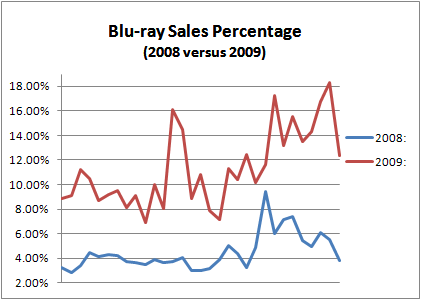
Let’s have a look at the 2008 to 2009 comparison based on the same time period using the same x-axis. Or in other words, May to September November 2008 sales as a comparison to May to September November 2009 sales. Here’s the graph:

Blu-ray Sales Percentage: 2008 versus 2009 Comparison (May to November)

Blu-ray Sales Percentage: 2008 versus 2009 Comparison (May to November)

December 8 Update: Note the dip at the end of both lines is for the Black Friday sales, which traditionally favours DVDs more than Blu-rays, since we’re talking about $2 DVDs compared to $10 Blu-ray titles (for 2009’s Black Friday, these were the discounted prices). I will update again at the end of the year. Every month of 2009 so far has outsold the same month in 2008, that’s to be expected. There were more peaks for 2009 as well, with Blu-ray better able to take advantage of hit titles (and 2009 gaves us more titles that the average home theater enthusiast, movie fans and PS3 gamers – the core Blu-ray demographic – would arguably enjoy more). The average growth for each week’s dataset is 158.64%, in other words, on average, a week in 2009 meant a near 159% increase compared to the same week in 2008 (this is using 2008 data that’s been updated for the post April 2009 model). But “percentage increases” are not that indicative of real growth, because if only one Blu-ray movie was sold last week, and two was sold this week, then that’s a 100% increase in a week, which sounds like a lot, but is really isn’t. The actual increase in market share for Blu-ray is about 6.59% on average for the above time period, meaning that on average, Blu-ray market share for a week in 2009 is likely to be around 6.6% higher than the same week in 2008 (so if Blu-ray had 5% market share in week 30 of 2008, then week 30 of 2009 should have roughly 11.6% market share). This is not an insignificant increase, and as I will mention again, due to the drop in revenue per title that should be greater on Blu-ray than on DVD, this increase may actually be larger.

For the above period (May to November), the 2008’s average was 4.48%, while the 2009 average was 11.07%.

From observation, Blu-ray growth seems to be driven by individual titles. For example, the release of The Dark Knight might have helped to sell more Blu-ray players, or to make more people aware of Blu-ray, and as such, this lifts the sale of all other titles. With many “Blu-ray friendly” hits coming this holiday season (Star Trek, Terminator Salvation, Transformers 2, Harry Potter), the overall Blu-ray sales percentage should increase beyond the temporary rise offered by these titles. How much remains to be seen, and I’ll update this feature when it becomes clearer. Now that two of the four hits I mentioned just above have been released, the picture is clearer and Blu-ray’s market share is on a very healthy trajectory, especially from May 2009 onwards, and there are still two more big hits from the list to go.