Archive for the ‘High Definition (Blu-ray/HD DVD/4K)’ Category

Weekly News Roundup (18 March 2012)

Sunday, March 18th, 2012

Welcome to another issue of the WNR. As promised, I put up the February US video game sales analysis earlier in the week. Nothing too surprising, just your usual “everything is doomed” set of stats. Is this a case of having a new normal, with the previous normal having been exaggerated by the success of the Wii, or something more sinister? With Microsoft saying this week they won’t be showing a new Xbox at E3 this year, and Sony in a similar state of mind, it will be up to the Wii U to save the coming holiday season it seems.

Work meant that my Skyrim adventures had to take a back seat this week, although I still had time to kill a vampire or two, a couple of giants (now much more easily dispatched via my legendary enchanted Daedric weapons), and the odd chicken via collateral damage.

Oh, it was also my birthday last week. I wonder at what age do you stop looking forward to your birthdays, and start dreading them because you’re getting older? For me, this happened on my 7th birthday.

Let’s get started with this WNR.

Copyright

Big news for US web users this week, as from July onwards, your ISP will officially start spying on your net activities for big content (ie. the RIAA and MPAA).

With very little evidence showing “graduated response” actually works to increase revenue, remembering that this, and not reducing piracy, is the ultimate goal, it will be interesting to see what the American version can amount to. It will be different to the French version though, in that each ISPs can decide to take whatever action it deems necessary, including no specific action and just a continuing series of warnings – with permanent account suspension not being considered so far.

It marks an important milestone in the war against piracy, and along with the RIAA’s victory over LimeWire a couple of years ago, the closing of Megaupload (and others) this year, you’d expect that piracy rates would start dropping, if it hasn’t already. Yet, all you continue to hear is how the industry is still losing billions of dollars every year, and how the problem is getting worse. With the RIAA and MPAA getting what they wanted this time, yet again, would it then be safe to conclude that, if a year from now and with revenue still not up significantly, that enforcing copyright may not actually lead to increased revenue? I’ve always found the idea of people hoarding tons of money saved from piracy, instead of simply spending the money on something else, quite funny. As is the idea of people spending more money than they actually have, when their supply of pirated content is cut off (which is an impossibility in itself).

But according to the likes of the RIAA and MPAA, piracy is a $58 billion dollar a year problem, and that if the piracy problem is magically solved somehow, creative industries would suddenly gain most of that back in revenue. But with the RIAA and MPAA already equating every single instance of copyright infringement to be worth at least $150,000,  via their much publicized lawsuits against students and single mothers, $58 billion may even seem a conservative figure. This “Copyright Maths” is the topic of a new TED speech by Rhapsody founder Rob Reid, a short must-watch video that shows how crazy the figures being thrown around really are. That an iPod classic can hold $8 billion worth of pirated songs based on the $150,000 calculation show how ridiculous it all it (a figure almost as ridiculous as the $40,000+ people are required to pay to fill up the same iPod with legal purchase).

And after the speech, Reid was asked what would be the best way to combat piracy. The answer was basically “give the people what they want”, by building legal services that people wanted to use, that makes piracy seem not worth the trouble. Do that, and the piracy problem will solve it self. Why go to the trouble of finding and downloading each song, when you have Spotify and millions of songs for instant gratification, for example. The same is probably even more true for movies, which are harder to download due to their larger file size (which also limits the amount of archived content that’s made available).

Kaleidescape

A full Kaleidescape set-up is for serious movie lovers, people unlikely to pirate movies (and more likely to overpay for them)

The problem is though that instead of giving people what they want, the movie and music industries are actually pursuing the opposite agenda. It cannot be better demonstrated than by the legal decision this week which banned Kaleidescape from selling its DVD and Blu-ray media servers. Piracy was just a convenient excuse for the body responsible for DVD copy protection, the DVD CCA, to legally pursue Kaleidescape, despite the core audience of Kaleidescape’s servers not being pirates at all. In fact, Kaleidescape demonstrated the amazing fact that, on average, each of their customers had a legal movie library of 500 titles or more. Considering the cost of these server set ups, it’s not hard to understand why this is the case, because their product is one for serious movie lovers with the required expendable income – and these people are not movie pirates. In fact, they’re probably the movie industry’s most hard-core customers.

So what does the industry have to gain by denying their biggest fans what they want?  The answer is of course “control”. They’re perfectly happy to let you “convert” your DVDs to a purely digital format, with Wal-Mart this week offering a “DVD to Ultraviolet” service for $2 (or $4 to “upconvert” your DVDs to a HD digital version). But as always, it comes with a catch. You’ll have to use the movie studio’s preferred platform, live with their DRM system, which then controls how you’ll be able to use your digital copy (which may even expire in time). It will invariably mean a worse user experience than something for enthusiasts like Kaleidescape, but a better experience may mean a loss of control, and that’s just not acceptable. And if all of this means they can charge you again and again for the same thing, then that’s just a sweet, sweet bonus.

High Definition

With the new iPad still making headlines, I thought I would jump on the bandwagon and write something about what could be considered Apple’s first HD tablet (1024×768 is not HD, as if it was, then it meant that I had HD on my first 486 computer).

With the new iPad resolution coming in at 2K, or 2048×1536, that’s a resolution higher than your average HDTV. Of course, a true enthusiasts won’t just see the fact that the screen would perfectly render a 1920×1080 resolution video with a couple of pixels to spare, they will of course wonder if you could expand the resolution of the video from 1920 to 2048 and use up all of the available pixels for a 2048×1152 video.

iTunes vs Blu-ray @ 1080p

iTunes 1080p compares well to Blu-ray, according to tests done by Ars Technica

But what may be more interesting is how Apple plans to distribute 1080p movies to the new iPad, as streaming of 25GB+ movies is not ideal, even with 4G. Ars Technica took the time to test several of iTunes’ new 1080p encodes, and compared it to the Blu-ray equivalent, and what they found was rather surprising – that somehow, a 5GB iTunes file isn’t 5 times worse in quality than a 25GB Blu-ray. By supporting the “High” H.264 profile, as well as increasing the “Level” support to 4.1, all now possible on the faster hardware of the new iPad (and iPhone 4S, as well as the updated Apple TV), the decoder can now be made to do more work, and the result is a more efficient encode. VUDU’s HDX does something similar to allow 1080p streaming on your average 10Mbps connection (Blu-ray, on the other hand, may require 30Mbps just for the video). Sure, you’ll lose a lot of fine detail, there will be banding and other aberrations, but that’s all moot on a 9.7″ screen. On a large screen TV connected via Apple TV, this may be an issue, but only for those serious about their movie watching, in which case, they would probably never consider Apple TV or iTunes 1080p anyway. For the rest, it’s “good enough”, and the convenience of it all makes up for everything else.

Mac Observer did similar tests but found wildly different results, so either Ars Technica did their test wrong, or Mac Observer did (or maybe video quality varies too much from movie to movie).

And with that, we come to the end of another WNR. See you next week.

Weekly News Roundup (19 February 2012)

Sunday, February 19th, 2012

Welcome to the latest edition of the WNR. It’s a shame that the leap day doesn’t fall on a Sunday this year, as it would make an awesome collector’s edition of the WNR – as such, it’s on possibly the most boring day of the week:  Wednesday.

I know I promised the NPD analysis last week, but it turns out there just wasn’t enough data to compile one, thanks to both Nintendo and Sony keeping mum on hardware figures (no doubt because they have crap numbers). Only Microsoft released figures for its Xbox 360 console (the least worst of the bunch). So it seems January 2012’s NPD analysis will have to be replaced with a much shortened version, which you’ll find in the “Gaming” section below.

In terms of news, there were only a couple of interesting ones, and a few late breaking ones that I will cover briefly in this edition, but in more detail in the next. So don’t be surprised at the brevity of this WNR (and it totally didn’t have anything to do with the fact that I’ve now put in 50+ hours in Skyrim).

Copyright

The likes of the MPAA and RIAA have compared web piracy to a lot of things, but I’ve always wondered why they haven’t compared it to some kind of infectious disease, as I think The Piracy Pandemic® has a certain ring to it.

It’s a great comparison not just because the content holder set their hyperbole engine into overdrive by comparing web piracy to something deadly and scary, but also on two other major points. One, just like an infectious disease, piracy spreads quickly, and it does so in poorer countries with greater virulence. And also just like viruses, piracy adapts to any measures you employ to try and stop it, whether it’s a technical measure, or a legal one. The more you try to fight it, the more likely it will mutate into something that’s more resistant.

The latter of these two points was demonstrated, twice, this week. Decentralisation has been a continuing trend in piracy (Megaupload and sites of similar ilk are actually quite a throwback to the early days of piracy, where everything was hosted on centralised HTTP websites), but despite decentralisation being the major driving force behind the creation of BitTorrent, two major centralised components still hold it back from truly being decentralised. The inherent weakness in BitTorrent file sharing is the existence, and the necessity, for centralised trackers and a centralised “indexer” website that catalogues the available downloads, like The Pirate Bay. This website would also host .torrent files, and while these files are small by any standard, the sheer number of them ensures that the total size of the website and database can be quite large. Taking down a tracker can cause downloads to cease to work, as peers would not be able to find each other, and taking down websites like The Pirate Bay would mean that you won’t even able able to find the torrents to get you started. These two weaknesses have often been exploited by content holders, with past lawsuits able to bring down popular trackers, and BitTorrent indexers such as Mininova.

The Pirate Bay Magnet Links

The Pirate Bay will remove .torrent files by the end of this month, encouraging users to use Magnet Links (show above with the little magnet icon) instead

This week, The Pirate Bay announced steps which will mitigate these two risks, although the actual technical measures used to solve these two problems have existed for some time already. The Pirate Bay, at the end of this month, will remove .torrent files for any torrents that has over 10 peers and will use Magnet Links instead. A Magnet Link is simply a web URL, a string of text that once loaded into your BitTorrent Client of choice, will give the client just enough information to be able to download the actual .torrent file from users that are already sharing the torrent. And using the DHT (Distributed Hash Table) technique, Magnet Links don’t need trackers in order to download the .torrent files (and the actual download most likely won’t need trackers as well, thanks also to DHT). But for The Pirate Bay, the best thing about switching to a Magnet Link based website is the fact that they no longer need to host .torrent files (well, not as many as before, anyway), and this allows the hosting, and bandwidth, requirements of The Pirate Bay to be reduced to the point where the entire website can probably fit onto a small USB thumb drive (removing all .torrent files, a user has already demonstrated the ability to reduce The Pirate Bay’s Magnet Link database to only 90MB). This will help more TPB mirrors to be set up, and to allow the website to be moved from host to host more easily, thus making the website more resilient to take-downs. There’s also something quite perverse about being able to “download” the entire Pirate Bay to your hard-drive.

And even in the event of The Pirate Bay finally being taken down, there’s now a plan B. A new BitTorrent client, Tribler, aims to remove the any need for websites like The Pirate Bay, and remove the one last centralised component of the largely decentralised BitTorrent download process. Tribler does this by moving the torrent indexing component into the BitTorrent swarm itself, and allow you can search for torrents right within the client. Even things like reviews, comments, and the obligatory removal of fake torrents, can all be done within the client. Tribler, developed by researchers at Delft University, is also open source, and that makes it more resilient, as if one variant of the client is taken down by authorities, others will pop up almost instantly (and probably with more features). What this essentially means is that BitTorrent, via Tribler, is now unstoppable. Or to put it even more succinctly, and to quote the head of the Tribler project, “The only way to take it down is to take The Internet down.”

Tribler

Tribler - the new BitTorrent client that claims to be unstoppable

Now, just because BitTorrent downloads cannot be stopped, it does not mean that you can’t be forced to stop using BitTorrent, as the major flaw in Tribler is that it still allows authorities, and those seeking to profit from (anti) piracy, to track your IP address. So the next evolution of BitTorrent, in my mind, will be one that allows peers to communicate anonymously – that is, to allow sharing without making the IP addresses public at any point in the process. The external pressure heaped towards downloaders, from law firms such as US Copyright Group, and also the rights holder’s push for graduated response, will no doubt have already pushed clever developers into tackling this very problem, and I don’t expect we’ll have to wait too long for this next evolution. And once it arrives, BitTorrent will be anonymous, unstoppable, and it will spell “game over” for both technical and legal methods to stop the downloading.

This scenario both scares me, and excites me. It scares me because, with no way to stop downloaders, things could get out of hand very quickly. But it also excites me because, without any technical or legal recourse, content holders might finally have admit to the need to compete with piracy, and we may finally see the entire industry put everything behind innovating their way out of the problem. Consumers will be the main beneficiary, and I look forward to new and brilliant ways to consume content, legally. Of course, this should have been the way forward since the first torrent was uploaded, and it would have been easier to compete back then, compared to a time when BitTorrent may have become truly unstoppable.

Going back to the point I made earlier about Megaupload being an outdated way of hosting pirated downloads, the closure of R&B/hip hop blog RnBXclusive this week shows why centralisation is dangerous. But what’s more dangerous is the pattern that’s emerging with law enforcement actions against websites suspected of copyright infringement – the fact that law enforcement agencies appear to be acting as the private police force for the entertainment industry without questioning the one-sided evidence presented to them – evidence that has often not stacked up in court. Time and time again, websites were taken down with the full force of the law, but still managed to be difficult to prosecute, or in the case of the similarly themed DaJaz1 (taken down by US Homeland Security as part of Operation In Our Sites), the case might not even end up in court. This is why due process exists and why it’s needed, for the evidence to be tested in a court of law before guilt is determined, and action is taken.

And to add insult to injury, visitors to rnbxclusive.com were initially threatened with messages that mentioned “an unlimited fine” and “a maximum penalty of up to 10 years” in prison for anyone who simply downloaded some songs from the website. A Big Brother style warning of the “capability to monitor and investigate you” was given an extra dimension of fear, by displaying the visitor’s IP address on the home page (a simple enough thing to do in php, but still scary enough for the less technical minded). These threats have since been removed from the website, no doubt due to complaints about the potentially misleading statements which could get SOCA (UK’s Serious Organised Crime Agency), the organisation that took charge of seizing the website, into trouble. But it’s the kind of hyperbole we’re used to seeing from the entertainment industry, the most likely ghost writers behind the now removed messages.

One of the entertainment industry’s tactic is to portray everyone who does something against their interest as criminals, even if it’s something as simple as ripping your own legally purchased DVD. I reported a couple of months ago on the efforts by public interest group Public Knowledge to make DVD ripping legal. They argued that due to the increasing number of devices that don’t play DVDs, such as tablets and smartphones, consumers need to be given the right to rip their own legally purchased movie discs. The fact that everyone who wants to do it is already doing it, means that making DVD ripping illegal under the DMCA is pointless at best, and at worse, criminalizes an activity that falls under fair use. With PK having made their submission to the US Copyright Office, which reviews submissions for exemptions to existing copyright laws every three years, the MPAA has just responded with quite an absurd argument *for* keeping DVD ripping illegal: it gives consumer more choice!

RealDVD

If Public Knowledge manages to get a DVD ripping exemption from the US Copyright Office, then it's still too late to save innovative software like RealDVD, which was sued into oblivion by the MPAA

What the MPAA is saying is that since consumers don’t have the legal option to rip their own DVDs, then the legal option to get the movie you already paid for, on other devices, is to simply re-purchase the movie again. And again and again. Consumers can “choose” to pay for the same movie on their iPhone, “choose” to pay for the same movie again on Android, and then “choose” to pay for the same movie once more on their PS3, for example.

Far from being a convincing argument, this is precisely PK’s argument for making DVD ripping legal, that consumers shouldn’t be made to fork out money for the same content over and over again, due to a legal measure designed to do something else. This is a perfect example of piracy laws being misused by content holders, for their own financial benefit, to take away a consumer’s rights. The fact that many movies are not even available on legal platforms further destroys the MPAA’s false arguments about “choice”.

I sincerely hope the US Copyright Office does the right thing and extends the exemption for CD ripping to cover DVDs and Blu-rays too. The reason that The US Copyright Office even asks for submission of exemptions is to prevent exactly this sort of thing – short sighted copyright laws that harm fair use and innovation.

The Megaupload case has also had some new developments in the last few days, although nothing that bodes well for Mr DotCom. More charges have been laid, and $50 million in Mega assets have been seized so far. Without insider knowledge, it’s hard to tell if this is an attempt to shore up the fed’s case before going to court, or if it’s some kind of tactic designed to force a favourable settlement. Copyright cases are not always easy to prove, see Viacom vs YouTube, and given the theatrics that has transpired so far, losing the case is not an option for federal prosecutors.

Meanwhile, the Pirate Bay and RIAA have been engaged in verbal warfare, with The Pirate Bay responding to an article by the RIAA that called it “one of the worst of the worst”. More on both of these late breaking stories next week.

Gaming

As mentioned earlier, due to Sony and Nintendo withholding hardware figures for the PS3 and Wii, I don’t have enough data to write up a full NPD analysis, so you’ll have to put up with a simplified version here.

NPD January Comparison

NPD January 2008 to 2012 Compared - things are bad across the board, it seems (January 2012 figures for PS3/Wii estimate only)

Microsoft was the only one brave enough to release data, with the Xbox 360 selling 270,000 units, down 29% from a year ago. Microsoft also mentioned that it held 49% of the current-gen console market. A little maths then tells us that the PS3 and Wii sold a *combined* 281,000 units. With the PS3 and Wii selling in similar numbers usually, that’s around 140,000 units for each, which is way down compared to the previous January’s 319,000 (Wii) and 267,000 (PS3).

These companies can only hope that January was a fluke, and that sales will pick up again.

Game sales were just as bad, with the number one selling title, Modern Warfare 3, only shipping 386,000 units – at the same stage of sales, Black Ops managed 750,000 (although MW3 sold more copies in the preceding months, it’s now flat in terms of sales to Black Ops), and Modern Warfare 2 managed 658,000 during its January period. And considering MW3 was the top seller, it means the other titles in the top 10 were much worse.

Overall, it’s the worst January since 2004.

The results are so bad that analysts are still debating the whys of it, with Wedbush Securities analyst Michael Pachter even questioning the validity of the data.

Maybe people are playing too much Skyrim to have time to buy any new games, just a thought!

And on that sour note, we come to the end of another WNR. Hope you enjoyed it, and see you next week.

Weekly News Roundup (New Years Day Edition)

Sunday, January 1st, 2012

Happy New Year! Hello from the 2012 side of the world, Australia being one of the first countries to go over to the other side, but you’ll all join me soon enough, whether you like it or not. Having experienced about 18 hours of 2012, I have to say that it has been pretty boring so far. No cataclysmic events yet, but I’ll keep you posted.

I guess it would be customary, at the end of the year, to review the just ended orbit around the sun and summarise the major events. But that would require actually remembering what happened, all year, when I can barely even remember writing last week’s WNR. It should also be a time to look forward to the brand new, still in shrink wraps, year, and make some bold predictions about 2012. But that would require insight and imagination, both of which are in short supply in this 36C (97F) heat.

With the award season upon us soon, I guess I can format this WNR “a look back” in similar fashion, but without spectacular musical numbers, or comedic writing. So basically an award show without any of the interesting bits. Or any actual awards. Sounds like a great idea!

There has been many deserving winners of the prestigious Loser of the Year award, from Sony’s PSN SNAFU, to recent events involving GoDaddy being pwned by Reddit, but there can only be one winner, and of course, it’s Righthaven. The group that helped to redefine the term Copyright Troll has had a horrible year, not only losing court cases, but eventually their shirt (and domain name), as the company is now on the verge of bankruptcy. Will they still be around to compete for next year’s award. Doubtful.

SOPA: winner of our Villain of the Year award

SOPA: winner of our Villain of the Year award

Competition for the always popular Villain of the Year award has been fierce this year, as individuals and companies fight to be total d*cks (hint: not “docks” or “ducks”), in the field of copyright, gaming and beyond. But this year’s award winner is neither an individual, nor a company (and it’s not a duck either). It is, of course, SOPA. The always controversial Stop Online Piracy Act stormed to a clear lead in the voting for the award, at the very last minute I might add. SOPA has managed to unite all against it, be it the conservative Heritage Foundation, Republican as well as Democrats, and even the sworn blood enemies, Reddit and 4chan, and that’s quite an achievement.

The Best Blu-ray of the Year award goes to Harry Potter and the Deathly Hallows, mainly because it was split into two parts and both parts still managed to not only get released in the same year, but both also topped the sales charts. Star Wars just misses out due to a point deduction for George Lucas being a total d*ck (hint: not a duck, named Howard or otherwise).

Skyrim

Skyrim wins our Game of the Year award, for wasting time that could have been used to cure diseases and save the planet

The Best Game of the Year should probably go to the best seller, which would be Modern Warfare 3, but that wouldn’t be fair to the game that everyone is talking about. The amazing world of Skyrim has drawn in thousands of gamers, most of whom have spent hours upon hours arrowing people, and assorted creatures, in the knee, and as a result, the game would have been responsible for breaking up thousands upon thousands of relationships if only gamers actually had real life relationships.

And finally, the Hero of the Year award goes to, in a lame effort to appease my readers, You! For helping to fight SOPA and to punish companies for not agreeing that SOPA is the worst thing to happen to the Internet since Rickrolling, for not buying into the Ultraviolet hype that, I have to admit, I was sucked into when I first heard the phrase “your movie library in the cloud”, for putting up with Sony’s PSN outage and that $600 invoice for adult toys that hackers charged to your credit card account when your details were stolen from PSN, for fighting the likes of Rigthhaven and the US Copyright Group and actually winning, and most courageously of all, for keeping on reading the WNR, rant after rant. You’re a deserving winner!

And as you can probably guess by now, it wasn’t exactly a very newsworthy week. The only real notable piece of news was the GoDaddy anti-SOPA boycott, which Digital Digest was proud to join in, having moved 22 domains out from GoDaddy. It would be easy to feel sorry for GoDaddy right now, as there’s almost nothing they can do or say to repair the damage caused by their ill advised support for SOPA in the first place – even their statement of “we oppose SOPA” was attacked by people claiming the company was opposing SOPA for the wrong reasons (not because SOPA is bad, but because GoDaddy was losing money because of supporting SOPA). Namecheap, hosting the Move Your Domain Day event by offering discounted, below cost domain transfers out of GoDaddy, also managed to raise $64,180 for the Electronic Frontier Foundation, $2 for every domain transfer – not bad work for a day, considering how much of a pain moving a domain (especially an active, website hosting one) is.

And that was it for the week really, so I probably shouldn’t babble on any further, especially on a day most of you will be nursing hangovers of varying degrees. So there’s nothing left to do except wish you a great new year, a prosperous one, a safe one, and one that’s heaps better than the awful, awful, 2011. See you next week.

Weekly News Roundup (11 December 2011)

Sunday, December 11th, 2011

Welcome to, by my calculations, the third last WNR of 2011. “You’ve got to be joking”, was a phrase that went through my mind quite a few times this week, while reading and writing some of the news items you’ll read about below. What they say is true, real news is becoming more and more like Onion News these days, which is both funny and incredibly depressing all at the same time.

Copyright

Let’s not waste more of 2011, and let’s started with this week’s copyright rants. We start with a scary peak into the future, if the likes of SOPA and PIPA are made into law, with the story of website that was seized as part of last year’s “Cyber Monday” seizures by the Department of Homeland Security.

I’ll leave you to read the full story for all the details, but suffice to say, domain was seized on the instance of music industry executives, website owner argues fair use, government, probably knowing that they didn’t have justification to make the seizure in the first place, stalls, and a full year later, domain name is returned to owners. Website ruined, financial costs incurred, and all for nothing.

IPRC Seizure Notice

Seized domains displayed this message, except it now seems some of the seizures were improper

The website in question was DaJaz1.com, who offered leaked music for downloads. The record labels told the government to seize the website, but the owners of DaJaz1.com says that the songs they linked to (not hosted) were often provided to them by employees of the record labels, for promotional purposes. But you have government agents too stupid to realise they’ve become pawns of the record (and movie) industry, too lazy to do any real research on the list of “bad” websites handed to them, and a justice system too biased towards rights holders. The full financial cost to DaJaz1.com is incalculable, and for most websites, being offline for a whole year basically means the end.

I do have my little theory about why the RIAA wanted DaJaz1.com shut down, as they also took down a few similar websites during the same operation. At its heart, the job of the RIAA companies is to help promote artists. But these days, the Internet can be leveraged by artists themselves for promotional purposes, and even music distribution, once relying on manufacturing/distribution/retail chain, can be all done digitally these days. In other words, there’s little justification these days for studios to be taking as much from artists as they are, and for all the talk of web piracy, this is what scares the RIAA companies the most. So any website that helps artists to directly promote their work, generate hype by using leaked music, and thus bypassing the studio system, will be seen as a major threat. Maybe not today, but soon enough. And PIPA/SOPA will then allow the record companies to get their dirty hands around the Internet, close down websites that threatens their outdated business model.

But even if the mistake was just an innocent one, how many websites will have to become collateral damage in this un-winnable war against downloads, before a real innovative website, like the next YouTube, will be the ultimate victim (it if hasn’t already occurred). The rights holders keep on saying that websites like YouTube getting blocked is hyperbole, and they may be right at present, because nobody is going to shut down YouTube without facing a mighty smashing courtesy of Google’s legal hammer, but would YouTube have been so safe in its infancy had SOPA/PIPA existed then? People uploading copyrighted clips was what the early days of YouTube was all about, before people realised they could create their own videos and it would be even more popular than a re-upload of something people can get on BitTorrent anyway. While it is now the bastion of creativity, it once was a haven for pirates (at least according to Viacom, in their lawsuit against YouTube), and it might just fall into the “dedicated to piracy” category of SOPA/PIPA. And if YouTube had been destroyed back then, would the web, and creativity and innovation, and the economy, be better off, or much much worse off? Is this a risk we should be taking?

It seems many are finally realising that, SOPA/PIPA, is very very dangerous. And it was a pleasure to read the quotes attributed to the CEO of the Consumer Electronics Association, Gary Shapiro. Not only does the CEA produce the excellent CES exhibition, and represents all the major electronic manufacturers, it appears they’ve joined the anti-SOPA brigade as well. Shapiro used language that even I might be a bit scared to used in the WNR, for fear of appearing too biased, but he’s absolutely right that SOPA will kill “innovation, wealth and jobs”, and that SOPA is nothing more than “a bunch of Hollywood and music industry lobbyists destroying the Internet”. Couldn’t have put it better myself (really, I couldn’t). I wonder if Sony, the only company to actually both belong to the pro-SOPA RIAA, and anti-SOPA CEA, might reconsider their CEA membership, although Shapiro did mention quite clearly that his views had wide ranging support amongst CEA members.

Other trade groups, some staunch supporters of SOPA, are also now reconsidering their support following the public backlash. The BSA, the anti-piracy lobby group for software makers, has in recent days, softened their support for SOPA, basically calling it overreaching. No doubt after many of their members complained about the group’s position of a bill aimed directly at tech companies, and one which ultimately only benefits the music and movie industries. But if the BSA continues to even partially support SOPA, then other companies could join Kaspersky in withdrawing from the group in protest over SOPA. The threat to Internet security posed by SOPA is well known, but it’s nice seeing a security company take a significant step in their protest of SOPA and the damage it could unleash on the Internet.

The MPAA has launched a stern defence of SOPA, by first attacking an alternate, less controversial bill as being too friendly to dirty old web pirates. As the MPAA was most likely the people who actually came up with SOPA, it’s no surprise they aren’t accommodating to any alternatives.  But the MPAA’s Chairman, Chris Dodd, also added fuel to the fire with a couple of curious comments. First up, he question why Google is not accommodating when it comes to filtering search results, by saying “When the Chinese told Google that they had to block sites or they couldn’t do [business] in their country, they managed to figure out how to block sites.”

That comment is simply too stupid to even come up with a reply, it would just be too easy to point out everything that’s wrong with the statement (and at the same time, it’s hard to resist point out the fact that Google pulled out of China for being forced to censor results, are we really comparing the US to China when it comes to web censorship, of all issues). To be fair to Dodd, he was probably referring to the technical aspects of result filtering, but it’s one thing to filter the BBC or CNN, but it’s another when you have to filter the thousands upon thousands of website the MPAA deems “bad”, as well as pre-emptively blocking “red flag” sites.

GTA IV Bank Heist

In Chris Dodd, the MPAA's chairman's eyes, downloading is the same as bank robbery

But Dodd wasn’t finished, because he had an analogy to share as well. Still referring to Google, he added “A guy that drives the getaway car didn’t rob the bank necessarily, but they got you to the bank and they got you out of it, so they are accessories in my view”. You see, in Dodd’s scenario, Google is the getaway driver, while Internet users are the robbers, and the MPAA studios are the bank. Again, too stupid to pull apart, but … can’t … resist. First of all, downloading a movie is not like a bank robbery, and I’m guessing it would be armed robbery as well. Downloading a copy of a movie, isn’t the same as stealing real money from a bank either. And if Google has some role to play in the analogy, it is not the get-away driver. It’s a stupid analogy to compare to downloading, because none the roles match up to anything related to downloading, but at best, the getaway driver would be the guy that transports or shares the burnt DVD copy of The Rise of the Planet of the Apes (in analogy: the bags of money) to your friends after it has been downloaded (in analogy: stolen at gunpoint), and even then, it doesn’t really make much sense. As for Google’s role in all of this? It’s the phone book company that helped the robbers to find the bank they robbed. The ISP would be the manufacturer of the car or the people responsible for the roads. Are they all “accessories” too, Chris?

The RIAA has been busy too, “helping” copyright troll Righthaven. Or rather, they’re trying to hurt Righthaven’s opponent by making sure Wayne Hoehn and his lawyers do not win the case based on fair use issues, which could hurt the RIAA’s stance (which is that there’s not such thing as fair use). At the same time, the RIAA is also trying to hurt Righthaven’s case by agreeing with the court that Righthaven don’t have standing to sue, and because this automatically throws the case out, there’s no need to consider the fair use issues. So the RIAA is basically out to hurt everyone in order to protect their own self interest, and you know, that’s totally within their M.O, and I guess it is kind of “neutral” if you think about it, even though Hoehn’s lawyers would disagree.

Speaking of fair use, the US Copyright Office entertains new suggestions for exemptions to existing copyright laws every couple of years, in the spirit of not allowing copyright to hamper innovation and consumer rights. A couple of years ago, the issue of smart phone jailbreaking was one of the exemption suggestions, and the US Copyright Office last year approved the exemption, to the disgust of Apple. Now, Public Knowledge and the EFF are submitting briefs that call for the exemption of DVD ripping and game console hacking. PK says that DVD ripping should be legal because so many devices these days don’t have DVD drives any more (eg. the iPad), and so in order for consumers to watch the movies they purchased, they should be allowed to bypass CSS and the DMCA restrictions, and rip for personal use. Makes sense. EFF, following their successful application of the smart phone jailbreaking exemption, say the exemption should be extended to game consoles (probably muttering “take that, Sony” while they were preparing the brief). And it also makes sense, because the same issues exist for smart phones and game consoles, being able to run your own apps (like, oh I don’t know, Linux), and both have issues with piracy if jailbreaking is allowed (but if it’s okay for smart phones, then it should be okay for game consoles).

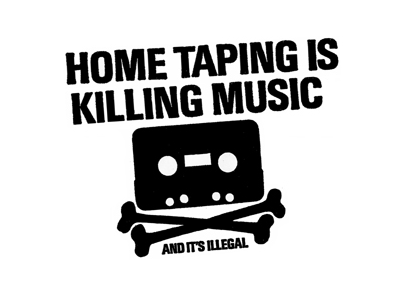
Home Taping is Killing Music

This anti-piracy message was brought to you by the RIAA, and it's not at all an exaggeration or anything

But perhaps the US Copyright Office should take note of the Swiss’s decision to exempt “piracy” for all personal use. The Swiss government found that there was hardly any financial damage from piracy for personal use (as opposed to re-selling the pirated copies for profit), as people’s spending on entertainment products have not been reduced, merely shifted to other things that can’t be pirated, such as concerts or merchandise. And as there’s no financial loss, the Swiss didn’t feel it was right to have laws that hamper innovation, or help protect outdated business models. And they also made note that the industry’s “Chicken Little” response to web piracy is not new, and that these industries should just get over it and find ways to profit from it. Remember when the music industry warned us that hope taping, on cassette tapes, would kill the music industry, and when the MPAA compared VCR taping to leaving a woman alone in a house with the Boston Strangler? Yeah, those industries.

High Definition

I haven’t had a HD/3D section for a while, so I thought I would add one for this issue. I could talk about the Black Friday sales week sales figures, which were somewhat disappointing for Blu-ray (only a 5% gain compared to last year’s Black Friday), but I really wanted to rant about two, slightly disturbing trends, when it comes to Blu-ray.

The trailers you find at the start of discs is beginning to really annoy me, mainly due to the quantity present, and two (not so new) developments. I’m a big fan of movie trailers, evident by Digital Digest’s growing collection of movie trailer downloads, but when you insert a disc to watch a movie, you don’t want to have to skip through half a dozen trailers mostly for movies you’ve already purchased, or have no interest in. Luckily, most can be skipped, but there’s the odd annoying one that can only be fast forwarded.

But the two developments are non movie related advertising, and BD-Live trailer downloads. The first one is particularly annoying, and a trend that has gotten worse in paid for content. I mean, I’ve already paid for the disc, or for the cable TV subscription, why should I still have to sit through ads? They’re not even funny ads, or ads related to movies, or the movie in question, and that to me is unacceptable.

BD-Live trailers is also extremely annoying, as it uses your Internet connection to download an average quality trailer from the Internet to show you. Supposedly, this is to guarantee “fresh” trailers, but in reality, it’s the movie studio’s way to make you pay (via your Internet connection charges) for its own advertising. And the trailers aren’t so fresh anyway, and sometimes you get the odd effect of having the same trailer show up twice. And again, it cannot be skipped, only fast forwarded.

Add these with the anti-piracy trailers, the “Blu-ray is a new format blah blah blah” disclaimer for badly produced, incompatible discs, the other disclaimers for commentaries and stuff, plus studio logos (which gets shown again at the start of the movie anyway), it’s minutes wasted just so I can get to the movie I paid to watch. It’s probably faster to download a pirated copy, than to sit through all of that crap without skipping, and they wonder why people pirate movies.

And on that rant, we come the end of another WNR. See you next week.

Weekly News Roundup (20 November 2011)

Sunday, November 20th, 2011

Not a week with a lot of news, and a lot of important news. Oh, and welcome to another edition of the WNR by the way. Early in the week, I also completed the October 2011 NPD analysis, which showed once more the strength of the Xbox 360 in the US, once again the stop selling console for the month. Battlefield 3 was the best selling game as expected, but it’s looking more like the case that the game was rushed to market to beat Modern Warfare 3, at least on the PC platform. The copy I ordered from the UK finally arrived, and while it’s a bit more stable than the beta, but not by much. For one, I had the sound looping/stuttering problem, which was solved by changing the affinity of the bf3.exe process in Task Manger to a single core – seems to be a common problem but one that remains unfixed by DICE/EA. It’s a shame, because otherwise, this is a game trying to bring in new things to the FPS shooter genre, while Modern Warfare 3 seems all very samey samey. Alright, let’s get started.

Copyright

There is only one issue that dominated this week’s headlines, and it’s SOPA. I bet the politicians that sponsored the Stop Online Piracy Act didn’t expect the kind of public backlash that has happened, but if you try to mess with the Internet, expect a reaction.

I’m going to do this a bit different, so I’ll just briefly go through the news stories covering the week’s events, and then provide a bit more analysis on the whole thing. We start off with the EFF’s warnings against the dangers of SOPA, including ones that others haven’t thought of. Apparently, the bill is so broad that it calls into the legality of a lot of existing Internet tools and standards. Tools and standards like VPN, SSH could all be ruled illegal, as all could be used to bypass SOPA filters (and the legislation makes any tool that does that illegal). But with VPN, SSH, businesses would no longer be able to do anything securely on the Internet, and it could potentially cripple the economy. Of course, I’d doubt the government would have the guts to go after VPNs or SSH, but because the legislation is worded so badly, it gives the government the power to do so, and the copyright industry might just go after VPN and encrypted/anonymous downloading services if people start using these as ways to bypass SOPA.

As the Congressional hearing on SOPA was this week, Internet companies decided to make a stand this week against SOPA. The majors (Google, Facebook, Twitter, Yahoo, eBay, AOL, LinkedIn, Mozilla and Zynga) all signed an open letter to Congress urging them to reconsider SOPA, with many others also urging Congress not to pass SOPA. And they need to stand up because their own interests may be hurt by SOPA, and they will be made the targets of copyright infringement as SOPA tries undo the DMCA’s ‘safe harbor’ provision. Plus, a lot of these firms have been fighting the good fight trying to support free speech in countries that want to curtail it, and if the US passes such a “draconian” (terms used by Google’s Eric Schmidt to describe SOPA) legislation, then the US loses its moral high ground on the matter, making global Internet censorship a step closer to reality.

American Censorship Infographic

This long infograph shows the full result of American Censorship Day, a day in which the Internet decided to fight back against pro-copyright interests

And finally, we have the hearing. A show trial if there ever was one, with one token voice against SOPA compared to the 5 that supported it. The US Chamber of Commerce was involved, as were drug company Pfizer (perhaps to try and highlight the counterfeiting aspect of the bill, but we all know it’s about movie and music downloads). As a rule of thumb, you should be against pretty much everything the US Chamber of Commerce supports, as the official sounding group is nothing more than a big business lobby group. Google was the only anti-SOPA voice as part of the very very small witness pool for such an important legislation, and even it was supportive of the “financial blockade” part of SOPA. No consumer, rights, public interest  groups were called up to testify. But while these groups, and other tech companies, were not heard at the hearing, they made their voices heard in other ways, as the day of the hearing was officially declared as the American Censhorship Day. The event, in which Digital Digest was proud to take part in, was supported by more than 6,000 other websites, including Mozilla (where I first heard about this event), in which websites blacked out their logos and linked to americancensorship.org or offered a splash page where site visitors could contact Congress to tell them to stop supporting SOPA. Tumblr did the best work by making it easy for people to make phone calls to Congress. But it was you and people like you in the end that made the most difference, with over 1,000,000 emails sent to Congress, 3,000 hand-written letters via sendwrite.com, and more than 87,000 phone calls to Congress, with some 1,293 hours spent talking with actual representatives (that’s 161 representatives talking non-stop for 8 hours!). Amazing effort by everyone!

Whether it will make a difference, I don’t know. But we already have Nancy Pelosi on the Democractic side and Darrell Issa on the Republican side tweeting their opposition, or at least reservations of SOPA, so that’s some progress I suppose. Also, the petition put up on the White House’s own petition website has now officially gone over the 25,000 signatures required for an official response from the White House, and the number of signatures is still climbing – 41,463 at last count. While I’m sure the response will emphasize the importance of stopping piracy and protecting jobs, basically a MPAA/RIAA press release, but at the very least, it tells those in the position of power that we are watching them, judging them, and if they choose to side with corporations against the interest of the people, we will make them accountable for their actions.

So the battle-lines have been drawn. Congress and the White House now needs to decide whether to act in the interest of the people that actually elected them, or in the interest of one industry (at the expense of another). The truth is that the Internet and Internet related industries account for more of the economy than the movie and music industries combined, and these industries are just as creative, if not more so, than Hollywood and the four major music labels, which create nothing, but merely profit from the work of real artists. They’re the middlemen in an era where their usefulness is diminishing by the day, and they know it too, and desperate enough to do anything to keep their dying business model alive, even if it means having to curtail the growth of the Internet. The US Chamber of Commerce is involved because they’re for anything that takes away the rights of consumer and give it to big business, like tort reform (watch HBO’s Hot Coffee documentary to find out why you should care). This is so much more than just about piracy.

LimeWire Logo

Does CNET deserve to be sued for allowing people to download LimeWire?

I’m still not quite sure if FilmOn’s Alki David is serious about suing CNET for copyright infringement, or whether he’s trying to make a point after CNET’s parent company, CBS, sued his FilmOn for copyright infringement. Probably a bit of both perhaps, as David re-files his copyright infringement lawsuit against CBS/CNET for their distribution of the, now illegal, LimeWire software. Doing as he promised back in July when the lawsuit was withdraw, the lawsuit has been re-filed with more plaintiffs added, and it alleges that CNET profited from distributing LimeWire, and even promoted the use of it by providing tips and instructions on how to use it for site visitors. If David is trying to make a point, then I do agree with him that big media often acts hypocritically when it comes to copyright infringement, often stealing ideas, entire works from others, while blaming all their woes on college kids and other downloaders. But looking at this case in isolation, and as an operator of a download website, I can’t really see any merit in the case. LimeWire the network may be illegal, but the software that connects to it is just a tool, and should be no more illegal than say a browser that can also be used to download pirated content. And it’s yet another situation where apportion of blame seems to be far too wide ranging, because if individuals who shared songs on LimeWire is guilty of copyright infringement, and that extends to the operators of the network due to the court decision, then extending it further to third party websites that distributed the software means you might as well also sue the ISP that allowed the download to happen, and so on. The blame has to stop somewhere.

High Definition

In HD/3D news, the fallout from WB’s botched launch of UltraViolet continues, with reports that Flixster, the app used to delivery WB’s UltraViolet movies, is giving away iTunes vouchers for those that complain about not being able to get the digital download/streaming working.

The idea behind UltraViolet seemed sound. One central system employed by all the movie studios (except Disney) that enables buyers of DVD/Blu-ray versions of movies to get a digital copy/stream version of the movie instantly, available to view on a variety of devices.

The actual implementation leaves a lot to be desired. As far as I know, it seems while UltraViolet is indeed one central system, and that all your “owned” movies are listed under one UltraViolet account regardless of which studios (other than Disney) you purchased disc was from, the actual delivery mechanism is left up to each studio. WB has chosen their own Flixster app to do the delivery, but a lot of people are having trouble with it.

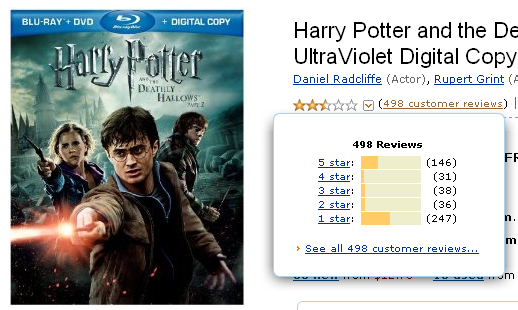
Harry Potter and the Deathly Hallows Part 2 Blu-ray UltraViolet edition Amazon Ratings

200+ "one star" ratings for the UltraViolet Blu-ray edition of the latest Harry Potter movie, as people protest WB's poorly thought out implementation of the new cloud based digital copy service

The way it should work is that UltraViolet should act like the new iTunes, where it not only tracks your movie collection, but also delivers the movies via a single app, or better, just downloads that are compatible with multiple devices. There should only be one signup needed, and that’s when you use UltraViolet for the very first time. After that, it’s all about adding movies to your UltraViolet collection, and that should be done through the simplest method possible (barcode/QR code scanning from a tablet/phone, for example).

Otherwise, you’ll end up like the current WB rollout, where people are so angry they’re posting one-star reviews on Amazon to protest against UltraViolet, and where you have to give out iTunes vouchers, when Apple is actually one of the main competitors to UltraViolet. Hollywood really does get in its own way sometimes, especially when it comes to the whole Internet thing (remember when they thought that nobody wanted a Blu-ray player with an Internet connection and made the feature optional?)

Stop fighting the Internet, and embrace it, you stupid fools. Advice for all, I think.

And that’s probably a good note to end this edition of the WNR on. See you next week.

P.S: Black Friday sales on next week. It looks like the sale has already started with Star Trek: Original Motion Picture Collection [Blu-ray] already on sale for about $24 cheaper, with The Lord of the Rings: The Motion Picture Trilogy Extended Edition [Blu-ray] also going on sale at $27 cheaper (might be even cheaper tomorrow, when the sale officially starts for this item).